

Approaches in
Teaching
Mathematics
Basal Textbook Approach
Direct Instruction
Osana, Angeline Marie G.
Direct Instruction
 Direct Instruction is a very
structured teaching strategy
suited to many subject areas,
but often used in mathematics
or literacy teaching.
Active Teaching
Model
Active Teaching Model
 earliest Direct Instruction
methods, developed for the
Missouri Mathematics
Effectiveness Project (Primary
Schools)
Active Teaching Model
 it could be adapted to any
academic age or level, and to
teach literacy, foreign
languages, science --- indeed
any structured skill-based
subject.
Content
1. Daily Review
2. Development
3. Seatwork
4. Homework
5. Special Reviews
Daily Review
(about 8 minutes, except on Mondays):
–Review of concepts and skills
associated with yesterday’s
homework.
–Collect and deal with homework
assignment.
–Ask several mental computation
exercises.
Development
(about 20 minutes) (introducing new
concepts, developing understanding):
– Briefly focus on prerequisite skills and
concepts.
– Focus on meaning and promoting student
understanding by lively explanations,
demonstrations, etc.
– Assess student competence:
• using process and product questions (active interaction).
• Using controlled practice
– Repeat and elaborate on the meaning portion as necessary.
Seatwork
(about 15 minutes) (Students working alone on
exercises)
– Provide uninterrupted successful practice.
– Momentum – keep the ball rolling – get
everyone involved, then sustain
involvement.
– Alerting – let students know their work will
be checked at the end of each period.
– Accountability – check the student’s work
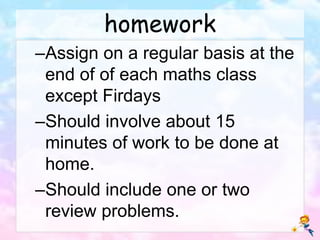
homework
–Assign on a regular basis at the
end of of each maths class
except Firdays
–Should involve about 15
minutes of work to be done at
home.
–Should include one or two
review problems.
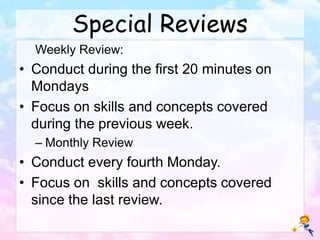
Special Reviews
Weekly Review:
• Conduct during the first 20 minutes on
Mondays
• Focus on skills and concepts covered
during the previous week.
– Monthly Review
• Conduct every fourth Monday.
• Focus on skills and concepts covered
since the last review.

Direct instruction in math

  • 1.
    Approaches in Teaching Mathematics Basal TextbookApproach Direct Instruction Osana, Angeline Marie G.
  • 2.
    Direct Instruction  DirectInstruction is a very structured teaching strategy suited to many subject areas, but often used in mathematics or literacy teaching.
  • 3.
  • 4.
    Active Teaching Model earliest Direct Instruction methods, developed for the Missouri Mathematics Effectiveness Project (Primary Schools)
  • 5.
    Active Teaching Model it could be adapted to any academic age or level, and to teach literacy, foreign languages, science --- indeed any structured skill-based subject.
  • 6.
    Content 1. Daily Review 2.Development 3. Seatwork 4. Homework 5. Special Reviews
  • 7.
    Daily Review (about 8minutes, except on Mondays): –Review of concepts and skills associated with yesterday’s homework. –Collect and deal with homework assignment. –Ask several mental computation exercises.
  • 8.
    Development (about 20 minutes)(introducing new concepts, developing understanding): – Briefly focus on prerequisite skills and concepts. – Focus on meaning and promoting student understanding by lively explanations, demonstrations, etc. – Assess student competence: • using process and product questions (active interaction). • Using controlled practice – Repeat and elaborate on the meaning portion as necessary.
  • 9.
    Seatwork (about 15 minutes)(Students working alone on exercises) – Provide uninterrupted successful practice. – Momentum – keep the ball rolling – get everyone involved, then sustain involvement. – Alerting – let students know their work will be checked at the end of each period. – Accountability – check the student’s work
  • 10.
    homework –Assign on aregular basis at the end of of each maths class except Firdays –Should involve about 15 minutes of work to be done at home. –Should include one or two review problems.
  • 11.
    Special Reviews Weekly Review: •Conduct during the first 20 minutes on Mondays • Focus on skills and concepts covered during the previous week. – Monthly Review • Conduct every fourth Monday. • Focus on skills and concepts covered since the last review.