Direct and Indirect Objects
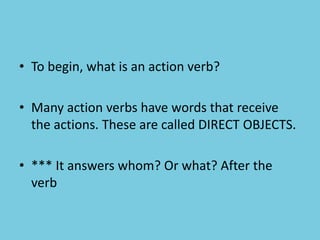
• To begin, what is an action verb?
• Many action verbs have words that receive
the actions. These are called DIRECT OBJECTS.
• *** It answers whom? Or what? After the
verb
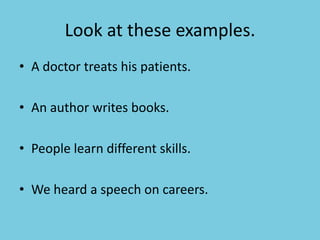
Look at these examples.
• A doctor treats his patients.
• An author writes books.
• People learn different skills.
• We heard a speech on careers.
• Work page 123 #21- 25 together
• Homework: page 31 in workbook
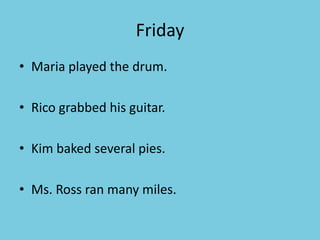
Friday
• Maria played the drum.
• Rico grabbed his guitar.
• Kim baked several pies.
• Ms. Ross ran many miles.
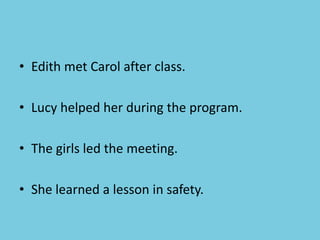
• Edith met Carol after class.
• Lucy helped her during the program.
• The girls led the meeting.
• She learned a lesson in safety.
Indirect Objects
• Helen threw Jane slow curve balls for the first
time.
• The business sent her the necessary
information.
• History has given us an idea of Roman history.
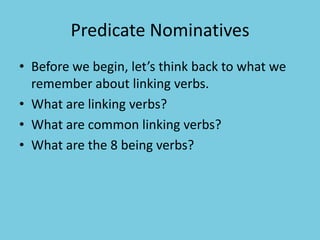
Predicate Nominatives
• Before we begin, let’s think back to what we
remember about linking verbs.
• What are linking verbs?
• What are common linking verbs?
• What are the 8 being verbs?
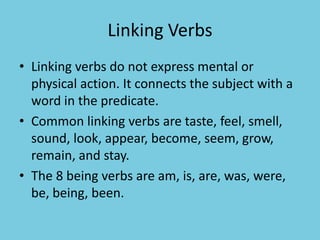
Linking Verbs
• Linking verbs do not express mental or
physical action. It connects the subject with a
word in the predicate.
• Common linking verbs are taste, feel, smell,
sound, look, appear, become, seem, grow,
remain, and stay.
• The 8 being verbs are am, is, are, was, were,
be, being, been.
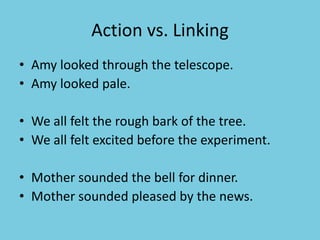
Action vs. Linking
• Amy looked through the telescope.
• Amy looked pale.
• We all felt the rough bark of the tree.
• We all felt excited before the experiment.
• Mother sounded the bell for dinner.
• Mother sounded pleased by the news.

Direct and indirect objects

  • 1.
  • 2.
    • To begin,what is an action verb? • Many action verbs have words that receive the actions. These are called DIRECT OBJECTS. • *** It answers whom? Or what? After the verb
  • 3.
    Look at theseexamples. • A doctor treats his patients. • An author writes books. • People learn different skills. • We heard a speech on careers.
  • 4.
    • Work page123 #21- 25 together • Homework: page 31 in workbook
  • 5.
    Friday • Maria playedthe drum. • Rico grabbed his guitar. • Kim baked several pies. • Ms. Ross ran many miles.
  • 6.
    • Edith metCarol after class. • Lucy helped her during the program. • The girls led the meeting. • She learned a lesson in safety.
  • 7.
    Indirect Objects • Helenthrew Jane slow curve balls for the first time. • The business sent her the necessary information. • History has given us an idea of Roman history.
  • 8.
    Predicate Nominatives • Beforewe begin, let’s think back to what we remember about linking verbs. • What are linking verbs? • What are common linking verbs? • What are the 8 being verbs?
  • 9.
    Linking Verbs • Linkingverbs do not express mental or physical action. It connects the subject with a word in the predicate. • Common linking verbs are taste, feel, smell, sound, look, appear, become, seem, grow, remain, and stay. • The 8 being verbs are am, is, are, was, were, be, being, been.
  • 10.
    Action vs. Linking •Amy looked through the telescope. • Amy looked pale. • We all felt the rough bark of the tree. • We all felt excited before the experiment. • Mother sounded the bell for dinner. • Mother sounded pleased by the news.