INTERVIEW
PRESENTER
DIVYA THAKUR
M.Sc.Nursing 1ST YR
METHODS OF DATA COLLECTION
 The various steps or strategies used to
gathering and analyzing data in a research
investigation are known as methods of data
collection.
 The strategy or system used to gather
information from participants and other
elements of evaluations.
INTERVIEW
 The word interview comes from Latin and middle
French words meaning to “see between” or “see
each other”. Generally an interview means a
meeting between people when questions are asked
and answered.
 It is a two way communication process
(interviewer& interviewee) or interaction in which
the subject or interviewee gives the needs
information. It provide the information about
persons feeling, perception and attitude toward
something.eg Job Interview
DEFINTION
 “An interview is any
planed conversation
with a specific purpose
involving two or more
people”.
Thill and Bovee
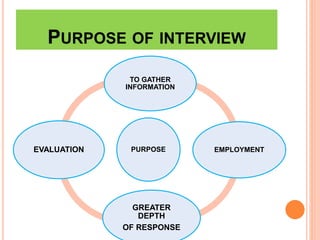
PURPOSE OF INTERVIEW
PURPOSE
TO GATHER
INFORMATION
EMPLOYMENT
GREATER
DEPTH
OF RESPONSE
EVALUATION
TYPES OF INTERVIEW
1)Structured Interview/Directive
interview
2)Unstructured Interview/non directive
interview
3)Semi-Structured Interviews
4)Focused Group Interview
5)Telephonic Interview
1)STRUCTURED INTERVIEW/DIRECTIVE
INTERVIEW
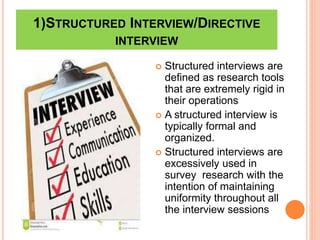
 Structured interviews are
defined as research tools
that are extremely rigid in
their operations
 A structured interview is
typically formal and
organized.
 Structured interviews are
excessively used in
survey research with the
intention of maintaining
uniformity throughout all
the interview sessions
MERITS OF STRUCTURED INTERVIEW
 Since the structure of the interview is fixed it
often generates reliable results and is quick
to execute.
 They can be used to get in touch with a
large sample of the target population.
 It increase the reliability of research data
 As preplanned questions so it will save time.
DEMERITS OF STRUCTURED INTERVIEW
 It tends to lose the spontaneity of natural setting.
 The scope of exploration of information of data is
limited
 Respondents are forced to select from the provided
answer options.
 A significant amount of time is required for a
structured interview.
 The researcher is expected to always adhere to the
list of decided questions irrespective of how
interesting the conversation is turning out to be with
the participants.
2)UNSTRUCTURED INTERVIEW/NON DIRECTIVE
INTERVIEW
 The unstructured interview is what the name
implies. The only structure to the interview is the
one that you provide. Basically, the interviewer is
interested in hearing from you, so you may be
asked a variety of different open ended questions.
 The main objective of most researchers using
unstructured interviews is to build a bond with the
respondents due to which there are high chances
that the respondents will be 100% truthful with their
answers.
MERITS AND DEMERITS
Merits
 It becomes extremely easy for researchers to try and
develop a friendly rapport with the participants
 this usually increases the flexibility of the entire research
process.
Demerits
 Time consuming in unnecessary data conversation
 There is no order of sequence
 This require more skills in the part of researcher
 The absence of a standardized set of questions and
guidelines
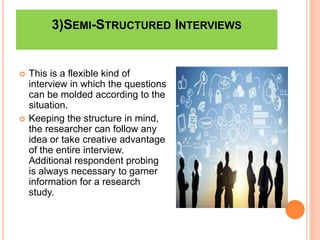
3)SEMI-STRUCTURED INTERVIEWS
 This is a flexible kind of
interview in which the questions
can be molded according to the
situation.
 Keeping the structure in mind,
the researcher can follow any
idea or take creative advantage
of the entire interview.
Additional respondent probing
is always necessary to garner
information for a research
study.
MERITS & DEMERITS
Merits
 It is flexible to an extent while maintaining the
research guidelines.
 Reliable qualitative data can be collected via these
interviews.
 Researchers can express the interview questions in
the format they prefer, unlike the structured
interview
Demerits
 Comparing two different answers becomes difficult
as the guideline for conducting interviews is not
entirely followed
4)FOCUSED GROUP INTERVIEW
 It is a unstructured group interview technique
where 6-10 members are brought together
 having same demographic and socioeconomic
characteristics under the guidance of trained
interviewers to focus on a specific phenomenon.
 The interview analyze the subjective experience
of the respondents.
 The duration is 1-2 hrs.
5)TELEPHONIC INTERVIEW
Telephonic interviews are widely used and easy to combine
with online surveys to carry out research effectively.
Merits
 It is more flexible and quick way of obtaining information.
 No field staff is required.
 Cost is less
Demerits
 Survey is limited to the respondent having telephonic
facilities
 Respondent’s facial expression, characteristics are not
clearly observed
 Possibility of bias of interview is more.
INTERVIEWING PROCESS
Rapport Building
Introduction
Probing
Recording
Closing
ADVANTAGES AND DISADVANTAGES OF
INTERVIEW
Advantages
 Opportunity for Feedback
 Probing Complex Answers
 Length of Interview
 High Participation
 High response rate
Disadvantages
 Cost & time
 Lack of Anonymity
 Personal Style
 Global Considerations
SUMMARIZATION OF TOPIC
 Introduction of methods of data collection.
 Introduction and definition of interview
 Purposes of interview.
 Types of interview.
 Process of interview.
 Advantages and disadvantages of interview
method.
REFERENCES
 Sharma, Suresh K. Nursing Research and
Statistics. Second edition. Page no. 303
 Sharma Kumar Dinesh, Communication and
Educational Technology 2nd Edition, Lotus
publishers, page no.115-116
 Polit Beck, text book of Nursing Research 7th
edition published by Wolters Kluwer pvt. Limited,
page no,319
 Bharat Pareek,Shivani Sharma text book of
Introduction to research ,Pee Vee publishers, page
no 138-140
THANK YOU

D.interview

  • 2.
  • 3.
    METHODS OF DATACOLLECTION  The various steps or strategies used to gathering and analyzing data in a research investigation are known as methods of data collection.  The strategy or system used to gather information from participants and other elements of evaluations.
  • 5.
    INTERVIEW  The wordinterview comes from Latin and middle French words meaning to “see between” or “see each other”. Generally an interview means a meeting between people when questions are asked and answered.  It is a two way communication process (interviewer& interviewee) or interaction in which the subject or interviewee gives the needs information. It provide the information about persons feeling, perception and attitude toward something.eg Job Interview
  • 6.
    DEFINTION  “An interviewis any planed conversation with a specific purpose involving two or more people”. Thill and Bovee
  • 7.
    PURPOSE OF INTERVIEW PURPOSE TOGATHER INFORMATION EMPLOYMENT GREATER DEPTH OF RESPONSE EVALUATION
  • 8.
    TYPES OF INTERVIEW 1)StructuredInterview/Directive interview 2)Unstructured Interview/non directive interview 3)Semi-Structured Interviews 4)Focused Group Interview 5)Telephonic Interview
  • 9.
    1)STRUCTURED INTERVIEW/DIRECTIVE INTERVIEW  Structuredinterviews are defined as research tools that are extremely rigid in their operations  A structured interview is typically formal and organized.  Structured interviews are excessively used in survey research with the intention of maintaining uniformity throughout all the interview sessions
  • 10.
    MERITS OF STRUCTUREDINTERVIEW  Since the structure of the interview is fixed it often generates reliable results and is quick to execute.  They can be used to get in touch with a large sample of the target population.  It increase the reliability of research data  As preplanned questions so it will save time.
  • 11.
    DEMERITS OF STRUCTUREDINTERVIEW  It tends to lose the spontaneity of natural setting.  The scope of exploration of information of data is limited  Respondents are forced to select from the provided answer options.  A significant amount of time is required for a structured interview.  The researcher is expected to always adhere to the list of decided questions irrespective of how interesting the conversation is turning out to be with the participants.
  • 12.
    2)UNSTRUCTURED INTERVIEW/NON DIRECTIVE INTERVIEW The unstructured interview is what the name implies. The only structure to the interview is the one that you provide. Basically, the interviewer is interested in hearing from you, so you may be asked a variety of different open ended questions.  The main objective of most researchers using unstructured interviews is to build a bond with the respondents due to which there are high chances that the respondents will be 100% truthful with their answers.
  • 13.
    MERITS AND DEMERITS Merits It becomes extremely easy for researchers to try and develop a friendly rapport with the participants  this usually increases the flexibility of the entire research process. Demerits  Time consuming in unnecessary data conversation  There is no order of sequence  This require more skills in the part of researcher  The absence of a standardized set of questions and guidelines
  • 14.
    3)SEMI-STRUCTURED INTERVIEWS  Thisis a flexible kind of interview in which the questions can be molded according to the situation.  Keeping the structure in mind, the researcher can follow any idea or take creative advantage of the entire interview. Additional respondent probing is always necessary to garner information for a research study.
  • 15.
    MERITS & DEMERITS Merits It is flexible to an extent while maintaining the research guidelines.  Reliable qualitative data can be collected via these interviews.  Researchers can express the interview questions in the format they prefer, unlike the structured interview Demerits  Comparing two different answers becomes difficult as the guideline for conducting interviews is not entirely followed
  • 16.
    4)FOCUSED GROUP INTERVIEW It is a unstructured group interview technique where 6-10 members are brought together  having same demographic and socioeconomic characteristics under the guidance of trained interviewers to focus on a specific phenomenon.  The interview analyze the subjective experience of the respondents.  The duration is 1-2 hrs.
  • 17.
    5)TELEPHONIC INTERVIEW Telephonic interviewsare widely used and easy to combine with online surveys to carry out research effectively. Merits  It is more flexible and quick way of obtaining information.  No field staff is required.  Cost is less Demerits  Survey is limited to the respondent having telephonic facilities  Respondent’s facial expression, characteristics are not clearly observed  Possibility of bias of interview is more.
  • 18.
  • 19.
    ADVANTAGES AND DISADVANTAGESOF INTERVIEW Advantages  Opportunity for Feedback  Probing Complex Answers  Length of Interview  High Participation  High response rate Disadvantages  Cost & time  Lack of Anonymity  Personal Style  Global Considerations
  • 20.
    SUMMARIZATION OF TOPIC Introduction of methods of data collection.  Introduction and definition of interview  Purposes of interview.  Types of interview.  Process of interview.  Advantages and disadvantages of interview method.
  • 22.
    REFERENCES  Sharma, SureshK. Nursing Research and Statistics. Second edition. Page no. 303  Sharma Kumar Dinesh, Communication and Educational Technology 2nd Edition, Lotus publishers, page no.115-116  Polit Beck, text book of Nursing Research 7th edition published by Wolters Kluwer pvt. Limited, page no,319  Bharat Pareek,Shivani Sharma text book of Introduction to research ,Pee Vee publishers, page no 138-140
  • 23.