TECHNIQUES IN
RESEARCH
DR. VIKRAMJIT SINGH
Observation, Interview,
Projective Techniques
TECHNIQUES IN
RESEARCH
Observation, Interview,
Projective Techniques
OBSERVATION TECHNIQUE
1
Observational research is a research technique
where you observe participants and phenomena in
their most natural settings. This enables
researchers to see their subjects make choices and
react to situations in their natural setting, as
opposed to structured settings like research labs or
focus groups.
WHAT ARE DIFFERENT KINDS OF
OBSERVATIONAL RESEARCH?
1.1
Naturalistic observation
With naturalistic observation, observation occurs
directly in the environment where the phenomenon
occurs. The observations are made as unobtrusively
as possible with the researcher not directly
interacting with the participants in any way.
WHAT ARE DIFFERENT KINDS OF
OBSERVATIONAL RESEARCH?
1.2
Participant observation
With participant observation, researchers actively
participate in the study itself. In addition to
observing behaviors, a researcher might conduct
interviews, take notes, look at documents, and take
photographs.
WHAT ARE DIFFERENT KINDS OF
OBSERVATIONAL RESEARCH?
1.3
Non- Participant observation
With non-participant observation, researchers
remotely participate in the study itself. He
observes the situation from a distinct distant
position. In addition to observing behaviors, a
researcher might conduct interviews, take notes,
look at documents, and take photographs.
WHAT ARE DIFFERENT KINDS OF
OBSERVATIONAL RESEARCH?
1.4
Structured observation
With structured observation, researchers do not
observe in the natural setting, but instead in a lab or a
simulated environment. A structured observation is
meant to observe a specific, limited set of behaviors.
This method is less natural, but enables less variables
to be at play.
WHAT ARE DIFFERENT KINDS OF
OBSERVATIONAL RESEARCH?
1.5
Unstructured observation
In unstructured observation the observation
process is not strictly planned and executed. It
gives freeodom on when, how and what to be
observed of the phenepmenon under investigation.
THe investigator expertises as well as contect will
decide the steps to be follwed while observation.
WHEN SHOULD I CONDUCT
OBSERVATIONAL RESEARCH?
1.6
You should conduct observation behavior when you
want to:
See how participants behave in a natural
setting
See how real world factors influence behavior
Describe a phenomenon
WHAT ARE SOME OBSERVATIONAL
RESEARCH METHODS?
1.7
Observation methods in research are utilized in
many qualitative research methodologies such
as pheneomenonology and grounded theory.
Both methods can involve stages of collecting
data through observational methods in natural
settings.
WHAT ARE THE ADVANTAGES AND DISADVANTAGES
OF OBSERVATIONAL RESEARCH?
1.8 Disadvantages
When you do observational research, it can be
difficult to control variables since you won’t
have control over the environment.
Furthermore, it can also be time intensive and
expensive to conduct observational studies.
WHAT ARE THE STEPS OF OBSERVATION?
1.10
Determine your research objective.
1.
Understand the objective and goals of your research.
Figure out what questions you’re trying to answer, and
determine who you’re trying to observe and why. See our
article on how to come up with a research objective.
Determine questions and create a research
guide
2.
From your research questions, create a research
guide that outlines how you’ll approach gathering
answers to your questions.
WHAT ARE THE STEPS OF OBSERVATION?
1.10
3. Establish your method of gathering data
Determine whether you will be taking a naturalistic
observation or an active participant approach. Decide if
you’ll be recording audio or video, taking pictures,
and/or taking notes.
4. Observe
Go into the field and do your observations! Make
sure you obtain all necessary permissions ahead of
time.
WHAT ARE THE STEPS OF OBSERVATION?
1.10
5. Prepare your data
After the observation, prepare your data for analysis.
Get your audio and video recordings transcribed, and
start to organize your notes and papers. See our article
on how to get audio transcribed.
6. Analyze behaviors in your data
Dive into the data and make sense of it.
Systematically code and organize your data to
find themes and patterns. See our articles on
qualitative coding to learn more about this step.
INTERVIEW TECHNIQUE
2
An interview is a qualitative research method used to
collect primary data. It involves asking one or more
people about their opinions on a company, a
product, or a topic. This method allows researchers
to obtain detailed information that might not be
available through other research methods.
INTERVIEW TECHNIQUE
2
Interviews can be used in a wide range of research
fields, including social sciences, psychology, health
sciences, business, and education. The data
collected from interviews is often transcribed, coded
and analyzed to identify patterns, themes, and
trends that can inform research findings, theory
development, and policy recommendations.
INTERVIEW TECHNIQUE
2
An interview is a research method that
involves asking questions to collect data from
individuals who have knowledge, experience
or opinions on a particular topic or subject
matter.
INTERVIEW TECHNIQUE
2
A researcher is conducting a study on the effects of social
media on mental health. They want to interview people who
use social media frequently to understand their experiences.
The researcher sets up a meeting with an interviewee and
asks them a series of questions about their social media
usage, how it affects their mood, and if they have noticed
any changes in their mental health since using social media.
CHARACTERISTICS OF INTERVIEWS
IN RESEARCH
2 .1
Personal: Interviews are usually conducted face-
to-face, over the phone, or through video
conferencing, allowing for personal interaction
between the researcher and the participant.
Interactive: Interviews are a two-way conversation
between the researcher and the participant,
allowing for follow-up questions and clarifications.
CHARACTERISTICS OF INTERVIEWS
IN RESEARCH
2 .1
Qualitative: Interviews are a qualitative research
method, focusing on subjective experiences,
opinions, and attitudes of participants.
In-depth: Interviews can provide in-depth
information on a research topic, allowing for a
thorough exploration of complex issues and
phenomena.
CHARACTERISTICS OF INTERVIEWS
IN RESEARCH
2 .1
Contextual: Interviews can provide contextual
information on a research topic, giving insight
into the cultural, social, and historical factors
that may influence the topic.
Time-consuming: Conducting interviews can be
time-consuming, requiring significant planning,
preparation, and follow-up.
TYPES OF INTERVIEWS IN RESEARCH
2 .2
There are three main types of interviews to research
customers:
structured,
unstructured
semi-structured interviews.
The interview format varies, from face-to-face to
online, one-on-one to focus groups.
STRUCTURED INTERVIEWS IN RESEARCH
2.2.1
The first type of interview in research is a structured
interview.
A structured interview is one where the researcher
asks the participants a list of questions that have
been prepared in advance.
These questions are closed-ended and appear in a set
order. The respondents are expected to answer yes,
no, or a short response.
Sometimes, they might choose from a pre-selected
list of answers.
STRUCTURED INTERVIEWS IN RESEARCH
2.2.1
A structured interview is like a survey or questionnaire.
However, it is conducted verbally rather than in written
form.
A structured interview also saves time as the questions
only have to be prepared once and repeated in multiple
interviews. However, the rigid structure might limit
spontaneity and in-depth responses.us. This can help to
ensure that the data collected is accurate and complete,
and can lead to a deeper understanding of the research
topic.
UNSTRUCTURED OR NON-DIRECTIVE
INTERVIEWS IN RESEARCH
2.2.2
The opposite of structured interviews is unstructured interviews.
Unstructured interviews do not rely on prearranged questions but
follow up based on interviewees' responses. Unstructured
interviews are sometimes called non-directive interviews. "Non-
directive" means not prepared/prearranged. The interview has no
structure or scoring. It is conversational. The researcher can ask
anything they want, depending on the interviewees' responses.The
questions are often open-ended to encourage people to express
themselves and give honest feedback.
UNSTRUCTURED OR NON-DIRECTIVE
INTERVIEWS IN RESEARCH
2.2.2
Like structured interviews, the main goal of an non directive
interview is to collect customer data. However, it does so in a more
friendly and conversational way.
Non directive interviews give researchers a lot of flexibility but can
be time-consuming to conduct. They create a friendly atmosphere
that allows participants to open up. They are more exploratory
than directive (structured) interviews. However, the lack of
structure can make the participants wander off and provide
irrelevant information.
SEMI-STRUCTURED INTERVIEWS IN
RESEARCH
2.2.3
A mix of structured and unstructured interviews is called a semi-
structured interview. Semi-structured interviews include a list of
predetermined questions, yet not set in order. The interviewer can
choose what to ask depending on the situation.
Semi-structured interviews maintain a reasonable degree of
flexibility and validity. Researchers can collect more detailed
responses yet not commit as much time and effort as in an
unstructured interview.
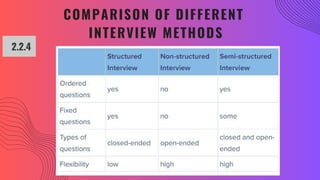
COMPARISON OF DIFFERENT
INTERVIEW METHODS
2.2.4
PROJECTIVE TECHNIQUES
Many a times respondents do not share there free actual
intrinsic feeling in a study. In this situations Projective
techniques are quite useful. Projective techniques are a way
to test someone’s feelings, thoughts, and attitudes. The word
“projection” means that one person is projecting their feelings
onto another person.
Projective techniques are a group of survey methods that
involve asking participants to provide information about
themselves without their knowledge. This type of survey
allows researchers to gain insight into individuals’ beliefs,
values, and behaviors.
3
PROJECTIVE TECHNIQUES
3
Psychologists have developed projective tests technique,
which are indirect and unstructured ways to find out about
people. They use respondents’ projections to discover hidden
motives, urges, or intentions that can’t be found through
direct questioning because the respondent either doesn’t
want to tell or can’t figure out himself.
Despite appearing straightforward, projective techniques
frequently require the assistance of a licensed psychologist to
help design the tests and appropriately evaluate them.
IMPORTANCE OF PROJECTIVE
TECHNIQUES
3.1
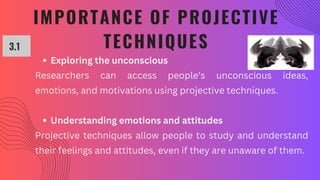
Exploring the unconscious
Researchers can access people’s unconscious ideas,
emotions, and motivations using projective techniques.
Understanding emotions and attitudes
Projective techniques allow people to study and understand
their feelings and attitudes, even if they are unaware of them.
IMPORTANCE OF PROJECTIVE
TECHNIQUES
3.1
Overcoming social desirability bias
Many a times respondents come with responses which are socially
acceptable in place of their natural response, this technique can help
to solve this problem.
Stimulating creativity and imagination
Projective techniques often involve creative and imaginative jobs, like
telling stories, drawing, or finishing sentences. These tasks make
people more creative and urge them to think outside of the box.
IMPORTANCE OF PROJECTIVE
TECHNIQUES
3.1
Enhancing qualitative research
Projective techniques are frequently utilized in qualitative
research to collect comprehensive and rich data.
Facilitating therapeutic processes
Projective techniques can be used in therapy to help people
figure out and talk about their ideas, feelings, and
experiences.
PROJECTIVE TECHNIQUES-
TYPES/EXAMPLE
3.2
Projective techniques are so crucial in attitude surveys or
motivational research. Projective testing techniques are
beneficial in allowing respondents to voice their opinions
without feeling self-conscious. These techniques assist the
respondents in unwittingly projecting their attitudes and
sentiments into the research topic.
WORD ASSOCIATION TEST
3.2.1
Word association tests can be applied in a variety of contexts:
Respondents can be given a set of words or phrases in a random
order, then asked to state or write the first word or phrase that
comes to mind.
Respondents are asked what word or phrase instantly comes to
mind when hearing specific brand names.
Respondents can also be questioned regarding slogans and what
they imply;
Respondents are asked to provide a “human attribute” or pair a
descriptive term with an inanimate object or product to
characterize it.
COMPLETION TEST
3.2.2
The sentence completion method asks responders to finish sentences
that have been left unfinished. These statements are typically written in
the third person and have a propensity for ambiguity.
Depending on the respondent’s personality, the following sentences,
for example, would be completed in a variety of striking ways:
“A beach getaway is…”
“Visiting the mountains for vacation is…”
“The purpose of golf is…”
“The typical individual thinks of skiing…”
“Museum visitors tend to be…”
THEMATIC APPERCEPTION TEST
3.2.3 The Thematic Apperception Test (TAT) asks participants to
describe a scene, potential character dialogue, and/or how the
“narrative” might develop after viewing one or more photos. The
photo interpretation technique is another name for TAT because
of this.
TAT can be utilized in many different contexts, from eliciting
characteristics of various products to forming opinions about the
types of people who could use particular goods or services.
EXPRESSION TECHNIQUE
3.2.4 The expression technique is more frequently employed than any
other projective technique to obtain respondents’ deeply held
beliefs and attitudes that can be interpreted as reflecting poorly
on the person. People often identify themselves as “virtues” that
they perceive in others as “vices.”
Respondents can discuss opinions they might not necessarily
admit to holding for themselves when given a chance to talk
about someone else, such as a neighbor, a relative, or a friend.
PROS OF PROJECTIVE TECHNIQUES:
Access to unconscious thoughts and emotions.
Enhanced self-expression.
Qualitative insights.
Stimulates creativity and imagination.
3.3.1
CONS OF PROJECTIVE TECHNIQUES:
Subjectivity and interpretation.
Limited standardization and norms.
Time-consuming and resource-intensive.
Limited empirical support.
Limited diagnostic utility.
3.3.2
THANK'S FOR
WATCHING

Techniques in Research - Projective, Interview, Observation by Dr. Vikramjit Singh

  • 1.
    TECHNIQUES IN RESEARCH DR. VIKRAMJITSINGH Observation, Interview, Projective Techniques
  • 2.
  • 3.
    OBSERVATION TECHNIQUE 1 Observational researchis a research technique where you observe participants and phenomena in their most natural settings. This enables researchers to see their subjects make choices and react to situations in their natural setting, as opposed to structured settings like research labs or focus groups.
  • 4.
    WHAT ARE DIFFERENTKINDS OF OBSERVATIONAL RESEARCH? 1.1 Naturalistic observation With naturalistic observation, observation occurs directly in the environment where the phenomenon occurs. The observations are made as unobtrusively as possible with the researcher not directly interacting with the participants in any way.
  • 5.
    WHAT ARE DIFFERENTKINDS OF OBSERVATIONAL RESEARCH? 1.2 Participant observation With participant observation, researchers actively participate in the study itself. In addition to observing behaviors, a researcher might conduct interviews, take notes, look at documents, and take photographs.
  • 6.
    WHAT ARE DIFFERENTKINDS OF OBSERVATIONAL RESEARCH? 1.3 Non- Participant observation With non-participant observation, researchers remotely participate in the study itself. He observes the situation from a distinct distant position. In addition to observing behaviors, a researcher might conduct interviews, take notes, look at documents, and take photographs.
  • 7.
    WHAT ARE DIFFERENTKINDS OF OBSERVATIONAL RESEARCH? 1.4 Structured observation With structured observation, researchers do not observe in the natural setting, but instead in a lab or a simulated environment. A structured observation is meant to observe a specific, limited set of behaviors. This method is less natural, but enables less variables to be at play.
  • 8.
    WHAT ARE DIFFERENTKINDS OF OBSERVATIONAL RESEARCH? 1.5 Unstructured observation In unstructured observation the observation process is not strictly planned and executed. It gives freeodom on when, how and what to be observed of the phenepmenon under investigation. THe investigator expertises as well as contect will decide the steps to be follwed while observation.
  • 9.
    WHEN SHOULD ICONDUCT OBSERVATIONAL RESEARCH? 1.6 You should conduct observation behavior when you want to: See how participants behave in a natural setting See how real world factors influence behavior Describe a phenomenon
  • 10.
    WHAT ARE SOMEOBSERVATIONAL RESEARCH METHODS? 1.7 Observation methods in research are utilized in many qualitative research methodologies such as pheneomenonology and grounded theory. Both methods can involve stages of collecting data through observational methods in natural settings.
  • 11.
    WHAT ARE THEADVANTAGES AND DISADVANTAGES OF OBSERVATIONAL RESEARCH? 1.8 Disadvantages When you do observational research, it can be difficult to control variables since you won’t have control over the environment. Furthermore, it can also be time intensive and expensive to conduct observational studies.
  • 12.
    WHAT ARE THESTEPS OF OBSERVATION? 1.10 Determine your research objective. 1. Understand the objective and goals of your research. Figure out what questions you’re trying to answer, and determine who you’re trying to observe and why. See our article on how to come up with a research objective. Determine questions and create a research guide 2. From your research questions, create a research guide that outlines how you’ll approach gathering answers to your questions.
  • 13.
    WHAT ARE THESTEPS OF OBSERVATION? 1.10 3. Establish your method of gathering data Determine whether you will be taking a naturalistic observation or an active participant approach. Decide if you’ll be recording audio or video, taking pictures, and/or taking notes. 4. Observe Go into the field and do your observations! Make sure you obtain all necessary permissions ahead of time.
  • 14.
    WHAT ARE THESTEPS OF OBSERVATION? 1.10 5. Prepare your data After the observation, prepare your data for analysis. Get your audio and video recordings transcribed, and start to organize your notes and papers. See our article on how to get audio transcribed. 6. Analyze behaviors in your data Dive into the data and make sense of it. Systematically code and organize your data to find themes and patterns. See our articles on qualitative coding to learn more about this step.
  • 15.
    INTERVIEW TECHNIQUE 2 An interviewis a qualitative research method used to collect primary data. It involves asking one or more people about their opinions on a company, a product, or a topic. This method allows researchers to obtain detailed information that might not be available through other research methods.
  • 16.
    INTERVIEW TECHNIQUE 2 Interviews canbe used in a wide range of research fields, including social sciences, psychology, health sciences, business, and education. The data collected from interviews is often transcribed, coded and analyzed to identify patterns, themes, and trends that can inform research findings, theory development, and policy recommendations.
  • 17.
    INTERVIEW TECHNIQUE 2 An interviewis a research method that involves asking questions to collect data from individuals who have knowledge, experience or opinions on a particular topic or subject matter.
  • 18.
    INTERVIEW TECHNIQUE 2 A researcheris conducting a study on the effects of social media on mental health. They want to interview people who use social media frequently to understand their experiences. The researcher sets up a meeting with an interviewee and asks them a series of questions about their social media usage, how it affects their mood, and if they have noticed any changes in their mental health since using social media.
  • 19.
    CHARACTERISTICS OF INTERVIEWS INRESEARCH 2 .1 Personal: Interviews are usually conducted face- to-face, over the phone, or through video conferencing, allowing for personal interaction between the researcher and the participant. Interactive: Interviews are a two-way conversation between the researcher and the participant, allowing for follow-up questions and clarifications.
  • 20.
    CHARACTERISTICS OF INTERVIEWS INRESEARCH 2 .1 Qualitative: Interviews are a qualitative research method, focusing on subjective experiences, opinions, and attitudes of participants. In-depth: Interviews can provide in-depth information on a research topic, allowing for a thorough exploration of complex issues and phenomena.
  • 21.
    CHARACTERISTICS OF INTERVIEWS INRESEARCH 2 .1 Contextual: Interviews can provide contextual information on a research topic, giving insight into the cultural, social, and historical factors that may influence the topic. Time-consuming: Conducting interviews can be time-consuming, requiring significant planning, preparation, and follow-up.
  • 22.
    TYPES OF INTERVIEWSIN RESEARCH 2 .2 There are three main types of interviews to research customers: structured, unstructured semi-structured interviews. The interview format varies, from face-to-face to online, one-on-one to focus groups.
  • 23.
    STRUCTURED INTERVIEWS INRESEARCH 2.2.1 The first type of interview in research is a structured interview. A structured interview is one where the researcher asks the participants a list of questions that have been prepared in advance. These questions are closed-ended and appear in a set order. The respondents are expected to answer yes, no, or a short response. Sometimes, they might choose from a pre-selected list of answers.
  • 24.
    STRUCTURED INTERVIEWS INRESEARCH 2.2.1 A structured interview is like a survey or questionnaire. However, it is conducted verbally rather than in written form. A structured interview also saves time as the questions only have to be prepared once and repeated in multiple interviews. However, the rigid structure might limit spontaneity and in-depth responses.us. This can help to ensure that the data collected is accurate and complete, and can lead to a deeper understanding of the research topic.
  • 25.
    UNSTRUCTURED OR NON-DIRECTIVE INTERVIEWSIN RESEARCH 2.2.2 The opposite of structured interviews is unstructured interviews. Unstructured interviews do not rely on prearranged questions but follow up based on interviewees' responses. Unstructured interviews are sometimes called non-directive interviews. "Non- directive" means not prepared/prearranged. The interview has no structure or scoring. It is conversational. The researcher can ask anything they want, depending on the interviewees' responses.The questions are often open-ended to encourage people to express themselves and give honest feedback.
  • 26.
    UNSTRUCTURED OR NON-DIRECTIVE INTERVIEWSIN RESEARCH 2.2.2 Like structured interviews, the main goal of an non directive interview is to collect customer data. However, it does so in a more friendly and conversational way. Non directive interviews give researchers a lot of flexibility but can be time-consuming to conduct. They create a friendly atmosphere that allows participants to open up. They are more exploratory than directive (structured) interviews. However, the lack of structure can make the participants wander off and provide irrelevant information.
  • 27.
    SEMI-STRUCTURED INTERVIEWS IN RESEARCH 2.2.3 Amix of structured and unstructured interviews is called a semi- structured interview. Semi-structured interviews include a list of predetermined questions, yet not set in order. The interviewer can choose what to ask depending on the situation. Semi-structured interviews maintain a reasonable degree of flexibility and validity. Researchers can collect more detailed responses yet not commit as much time and effort as in an unstructured interview.
  • 28.
  • 29.
    PROJECTIVE TECHNIQUES Many atimes respondents do not share there free actual intrinsic feeling in a study. In this situations Projective techniques are quite useful. Projective techniques are a way to test someone’s feelings, thoughts, and attitudes. The word “projection” means that one person is projecting their feelings onto another person. Projective techniques are a group of survey methods that involve asking participants to provide information about themselves without their knowledge. This type of survey allows researchers to gain insight into individuals’ beliefs, values, and behaviors. 3
  • 30.
    PROJECTIVE TECHNIQUES 3 Psychologists havedeveloped projective tests technique, which are indirect and unstructured ways to find out about people. They use respondents’ projections to discover hidden motives, urges, or intentions that can’t be found through direct questioning because the respondent either doesn’t want to tell or can’t figure out himself. Despite appearing straightforward, projective techniques frequently require the assistance of a licensed psychologist to help design the tests and appropriately evaluate them.
  • 31.
    IMPORTANCE OF PROJECTIVE TECHNIQUES 3.1 Exploringthe unconscious Researchers can access people’s unconscious ideas, emotions, and motivations using projective techniques. Understanding emotions and attitudes Projective techniques allow people to study and understand their feelings and attitudes, even if they are unaware of them.
  • 32.
    IMPORTANCE OF PROJECTIVE TECHNIQUES 3.1 Overcomingsocial desirability bias Many a times respondents come with responses which are socially acceptable in place of their natural response, this technique can help to solve this problem. Stimulating creativity and imagination Projective techniques often involve creative and imaginative jobs, like telling stories, drawing, or finishing sentences. These tasks make people more creative and urge them to think outside of the box.
  • 33.
    IMPORTANCE OF PROJECTIVE TECHNIQUES 3.1 Enhancingqualitative research Projective techniques are frequently utilized in qualitative research to collect comprehensive and rich data. Facilitating therapeutic processes Projective techniques can be used in therapy to help people figure out and talk about their ideas, feelings, and experiences.
  • 34.
    PROJECTIVE TECHNIQUES- TYPES/EXAMPLE 3.2 Projective techniquesare so crucial in attitude surveys or motivational research. Projective testing techniques are beneficial in allowing respondents to voice their opinions without feeling self-conscious. These techniques assist the respondents in unwittingly projecting their attitudes and sentiments into the research topic.
  • 35.
    WORD ASSOCIATION TEST 3.2.1 Wordassociation tests can be applied in a variety of contexts: Respondents can be given a set of words or phrases in a random order, then asked to state or write the first word or phrase that comes to mind. Respondents are asked what word or phrase instantly comes to mind when hearing specific brand names. Respondents can also be questioned regarding slogans and what they imply; Respondents are asked to provide a “human attribute” or pair a descriptive term with an inanimate object or product to characterize it.
  • 36.
    COMPLETION TEST 3.2.2 The sentencecompletion method asks responders to finish sentences that have been left unfinished. These statements are typically written in the third person and have a propensity for ambiguity. Depending on the respondent’s personality, the following sentences, for example, would be completed in a variety of striking ways: “A beach getaway is…” “Visiting the mountains for vacation is…” “The purpose of golf is…” “The typical individual thinks of skiing…” “Museum visitors tend to be…”
  • 37.
    THEMATIC APPERCEPTION TEST 3.2.3The Thematic Apperception Test (TAT) asks participants to describe a scene, potential character dialogue, and/or how the “narrative” might develop after viewing one or more photos. The photo interpretation technique is another name for TAT because of this. TAT can be utilized in many different contexts, from eliciting characteristics of various products to forming opinions about the types of people who could use particular goods or services.
  • 38.
    EXPRESSION TECHNIQUE 3.2.4 Theexpression technique is more frequently employed than any other projective technique to obtain respondents’ deeply held beliefs and attitudes that can be interpreted as reflecting poorly on the person. People often identify themselves as “virtues” that they perceive in others as “vices.” Respondents can discuss opinions they might not necessarily admit to holding for themselves when given a chance to talk about someone else, such as a neighbor, a relative, or a friend.
  • 39.
    PROS OF PROJECTIVETECHNIQUES: Access to unconscious thoughts and emotions. Enhanced self-expression. Qualitative insights. Stimulates creativity and imagination. 3.3.1
  • 40.
    CONS OF PROJECTIVETECHNIQUES: Subjectivity and interpretation. Limited standardization and norms. Time-consuming and resource-intensive. Limited empirical support. Limited diagnostic utility. 3.3.2
  • 41.