Resources Sheryl Nussbaum-Beach http://www.21stcenturycollaborative.com     http ://ncaect.wikispaces.com/
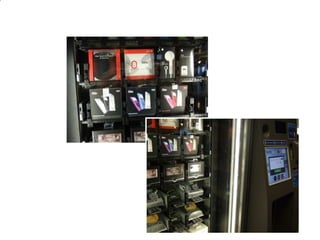
iPods in Vending Machines Signs of the Times….
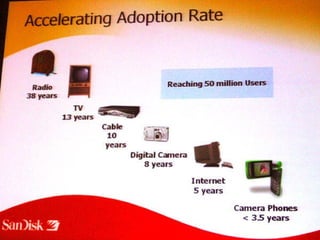
Are you Ready for 21st Century Teaching and Learning? It isn’t just “coming”… it has arrived! And schools who aren’t redefining themselves, risk becoming irrelevant in preparing students for the future.
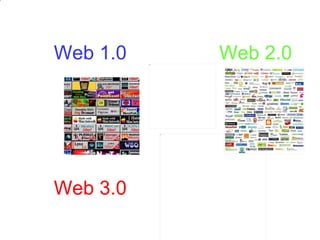
You Ain’t Seen Nothing Yet! Web 1.0   Web 2.0 Web 3.0 Singularity
Some statistics- - Over 1 billion people on the Internet  http://www.internetworldstats.com/ 70 million blogs, 2.7 million posts  a day. 80 new blog sites created every minute “ None of the top 10 jobs that will exist in 2010 exist today." --  Richard Riley , (Former US Sec. of Ed.) A Changing World
It is estimated that  1.5 exabytes of unique new information  will be generated  worldwide this year. That’s estimated to be  more than in the  previous 5,000 years. Knowledge Creation
For students starting a four-year technical or higher education degree, this means that . . . half of what they learn in their first year of study will be outdated by their third year of study.
 
Trend 1  –  Social and intellectual capital are the new economic values in the world economy. This new economy will be held together and advanced through the building of relationships. Unleashing and connecting the collective knowledge, ideas, and experiences of people creates and heightens value. Source : Journal of School Improvement, Volume 3, Issue 1, Spring  2002 http://www.ncacasi.org/jsi/2002v3i1/ten_trends
Trend 4  –  Education Will Shift from Averages to Individuals. (Standardization to Personalization)   The trend toward standards and high-stakes testing will likely incite a movement toward ensuring that support is provided for individual students to reach high levels of learning.  Demand will grow for personalization rather than a system often driven by prescribed high-stakes tests that produce averages, demand uniformity, and sustain a scoreboard mentality .
Changing Learning Landscape Trend 7 – Technology will increase the speed of communication and the pace of advancement or decline. Using participatory media educators will help today’s students shape tomorrow’s world. Teachers will become partners with students- using learning communities to open the classroom to the world. They will deal with real world problems and opportunities while gaining a global perspective.
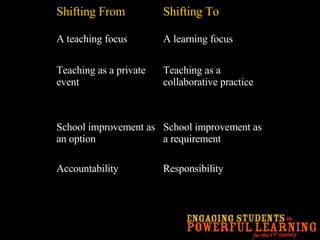
Responsibility Accountability School improvement as a requirement School improvement as an option Teaching as a collaborative practice Teaching as a private event A learning focus A teaching focus Shifting To Shifting From
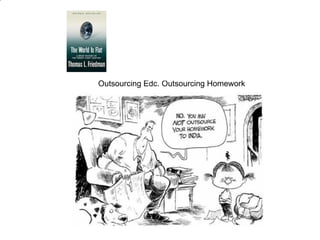
Outsourcing  Edc .   Outsourcing Homework   "Jobs in the new economy--the ones that won't get outsourced or automated--"put an enormous premium on creative and innovative skills, seeing patterns where other people see only chaos." –  Marc Tucker
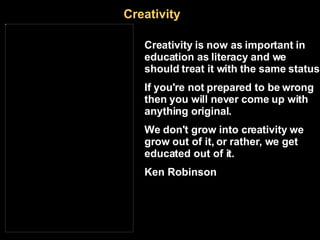
Creativity Creativity is now as important in education as literacy and we should treat it with the same status. If you're not prepared to be wrong then you will never come up with anything original.   We don't grow into creativity we grow out of it, or rather, we get educated out of it. Ken Robinson   http :// www.bloglines.com/blog/andrewch?id =4
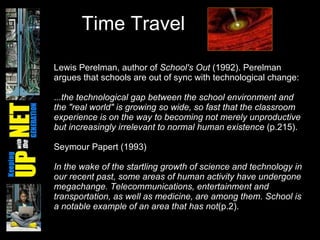
Time Travel Lewis Perelman, author of  School's Out  (1992). Perelman argues that schools are out of sync with technological change:  . ..the technological gap between the school environment and the "real world" is growing so wide, so fast that the classroom experience is on the way to becoming not merely unproductive but increasingly irrelevant to normal human existence  (p.215).  Seymour Papert (1993) In the wake of the startling growth of science and technology in our recent past, some areas of human activity have undergone megachange. Telecommunications, entertainment and transportation, as well as medicine, are among them. School is a notable example of an area that has not (p.2).
Born to be Wired! Understanding the Net Generation I-Generation Who Are They? Some of them are among us.
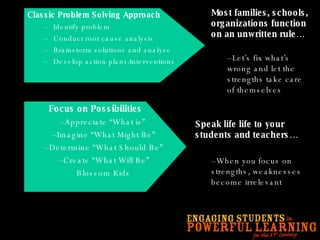
Rethinking Teaching and Learning Multiliterate Change in pedagogy   Change in the way classrooms  are managed A move from deficit based instruction to strength based learning Collaboration and communication Inside and Outside the classroom
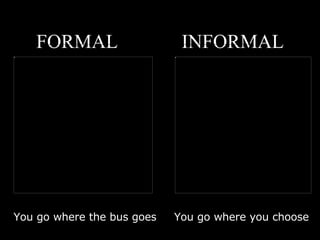
FORMAL  INFORMAL You go where the bus goes You go where you choose Jay Cross – Internet Time
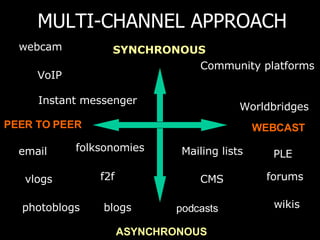
MULTI-CHANNEL APPROACH SYNCHRONOUS ASYNCHRONOUS PEER TO PEER WEBCAST Instant messenger forums f2f blogs photoblogs vlogs wikis folksonomies Conference rooms email Mailing lists CMS Community platforms VoIP webcam podcasts PLE Worldbridges
 
Model how to develop PLNs Take risks while they watch!
From this To This
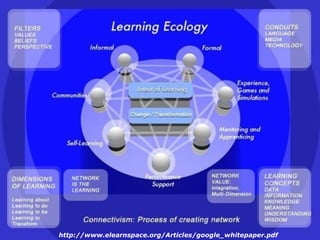
http://www.elearnspace.org/Articles/google_whitepaper.pdf
 
What will be our legacy… Bertelsmann Foundation Report:  The Impact of Media and Technology in Schools 2 Groups Content Area: Civil War One Group taught using Sage on the Stage methodology One Group taught using innovative applications of technology and project-based instructional models End of the Study, both groups given identical teacher-constructed tests of their knowledge of the Civil War. Question: Which group did better?
Answer… No significant test differences were found
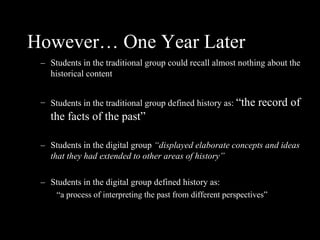
However… One Year Later Students in the traditional group could recall almost nothing about the historical content Students in the traditional group defined history as:  “the record of the facts of the past” Students in the digital group  “displayed elaborate concepts and ideas that they had extended to other areas of history” Students in the digital group defined history as:  “ a process of interpreting the past from different perspectives”
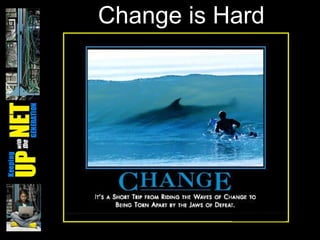
Change is Hard
Real Question is this: Are we willing to change- to risk change- to meet the needs of the precious folks we serve? Can you accept that Change (with a “big” C) is sometimes a messy process and that learning new things together is going to require some tolerance for ambiguity.
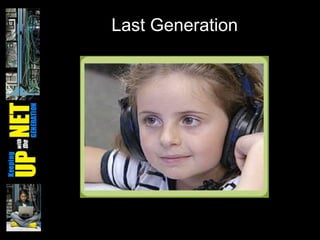
Last Generation

Ncaetc

  • 1.
  • 2.
    Resources Sheryl Nussbaum-Beachhttp://www.21stcenturycollaborative.com http ://ncaect.wikispaces.com/
  • 3.
    iPods in VendingMachines Signs of the Times….
  • 4.
    Are you Readyfor 21st Century Teaching and Learning? It isn’t just “coming”… it has arrived! And schools who aren’t redefining themselves, risk becoming irrelevant in preparing students for the future.
  • 5.
    You Ain’t SeenNothing Yet! Web 1.0 Web 2.0 Web 3.0 Singularity
  • 6.
    Some statistics- -Over 1 billion people on the Internet http://www.internetworldstats.com/ 70 million blogs, 2.7 million posts a day. 80 new blog sites created every minute “ None of the top 10 jobs that will exist in 2010 exist today." -- Richard Riley , (Former US Sec. of Ed.) A Changing World
  • 7.
    It is estimatedthat 1.5 exabytes of unique new information will be generated worldwide this year. That’s estimated to be more than in the previous 5,000 years. Knowledge Creation
  • 8.
    For students startinga four-year technical or higher education degree, this means that . . . half of what they learn in their first year of study will be outdated by their third year of study.
  • 9.
  • 10.
    Trend 1 – Social and intellectual capital are the new economic values in the world economy. This new economy will be held together and advanced through the building of relationships. Unleashing and connecting the collective knowledge, ideas, and experiences of people creates and heightens value. Source : Journal of School Improvement, Volume 3, Issue 1, Spring 2002 http://www.ncacasi.org/jsi/2002v3i1/ten_trends
  • 11.
    Trend 4 – Education Will Shift from Averages to Individuals. (Standardization to Personalization) The trend toward standards and high-stakes testing will likely incite a movement toward ensuring that support is provided for individual students to reach high levels of learning. Demand will grow for personalization rather than a system often driven by prescribed high-stakes tests that produce averages, demand uniformity, and sustain a scoreboard mentality .
  • 12.
    Changing Learning LandscapeTrend 7 – Technology will increase the speed of communication and the pace of advancement or decline. Using participatory media educators will help today’s students shape tomorrow’s world. Teachers will become partners with students- using learning communities to open the classroom to the world. They will deal with real world problems and opportunities while gaining a global perspective.
  • 13.
    Responsibility Accountability Schoolimprovement as a requirement School improvement as an option Teaching as a collaborative practice Teaching as a private event A learning focus A teaching focus Shifting To Shifting From
  • 14.
    Outsourcing Edc. Outsourcing Homework "Jobs in the new economy--the ones that won't get outsourced or automated--"put an enormous premium on creative and innovative skills, seeing patterns where other people see only chaos." – Marc Tucker
  • 15.
    Creativity Creativity isnow as important in education as literacy and we should treat it with the same status. If you're not prepared to be wrong then you will never come up with anything original. We don't grow into creativity we grow out of it, or rather, we get educated out of it. Ken Robinson http :// www.bloglines.com/blog/andrewch?id =4
  • 16.
    Time Travel LewisPerelman, author of School's Out (1992). Perelman argues that schools are out of sync with technological change: . ..the technological gap between the school environment and the "real world" is growing so wide, so fast that the classroom experience is on the way to becoming not merely unproductive but increasingly irrelevant to normal human existence (p.215). Seymour Papert (1993) In the wake of the startling growth of science and technology in our recent past, some areas of human activity have undergone megachange. Telecommunications, entertainment and transportation, as well as medicine, are among them. School is a notable example of an area that has not (p.2).
  • 17.
    Born to beWired! Understanding the Net Generation I-Generation Who Are They? Some of them are among us.
  • 18.
    Rethinking Teaching andLearning Multiliterate Change in pedagogy Change in the way classrooms are managed A move from deficit based instruction to strength based learning Collaboration and communication Inside and Outside the classroom
  • 19.
    FORMAL INFORMALYou go where the bus goes You go where you choose Jay Cross – Internet Time
  • 20.
    MULTI-CHANNEL APPROACH SYNCHRONOUSASYNCHRONOUS PEER TO PEER WEBCAST Instant messenger forums f2f blogs photoblogs vlogs wikis folksonomies Conference rooms email Mailing lists CMS Community platforms VoIP webcam podcasts PLE Worldbridges
  • 21.
  • 22.
    Model how todevelop PLNs Take risks while they watch!
  • 23.
  • 24.
  • 25.
  • 26.
    What will beour legacy… Bertelsmann Foundation Report: The Impact of Media and Technology in Schools 2 Groups Content Area: Civil War One Group taught using Sage on the Stage methodology One Group taught using innovative applications of technology and project-based instructional models End of the Study, both groups given identical teacher-constructed tests of their knowledge of the Civil War. Question: Which group did better?
  • 27.
    Answer… No significanttest differences were found
  • 28.
    However… One YearLater Students in the traditional group could recall almost nothing about the historical content Students in the traditional group defined history as: “the record of the facts of the past” Students in the digital group “displayed elaborate concepts and ideas that they had extended to other areas of history” Students in the digital group defined history as: “ a process of interpreting the past from different perspectives”
  • 29.
  • 30.
    Real Question isthis: Are we willing to change- to risk change- to meet the needs of the precious folks we serve? Can you accept that Change (with a “big” C) is sometimes a messy process and that learning new things together is going to require some tolerance for ambiguity.
  • 31.