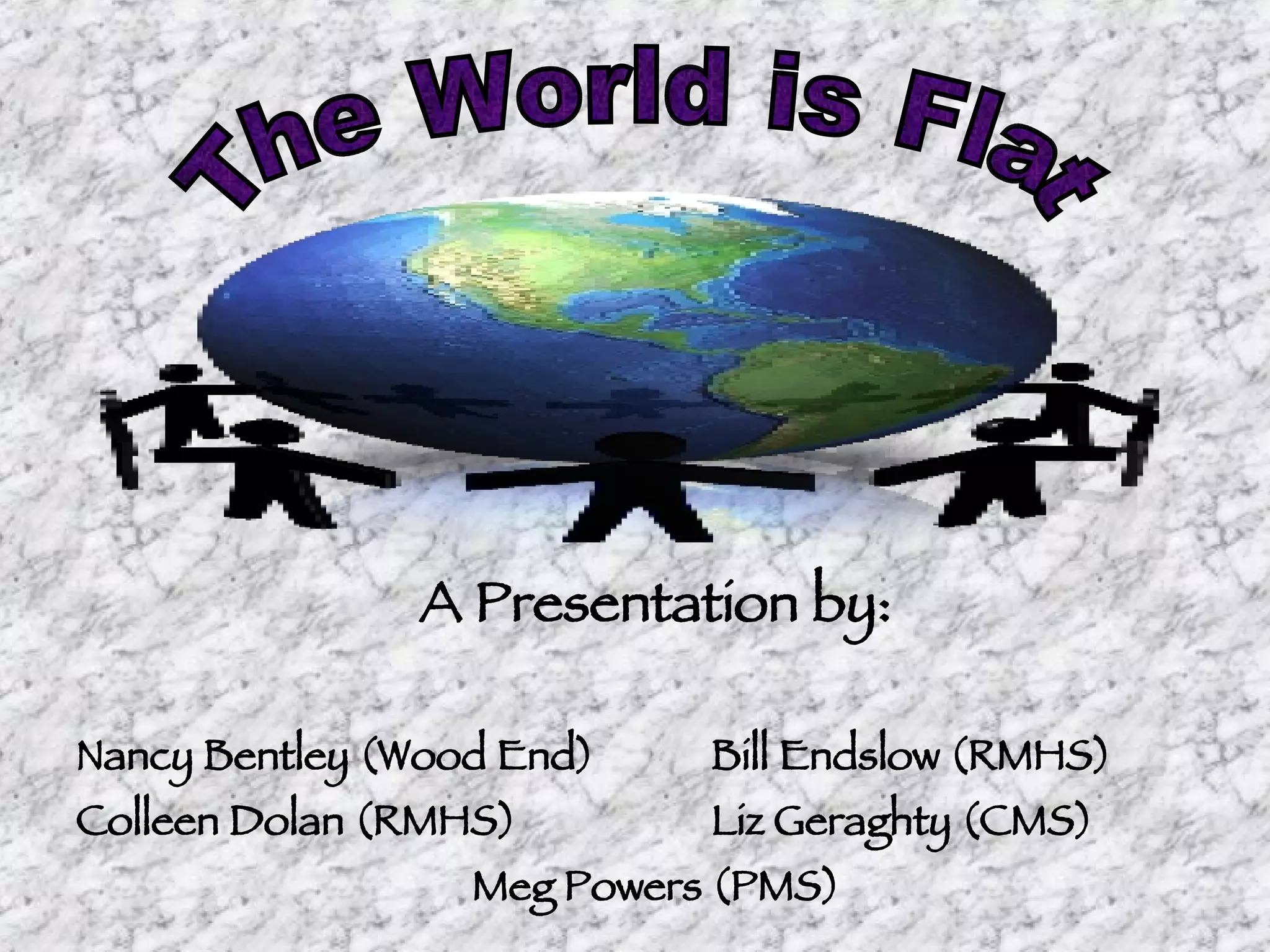
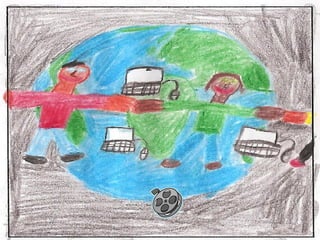


The World is Flat A Presentation by: Nancy Bentley (Wood End) Bill Endslow (RMHS) Colleen Dolan (RMHS) Liz Geraghty (CMS) Meg Powers (PMS)
 
Massachusetts Board of Education Presentation Reading Public Schools  21 st  Century Skills Proposal
 
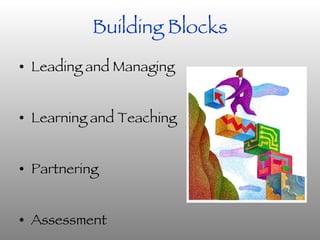
Building Blocks Leading and Managing Learning and Teaching Partnering Assessment
Leading & Managing Resources and Infrastructure Knowledge and skills Policymaking Accountability
If it’s not happening, it’s because you are not doing it. Thomas Friedman
Resources / Infrastructure Resource allocation ensures students, parents, teachers and administrators seamless access to 21st century technology in school, home, community Technical support process addresses issues in a timely fashion District and town services and operations are connected and technology is integrated seamlessly
 
Knowledge and Skills Innovative management, data driven decision making, on-going professional development Proficiency in use of 21 st  century tools to create curriculum, develop assessment methods, and align standards Effective use of 21st century learning tools in management and act as role models in the usage. Administrators demonstrate:
" Teachers must become comfortable as co-learners with their students and with colleagues around the world. Today it is less about  staying ahead  and more about  moving ahead  as members of dynamic learning communities. The digital-age teaching professional must demonstrate a vision of technology infusion and develop the technology skills of others.  These are the hallmarks of the new education leader.”   Don Knezek, ISTE CEO, 2008
Policymaking Focuses on the integration of 21st century skills into content mastery Funding supports and encourages seamless integration of 21st century skills Curriculum is aligned with assessment and inclusive of 21 st  century skills Professional development focuses on the most effective research-based teaching strategies, learning strategies and 21st century skills Ensure collaboration opportunities for staff
Here’s to the crazy ones, the misfits, the rebels,  the troublemakers, the round pegs in the square holes, the ones who see things differently.  They’re not fond of rules and they have no respect for the status quo.  You can quote them,  disagree with them, glorify or vilify them. About the only thing you can’t do is ignore them, because they change things, they push the human race forward and while some may see them as the crazy ones, we see genius. Because the people who are crazy enough to think they can change the world, are the ones who do. Apple Computer 1984
Accountability District evaluates student achievement of 21st century skills in every aspect of teaching and learning District evaluates the systemic incorporation of 21st century skills Professional development is evaluated based on inclusion of 21st century skills  Effective support processes for teachers and staff are in place
Are we teaching students to be ready for a bright future, or preparing them to be productive citizens of the past? Niki  Alan November Webblog 3/30/08
Learning and Teaching 21 st  Century Content 21 st  Century Context Learning Skills Learning Tools
21 Century Context Content should be contemporary and relevant Establish and utilize global partnerships to create real world connections via the internet Expect the use of 21 st  Century Skills Give students real world data, tools and situations to enhance problem solving
 
21 st  Century Content Enhance current curriculum with technology at all levels. Add more World Languages that reflect the Flat World Begin teaching World Languages in elementary Promote right brain thinking through teaching the arts Teach technology in connection to the arts Create cross-disciplinary Courses at all levels Relevant examples, applications, and real world situations should be incorporated.
Learning Skills Encourage critical thinking skills Expand communication skills both online and in person Broaden technology skills to increase global awareness, initiate leadership, and practice problem solving Teach students to be discriminating readers and users of online content Students need to be able to manage information, integrate subjects and skills, think critically and creatively and solve problems
Instruction Expand opportunities for Virtual Learning in all subjects and all levels Offer opportunities to create innovative uses for computers Expand communication skills both on-line and in person Teach students to be discriminating readers and users of on-line content Technology should be seamlessly integrated into the learning environment.
Learning Tools Make sure infrastructure is in place to support technology system wide Every teacher receives a laptop Every student receives a laptop beginning in grade 3 SmartBoard in every classroom Students have their own digital portfolios that they can access from home or school Bring online experts into classrooms Expand opportunities for Virtual Learning in all subjects and all levels Offer opportunities to create innovative uses for computers
The most important question we should be asking is how can we convince our teachers to expect students to learn rather than to acquire knowledge.  Then we can get them to use the tools we have supplied them to help students learn how to learn, to acquire knowledge and to apply their learning. Ray Dewar Alan November Webblog 7/19/07
Partnering Partnering is the creation of relationships that extend beyond the classroom.  These are the relationships that have flattened the world and that our children will need to successfully participate in the world as adults. Who are our partners? Parents and Community  Schools Across the District Higher Education and Teacher Preparation Content Providers Businesses Flat World Partners
“ Girls, when I was growing up, my parents used to say to me, ‘Tom, finish your dinner– people in China and India are starving.’  My advice to you is: Girls, finish your homework – people in China and India are starving for your jobs.” Thomas Friedman
 
Parents and Community Local businesses to provide 21 st  century skills training for parents.  Community programs and businesses to provide after-school opportunities to develop 21 st  century skills. Local businesses to provide assistance of hardware for families in need of technology School based technology nights to provide hands-on learning for families.  Workshops and extended learning programs to continue family education. Parents, schools and the community collaborate so that each child will master 21st century skills. The district will collaborate with: In addition, schools across the district can provide:
Higher Education and Teacher Preparation Provide district planning time to promote K-12 integration of content and education strategies with 21st century skills. Provide time and compensation to support action research focused on teaching and learning with the integration of 21st century skills. Develop relationships with area higher education institutions to support teacher preparation for proficiency in 21 st  century skills and the hiring of teachers with these skills.  The district will partner K–12 classroom teachers experienced in 21st century skills as mentors for first year teachers.  The district will continue district-wide teacher preparation and sharing through the addition of another District Sharing Conference.
Content Providers The district will collaborate with content providers to create content and resources that use and promote 21 st  century skills. District education leaders will collaborate with content providers to develop aligned resources, assessments and curriculum integrated with the appropriate 21st century tools and educational systems.
Flat World Partners Partner with schools across America or worldwide for authentic and meaningful project-based learning  Establish and utilize global business partnerships to create real world business and industry connections via the Internet. Initiate global educational partnerships to allow for collaboration between teachers at all levels Bring on-line experts into the classroom via Skype
ASSESSMENT All assessment is learner-centered, formative, context-specific, ongoing and rooted in teaching strategies. All teachers use classroom assessments that demonstrate evidence of student performance in core subjects and 21st century skills   All teachers share with parents and students the information needed to monitor student progress in achieving learning goals.
ASSESSMENT CON’T Students, teachers and parents always collaborate to monitor student progress in achieving learning goals and use assessment to evaluate long-term student progress   Assessments use technology and record student performance as a means of tracking information over time.
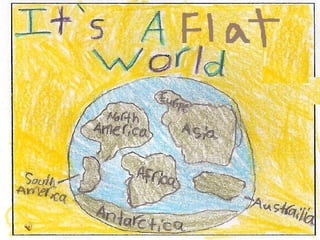
References http://www.teckitech.com/random/great-inspirational-video-from-india/ Friedman, T. L. (2007).  The Word is Flat . New York: Picador.  Drawings courtesy of Wood End 4 th  Graders http://nlcommunities.com/communities/alannovember/default.aspx
Credits Claudia Giles – Parker Middle School Nate Fisher -  RMHS  Ms. Bentley’s 4 th  Grade Class –  Wood End School
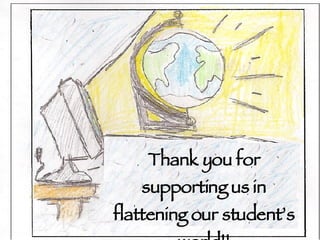
Thank you for supporting us in flattening our student’s world!!
 

Offshoring Presentation

  • 1.
    The World isFlat A Presentation by: Nancy Bentley (Wood End) Bill Endslow (RMHS) Colleen Dolan (RMHS) Liz Geraghty (CMS) Meg Powers (PMS)
  • 2.
  • 3.
    Massachusetts Board ofEducation Presentation Reading Public Schools 21 st Century Skills Proposal
  • 4.
  • 5.
    Building Blocks Leadingand Managing Learning and Teaching Partnering Assessment
  • 6.
    Leading & ManagingResources and Infrastructure Knowledge and skills Policymaking Accountability
  • 7.
    If it’s nothappening, it’s because you are not doing it. Thomas Friedman
  • 8.
    Resources / InfrastructureResource allocation ensures students, parents, teachers and administrators seamless access to 21st century technology in school, home, community Technical support process addresses issues in a timely fashion District and town services and operations are connected and technology is integrated seamlessly
  • 9.
  • 10.
    Knowledge and SkillsInnovative management, data driven decision making, on-going professional development Proficiency in use of 21 st century tools to create curriculum, develop assessment methods, and align standards Effective use of 21st century learning tools in management and act as role models in the usage. Administrators demonstrate:
  • 11.
    " Teachers mustbecome comfortable as co-learners with their students and with colleagues around the world. Today it is less about staying ahead and more about moving ahead as members of dynamic learning communities. The digital-age teaching professional must demonstrate a vision of technology infusion and develop the technology skills of others.  These are the hallmarks of the new education leader.” Don Knezek, ISTE CEO, 2008
  • 12.
    Policymaking Focuses onthe integration of 21st century skills into content mastery Funding supports and encourages seamless integration of 21st century skills Curriculum is aligned with assessment and inclusive of 21 st century skills Professional development focuses on the most effective research-based teaching strategies, learning strategies and 21st century skills Ensure collaboration opportunities for staff
  • 13.
    Here’s to thecrazy ones, the misfits, the rebels, the troublemakers, the round pegs in the square holes, the ones who see things differently. They’re not fond of rules and they have no respect for the status quo. You can quote them, disagree with them, glorify or vilify them. About the only thing you can’t do is ignore them, because they change things, they push the human race forward and while some may see them as the crazy ones, we see genius. Because the people who are crazy enough to think they can change the world, are the ones who do. Apple Computer 1984
  • 14.
    Accountability District evaluatesstudent achievement of 21st century skills in every aspect of teaching and learning District evaluates the systemic incorporation of 21st century skills Professional development is evaluated based on inclusion of 21st century skills Effective support processes for teachers and staff are in place
  • 15.
    Are we teachingstudents to be ready for a bright future, or preparing them to be productive citizens of the past? Niki Alan November Webblog 3/30/08
  • 16.
    Learning and Teaching21 st Century Content 21 st Century Context Learning Skills Learning Tools
  • 17.
    21 Century ContextContent should be contemporary and relevant Establish and utilize global partnerships to create real world connections via the internet Expect the use of 21 st Century Skills Give students real world data, tools and situations to enhance problem solving
  • 18.
  • 19.
    21 st Century Content Enhance current curriculum with technology at all levels. Add more World Languages that reflect the Flat World Begin teaching World Languages in elementary Promote right brain thinking through teaching the arts Teach technology in connection to the arts Create cross-disciplinary Courses at all levels Relevant examples, applications, and real world situations should be incorporated.
  • 20.
    Learning Skills Encouragecritical thinking skills Expand communication skills both online and in person Broaden technology skills to increase global awareness, initiate leadership, and practice problem solving Teach students to be discriminating readers and users of online content Students need to be able to manage information, integrate subjects and skills, think critically and creatively and solve problems
  • 21.
    Instruction Expand opportunitiesfor Virtual Learning in all subjects and all levels Offer opportunities to create innovative uses for computers Expand communication skills both on-line and in person Teach students to be discriminating readers and users of on-line content Technology should be seamlessly integrated into the learning environment.
  • 22.
    Learning Tools Makesure infrastructure is in place to support technology system wide Every teacher receives a laptop Every student receives a laptop beginning in grade 3 SmartBoard in every classroom Students have their own digital portfolios that they can access from home or school Bring online experts into classrooms Expand opportunities for Virtual Learning in all subjects and all levels Offer opportunities to create innovative uses for computers
  • 23.
    The most importantquestion we should be asking is how can we convince our teachers to expect students to learn rather than to acquire knowledge. Then we can get them to use the tools we have supplied them to help students learn how to learn, to acquire knowledge and to apply their learning. Ray Dewar Alan November Webblog 7/19/07
  • 24.
    Partnering Partnering isthe creation of relationships that extend beyond the classroom. These are the relationships that have flattened the world and that our children will need to successfully participate in the world as adults. Who are our partners? Parents and Community Schools Across the District Higher Education and Teacher Preparation Content Providers Businesses Flat World Partners
  • 25.
    “ Girls, whenI was growing up, my parents used to say to me, ‘Tom, finish your dinner– people in China and India are starving.’ My advice to you is: Girls, finish your homework – people in China and India are starving for your jobs.” Thomas Friedman
  • 26.
  • 27.
    Parents and CommunityLocal businesses to provide 21 st century skills training for parents. Community programs and businesses to provide after-school opportunities to develop 21 st century skills. Local businesses to provide assistance of hardware for families in need of technology School based technology nights to provide hands-on learning for families. Workshops and extended learning programs to continue family education. Parents, schools and the community collaborate so that each child will master 21st century skills. The district will collaborate with: In addition, schools across the district can provide:
  • 28.
    Higher Education andTeacher Preparation Provide district planning time to promote K-12 integration of content and education strategies with 21st century skills. Provide time and compensation to support action research focused on teaching and learning with the integration of 21st century skills. Develop relationships with area higher education institutions to support teacher preparation for proficiency in 21 st century skills and the hiring of teachers with these skills. The district will partner K–12 classroom teachers experienced in 21st century skills as mentors for first year teachers. The district will continue district-wide teacher preparation and sharing through the addition of another District Sharing Conference.
  • 29.
    Content Providers Thedistrict will collaborate with content providers to create content and resources that use and promote 21 st century skills. District education leaders will collaborate with content providers to develop aligned resources, assessments and curriculum integrated with the appropriate 21st century tools and educational systems.
  • 30.
    Flat World PartnersPartner with schools across America or worldwide for authentic and meaningful project-based learning Establish and utilize global business partnerships to create real world business and industry connections via the Internet. Initiate global educational partnerships to allow for collaboration between teachers at all levels Bring on-line experts into the classroom via Skype
  • 31.
    ASSESSMENT All assessmentis learner-centered, formative, context-specific, ongoing and rooted in teaching strategies. All teachers use classroom assessments that demonstrate evidence of student performance in core subjects and 21st century skills All teachers share with parents and students the information needed to monitor student progress in achieving learning goals.
  • 32.
    ASSESSMENT CON’T Students,teachers and parents always collaborate to monitor student progress in achieving learning goals and use assessment to evaluate long-term student progress Assessments use technology and record student performance as a means of tracking information over time.
  • 33.
    References http://www.teckitech.com/random/great-inspirational-video-from-india/ Friedman,T. L. (2007). The Word is Flat . New York: Picador. Drawings courtesy of Wood End 4 th Graders http://nlcommunities.com/communities/alannovember/default.aspx
  • 34.
    Credits Claudia Giles– Parker Middle School Nate Fisher - RMHS Ms. Bentley’s 4 th Grade Class – Wood End School
  • 35.
    Thank you forsupporting us in flattening our student’s world!!
  • 36.