Changing Educational Paradigms
                (The Theory)

In this presentation, we'll talk about:


    How today's kids are different than they
    were a decade or two ago.

    Changing roles of education.
But first...
Here are some important things to keep in
   mind:

    Today's generation has grown up with
    technology.

    It's not bad, it's not wrong, it's different.
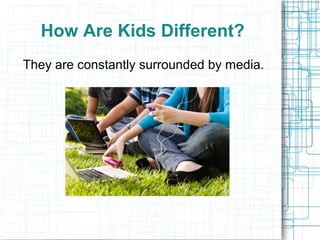
How Are Kids Different?
They are constantly surrounded by media.
How Are Kids Different?
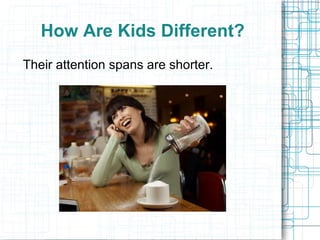
Their attention spans are shorter.
How Are Kids Different?
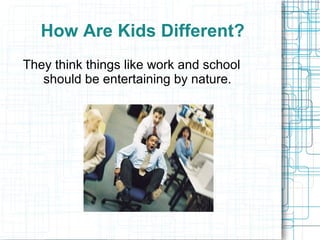
They think things like work and school
   should be entertaining by nature.
How Are Kids Different?
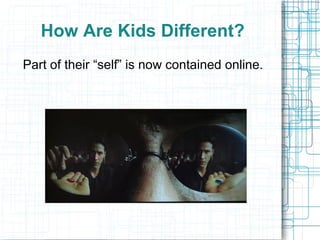
Part of their “self” is now contained online.
How Are Kids Different?
“Our newest generation – currently in K-12 – is
  demonstrating for us the impact of having developed
  under the digital wave. These youth have been
  completely normalized by digital technologies—it is a
  fully integrated aspect of their lives. Many students
  in this group are using new media and technologies
  to create new things in new ways, learn new things in
  new ways, and communicate in new ways with new
  people—behaviors that have become hardwired in
  their ways of thinking and operating in the world.
  Children are establishing a relationship to
  knowledge gathering which is alien to their
  parents and teachers.”
So, What's the Problem?
We are using Enlightenment era
  philosophies of education in the Age of
  Information.
So, What's the Problem?

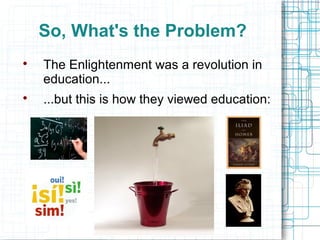
    The Enlightenment was a revolution in
    education...

    ...but this is how they viewed education:
So, What's the Problem?

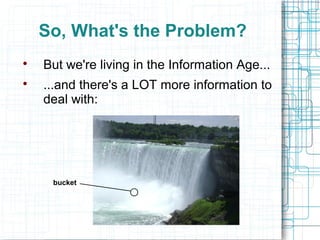
    But we're living in the Information Age...

    ...and there's a LOT more information to
    deal with:


     bucket
Therefore...

    Our educational system should:
     −   Help students SORT information.
     −   Help students THINK CRITICALLY.
     −   Create LIFE-LONG LEARNERS.
     −   Not force students to memorize
         USELESS KNOWLEDGE.
Things to Think About:

    “Games, simulations, and social
    networking are already permeating the
    workplace as productivity and
    development tools – we may be doing
    our students a large disservice by not
    integrating these tools into their
    education.”

    Don't use technology for technology's
    sake.

Educational paradigms, part i

  • 1.
    Changing Educational Paradigms (The Theory) In this presentation, we'll talk about:  How today's kids are different than they were a decade or two ago.  Changing roles of education.
  • 2.
    But first... Here aresome important things to keep in mind:  Today's generation has grown up with technology.  It's not bad, it's not wrong, it's different.
  • 3.
    How Are KidsDifferent? They are constantly surrounded by media.
  • 4.
    How Are KidsDifferent? Their attention spans are shorter.
  • 5.
    How Are KidsDifferent? They think things like work and school should be entertaining by nature.
  • 6.
    How Are KidsDifferent? Part of their “self” is now contained online.
  • 7.
    How Are KidsDifferent? “Our newest generation – currently in K-12 – is demonstrating for us the impact of having developed under the digital wave. These youth have been completely normalized by digital technologies—it is a fully integrated aspect of their lives. Many students in this group are using new media and technologies to create new things in new ways, learn new things in new ways, and communicate in new ways with new people—behaviors that have become hardwired in their ways of thinking and operating in the world. Children are establishing a relationship to knowledge gathering which is alien to their parents and teachers.”
  • 8.
    So, What's theProblem? We are using Enlightenment era philosophies of education in the Age of Information.
  • 9.
    So, What's theProblem?  The Enlightenment was a revolution in education...  ...but this is how they viewed education:
  • 10.
    So, What's theProblem?  But we're living in the Information Age...  ...and there's a LOT more information to deal with: bucket
  • 11.
    Therefore...  Our educational system should: − Help students SORT information. − Help students THINK CRITICALLY. − Create LIFE-LONG LEARNERS. − Not force students to memorize USELESS KNOWLEDGE.
  • 12.
    Things to ThinkAbout:  “Games, simulations, and social networking are already permeating the workplace as productivity and development tools – we may be doing our students a large disservice by not integrating these tools into their education.”  Don't use technology for technology's sake.