#jiscassess
          www.jisc.ac.uk/assessmentandfeedback


JISC Assessment and Feedback
      Programme Meeting
        5th October 2011
Welcome

 A special welcome to project representatives, programme
  support team, JISC Advance and JISC RSC’s, The Higher
  Education Academy
 Housekeeping
   – 13.00 – 14:00 Lunch in the restaurant
   – 16:00 Close
 Wireless access and extension cables
 Delegate packs
   – Agenda, guide to the wiki spaces, programme calendar,
     Making Connections session handout
   – Feedback please – online evaluation forms!
 Publications from the e-Learning team
Agenda


 10.00 – 10.30: Overview of programme and expectations
 10.30 – 11.00: Project Elevator Pitches
 11.00 – 11.15: Tea and coffee
 11.15 – 11.45: Project Elevator Pitches (continued)
 11.45 – 13.00: Poster Networking
 13.00 – 14.00: Lunch
 14.00 – 15.00: Parallel sessions:
               » Strand A – main room (Expand Suite)
               » Strand B – breakout room (Advance 2)
               » Strand C – breakout room (Advance 3)
 15.00 – 16.00: Change Activity (The Higher Education Academy)
Aims for today


 Introduce the JISC Assessment and Feedback programme, team,
  structure and expectations
 Provide an opportunity for projects to hear about each others’ work
  and to identify connections and common themes
 Facilitate networking between projects, and cluster level discussions
 Initiate discussions relating to this phase of project planning
Programme overview and expectations


 Overview of the programme structure
 Summary of expectations for each strand
 Reporting and other programme requirements
 Introduction to the support team
 Wiki spaces and useful resources
Overview


          Overview of programme,
          strands, deliverables and
           reporting expectations


www.jisc.ac.uk/assessmentandfeedback
                             #JISCASSESS
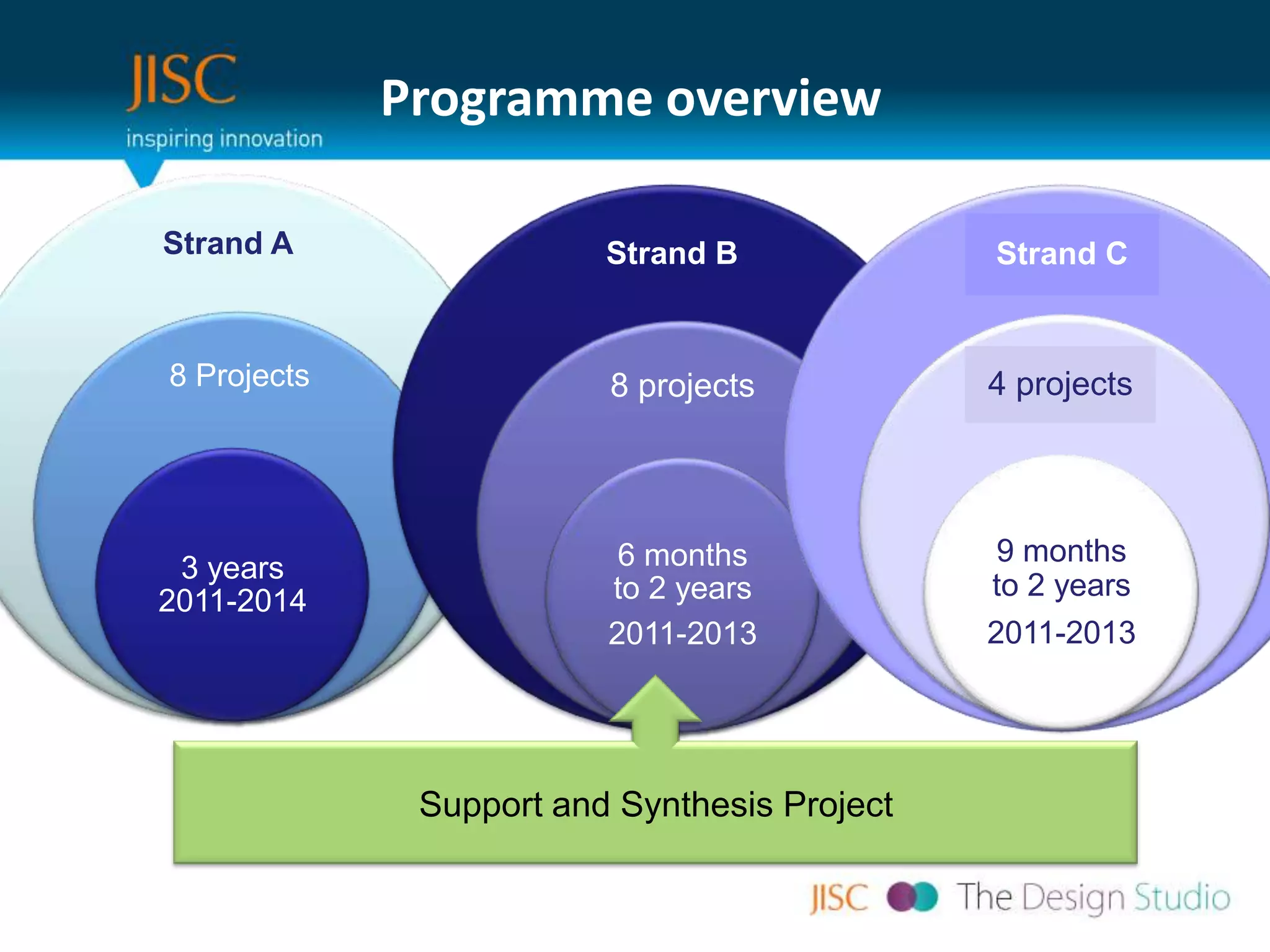
Programme overview

Strand A                 Strand B             Strand C


8 Projects               8 projects           4 projects


                          6 months            9 months
 3 years
2011-2014                to 2 years           to 2 years
                         2011-2013            2011-2013


              Support and Synthesis Project
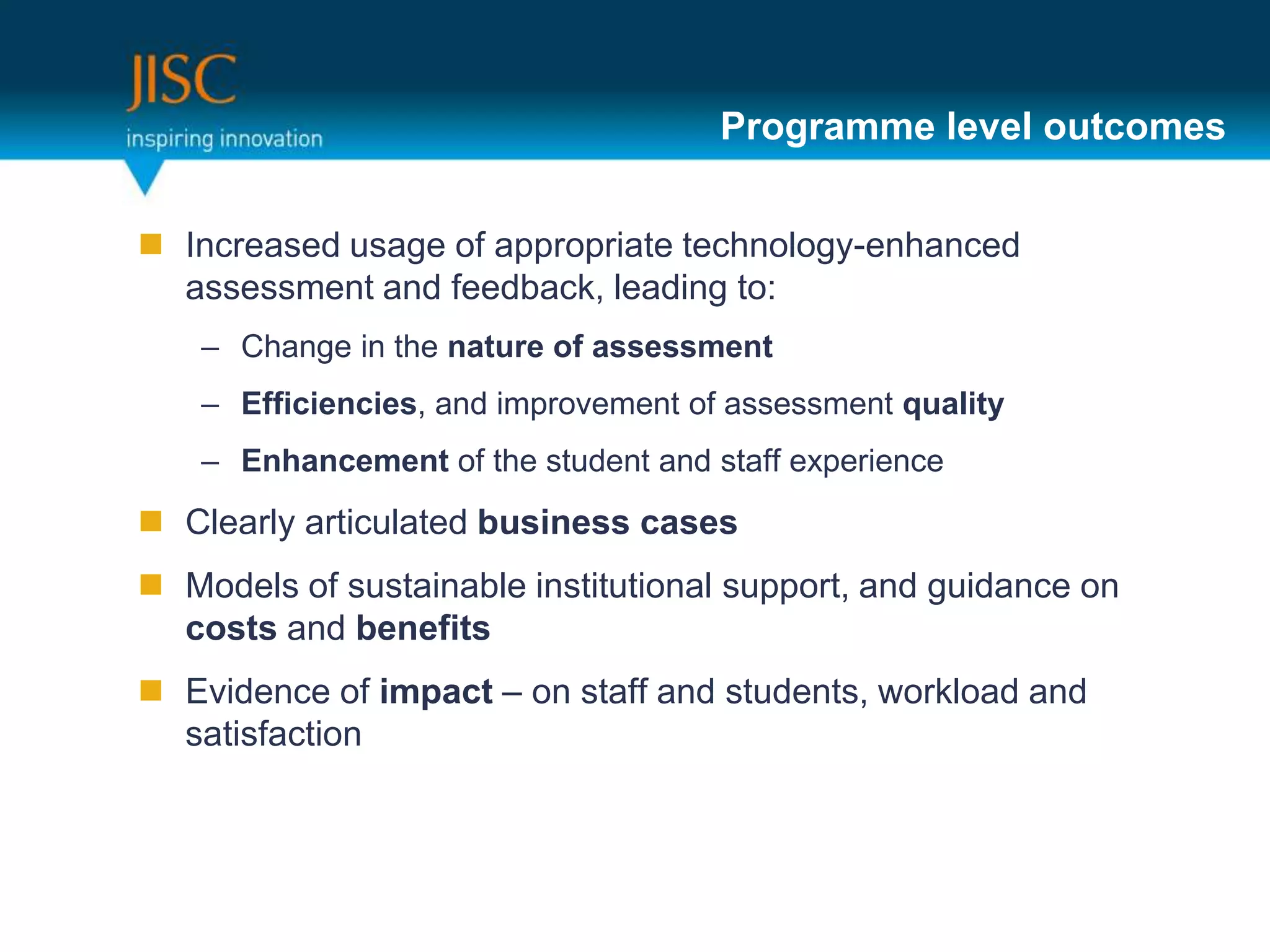
Programme level outcomes


 Increased usage of appropriate technology-enhanced
  assessment and feedback, leading to:
    – Change in the nature of assessment
    – Efficiencies, and improvement of assessment quality
    – Enhancement of the student and staff experience
 Clearly articulated business cases
 Models of sustainable institutional support, and guidance on
  costs and benefits
 Evidence of impact – on staff and students, workload and
  satisfaction
JISC requirements


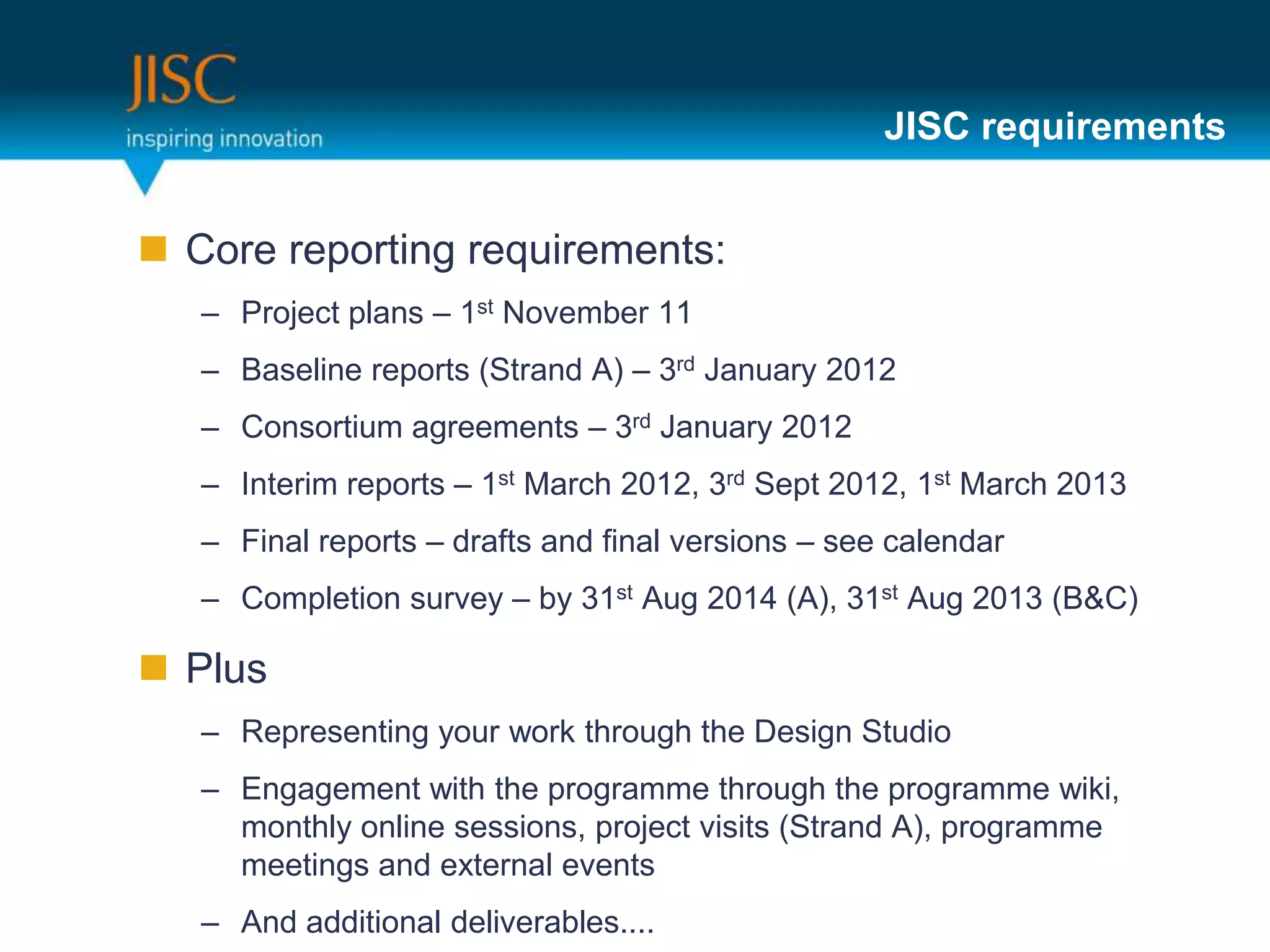
 Core reporting requirements:
   – Project plans – 1st November 11
   – Baseline reports (Strand A) – 3rd January 2012
   – Consortium agreements – 3rd January 2012
   – Interim reports – 1st March 2012, 3rd Sept 2012, 1st March 2013
   – Final reports – drafts and final versions – see calendar
   – Completion survey – by 31st Aug 2014 (A), 31st Aug 2013 (B&C)

 Plus
   – Representing your work through the Design Studio
   – Engagement with the programme through the programme wiki,
     monthly online sessions, project visits (Strand A), programme
     meetings and external events
   – And additional deliverables....
Deliverables


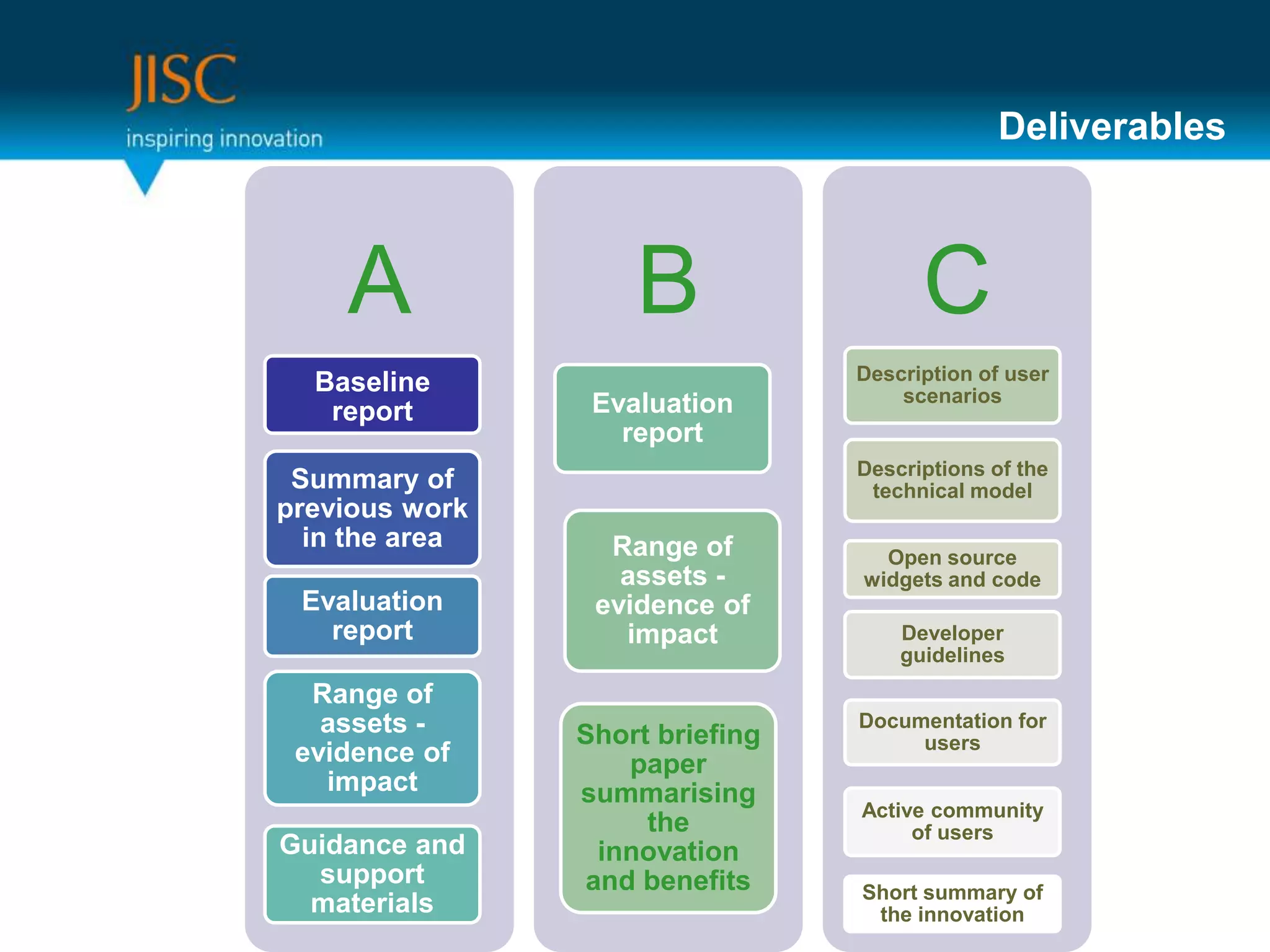
    A               B                  C
  Baseline                       Description of user
                 Evaluation          scenarios
   report
                   report
                                 Descriptions of the
 Summary of                       technical model
previous work
  in the area     Range of         Open source
                   assets -      widgets and code
 Evaluation      evidence of
   report          impact            Developer
                                     guidelines
  Range of
   assets -     Short briefing
                                 Documentation for
                                      users
 evidence of       paper
   impact       summarising
                                 Active community
                     the              of users
Guidance and     innovation
  support       and benefits     Short summary of
  materials                       the innovation
Programme and support team


www.jisc.ac.uk/assessmentandfeedback
                           #JISCASSESS
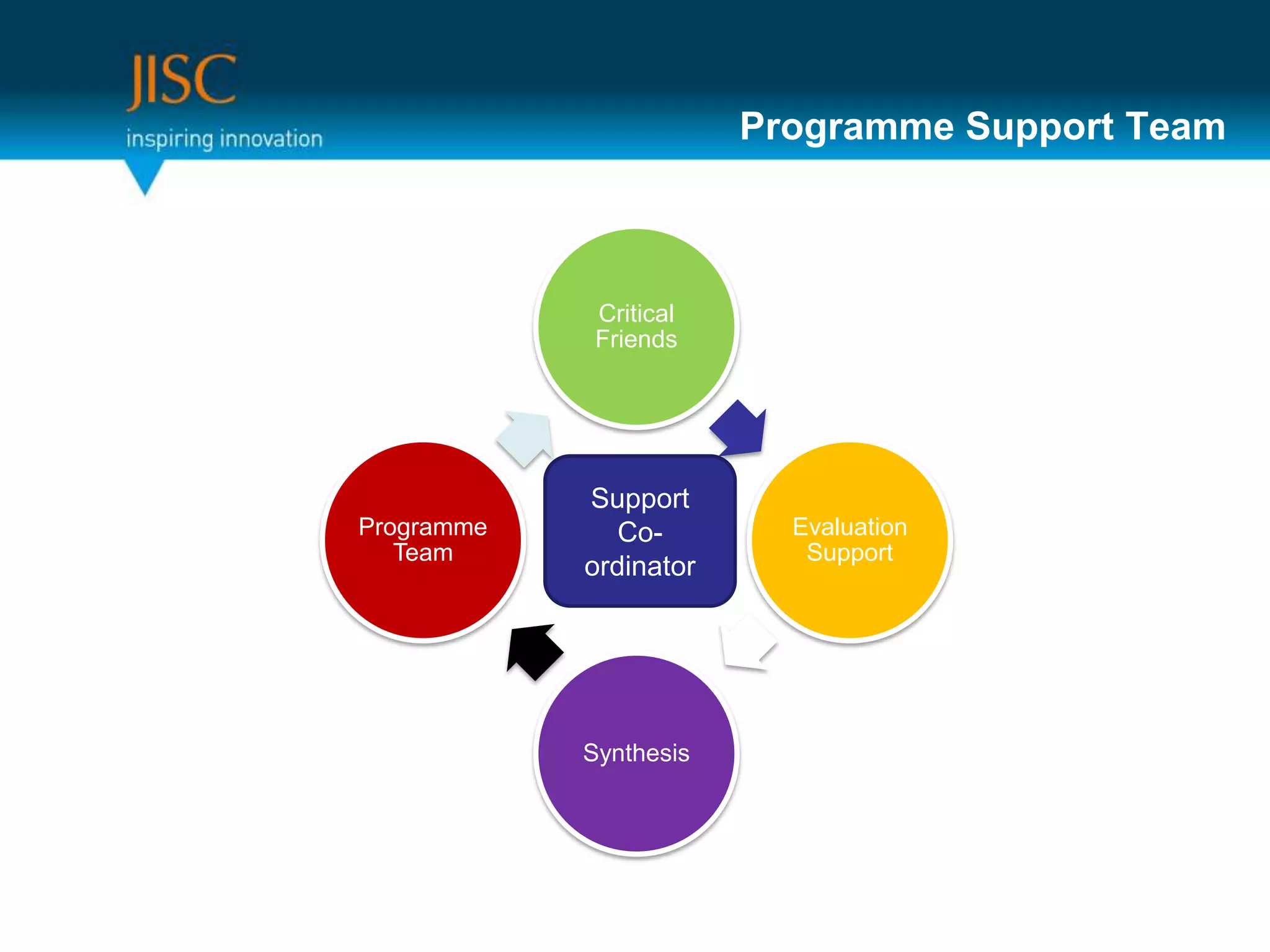
Programme Support Team


             Critical
             Friends


            Support
Programme      Co-        Evaluation
   Team                    Support
            ordinator


            Synthesis
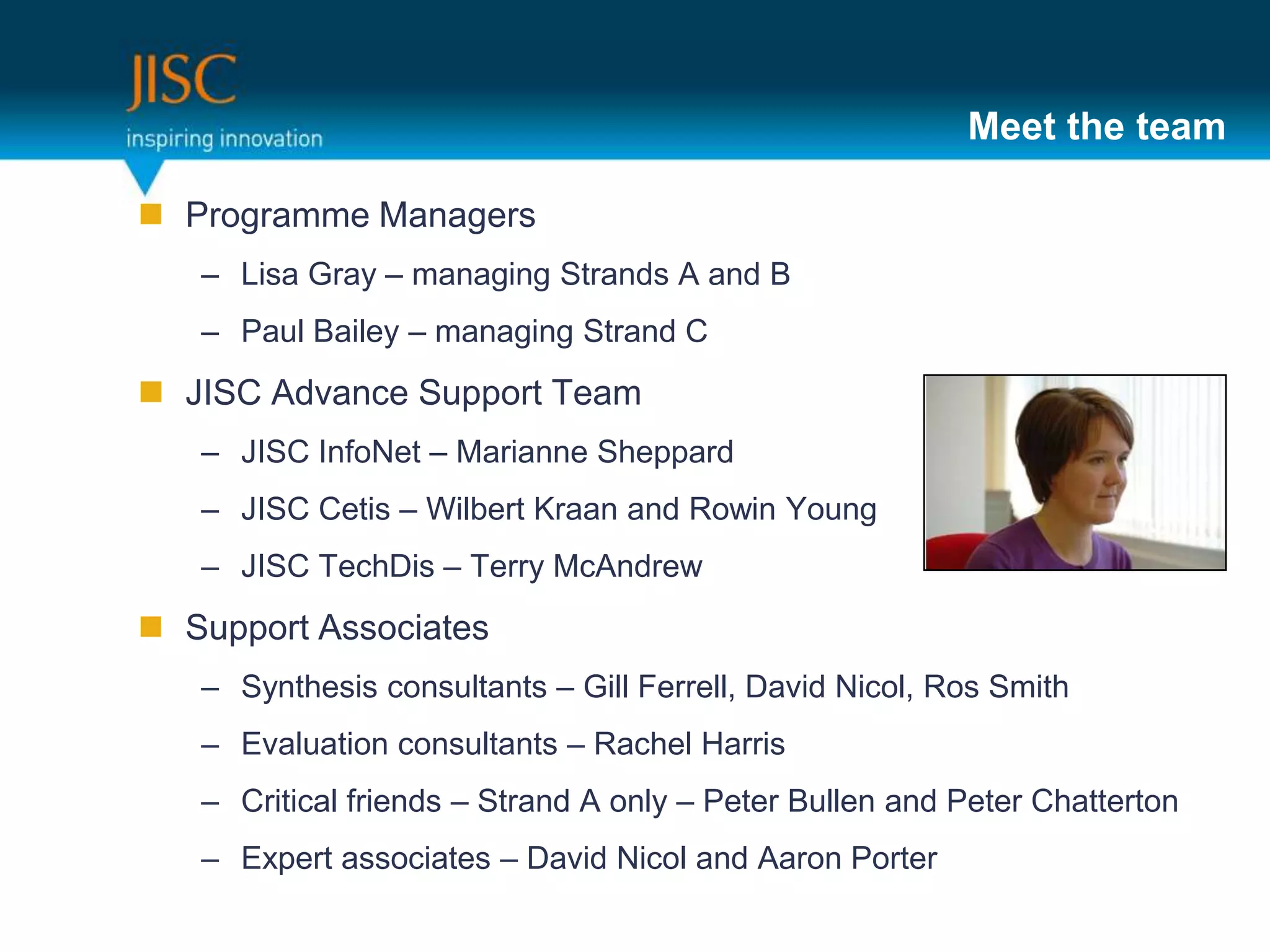
Meet the team

 Programme Managers
   – Lisa Gray – managing Strands A and B
   – Paul Bailey – managing Strand C
 JISC Advance Support Team
   – JISC InfoNet – Marianne Sheppard
   – JISC Cetis – Wilbert Kraan and Rowin Young
   – JISC TechDis – Terry McAndrew
 Support Associates
   – Synthesis consultants – Gill Ferrell, David Nicol, Ros Smith
   – Evaluation consultants – Rachel Harris
   – Critical friends – Strand A only – Peter Bullen and Peter Chatterton
   – Expert associates – David Nicol and Aaron Porter
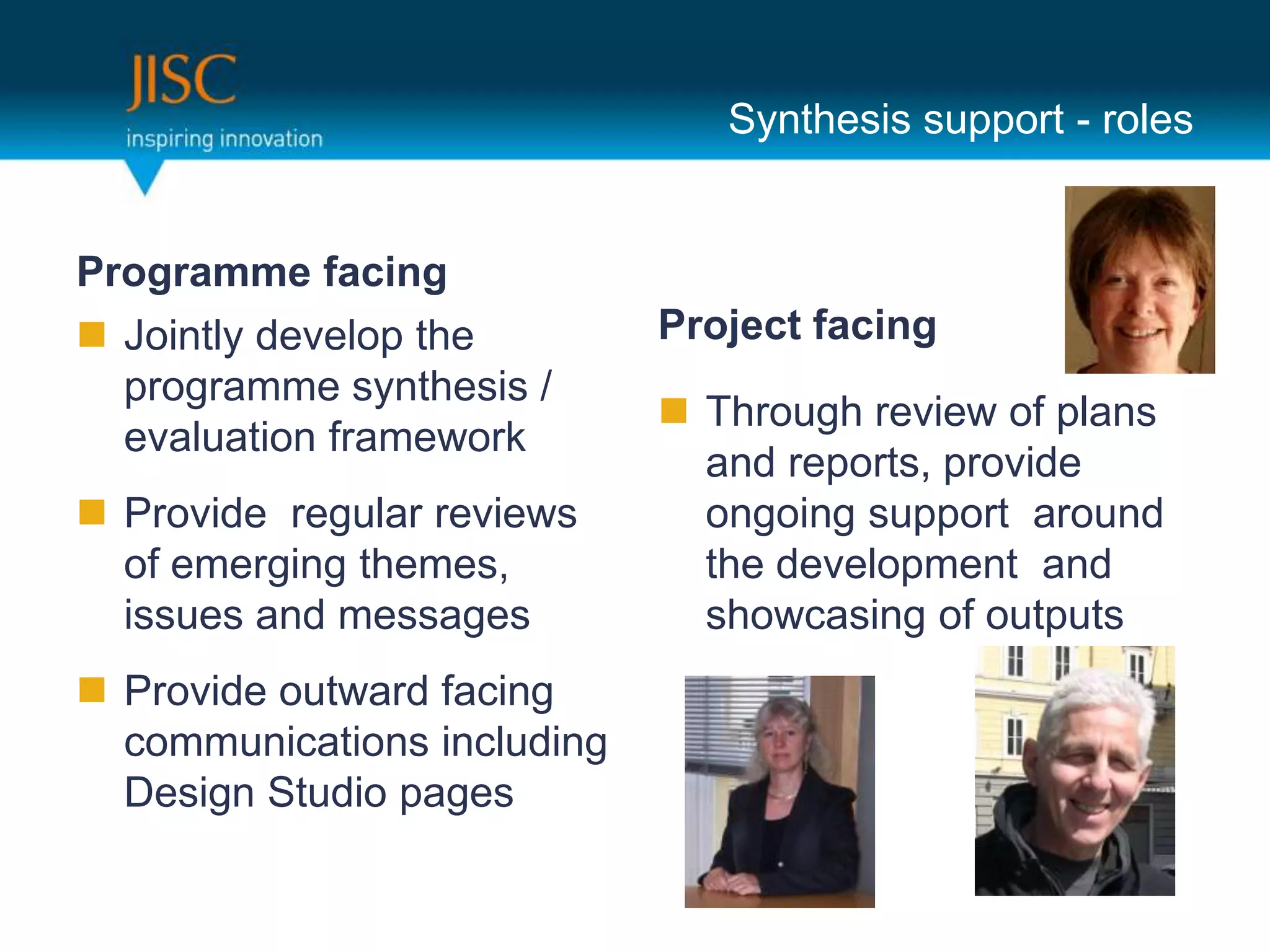
Synthesis support - roles


Programme facing
 Jointly develop the        Project facing
  programme synthesis /
                              Through review of plans
  evaluation framework
                               and reports, provide
 Provide regular reviews      ongoing support around
  of emerging themes,          the development and
  issues and messages          showcasing of outputs
 Provide outward facing
  communications including
  Design Studio pages
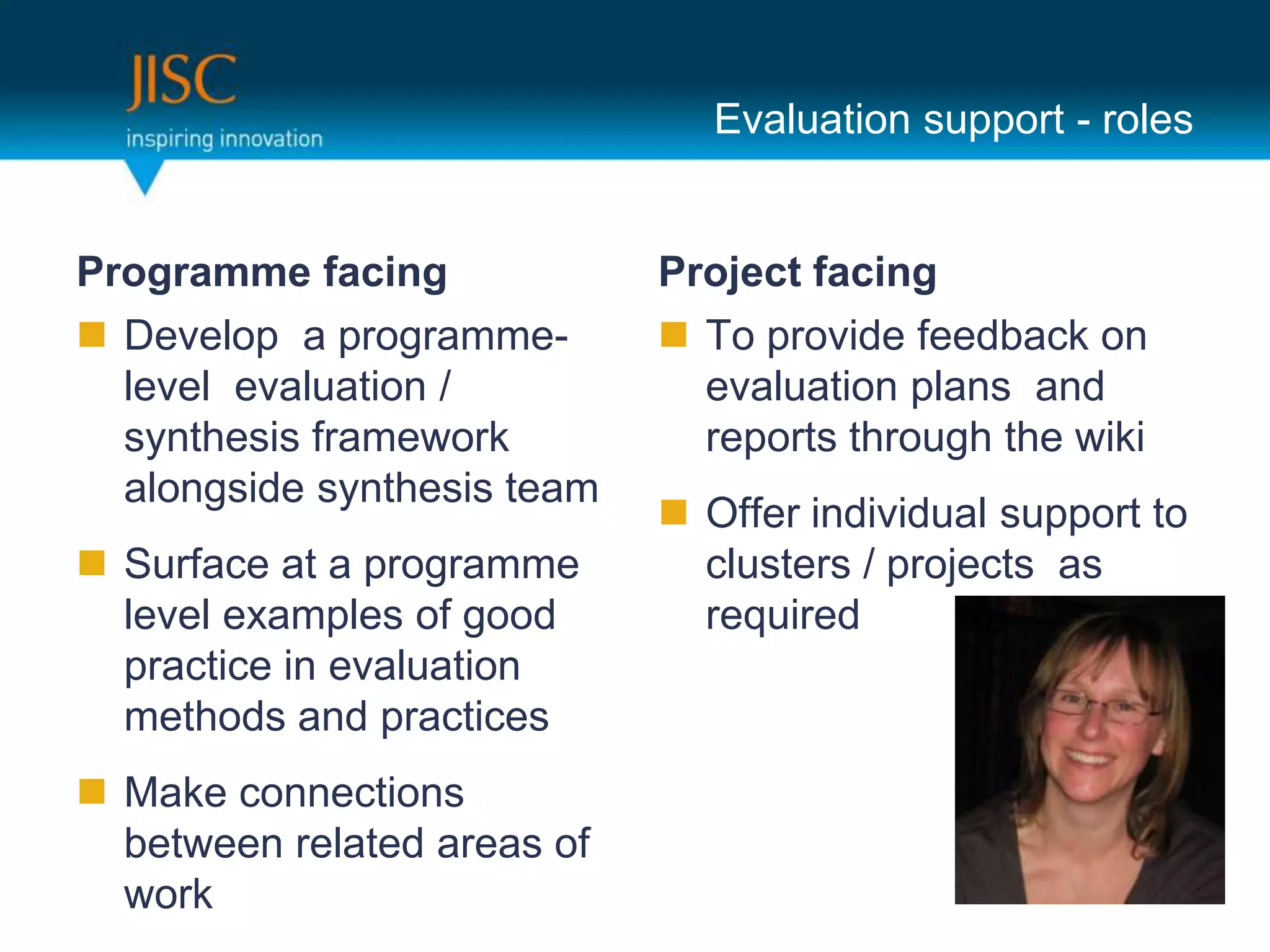
Evaluation support - roles


Programme facing             Project facing
 Develop a programme-        To provide feedback on
  level evaluation /           evaluation plans and
  synthesis framework          reports through the wiki
  alongside synthesis team
                              Offer individual support to
 Surface at a programme       clusters / projects as
  level examples of good       required
  practice in evaluation
  methods and practices
 Make connections
  between related areas of
  work
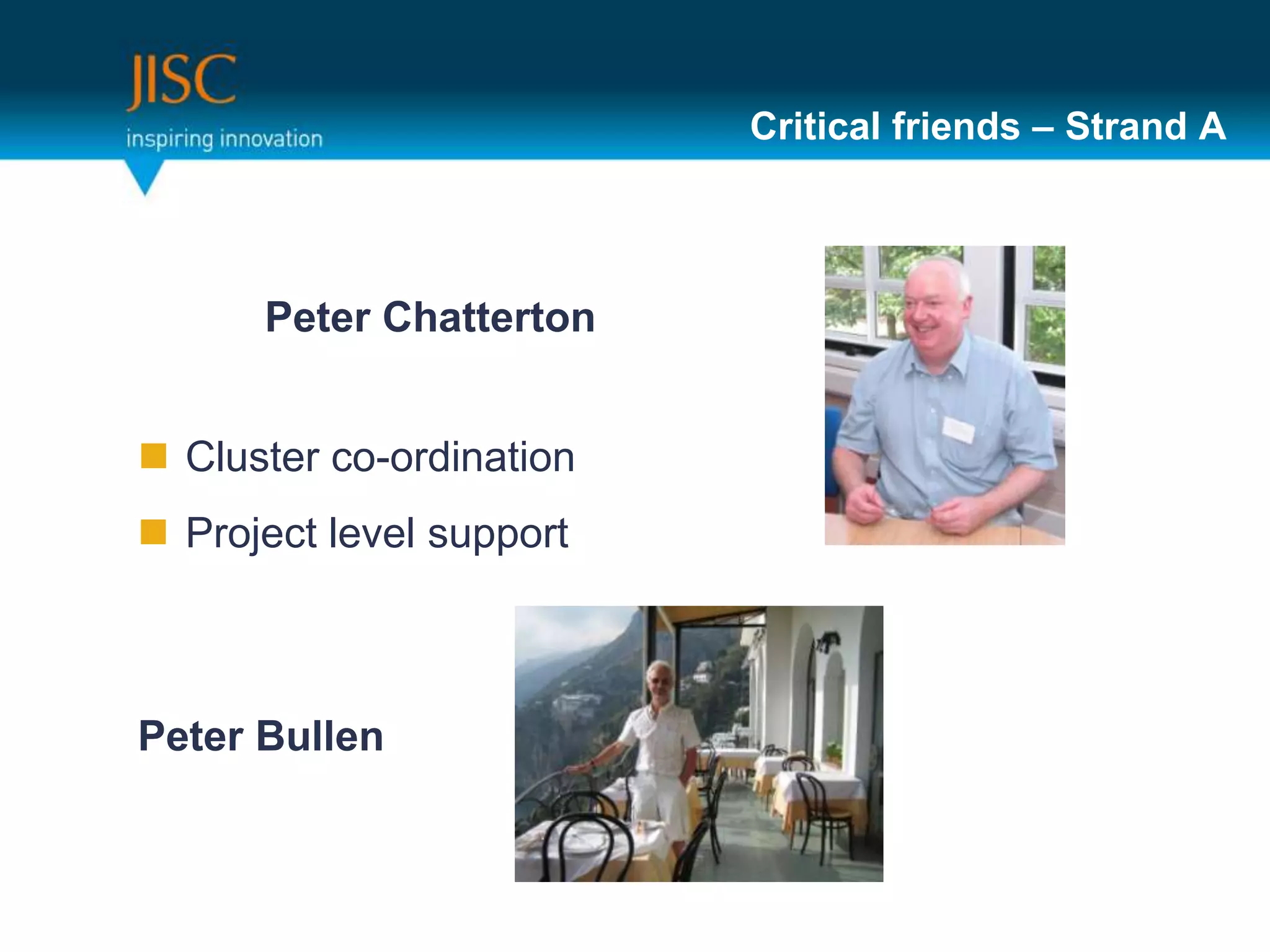
Critical friends – Strand A


      Peter Chatterton


 Cluster co-ordination
 Project level support


Peter Bullen
Wiki spaces and key
                 resources


www.jisc.ac.uk/assessmentandfeedback
                            #JISCASSESS
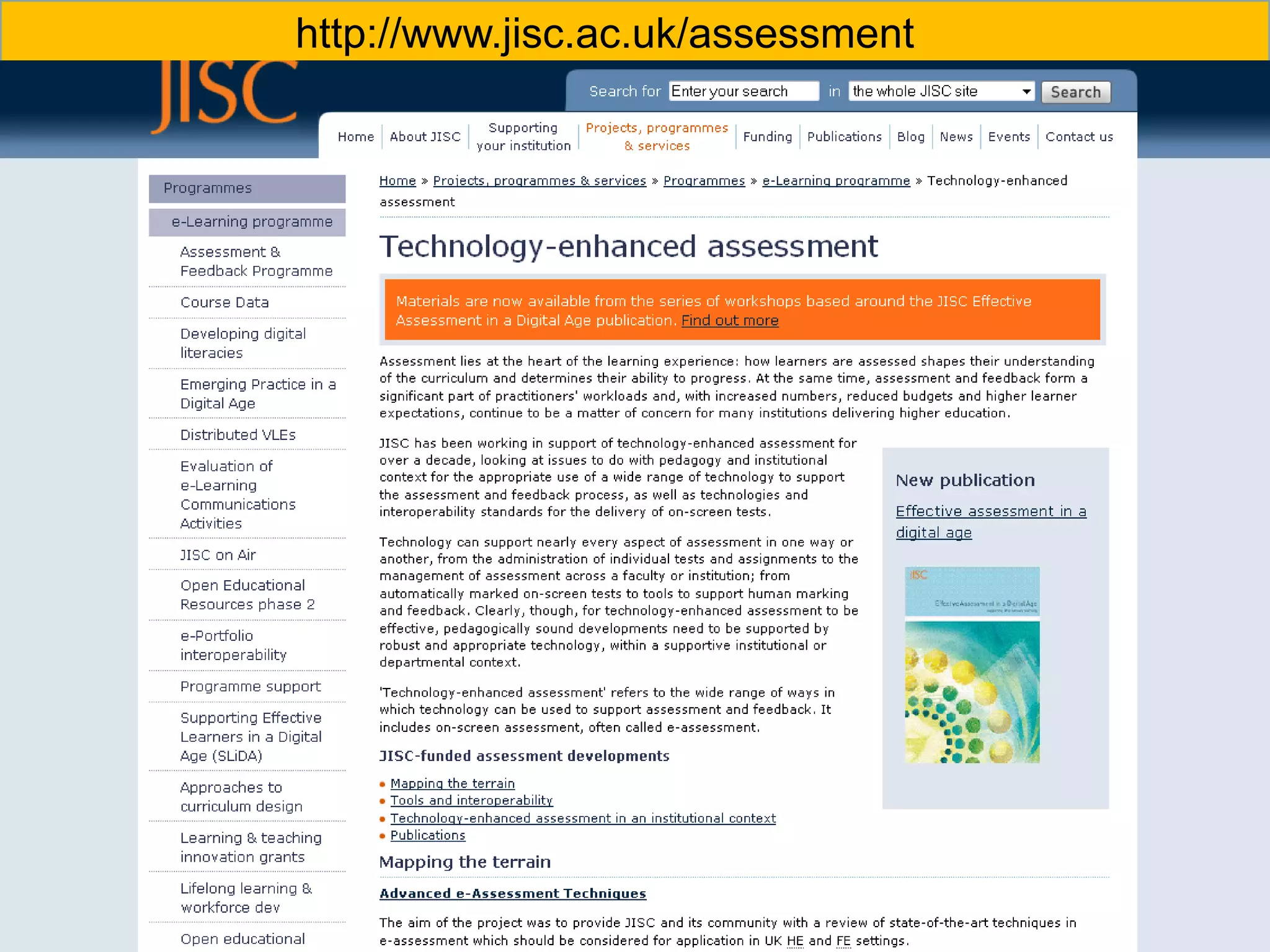
http://www.jisc.ac.uk/assessment
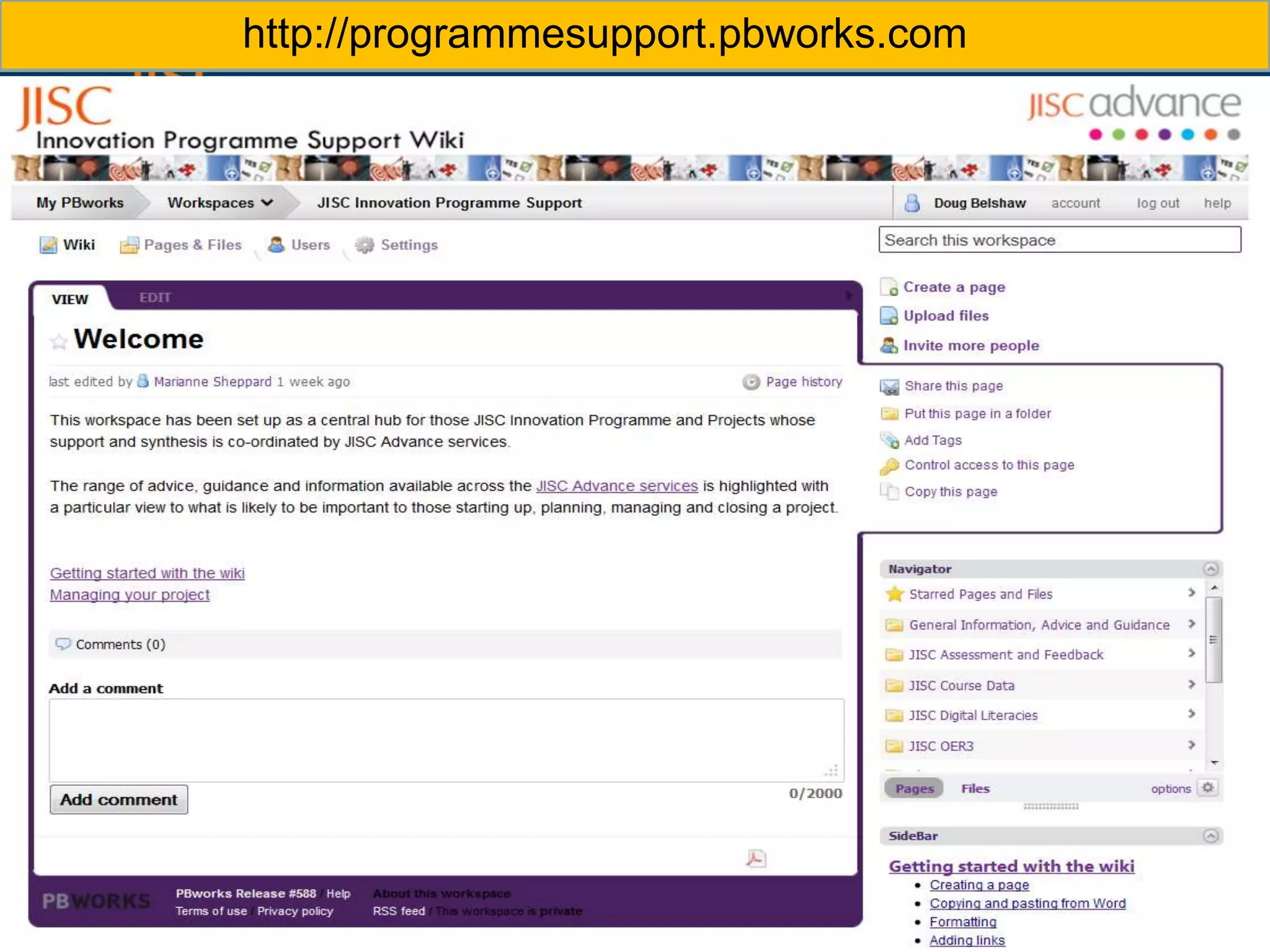
http://programmesupport.pbworks.com
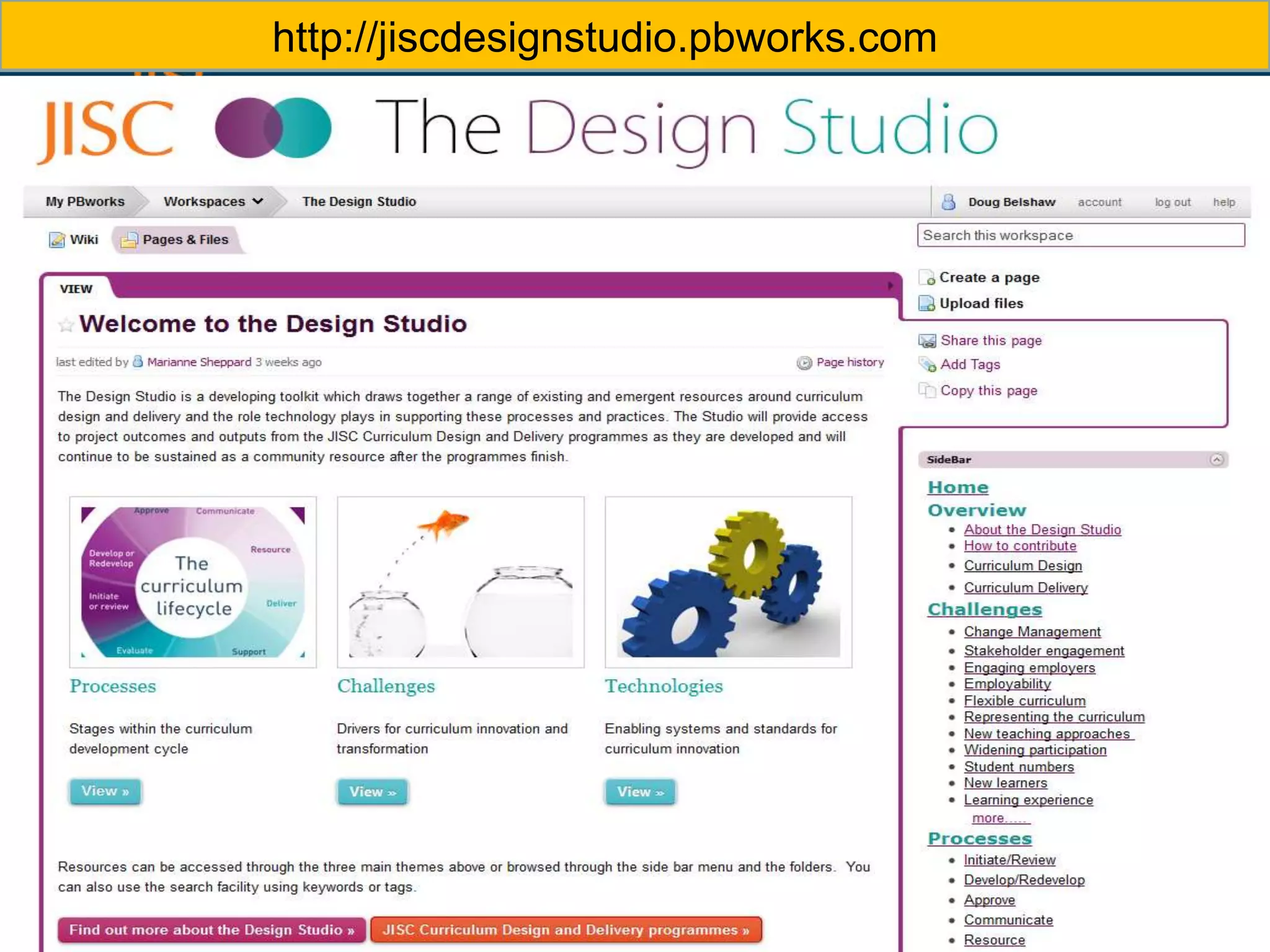
http://jiscdesignstudio.pbworks.com
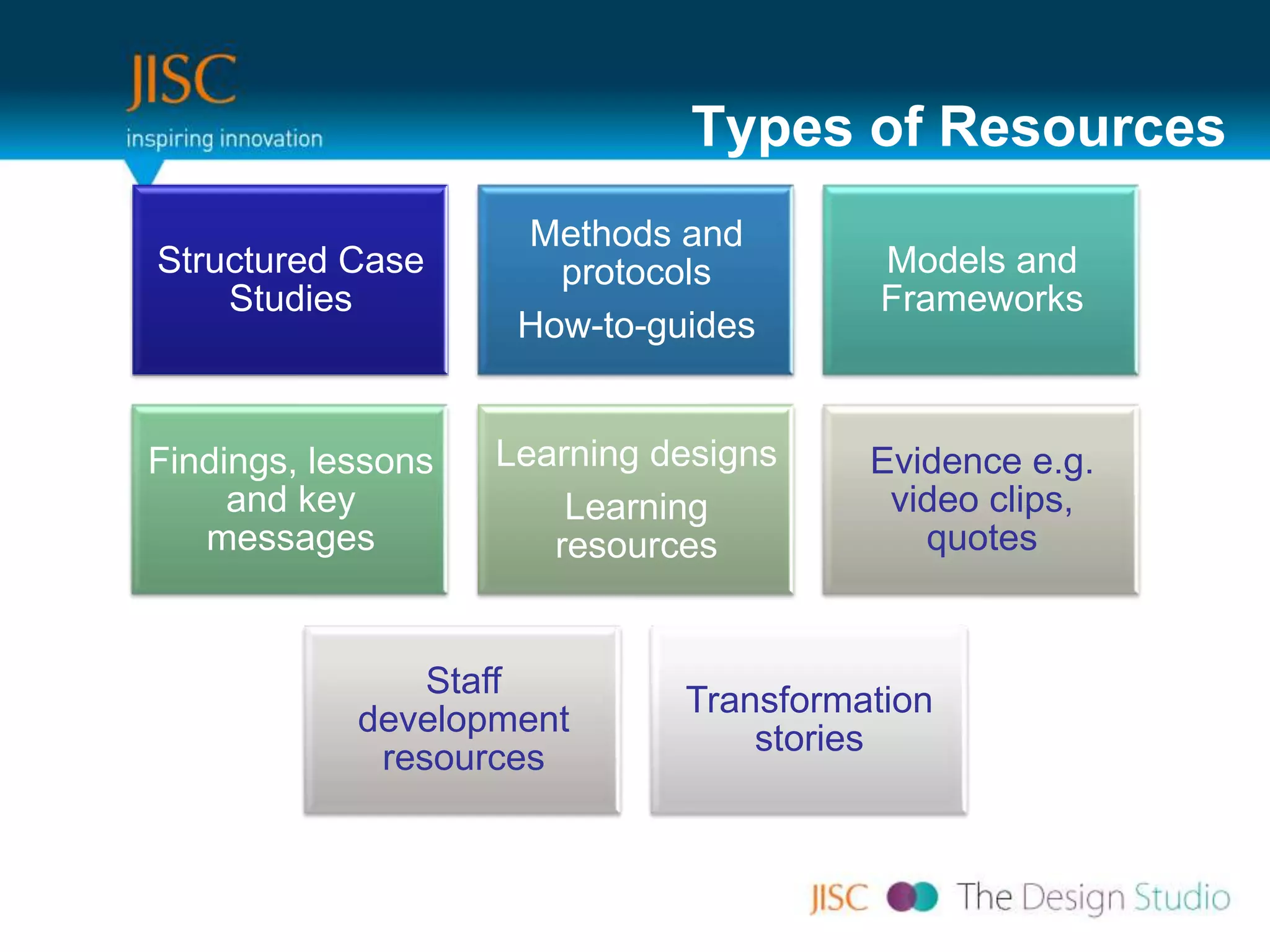
Types of Resources
                     Methods and
Structured Case        protocols         Models and
    Studies                              Frameworks
                     How-to-guides


Findings, lessons   Learning designs    Evidence e.g.
     and key            Learning         video clips,
   messages            resources           quotes


                Staff
                              Transformation
            development
                                  stories
             resources
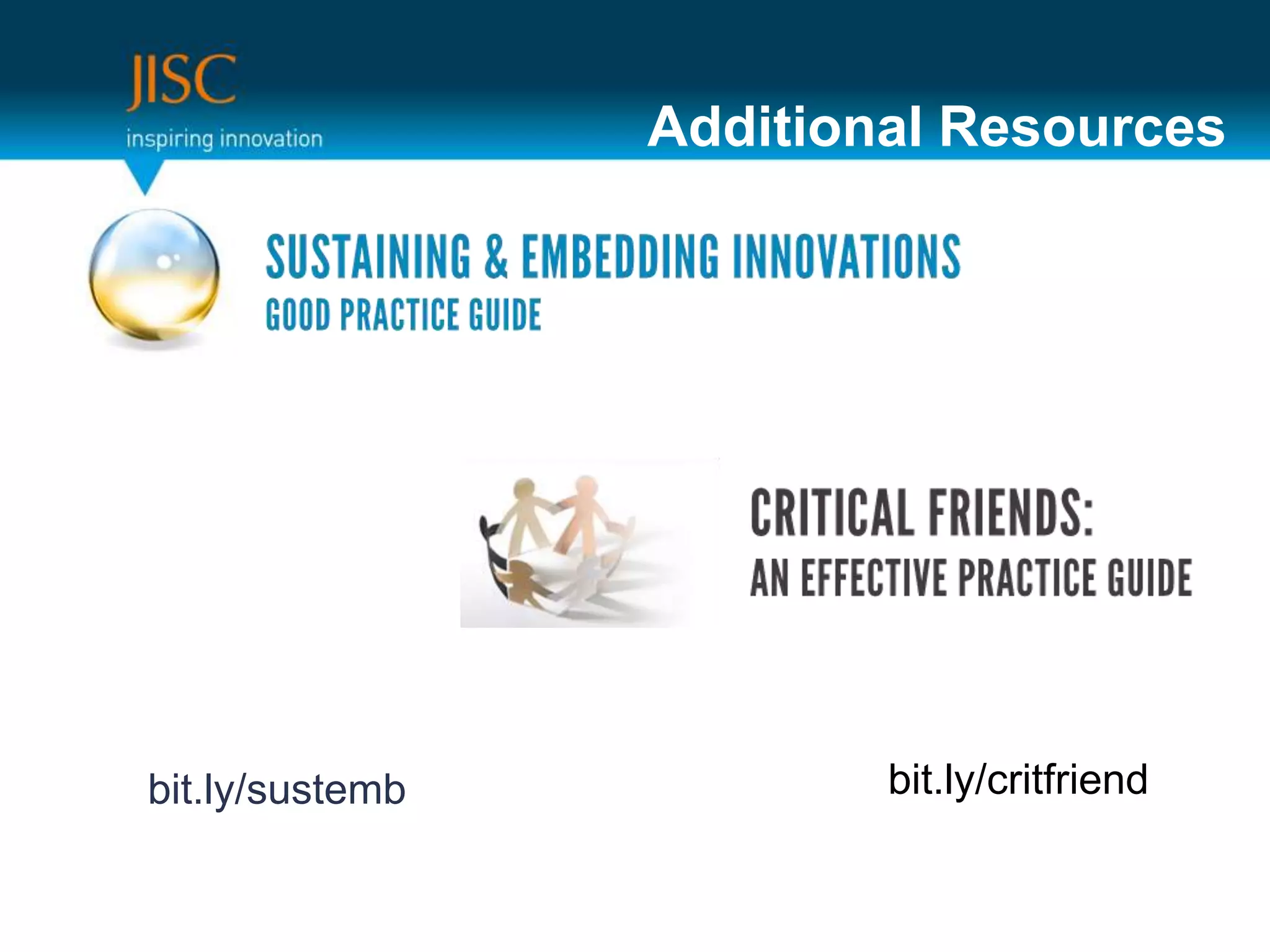
Additional Resources


bit.ly/sustemb           bit.ly/critfriend
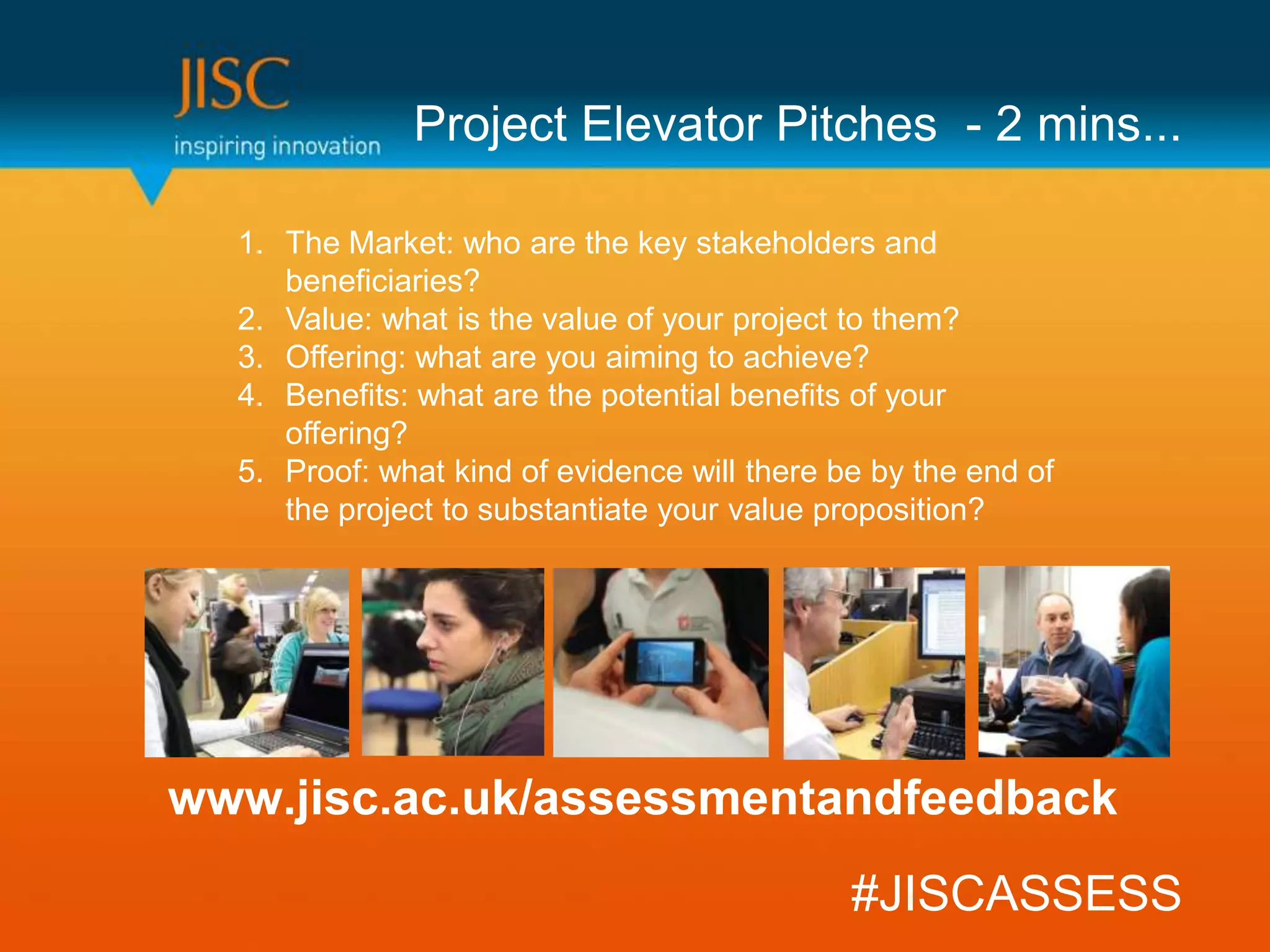
Project Elevator Pitches - 2 mins...

  1. The Market: who are the key stakeholders and
     beneficiaries?
  2. Value: what is the value of your project to them?
  3. Offering: what are you aiming to achieve?
  4. Benefits: what are the potential benefits of your
     offering?
  5. Proof: what kind of evidence will there be by the end of
     the project to substantiate your value proposition?


www.jisc.ac.uk/assessmentandfeedback
                                              #JISCASSESS
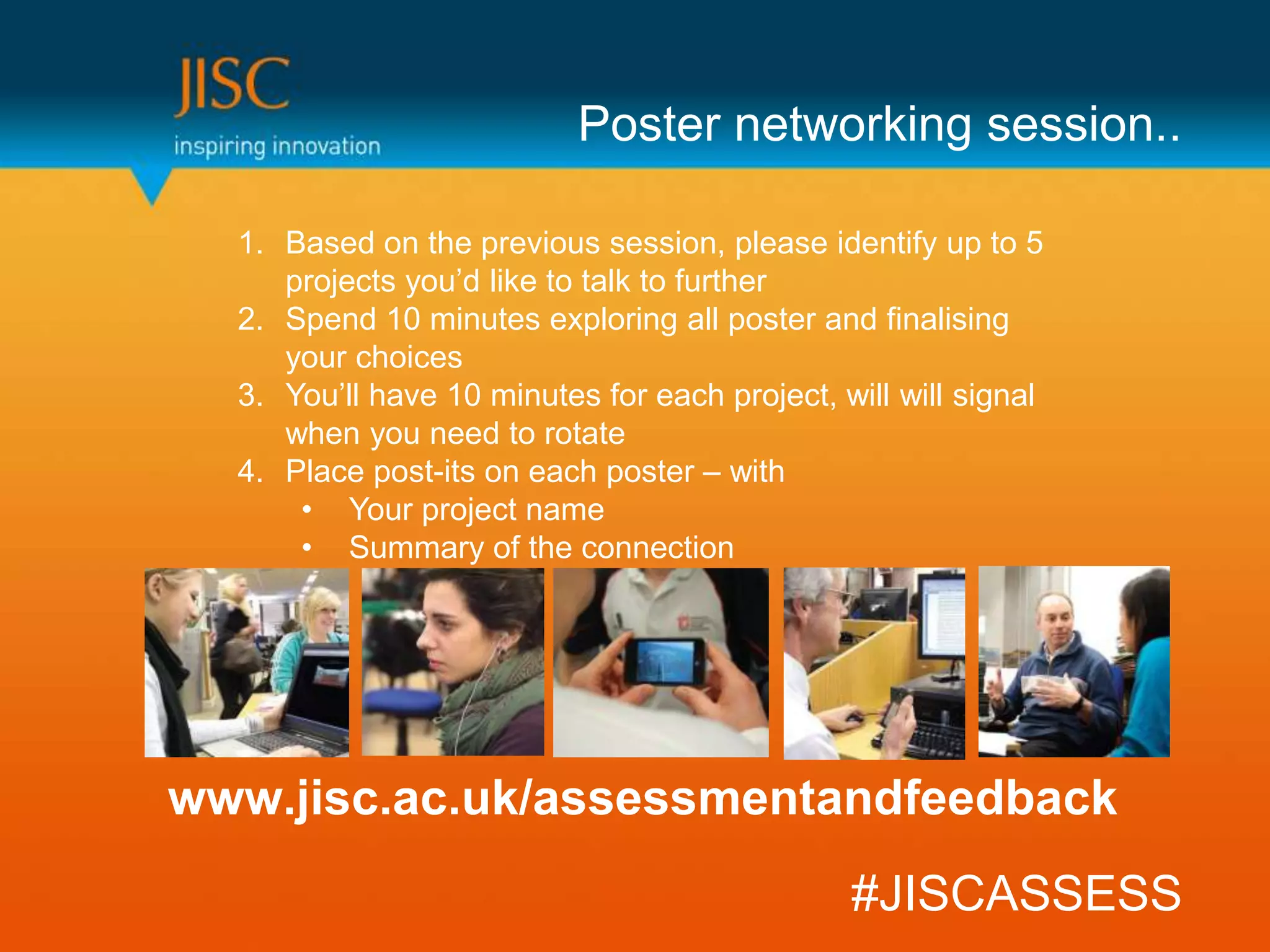
Poster networking session..

  1. Based on the previous session, please identify up to 5
     projects you’d like to talk to further
  2. Spend 10 minutes exploring all poster and finalising
     your choices
  3. You’ll have 10 minutes for each project, will will signal
     when you need to rotate
  4. Place post-its on each poster – with
      • Your project name
      • Summary of the connection


www.jisc.ac.uk/assessmentandfeedback
                                               #JISCASSESS

Assessment and Feedback start-up meeting Oct 2011

  • 1.
    #jiscassess www.jisc.ac.uk/assessmentandfeedback JISC Assessment and Feedback Programme Meeting 5th October 2011
  • 2.
    Welcome  A specialwelcome to project representatives, programme support team, JISC Advance and JISC RSC’s, The Higher Education Academy  Housekeeping – 13.00 – 14:00 Lunch in the restaurant – 16:00 Close  Wireless access and extension cables  Delegate packs – Agenda, guide to the wiki spaces, programme calendar, Making Connections session handout – Feedback please – online evaluation forms!  Publications from the e-Learning team
  • 3.
    Agenda  10.00 –10.30: Overview of programme and expectations  10.30 – 11.00: Project Elevator Pitches  11.00 – 11.15: Tea and coffee  11.15 – 11.45: Project Elevator Pitches (continued)  11.45 – 13.00: Poster Networking  13.00 – 14.00: Lunch  14.00 – 15.00: Parallel sessions: » Strand A – main room (Expand Suite) » Strand B – breakout room (Advance 2) » Strand C – breakout room (Advance 3)  15.00 – 16.00: Change Activity (The Higher Education Academy)
  • 4.
    Aims for today Introduce the JISC Assessment and Feedback programme, team, structure and expectations  Provide an opportunity for projects to hear about each others’ work and to identify connections and common themes  Facilitate networking between projects, and cluster level discussions  Initiate discussions relating to this phase of project planning
  • 5.
    Programme overview andexpectations  Overview of the programme structure  Summary of expectations for each strand  Reporting and other programme requirements  Introduction to the support team  Wiki spaces and useful resources
  • 6.
    Overview Overview of programme, strands, deliverables and reporting expectations www.jisc.ac.uk/assessmentandfeedback #JISCASSESS
  • 7.
    Programme overview Strand A Strand B Strand C 8 Projects 8 projects 4 projects 6 months 9 months 3 years 2011-2014 to 2 years to 2 years 2011-2013 2011-2013 Support and Synthesis Project
  • 8.
    Programme level outcomes Increased usage of appropriate technology-enhanced assessment and feedback, leading to: – Change in the nature of assessment – Efficiencies, and improvement of assessment quality – Enhancement of the student and staff experience  Clearly articulated business cases  Models of sustainable institutional support, and guidance on costs and benefits  Evidence of impact – on staff and students, workload and satisfaction
  • 9.
    JISC requirements  Corereporting requirements: – Project plans – 1st November 11 – Baseline reports (Strand A) – 3rd January 2012 – Consortium agreements – 3rd January 2012 – Interim reports – 1st March 2012, 3rd Sept 2012, 1st March 2013 – Final reports – drafts and final versions – see calendar – Completion survey – by 31st Aug 2014 (A), 31st Aug 2013 (B&C)  Plus – Representing your work through the Design Studio – Engagement with the programme through the programme wiki, monthly online sessions, project visits (Strand A), programme meetings and external events – And additional deliverables....
  • 10.
    Deliverables A B C Baseline Description of user Evaluation scenarios report report Descriptions of the Summary of technical model previous work in the area Range of Open source assets - widgets and code Evaluation evidence of report impact Developer guidelines Range of assets - Short briefing Documentation for users evidence of paper impact summarising Active community the of users Guidance and innovation support and benefits Short summary of materials the innovation
  • 11.
    Programme and supportteam www.jisc.ac.uk/assessmentandfeedback #JISCASSESS
  • 12.
    Programme Support Team Critical Friends Support Programme Co- Evaluation Team Support ordinator Synthesis
  • 13.
    Meet the team Programme Managers – Lisa Gray – managing Strands A and B – Paul Bailey – managing Strand C  JISC Advance Support Team – JISC InfoNet – Marianne Sheppard – JISC Cetis – Wilbert Kraan and Rowin Young – JISC TechDis – Terry McAndrew  Support Associates – Synthesis consultants – Gill Ferrell, David Nicol, Ros Smith – Evaluation consultants – Rachel Harris – Critical friends – Strand A only – Peter Bullen and Peter Chatterton – Expert associates – David Nicol and Aaron Porter
  • 14.
    Synthesis support -roles Programme facing  Jointly develop the Project facing programme synthesis /  Through review of plans evaluation framework and reports, provide  Provide regular reviews ongoing support around of emerging themes, the development and issues and messages showcasing of outputs  Provide outward facing communications including Design Studio pages
  • 15.
    Evaluation support -roles Programme facing Project facing  Develop a programme-  To provide feedback on level evaluation / evaluation plans and synthesis framework reports through the wiki alongside synthesis team  Offer individual support to  Surface at a programme clusters / projects as level examples of good required practice in evaluation methods and practices  Make connections between related areas of work
  • 16.
    Critical friends –Strand A Peter Chatterton  Cluster co-ordination  Project level support Peter Bullen
  • 17.
    Wiki spaces andkey resources www.jisc.ac.uk/assessmentandfeedback #JISCASSESS
  • 18.
  • 19.
  • 20.
  • 21.
    Types of Resources Methods and Structured Case protocols Models and Studies Frameworks How-to-guides Findings, lessons Learning designs Evidence e.g. and key Learning video clips, messages resources quotes Staff Transformation development stories resources
  • 22.
  • 23.
    Project Elevator Pitches- 2 mins... 1. The Market: who are the key stakeholders and beneficiaries? 2. Value: what is the value of your project to them? 3. Offering: what are you aiming to achieve? 4. Benefits: what are the potential benefits of your offering? 5. Proof: what kind of evidence will there be by the end of the project to substantiate your value proposition? www.jisc.ac.uk/assessmentandfeedback #JISCASSESS
  • 24.
    Poster networking session.. 1. Based on the previous session, please identify up to 5 projects you’d like to talk to further 2. Spend 10 minutes exploring all poster and finalising your choices 3. You’ll have 10 minutes for each project, will will signal when you need to rotate 4. Place post-its on each poster – with • Your project name • Summary of the connection www.jisc.ac.uk/assessmentandfeedback #JISCASSESS

Editor's Notes

  • #5 The outcomes of the programme would be widely communicated and disseminated to colleges and universities – with opportunities to work with professional and sector bodies to use their networks. The programme aims to have practical and tangible outputs which other colleges and universities can gain value from and use in their own contexts.
  • #8 Assessment, as we all know, lies at the heart of the heart of the learning experience. Over the last couple of years JISC recognised the importance of this area in it being a key driver to change in institutions, as well the enormous potential technology has to transform assessment practices, proven by previous programmes of work including the Curriculum Design and Curriculum Delivery programmes which have recently completed. We have recently launched a new guide Effective Assessment in a Digital Age, which showcases some of the excellent work that has gone before, as well as run a number of national workshops taking this work into institutions. This programme builds on all of this past work, aiming to take us forward in new ways. Strand A: Institutional change. These projects will redesign assessment and feedback processes and practices, making best use of technology to deliver significant change at programme, school or institutional level.(15 months – 2 years funded, £100-£200k per project)Strand B: Evidence and evaluation. These projects will evaluate assessment-and feedback-related innovations which are already underway in a faculty or institution, and report on lessons for the sector.(6 months – 2 years, £20k per project) Strand C: Technology transfer. These projects will package a technology innovation in assessment and feedback for re-use (with associated processes and practice), and support its transfer to two or more named external institutions.(9 months – 2 years, £40k per project)Support projectA Support and Synthesis project led by JISC infoNet and in partnership with JISC-CETIS will co-ordinate a support and synthesis team to provide support to projects across all strands hrough a range of mechanisms including Elluminate workshops, access to sector expertise and peer support through CAMEL networks. I’ll say a little more about that later.
  • #10 These dates are all in your calendars, but just to summarise the core reporting requirements are:Reports – we’ll be asking you to complete all future reports in the wiki, further information on this process will provided. All comments on your project plans for example will be shared through the wiki. Project plans – all strands - drafts should now be in, and final versions need to be completed by 1st November. Please let me know if there’s likely to be any delays, and we can look to accommodate those where possible. There is one to one support around the evaluation planning available from our evaluation expert – which I’ll mention later. Also cluster level and critical friend support for Strand A plans. Interim reports – six monthlyFinal report – telling the story of your project to the wider community, what you have done, how and why, and what you have learnt. Completion survey is a confidential official sign off of the project.ALL DOCS WILL BE AVAILABLE FROM THE PUBLIC JISC PAGES as well as the programme wiki space. HOWEVER if there is sensitive information to be shared you’ll also be able to do so through the wiki, and this won’t be shared more widely. ALL PROJECTS will also be expected to engage with the Design Studio which I’ll mention a little later as a programme level route to disseminating your project outputs. AND engage with the programme through the programme wiki, online Collaborate sessions, face to face programme meetings, and other external events as required. All strand A projects will also have a project visit. Each strand is also expected to deliver on a set of specific deliverables.....
  • #19 JISC Assessment pagesProvides:Background to JISC’s activities with technology enhanced assessment Link to the latest JISC publication on assessment – Effective assessment in a digital age Information on previous projects and activities in the assessment spaceResources including activities to run with stakeholder groups developed as part of a series of national workshops
  • #20  Programme space Share reports, receive feedback, work in shared spaces with other projects Project pages – will be prepopulated by us from information in your project plans. All project plans will be uploaded here, and all future reports you’ll be expected to either create in the wiki, or upload as a document. Using the wiki will mean we will be able to have separate sections for different topics, and collate them in different ways for different purposes. Will be a private space for any sensitive information just shared between you and the programme team. All reports will be also wrapped up as documents and shared on the JISC project pages as a formal record. Closed to the programme community including support team Links to further relevant resources provided here – e.g. Collated resources around evaluation and project management, programme calendar etc Collating project blogs Further information on accessing the wiki and your project pages will be sent round next week.
  • #22 What types of resources will you find here?A range of different types of tools, case studies, models, learning design, lessons learned etc which support teams in designing, developing and delivering curriculum in their institutions
  • #23 Sustainability Toolkit. Developed as a result of the programmes experiences, built on at JIF and the JISC online conference. Includes sections on: Changing people and cultureInfluencing organisational changeEmbedding or aligning innovations Creating tools and resources commercial and open approaches to innovationCritical friends resource A resource for future critical friends, on the process, examples, and benefits of the approach.
  • #24 Our first activity are the project elevator pitches – we’ve asked all projects to prepare a 2 minute ‘elevator pitches’ imagining your are in a lift with some very important people, and have only a limited time to let them know succintly what the value is of your project, and to who. We’ve asked you to think about the following: You’ll have 2 minutes each, plus one minute for one questionPLEASE USE YOUR CONNECTIONS SHEET TO START MAKING NOTES ON THE PROJECTS YOU IDENTIFY CONNECTIONS WITH, to inform who you might like to network with in the next session.
  • #25 We asked you to prepare a poster providing a visual representation of your project – so thank you all very much for the excellent posters we have today. Based on the information you’ve received so far, please identify up to 5 projects you’d like to spend time talking to. We’ll sound a buzzer after 10 mins and ask you to rotate. Try to include at least 2 projects from different strands. If you are the only representative from your project, please stay with your poster if you have interested parties, but ensure you move round too. PLEASE ENSURE THAT YOU PLACE A POST-IT ON EACH PROJECT YOU’ve identified a connection with your project name , and summary of the connection.