From Open Data to Open Pedagogy:
An Introduction to Integrating Open Practices
into the Classroom
Michelle Reed, Open Education Librarian
Peace Ossom Williamson, Director of Research Data Services
Open Education Week | UTA Libraries | 3.30.17
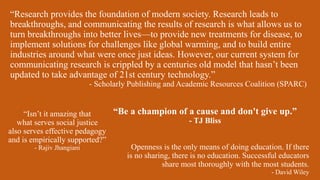
Openness is the only means of doing education. If there
is no sharing, there is no education. Successful educators
share most thoroughly with the most students.
- David Wiley
“Be a champion of a cause and don't give up.”
- TJ Bliss
“Research provides the foundation of modern society. Research leads to
breakthroughs, and communicating the results of research is what allows us to
turn breakthroughs into better lives—to provide new treatments for disease, to
implement solutions for challenges like global warming, and to build entire
industries around what were once just ideas. However, our current system for
communicating research is crippled by a centuries old model that hasn’t been
updated to take advantage of 21st century technology.”
- Scholarly Publishing and Academic Resources Coalition (SPARC)
“Isn’t it amazing that
what serves social justice
also serves effective pedagogy
and is empirically supported?”
- Rajiv Jhangiani
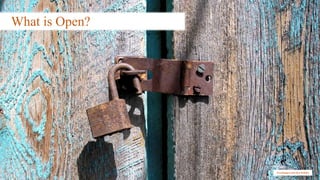
What is Open?
Freeimages.com (lyn belisle)
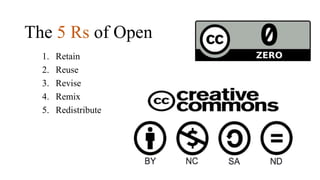
The 5 Rs of Open
1. Retain
2. Reuse
3. Revise
4. Remix
5. Redistribute
Adopting Open Practices
Freeimages.com (Joanie Cahill)
Open Pedagogy
Freeimages.com (Joanie Cahill)
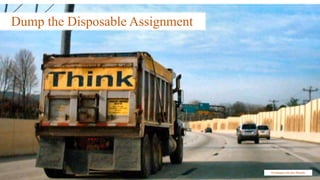
Dump the Disposable Assignment
Freeimages.com (Joe Zlomek)
Open Textbooks, Open Pedagogy
“I’ve spent some time talking about open pedagogy at several universities this Spring, and in each of those
presentations and workshops, I have usually mentioned The Open Anthology of Earlier American Literature, an OER
anthology that my students and I produced last year for an American literature survey course I taught. When I talk
about the anthology, it’s usually to make a point about open pedagogy. I began the project with the simple desire to
save my students about $85 US, which is how much they were (ostensibly) paying for the Heath Anthology of
American Literature Volume A. Most of the actual texts in the Heath were a public domain texts, freely available and
not under any copyright
restrictions. As the Heath
produced new editions (of
literature from roughly 1400-
1800!), forcing students to buy
new textbooks or be irritatingly
out of sync with page numbers,
and as students turned to rental
markets that necessitated them
giving their books back at the end
of the semester, I began to look in
earnest for an alternative.”
- Robin DeRosa
How is Open Different?
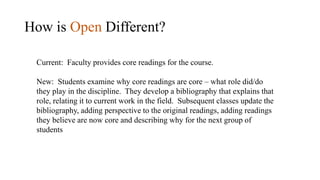
Current: Faculty provides core readings for the course.
New: Students examine why core readings are core – what role did/do
they play in the discipline. They develop a bibliography that explains that
role, relating it to current work in the field. Subsequent classes update the
bibliography, adding perspective to the original readings, adding readings
they believe are now core and describing why for the next group of
students
How is Open Different?
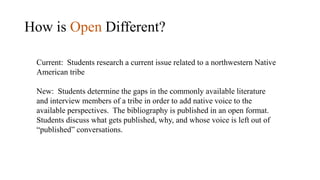
Current: Students research a current issue related to a northwestern Native
American tribe
New: Students determine the gaps in the commonly available literature
and interview members of a tribe in order to add native voice to the
available perspectives. The bibliography is published in an open format.
Students discuss what gets published, why, and whose voice is left out of
“published” conversations.
For Additional Ideas…
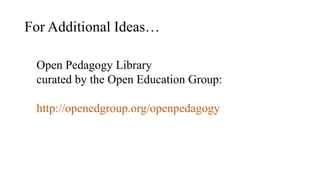
Open Pedagogy Library
curated by the Open Education Group:
http://openedgroup.org/openpedagogy
Let’s Play
http://libguides.uta.edu/oe-data
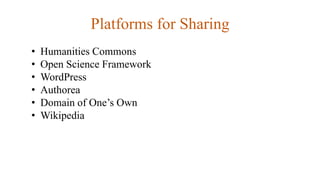
Platforms for Sharing
• Humanities Commons
• Open Science Framework
• WordPress
• Authorea
• Domain of One’s Own
• Wikipedia
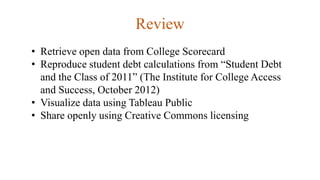
Review
• Retrieve open data from College Scorecard
• Reproduce student debt calculations from “Student Debt
and the Class of 2011” (The Institute for College Access
and Success, October 2012)
• Visualize data using Tableau Public
• Share openly using Creative Commons licensing
Thank You
http://library.uta.edu/scholcomm
Michelle Reed
michelle.reed@uta.edu
Peace Ossom Williamson
peace@uta.edu

From Open Data to Open Pedagogy

  • 1.
    From Open Datato Open Pedagogy: An Introduction to Integrating Open Practices into the Classroom Michelle Reed, Open Education Librarian Peace Ossom Williamson, Director of Research Data Services Open Education Week | UTA Libraries | 3.30.17
  • 2.
    Openness is theonly means of doing education. If there is no sharing, there is no education. Successful educators share most thoroughly with the most students. - David Wiley “Be a champion of a cause and don't give up.” - TJ Bliss “Research provides the foundation of modern society. Research leads to breakthroughs, and communicating the results of research is what allows us to turn breakthroughs into better lives—to provide new treatments for disease, to implement solutions for challenges like global warming, and to build entire industries around what were once just ideas. However, our current system for communicating research is crippled by a centuries old model that hasn’t been updated to take advantage of 21st century technology.” - Scholarly Publishing and Academic Resources Coalition (SPARC) “Isn’t it amazing that what serves social justice also serves effective pedagogy and is empirically supported?” - Rajiv Jhangiani
  • 3.
  • 4.
    The 5 Rsof Open 1. Retain 2. Reuse 3. Revise 4. Remix 5. Redistribute
  • 6.
  • 9.
  • 10.
    Dump the DisposableAssignment Freeimages.com (Joe Zlomek)
  • 11.
    Open Textbooks, OpenPedagogy “I’ve spent some time talking about open pedagogy at several universities this Spring, and in each of those presentations and workshops, I have usually mentioned The Open Anthology of Earlier American Literature, an OER anthology that my students and I produced last year for an American literature survey course I taught. When I talk about the anthology, it’s usually to make a point about open pedagogy. I began the project with the simple desire to save my students about $85 US, which is how much they were (ostensibly) paying for the Heath Anthology of American Literature Volume A. Most of the actual texts in the Heath were a public domain texts, freely available and not under any copyright restrictions. As the Heath produced new editions (of literature from roughly 1400- 1800!), forcing students to buy new textbooks or be irritatingly out of sync with page numbers, and as students turned to rental markets that necessitated them giving their books back at the end of the semester, I began to look in earnest for an alternative.” - Robin DeRosa
  • 12.
    How is OpenDifferent? Current: Faculty provides core readings for the course. New: Students examine why core readings are core – what role did/do they play in the discipline. They develop a bibliography that explains that role, relating it to current work in the field. Subsequent classes update the bibliography, adding perspective to the original readings, adding readings they believe are now core and describing why for the next group of students
  • 13.
    How is OpenDifferent? Current: Students research a current issue related to a northwestern Native American tribe New: Students determine the gaps in the commonly available literature and interview members of a tribe in order to add native voice to the available perspectives. The bibliography is published in an open format. Students discuss what gets published, why, and whose voice is left out of “published” conversations.
  • 14.
    For Additional Ideas… OpenPedagogy Library curated by the Open Education Group: http://openedgroup.org/openpedagogy
  • 15.
  • 17.
    Platforms for Sharing •Humanities Commons • Open Science Framework • WordPress • Authorea • Domain of One’s Own • Wikipedia
  • 18.
    Review • Retrieve opendata from College Scorecard • Reproduce student debt calculations from “Student Debt and the Class of 2011” (The Institute for College Access and Success, October 2012) • Visualize data using Tableau Public • Share openly using Creative Commons licensing
  • 19.

Editor's Notes

  • #2 This presentation is licensed under an Attribution 4.0 International license (CC-BY): https://creativecommons.org/licenses/by/4.0/ Workshop Description: In celebration of Open Education Week, UTA Libraries will host a workshop about building assignments that rely on open data and promote open sharing of information. During this hands-on workshop, we’ll discuss open pedagogy as a practice that increases student engagement, explore tools that support collaboration and sharing, and walk through an example of a reproducibility and data visualization project appropriate for undergraduate students.
  • #3 About me: I am an open advocate.
  • #4 Open = free to access + permissions to reuse “Lock” is used with permission from Freeimages contributor lyn belisle: http://www.freeimages.com
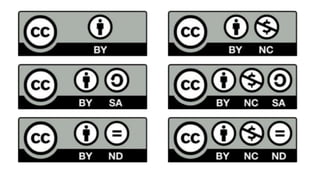
  • #5 Open means free for anyone to access and includes permission to engage in the 5R activities. Frequently communicated via CC license, which provides alternatives to “all rights reserved” copyright. More at http://creativecommons.org/about CC-zero license is an option for releasing work into the public domain, freeing it of all copyright restrictions: https://creativecommons.org/choose/zero/
  • #6 Slide from David Ernst’s “Open Textbooks” presentation at University of Texas at Arlington: https://www.slideshare.net/djernst/university-of-texas-at-arlington-72016692
  • #7 One way to “go open” is to adopt OER “Open” is used with permission from Freeimages contributor Joanie Cahill: http://www.freeimages.com
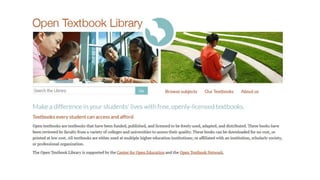
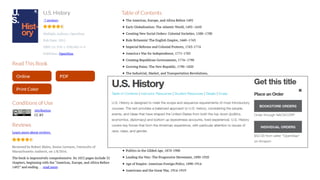
  • #8 Open Textbook Library: https://open.umn.edu/opentextbooks/
  • #9 Open Textbook Library: https://open.umn.edu/opentextbooks/BookDetail.aspx?bookId=206 OpenStax: https://openstax.org/details/us-history
  • #10 In short, open ped is about student-generated content that lives beyond the classroom and is openly licensed to make a difference in the greater community. “Open” is used with permission from Freeimages contributor Joanie Cahill: http://www.freeimages.com
  • #11 Disposable v. renewable assignments “Unusual Dumper” is used with permission from Freeimages contributor Joe Zlomek: http://www.freeimages.com
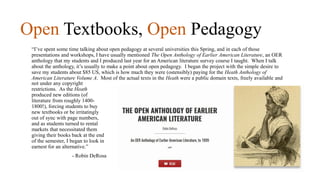
  • #12 Robin DeRosa is Professor of Interdisciplinary Studies at Plymouth State University. Read more about the project at http://umwdtlt.com/open-textbook-pedagogy-practice/ Current anthology: https://openamlit.pressbooks.com/ In the spirit of open = sharing, work on revision of the anthology has been picked up by the Rebus Community. Info here: https://forum.rebus.community/topic/66/lit-the-open-anthology-of-earlier-american-literature-lead-tim-robbins-graceland-university
  • #13 Slide used with permission from “Going OER: Open Education to Transform” by Quill West, Deb Gilchrist, and Kathy Swart.
  • #14 Slide used with permission from “Going OER: Open Education to Transform” by Quill West, Deb Gilchrist, and Kathy Swart.
  • #15 More information in the Open Pedagogy Library curated by the Open Education Group: http://openedgroup.org/openpedagogy
  • #16 Hands-on activity
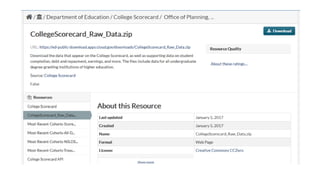
  • #17 The data that we’ll be using for today’s activity are from the US Department of Education— government data from the public domain. The dataset is licensed as CC Zero, which means it is not protected by copyright: https://creativecommons.org/publicdomain/zero/1.0/
  • #18 In addition to asking students to share their data visualization, they could be asked to summarize their process, research and analyze causes and consequences of the trends we discovered in the data, or investigate and add personal narratives to add qualitative data to the final product. Some platforms to consider: https://hcommons.org/ https://osf.io/ https://wordpress.com/ https://www.authorea.com/ http://help.linklab.domains/ https://wikiedu.org/teach/
  • #19 “Student Debt and the Class of 2011” – report from the Institute for College Access and Success (October 2012): http://files.eric.ed.gov/fulltext/ED537338.pdf College Scorecard Data: https://catalog.data.gov/dataset/college-scorecard About the data: https://collegescorecard.ed.gov/data/documentation/ Note: We used a newer dataset (not 2011 data), so ours was not a reproduction of the calculations, though some comparison of trends is possible.
  • #20 Thank you! Please get in touch if you’d like us to speak to your students (or colleagues) about these topics. The call for grant applications to support open educational practices will be announced in April 2017. More on open education at UTA: http://library.uta.edu/scholcomm/open-education