For Internal Use OnlyAuthor: Reza Hagel 2019 Copyright FOCUS InternationalFor Internal Use OnlyAuthor: Reza Hagel
Created by Executives for Executives
Digital
Transformation
Strategy
1
A Case Study from FOCUS International Advisory Services
For Internal Use OnlyAuthor: Reza Hagel 2019 Copyright FOCUS InternationalFor Internal Use OnlyAuthor: Reza Hagel
HOW TO BUILD A STRATEGY
IN A DIGITAL WORLD
Digital technology is everywhere. As a consequence, companies need fully embrace the
digital transformation. To succeed, it is no longer sufficient to optimize front offices and
increase customer experience by using digital. Instead, companies need a solid
enterprise-wide transformation to reap the full potential of digital.
We team up with clients to explore and define a digital strategy and road map to this
end, thereby also creating a kick starter for change.
INTRODUCTION
Digital transformation is the name of the game these days for many organizations. The
background of this is a wide and impressive range of new (information and
communication) technologies that have a growing impact on business models, value
chains and customer behavior.
EXTREME EXPECTATIONS
Several trends that affect business are a move towards a networked society with an
exponential growth in the quantity of data, a continued increase in processing capacity
and a world in which everything is connected. This cocktail of technological
developments provides new opportunities to convert data into valuable insights and new
or enhanced services. In a somewhat broader sense, technology is playing an increasingly
prominent role in society and is now manifest in nearly everything we do. It is now
completely integrated into our daily lives – even in a physical sense – and, as such, is no
longer merely an add-on. In relation to this there is also the emergence of an era of
extreme expectations where customers simply expect the highest level of service at low
cost.
In conclusion, there is no doubt that digitization is very demanding for companies. It
impacts all aspects of business – not only a company’s products and services, but also its
delivery models and modus operandi.
2Author: Reza Hagel
For Internal Use OnlyAuthor: Reza Hagel 2019 Copyright FOCUS InternationalFor Internal Use OnlyAuthor: Reza Hagel
DIGITAL COMPASS
3
A generic advice is that companies need to be (extremely) flexible and agile in the current era.
However, this by no means implies that they can manage without a strategy. In fact, in turbulent
times they need a strategic compass more than ever. As stated earlier, companies are confronted
by major changes in several domains. Sustainability developments call for strategic and
operational changes, customers demand best-in-class interactions and new technology has the
potential to disrupt the current business model. Traditional organizations must be aware that
customers have become accustomed to a range of new options and expect that every well-
organized organization offers them services and products with the same seamless and simple
interfaces. This customer centricity also leads to new expectations with regard to flawless
operations. This means that digital impacts not only the front-end of operations, but also the rest
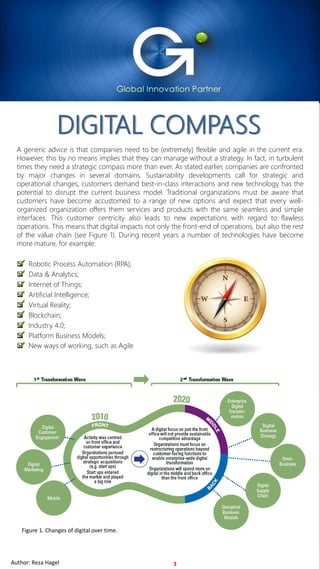
of the value chain (see Figure 1). During recent years a number of technologies have become
more mature, for example:
❑ Robotic Process Automation (RPA);
❑ Data & Analytics;
❑ Internet of Things;
❑ Artificial Intelligence;
❑ Virtual Reality;
❑ Blockchain;
❑ Industry 4.0;
❑ Platform Business Models;
❑ New ways of working, such as Agile
Figure 1. Changes of digital over time.
Author: Reza Hagel
For Internal Use OnlyAuthor: Reza Hagel 2019 Copyright FOCUS InternationalFor Internal Use OnlyAuthor: Reza Hagel 4
HOW TO GET STARTED?The key question was: ‘how can the client anticipate on these breakthrough technology developments?’.
The answer is of course not an easy, straightforward one. Moreover, defining a strategy is just the first
step in transforming the business. As the famous management thinker Peter Drucker once said: ‘strategy
is a commodity, execution is an art‘.
How did we support our client to get started?
First of all, a bit of background. In recent years, the company has been active in many digital initiatives
and has been working on innovations in several areas. Nonetheless, management felt that a more
consistent and focused vision on the opportunities and threats was needed to be prepared for future
changes and thereby reach the next level of maturity in the digital transformation.
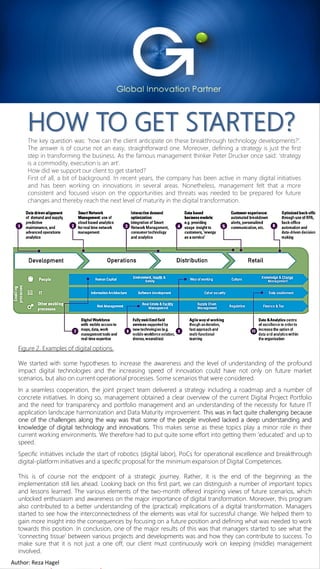
Figure 2. Examples of digital options.
We started with some hypotheses to increase the awareness and the level of understanding of the profound
impact digital technologies and the increasing speed of innovation could have not only on future market
scenarios, but also on current operational processes. Some scenarios that were considered.
In a seamless cooperation, the joint project team delivered a strategy including a roadmap and a number of
concrete initiatives. In doing so, management obtained a clear overview of the current Digital Project Portfolio
and the need for transparency and portfolio management and an understanding of the necessity for future IT
application landscape harmonization and Data Maturity improvement. This was in fact quite challenging because
one of the challenges along the way was that some of the people involved lacked a deep understanding and
knowledge of digital technology and innovations. This makes sense as these topics play a minor role in their
current working environments. We therefore had to put quite some effort into getting them ‘educated’ and up to
speed.
Specific initiatives include the start of robotics (digital labor), PoCs for operational excellence and breakthrough
digital-platform initiatives and a specific proposal for the minimum expansion of Digital Competences.
This is of course not the endpoint of a strategic journey. Rather, it is the end of the beginning as the
implementation still lies ahead. Looking back on this first part, we can distinguish a number of important topics
and lessons learned. The various elements of the two-month offered inspiring views of future scenarios, which
unlocked enthusiasm and awareness on the major importance of digital transformation. Moreover, this program
also contributed to a better understanding of the (practical) implications of a digital transformation. Managers
started to see how the interconnectedness of the elements was vital for successful change. We helped them to
gain more insight into the consequences by focusing on a future position and defining what was needed to work
towards this position. In conclusion, one of the major results of this was that managers started to see what the
‘connecting tissue’ between various projects and developments was and how they can contribute to success. To
make sure that it is not just a one off, our client must continuously work on keeping (middle) management
involved.
Author: Reza Hagel
For Internal Use OnlyAuthor: Reza Hagel 2019 Copyright FOCUS InternationalFor Internal Use OnlyAuthor: Reza Hagel
A HOLISTIC BUSINESS
APPROACH
Achieving a sustainable competitive advantage may have been possible by some relatively easy
restructuring of customer-facing functions in the early days of digital technologies. However,
nowadays we need an enterprise-wide digital transformation and a restructuring of the middle and
back office as well as looking outside the firm to its ecosystems to explore new opportunities. We put
this in place at the start of the project.
5
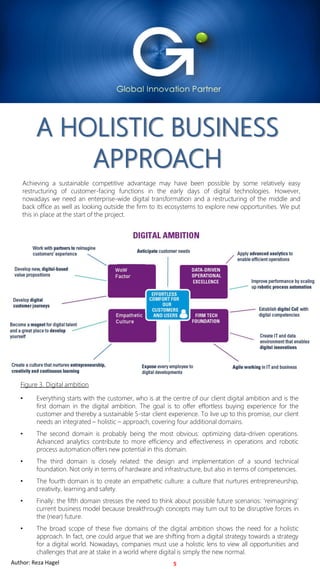
Figure 3. Digital ambition
• Everything starts with the customer, who is at the centre of our client digital ambition and is the
first domain in the digital ambition. The goal is to offer effortless buying experience for the
customer and thereby a sustainable 5-star client experience. To live up to this promise, our client
needs an integrated – holistic – approach, covering four additional domains.
• The second domain is probably being the most obvious: optimizing data-driven operations.
Advanced analytics contribute to more efficiency and effectiveness in operations and robotic
process automation offers new potential in this domain.
• The third domain is closely related: the design and implementation of a sound technical
foundation. Not only in terms of hardware and infrastructure, but also in terms of competencies.
• The fourth domain is to create an empathetic culture: a culture that nurtures entrepreneurship,
creativity, learning and safety.
• Finally: the fifth domain stresses the need to think about possible future scenarios: ‘reimagining’
current business model because breakthrough concepts may turn out to be disruptive forces in
the (near) future.
• The broad scope of these five domains of the digital ambition shows the need for a holistic
approach. In fact, one could argue that we are shifting from a digital strategy towards a strategy
for a digital world. Nowadays, companies must use a holistic lens to view all opportunities and
challenges that are at stake in a world where digital is simply the new normal.
Author: Reza Hagel
For Internal Use OnlyAuthor: Reza Hagel 2019 Copyright FOCUS InternationalFor Internal Use OnlyAuthor: Reza Hagel
USE A STRUCTURED BUT
AGILE APPROACH
At the start of the project, our client was already active in many digital initiatives. However,
management still needed to focus on the topics that matter most and at the same time there was
uncertainty about missing crucial developments. This was the starting point for a structured approach
to challenge the organization, both top-down and bottom-up.
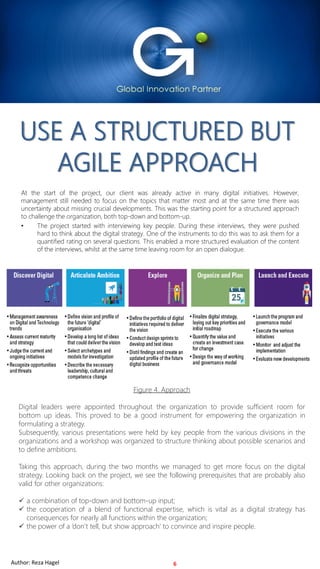
• The project started with interviewing key people. During these interviews, they were pushed
hard to think about the digital strategy. One of the instruments to do this was to ask them for a
quantified rating on several questions. This enabled a more structured evaluation of the content
of the interviews, whilst at the same time leaving room for an open dialogue.
6
Figure 4. Approach
Digital leaders were appointed throughout the organization to provide sufficient room for
bottom up ideas. This proved to be a good instrument for empowering the organization in
formulating a strategy.
Subsequently, various presentations were held by key people from the various divisions in the
organizations and a workshop was organized to structure thinking about possible scenarios and
to define ambitions.
Taking this approach, during the two months we managed to get more focus on the digital
strategy. Looking back on the project, we see the following prerequisites that are probably also
valid for other organizations:
✓ a combination of top-down and bottom-up input;
✓ the cooperation of a blend of functional expertise, which is vital as a digital strategy has
consequences for nearly all functions within the organization;
✓ the power of a ‘don’t tell, but show approach’ to convince and inspire people.
Author: Reza Hagel
For Internal Use OnlyAuthor: Reza Hagel 2019 Copyright FOCUS InternationalFor Internal Use OnlyAuthor: Reza Hagel
‘THINKING AND DOING’
• In a world of continuous and rapid change, some argue that doing is the best
kind of thinking. Since we can no longer define blueprints for the future, the only
way to be successful is to continuously experiment and learn. Point taken.
• However, the opposite is also true. Thinking is doing. We found out that intense
dialogue during the sessions was very valuable. In fact, sometimes it was
confrontational in a positive manner. Talking about the consequences of a digital
strategy – for instance ‘working agile’ – may sound easy and logical in theory,
but the real challenge, of course, is turning promising words into practice. The
same is valid for processes that may at first glance not be within the scope of a
digital strategy, such as financial administration. The reality is that a dedicated
focus on customers and their expectations also calls for swifter and better
financial processes.
• Deeper thinking and dialogue does not only bring awareness. We also
experienced that actively and deeply exploring the consequences of such topics
led to an enthusiastic ‘action modus’ amongst participants. Having said that, it is
an ongoing challenge to provide sufficient resources – both in terms of high
level knowledge and hands-on capacity – for the transformation.
EXCEL IN THE BALANCING ACT BETWEEN HOW AND WHAT
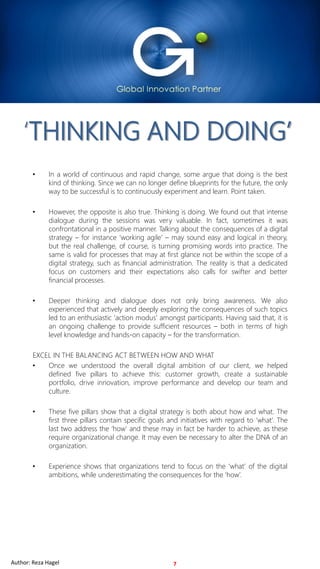
• Once we understood the overall digital ambition of our client, we helped
defined five pillars to achieve this: customer growth, create a sustainable
portfolio, drive innovation, improve performance and develop our team and
culture.
• These five pillars show that a digital strategy is both about how and what. The
first three pillars contain specific goals and initiatives with regard to ‘what’. The
last two address the ‘how’ and these may in fact be harder to achieve, as these
require organizational change. It may even be necessary to alter the DNA of an
organization.
• Experience shows that organizations tend to focus on the ‘what’ of the digital
ambitions, while underestimating the consequences for the ‘how’.
7Author: Reza Hagel
For Internal Use OnlyAuthor: Reza Hagel 2019 Copyright FOCUS InternationalFor Internal Use OnlyAuthor: Reza Hagel
FOCUS
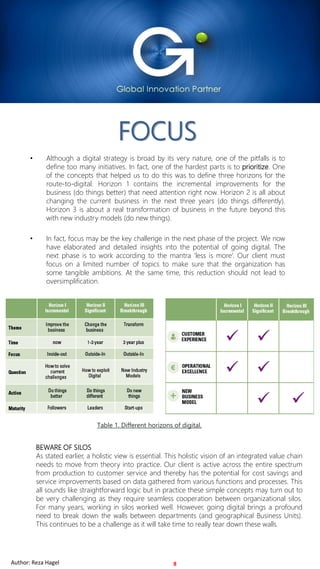
• Although a digital strategy is broad by its very nature, one of the pitfalls is to
define too many initiatives. In fact, one of the hardest parts is to prioritize. One
of the concepts that helped us to do this was to define three horizons for the
route-to-digital. Horizon 1 contains the incremental improvements for the
business (do things better) that need attention right now. Horizon 2 is all about
changing the current business in the next three years (do things differently).
Horizon 3 is about a real transformation of business in the future beyond this
with new industry models (do new things).
• In fact, focus may be the key challenge in the next phase of the project. We now
have elaborated and detailed insights into the potential of going digital. The
next phase is to work according to the mantra ‘less is more’. Our client must
focus on a limited number of topics to make sure that the organization has
some tangible ambitions. At the same time, this reduction should not lead to
oversimplification.
8
BEWARE OF SILOS
As stated earlier, a holistic view is essential. This holistic vision of an integrated value chain
needs to move from theory into practice. Our client is active across the entire spectrum
from production to customer service and thereby has the potential for cost savings and
service improvements based on data gathered from various functions and processes. This
all sounds like straightforward logic but in practice these simple concepts may turn out to
be very challenging as they require seamless cooperation between organizational silos.
For many years, working in silos worked well. However, going digital brings a profound
need to break down the walls between departments (and geographical Business Units).
This continues to be a challenge as it will take time to really tear down these walls.
Table 1. Different horizons of digital.
Author: Reza Hagel

Digital transformation strategy

  • 1.
    For Internal UseOnlyAuthor: Reza Hagel 2019 Copyright FOCUS InternationalFor Internal Use OnlyAuthor: Reza Hagel Created by Executives for Executives Digital Transformation Strategy 1 A Case Study from FOCUS International Advisory Services
  • 2.
    For Internal UseOnlyAuthor: Reza Hagel 2019 Copyright FOCUS InternationalFor Internal Use OnlyAuthor: Reza Hagel HOW TO BUILD A STRATEGY IN A DIGITAL WORLD Digital technology is everywhere. As a consequence, companies need fully embrace the digital transformation. To succeed, it is no longer sufficient to optimize front offices and increase customer experience by using digital. Instead, companies need a solid enterprise-wide transformation to reap the full potential of digital. We team up with clients to explore and define a digital strategy and road map to this end, thereby also creating a kick starter for change. INTRODUCTION Digital transformation is the name of the game these days for many organizations. The background of this is a wide and impressive range of new (information and communication) technologies that have a growing impact on business models, value chains and customer behavior. EXTREME EXPECTATIONS Several trends that affect business are a move towards a networked society with an exponential growth in the quantity of data, a continued increase in processing capacity and a world in which everything is connected. This cocktail of technological developments provides new opportunities to convert data into valuable insights and new or enhanced services. In a somewhat broader sense, technology is playing an increasingly prominent role in society and is now manifest in nearly everything we do. It is now completely integrated into our daily lives – even in a physical sense – and, as such, is no longer merely an add-on. In relation to this there is also the emergence of an era of extreme expectations where customers simply expect the highest level of service at low cost. In conclusion, there is no doubt that digitization is very demanding for companies. It impacts all aspects of business – not only a company’s products and services, but also its delivery models and modus operandi. 2Author: Reza Hagel
  • 3.
    For Internal UseOnlyAuthor: Reza Hagel 2019 Copyright FOCUS InternationalFor Internal Use OnlyAuthor: Reza Hagel DIGITAL COMPASS 3 A generic advice is that companies need to be (extremely) flexible and agile in the current era. However, this by no means implies that they can manage without a strategy. In fact, in turbulent times they need a strategic compass more than ever. As stated earlier, companies are confronted by major changes in several domains. Sustainability developments call for strategic and operational changes, customers demand best-in-class interactions and new technology has the potential to disrupt the current business model. Traditional organizations must be aware that customers have become accustomed to a range of new options and expect that every well- organized organization offers them services and products with the same seamless and simple interfaces. This customer centricity also leads to new expectations with regard to flawless operations. This means that digital impacts not only the front-end of operations, but also the rest of the value chain (see Figure 1). During recent years a number of technologies have become more mature, for example: ❑ Robotic Process Automation (RPA); ❑ Data & Analytics; ❑ Internet of Things; ❑ Artificial Intelligence; ❑ Virtual Reality; ❑ Blockchain; ❑ Industry 4.0; ❑ Platform Business Models; ❑ New ways of working, such as Agile Figure 1. Changes of digital over time. Author: Reza Hagel
  • 4.
    For Internal UseOnlyAuthor: Reza Hagel 2019 Copyright FOCUS InternationalFor Internal Use OnlyAuthor: Reza Hagel 4 HOW TO GET STARTED?The key question was: ‘how can the client anticipate on these breakthrough technology developments?’. The answer is of course not an easy, straightforward one. Moreover, defining a strategy is just the first step in transforming the business. As the famous management thinker Peter Drucker once said: ‘strategy is a commodity, execution is an art‘. How did we support our client to get started? First of all, a bit of background. In recent years, the company has been active in many digital initiatives and has been working on innovations in several areas. Nonetheless, management felt that a more consistent and focused vision on the opportunities and threats was needed to be prepared for future changes and thereby reach the next level of maturity in the digital transformation. Figure 2. Examples of digital options. We started with some hypotheses to increase the awareness and the level of understanding of the profound impact digital technologies and the increasing speed of innovation could have not only on future market scenarios, but also on current operational processes. Some scenarios that were considered. In a seamless cooperation, the joint project team delivered a strategy including a roadmap and a number of concrete initiatives. In doing so, management obtained a clear overview of the current Digital Project Portfolio and the need for transparency and portfolio management and an understanding of the necessity for future IT application landscape harmonization and Data Maturity improvement. This was in fact quite challenging because one of the challenges along the way was that some of the people involved lacked a deep understanding and knowledge of digital technology and innovations. This makes sense as these topics play a minor role in their current working environments. We therefore had to put quite some effort into getting them ‘educated’ and up to speed. Specific initiatives include the start of robotics (digital labor), PoCs for operational excellence and breakthrough digital-platform initiatives and a specific proposal for the minimum expansion of Digital Competences. This is of course not the endpoint of a strategic journey. Rather, it is the end of the beginning as the implementation still lies ahead. Looking back on this first part, we can distinguish a number of important topics and lessons learned. The various elements of the two-month offered inspiring views of future scenarios, which unlocked enthusiasm and awareness on the major importance of digital transformation. Moreover, this program also contributed to a better understanding of the (practical) implications of a digital transformation. Managers started to see how the interconnectedness of the elements was vital for successful change. We helped them to gain more insight into the consequences by focusing on a future position and defining what was needed to work towards this position. In conclusion, one of the major results of this was that managers started to see what the ‘connecting tissue’ between various projects and developments was and how they can contribute to success. To make sure that it is not just a one off, our client must continuously work on keeping (middle) management involved. Author: Reza Hagel
  • 5.
    For Internal UseOnlyAuthor: Reza Hagel 2019 Copyright FOCUS InternationalFor Internal Use OnlyAuthor: Reza Hagel A HOLISTIC BUSINESS APPROACH Achieving a sustainable competitive advantage may have been possible by some relatively easy restructuring of customer-facing functions in the early days of digital technologies. However, nowadays we need an enterprise-wide digital transformation and a restructuring of the middle and back office as well as looking outside the firm to its ecosystems to explore new opportunities. We put this in place at the start of the project. 5 Figure 3. Digital ambition • Everything starts with the customer, who is at the centre of our client digital ambition and is the first domain in the digital ambition. The goal is to offer effortless buying experience for the customer and thereby a sustainable 5-star client experience. To live up to this promise, our client needs an integrated – holistic – approach, covering four additional domains. • The second domain is probably being the most obvious: optimizing data-driven operations. Advanced analytics contribute to more efficiency and effectiveness in operations and robotic process automation offers new potential in this domain. • The third domain is closely related: the design and implementation of a sound technical foundation. Not only in terms of hardware and infrastructure, but also in terms of competencies. • The fourth domain is to create an empathetic culture: a culture that nurtures entrepreneurship, creativity, learning and safety. • Finally: the fifth domain stresses the need to think about possible future scenarios: ‘reimagining’ current business model because breakthrough concepts may turn out to be disruptive forces in the (near) future. • The broad scope of these five domains of the digital ambition shows the need for a holistic approach. In fact, one could argue that we are shifting from a digital strategy towards a strategy for a digital world. Nowadays, companies must use a holistic lens to view all opportunities and challenges that are at stake in a world where digital is simply the new normal. Author: Reza Hagel
  • 6.
    For Internal UseOnlyAuthor: Reza Hagel 2019 Copyright FOCUS InternationalFor Internal Use OnlyAuthor: Reza Hagel USE A STRUCTURED BUT AGILE APPROACH At the start of the project, our client was already active in many digital initiatives. However, management still needed to focus on the topics that matter most and at the same time there was uncertainty about missing crucial developments. This was the starting point for a structured approach to challenge the organization, both top-down and bottom-up. • The project started with interviewing key people. During these interviews, they were pushed hard to think about the digital strategy. One of the instruments to do this was to ask them for a quantified rating on several questions. This enabled a more structured evaluation of the content of the interviews, whilst at the same time leaving room for an open dialogue. 6 Figure 4. Approach Digital leaders were appointed throughout the organization to provide sufficient room for bottom up ideas. This proved to be a good instrument for empowering the organization in formulating a strategy. Subsequently, various presentations were held by key people from the various divisions in the organizations and a workshop was organized to structure thinking about possible scenarios and to define ambitions. Taking this approach, during the two months we managed to get more focus on the digital strategy. Looking back on the project, we see the following prerequisites that are probably also valid for other organizations: ✓ a combination of top-down and bottom-up input; ✓ the cooperation of a blend of functional expertise, which is vital as a digital strategy has consequences for nearly all functions within the organization; ✓ the power of a ‘don’t tell, but show approach’ to convince and inspire people. Author: Reza Hagel
  • 7.
    For Internal UseOnlyAuthor: Reza Hagel 2019 Copyright FOCUS InternationalFor Internal Use OnlyAuthor: Reza Hagel ‘THINKING AND DOING’ • In a world of continuous and rapid change, some argue that doing is the best kind of thinking. Since we can no longer define blueprints for the future, the only way to be successful is to continuously experiment and learn. Point taken. • However, the opposite is also true. Thinking is doing. We found out that intense dialogue during the sessions was very valuable. In fact, sometimes it was confrontational in a positive manner. Talking about the consequences of a digital strategy – for instance ‘working agile’ – may sound easy and logical in theory, but the real challenge, of course, is turning promising words into practice. The same is valid for processes that may at first glance not be within the scope of a digital strategy, such as financial administration. The reality is that a dedicated focus on customers and their expectations also calls for swifter and better financial processes. • Deeper thinking and dialogue does not only bring awareness. We also experienced that actively and deeply exploring the consequences of such topics led to an enthusiastic ‘action modus’ amongst participants. Having said that, it is an ongoing challenge to provide sufficient resources – both in terms of high level knowledge and hands-on capacity – for the transformation. EXCEL IN THE BALANCING ACT BETWEEN HOW AND WHAT • Once we understood the overall digital ambition of our client, we helped defined five pillars to achieve this: customer growth, create a sustainable portfolio, drive innovation, improve performance and develop our team and culture. • These five pillars show that a digital strategy is both about how and what. The first three pillars contain specific goals and initiatives with regard to ‘what’. The last two address the ‘how’ and these may in fact be harder to achieve, as these require organizational change. It may even be necessary to alter the DNA of an organization. • Experience shows that organizations tend to focus on the ‘what’ of the digital ambitions, while underestimating the consequences for the ‘how’. 7Author: Reza Hagel
  • 8.
    For Internal UseOnlyAuthor: Reza Hagel 2019 Copyright FOCUS InternationalFor Internal Use OnlyAuthor: Reza Hagel FOCUS • Although a digital strategy is broad by its very nature, one of the pitfalls is to define too many initiatives. In fact, one of the hardest parts is to prioritize. One of the concepts that helped us to do this was to define three horizons for the route-to-digital. Horizon 1 contains the incremental improvements for the business (do things better) that need attention right now. Horizon 2 is all about changing the current business in the next three years (do things differently). Horizon 3 is about a real transformation of business in the future beyond this with new industry models (do new things). • In fact, focus may be the key challenge in the next phase of the project. We now have elaborated and detailed insights into the potential of going digital. The next phase is to work according to the mantra ‘less is more’. Our client must focus on a limited number of topics to make sure that the organization has some tangible ambitions. At the same time, this reduction should not lead to oversimplification. 8 BEWARE OF SILOS As stated earlier, a holistic view is essential. This holistic vision of an integrated value chain needs to move from theory into practice. Our client is active across the entire spectrum from production to customer service and thereby has the potential for cost savings and service improvements based on data gathered from various functions and processes. This all sounds like straightforward logic but in practice these simple concepts may turn out to be very challenging as they require seamless cooperation between organizational silos. For many years, working in silos worked well. However, going digital brings a profound need to break down the walls between departments (and geographical Business Units). This continues to be a challenge as it will take time to really tear down these walls. Table 1. Different horizons of digital. Author: Reza Hagel