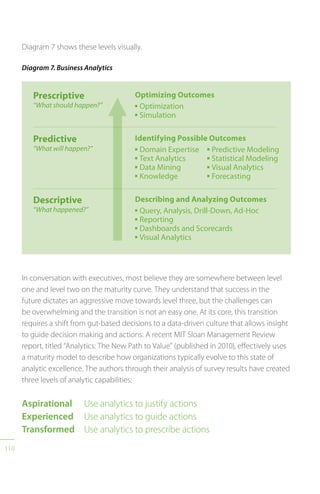
the Digital Enterprise
A Framework for Transformation
TCS Consulting Journal
Vol. 05
Copyright ยฉ 2013 Tata Consultancy Services
Limited. All content/information present here
is the exclusive property of Tata Consultancy
Services Limited (TCS). The content/information
contained here is correct at the time of
publishing. No material from here may be
copied, modified, reproduced, republished,
uploaded, transmitted, posted or distributed
in any form without prior written permission
from TCS. Unauthorized use of the content/
information appearing here may violate
copyright, trademark and other applicable laws,
and could result in criminal or civil penalties.
I have the pleasure of presenting the ideas and
insights from TCS consultants as we enter what
could be the most transformative period in history.
Several key drivers have positioned the next decade
to deliver a staggeringโ€”perhaps unprecedentedโ€”
amount of change. The accelerating pace of business,
the growing impact of digital, and several other major
indicators suggest that a next generation enterprise is
on the horizon.
This digital enterprise leverages digital technology
to re-imagine their business, and embraces the key
characteristics that enable future success. Innovative,
fast, responsive, agile, creative and, design oriented
are some of these key characteristics.
We at TCS have embraced this future enterprise
vision, and are investing as partners in our customerโ€™s
transformation journey. I am happy to present a new
issue of Perspectives that represents a substantial step
forward in that quest.
N. Chandrasekaran
CEO & Managing Director
Greetings
A word from the CEO
2
A word from the EVP
The magic of thinking the impossible is here to
stay with digital, to change all that came before it.
Digital capabilities will be fundamental to companies
transforming customer experience. Embracing
integrated data and processes will help them thrive
in an ever-redefined business environment.
The future enterprise will leverage the maturation
and convergence of Social, Mobile, Analytics, Big
Data, Cloud and the Internet of things to drive this
agenda. As commoditization accelerates, companies
will differentiate by delivering outstanding customer
experiences. Quicker and more informed decisions
will be taken in real time as the enterprise turns digital.
To enable those characteristics that drive digital
successโ€”organizational policies, practices, systems,
processes and structures that worked in silos will
change into a unified data structure. When we look
back, this metamorphosis will be viewed as the
catalyst that enabled the next generation enterprise:
The Digital Enterprise.
In this issue of Perspectives, we outline the many
aspects of digital transformation and a roadmap
for getting there. This issue of Perspectives exudes
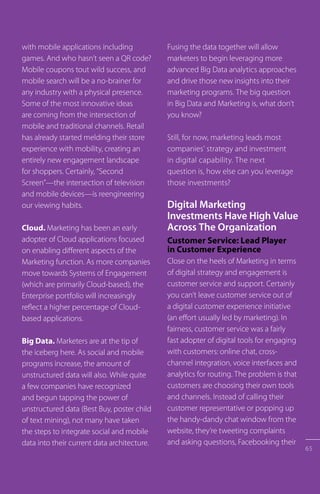
the enthusiasm and capabilities that TCS has in
supporting the transformation ahead.
J Rajagopal
EVP & Global Head, Consulting (GCP)
Table of Contents
The
Digital
Enterprise
The Digital Enterprise
A Framework for Transformation
7
The Digital
Publishing Enterprise
How to Manage the New
Digital Enterprise from Product
Concept to Consumer
19
Any Customer, Any
Channel, Anytime
Building the Digital Insurance
Enterprise for the Era of
Engagement and Collaboration
33
6 The
Digital
Guest List
Expands
Driving Digital
Transformation Across Lines
of Business
60
Five Mobile Fails
How Banks and Financial
Services Institutions Can Avoid
Pitfalls in Mobile Strategy
and Execution
43
Taming
the Digital
Storm
Infographic
86 Digital
Enterprise
& the
Changing
Role of IT
The CIOโ€™s Pivotal Role
in the Digital Enterprise
Effectiveness
112
90 A Roadmap
for the
Digital
Enterprise
Six Key Elements to Enable
the Digital Enterprise
6
The
Digital
Enterprise
7
Introduction
The global business environment is being disrupted by
the collision of an unprecedented wave of innovation.
The combination of pervasive networking, the explosion of
big data, the availability of advanced analytics and social
media and the fact that mobile technology will become
businessesโ€™ new face of engagement means that, in the very
near future, โ€œdigitalโ€ and โ€œbusinessโ€ will be synonymous. To
grapple with this fact, businesses need a new framework of
understanding and action.
Big data, cloud computing, social business and mobility are
causing digital disruption across many industries. Social media
and mobile technologies have shifted the balance of power
and influence to the consumer. Engaging effectively with the
ecosystem to drive ROI requires a shift in both technology
and culture.
Many business leaders simply see digital as siloed components
affecting only certain parts of the organization; this is a critical
error. Digital does not impact some parts of your business:
The Digital Enterprise
A Framework for Transformation
Authors
Frank Diana
Principalโ€”Digital Enterprise Solutions, Global Consulting Practice
Tonya McKinney
Headโ€”Digital Strategy Consulting and Solutions,
Global Consulting Practice
Kevin Mulcahy
Headโ€”Business Analytics Solutions, Global Consulting Practice
8
it ripples through it and will change almost everything about
your business.
Harnessing the disruptive force of digital requires a holistic
view of the enterprise, encompassing both technology and
culture. Digital must be ingrained and integrated across
sales, customer service, marketing and human resources,
affecting the entire universe of business operations. Donโ€™t
create a digital department. All of your departments will be
digital soon.
At some point, digital will impact your P&L enough that
you will be forced to change, but if you wait until you see
a significant shift to act, youโ€™ll already be behind. The key is
to predict the most likely and extreme areas of impact, as
well as the areas you can leverage for your business and to
become a โ€œdigital firstโ€ mover rather than a reactor.
Drivers ofTransformation
Four critical areas of technology are driving the changes
in todayโ€™s enterprises and creating a perfect storm
of innovation.
Big Data. Companies, customers, partners and machines
are all generating more data than ever before: structured,
unstructured and semi-structured. Twitter streams, social
media data and more are unstructured data that doesnโ€™t
fit into neat categories, but if it can be assimilated, itโ€™s also
more valuable than structured data. The rapid expansion of
big data means youโ€™ve got more data about customers in
more places than ever before, but more data doesnโ€™t mean
itโ€™s easier to develop a composite picture of the customer.
Social Media. Social media is largely responsible for a shift
in the balance of power from businesses to consumers.
It has also created a powerful, two-way communication
(see โ€œExpanding
the Digital Guest Listโ€
in this edition
of Perspectives).
9
between consumers and businesses.
As a tool, it has tremendous potential
for both business-to-business
and business-to-consumer
engagement, building loyalty and
sharing or โ€œcrowdsourcingโ€ solutions
among partners and customers in
the ecosystem.
Mobility. Enabled by mobile
communications, the โ€œanywhere,
anytimeโ€ culture is pervading and
transforming business. Location-
based offers to mobile devices target
consumers near the point of sale.
Productivity increases as workers
access corporate resources from
mobile devices. Business processes can
be rethought, informed by mobility
(dynamic rerouting of service calls for
example). Mobile apps will ultimately
be the face of customer engagement
and depending on the app, the traffic
could strain your infrastructure.
Transformation in the Publishing Industry
The publishing industry is grappling with the e-book phenomena, a
disruption that is occurring faster than many in the industry predicted. A
recent report from Juniper Research projects that e-book sales will triple in
2012 to $9.7 billion. According to the report, by 2016 about 30% of e-books
will be purchased on tablets, 15% on smartphones and roughly 55% will be
purchased on e-readers. And brick-and-mortar bookstores in general will be
under pressure.โ€œUnless bookstores can marry the digital and the physical,
theyโ€™re going to go under,โ€said Dr. Windsor Holden, research director at
Juniper Research and one of the authors of the report.
Cloud Computing. Cloud computing
offers new scalability and economy,
but also creates shadow IT initiatives,
as one department signs up for
cloud resources unknown to the IT
department. This in turn creates more
silos. The fact that cloud offerings are
typically paid for by subscription makes
them economical and moves capex
to opex, but even this indicates that
digital strategy must be embraced
holistically: Finance must understand
the implications of that shift.
The problem is that companies are
โ€œdoingโ€ big data, social, mobility and
cloud. Such initiatives are not holistic or
strategic but scattershot and isolated.
The digital transformation is not being
managed holistically.
10
A Framework for
Transformation
Faced with massive change, some
leaders will struggle simply to stem
the tide without fundamentally
changing their organizations. Others
will look for ways to jump ahead of the
curve. The following framework offers
executives and business strategists
areas where they can exert control
and drive a holistic digital strategy
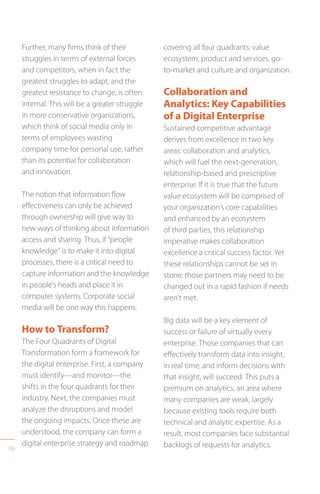
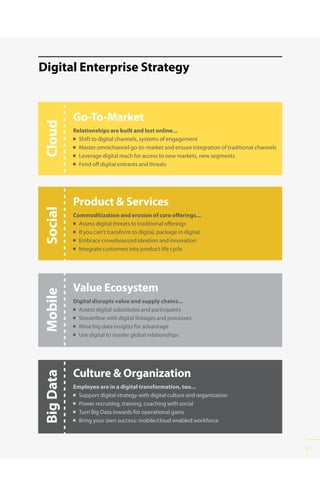
in four quadrants of transformation:
value ecosystem, product and service
innovation, go-to-market and culture
and organization.
Value Ecosystem
There are new, often purely digital
entrants, disrupting long-standing
industry value chains, which are
becoming value ecosystems of
horizontal, bi-directional relationships.
These players leapfrog one another
in an attempt to grab market
shareโ€”witness the bookstore
example. Long-standing industry
value chains are being dismantled,
partly because individual companies
no longer compete with each
other; instead, entire value chains
compete. Companies are also
repositioning themselves within their
value ecosystems, moving closer
to consumers, or pulling back to
become the backbone of services for
a fleet group of smaller, more nimble
providers. New partner ecosystems will
develop in this era of competitionโ€”
a partner in one channel may become
a competitor in another.
The traditional market approach
driven by the imperatives of industrial-
age thinkingโ€”โ€œdrive down cost and
improve efficiency by owning every
part of the value chainโ€โ€”is giving way
to a new, networked market structure.
Enterprises will increasingly move
away from operating strategies built
around vertical integration, effectively
reengineering industry processes.
Most successful companies no longer
own the end-to-end value chain. They
tend to focus on what differentiates
them and outsource other activities
across an ecosystem of partners
and sometimes even customers
(using feedback to drive R&D or even
replacing paid support teams with
โ€œzero-touchโ€ customer forums).
Product and Service Innovation
If digital doesnโ€™t change what you sell,
it will change how, when and to whom
you sell.
The possibilities include digitizing
existing products (such as books
to e-books), controlling revenue
erosion from new market entrants
(such as Skype, which has cut into
11
Supplementing Systems of Record with Systems
of Engagement
Core to a companyโ€™s success as a digital enterprise are systems of
engagement, in addition to historical systems of record. Systems of
engagement are the operational/execution manifestation of excellence
in collaboration and analytics. Systems of engagement are an emerging
trend; Salesforce.comโ€™s Chatter takes Salesforce from the realm of CRM
to a more engaged model. This blending of systems of record with
systems of engagement is a key trend.
Systems of engagement that monitor, predict, prescribe and drive
execution in all channels are key to responding and managing your
company at pace. Systems of engagement should drive the effective
and holistic use of the perfect storm of innovation: Social, Mobile,
Cloud and Big Data. They should facilitate the orchestration of
processes that include third party services and enterprise services.
Systems of engagement offer speedโ€”they help you manage in this fast
paced environment, with a focus on delivering optimized outcomes.
And with this operational agility you can address challenges in a holistic
and effective manner.
telecomsโ€™ core revenue) and guarding against the
commoditization of core offerings (music sales and DVD
rentals, for example).
Companies will need to offer premium support for
multiple digital services, location-based services, cloud-
based offerings, digital wallets and mobile payments.
There will be many more machine-to-machine (M2M)
offerings, such as smart energy meters that report
usage via IP connections and GPS fleet trackers in the
logistics market. APIs, which among other things drive
mobile apps, will become a fundamental platform of
digital information exchange.
12
Most importantly, systems of engagement leverage the vast amount of
information available today to make every interaction a more informed
one and when you donโ€™t know something, guide you to engage with
others to help you collaborate in more effective ways.
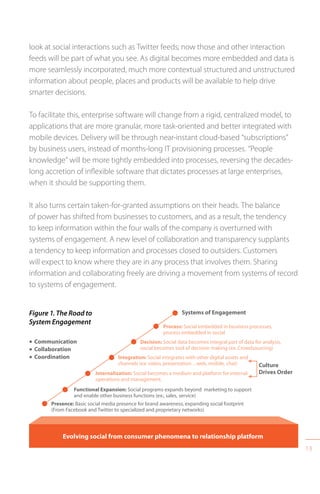
Where systems of record were often partitioned and siloed, systems of
engagement are transparent and collaborative. This will require cultural
adjustments and shifts that will happen in stages (see Figure 1).
Companies will need to develop new product and service delivery
channels and experiences. It will mean creating products and
services comprised of differentiated internal services and value-
added external services. The biggest innovations might come from
customers; the best way to obtain them is through social media and
crowdsourcing. One example comes from Timbuktu. The designer
bag company detected a demand from its online community for
a diaper bag that was utilitarian, but also masculine. Through its
popular blog and Twitter feed, the company proceeded to test
product designs with its community, leaving behind older methods
like surveys and focus groups. The Stork (โ€œThe diaper bag for people
who donโ€™t want to carry a diaper bagโ€) became the companyโ€™s most
popular product.
Systems will increasingly learn adaptively from human experience.
The emphasis will shift from transactional systems of record to
experiential systemsโ€”or what Geoffrey Moore has called โ€œSystems
of Engagement.โ€ Knowledge and information assets will be
captured and shared in a way that provides everyone with more
relevant information and context for effective decisions and actions.
This context will be pushed to the edge of the enterprise so that
everyone has more information that can help drive informed
interactions. For example, embedded analytics and knowledge-
sharing will enrich enterprise applications. Before you might have
had to do analysis in a separate tool; now relevant visualizations
would be pushed and embedded. You might have had to go and
13
look at social interactions such as Twitter feeds; now those and other interaction
feeds will be part of what you see. As digital becomes more embedded and data is
more seamlessly incorporated, much more contextual structured and unstructured
information about people, places and products will be available to help drive
smarter decisions.
To facilitate this, enterprise software will change from a rigid, centralized model, to
applications that are more granular, more task-oriented and better integrated with
mobile devices. Delivery will be through near-instant cloud-based โ€œsubscriptionsโ€
by business users, instead of months-long IT provisioning processes. โ€œPeople
knowledgeโ€ will be more tightly embedded into processes, reversing the decades-
long accretion of inflexible software that dictates processes at large enterprises,
when it should be supporting them.
It also turns certain taken-for-granted assumptions on their heads. The balance
of power has shifted from businesses to customers, and as a result, the tendency
to keep information within the four walls of the company is overturned with
systems of engagement. A new level of collaboration and transparency supplants
a tendency to keep information and processes closed to outsiders. Customers
will expect to know where they are in any process that involves them. Sharing
information and collaborating freely are driving a movement from systems of record
to systems of engagement.
Figure 1. The Road to
System Engagement
14
Go-To-Market
Go-to-market is the practice of creating engagement and communication with
customers before, during and after the purchase. Digital is changing the way
enterprises go-to-market. Most organizations began to recognize the potential
of digital by the way they opened up new marketing channels. As these channels
became a prevalent mode of communicating with customers, the customersโ€™
expectation of the experience increased. Companies are relentlessly pursuing new
market segments, geographically and demographically. Recognizing the forces of
competition, enterprises need to work with existing partners, with the recognition
that these partners may compete with the enterprise in other channels. New
devices, from smartphones to smart homes, are seamlessly tying the consumer to
the digital enterprise.
Hereโ€™s an example: very soon, consumers bearing a mobile phone will be able to
use an app to โ€œlook insideโ€ their camera-equipped โ€œsmartโ€ refrigerators at home to
see what they need to pick up from the grocery store. In this scenario, and many
others like it, the digital spring is changing go-to-market strategies. The telecom
provider, appliance manufacturer, homebuilder, app developer, grocery store and
mobile device manufacturer all play a role in each otherโ€™s go-to-market strategy;
they are all part of a value ecosystem.
Companies will develop business models that reflect the value ecosystem,
characterized by flows of information with customers, suppliers and partnersโ€”
disruptors such as Amazon, Facebook and Google are already well ahead in
this game.
Businesses can avoid the hazards of commoditization by using social media, big
data, and other technologies to understand customer needs and provide products
and services they want. They will be differentiated by their ability to connect with
customers, analyze feedback and deliver. Once this happens, they will be able to
charge a premium for the value they provide.
Innovative companies will package their strategic processes as services
and launch them via new channels. For example, telecom providers may well
discontinue offering unlimited internet access as bandwidth capacity decreases
and companies place a premium on data use. At the same time, the customer
15
information constantly collected by
enterprises will be used to optimize
network performance and drive
new services.
Culture and Organization
More radical change is afoot on the
culture front. Companies are faced
with a highly educated consumer base
with high expectations of personalized
interactions with a company, informed
by a wealth of information available
online about a product or service.
That same educated consumer, as a
representative of Generation Y, also has
high expectations for his experience
as an employeeโ€“and most of them
are digital. These expectations include
organizational transparency, flexibility
of policies and the ability to work
remotely at least some of the time.
Companies can gain from internal
collaboration and innovation. Game
mechanics can be applied to great
effect within all types of organizations.
This innovation climate must be
fostered by technology and an
organizational dynamic that can
support it. Everyone
in your company needs to be able
to understand and function in
digital environments.
Figure 2. The 4 Quadrants
16
Further, many firms think of their
struggles in terms of external forces
and competitors, when in fact the
greatest struggles to adapt, and the
greatest resistance to change, is often
internal. This will be a greater struggle
in more conservative organizations,
which think of social media only in
terms of employees wasting
company time for personal use, rather
than its potential for collaboration
and innovation.
The notion that information flow
effectiveness can only be achieved
through ownership will give way to
new ways of thinking about information
access and sharing. Thus, if โ€œpeople
knowledgeโ€ is to make it into digital
processes, there is a critical need to
capture information and the knowledge
in peopleโ€™s heads and place it in
computer systems. Corporate social
media will be one way this happens.
How to Transform?
The Four Quadrants of Digital
Transformation form a framework for
the digital enterprise. First, a company
must identifyโ€”and monitorโ€”the
shifts in the four quadrants for their
industry. Next, the companies must
analyze the disruptions and model
the ongoing impacts. Once these are
understood, the company can form a
digital enterprise strategy and roadmap
covering all four quadrants: value
ecosystem, product and services, go-
to-market and culture and organization.
Collaboration and
Analytics: Key Capabilities
of a Digital Enterprise
Sustained competitive advantage
derives from excellence in two key
areas: collaboration and analytics,
which will fuel the next-generation,
relationship-based and prescriptive
enterprise. If it is true that the future
value ecosystem will be comprised of
your organizationโ€™s core capabilities
and enhanced by an ecosystem
of third parties, this relationship
imperative makes collaboration
excellence a critical success factor. Yet
these relationships cannot be set in
stone; those partners may need to be
changed out in a rapid fashion if needs
arenโ€™t met.
Big data will be a key element of
success or failure of virtually every
enterprise. Those companies that can
effectively transform data into insight,
in real time, and inform decisions with
that insight, will succeed. This puts a
premium on analytics, an area where
many companies are weak, largely
because existing tools require both
technical and analytic expertise. As a
result, most companies face substantial
backlogs of requests for analytics.
17
The ability to quickly visualize data using emerging data
discovery tools that can be used effectively by everyone,
not just data scientists, is critical to helping businesses
take advantage of the growing footprint of digital
information. The ability to quickly develop, share and
interact with analytics is a key capability for all business
users moving forward.
Digital requires acting with speed. Thereโ€™s no time for
annual planning cycles. Companies are pressured to
be adaptive, flexible, and collaborative due to rapidly
changing business models and windows of opportunity
that continue to shrink. These dynamics drive the need for
analytic excellence, operating dexterity and an awareness-
to-action framework.
Over time, companies will adopt this framework to sense
market stimuli (such as a customer about to churn), glean
insight from that stimulus and drive action with the
speed the market demands. That means automation at
every opportunity. If you can mine traffic patterns in real
time, then change the traffic signals based on predicted
congestion, instead of waiting for the congestion to
happen, youโ€™re on the right path.
The New Role of the Customer
Digital trends create transparency and interactivity between customers
and organizations, allowing customers to play new roles. Itโ€™s a long
term, ongoing relationship and the customer has both insight, influence,
and even direct participation in each of the four quadrants of digital
transformation. As part of your transformation, rethink your customer
experience and contribution in all four areas. Customers can be product
innovators, sellers, even technical support. Of course, this means
companies must now understand customersโ€™ behavior, expectations,
innovation, limitations and influence.
18
Multi-channel coordination requires a true alignment of social and mobile,
more holistic personalization of the customer experience, and a seamless
integration between channels. When customers call you, they expect you
to know that theyโ€™ve just been to the retail store with a complaint, and to
acknowledge the email they sent on the way back home.
Characteristics of the Digital Customer
n Interactive, Engaged, Iterative Buyer
n Influencer
n Peer Advisor
n Competitor
A Comprehensive
Digital Strategy
To truly capitalize on the transformation
ahead, enterprises must develop a
comprehensive digital strategy. Systems
and processes must be built with the
flexibility to change constantly. Quality
must be embedded into processes and
the systems that support them, but not
in a way that is so rigid that the systems
canโ€™t change when the definition of
quality changes.
Once a characteristic of small software
start-ups, agile development principles
will find their way into some of the
most historically staid organizations.
Business units will have the freedom
to iterate new experimental solutions
with minimal overhead investment,
but compliance and a holistic analytical
view will be built in. Agility will be
embedded into standard operating
procedure, regardless of the nature of
the industry or department. Human
resources, legal, customer serviceโ€”all
departments will be executing on
the digital strategy, with powerful
digital tools.
Though technology facilitates
the disruptive forces of digital
transformation, in the end the core
of transformation will be human.
Resistance to change is the greatest
obstacle to digital transformation. To
succeed, you must first accept that
the perfect stormโ€™s power can be
harnessed with ingenuity.
n Reseller
n Innovator
n Solution Integrator/Developer
n Competitor
19
Introduction
For the publishing industry, โ€˜being digitalโ€™ is no longer an
add-on to the core physical publishing business, a โ€˜nice to
haveโ€™ element on the periphery. It is increasingly the core
business, with implications that reach into every part of the
organizationโ€™s operations. Over the next ten years, the entire
environment in which content is used and transacted will
undergo a vast change. Publishers need to be adequately
prepared to successfully navigate the new environment. They
will need to reengineer and reinvent their businesses and will
need new systems to manage the new Digital Enterprise from
product concept to consumer.
In late March 2012, fifteen years after the first Harry Potter
novel was published and five years after the last book in the
series came out, J. K. Rowlingโ€™s hugely popular Harry Potter
novels were made available in the e-book format. Ms. Rowling,
who for long had been skeptical and resistant of moving to a
digital platform, realized that โ€œe-books are here to stayโ€ after
downloading and reading e-books herself. The seven novels,
which have sold an estimated 450 million physical copies
worldwide, saw digital sales zoom past ยฃ3 million in the first
The Digital
Publishing Enterprise
Authors
John Wicker
Principalโ€”Media and Information Services, Global
Consulting Practice
How to Manage the New Digital Enterprise
from Product Concept to Consumer
Figure 1. Examples of Diversity in Mobile Interactions
1-1 Global tablet sales will
rise to 375 million in 2016
The popularity of
e-reading soared
in 2007 with the
launch of Kindle by
Amazon and has only
increased with the
availability of higher-
end devices.
760 million global
tablet installed base
375 million global
tablet sales (one-
third to businesses,
two-fifths to
emerging markets)
20
month with ยฃ1 million worth of e-books being sold in the first three days. While this
reflects the pent-up demand of fans of the boy wizard, it is also representative of a much
larger phenomenonโ€”the publishing industryโ€™s inexorable move towards the digital era.
Unlike other media industries such as music, which went digital two decades ago,
book publishing has been a relative latecomer, shielded from the digital onslaught
due to the absence of convenient e-readers. All this changed in 2007 with the
launch of the Kindle by Amazon. The popularity of e-reading soared, and has only
increased with the availability of better, higher-end devices such as the iPad from
Apple, the new Kindle Fire from Amazon, Nook Simple Touch from Barnes  Noble
and Galaxy Note from Samsung. The recently announced Nexus 7 tablet from
Google will no doubt add fuel to this demand. Technology analyst firm, Forrester,
predicts that, fuelled by the โ€œcompelling user experience of Appleโ€™s iPad and the
content-focused experience of the Amazon Kindle Fire, and other tablets,โ€ global
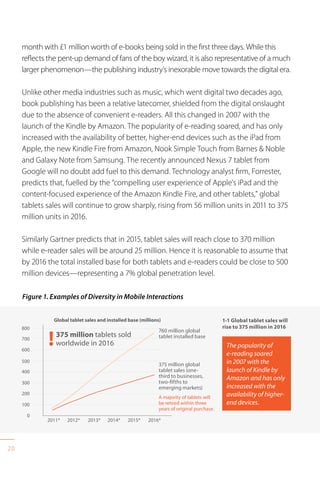
tablets sales will continue to grow sharply, rising from 56 million units in 2011 to 375
million units in 2016.
Similarly Gartner predicts that in 2015, tablet sales will reach close to 370 million
while e-reader sales will be around 25 million. Hence it is reasonable to assume that
by 2016 the total installed base for both tablets and e-readers could be close to 500
million devicesโ€”representing a 7% global penetration level.
21
Digital Publishingโ€”Crossing the
Chasm to a Digital Future
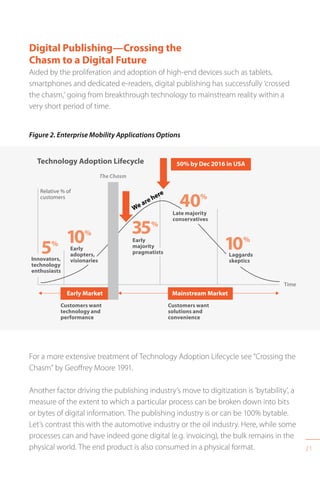
Aided by the proliferation and adoption of high-end devices such as tablets,
smartphones and dedicated e-readers, digital publishing has successfully โ€˜crossed
the chasm,โ€™ going from breakthrough technology to mainstream reality within a
very short period of time.
Relative % of
customers
Innovators,
technology
enthusiasts
Early
adopters,
visionaries
Early
majority
pragmatists Laggards
skeptics
Customers want
technology and
performance
Customers want
solutions and
convenience
Time
The Chasm
Late majority
conservatives
Figure 2. Enterprise Mobility Applications Options
For a more extensive treatment of Technology Adoption Lifecycle see โ€œCrossing the
Chasmโ€ by Geoffrey Moore 1991.
Another factor driving the publishing industryโ€™s move to digitization is โ€˜bytabilityโ€™, a
measure of the extent to which a particular process can be broken down into bits
or bytes of digital information. The publishing industry is or can be 100% bytable.
Letโ€™s contrast this with the automotive industry or the oil industry. Here, while some
processes can and have indeed gone digital (e.g. invoicing), the bulk remains in the
physical world. The end product is also consumed in a physical format.
22
One industry that has scaled the โ€˜bytabilityโ€™ ladder with
ease is the music business, since most of the process
of producing and listening to music is digital in nature.
However, the physical world does come into the picture
while recording music since you need a studio, or a
stage and the performers (currently) have to be in the
same location.
In contrast, in the publishing business, the author,
publisher, distributor and the consumer are not
required to interact in the physical world at all. The
availability of computers, internet and e-reading
platforms have ensured that the entire publishing
process, from book writing and production to
distribution, archival and consumption can be digitized.
Scientific and medical journals and reference books
such as encyclopedias have been the forerunners in
migrating to a digital format. In 2011, Amazon, the bell-
weather for the digital distribution business, announced
that e-book sales had outpaced those of printed books.
This trend is now evident across the industry.
The Association of American Publishers (AAP) recently
reported that, for the first time ever, net sales revenue
from e-books exceeded that of hardcover books
in the first quarter of 2012. In 2011, e-book net sales
revenue climbed 332.6 percent over 2010. In contrast,
print sales grew a mere 2 percent over 2010. Reports
from other parts of the world too reveal a decline in
physical book sales and an associated increase in digital
book consumption. The Publishers Association in the
UK recently revealed that sales of consumer e-books
increased by 366% in 2011, and all digital formats
encompassing e-books, audio book downloads and
online subscriptions accounted for 8% of the total
invoiced value of book sales in 2011, up from 5% in 2010.
According to Pew
Research Center in the US
that provides information
on the issues, attitudes
and trends shaping
America and the world,
there are four times more
people reading e-books
in the US on a typical day
now than was the case
less than two years ago.
23
Publishers are experiencing the digital revolution first-hand.
In 2008, digital revenues at New York-based book publisher
Hachette Book Group (HBG) represented just 1% of the
companyโ€™s topline. This year, about 20% of HBGโ€™s revenue
will come from digital sales. Similarly, at Hyperion Publishing,
the book-publishing arm of Walt Disney Co.โ€™s Disney-ABC
Television Group, digital revenues grew from 6% of sales in
2010 to 18% in 2011 and are projected to touch 28% in 2012.
Challenges
In the digital arena, every element of the
traditional publishing process is being questioned
or redefined.
Digitization, the availability and consumption of content in
an electronic format, is without doubt, one of the biggest
disruptive changes impacting the publishing industry since
Guttenbergโ€™s invention of movable type and the printing
press in 1440. Moreover, the speed at which the digital
environment has engulfed the industry has caught several
players unaware. In September 2010, the Borders Group, once
the second largest book retailer in the US that helped pioneer
brick-and-mortar book superstores, liquidated its 40-year-old
business, after failing to overcome competition from players
that had a well-honed online presence and platform strategy
such as Amazon.com (Kindle) and Barnes  Noble (Nook).
The publishing industry faces enormous challenges in the
digital age since old rules no longer apply. As content and
consumption become increasingly digital, old order business
models based on tight control of the distribution of premium
contentโ€”to the point of scarcityโ€”are no longer relevant.
Consumers are increasingly calling the shots, demanding
content in multiple formats, across multiple platforms, and at a
time thatโ€™s convenient for them.
24
Book publishing traditionally followed
a time-tested processโ€”contracting
an author to write a book, developing
the manuscript, copy editing and
typesetting, designing, proofreading,
printing, distribution, publicity and
Some of the key changes the publishing industry can
expect in the future are:
n Publishers will need less warehouse space, if any. Print
buying and typographic design will probably be very
low on the list of skill sets needed by the publisherโ€™s
โ€˜production departmentโ€™ten years down the line but
the ability to developโ€˜appsโ€™internally or through third
parties will become increasingly important. Technical
fluency will be essential in all aspects of the new
digital enterprise.
n Delivering content in multiple forms and contexts
will be a far more critical component of success than
it is today. Hence the ability for business systems to
manage increasingly complex productโ€˜fragmentsโ€™and
โ€˜bundlesโ€™will be crucial.
n Skills and capabilities to manage direct relationships
with consumers will be key. The shift from B2B to B2C
has huge organizational and system implications.
n The capabilities of the digital world will allow for many
more products and the bundling of different products.
Hence the ability to manage the associated rights and
royalties will become much more complex.
retail sales. This led to the creation of
a quality product released in a fairly
predictable time frame. In the digital
arena, every element of the process is
being questioned or redefined.
25
At one end, the logistics of printing
and shipping do not play any role in
e-book publishing, while at the other,
authors are taking the lead and opting
for self-publishing, putting a question-
mark on the previously all-important
role of publishers themselves. Amanda
Hocking for instance, used Kindleโ€™s
self-publishing platform to publish
her novel after being rejected by all
major players and achieved best-seller
status. In the digital space, the sales
and marketing process is also being
redefined, since publishers now need
to reach out directly to customers, not
necessarily through retail stores.
Print-on-demand is another element
that is changing the dynamics of the
print process since publishers no longer
need to plan for a minimum print-run.
An important aspect for e-books is
that the entire publishing cycle can be
cut down to a few weeks as against
months in the traditional print medium.
Notably, both costs and revenues are
typically lower for e-books, and they
often enjoy higher profit margins than
their print counterparts. At Penguin
Group, revenue from e-books was
up 106% in 2011 representing 12% of
worldwide revenues. However, while
overall revenues were up by a mere 1%,
profits grew by 8%. Simon  Shuster,
another big-six publisher, showed a
similar pattern in its results where,
with digital sales more than doubling
from 2010, the companyโ€™s operating
income was up by 31% despite overall
publishing revenues being down
by 1% .
The old order is being replaced by a
new one where different attributes are
valued. As we shift from a distribution
paradigm to a consumption paradigm,
companies have to rethink their
strategies. The balance of power is
shifting from the content owners to
platformsโ€”and from producers to
consumers. We are moving from a
B2B (Business to Business) environment
to a B2C (Business to Consumer) and
potentially a C2C (Creator to Consumer)
environment. The implications of the
shift from a distribution โ€˜pushโ€™ to a
consumption โ€˜pullโ€™ paradigm
in an entirely โ€˜bytableโ€™ world are
truly revolutionary.
Successfully Navigating
the Digital Age
Arguments about the ultimate role
of the e-book in publishing are likely
to remain unresolved for some time
to come, but few can doubt that in
many, if not all, sectors of publishing,
the future is digital. In some areas, such
as journals and learning management
systems, that future has already
arrived. The Encyclopedia Britannica
for instance, which for long enjoyed
26
the status of being the oldest print-based English-language encyclopedia, recently
announced its intention of going completely digital after being in existence for
244 years.
How far will the digitization of the publishing industry go? It is difficult to make
accurate predictions given the dynamic nature of the industry; however based on
current trends, we believe that by the end of 2016, 50% of all books sold will be
consumed electronically.
Faced with massive change, some leaders will struggle simply to stem the tide
without fundamentally changing their organizations. Others will look for ways
to jump ahead of the curve. Leaders need a framework for Digital Enterprise
transformation. The following framework offers executives and business strategists
areas where they can exert control and drive a holistic digital strategy in four
quadrants of transformation: product and service innovation, value ecosystem, go-
to-market and culture  organization.
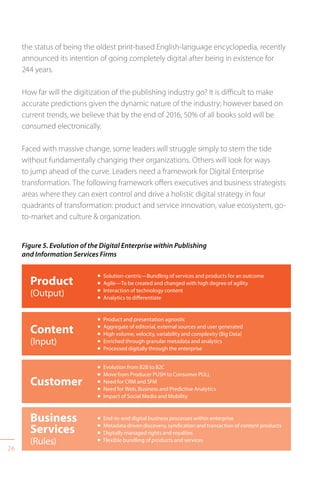
Figure 5. Evolution of the Digital Enterprise within Publishing
and Information Services Firms
n Solution-centricโ€”Bundling of services and products for an outcome
n Agileโ€”To be created and changed with high degree of agility
n Interaction of technology content
n Analytics to differentiate
Product
(Output)
Content
(Input)
n Product and presentation agnostic
n Aggregate of editorial, external sources and user generated
n High volume, velocity, variability and complexity (Big Data)
n Enriched through granular metadata and analytics
n Processed digitally through the enterprise
n Evolution from B2B to B2C
n Move from Producer PUSH to Consumer PULL
n Need for CRM and SFM
n Need for Web, Business and Predictive Analytics
n Impact of Social Media and Mobility
Customer
Business
Services
(Rules)
n End-to-end digital business processes within enterprise
n Metadata driven discovery, syndication and transaction of content products
n Digitally managed rights and royalties
n Flexible bundling of products and services
27
How far will the digitization of the
publishing industry go?
Based on current trends, we believe that by the
end of 2016, 50% of all books sold will be
consumed electronically.
Product and Service
Innovation
As discussed earlier in this article,
digital has impacted products and
services across many industriesโ€”but in
publishing, digital is the product. This
is the most critical quadrant to address
for this industry, and the timeline to do
so is shrinking on an accelerated pace.
Some key areas of consideration when
creating a strategy for this piece of the
quadrant are:
Content Storage and Metadata
Management
It is essential to create and store content
in a format that provides enormous
flexibility both in terms of delivery
formatsโ€”whether conventional
print on paper or digitalโ€”and for
reworking for future reuse. This requires
publishers to put in place a digital asset
management capability which allows
them to store and manage the product
workflow from โ€˜concept to consumer.โ€™
Notably, a storage system which has no
mechanism for retrieving the content
that has been stored in it is clearly
of no practical value. Therefore the
content itself has to be supplemented
with metadata, data that describes
and defines both the content and the
files that contain it, and is essential for
โ€œsearchabilityโ€ and โ€œdiscoverabilityโ€ in
the online arena.
However, metadata management in
a digital context, where a one-to-one
equation of product (distributable
item) and content (or the โ€˜workโ€™) is
increasingly untenable, is not very
simple. Whereas in the physical world,
a book is published in limited formats
(typically hardbound and paperback),
in the digital world there are myriad
options for formatsโ€”some of which no
doubt are yet to be invented.
Similarly, individual elements of
content (e.g. โ€™learning objectsโ€™) may
be used and reused in many different
combinations and contexts. As the
opportunities for using and reusing the
content become more complex and
more granular, the familiar structure
of published content begins to break
down in many different directions.
28
While it provides the potential for many new publishing
opportunities, this new granularity complicates the business
of storing and managing assetsโ€”not least, because of the
unavoidable explosion of metadata.
Additionally, metadata creation and management can be
time consumingโ€”and costly. Therefore, it becomes critical
to โ€™do it once, do it rightโ€™. Metadata needs to be captured
once and at the earliest opportunity in the publication
workflow, and then (just like the content itself) used and
re-used wherever it is needed within the publishing process.
With an extensive, flexible and well-managed master
metadata management system (MMMS) in place, a
publisherโ€™s primary assetโ€”content and the rights to
use that contentโ€”rightfully take center-stage. All other
systems which create or require content metadataโ€”from
production workflow to fulfillment and accountingโ€”should
feed and be fed by the MMMS.
Compelling Content
Despite strong and growing consumer demand for digital
content, many content offerings fail to meet customer
requirements. This is typically because of one or more of
the following: they do not match specifics of consumer
demand, they do not provide a compelling experience,
they are not well optimized for the platform or technology,
they do not deliver sufficient added value or they are not
correctly priced or packaged.
Most media companies have largely replicated their
traditional analog productsโ€”books, magazines and
newspapersโ€”in digital forms. While this is a good start,
they will not complete the digital transition until they have
created entirely new digital media products that leverage
the promises of the new medium. While digital efforts
29
of โ€˜old schoolโ€™ companies remain
mere imitations of traditional media
products, it provides an opening for
new age companies, unencumbered
by the past, to provide truly original
products. Traditional publishing
companies may be able to get a jump
over these new entrants by establishing
formal organizational priorities for
product innovation.
Content Usage Rights
Any publishing asset is more than
just content. Certainly, an asset is
content (or at least has content in it);
but content by itself has no value as
an asset unless one also has the right
to use it; publishers therefore need
to know not only about the content
but also about the rights they have to
use that content in any given context.
These are the rights that have been
acquired under a contract.
Open Standards
Open standards in three critical areasโ€”
numbering, metadata and digital rights
management (DRMโ€”are an essential
requirement for achieving the potential
of new media. The current inability of
most media companies to adequately
describe their potential product
offerings stems from the โ€˜constraintsโ€™
of existing ERP data structures. This
severely limits their ability to capitalize
on new product opportunities.
Publishers are literally unable to sell
what consumers want (and will pay for)
because they cannot uniquely identify
these new โ€œproductsโ€ or their rights to
sell them.
Value Ecosystem
Innovative Business Models
As the value chain evolves, more
power will shift from content creators
to the platform on which content is
distributed. Many solution providers,
especially in publishing, are developing
their own products that optimally
leverage the technology capabilities
of their platforms. Content owners
will invest in and/or partner with
these platforms to stay in the game.
Publishers, likewise, should look to
develop and extend their interest in
these platforms to retain as much
control as possible within the new
value chains.
Simultaneously, publishers will need
to rationalize as they re-focus on their
core strengths. As the ecosystem
evolves, they will need exit strategies
for the sections of their business that
are no longer core. Companies trying
to become Digital Enterprises should
aggressively seek ways to shift the
responsibility for these functions
to specialists.
30
Go-To-Market
Pricing and Payment Models
In a digital environment, publishers and media companies
must consider a variety of new pricing and payment models
for their content. They will need to build a portfolio of new
digital revenue streams, some of which may be only loosely
related to their current business. Replacing declining revenues
from physical media will be challenging but retaining
profitability may be less so if they aggressively cut costs and
outsource activities which are not core.
Social Media
Social media capabilities are enabling communication and
collaboration on a scale never seen before. Socially enabling
the enterprise is an initiative embraced by a growing
percentage of companiesโ€”this will be a sustained trend
over the next several years. It is critical to recognize that we
are at the beginning of this revolution not the endโ€”indeed,
the iPad will one day be seen as the Model T Ford of tablet
technology.
Mobile Environment
As smartphones, e-book readers and tablets become
pervasive, publishers need to anticipate rather than react to
how mobility will affect their business in the years to come.
To understand how game-changing mobility could be,
consider what is happening in the education area. Many
educational institutions are now โ€™going digitalโ€™ and allowing
students to purchase digital versions of textbooks. In a class-
room context, students will require their digital versions to
support capabilities for note-taking, sharing or updating
notes with others over wireless networks. They will also
expect content updates (such as new sample tests for those
purchasing tutorial material for competitive exams) in the
same way they update their software operating systems and
31
business productivity applications. Such requests will have to be serviced on-
demand and independent of the devices that request them.
Business Analytics
Digital distribution is driving the transition of business models from traditional
B2B towards B2C. With products that can now be โ€˜pulledโ€™ by the consumer, and
not just โ€˜pushedโ€™ by the creator, it is critical for media companies to have a clearer
understanding of their customers.
The key to this is data and learning how to use the data to take faster and smarter
business decisions. Business intelligence and analytics platforms are therefore critical
and can make key tasksโ€”from planning, production to channel management and
contracts managementโ€”far more efficient, and ultimately boost profitability of an
asset within its โ€˜use-byโ€™ date.
Culture and Organization
Culture differentiates an organization. If a business withstands the test of time, it
does so due to its culture. Culture has no metric; a successful business identifies
with its culture in a manner no other business can. If a company has learned to run
its processes by simply imposing regulations it may very well continue that way.
Whether or not this is an ideal way to function, we need to accept it.
How a business accepts or reacts to the digital environment depends on its culture.
Developing a digital transition strategy without considering culture can easily create
a hostile environment.
Digital will remake employee-enterprise connectedness in the same way that it is
revolutionizing customer-enterprise relationships. Digital enables more collaborative
and comprehensive employee engagement, which in turn drives higher levels of
employee performance. If social and mobile are the best ways to reach customers,
logically, theyโ€™re also the best way to reach employees. Making social networking
and collaboration available internally allows all employees to learn from one another
and collectively problem solve.
32
Conclusion
Digitalization, mobility, changing media consumption patternsโ€”we live in a time
of technology acceleration, the like of which has never been seen before. The good
news is that while technology changes have created some of these challenging
situations, they are also responsible for delivering solutions. These have to be
skillfully leveraged to create a new framework for media product innovation that
can deliver content assets that are aligned with 21st-century consumer behavior
and demand. The process of product innovation and rebuilding that this entails may
well be a publishing companyโ€™s ticket out of the media meltdown.
Publishers need to reach audiences, know where they are, and understand which
products to target them with. Partnering with suppliers and other parts of the new
supply network to build operating dexterity and scalability will be critical in building
a new ecosystem. Alliances with telecommunications companies, technology
companies, device manufacturers and system integrators, will be key. Together, we
may actually be able to see around the bend, shift gears and accelerate to win.
33
Collaboration, Analytics, and Channel
Transformation:
A Step-by-Step Journey
Already under pressure to modernize and rationalize the
insurance companyโ€™s information technology foundation,
chief information officers, marketing heads and other leaders
in the insurance enterprise now confront accelerating
technological, social, and economic disruptions.
Instead of merely reacting with a โ€œmobile strategyโ€ or โ€œsocial
strategyโ€ and piecemeal modernization, insurance companies
have an opportunity to reinvent their relationships and their
operations as part of a step-by-step journey towards the
โ€œdigital insurance enterprise.โ€ Along this journey:
n Initial investmentsโ€”such as communications channel
integration and web based solutions supporting
intermediariesโ€”will drive the immediate returns in the
distribution channel through enhanced agent/intermediary
support that creates a virtuous cycle for continued
modernization and integration.
Any Customer,
Any Channel, Anytime
Building the Digital Insurance Enterprise for
the Era of Engagement and Collaboration
Authors
Frank Diana
Principalโ€”Digital Enterprise Solutions, Global Consulting Practice
Matthew Palmer
Head of Insurance Domain Group, Europe
34
n Collaborative system transformation will reduce
administrative burden on agents/intermediaries
and customer-facing employees and enhance
key components of the sales and service process,
from recommendations, quoting, applications and
underwriting to service, claims and settlement.
n Longer-term, the insurance company will find itself
increasingly empowered to engage and collaborate with
all customersโ€”both intermediaries and end customersโ€”
while leveraging all the sources of knowledge and
innovation represented by connected stakeholders and
โ€œbig dataโ€ analytics.
n Leveraging enhanced analytics capability and integrated
systems of engagement and collaboration, companies
can deliver the differentiated experience that customers
increasingly demand as comprehensive, real-time
knowledge is increasingly at the fingertips of those who
touch the customer
Customers call frantically but canโ€™t reach agents in the aftermath of a
catastrophic storm. Fortunately, their smart phones still connect to Twitter.
More fortunately, your customer service representatives see tweets for
help, engage customers on Twitter, provide immediate assistance if
appropriate, transition those needing further support to a voice channel
and take steps to resolve their various issues. Subsequently, agents get a
web-based handoff from the contact center and use a combination of SMS
text messaging with video and photos along with personalized, mobility
optimized web portals to communicate with customers and complete
the service loop. Moreover, insurance company personnel deployed
locally keep up-to-date via contact with CSRs and agents. Along the way,
CSRs and agents have access to customersโ€™ histories across products and
policiesโ€”all the knowledge needed to deliver the best possible service
under the worst possible conditions.
35
From Organizational
Disruption to Creative
Disruption: Preparing for
the Era of Engagement
and Collaboration
Are your insurance company and
distribution channels ready to succeed
in this scenario?
In this scenario, youโ€™re a PC insurance
firm dealing with commercial or
residential customersโ€”but tweak
a few details and the technology-
enabled scenario applies equally to
life or health insurance companies.
Likely, your company is developing
capabilities for one or more of these
activities, with some of your agents and
end customersโ€”but are you prepared
for a world in which this scenario of
digital engagement and collaboration
becomes the new baseline for your
enterpriseโ€™s performance?
Welcome to the opportunities and
challenges of the โ€œEra of Engagement
and Collaborationโ€:
n Informed, mobile, social media-
empowered businesses and
consumersโ€”as well as intermediary
partners and even your employeesโ€”
increasingly in charge of how they
interact with you and others and no
longer willing to be โ€œjust another
policy or ID number.โ€
n Digitally empowered competitorsโ€”
organizations that somehow know
what to do with more data (and
connectivity) than others know what
to do with.
n Collaboratively empowered
innovatorsโ€”those that find the best
ideas wherever they can be found
then become your unforeseen
new competitors.
If youโ€™re a chief information officer, a
strategist, marketer or any other leader
in the insurance space, by this point
you know all too intimately these and
other sources of almost continual
upheaval. Accelerating disruptions
define the world we work in today.
Though insurance is arguably one of
the most unique and differentiated of
the worldโ€™s mature industriesโ€”and
historically swift to harness new waves
of technologyโ€”we are hardly immune
to technology-powered forces of
commoditization, marginalization and
overnight displacement that sweep
across other industries. As a leader,
you know your job is to face these
disruptions head onโ€”and turn them to
your advantage. But how?
Consumers expect service across
digital and mobile channels. Agents,
brokers and employees expect to be
able to provide it and will use tools at
36
hand to do so, regardless of permission
from your IT organization. And thanks
to unprecedented digital and mobile
innovation, insurance companiesโ€”
like most industries worldwideโ€”are
discovering a wealth of opportunities
to engage across all channels and
deepen their customer relationships.
Yet your ability to capture these
opportunities and commercialize new
innovations is constrained by traditional
approaches that segment and solve
challenges in silos, not holistically. Fresh
approaches and solutions on a different
scale of thinking are required, because
data onslaught and consumerization of
technology have created the โ€œPerfect
Stormโ€ intersection of social, mobile,
big data and the cloud. It is uncommon
and perhaps even unique, to have so
many emerging forcesโ€”all rapidly
evolving, all technology centric, and
each buffeting every business with
gale-force winds of change.
Business consultant and author
Geoffrey Moore introduced the
โ€œEngagement Eraโ€ concept in his book
Escape Velocity, which explores how
established technology companies,
finding themselves in this Perfect
Storm, must free themselves from โ€œthe
pull of the past,โ€ seamlessly innovate,
collaborate, engage and thereby
reinvent themselves and the solutions
they provide customers. In a similar
way, but tugged backwards by years,
decades, or even centuries of history,
forward-looking insurance companies
must manage the complexity created
by unprecedented disruptive forces
and harness those innovative changes
that enable the success of the digital
enterprise in the โ€œEra of Engagement
and Collaboration.โ€
A Holistic Approach to
Grappling with Complexity
and Change
Every insurance carrier today
recognizes the transformative forces
that impel the emerging digital
enterpriseโ€”but with some notable
exceptions, most companies to date
have grappled with these changes in a
siloed, exploratory, piecemeal solutions
manner. After all, most IT organizations
are still dealing with legacy systems
and the evolution of IT infrastructure.
As a stopgap, we deploy our โ€œsocial
strategyโ€, โ€œmobile strategyโ€ and โ€œdata
center strategyโ€โ€”but we struggle to
weave these strategies together into
overarching, enterprise-and-beyond
digital strategies that take us step-by-
step into the โ€œEra of Engagement
and Collaboration.โ€
A holistic digital enterprise strategy
confronts the disruptors and harnesses
the enablers at every step along the
37
journey. To confront key disruptorsโ€”including social networking, gamification,
mobility and cloudโ€”you leverage key enablersโ€”including big data, geospatial
visualization, digital identities and business architecture. To be clear, weโ€™re not
talking about technologiesโ€”fundamentally, weโ€™re talking about business and
people enabled by technologies. Specifically, businesses and people need to be
enabled to collaborate and innovate, to reinvent relationships with customers
(distribution channels and the end customer) and to manage systemic complexity
with operational dexterity.
Innovation is no longer about the periodic breakthroughs arising from your research
and development efforts. Innovation itself is increasingly commoditized.
Itโ€™s about harnessing ideas wherever they can be found and rapidly commercializing
them. Itโ€™s about collaborating and co-creating solutions with customers. Itโ€™s about
the audacity of โ€œsupply chain hoppingโ€ to overcome historical barriers to new
market entry.
Reinventing customer relationships also requires collaboration, because the
customer is much more in charge. There are also different relationships to reinvent.
Despite more and more direct-to-consumer plays, insurance remains predominately
a business-to-business-to-consumer industry. So your insurance company must
reinvent the way it relates with more empowered intermediariesโ€”agents and
brokersโ€”as well as with end customers (businesses and individuals). All these
relationships have their own unique demands. How do you simultaneously cede yet
maintain control? How do you systematically meet constantly rising and changing
expectationsโ€”on an individual basis?
Fundamentally, insurance companies must develop a new level of operating
dexterity to manage systemic complexity that will only increase from here. This
means going beyond ITโ€”moving from information technology to
business technology that holistically enables the digital insurance enterprise.
38
Path to the Digital Insurance Enterprise
Channel Integration and Systems of Engagement
Clearly, transforming your insurance enterprise for the
era of engagement and collaboration will be an ongoing
journey. Insurers must take practical steps that increase their
immediate returns, even as we embrace and pursue over time
the ultimate vision of an engaged digital enterprise.
A key step toward the ultimate social business modelโ€”
something entirely within reach todayโ€”is to evolve your
social media presence to deliver an integrated multichannel
experience. In other words, building out โ€œsystems of
engagementโ€ enables your shift from disconnected social
media and mobile strategies to a much more comprehensive,
integrated, multichannel relationship platform. As integration
becomes increasingly seamless, the โ€œdigital engagement
centerโ€ makes possible the scenario outlined at the beginning
of this discussion.
Again, technology plays a central enabling role. But ultimately
the challenge involves using all communications channels
to reinvent the customer relationshipโ€”and to drive the
associated cultural and organizational evolution that makes
this reinvented relationship possible. To do this well, your
company must combine collaboration excellence with
analytical excellence. Collaboration excellence entails both a
collaborative culture and collaborative systems that support
true partnering with employees, intermediaries, and end
customers. Analytical excellence means grappling with big
data and gleaning the insights you need to anticipate and
influence customer needs.
In this emerging context, often described as
โ€œconsumerization at the edge of the enterprise,โ€ the core
of your business shifts outward to the customer, and
39
systems of engagement become
increasingly crucial to your overall
operational management. Systems
of record traditionally at the core of
your insurance companyโ€”enterprise
resource planning, customer
relationship management, legacy
and modern policy systemsโ€”remain
relevant, but with an evolving role.
More and more systems of
engagement come to the forefront,
and over time manage all channels in a
more and more integrated fashion.
What does this consumerization
mean concretely? Think of it this way:
a smart phone or tablet computer is
the new front door to your businessโ€”
superseding the PC that used to be the
new front door to your business. About
six in 10 people now use their mobile
phones for banking and about the
same number use handhelds for social
media. What does this tell you? Perhaps
the mobile channel is a good place to
start the digital enterprise journey.
So start from mobileโ€”and clean up
your web strategy as you evolve to
an integrated multichannel customer
experience. (Working within the
constraints of mobile invariably reduces
the sloppiness of user experience that
is typical of todayโ€™s โ€œeverything but
the kitchen sinkโ€ corporate web sites.)
Then build on channel convergence to
take the next steps toward the digital
enterprise vision.
In this way, you can start to leapfrog
over incremental improvements.
Remember, this isnโ€™t your โ€œmobile
strategyโ€ in a vacuumโ€”this is you
using your mobile strategy to begin the
transformation of customer experience
and drive toward integrated systems
of engagement. With mobile and
web converging, you have taken a
step forward towards multichannel
convergence. Itโ€™s then just an extension
to integrate other contemporary and
traditional communications channels.
The enabling power of these integrated
and transformed channels then
will depend on increasingly tight
integrationโ€”including integration
with systems of record that will
enable further automation of business
processes and case management.
These in turn will reduce administrative
burden and increase productivity of
customer service representatives and
other employees, as well as agents
and other intermediaries that you
support. Ultimately, productivity will
be enabled not only by automation
of more and more business processes,
but also through transparent access to,
and rapid analysis of, structured and
unstructured data.
40
Caselets
A Life Insurer Prioritizes Investment
A large life insurance leader dove into dozens of social
and mobile projects and proposalsโ€”before realizing
that these efforts were occurring in disconnected
silos, without an overarching strategy for this growing
investment. Employing a โ€œrationalization frameworkโ€ and
workshops provided by Tata Consultancy Services, the
company assessed these myriad initiatives, scoring them
based on their alignment with CEO strategy, contribution
to strategic outcomes, business insight value and
technology leverage. A social-based group benefits
platform designed to drive social up-selling and cross-
selling earned the highest scoreโ€”and the opportunity
to be prototyped. Now all proposed digital initiatives
are prioritized in this mannerโ€”ensuring that each one
pushes the company forward on the path toward its
ultimate vision of a digital center of engagement.
Product-to-Customer Shift Increases Product
Density
Thanks to its commitment to innovation, a large financial
service firm decided to make a shift from product to
customer orientationโ€”and ended up driving greater
product density per household. The company developed
a holistic social media strategy encompassing listening,
engaging, relationship strengthening, and innovation.
Four product-focused websites were consolidated
into one customer portal with full service, including
electronic signatures and innovative services for mobile
devices. In parallel, the company enhanced its contact
center infrastructure with virtual assistant, multichannel
integration and transaction sharing capabilities.
41
Unified Platform Drives Infrastructure Efficiencies
Thanks to its long history of successful mergers and acquisitions, a global financial
protection leader needed to rationalize its infrastructure into a single architecture
allowing for reduced support teams. A unified portal platform provided
all stakeholders with sign-on access, personalization and customization of
information and content across web and mobile channels, and a search engine to
access product, policy, compensation and benefit information. Other capabilities
include group rebalancing, which allows the broker to save multiple contract lists
and investment models. Other advanced materials, tools, and quick links generate
illustrations and views of product performance, helping clients make quick,
informed decisions.
The ability to defend, create and/or
sustain your competitive advantage
hinges on excellence in two critical
areas: collaboration and analytics.
Collaboration excellence addresses the
growing need for relationship-based
enterprises that re-invent customer
relationships, leverage the collective
knowledge and talent of employees,
and partner to facilitate operating
dexterity. Analytics gives you the power
to find pattern and meaning in more
data than all enterprises heretofore in
human history have created,
captured and stored. Moreover,
integrated systems of engagement and
collaboration create other benefitsโ€”
improved IT governance along with
the streamlining and automation of
processes. Process efficiencies, in turn,
Bringing It All Together
in the Digital Insurance
Enterprise
There is no question that senior
insurance industry leadersโ€”especially
CIOs and marketing headsโ€”are on the
hottest of hot seats today. Historically,
given its maturity and the regulatory
fabric that envelops it, insurance
companies of all types have enjoyed
remarkable predictability and stability,
even as we provided crucial services
to a world that needs us because
itโ€™s always been unpredictable and
chaotic. Todayโ€”thanks to a myriad of
technological, social and economic
disruptionsโ€”insurance companies
are compelled, by forces out of their
control, to reinvent their relationships
and their operations.
42
improve service by giving CSRs, agents and others more
time to focus on engagement with the customer.
Whatโ€™s not different? Results matter, now and always. And
innovation still delivers the goods. The insurance industry
has reached its biggest-ever tipping pointโ€”we stand on
the cusp of the Era of Engagement and Collaboration. As
in the past, the industry has the potential to truly innovate
and transform itself by embracing the disruption and
creating a new paradigm of sustainable competitiveness.
There will be inevitable losersโ€”some possessing great
vision, yet failing to achieve immediate returns, others too
focused on past and present to reimagine their future. Will
your company end up in the winnersโ€™ column?
43
Introduction
At this point, every major enterprise recognizes the need for a
mobile strategy. But where do you begin when you donโ€™t have
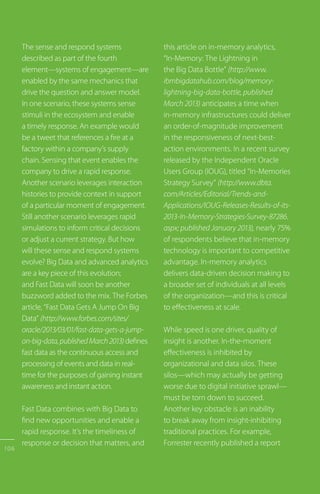
years of experience with the data, processes and use cases
of mobile?
To give you a head start, we present five common mobile
โ€œfailsโ€ we have observed. We focus on examples from the
banking and financial services (BFS) industry, but the bulk
of our insights apply across all industries. Whether youโ€™re
designing mobile applications, producing mobile promotions,
or mobile-enabling your website, you need a mobile strategy,
so we offer a proposed framework for devising a holistic
strategy that embraces mobileโ€™s transformative potential.
Mobile Fail 1: Not Everything Moves
A mobile strategy canโ€™t simply consist of creating a mobile
application and then waiting for downloads to begin. Letโ€™s
face it: not everything (or everyone) moves. There has to be a
business case for the mobile app and its use.
Mobile Fail Case: Not Understanding Mobile in the
Context of Hedge Fund Managers
Our case in point is a hedge fund. The typical hedge fund
Five Mobile Fails
How Banks and Financial Services Institutions Can
Avoid Pitfalls in Mobile Strategy and Execution
Author
Tonya McKinney
Headโ€”Digital Strategy Consulting and Solutions,
Global Consulting Practice
44
manager spends close to 14 hours at his desk, handling trades on one screen and
monitoring financial data feeds on another. Wanting to be at the competitive
forefront, one company created an app that essentially replicated desktop
functionality for tradersโ€™ iPads. To the companyโ€™s surprise, the app was rarely used.
The reason? There was no use case for traders using the iPad app. After 14 hours in
front of screens, the last thing they needed was the same app on a mobile device.
The company had based its assumptions on general trends rather than specific
trends observed among its user population or specific objectives for the business.
Mobile Save: Lessons from Televisionโ€™s โ€˜Second Screenโ€™ Approach for
Hedge Fund Managers
Possible mobile save: Given the propensity of hedge fund managers to toggle
between screens to make investment decisions, read email and effect trades, one
possible use case could be to use the iPad for ancillary, second screen functions,
such as a news feed or SMS updates about trading activity in foreign markets.
Second screen is a digital model from television/entertainment where viewers
are watching a program but viewing secondary content on second or even third
screens on a mobile device to enhance their experience. Moving fact-response or
view-only activities to the iPad could free traders from distractions while performing
core work at their desks and provide them with valuable information to consider
when they leave the office.
Lessons Learnt: Donโ€™t rely on general trends to make investment decisions about
mobile apps and technology. Instead, your mobile strategy and execution must be
based on outcomes and a deep understanding of your particular users. And, donโ€™t
forget that mobile has to be evaluated in context, and that by introducing mobile
devices, apps and technology the context will alter.
Mobile Use Case Checklist
n Assess both current and future mobile device preferences. Mobile device
preferences are fast-moving and unique across cultures, generations and
socioeconomic groups. Assess not only what your target group uses now, but
what they are most likely to use in the future. It may seem that everyone has an
iPhone but an older segment may rely more extensively on Blackberries now and
their next upgrade may be to a Microsoft device within 18 months.
n Assess current and potential usage. How, when and why is the user population
45
using mobility at home and at work
now? What are the apps and uses most
adopted; even outside the industry?
How are these likely to change over the
next few months and years?
n Conduct field studies to define use
cases. Ensure that mobile use cases
are well understood in context (user,
interactions, process, environment).
Evaluate the need or potential of
mobility by monitoring the users
in their actual environment, asking
questions such as: How will processes
change with mobile? How will the
mobile solution affect not only users
but also those who interact with
users? For instance, does a mobile
application enhance the interaction
between a financial advisor and a
client or does the client feel alienated
by a perceived lack of focus from
the advisor?
n Small trials. Try a test case with a
small, representative group of users
and iterate quickly vs. rolling it out to
entire teams or segments.
Mobile Fail 2:
No Mobile Metrics
According to Forrester Research, 47% of
financial ebusiness managers say they
donโ€™t know how to measure mobile
ROI1
. Typically, the lack of precedent
for measurement prevents most
organizations from developing mobile-
specific KPIs. Many organizations just
take traditional KPIs and apply them
to mobile initiatives. Others merely
measure what is easy to measure or
what they already measure, often
copied from web measures, such
as โ€œdownloadsโ€ and โ€œduration.โ€ Very
few organizations have realized that
the nature of mobility on-the-spot,
multimedia data captureโ€”offers
entirely new information that can bring
unprecedented insight to the company.
Saga: An Example of Unique
Use Cases Based on Unique
Mobile Data
Saga is a tool only possible with mobile.
It collects persistent, ambient data from
your mobile device and uses analytics
to help you decide what to do next.
[1] 2010 Q2 Global eBusiness and Channel
Strategy Professional Online Survey, Forrester
Research, Inc
46
New Measures from Mobile: The Power
of โ€™Whereโ€™
The most obvious unique metric from mobile is โ€˜whereโ€™.
Consider how geolocational information from mobile
changes how you might measure and analyze transactions
and other customer behavior. Just as the rise of ecommerce
created new metrics such as โ€™shopping cart abandonmentโ€™,
mobile adds another dimension, โ€˜whereโ€™. Now you can know
the customerโ€™s location when he or she is abandoning the
cart or failing to complete an online account transfer.
A bank trying to determine whether to retain an ATM or
branch location has powerful decision-making insight with
mobile data. What is the timing, location, frequency and
type of financial activity completed on a mobile device,
e.g. electronic check deposit at home using a mobile
device camera vs. the ATM two blocks away? Knowing that
customers are more inclined to conduct certain transactions
at home, as opposed to at a Starbucks for example, is
valuable information that could affect the design of an
application, the location of a branch, a business process or
advertising placement.
Besides geolocation, there are other types of new data from
mobile phones to consider: audio, video and social sharing.
A simple exercise to help you understand the value of the
new data and insight from mobile is to mix and match the
new data types with the traditional data types.
Lesson Learnt: Understand the unique data opportunities
with mobile and develop mobile-specific metrics. Map the
value of mobile insights across the business from timing
online promotions, to placing print ads to determining
where to put branches.
47
Unique Mobile Data Offers New Opportunities for Analysis
TraditionalMobile Data
Account TypeBanking Location
LifestageTransaction Timing
Transaction HistoryPrevious Transaction
New ServicesMobile Types
DemographicsMobile Profiles
Financial Goal and ProgressMobile Banking Sharing
Account ConsolidationSocial Banking Content
Combining the new data types from mobile devices with
traditional data can drive new insights from analytics
Mobile Measurement Checklist:
n Align mobile targets to support strategic outcomes.
n Map the mobile actions and behaviors that drive
your outcomes.
n Understand the insight needed from mobile in order to
take the action.
n Document the mobile data that can drive the analytics
insight, youโ€™ll find that more insight can be uncovered
because more or better data can be collected.
n Set KPIs and objectives, even if youโ€™re not sure theyโ€™re the
right ones.
n Make sure data architecture, storage, and analysis can
incorporate mobile device information, including
persistent location data, audio, images, and video.
48
Mobile Fail 3: Competitive Cloning
Rushing a mobile offering to market just because competitors have one is not
a mobile strategy. According to Javelin Strategy  Research, more than 70% of
American Banker Executive Forum members cited โ€™competitive pressureโ€™ as the
main driver for their mobile initiatives.
Working from Outcomes to Define Mobile KPIs
Mobile
Data
Mobile
Insight
Mobile
Action
Outcomes
Begin with your outcomes
and work through mobile
actions, insight and data
to get to those outcomes,
taking into consideration
the unique data provided
by mobile.
Objectives KPI
Customers Adopting
Mobile Banking
n Number of downloads
n Type and frequency of mobile transactions
n Time spent on the app
n Location and time the app is used
n Social recommendations for the app
Mobile and Customer
Acquisition/Retention
n Number of new customers
n Number of new customers from new segments
n Rate of customer attrition
Mobile Sales and
Marketing
n Promotion responses via mobile
n New services sold (such as credit cards)
n Annual revenue per customer or account
n Number of accounts consolidated
n Social and peer engagement
Mobile and Service
n Reduced support calls
n Reduced support costs
n Faster issue resolution
n Issues resolved via mobile versus other channels
Cost Mobile cost per user
Sample KPIs for Mobile Banking
49
Fail Case: Equal Opportunity Mediocrity in Mobile
A large number of mobile investment research applications
hit the market as competitors scrambled to float
competing products. Most delivered the same content,
in the same format as their websites, without added
functionality that leveraged the mobile device, format or
use case. Unsurprisingly, adoption was disappointing.
The top 20 banking apps in the Apple App Store are
virtually indistinguishable, using similar icons and colors
and providing little differentiation in user experience.
But boring interfaces arenโ€™t the only issue. Neal Oโ€™Farrell,
director of the Identity Theft Council, said that there
was a rush of mobile banking apps to capture market
share. Now people realize security is as much of a priority
as convenience.2
Launching a low-value mobile solution means users
review the app poorly and it becomes that much more
difficult to lure users back to a new or revamped app.
Mobile Save: Making the Most of the Device
A Citibank iPad app launched during the race to get
mobile account apps into the market, but it was a notable
exception because it continued where the competition
left off. The app had several advantages, but the most
striking was its use of the iPad visual interface for high
impact graphics that display spending trends and provide
helpful budgeting and financial planning advice. The
Citibank app has swept awards, monopolized press
coverage and even lured the leery online: at one point,
more than 5,000 Citi customers who previously had
no digital accounts with the firm had downloaded the
app. This well-designed app created a new channel of
engagement for the bank and set the industry benchmark
for more than a year.
[2] Eileen Courter, โ€œMobile
Security Still a Race Between
Bad Guys and Good Guys,โ€
Credit Union Times, August
5, 2012, http://web1.cutimes.
com/2012/08/05/mobile-
security-still-a-race-between-
bad-guys-and.
50
The Next Copycat Trend: Gamification
Recently, many companies have become enamored with game mechanics, which
can drive behavior and loyalty among customers, if correctly applied. We fully
anticipate a rush of financial games and gaming functionality to hit mobile in the
next year. But we caution the reader: gamification is powerful but game mechanics
must be aligned to your goals and users, not just plugged in because your
competitor has a game.
Just consider the boomerang behavior a California energy company experienced
after they tried scoring and comparing neighborhood energy use. Households
that previously scored higher on conserving energy, noted they were saving
more energy than their neighbors, and instead of continuing, began to relax their
conservation efforts.3
So, in this case, using game mechanics triggered the opposite
of hoped-for behavior. The team adjusted their approach and even continued using
some game concepts to better effectโ€”a simple smiley face badge helped reverse
the boomerang effect. Gamification must reflect a deep understanding of user
behavior, psychographics, and behavior theory in order to provide business value
and drive engagement and loyalty.
Citiโ€™s iPad app attracted
5,000 customers with no
prior digital relationship.
And more than 5,000 Citi
customers who had never
created online or mobile user
IDs signed up for the iPad app,
suggesting that the tablet
application lured in previously
non-digital customers.
How Citi learned to love the iPad
By Reena Jana, Contributor
CNN Money
http://tech.fortune.cnn.
com/2012/04/05/citi/
Citibankโ€™s Banking iPhone App Delivered Functionality Unique to Mobile
[3] Michael G. Pollitt and Irina Shaorshadze, โ€œThe Role of Behavioural Economics in Energy and Climate Policy, โ€œ ESRC
Electricity Policy Research Group, University of Cambridge, December 2011.
51
Lesson Learnt: Donโ€™t follow the crowd when developing your mobile
apps, unless itโ€™s a crowd of customers. Make your own assessment and
understand the needs of the user, along with the outcomes you hope to
achieve. Keeping up with Jones Co. is not a strategy.
Mobile Experience Checklist:
n At a minimum, read the reviews of competitorsโ€™ apps so you donโ€™t
repeat their mistakes.
n Express your brand in mobile. Which unique and valued brand aspects
can you recreate and reinforce via mobile capabilities? More choice?
Friendly service? Helpful information?
n Get into the fieldโ€”yes, field studies again. Truly impactful mobile use
cases seldom reveal themselves while you sit in a conference room or
a usability lab. Go see what people really do and want to do when they
are mobile.
n Even if youโ€™re providing basic functionality, leverage the innate and
unique capabilities of the mobile device to meet customer needs in
new ways and differentiate yourself from the competition. Consider
โ€™what ifโ€™ scenario calculators and supporting information that help
customers make smarter financial decisions.
Mobile Fail 4: Watch Out for App Bunnies
Mobile apps have a tendency to multiply. A line of business or functional
department can easily hire a mobile development firm to create an
application for a nominal fee. But that application may have very little
regard for corporate security and governance and could wind up
generating a huge total cost of ownership (TCO). An organization with
just 10 mobile applications, built for three platforms, with two updates
per year is an organization with 60 mobile projects per year.
52
Siloed, disconnected applications indicate the company is not thinking holistically
about the customer experience. Uncoordinated customer mobile applications
create new customer touchpoints that are not integrated into the larger customer
experience. Mobile often disrupts existing business processes. Without a central
management approach or enterprise standards, the customer experience is uneven,
security holes are opened and money is wasted.
Itโ€™s best to catch this fail early, because weeding and consolidating mobile apps later
can alienate your early adopters. Itโ€™s better to get a mobile strategy and a Center of
Excellence in place as early as possible rather than creating apps scattershot and
incurring the expense of consolidating them later.
Note that the problem is not necessarily having multiple mobile apps. For example,
Spanish bank La Caixa has taken advantage of the enormous appeal of the Apple
Store to create its own App Store where it offers more than 40 applications, each
targeted to a different segment according to its demographic profile and financial
needs. This is part of a strategy based on extensive customer research, not a lack of
planning and governance.
Lesson Learnt: Mobile applications can be relatively cheap to build, but without
planning, are expensive to secure, govern and maintain. More importantly,
uncontrolled app growth creates a disjointed customer experience. Rolling back
functionality later or combining mismatched apps doesnโ€™t endear you to customers.
A collection of mobile apps needs to be managed centrally, with firm-wide
governance and data and integration standards.
Mobile App Math: Exponential Costs
10 x 3 x 2 =60Mobile Apps Mobile
Platforms
Annual
Updates
Annual Mobile
Projects
App bunnies
multiply and so do
their costs.
53
TCS Mobility Center of
Excellence Model
A Mobility Center of Excellence helps stamp out โ€˜app bunniesโ€™ without hindering Innovation
Mobile Experience Checklist:
n Create a Mobility Center of Excellence
A Mobility Center of Excellence centralizes program management, research and
development and prototyping while ensuring the priorities of audience, governance
and security.
Mobile Fail 5: Mobile Myopia
In the rush to meet the mobile expectations of consumers (as well as management,
press and analysts), many companies make the mistake of focusing on mobile in
isolation, separate from other channels, programs and business processes. We see a
distinct lack of integration with both traditional channels such as branches, advisors
and call centers as well as emerging channels such as social media. Companies also
54
have a tendency to see mobile as a point solution,
without seeing the impact of the value of applying
mobile capabilities to a process from end-to-end.
Fail Case: Failing to See the Combined Power
of Mobile and Social
Very few banking or financial services institutions, as
of this publication date, have integrated their mobile
and social channels much further than โ€™shareโ€™ or โ€™likeโ€™.
Banking and social are both in the top 10 of mobile
activities, so it only makes sense to integrate your
institutionโ€™s banking and social activities on mobile.
However few institutions have adopted this approach.
One notable exception is Australiaโ€™s Commonwealth
Bank, which has launched an iPhone application that
allows customers to perform banking transactions,
such as paying others and receiving payments, via
Facebook contacts.
โ€œThe bank
(Commonwealth) has
demonstrated a beta
Facebook banking
application that will
allow customers to
do all their banking
transactions, including
paying others and
collecting money without
leaving the social
network.โ€ Social banking
on the way July 6. 2012
The Age Lia Timson
http://www.theage.com.
au/itpro/business-it/
social-banking-on-
theway-20120705-21jrh.
html#ixzz20nsIl3Xm
Commonwealth Banksโ€™
CommBank Kaching
iPhone application
integrates payments to
Facebook friends.
Integrated Mobile and Social Banking
55
The industryโ€™s social myopia is as prevalent as mobile myopia, most mobile to social
integration efforts are concentrated on Facebook and Twitter, overlooking richer
more established financial conversations. Social Media Explorerโ€™s Conversation
Report: What Consumers Are Saying About Banking noted forums as the runaway
favorite for banking social engagement: โ€œ90% of the (banking) conversations
studied (during the 2011 calendar year) took place on forums and message
boardsโ€”not Facebook, not Twitter, not blogs.โ€4
Mobile Rejuvenation of Traditional Channels and Processes
The other โ€˜blind spotโ€™ of mobile myopia is failing to see or map the full impact
of mobile on traditional channels and processes. Combining mobile capabilities
with these areas can unlock value. This fail, like Fail 4, creates disjointed customer
touchpoints as well as disjointed processes.
Multichannel: An integrated approach can make great improvements in customer
experience, such as integrating mobile with in-person channels. Mobile can keep
branch staff and advisors informed without sitting at a computer, allowing them to
serve and interact successfully with more customers.
End-to-End Process: Consider the potential mobile has to offer for well-
established processes such as fraud. The first mobile projects were mobile customer
alerts of potential fraud and mobile location data to trigger an improper transaction
flag if a customer suddenly heads for Switzerland, for example. But consider the value
of applying mobileโ€”and other digital capabilitiesโ€”to the end-to-end process.
Evaluate the entire set of users and processes in the fraud function. For instance,
the fraud investigation personnel have many mobile use cases from mobile case
alerts and suspect location data, as well as mobile data collection power to improve
prosecution (recall the Saga example mentioned in Mobile Case 2).
Lesson Learnt: Make sure youโ€™re thinking about mobile holistically across
traditional and emerging channels, across the entire customer experience and
across end-to-end business processes.
[4] Jason Falls, โ€œBulk Of Social Conversations In Banking Arenโ€™t On Facebook And Twitter,โ€ The Financial Brand.com,
August 29, 2012, http://thefinancialbrand.com/24881/social-media-banking-engagement-in-forums/.
56
Mobile Experience Checklist:
Consider these combinations as examples of the multiple
dimensions that must be considered when formulating a
mobile strategy.
n Mobile + Social: 60% of mobile users access social
media from their smartphones. Mobile and social cannot
be governed by separate strategies.
n Mobile + Cloud: The proliferation of data generated by
mobile devices, as well as the management of the devices
themselves, necessitates a cloud approach.
n Mobile + Big Data: How will you capture, store,
and manage the mobile data, such as location and
unstructured information? All must be considered as part
of a broader data-management strategy.
n Mobile + Analytics: What new insights can be gained
from collecting data from mobile devices and apps?
n Mobile + Traditional Channels: How does mobile
impact traditional channels, such as call centers or
branch banking?
n Mobile + End-to-end Processes: How does a mobile
project affect process? How can an entire process be
improved though digital and mobile capabilities?
57
Holistic, Integrated Innovation
This framework also ensures that mobile strategy and efforts align and leverage
efforts in other digital areas: social, mobile, big data and cloudโ€”and that all
channels are in alignment.
Value
Ecosystem
n  Mobile enables cross-ecosystem engagement
n  Mobile enables ecosystem reengineering
n  Relationship ecosystem on Mobile Platforms
n  Mobile enablement of linkages/processes
n  New insights from instrumented channels
n  Mobile providing new or extended value
within the ecosystem
n  Competitive threatsโ€”mobile lowers barriers
n  Glocalization (Globalization/Localization)โ€”
Mobile creates a stakeholders
Products and
Services
n  Digitization of traditional products and
servicesโ€”Mobile as a delivery channel, an
offering, and packaging
n  Mobile opens the innovation process to all
stakeholders
n  Smart technology expands product/service
opportunities
n  Integration of customers in service delivery
n  Mobile as a differentiator
n  Mobile data and analytics to manage portfolio
Go-to-Market
n  Go-to-market shifts to mobile and expands
channels to market
n  Access to new market segmentsโ€”Generational
shift of buyer
n  Rapid competition from new market entrants
n  New markets opened by mobileโ€”fast access
to emerging markets by segment or country
n  Peer-to-peer influence
Culture and
Organization
n  Employees transforming too
n  Social/mobile-based recruiting
n  Mobile crowd/game mechanics for
performance drivers anywhere, any time
n  Attritionโ€”early indicators in mobile data
n  Operating models shifting to high
engagement
n  Mobile as an enabler of next generation
efficiency
TCS Digital Enterprise Strategy Framework
How to Succeed: A Holistic
Mobile Strategy
Developing a holistic mobile strategy means aligning
and integrating mobile into the enterprise digital
strategy. The Framework is designed to prevent siloed,
isolated digital approaches and instead ensure that
digital innovation and benefits are realized across the
entire organization: all functions, processes, channels
and audiences.
58
Rationalization of Digital Programs and Initiatives
The framework includes tools and techniques for both strategy definition and
rationalization. The Digital Strategy Rationalization Tools score potential and
proposed initiatives across three critical areas:
Strategic Alignment: How well do the mobile initiatives align to the business strategy?
Business Outcomes: What business value can be gained through the mobile initiative?
Business Insight: What business insights can be gained through the mobile initiative?
Align Mobile with All Channels and Outcomes
59
FocusonInnovation-enabledGrowth
ReassessPortfolios
InviteDisruptiveInnovation
Innovation Customer
Centricity
Operational
Excellence
PersonalizeRelationships
Grow
Revenue
ImproveCustomerRelationships
ImproveDecisionSpeedAccuracy
DriveOperationalAgility
ContinuouslyReviseStrategy
PursueOptimalActions
Score
Score
Score
Score
Initiative 1
Initiative 2
Initiative 3
Initiative 4
Initiative 5
Scoring mobile initiatives can help prioritize efforts
Score
Score Each Mobile Initiatives for Strategic Alignment
Conclusion
As with anything, there are no guarantees of success at the outset of an enterprise
mobile strategy. This is a new field, with new KPIs and no pre-determined
outcomes. However, when compared to โ€™safeโ€™ initiatives, such as website re-
platforming and ERP and CRM refreshes, embarking on a holistic mobile strategy
can propel an organization far past incremental gains into truly transformational
events. With a healthy amount of research, strategic thinking and a willingness
to โ€™fail forwardโ€™ in small iterations, combined with an appreciation of unexpected
discoveries, benefits will accrue.
60
Driving Digital Transformation
Across Lines of Business
The Digital
Guestlist
Expands
61
Introduction
At most organizations, marketing has been the visionary and
champion for digital strategy, projects and investment. But,
digital is changing more than how we buy and consumeโ€”itโ€™s
changing the way we work, play and live. Itโ€™s time to take
digital beyond marketing.
As digital technology continues to mature and evolve, we can
apply digital capabilitiesโ€”social, mobile, cloud and big dataโ€”
across the organization to improve profit, reduce costs and
make both customer and employee happier. At a minimum,
an enterprise-wide digital strategy will help you leverage
current and planned digital investments across all functions.
So, expand the guest list at the next Digital Strategy meeting.
Bring Sales, Service, HR, Legal and Finance to the discussion.
Authors
Tonya McKinney
Headโ€”Digital Strategy Consulting and Solutions,
Global Consulting Practice
William Quinn
Directorโ€”Digital Strategy Consulting and Solutions,
Global Consulting Practice
62
DigitalTransformation:
Beyond Marketing
Organizations readily see the advantage in digital
marketing. Now imagine your market advantage if you
digitally enable your entire company. The business
case for social collaboration to better engage with
customers holds true for product launches and even
contract negotiations. If cloud-based applications give
Marketing speed and savings, why not HR, Legal and
Finance? If mobile makes eCommerce more efficient,
why could it not improve procurement processes
with partners? Much of what we aspire to externally,
is exactly what we need internally: communication,
collaboration and coordination.
Unquestionably, the digital universe significantly
impacts marketing. But the public perception and
customer reception of a companyโ€™s brand affects the
success of every department in the companyโ€”not to
mention the organizationโ€™s bottom line. And companies
that can use technology to learn and engage with their
current and future customers as well as their fellow
employees can dramatically outpace the competition.
Every enterprise function is, and will undergo, dramatic
change due to digital advances, even if youโ€™re not
planning and guiding that change. Enterprise functions
that leverage these digital capabilities will experience
efficiency and bottom line benefits. The question
is, will you be reactive or proactive? Will your digital
transformation lurch forward in discrete siloโ€™s? Or leap
forward with an integrated, coordinated strategy?
Leveraging Digital Marketing Investments
Marketing is, and will remain for some time at the
leading edge of enterprise digital strategy. Programs
63
and plans for social, mobile, cloud and big data analytics are
common in marketing. Many marketing groups are out of the
experimentation stage and are operationalizing digital efforts.
Indications of this maturity include the following:
n Templates for digital marketing strategy and
methodology are readily available
n Digital marketing processes and activities are
being automated
n Measures and KPIs are moving towards broad acceptance
n Digital marketing solutions have already proliferated and
consolidation is underway
n Software, tools, and platforms are reaching enterprise
performance, scale and standards
n Enterprise software packagesโ€”such as SAP and Oracleโ€”are
providing basic digital features and functionality
Marketing is progressing in all four dimensions of digital
transformationโ€”social, mobile, cloud, big data, making
investments and gathering best practices that can lead the
rest of the organization through their digital transformation.
64
Social. Social network engagement, social promotion,
company communities and social listening are
becoming commonplace. As we noted in โ€œThe Digital
Enterprise: A Framework for Transformationโ€ in this
issue of Perspectives, operationalizing digital capabilities
means creating systems of engagement, and digital
marketing will be the first to reach that maturity with
tools and applications that offer real-time, enterprise
level monitoring, automation and analytics of social
engagement. As more enterprise applications
embed social capabilities into their applications,
any organization will have a minimum level of social
engagement. In each of the sections that follow, we
explore how other functional areas can apply the social
tools and techniques that marketing has pioneered.
Marketing will also be the first to find business value in
human dynamics areas of social networkingโ€”game
mechanics, crowd behavior and crowdsourcing.
These advanced approaches in driving and harvesting
behavior hold the promise of fostering customer
relationships of previously unimagined intensity,
integration and loyalty. And, as Marketers crack the
consumer behavior code via analytics and social
engagement practices, other areas of the organization
will have the business case to adopt these practices
as well.
Mobile. Most marketing websites are mobile these
days, and many marketing teams have experimented
with mobile applications including
games. And who hasnโ€™t seen a QR code?
Mobile coupons tout wild success, and
mobile search will be a no-brainer for
any industry with a physical presence.
Some of the most innovative ideas
are coming from the intersection of
mobile and traditional channels. Retail
has already started melding their store
experience with mobility, creating an
entirely new engagement landscape
for shoppers. Certainly, โ€œSecond
Screenโ€โ€”the intersection of television
and mobile devicesโ€”is reengineering
our viewing habits.
Cloud. Marketing has been an early
adopter of Cloud applications focused
on enabling different aspects of the
Marketing function. As more companies
move towards Systems of Engagement
(which are primarily Cloud-based), the
Enterprise portfolio will increasingly
reflect a higher percentage of Cloud-
based applications.
Big Data. Marketers are at the tip of
the iceberg here. As social and mobile
programs increase, the amount of
unstructured data will also. While quite
a few companies have recognized
and begun tapping the power of
unstructured data (Best Buy, poster child
of text mining), not many have taken
the steps to integrate social and mobile
data into their current data architecture.
Fusing the data together will allow
marketers to begin leveraging more
advanced Big Data analytics approaches
and drive those new insights into their
marketing programs. The big question
in Big Data and Marketing is, what donโ€™t
you know?
Still, for now, marketing leads most
companiesโ€™ strategy and investment
in digital capability. The next
question is, how else can you leverage
those investments?
Digital Marketing
Investments Have High Value
Across The Organization
Customer Service: Lead Player
in Customer Experience
Close on the heels of Marketing in terms
of digital strategy and engagement is
customer service and support. Certainly
you canโ€™t leave customer service out of
a digital customer experience initiative
(an effort usually led by marketing). In
fairness, customer service was a fairly
fast adopter of digital tools for engaging
with customers: online chat, cross-
channel integration, voice interfaces and
analytics for routing. The problem is that
customers are choosing their own tools
and channels. Instead of calling their
customer representative or popping up
the handy-dandy chat window from the
website, theyโ€™re tweeting complaints
and asking questions, Facebooking their
65
66
friends about how to use your product and Yelping that youโ€™re not meeting their
expectations. Further, they actually expect you to know theyโ€™re on those non-
company channels and respond.
Digital
Trend
Marketing Investments Sales Service RD Legal Finance HR
Social Social Ads/Offers X X
Social Multimedia Sharing X X X X
Social Collaboration/Co-creation X X X X X X
Communities/Social Networking X X X X
Crowdsouring X X X X
Social Reviews and Ratings X X X X X
Social Listening/Monitoring X X X X X
Social Entertainment/Gaming X X X X X X
Mobile Mobile Enabled Web X X X X X X
Mobile Computing/Applications X X X X X X
Mobile Platforms X X X X X X
Mobile Security and Governance X X X X X X
Mobile Commence X
BYOD X X X X X X
Cloud SaaS, PaaS, IaaS X X X X X X
Public, Private, Hybrid Clouds X X X X X X
Cloud Providers/Vendors X X X X X X
Cloud Data and Security X X X X X X
Big Data Unstructured, Multimedia Data Management X X X X X
High Volume Data Analytics X X X X X
Social and Mobile Data/Analytics X X X X X
Big Data Storage and Environments X X X X X X
Advanced Analytics Techniques X X X X X X
Big Data Visualization X X X X X X
Extending Digital to Customer Service Social. Initially social queries were
handled by Marketing, but more and more companies are transitioning the
handing of issues and complaints to customer service and support groups.
Customer services software vendors have recognized this need and are adding
more digital channel tracking and management capabilities. This is essential,
because no matter what channels customers choose, they want seamless
engagement across them all.
67
Customer Service and Marketing will
need to coordinate strategy and tools
for engaging directly in social media
and networks and change these
statistics for social service:
n 72% of companies have not yet
integrated social media into their
business customer service operations
(source: www.fourthsource.comโ€”
Social Media has to be integrated into
Customer Service)
n Only 16% of organizations currently
see social media as a key customer
service channel (source: www.
fourthsource.comโ€”Social Media has to
be integrated into Customer Service)
n Over 58% of people who have
tweeted about a bad experience
never received a response from the
offending company (source: www.
customersrock.netโ€”Customer Service
Through Social Media: The game
has changed)
n 55% of consumers expect a
response the same day to an online
complaintโ€”yet only 29% receive
one (source: www.customersrock.netโ€”
Customer Service Through Social Media:
The game has changed)
n 43% of consumers say that
companies should use social media
to solve customersโ€™ problems (source:
www.customersrock.netโ€”Customer
Service Through Social Media: The
game has changed)
Mobile. After we mobile-enabled
our websites, a second mobile to-do
was allow customers to enter issues
via mobile devices. Next steps are to
truly leverage mobility to improve
customer service using the real-time,
in-context data provided by Mobile
devices. Mobility gives organizations
the opportunity to support field service
personnel and even users as they
directly service and interact with your
product. For instance, using mobile
devices plus product instrumentation
(HVAC, Automobiles, Electronics, etc.) to
improve support and service calls.
Cloud. Customer service was an
early frontier for software-as-a-service
vendors. Cloud-based offerings that
combine Big Data and workflow will
grow in importance, as companies react
to the need for real-time response to
customer issues.
Big Data. For quite some time, to avert
risk, most call centers have recorded
calls. Big Data techniques give you
the power to incorporate this rich,
variable, unstructured call data into
daily operations.
68
Case In Point: The ROI of Peer-to-Peer
Problem Solving
This May, The Economist reported that TomTom,
a maker of satellite-navigation systems, deployed
peer-to-peer social support. Within two weeks,
participating customers handled 20,000 cases,
saving TomTom approximately $150,000. The
Economist cited Gartner estimates that social support
communities could save companies as much as 50%
on support costs, but cautioned companies to keep
an eye on customer satisfaction.
(The future of customer support: Outsourcing is so last year, The
Economist, Babbage Science and Technology, May 11th 2012,
16:34 by M.H. | SEATTLE)
http://www.economist.
com/blogs/babbage/
2012/05/future-
customer-support
Customer Service Outside the Phone Box:
Customers Helping Customers
Each functional area will find their own unique value in
digital technologies and trendsโ€”providing diversity and
ideation to the digital strategy development. For Customer
Service, a form of crowdsourcing is proving to be a core
source of digital ROI: peer-to-peer support and service.
Peer to peer support primarily developed outside the walls
of the organization as customers took advantage of open
social networks and sharing to connect and help one
another. Customersโ€™ answer each otherโ€™s questions and
solve problems with no support or expenditure from
the enterprise.
Your customers and non-company experts often understand
problems better than your official company representatives.
Certainly, they understand products in different ways than
the company itself. And, credibility and trust is higher among
customers than with the company.
69
Customer Service Future in Digital Strategy and
Execution: The Digital Hub
As a critical customer touch point, Customer Service is essential
to any customer experience strategy, both as an execution
point and as a source of data and feedback to guide strategy.
Customer Service may have a still bigger role to play in the
entire digital enterprise strategy as an integrated, omni-channel
Digital Engagement Center. While digital can enable the entire
organization and push engagement to the edges, a centralized
hub that monitors, analyzes, automates and manages all
channels would be a definite competitive advantage. And,
establishing a digital engagement center can be a helpful,
if not permanent, stage in your roadmap to deploying and
maturing digital systems of engagement as well as developing
internal engagement skillsets.
Customer Service is a logical candidate for centralized
digital engagement:
n Multichannel: Already functioning across several
online channels.
n People: Already staffed with core skillsets for customer
conversationsโ€”just need to develop digital skills.
n Technology: Already using and integrated to systems from
which customer engagement will be managed or data
stored, such as CRM. Already using automated workflow
and routing to manage queries from traditional channels.
Certainly, Customer Service teams and call centers can no
longer remain static, responding to customer complaints
during limited hours in a select, few channels. Your call centers
can, and should, transform into digital engagement centers:
hubs of omni-channel, digital interactions using web, chat,
social media, big data insights, mobile/SMS, and of course
telephony and email as well.
70
Sales Leverages Digital
Sales has been an area of high promise
but unrealized ROI for digital efforts.
Sales is certainly involved in, and a
consideration for, digital strategy. Social
CRM emerged as an early theme in
social networking, but sales staff has
not taken advantage of it to date. A
contributing factor is salesโ€™ continued
reliance on face-to-face interactions.
With todayโ€™s technology, in-person
sales meetings are no longer a necessity
and can even be a hindrance. Digital is
second nature to customers who have
been raised on social media and virtual
communication. By recognizing that
sales can take place just as effectively
(if not more so) without the burden of
in-person meetings, enterprises can
expand their customer base while
shrinking travel expenditures.
Where are the wins for sales and how
can digital strategy both enable and
engage the Sales organization?
Social. Contacts were often the key
to B2B sales value. Salespeople were
often hired for their contacts, but now
everyone knows who you know. Itโ€™s
more important how you influence
others than simply connecting to them.
Social listening and analytics can help
Sales teams understand the most right,
most influential contacts to engage
with in an account. And, internal
application of social collaboration has
had some uptake recently, especially
with the launch of Salesforce.comโ€™s
Chatter tool.
Mobile. Mobile is the number
one digital demand for sales teams
given their mobile work style. Much
investment and progress has been
made. All leading CRM systems have
mobility, and companies are moving
to extend and integrate more back-
end systems that Sales people rely
on. Companies are also making it easy
for Sales people to get sales materials
and even some training via mobile.
Next steps will involve bringing more
customer knowledge, product and
service training, and marketing content
right to the mobile salesperson, in real-
time, suited to the context.
Cloud. Salesforce.com is the much-
touted success story of SaaS cloud
technology, disrupting CRM and
dislodging the CRM behemoths. The
drive for mobility drove many sales-
related apps into the cloud. Expect
continued investment in mobile tools
for sales teams.
Big Data. Itโ€™s always been a challenge
to capture the unstructured data
common to interactive sales activities.
A lot of effort has been expended on
trying to get sales people to structure
71
sales data and input it into systems of record. Big Data approaches could actually
free Sales people from high overhead data entry into CRM systems because it can
capture and analyze the free-form data of common Sales engagement.
Everyoneโ€™s in Research  Development
Most digital strategies and initiatives are focused on the go-to-market strategy and
benefit marketing, sales and service, but research and development is a perfect
example of the value of extending digital capabilities into other strategic areas.
Social. As companies mature as social businesses, and out of the four digital
trends, social is the foundation of engagement-social capabilities will be welded
into decision making and business process. For research and development, digital
provides the means to fully engage customers throughout the product lifecycle.
Digital capabilities can bring customers out of the focus group and into almost
every stage of product management and development from ideation and design to
testing and launch.
Mobile. The best product feedback is collected in context-when and where a
product is used. Mobile and instrumentation enables RD to get real-time product
feedback data.
Companies Incorporate Customers in Innovation and Ideation
http://social.ford.com/your-ideas/
72
http://mystarbucksidea.force.com/
http://www.shell.com/home/content/future_energy/innovation/game_
changer/what_is_gamechanger/
Big Data. Product teams want and need to know how
customers are using and responding to their products.
Traditionally, this data and insight is gathered through
research, surveys, focus groups, customer councils and
some direct observation. Most of these methods have
significant lead time on insights. Applying big data
analytics to research and development can provide an
almost continuous feedback loop, which overcomes
one of the major causes of innovation/project failureโ€”
delayed feedback.
(Sengupta, Kishore,
Tarek K Abdel-Hamid,
and Luk N Van
Wassenhove. 2008.
The Experience Trap.
Harvard Business
Review 86)
73
QA
TCS QA with CNA on Digital Enablement for Legal Teams
TCS Head of Digital Strategy, Tonya McKinney has a QA session with CNAโ€™s Becky
Nelson, Vice Presidentโ€”Client Executive, Information Technology
CNAโ€™s digital strategy is focused on ensuring all digital investmentsโ€”web,
mobile, video, social media, etc.โ€”are aligned to the organizationโ€™s vision, goals,
opportunities and initiatives. It encompasses a broad, long view of the opportunities
and risks that digital potentially creates and harvests customer insights through
advanced data management. It includes customer intelligence, on-line collaboration,
new product/market exploration, sales and service optimization, employee
productivity, enterprise technology architectures, innovation and governance. CNAโ€™s
digital strategy was sponsored by Chairman and CEO, Tom Motamed toโ€œensure that
enterprise technology and process investments are connected, deliver improved
efficiency and effectiveness and provide a superior customer experience.โ€Executing
digital strategy will create a consistent, cohesive, measurable and distinctive
experience for employees, producers and insuredโ€™s who interact with CNA digitally.
In partnership with all business leaders, CNAโ€™s Chief Information Officer, Ray Oral
has developed an execution roadmap designed toโ€œtake small or big steps toward
creating a connected enterprise with use of every digital channel we offer.โ€
Tonya Q: Becky I understand you
recently undertook a review of how
digital capabilities might improve
productivity for legal teamsโ€ฆ
any surprises?
Becky A: iPad and other mobile
devices have changed the way people
work. Mobile applications are easier
to navigate and use than traditional
corporate applications. The result is
that we are already seeing our legal
teams wanting to leverage mobile
capabilities and applications for things
like dictation, document annotation,
contract reviews/approvals and video
conferencing/recording for depositions
without the need to travel. CNAโ€™s digital
strategy will drive the foundation
needed to be successful in these
spaces as well as improve productivity
of our corporate workforce by making
these subsets of these services from
traditional enterprise applications
available to a mobile workforce that
can be accessed anytime or anywhere.
Tonya Q: Given your early insight,
what types of solutions would you
recommend to your peer IT leaders as
the first wave of digital enablement for
legal teams?
74
Becky A: Make email, calendar, instant
messaging, video conferencing and
access to corporate intranet sites
including news feeds available via
mobile. Then engage your IT Security/
Risk teams to look at document/
data security policies and appetite
for opening other areas being
requested like document management
capabilities like annotation, dictation,
etc. discussed above.
Tonya Q: What use cases do you see
for application of Big Data Analytics for
Legal departments?
Becky A: Big data could help identify
trends or patterns around our use of
legal services. The areas of focus that
might make sense to explore would
be eDiscovery and external legal
costs to see what patterns can be
derived that might be able to help
increase productivity or lower our
operational costs.
Tonya Q: How can the executives
leading Legal departments ensure their
teams are not left out of when digital
strategies and investments?
Becky A: Build an operating model
that consists of business and IT
representatives to drive digital
strategies and govern enterprise
investments to ensure they are
advancing digital needs. Communicate
the operating model/strategy and
seek feedback/participation from
other business departments, so they
know who to get involved. It is rapidly
evolving world. To stay current, we must
stay connectedโ€”to the businesses
goals and the latest technologies while
adopting a test and learn mentality that
is more nimble and responsive to user
needs than systems of the past.
Legal Team: Digital
Strategies Beyond
Document Management
At first glance, Legal seems perhaps
the last functions to apply digital. The
tools and capabilities that improve
operations in other units can also be
used by Legal, although we believe
Big Data analytics will provide the
greatest value as these teams mature
their adoption of digital. Analyzing big
data has already proved effective in
reducing fraud, theft and corruption.
For instance, fusing and analyzing
disparate data sources including social
media content makes it easier for
insurance companies to detect and
eliminate fraud.
75
Inviting Legal to help form enterprise digital strategy
serves two purposes:
a) Share marketingโ€™s digital best practices and help
educate legal on how to apply digital capabilities to
their functional/operational needs.
b) Keep in-house legal informed about these emergent
digital opportunities and activities, so they can better
calculate risk and guide decision-making in fast-
changing and uncertain regulatory environments.
Legal and Social
Legal departments are less dependent on technology
than other functions, so itโ€™s not surprising adoption
of social by legal professionals has lagged other
professions. LinkedIn is the preferred social network by
a wide margin (helpful for recruiting of legal staff) and
recent research shows adoption picking up and the gap
between generations of legal professionals closing in
social media.
Legal Professionalsโ€™Use of LinkedIn: Generation
Disparities Narrow
(Source: Greentarget Strategic
Communications, InsideCounsel,
and Zeughauser Groupโ€”2012
In-House Counsel New Media
Engagement Survey)
76
(Source: Greentarget
Strategic Communications,
InsideCounsel, and
Zeughauser Groupโ€”2012
In-House Counsel New
Media Engagement Survey)
In-House Legal Staff Should Improve Their
Social Acumen
One concerning trend for companies is the fact that in-
house legal professionals are less engaged in social than
external legal professionals. Itโ€™s incumbent on in-house
legal staff to become familiar with the social media domain
to better advise the company on risk and regulation as it
expands social and digital efforts. In-house legal should
also take a page from external legal firms and use social
to improve their interaction and collaboration with both
internal teams and possibly customer contacts.
Expanding Use of Social for Legal:
Collaborative Process
Legal departments are under-utilizing social. Currently, legal
use of social is focused on professional promotion and some
research, but social tools have value for core legal processes.
77
For instance, contract preparation and negotiation is a
notoriously iterative, linear, lengthy process that manages
many inputs from many reviewers and approvers. The
contract process is exactly like Marketingโ€™s own creative
asset review process, which has been streamlined and
accelerated with collaborative tools that allow multiple
users to review and modify a document while tracking
and organizing even simultaneous updates.
Finding internal expertise is a tedious, email-driven
process for legal departments with hundreds of
professionals. Expert search and matching is fairly standard
in enterprise social collaboration tools and is easily
extendable to legal teams.
Digital may finally be the technology age for Legal
departmentsโ€”thereโ€™s much to learn and leverage from
the early successes in social media and networking.
Social Tools Helps You Find Internal Experts Fast
Caption: Whodini, a
member of TCSโ€™s Co-
Innovation Network
(COIN), offers a product
that automatically builds
expertise profiles from
email content and helps
you quickly find an expert
that matches your need
Legal and Mobile
Legalโ€™s use of mobile mirrors their use of socialโ€”
underutilized: while legal professionals own and use
smartphones and tablets, their professional use is primarily
limited to email, research and PDF document readers. In
78
fairness, searching Apple and Android applications reveals
few designed for legal professionals. Still, many existing and
planned mobile investments could be extended or modified
for legal use. For instance, automated approval is a common
process delivered via mobile and would be a boon to legal
teams. Digital strategist need to actively engage with legal
to capture their requirements and use cases for mobility.
โ€ƒ
Advanced Mobile Benefits Elude Legal Staff
In which area/s of work has your smartphone or tablet enabled
you to come up with new ways to do your work?
Caption: Legal professionals
primarily use their mobile
devices for email and have
not been able to tap more
advanced use cases in Mobility.
(Source: ALM Legal Intelligenceโ€”โ€Productivity in the Legal Profession: The
Impact of Mobile Technologyโ€)
In the Am Law Tech Survey 2010, 80%
of firms report using hosted solutions
for eDiscovery, litigation support, and
operations. Forrester
79
Legal and Cloud
Few can argue that Legal, as a function, is underserved by enterprise technology.
Many factors contribute to this state: the smaller size of legal teams make it hard
to create a compelling business case, legal teams lack the technology expertise to
make the case for new tech, IT departments fail to understand how legal can use
technology and there is a distinct lack of technology designed for legal use.
Cloud Can Make the Legal Business Case
Cloud computing may help overcome the lack of business case. The cost efficiencies
that Cloud computing provides can make more functionality available to legal
teams at lower costโ€ฆ If security concerns are sufficiently addressed. Certainly
Cloud computing is essential for deploying the social and mobile capabilities weโ€™ve
already discussed.
Legal and Big Data
Legal activity generates a huge amount of unstructured data ranging from reams
of prose in contracts to video depositions. The high volume and variety of formats
have been limitations that have left this information has largely gone untapped.
Now, with the new capabilities to manage and analyze big data becoming generally
available, legal teams can quickly mine these sources.
Big Data Analytics Give Legal Teams Predictive Insight
The advantage of faster, deeper research is obvious, and companies have already
begun analyzing social data for fraud and intellectual property infringement. Now,
consider how the use of advanced analytics could offer legal teams new insights
to create legal strategy. By combining internal data with external data sources
(market data, economic factors, company profiles), legal teams can get a view of
contributing factors in previous litigation that better inform current strategies.
Other analytical techniques can offer legal teamโ€™s predictive insightโ€”the ability to
identify risk areas and take action before issues arise. Because of these transforming
capabilities, we see big data as the strongest business case in Digital Legal Strategy.
Finance
While finance has many technology tools, including advanced analytics tools, the
team has been slow to adopt digital trends and concepts.
80
Human Resources: Key to the Organizationโ€™s
Digital Success
People engage in social, people are mobile, people want the flexibility of cloud
and people generate the terabytes of unstructured data that stress our traditional
analytics systems. Everyโ€œmoment of truthโ€in a digital customer experience involves
people. To execute on a digital strategy, you need a digital organization and culture,
and HR is key in transforming the enterprise. HR has explosive potential to bring
digital capabilities in house and drive business improvementsโ€”far beyond using
LinkedIn for recruiting. If HR applies and masters game and crowd mechanics for
enterprise performance, HR, not marketing, will become the enterprises new
digital innovators.
Improving Employee Experience Makes a Better Customer Experience
Digital will remake employee-enterprise connectedness in the same way that it
is revolutionizing customer-enterprise relationships. Just as we see in consumer
scenarios, digital enables more collaborative and comprehensive employee
engagement, which in turn drives higher levels of employee performance. If social
and mobile are the best ways to reach customers, logically, theyโ€™re also the best way
to reach employees. Making social networking and collaboration available internally
allows all employees to learn from one another and collectively problem solve.
Human Resources Organizations Need to Hone Their Mobile
Employee Strategies
81
Gaming the Digital Enterprise
Just as game and crowd mechanics
can be used to drive customer
engagement, they can also be used
to boost employee performance
and loyalty. Employees arenโ€™t simply
interested in earning a paycheck.
Humans engage, participate and are
loyal because of deeper motivationโ€”
because itโ€™s interesting, because itโ€™s
engaging, because itโ€™s the right
thing to do and because they want
to contribute.
Managing employees the old
way involved:
n Financial incentives (carrots
and sticks)
n Siloed organizations
n Management hierarchies
n Annual or quarterly reviews
n Clock-in/clock-out (or an implied
mandate that you should be at
work during certain hours)
Contrast this with the crowd-, game-,
and analytics-driven approaches we
can leverage going forward:
n Outcome-based performance
measurement
n Continuous and real-time feedback
n Social collaboration
n Real-time coaching and mentoring
n Engagement using crowd mechanics
n Performance via multi-motivational
game mechanics
As HR learns and applies the
multiple motivational approaches of
gamification, tapping into peopleโ€™s
desire for status, achievement
and rewards to drive enterprise
performance, HR will become the
go-to gurus for behavioral insight and
game mechanics.
Mining Big Data for Talent
and Expertise
The new digital enterprise helps you
find out more about the people who
work for you, or who want to work for
you. Where is expertise hidden in your
organization? Employees may have a
deep interest or expertise in areas that
are not evident on their CV. The digital
enterprise lets you see who knows
what and helps you to take advantage
of talents you may not realize you have
on board (the mailroom worker who is
in film school and could help you with
video production; the salesperson who
does voiceovers for commercials; the
person who answers all the questions
about SharePoint on the message
boards even though it is not her job
to do so). You can then bridge the gap
between the subject matter experts
and the teams who need their expertise
across the organization.
HR Functions/Goals Social Mobile
Recruiting HR has rapidly adopted social sites for
recruiting. LinkedIn offers enterprise
recruiting tools.
Involve the entire organization in
recruiting.
Social gives you connectivity to a vast
network of the best recruits.
Mobile allows employees to capture
business card/CV information via
mobile devices wherever they may
be (conferences, network events, etc.)
and submit the contact information
directly to HR to initiate recruiting.
Onboarding Social tools help new employees find
SMEs within the company quickly and
easily, rather than relying on tribal
knowledge to find the right contacts.
Employees can submit new hire
documentation via mobile (photo of
driverโ€™s license and social security card,
for example) and track the status from
anywhere, at any time.
Performance There is huge potential in leveraging
social and game mechanics to drive
employee performance.
Mobile apps allow employees to
track their performance and receive
real-time feedback anytime, from
anywhere.
Development Social capabilities let employees self-
organize to mentor and be mentored.
Social also lets employees โ€œfollowโ€ the
SMEs and influencers to learn from and
emulate. High achievers are identified
and recognized so others can emulate
their behavior.
Employee can receive training via
mobile devices from anywhere at
any time.
Attrition Social listening and sentiment analysis
help gauge morale and employee
satisfaction.
[I wish there were a
mobile app for expressing
frustration on projects
that could later be used to identify
process improvements]
Curate Company
Knowledge
Information is readily available
throughout the organization.
Employees can collaborate and
provide input on documents, projects,
policies, etc.
Company systems and information
is accessible via mobile for real-time
access and collaboration.
Organizational
Change
Organizational change is driven
socially by influencers in the company,
rather than being handed down from
management.
Social listening lets management
track acceptance (or resistance) of
organizational change.
Mobile apps bring on-the-go
(road) employees into the social
conversation to support and influence
organizational change.
Table 1
82
How HR isTransformed
Digital helps HR to become proactive instead of reactive. For instance, social
listening and analytics can help you track employee satisfaction and intervene when
problems are still small.
83
Cloud Big Data
HR can streamline the recruiting process with
cloud-based collection of contact information
and employment applications. Cloud-based
solutions enable seamless collaboration with other
departments and access to information throughout
recruiting and interview process.
Big data helps HR identify potential recruits by
analyzing information from social sites, blogs, web
sites, white papers and presentations posted online
to help find individuals with the necessary skill set.
Big Data analytics can help build more reliable,
predictive profiles for hiring.
Cloud technology lets HR streamline the new hire
process with cloud based, gamified applications to
sign up for benefits, direct deposit, and so on.
Social and gamified applications run from the cloud,
enabling remote access, and driving social influence.
Big data allows performance systems to process
unstructured data to identify and reward
โ€œquiet achievers.โ€
Training is delivered on-demand in a gamified
environment in multiple formats suited to
each employeeโ€™s learning style (video, text,
experiential, etc.)
Development mentors are identified through
analysis of unstructured data like email and
documents based on subject matter expertise as
well as likes, interests, etc.
Process unstructured social data to identify
dissatisfied employees who might be a flight risk.
Cloud based document repositories make searching
for, collaborating on, and updating information in
real-time seamless.
Big data lets employees find information they didnโ€™t
know exist by identifying and recommending
related documents.
Cloud becomes an enabler of social and mobile
applications to speed adoption of organizational
change.
Natural language processing, powered, by big data,
analyzes sentiment about organizational change
across multiple sources (social, email, etc.)	
Digital also helps identify underappreciated resources. In the past, leaders and
extroverts got the attention. Itโ€™s important to nurture them but also to identify the
quiet achievers whose knowledge, skills, and abilities may go unsung.
Table 1 shows how the four pillars of digital transformation can drive change for each
important area in HR.This scorecard is more detailed than those for other functional areas
because HR is of prime importance in driving digital transformation across the enterprise.
84
A Harmonized Enterprise Digital Strategy
Based on the evolution of digital and how it impacts every facet of an organization,
it is incumbent upon enterprises to develop a comprehensive digital strategy. This
holistic framework will help guide companies through the digital universe and
enable them to maximize digital opportunities in a coordinated, integrated approach.
Organizations cannot relate to customers in digital channels through traditional
corporate silosโ€”digital channels are too transparent and customers will not tolerate
uncoordinated, uninformed touches from our various internal departments.
Figure 1. Digital Harmonization
A Framework To Leverage And Harmonize Digital Efforts
Across The Enterprise
85
Foremost, a digital strategy must align with the organizationโ€™s larger business
objectives. To be truly comprehensive, the strategy must reinforce an enterpriseโ€™s
short- and long-term goals, as well as the mission of each business unit.
Second, holistic digital strategy breaks down information and organizational silos,
ensuring all functions including legal, human resources, and finance incorporate
the digital strategy into daily operations to the same extent that marketing and
communications have done traditionally. Every department views the digital
strategy as part of their responsibility and an instrumental means to achieving
department and enterprise-wide objectives (Figure 1).
Takeaways
n To deal with digital transformation, an enterprise
must create a comprehensive digital strategy.
n The digital strategy cannot begin and end in
marketing. The digital enterprise is about much
more than go-to-market.
n All business units must understand how
to apply digital capabilities: HR, sales,
legal and finance need to be able to recognize
and assess how digital affects their operations.
n An effective digital strategy meshes with
company culture, building employee
affiliation with the enterprise and rewarding
and recognizing employee achievements
and expertise.
n The effectiveness of digital strategy should be
evaluated based upon how it impacts all
business units.
86
Infographic
Taming
the Digital
Storm
87
Social Interactions
Mobility Adoption
Number of Social Networking Accounts
Number of Social Networking Users
2,395
798
2,723
910
3,073
1,030
3,471
1,135
3,890
1,240
(Source: RADICATI)
Global Social Media Traffic
(Millions)
2011 2012 2013 2014 2015
(Source: Oxford Econimics)
Health Monitoring 21%
Mobile-to-Machine 31%
Untethered Workforce 33%
Mobile Advertising 27%
App Stores 19%
Mobile Wallets 32%
Location-aware Services 37%
5-year Horizon
88
What Generates Big Data?
Enterprise Apps Transaction Data
72%
Data from Sensors
42%
Clickstream
27%
Location Data
27%
Images
13%
Scientific/Genomic
12%
BI Analytics
55%
Enterprise Applications
28%
Social Media
35%
BPM
17%
35%
Email, Documents, Unstructured Data Business Rules
17%
Source Use
Cloud Computing
(Source: Global Big Data Online Survey,
Forrester Research, INC., June 2011)
Positive Impact over 5 years
(% of Corporate Dec. Makers)
(Source: Oxford Econimics)
Decrease time to market 21%
Easier to do business 31%
Better accessibility
by customer 33%
27%
19%
Reducing technology costs 32%
Improved business
Flexibility
Reducing
non-technology costs
89
Product  Services
Commoditization and erosion of core offerings...
n Assess digital threats to traditional offerings
n If you canโ€™t transform to digital, package in digital
n Embrace crowdsourced ideation and innovation
n Integrate customers into product life cycle
Go-To-Market
Relationships are built and lost online...
n Shift to digital channels, systems of engagement
n Master omnichannel go-to-market and ensure integration of traditional channels
n Leverage digital reach for access to new markets, new segments
n Fend off digital entrants and threats
Cloud
Value Ecosystem
Digital disrupts value and supply chains...
n Assess digital substitutes and participants
n Streamline with digital linkages and processes
n Mine big data insights for advantage
n Use digital to master global relationships
Mobile
Culture  Organization
Employee are in a digital transformation, too...
n Support digital strategy with digital culture and organization
n Power recruiting, training, coaching with social
n Turn Big Data inwards for operational gains
n Bring your own success: mobile/cloud enabled workforce
BigData
Digital Enterprise Strategy
Social
89
9090
A Roadmap
for the
Digital
Enterprise
Six Key Elements to Enable
the Digital Enterprise
91
Introduction
Several key drivers have positioned the next decade to deliver
a staggeringโ€”perhaps unprecedentedโ€”amount of change.
The accelerating pace of business, the growing impact of
digital and several other major indicators suggest that a next
generation enterprise is on the horizon. The first of these
indicators is the level of societal change impacting everything
from business to war. In the business world, the implications
of this change can be seen in our employees, where, for the
first time in history, four generations of workers are in our
workforce. The associated challenges are coming into focus,
as some of these workers are digital natives, but the vast
majority consists of digital immigrants. With customers, the
shift of power to the individual has changed their role forever
and placed them at the center of the company ecosystem.
Other indicators include an intense focus on growth, which
increasingly requires collaboration within, and outside, the four
walls of the enterprise. This growth agenda drives a new type
of value ecosystem enabling growth that, in many cases, is
outside a companyโ€™s traditional business.
The search for effectiveness is an emerging indicator that
promises to drive many future initiatives. Whereas the goal
of efficiency is doing things right, effectiveness will focus on
doing the right things. In parallel, and after hitting an efficiency
wall, companies will focus on creating next generation
efficiencies. The maturation and convergence of Social, Mobile,
Analytics, Big Data, Cloud and the Internet of Things will be
key enablers. As commoditization across industries accelerates,
Author
Frank Diana
Principalโ€”Digital Enterprise Solutions, Global Consulting Practice
92
companies will differentiate by creating consumer-like experiences, specializing and
effectively using insight. Perhaps the biggest indicator is the realization that future
success is tied to Digital DNAโ€”or those characteristics that enable companies to
operate in a rapidly changing business environment. Internet companies and start-
ups have the DNA advantage and the barriers for new market entrants continue to
collapse. But most companies are traditional and have a considerable gap to close.
To do this, enshrined organizational policies, practices, processes and structures that
inhibit Digital DNA will change. When we look back, this structural change will be
viewed as the catalyst that enabled next generation enterprises.
The underlying driver of all of these indicators is digital. It is for this reason that โ€˜Digital
Enterpriseโ€™ was chosen to describe the future stateโ€”and for discussion purposes,
the focus is on the enterprise of 2020. More specifically, the focus is on the Digital
DNA required for the enterprise to succeed in 2020. The key premise that supports
this focus is the one certainty that is likely to drive future executive agendas: that is, in
2020, companies of all sizes must exhibit these key characteristics:
n Growth-oriented
n Effective
n Experiential
n Responsive and adaptive
n Powered by knowledge, creativity and ideas
n Relationship-based
n Insight and engagement-driven
n Open, agile and collaborative
n Fast, iterative and experimental
No other bet has this degree of certainty, and making that next big bet is difficult
for executives today. Compressed technology cycles make it difficult to keep pace
with innovation, and obsolescence is generally just around the corner. Planning
cycles are struggling to keep up, and experimentation increasingly replaces
planning for many visionary leaders. As a result, traditional businesses are beginning
to understand that viability in the next decade drives the need to evolve. As
companies transform over the next several years, enabling these characteristics
should be at the top of the transformation agenda. The disparate initiatives
pervasive in most enterprises must come together holistically if these characteristics
93
are to be realized. The focus of the following sections is the enabling roadmap
that transitions a traditional business to a Digital Enterprise that exhibits the
characteristics required for future success. To drive this transition, companies must
focus on and invest in several key enablers. Diagram 1 lists the Digital Enterprise
characteristics and their key enablers. The first enabler, the notion of structural
change, is coming into focus. When you look at the characteristics of the future
enterprise, itโ€™s easy to conclude that most traditional companies are not structured
to deliver against these collective characteristics. As a result, structural change is
required and expected. There is plenty of evidence to support this in the form of
new executive roles and organizational structures.
Diagram 1. Digital Enterprise characteristics and enablers
n Growth-oriented
n Relationship-based
n Flat
n Effective
n Insight-driven
n Experiential
n Open, agile and collaborative
n Responsive and adaptive
n Fast, iterative and experimental
n Powered by knowledge
n Powered by creativity and ideas
Characteristics
n Structural change
n Edge drives designโ€”Core adapts
n Ecosystem Services
n Next Generation Experiences
n Systems of Engagement
n Sense and Respond Systems
n Collective Intelligence
n Descriptive to prescriptive
n Think differently
Enablers
In the following sections, six Digital Enterprise road map elements that represent
several of the enablers identified in diagram 1 are addressed. The six chosen are by
no means an exhaustive list, but one that focuses on two critical areas of excellence:
The first is relationship (collaboration) excellence supported by the key areas of
experience, engagement and value ecosystems. The second is insight (analytics)
excellence supported by knowledge, collective intelligence, advanced analytics and
effectively managing the data tsunami.
94
Here are the six road map elements:
1. Developing a holistic strategy
2. Creating experience-based
differentiation
3. Creating an integrated
social ecosystem
4. Developing systems of
engagement and integrating
to systems of record
5. Enabling effectiveness
6. Moving insight delivery from
descriptive to prescriptive
Each roadmap element is addressed in
detail in the following sections.
Holistic Strategy
There are nine elements of a holistic
digital enterprise strategy. The first
critical element is managing innovation
convergence. The isolated focus on key
innovations like Mobile, Social, Cloud,
Big Data, Analytics and the Internet of
Things, fails to exploit the value created
by their intersection. Equally, when
innovations collide, the intersection
must be effectively managedโ€”or the
result is distributed chaos. A holistic
strategy must effectively focus on this
intersection. The second element is
the enablement of digital enterprise
characteristics. This is perhaps the most
critical element of the strategy, as it is
the digital enterprise characteristics
described earlier that enable future
competitive advantage.
The third element of the strategy
helps to clarify ecosystem positioning.
Fueled by the increasing importance
of relationships to value propositions,
the Digital Enterprise adds relationship
management to its list of critical
core competencies. Thus, there is an
increasing focus on value ecosystems.
More and more companies will need
to identify the relevant ecosystem(s)
that they should participate in. Once
identified, their ecosystem(s) role must
be determined. The critical piece of this
strategic element is the identification
of the necessary relationships within
the ecosystem(s). It comes down to
collaboration excellence and therefore
managing these relationships must
become a core competence if
companies are to succeed. The fourth
strategic element focuses on future
business and operating models. I am
a big believer that operating models
will change, as a number of business
and innovation disruptors both
challenge existing models and present
opportunities for new ones. Assessing
these disruptors and their impact
to current models is task number
one. The strategy should enable the
development of new models and
offerings that drive new revenue
streams, and the effective redesign of
existing operating models.
95
Creating next generation efficiency is the focus of the fifth strategic element. This
next generation is enabled by the convergence of innovation described above,
and depends on the key elements of Smart Automation and Smart Optimization
approaches. The System of Engagement phenomenon is the focus of the sixth
strategic element: enabling effectiveness through engagement and collaboration
excellence. The key activities associated with the strategic planning process include:
enabling systems of engagement, delivering consumer-like experiences, integrating
systems of engagement with systems of record, creating a sense and respond
system, enabling right-time in-the-moment effectiveness, establishing a relationship
culture, and developing relationship management skills. Close behind collaboration
excellence as a core competence is analytic excellence. The seventh strategic
element therefore is enabling analytic excellence. The role of analytics is evolving
and there are several key activities that are critical to establishing a differentiated level
of excellence. These are: moving from a descriptive-to-prescriptive insight paradigm,
establishing an analytic center of excellence, evolving existing business intelligence
capabilities, developing advanced analytic and Big Data capabilities and developing
analytic applications.
In addition to the isolated focus on various innovation areas, companies have
redundant initiatives in place across their organizations. The eighth strategic
element addresses this problem by harmonizing and rationalizing cross-
organizational initiatives. To accomplish this, critical activities include: identifying
existing initiatives across functions, finding overlap and redundancy, developing a
harmonization road map, evaluating proposed initiatives, developing an initiative
portfolio, prioritizing initiatives, and lastly, aligning Business and IT. The ninth
and last piece of holistic strategy may be the most difficult. Geoffrey Moore has
described the future of design as edge-driven with an adaptive core. As opposed
to our core systems driving our design and forcing the edge to adapt, the design
principle has flipped. The edge will now drive our design and our core must adapt.
The critical elements of this strategy are: consumer-like experiences, service-
oriented architectures, and a modern core platform.
Experience-Based Differentiation
With the rapid commoditization of products and services, the speed at which new
market entrants emerge and the rise of consumerization, experience is the new
battle ground. When I talk of experience, I mean stakeholder experience. Ultimately,
itโ€™s about creating differentiated customer experiencesโ€”but to get there, the
experience we create for our employees and partners is critical to that end goal.
Engagement is the foundation of our experience road map. We create experiences
through engagementโ€”and with the right experiences, we create trust. That holds
true for any stakeholder in our ecosystem. As we move away from command
and control models towards edge interaction that is value-based, trust is the critical
ingredient. This places great importance on the systems of engagement that we
develop in the next five to ten years, and puts this effort at the top of the priority list.
To create an engagement foundation that delivers experience-based differentiation,
strategy is a critical first step. The experience vision must align with company
strategy and brand attributes, and the brand experience should be evaluated
and envisioned from the stakeholder perspective. Experience design should be
informed by stakeholder insight and co-created with all stakeholders. This shifts
experience design to an edge-driven model where the core adaptsโ€”a complete
reversal from previous design principles. As most of us that have lived through
the ERP and process reengineering days can attest, the core drove design and the
edge adapted. The most effective way to co-create is through visualization. The
experience delivered should be envisioned and visualized as a way to ensure that all
stakeholders can clearly see the intended experience. Journey maps and real world
personas are common practices that should be used in the design phase, as we
look towards customer behaviors, motivations and rewards derived from insight.
The true obstacles lie in the execution of the experience strategy and design. This
is at the core of my premise that significant structural changes lie ahead. Traditional
companies are not structured to deliver consumer-like experiencesโ€”and letโ€™s face
it, weโ€™ve all been conditioned to expect them. How many companies are structured
to deliver on these digital enterprise characteristics:
n Open, agile and collaborative
n Able to listen, adapt and respond
n Engagement-driven
n Fast, iterative and experimental
n Powered by creativity and ideas
96
97
Diagram 2. Measuring Customer Experience
v2
Value of
Touchpoints
to Customer
Cost of
Technology
and Insight
v1
Value of
Touchpoints
to Customer
Cost of
Processes/
Process Change
RoCx
Return
onCustomer
Experience
Cost of Staff,
Training,
Re-Organization
Channels
Customer
Touchpoints
And yet, delivering experience-based
differentiation will demand that we
exhibit these characteristics. Therefore,
we must align internal activities and
structures to support the experiences
we intend to deliver.
At the end of the day, it comes down to
fostering collaboration and integration
within the company and making
experience a core competence. There
are several practices that companies
are embracing to get there, like
establishing cross-functional teams
or creating new executive roles. By
placing the customer at center of our
existence, we can drive towards the in-
the-moment effectiveness so critical to
any experience strategy. So that brings
us right back to the foundationโ€”
systems of engagement. How we
address the foundation defines our
success or failure. These systems
must analyze customer experience
across unified data sets and simplify
and align process to customer touch
points. They must eliminate interaction
fragmentation and break down data
silos in order to inform every interaction
with context.
The last piece of the experience road
map is measurement. We must identify
the aspects of customer experience
that drive the intended outcomes and
then effectively measure the Return on
Customer Experience (RoCx). It is critical
that we define and delineate customer
value from company value and define
goals and metrics for each touch point.
Diagram 2 visualizes the focus on Return
on Customer Experience.
98
Integrated Social
Ecosystem
My belief that digital is still very
misunderstood is growing stronger.
Instead of understanding digital to be
the transformative engine that drives
sustainabilityโ€”it is still viewed as an
offering or channel. Those are indeed
critical pieces of the digital story, but
itโ€™s not the whole story. Those very
innovations that drive our current
disruptive environmentโ€”transform
us to deal with the aftermath. Our
customers have shiftedโ€”and we canโ€™t
shift with them if we are inhibited by
traditional views of digital. I participated
in a recent think tank discussion,
where people talked of digitalโ€™s small
contribution to revenue, concluding that
it was not worth the focus.
Heavy sigh!
Without a burning platform, I fear
companies will stay on the digital
sidelines. This approach may have
worked in the past, but we live in a
different, fast paced world. Without
the vision to see the future, companies
will leave themselves no time to
react to nimble start-ups or Internet
Companies that continue to expand
outside their traditional business.
Internet Companies and start-ups have
a high digital quotientโ€”traditional
companies do not.
The third element of the digital
enterprise roadmap focuses on the most
misunderstood member of the digital
family: Social. There is still too much
emphasis on Facebook, Twitter, LinkedIn
and other social networks, as opposed to
viewing social as a critical component of
future systems of engagement. As these
systems emerge, they will do so across
three ecosystems: customer, employee
and partner. Diagram 3 shows the
importance of the Social Ecosystem in the
broader Digital Enterprise architecture.
The initial social ecosystem focused
on the customer and was dominated
by activity in external social channels.
There are great examples of customer
communities and other internal social
customer efforts created and managed
by companies; but the dominant activity
in the social customer ecosystem is in
the external channel. Social listening
has for the most part focused on brand
monitoring, with a growing focus on
customer service and social leads. Social
will increasingly be woven into the
fabric of customer-facing processes, and
software vendors are already moving
down this path.
The second social ecosystem and one
that is seeing a growing focus is the
employee ecosystem. One typical
initiative in this area is the creation of
internal communities using software
99
like Jive or comparable products. These efforts will evolve from basic community
development to the creation of a social layer that fundamentally changes our
business processes. Integrated activity streams, social task management and
interaction histories are just some of the things we will see as this ecosystem evolves.
Collaboration, communication and coordination will all improve with this evolution,
and the collective knowledge of the organization will be used in a way that has
eluded us for years.
The third social ecosystemโ€”and one that is just now getting attentionโ€”is the
partner ecosystem. As value ecosystems emerge, the importance of collaboration
grows and social is a key enabler of collaboration excellence. This third ecosystem
therefore becomes a key component of the relationship management strategy.
Effectively managing an environment that includes a growing number of external
stakeholders is a critical success factor. This scenario makes it clear: social needs to
break away from traditional views to become the enabler it is destined to be.
Is there a danger of three separate and distinct ecosystems emerging? I think
soโ€”and thatโ€™s a big mistake. The collective intelligence of complete ecosystems
unleashes the knowledge, creativity, ideas and innovation so necessary to
future survivalโ€”disconnected ecosystems canโ€™t deliver that. Next generation
Diagram 3. Digital Enterprise Architecture
Systems of Record
n ERP n CRM n SCM
n ECM n HR n Other
Employees Customers
Other
Stakeholders
App Stores
Mobile Apps
Mobile Devices
Personal Workflow
Personal Cloud
Unified Communications
Collaborative Applications
Integrated Activity Streams
Social Task Management
Listening
Intelligent Filtering
Communities
App Stores
Other
Enterprise External Stakeholders
100
experiences will be delivered by an ecosystem of stakeholdersโ€”disconnected
ecosystems canโ€™t deliver that either. A system of engagement that uses
complete interaction histories to make each moment of engagement an
effective one cannot do so without an integrated social ecosystem.
So back to the misunderstood nature of digitalโ€”itโ€™s very puzzling to me. How
can we enable digital enterprise characteristics so important to future success, if
we donโ€™t start thinking differently? Though misunderstood, social is a key piece
of future systems of engagement and an enabler of many future enterprise
characteristics. The future cannot be realized however, if the three social ecosystems
are not integrated. So the third critical element of the digital enterprise road map is
the integrated social ecosystem.
Systems of Engagement
Geoffrey Moore introduced the Systems of Engagement concept about two
years ago. This vision for the future of Information Technology is gaining broader
acceptanceโ€”but a surprising number of executives are blind to the coming sea
change. Is it hype or reality? For me, this question boils down to one certainty:
traditional companies must infuse their organizations with digital DNAโ€”and I
believe systems of engagement accomplish this. They raise Digital DNA quotients
by using consumer technology to make companies more effective. This notion of
effectiveness is a key shift from a two decade long focus on efficiency. Thatโ€™s not
to say the importance of efficiency has diminished, in fact Iโ€™d say the next phase
in the search for efficiency gains is upon us. But at the same time, effectiveness
will headline a decade long journey focused on growth. The same platform
that enables next generation efficiencyโ€”Mobile, Social, Big Data, Analytics and
Cloud Computingโ€”forms the foundation for effectiveness through systems of
engagement. Diagram 4 describes the system of engagement vision.
101
Diagram 4. Systems of Engagement
Top executives
n Consumer technology
n Mobile face
n SOR Integration
n Context
n Public Cloud
Transactional workers
Decision Support
Systems of Record
SystemsofEngagement
Middle of the
Organization
External
Stakeholders
Where current enterprise systems are designed around records (systems of record),
these new systems are designed around interactions. Where technology investment
in the last two decades enabled transaction workers and executives, these systems
enable the middle of organizations with a focus on growth. Here is more evidence
supporting the likelihood of these systems emerging: driving future growth will
increasingly involve multiple stakeholders within a value ecosystem. So systems of
engagement therefore must be viewed holistically across the entire ecosystemโ€”
and if you ask me, few if any have taken this holistic view. What we have are isolated
sets of initiatives that in the worst case create more silos, and in the best case are
sub optimal. Holistic systems of engagement should bring together the entire value
ecosystemโ€”but there are many obstacles:
n Lack of visionโ€”failure to see the burning platform
n Shifting industry boundaries and ecosystem complexity
n Ecosystem uncertainty
n Organization and data silos
n Innovation-crushing policies and procedures
n Outdated back-office systems
n Top-down command and control models
n Digital initiative sprawl
n Shadow IT
n Lack of governance
102
Deploying systems of engagement: Effectively
navigating these obstacles is the first order of
business, and a holistic strategy is the enabler. The
second is effectively using consumer technology and
interaction histories (think Facebook Timeline) to drive
effectiveness. These systems will increasingly use
mobile as the face of engagement. Iโ€™ve had the pleasure
of working with Ted Schadler from Forrester on
occasion, and he and John McCarthy produced a report
on the role of Mobile in this emerging spaceโ€” โ€œA Billion
Smartphones Require New Systems of Engagement.โ€
I have a lot of respect for Ted, and I believe his findings
are spot on. Specifically, he states that recent research
indicates that companies have:
โ€œA new ability to empower customers, employees,
and partners with context-rich apps and
smart products to help them decide and act
immediately in their moments of need.โ€
Mobile therefore lies at the heart of the system of
engagement vision; and โ€˜context-richโ€™ aptly describes a
critical enabler. Not only will these systems deliver effective
interactions, but they will usher in new ways of working by
leveraging mobile apps, smart products, personal clouds,
integrated activity streams, social task management
and personal workflow. They will increasingly leverage
all data in our ecosystems to drive outcomes and
enable the effective use of collective intelligence.
Beyond Mobile, systems of engagement will leverage
the social ecosystem described as the third element
of this roadmap. The collaborating, communicating
and coordinating power of social will fuel these
(Forrester Blogs, http://
blogs.forrester.com/
ted_schadler/12-02-14-a_
billion_smartphones_
require_new_systems_of_
engagement; published
February 2012)
103
future systems. But perhaps the most
impactful and difficult engagement
element is the sense-and-respond
system. To deliver in-the-moment
effectiveness, context must be
provided at the point of interactionโ€”
and interaction windows are short. But
context is just a means to an endโ€”we
need to determine appropriate action
(response)โ€”and this requires a deeper
use of analytics than most companies
are prepared to support. I believe the
hype around Big Data masks the true
issue: organizations lack the analytic
maturity critical to future success.
Yes, Big Data technologies play a
critical role, but the point of failure in
many cases will occur in the process
of converting data to insight, insight
to action and action to intended
outcomes. Sense and respond
systems therefore will only succeed if
companies mature from a descriptive
(backward looking) paradigm to a
predictive and prescriptive paradigm
(forward looking). We will explore this
maturation as part of the sixth element
of this roadmap.
So weโ€™ve done the hard work of
deploying system of engagement
componentsโ€”it must be time to sit
back and enjoy all this engagement.
Not so fastโ€”we need to integrate
these new systems of engagement
with our systems of record.
Integrating systems of engagement
and systems of record: In effect,
systems of engagement are built
on top of systems of record. But a
complex tension exists between the
two: systems of record want to be
stable and secure, while systems of
engagement want to be agile, flexible,
fast and responsive. Focus too much
on stability and securityโ€”and the
value of systems of engagement
diminishes. Aggressively leverage
systems of engagement to create
Digital DNAโ€”and the company could
be exposed. This type of environment
introduces risk, including possible
leaks of confidential information
and intellectual property. But in a
recent McKinsey Global Survey titled
โ€œEvolution of the networked enterprise:
McKinsey Global Survey resultsโ€
(http://www.mckinsey.com/insights/
business_technology/ evolution_of_the_
networked_enterprise_mckinsey_global_
survey_results, published March 2013),
60 percent of respondents still say the
potential benefits outweigh the risks.
Solutions that manage this tension will
likely evolve over time, but until then,
leaders need to develop road maps
that enable a phased transitionโ€”not a
complete overhaul.
Lastly, all of this is further complicated
by architectures that are not service
oriented and antiquated legacy
104
environments. Investments made in legacy modernization
and service orientation will deliver considerable returns
over the next several yearsโ€”and those that have done this
hard work are ahead of the game. Without an enabling
foundationโ€”realizing the systems of engagement vision will
be difficult.
Either way, this is likely a five to ten year journeyโ€”but journey
we must.
Effectiveness
Efficiency dominated the last two decades with a focus on
doing things in the right manner. But the next decade brings
an increased focus on doing the right thingsโ€”also known as
effectiveness. The overarching goal of effectiveness is to drive
desired outcomes and encourage innovation to meet enterprise
goals. This simple statement has far reaching implications and
represents one of the strongest drivers of enterprise change in
this next decade. If I were to place one long term bet, it would
be on the enablers of enterprise effectiveness.
To drive business effectiveness, each element of the value
ecosystem must be consideredโ€”and it starts with an outside-in
view of the role played by each ecosystem stakeholder. A holistic
effectiveness strategy and road map has the potential to:
n Drive optimal business outcomes
n Make every moment of engagement an optimal one
n Make every decision a smarter one
n Drive course correction in real-time
n Drive rapid and iterative strategic planning
n Enable future enterprise characteristics
Holistic systems of engagement are a major piece of the
effectiveness road map. But without structural change
(organization, process, policies, procedures, etc.) the road to
105
Diagram 5. Measuring Customer Experience
Growth
and Effectiveness
Next Generation
Efficiency
Mobile
Social
Cloud
Big Data
Enabling right-time in-the-moment effectiveness
In-the-moment can span seconds or weeks depending on the circumstances. It can
mean a current customer interaction that requires real-time insight to drive the next best
action, or the timely analysis of a claim to determine the appropriate course of action.
In any case, windows for decision making are shrinking and now require analytics at the
speed of stakeholder experiences. As colleague Tonya McKinney describes it: we are
dealing with micro-cycles of engagement. These micro-cycles create our moments of
need, and effectiveness is now a clear differentiator. Effectiveness can be achieved
through action-enabling insight, and the facilitator is the Google-like question
and answer paradigm so familiar to all of us. IBM Watson showed us the art of the
possible when it defeated two Jeopardy champions. Now, rapid advancements in
the price and performance of technology make realizing this question and answer
paradigm achievable and economical for a wide range of use cases.
effectiveness will be a difficult one. I believe that effectiveness holds the key to
future enterprise success, and as such, I am certain that considerable structural
change is likely in the coming decade. Beyond structural change, the convergence
of Mobile, Social, Big Data, Analytics, The Internet of Things and Cloud Computing
provide a platform for effectiveness. Collectively, the platform delivers the core
elements of the effectiveness road map (see diagram 5).
The sense and respond systems
described as part of the fourth
elementโ€”systems of engagementโ€”are
enabled by the same mechanics that
drive the question and answer model.
In one scenario, these systems sense
stimuli in the ecosystem and enable
a timely response. An example would
be a tweet that references a fire at a
factory within a companyโ€™s supply
chain. Sensing that event enables the
company to drive a rapid response.
Another scenario leverages interaction
histories to provide context in support
of a particular moment of engagement.
Still another scenario leverages rapid
simulations to inform critical decisions
or adjust a current strategy. But how
will these sense and respond systems
evolve? Big Data and advanced analytics
are a key piece of this evolution;
and Fast Data will soon be another
buzzword added to the mix. The Forbes
article, โ€œFast Data Gets A Jump On Big
Dataโ€ (http://www.forbes.com/sites/
oracle/2013/03/01/fast-data-gets-a-jump-
on-big-data,publishedMarch2013)defines
fast data as the continuous access and
processing of events and data in real-
time for the purposes of gaining instant
awareness and instant action.
Fast Data combines with Big Data to
find new opportunities and enable a
rapid response. Itโ€™s the timeliness of
response or decision that matters, and
this article on in-memory analytics,
โ€œIn-Memory: The Lightning in
the Big Data Bottleโ€ (http://www.
ibmbigdatahub.com/blog/memory-
lightning-big-data-bottle, published
March 2013) anticipates a time when
in-memory infrastructures could deliver
an order-of-magnitude improvement
in the responsiveness of next-best-
action environments. In a recent survey
released by the Independent Oracle
Users Group (IOUG), titled โ€œIn-Memories
Strategy Surveyโ€ (http://www.dbta.
com/Articles/Editorial/Trends-and-
Applications/IOUG-Releases-Results-of-its-
2013-In-Memory-Strategies-Survey-87286.
aspx; published January 2013), nearly 75%
of respondents believe that in-memory
technology is important to competitive
advantage. In-memory analytics
delivers data-driven decision making to
a broader set of individuals at all levels
of the organizationโ€”and this is critical
to effectiveness at scale.
While speed is one driver, quality of
insight is another. In-the-moment
effectiveness is inhibited by
organizational and data silos. These
silosโ€”which may actually be getting
worse due to digital initiative sprawlโ€”
must be torn down to succeed.
Another key obstacle is an inability
to break away from insight-inhibiting
traditional practices. For example,
Forrester recently published a report
106
107
titled โ€œDigital Intelligenceโ€ (http://www.forrester.com/Digital
+Intelligence+Transforms+Analytics+Into+Action/fulltext/-/E-
RES83961; published October 2012), where they urge Marketers
to move from traditional web analytics to digital intelligence.
They go on to describe how digital intelligence promises to
deliver complete visibility to customer interactions across all
digital touch points and turn analytics into actionable insights.
Cloud-enabled business networks
Disruptive innovation is coming to the world of business
collaborationโ€”and effectiveness is the likely outcome.
In their recent report titled โ€œBuilding Business Network
Platforms In The Cloudโ€ (http://www.forrester.com/Buildi
ng+Business+Network+Platforms+In+The+Cloud/fulltext/-
/E-RES77764; published October 2012), Forrester describes
a future where Cloud-enabled business networks deliver
an ease of engagement never before seen in traditional
business-to-business (B2B) collaboration solutions.
According to Forrester, these networks enable business
collaboration by sharing data in real time on a single cloud
platform based on trust relationship models rather than by
mapping and exchanging B2B data. As industry boundaries
continue to blur and multiple relationships are increasingly
required to create value, this business network capability will
manage increased collaboration complexity and make every
relationship more effective.
Leveraging Innovation Convergence
So it is clear that analytics and collaboration are the
enablers of future business effectiveness, and as the primary
innovations continue to converge, the byproduct is an
engine to deliver that effectiveness. Collectively, systems of
engagement will increasingly enable the capture, sharing
and consumption of tacit knowledge. Socialโ€”which
was the third element of this roadmapโ€”leverages its
collaboration, communication and coordination strengths
108
to make the entire ecosystem more effective, while enabling
the use of institutional knowledge. The rapid convergence
of Mobile and Social supports the micro-cycles phenomena
and enables a re-invention of business process. The Internet
of Things plays a crucial role in sense-and-respond systems
and promises to generate a sea of data that if harnessed,
can contribute significantly to business effectiveness.
To say it again, the overarching goal of effectiveness is to
drive desired outcomes and encourage innovation to meet
enterprise goals. The shift to effectiveness will happen over
the course of the next decade, and the enablers are in place
to support the journey.
Insight
The final piece of the Digital Enterprise road map focuses
on moving insight delivery from descriptive to prescriptive.
Throughout this series, I have stressed the importance
of analytic excellence to long term success. But current
methods such as traditional business intelligence (BI)
focus on reporting and analysis that seeks to answer
questions related to past eventsโ€”what happened.
Advanced analytics seeks to answer questions such as:
why is this happening, what if these trends continue, what
will happen next (predict) and what is the best that can
happen (prescribe). There is a growing view that prescribing
outcomes is the ultimate role of analytics. To accomplish
this, analytic initiatives need to leverage an insight-action-
outcome framework that starts by defining outcome-
enabling insight and ends with a focus on data provisioning.
Diagram 6 depicts a framework for business outcomes.
109
People
Process
Technology
Diagram 6. Business Outcome Framework
Data
Actionable
Insight
Actionable
Insight
Actionable
Insight
Data and Analytics Mapping
Insight Mapping
Outcome Mapping
However, the data side of this framework is growing in complexity. The digitization
of virtually everything now creates data across a broad range of industries. Data
is flowing through social media, medical and scientific devices, sensors, monitors,
detectors, supply chain devices, instrumented cars, roads, domestic appliances and
much more. The utility sector provides a great example of this data tsunami and the
growing need for analytics. The smart grid and the gradual installation of intelligent
endpoints, smart meters and other devices will generate volumes of data. Smart
grid utilities are evolving into brokers of information, and this type of information
broker will emerge across all industries to feed a growing need to leverage third
party data. For Utilities, this is a formidable IT challenge, but it is also a huge
opportunity to move beyond simple meter-to-cash functions and into real-time
optimization of their operations.
With insight and enabling data defined, advanced analytic technology drives
the framework with levels of sophistication, speed and accuracy previously
unachievableโ€”but analytic capability and a data culture are lacking in most
organizations. To address this, holistic strategies must incorporate a road map for
analytic excellence that moves organizations from their current level of analytic
maturity (mostly descriptive) to the highest level of maturity (prescriptive). Companies
that effectively manage this transition will do so across these three levels:
Level One Descriptive Query, reporting, dashboards, KPIs, etc.
Level Two Predictive Answer questions about what will happen next
Level Three Prescriptive Optimize outcomes
110
Diagram 7 shows these levels visually.
In conversation with executives, most believe they are somewhere between level
one and level two on the maturity curve. They understand that success in the
future dictates an aggressive move towards level three, but the challenges can
be overwhelming and the transition is not an easy one. At its core, this transition
requires a shift from gut-based decisions to a data-driven culture that allows insight
to guide decision making and actions. A recent MIT Sloan Management Review
report, titled โ€œAnalytics: The New Path to Valueโ€ (published in 2010), effectively uses
a maturity model to describe how organizations typically evolve to this state of
analytic excellence. The authors through their analysis of survey results have created
three levels of analytic capabilities:
Aspirational	 Use analytics to justify actions
Experienced	 Use analytics to guide actions
Transformed	 Use analytics to prescribe actions
Diagram 7. Business Analytics
Prescriptive
โ€œWhat should happen?โ€
Optimizing Outcomes
n
Optimization
n
Simulation
Predictive
โ€œWhat will happen?โ€
Identifying Possible Outcomes
n
Domain Expertise
n
Text Analytics
n
Data Mining
n
Knowledge
n
Predictive Modeling
n
Statistical Modeling
n
Visual Analytics
n
Forecasting
Descriptive
โ€œWhat happened?โ€
Describing and Analyzing Outcomes
n
Query, Analysis, Drill-Down, Ad-Hoc
n
Reporting
n
Dashboards and Scorecards
n
Visual Analytics
111
The report found that as the value of analytics grows,
organizations are likely to seek a wider range of
capabilitiesโ€”and a more advanced use of existing ones.
This dynamic is leading some organizations to create
a centralized analytics unit that makes it possible to
share analytic resources efficiently and effectively. These
centralized units are the primary source of analytics,
providing a home for more advanced skills within the
organization. This same dynamic could lead to the
appointment of Chief Analytics Officers (CAO) in the future.
The availability of strong business-focused analytical
talent will be the greatest constraint on the path to
analytic excellence. Companies will explore hiring, training
and outsourcing alternatives to address the need for
specialized skills. Another obstacle is the data itself, which
will increasingly lead organizations to establish enterprise
data management functions led by Chief Data Officers
that coordinate data across business units. The information
management challenge will grow as millions of next-
generation tech-savvy users leverage feeds and mash-ups
to bring data together in a way that lets them answer their
own questions. This gives rise to new challenges, including
data security and governance.
Actionable insight could be the biggest determinant of
future success, which makes the move to analytic excellence
mission critical. It seemed only appropriate to wrap up the
digital enterprise road map with what is potentially the
biggest piece of the future road map.
112112
Digital
Enterprise
 the
Changing
Role of IT
The CIOโ€™s Pivotal Role in the
Digital Enterprise Effectiveness
113
Introduction
Digital Transformationโ€”involving the four pillars of
technological disruption, namely Big Data and Analytics, Cloud
Computing, Mobility and Social Networksโ€”can provide major
benefits to the enterprise, including easier customer reach,
personalized customer care, improved productivity and better
collaboration and innovation, leading to increased revenue and
reduced cost. While each of these pillars is powerful by itself,
their collective use can provide strong synergies and endless
possibilities for innovation. However, investing in these without
a well-thought out digital strategy will lead to ineffective
implementation and an ad-hoc and skewed adoption. With
the blurring of boundaries between business and technology,
the IT department and the CIO today have a pivotal role to play
in ensuring the effectiveness of a Digital Enterprise. This paper
highlights the various factors and considerations that drive
this change in the role of IT, as well as the cultural and mindset
change that must occur at all levels of the enterprise.
The consumerization of technology, marked by the invasion
of employee-owned smartphones and tablet devices into the
workplace, has changed the roles of the IT department and
the CIO. No longer limited to technology, these roles have
evolved and grown, making โ€˜peopleโ€™ the key consideration
and focusing on their empowerment and collaboration needs.
The key benefits of Digital Transformation, built on the four
pillars of Big Data and Analytics, Cloud Computing, Mobility
and Social Networking, are numerous. Cloud computing with
its anything-as-a-service paradigm shift offers new scalability
Author
Sasirekha Rameshkumar
Consultant, Global Consulting Practice
114
and economy. Mobility with its anytime-anywhere culture is enabling easier customer
reach, better supplier interaction and improving employee productivity. Social media
is shifting the balance of power from businesses to consumers and offers powerful
two-way communication between consumers and businesses. Social media can
change the partner ecosystem dramatically, building sharing and crowdsourcing
solutions. Big data expansion means there is more and more data about the
customers, and with effective analytics, personalized customer care has become a
reality. By effectively embracing these four pillars of a Digital Enterprise, CIOs today can
lead their organizations to a state where information technology redefines business.
The New DigitalTechnologiesโ€”Their Impact
is All Pervasive
Digital disruption is not limited to the boundaries of the enterprise; it has something
to offer everyoneโ€”customers, employees, partners, service providers, CXOs, top
management, entrepreneurs as well as shareholders. As the influence of these
technologies and the corresponding customer demands are not under the control
of any entity, ignoring these, or even worse, letting the individual components grow
unharnessed is surely a recipe for disaster.
Customers voice their grievances on social networks, use peer reviews for product
selection and increasingly expect personalized products and services and near-
instant solutions. Mobile devices today are almost equivalent to computers and
function as instant access, anytime-anywhere devices. Employees bring their own
devices, business users work on projects using easily available cloud services and
IT personnel explore newer technologies with no initial investment. The availability
of cost-effective analytics and big data can provide organizations with real-time
business intelligence, making it possible to take decisions on each individual case,
based on a clear understanding of past dataโ€”a possibility that did not exist earlier.
Social media is fast becoming the standard, or default channel for communicationโ€”
between customers, employees, partners, and even within the organization. Customers
speaking to a customer service representative to get their queries answered and
problems solved has become the norm. There is a close correlation between customersโ€™
loyalty and their level of comfort in their digital interactions with the organization.
Social media investments today can have business objectives such as reducing
115
costs on traditional customer research,
paid media and third-party customer
surveys as well as pre-empting negative
influence spread. Enterprises are
currently in the experimental stage of
social media usage, and it is expected
that in a few years, organizations will
use social media to achieve targeted
objectives with clearly defined business
resultsโ€”both in the customer space as
well as in employee collaboration.
Big data today is bringing in the most
benefits for companies that conduct a
lot of their business on Internetโ€”in the
area of logistics and sales, in improving
customersโ€™ offline experience and
marketing to consumers based on their
physical location. And in customer
service, monitoring how customers
use their products to detect product
and design flaws is seen as a critical
application for big data with great
potential benefits.
The Synergy between the
Four Pillars
Individually, each of the above
mentioned four pillars is powerful by
itself; leveraging them collectively
however, produces synergy and
provides possibilities for innovation.
Research firm Gartner rightly calls this
the โ€˜Nexus of Forces.โ€™ Take for example,
a high valued customer on business
travel across the globe, who raises a
complaint on a social network. This
triggers a message to the customer
service representative, who connects
to the analytics system, deployed
cost-effectively on a public cloud, to
get the complete customer history. He
then uses a mobile application to get
approval for the additional expenses
required to solve the problem without
delay, fixes the problem and informs
the customer on the same social
network. The outcome is that customer
is not just satisfied, but delighted as
his problem has been resolved within
minutes, even though he is almost half
a world away from his home country.
As the number of mobile connected
devices grows exponentially, there will
be more connected mobile devices
than people in the near future. Social
and mobile client interactions are by
nature ad-hoc and their volumes are
not predictable. The elastic nature
of the cloudโ€”that can cater to wide
load fluctuationsโ€”makes it the
ideal platform for social and mobile
interactions. Enterprises with an
independent cloud infrastructure for
non-transactional applications are also
assured that the performance and
security of the underlying applications
and infrastructure (that are transactional
and still the foundation for any business)
are not adversely affected.
IT can help enterprises
get value from theโ€˜Nexus
of Forcesโ€™
The IT departmentโ€™s role in ensuring
that these four pillars operate in an
effective and seamless manner cannot
be overstated. It is imperative that the
users, be they customers, business
users or external partners, are provided
with a simple, straightforward and
intuitive experience. IT has to absorb
all the backend complexities on which
innovative solutions are built. In this
way, IT can regain its glory days and
become the โ€˜business game changerโ€™
in the new Digital Enterprise.
Going digital gives enterprises the
opportunity to extract value from their
service orientation investments. The
better the underlying applications adhere
to the service-oriented architecture (SOA)
concept, the easier it is to try out new
ideas on social and mobile interactions.
Agility is the key to success, and the
underlying IT systems must be made
more open and flexible with adequate
instrumentation, service orientation and
Application Programming Interface (API)
management.
Cloud computing has evolved over the
past few years, and today โ€˜anything-
as-a-serviceโ€™ no longer means only
commodity services. Cloud computing
can now cater to custom requirements,
making it possible to have the best
of both worlds: the IT best practice
of using a layered approach to
application development enables the
twin achievement of these seemingly
conflicting objectivesโ€”differentiated
solutions coupled with maximum
cost benefit due to commoditization
and economies of scale, such as a
completely customized solution at the
top layer (business process or workflow),
with highly commoditized underlying
applications, software and hardware.
The rapid pace of development in these
four pillars makes it impossible for IT to
retain end-to-end accountability and
responsibility for all the initiatives related
to these areas. Co-creation of solutions,
with active involvement from business,
customers, suppliers and partners, is
the key to the growth and continued
relevance of IT. IT has to take on the role
of the enabler in creating an eco-system
that nurtures idea generation, innovation
and experimentation, all aimed at making
the best use of technology to deliver
business results.
The Digital Enterprise
thrives on Innovation
While customer experience is driving
new initiatives in most organizations,
appropriate instrumentation and
116
117
automation in these four pillars can also be used to solve a variety of real-life
problems. Examples include real-time parking (i.e. making it easier to find a place
to park), real-time tracking of vehicles and inventory and taking instant decisions
and corrective actions to handle unexpected situations (for example, during
natural disasters).
Innovation is not necessarily about only conceiving a completely new idea; it
can also mean adapting an idea to a different context to solve real-life problems.
Enterprises that look beyond their own domains to identify potential ideas that can
benefit their business are the ones forging ahead. It is not an exaggeration to say
that now is when enterprises are facing the โ€˜Perfect Storm of Innovationโ€™.
Business users and IT have to work together to develop new ideas that exploit
technology, customers can be co-creators, employees have to be empowered to
cut across department boundaries to make decisions and suppliers have to be co-
innovators and partners.
The pace of technology change and the speed at which competitors emulate any
innovative differentiator, makes it necessary for organizations to continuously innovate.
In todayโ€™s context, innovation is really about bringing in new approaches from both
the customer space and from other domains, into the organization. Creating an
environment that nourishes an innovative culture across the organization is the key
for sustaining value. Hence most enterprises today are investing in internal social and
collaboration platforms and encouraging employees to participate, contribute
and collaborate.
The Digital Enterpriseโ€”Challenges to Overcome
Unquestionably, there are many success stories on how organizations have used
one or more of the four pillars of the Digital Enterprise to turn around their failing
fortunes, and more stories on how successful companies have further fueled their
own growth. However, there are also a few cases where organizations have failed
to achieve value from their investments. In the Big Data Study conducted by TCS,
which surveyed 1,217 companies in eight countries across North America, Europe,
Asia-Pacific and Latin America in December 2012 and January 2013, a little over
half (643) said they had undertaken Big Data initiatives in 2012 and 43% of them
predicted an ROI of 25% or above while about 24% had negative or no return. The same
118
study showed that, while sales receives
around 30% of the budget, and logistics
and finance together get only 14%, on
the potential returns, logistics ranked
as high as sales. Some organizations
have ended up wasting resources and
increasing the complexity of their eco-
system and worse still, leaving customers
and employees disillusioned. As with all
breakthrough ideas, these new initiatives
have associated risks and pitfalls. Some of
the issues include:
n Impact on employee productivity and
exposure to legal implications due to
increased use of social networking
n Increase in IT complexity resulting from
the need to manage multiple mobile
platforms and ensuring compatibility
across channels
n Overuse of analytics, thereby possibly
flooding users with information and
making it difficult for them to separate
the wheat from the chaff
n Ineffective use of cloud that may result
in increased financial outlay
n Increase in security risks and difficulty
in protection of IP due to social and
mobile interactions
Digital Strategy
Need for a well thought-out
Digital Strategy
A big bang approach or an attempt
to overhaul the entire organization
with the power of these four pillars
poses a major risk. Implementing such
initiatives without a well-thought out
digital strategy will result in an ad-hoc
and skewed adoption, thereby posing
a serious financial threat as well as
damaging the organizationโ€™s image.
Enterprise Architecture (EA) with
its guideline-based and big picture
approach is ideal for use in developing
an appropriate digital strategy. However,
instead of the IT department anchoring
the creation of EA with inputs from
others as has been traditionally the case,
in the new Digital Enterprise, EA should
go hand-in-hand with collaboration,
innovation and empowerment. Ideally,
the digital strategy should be driven by
the business with active involvement
from customers, suppliers and partners,
enabled and ably supported by IT.
The digital strategy should be a guiding
force in setting high level policies,
business priorities, investment limits
and long term goals, rather than
being prescriptive and thereby
curtailing innovation.
Digital Strategyโ€”Considerations
To support the new initiatives
effectively, the IT department must
develop new technology skills related
to mobile computing, enable multi-
119
channels, application integration and analytics that focus on unstructured data (which
typically constitutes 80% of the data), develop NoSQL databases that are appropriate
for cloud, exploit open-source tools and use mash-ups and scripting languages.
The vast amount of data available and the innumerable possibilities of exploiting
this data can be a daunting task and can overwhelm the organizationโ€™s analytics
efforts. By using cloud computing, huge initial investments on big data and
analytics can be avoided. The simple approach of using stubs can ensure that ideas
are piloted and refined before full-fledged deployment is pursued.
Though there are several models of cloud pricing available, the true spirit of
cloud computing, where IT is treated as any other utility, can be actualized only
in the pay-per-use model. The downside is the possibility of cloud usage-based
payments overshooting expectations or fluctuating wildly. However, these are
usually just teething issues that can be corrected by having proper checks and
balancesโ€”alerts when the usage is expected to exceed the limits (that can be
set approximately) and also tracing back the expense to the source (application
or department). Once sufficiently mature, the departments can be given โ€˜pre-
paidโ€™ limits for their cloud usageโ€”giving them autonomy and encouraging
innovation while keeping spend in control.
Digital initiatives invariably present new security risksโ€”for example, big data may
also be critical data which can be exposed to business, customers and IT. Again, while
encouraging employees to bring-your-own-device (BYOD) definitely saves costs and
improves employee productivity, it can increase security risks. Lastly, data stored in
the cloud adds another layer of complexity. It is therefore imperative that a significant
percentage (say 20โ€“30%) of the cost savings and the increased revenue from these
initiatives be reinvested in improving information security and reducing enterprise risks.
A Cultural and Mindset Change is Required
A key cultural change that is sweeping many organizations today is that the IT
department is no longer expected to simply receive business requirements and
business rules as input and religiously deliver on this input. While so far IT has been
measuring its success in building the systems correctly, it should now focus on
building the right systems.
120
Unlike traditional IT application development, development in a Digital Enterprise
cannot follow the familiar build-deploy-maintain lifecycle. The new initiatives
cannot afford to take the Waterfall development approach, taking months to
develop, test and deploy full functionality to the user; instead they can benefit from
the focused use of agile methodology as the best way to collaboratively develop
and deploy functionalities for the user.
The cultural change in mindset for the business user community is that they
must take on greater responsibility in these initiatives, accept that IT will now
be supplying systems and functions that are constantly evolving, and that their
feedback will drive improvement and enrichment of these applications. As
individual consumers, we all are quite accepting of this new IT world with changing
functions, interfaces and the seemingly perpetual โ€˜betaโ€™ phases. The next step,
therefore, is taking it to the enterprise level.
To be really effective, Digital Enterprises should also empower the business users,
especially the ones in direct contact with customers, to make decisions, as the
customers do not want to just connect to chat and discuss, but want their queries
answered and problems solved.
Conclusion
The evolution of the Digital Enterprise is another milestone for the CIO, signaling
a change from heading the IT department to helping the organization tap into
its most valuable assetโ€”informationโ€”using cutting edge technology. It is very
difficult to use ROI to measure the success of these digital investments as it is mostly
about innovation. The challenge for the CIO is to arrive at a pragmatic vision of the
Digital Enterprise, prioritize initiatives in line with expected business benefits, keep
expectations under control, and strive for long term results. Since this is a path-
breaking advancement, for the Digital Enterprise to be truly successful, the CIO must
inculcate the required change in mindset and culture at all levelsโ€”IT, business user
as well as top management.
References
[1] TCS, Perspectives, Volume: Digital Enterpriseโ€”A Framework for Transformation (2012), accessed: June 13, 2013,
http://sites.tcs.com/insights/perspectives/digital-enterprise-topics
[2] TCS, Emerging Big returns on Big Data: Big Data Study (2013), accessed: June 13, 2013,
http://sites.tcs.com/big-data-study/the-emerging-big-returns-on-big-data-video/
121
About TCSโ€™ Global Consulting Practice
TCSโ€™ Global Consulting Practice (GCP) is a key component
in how TCS delivers additional value to clients. Using our
collective industry insight, technology expertise, and
consulting know-how, we partner with enterprises worldwide
to deliver integrated end-to-end IT enabled business
transformation services.
By tapping our worldwide pool of resourcesโ€”onsite, offshore
and nearshore, our high caliber consultants leverage solution
accelerators and practice capabilities, balanced with our
knowledge of local market demands, to enable enterprises to
effectively meet their business goals.
GCP spearheads TCS consulting capacity with consultants
located in North America, UK, Europe, Asia Pacific, India,
Ibero-America and Australia.
About Tata Consultancy Services (TCS)
Tata Consultancy Services is an IT services, consulting
and business solutions organization that delivers real results
to global business, ensuring a level of certainty no other
firm can match. TCS offers a consulting-led, integrated
portfolio of IT and IT-enabled infrastructure, engineering and
assurance services. This is delivered through its unique Global
Network Delivery ModelTM, recognized as the benchmark
of excellence in software development. A part of the Tata
Group, Indiaโ€™s largest industrial conglomerate, TCS has a
global footprint and is listed on the National Stock Exchange
and Bombay Stock Exchange in India.
For more information, visit us at www.tcs.com
Contact
If you would like to read
otherissuesofourconsulting
journal, please visit
www.tcs.com/Perspectives.
For more information
about TCSโ€™ consulting
services, email us at
global.consulting@tcs.com
or visit
www.tcs.com/consulting.
tcs.com

The Digital Enterprise Vol 5 - A Framework for Transformation

  • 1.
    the Digital Enterprise AFramework for Transformation TCS Consulting Journal Vol. 05
  • 2.
    Copyright ยฉ 2013Tata Consultancy Services Limited. All content/information present here is the exclusive property of Tata Consultancy Services Limited (TCS). The content/information contained here is correct at the time of publishing. No material from here may be copied, modified, reproduced, republished, uploaded, transmitted, posted or distributed in any form without prior written permission from TCS. Unauthorized use of the content/ information appearing here may violate copyright, trademark and other applicable laws, and could result in criminal or civil penalties.
  • 3.
    I have thepleasure of presenting the ideas and insights from TCS consultants as we enter what could be the most transformative period in history. Several key drivers have positioned the next decade to deliver a staggeringโ€”perhaps unprecedentedโ€” amount of change. The accelerating pace of business, the growing impact of digital, and several other major indicators suggest that a next generation enterprise is on the horizon. This digital enterprise leverages digital technology to re-imagine their business, and embraces the key characteristics that enable future success. Innovative, fast, responsive, agile, creative and, design oriented are some of these key characteristics. We at TCS have embraced this future enterprise vision, and are investing as partners in our customerโ€™s transformation journey. I am happy to present a new issue of Perspectives that represents a substantial step forward in that quest. N. Chandrasekaran CEO & Managing Director Greetings A word from the CEO
  • 4.
  • 5.
    A word fromthe EVP The magic of thinking the impossible is here to stay with digital, to change all that came before it. Digital capabilities will be fundamental to companies transforming customer experience. Embracing integrated data and processes will help them thrive in an ever-redefined business environment. The future enterprise will leverage the maturation and convergence of Social, Mobile, Analytics, Big Data, Cloud and the Internet of things to drive this agenda. As commoditization accelerates, companies will differentiate by delivering outstanding customer experiences. Quicker and more informed decisions will be taken in real time as the enterprise turns digital. To enable those characteristics that drive digital successโ€”organizational policies, practices, systems, processes and structures that worked in silos will change into a unified data structure. When we look back, this metamorphosis will be viewed as the catalyst that enabled the next generation enterprise: The Digital Enterprise. In this issue of Perspectives, we outline the many aspects of digital transformation and a roadmap for getting there. This issue of Perspectives exudes the enthusiasm and capabilities that TCS has in supporting the transformation ahead. J Rajagopal EVP & Global Head, Consulting (GCP)
  • 6.
    Table of Contents The Digital Enterprise TheDigital Enterprise A Framework for Transformation 7 The Digital Publishing Enterprise How to Manage the New Digital Enterprise from Product Concept to Consumer 19 Any Customer, Any Channel, Anytime Building the Digital Insurance Enterprise for the Era of Engagement and Collaboration 33 6 The Digital Guest List Expands Driving Digital Transformation Across Lines of Business 60 Five Mobile Fails How Banks and Financial Services Institutions Can Avoid Pitfalls in Mobile Strategy and Execution 43
  • 7.
    Taming the Digital Storm Infographic 86 Digital Enterprise &the Changing Role of IT The CIOโ€™s Pivotal Role in the Digital Enterprise Effectiveness 112 90 A Roadmap for the Digital Enterprise Six Key Elements to Enable the Digital Enterprise
  • 8.
  • 9.
    7 Introduction The global businessenvironment is being disrupted by the collision of an unprecedented wave of innovation. The combination of pervasive networking, the explosion of big data, the availability of advanced analytics and social media and the fact that mobile technology will become businessesโ€™ new face of engagement means that, in the very near future, โ€œdigitalโ€ and โ€œbusinessโ€ will be synonymous. To grapple with this fact, businesses need a new framework of understanding and action. Big data, cloud computing, social business and mobility are causing digital disruption across many industries. Social media and mobile technologies have shifted the balance of power and influence to the consumer. Engaging effectively with the ecosystem to drive ROI requires a shift in both technology and culture. Many business leaders simply see digital as siloed components affecting only certain parts of the organization; this is a critical error. Digital does not impact some parts of your business: The Digital Enterprise A Framework for Transformation Authors Frank Diana Principalโ€”Digital Enterprise Solutions, Global Consulting Practice Tonya McKinney Headโ€”Digital Strategy Consulting and Solutions, Global Consulting Practice Kevin Mulcahy Headโ€”Business Analytics Solutions, Global Consulting Practice
  • 10.
    8 it ripples throughit and will change almost everything about your business. Harnessing the disruptive force of digital requires a holistic view of the enterprise, encompassing both technology and culture. Digital must be ingrained and integrated across sales, customer service, marketing and human resources, affecting the entire universe of business operations. Donโ€™t create a digital department. All of your departments will be digital soon. At some point, digital will impact your P&L enough that you will be forced to change, but if you wait until you see a significant shift to act, youโ€™ll already be behind. The key is to predict the most likely and extreme areas of impact, as well as the areas you can leverage for your business and to become a โ€œdigital firstโ€ mover rather than a reactor. Drivers ofTransformation Four critical areas of technology are driving the changes in todayโ€™s enterprises and creating a perfect storm of innovation. Big Data. Companies, customers, partners and machines are all generating more data than ever before: structured, unstructured and semi-structured. Twitter streams, social media data and more are unstructured data that doesnโ€™t fit into neat categories, but if it can be assimilated, itโ€™s also more valuable than structured data. The rapid expansion of big data means youโ€™ve got more data about customers in more places than ever before, but more data doesnโ€™t mean itโ€™s easier to develop a composite picture of the customer. Social Media. Social media is largely responsible for a shift in the balance of power from businesses to consumers. It has also created a powerful, two-way communication (see โ€œExpanding the Digital Guest Listโ€ in this edition of Perspectives).
  • 11.
    9 between consumers andbusinesses. As a tool, it has tremendous potential for both business-to-business and business-to-consumer engagement, building loyalty and sharing or โ€œcrowdsourcingโ€ solutions among partners and customers in the ecosystem. Mobility. Enabled by mobile communications, the โ€œanywhere, anytimeโ€ culture is pervading and transforming business. Location- based offers to mobile devices target consumers near the point of sale. Productivity increases as workers access corporate resources from mobile devices. Business processes can be rethought, informed by mobility (dynamic rerouting of service calls for example). Mobile apps will ultimately be the face of customer engagement and depending on the app, the traffic could strain your infrastructure. Transformation in the Publishing Industry The publishing industry is grappling with the e-book phenomena, a disruption that is occurring faster than many in the industry predicted. A recent report from Juniper Research projects that e-book sales will triple in 2012 to $9.7 billion. According to the report, by 2016 about 30% of e-books will be purchased on tablets, 15% on smartphones and roughly 55% will be purchased on e-readers. And brick-and-mortar bookstores in general will be under pressure.โ€œUnless bookstores can marry the digital and the physical, theyโ€™re going to go under,โ€said Dr. Windsor Holden, research director at Juniper Research and one of the authors of the report. Cloud Computing. Cloud computing offers new scalability and economy, but also creates shadow IT initiatives, as one department signs up for cloud resources unknown to the IT department. This in turn creates more silos. The fact that cloud offerings are typically paid for by subscription makes them economical and moves capex to opex, but even this indicates that digital strategy must be embraced holistically: Finance must understand the implications of that shift. The problem is that companies are โ€œdoingโ€ big data, social, mobility and cloud. Such initiatives are not holistic or strategic but scattershot and isolated. The digital transformation is not being managed holistically.
  • 12.
    10 A Framework for Transformation Facedwith massive change, some leaders will struggle simply to stem the tide without fundamentally changing their organizations. Others will look for ways to jump ahead of the curve. The following framework offers executives and business strategists areas where they can exert control and drive a holistic digital strategy in four quadrants of transformation: value ecosystem, product and service innovation, go-to-market and culture and organization. Value Ecosystem There are new, often purely digital entrants, disrupting long-standing industry value chains, which are becoming value ecosystems of horizontal, bi-directional relationships. These players leapfrog one another in an attempt to grab market shareโ€”witness the bookstore example. Long-standing industry value chains are being dismantled, partly because individual companies no longer compete with each other; instead, entire value chains compete. Companies are also repositioning themselves within their value ecosystems, moving closer to consumers, or pulling back to become the backbone of services for a fleet group of smaller, more nimble providers. New partner ecosystems will develop in this era of competitionโ€” a partner in one channel may become a competitor in another. The traditional market approach driven by the imperatives of industrial- age thinkingโ€”โ€œdrive down cost and improve efficiency by owning every part of the value chainโ€โ€”is giving way to a new, networked market structure. Enterprises will increasingly move away from operating strategies built around vertical integration, effectively reengineering industry processes. Most successful companies no longer own the end-to-end value chain. They tend to focus on what differentiates them and outsource other activities across an ecosystem of partners and sometimes even customers (using feedback to drive R&D or even replacing paid support teams with โ€œzero-touchโ€ customer forums). Product and Service Innovation If digital doesnโ€™t change what you sell, it will change how, when and to whom you sell. The possibilities include digitizing existing products (such as books to e-books), controlling revenue erosion from new market entrants (such as Skype, which has cut into
  • 13.
    11 Supplementing Systems ofRecord with Systems of Engagement Core to a companyโ€™s success as a digital enterprise are systems of engagement, in addition to historical systems of record. Systems of engagement are the operational/execution manifestation of excellence in collaboration and analytics. Systems of engagement are an emerging trend; Salesforce.comโ€™s Chatter takes Salesforce from the realm of CRM to a more engaged model. This blending of systems of record with systems of engagement is a key trend. Systems of engagement that monitor, predict, prescribe and drive execution in all channels are key to responding and managing your company at pace. Systems of engagement should drive the effective and holistic use of the perfect storm of innovation: Social, Mobile, Cloud and Big Data. They should facilitate the orchestration of processes that include third party services and enterprise services. Systems of engagement offer speedโ€”they help you manage in this fast paced environment, with a focus on delivering optimized outcomes. And with this operational agility you can address challenges in a holistic and effective manner. telecomsโ€™ core revenue) and guarding against the commoditization of core offerings (music sales and DVD rentals, for example). Companies will need to offer premium support for multiple digital services, location-based services, cloud- based offerings, digital wallets and mobile payments. There will be many more machine-to-machine (M2M) offerings, such as smart energy meters that report usage via IP connections and GPS fleet trackers in the logistics market. APIs, which among other things drive mobile apps, will become a fundamental platform of digital information exchange.
  • 14.
    12 Most importantly, systemsof engagement leverage the vast amount of information available today to make every interaction a more informed one and when you donโ€™t know something, guide you to engage with others to help you collaborate in more effective ways. Where systems of record were often partitioned and siloed, systems of engagement are transparent and collaborative. This will require cultural adjustments and shifts that will happen in stages (see Figure 1). Companies will need to develop new product and service delivery channels and experiences. It will mean creating products and services comprised of differentiated internal services and value- added external services. The biggest innovations might come from customers; the best way to obtain them is through social media and crowdsourcing. One example comes from Timbuktu. The designer bag company detected a demand from its online community for a diaper bag that was utilitarian, but also masculine. Through its popular blog and Twitter feed, the company proceeded to test product designs with its community, leaving behind older methods like surveys and focus groups. The Stork (โ€œThe diaper bag for people who donโ€™t want to carry a diaper bagโ€) became the companyโ€™s most popular product. Systems will increasingly learn adaptively from human experience. The emphasis will shift from transactional systems of record to experiential systemsโ€”or what Geoffrey Moore has called โ€œSystems of Engagement.โ€ Knowledge and information assets will be captured and shared in a way that provides everyone with more relevant information and context for effective decisions and actions. This context will be pushed to the edge of the enterprise so that everyone has more information that can help drive informed interactions. For example, embedded analytics and knowledge- sharing will enrich enterprise applications. Before you might have had to do analysis in a separate tool; now relevant visualizations would be pushed and embedded. You might have had to go and
  • 15.
    13 look at socialinteractions such as Twitter feeds; now those and other interaction feeds will be part of what you see. As digital becomes more embedded and data is more seamlessly incorporated, much more contextual structured and unstructured information about people, places and products will be available to help drive smarter decisions. To facilitate this, enterprise software will change from a rigid, centralized model, to applications that are more granular, more task-oriented and better integrated with mobile devices. Delivery will be through near-instant cloud-based โ€œsubscriptionsโ€ by business users, instead of months-long IT provisioning processes. โ€œPeople knowledgeโ€ will be more tightly embedded into processes, reversing the decades- long accretion of inflexible software that dictates processes at large enterprises, when it should be supporting them. It also turns certain taken-for-granted assumptions on their heads. The balance of power has shifted from businesses to customers, and as a result, the tendency to keep information within the four walls of the company is overturned with systems of engagement. A new level of collaboration and transparency supplants a tendency to keep information and processes closed to outsiders. Customers will expect to know where they are in any process that involves them. Sharing information and collaborating freely are driving a movement from systems of record to systems of engagement. Figure 1. The Road to System Engagement
  • 16.
    14 Go-To-Market Go-to-market is thepractice of creating engagement and communication with customers before, during and after the purchase. Digital is changing the way enterprises go-to-market. Most organizations began to recognize the potential of digital by the way they opened up new marketing channels. As these channels became a prevalent mode of communicating with customers, the customersโ€™ expectation of the experience increased. Companies are relentlessly pursuing new market segments, geographically and demographically. Recognizing the forces of competition, enterprises need to work with existing partners, with the recognition that these partners may compete with the enterprise in other channels. New devices, from smartphones to smart homes, are seamlessly tying the consumer to the digital enterprise. Hereโ€™s an example: very soon, consumers bearing a mobile phone will be able to use an app to โ€œlook insideโ€ their camera-equipped โ€œsmartโ€ refrigerators at home to see what they need to pick up from the grocery store. In this scenario, and many others like it, the digital spring is changing go-to-market strategies. The telecom provider, appliance manufacturer, homebuilder, app developer, grocery store and mobile device manufacturer all play a role in each otherโ€™s go-to-market strategy; they are all part of a value ecosystem. Companies will develop business models that reflect the value ecosystem, characterized by flows of information with customers, suppliers and partnersโ€” disruptors such as Amazon, Facebook and Google are already well ahead in this game. Businesses can avoid the hazards of commoditization by using social media, big data, and other technologies to understand customer needs and provide products and services they want. They will be differentiated by their ability to connect with customers, analyze feedback and deliver. Once this happens, they will be able to charge a premium for the value they provide. Innovative companies will package their strategic processes as services and launch them via new channels. For example, telecom providers may well discontinue offering unlimited internet access as bandwidth capacity decreases and companies place a premium on data use. At the same time, the customer
  • 17.
    15 information constantly collectedby enterprises will be used to optimize network performance and drive new services. Culture and Organization More radical change is afoot on the culture front. Companies are faced with a highly educated consumer base with high expectations of personalized interactions with a company, informed by a wealth of information available online about a product or service. That same educated consumer, as a representative of Generation Y, also has high expectations for his experience as an employeeโ€“and most of them are digital. These expectations include organizational transparency, flexibility of policies and the ability to work remotely at least some of the time. Companies can gain from internal collaboration and innovation. Game mechanics can be applied to great effect within all types of organizations. This innovation climate must be fostered by technology and an organizational dynamic that can support it. Everyone in your company needs to be able to understand and function in digital environments. Figure 2. The 4 Quadrants
  • 18.
    16 Further, many firmsthink of their struggles in terms of external forces and competitors, when in fact the greatest struggles to adapt, and the greatest resistance to change, is often internal. This will be a greater struggle in more conservative organizations, which think of social media only in terms of employees wasting company time for personal use, rather than its potential for collaboration and innovation. The notion that information flow effectiveness can only be achieved through ownership will give way to new ways of thinking about information access and sharing. Thus, if โ€œpeople knowledgeโ€ is to make it into digital processes, there is a critical need to capture information and the knowledge in peopleโ€™s heads and place it in computer systems. Corporate social media will be one way this happens. How to Transform? The Four Quadrants of Digital Transformation form a framework for the digital enterprise. First, a company must identifyโ€”and monitorโ€”the shifts in the four quadrants for their industry. Next, the companies must analyze the disruptions and model the ongoing impacts. Once these are understood, the company can form a digital enterprise strategy and roadmap covering all four quadrants: value ecosystem, product and services, go- to-market and culture and organization. Collaboration and Analytics: Key Capabilities of a Digital Enterprise Sustained competitive advantage derives from excellence in two key areas: collaboration and analytics, which will fuel the next-generation, relationship-based and prescriptive enterprise. If it is true that the future value ecosystem will be comprised of your organizationโ€™s core capabilities and enhanced by an ecosystem of third parties, this relationship imperative makes collaboration excellence a critical success factor. Yet these relationships cannot be set in stone; those partners may need to be changed out in a rapid fashion if needs arenโ€™t met. Big data will be a key element of success or failure of virtually every enterprise. Those companies that can effectively transform data into insight, in real time, and inform decisions with that insight, will succeed. This puts a premium on analytics, an area where many companies are weak, largely because existing tools require both technical and analytic expertise. As a result, most companies face substantial backlogs of requests for analytics.
  • 19.
    17 The ability toquickly visualize data using emerging data discovery tools that can be used effectively by everyone, not just data scientists, is critical to helping businesses take advantage of the growing footprint of digital information. The ability to quickly develop, share and interact with analytics is a key capability for all business users moving forward. Digital requires acting with speed. Thereโ€™s no time for annual planning cycles. Companies are pressured to be adaptive, flexible, and collaborative due to rapidly changing business models and windows of opportunity that continue to shrink. These dynamics drive the need for analytic excellence, operating dexterity and an awareness- to-action framework. Over time, companies will adopt this framework to sense market stimuli (such as a customer about to churn), glean insight from that stimulus and drive action with the speed the market demands. That means automation at every opportunity. If you can mine traffic patterns in real time, then change the traffic signals based on predicted congestion, instead of waiting for the congestion to happen, youโ€™re on the right path. The New Role of the Customer Digital trends create transparency and interactivity between customers and organizations, allowing customers to play new roles. Itโ€™s a long term, ongoing relationship and the customer has both insight, influence, and even direct participation in each of the four quadrants of digital transformation. As part of your transformation, rethink your customer experience and contribution in all four areas. Customers can be product innovators, sellers, even technical support. Of course, this means companies must now understand customersโ€™ behavior, expectations, innovation, limitations and influence.
  • 20.
    18 Multi-channel coordination requiresa true alignment of social and mobile, more holistic personalization of the customer experience, and a seamless integration between channels. When customers call you, they expect you to know that theyโ€™ve just been to the retail store with a complaint, and to acknowledge the email they sent on the way back home. Characteristics of the Digital Customer n Interactive, Engaged, Iterative Buyer n Influencer n Peer Advisor n Competitor A Comprehensive Digital Strategy To truly capitalize on the transformation ahead, enterprises must develop a comprehensive digital strategy. Systems and processes must be built with the flexibility to change constantly. Quality must be embedded into processes and the systems that support them, but not in a way that is so rigid that the systems canโ€™t change when the definition of quality changes. Once a characteristic of small software start-ups, agile development principles will find their way into some of the most historically staid organizations. Business units will have the freedom to iterate new experimental solutions with minimal overhead investment, but compliance and a holistic analytical view will be built in. Agility will be embedded into standard operating procedure, regardless of the nature of the industry or department. Human resources, legal, customer serviceโ€”all departments will be executing on the digital strategy, with powerful digital tools. Though technology facilitates the disruptive forces of digital transformation, in the end the core of transformation will be human. Resistance to change is the greatest obstacle to digital transformation. To succeed, you must first accept that the perfect stormโ€™s power can be harnessed with ingenuity. n Reseller n Innovator n Solution Integrator/Developer n Competitor
  • 21.
    19 Introduction For the publishingindustry, โ€˜being digitalโ€™ is no longer an add-on to the core physical publishing business, a โ€˜nice to haveโ€™ element on the periphery. It is increasingly the core business, with implications that reach into every part of the organizationโ€™s operations. Over the next ten years, the entire environment in which content is used and transacted will undergo a vast change. Publishers need to be adequately prepared to successfully navigate the new environment. They will need to reengineer and reinvent their businesses and will need new systems to manage the new Digital Enterprise from product concept to consumer. In late March 2012, fifteen years after the first Harry Potter novel was published and five years after the last book in the series came out, J. K. Rowlingโ€™s hugely popular Harry Potter novels were made available in the e-book format. Ms. Rowling, who for long had been skeptical and resistant of moving to a digital platform, realized that โ€œe-books are here to stayโ€ after downloading and reading e-books herself. The seven novels, which have sold an estimated 450 million physical copies worldwide, saw digital sales zoom past ยฃ3 million in the first The Digital Publishing Enterprise Authors John Wicker Principalโ€”Media and Information Services, Global Consulting Practice How to Manage the New Digital Enterprise from Product Concept to Consumer
  • 22.
    Figure 1. Examplesof Diversity in Mobile Interactions 1-1 Global tablet sales will rise to 375 million in 2016 The popularity of e-reading soared in 2007 with the launch of Kindle by Amazon and has only increased with the availability of higher- end devices. 760 million global tablet installed base 375 million global tablet sales (one- third to businesses, two-fifths to emerging markets) 20 month with ยฃ1 million worth of e-books being sold in the first three days. While this reflects the pent-up demand of fans of the boy wizard, it is also representative of a much larger phenomenonโ€”the publishing industryโ€™s inexorable move towards the digital era. Unlike other media industries such as music, which went digital two decades ago, book publishing has been a relative latecomer, shielded from the digital onslaught due to the absence of convenient e-readers. All this changed in 2007 with the launch of the Kindle by Amazon. The popularity of e-reading soared, and has only increased with the availability of better, higher-end devices such as the iPad from Apple, the new Kindle Fire from Amazon, Nook Simple Touch from Barnes Noble and Galaxy Note from Samsung. The recently announced Nexus 7 tablet from Google will no doubt add fuel to this demand. Technology analyst firm, Forrester, predicts that, fuelled by the โ€œcompelling user experience of Appleโ€™s iPad and the content-focused experience of the Amazon Kindle Fire, and other tablets,โ€ global tablets sales will continue to grow sharply, rising from 56 million units in 2011 to 375 million units in 2016. Similarly Gartner predicts that in 2015, tablet sales will reach close to 370 million while e-reader sales will be around 25 million. Hence it is reasonable to assume that by 2016 the total installed base for both tablets and e-readers could be close to 500 million devicesโ€”representing a 7% global penetration level.
  • 23.
    21 Digital Publishingโ€”Crossing the Chasmto a Digital Future Aided by the proliferation and adoption of high-end devices such as tablets, smartphones and dedicated e-readers, digital publishing has successfully โ€˜crossed the chasm,โ€™ going from breakthrough technology to mainstream reality within a very short period of time. Relative % of customers Innovators, technology enthusiasts Early adopters, visionaries Early majority pragmatists Laggards skeptics Customers want technology and performance Customers want solutions and convenience Time The Chasm Late majority conservatives Figure 2. Enterprise Mobility Applications Options For a more extensive treatment of Technology Adoption Lifecycle see โ€œCrossing the Chasmโ€ by Geoffrey Moore 1991. Another factor driving the publishing industryโ€™s move to digitization is โ€˜bytabilityโ€™, a measure of the extent to which a particular process can be broken down into bits or bytes of digital information. The publishing industry is or can be 100% bytable. Letโ€™s contrast this with the automotive industry or the oil industry. Here, while some processes can and have indeed gone digital (e.g. invoicing), the bulk remains in the physical world. The end product is also consumed in a physical format.
  • 24.
    22 One industry thathas scaled the โ€˜bytabilityโ€™ ladder with ease is the music business, since most of the process of producing and listening to music is digital in nature. However, the physical world does come into the picture while recording music since you need a studio, or a stage and the performers (currently) have to be in the same location. In contrast, in the publishing business, the author, publisher, distributor and the consumer are not required to interact in the physical world at all. The availability of computers, internet and e-reading platforms have ensured that the entire publishing process, from book writing and production to distribution, archival and consumption can be digitized. Scientific and medical journals and reference books such as encyclopedias have been the forerunners in migrating to a digital format. In 2011, Amazon, the bell- weather for the digital distribution business, announced that e-book sales had outpaced those of printed books. This trend is now evident across the industry. The Association of American Publishers (AAP) recently reported that, for the first time ever, net sales revenue from e-books exceeded that of hardcover books in the first quarter of 2012. In 2011, e-book net sales revenue climbed 332.6 percent over 2010. In contrast, print sales grew a mere 2 percent over 2010. Reports from other parts of the world too reveal a decline in physical book sales and an associated increase in digital book consumption. The Publishers Association in the UK recently revealed that sales of consumer e-books increased by 366% in 2011, and all digital formats encompassing e-books, audio book downloads and online subscriptions accounted for 8% of the total invoiced value of book sales in 2011, up from 5% in 2010. According to Pew Research Center in the US that provides information on the issues, attitudes and trends shaping America and the world, there are four times more people reading e-books in the US on a typical day now than was the case less than two years ago.
  • 25.
    23 Publishers are experiencingthe digital revolution first-hand. In 2008, digital revenues at New York-based book publisher Hachette Book Group (HBG) represented just 1% of the companyโ€™s topline. This year, about 20% of HBGโ€™s revenue will come from digital sales. Similarly, at Hyperion Publishing, the book-publishing arm of Walt Disney Co.โ€™s Disney-ABC Television Group, digital revenues grew from 6% of sales in 2010 to 18% in 2011 and are projected to touch 28% in 2012. Challenges In the digital arena, every element of the traditional publishing process is being questioned or redefined. Digitization, the availability and consumption of content in an electronic format, is without doubt, one of the biggest disruptive changes impacting the publishing industry since Guttenbergโ€™s invention of movable type and the printing press in 1440. Moreover, the speed at which the digital environment has engulfed the industry has caught several players unaware. In September 2010, the Borders Group, once the second largest book retailer in the US that helped pioneer brick-and-mortar book superstores, liquidated its 40-year-old business, after failing to overcome competition from players that had a well-honed online presence and platform strategy such as Amazon.com (Kindle) and Barnes Noble (Nook). The publishing industry faces enormous challenges in the digital age since old rules no longer apply. As content and consumption become increasingly digital, old order business models based on tight control of the distribution of premium contentโ€”to the point of scarcityโ€”are no longer relevant. Consumers are increasingly calling the shots, demanding content in multiple formats, across multiple platforms, and at a time thatโ€™s convenient for them.
  • 26.
    24 Book publishing traditionallyfollowed a time-tested processโ€”contracting an author to write a book, developing the manuscript, copy editing and typesetting, designing, proofreading, printing, distribution, publicity and Some of the key changes the publishing industry can expect in the future are: n Publishers will need less warehouse space, if any. Print buying and typographic design will probably be very low on the list of skill sets needed by the publisherโ€™s โ€˜production departmentโ€™ten years down the line but the ability to developโ€˜appsโ€™internally or through third parties will become increasingly important. Technical fluency will be essential in all aspects of the new digital enterprise. n Delivering content in multiple forms and contexts will be a far more critical component of success than it is today. Hence the ability for business systems to manage increasingly complex productโ€˜fragmentsโ€™and โ€˜bundlesโ€™will be crucial. n Skills and capabilities to manage direct relationships with consumers will be key. The shift from B2B to B2C has huge organizational and system implications. n The capabilities of the digital world will allow for many more products and the bundling of different products. Hence the ability to manage the associated rights and royalties will become much more complex. retail sales. This led to the creation of a quality product released in a fairly predictable time frame. In the digital arena, every element of the process is being questioned or redefined.
  • 27.
    25 At one end,the logistics of printing and shipping do not play any role in e-book publishing, while at the other, authors are taking the lead and opting for self-publishing, putting a question- mark on the previously all-important role of publishers themselves. Amanda Hocking for instance, used Kindleโ€™s self-publishing platform to publish her novel after being rejected by all major players and achieved best-seller status. In the digital space, the sales and marketing process is also being redefined, since publishers now need to reach out directly to customers, not necessarily through retail stores. Print-on-demand is another element that is changing the dynamics of the print process since publishers no longer need to plan for a minimum print-run. An important aspect for e-books is that the entire publishing cycle can be cut down to a few weeks as against months in the traditional print medium. Notably, both costs and revenues are typically lower for e-books, and they often enjoy higher profit margins than their print counterparts. At Penguin Group, revenue from e-books was up 106% in 2011 representing 12% of worldwide revenues. However, while overall revenues were up by a mere 1%, profits grew by 8%. Simon Shuster, another big-six publisher, showed a similar pattern in its results where, with digital sales more than doubling from 2010, the companyโ€™s operating income was up by 31% despite overall publishing revenues being down by 1% . The old order is being replaced by a new one where different attributes are valued. As we shift from a distribution paradigm to a consumption paradigm, companies have to rethink their strategies. The balance of power is shifting from the content owners to platformsโ€”and from producers to consumers. We are moving from a B2B (Business to Business) environment to a B2C (Business to Consumer) and potentially a C2C (Creator to Consumer) environment. The implications of the shift from a distribution โ€˜pushโ€™ to a consumption โ€˜pullโ€™ paradigm in an entirely โ€˜bytableโ€™ world are truly revolutionary. Successfully Navigating the Digital Age Arguments about the ultimate role of the e-book in publishing are likely to remain unresolved for some time to come, but few can doubt that in many, if not all, sectors of publishing, the future is digital. In some areas, such as journals and learning management systems, that future has already arrived. The Encyclopedia Britannica for instance, which for long enjoyed
  • 28.
    26 the status ofbeing the oldest print-based English-language encyclopedia, recently announced its intention of going completely digital after being in existence for 244 years. How far will the digitization of the publishing industry go? It is difficult to make accurate predictions given the dynamic nature of the industry; however based on current trends, we believe that by the end of 2016, 50% of all books sold will be consumed electronically. Faced with massive change, some leaders will struggle simply to stem the tide without fundamentally changing their organizations. Others will look for ways to jump ahead of the curve. Leaders need a framework for Digital Enterprise transformation. The following framework offers executives and business strategists areas where they can exert control and drive a holistic digital strategy in four quadrants of transformation: product and service innovation, value ecosystem, go- to-market and culture organization. Figure 5. Evolution of the Digital Enterprise within Publishing and Information Services Firms n Solution-centricโ€”Bundling of services and products for an outcome n Agileโ€”To be created and changed with high degree of agility n Interaction of technology content n Analytics to differentiate Product (Output) Content (Input) n Product and presentation agnostic n Aggregate of editorial, external sources and user generated n High volume, velocity, variability and complexity (Big Data) n Enriched through granular metadata and analytics n Processed digitally through the enterprise n Evolution from B2B to B2C n Move from Producer PUSH to Consumer PULL n Need for CRM and SFM n Need for Web, Business and Predictive Analytics n Impact of Social Media and Mobility Customer Business Services (Rules) n End-to-end digital business processes within enterprise n Metadata driven discovery, syndication and transaction of content products n Digitally managed rights and royalties n Flexible bundling of products and services
  • 29.
    27 How far willthe digitization of the publishing industry go? Based on current trends, we believe that by the end of 2016, 50% of all books sold will be consumed electronically. Product and Service Innovation As discussed earlier in this article, digital has impacted products and services across many industriesโ€”but in publishing, digital is the product. This is the most critical quadrant to address for this industry, and the timeline to do so is shrinking on an accelerated pace. Some key areas of consideration when creating a strategy for this piece of the quadrant are: Content Storage and Metadata Management It is essential to create and store content in a format that provides enormous flexibility both in terms of delivery formatsโ€”whether conventional print on paper or digitalโ€”and for reworking for future reuse. This requires publishers to put in place a digital asset management capability which allows them to store and manage the product workflow from โ€˜concept to consumer.โ€™ Notably, a storage system which has no mechanism for retrieving the content that has been stored in it is clearly of no practical value. Therefore the content itself has to be supplemented with metadata, data that describes and defines both the content and the files that contain it, and is essential for โ€œsearchabilityโ€ and โ€œdiscoverabilityโ€ in the online arena. However, metadata management in a digital context, where a one-to-one equation of product (distributable item) and content (or the โ€˜workโ€™) is increasingly untenable, is not very simple. Whereas in the physical world, a book is published in limited formats (typically hardbound and paperback), in the digital world there are myriad options for formatsโ€”some of which no doubt are yet to be invented. Similarly, individual elements of content (e.g. โ€™learning objectsโ€™) may be used and reused in many different combinations and contexts. As the opportunities for using and reusing the content become more complex and more granular, the familiar structure of published content begins to break down in many different directions.
  • 30.
    28 While it providesthe potential for many new publishing opportunities, this new granularity complicates the business of storing and managing assetsโ€”not least, because of the unavoidable explosion of metadata. Additionally, metadata creation and management can be time consumingโ€”and costly. Therefore, it becomes critical to โ€™do it once, do it rightโ€™. Metadata needs to be captured once and at the earliest opportunity in the publication workflow, and then (just like the content itself) used and re-used wherever it is needed within the publishing process. With an extensive, flexible and well-managed master metadata management system (MMMS) in place, a publisherโ€™s primary assetโ€”content and the rights to use that contentโ€”rightfully take center-stage. All other systems which create or require content metadataโ€”from production workflow to fulfillment and accountingโ€”should feed and be fed by the MMMS. Compelling Content Despite strong and growing consumer demand for digital content, many content offerings fail to meet customer requirements. This is typically because of one or more of the following: they do not match specifics of consumer demand, they do not provide a compelling experience, they are not well optimized for the platform or technology, they do not deliver sufficient added value or they are not correctly priced or packaged. Most media companies have largely replicated their traditional analog productsโ€”books, magazines and newspapersโ€”in digital forms. While this is a good start, they will not complete the digital transition until they have created entirely new digital media products that leverage the promises of the new medium. While digital efforts
  • 31.
    29 of โ€˜old schoolโ€™companies remain mere imitations of traditional media products, it provides an opening for new age companies, unencumbered by the past, to provide truly original products. Traditional publishing companies may be able to get a jump over these new entrants by establishing formal organizational priorities for product innovation. Content Usage Rights Any publishing asset is more than just content. Certainly, an asset is content (or at least has content in it); but content by itself has no value as an asset unless one also has the right to use it; publishers therefore need to know not only about the content but also about the rights they have to use that content in any given context. These are the rights that have been acquired under a contract. Open Standards Open standards in three critical areasโ€” numbering, metadata and digital rights management (DRMโ€”are an essential requirement for achieving the potential of new media. The current inability of most media companies to adequately describe their potential product offerings stems from the โ€˜constraintsโ€™ of existing ERP data structures. This severely limits their ability to capitalize on new product opportunities. Publishers are literally unable to sell what consumers want (and will pay for) because they cannot uniquely identify these new โ€œproductsโ€ or their rights to sell them. Value Ecosystem Innovative Business Models As the value chain evolves, more power will shift from content creators to the platform on which content is distributed. Many solution providers, especially in publishing, are developing their own products that optimally leverage the technology capabilities of their platforms. Content owners will invest in and/or partner with these platforms to stay in the game. Publishers, likewise, should look to develop and extend their interest in these platforms to retain as much control as possible within the new value chains. Simultaneously, publishers will need to rationalize as they re-focus on their core strengths. As the ecosystem evolves, they will need exit strategies for the sections of their business that are no longer core. Companies trying to become Digital Enterprises should aggressively seek ways to shift the responsibility for these functions to specialists.
  • 32.
    30 Go-To-Market Pricing and PaymentModels In a digital environment, publishers and media companies must consider a variety of new pricing and payment models for their content. They will need to build a portfolio of new digital revenue streams, some of which may be only loosely related to their current business. Replacing declining revenues from physical media will be challenging but retaining profitability may be less so if they aggressively cut costs and outsource activities which are not core. Social Media Social media capabilities are enabling communication and collaboration on a scale never seen before. Socially enabling the enterprise is an initiative embraced by a growing percentage of companiesโ€”this will be a sustained trend over the next several years. It is critical to recognize that we are at the beginning of this revolution not the endโ€”indeed, the iPad will one day be seen as the Model T Ford of tablet technology. Mobile Environment As smartphones, e-book readers and tablets become pervasive, publishers need to anticipate rather than react to how mobility will affect their business in the years to come. To understand how game-changing mobility could be, consider what is happening in the education area. Many educational institutions are now โ€™going digitalโ€™ and allowing students to purchase digital versions of textbooks. In a class- room context, students will require their digital versions to support capabilities for note-taking, sharing or updating notes with others over wireless networks. They will also expect content updates (such as new sample tests for those purchasing tutorial material for competitive exams) in the same way they update their software operating systems and
  • 33.
    31 business productivity applications.Such requests will have to be serviced on- demand and independent of the devices that request them. Business Analytics Digital distribution is driving the transition of business models from traditional B2B towards B2C. With products that can now be โ€˜pulledโ€™ by the consumer, and not just โ€˜pushedโ€™ by the creator, it is critical for media companies to have a clearer understanding of their customers. The key to this is data and learning how to use the data to take faster and smarter business decisions. Business intelligence and analytics platforms are therefore critical and can make key tasksโ€”from planning, production to channel management and contracts managementโ€”far more efficient, and ultimately boost profitability of an asset within its โ€˜use-byโ€™ date. Culture and Organization Culture differentiates an organization. If a business withstands the test of time, it does so due to its culture. Culture has no metric; a successful business identifies with its culture in a manner no other business can. If a company has learned to run its processes by simply imposing regulations it may very well continue that way. Whether or not this is an ideal way to function, we need to accept it. How a business accepts or reacts to the digital environment depends on its culture. Developing a digital transition strategy without considering culture can easily create a hostile environment. Digital will remake employee-enterprise connectedness in the same way that it is revolutionizing customer-enterprise relationships. Digital enables more collaborative and comprehensive employee engagement, which in turn drives higher levels of employee performance. If social and mobile are the best ways to reach customers, logically, theyโ€™re also the best way to reach employees. Making social networking and collaboration available internally allows all employees to learn from one another and collectively problem solve.
  • 34.
    32 Conclusion Digitalization, mobility, changingmedia consumption patternsโ€”we live in a time of technology acceleration, the like of which has never been seen before. The good news is that while technology changes have created some of these challenging situations, they are also responsible for delivering solutions. These have to be skillfully leveraged to create a new framework for media product innovation that can deliver content assets that are aligned with 21st-century consumer behavior and demand. The process of product innovation and rebuilding that this entails may well be a publishing companyโ€™s ticket out of the media meltdown. Publishers need to reach audiences, know where they are, and understand which products to target them with. Partnering with suppliers and other parts of the new supply network to build operating dexterity and scalability will be critical in building a new ecosystem. Alliances with telecommunications companies, technology companies, device manufacturers and system integrators, will be key. Together, we may actually be able to see around the bend, shift gears and accelerate to win.
  • 35.
    33 Collaboration, Analytics, andChannel Transformation: A Step-by-Step Journey Already under pressure to modernize and rationalize the insurance companyโ€™s information technology foundation, chief information officers, marketing heads and other leaders in the insurance enterprise now confront accelerating technological, social, and economic disruptions. Instead of merely reacting with a โ€œmobile strategyโ€ or โ€œsocial strategyโ€ and piecemeal modernization, insurance companies have an opportunity to reinvent their relationships and their operations as part of a step-by-step journey towards the โ€œdigital insurance enterprise.โ€ Along this journey: n Initial investmentsโ€”such as communications channel integration and web based solutions supporting intermediariesโ€”will drive the immediate returns in the distribution channel through enhanced agent/intermediary support that creates a virtuous cycle for continued modernization and integration. Any Customer, Any Channel, Anytime Building the Digital Insurance Enterprise for the Era of Engagement and Collaboration Authors Frank Diana Principalโ€”Digital Enterprise Solutions, Global Consulting Practice Matthew Palmer Head of Insurance Domain Group, Europe
  • 36.
    34 n Collaborative systemtransformation will reduce administrative burden on agents/intermediaries and customer-facing employees and enhance key components of the sales and service process, from recommendations, quoting, applications and underwriting to service, claims and settlement. n Longer-term, the insurance company will find itself increasingly empowered to engage and collaborate with all customersโ€”both intermediaries and end customersโ€” while leveraging all the sources of knowledge and innovation represented by connected stakeholders and โ€œbig dataโ€ analytics. n Leveraging enhanced analytics capability and integrated systems of engagement and collaboration, companies can deliver the differentiated experience that customers increasingly demand as comprehensive, real-time knowledge is increasingly at the fingertips of those who touch the customer Customers call frantically but canโ€™t reach agents in the aftermath of a catastrophic storm. Fortunately, their smart phones still connect to Twitter. More fortunately, your customer service representatives see tweets for help, engage customers on Twitter, provide immediate assistance if appropriate, transition those needing further support to a voice channel and take steps to resolve their various issues. Subsequently, agents get a web-based handoff from the contact center and use a combination of SMS text messaging with video and photos along with personalized, mobility optimized web portals to communicate with customers and complete the service loop. Moreover, insurance company personnel deployed locally keep up-to-date via contact with CSRs and agents. Along the way, CSRs and agents have access to customersโ€™ histories across products and policiesโ€”all the knowledge needed to deliver the best possible service under the worst possible conditions.
  • 37.
    35 From Organizational Disruption toCreative Disruption: Preparing for the Era of Engagement and Collaboration Are your insurance company and distribution channels ready to succeed in this scenario? In this scenario, youโ€™re a PC insurance firm dealing with commercial or residential customersโ€”but tweak a few details and the technology- enabled scenario applies equally to life or health insurance companies. Likely, your company is developing capabilities for one or more of these activities, with some of your agents and end customersโ€”but are you prepared for a world in which this scenario of digital engagement and collaboration becomes the new baseline for your enterpriseโ€™s performance? Welcome to the opportunities and challenges of the โ€œEra of Engagement and Collaborationโ€: n Informed, mobile, social media- empowered businesses and consumersโ€”as well as intermediary partners and even your employeesโ€” increasingly in charge of how they interact with you and others and no longer willing to be โ€œjust another policy or ID number.โ€ n Digitally empowered competitorsโ€” organizations that somehow know what to do with more data (and connectivity) than others know what to do with. n Collaboratively empowered innovatorsโ€”those that find the best ideas wherever they can be found then become your unforeseen new competitors. If youโ€™re a chief information officer, a strategist, marketer or any other leader in the insurance space, by this point you know all too intimately these and other sources of almost continual upheaval. Accelerating disruptions define the world we work in today. Though insurance is arguably one of the most unique and differentiated of the worldโ€™s mature industriesโ€”and historically swift to harness new waves of technologyโ€”we are hardly immune to technology-powered forces of commoditization, marginalization and overnight displacement that sweep across other industries. As a leader, you know your job is to face these disruptions head onโ€”and turn them to your advantage. But how? Consumers expect service across digital and mobile channels. Agents, brokers and employees expect to be able to provide it and will use tools at
  • 38.
    36 hand to doso, regardless of permission from your IT organization. And thanks to unprecedented digital and mobile innovation, insurance companiesโ€” like most industries worldwideโ€”are discovering a wealth of opportunities to engage across all channels and deepen their customer relationships. Yet your ability to capture these opportunities and commercialize new innovations is constrained by traditional approaches that segment and solve challenges in silos, not holistically. Fresh approaches and solutions on a different scale of thinking are required, because data onslaught and consumerization of technology have created the โ€œPerfect Stormโ€ intersection of social, mobile, big data and the cloud. It is uncommon and perhaps even unique, to have so many emerging forcesโ€”all rapidly evolving, all technology centric, and each buffeting every business with gale-force winds of change. Business consultant and author Geoffrey Moore introduced the โ€œEngagement Eraโ€ concept in his book Escape Velocity, which explores how established technology companies, finding themselves in this Perfect Storm, must free themselves from โ€œthe pull of the past,โ€ seamlessly innovate, collaborate, engage and thereby reinvent themselves and the solutions they provide customers. In a similar way, but tugged backwards by years, decades, or even centuries of history, forward-looking insurance companies must manage the complexity created by unprecedented disruptive forces and harness those innovative changes that enable the success of the digital enterprise in the โ€œEra of Engagement and Collaboration.โ€ A Holistic Approach to Grappling with Complexity and Change Every insurance carrier today recognizes the transformative forces that impel the emerging digital enterpriseโ€”but with some notable exceptions, most companies to date have grappled with these changes in a siloed, exploratory, piecemeal solutions manner. After all, most IT organizations are still dealing with legacy systems and the evolution of IT infrastructure. As a stopgap, we deploy our โ€œsocial strategyโ€, โ€œmobile strategyโ€ and โ€œdata center strategyโ€โ€”but we struggle to weave these strategies together into overarching, enterprise-and-beyond digital strategies that take us step-by- step into the โ€œEra of Engagement and Collaboration.โ€ A holistic digital enterprise strategy confronts the disruptors and harnesses the enablers at every step along the
  • 39.
    37 journey. To confrontkey disruptorsโ€”including social networking, gamification, mobility and cloudโ€”you leverage key enablersโ€”including big data, geospatial visualization, digital identities and business architecture. To be clear, weโ€™re not talking about technologiesโ€”fundamentally, weโ€™re talking about business and people enabled by technologies. Specifically, businesses and people need to be enabled to collaborate and innovate, to reinvent relationships with customers (distribution channels and the end customer) and to manage systemic complexity with operational dexterity. Innovation is no longer about the periodic breakthroughs arising from your research and development efforts. Innovation itself is increasingly commoditized. Itโ€™s about harnessing ideas wherever they can be found and rapidly commercializing them. Itโ€™s about collaborating and co-creating solutions with customers. Itโ€™s about the audacity of โ€œsupply chain hoppingโ€ to overcome historical barriers to new market entry. Reinventing customer relationships also requires collaboration, because the customer is much more in charge. There are also different relationships to reinvent. Despite more and more direct-to-consumer plays, insurance remains predominately a business-to-business-to-consumer industry. So your insurance company must reinvent the way it relates with more empowered intermediariesโ€”agents and brokersโ€”as well as with end customers (businesses and individuals). All these relationships have their own unique demands. How do you simultaneously cede yet maintain control? How do you systematically meet constantly rising and changing expectationsโ€”on an individual basis? Fundamentally, insurance companies must develop a new level of operating dexterity to manage systemic complexity that will only increase from here. This means going beyond ITโ€”moving from information technology to business technology that holistically enables the digital insurance enterprise.
  • 40.
    38 Path to theDigital Insurance Enterprise Channel Integration and Systems of Engagement Clearly, transforming your insurance enterprise for the era of engagement and collaboration will be an ongoing journey. Insurers must take practical steps that increase their immediate returns, even as we embrace and pursue over time the ultimate vision of an engaged digital enterprise. A key step toward the ultimate social business modelโ€” something entirely within reach todayโ€”is to evolve your social media presence to deliver an integrated multichannel experience. In other words, building out โ€œsystems of engagementโ€ enables your shift from disconnected social media and mobile strategies to a much more comprehensive, integrated, multichannel relationship platform. As integration becomes increasingly seamless, the โ€œdigital engagement centerโ€ makes possible the scenario outlined at the beginning of this discussion. Again, technology plays a central enabling role. But ultimately the challenge involves using all communications channels to reinvent the customer relationshipโ€”and to drive the associated cultural and organizational evolution that makes this reinvented relationship possible. To do this well, your company must combine collaboration excellence with analytical excellence. Collaboration excellence entails both a collaborative culture and collaborative systems that support true partnering with employees, intermediaries, and end customers. Analytical excellence means grappling with big data and gleaning the insights you need to anticipate and influence customer needs. In this emerging context, often described as โ€œconsumerization at the edge of the enterprise,โ€ the core of your business shifts outward to the customer, and
  • 41.
    39 systems of engagementbecome increasingly crucial to your overall operational management. Systems of record traditionally at the core of your insurance companyโ€”enterprise resource planning, customer relationship management, legacy and modern policy systemsโ€”remain relevant, but with an evolving role. More and more systems of engagement come to the forefront, and over time manage all channels in a more and more integrated fashion. What does this consumerization mean concretely? Think of it this way: a smart phone or tablet computer is the new front door to your businessโ€” superseding the PC that used to be the new front door to your business. About six in 10 people now use their mobile phones for banking and about the same number use handhelds for social media. What does this tell you? Perhaps the mobile channel is a good place to start the digital enterprise journey. So start from mobileโ€”and clean up your web strategy as you evolve to an integrated multichannel customer experience. (Working within the constraints of mobile invariably reduces the sloppiness of user experience that is typical of todayโ€™s โ€œeverything but the kitchen sinkโ€ corporate web sites.) Then build on channel convergence to take the next steps toward the digital enterprise vision. In this way, you can start to leapfrog over incremental improvements. Remember, this isnโ€™t your โ€œmobile strategyโ€ in a vacuumโ€”this is you using your mobile strategy to begin the transformation of customer experience and drive toward integrated systems of engagement. With mobile and web converging, you have taken a step forward towards multichannel convergence. Itโ€™s then just an extension to integrate other contemporary and traditional communications channels. The enabling power of these integrated and transformed channels then will depend on increasingly tight integrationโ€”including integration with systems of record that will enable further automation of business processes and case management. These in turn will reduce administrative burden and increase productivity of customer service representatives and other employees, as well as agents and other intermediaries that you support. Ultimately, productivity will be enabled not only by automation of more and more business processes, but also through transparent access to, and rapid analysis of, structured and unstructured data.
  • 42.
    40 Caselets A Life InsurerPrioritizes Investment A large life insurance leader dove into dozens of social and mobile projects and proposalsโ€”before realizing that these efforts were occurring in disconnected silos, without an overarching strategy for this growing investment. Employing a โ€œrationalization frameworkโ€ and workshops provided by Tata Consultancy Services, the company assessed these myriad initiatives, scoring them based on their alignment with CEO strategy, contribution to strategic outcomes, business insight value and technology leverage. A social-based group benefits platform designed to drive social up-selling and cross- selling earned the highest scoreโ€”and the opportunity to be prototyped. Now all proposed digital initiatives are prioritized in this mannerโ€”ensuring that each one pushes the company forward on the path toward its ultimate vision of a digital center of engagement. Product-to-Customer Shift Increases Product Density Thanks to its commitment to innovation, a large financial service firm decided to make a shift from product to customer orientationโ€”and ended up driving greater product density per household. The company developed a holistic social media strategy encompassing listening, engaging, relationship strengthening, and innovation. Four product-focused websites were consolidated into one customer portal with full service, including electronic signatures and innovative services for mobile devices. In parallel, the company enhanced its contact center infrastructure with virtual assistant, multichannel integration and transaction sharing capabilities.
  • 43.
    41 Unified Platform DrivesInfrastructure Efficiencies Thanks to its long history of successful mergers and acquisitions, a global financial protection leader needed to rationalize its infrastructure into a single architecture allowing for reduced support teams. A unified portal platform provided all stakeholders with sign-on access, personalization and customization of information and content across web and mobile channels, and a search engine to access product, policy, compensation and benefit information. Other capabilities include group rebalancing, which allows the broker to save multiple contract lists and investment models. Other advanced materials, tools, and quick links generate illustrations and views of product performance, helping clients make quick, informed decisions. The ability to defend, create and/or sustain your competitive advantage hinges on excellence in two critical areas: collaboration and analytics. Collaboration excellence addresses the growing need for relationship-based enterprises that re-invent customer relationships, leverage the collective knowledge and talent of employees, and partner to facilitate operating dexterity. Analytics gives you the power to find pattern and meaning in more data than all enterprises heretofore in human history have created, captured and stored. Moreover, integrated systems of engagement and collaboration create other benefitsโ€” improved IT governance along with the streamlining and automation of processes. Process efficiencies, in turn, Bringing It All Together in the Digital Insurance Enterprise There is no question that senior insurance industry leadersโ€”especially CIOs and marketing headsโ€”are on the hottest of hot seats today. Historically, given its maturity and the regulatory fabric that envelops it, insurance companies of all types have enjoyed remarkable predictability and stability, even as we provided crucial services to a world that needs us because itโ€™s always been unpredictable and chaotic. Todayโ€”thanks to a myriad of technological, social and economic disruptionsโ€”insurance companies are compelled, by forces out of their control, to reinvent their relationships and their operations.
  • 44.
    42 improve service bygiving CSRs, agents and others more time to focus on engagement with the customer. Whatโ€™s not different? Results matter, now and always. And innovation still delivers the goods. The insurance industry has reached its biggest-ever tipping pointโ€”we stand on the cusp of the Era of Engagement and Collaboration. As in the past, the industry has the potential to truly innovate and transform itself by embracing the disruption and creating a new paradigm of sustainable competitiveness. There will be inevitable losersโ€”some possessing great vision, yet failing to achieve immediate returns, others too focused on past and present to reimagine their future. Will your company end up in the winnersโ€™ column?
  • 45.
    43 Introduction At this point,every major enterprise recognizes the need for a mobile strategy. But where do you begin when you donโ€™t have years of experience with the data, processes and use cases of mobile? To give you a head start, we present five common mobile โ€œfailsโ€ we have observed. We focus on examples from the banking and financial services (BFS) industry, but the bulk of our insights apply across all industries. Whether youโ€™re designing mobile applications, producing mobile promotions, or mobile-enabling your website, you need a mobile strategy, so we offer a proposed framework for devising a holistic strategy that embraces mobileโ€™s transformative potential. Mobile Fail 1: Not Everything Moves A mobile strategy canโ€™t simply consist of creating a mobile application and then waiting for downloads to begin. Letโ€™s face it: not everything (or everyone) moves. There has to be a business case for the mobile app and its use. Mobile Fail Case: Not Understanding Mobile in the Context of Hedge Fund Managers Our case in point is a hedge fund. The typical hedge fund Five Mobile Fails How Banks and Financial Services Institutions Can Avoid Pitfalls in Mobile Strategy and Execution Author Tonya McKinney Headโ€”Digital Strategy Consulting and Solutions, Global Consulting Practice
  • 46.
    44 manager spends closeto 14 hours at his desk, handling trades on one screen and monitoring financial data feeds on another. Wanting to be at the competitive forefront, one company created an app that essentially replicated desktop functionality for tradersโ€™ iPads. To the companyโ€™s surprise, the app was rarely used. The reason? There was no use case for traders using the iPad app. After 14 hours in front of screens, the last thing they needed was the same app on a mobile device. The company had based its assumptions on general trends rather than specific trends observed among its user population or specific objectives for the business. Mobile Save: Lessons from Televisionโ€™s โ€˜Second Screenโ€™ Approach for Hedge Fund Managers Possible mobile save: Given the propensity of hedge fund managers to toggle between screens to make investment decisions, read email and effect trades, one possible use case could be to use the iPad for ancillary, second screen functions, such as a news feed or SMS updates about trading activity in foreign markets. Second screen is a digital model from television/entertainment where viewers are watching a program but viewing secondary content on second or even third screens on a mobile device to enhance their experience. Moving fact-response or view-only activities to the iPad could free traders from distractions while performing core work at their desks and provide them with valuable information to consider when they leave the office. Lessons Learnt: Donโ€™t rely on general trends to make investment decisions about mobile apps and technology. Instead, your mobile strategy and execution must be based on outcomes and a deep understanding of your particular users. And, donโ€™t forget that mobile has to be evaluated in context, and that by introducing mobile devices, apps and technology the context will alter. Mobile Use Case Checklist n Assess both current and future mobile device preferences. Mobile device preferences are fast-moving and unique across cultures, generations and socioeconomic groups. Assess not only what your target group uses now, but what they are most likely to use in the future. It may seem that everyone has an iPhone but an older segment may rely more extensively on Blackberries now and their next upgrade may be to a Microsoft device within 18 months. n Assess current and potential usage. How, when and why is the user population
  • 47.
    45 using mobility athome and at work now? What are the apps and uses most adopted; even outside the industry? How are these likely to change over the next few months and years? n Conduct field studies to define use cases. Ensure that mobile use cases are well understood in context (user, interactions, process, environment). Evaluate the need or potential of mobility by monitoring the users in their actual environment, asking questions such as: How will processes change with mobile? How will the mobile solution affect not only users but also those who interact with users? For instance, does a mobile application enhance the interaction between a financial advisor and a client or does the client feel alienated by a perceived lack of focus from the advisor? n Small trials. Try a test case with a small, representative group of users and iterate quickly vs. rolling it out to entire teams or segments. Mobile Fail 2: No Mobile Metrics According to Forrester Research, 47% of financial ebusiness managers say they donโ€™t know how to measure mobile ROI1 . Typically, the lack of precedent for measurement prevents most organizations from developing mobile- specific KPIs. Many organizations just take traditional KPIs and apply them to mobile initiatives. Others merely measure what is easy to measure or what they already measure, often copied from web measures, such as โ€œdownloadsโ€ and โ€œduration.โ€ Very few organizations have realized that the nature of mobility on-the-spot, multimedia data captureโ€”offers entirely new information that can bring unprecedented insight to the company. Saga: An Example of Unique Use Cases Based on Unique Mobile Data Saga is a tool only possible with mobile. It collects persistent, ambient data from your mobile device and uses analytics to help you decide what to do next. [1] 2010 Q2 Global eBusiness and Channel Strategy Professional Online Survey, Forrester Research, Inc
  • 48.
    46 New Measures fromMobile: The Power of โ€™Whereโ€™ The most obvious unique metric from mobile is โ€˜whereโ€™. Consider how geolocational information from mobile changes how you might measure and analyze transactions and other customer behavior. Just as the rise of ecommerce created new metrics such as โ€™shopping cart abandonmentโ€™, mobile adds another dimension, โ€˜whereโ€™. Now you can know the customerโ€™s location when he or she is abandoning the cart or failing to complete an online account transfer. A bank trying to determine whether to retain an ATM or branch location has powerful decision-making insight with mobile data. What is the timing, location, frequency and type of financial activity completed on a mobile device, e.g. electronic check deposit at home using a mobile device camera vs. the ATM two blocks away? Knowing that customers are more inclined to conduct certain transactions at home, as opposed to at a Starbucks for example, is valuable information that could affect the design of an application, the location of a branch, a business process or advertising placement. Besides geolocation, there are other types of new data from mobile phones to consider: audio, video and social sharing. A simple exercise to help you understand the value of the new data and insight from mobile is to mix and match the new data types with the traditional data types. Lesson Learnt: Understand the unique data opportunities with mobile and develop mobile-specific metrics. Map the value of mobile insights across the business from timing online promotions, to placing print ads to determining where to put branches.
  • 49.
    47 Unique Mobile DataOffers New Opportunities for Analysis TraditionalMobile Data Account TypeBanking Location LifestageTransaction Timing Transaction HistoryPrevious Transaction New ServicesMobile Types DemographicsMobile Profiles Financial Goal and ProgressMobile Banking Sharing Account ConsolidationSocial Banking Content Combining the new data types from mobile devices with traditional data can drive new insights from analytics Mobile Measurement Checklist: n Align mobile targets to support strategic outcomes. n Map the mobile actions and behaviors that drive your outcomes. n Understand the insight needed from mobile in order to take the action. n Document the mobile data that can drive the analytics insight, youโ€™ll find that more insight can be uncovered because more or better data can be collected. n Set KPIs and objectives, even if youโ€™re not sure theyโ€™re the right ones. n Make sure data architecture, storage, and analysis can incorporate mobile device information, including persistent location data, audio, images, and video.
  • 50.
    48 Mobile Fail 3:Competitive Cloning Rushing a mobile offering to market just because competitors have one is not a mobile strategy. According to Javelin Strategy Research, more than 70% of American Banker Executive Forum members cited โ€™competitive pressureโ€™ as the main driver for their mobile initiatives. Working from Outcomes to Define Mobile KPIs Mobile Data Mobile Insight Mobile Action Outcomes Begin with your outcomes and work through mobile actions, insight and data to get to those outcomes, taking into consideration the unique data provided by mobile. Objectives KPI Customers Adopting Mobile Banking n Number of downloads n Type and frequency of mobile transactions n Time spent on the app n Location and time the app is used n Social recommendations for the app Mobile and Customer Acquisition/Retention n Number of new customers n Number of new customers from new segments n Rate of customer attrition Mobile Sales and Marketing n Promotion responses via mobile n New services sold (such as credit cards) n Annual revenue per customer or account n Number of accounts consolidated n Social and peer engagement Mobile and Service n Reduced support calls n Reduced support costs n Faster issue resolution n Issues resolved via mobile versus other channels Cost Mobile cost per user Sample KPIs for Mobile Banking
  • 51.
    49 Fail Case: EqualOpportunity Mediocrity in Mobile A large number of mobile investment research applications hit the market as competitors scrambled to float competing products. Most delivered the same content, in the same format as their websites, without added functionality that leveraged the mobile device, format or use case. Unsurprisingly, adoption was disappointing. The top 20 banking apps in the Apple App Store are virtually indistinguishable, using similar icons and colors and providing little differentiation in user experience. But boring interfaces arenโ€™t the only issue. Neal Oโ€™Farrell, director of the Identity Theft Council, said that there was a rush of mobile banking apps to capture market share. Now people realize security is as much of a priority as convenience.2 Launching a low-value mobile solution means users review the app poorly and it becomes that much more difficult to lure users back to a new or revamped app. Mobile Save: Making the Most of the Device A Citibank iPad app launched during the race to get mobile account apps into the market, but it was a notable exception because it continued where the competition left off. The app had several advantages, but the most striking was its use of the iPad visual interface for high impact graphics that display spending trends and provide helpful budgeting and financial planning advice. The Citibank app has swept awards, monopolized press coverage and even lured the leery online: at one point, more than 5,000 Citi customers who previously had no digital accounts with the firm had downloaded the app. This well-designed app created a new channel of engagement for the bank and set the industry benchmark for more than a year. [2] Eileen Courter, โ€œMobile Security Still a Race Between Bad Guys and Good Guys,โ€ Credit Union Times, August 5, 2012, http://web1.cutimes. com/2012/08/05/mobile- security-still-a-race-between- bad-guys-and.
  • 52.
    50 The Next CopycatTrend: Gamification Recently, many companies have become enamored with game mechanics, which can drive behavior and loyalty among customers, if correctly applied. We fully anticipate a rush of financial games and gaming functionality to hit mobile in the next year. But we caution the reader: gamification is powerful but game mechanics must be aligned to your goals and users, not just plugged in because your competitor has a game. Just consider the boomerang behavior a California energy company experienced after they tried scoring and comparing neighborhood energy use. Households that previously scored higher on conserving energy, noted they were saving more energy than their neighbors, and instead of continuing, began to relax their conservation efforts.3 So, in this case, using game mechanics triggered the opposite of hoped-for behavior. The team adjusted their approach and even continued using some game concepts to better effectโ€”a simple smiley face badge helped reverse the boomerang effect. Gamification must reflect a deep understanding of user behavior, psychographics, and behavior theory in order to provide business value and drive engagement and loyalty. Citiโ€™s iPad app attracted 5,000 customers with no prior digital relationship. And more than 5,000 Citi customers who had never created online or mobile user IDs signed up for the iPad app, suggesting that the tablet application lured in previously non-digital customers. How Citi learned to love the iPad By Reena Jana, Contributor CNN Money http://tech.fortune.cnn. com/2012/04/05/citi/ Citibankโ€™s Banking iPhone App Delivered Functionality Unique to Mobile [3] Michael G. Pollitt and Irina Shaorshadze, โ€œThe Role of Behavioural Economics in Energy and Climate Policy, โ€œ ESRC Electricity Policy Research Group, University of Cambridge, December 2011.
  • 53.
    51 Lesson Learnt: Donโ€™tfollow the crowd when developing your mobile apps, unless itโ€™s a crowd of customers. Make your own assessment and understand the needs of the user, along with the outcomes you hope to achieve. Keeping up with Jones Co. is not a strategy. Mobile Experience Checklist: n At a minimum, read the reviews of competitorsโ€™ apps so you donโ€™t repeat their mistakes. n Express your brand in mobile. Which unique and valued brand aspects can you recreate and reinforce via mobile capabilities? More choice? Friendly service? Helpful information? n Get into the fieldโ€”yes, field studies again. Truly impactful mobile use cases seldom reveal themselves while you sit in a conference room or a usability lab. Go see what people really do and want to do when they are mobile. n Even if youโ€™re providing basic functionality, leverage the innate and unique capabilities of the mobile device to meet customer needs in new ways and differentiate yourself from the competition. Consider โ€™what ifโ€™ scenario calculators and supporting information that help customers make smarter financial decisions. Mobile Fail 4: Watch Out for App Bunnies Mobile apps have a tendency to multiply. A line of business or functional department can easily hire a mobile development firm to create an application for a nominal fee. But that application may have very little regard for corporate security and governance and could wind up generating a huge total cost of ownership (TCO). An organization with just 10 mobile applications, built for three platforms, with two updates per year is an organization with 60 mobile projects per year.
  • 54.
    52 Siloed, disconnected applicationsindicate the company is not thinking holistically about the customer experience. Uncoordinated customer mobile applications create new customer touchpoints that are not integrated into the larger customer experience. Mobile often disrupts existing business processes. Without a central management approach or enterprise standards, the customer experience is uneven, security holes are opened and money is wasted. Itโ€™s best to catch this fail early, because weeding and consolidating mobile apps later can alienate your early adopters. Itโ€™s better to get a mobile strategy and a Center of Excellence in place as early as possible rather than creating apps scattershot and incurring the expense of consolidating them later. Note that the problem is not necessarily having multiple mobile apps. For example, Spanish bank La Caixa has taken advantage of the enormous appeal of the Apple Store to create its own App Store where it offers more than 40 applications, each targeted to a different segment according to its demographic profile and financial needs. This is part of a strategy based on extensive customer research, not a lack of planning and governance. Lesson Learnt: Mobile applications can be relatively cheap to build, but without planning, are expensive to secure, govern and maintain. More importantly, uncontrolled app growth creates a disjointed customer experience. Rolling back functionality later or combining mismatched apps doesnโ€™t endear you to customers. A collection of mobile apps needs to be managed centrally, with firm-wide governance and data and integration standards. Mobile App Math: Exponential Costs 10 x 3 x 2 =60Mobile Apps Mobile Platforms Annual Updates Annual Mobile Projects App bunnies multiply and so do their costs.
  • 55.
    53 TCS Mobility Centerof Excellence Model A Mobility Center of Excellence helps stamp out โ€˜app bunniesโ€™ without hindering Innovation Mobile Experience Checklist: n Create a Mobility Center of Excellence A Mobility Center of Excellence centralizes program management, research and development and prototyping while ensuring the priorities of audience, governance and security. Mobile Fail 5: Mobile Myopia In the rush to meet the mobile expectations of consumers (as well as management, press and analysts), many companies make the mistake of focusing on mobile in isolation, separate from other channels, programs and business processes. We see a distinct lack of integration with both traditional channels such as branches, advisors and call centers as well as emerging channels such as social media. Companies also
  • 56.
    54 have a tendencyto see mobile as a point solution, without seeing the impact of the value of applying mobile capabilities to a process from end-to-end. Fail Case: Failing to See the Combined Power of Mobile and Social Very few banking or financial services institutions, as of this publication date, have integrated their mobile and social channels much further than โ€™shareโ€™ or โ€™likeโ€™. Banking and social are both in the top 10 of mobile activities, so it only makes sense to integrate your institutionโ€™s banking and social activities on mobile. However few institutions have adopted this approach. One notable exception is Australiaโ€™s Commonwealth Bank, which has launched an iPhone application that allows customers to perform banking transactions, such as paying others and receiving payments, via Facebook contacts. โ€œThe bank (Commonwealth) has demonstrated a beta Facebook banking application that will allow customers to do all their banking transactions, including paying others and collecting money without leaving the social network.โ€ Social banking on the way July 6. 2012 The Age Lia Timson http://www.theage.com. au/itpro/business-it/ social-banking-on- theway-20120705-21jrh. html#ixzz20nsIl3Xm Commonwealth Banksโ€™ CommBank Kaching iPhone application integrates payments to Facebook friends. Integrated Mobile and Social Banking
  • 57.
    55 The industryโ€™s socialmyopia is as prevalent as mobile myopia, most mobile to social integration efforts are concentrated on Facebook and Twitter, overlooking richer more established financial conversations. Social Media Explorerโ€™s Conversation Report: What Consumers Are Saying About Banking noted forums as the runaway favorite for banking social engagement: โ€œ90% of the (banking) conversations studied (during the 2011 calendar year) took place on forums and message boardsโ€”not Facebook, not Twitter, not blogs.โ€4 Mobile Rejuvenation of Traditional Channels and Processes The other โ€˜blind spotโ€™ of mobile myopia is failing to see or map the full impact of mobile on traditional channels and processes. Combining mobile capabilities with these areas can unlock value. This fail, like Fail 4, creates disjointed customer touchpoints as well as disjointed processes. Multichannel: An integrated approach can make great improvements in customer experience, such as integrating mobile with in-person channels. Mobile can keep branch staff and advisors informed without sitting at a computer, allowing them to serve and interact successfully with more customers. End-to-End Process: Consider the potential mobile has to offer for well- established processes such as fraud. The first mobile projects were mobile customer alerts of potential fraud and mobile location data to trigger an improper transaction flag if a customer suddenly heads for Switzerland, for example. But consider the value of applying mobileโ€”and other digital capabilitiesโ€”to the end-to-end process. Evaluate the entire set of users and processes in the fraud function. For instance, the fraud investigation personnel have many mobile use cases from mobile case alerts and suspect location data, as well as mobile data collection power to improve prosecution (recall the Saga example mentioned in Mobile Case 2). Lesson Learnt: Make sure youโ€™re thinking about mobile holistically across traditional and emerging channels, across the entire customer experience and across end-to-end business processes. [4] Jason Falls, โ€œBulk Of Social Conversations In Banking Arenโ€™t On Facebook And Twitter,โ€ The Financial Brand.com, August 29, 2012, http://thefinancialbrand.com/24881/social-media-banking-engagement-in-forums/.
  • 58.
    56 Mobile Experience Checklist: Considerthese combinations as examples of the multiple dimensions that must be considered when formulating a mobile strategy. n Mobile + Social: 60% of mobile users access social media from their smartphones. Mobile and social cannot be governed by separate strategies. n Mobile + Cloud: The proliferation of data generated by mobile devices, as well as the management of the devices themselves, necessitates a cloud approach. n Mobile + Big Data: How will you capture, store, and manage the mobile data, such as location and unstructured information? All must be considered as part of a broader data-management strategy. n Mobile + Analytics: What new insights can be gained from collecting data from mobile devices and apps? n Mobile + Traditional Channels: How does mobile impact traditional channels, such as call centers or branch banking? n Mobile + End-to-end Processes: How does a mobile project affect process? How can an entire process be improved though digital and mobile capabilities?
  • 59.
    57 Holistic, Integrated Innovation Thisframework also ensures that mobile strategy and efforts align and leverage efforts in other digital areas: social, mobile, big data and cloudโ€”and that all channels are in alignment. Value Ecosystem n Mobile enables cross-ecosystem engagement n Mobile enables ecosystem reengineering n Relationship ecosystem on Mobile Platforms n Mobile enablement of linkages/processes n New insights from instrumented channels n Mobile providing new or extended value within the ecosystem n Competitive threatsโ€”mobile lowers barriers n Glocalization (Globalization/Localization)โ€” Mobile creates a stakeholders Products and Services n Digitization of traditional products and servicesโ€”Mobile as a delivery channel, an offering, and packaging n Mobile opens the innovation process to all stakeholders n Smart technology expands product/service opportunities n Integration of customers in service delivery n Mobile as a differentiator n Mobile data and analytics to manage portfolio Go-to-Market n Go-to-market shifts to mobile and expands channels to market n Access to new market segmentsโ€”Generational shift of buyer n Rapid competition from new market entrants n New markets opened by mobileโ€”fast access to emerging markets by segment or country n Peer-to-peer influence Culture and Organization n Employees transforming too n Social/mobile-based recruiting n Mobile crowd/game mechanics for performance drivers anywhere, any time n Attritionโ€”early indicators in mobile data n Operating models shifting to high engagement n Mobile as an enabler of next generation efficiency TCS Digital Enterprise Strategy Framework How to Succeed: A Holistic Mobile Strategy Developing a holistic mobile strategy means aligning and integrating mobile into the enterprise digital strategy. The Framework is designed to prevent siloed, isolated digital approaches and instead ensure that digital innovation and benefits are realized across the entire organization: all functions, processes, channels and audiences.
  • 60.
    58 Rationalization of DigitalPrograms and Initiatives The framework includes tools and techniques for both strategy definition and rationalization. The Digital Strategy Rationalization Tools score potential and proposed initiatives across three critical areas: Strategic Alignment: How well do the mobile initiatives align to the business strategy? Business Outcomes: What business value can be gained through the mobile initiative? Business Insight: What business insights can be gained through the mobile initiative? Align Mobile with All Channels and Outcomes
  • 61.
    59 FocusonInnovation-enabledGrowth ReassessPortfolios InviteDisruptiveInnovation Innovation Customer Centricity Operational Excellence PersonalizeRelationships Grow Revenue ImproveCustomerRelationships ImproveDecisionSpeedAccuracy DriveOperationalAgility ContinuouslyReviseStrategy PursueOptimalActions Score Score Score Score Initiative 1 Initiative2 Initiative 3 Initiative 4 Initiative 5 Scoring mobile initiatives can help prioritize efforts Score Score Each Mobile Initiatives for Strategic Alignment Conclusion As with anything, there are no guarantees of success at the outset of an enterprise mobile strategy. This is a new field, with new KPIs and no pre-determined outcomes. However, when compared to โ€™safeโ€™ initiatives, such as website re- platforming and ERP and CRM refreshes, embarking on a holistic mobile strategy can propel an organization far past incremental gains into truly transformational events. With a healthy amount of research, strategic thinking and a willingness to โ€™fail forwardโ€™ in small iterations, combined with an appreciation of unexpected discoveries, benefits will accrue.
  • 62.
    60 Driving Digital Transformation AcrossLines of Business The Digital Guestlist Expands
  • 63.
    61 Introduction At most organizations,marketing has been the visionary and champion for digital strategy, projects and investment. But, digital is changing more than how we buy and consumeโ€”itโ€™s changing the way we work, play and live. Itโ€™s time to take digital beyond marketing. As digital technology continues to mature and evolve, we can apply digital capabilitiesโ€”social, mobile, cloud and big dataโ€” across the organization to improve profit, reduce costs and make both customer and employee happier. At a minimum, an enterprise-wide digital strategy will help you leverage current and planned digital investments across all functions. So, expand the guest list at the next Digital Strategy meeting. Bring Sales, Service, HR, Legal and Finance to the discussion. Authors Tonya McKinney Headโ€”Digital Strategy Consulting and Solutions, Global Consulting Practice William Quinn Directorโ€”Digital Strategy Consulting and Solutions, Global Consulting Practice
  • 64.
    62 DigitalTransformation: Beyond Marketing Organizations readilysee the advantage in digital marketing. Now imagine your market advantage if you digitally enable your entire company. The business case for social collaboration to better engage with customers holds true for product launches and even contract negotiations. If cloud-based applications give Marketing speed and savings, why not HR, Legal and Finance? If mobile makes eCommerce more efficient, why could it not improve procurement processes with partners? Much of what we aspire to externally, is exactly what we need internally: communication, collaboration and coordination. Unquestionably, the digital universe significantly impacts marketing. But the public perception and customer reception of a companyโ€™s brand affects the success of every department in the companyโ€”not to mention the organizationโ€™s bottom line. And companies that can use technology to learn and engage with their current and future customers as well as their fellow employees can dramatically outpace the competition. Every enterprise function is, and will undergo, dramatic change due to digital advances, even if youโ€™re not planning and guiding that change. Enterprise functions that leverage these digital capabilities will experience efficiency and bottom line benefits. The question is, will you be reactive or proactive? Will your digital transformation lurch forward in discrete siloโ€™s? Or leap forward with an integrated, coordinated strategy? Leveraging Digital Marketing Investments Marketing is, and will remain for some time at the leading edge of enterprise digital strategy. Programs
  • 65.
    63 and plans forsocial, mobile, cloud and big data analytics are common in marketing. Many marketing groups are out of the experimentation stage and are operationalizing digital efforts. Indications of this maturity include the following: n Templates for digital marketing strategy and methodology are readily available n Digital marketing processes and activities are being automated n Measures and KPIs are moving towards broad acceptance n Digital marketing solutions have already proliferated and consolidation is underway n Software, tools, and platforms are reaching enterprise performance, scale and standards n Enterprise software packagesโ€”such as SAP and Oracleโ€”are providing basic digital features and functionality Marketing is progressing in all four dimensions of digital transformationโ€”social, mobile, cloud, big data, making investments and gathering best practices that can lead the rest of the organization through their digital transformation.
  • 66.
    64 Social. Social networkengagement, social promotion, company communities and social listening are becoming commonplace. As we noted in โ€œThe Digital Enterprise: A Framework for Transformationโ€ in this issue of Perspectives, operationalizing digital capabilities means creating systems of engagement, and digital marketing will be the first to reach that maturity with tools and applications that offer real-time, enterprise level monitoring, automation and analytics of social engagement. As more enterprise applications embed social capabilities into their applications, any organization will have a minimum level of social engagement. In each of the sections that follow, we explore how other functional areas can apply the social tools and techniques that marketing has pioneered. Marketing will also be the first to find business value in human dynamics areas of social networkingโ€”game mechanics, crowd behavior and crowdsourcing. These advanced approaches in driving and harvesting behavior hold the promise of fostering customer relationships of previously unimagined intensity, integration and loyalty. And, as Marketers crack the consumer behavior code via analytics and social engagement practices, other areas of the organization will have the business case to adopt these practices as well. Mobile. Most marketing websites are mobile these days, and many marketing teams have experimented
  • 67.
    with mobile applicationsincluding games. And who hasnโ€™t seen a QR code? Mobile coupons tout wild success, and mobile search will be a no-brainer for any industry with a physical presence. Some of the most innovative ideas are coming from the intersection of mobile and traditional channels. Retail has already started melding their store experience with mobility, creating an entirely new engagement landscape for shoppers. Certainly, โ€œSecond Screenโ€โ€”the intersection of television and mobile devicesโ€”is reengineering our viewing habits. Cloud. Marketing has been an early adopter of Cloud applications focused on enabling different aspects of the Marketing function. As more companies move towards Systems of Engagement (which are primarily Cloud-based), the Enterprise portfolio will increasingly reflect a higher percentage of Cloud- based applications. Big Data. Marketers are at the tip of the iceberg here. As social and mobile programs increase, the amount of unstructured data will also. While quite a few companies have recognized and begun tapping the power of unstructured data (Best Buy, poster child of text mining), not many have taken the steps to integrate social and mobile data into their current data architecture. Fusing the data together will allow marketers to begin leveraging more advanced Big Data analytics approaches and drive those new insights into their marketing programs. The big question in Big Data and Marketing is, what donโ€™t you know? Still, for now, marketing leads most companiesโ€™ strategy and investment in digital capability. The next question is, how else can you leverage those investments? Digital Marketing Investments Have High Value Across The Organization Customer Service: Lead Player in Customer Experience Close on the heels of Marketing in terms of digital strategy and engagement is customer service and support. Certainly you canโ€™t leave customer service out of a digital customer experience initiative (an effort usually led by marketing). In fairness, customer service was a fairly fast adopter of digital tools for engaging with customers: online chat, cross- channel integration, voice interfaces and analytics for routing. The problem is that customers are choosing their own tools and channels. Instead of calling their customer representative or popping up the handy-dandy chat window from the website, theyโ€™re tweeting complaints and asking questions, Facebooking their 65
  • 68.
    66 friends about howto use your product and Yelping that youโ€™re not meeting their expectations. Further, they actually expect you to know theyโ€™re on those non- company channels and respond. Digital Trend Marketing Investments Sales Service RD Legal Finance HR Social Social Ads/Offers X X Social Multimedia Sharing X X X X Social Collaboration/Co-creation X X X X X X Communities/Social Networking X X X X Crowdsouring X X X X Social Reviews and Ratings X X X X X Social Listening/Monitoring X X X X X Social Entertainment/Gaming X X X X X X Mobile Mobile Enabled Web X X X X X X Mobile Computing/Applications X X X X X X Mobile Platforms X X X X X X Mobile Security and Governance X X X X X X Mobile Commence X BYOD X X X X X X Cloud SaaS, PaaS, IaaS X X X X X X Public, Private, Hybrid Clouds X X X X X X Cloud Providers/Vendors X X X X X X Cloud Data and Security X X X X X X Big Data Unstructured, Multimedia Data Management X X X X X High Volume Data Analytics X X X X X Social and Mobile Data/Analytics X X X X X Big Data Storage and Environments X X X X X X Advanced Analytics Techniques X X X X X X Big Data Visualization X X X X X X Extending Digital to Customer Service Social. Initially social queries were handled by Marketing, but more and more companies are transitioning the handing of issues and complaints to customer service and support groups. Customer services software vendors have recognized this need and are adding more digital channel tracking and management capabilities. This is essential, because no matter what channels customers choose, they want seamless engagement across them all.
  • 69.
    67 Customer Service andMarketing will need to coordinate strategy and tools for engaging directly in social media and networks and change these statistics for social service: n 72% of companies have not yet integrated social media into their business customer service operations (source: www.fourthsource.comโ€” Social Media has to be integrated into Customer Service) n Only 16% of organizations currently see social media as a key customer service channel (source: www. fourthsource.comโ€”Social Media has to be integrated into Customer Service) n Over 58% of people who have tweeted about a bad experience never received a response from the offending company (source: www. customersrock.netโ€”Customer Service Through Social Media: The game has changed) n 55% of consumers expect a response the same day to an online complaintโ€”yet only 29% receive one (source: www.customersrock.netโ€” Customer Service Through Social Media: The game has changed) n 43% of consumers say that companies should use social media to solve customersโ€™ problems (source: www.customersrock.netโ€”Customer Service Through Social Media: The game has changed) Mobile. After we mobile-enabled our websites, a second mobile to-do was allow customers to enter issues via mobile devices. Next steps are to truly leverage mobility to improve customer service using the real-time, in-context data provided by Mobile devices. Mobility gives organizations the opportunity to support field service personnel and even users as they directly service and interact with your product. For instance, using mobile devices plus product instrumentation (HVAC, Automobiles, Electronics, etc.) to improve support and service calls. Cloud. Customer service was an early frontier for software-as-a-service vendors. Cloud-based offerings that combine Big Data and workflow will grow in importance, as companies react to the need for real-time response to customer issues. Big Data. For quite some time, to avert risk, most call centers have recorded calls. Big Data techniques give you the power to incorporate this rich, variable, unstructured call data into daily operations.
  • 70.
    68 Case In Point:The ROI of Peer-to-Peer Problem Solving This May, The Economist reported that TomTom, a maker of satellite-navigation systems, deployed peer-to-peer social support. Within two weeks, participating customers handled 20,000 cases, saving TomTom approximately $150,000. The Economist cited Gartner estimates that social support communities could save companies as much as 50% on support costs, but cautioned companies to keep an eye on customer satisfaction. (The future of customer support: Outsourcing is so last year, The Economist, Babbage Science and Technology, May 11th 2012, 16:34 by M.H. | SEATTLE) http://www.economist. com/blogs/babbage/ 2012/05/future- customer-support Customer Service Outside the Phone Box: Customers Helping Customers Each functional area will find their own unique value in digital technologies and trendsโ€”providing diversity and ideation to the digital strategy development. For Customer Service, a form of crowdsourcing is proving to be a core source of digital ROI: peer-to-peer support and service. Peer to peer support primarily developed outside the walls of the organization as customers took advantage of open social networks and sharing to connect and help one another. Customersโ€™ answer each otherโ€™s questions and solve problems with no support or expenditure from the enterprise. Your customers and non-company experts often understand problems better than your official company representatives. Certainly, they understand products in different ways than the company itself. And, credibility and trust is higher among customers than with the company.
  • 71.
    69 Customer Service Futurein Digital Strategy and Execution: The Digital Hub As a critical customer touch point, Customer Service is essential to any customer experience strategy, both as an execution point and as a source of data and feedback to guide strategy. Customer Service may have a still bigger role to play in the entire digital enterprise strategy as an integrated, omni-channel Digital Engagement Center. While digital can enable the entire organization and push engagement to the edges, a centralized hub that monitors, analyzes, automates and manages all channels would be a definite competitive advantage. And, establishing a digital engagement center can be a helpful, if not permanent, stage in your roadmap to deploying and maturing digital systems of engagement as well as developing internal engagement skillsets. Customer Service is a logical candidate for centralized digital engagement: n Multichannel: Already functioning across several online channels. n People: Already staffed with core skillsets for customer conversationsโ€”just need to develop digital skills. n Technology: Already using and integrated to systems from which customer engagement will be managed or data stored, such as CRM. Already using automated workflow and routing to manage queries from traditional channels. Certainly, Customer Service teams and call centers can no longer remain static, responding to customer complaints during limited hours in a select, few channels. Your call centers can, and should, transform into digital engagement centers: hubs of omni-channel, digital interactions using web, chat, social media, big data insights, mobile/SMS, and of course telephony and email as well.
  • 72.
    70 Sales Leverages Digital Saleshas been an area of high promise but unrealized ROI for digital efforts. Sales is certainly involved in, and a consideration for, digital strategy. Social CRM emerged as an early theme in social networking, but sales staff has not taken advantage of it to date. A contributing factor is salesโ€™ continued reliance on face-to-face interactions. With todayโ€™s technology, in-person sales meetings are no longer a necessity and can even be a hindrance. Digital is second nature to customers who have been raised on social media and virtual communication. By recognizing that sales can take place just as effectively (if not more so) without the burden of in-person meetings, enterprises can expand their customer base while shrinking travel expenditures. Where are the wins for sales and how can digital strategy both enable and engage the Sales organization? Social. Contacts were often the key to B2B sales value. Salespeople were often hired for their contacts, but now everyone knows who you know. Itโ€™s more important how you influence others than simply connecting to them. Social listening and analytics can help Sales teams understand the most right, most influential contacts to engage with in an account. And, internal application of social collaboration has had some uptake recently, especially with the launch of Salesforce.comโ€™s Chatter tool. Mobile. Mobile is the number one digital demand for sales teams given their mobile work style. Much investment and progress has been made. All leading CRM systems have mobility, and companies are moving to extend and integrate more back- end systems that Sales people rely on. Companies are also making it easy for Sales people to get sales materials and even some training via mobile. Next steps will involve bringing more customer knowledge, product and service training, and marketing content right to the mobile salesperson, in real- time, suited to the context. Cloud. Salesforce.com is the much- touted success story of SaaS cloud technology, disrupting CRM and dislodging the CRM behemoths. The drive for mobility drove many sales- related apps into the cloud. Expect continued investment in mobile tools for sales teams. Big Data. Itโ€™s always been a challenge to capture the unstructured data common to interactive sales activities. A lot of effort has been expended on trying to get sales people to structure
  • 73.
    71 sales data andinput it into systems of record. Big Data approaches could actually free Sales people from high overhead data entry into CRM systems because it can capture and analyze the free-form data of common Sales engagement. Everyoneโ€™s in Research Development Most digital strategies and initiatives are focused on the go-to-market strategy and benefit marketing, sales and service, but research and development is a perfect example of the value of extending digital capabilities into other strategic areas. Social. As companies mature as social businesses, and out of the four digital trends, social is the foundation of engagement-social capabilities will be welded into decision making and business process. For research and development, digital provides the means to fully engage customers throughout the product lifecycle. Digital capabilities can bring customers out of the focus group and into almost every stage of product management and development from ideation and design to testing and launch. Mobile. The best product feedback is collected in context-when and where a product is used. Mobile and instrumentation enables RD to get real-time product feedback data. Companies Incorporate Customers in Innovation and Ideation http://social.ford.com/your-ideas/
  • 74.
    72 http://mystarbucksidea.force.com/ http://www.shell.com/home/content/future_energy/innovation/game_ changer/what_is_gamechanger/ Big Data. Productteams want and need to know how customers are using and responding to their products. Traditionally, this data and insight is gathered through research, surveys, focus groups, customer councils and some direct observation. Most of these methods have significant lead time on insights. Applying big data analytics to research and development can provide an almost continuous feedback loop, which overcomes one of the major causes of innovation/project failureโ€” delayed feedback. (Sengupta, Kishore, Tarek K Abdel-Hamid, and Luk N Van Wassenhove. 2008. The Experience Trap. Harvard Business Review 86)
  • 75.
    73 QA TCS QA withCNA on Digital Enablement for Legal Teams TCS Head of Digital Strategy, Tonya McKinney has a QA session with CNAโ€™s Becky Nelson, Vice Presidentโ€”Client Executive, Information Technology CNAโ€™s digital strategy is focused on ensuring all digital investmentsโ€”web, mobile, video, social media, etc.โ€”are aligned to the organizationโ€™s vision, goals, opportunities and initiatives. It encompasses a broad, long view of the opportunities and risks that digital potentially creates and harvests customer insights through advanced data management. It includes customer intelligence, on-line collaboration, new product/market exploration, sales and service optimization, employee productivity, enterprise technology architectures, innovation and governance. CNAโ€™s digital strategy was sponsored by Chairman and CEO, Tom Motamed toโ€œensure that enterprise technology and process investments are connected, deliver improved efficiency and effectiveness and provide a superior customer experience.โ€Executing digital strategy will create a consistent, cohesive, measurable and distinctive experience for employees, producers and insuredโ€™s who interact with CNA digitally. In partnership with all business leaders, CNAโ€™s Chief Information Officer, Ray Oral has developed an execution roadmap designed toโ€œtake small or big steps toward creating a connected enterprise with use of every digital channel we offer.โ€ Tonya Q: Becky I understand you recently undertook a review of how digital capabilities might improve productivity for legal teamsโ€ฆ any surprises? Becky A: iPad and other mobile devices have changed the way people work. Mobile applications are easier to navigate and use than traditional corporate applications. The result is that we are already seeing our legal teams wanting to leverage mobile capabilities and applications for things like dictation, document annotation, contract reviews/approvals and video conferencing/recording for depositions without the need to travel. CNAโ€™s digital strategy will drive the foundation needed to be successful in these spaces as well as improve productivity of our corporate workforce by making these subsets of these services from traditional enterprise applications available to a mobile workforce that can be accessed anytime or anywhere. Tonya Q: Given your early insight, what types of solutions would you recommend to your peer IT leaders as the first wave of digital enablement for legal teams?
  • 76.
    74 Becky A: Makeemail, calendar, instant messaging, video conferencing and access to corporate intranet sites including news feeds available via mobile. Then engage your IT Security/ Risk teams to look at document/ data security policies and appetite for opening other areas being requested like document management capabilities like annotation, dictation, etc. discussed above. Tonya Q: What use cases do you see for application of Big Data Analytics for Legal departments? Becky A: Big data could help identify trends or patterns around our use of legal services. The areas of focus that might make sense to explore would be eDiscovery and external legal costs to see what patterns can be derived that might be able to help increase productivity or lower our operational costs. Tonya Q: How can the executives leading Legal departments ensure their teams are not left out of when digital strategies and investments? Becky A: Build an operating model that consists of business and IT representatives to drive digital strategies and govern enterprise investments to ensure they are advancing digital needs. Communicate the operating model/strategy and seek feedback/participation from other business departments, so they know who to get involved. It is rapidly evolving world. To stay current, we must stay connectedโ€”to the businesses goals and the latest technologies while adopting a test and learn mentality that is more nimble and responsive to user needs than systems of the past. Legal Team: Digital Strategies Beyond Document Management At first glance, Legal seems perhaps the last functions to apply digital. The tools and capabilities that improve operations in other units can also be used by Legal, although we believe Big Data analytics will provide the greatest value as these teams mature their adoption of digital. Analyzing big data has already proved effective in reducing fraud, theft and corruption. For instance, fusing and analyzing disparate data sources including social media content makes it easier for insurance companies to detect and eliminate fraud.
  • 77.
    75 Inviting Legal tohelp form enterprise digital strategy serves two purposes: a) Share marketingโ€™s digital best practices and help educate legal on how to apply digital capabilities to their functional/operational needs. b) Keep in-house legal informed about these emergent digital opportunities and activities, so they can better calculate risk and guide decision-making in fast- changing and uncertain regulatory environments. Legal and Social Legal departments are less dependent on technology than other functions, so itโ€™s not surprising adoption of social by legal professionals has lagged other professions. LinkedIn is the preferred social network by a wide margin (helpful for recruiting of legal staff) and recent research shows adoption picking up and the gap between generations of legal professionals closing in social media. Legal Professionalsโ€™Use of LinkedIn: Generation Disparities Narrow (Source: Greentarget Strategic Communications, InsideCounsel, and Zeughauser Groupโ€”2012 In-House Counsel New Media Engagement Survey)
  • 78.
    76 (Source: Greentarget Strategic Communications, InsideCounsel,and Zeughauser Groupโ€”2012 In-House Counsel New Media Engagement Survey) In-House Legal Staff Should Improve Their Social Acumen One concerning trend for companies is the fact that in- house legal professionals are less engaged in social than external legal professionals. Itโ€™s incumbent on in-house legal staff to become familiar with the social media domain to better advise the company on risk and regulation as it expands social and digital efforts. In-house legal should also take a page from external legal firms and use social to improve their interaction and collaboration with both internal teams and possibly customer contacts. Expanding Use of Social for Legal: Collaborative Process Legal departments are under-utilizing social. Currently, legal use of social is focused on professional promotion and some research, but social tools have value for core legal processes.
  • 79.
    77 For instance, contractpreparation and negotiation is a notoriously iterative, linear, lengthy process that manages many inputs from many reviewers and approvers. The contract process is exactly like Marketingโ€™s own creative asset review process, which has been streamlined and accelerated with collaborative tools that allow multiple users to review and modify a document while tracking and organizing even simultaneous updates. Finding internal expertise is a tedious, email-driven process for legal departments with hundreds of professionals. Expert search and matching is fairly standard in enterprise social collaboration tools and is easily extendable to legal teams. Digital may finally be the technology age for Legal departmentsโ€”thereโ€™s much to learn and leverage from the early successes in social media and networking. Social Tools Helps You Find Internal Experts Fast Caption: Whodini, a member of TCSโ€™s Co- Innovation Network (COIN), offers a product that automatically builds expertise profiles from email content and helps you quickly find an expert that matches your need Legal and Mobile Legalโ€™s use of mobile mirrors their use of socialโ€” underutilized: while legal professionals own and use smartphones and tablets, their professional use is primarily limited to email, research and PDF document readers. In
  • 80.
    78 fairness, searching Appleand Android applications reveals few designed for legal professionals. Still, many existing and planned mobile investments could be extended or modified for legal use. For instance, automated approval is a common process delivered via mobile and would be a boon to legal teams. Digital strategist need to actively engage with legal to capture their requirements and use cases for mobility. โ€ƒ Advanced Mobile Benefits Elude Legal Staff In which area/s of work has your smartphone or tablet enabled you to come up with new ways to do your work? Caption: Legal professionals primarily use their mobile devices for email and have not been able to tap more advanced use cases in Mobility. (Source: ALM Legal Intelligenceโ€”โ€Productivity in the Legal Profession: The Impact of Mobile Technologyโ€) In the Am Law Tech Survey 2010, 80% of firms report using hosted solutions for eDiscovery, litigation support, and operations. Forrester
  • 81.
    79 Legal and Cloud Fewcan argue that Legal, as a function, is underserved by enterprise technology. Many factors contribute to this state: the smaller size of legal teams make it hard to create a compelling business case, legal teams lack the technology expertise to make the case for new tech, IT departments fail to understand how legal can use technology and there is a distinct lack of technology designed for legal use. Cloud Can Make the Legal Business Case Cloud computing may help overcome the lack of business case. The cost efficiencies that Cloud computing provides can make more functionality available to legal teams at lower costโ€ฆ If security concerns are sufficiently addressed. Certainly Cloud computing is essential for deploying the social and mobile capabilities weโ€™ve already discussed. Legal and Big Data Legal activity generates a huge amount of unstructured data ranging from reams of prose in contracts to video depositions. The high volume and variety of formats have been limitations that have left this information has largely gone untapped. Now, with the new capabilities to manage and analyze big data becoming generally available, legal teams can quickly mine these sources. Big Data Analytics Give Legal Teams Predictive Insight The advantage of faster, deeper research is obvious, and companies have already begun analyzing social data for fraud and intellectual property infringement. Now, consider how the use of advanced analytics could offer legal teams new insights to create legal strategy. By combining internal data with external data sources (market data, economic factors, company profiles), legal teams can get a view of contributing factors in previous litigation that better inform current strategies. Other analytical techniques can offer legal teamโ€™s predictive insightโ€”the ability to identify risk areas and take action before issues arise. Because of these transforming capabilities, we see big data as the strongest business case in Digital Legal Strategy. Finance While finance has many technology tools, including advanced analytics tools, the team has been slow to adopt digital trends and concepts.
  • 82.
    80 Human Resources: Keyto the Organizationโ€™s Digital Success People engage in social, people are mobile, people want the flexibility of cloud and people generate the terabytes of unstructured data that stress our traditional analytics systems. Everyโ€œmoment of truthโ€in a digital customer experience involves people. To execute on a digital strategy, you need a digital organization and culture, and HR is key in transforming the enterprise. HR has explosive potential to bring digital capabilities in house and drive business improvementsโ€”far beyond using LinkedIn for recruiting. If HR applies and masters game and crowd mechanics for enterprise performance, HR, not marketing, will become the enterprises new digital innovators. Improving Employee Experience Makes a Better Customer Experience Digital will remake employee-enterprise connectedness in the same way that it is revolutionizing customer-enterprise relationships. Just as we see in consumer scenarios, digital enables more collaborative and comprehensive employee engagement, which in turn drives higher levels of employee performance. If social and mobile are the best ways to reach customers, logically, theyโ€™re also the best way to reach employees. Making social networking and collaboration available internally allows all employees to learn from one another and collectively problem solve. Human Resources Organizations Need to Hone Their Mobile Employee Strategies
  • 83.
    81 Gaming the DigitalEnterprise Just as game and crowd mechanics can be used to drive customer engagement, they can also be used to boost employee performance and loyalty. Employees arenโ€™t simply interested in earning a paycheck. Humans engage, participate and are loyal because of deeper motivationโ€” because itโ€™s interesting, because itโ€™s engaging, because itโ€™s the right thing to do and because they want to contribute. Managing employees the old way involved: n Financial incentives (carrots and sticks) n Siloed organizations n Management hierarchies n Annual or quarterly reviews n Clock-in/clock-out (or an implied mandate that you should be at work during certain hours) Contrast this with the crowd-, game-, and analytics-driven approaches we can leverage going forward: n Outcome-based performance measurement n Continuous and real-time feedback n Social collaboration n Real-time coaching and mentoring n Engagement using crowd mechanics n Performance via multi-motivational game mechanics As HR learns and applies the multiple motivational approaches of gamification, tapping into peopleโ€™s desire for status, achievement and rewards to drive enterprise performance, HR will become the go-to gurus for behavioral insight and game mechanics. Mining Big Data for Talent and Expertise The new digital enterprise helps you find out more about the people who work for you, or who want to work for you. Where is expertise hidden in your organization? Employees may have a deep interest or expertise in areas that are not evident on their CV. The digital enterprise lets you see who knows what and helps you to take advantage of talents you may not realize you have on board (the mailroom worker who is in film school and could help you with video production; the salesperson who does voiceovers for commercials; the person who answers all the questions about SharePoint on the message boards even though it is not her job to do so). You can then bridge the gap between the subject matter experts and the teams who need their expertise across the organization.
  • 84.
    HR Functions/Goals SocialMobile Recruiting HR has rapidly adopted social sites for recruiting. LinkedIn offers enterprise recruiting tools. Involve the entire organization in recruiting. Social gives you connectivity to a vast network of the best recruits. Mobile allows employees to capture business card/CV information via mobile devices wherever they may be (conferences, network events, etc.) and submit the contact information directly to HR to initiate recruiting. Onboarding Social tools help new employees find SMEs within the company quickly and easily, rather than relying on tribal knowledge to find the right contacts. Employees can submit new hire documentation via mobile (photo of driverโ€™s license and social security card, for example) and track the status from anywhere, at any time. Performance There is huge potential in leveraging social and game mechanics to drive employee performance. Mobile apps allow employees to track their performance and receive real-time feedback anytime, from anywhere. Development Social capabilities let employees self- organize to mentor and be mentored. Social also lets employees โ€œfollowโ€ the SMEs and influencers to learn from and emulate. High achievers are identified and recognized so others can emulate their behavior. Employee can receive training via mobile devices from anywhere at any time. Attrition Social listening and sentiment analysis help gauge morale and employee satisfaction. [I wish there were a mobile app for expressing frustration on projects that could later be used to identify process improvements] Curate Company Knowledge Information is readily available throughout the organization. Employees can collaborate and provide input on documents, projects, policies, etc. Company systems and information is accessible via mobile for real-time access and collaboration. Organizational Change Organizational change is driven socially by influencers in the company, rather than being handed down from management. Social listening lets management track acceptance (or resistance) of organizational change. Mobile apps bring on-the-go (road) employees into the social conversation to support and influence organizational change. Table 1 82 How HR isTransformed Digital helps HR to become proactive instead of reactive. For instance, social listening and analytics can help you track employee satisfaction and intervene when problems are still small.
  • 85.
    83 Cloud Big Data HRcan streamline the recruiting process with cloud-based collection of contact information and employment applications. Cloud-based solutions enable seamless collaboration with other departments and access to information throughout recruiting and interview process. Big data helps HR identify potential recruits by analyzing information from social sites, blogs, web sites, white papers and presentations posted online to help find individuals with the necessary skill set. Big Data analytics can help build more reliable, predictive profiles for hiring. Cloud technology lets HR streamline the new hire process with cloud based, gamified applications to sign up for benefits, direct deposit, and so on. Social and gamified applications run from the cloud, enabling remote access, and driving social influence. Big data allows performance systems to process unstructured data to identify and reward โ€œquiet achievers.โ€ Training is delivered on-demand in a gamified environment in multiple formats suited to each employeeโ€™s learning style (video, text, experiential, etc.) Development mentors are identified through analysis of unstructured data like email and documents based on subject matter expertise as well as likes, interests, etc. Process unstructured social data to identify dissatisfied employees who might be a flight risk. Cloud based document repositories make searching for, collaborating on, and updating information in real-time seamless. Big data lets employees find information they didnโ€™t know exist by identifying and recommending related documents. Cloud becomes an enabler of social and mobile applications to speed adoption of organizational change. Natural language processing, powered, by big data, analyzes sentiment about organizational change across multiple sources (social, email, etc.) Digital also helps identify underappreciated resources. In the past, leaders and extroverts got the attention. Itโ€™s important to nurture them but also to identify the quiet achievers whose knowledge, skills, and abilities may go unsung. Table 1 shows how the four pillars of digital transformation can drive change for each important area in HR.This scorecard is more detailed than those for other functional areas because HR is of prime importance in driving digital transformation across the enterprise.
  • 86.
    84 A Harmonized EnterpriseDigital Strategy Based on the evolution of digital and how it impacts every facet of an organization, it is incumbent upon enterprises to develop a comprehensive digital strategy. This holistic framework will help guide companies through the digital universe and enable them to maximize digital opportunities in a coordinated, integrated approach. Organizations cannot relate to customers in digital channels through traditional corporate silosโ€”digital channels are too transparent and customers will not tolerate uncoordinated, uninformed touches from our various internal departments. Figure 1. Digital Harmonization A Framework To Leverage And Harmonize Digital Efforts Across The Enterprise
  • 87.
    85 Foremost, a digitalstrategy must align with the organizationโ€™s larger business objectives. To be truly comprehensive, the strategy must reinforce an enterpriseโ€™s short- and long-term goals, as well as the mission of each business unit. Second, holistic digital strategy breaks down information and organizational silos, ensuring all functions including legal, human resources, and finance incorporate the digital strategy into daily operations to the same extent that marketing and communications have done traditionally. Every department views the digital strategy as part of their responsibility and an instrumental means to achieving department and enterprise-wide objectives (Figure 1). Takeaways n To deal with digital transformation, an enterprise must create a comprehensive digital strategy. n The digital strategy cannot begin and end in marketing. The digital enterprise is about much more than go-to-market. n All business units must understand how to apply digital capabilities: HR, sales, legal and finance need to be able to recognize and assess how digital affects their operations. n An effective digital strategy meshes with company culture, building employee affiliation with the enterprise and rewarding and recognizing employee achievements and expertise. n The effectiveness of digital strategy should be evaluated based upon how it impacts all business units.
  • 88.
  • 89.
    87 Social Interactions Mobility Adoption Numberof Social Networking Accounts Number of Social Networking Users 2,395 798 2,723 910 3,073 1,030 3,471 1,135 3,890 1,240 (Source: RADICATI) Global Social Media Traffic (Millions) 2011 2012 2013 2014 2015 (Source: Oxford Econimics) Health Monitoring 21% Mobile-to-Machine 31% Untethered Workforce 33% Mobile Advertising 27% App Stores 19% Mobile Wallets 32% Location-aware Services 37% 5-year Horizon
  • 90.
    88 What Generates BigData? Enterprise Apps Transaction Data 72% Data from Sensors 42% Clickstream 27% Location Data 27% Images 13% Scientific/Genomic 12% BI Analytics 55% Enterprise Applications 28% Social Media 35% BPM 17% 35% Email, Documents, Unstructured Data Business Rules 17% Source Use Cloud Computing (Source: Global Big Data Online Survey, Forrester Research, INC., June 2011) Positive Impact over 5 years (% of Corporate Dec. Makers) (Source: Oxford Econimics) Decrease time to market 21% Easier to do business 31% Better accessibility by customer 33% 27% 19% Reducing technology costs 32% Improved business Flexibility Reducing non-technology costs
  • 91.
    89 Product Services Commoditizationand erosion of core offerings... n Assess digital threats to traditional offerings n If you canโ€™t transform to digital, package in digital n Embrace crowdsourced ideation and innovation n Integrate customers into product life cycle Go-To-Market Relationships are built and lost online... n Shift to digital channels, systems of engagement n Master omnichannel go-to-market and ensure integration of traditional channels n Leverage digital reach for access to new markets, new segments n Fend off digital entrants and threats Cloud Value Ecosystem Digital disrupts value and supply chains... n Assess digital substitutes and participants n Streamline with digital linkages and processes n Mine big data insights for advantage n Use digital to master global relationships Mobile Culture Organization Employee are in a digital transformation, too... n Support digital strategy with digital culture and organization n Power recruiting, training, coaching with social n Turn Big Data inwards for operational gains n Bring your own success: mobile/cloud enabled workforce BigData Digital Enterprise Strategy Social 89
  • 92.
    9090 A Roadmap for the Digital Enterprise SixKey Elements to Enable the Digital Enterprise
  • 93.
    91 Introduction Several key drivershave positioned the next decade to deliver a staggeringโ€”perhaps unprecedentedโ€”amount of change. The accelerating pace of business, the growing impact of digital and several other major indicators suggest that a next generation enterprise is on the horizon. The first of these indicators is the level of societal change impacting everything from business to war. In the business world, the implications of this change can be seen in our employees, where, for the first time in history, four generations of workers are in our workforce. The associated challenges are coming into focus, as some of these workers are digital natives, but the vast majority consists of digital immigrants. With customers, the shift of power to the individual has changed their role forever and placed them at the center of the company ecosystem. Other indicators include an intense focus on growth, which increasingly requires collaboration within, and outside, the four walls of the enterprise. This growth agenda drives a new type of value ecosystem enabling growth that, in many cases, is outside a companyโ€™s traditional business. The search for effectiveness is an emerging indicator that promises to drive many future initiatives. Whereas the goal of efficiency is doing things right, effectiveness will focus on doing the right things. In parallel, and after hitting an efficiency wall, companies will focus on creating next generation efficiencies. The maturation and convergence of Social, Mobile, Analytics, Big Data, Cloud and the Internet of Things will be key enablers. As commoditization across industries accelerates, Author Frank Diana Principalโ€”Digital Enterprise Solutions, Global Consulting Practice
  • 94.
    92 companies will differentiateby creating consumer-like experiences, specializing and effectively using insight. Perhaps the biggest indicator is the realization that future success is tied to Digital DNAโ€”or those characteristics that enable companies to operate in a rapidly changing business environment. Internet companies and start- ups have the DNA advantage and the barriers for new market entrants continue to collapse. But most companies are traditional and have a considerable gap to close. To do this, enshrined organizational policies, practices, processes and structures that inhibit Digital DNA will change. When we look back, this structural change will be viewed as the catalyst that enabled next generation enterprises. The underlying driver of all of these indicators is digital. It is for this reason that โ€˜Digital Enterpriseโ€™ was chosen to describe the future stateโ€”and for discussion purposes, the focus is on the enterprise of 2020. More specifically, the focus is on the Digital DNA required for the enterprise to succeed in 2020. The key premise that supports this focus is the one certainty that is likely to drive future executive agendas: that is, in 2020, companies of all sizes must exhibit these key characteristics: n Growth-oriented n Effective n Experiential n Responsive and adaptive n Powered by knowledge, creativity and ideas n Relationship-based n Insight and engagement-driven n Open, agile and collaborative n Fast, iterative and experimental No other bet has this degree of certainty, and making that next big bet is difficult for executives today. Compressed technology cycles make it difficult to keep pace with innovation, and obsolescence is generally just around the corner. Planning cycles are struggling to keep up, and experimentation increasingly replaces planning for many visionary leaders. As a result, traditional businesses are beginning to understand that viability in the next decade drives the need to evolve. As companies transform over the next several years, enabling these characteristics should be at the top of the transformation agenda. The disparate initiatives pervasive in most enterprises must come together holistically if these characteristics
  • 95.
    93 are to berealized. The focus of the following sections is the enabling roadmap that transitions a traditional business to a Digital Enterprise that exhibits the characteristics required for future success. To drive this transition, companies must focus on and invest in several key enablers. Diagram 1 lists the Digital Enterprise characteristics and their key enablers. The first enabler, the notion of structural change, is coming into focus. When you look at the characteristics of the future enterprise, itโ€™s easy to conclude that most traditional companies are not structured to deliver against these collective characteristics. As a result, structural change is required and expected. There is plenty of evidence to support this in the form of new executive roles and organizational structures. Diagram 1. Digital Enterprise characteristics and enablers n Growth-oriented n Relationship-based n Flat n Effective n Insight-driven n Experiential n Open, agile and collaborative n Responsive and adaptive n Fast, iterative and experimental n Powered by knowledge n Powered by creativity and ideas Characteristics n Structural change n Edge drives designโ€”Core adapts n Ecosystem Services n Next Generation Experiences n Systems of Engagement n Sense and Respond Systems n Collective Intelligence n Descriptive to prescriptive n Think differently Enablers In the following sections, six Digital Enterprise road map elements that represent several of the enablers identified in diagram 1 are addressed. The six chosen are by no means an exhaustive list, but one that focuses on two critical areas of excellence: The first is relationship (collaboration) excellence supported by the key areas of experience, engagement and value ecosystems. The second is insight (analytics) excellence supported by knowledge, collective intelligence, advanced analytics and effectively managing the data tsunami.
  • 96.
    94 Here are thesix road map elements: 1. Developing a holistic strategy 2. Creating experience-based differentiation 3. Creating an integrated social ecosystem 4. Developing systems of engagement and integrating to systems of record 5. Enabling effectiveness 6. Moving insight delivery from descriptive to prescriptive Each roadmap element is addressed in detail in the following sections. Holistic Strategy There are nine elements of a holistic digital enterprise strategy. The first critical element is managing innovation convergence. The isolated focus on key innovations like Mobile, Social, Cloud, Big Data, Analytics and the Internet of Things, fails to exploit the value created by their intersection. Equally, when innovations collide, the intersection must be effectively managedโ€”or the result is distributed chaos. A holistic strategy must effectively focus on this intersection. The second element is the enablement of digital enterprise characteristics. This is perhaps the most critical element of the strategy, as it is the digital enterprise characteristics described earlier that enable future competitive advantage. The third element of the strategy helps to clarify ecosystem positioning. Fueled by the increasing importance of relationships to value propositions, the Digital Enterprise adds relationship management to its list of critical core competencies. Thus, there is an increasing focus on value ecosystems. More and more companies will need to identify the relevant ecosystem(s) that they should participate in. Once identified, their ecosystem(s) role must be determined. The critical piece of this strategic element is the identification of the necessary relationships within the ecosystem(s). It comes down to collaboration excellence and therefore managing these relationships must become a core competence if companies are to succeed. The fourth strategic element focuses on future business and operating models. I am a big believer that operating models will change, as a number of business and innovation disruptors both challenge existing models and present opportunities for new ones. Assessing these disruptors and their impact to current models is task number one. The strategy should enable the development of new models and offerings that drive new revenue streams, and the effective redesign of existing operating models.
  • 97.
    95 Creating next generationefficiency is the focus of the fifth strategic element. This next generation is enabled by the convergence of innovation described above, and depends on the key elements of Smart Automation and Smart Optimization approaches. The System of Engagement phenomenon is the focus of the sixth strategic element: enabling effectiveness through engagement and collaboration excellence. The key activities associated with the strategic planning process include: enabling systems of engagement, delivering consumer-like experiences, integrating systems of engagement with systems of record, creating a sense and respond system, enabling right-time in-the-moment effectiveness, establishing a relationship culture, and developing relationship management skills. Close behind collaboration excellence as a core competence is analytic excellence. The seventh strategic element therefore is enabling analytic excellence. The role of analytics is evolving and there are several key activities that are critical to establishing a differentiated level of excellence. These are: moving from a descriptive-to-prescriptive insight paradigm, establishing an analytic center of excellence, evolving existing business intelligence capabilities, developing advanced analytic and Big Data capabilities and developing analytic applications. In addition to the isolated focus on various innovation areas, companies have redundant initiatives in place across their organizations. The eighth strategic element addresses this problem by harmonizing and rationalizing cross- organizational initiatives. To accomplish this, critical activities include: identifying existing initiatives across functions, finding overlap and redundancy, developing a harmonization road map, evaluating proposed initiatives, developing an initiative portfolio, prioritizing initiatives, and lastly, aligning Business and IT. The ninth and last piece of holistic strategy may be the most difficult. Geoffrey Moore has described the future of design as edge-driven with an adaptive core. As opposed to our core systems driving our design and forcing the edge to adapt, the design principle has flipped. The edge will now drive our design and our core must adapt. The critical elements of this strategy are: consumer-like experiences, service- oriented architectures, and a modern core platform. Experience-Based Differentiation With the rapid commoditization of products and services, the speed at which new market entrants emerge and the rise of consumerization, experience is the new battle ground. When I talk of experience, I mean stakeholder experience. Ultimately,
  • 98.
    itโ€™s about creatingdifferentiated customer experiencesโ€”but to get there, the experience we create for our employees and partners is critical to that end goal. Engagement is the foundation of our experience road map. We create experiences through engagementโ€”and with the right experiences, we create trust. That holds true for any stakeholder in our ecosystem. As we move away from command and control models towards edge interaction that is value-based, trust is the critical ingredient. This places great importance on the systems of engagement that we develop in the next five to ten years, and puts this effort at the top of the priority list. To create an engagement foundation that delivers experience-based differentiation, strategy is a critical first step. The experience vision must align with company strategy and brand attributes, and the brand experience should be evaluated and envisioned from the stakeholder perspective. Experience design should be informed by stakeholder insight and co-created with all stakeholders. This shifts experience design to an edge-driven model where the core adaptsโ€”a complete reversal from previous design principles. As most of us that have lived through the ERP and process reengineering days can attest, the core drove design and the edge adapted. The most effective way to co-create is through visualization. The experience delivered should be envisioned and visualized as a way to ensure that all stakeholders can clearly see the intended experience. Journey maps and real world personas are common practices that should be used in the design phase, as we look towards customer behaviors, motivations and rewards derived from insight. The true obstacles lie in the execution of the experience strategy and design. This is at the core of my premise that significant structural changes lie ahead. Traditional companies are not structured to deliver consumer-like experiencesโ€”and letโ€™s face it, weโ€™ve all been conditioned to expect them. How many companies are structured to deliver on these digital enterprise characteristics: n Open, agile and collaborative n Able to listen, adapt and respond n Engagement-driven n Fast, iterative and experimental n Powered by creativity and ideas 96
  • 99.
    97 Diagram 2. MeasuringCustomer Experience v2 Value of Touchpoints to Customer Cost of Technology and Insight v1 Value of Touchpoints to Customer Cost of Processes/ Process Change RoCx Return onCustomer Experience Cost of Staff, Training, Re-Organization Channels Customer Touchpoints And yet, delivering experience-based differentiation will demand that we exhibit these characteristics. Therefore, we must align internal activities and structures to support the experiences we intend to deliver. At the end of the day, it comes down to fostering collaboration and integration within the company and making experience a core competence. There are several practices that companies are embracing to get there, like establishing cross-functional teams or creating new executive roles. By placing the customer at center of our existence, we can drive towards the in- the-moment effectiveness so critical to any experience strategy. So that brings us right back to the foundationโ€” systems of engagement. How we address the foundation defines our success or failure. These systems must analyze customer experience across unified data sets and simplify and align process to customer touch points. They must eliminate interaction fragmentation and break down data silos in order to inform every interaction with context. The last piece of the experience road map is measurement. We must identify the aspects of customer experience that drive the intended outcomes and then effectively measure the Return on Customer Experience (RoCx). It is critical that we define and delineate customer value from company value and define goals and metrics for each touch point. Diagram 2 visualizes the focus on Return on Customer Experience.
  • 100.
    98 Integrated Social Ecosystem My beliefthat digital is still very misunderstood is growing stronger. Instead of understanding digital to be the transformative engine that drives sustainabilityโ€”it is still viewed as an offering or channel. Those are indeed critical pieces of the digital story, but itโ€™s not the whole story. Those very innovations that drive our current disruptive environmentโ€”transform us to deal with the aftermath. Our customers have shiftedโ€”and we canโ€™t shift with them if we are inhibited by traditional views of digital. I participated in a recent think tank discussion, where people talked of digitalโ€™s small contribution to revenue, concluding that it was not worth the focus. Heavy sigh! Without a burning platform, I fear companies will stay on the digital sidelines. This approach may have worked in the past, but we live in a different, fast paced world. Without the vision to see the future, companies will leave themselves no time to react to nimble start-ups or Internet Companies that continue to expand outside their traditional business. Internet Companies and start-ups have a high digital quotientโ€”traditional companies do not. The third element of the digital enterprise roadmap focuses on the most misunderstood member of the digital family: Social. There is still too much emphasis on Facebook, Twitter, LinkedIn and other social networks, as opposed to viewing social as a critical component of future systems of engagement. As these systems emerge, they will do so across three ecosystems: customer, employee and partner. Diagram 3 shows the importance of the Social Ecosystem in the broader Digital Enterprise architecture. The initial social ecosystem focused on the customer and was dominated by activity in external social channels. There are great examples of customer communities and other internal social customer efforts created and managed by companies; but the dominant activity in the social customer ecosystem is in the external channel. Social listening has for the most part focused on brand monitoring, with a growing focus on customer service and social leads. Social will increasingly be woven into the fabric of customer-facing processes, and software vendors are already moving down this path. The second social ecosystem and one that is seeing a growing focus is the employee ecosystem. One typical initiative in this area is the creation of internal communities using software
  • 101.
    99 like Jive orcomparable products. These efforts will evolve from basic community development to the creation of a social layer that fundamentally changes our business processes. Integrated activity streams, social task management and interaction histories are just some of the things we will see as this ecosystem evolves. Collaboration, communication and coordination will all improve with this evolution, and the collective knowledge of the organization will be used in a way that has eluded us for years. The third social ecosystemโ€”and one that is just now getting attentionโ€”is the partner ecosystem. As value ecosystems emerge, the importance of collaboration grows and social is a key enabler of collaboration excellence. This third ecosystem therefore becomes a key component of the relationship management strategy. Effectively managing an environment that includes a growing number of external stakeholders is a critical success factor. This scenario makes it clear: social needs to break away from traditional views to become the enabler it is destined to be. Is there a danger of three separate and distinct ecosystems emerging? I think soโ€”and thatโ€™s a big mistake. The collective intelligence of complete ecosystems unleashes the knowledge, creativity, ideas and innovation so necessary to future survivalโ€”disconnected ecosystems canโ€™t deliver that. Next generation Diagram 3. Digital Enterprise Architecture Systems of Record n ERP n CRM n SCM n ECM n HR n Other Employees Customers Other Stakeholders App Stores Mobile Apps Mobile Devices Personal Workflow Personal Cloud Unified Communications Collaborative Applications Integrated Activity Streams Social Task Management Listening Intelligent Filtering Communities App Stores Other Enterprise External Stakeholders
  • 102.
    100 experiences will bedelivered by an ecosystem of stakeholdersโ€”disconnected ecosystems canโ€™t deliver that either. A system of engagement that uses complete interaction histories to make each moment of engagement an effective one cannot do so without an integrated social ecosystem. So back to the misunderstood nature of digitalโ€”itโ€™s very puzzling to me. How can we enable digital enterprise characteristics so important to future success, if we donโ€™t start thinking differently? Though misunderstood, social is a key piece of future systems of engagement and an enabler of many future enterprise characteristics. The future cannot be realized however, if the three social ecosystems are not integrated. So the third critical element of the digital enterprise road map is the integrated social ecosystem. Systems of Engagement Geoffrey Moore introduced the Systems of Engagement concept about two years ago. This vision for the future of Information Technology is gaining broader acceptanceโ€”but a surprising number of executives are blind to the coming sea change. Is it hype or reality? For me, this question boils down to one certainty: traditional companies must infuse their organizations with digital DNAโ€”and I believe systems of engagement accomplish this. They raise Digital DNA quotients by using consumer technology to make companies more effective. This notion of effectiveness is a key shift from a two decade long focus on efficiency. Thatโ€™s not to say the importance of efficiency has diminished, in fact Iโ€™d say the next phase in the search for efficiency gains is upon us. But at the same time, effectiveness will headline a decade long journey focused on growth. The same platform that enables next generation efficiencyโ€”Mobile, Social, Big Data, Analytics and Cloud Computingโ€”forms the foundation for effectiveness through systems of engagement. Diagram 4 describes the system of engagement vision.
  • 103.
    101 Diagram 4. Systemsof Engagement Top executives n Consumer technology n Mobile face n SOR Integration n Context n Public Cloud Transactional workers Decision Support Systems of Record SystemsofEngagement Middle of the Organization External Stakeholders Where current enterprise systems are designed around records (systems of record), these new systems are designed around interactions. Where technology investment in the last two decades enabled transaction workers and executives, these systems enable the middle of organizations with a focus on growth. Here is more evidence supporting the likelihood of these systems emerging: driving future growth will increasingly involve multiple stakeholders within a value ecosystem. So systems of engagement therefore must be viewed holistically across the entire ecosystemโ€” and if you ask me, few if any have taken this holistic view. What we have are isolated sets of initiatives that in the worst case create more silos, and in the best case are sub optimal. Holistic systems of engagement should bring together the entire value ecosystemโ€”but there are many obstacles: n Lack of visionโ€”failure to see the burning platform n Shifting industry boundaries and ecosystem complexity n Ecosystem uncertainty n Organization and data silos n Innovation-crushing policies and procedures n Outdated back-office systems n Top-down command and control models n Digital initiative sprawl n Shadow IT n Lack of governance
  • 104.
    102 Deploying systems ofengagement: Effectively navigating these obstacles is the first order of business, and a holistic strategy is the enabler. The second is effectively using consumer technology and interaction histories (think Facebook Timeline) to drive effectiveness. These systems will increasingly use mobile as the face of engagement. Iโ€™ve had the pleasure of working with Ted Schadler from Forrester on occasion, and he and John McCarthy produced a report on the role of Mobile in this emerging spaceโ€” โ€œA Billion Smartphones Require New Systems of Engagement.โ€ I have a lot of respect for Ted, and I believe his findings are spot on. Specifically, he states that recent research indicates that companies have: โ€œA new ability to empower customers, employees, and partners with context-rich apps and smart products to help them decide and act immediately in their moments of need.โ€ Mobile therefore lies at the heart of the system of engagement vision; and โ€˜context-richโ€™ aptly describes a critical enabler. Not only will these systems deliver effective interactions, but they will usher in new ways of working by leveraging mobile apps, smart products, personal clouds, integrated activity streams, social task management and personal workflow. They will increasingly leverage all data in our ecosystems to drive outcomes and enable the effective use of collective intelligence. Beyond Mobile, systems of engagement will leverage the social ecosystem described as the third element of this roadmap. The collaborating, communicating and coordinating power of social will fuel these (Forrester Blogs, http:// blogs.forrester.com/ ted_schadler/12-02-14-a_ billion_smartphones_ require_new_systems_of_ engagement; published February 2012)
  • 105.
    103 future systems. Butperhaps the most impactful and difficult engagement element is the sense-and-respond system. To deliver in-the-moment effectiveness, context must be provided at the point of interactionโ€” and interaction windows are short. But context is just a means to an endโ€”we need to determine appropriate action (response)โ€”and this requires a deeper use of analytics than most companies are prepared to support. I believe the hype around Big Data masks the true issue: organizations lack the analytic maturity critical to future success. Yes, Big Data technologies play a critical role, but the point of failure in many cases will occur in the process of converting data to insight, insight to action and action to intended outcomes. Sense and respond systems therefore will only succeed if companies mature from a descriptive (backward looking) paradigm to a predictive and prescriptive paradigm (forward looking). We will explore this maturation as part of the sixth element of this roadmap. So weโ€™ve done the hard work of deploying system of engagement componentsโ€”it must be time to sit back and enjoy all this engagement. Not so fastโ€”we need to integrate these new systems of engagement with our systems of record. Integrating systems of engagement and systems of record: In effect, systems of engagement are built on top of systems of record. But a complex tension exists between the two: systems of record want to be stable and secure, while systems of engagement want to be agile, flexible, fast and responsive. Focus too much on stability and securityโ€”and the value of systems of engagement diminishes. Aggressively leverage systems of engagement to create Digital DNAโ€”and the company could be exposed. This type of environment introduces risk, including possible leaks of confidential information and intellectual property. But in a recent McKinsey Global Survey titled โ€œEvolution of the networked enterprise: McKinsey Global Survey resultsโ€ (http://www.mckinsey.com/insights/ business_technology/ evolution_of_the_ networked_enterprise_mckinsey_global_ survey_results, published March 2013), 60 percent of respondents still say the potential benefits outweigh the risks. Solutions that manage this tension will likely evolve over time, but until then, leaders need to develop road maps that enable a phased transitionโ€”not a complete overhaul. Lastly, all of this is further complicated by architectures that are not service oriented and antiquated legacy
  • 106.
    104 environments. Investments madein legacy modernization and service orientation will deliver considerable returns over the next several yearsโ€”and those that have done this hard work are ahead of the game. Without an enabling foundationโ€”realizing the systems of engagement vision will be difficult. Either way, this is likely a five to ten year journeyโ€”but journey we must. Effectiveness Efficiency dominated the last two decades with a focus on doing things in the right manner. But the next decade brings an increased focus on doing the right thingsโ€”also known as effectiveness. The overarching goal of effectiveness is to drive desired outcomes and encourage innovation to meet enterprise goals. This simple statement has far reaching implications and represents one of the strongest drivers of enterprise change in this next decade. If I were to place one long term bet, it would be on the enablers of enterprise effectiveness. To drive business effectiveness, each element of the value ecosystem must be consideredโ€”and it starts with an outside-in view of the role played by each ecosystem stakeholder. A holistic effectiveness strategy and road map has the potential to: n Drive optimal business outcomes n Make every moment of engagement an optimal one n Make every decision a smarter one n Drive course correction in real-time n Drive rapid and iterative strategic planning n Enable future enterprise characteristics Holistic systems of engagement are a major piece of the effectiveness road map. But without structural change (organization, process, policies, procedures, etc.) the road to
  • 107.
    105 Diagram 5. MeasuringCustomer Experience Growth and Effectiveness Next Generation Efficiency Mobile Social Cloud Big Data Enabling right-time in-the-moment effectiveness In-the-moment can span seconds or weeks depending on the circumstances. It can mean a current customer interaction that requires real-time insight to drive the next best action, or the timely analysis of a claim to determine the appropriate course of action. In any case, windows for decision making are shrinking and now require analytics at the speed of stakeholder experiences. As colleague Tonya McKinney describes it: we are dealing with micro-cycles of engagement. These micro-cycles create our moments of need, and effectiveness is now a clear differentiator. Effectiveness can be achieved through action-enabling insight, and the facilitator is the Google-like question and answer paradigm so familiar to all of us. IBM Watson showed us the art of the possible when it defeated two Jeopardy champions. Now, rapid advancements in the price and performance of technology make realizing this question and answer paradigm achievable and economical for a wide range of use cases. effectiveness will be a difficult one. I believe that effectiveness holds the key to future enterprise success, and as such, I am certain that considerable structural change is likely in the coming decade. Beyond structural change, the convergence of Mobile, Social, Big Data, Analytics, The Internet of Things and Cloud Computing provide a platform for effectiveness. Collectively, the platform delivers the core elements of the effectiveness road map (see diagram 5).
  • 108.
    The sense andrespond systems described as part of the fourth elementโ€”systems of engagementโ€”are enabled by the same mechanics that drive the question and answer model. In one scenario, these systems sense stimuli in the ecosystem and enable a timely response. An example would be a tweet that references a fire at a factory within a companyโ€™s supply chain. Sensing that event enables the company to drive a rapid response. Another scenario leverages interaction histories to provide context in support of a particular moment of engagement. Still another scenario leverages rapid simulations to inform critical decisions or adjust a current strategy. But how will these sense and respond systems evolve? Big Data and advanced analytics are a key piece of this evolution; and Fast Data will soon be another buzzword added to the mix. The Forbes article, โ€œFast Data Gets A Jump On Big Dataโ€ (http://www.forbes.com/sites/ oracle/2013/03/01/fast-data-gets-a-jump- on-big-data,publishedMarch2013)defines fast data as the continuous access and processing of events and data in real- time for the purposes of gaining instant awareness and instant action. Fast Data combines with Big Data to find new opportunities and enable a rapid response. Itโ€™s the timeliness of response or decision that matters, and this article on in-memory analytics, โ€œIn-Memory: The Lightning in the Big Data Bottleโ€ (http://www. ibmbigdatahub.com/blog/memory- lightning-big-data-bottle, published March 2013) anticipates a time when in-memory infrastructures could deliver an order-of-magnitude improvement in the responsiveness of next-best- action environments. In a recent survey released by the Independent Oracle Users Group (IOUG), titled โ€œIn-Memories Strategy Surveyโ€ (http://www.dbta. com/Articles/Editorial/Trends-and- Applications/IOUG-Releases-Results-of-its- 2013-In-Memory-Strategies-Survey-87286. aspx; published January 2013), nearly 75% of respondents believe that in-memory technology is important to competitive advantage. In-memory analytics delivers data-driven decision making to a broader set of individuals at all levels of the organizationโ€”and this is critical to effectiveness at scale. While speed is one driver, quality of insight is another. In-the-moment effectiveness is inhibited by organizational and data silos. These silosโ€”which may actually be getting worse due to digital initiative sprawlโ€” must be torn down to succeed. Another key obstacle is an inability to break away from insight-inhibiting traditional practices. For example, Forrester recently published a report 106
  • 109.
    107 titled โ€œDigital Intelligenceโ€(http://www.forrester.com/Digital +Intelligence+Transforms+Analytics+Into+Action/fulltext/-/E- RES83961; published October 2012), where they urge Marketers to move from traditional web analytics to digital intelligence. They go on to describe how digital intelligence promises to deliver complete visibility to customer interactions across all digital touch points and turn analytics into actionable insights. Cloud-enabled business networks Disruptive innovation is coming to the world of business collaborationโ€”and effectiveness is the likely outcome. In their recent report titled โ€œBuilding Business Network Platforms In The Cloudโ€ (http://www.forrester.com/Buildi ng+Business+Network+Platforms+In+The+Cloud/fulltext/- /E-RES77764; published October 2012), Forrester describes a future where Cloud-enabled business networks deliver an ease of engagement never before seen in traditional business-to-business (B2B) collaboration solutions. According to Forrester, these networks enable business collaboration by sharing data in real time on a single cloud platform based on trust relationship models rather than by mapping and exchanging B2B data. As industry boundaries continue to blur and multiple relationships are increasingly required to create value, this business network capability will manage increased collaboration complexity and make every relationship more effective. Leveraging Innovation Convergence So it is clear that analytics and collaboration are the enablers of future business effectiveness, and as the primary innovations continue to converge, the byproduct is an engine to deliver that effectiveness. Collectively, systems of engagement will increasingly enable the capture, sharing and consumption of tacit knowledge. Socialโ€”which was the third element of this roadmapโ€”leverages its collaboration, communication and coordination strengths
  • 110.
    108 to make theentire ecosystem more effective, while enabling the use of institutional knowledge. The rapid convergence of Mobile and Social supports the micro-cycles phenomena and enables a re-invention of business process. The Internet of Things plays a crucial role in sense-and-respond systems and promises to generate a sea of data that if harnessed, can contribute significantly to business effectiveness. To say it again, the overarching goal of effectiveness is to drive desired outcomes and encourage innovation to meet enterprise goals. The shift to effectiveness will happen over the course of the next decade, and the enablers are in place to support the journey. Insight The final piece of the Digital Enterprise road map focuses on moving insight delivery from descriptive to prescriptive. Throughout this series, I have stressed the importance of analytic excellence to long term success. But current methods such as traditional business intelligence (BI) focus on reporting and analysis that seeks to answer questions related to past eventsโ€”what happened. Advanced analytics seeks to answer questions such as: why is this happening, what if these trends continue, what will happen next (predict) and what is the best that can happen (prescribe). There is a growing view that prescribing outcomes is the ultimate role of analytics. To accomplish this, analytic initiatives need to leverage an insight-action- outcome framework that starts by defining outcome- enabling insight and ends with a focus on data provisioning. Diagram 6 depicts a framework for business outcomes.
  • 111.
    109 People Process Technology Diagram 6. BusinessOutcome Framework Data Actionable Insight Actionable Insight Actionable Insight Data and Analytics Mapping Insight Mapping Outcome Mapping However, the data side of this framework is growing in complexity. The digitization of virtually everything now creates data across a broad range of industries. Data is flowing through social media, medical and scientific devices, sensors, monitors, detectors, supply chain devices, instrumented cars, roads, domestic appliances and much more. The utility sector provides a great example of this data tsunami and the growing need for analytics. The smart grid and the gradual installation of intelligent endpoints, smart meters and other devices will generate volumes of data. Smart grid utilities are evolving into brokers of information, and this type of information broker will emerge across all industries to feed a growing need to leverage third party data. For Utilities, this is a formidable IT challenge, but it is also a huge opportunity to move beyond simple meter-to-cash functions and into real-time optimization of their operations. With insight and enabling data defined, advanced analytic technology drives the framework with levels of sophistication, speed and accuracy previously unachievableโ€”but analytic capability and a data culture are lacking in most organizations. To address this, holistic strategies must incorporate a road map for analytic excellence that moves organizations from their current level of analytic maturity (mostly descriptive) to the highest level of maturity (prescriptive). Companies that effectively manage this transition will do so across these three levels: Level One Descriptive Query, reporting, dashboards, KPIs, etc. Level Two Predictive Answer questions about what will happen next Level Three Prescriptive Optimize outcomes
  • 112.
    110 Diagram 7 showsthese levels visually. In conversation with executives, most believe they are somewhere between level one and level two on the maturity curve. They understand that success in the future dictates an aggressive move towards level three, but the challenges can be overwhelming and the transition is not an easy one. At its core, this transition requires a shift from gut-based decisions to a data-driven culture that allows insight to guide decision making and actions. A recent MIT Sloan Management Review report, titled โ€œAnalytics: The New Path to Valueโ€ (published in 2010), effectively uses a maturity model to describe how organizations typically evolve to this state of analytic excellence. The authors through their analysis of survey results have created three levels of analytic capabilities: Aspirational Use analytics to justify actions Experienced Use analytics to guide actions Transformed Use analytics to prescribe actions Diagram 7. Business Analytics Prescriptive โ€œWhat should happen?โ€ Optimizing Outcomes n Optimization n Simulation Predictive โ€œWhat will happen?โ€ Identifying Possible Outcomes n Domain Expertise n Text Analytics n Data Mining n Knowledge n Predictive Modeling n Statistical Modeling n Visual Analytics n Forecasting Descriptive โ€œWhat happened?โ€ Describing and Analyzing Outcomes n Query, Analysis, Drill-Down, Ad-Hoc n Reporting n Dashboards and Scorecards n Visual Analytics
  • 113.
    111 The report foundthat as the value of analytics grows, organizations are likely to seek a wider range of capabilitiesโ€”and a more advanced use of existing ones. This dynamic is leading some organizations to create a centralized analytics unit that makes it possible to share analytic resources efficiently and effectively. These centralized units are the primary source of analytics, providing a home for more advanced skills within the organization. This same dynamic could lead to the appointment of Chief Analytics Officers (CAO) in the future. The availability of strong business-focused analytical talent will be the greatest constraint on the path to analytic excellence. Companies will explore hiring, training and outsourcing alternatives to address the need for specialized skills. Another obstacle is the data itself, which will increasingly lead organizations to establish enterprise data management functions led by Chief Data Officers that coordinate data across business units. The information management challenge will grow as millions of next- generation tech-savvy users leverage feeds and mash-ups to bring data together in a way that lets them answer their own questions. This gives rise to new challenges, including data security and governance. Actionable insight could be the biggest determinant of future success, which makes the move to analytic excellence mission critical. It seemed only appropriate to wrap up the digital enterprise road map with what is potentially the biggest piece of the future road map.
  • 114.
    112112 Digital Enterprise the Changing Role ofIT The CIOโ€™s Pivotal Role in the Digital Enterprise Effectiveness
  • 115.
    113 Introduction Digital Transformationโ€”involving thefour pillars of technological disruption, namely Big Data and Analytics, Cloud Computing, Mobility and Social Networksโ€”can provide major benefits to the enterprise, including easier customer reach, personalized customer care, improved productivity and better collaboration and innovation, leading to increased revenue and reduced cost. While each of these pillars is powerful by itself, their collective use can provide strong synergies and endless possibilities for innovation. However, investing in these without a well-thought out digital strategy will lead to ineffective implementation and an ad-hoc and skewed adoption. With the blurring of boundaries between business and technology, the IT department and the CIO today have a pivotal role to play in ensuring the effectiveness of a Digital Enterprise. This paper highlights the various factors and considerations that drive this change in the role of IT, as well as the cultural and mindset change that must occur at all levels of the enterprise. The consumerization of technology, marked by the invasion of employee-owned smartphones and tablet devices into the workplace, has changed the roles of the IT department and the CIO. No longer limited to technology, these roles have evolved and grown, making โ€˜peopleโ€™ the key consideration and focusing on their empowerment and collaboration needs. The key benefits of Digital Transformation, built on the four pillars of Big Data and Analytics, Cloud Computing, Mobility and Social Networking, are numerous. Cloud computing with its anything-as-a-service paradigm shift offers new scalability Author Sasirekha Rameshkumar Consultant, Global Consulting Practice
  • 116.
    114 and economy. Mobilitywith its anytime-anywhere culture is enabling easier customer reach, better supplier interaction and improving employee productivity. Social media is shifting the balance of power from businesses to consumers and offers powerful two-way communication between consumers and businesses. Social media can change the partner ecosystem dramatically, building sharing and crowdsourcing solutions. Big data expansion means there is more and more data about the customers, and with effective analytics, personalized customer care has become a reality. By effectively embracing these four pillars of a Digital Enterprise, CIOs today can lead their organizations to a state where information technology redefines business. The New DigitalTechnologiesโ€”Their Impact is All Pervasive Digital disruption is not limited to the boundaries of the enterprise; it has something to offer everyoneโ€”customers, employees, partners, service providers, CXOs, top management, entrepreneurs as well as shareholders. As the influence of these technologies and the corresponding customer demands are not under the control of any entity, ignoring these, or even worse, letting the individual components grow unharnessed is surely a recipe for disaster. Customers voice their grievances on social networks, use peer reviews for product selection and increasingly expect personalized products and services and near- instant solutions. Mobile devices today are almost equivalent to computers and function as instant access, anytime-anywhere devices. Employees bring their own devices, business users work on projects using easily available cloud services and IT personnel explore newer technologies with no initial investment. The availability of cost-effective analytics and big data can provide organizations with real-time business intelligence, making it possible to take decisions on each individual case, based on a clear understanding of past dataโ€”a possibility that did not exist earlier. Social media is fast becoming the standard, or default channel for communicationโ€” between customers, employees, partners, and even within the organization. Customers speaking to a customer service representative to get their queries answered and problems solved has become the norm. There is a close correlation between customersโ€™ loyalty and their level of comfort in their digital interactions with the organization. Social media investments today can have business objectives such as reducing
  • 117.
    115 costs on traditionalcustomer research, paid media and third-party customer surveys as well as pre-empting negative influence spread. Enterprises are currently in the experimental stage of social media usage, and it is expected that in a few years, organizations will use social media to achieve targeted objectives with clearly defined business resultsโ€”both in the customer space as well as in employee collaboration. Big data today is bringing in the most benefits for companies that conduct a lot of their business on Internetโ€”in the area of logistics and sales, in improving customersโ€™ offline experience and marketing to consumers based on their physical location. And in customer service, monitoring how customers use their products to detect product and design flaws is seen as a critical application for big data with great potential benefits. The Synergy between the Four Pillars Individually, each of the above mentioned four pillars is powerful by itself; leveraging them collectively however, produces synergy and provides possibilities for innovation. Research firm Gartner rightly calls this the โ€˜Nexus of Forces.โ€™ Take for example, a high valued customer on business travel across the globe, who raises a complaint on a social network. This triggers a message to the customer service representative, who connects to the analytics system, deployed cost-effectively on a public cloud, to get the complete customer history. He then uses a mobile application to get approval for the additional expenses required to solve the problem without delay, fixes the problem and informs the customer on the same social network. The outcome is that customer is not just satisfied, but delighted as his problem has been resolved within minutes, even though he is almost half a world away from his home country. As the number of mobile connected devices grows exponentially, there will be more connected mobile devices than people in the near future. Social and mobile client interactions are by nature ad-hoc and their volumes are not predictable. The elastic nature of the cloudโ€”that can cater to wide load fluctuationsโ€”makes it the ideal platform for social and mobile interactions. Enterprises with an independent cloud infrastructure for non-transactional applications are also assured that the performance and security of the underlying applications and infrastructure (that are transactional and still the foundation for any business) are not adversely affected.
  • 118.
    IT can helpenterprises get value from theโ€˜Nexus of Forcesโ€™ The IT departmentโ€™s role in ensuring that these four pillars operate in an effective and seamless manner cannot be overstated. It is imperative that the users, be they customers, business users or external partners, are provided with a simple, straightforward and intuitive experience. IT has to absorb all the backend complexities on which innovative solutions are built. In this way, IT can regain its glory days and become the โ€˜business game changerโ€™ in the new Digital Enterprise. Going digital gives enterprises the opportunity to extract value from their service orientation investments. The better the underlying applications adhere to the service-oriented architecture (SOA) concept, the easier it is to try out new ideas on social and mobile interactions. Agility is the key to success, and the underlying IT systems must be made more open and flexible with adequate instrumentation, service orientation and Application Programming Interface (API) management. Cloud computing has evolved over the past few years, and today โ€˜anything- as-a-serviceโ€™ no longer means only commodity services. Cloud computing can now cater to custom requirements, making it possible to have the best of both worlds: the IT best practice of using a layered approach to application development enables the twin achievement of these seemingly conflicting objectivesโ€”differentiated solutions coupled with maximum cost benefit due to commoditization and economies of scale, such as a completely customized solution at the top layer (business process or workflow), with highly commoditized underlying applications, software and hardware. The rapid pace of development in these four pillars makes it impossible for IT to retain end-to-end accountability and responsibility for all the initiatives related to these areas. Co-creation of solutions, with active involvement from business, customers, suppliers and partners, is the key to the growth and continued relevance of IT. IT has to take on the role of the enabler in creating an eco-system that nurtures idea generation, innovation and experimentation, all aimed at making the best use of technology to deliver business results. The Digital Enterprise thrives on Innovation While customer experience is driving new initiatives in most organizations, appropriate instrumentation and 116
  • 119.
    117 automation in thesefour pillars can also be used to solve a variety of real-life problems. Examples include real-time parking (i.e. making it easier to find a place to park), real-time tracking of vehicles and inventory and taking instant decisions and corrective actions to handle unexpected situations (for example, during natural disasters). Innovation is not necessarily about only conceiving a completely new idea; it can also mean adapting an idea to a different context to solve real-life problems. Enterprises that look beyond their own domains to identify potential ideas that can benefit their business are the ones forging ahead. It is not an exaggeration to say that now is when enterprises are facing the โ€˜Perfect Storm of Innovationโ€™. Business users and IT have to work together to develop new ideas that exploit technology, customers can be co-creators, employees have to be empowered to cut across department boundaries to make decisions and suppliers have to be co- innovators and partners. The pace of technology change and the speed at which competitors emulate any innovative differentiator, makes it necessary for organizations to continuously innovate. In todayโ€™s context, innovation is really about bringing in new approaches from both the customer space and from other domains, into the organization. Creating an environment that nourishes an innovative culture across the organization is the key for sustaining value. Hence most enterprises today are investing in internal social and collaboration platforms and encouraging employees to participate, contribute and collaborate. The Digital Enterpriseโ€”Challenges to Overcome Unquestionably, there are many success stories on how organizations have used one or more of the four pillars of the Digital Enterprise to turn around their failing fortunes, and more stories on how successful companies have further fueled their own growth. However, there are also a few cases where organizations have failed to achieve value from their investments. In the Big Data Study conducted by TCS, which surveyed 1,217 companies in eight countries across North America, Europe, Asia-Pacific and Latin America in December 2012 and January 2013, a little over half (643) said they had undertaken Big Data initiatives in 2012 and 43% of them predicted an ROI of 25% or above while about 24% had negative or no return. The same
  • 120.
    118 study showed that,while sales receives around 30% of the budget, and logistics and finance together get only 14%, on the potential returns, logistics ranked as high as sales. Some organizations have ended up wasting resources and increasing the complexity of their eco- system and worse still, leaving customers and employees disillusioned. As with all breakthrough ideas, these new initiatives have associated risks and pitfalls. Some of the issues include: n Impact on employee productivity and exposure to legal implications due to increased use of social networking n Increase in IT complexity resulting from the need to manage multiple mobile platforms and ensuring compatibility across channels n Overuse of analytics, thereby possibly flooding users with information and making it difficult for them to separate the wheat from the chaff n Ineffective use of cloud that may result in increased financial outlay n Increase in security risks and difficulty in protection of IP due to social and mobile interactions Digital Strategy Need for a well thought-out Digital Strategy A big bang approach or an attempt to overhaul the entire organization with the power of these four pillars poses a major risk. Implementing such initiatives without a well-thought out digital strategy will result in an ad-hoc and skewed adoption, thereby posing a serious financial threat as well as damaging the organizationโ€™s image. Enterprise Architecture (EA) with its guideline-based and big picture approach is ideal for use in developing an appropriate digital strategy. However, instead of the IT department anchoring the creation of EA with inputs from others as has been traditionally the case, in the new Digital Enterprise, EA should go hand-in-hand with collaboration, innovation and empowerment. Ideally, the digital strategy should be driven by the business with active involvement from customers, suppliers and partners, enabled and ably supported by IT. The digital strategy should be a guiding force in setting high level policies, business priorities, investment limits and long term goals, rather than being prescriptive and thereby curtailing innovation. Digital Strategyโ€”Considerations To support the new initiatives effectively, the IT department must develop new technology skills related to mobile computing, enable multi-
  • 121.
    119 channels, application integrationand analytics that focus on unstructured data (which typically constitutes 80% of the data), develop NoSQL databases that are appropriate for cloud, exploit open-source tools and use mash-ups and scripting languages. The vast amount of data available and the innumerable possibilities of exploiting this data can be a daunting task and can overwhelm the organizationโ€™s analytics efforts. By using cloud computing, huge initial investments on big data and analytics can be avoided. The simple approach of using stubs can ensure that ideas are piloted and refined before full-fledged deployment is pursued. Though there are several models of cloud pricing available, the true spirit of cloud computing, where IT is treated as any other utility, can be actualized only in the pay-per-use model. The downside is the possibility of cloud usage-based payments overshooting expectations or fluctuating wildly. However, these are usually just teething issues that can be corrected by having proper checks and balancesโ€”alerts when the usage is expected to exceed the limits (that can be set approximately) and also tracing back the expense to the source (application or department). Once sufficiently mature, the departments can be given โ€˜pre- paidโ€™ limits for their cloud usageโ€”giving them autonomy and encouraging innovation while keeping spend in control. Digital initiatives invariably present new security risksโ€”for example, big data may also be critical data which can be exposed to business, customers and IT. Again, while encouraging employees to bring-your-own-device (BYOD) definitely saves costs and improves employee productivity, it can increase security risks. Lastly, data stored in the cloud adds another layer of complexity. It is therefore imperative that a significant percentage (say 20โ€“30%) of the cost savings and the increased revenue from these initiatives be reinvested in improving information security and reducing enterprise risks. A Cultural and Mindset Change is Required A key cultural change that is sweeping many organizations today is that the IT department is no longer expected to simply receive business requirements and business rules as input and religiously deliver on this input. While so far IT has been measuring its success in building the systems correctly, it should now focus on building the right systems.
  • 122.
    120 Unlike traditional ITapplication development, development in a Digital Enterprise cannot follow the familiar build-deploy-maintain lifecycle. The new initiatives cannot afford to take the Waterfall development approach, taking months to develop, test and deploy full functionality to the user; instead they can benefit from the focused use of agile methodology as the best way to collaboratively develop and deploy functionalities for the user. The cultural change in mindset for the business user community is that they must take on greater responsibility in these initiatives, accept that IT will now be supplying systems and functions that are constantly evolving, and that their feedback will drive improvement and enrichment of these applications. As individual consumers, we all are quite accepting of this new IT world with changing functions, interfaces and the seemingly perpetual โ€˜betaโ€™ phases. The next step, therefore, is taking it to the enterprise level. To be really effective, Digital Enterprises should also empower the business users, especially the ones in direct contact with customers, to make decisions, as the customers do not want to just connect to chat and discuss, but want their queries answered and problems solved. Conclusion The evolution of the Digital Enterprise is another milestone for the CIO, signaling a change from heading the IT department to helping the organization tap into its most valuable assetโ€”informationโ€”using cutting edge technology. It is very difficult to use ROI to measure the success of these digital investments as it is mostly about innovation. The challenge for the CIO is to arrive at a pragmatic vision of the Digital Enterprise, prioritize initiatives in line with expected business benefits, keep expectations under control, and strive for long term results. Since this is a path- breaking advancement, for the Digital Enterprise to be truly successful, the CIO must inculcate the required change in mindset and culture at all levelsโ€”IT, business user as well as top management. References [1] TCS, Perspectives, Volume: Digital Enterpriseโ€”A Framework for Transformation (2012), accessed: June 13, 2013, http://sites.tcs.com/insights/perspectives/digital-enterprise-topics [2] TCS, Emerging Big returns on Big Data: Big Data Study (2013), accessed: June 13, 2013, http://sites.tcs.com/big-data-study/the-emerging-big-returns-on-big-data-video/
  • 123.
    121 About TCSโ€™ GlobalConsulting Practice TCSโ€™ Global Consulting Practice (GCP) is a key component in how TCS delivers additional value to clients. Using our collective industry insight, technology expertise, and consulting know-how, we partner with enterprises worldwide to deliver integrated end-to-end IT enabled business transformation services. By tapping our worldwide pool of resourcesโ€”onsite, offshore and nearshore, our high caliber consultants leverage solution accelerators and practice capabilities, balanced with our knowledge of local market demands, to enable enterprises to effectively meet their business goals. GCP spearheads TCS consulting capacity with consultants located in North America, UK, Europe, Asia Pacific, India, Ibero-America and Australia. About Tata Consultancy Services (TCS) Tata Consultancy Services is an IT services, consulting and business solutions organization that delivers real results to global business, ensuring a level of certainty no other firm can match. TCS offers a consulting-led, integrated portfolio of IT and IT-enabled infrastructure, engineering and assurance services. This is delivered through its unique Global Network Delivery ModelTM, recognized as the benchmark of excellence in software development. A part of the Tata Group, Indiaโ€™s largest industrial conglomerate, TCS has a global footprint and is listed on the National Stock Exchange and Bombay Stock Exchange in India. For more information, visit us at www.tcs.com Contact If you would like to read otherissuesofourconsulting journal, please visit www.tcs.com/Perspectives. For more information about TCSโ€™ consulting services, email us at global.consulting@tcs.com or visit www.tcs.com/consulting.
  • 124.