Digital
Transformation
By Simon Barna
IE ALUMNI WEBINAR
31 March, 2018
What’s cake
got to do with it?
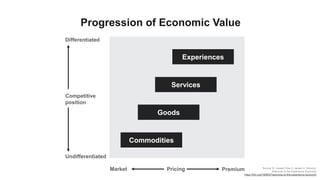
Goods
Services
Commodities
Progression of Economic Value
Experiences
Differentiated
Undifferentiated
Market Premium
Competitive
position
Pricing Source: B. Joseph Pine II, James H. Gilmore;
Welcome to the Experience Economy
https://hbr.org/1998/07/welcome-to-the-experience-economy
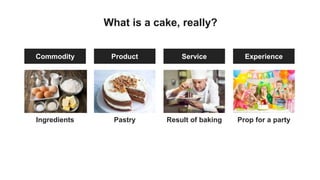
Product ServiceCommodity
What is a cake, really?
Experience
Pastry Result of bakingIngredients Prop for a party
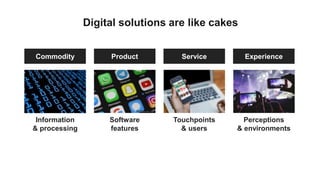
Digital solutions are like cakes
Software
features
Touchpoints
& users
Information
& processing
Perceptions
& environments
Product ServiceCommodity Experience
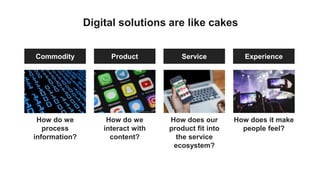
Digital solutions are like cakes
Product ServiceCommodity Experience
How do we
interact with
content?
How does our
product fit into
the service
ecosystem?
How do we
process
information?
How does it make
people feel?
Here comes
the iceberg…
Well; cake
12
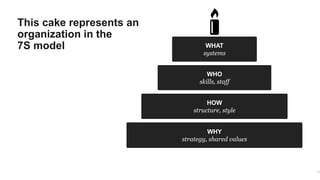
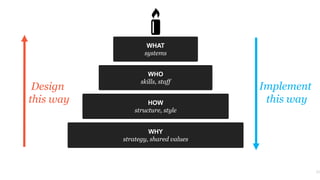
WHAT
systems
WHO
skills, staff
HOW
structure, style
WHY
strategy, shared values
This cake represents an
organization in the
7S model
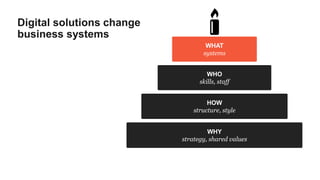
Digital solutions change
business systems
WHAT
systems
WHO
skills, staff
HOW
structure, style
WHY
strategy, shared values
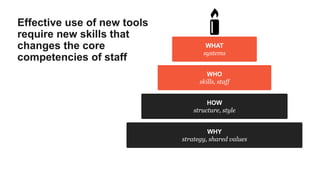
Effective use of new tools
require new skills that
changes the core
competencies of staff
WHAT
systems
WHO
skills, staff
HOW
structure, style
WHY
strategy, shared values
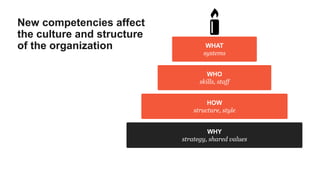
New competencies affect
the culture and structure
of the organization WHAT
systems
WHO
skills, staff
HOW
structure, style
WHY
strategy, shared values
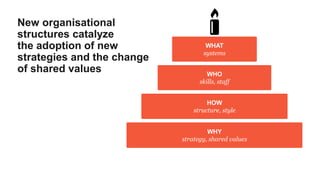
New organisational
structures catalyze
the adoption of new
strategies and the change
of shared values
WHAT
systems
WHO
skills, staff
HOW
structure, style
WHY
strategy, shared values
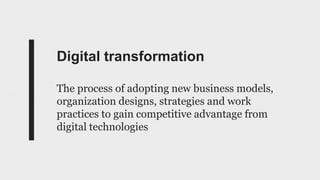
Digital transformation
The process of adopting new business models,
organization designs, strategies and work
practices to gain competitive advantage from
digital technologies
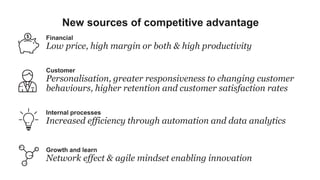
New sources of competitive advantage
Financial
Low price, high margin or both & high productivity
Customer
Personalisation, greater responsiveness to changing customer
behaviours, higher retention and customer satisfaction rates
Internal processes
Increased efficiency through automation and data analytics
Growth and learn
Network effect & agile mindset enabling innovation
Is there a recipe?
But…
WHAT
systems
22
WHO
skills, staff
HOW
structure, style
WHY
strategy, shared values
Design
this way
Implement
this way
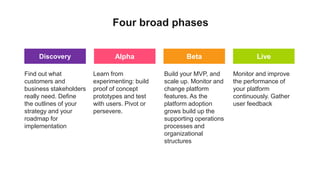
Alpha BetaDiscovery
Four broad phases
Live
Find out what
customers and
business stakeholders
really need. Define
the outlines of your
strategy and your
roadmap for
implementation
Learn from
experimenting: build
proof of concept
prototypes and test
with users. Pivot or
persevere.
Build your MVP, and
scale up. Monitor and
change platform
features. As the
platform adoption
grows build up the
supporting operations
processes and
organizational
structures
Monitor and improve
the performance of
your platform
continuously. Gather
user feedback
24
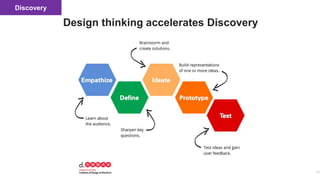
Design thinking accelerates Discovery
Discovery
25
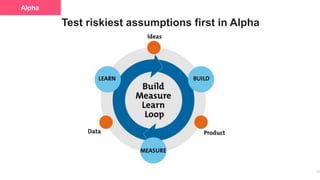
Alpha
Test riskiest assumptions first in Alpha
26
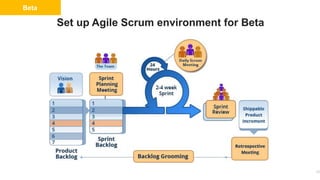
Beta
Set up Agile Scrum environment for Beta
27
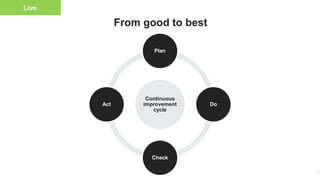
Live
From good to best
Continuous
improvement
cycle
Plan
Do
Check
Act
28
In summary
30
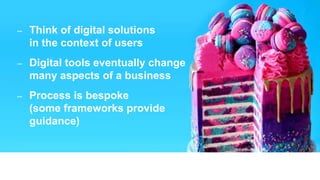
– Think of digital solutions
in the context of users
– Digital tools eventually change
many aspects of a business
– Process is bespoke
(some frameworks provide
guidance)
Questions?

Digital Transformation - an introduction

Editor's Notes

  • #2 11 - Overview Deck / Cover
  • #3 Car manufacturers become service providers
  • #4 Car manufacturers become service providers
  • #5 Car manufacturers become service providers
  • #13 9 - "Understand where your audience is looking"
  • #14 New digital solution = New skills and processes
  • #15 New digital solution = New skills and processes
  • #16 New digital solution = New skills and processes
  • #17 New digital solution = New skills and processes
  • #18 2 – Animations Quote
  • #25 9 - "Understand where your audience is looking"
  • #26 9 - "Understand where your audience is looking"
  • #27 9 - "Understand where your audience is looking"
  • #28 9 - "Understand where your audience is looking"
  • #29 9 - "Understand where your audience is looking"
  • #31 9 - "Understand where your audience is looking"
  • #32 11 - Overview Deck / Cover