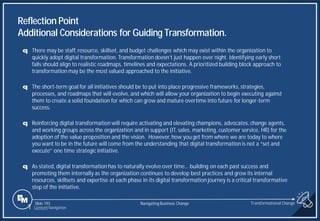
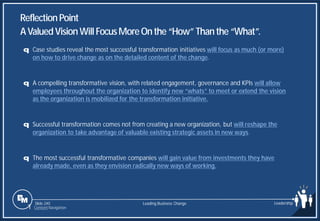
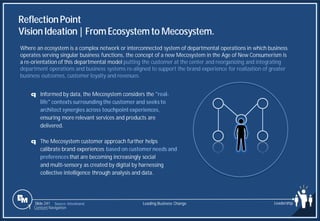
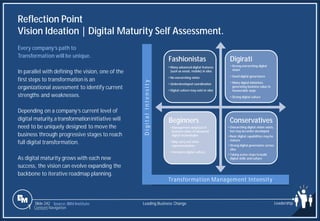
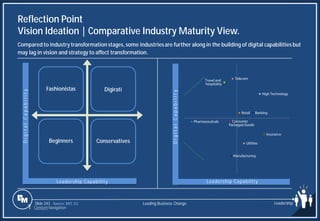
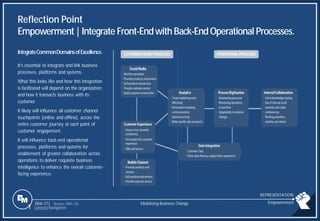
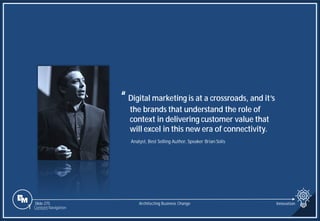
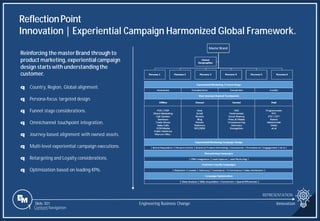
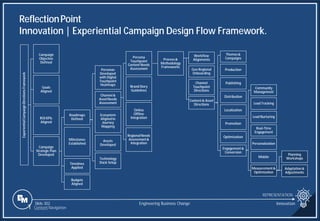
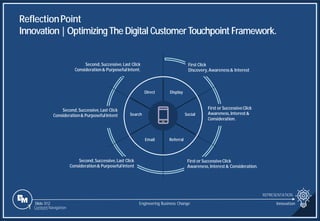
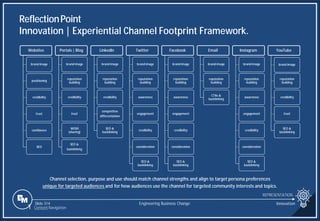
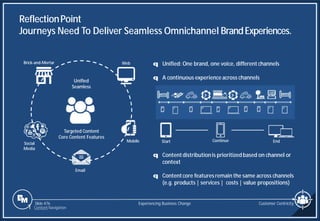
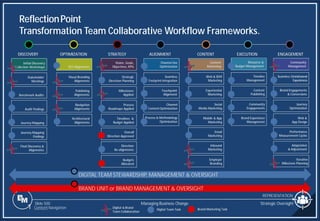
Slide 1 Blueprint
Estimated Reading Time: 60 minutes (Best Viewed in Presentation Mode)
[ 00:05 average viewing time per slide ]
Ver. 1.0,050522
Slide 2
“ The greatest danger for most of us is not
that our aim is too high and we miss it, but
that it is too low and we reach it.
Michelangelo
If you strive for greatness, you needto aspirefor greatness.
Preface
Aspiring for Business Change
Slide 3
GUIDING PREFACE
Preface
Aspiring for Business Change
Slide 4
This discussion document…
is intended to be a tool of inspiration to have a conversation among
key internal sponsors, champions, stakeholders and employees alike to align the
aspiration of digital transformation efforts into a highly integrated holistic
organizational transformative vision and process to benefit the business as a whole
across business operations, geographies, business units,
departments, brands, and products.
2022 offers the opportunity to
re-envision digital transformation.
Preface
Aspiring for Business Change
Slide 5
For many organizations aspiring for transformation,
efforts may be viewed as disjointed…
If this is your situation, it’s time to bring stakeholders back together to revisit
the digital transformation initiative and discuss what it can be at an
organizational level for greater business success.
Preface
Aspiring for Business Change
Slide 6
Albeit, comprehensive in design, the content contained within offers
inspiration, aspiration and ideation for impacting business change.
I encourage you to take the time to review its content in full to jumpstart
and renew thought processes for how you can make change individually, collectively,
and collaboratively as one organization for the benefit of your
business success, growth and prosperity.
This document is designed to be the catalyst to re-engage the conversation.
Preface
Aspiring for Business Change
Slide 7
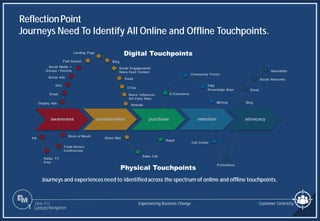
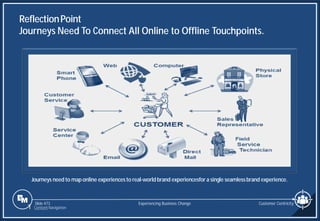
A clear vision and strategic direction are several core reasons
organizations continue to struggle with their digital transformation initiatives.
Source: MIT Sloan Management Review Preface
Aspiring for Business Change
Slide 8
The most successful organizations understand that the power of a
digital transformation strategy lies in its vision, scope and objectives.
Less digitally mature organizations will tend to focus on individual technologies
and strategies that are decidedly operational in focus.
Source: MIT Sloan Management Review Preface
Aspiring for Business Change
Slide 9
As digital technologies further emerge and mature,
technology becomes the catalyst for digital disruption reinforcing
aspirations for business change and digital transformation.
But technologies are not necessarily the underlying reason
necessitating business change and transformation.
Preface
Aspiring for Business Change
Slide 10
Consider how digital technology has influenced
consumer communications, sharing, preferences,
decision making, and commerce.
This impact of technology on consumer behaviors
simply cannot be overlooked.
Preface
Aspiring for Business Change
Slide 11
Technology
has become the enabler of disruption…
whereas…
Changing Consumer Behaviors
have actually become the business disruptor.
Preface
Aspiring for Business Change
Slide 12
Therefore, when aspiring for digital transformation,
the focus should be on the customer and the relationship with the consumer
using technology as the bridge to impact transformational change.
Preface
Aspiring for Business Change
Slide 13
Using the words of a notable technologist and visionary
which remains highly relevant to today’s digital transformation…
Preface
Aspiring for Business Change
Slide 14
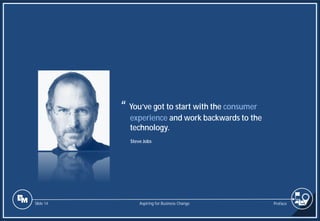
“ You’ve got to start with the consumer
experience and work backwards to the
technology.
Steve Jobs
Preface
Aspiring for Business Change
Slide 15
TOPICS & CONTENT
Content
Designing a Blueprint for Business Change
Slide 16
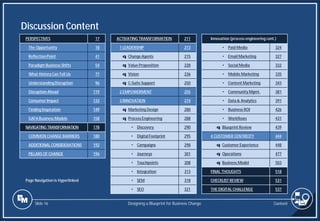
Discussion Content
PERSPECTIVES 17
The Opportunity 18
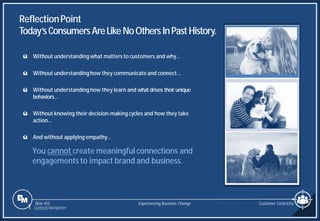
ReflectionPoint 41
Paradigm Business Shifts 54
What History Can Tell Us 77
Understanding Disruption 96
Disruption Ahead 119
Consumer Impact 133
Finding Inspiration 149
GAFA Business Models 158
NAVIGATING TRANSFORMATION 178
COMMON CHANGE BARRIERS 180
ADDITIONAL CONSIDERATIONS 192
PILLARS OF CHANGE 196
Page Navigation is Hyperlinked
ACTIVATING TRANSFORMATION 211
1 LEADERSHIP 213
q Change Agents 215
q Value Proposition 228
q Vision 236
q C-Suite Support 250
2 EMPOWERMENT 255
3 INNOVATION 274
q Marketing Design 280
q Process Engineering 288
• Discovery 290
• Digital Footprint 295
• Campaigns 298
• Journeys 301
• Touchpoints 308
• Integration 313
• SEM 318
• SEO 321
Content
Designing a Blueprint for Business Change
Innovation (process engineering cont.)
• Paid Media 324
• Email Marketing 327
• Social Media 332
• Mobile Marketing 335
• Content Marketing 343
• Community Mgmt. 381
• Data& Analytics 391
• Business ROI 426
• Workflows 431
q Blueprint Review 439
4 CUSTOMER CENTRICITY 444
q Customer Experience 448
q Operations 477
q Business Model 503
FINAL THOUGHTS 518
CHECKLIST REVIEW 531
THE DIGITAL CHALLENGE 537
Slide 17
PERSPECTIVES
CATALYSTS FOR BUSINESS CHANGE.
Finding Opportunity for Business Change Perspectives
1 Content Navigation
Slide 18
THE OPPORTUNITY
WHERE CHANGE OFFERS OPPORUNITY.
Finding Opportunity for Business Change Perspectives
1 Content Navigation
Slide 19
Fundamental business change just doesn’t happen.
It is common for transformation journeys to have many starts and fails.
Organizations do not quickly transform overnight.
Finding Opportunity for Business Change Perspectives
1 Content Navigation
Slide 20
The good news, there remains limitless opportunities for organizations
in their transformation journeys to work together and to continually evolve for
impacting business change through a common vision and iterative
transformative process via collective, sustaining collaboration.
Finding Opportunity for Business Change Perspectives
1 Content Navigation
Slide 21
This objective review is to realign your ongoing efforts and realign
the vision and the requisite integrated business systems, platforms, and processes
to move digital transformation initiatives to the next step…
while at the same time serve to… renew and expand organizational
inspiration, aspiration and advocacy for adopting business change.
Finding Opportunity for Business Change Perspectives
1 Content Navigation
Slide 22
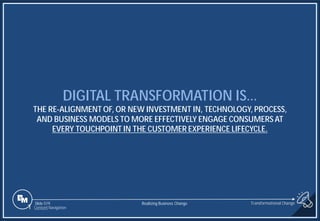
DIGITAL TRANSFORMATION IS…
THE RE-ALIGNMENT OF, OR NEW INVESTMENT IN, TECHNOLOGY, PROCESS,
AND BUSINESS MODELS TO MORE EFFECTIVELY ENGAGE CONSUMERS AT
EVERY TOUCHPOINT IN THE CUSTOMER EXPERIENCE LIFECYCLE.
Using a common definition as aligned to where change can be most affected,
Finding Opportunity for Business Change Perspectives
1 Content Navigation
Slide 23
Although the impact of digitization is not new,
the digital economy continues to evolves which presents continual
unprecedented challenges for all C-Level executives.
Finding Opportunity for Business Change Perspectives
1 Content Navigation
Slide 24
We are now living in an increasingly complex, ever changing, digital world.
Information flow and data continues to grow at exponential rates with
technology advances bringing about fundamental and rapid changes to our society.
Finding Opportunity for Business Change Perspectives
1 Content Navigation
Slide 25
We just need to think about the recent emergence of Web 3.0
as the next step in the development of the internet.
Web 3.0 has the potential to be just as disruptive and to usher in a
significant paradigm shift as much as Web 2.0, where the fundamental ideas of
decentralization, openness and increased consumer usefulness are now
becoming the underlying foundation of the Internet.
Finding Opportunity for Business Change Perspectives
1 Content Navigation
Slide 26
Now more than ever, within this environment,
Smart Organizations are realizing that adaptability remains
paramount to future business success.
Finding Opportunity for Business Change Perspectives
1 Content Navigation
Slide 27
As a result, there is an inherent need to rethink the entire customer journey.
This, more often than not, has become the main facilitator for driving
both new and renewed Digital Transformation initiatives.
Finding Opportunity for Business Change Perspectives
1 Content Navigation
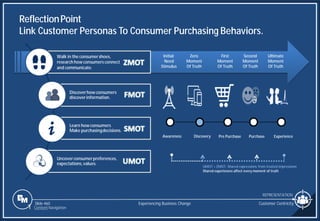
Slide 28
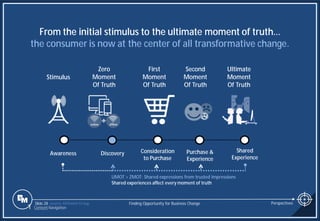
From the initial stimulus to the ultimate moment of truth…
the consumer is now at the center of all transformative change.
UMOT > ZMOT: Shared expressions from trusted impressions
Shared experiences affect every moment of truth
Discovery Consideration
to Purchase
Purchase &
Experience
Shared
Experience
Awareness
Stimulus
Zero
Moment
Of Truth
First
Moment
Of Truth
Second
Moment
Of Truth
Ultimate
Moment
Of Truth
Finding Opportunity for Business Change Perspectives
1 Content Navigation
source: AltimeterGroup
Slide 29
And this is even more relevant in a post-pandemic world
as commerce linked to the customer experience becomes more valued
in consumer purchasing behaviors.
Finding Opportunity for Business Change Perspectives
1 Content Navigation
Slide 30
Companies of all sizes – and across all industries continue to
facecommon pressures fromcustomers, employees and competitors alike
to begin or speed up their digital transformation efforts.
Finding Opportunity for Business Change Perspectives
1 Content Navigation
Slide 31
For manyorganizations,a common, onerous challengeexists.
Theymust iterateandinnovatein real-timewhile navigatingoutdated
businessprocessesandlegacytechnologysystems.
e.g.today,consumerfacingcompaniesare managingan averageof
44 disparatefront-end technologysystems.
Source: Salesforce Finding Opportunity for Business Change Perspectives
1 Content Navigation
Slide 32
As organizations consider deploying
Digital Transformation initiatives, it must first be understood that
it will be a direction unique for every organization.
Finding Opportunity for Business Change Perspectives
1 Content Navigation
Slide 33
Implementing new technologies is certainly part of the equation.
However, the value proposition remains to be the customer relationship
which will strategically empower a vision through the necessary transformational steps
to realize the benefits for the possibilities new technologies create.
Finding Opportunity for Business Change Perspectives
1 Content Navigation
Slide 34
It will influence front- and back-end platforms, systems, workflows and collaboration
impacting all aspects of business including business models; operational processes;
marketing; data analytics; product innovation; logistics; and commerce.
Finding Opportunity for Business Change Perspectives
1 Content Navigation
Slide 35
All of which will influence an organization’s
Sales, Marketing, Customer Service, IT, and HR business functions
and reach across geographies, business units, and operational teams
for impacting every customer touchpoint.
Finding Opportunity for Business Change Perspectives
1 Content Navigation
Slide 36
And, in the end…
Digital Transformation will be about creating greater value
across the entire business ecosystem which will benefit the organization
at a holistic level to serve customers and to better compete
in a changing digital world.
Finding Opportunity for Business Change Perspectives
1 Content Navigation
Slide 37
Where VALUE is defined by delivering better
omnichannel brand experiences which benefits the entire organization…
by getting closer to customers leading to greater business
outcomes, profitability and success.
Finding Opportunity for Business Change Perspectives
1 Content Navigation
Slide 38
THIS IS THE OPPORTUNITY.
Finding Opportunity for Business Change Perspectives
1 Content Navigation
Slide 39
This is where leadership and vision
creates fundamental business change through
strategy, process and culture.
Finding Opportunity for Business Change Perspectives
1 Content Navigation
Slide 40
As a common and natural step in any transformation journey,
the discussion objective proposed today is self assessment and reflection.
This will allow you, as a change agent, to re-visit and re-frame the discussion
based on your own organization’s current progress to date and to refine the
transformation roadmap for how best to move forward.
Finding Opportunity for Business Change Perspectives
1 Content Navigation
Slide 41
REFLECTION POINT
SELF ASSESSMENT. REVISITING THE NEED FOR BUSINESS CHANGE.
Reflection Point
Assessing Need for Business Change
1 Content Navigation
Slide 42
“ Coming together is a beginning. Keeping
together is progress. Working together is
success.
American industrialist and automaker Henry Ford
Assessing Need for Business Change Reflection Point
1 Content Navigation
Slide 43
This proposed Reflection Point is to re-engage in the digital transformation
discussion to review and refine your initiatives underway which can impact core
business systems, processes, methodologies, frameworks, analytics,
and ultimately the customer experience.
Assessing Need for Business Change Reflection Point
1 Content Navigation
Slide 44
Renewing the discussion should steer meaningful and insightful
stakeholder conversations across business operations to assess your progress
to date and to further advance concepts in a continuing effort for developing
actionable transformation roadmaps.
Assessing Need for Business Change Reflection Point
1 Content Navigation
Slide 45
As a self reflection point, sponsors and champions must re-emphasize
to executives, stakeholders, and employees alike…
Digital Disruption Has Indeed Changed Business As Usual.
Assessing Need for Business Change Reflection Point
1 Content Navigation
Slide 46
To set the baseline for discussion…
Stakeholders must understand digital disruption occurs when
new technologies and business models affect the consumer value proposition
of existing goods and services.
Assessing Need for Business Change Reflection Point
1 Content Navigation
Slide 47
And, contrary to common belief, digital disruption impacts
all channels across the online and offline spectrum as it influences all
customer touchpoints and shapes new consumer purchasing behaviors
impacting the business bottom line.
Assessing Need for Business Change Reflection Point
1 Content Navigation
Slide 48
Therefore, to succeed with any digital transformation initiative,
efforts will need to align across the organization holistically.
Progressive roadmaps must define how an integrated digital ecosystem
can support efficiencies across operations, business units, brands, departments,
and consumer touchpoints for creating greater business outcomes.
Assessing Need for Business Change Reflection Point
1 Content Navigation
Slide 49
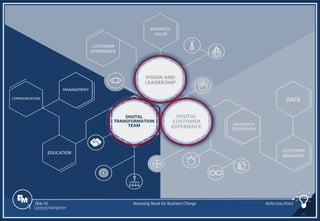
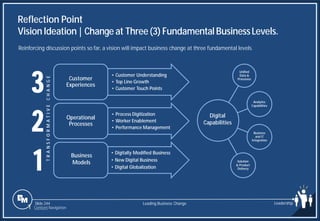
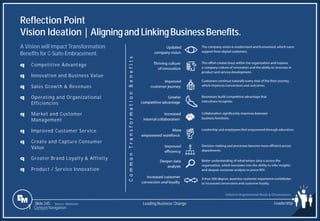
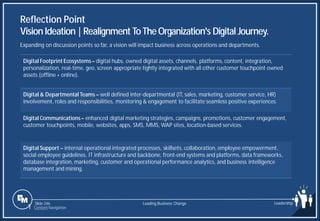
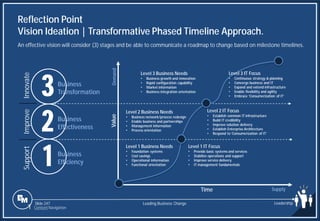
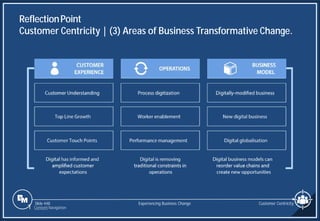
Fundamentally, there are three core elements to digital transformation.
Assessing Need for Business Change Reflection Point
1 Content Navigation
Slide 50 Assessing Need for Business Change Reflection Point
1 Content Navigation
Slide 51
Of significant note, transformation can not and must not
be done in silos. There must be collaboration and integration at all business levels
across all three transformation areas.
This is where many organizations fail in their transformation efforts.
Assessing Need for Business Change Reflection Point
1 Content Navigation
Slide 52
People who bet against the
Internet [digital], who think that
somehow this change is just a
generational shift, miss that it is a
fundamental reorganizing of the
power of the end user.
“
- EricSchmidt,GoogleChairman
Assessing Need for Business Change Reflection Point
1 Content Navigation
Slide 53
Consider the paradigm shifts as occurred over time
affecting business change.
Assessing Need for Business Change Reflection Point
1 Content Navigation
Slide 54
THE BUSINESS LANDSCAPE HAS SHIFTED NECESSITATING
BUSINESS CHANGE IN A DIGITAL WORLD.
PARADIGM SHIFTS
Business Shifts
Recognizing Global Business Change
1 Content Navigation
Slide 55
IT’S NOT BUSINESS AS USUAL.
Recognizing Global Business Change Business Shifts
1 Content Navigation
Slide 56
The manufacturing economy used technology
to scale production and reduce costs to produce affordable products
and goods using economies in scale.
Recognizing Global Business Change Business Shifts
1 Content Navigation
Slide 57
The distribution economy used technology
to connect markets and suppliers to consumers.
Recognizing Global Business Change Business Shifts
1 Content Navigation
Slide 58
The information economy used technology
to connect supply chains to the world population through the Internet.
Recognizing Global Business Change Business Shifts
1 Content Navigation
Slide 59
Now, the experience economy uses technology
to connect brands to individuals, peers and groups.
Recognizing Global Business Change Business Shifts
1 Content Navigation
Slide 60
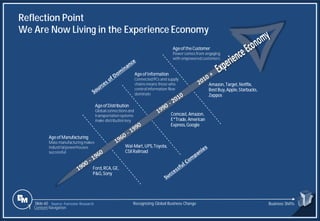
Reflection Point
We Are Now Living in the Experience Economy
Source: Forrester Research
Age of Manufacturing
Mass manufacturing makes
industrial powerhouses
successful
Age of Distribution
Global connectionsand
transportation systems
make distribution key
Age of Information
Connected PCs and supply
chains means those who
control information flow
dominate
Age of the Customer
Power comes from engaging
with empowered customers
Ford,RCA,GE,
P&G,Sony
Wal-Mart,UPS,Toyota,
CSXRailroad
Comcast, Amazon,
E*Trade, American
Express,Google
Amazon,Target,Netflix,
Best Buy,Apple,Starbucks,
Zappos
Recognizing Global Business Change Business Shifts
1 Content Navigation
Slide 61
All the while as the emerging subscription economy is using technology...
to connect consumers to recurring subscriber products and/or services
where brands are emphasizing customer retention over customer acquisition.
Recognizing Global Business Change Business Shifts
1 Content Navigation
Slide 62
REFLECT ON BUSINESS IN THE PAST
Market change was slow, steady and predictable.
Important variables (i.e., pricing, adoption rates) in a market
were known and understood.
Business model shifts were evolutionary with little volatility.
Product development processes were easily defined
and (relatively) simple to execute.
Recognizing Global Business Change Business Shifts
1 Content Navigation
Slide 63
NOW REFLECT ON BUSINESS TODAY
Rapidly changing technology advances.
Very short product cycles.
Market players are more interconnected.
Networks of relationships between businesses, between business
and consumers, and consumers-to-consumer are denser.
Digital [data] feedback loops are quicker.
Markets are moving faster and more unpredictably
than ever before.
Consumer behaviors and preferences are rapidly changing.
Recognizing Global Business Change Business Shifts
1 Content Navigation
Slide 64
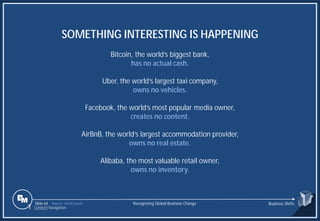
SOMETHING INTERESTING IS HAPPENING
Bitcoin, the world’s biggest bank,
has no actual cash.
Uber, the world’s largest taxi company,
owns no vehicles.
Facebook, the world’s most popular media owner,
creates no content.
AirBnB, the world’s largest accommodation provider,
owns no real estate.
Alibaba, the most valuable retail owner,
owns no inventory.
Source: TechCrunch Recognizing Global Business Change Business Shifts
1 Content Navigation
Slide 65
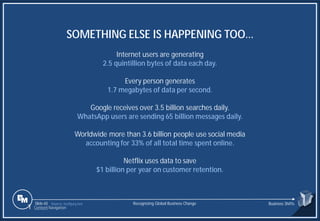
SOMETHING ELSE IS HAPPENING TOO…
Internet users are generating
2.5 quintillion bytes of data each day.
Every person generates
1.7 megabytes of data per second.
Google receives over 3.5 billion searches daily.
WhatsApp users are sending 65 billion messages daily.
Worldwide more than 3.6 billion people use social media
accounting for 33% of all total time spent online.
Netflix uses data to save
$1 billion per year on customer retention.
Source: techjury.net Recognizing Global Business Change Business Shifts
1 Content Navigation
Slide 66
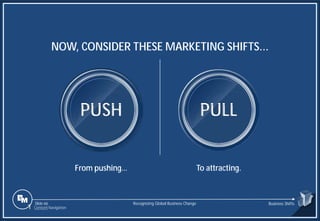
From pushing… To attracting.
PUSH PULL
NOW, CONSIDER THESE MARKETING SHIFTS...
Recognizing Global Business Change Business Shifts
1 Content Navigation
Slide 67
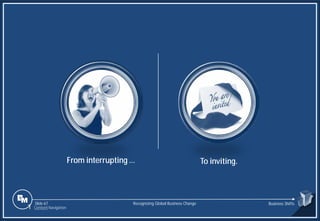
From interrupting … To inviting.
PUSH PULL
Recognizing Global Business Change Business Shifts
1 Content Navigation
Slide 68
From unfocused… To focused.
Recognizing Global Business Change Business Shifts
1 Content Navigation
Slide 69
From control… To many unknowns.
Recognizing Global Business Change Business Shifts
1 Content Navigation
Slide 70
From avoiding risk… To managing risk.
Recognizing Global Business Change Business Shifts
1 Content Navigation
Slide 71
From disjointed
(customer) experiences…
To seamless omnichannel
(customer) experiences.
Recognizing Global Business Change Business Shifts
1 Content Navigation
Slide 72
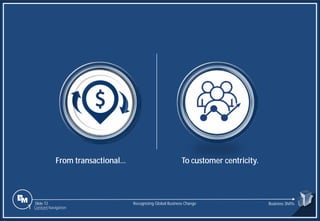
From transactional… To customer centricity.
Recognizing Global Business Change Business Shifts
1 Content Navigation
Slide 73
At the center of all of these paradigm shifts…
advances in technology have enabled digital disruption at scale
with the Customer at the center.
Recognizing Global Business Change Business Shifts
1 Content Navigation
Slide 74
There can be little debate…
Consumer Attention is now the New Business Currency.
Recognizing Global Business Change Business Shifts
1 Content Navigation
Slide 75
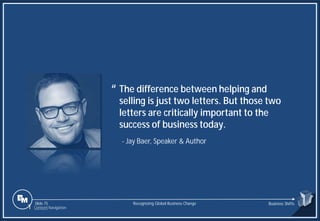
The difference between helping and
selling is just two letters. But those two
letters are critically important to the
success of business today.
“
- Jay Baer, Speaker & Author
Recognizing Global Business Change Business Shifts
1 Content Navigation
Slide 76
History too can offer us some valuable lessons to inspire change.
Recognizing Global Business Change Business Shifts
1 Content Navigation
Slide 77
DISRUPTION’S IMPACT ON BUSINESS PROSPERITY.
HISTORY LESSONS
History Lessons
Embracing Global Business Change
1 Content Navigation
Slide 78
Consider the Evolution of Branding.
Embracing Global Business Change History Lessons
1 Content Navigation
Slide 79
Reflection Point
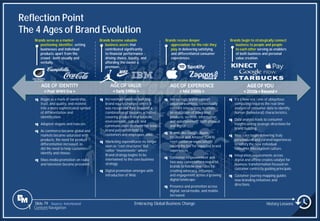
The 4 Ages of Brand Evolution
Brands serve as a market
positioning identifier, setting
businesses and individual
products apart from the
crowd - both visually and
verbally.
q Began as a mark of ownership,
trust, and quality, and evolved
into a more sophisticated symbol
of differentiation and
identification.
q Adopted slogans and mascots.
q As commerce became global and
markets became saturated with
products, the need for product
differentiation increased, as
did the need to help customers
identify and choose.
q Mass media promotion on radio
and television became prevalent.
Brands become valuable
business assets that
contributed significantly
to financial performance -
driving choice, loyalty, and
affording the owner a
premium.
q Increasingly views on building
brand equity changed where it
was recognized they required a
combination of business activities
covering products and services,
environments, culture, and
communication to create the total
brand perception held by
customers and employees alike.
q Marketing expenditures no longer
seen as “cost structures” but
rather “investments” where
Brand strategy begins to be
intertwined to the core business
strategy.
q Digital promotion emerges with
introduction of Web.
Brands receive deeper
appreciation for the role they
play in delivering satisfying
and differentiated consumer
experiences.
q Increasingly brand support
required seamless, contextually
relevant interactions to create
an ecosystem of integrated
products, services, information
and entertainment: both physical
and digital.
q Brands like Google, Apple,
Facebook and Amazon (GAFA)
reset customer expectations
raising the bar for expected brand
experiences.
q Consumer empowerment and
two-way conversations required
brands to follow new rules for
creating advocacy, influence,
and engagement across a growing
digital landscape.
q Presence and promotion across
digital, social media, and mobile
increased.
Brands begin to strategically connect
business to people and people
to each other serving as enablers
of both business and personal
value creation.
q It’s a New era - one of ubiquitous
computing requires the real-time
analysis of consumer data to identify
human (behavioral) characteristics.
q Data analysis leads to consumer
insights aiding strategic directions for
brand building.
q New rules begin delivering truly
personalized and curated experiences
to satisfy the new individual
consumer Mecosystem culture.
q Integration requirements across
digital and offline creates catalyst for
business transformation focused on
customer centricity guiding principals.
q Customer journey mapping guides
new branding initiatives and
directions.
Source: Interbrand Embracing Global Business Change History Lessons
1 Content Navigation
Slide 80
Over the last 75 years,
branding and customer marketing has significantly evolved.
During each evolutionary stage, companies had to respond to changing consumer
behaviors to engage consumers and to remain relevant
or risk obsolescence.
Embracing Global Business Change History Lessons
1 Content Navigation
Slide 81
The risk is real…
no organization or industry is an exception.
Embracing Global Business Change History Lessons
1 Content Navigation
Slide 82
The net impact on today’s business remains.
Failure to adapt to the new realities for engaging with consumers created
through waves of digital influence can and will fundamentally
create significant risk for many businesses.
Embracing Global Business Change History Lessons
1 Content Navigation
Slide 83
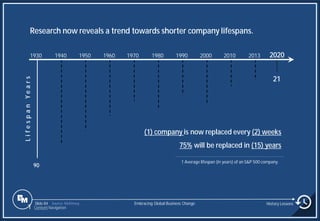
Consider the lifespan of an S&P company is shrinking.
Embracing Global Business Change History Lessons
1 Content Navigation
Slide 84 Source: McKinsey
1930 1940 1950 1960 1970 1980 1990 2000 2010 2013 2020
21
90
Research now reveals a trend towards shorter company lifespans.
† Average lifespan (in years) of an S&P 500 company.
(1) company is now replaced every (2) weeks
75% will be replaced in (15) years
Embracing Global Business Change History Lessons
1 Content Navigation
L
i
f
e
s
p
a
n
Y
e
a
r
s
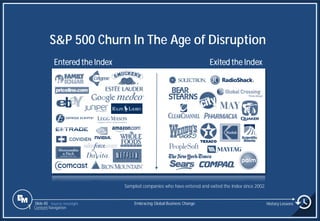
Slide 85 Source: Innosight Embracing Global Business Change History Lessons
1 Content Navigation
Entered the Index Exited the Index
S&P 500 Churn In The Age of Disruption
Sampled companies who have entered and exited the Index since 2002.
Slide 86
Household Brands such as Blockbuster, Blackberry, Kodak and Nokia
all have their own story to tell. Blockbuster and Kodak had to contend with the
internet and digitization driving a wrecking ball through their business.
Embracing Global Business Change History Lessons
1 Content Navigation
Slide 87
Blackberry and Nokia misread and then were slow to act
on more basic market segment and consumer preference shifts
– touch screens and a rich App ecosystem.
Embracing Global Business Change History Lessons
1 Content Navigation
Slide 88
At the heart of these business struggles and many other stories like them,
companies did not or were not willing to recognize quickly evolving market complexities.
Each failed to cope and respond to the reality that their industries
were profoundly changing.
Embracing Global Business Change History Lessons
1 Content Navigation
Slide 89
And this is where many businesses continue to fail today.
History is continuing to repeat itself as companies resist change
in the face of significant market forces and consumer shifts that are fundamentally
reshaping the business landscape of the future.
Embracing Global Business Change History Lessons
1 Content Navigation
Slide 90
So how does a company continue to thrive in the age of digital disruption?
Embracing Global Business Change History Lessons
1 Content Navigation
Slide 91
One approach would be for a company to have a wide economic moat,
a term coined by Warren Buffett to describe businesses that are difficult for new
competitors to gain entry to, either due to the sheer scale of the enterprise
or to an exclusive patent or other such competitive advantage.
However for most organizations, this simply isn’t possible.
Embracing Global Business Change History Lessons
1 Content Navigation
Slide 92
The alternative is for executives to create
a sense of urgency for change within their organizations.
Embrace its own creative destruction through business change and innovation
by finding ways to stay relevant by envisioning itself as the customer and then
creating value within its own market.
This is the essence that defines digital transformation.
Embracing Global Business Change History Lessons
1 Content Navigation
Slide 93
History tells us… if organizations are not actively
rethinking how technology, disruptive forces, and changing consumer behaviors
are impacting its future business health and prosperity…
they are risking everything.
Embracing Global Business Change History Lessons
1 Content Navigation
Slide 94
THE GOOD NEWS, RISK CAN BE MANAGED.
With vision, commitment and action, organizations can reinvent themselves
managing risk against obsolescence.
Embracing Global Business Change History Lessons
1 Content Navigation
Slide 95
But to manage risk is to understand risk and the disruptive forces in play.
Embracing Global Business Change History Lessons
1 Content Navigation
Slide 96
DIGITAL DISRUPTION
TECHNOLOGY IS THE ENABLER. CONSUMERS ARE THE DISRUPTOR.
Digital Disruption
Adapting to Business Change
1 Content Navigation
Slide 97
To manage risk is to understand disruption is everywhere
and it needs to be embraced and managed head on as technology, society and
consumers evolve at an unprecedented pace.
Adapting to Business Change Digital Disruption
1 Content Navigation
Slide 98
Digital advances and its impact on business has changed the business landscape.
The proliferation and mass adoption of digital devices, applications and networks
are at the forefront of today’s business disruption.
Adapting to Business Change Digital Disruption
1 Content Navigation
Slide 99
Of worthy re-emphasis… as digital further emerges and matures, technology
remains to be the catalyst for aspiring to business change and digital transformation.
Not the Reason.
Adapting to Business Change Digital Disruption
1 Content Navigation
Slide 100
Advances in technology influences how people work, communicate,
share, make decisions, and purchase products, goods and services.
Adapting to Business Change Digital Disruption
1 Content Navigation
Slide 101
And, it is the technology that is enabling changing consumer behaviors
which creates the disruption in business and the need for change.
Adapting to Business Change Digital Disruption
1 Content Navigation
Slide 102
Consider… the concept of Digital Darwinism.
Adapting to Business Change Digital Disruption
1 Content Navigation
Slide 103
Digital Darwinism is the phenomenon
when technology and society evolve faster
than an organization can adapt…
[it] is a fate that threatens most
organizations in almost every industry.
Because of this, businesses not only have
to compete for today but also for the
unforeseeable future.
Brian Solis
Digital Analyst
“
Adapting to Business Change Digital Disruption
1 Content Navigation
Slide 104
Organizations who overlook the concept of DigitalDarwinism
and its impact on business prosperity and healthput themselves at risk.
Digital technologies have transitioned markets from being complicated and stable
to markets that are now complexand characterizedby velocity.
Adapting to Business Change Digital Disruption
1 Content Navigation
Slide 105
Relevancy and competitiveness now require
looking at business and the world through a different lens, adapting to it,
and then getting out in front of disruptive forces before they occur.
Adapting to Business Change Digital Disruption
1 Content Navigation
Slide 106
For digital transformation to truly impact business change,
it becomes critical for organizations to recognize both the enablers and the
resulting disruptive forces to keep in step for how consumers
engage with today’s business.
Adapting to Business Change Digital Disruption
1 Content Navigation
Slide 107
As a result, organizations must formalize and adopt
new business models, refine or create new operational processes,
develop new systems and skillsets, use data analytics, and redefine
new customer experiences to remain relevant,
competitive, and profitable.
Adapting to Business Change Digital Disruption
1 Content Navigation
Slide 108
Change may be difficult.
But successful transformation enables organizations to more rapidly
assess new opportunities and to facilitate the testing of new ideas to engage
and re-engage consumers throughout the customer journey to ensure
business prosperity and longevity.
Adapting to Business Change Digital Disruption
1 Content Navigation
Slide 109
1 Content Navigation
Source: IBM
Reflection Point
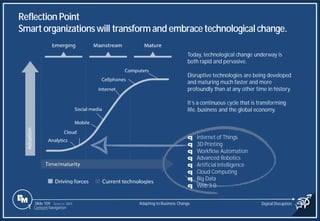
Smartorganizations will transformand embracetechnological change.
Today, technological change underway is
both rapid and pervasive.
Disruptive technologies are being developed
and maturing much faster and more
profoundly than at any other time in history.
It’s a continuous cycle that is transforming
life, business and the global economy.
q Internet of Things
q 3D Printing
q Workflow Automation
q Advanced Robotics
q Artificial Intelligence
q Cloud Computing
q Big Data
q Web 3.0
Adapting to Business Change Digital Disruption
Slide 110
Technology is actually the easy part in the transformation...
integrated front- and back-end business systems, platforms, networks,
web and digital assets, digital channels, et al.
Adapting to Business Change Digital Disruption
1 Content Navigation
Slide 111
11%
Ease &
Convenience
14%
Service &
Personal Care
12%
Trust &
Reputation
10%
Product Origin
12%
Health &
Safety
11%
Ease &
Convenience
12%
Service &
Personal Care
10%
Trust &
Reputation
7%
Product Origin
9%
Health &
Safety
21%
Quality
19%
Price
26%
Quality
25%
Price
Post-Pandemic Pre-Pandemic
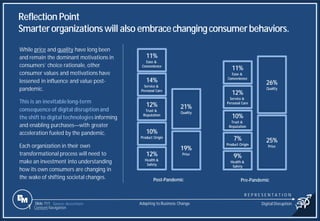
While price and quality have long been
and remain the dominant motivations in
consumers’ choice rationale, other
consumer values and motivations have
lessened in influence and value post-
pandemic.
This is an inevitablelong-term
consequence of digital disruption and
the shift to digital technologies informing
and enabling purchases—with greater
acceleration fueled by the pandemic.
Each organization in their own
transformational process will need to
make an investment into understanding
how its own consumers are changing in
the wake of shifting societal changes.
Source: Acccenture
Reflection Point
Smarterorganizations will also embracechanging consumerbehaviors.
Adapting to Business Change Digital Disruption
1 Content Navigation
R E P R E S E N T A T I O N
Slide 112
The difficult part in the transformation process is the cultural change
required to adopt new business models, operating processes and skillsets to
understand and adapt for changing and shifting customer behaviors
created by digital influence.
Adapting to Business Change Digital Disruption
1 Content Navigation
Slide 113
This may require a new way of thinking.
Creativity + Innovation + Analytics + Strategy + Purpose.
Adapting to Business Change Digital Disruption
1 Content Navigation
Slide 114
Reinforcing the discussion point, digital transformation is
certainly about the technology (both as an enabler of disruption and as a
transformative organizational change component)…
but it must be understood the essence of digital disruption is
how an organization’s own consumers are adapting to technological change
and how behaviors are changing for engaging with business.
Adapting to Business Change Digital Disruption
1 Content Navigation
Slide 115
Embracing digital transformation head on affords organizations
the opportunity to leverage disruption to get closer to customers to understand
changing consumer values, motivations, buying behaviors, and purchasing preferences
for greater business benefit.
Adapting to Business Change Digital Disruption
1 Content Navigation
Slide 116
Disruption will be unique for every organization,
as why it is digital transformation is unique for every company.
There will certainly be common industry disruptors across the business landscape,
but there remain to be nuances to changing consumer behaviors
unique for every organization.
Adapting to Business Change Digital Disruption
1 Content Navigation
Slide 117
A key benefit and component to any digital transformation effort will be
understanding customer nuances and being able to adapt to consumer behaviors
much more rapidly via business intelligence delivered through data analytics.
Adapting to Business Change Digital Disruption
1 Content Navigation
Slide 118
But disruption and risk is not simply a one time event.
Managing risk is continuous which requires constant monitoring, analysis
and planning with the foresight to look over the horizon to see what’s coming next.
Adapting to Business Change Digital Disruption
1 Content Navigation
Slide 119
DISRUPTION AHEAD
ADAPTING AND PLANNING FOR THE NEXT WAVE OF CHANGE.
Planning for Business Change Digital Disruption
1 Content Navigation
Slide 120
Over the past decade, disruptive technologies...
such as artificial intelligence, intelligent process automation, and deep data learning
to name a few have shaped and transformed how business operated.
Planning for Business Change Digital Disruption
1 Content Navigation
Slide 121
These past technological changes of disruption are now maturing…
with new emerging disruptors further advancing and shaping how business
is conducted in a new Web 3.0 and post-pandemic world.
Planning for Business Change Digital Disruption
1 Content Navigation
Slide 122
With foresight and proactive planning, organizations can get ahead of
the next wave of business disruptors which began in 2022…
How an organization responds to the continuous change of evolving business
disruptions will determine an organization’s longer-term success in their own
digital transformation journey.
Planning for Business Change Digital Disruption
1 Content Navigation
Slide 123
DECISION INTELLIGENCE (DI)
WILL ESTABLISH OBJECTIVES AND MAP DECISIONS ACCORDINGLY.
Decision-making fuels organizational growth. Decision Intelligence (DI) aims to
solve the problem of siloed decision islands and help executives in their decision-
making process considering enterprise objectives as the big picture.
Source: Gartner Group Planning for Business Change Digital Disruption
1 Content Navigation
Slide 124
INTEGRATED DATA
WILL BECOME THE MOST VALUED ASSET FOR AN ORGANIZATION.
Integrated data will become imperative for organizations to enhance
customer experiences through business intelligence. Data integration must be
flexible and resilient across platforms and to its users to simplify an organization’s
data infrastructure and to create a scalable data architecture.
Source: Gartner Group Planning for Business Change Digital Disruption
1 Content Navigation
Slide 125
HYPER-AUTOMATION
WILL BE CONSIDERED THE FIRST STEP TOWARDS DIGITAL TRANSFORMATION.
Hyper-Automation will expand process automation by identifying and
automating as many business processes as possible rapidly. It will further reduce
manual workloads and optimize business processes leveraging tools such as
Robotic Process Automation, AI, ML, Data Analytics and more
to automate processes faster.
Source: Gartner Group Planning for Business Change Digital Disruption
1 Content Navigation
Slide 126
REMOTE-FIRST ENTERPRISE
WILL BECOME THE NORM POST PANDEMIC AND SEE EXPONENTIAL GROWTH.
Remote workplaces will rise in adoption. New collaborative workforce models
will enable frictionless customer experiences with boundary-less engagements
while enabling dispersed and scalable global workforces to expand
worldwide customer footprints.
Source: Gartner Group Planning for Business Change Digital Disruption
1 Content Navigation
Slide 127
TOTAL EXPERIENCE (TX)
WILL BECOME A PRIMARY DRIVER OF BUSINESS.
Total experience (TX) combines the customer experience components of
satisfaction, loyalty and advocacy into a multi-experience to create seamless
enterprise-wide customer experiences across business operations.
It considers all stakeholders such as end-users, business users, partners,
affiliates, and employees to accelerate and drive business growth.
Source: Gartner Group Planning for Business Change Digital Disruption
1 Content Navigation
Slide 128
These new disruptive trends as forecasted by the Gartner Group
should further reinforce the need for digital transformation…
organizations simply can not use yesterday’s thinking
to approach the problems of tomorrow.
Planning for Business Change Digital Disruption
1 Content Navigation
Slide 129
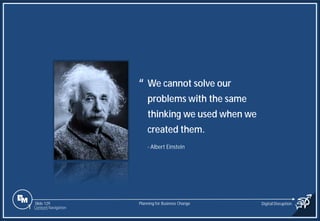
We cannot solve our
problems with the same
thinking we used when we
created them.
- Albert Einstein
“
Planning for Business Change Digital Disruption
1 Content Navigation
Slide 130
The one thing we can counton with absolutecertainty…
futuredisruptivetrendsin technologywill continueto shape
the globaldigitallandscapeandinfluencechangingconsumerbehaviors.
Planning for Business Change Digital Disruption
1 Content Navigation
Slide 131
Therefore,businesses with the greatest foresight will evolve
with technological advances and continually adapt for retaining
customer relevancy through business change.
Planning for Business Change Digital Disruption
1 Content Navigation
Slide 132
Thisonlybecomespossiblewhen organizationskeep
Customersat the centerof BusinessChange.
Planning for Business Change Digital Disruption
1 Content Navigation
Slide 133
DISRUPTION’S INFLUENCE ON CONSUMER BEHAVIORS
REINFORCE THE NEED FOR TRANSFORMATION.
CONSUMER IMPACT
Consumer Impact
Reimagining Business Change
1 Content Navigation
Slide 134
Creating betterconsumerexperiencesis at the centerof the
valuepropositionfor digital transformation.
Reimagining Business Change Consumer Impact
1 Content Navigation
Slide 135
And if thereis still any lingeringmisunderstandingas tothe benefit
of digital transformation,this is the opportunitytocommunicatetransformationis much more
than realizingnear-termoperationalefficienciesand profitability.
Reimagining Business Change Consumer Impact
1 Content Navigation
Slide 136
Digital transformationis trulythe reimaginationof the organization
to more effectivelyengageconsumersthroughoutthe customerjourneyto deliver
bettercustomerexperiencesat everytouchpointforsustainedrelevancyandcompetitiveness
leadingto greaterexpandedandsustainedbusinessgrowthandprofitability.
Reimagining Business Change Consumer Impact
1 Content Navigation
Slide 137
Why is this important?
Why do we need to clarify and re-emphasizethe customer
in our transformationdiscussion?
Reimagining Business Change Consumer Impact
1 Content Navigation
Slide 138
As shoppinghabitsradicallyevolve,researchshowsthat
lessthanhalfof executiveshavedefinedtheircustomerexperiencestrategies.
Source: Gartner Group Reimagining Business Change Consumer Impact
1 Content Navigation
Slide 139
Thecustomerexperiencestrategyis the lifelineto all future,sustainedsuccess.
Reimagining Business Change Consumer Impact
1 Content Navigation
Slide 140
This becomesevenmuch more relevantwhen considering
we are now living in the ageof the experienceand the subscriptioneconomies.
Reimagining Business Change Consumer Impact
1 Content Navigation
Slide 141
Dismissing,overlookingor placing lesseremphasison this criticalguiding direction,
an organization losesthe businessopportunityfor impactingreal lastingbusinesschange
via the investmentit makesin the digital transformationprocess.
Reimagining Business Change Consumer Impact
1 Content Navigation
Slide 142
Whatwe must continuallyreinforceis…
a brand’srelevanceis nowdefinedthroughthe customerexperience
whichincludesthe sumof all engagementsa customerhaswith a business
throughouteverytouchpointin the customerjourney.
Reimagining Business Change Consumer Impact
1 Content Navigation
Slide 143
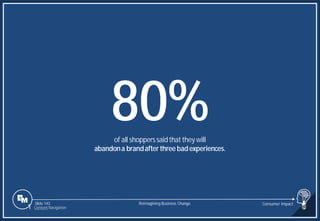
80%
of all shopperssaidthattheywill
abandona brandafterthree badexperiences.
Reimagining Business Change Consumer Impact
1 Content Navigation
Slide 144
So understandingchangingconsumerbehaviors,
and then planning for and creatingvaluedcustomerexperiences
is paramountto all futurebusinesssuccess.
Reimagining Business Change Consumer Impact
1 Content Navigation
Slide 145
No-one can disagreethatconsumershopping habits
are indeed changingwith digital.
Thegoodnewsis thatorganizationscanbe proactive
to stayahead of changeand prosper with a digital transformativemindset
usingtoday’sabundanceof availableconsumerand businessdata.
Reimagining Business Change Consumer Impact
1 Content Navigation
Slide 146
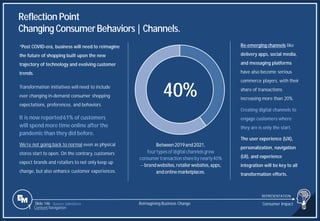
“Post COVID-era, business will need to reimagine
the future of shopping built upon the new
trajectory of technology and evolving customer
trends.
Transformation initiatives will need to include
ever changing in-demand consumer shopping
expectations, preferences, and behaviors.
It is now reported61% of customers
will spend more time online after the
pandemic than they did before.
We’re not going back to normal even as physical
stores start to open. On the contrary, customers
expect brands and retailers to not only keep up
change, but also enhance customer experiences.
Source: Salesforce
Reflection Point
Changing ConsumerBehaviors| Channels.
40%
Re-emerging channels like
delivery apps, social media,
and messaging platforms
have also become serious
commerce players, with their
share of transactions
increasing more than 20%.
Creating digital channels to
engage customers where
they are is only the start.
The user experience (UX),
personalization, navigation
(UI), and experience
integration will be key to all
transformation efforts.
Between2019and2021,
fourtypes of digital channels grew
consumertransactionshare by nearly40%
-- brandwebsites,retailerwebsites,apps,
andonline marketplaces.
Reimagining Business Change Consumer Impact
1 Content Navigation
REPRESENTATION
Slide 147
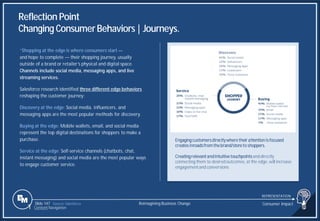
“Shopping at the edge is where consumers start —
and hope to complete — their shopping journey, usually
outside of a brand or retailer’s physical and digital space.
Channels include social media, messaging apps, and live
streaming services.
Salesforce research identified three different edge behaviors
reshaping the customer journey:
Discovery at the edge: Social media, influencers, and
messaging apps are the most popular methods for discovery.
Buying at the edge: Mobile wallets, email, and social media
represent the top digital destinations for shoppers to make a
purchase.
Service at the edge: Self-service channels (chatbots, chat,
instant messaging) and social media are the most popular ways
to engage customer service.
Reflection Point
Changing ConsumerBehaviors| Journeys.
Engagingcustomersdirectlywhere their attention is focused
creates inroadsfromthe brand/store to shoppers.
Creatingrelevant andintuitive touchpointsand directly
connecting them to desired outcomes, at the edge, will increase
engagementand conversions.
Reimagining Business Change
Source: Salesforce Consumer Impact
1 Content Navigation
REPRESENTATION
Slide 148
The discussionso far has focusedon theneed for change.
There’smanyexamplesof companiesforwhichhavesuccessfullytransformed
andwhichcanprovideinspiration.
Reimagining Business Change Consumer Impact
1 Content Navigation
Slide 149
INSPIRATION
ASPIRATIONAL COMPANIES REIMAGINING THEMSELVES.
Inspirational Change
Aspiring for Business Change
1 Content Navigation
Slide 150
Success stories are growing which can aspire and lead the way.
History affords us the opportunity to study companies who are getting it right.
Aspiring for Business Change Inspirational Change
1 Content Navigation
Slide 151
q Category: Electronics
q Best Buy saw its market share in the consumer electronics industry
dip until its new CEO brought an innovative digital perspective that
led the transformation of the company into a digital technology
leader.
q It took 7 years, but going digital has enabled Best Buy to become a
company that uses technology to enrich people’s lives, not just sell
them hot new CDs and the latest TVs.
q The company used digital technology to improve delivery times and
began advising consumers and helping them get the most out of their
digital devices.
q Best Buy eschewed snail mail and embraced digital marketing,
provided customized assistance and recommendations for consumers
based on digitally gathered data, improved delivery times, introduced
the Geek Squad, as well as a price matching program.
q Net result – their stock price rose from $23.70 in 2012 to about $98
today.
Aspiring for Business Change Inspirational Change
1 Content Navigation
Slide 152
q Category: Consumer Goods
q Target added new technology in their stores, introduced online
ordering and increased their social media, web presence and online
sales to increase their market share.
q A new, remodeled, store design and greater focus on direct to
customer sales has enabled customers to discover new products, gain
easier access to popular brands and make purchases online and
directly through social media.
q The transformative digital strategy enabled deeper consumer
customization at every touchpoint.
q Net result – the company startedits retail digital transformation
efforts in 2006 and has since seen its stock value rise from a low of
$53 to $217 today with revenue increasing by 50% to more than $93
billion in 2020.
Aspiring for Business Change Inspirational Change
1 Content Navigation
Slide 153
q Category: Home-BuildingMaterials
q Even though The Home Depot has been very successful, in late 2017
the company decided to adopt a more expansive digital
transformation strategy.
q Goal was to enhance the online shopping experience and provide
customers with the highest quality products and best resources
through a seamless process across all channels.
q Home Depot invested $11 billion over three years to improve both its
in-store and online shopping experience, and hired 1,000
professionals who specialize in information technology to improve the
customer experience.
q They now have back-end and distribution channels leveraging more
effective use of customer data with the added benefit of realizing
business efficiencies for tracking local trends and maintaining proper
inventory levels.
q Net result – over the past two years, its stock value has risen from
$135 to $373 with revenue growing more than 30% since 2017
reaching $132 billion in 2021.
Aspiring for Business Change Inspirational Change
1 Content Navigation
Slide 154
q Category: Active Sports
q One of the world’s top athletic shoes and clothing companies, Nike,
felt they were starting to become sluggish and outdated. Nike’s
leadership didn’t hesitate.
q The company focused on better connecting with its customer base via
emphasis on more powerful data analytics, an updated e-commerce
strategy, and stronger digital marketing campaigns to ramp up direct to
customer sales.
q Use of digital consumer data led Nike to open concept stores, create
more membership opportunities and improve the customer
experience online and through apps.
q Transformation has aided in quicker product development cycles, near-
instantaneous response to new trends.
q Net result – It’s stock price has grown from $52 to almost $148 in the
two years since the transformation began.
Aspiring for Business Change Inspirational Change
1 Content Navigation
Slide 155
q Category: Food & Beverage
q In 2008, Starbuck sales where in decline, stores were closing and the
stock price was under $10.
q Digital transformation efforts began with a new “Digital Ventures”
investment to create a unique Starbucks experience in stores and
online.
q By activating its loyal consumer base, it collected over 50 thousand
customer-submitted ideas to improve its products, customer
experience and corporate initiatives through its innovative My
Starbucks Idea site.
q Today, it boasts more than 31 million active users of its mobile
payment system, second only to Apple, and generates more than one-
quarter of all retail revenue from the mobile app.
q Starbuck’s has been able to create an aspired digitally enhanced loyal
customer community supporting real-world, in-store customer
experiences.
q Net result – the niche retailerhas since rebounded to become one of
the most aspired global digital brands with 2020 revenue of 23.5
billion dollars and a stock price of $98.
Aspiring for Business Change Inspirational Change
1 Content Navigation
Slide 156
q Category: Consumer Household Goods
q P&G for its digital transformation initiative implemented a large-scale
application of digital technology and advanced analytics across every
aspect of its business operations.
q It influenced everything from the way the consumer goods giant created
molecules in its R&D labs to how it maintained relationships with
retailers, and how it manufactured products, built brands, and interacted
with customers.
q Transformation further helped build value-driven 1:1 consumer
relationships while creating significant competitive advantages.
q As one case point, the Dove and Tide brands now drive as many
consumers to the website as they did to retail shelves prior to its
transformation efforts.
q Net result – P&G has realized better innovation, higher productivity,
lower costs, and faster brand growth.
Aspiring for Business Change Inspirational Change
1 Content Navigation
Slide 157
These are just a few of the many success stories across industry.
There are also many business model case studies
which can be inspiring as well.
Aspiring for Business Change Inspirational Change
1 Content Navigation
Slide 158
ASPIRING BUSINESS MODELS FOR TRANSFORMATION.
GAFANOMICS®
Modeling for Business Change Inspirational Change
1 Content Navigation
Slide 159
For expanded inspiration, consider the learnings from the big four GAFA brands
that exemplify the concept of the mecosystem and platform thinking at scale.
Modeling for Business Change Inspirational Change
1 Content Navigation
Slide 160
Case Point
Welcometo GAFAWorld
GAFA is the acronym for the brands that exemplify platform thinking at scale and which redefines the
connected customer experience: Google, Amazon, Facebook, and Apple.
Source: Interbrand
The GAFA marketing framework emphasizes the design of desirable customer experiences as a top line business objective replacing
historic bottom line product sales objectives to allow a company to profitably extend its business across multiple sectors by
providing customer access to a personalized ecosystem of offerings within a single branded space.
The ‘GAFA Framework’ can serve as inspiration to drive and manage business change and innovation during the course of Digital
Transformation initiatives as companies begin to consider the implications of alternative customer-centric business models.
Modeling for Business Change Inspirational Change
1 Content Navigation
Slide 161
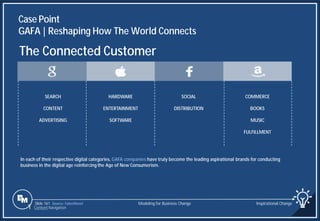
The Connected Customer
SEARCH
CONTENT
ADVERTISING
HARDWARE
ENTERTAINMENT
SOFTWARE
SOCIAL
DISTRIBUTION
COMMERCE
BOOKS
MUSIC
FULFILLMENT
Case Point
GAFA| Reshaping How The World Connects
In each of their respective digital categories, GAFA companies have truly become the leading aspirational brands for conducting
business in the digital age reinforcing the Age of New Consumerism.
Source: FaberNovel Modeling for Business Change Inspirational Change
1 Content Navigation
Slide 162
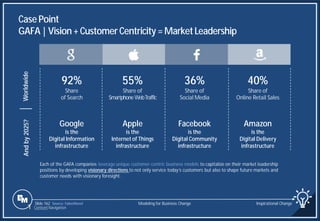
92%
Share
of Search
55%
Share of
SmartphoneWebTraffic
36%
Share of
Social Media
40%
Share of
Online Retail Sales
Google
is the
Digital Information
infrastructure
Apple
is the
Internet of Things
infrastructure
Facebook
is the
Digital Community
infrastructure
Amazon
is the
Digital Delivery
infrastructure
Worldwide
And
by
2025?
Case Point
GAFA| Vision + Customer Centricity = MarketLeadership
Each of the GAFA companies leverage unique customer-centric business models to capitalize on their market leadership
positions by developing visionary directions to not only service today’s customers but also to shape future markets and
customer needs with visionary foresight.
Source: FaberNovel Modeling for Business Change Inspirational Change
1 Content Navigation
Slide 163
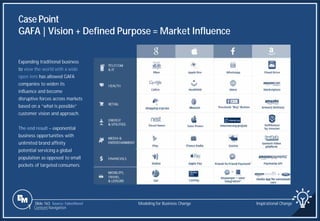
Expanding traditional business
to view the world with a wide
open lens has allowed GAFA
companies to widen its
influence and become
disruptive forces across markets
based on a “what is possible”
customer vision and approach.
The end result – exponential
business opportunities with
unlimited brand affinity
potential servicing a global
population as opposed to small
pockets of targeted consumers.
Case Point
GAFA| Vision + Defined Purpose = Market Influence
Source: FaberNovel Modeling for Business Change Inspirational Change
1 Content Navigation
Slide 164
Case Point
GAFA| Vision + Inspired Innovation = Great Products
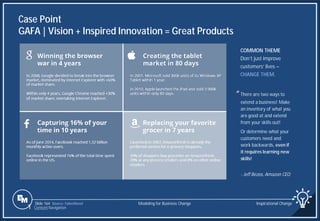
COMMON THEME
Don’t just improve
customers’ lives –
CHANGE THEM.
“ There are two ways to
extend a business! Make
an inventory of what you
are good at and extend
from your skills out!
Or determine what your
customers need and
work backwards, even if
it requires learning new
skills!
- Jeff Bezos, Amazon CEO
Source: FaberNovel Modeling for Business Change Inspirational Change
1 Content Navigation
Slide 165
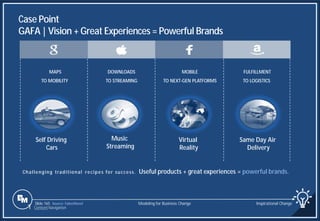
MAPS
TO MOBILITY
DOWNLOADS
TO STREAMING
MOBILE
TO NEXT-GEN PLATFORMS
FULFILLMENT
TO LOGISTICS
Self Driving
Cars
Music
Streaming
Virtual
Reality
Same Day Air
Delivery
Case Point
GAFA| Vision + Great Experiences = Powerful Brands
Challenging traditional recipes for success. Useful products + great experiences = powerful brands.
Source: FaberNovel Modeling for Business Change Inspirational Change
1 Content Navigation
Slide 166
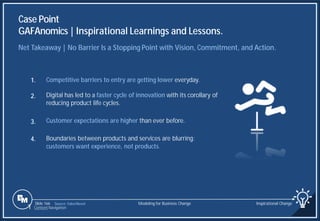
Case Point
GAFAnomics | Inspirational Learnings and Lessons.
Source: FaberNovel
Net Takeaway | No Barrier Is a Stopping Point with Vision, Commitment, and Action.
Competitive barriers to entry are getting lower everyday.
Digital has led to a faster cycle of innovation with its corollary of
reducing product life cycles.
Customer expectations are higher than ever before.
Boundaries between products and services are blurring:
customers want experience, not products.
1.
2.
3.
4.
Modeling for Business Change Inspirational Change
1 Content Navigation
Slide 167
Case Point
GAFAnomics | Inspirational Learnings and Lessons.
Source: FaberNovel
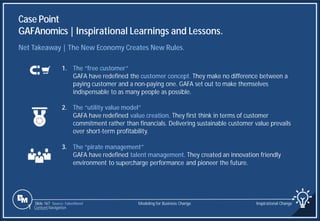
Net Takeaway | The New Economy Creates New Rules.
1. The “free customer”
GAFA have redefined the customer concept. They make no difference between a
paying customer and a non-paying one. GAFA set out to make themselves
indispensable to as many people as possible.
2. The “utility value model”
GAFA have redefined value creation. They first think in terms of customer
commitment rather than financials. Delivering sustainable customer value prevails
over short-term profitability.
3. The “pirate management”
GAFA have redefined talent management. They created an innovation friendly
environment to supercharge performance and pioneer the future.
Modeling for Business Change Inspirational Change
1 Content Navigation
Slide 168
Case Point
GAFAnomics | Inspirational Learnings and Lessons.
Source: FaberNovel
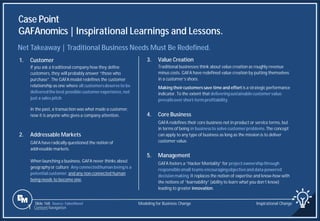
Net Takeaway | Traditional Business Needs Must Be Redefined.
3. Value Creation
Traditional businesses think about value creation as roughly revenue
minus costs. GAFA have redefined value creation by putting themselves
in a customer’s shoes.
Making theircustomerssave time and effort is a strategic performance
indicator. To the extent that deliveringsustainablecustomervalue
prevailsover short-term profitability.
4. Core Business
GAFA redefines their core business not in product or service terms, but
in terms of being in businessto solve customerproblems.The concept
can apply to any type of business as long as the mission is to deliver
customer value.
5. Management
GAFA fosters a “Hacker Mentality” for projectownershipthrough
responsiblesmall teams encouragingobjectiveand data-powered
decisionmaking.It replaces the notion of expertise and know-how with
the notions of “learnability” (ability to learn what you don’t know)
leading to greater innovation.
1. Customer
If you ask a traditional company how they define
customers, they will probably answer “those who
purchase”. The GAFA model redefines the customer
relationship as one where all customersdeserveto be
deliveredthe best possiblecustomerexperience,not
just a sales pitch.
In the past, a transaction was what made a customer,
now it is anyone who gives a company attention.
2. Addressable Markets
GAFA have radically questioned the notion of
addressable markets.
When launching a business, GAFA never thinks about
geography or culture. Any connectedhuman beingis a
potentialcustomer,and any non-connected human
being needs to become one.
Modeling for Business Change Inspirational Change
1 Content Navigation
Slide 169
Case Point
GAFAnomics | Inspirational Learnings and Lessons.
Source: FaberNovel
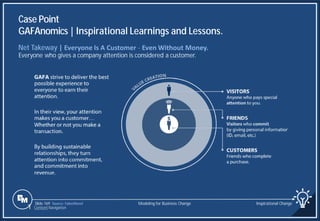
Net Takeway | Everyone Is A Customer ˗ Even Without Money.
Everyone who gives a company attention is considered a customer.
Modeling for Business Change Inspirational Change
1 Content Navigation
Slide 170
Case Point
GAFAnomics | Inspirational Learnings and Lessons.
Source: FaberNovel
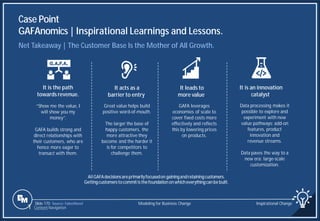
Net Takeaway | The Customer Base Is the Mother of All Growth.
All GAFAdecisions are primarilyfocusedon gainingandretainingcustomers.
Gettingcustomers to commit is the foundation on whicheverythingcan be built.
It is the path
towards revenue.
“Show me the value, I
will show you my
money”.
GAFA builds strong and
direct relationships with
their customers, who are
hence more eager to
transact with them.
It acts as a
barrier to entry.
Great value helps build
positive word-of-mouth.
The larger the base of
happy customers, the
more attractive they
become and the harder it
is for competitors to
challenge them.
It leads to
more value.
GAFA leverages
economies of scale to
cover fixed costs more
effectively and reflects
this by lowering prices
on products.
It is an innovation
catalyst.
Data processing makes it
possible to explore and
experiment with new
value pathways: add-on
features, product
innovation and
revenue streams.
Data paves the way to a
new era: large-scale
customization.
Modeling for Business Change Inspirational Change
1 Content Navigation
Slide 171
Case Point
GAFAnomics | Inspirational Learnings and Lessons.
7.9 Billion People
[Potential Customers]
Source: FaberNovel
GAFA doesn’t think in terms of geography or culture.
They rely on the belief that any connected person is a potential connection and customer.
Net Takeaway | The World Can Be Viewed Using A Different Lens.
Modeling for Business Change Inspirational Change
1 Content Navigation
Slide 172
Case Point
GAFAnomics | Inspirational Learnings and Lessons.
Source: FaberNovel
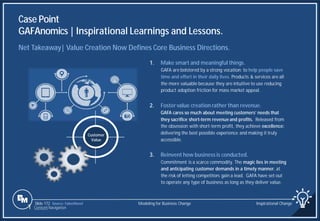
Net Takeaway| Value Creation Now Defines Core Business Directions.
1. Make smart and meaningful things.
GAFA are bolstered by a strong vocation: to help people save
time and effort in their daily lives. Products & services are all
the more valuable because they are intuitive to use reducing
product adoption friction for mass market appeal.
2. Fostervalue creation rather than revenue.
GAFA cares so much about meeting customers’ needs that
they sacrifice short-term revenue and profits. Released from
the obsession with short-term profit, they achieve excellence:
delivering the best possible experience and making it truly
accessible.
3. Reinvent how business is conducted.
Commitment is a scarce commodity. The magic lies in meeting
and anticipating customer demands in a timely manner, at
the risk of letting competitors gain a lead. GAFA have set out
to operate any type of business as long as they deliver value.
Customer
Value
Modeling for Business Change Inspirational Change
1 Content Navigation
Slide 173
Case Point
GAFAnomics | Inspirational Learnings and Lessons.
Source: FaberNovel
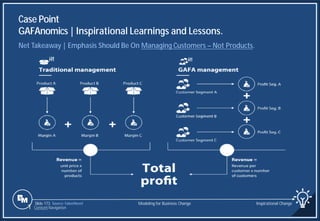
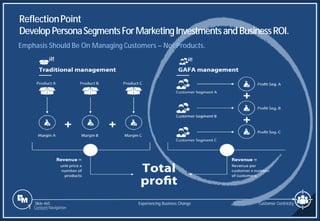
Net Takeaway | Emphasis Should Be On Managing Customers – Not Products.
Modeling for Business Change Inspirational Change
1 Content Navigation
Slide 174
Case Point
GAFAnomics | Inspirational Learnings and Lessons.
Source: FaberNovel
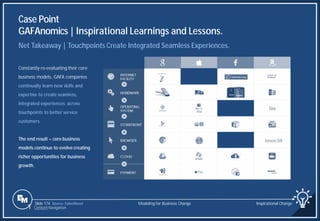
Net Takeaway | Touchpoints Create Integrated Seamless Experiences.
Constantly re-evaluating their core
business models, GAFA companies
continually learn new skills and
expertise to create seamless,
integrated experiences across
touchpoints to better service
customers.
The end result – core business
models continue to evolve creating
richer opportunities for business
growth.
Modeling for Business Change Inspirational Change
1 Content Navigation
Slide 175
Case Point
GAFAnomics | Inspirational Learnings and Lessons.
Source: FaberNovel
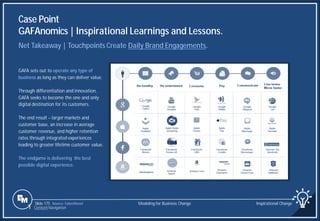
Net Takeaway | Touchpoints Create Daily Brand Engagements.
GAFA sets out to operate any type of
business as long as they can deliver value.
Through differentiation and innovation,
GAFA seeks to become the one and only
digital destination for its customers.
The end result – larger markets and
customer base, an increase in average
customer revenue, and higher retention
rates through integrated experiences
leading to greater lifetime customer value.
The endgame is delivering the best
possible digital experience.
Modeling for Business Change Inspirational Change
1 Content Navigation
Slide 176
GAFA businessandmarketingtransformationalmodelscanbe replicable.
Thekeylearningis with VisionandLeadership,a CustomerCentricapproachfocused
on the customerexperiencecanbe reimaginedto ensurebusinessrelevancyandsustainability
in an everchangingconsumerlandscape.
Modeling for Business Change Inspirational Change
1 Content Navigation
Slide 177
Now with a bit of inspirationand understandingbehind us,
takethe opportunityto re-review howbest youcannavigate
the transformationlandscape.
Modeling for Business Change Inspirational Change
1 Content Navigation
Slide 178
NAVIGATING DIGITAL
TRANSFORMATION
LEVERAGING A TRANSFORMATIVE GUIDING FRAMEWORK.
Transformational Change
Navigating Business Change
1 Content Navigation
Slide 179
Changeis nevereasy.
Tobeginchangeand tonavigatechange,we mustfirst address
the commonbarrierstochange.
1 Content Navigation
Transformational Change
Navigating Business Change
Slide 180
COMMON BARRIERS
BUSINESS CHANGE IS NEVER EASY.
1 Content Navigation
Transformational Change
Navigating Business Change
Slide 181
UnderstandingandNavigatingCommonHurdles.
1 Content Navigation
Transformational Change
Navigating Business Change
Slide 182
STRATEGY IN A SILO
THE EXPERIENCE FEELS DISJOINTED.
Many of today’s marketing and digital strategies are practiced in a silo.
Different departments manage different steps in the customer journey, let alone
collaborate. They often act as their own fiefdom. They use different standards
and metrics to measure success.
1 Content Navigation
Transformational Change
Navigating Business Change
Slide 183
INTERNAL POLITICS
TRANSFORMATION THREATENS THE STATUS QUO.
This causes self defense mechanisms to kick in. Executives push back.
They concentrate on their own priorities. Personal agendas win
in favor of what’s right or best for the organization.
1 Content Navigation
Transformational Change
Navigating Business Change
Slide 184
BUDGET ALLOCATION
BUDGETS ARE LOCKED WITHOUT PROOF OF ROI.
Digital is still reasonably new and unproven. It requires continuous experimentation
which often occurs in silos. Success and failure is rarely communicated beyond
individual departments or teams making ROI difficult to measure.
1 Content Navigation
Transformational Change
Navigating Business Change
Slide 185
DIGITAL FRAGMENTATION
PRIORITIES ARE MIS-ALIGNED.
A lack of digital planning often exists in many organizations. System and platform
efforts are typically strewn across multiple departments with no real dedicated teams.
Singular digital initiatives including websites, channels, apps, and/or e-commerce is
fragmented with lower priority given to a truly integrated digital ecosystem
aligned to an omni-channel customer experience.
1 Content Navigation
Transformational Change
Navigating Business Change
Slide 186
EDUCATION
INTERNAL KNOWLEDGE, VALUE SYSTEMS AND BELIEFS ARE DISJOINTED.
Vastly different levels of knowledge, skills and comfort exists in typical enterprises.
Knowledge is scattered across the organization. A Millennial (Digital Natives) versus
Baby Boomer (Digital Novices) divide may exist causing internal friction.
1 Content Navigation
Transformational Change
Navigating Business Change
Slide 187
LEADERSHIP
CHANGE CAN BE HARD AND PAINFUL.
Vision and someone to lead is critical. Employees will routinely follow a course
of Business As Usual. Digital is kept at arms length or in fringe conversations.
It may be viewed as a threat. A lack of digital specialists typically
means strategy will often be viewed in silos or isolation.
1 Content Navigation
Transformational Change
Navigating Transformation
Slide 188
CULTURAL CHANGE
SUCCESS WILL ONLY COME WITH A WILLINGNESS TO FAIL.
Without a culture in which employees can explore (and occasionally fail)
without fear of reprimand, digital transformation benefits will likely never materialize
and organizations will further be put at risk to survive the digital age.
1 Content Navigation
Transformational Change
Navigating Business Change
Slide 189
DISPARATE DATA
DATA INSIGHTS ARE KEY YET DATA REMAINS LOCKED IN SILOS.
Existing infrastructures and processes lack a data model to gather and distribute data.
Data remains in a silo, spread across departments or disparate systems. There exists a
lack of understanding of what data is collected and who owns the data. There is no
investment in staff and process to deliver data with actionable insight.
1 Content Navigation
Transformational Change
Navigating Business Change
Slide 190
The starting point is knowing where the barriers are
to be able to take steps to resolve them.
For those willing to embrace change, barriers can be navigated.
But it must begin with acknowledging them and then having insight
into the nuances and depth of each barrier that will be
unique to each organization.
BARRIERS CAN BE OVERCOME.
1 Content Navigation
Transformational Change
Navigating Business Change
Slide 191
As you reflecton the commonchangebarriers,
it maybe relevantto reviewsomeadditionalguidingconsiderations
organizationsare facingformoving theirtransformation
initiativesforward.
Transformational Change
1 Content Navigation
Navigating Business Change
Slide 192
CONSIDERATIONS
ADDITIONAL REFLECTIONS FOR CHANGE.
1 Content Navigation
Transformational Change
Navigating Business Change
Slide 193
q There may be staff, resource, skillset, and budget challenges which may exist within the organization to
quickly adopt digital transformation. Transformation doesn’t just happen over night. Identifying early short
falls should align to realistic roadmaps, timelines and expectations. A prioritized building block approach to
transformation may be the most valued approached to the initiative.
q The short-term goal for all initiatives should be to put into place progressive frameworks, strategies,
processes, and roadmaps that will evolve, and which will allow your organization to begin executing against
them to create a solid foundation for which can grow and mature overtime into future for longer-term
success.
q Reinforcing digital transformation will require activating and elevating champions, advocates, change agents,
and working groups across the organization and in support (IT, sales, marketing, customer service, HR) for the
adoption of the value proposition and the vision. However, how you get from where we are today to where
you want to be in the future will come from the understanding that digital transformation is not a “set and
execute” one time strategic initiative.
q As stated, digital transformation has to naturally evolve over time… building on each past success and
promoting them internally as the organization continues to develop best practices and grow its internal
resources, skillsets and expertise at each phase in its digital transformation journey is a critical transformative
step of the initiative.
Reflection Point
Additional Considerations for Guiding Transformation.
Transformational Change
1 Content Navigation
Navigating Business Change
Slide 194
q Stewardship roles for change agents and key stakeholders will need to apply an agile management approach
leveraging expertise with scale and balance to execute a strategic transformative direction at the highest
possible levels that will ‘phase in’ building block programs and initiatives based on capabilities and budgets
unique to the realities facing the organization.
q If you are a global organization, you must also be able to demonstrate you can leverage expertise, staff and
resources across a global (IT, sales, customer service, marketing, HR) operations footprint in a cohesive,
seamless team effort for applying the best possible resources for each transformation engagement and the
aspirational Total Experience customer concept.
q The key to all early success will hinge on the ability to quickly and effectively establish proof cases as credibility
for demonstrating and reinforcing transformation is clearly and quantifiably impacting business milestones in
all transformation areas impacted.
q And the bigger picture point which needs continuous reinforcement is the appreciation that any progressive
building blocks proposed and implemented today will be designed to grow and mature over time as ROI is
demonstrated and as the organization’s internal expertise and skillsets grow and mature. It will be a recurring
process of planning, experimentation, execution, measurement and refinement.
Reflection Point
Additional Considerations for Guiding Transformation.
Transformational Change
1 Content Navigation
Navigating Business Change
Slide 195
With all theseconsiderations inmind and as applicable,
navigatingandactivating transformationwill requirea guidingframework
to stewardongoingeffortsand to help solidify a structureddirectionalapproach
to speedup planned progressivestepsin the initiative.
Transformational Change
1 Content Navigation
Navigating Business Change
Slide 196
PILLARS OF CHANGE
1 Content Navigation
Transformational Change
SIX (6) CORE TRANSFORMATIVE PILLARS TO FUNDAMENTAL BUSINESS CHANGE.
Framing Transformative Business Change
Slide 197
A TRANSFORMATIVEFRAMEWORK
ThereareSix (6)Core TransformativePillarstoFundamentalBusinessChange.
Transformational Change
1 Content Navigation
Framing Transformative Business Change
Slide 198
Alignstrategicdirectionsfor transformational change.
Transformational Change
1 Content Navigation
Framing Transformative Business Change
Slide 199
EXTERNAL DEGREE OF CHANGE
INTERNAL
ABILITY
TO
CHANGE
EMPOWERMENT
CUSTOMER
CENTRICITY
INNOVATION
LEADERSHIP
& VISION
stewardship cultural change
adaptive change
risk & reward
Vision
Leadership
Transformation
Consider four core strategic directions to impact three fundamental business change areas.
ReflectionPoint
PromoteChange Through(4) TransformativeStrategicDirections.
Customer
Experiences
Operational
Processes
Business
Models
TRANSFORMATION CORE PILLARS OF CHANGE
1
2
4
3
Transformational Change
1 Content Navigation
Framing Transformative Business Change
Slide 200
Roadmapthe majormilestonesforthe transformationalchange.
Transformational Change
1 Content Navigation
Framing Transformative Business Change
Slide 201
Transform
Marketing
Define
Strategic
Directions
Apply
Process &
Methodology
Realign
Workflows
& Budgets
Optimize
Journeys
Optimize
Touchpoints
Optimize
Experience
Engage &
Collaborate
Measure &
Improve
Reinforce
Sponsorship
Create
Steering
Committee
Document
Change
Needs
AdoptValue
Proposition
Define
Vision
Reinforce
C-Suite
Support
Acquire
Adequate
Funding
Enlist
Change
Agents
Mobilize
Efforts
1. LEADERSHIP AND VISION
2. EMPOWER THE ORGANIZATION
Reflection Point
There Is A Logical Navigation Flow To Digital Transformation.
3. MOBILIZE AND TRANSFORM WITH INNOVATION
4. REDEFINE THE CUSTOMER EXPERIENCE
Promote
Vision
Build
Roadmaps
Governby
Committee
Expand
Skillsets
BuildTech
Stacks
ApplyData
Analytics
Encourage
Change
Be Risk
Friendly
Mobilize
Organization
Reinforce
Cultural
Change
Align to
Customer
Centricity
Reimagine
Customer
Experiences
Emphasize
Customer
Loyalty
Align
Business
Processes
Focus on
Customer
Needs
Use Data
for Business
Intelligence
BuildLasting
Relationships
Continually
Learn &
Improve
Creating a milestone roadmap will enable a guiding structure to manage transformation.
Transformational Change
1 Content Navigation
Framing Transformative Business Change
Slide 202
Managetransformationalchangewith structuredstewardship.
Transformational Change
1 Content Navigation
Framing Transformative Business Change
Slide 203
ReflectionPoint
StewardDigital TransformationVia A StructuredFramework.
Steward the initiative across four distinct areas of agile management focus.
Source: MIT, CG
Frame the
Digital Challenge
Focus the
Investment
Mobilize the
Organization
Sustain the
Digital Transition
Build & Expand
Awareness Across the
Organization
Fund the
Transformation
Promote New
Behaviors and Evolve
Culture
Build Foundational
Skills
Establish Reachable
Goals & Milestones
Build Governance Earn the Right to
Engage Employees
Create Incentives and
Rewards
Craft the Vision and
Align Top Team
Translate Vision Into
Action
Align Workgroups and
Signal Ambitions
Measure, Monitor and
Iterate
FRAME FOCUS MOBILIZE SUSTAIN
Transformational Change
1 Content Navigation
Framing Transformative Business Change
Slide 204
Empowertransformationthroughbusinessculture,riskandreward.
Transformational Change
1 Content Navigation
Framing Transformative Business Change
Slide 205
ReflectionPoint
EmpowerTransformationWith a Digital BusinessCulture.
Principles of Empowerment
1. RightMindset
• agile, lean, disrupt, fail fast,
customer-centricity, MVP, start with
why, experimentation
2. RightToolset
• modern, collaborative, lightweight
and effective tools
3. RightBehavior
• buy-in and support from leadership,
aligned incentives across silos, no fear
or rejection for new approaches
4. RightFeedback Loops
• learn from digital experimentation,
repeat and iterate, challenge results,
develop risk and reward incentives
Engageandincentivizestakeholdersacrossthe organizationto builda businesscultureof change.
Transformational Change
1 Content Navigation
Framing Transformative Business Change
Slide 206
Leveragetransformationalchangethroughinnovation.
Transformational Change
1 Content Navigation
Framing Transformative Business Change
Slide 207
ReflectionPoint
Start TransformationWithMarketingAs The Initial Agentof Change.
Reimagine the external-facing
customer experience from different
operational perspectives.
Rework and/or redefine internal
operating processes and business
models.
Marketing as the primary function within business will become the initial agent of change using a combinationofdigitalstrategies,
channels,tactics,andtoolstoredefinethecustomerexperiencethroughbusinessmodelsandoperatingprocesses.
Bring stakeholders together for collaborative business change across business operations.
Transformational Change
1 Content Navigation
Framing Transformative Business Change
IT, Sales, Marketing, CustomerService, Human Resources.
Offline
Touchpoints
Online
Touchpoints
Owned,
Earned, Paid
Media
Web
DigitalHub
ORGANIZATION
Slide 208
Createculturaltransformationalchangethroughcustomercentricity.
Transformational Change
1 Content Navigation
Framing Transformative Business Change
Slide 209
ReflectionPoint
Customer Centricity PutsTheCustomer AtTheCenter ofAllBusinessChange.
BEING CUSTOMER-CENTRIC
MEANS
§ Align organization around the
customer.
§ Put customers at the heart of the
company leveraging experience
design.
§ Create a company-wide customer-
centric culture.
§ Reinforce customers’ needs first, no
matter what.
§ Listen to customers, understanding
their needs, acting and repeating.
Monitor the online conversation.
§ Offer a positive customer experience
from the start of the awareness stage
all the way to the post-purchase
process and advocacy stage.
Articulate aclear valueproposition,visionandroadmapwith encouragedemployeefeedbackloops.
Transformational Change
1 Content Navigation
Framing Transformative Business Change
Slide 210
Throughthese(6)corepillarsof transformativechange,
you will be able to plan and architectthe requisitebuilding blocks
for activatingand mobilizing changethroughoutthe organization.
Transformational Change
1 Content Navigation
Framing Transformative Business Change
Slide 211
ACTIVATING
TRANSFORMATION
ENVISIONING STRATEGIC DIRECTIONS FOR CHANGE.
Leading Business Change
1 Content Navigation
Transformational Change
Slide 212
Activationof anyTransformationInitiativemusthaveclearleadership.
Leadershipmustenlist changeagentsto guideand managethe effort
and adopta value propositionand vision.
Transformational Change
1 Content Navigation
Leading Business Change
Slide 213
LEADERSHIP
CHANGE AGENTS, VALUE PROPOSITION, VISION.
Leadership
Leading Business Change
1 Content Navigation
Slide 214
“ Organizations that destroy the status quo
win. Whatever the status quo is, changing
it gives you the opportunity to be
remarkable..
Best Selling Author & Marketing Guru Seth Godin
Leading Business Change Leadership
1 Content Navigation
Slide 215
Change Agents
EVERYTHING STARTS BY CHALLENGING THE STATUS QUO.
Leading Business Change Leadership
1 Content Navigation
Slide 216
Challengingthe statusquoforbusinesschangerequiresan internal movement.
ThroughLeadership+ Vision
transformationalbusinesschangecan be willingly adopted
to becomean organizationalreality.
Leading Business Change Leadership
1 Content Navigation
Slide 217
All Movements Beginwith ChangeAgents.
To build an internal movement,changeagentsmustbe enlisted
to be the stewardsof the initiative, createa senseof urgencyamongC-Suiteexecutives,
and expandmobilizationacrossthe organizationto expediteand setin motion
the requisitebusinesschangeand digital transformationprocess.
Leading Business Change Leadership
1 Content Navigation
Slide 218
A person from inside or outside the organization who helps an organization transform itself by
focusing on such matters as organizational effectiveness, improvement, and development. A
change agent usually focuses his efforts on the effect of changing technologies, structures and
tasks on interpersonal and group relationships in the organization. The focus is on the people
in the organization and their interactions.
Definition: Change Agent
Leading Business Change Leadership
1 Content Navigation
Slide 219
You’lllikelyneedto expandthe recruitmentandenlistmentof changeagents.
Stakeholdersultimatelybecomethe face of organizationalchange
to champion and drivethe businesstransformationprocess.
Leading Business Change Leadership
1 Content Navigation
Slide 220
It requires ateameffort.
Key Roles,Purpose& FunctionsMayVarybyIndividual…
Organizationaltransformationdoes trulyrequire a teamof changeagents.
Keystakeholdersneed to be enlisted acrossall businessoperationsto impactand benefit
businesschangethroughan internal movement.
Leading Business Change Leadership
1 Content Navigation
Slide 221
To recruit and enlist thesekeyinfluentialstakeholders,
changeagentscan be identified usingleading questions.
Leading Business Change Leadership
1 Content Navigation
Slide 222
Reflection Point
Recruiting Change Agents
q Who will lead the movement?Who will be the internal voice to inspire change?
q Who will be the internal champions and stewardsfor change? How will they be recruited? Across
business operations?
q Who will create the business case and business model for C-Suite|Board adoption?
q Who will explain and document how a better “CX” can be a core business direction so that a wave
of organizational-wide support begins to build?
q Who are the internal departmentheads across Marketing, Sales, CustomerService, Human
Resources, and IT which need to be recruited and/or motivated? How can distributed teams and
efforts across a global footprint work in collaboration to create and reinforce a desired, integrated
customer experience which will benefit both business and customers as well as employee careers?
q Who needs to be recruited to form the requisite cross-functional steeringcommitteefrom
Marketing, Sales, Customer Service, Human Resources, and IT to collaborate and support change
across E-Commerce, Social, Mobile, Digital, and Real World?
Leading Business Change Leadership
REPRESENTATION
1 Content Navigation
Slide 223
Oncechange agentshavebeenidentified,recruited andenlisted…
it will be imperativefor ChangeAgentsto workcollaborativelywith the
executivesteeringcommitteeto developand/or refine the value proposition and vision
througha needsanalysisto guidethe mobilizationof all transformativeefforts.
Leading Business Change Leadership
1 Content Navigation
Slide 224
Reflection Point
Needs Analysis | Defining Operational Transformative Change
q What is digital transformation for the organization? What is the customer value proposition?What are the
goals and objectives? How can digital impact business change and efficiencies to impact the customer
experience?
q How can a cultural environment of innovation, employee empowerment, and risk and reward be built across
the enterprise?
q How can customer and channel marketingbreak out of silos for creating better omni-channel customer
experiences to have greater business impact?
q How will requiredbusiness systems,processes, methodologies,and technologies be integrated? What data is
available? What data can be collected? What will be the data framework? How will data be governed and used?
q How will the transformation efforts be rolled out and promotedacross the organization? What is the impact
on business, departmental staffing and business models in place?
q How can ROI or the promise of it be demonstratedacross at organizational levels?
q What is the plan to reinforce sponsorship support from the Board and C-Suite executives? Who needs to be
internal champions and are who are most likely to be receptive to business change, e.g., board members, CEO,
CDO, CXO, CMO, et al?
q How and when (at what stage in the movement)will the business case and/or progress updates be presented
to key sponsors to reinforce continued sponsorship?
Leading Business Change Leadership
REPRESENTATION
1 Content Navigation
Slide 225
ReinforcingAll MovementsMustConsiderThe Organization…
One sizewill not fit all. Asnoted, changeagentsmust be realisticto consider
how transformativechangewill be unique to the organizationbasedon practicalities
of availableresources,expertise,skillsets,and organizationalcommitment.
Leading Business Change Leadership
1 Content Navigation
Slide 226
And mostcritical of allis changeagentsmust be ableto
mobilizethe organizationintoactionthroughthe valuepropositionanda vision.
Leading Business Change Leadership
1 Content Navigation
Slide 227
As organizationspotentiallyexpand their circle of changeagents,
the endgoalsmustbe clearlydefinedbeforeadvancingtransformation
to ultimatelydrive,manageandguidethe initiativeto achievesuccess.
Thereflectionpointis the valueproposition.
Leading Business Change Leadership
1 Content Navigation
Slide 228
Value Proposition
REALIGNING TO THE CUSTOMER EXPERIENCE.
Leading Business Change Leadership
1 Content Navigation
Slide 229
Not all corporationsbegin as digitaland data-drivenentities.
Tofullyembracedigitaltransformation,organizationswill need
a customervaluepropositionto embracedigitalasa business model.
Leading Business Change Leadership
1 Content Navigation
Slide 230
Therefore,before realigninga visionfor businesschange,
a clearDigitalTransformationValuePropositionmust be defined.
It mustbe easilycommunicatedaimed atC-SuiteExecutives
to leverageheightenedsponsorshipandfurtherserveto createa senseof urgency
acrossthe organizationatall levels.
Leading Business Change Leadership
1 Content Navigation
Slide 231
Why does a value proposition matter?
Fully embracing digital transformations require companies
to reimagine their business from a customer's perspective.
Leading Business Change Leadership
1 Content Navigation
Slide 232
An effective value proposition will define a new way
of thinking about an organization’s business. It will tell the ideal
customer why they should buy from your company and not from
competitor brands.
Leading Business Change Leadership
1 Content Navigation
Slide 233
It will put the customer at the center
for defining and/or refining the vision for where your organization can
make real change for business benefit which is at the core of
the transformation effort.
Leading Business Change Leadership
1 Content Navigation
Slide 234
1 Content Navigation
Six out of 10 companies have produced new
business models due to digital transformation
strategies, and over half of company CEOs say
that digital technologies have helped increase
revenues.
The most common benefits cited aligned to a
customer centricity business model approach
include: 40% improved operational efficiencies,
36% reduced time to market, 35% improved
ability to match customer expectations.
Source: Forbes
Reflection Point
RealigningBusinessTo The Value Proposition.
6
Leading Business Change Leadership
Slide 235
Framing the value proposition will provide the direction
required to realign the guiding vision for business transformation
which underpins all efforts.
Leading Business Change Leadership
1 Content Navigation
Slide 236
Vision
ALIGNING VISION TO THE VALUE PROPOSITION.
Leading Business Change Leadership
1 Content Navigation
Slide 237
VISION IS CRITICAL
There will be a need to embrace transformation with a clear vision.
Transformation needs an actionable vision.
Leading Business Change Leadership
1 Content Navigation
Slide 238
Reinforcing everything discussed so far,
the Vision needs to align business benefits to the value proposition
and then be adopted by the C-Suite and be promoted
top > down into the organization.
Leading Business Change Leadership
1 Content Navigation
Slide 239
And to be clear…
the Vision must be driven from
top > down for successful organizational adoption.
This is the only path to success.
Leading Business Change Leadership
1 Content Navigation
Slide 240
q Case studies reveal the most successful transformation initiatives will focus as much (or more)
on how to drive change as on the detailed content of the change.
q A compelling transformative vision, with related engagement, governance and KPIs will allow
employees throughout the organization to identify new “whats” to meet or extend the vision
as the organization is mobilized for the transformation initiative.
q Successful transformation comes not from creating a new organization, but will reshape the
organization to take advantage of valuable existing strategic assets in new ways.
q The most successful transformative companies will gain value from investments they have
already made, even as they envision radically new ways of working.
ReflectionPoint
AValuedVision WillFocusMoreOnthe “How”Thanthe “What”.
Leading Business Change Leadership
1 Content Navigation
Slide 241
ReflectionPoint
VisionIdeation| FromEcosystemto Mecosystem.
Where an ecosystem is a complex network or interconnected system of departmental operations in which business
operates serving singular business functions, the concept of a new Mecosystem in the Age of New Consumerism is
a re-orientation of this departmental model putting the customer at the center and reorganizing and integrating
department operations and business systems re-aligned to support the brand experience for realization of greater
business outcomes, customer loyalty and revenues.
q Informed by data, the Mecosystem considers the "real-
life" contexts surrounding the customer and seeks to
architect synergies across touchpoint experiences,
ensuring more relevant services and products are
delivered.
q The Mecosystem customer approach further helps
calibrate brand experiences based on customer needs and
preferencesthat are becoming increasingly social
and multi-sensory as created by digital by harnessing
collective intelligence through analysis and data.
Source: Interbrand Leading Business Change Leadership
1 Content Navigation
Slide 242 Source: IBM Institute
Fashionistas Digirati
Beginners Conservatives
• Many advanced digital features
(such as social, mobile) in silos
• No overarching vision
• Underdeveloped coordination
• Digital culture may exist in silos
• Strong overarching digital
vision
• Good digital governance
• Many digital initiatives
generating business value in
measurable ways
• Strong digital culture
• Management skeptical of
business value of advanced
digital technologies
• May carry out some
experimentation
• Immature digital culture
• Overarching digital vision exists,
but may be under developed
• Basic digital capabilities may be
mature
• Strong digital governance across
silos
• Taking active steps to build
digital skills and culture
D
i
g
i
t
a
l
I
n
t
e
n
s
i
t
y
Transformation Management Intensity
Every company’s path to
Transformation will be unique.
In parallel with defining the vision, one of the
first steps to transformation is an
organizational assessment to identify current
strengths and weaknesses.
Depending on a company’s current level of
digital maturity,atransformationinitiative will
need to be uniquely designed to move the
business through progressive stages to reach
full digital transformation.
As digital maturity grows with each new
success, the vision can evolve expanding the
backbone to iterative roadmap planning.
Reflection Point
Vision Ideation | Digital Maturity Self Assessment.
Leading Business Change Leadership
1 Content Navigation
Slide 243
Fashionistas Digirati
Beginners Conservatives
D
i
g
i
t
a
l
C
a
p
a
b
i
l
i
t
y
Leadership Capability
Reflection Point
Vision Ideation | Comparative Industry Maturity View.
Source: MIT, CG
Compared to industry transformation stages, some industriesare further along in the building of digital capabilities but
may lag in vision and strategy to affect transformation.
Leading Business Change Leadership
D
i
g
i
t
a
l
C
a
p
a
b
i
l
i
t
y
Leadership Capability
1 Content Navigation
Slide 244
Reflection Point
VisionIdeation| Change at Three(3) FundamentalBusinessLevels.
T
R
A
N
S
F
O
R
M
A
T
I
V
E
C
H
A
N
G
E
• Customer Understanding
• Top Line Growth
• Customer Touch Points
Customer
Experiences
• Process Digitization
• Worker Enablement
• Performance Management
Operational
Processes
Business
Models
• Digitally Modified Business
• New Digital Business
• Digital Globalization
Unified
Data &
Processes
Analytics
Capabilities
Business
and IT
Integration
Solution
& Product
Delivery
Digital
Capabilities
3
2
1
Leading Business Change Leadership
1 Content Navigation
Reinforcing discussion points so far, a vision will impact business change at three fundamental levels.
Slide 245 Leading Business Change
Linked to Organizational Needs & Circumstances
A Vision will impact Transformation
Benefits for C-Suite Embracement.
q Competitive Advantage
q Innovation and Business Value
q Sales Growth & Revenues
q Operating and Organizational
Efficiencies
q Market and Customer
Management
q Improved Customer Service
q Create and Capture Consumer
Value
q Greater Brand Loyalty & Affinity
q Product / Service Innovation
Source: Altimeter
C
o
m
m
o
n
T
r
a
n
s
f
o
r
m
a
t
i
o
n
B
e
n
e
f
i
t
s
Reflection Point
Vision Ideation | Aligningand LinkingBusinessBenefits.
Leadership
1 Content Navigation
Slide 246
Digital Footprint Ecosystems– digital hubs, owned digital assets, channels, platforms, content, integration,
personalization, real-time, geo, screen appropriate tightly integrated with all other customer touchpoint owned
assets (offline + online).
Digital & Departmental Teams – well defined inter-departmental (IT, sales, marketing, customer service, HR)
involvement, roles and responsibilities, monitoring & engagement to facilitate seamless positive experiences.
Digital Communications– enhanced digital marketing strategies, campaigns, promotions, customer engagement,
customer touchpoints, mobile, websites, apps, SMS, MMS, WAP sites, location-based services.
Digital Support – internal operational integrated processes, skillsets, collaboration, employee empowerment,
social employee guidelines, IT infrastructure and backbone, front-end systems and platforms, data frameworks,
database integration, marketing, customer and operational performance analytics, and business intelligence
management and mining.
Reflection Point
VisionIdeation |Realignment ToTheOrganization's Digital Journey.
Leading Business Change Leadership
1 Content Navigation
Expanding on discussion points so far, a vision will impact business across operations and departments.
Slide 247
1
2
3
Innovate
Improve
Support
Level 2 Business Needs
• Business network/process redesign
• Enable business and partnerships
• Management information
• Process orientation
Level 1 Business Needs
• Foundation systems
• Cost savings
• Operational information
• Functional orientation
Level 2 IT Focus
• Establish common IT infrastructure
• Build IT credibility
• Improve solution delivery
• Establish Enterprise Architecture
• Respond to ‘Consumerization of IT’
Level 3 Business Needs
• Business growth and innovation
• Rapid configuration capability
• Market information
• Business integration orientation
Level 1 IT Focus
• Provide basic systems and services
• Stabilize operations and support
• Improve service delivery
• IT management fundamentals
Level 3 IT Focus
• Continuous strategy & planning
• Converge business and IT
• Expand and extend infrastructure
• Enable flexibility and agility
• Embrace ‘Consumerization of IT’
Time
Value
Demand
Supply
Reflection Point
Vision Ideation | Transformative Phased Timeline Approach.
Business
Transformation
Business
Effectiveness
Business
Efficiency
Leading Business Change Leadership
1 Content Navigation
An effective vision will consider (3) stages and be able to communicate a roadmap to change based on milestone timelines.
Slide 248 Source: UHL Glénai
Reflection Point
Vision Ideation | Implementing Transformative Lifecycles.
Transformation
Will Not Be A One Time Event.
Lifecycle Planning
Based on your own unique
organizational assessment,
transformation roadmaps should
follow and align to lifecycles phases.
Iterative planning is required to
envision change, engage your staff,
empower continuous
transformation and optimize for
lasting change to reap more
efficient and greater outcomes.
Leading Business Change Leadership
1 Content Navigation
An effective vision will include progressive iterative lifecycle steps and goals in the business transformational journey.
1 2
3
4
Slide 249
Although developing a vision may seem like a daunting task…
with conviction and commitment the steps and considerations outlined
can successfully begin to build an actionable vision leading to a roadmap
for transformational change.
Leading Business Change Leadership
1 Content Navigation
Slide 250
C-Suite Support
ADOPTING AND EMBRACING DIGITAL TRANSFORMATION.
Leading Business Change Leadership
1 Content Navigation
Slide 251
A quick note on C-Suite support and adoption.
Leading Business Change Leadership
1 Content Navigation
Slide 252
To achieve real transformation, you must emphasize
a top / down approach to influence an empowered and customer-centric
organizational culture which can be spearheaded and supported
from within the C-Suite.
Leading Business Change Leadership
1 Content Navigation
Slide 253
Reflection Point
Levels of Typical C-Suite Digital Transformation Support.
Source: Altimeter
Surveyed across industries, C-Suite
level champions varied with the CMO
followed by the CEO most supportive of
transformational change.
Sponsors may vary by organization.
However, C-Suite executive level
functional support across organizational
operations is required for successful
transformation to be successful and
realized.
Leading Business Change Leadership
1 Content Navigation
C-Suitesupportmaydifferbyorganization.Ideally,theinitiativewillinspireallC-Levelexecutivestobeactivechampionsforchange.
Slide 254
As we have discussed, transformation starts with Leadership which leads to
the enlistment of change agents and the adoption of a value proposition and vision.
The next step must be empowering the organization to affect change.
Leading Business Change Leadership
1 Content Navigation
Slide 255
EMPOWERMENT
EMPOWERING THE ORGANIZATION TO TRANSFORM AND CHANGE.
Empowerment
Mobilizing Business Change
1 Content Navigation
Slide 256
Stewardship, Skills, Culture and Technology.
Empowering transformation is about creating a mindset for adopting
and impacting change internally within the business.
Mobilizing Business Change Empowerment
1 Content Navigation
Slide 257
To evolve and to empower is to lay the groundwork for sustainable change
through four fundamental reinforcing directions as linked to the six pillars of
transformative change.
Mobilizing Business Change Empowerment
1 Content Navigation
Slide 258
ARTICULATE VISION & PRIORITIES
WHAT WILL SUCCESS LOOK LIKE? WHY DO WE NEED TO CHANGE?
Employees will need to see that change is valuable for them and for customers.
Because elevating digital maturity will involve numerous building block projects,
it will require the need to prioritize the ”must haves” over the ”nice-to-haves”
by developing actionable, governable roadmaps.
Mobilizing Business Change Empowerment
1 Content Navigation
Slide 259
CREATE CURIOSITY & A NEW MINDSET
ENGAGE AND EMPOWER EMPLOYEES TO DEVELOP NEW COMPETENCIES.
Digitally mature companies encourage employees to experiment and innovate
while equipping them with the right tools to resolve challenges. It requires
change agent leaders with the right qualities to inspire, influence,
and encourage collaboration.
Mobilizing Business Change Empowerment
1 Content Navigation
Slide 260
LEVERAGE & USE DATA
INNOVATE USING PROCESS AND DATA-DRIVEN DECISIONS.
Leverage data to draw sound conclusions. Data is the lifeblood of a digitally mature
organization and is essential to driving change and innovation. Good data enables an
organization to calculate, understand, and articulate the value expected from digital
initiatives and to respond to and satisfy customers.
Mobilizing Business Change Empowerment
1 Content Navigation
Slide 261
BUILD A CULTURE OF INNOVATION
BALANCE FREEDOM TO EXPLORE WITH INCENTIVES TO ACCELERATE INNOVATION
THROUGH CUSTOMER CENTRICTY.
Innovation is key to staying ahead of both known and emerging competitors.
For innovation to flourish, and for customer centricity to take root, organizations must
encourage and elevate cross-functional collaboration, and adopt agile management
approaches to strengthen the partnership between the business and IT function.
Mobilizing Business Change Empowerment
1 Content Navigation
Slide 262
To engage the organization and to empower the organization at all levels
will require implementing these four guiding fundamental directions.
Mobilizing Business Change Empowerment
1 Content Navigation
Slide 263
Reflection Point
Empowerment | Establish and Communicate Priorities for Change.
Identify Core Priorities.
As previously highlighted,
change can be difficult.
All organizations face it. Digital
transformation and priorities
will be different and unique for
each organization.
A basic need is to identify your
initial priorities and roadmap
change as building blocks to
mobilize efforts accordingly.
Grow and mature with each
success, replicate and iterate
across the global operations to
holistically transform the
organization.
Source: Altimeter Mobilizing Business Change Empowerment
Survey results describe the importance from executives surveyed of different building block
elements of digital transformation initiatives.
1 Content Navigation
Slide 264
Reflection Point
Empowerment | Disseminate, Promote Vision and Priorities.
Prioritize Business Transformation Steps.
Before organizations can truly impact business change,
employees need to understand what success looks like and
why the organization requires change.
In the digital marketplace, the answer to “why?” should
center around how the digital investment and strategy
delivers incremental value to customers. This strategy should
be based on exercises in design-thinking that reveal what
customers value most. As the value proposition is articulated
to employees, it is important to build emotional connections
by explaining how change is valuable for employees.
Once the value proposition has been defined for each
building block initiative, determine which building blocks are
critical “must-haves” to the digital strategy and which are
“nice-to-haves” that may have to wait until time and
resources are available.
Source: UHL Glénai Mobilizing Business Change Empowerment
1 Content Navigation
Slide 265
Reflection Point
Empowerment | Plan and Govern Using Building Block Elements.
Define The What and How.
Successful transformation is executed
by what some reference as Minimal
Viable Products (MVPs) aka building
block elements -- which is defined by
the digital steering committee and as
aligned and prioritized with the digital
vision.
Every organization will have differing
priorities as initially defined by their
unique core business needs identified
in the needs analysis assessment. Each
building block element should have a
transitional, iterative roadmap to
enable proper stewardship,
governance and mobilization.
Leveraging an agile management
approach, each building block can be
clearly managed for the What and
How to become actionable.
Source: UHL Glénai Mobilizing Business Change Empowerment
1 Content Navigation
REPRESENTATION
Slide 266
Reflection Point
Empowerment| Be Agile To Engageand EmpowerThe Organization.
Leverage Agile Management Frameworks.
To elevate cross-functional collaboration, rather than
organizing work within functional silos, an agile management
approach enables cross-functional teams with diverse
perspectives to solve problems together and uncover
previously unknown opportunities. In this model, change
agents will take on formal and informal management roles to
govern and guide organizational efforts through each phase
of building block implementation.
Source: UHL Glénai
Management Roles
Transformational
IT Management
Mobilizing Business Change Empowerment
1 Content Navigation
REPRESENTATION
Slide 267
Reflection Point
Empowerment | Activate and Mobilize The Organization.
Manage by Building Block (MVP) Execution.
Innovation and product management may require new ways of thinking and working rooted in agile methodology. Mature digital organizations
increasingly embrace the concept of introducing a minimum viable product (MVP) and then improving it over time. It’s a stronger approach than
striving for a full-featured big bang, which, in today’s market, could wind up being irrelevant by the time it is ready for launch. Each MVP can be
mobilized as an essential building block leveraging Meta Management principles.
Source: UHL Glénai Mobilizing Business Change Empowerment
1 Content Navigation
Building
Block
(MVP)
Execution
REPRESENTATION
Slide 268
Reflection Point
Empowerment | Overcome Catalysts & Inhibitors to Change.
Overcome Barriers.
As discussed, there will be
many barriers to change
which may be foreseen and
unforeseen in the
transformation process.
It will be the role of steering
committees and change
agents to resolve barriers as
they occur to keep the
initiative moving forward.
Experimentation with the
concept of a cross-functional
catalyst teams to drive
short-term initiatives can
be a valued direction for
many organizations.
Source: UHL Glénai Mobilizing Business Change Empowerment
1 Content Navigation
REPRESENTATION
Slide 269
Reflection Point
Empowerment | Expand Skillsets, Competencies & Innovation.
Motivate and Empower Employees.
It’s critical to allow employees to experiment and innovate
without fear of failure, resolve challenges more resiliently,
and champion change, while knowing they are supported.
Consider the skills required to successfully lead organizational
change (technology, digital savviness, collaboration,
influence) and identify individuals who will be a good fit. As
the digital journey evolves, organizations may need to
identify and prepare change champions at additional levels.
Digital maturity also requires employees to adopt a growth
mindset that motivates them to develop and use new skills as
operations become more digital. Training should be part of
the mix, but it is important to recognize the value and
importance of experiential, on-the-job learning.
Source: UHL Glénai Mobilizing Business Change Empowerment
1 Content Navigation
REPRESENTATION
Slide 270
Reflection Point
Empowerment|Deploy TheRightToolStacks ForWorkflowEfficiencies.
Provide The Right Platforms & Tools.
When selecting and configuring a tech stack
which becomes a critical backbone
component to enable transformation, an
integrated framework should reflect four (4)
core considerations.
1. People | Usability and friendliness over
back-end and admin needs.
2. Platforms | Best-of-Feature solutions
over Best of Breed (Suite) or All in One
Suites are best choices.
3. Features | Out of box solutions over
alternative coding platforms to reduce IT
resources and investments.
4. Integrations | Preferably native
integrations for seamless exchange of
business critical data over SAAS or API
integrations.
Source: martechtribe.com
Digital & Content
Management
Platforms
Supply-Chain,
E-Commerce Tools
Call Center,
Community & Social
Platforms
Assorted Workflow
& Collaboration Tools
Business Intelligence
& Research Tools
Marketing & Email
Automation Platforms
ERP, SAP, CRM
Platforms
Mobile Marketing
Automation Platform
Reputation Mgmt.
& Analytics Platforms
Centralized Data Backbone Framework
Mobilizing Business Change Empowerment
1 Content Navigation
REPRESENTATION
Slide 271
Reflection Point
Empowerment | Become Data Driven To Drive Transformation.
Make Data Essential for Decision Making.
Data is the lifeblood of the digital organization. Mature
digital companies foster a culture that pushes leaders and
peers to use data when making decisions.
Good data is essential to determine the value of change
and to articulate the results you expect from digital
initiatives. Without well-defined success measures, it will
be difficult to inspire leaders to model the right behaviors
and also evolve performance management systems and
incentive structures to reward desired behaviors.
One way to use data to promote the right behaviors for
data use is to communicate “use cases” that demonstrate
how a particular change is tangible and measurable.
Examples can point to progress that a team is making and
the impact of its work. This motivates others to find similar
opportunities and demonstrate comparable behaviors.
Source: UHL Glénai Mobilizing Business Change Empowerment
1 Content Navigation
REPRESENTATION
Slide 272
Reflection Point
Empowerment|Integrate Front-EndwithBack-EndOperational Processes.
IntegrateCommonDomainsofExcellence.
It’s essential to integrate and link business
processes, platforms and systems.
What this looks like and how this integration
is facilitated will depend on the organization,
and how it transacts business with its
customer.
It likely will influence all customer channel
touchpoints (online and offline), across the
entire customer journey at each point of
customer engagement.
It will influence back-end operational
processes, platforms and systems for
enablement of greater collaboration across
operations to deliver requisite business
intelligence to enhance the overall customer-
facing experience.
Source: MIT, CG Mobilizing Business Change Empowerment
1 Content Navigation
REPRESENTATION
Slide 273
Empowering the organization for business change does require cultural change…
embracing the right mindset, management, tools, skillsets and motivations.
As empowerment is realized, innovation through process and methodology
enables the delivery of a business transforming customer experience.
Mobilizing Business Change Empowerment
1 Content Navigation
Slide 274
INNOVATION
REIMAGINING CUSTOMER EXPERIENCES VIA PROCESS & METHODOLOGY.
.
Innovation
Architecting Business Change
1 Content Navigation
Slide 275
“Digital marketing is at a crossroads, and it’s
the brands that understand the role of
context in delivering customer value that
will excel in this new era of connectivity.
Analyst, Best Selling Author, Speaker Brian Solis
Architecting Business Change Innovation
1 Content Navigation
Slide 276
Innovation begins with process and methodology as underpinned by
four key digital enabling requirements which forms the underlying foundation
for delivering new brand experiences aligned to customer value.
Architecting Business Change Innovation
1 Content Navigation
Slide 277
Reflection Point
Innovation | Four Underpinning Digital Enabling Requirements.
CustomerValueCanOnlyBeRealizedIf
InnovationisUnlockedandEnabled.
To innovate and to transform is to apply
process and methodology which can be
empowered with leadership, collective
experience and knowledge.
All innovation is linked and starts with this
premise using four key enablers.
1) A unwavering commitment to place the
customer at the center of transformation.
2) A digital savvy workforce skilled across line-
authority business disciplines.
3) Stewardship via process to drive
operational excellence across building block
element execution.
4) Organizational IT excellence and data
governance to support the requisite digital
business ecosystem.
Source: UHL Glénai Architecting Business Change Innovation
1 Content Navigation
1
2
3
4
Slide 278
To innovate and transform is to create customer value
through experiential design delivered at each customer touchpoint.
Architecting Business Change Innovation
1 Content Navigation
Slide 279
Through process engineering and methodology,
you can innovate and reimagine experiential marketing
and the customer experience.
Architecting Business Change Innovation
1 Content Navigation
Slide 280
Marketing Design
REIMAGINING EXPERIENTIAL MARKETING.
Architecting Business Change
1 Content Navigation
Innovation
Slide 281
Reimagining marketing begins with an experiential transformative framework.
Architecting Business Change Innovation
1 Content Navigation
Slide 282
Where you can activate experiential design using a 12 step guiding process.
Architecting Business Change Innovation
1 Content Navigation
Slide 283
Advance
Discovery
Digital Ecosystem
Optimization
Strategic
Directions
Campaign
Planning
Customer Journey
Alignments
Brand Experience
Touchpoints
Workflow Team
Collaboration
Measurement
& ROI Analysis
Digital Ecosystem
Alignments
Content Marketing
Directions
Community
Management &
Engagement
Campaign
Building Block
Execution
ReflectionPoint
Innovation | Transformation Process Roadmap Framework.
REPRESENTATION
Architecting Business Change Innovation
1 Content Navigation
Slide 284
ReflectionPoint
Innovation | Experiential Transformation Marketing Framework.
REPRESENTATION
Architecting Business Change Innovation
1 Content Navigation
ProcessRoadmap | Marketing TransformationMaster Frameworks
Advance
Discovery
Digital
Footprint
Review
Goals &
Objectives
Review
KPI Review
Benchmark
Performance
Audits
Customer
Journey
Mapping
Ecosystem
Optimization
SEO
Alignments
Digital
Landscape
Navigation
Alignments
Content &
Publishing
Schedule
Alignments
Brand Identity
Alignments
Design &
Architectural
Alignments
Offline
Touchpoint
Integration
Strategic
Campaign
Directions
Vision, Goals,
Objectives &
KPIs
Target
Personas
Digital
Footprint &
Touchpoints
Brand Story
Branding
Online/Offline
Integration
Content
Production
Publishing
Localization
Mobile
Lead
Generation
Employer
Branding
Milestone
Management
Process &
Methodology
Search Engine
Marketing
Search Engine
Optimization
Paid Media
Experiential
Marketing
Social Media
Marketing
Mobile &
App
Marketing
Email
Marketing
Content
Strategy
Inbound
Marketing
Employer
Brand
Marketing
Workflow
Alignments
Global,
Regional
Alignments
Team
Structures
Team Roles
Corporate
Models
Hub & Spoke
Models
Decentralized
Local Models
Onboarding
& Continued
Learning
Content
Directions
Owned
Earned
Paid
User
Generated
Content
(UGC)
Campaigns &
Promotions
Technology
Stacks
Workflow
Management
Marketing
Automation
Community
Management
CRM & Lead
Management
Workflow
Collaboration
Data + Visual
Analytics
Business
Intelligence
(Insights)
Listening &
Monitoring
Web & App
Platforms
Ecosystem
Alignment
Channel Use
Optimization
Seamless
Integrated
Footprint
Customer
Touchpoints
Alignment
Channel
Content
Optimization
Building
Block
Execution
Budget
Alignments
Objective
Oriented
Phased In
Roadmaps &
Timelines
Omnichannel
Brand
Experience
Optimization
Global
Workflow
Management
Engagement
& Conversion
Community
Management
Lead
Tracking
Lead
Nurturing
Mobile
Optimization
Web Design
Real-Time
Personalization
Mobile First
Design
App Design
Team
Collaboration
Intra-Office
Global
Management
Inter-
Department
Agencies &
Stakeholders
Planning
Workshops
Workflow
Tools
Measure,
Analyze,
Optimize
Measurement
& Performance
ROI Analysis
Campaign
Optimization
Reporting
Cycles
Adaptation &
Re-alignment
Iterative
Planning
Cycles
Brand
Workflow
Management
Slide 285
Of note for global companies, experiential marketing design may require
hub and spoke activation with geo considerations where applicable.
Architecting Business Change Innovation
1 Content Navigation
Slide 286
However, ideally experiential marketing transformation enables
a shift from product and brand marketing to…
a focus on customer- and persona-based marketing.
Architecting Business Change Innovation
1 Content Navigation
Slide 287
Experiential
Campaign
Framework
Objectives
Budget Allocation
Campaign Planning
Promotions
Special Offers
& Contests
Content Marketing
Loyalty, Rewards &
Incentive Programs
Membership Programs
Community Portals
Engagement Apps
Offline - Commerce,
Special Events
Crowdsourcing
Brand Evangelism
User Generated
Content
Creative Direction &
Campaign Design
Brand Experience
Reinforcement
Execution Requirements
Channel Selection
Legal & Channel
Compliance
Technology Platforms
Web, App, UX
Development
Publishing &
Process Flow
Resource Allocation
Management &
Maintenance
Key Performance
Indicators
Measurement Cycles
Promotion Plan Budget Re-alignment
Execution
Measurement, Analysis &
Optimization Cycles
Adjustments & Adaptation
Reflection Point
Innovation | Experiential Marketing Campaign Design Framework.
REPRESENTATION
Architecting Business Change Innovation
1 Content Navigation
Slide 288
Once an experiential framework is designed,
process engineering will enable the transformation effort.
Architecting Business Change Innovation
1 Content Navigation
Slide 289
Process Enabled
PROCESS ENGINEERING MARKETING DESIGN.
Enabling Business Change
1 Content Navigation
Innovation
Slide 290
“ You can only know where you’re going if
you know where you’ve been.
Legendary historian and documentarian James Burke
Enabling Business Change Innovation
1 Content Navigation
Slide 291
Discovery
PROCESS ENGINEERING MARKETING DESIGN.
Enabling Business Change
1 Content Navigation
Innovation
Slide 292
Develop business intelligence through discovery.
Enabling Business Change Innovation
1 Content Navigation
Slide 293
D
i
s
c
o
v
e
r
y
F
r
a
m
e
w
o
r
k
Digital Footprint &
Integration Review
Campaign Planning
Review
Benchmark
Performance Audits
Web
SEM|SEO
SMM
Email
Mobile, Apps
& IoT
Paid Media
Content
Lead Generation
Competitive
Landscape
Departmental
Collaboration
Internal Process &
Workflow
Offline / Online
Branding Integration
Online Reputation
Analysis
Existing Goals &
Objectives Review
Existing KPIs Review
Customer Journey
Mapping
Customer Persona
& Needs Analysis
Reimagining experiential marketing and design
starts with DISCOVERY which is a critical early step
to architecting a Digital Transformation effort.
q Reveals what’s broken and what’s not.
q Establishes a performance benchmark to measure
against future ROI.
q Identifies early baseline priority needs within the
current digital ecosystem and as aligned to offline
touchpoints which can be executed against a timeline
in advance of defining strategic directions.
q Provides the insights and intelligence required to
architect strategy, internal process and executable
tactical directions.
ReflectionPoint
Innovation | Advance Discovery Framework.
REPRESENTATION
Enabling Business Change Innovation
1 Content Navigation
Slide 294
ReflectionPoint
Innovation | Advance Discovery Framework.
REPRESENTATION
Enabling Business Change Innovation
Discovery Review Process Audit Inclusion
Digital Footprint (Ecosystem) What are the current digital assets? How are they linked (connected)?Managed and supported?
Existing Goals & Objectives
What are the current goals & objectivesdriving the digital efforts? Are they mapped to business goals and
objectives? Are they measurable?
Existing KPIs What does success look like? How is it currently being measured? What is the current performance?
Search Engine Optimization (SEO)
Brand and competitive SERP optimization (accessibility, indexability, on-page/ off-pageoptimization, keyword
analysis, link building) for all digital assets
Search Engine Marketing (SEM)
Paid search & display (objectives,campaigns & ad groups, budgets, targeting, bidding, delivery, ad rotation,
keywords,landing pages, device, ad schedules, A/B testing, overall performance).
Social Media Marketing (SMM)
Channel objectives & use, branding,profiles, descriptions,tags, links, practices and trends, content, targeting &
publishing, SEO & web traffic influence,unclaimed properties, KPI metrics, performance.
Email Marketing
Objectives& use, campaign frequencies,content themes, open rates, CTRs, landing pages, opt-in lead gen, list
management.
Mobile Marketing
Objectives& use, cross channel strategic direction, audience profile and needs, responsivedesigns (web, mobile,
landing pages), SMS/MMS,app use, A/B testing, optimization, KPIs, performance.
Advertising (Digital)
Objectives& use (banner, display, rich media, video, pop-up,mobile, native, social), campaigns & ad groups,
targeting, contextual delivery, media buys, ad rotation and schedules, design, landing pages, device optimization,
A/B testing, ROAS performance.
1 Content Navigation
Slide 295
Discovery Review Process Audit Inclusion
Content Marketing
Content assets, strategy, optimization, objective-based use, production process,topics (brand, competitive,
industry), audience needs, re-purposing,re-targeting, performance.
Apps & IoT Objectives& use, strategy, design, development,promotion, in-app engagement, performance– opportunities.
Lead Generation
CRM platform, ecosystem integration, and process(lead acquisition, lead nurturing, triggered response,
behavioral tracking, real-time contextual content delivery,lead stage tracking, database segmentation and
management).
Departmental Collaboration
Inter-Departmental input (sales, customer service, HR, IT), information (data) sharing, independentdepartmental
initiatives / assets, departmental cooperation and support.
Internal Process & Workflow
Staff and agency resources,processes,systems and technology platforms, internal champions for change, other
stakeholder roles, C-Suite advocate support.
Offline/ Online Branding Integration Street level consumer branding tie-ins and integration; sales, customer service, HR tie-ins.
Online Brand Reputation
Competitive landscape benchmark review, online brand amplitude and resonance,discussion topic themes,
brand /productsentiments, levels of customer service and satisfaction, customer engagements and advocacy.
Customer Journey Mapping
Target persona development,online behavior and preferenceanalysis, digital touchpoints (heatmap),
multiscreen behaviors,content needs assessment.
ReflectionPoint
Innovation | Advance Discovery Framework.
REPRESENTATION
Enabling Business Change Innovation
1 Content Navigation
Slide 296
Digital Footprint
PROCESS ENGINEERING MARKETING DESIGN.
Engineering Business Change
1 Content Navigation
Innovation
Slide 297
Optimize the digital footprint for experiential marketing.
Engineering Business Change Innovation
1 Content Navigation
Slide 298
Social
Media
Ecosystem
Optimization
Framework
SEO Alignments
Keyword
Optimization
Assessability &
Indexability
On-Page / Off-Page
Optimization
Link Building
Visual Branding
Alignments
Online / Offline
Integration
Seamless
Experience
Navigation
Alignments
Footprint Integration Content Organization
Publishing
Alignments
Keyword Density
Headline
Optimization
Publishing Schedules Channel Use
Architectural
Alignments
Mobile
Optimization
Objectives &
Roadmap
Web & Social
Design Flaws
Layout & Click Path
Corrections
Web
Properties
As an actionable outcome of the discovery
process, optimizingthe digital footprint allows
the transformation effort to begin on a solid
digital ecosystem foundation to align the
benefits of experiential marketing.
q Optimization of the digital footprint provides easier
consumer discovery.
q Aligns common and complementary branding across
all digital assets.
q Begins to implement channel best practices for
content production and publishing.
q Optimizes navigation for better digital consumer
experiences.
q Begins to address architectural and design flaws
across owned digital assets as well as mobile
optimization needs.
ReflectionPoint
Innovation | Digital Footprint Optimization Framework.
REPRESENTATION
Engineering Business Change Innovation
1 Content Navigation
Slide 299
Campaigns
PROCESS ENGINEERING MARKETING DESIGN.
Engineering Business Change
1 Content Navigation
Innovation
Slide 300
Develop an experiential campaign design framework.
Engineering Business Change Innovation
1 Content Navigation
Slide 301
REPRESENTATION
Engineering Business Change Innovation
1 Content Navigation
ReflectionPoint
Innovation | Experiential Campaign Harmonized Global Framework.
Reinforcing the master Brand through to
product marketing, experiential campaign
design starts with understandingthe
customer.
q Country, Region, Global alignment.
q Persona-focus targeted design.
q Funnel stage considerations.
q Omnichannel touchpoint integration.
q Journey-based alignment with owned assets.
q Multi-level experiential campaign executions.
q Retargeting and Loyalty considerations.
q Optimization based on leading KPIs.
Master Brand
Slide 302
ReflectionPoint
Innovation | Experiential Campaign Design Flow Framework.
Experiential
Campaign
Directions
Framework
Campaign
Objective
Defined
Goals
Aligned
ROI KPIs
Aligned
Campaign
Strategic Plan
Developed
Process&
Methodology
Frameworks
Workflow
Alignments
Geo-Regional
Onboarding
Channel
Touchpoint
Directions
Content & Asset
Directions
Themes&
Campaigns
Production
Publishing
Distribution
Localization
Promotion
Optimization
Engagement&
Conversion
Community
Management
Lead Tracking
Lead Nurturing
Real-Time
Engagement
Personalization
Mobile
Measurement&
Optimization
Planning
Workshops
Adaptation&
Adjustments
Roadmaps
Defined
Milestones
Established
Channel&
AssetNeeds
Assessment
Ecosystem
Alignedto
Journey
Mapping
Persona
Touchpoint
Content Needs
Assessment
Brand Story
Guidelines
Online
Offline
Integration
RegionalNeeds
Assessment&
Integration
Personas
Developed
with Digital
Touchpoint
Heatmaps
Assets
Developed
Technology
Stack Setup
Timelines
Applied
Budgets
Aligned
REPRESENTATION
Engineering Business Change Innovation
1 Content Navigation
Slide 303
Journeys
PROCESS ENGINEERING MARKETING DESIGN.
Engineering Business Change
1 Content Navigation
Innovation
Slide 304
Map the experiential touchpoint journey.
Engineering Business Change Innovation
1 Content Navigation
Slide 305
ReflectionPoint
Innovation | Aligning Customer Journeys Framework.
REPRESENTATION
Engineering Business Change Innovation
Review past journey analytics and/or conduct new research and analysis to map the current customer journey. Interview
stakeholders for customer insights to identify opportunities and challenges.
Document any differences or nuances between current journeys and changing digital customers. Observe persona traits or
characteristics that are unique to the digital customer, and which influence all customer touchpoints.
Map the ideal sample journey based on touchpoint experiences and consumer behaviors. Organize the journey by channel
and device preferences.
Observe the gaps in journey touchpoints, and where investments are being made and for where they are not being made.
Assess the processes, policies, and systems that impact engagement with customers at each touchpoint. Pinpoint obstacles
and reimagine and optimize the journey.
Continue to analyze and study the “ultimate customer journey” in time cycle (six-month) periods to continually adapt
marketing investments and to reinforce the customer experience.
1
2
3
4
5
6
1 Content Navigation
Slide 306
Visually Map and Align the Journey to Touchpoints.
Engineering Business Change Innovation
1 Content Navigation
Slide 307
awareness consideration purchase retention advocacy
PR
Radio, TV
Print
Trade Shows
Conferences
Word of Mouth
Display Ads
Email
PPC
Social Ads
Blog
Website
Direct Mail
News / Influencer
3rd Party Sites
Sales Call
Retail
E-Commerce
Community Forum
IM/Chat
Call Center
FAQ
Knowledge Base
Promotions
Blog
Social Networks
Newsletter
Email
Social Media +
Groups / Forums
CTAs
Paid Search
Landing Page
Email
Social Engagements
News Feed Content
Website
ReflectionPoint
Innovation | Mapping Customer Journeys Framework.
REPRESENTATION
Engineering Business Change Innovation
Slide 307
Visuallymappingeachcustomerjourneytouchpointallowsforclarityastohowcustomersareengagingandinteractingwiththeorganizationand/orbrand.
Visualmappingalsoallowsforreflection andanalysisforoptimizingthejourney.
Physical Touchpoints
Digital Touchpoints
1 Content Navigation
Slide 308
Re-Optimize the Journey and the Investments.
Engineering Business Change Innovation
1 Content Navigation
Slide 309
Digital Touchpoint Traffic Trust Credibility Influence
Website
Portal
Press | Articles
Paid Media + PPC
Testimonials
Price Comparison
Social + Communities
Online Videos
CTA Offers
Email
Blog
Performance
Dimension
Awareness Consideration
Product
Research
Compare
Solutions
Purchase
Customer
Service
Product
Support
Retention
Learn
More
Customer
Relations
Advocacy
High Touchpoint Low Touchpoint
Heatmapscanbeusedtoanalyzeandbetterunderstandhowcustomerstraverseandvaluethemulti-channeltouchpointlandscape. Heatmappingasatoolensures
bestresources,tacticsandcontentarealwaysappliedandoptimizedattherighttimesforeachdigitaltouchpoint.
ReflectionPoint
Innovation|Optimizing Customer JourneysandInvestmentFramework.
REPRESENTATION
Engineering Business Change Innovation
Slide 309
1 Content Navigation
Slide 310
Touchpoints
PROCESS ENGINEERING MARKETING DESIGN.
Engineering Business Change
1 Content Navigation
Innovation
Slide 311
Re-Align Digital Touchpoints.
Engineering Business Change Innovation
1 Content Navigation
Slide 312
ReflectionPoint
Innovation|Optimizing The Digital CustomerTouchpoint Framework.
REPRESENTATION
Engineering Business Change Innovation
Slide 312
1 Content Navigation
Second,Successive,Last Click
Consideration& PurposefulIntent.
First Click
Discovery,Awareness& Interest
First or SuccessiveClick
Awareness,Interest&
Consideration.
Second,Successive,Last Click
Consideration& PurposefulIntent
First or SuccessiveClick
Awareness,Interest& Consideration.
Second,Successive,Last Click
Consideration& PurposefulIntent
Direct Display
Email Referral
Social
Search
Slide 313
Define purpose and use of the owned digital channels footprint.
Engineering Business Change Innovation
1 Content Navigation
Slide 314
Websites
brand image
positioning
credibility
trust
confidence
SEO
Portals | Blog
brand image
reputation
building
credibility
trust
WOM
(sharing)
SEO &
backlinking
LinkedIn
brand image
reputation
building
credibility
competitive
differentiation
SEO &
backlinking
Twitter
brand image
reputation
building
awareness
engagement
credibility
consideration
SEO &
backlinking
Facebook
brand image
reputation
building
awareness
engagement
credibility
consideration
SEO &
backlinking
Email
brand image
reputation
building
CTAs &
backlinking
Instagram
brand image
reputation
building
awareness
engagement
credibility
consideration
SEO &
backlinking
YouTube
brand image
reputation
building
credibility
trust
SEO &
backlinking
Channel selection, purpose and use should match channel strengths and align to target persona preferences
unique for targeted audiences and for how audiences use the channel for targeted community interests and topics.
ReflectionPoint
Innovation | Experiential Channel Footprint Framework.
REPRESENTATION
Engineering Business Change Innovation
1 Content Navigation
Slide 315
Integration
PROCESS ENGINEERING MARKETING DESIGN.
Engineering Business Change
1 Content Navigation
Innovation
Slide 316
Visually design and then build the integrated seamless brand experience.
Engineering Business Change Innovation
1 Content Navigation
Slide 317
• Brand Story
• Branding Guidelines
• Content Needs
Seamless
Brand
Experience
Web & Portal
Assets
Social Media
Profiles
Email & SMS
Paid Media
& SEM
Mobile& Apps
Offline
Engagements
• Content
• Publishing
• Distribution
• Engagement
• Conversion
Campaigns
Budgets
Aligned
STRATEGICDIRECTIONDEFINED
• Measurement
• Optimization
• Workshops
• Planning Cycles
Ecosystem
Alignment
Asset
Development
& Upgrades
Community
Management
Optimized
Content
Distribution
Channel
Journey
Mapping
Lead
Nurturing
Opt-in
Lead Gen
Multi-touch
Alignment
Reach &
Discovery
Preference &
Multiscreen
Managed
Engagement
Efficiencies
Inbound
Marketing
Engineering Business Change
Reflection Point
Innovation | Experiential Seamless Brand Experience Framework.
Innovation
REPRESENTATION
Slide 317
1 Content Navigation
Slide 318
Leverage a requisite integrated experiential digital hub experience.
Engineering Business Change Innovation
1 Content Navigation
Slide 319
xx
Linked
In
You
Tube
Twitter
xx
Twitter
Face
book
V.me
France
Comms
Info
Incentives
Rewards
Collab.
Hub
Microsi
te
Membership
Microsites
Opt-In
Topic
Microsites
Rewards
Microsite
Product
Service
Microsites
xx
Twitter
Face
book
Twitter
Face
book
You
Tube
Insta-
gram
Corp.
Blog
Snap
Chat
Twitter
Linked
In
Parent
Hub
Website
Localized
Websites &
Touchpoints
Brand or
Product
Website
Corporate
Social
Profiles
Brand or
Product
Website
Affiliated
Websites
Gateway
Microsites
Customer
Portals
Special
Interest
Microsites
Campaign
Microsites
Linked navigation
Objective is to navigate to any touchpoint destination with a minimal of clicks. Aside from the navigational benefits,
a linked navigational digital footprint makes it easier to discover new content and brand engagement opportunities.
ReflectionPoint
Innovation|Experiential Integrated Digital HubFootprint Framework.
REPRESENTATION
Engineering Business Change Innovation
1 Content Navigation
Slide 320
SEM
PROCESS ENGINEERING MARKETING DESIGN.
Engineering Business Change
1 Content Navigation
Innovation
Slide 321
Design the experiential SEM framework.
Engineering Business Change Innovation
1 Content Navigation
Slide 322
Brand Conversation
• SHARING
• MENTIONS
• SHARES
• REPOSTS
• REVIEWS
EARNED
MEDIA
• WEB PROPERTIES
• PORTALS / MICROSITES
• MOBILE + APPS
• BLOGS
• SOCIAL MEDIA
• EMAIL + SMS
Brand Experience
OWNED
MEDIA
Brand Awareness
• BANNER ADS
• PAY PER CLICK
• DISPLAYADS
• RETARGETING
• PAID INFLUENCERS
• PAID CONTENT
PROMOTION
• SOCIAL MEDIA ADS
PAID
MEDIA
SEO & brand content
drive earned media
(sharing) & traffic
More exposure to web
properties is gained
with SEO and PPC
Sharing& engagement
is enhanced with paid promotion
When leveraged together -
owned, earned and paid media create
a comprehensive SEM strategy
ReflectionPoint
Innovation | Experiential Search Engine Marketing Framework.
REPRESENTATION
Engineering Business Change Innovation
1 Content Navigation
Slide 323
SEO
PROCESS ENGINEERING MARKETING DESIGN.
Engineering Business Change
1 Content Navigation
Innovation
Slide 324
Implement an optimized experiential SEO framework.
Engineering Business Change Innovation
1 Content Navigation
Slide 325
Search
Engine
Optimization
Framework
SEO Audit
Keyword
Analysis
Brand
Keywords
Competitive
Keywords
Relevance
Competitive
Performance
Long Tail
Keywords
Optimization
Footprint
URLs, Meta Tags,
Meta Data,
Descriptions
Site & Page
Submission
Sitemaps
Content
Siloing
Content
Owned
Publishing
Volume &
Frequency
On-Page
(Web)
Off-Page
(Social)
Mobile
Paid Social Native
Earned Engagements
Advertising PPC Banner Display
Measurement
Continued
Optimization
Analysis
Cycles
Optimization UX
Keyword
Density & Use
Rich Media
Rich Snippets
Multimedia
Optimization
Employee
Sharing
Link Building
Backlinking
ReflectionPoint
Innovation | Experiential SEO Framework.
REPRESENTATION
Engineering Business Change Innovation
1 Content Navigation
Slide 326
Paid Media
PROCESS ENGINEERING MARKETING DESIGN.
Engineering Business Change
1 Content Navigation
Innovation
Slide 327
Align paid media to the experiential customer journey.
Engineering Business Change Innovation
1 Content Navigation
Slide 328
Programmatic
Campaigns
Objectives
Channel Planning
Media Buy
Analysis
Display & Banner
Re-Targeting
Social
Mobile
Search
Rich Media
Native &
Syndicated
Ad Creation
Tracking
Developed
Budget Allocated Campaign Launch A/B Testing
Monitor
Performance
Campaign
Adjustments
Accounts Setup
Landing Page
Creation
PPC
Keyword
Campaigns
Objectives
Search Engine
Selection
Keyword Groups
Keyword Research Ad Creation
Landing Page Creation
Account Setup Campaign Launch A/B Testing Monitor Performance Campaign Adjustments
Budget Allocated
Tracking Installation
ReflectionPoint
Innovation | Experiential Paid Media Framework.
REPRESENTATION
Engineering Business Change Innovation
Iterative Optimization Cycles
1 Content Navigation
Slide 329
Email Marketing
PROCESS ENGINEERING MARKETING DESIGN.
Engineering Business Change
1 Content Navigation
Innovation
Slide 330
Leverage multi-touchpoint experiential email frameworks.
Engineering Business Change Innovation
1 Content Navigation
Slide 331
Distribution Scheduling
Live Distribution
Email & Web Traffic
Analytics
Engagement
Optimization
Adjustments
List Management &
Maintenance
Email
Marketing
Framework
Objectives
Brand Experience
Reinforcement
Platform Selection
CRM Integration
Lead Generation
Programs
Opt-in
Promotion
Social Media
Website
Mobile Site
Campaign Execution
Target List Selection
Campaign Design
Campaign Schedules
Managed Frequencies
Budget Allocations
HTML Design &
Production
Multi-Touch
Theme Use
Brand Engagements Site Traffic
Call to Actions Landing Page Offers
Content & Campaign
Promotion
Engagements, Reach,
Traffic, Subscribers
Social Media
Community Building
Engagements, Follower
Growth, Social Sharing
Lead Nurturing
CRM Triggered Lead
Responses
Customer Loyalty &
Advocacy Programs
Rewards, Incentives,
News, Information,
Education
Campaign Planning
Workflow Management
List Management
Target Persona
Segmentation
Target Persona
Content Needs
q Campaign
Segmentation
q Target
Segmentation
q Recipient
Personalization
q Triggered Lead
Responses
q Custom or
Template Formats
q Automated Device
Optimization
q Social Sharing &
Linking
ReflectionPoint
Innovation | Experiential Email Marketing Framework.
REPRESENTATION
Engineering Business Change Innovation
1 Content Navigation
Slide 332
Clearly define the use of experiential email.
Engineering Business Change Innovation
1 Content Navigation
Slide 333
ReflectionPoint
Innovation | Experiential Email Distribution and Use Framework.
REPRESENTATION
Engineering Business Change Innovation
1 Content Navigation
Slide 334
Social Media
PROCESS ENGINEERING MARKETING DESIGN.
Engineering Business Change
1 Content Navigation
Innovation
Slide 335
Design social media marketing for customer experiences.
Engineering Business Change Innovation
1 Content Navigation
Slide 336
Social
Media
Marketing
Framework
Overriding Objectives
Purpose & Use
Target Persona
Channel Mapping
Channel Selection
Facebook
Twitter
YouTube & Vimeo
Instagram & Pinterest
Messaging Networks
Live Streaming
Networks
Popular New
Networks
Business Networking
LinkedIn & Xing
Community Portals
Popular Geo
Networks
Specialty Niche &
Emerging Networks
Target Persona
Content Needs
Product
Information
Community Services
Special Offers
Rewards & Incentives
Membership
Community
Engagement
Customer Voice
Brand & Product
Influence
Brand Experience
Reinforcement
Moments of Truth
Alignment
Channel Purpose
& Use Alignment
Channel Aligned
Content Strategies
Channel
Linking Alignment
Resource & Budget
Allocation
Channel KPIs
Execution
Measurement Cycles
Adjustments &
Adaptation
Budget Alignment
& Optimization
ReflectionPoint
Innovation | Experiential Social Media Marketing Framework.
REPRESENTATION
Engineering Business Change Innovation
1 Content Navigation
Slide 337
Mobile Marketing
PROCESS ENGINEERING MARKETING DESIGN.
Engineering Business Change
1 Content Navigation
Innovation
Slide 338
Design mobile marketing for experiential campaigns.
Engineering Business Change Innovation
1 Content Navigation
Slide 339
Use a mobile optimized web design approach.
Engineering Business Change Innovation
1 Content Navigation
Slide 340
Mobile Site
Separate version of corporate site
Separate domain
Usually a scaled-down version of main site
Customize format for mobile, but poor SEO
due to separate domain
More difficult to manage two separate sites
rather than one
Pro: Able to completely custom content for
mobile
Responsive Design
Use same code across desktop and mobile
website versions
Design will automatically format content for
mobile when it’s accessed from a mobile
device
Option is good for SEO because there’s only
one website
Always compatible with the latest mobile
devices
Quick set up but costs are usually higher
than a mobile site costs
Pro: Google-endorsed.SEO-friendly.Future-
proof for the latest mobile devices
Con: If not done correctly, responsivedesign
can slow down the mobile version of the site
Con: Responsivedesign may also require a
site redesign without mobile-specific
content
Dynamic Serving
Determines from where site is being
accessed (mobile, desktop,or tablet), and it
then servesa differentcode dependingon
the device
Strong SEO as it keeps the URL the same
while offering a customized format for the
user’s device
Expensiveto maintain because new pages
will need to be coded several times
Pro: Only one URL so dynamic serving is
another SEO-friendly option
Pro: Can include mobile-specific content
Con: Dynamic serving sites are tricky to
maintain because every time a new mobile
device comes out, there will be a need to
update the list of user agents to reflect that
new device
Con: Fairly common for desktop and mobile
devices to be served the wrong code
Eachbrandgrouporbrandassetmaybedifferent. Eachimplementationwould bebasedonuniquetimelines,prioritiesandgoals.
ReflectionPoint
Innovation | Experiential Mobile Design Website Frameworks.
Not Recommended
REPRESENTATION
Engineering Business Change Innovation
1 Content Navigation
Slide 341
Leverage mobile across touchpoints.
Engineering Business Change Innovation
1 Content Navigation
Slide 342
ReflectionPoint
Innovation | Experiential Mobile Marketing Framework.
Roadmaps
Resource &
Budget Allocation
Prioritized
Roll Outs
Manage to
Milestones
AppMarketing
Automation
Platform
Selection
Content
Directions
PersonaNeeds
Web (Mobile)
Optimization
Dynamic
Serving
Mobile
Centric
AppCentric
Mobile
First Design
Mobile
OptimizedSite
Architecture&
Design
Hybridor Mobile
CentricContent
Target Persona Use Touchpoint Objectives Strategic Directions
Web Assets
Mobile
Optimized
Responsive
Web Design
Seamless Multi-
Touch Experience
Dynamic Mobile
Specific Content
Mobile Apps
Purpose &
Persona Use
Competitive
App Review
Architecture
& Design
Content
Considerations
Engagement
Retention
Lifetime Value
Real-Time
Location
i_Beacons &
Geo-Fencing
App
Development
Incremental
Builds
In-App Experience
Optimization
A/B Testing &
Analytics
Push
Notifications
Measure Mobile
Engagements
Optimize Mobile
Platforms
REPRESENTATION
Engineering Business Change Innovation
1 Content Navigation
Slide 343
Leverage mobile apps where value can be delivered.
Engineering Business Change Innovation
1 Content Navigation
Slide 344
Owned Content Needs
Paid Media Needs
App
Promotion
Framework
App Store
Submission
App Store
Optimization
Cost Per Download
Analysis
Resource & Budget
Allocation
Active Promotion
Mobile
Advertising
Mobile Search
Social Media Profiles
Social Media
Advertising
Web & Mobile Sites
Email & Customer
Statements
SEO Content
A/B Testing Measurement Optimization
Resource & Budget
Re-alignment
ReflectionPoint
Innovation | Experiential Mobile App Promotion Framework.
REPRESENTATION
Engineering Business Change Innovation
1 Content Navigation
Slide 345
Content Marketing
PROCESS ENGINEERING MARKETING DESIGN.
Engineering Business Change
1 Content Navigation
Innovation
Slide 346
Build an experiential content marketing campaign strategies.
Engineering Business Change Innovation
1 Content Navigation
Slide 347
Systems
Platforms
Framework
Process
Analytics
Email
Campaigns
Paid Media
Retargeting
Publishing
Channels
Content
SEO
Planning
Marketing
Strategy Brand Story
CONTENT
MARKETING
ReflectionPoint
Innovation | Experiential Content Marketing Framework.
REPRESENTATION
Engineering Business Change Innovation
1 Content Navigation
Slide 348
Clearly articulate the content marketing objectives.
Engineering Business Change Innovation
1 Content Navigation
Slide 349
Package the structure,
framework, process approach
to be replicated and
leveraged across geographies
with corporate guidance and
oversight.
Universally build higher
consumer engagements
through aspiring and sharable
generation-oriented content
for all persona archetypes.
Leverage storytelling content
directions that build lifestyle
experiences which identify
with generational and pet
owner values.
Place emphasis, deliver
content and build experiences
on the most appropriate
channels mapped to regional
target generation appeal and
use.
Tightly integrate content
directions with the digital
ecosystem with links to the
physical world to create a
blended, seamless, and
holistic brand experience.
Build web traffic and
commerce to support
business goals and objectives
aligned to sales revenue
goals.
ReflectionPoint
Innovation | Experiential Content Strategy Framework.
REPRESENTATION
Engineering Business Change Innovation
1 Content Navigation
Overriding Objective
Build a Global, Omnichannel Brand Presence and Experience among target customers using timely, personalized
and contextual content.
Underlying Supporting Objectives
BUILD GREATER
ENGAGEMENTS
& SHAREABILITY
LEVERAGE
EXPERIENTIAL
MARKETING
SUPPORT
BUSINESS GOALS
AND OBJECTIVES
REPLICATE
ACROSS
GEOGRAPHIES
USE CONSUMER
BEHAVIORS
TO BUILD
COMMUNITIES
CREATE
SEAMLESS
CONSUMER
JOURNEYS
1 4 5 6
2 3
Slide 350
Develop a strategic guiding content framework.
Engineering Business Change Innovation
1 Content Navigation
Slide 351
ReflectionPoint
Innovation | Experiential Content Strategy Framework.
REPRESENTATION
Engineering Business Change Innovation
1 Content Navigation
Hub
and Spoke
Model
KPI & ROI
Managed
Engineered
Efficiencies
Content
Analysis
Steered
Customer
Journey
Driven
Iterative
Planning
Open
Team
Collaboration
KPI & ROI
Managed
Process
Engineered
Efficiencies
Content
Analysis
Steered
Customer
Journey
Driven
Hub
and Spoke
Model
Iterative
Planning
Cycles
Slide 352
Apply a structure to the framework with process.
Engineering Business Change Innovation
1 Content Navigation
Slide 353
Content Strategy Framework
Planning
(Structure)
Objectives
& Goals
Guiding
Framework
Brand Story
Development
Messaging
Platform
Resource
Planning &
Allocation
Business
Intelligence
Personas
& Content
Mapping
Channel
Mapping
Competitive &
Inspirational
Review
Benchmarking
& Audits
Content
Inventory
Audit
Internal
Performance
Benchmark
Development
(Frameworks)
Strategic
Directions
Campaign &
App Creation
Brand
Promotion
UGC
Events
& Retail
Tie-ins
Content
Creation
Personality,
Style & Voice
Guidelines
Channel,
Media &
Content Mix
Guidelines
Re-Purposing
Guidelines
SEO, CTA &
Landing Page
Guidelines
Performance
Tracking
Channel KPIs
Measurement
Analysis &
Reporting
Program Re-
Alignments
Management
(Process)
Content
Engineering
Workflows
Publishing &
Delivery
Tools &
Platforms
Asset Library
& Archival
System
Hub & Spoke
Implementation
Guide
Content
Distribution
Channel
Selection &
Integration
Paid
Promotion
Governance
(Teams)
Leadership
& Team Roles
Center of
Excellence
Consortium
Editorial
Board
Content
Leads
Executive
Steering
Committee
Content
Departments
Inter-Agency
Collaboration
Corporate
Oversight
ReflectionPoint
Innovation | Experiential Content Strategy Framework.
REPRESENTATION
Engineering Business Change Innovation
1 Content Navigation
Slide 354
Define the guiding process framework.
Engineering Business Change Innovation
1 Content Navigation
Slide 355
ReflectionPoint
Innovation | Experiential Content Guiding Process Framework.
REPRESENTATION
Engineering Business Change Innovation
1 Content Navigation
Planning Phase
Development Phase
Management Phase
Governance Phase
This phase builds the structure, framework and business
intelligence to guide the overall initiative.
As variouselements of the planningphase arecompleted, strategic
directions and guidelines begin totake shape intocontent frameworks.
In the management phase, Content Engineering is applied to
define management and workflow best processes incl. automation.
In the last phase, team structures including roles and processes
are put into place to govern the execution of the overall
initiative.
Slide 356
Plan and govern with specific guidelines.
Engineering Business Change Innovation
1 Content Navigation
Slide 357
ReflectionPoint
Innovation | Experiential Content Strategic Process Framework.
REPRESENTATION
Engineering Business Change Innovation
1 Content Navigation
• Objectivesare defined for the contentmarketing initiative
mapped to business objectives and goals.
• A strategic framework is built to guide, manage and govern the
initiative.
• The Brand Story is developed to be a common theme carried
throughoutall contentdevelopment.
• The message platform is reviewed and aligned to key core values
as a guiding instrumentfor contentdevelopment.
• Target demographic buyer personas are created to ascertain
interests,likes, affinities, personalities and online preferences
and habits.
• Channel mapping is conducted toalign target demographics
to channel use and influence.
• Competitive and inspirational digital contentaudits are
created to benchmark peerperformance,and to discover
deeper insights into the psychographicsof targeted
communityengagements.
• An internal contentinventory audit is conductedto identify
existing digital and physical assets which can be leveraged
into the new initiative.
• A performancebenchmarkaudit is conductedto measure
past performance,and to gather insights into communities
already built.
Planning Phase
This phase builds the structure, framework and business intelligence to guide the overall initiative.
Slide 358
ReflectionPoint
Innovation | Experiential Content Strategic Process Framework.
REPRESENTATION
Engineering Business Change Innovation
1 Content Navigation
• Strategic contentdirections are defined to govern and steer
contentproduction.
• Personality, style and tone guidelines are developed.
• Channel, media and contentmix guidelines are constructedto
define contentdevelopmentand publishing best practices and
directions.
• Content re-use / re-purposing guidelines are developed.
• SEO, CTAs and Landing Pages best practicesare outlined and
documented.
• Multi-device, mobile and cross targeting guidelines are
developed and documented.
• Campaign theme and style use guidelines by channel are
documentedfor Brand Promotions,UGC campaigns, with
added considerationsfor special events and any 'would be'
retail tie-ins.
• KPIs are identified and mapped to business objectivesand
goals using four categories of metrics:consumption metrics,
sharing metrics,lead generation metrics, and sales (e-
commerce)metrics.
• Analysis and reporting templates built. Review cycles
outlined.
• KPI thresholdsdetermined and documentedfor necessitating
program re-alignments.
Development Phase
As various elements of the planning phase are completed,strategic directions and guidelines begin to take shape.
Slide 359
ReflectionPoint
Innovation | Experiential Content Strategic Process Framework.
REPRESENTATION
Engineering Business Change Innovation
1 Content Navigation
• Workflows and processes willbe defined and documentedto
deliver maximum organizational efficiencies.
• Publishing tools and platforms will be selected,optimized and
activated.
• Processesfor analyzing ongoing content needsbased on past KPI
performancewill be identified.
• A digital asset library and archival processand system will be
built and activated for worldwide accessand use.
• Guidelines will be put into place for best practices to publish and
cross-promotecontentacross channels for tighter digital
integration.
• Guidelines will be defined to govern the use of Paid Content
Promotionbased on best practicesand per channeluse.
• The Hub and Spoke Model implementation guidewill be
written and published for promoting the initiative with
countryoffices. Implementationguide will outline the
contentstrategy in detail, and provide an easy step-by-step
tutorial for developing and executingregional efforts.
Management Phase
ContentEngineering will be implementedtoo define automation& management best processes.
Slide 360
ReflectionPoint
Innovation | Experiential Content Strategic Process Framework.
REPRESENTATION
Engineering Business Change Innovation
1 Content Navigation
• CoE (Center of Excellence)is a consortium ofexperts who
provide strategic leadership and guidance on best practices.
• The Editorial Board or Content Council is a team of content
creators and/or marketing professionals who meet regularly to
align content.
• Content Leads are individuals who editorially or strategically lead
individual content initiatives.
• The ExecutiveSteering Committee is a cross functionalstrategic
group to provide business oversight across the entire initiative.
• The Content Department /Division is the in-house, country
office (department)or agency group staff creating the
content.
• Inter-OfficeCorporate Oversight defines the roles and
processes toprovide corporate oversight and governance to
independentcountryoffice initiatives
• AgencyCollaboration defines the roles and processes for
collaboration among stakeholderagencies to ensure content
reinforces a seamless brand experience.
Governance Phase
Organizes Teams, Roles and Processes to Govern the Execution of the Overall Initiative.
Slide 361
Consider global content needs and management.
Engineering Business Change Innovation
1 Content Navigation
Slide 362
ReflectionPoint
Innovation | Experiential Content Global Needs Framework.
REPRESENTATION
Engineering Business Change Innovation
1 Content Navigation
q Corporate activity across its digital
platforms will serve as the benchmark for
global efforts.
q Corporate content production and use will
be leveraged widely for individual country
use with translation as required.
q The Asset Archival System or Digital Asset
Management System will serve to ensure
country specific digital profiles are
populated with quality, consistent, and daily
content.
q A support structure will provide near real-
time communications to inform global
offices and marketing teams of new best
practices, recommended content themes
and topics, and all relevant initiative re-
alignments.
Content Toolbox
Articles, advertorials, ambassadors,
blogging, branded apps, campaigning,
consumerprofiles, UGC and crowd-
sourcing, curation, digital Newsletters, email,
endorsements, images, infographics, interactive tools,
influencer, microsites,mobile applications, mobile
content,news releases, online magazines, podcasts,
print magazines, print newsletters,real-world events,
research & surveys, social content,traditional media,
videos and WOM should all be consideredas part of the
tactical toolbox.
Global Tactical Considerations
Slide 363
Apply a content SEO strategy.
Engineering Business Change Innovation
1 Content Navigation
Slide 364
ReflectionPoint
Innovation | Experiential SEO Strategic Content Framework.
REPRESENTATION
Engineering Business Change Innovation
1 Content Navigation
SEO Strategy
Original, engaging stories always win. Publishing
stories that people are compelled to share, link to,
and write about is simply the most organic path to
good performing SEO.
Keyword and audience research still matters.
Keywords may be more than the sum of their
phrasing, but content marketers should still use the
available research to help determine optimal
content themes.
Great headlines are key. Boring headlines don't
build engagements; at the same time, misleading
headlines may build lack of trust. To connect with
audiences in a lasting way, smart headlines tested
and optimized is the best approach.
Better content. More content. Content volume
cannot come at the expense of quality. Content
actually has to provide meaningful insights against a
specific topic or keyword to garner SEO benefit.
Optimize on both the page and platform level.
Meta tags and descriptions help search engines
know what’s on your page. Failing to follow best
practices can sabotage content discovery.
Get inbound links. Even if you’re creating
engaging, original content, it’s still important to
find other ways to get links to your site from
reputable sources. Content delivery (or
distribution) networks can be leveraged to spark a
large volume of traffic.
Social matters to search, in more ways than
one. Although Google and others are non-
committal on the exact role social media plays in
their complex set of considerations, the circle of
influence between social media and search,
including and beyond the traffic it drives, is
indisputable.
Slide 365
Apply a content social media strategy.
Engineering Business Change Innovation
1 Content Navigation
Slide 366
ReflectionPoint
Innovation | Experiential Social Media Strategic Content Framework.
REPRESENTATION
Engineering Business Change Innovation
1 Content Navigation
Social Media Strategy
Build a Content Hub. The website or blog should be
a key component of the content marketing strategy
(as well as your social media strategy), as this is
where we will direct followers to forge a deeper
relationships and conduct e-commerce.
Dedicate a content plan for each channel. For each
channel (profile), we need to understand why we
are present, and what content we will deliver.
Plan for each channel. Develop content based on
identifying channel goals, how we want consumers
to engage with us, what is the specific type of
content that will resonate with the channel
audience, the identification of the right tone, and
what the anticipated volume of content will be and
at what publishing cycle to keep followers engaged.
Develop with emphasis on shareability. this is
where the greatest influence can be realized.
Apply adequate resources. Develop a consistent
presence. Having an outdated presence on any
social platform looks far worse that not having a
presence there at all. Before we commit to a
platform, we must make sure we have the
resources to consistently produce content and
engage with followers.
Understand Pay to Play is the norm (especially on
Facebook) and organic reach of content needs to
be supported with paid native advertising.
It's not enough to be social, we have to be
socially involved. Building social relationships
does require an active and purposeful effort to
develop dialogue as a result of that content that
engages followers.
Slide 367
Develop needs and content development best practices.
Engineering Business Change Innovation
1 Content Navigation
Slide 368
Content
Performance&
Analytics Input
Needs Assessment
Input
Channel Mix Needs
Review
Persona Mix Needs
Review
Content Type Needs
Review
Tabulating &
Cataloging
ReflectionPoint
Innovation | Experiential Content Needs Assessment Framework.
REPRESENTATION
Engineering Business Change Innovation
1 Content Navigation
Slide 369
Ideation
Process
ReflectionPoint
Innovation | Experiential Content Ideation Framework.
REPRESENTATION
Engineering Business Change Innovation
1 Content Navigation
Slide 370
Content
Re-Purposing
ReflectionPoint
Innovation | Experiential Content Re-Purposing Framework.
REPRESENTATION
Engineering Business Change Innovation
1 Content Navigation
Slide 371
Develop an editorial, publishing and distribution strategy.
Engineering Business Change Innovation
1 Content Navigation
Slide 372
Content
Production
Routing
ReflectionPoint
Innovation | Experiential Content Editorial Routing Framework.
REPRESENTATION
Engineering Business Change Innovation
1 Content Navigation
Slide 373
Blog Post
Distribution
Example
ReflectionPoint
Innovation | Experiential Content Distribution Framework.
REPRESENTATION
Engineering Business Change Innovation
1 Content Navigation
Slide 374
Apply a process for oversight, analysis and optimization.
Engineering Business Change Innovation
1 Content Navigation
Slide 375
Weekly
Oversight
Process
The 4-1-1 Rule suggests that you should post four pieces of new content, one repost and one self-serving post. When you follow this
pattern, you will achieve the ideal ratio of original posts, engagement and self-serving posts.
ReflectionPoint
Innovation | Experiential Content Oversight Framework.
REPRESENTATION
Engineering Business Change Innovation
Slide 375
1 Content Navigation
Slide 376
ReflectionPoint
Innovation|Experiential Content PerformanceMeasurementFramework.
REPRESENTATION
Engineering Business Change Innovation
1 Content Navigation
Slide 377
Build Trust
SEO Text
Optimization
Create Quality Match Intent
Produce Calls
to Action
Establish
Authority
Continuously
Measure
Optimize
Engagements
with Visuals
Word choice, objectivity within published
content, UGC, and sharing expert advice
all matters. Limit overt pushy sales
approaches.
One of the keystones of content creation
is to match the user’s intent. Themes &
topics should optimized and mapped to
channel and customer needs.
Always apply filters for context and
relevancy with basic production criteria
such as grammar & spelling, formatting,
content length, focus, and readability.
Leverage a content marketing effort that
is both deep and wide. Create in-depth
expert advice posts and articles. Guest
blog for wider reach and influence.
Optimized content is action oriented.
Build into content calls to action to
stimulate customers moving to the next
step in the conversion process.
Images and videos are extremely
important for both engagement and
conversion decisions. Ensure images or
videos are in context with your content
and provide value. Manage load times
and SEO optimization.
Content directions should leverage
keywords for maximum user discovery.
Keyword research stimulates content
theme and topic ideation.
Continuously adapt and evolve based on
KPIs that govern channel and content
performance.
ReflectionPoint
Innovation | Experiential Content Optimization Framework.
REPRESENTATION
Engineering Business Change Innovation
1 Content Navigation
Slide 378
Do develop inbound experiential marketing campaigns.
Engineering Business Change Innovation
1 Content Navigation
Slide 379
Content
Marketing
Campaign
Framework
Objectives
Brand Experience
Reinforcement
Platform Selection
& Setup
CRM Integration
Content &
Lead Gen Strategy
Ideal Customer
Profiles
Target Persona
Segmentation
Competitor
Analysis
Keyword & PPC
Analysis
Website Readiness
Assessment
Campaign
Planning
Persona
Segments
Campaign Offer
Campaign Timeline
Triggered
Response Lead
Nurturing Rules
Call to Action
Offer
Landing Page
& Email Design
Resource & Budget
Allocation
Social Media
Tactical Plan
Channel Selection
& Use
Content Themes
Call to Action
& Offer Lists
Campaign Cycles &
Frequencies Defined
Measurement KPIs
Resource & Budget
Allocation Needs
Campaign Execution
Landing Page &
Email Templates
Built
A/B Test Content
Produced
Campaign Launch
Content Offers
Published &
Promoted
A/B Testing &
Optimization
Lead Capture
Lead Tracking
Lead Nurturing
Lead
Classification
Triggered
Responses
Measurement
Optimization
CRM Management
ReflectionPoint
Innovation | Experiential Content Marketing Campaign Framework.
REPRESENTATION
Engineering Business Change Innovation
1 Content Navigation
Slide 380
Do leverage storytelling in the design of experiential campaigns.
Engineering Business Change Innovation
1 Content Navigation
Slide 381
ReflectionPoint
Innovation | Campaign Storytelling and Messaging Framework.
REPRESENTATION
Engineering Business Change Innovation
Analytical
What type of content
is resonating with
audiences?
Common
Center
Creative
Micro-moment
conceptualization
In serial format
Persona
Target
Identity Traits
Visual Cue
Identifiers
Message
Cue
Motivators
Social
Object
Creation
Optimized
Distribution
Events, Campaigns, Weekly
Engagements
1. What’s the objective?
2. What’s the desired result?
3. Who are we targeting?
4. What’s the visual storyline?
5. How and where will we engage?
6. What is success?
Everyone loves stories. Engaging audiences through relatable and entertaining stories.
Emotive micro-moment campaignconceptseasily come to life using storyboardingto develop serial storyline
visual assets.
1 Content Navigation
Slide 382
ReflectionPoint
Innovation | Campaign Storytelling and Messaging Framework.
REPRESENTATION
Engineering Business Change Innovation
A Storytelling & Messaging Approach.
q Each serial storyline would stand on its own to tell an expanded visual brand story over a series of multiple
posts leveraging the concept “consumer attention is best realized through snackable micro-moments.”
q Each individual post would also encapsulate a key visual/message takeaway that can also stand on its own or
be recalled with ease and emotional contextual relevance when viewed as part of the more expanded
storyline.
q Serial storylines can be of any length (number of posts or duration).
q Storylines can also overlap within a publishing calendar if strategically designed and scheduled for multiple,
distinct segmented audience profiles to reinforce the ability to continuously deliver fresh content to all target
audience newsfeeds on a consistent and regular basis.
q The ultimate goal is to create a more consistent publishing schedule with an abundance and variety of
contextual content in support of Campaigns and sustaining year-round levels of high engagements.
q If successful, the Campaign and all marketing efforts can elicit far greater emotional attachment to the brand
while increasing reach, awareness, engagements and influence with multiple targeted audiences – without
being overtly promotional.
1 Content Navigation
Slide 383
Community
PROCESS ENGINEERING MARKETING DESIGN.
Engineering Business Change
1 Content Navigation
Innovation
Slide 384
Monitor the online brand discussion and conversation.
Engineering Business Change Innovation
1 Content Navigation
Slide 385
ReflectionPoint
Innovation | Social Listening and Monitoring Framework.
REPRESENTATION
Engineering Business Change Innovation
1 Content Navigation
q Increase internal knowledge,
discover feedback and unmet
needs of audiences to deliver
experiential brand
engagements.
q Understand brand sentiment.
Maintain a pulse of
community brand opinions
and feelings.
q Manage and build brand
visibility and reputations.
q Increase and enhance overall
community engagements and
experiences.
(4) Goals of Social Listening
Slide 386
ReflectionPoint
Innovation | Social Listening and Monitoring Framework.
REPRESENTATION
Engineering Business Change Innovation
1 Content Navigation
Methodology & Process
Review Cycles Listening, monitoring and measuring should be conducted in iterative time period cycles benchmarking against baseline time periods.
Analysis
Objective
The overall objective for the listening program is to continually benchmark, measure and analyze the brand and topical discussion across the digital
landscape – especially among discussions occurring among the general population. It is the goal to be able to collect and leverage insights as value
added intelligence to steer, adapt and optimize the planned content and publishing strategies.
Topic Analysis Inter-related relevant topic categories can be defined across the pet pharmaceutical landscape.
Each topic category would be chosen based on where the topical conversation may appear across the digital landscape without regard to
commonly found semantic nuances that may be used within the overall general population discussion.
Data Collection Data collection and analysis would be guided by applied data filters: e.g. >> chosen time period(s), >> the geography, >> language use, >> the
inclusion of all core digital mainstream and social media outlets. Mainstream Outlets wold include regional and national news outlets, professional
and industry news, company news, general news outlets, news agencies, and TV and radio digital outlets. Social Media Channel Outlets would
include blogs, forums, Twitter, Facebook, Instagram, other social platforms of significance, video and photo sharing sites, consumer opinion sites
and a variety of hosted communities.
Keyword Queries Boolean query logic would be used to build the keyword sets for each of the defined topic categories to enable the platform tool to crawl the web
and to collect the data insights according to API rights associated with each channel outlet.
Measurement &
Analysis
Insights based on both quantitative with qualitative analysis would be collected, and which would be used to measure and analyze conversation
amplitudes, discussion themes, content resonance, reach, influence, and evolving sentiments.
Tool Platforms Various social listening & intelligence gathering platforms exist to manage the requirement.
Slide 387
Develop and publish content for community engagement.
Engineering Business Change Innovation
1 Content Navigation
Slide 388
ReflectionPoint
Innovation | Content Marketing Engagement Guidelines.
REPRESENTATION
Engineering Business Change Innovation
Content Don'ts
§ Don't neglect to produce content viewers actually
want. Content cannot have influence if it doesn't
identify with the target demographics.
§ Don't overtly sell. Engaging in conversations with
target audiences for the purpose of satisfying
follower needs will lead to greater credibility and
trust.
§ Don’t forget about design. Digital followers are
extremely visually cued and leading the eye to an
attractive post can make a world of difference in
engagements and influence.
§ Don’t think the touchpoint journey is linear.
Content needs to be properly targeted and topically
relevant across a mix of owned, earned, and paid
media to establish many “starting lines” throughout
the journey.
Content Do's
• Do create a documented strategy. The biggest fail
today with content marketing is the absence of a
documented strategy.
• Do leverage ecology modeling and target
personas. Produce a steady stream of experiential
content that identifies with target audiences.
• Do make content social, engaging and shareable.
To overcome awareness problems, content must
produce engagements.
• Do be more strategic with short-form mobile
content. An increasing mobile audience is becoming
an audience of mobile-first users.
• Do measure content performance. Establish a clear
link between metrics and business objectives.
1 Content Navigation
Slide 389
Do consider influencer marketing for greater community engagement.
Engineering Business Change Innovation
1 Content Navigation
Slide 390 Engineering Business Change Innovation
1 Content Navigation
ReflectionPoint
Innovation | Influencer Marketing Value and Benefit Framework.
Social Broadcasters
Mass Influencers
Mass Connectors &
Mass Mavens
Potential
Influencers
Source: Forrester Research
Three categories of influencers.
Reach
Proximity
Expertise
Relevancy
Credibility
Trust
Influence
Behavior
PILLARS OF INFLUENCE
Outcome
Six considerations of influence.
q Help drive social
media execution.
q Enhance a search
engine optimization
strategy.
q Help drive sales and
position Brands as a
leading expert in the
field.
Enhancing Community Engagements for Measurable Actions and Outcomes.
Slide 391
Grow and manage communities for brand experiences.
Engineering Business Change Innovation
1 Content Navigation
Slide 392
Community Managers are responsible for relationship building and management across all channels with a
comprehensive list of roles to build an active and vibrant online Brand presence and community.
Community Management
Social Updates
crafting posts &
comments
PersonalizedEngagement
follows, mentions,
dialogue, comments
CommunityBuilding
audience outreach
& acquisition
Research & Planning
align strategy with content
& editorial calendar
Ideation
tactical planning &
defining best practices
ContentAggregation
reading RSS feeds,
filtering & sharing
KPI Measurement
measurement &
reporting
Listening& Monitoring
tracking brand, influencer, competitive
& keyword mentions
RelationshipBuilding
influencer research,
outreach & recruitment
Advocacy
relationships with high
engagement followers
Brand Awareness
forum & group research
& participation
Experimentation
exploration of changing
trends & practices
ReflectionPoint
Innovation | Experiential Community Management Framework.
REPRESENTATION
Engineering Business Change Innovation
1 Content Navigation
Slide 393
Data & Analytics
PROCESS ENGINEERING MARKETING DESIGN.
Engineering Business Change
1 Content Navigation
Innovation
Slide 394
Build actionable data analytics frameworks across all touchpoints.
Engineering Business Change Innovation
1 Content Navigation
Slide 395
ReflectionPoint
Data & Analytics | Data Hierarchy Guiding Framework.
Leveraging analytics across the breadth of available marketing data will build Business Intelligence for creating customer experiences,
while optimizing the experiential omnichannel experienceand business performanceacross all consumer touchpoints.
.
Dashboard Reporting
Marketing Performance Visualization, Optimization Analysis
Sales Lift Modeling
Predictive Analysis, Forecasting
Brand Unit CRMs
Consumer Redemptions, Sales + Revenue Attributions
eCommerce Partners
Sales, Revenue Attribution
Google Analytics
Visitor Behaviors, Content Engagements
Brand Websites & Portals
Visitor Site Traffic Attribution
Website Coding
Landing Page & Conversion Pixel/Tag Placements
Owned Channels & Touchpoints
Campaigns, Content, CTAs, Online-Offline Tracking
Paid Media + Search
Programmatic + Varied + SEM + Partner Platforms
Audience Persona Profiling
(Geo-Socio-Demo Audience Targeting)
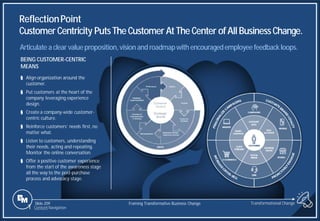
Campaigns & Acquisition
(Web, Display, Search, Social, Apps,
Email, Offline)
Website Traffic
TrafficGeneration&Behaviors
(Click-Thru, Funnel Paths, Leads,
Conversions)
PerformanceMeasurement
(Marketing and Commerce KPIs
and Optimization Metrics)
OmnichannelOptimization
(Campaigns, Channels, Platforms,
Attribution Analyses)
Branded
Filterable
Datasets
Paid Media
Performance
Partner Media
Performance
Website Traffic
& Behaviors
Email
Performance
Social Media
Performance
Customer
Portals UX
Behaviors
Mobile App
Downloads &
UX Behaviors
Opt-In Survey
Behaviors
Trials, Rebates
& Coupons
Redemption
Partner
eCommerce
Datasets
Earned Media
Press &
Blogger
Influence
Trackable
Offline
Initiatives
Performance
Branded Sales
Attribution
REPRESENTATION
Engineering Business Change
1 Content Navigation
Innovation
Slide 396
ReflectionPoint
Data & Analytics | Performance Measurement Framework.
Expanding process to include guiding measurement plans will identify relevant KPIs and actionable performance metrics by marketing
attribution to deliver enhanced customer experiences and greater business benefit.
REPRESENTATION
KPI Measurement Plan
AWARENESS – CONSIDERATION – ACQUISITION
KPIs & Tactics
AWARENESS
Owned, Earned & Paid Influence
CONSIDERATION
Marketing Engagements
ACQUISITION
Marketing Conversions
REVENUE
Modeling
Awareness | Audience Profiling Consideration | Campaigns & Content Acquisition | Website Traffic
Orders |
Revenues
Metrics
Owned (Earned)
Reach &
Frequency
Imp. | Clicks
CPM, CPC
Paid
Reach &
Frequency
Imp. | Clicks
CPM, CPC
Total
Reach &
Frequency
Imp. | Clicks
CPM, CPC
Call to Action
Performance
Engagements
CTR, Open Rate,
ER, CPE
Community
Growth
Platform
Subscribers,
Followers, ER
Website
Traffic
Site Visits
CPV, ER,
Bounce Rate
Micro
Conversions
Triggered
Engagements
CVR, CPA
Sales Lead
Pre-Qualification
Purchase Intent
Clicks
CPL
Marketing
Attribution
Orders, Revenues
Sales Lift, AOV ,
CLV, ROAS
Target Goals
Benchmark +
MoM Growth
TBD
Benchmark +
MoM Growth
TBD
Benchmark +
MoM Growth
TBD
Benchmark +
MoM Growth
TBD
Benchmark +
MoM Growth
TBD
Benchmark +
MoM Growth
TBD
Benchmark +
MoM Growth
TBD
Benchmark +
MoM Growth
TBD
Benchmark +
MoM Growth
TBD
Data Platform
Analytics
- DSP (Advertising) Analytics - DMP (Audience Profiling) Analytics - SEM Analytics - Social Media Analytics - Website & Portal Analytics - Email Analytics -
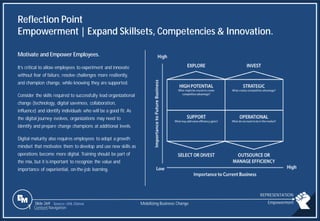
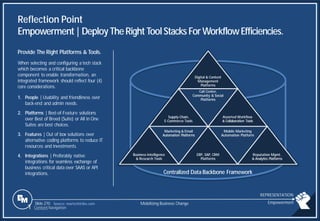
- Attribution Modeling Analytics - [Offline Touchpoint] Analytics -
Segments
- Performance &
Attribution
Omni-Channels Online + Offline Marketing Consumer Touchpoints
Demographic Profile Segmentation
DMA | Geo Market Segmentation
Desktop Mobile Cross-Device
The keystone to any experiential design effort is to leverage a structured attribution KPI and metrics framework based on guiding strategic questions relevant to
businessunit or brand group to deliver timely and actionable businessinsights measured against three core analytic pillars and as aligned to the marketing funnel.
Engineering Business Change
1 Content Navigation
GreaterReach > Greater Engagements > Greater Awareness > Greater Web Traffic > Greater Conversions
Innovation
Slide 397
ReflectionPoint
Data & Analytics | Marketing Insights Framework.
Expanding process to include the use of a guiding measurement plans to align measurement to the marketing funnel analytic pillars.
REPRESENTATION
Measurement plans will allow us to analyze and to collect leading business intelligence at each stage of the customer journey with the
goal to optimize experiences across an omnichannel consumer touchpoint journey.
Awareness
Discovery
Acquisition
Outcomes
Consideration
Behaviors
STEP 1: Awareness
What campaigns are creating business
and/or Brand awareness, and are
attracting interest?
STEP 2: Consideration
What happens before and after
people show business and/or
product interest?
STEP 3: Acquisition
What was the impact of
campaign performance on
defined conversions?
AWARENESS
CONSIDERATION
ACQUISITION
Engineering Business Change
1 Content Navigation
Innovation
Slide 398
ReflectionPoint
Data & Analytics | Marketing Insights Framework.
Aligning KPI frameworks via business leading questions will guide marketing performance analytics for delivering customer insights
while maximizing business performance.
REPRESENTATION
Awareness
Website Traffic – How we are creating traffic for each
branded website?
How is Owned, Earned and Paid media contributing
to brand awareness?
Are we mapping to milestone target goals for
awareness and website traffic?
Are we continuously optimizing marketing campaign
performance and the consumer touchpoint journey?
Are we aligned to strategic priorities,seasonality
trends and budget spend?
Consideration
Consumer Engagements – What does the user
journey look like? What does it look like with and
without e-commerce?
What campaigns are resonating with people? What
content? What CTAs?
What ties into an optimal experience for the potential
customer? Is there a measurable funnel clickpath
once arriving on a Branded website?
Which channels and marketing investments are
performing best for consumer engagements?
Are Brand engagements growing? Is the amplitude of
the Brand conversation increasing? Are our owned
digital channels growing an audience?
Are we activating target audiences? Are engagement
rates increasing?
Acquisition
Lead Conversions – What outcomes signifyvalue for
delivering the desired consumer experience based on
channel and spend?
What outcomes are expected when people arrive at
the website? Are micro conversions clearlyidentified?
What pages should they see? What content? What
videos should they watch?
What does measurable conversion look like in the
absence of owned e-commerce capabilities?
Are consumers pre-qualifying themselves? Are we
growing opt-in lists and portal accounts?
Are potential leads downloading and using rebate
offers and coupons? Are we tracking downloads and
use?
Are we able to statisticallyapply modeling to predict
attributable revenue outcomes?
Engineering Business Change
1 Content Navigation
Innovation
Slide 399
ReflectionPoint
Data & Analytics | Marketing Insights Framework.
Transforming collected business intelligence acquired through analytics into actionable intelligence to strategically drive future
marketing performance and ultimately business outcomes via recurring Campaign Analysis and Reporting.
REPRESENTATION
Data analytics should support a process for quantitative and qualitative analytics with analysis reporting to deliver actionable insights to
all relevant stakeholders to drive campaign optimization and enhanced marketing performance.
Channel & Campaignperformance& influence
(Measured Quantitative Analysis)
Engineering Business Change
1 Content Navigation
Innovation
Slide 400
ReflectionPoint
Data & Analytics | Marketing Insights Framework.
Leveraging data methodology for delivering actionable attribution-based business intelligence required for campaign analysis,
optimization and reporting via an ecosystem of data + segmentation + measurement + cross tabulation.
REPRESENTATION
Owned Media
Channels, Campaigns & Content
q Organic reach, frequency, impressions
q Geo-socio-demo persona target goals
q Campaign and owned channel engagements,
engagement rates, performance metrics
q Community growth (opt-ins, accounts, social
media)
q Attributed website traffic (visits,views, duration,
bounce rate, CTAs)
q Defined conversion counts
q Conversion attribution: channels, platforms,
markets, geo-socio-demos, device
q MoM target milestone growth
Shared & Earned Media
Content Sharing & Publicity
q Earned Reach, frequency, impressions
q Geo-socio-demo persona target goals
q Organic content shares, engagements, reach,
clicks,performance metrics
q Attributed website traffic (visits,views, duration,
bounce rate, CTAs)
q Defined conversion counts
q Conversion Attribution: channels, platforms,
markets, geo-socio-demos, device
q MoM target milestone growth
Paid Media
Advertising Campaigns
q Paid reach, frequency, impressions
q Geo-socio-demo persona target goals
q Campaign performance KPIs (CTR, CPC, CPM, CPV,
CVR, CPL, AOV, ROAS)
q Attributed website traffic (visits, views, duration,
bounce rate, CTAs)
q Defined conversion Counts
q Conversion Attribution: channels, platforms,
markets, geo-socio-demos, device
q MoM target milestone growth
Traffic Source
Patterns
Campaign Impact
& Performance
CTA | Content
Resonance
Device & Screen
Preference
Channel &
Platform
Influence
Community
Inspiration &
Growth
Geo-Socio-Demo
Activation
Audience
Targeting
Influence
Acquisition &
Conversion Costs
Sales Lift
Influence &
Impact
MoM Benchmark
Performance
Milestone
Performance
Targets
Cross Tabulation
Engineering Business Change
1 Content Navigation
Innovation
Slide 401
Leverage dashboards and visual data analytics for business intelligence.
Engineering Business Change
1 Content Navigation
Innovation
Slide 402
ReflectionPoint
Data & Analytics | Dashboard Value Proposition Framework.
Engineering Business Change
Dashboards provide a central stakeholder location to quickly
review and understand business performance.
ü Quickly understand and monitor real-time performance.
ü Offers data-driven business performance transparency.
ü Enables the easy sharing of information across teams.
ü Provides the ability to spot performance trends quicker.
ü Facilitates faster data-driven business decisions.
ü Saves time and valued resources via reporting efficiencies.
Why build a dashboard?
Dashboards offer many business
and managerial benefits.
Real-Time | Data Access
Visual Formats
Central Location
Cost Effective
Customizable
Virtual Access
…and much more
1 Content Navigation
Innovation
Slide 403
ReflectionPoint
Data & Analytics | Dashboard Guiding Directional Framework.
Engineering Business Change
Expand methodology and process for aligning workflows for faster build cycles, rollouts and user adoptions.
Identify and prioritize all relevant
stakeholders and stakeholder groups.
Document business/brand/campaign
goals, objectives per each stakeholder
group.
Survey each stakeholder group via
leading business questions to ascertain
needs and requirements.
Align and expand the data hierarchy
ecosystem for each stakeholder group’s
dashboard needs.
Align each stakeholder group KPI map
to available data source and the
required dimensions and metrics.
Map each data source to requisite data
connection needs for each stakeholder
dashboard.
Make the required data connections to
the dashboard platform, test, and QA.
Develop, test, and QA custom data
connectors and set data refresh cycles
as needed.
Design and develop Beta dashboards
into usable environments for each
stakeholder group by priority status.
Build each stakeholder dashboard
environment using a natural visual
storytelling flow.
Build and test each stakeholder
dashboard aligned to defined KPIs and
documented build criteria.
Soft launch each stakeholder dashboard
per scheduled timelines as a full beta
and solicit user feedback.
Modify, refine each dashboard
environment per beta launch input as
required.
Officiallylaunch (publish) each
stakeholder dashboard per scheduled
timelines.
Produce a series of quick reference
user guides.
Discovery Data Mapping Design & Build Publish
Step 1 Step 2 Step 3 Step 4
Setup and schedule automated delta
performance alerts and reporting.
1 Content Navigation
Innovation
Slide 404
ReflectionPoint
Data & Analytics | Dashboard Foundational Design Framework.
Engineering Business Change
A dashboard is essentiallya data visualization tool that tracks, analyzes, and
displays KPIs, metrics, and critical data points. Depending on stakeholder group
needs, dashboards can be developed in one of three fundamental types.
q The Strategic or Managerial dashboard focuseson providing the key performanceindicators
(KPIs) in an easily consumableand quick-to-understandvisual. These at-a-glance dashboards
rely on consistencyand clarity. End users are looking for immediate answers rather than
digging deeper into the data.
q The Tactical or Operational dashboard focuseson showing progress of work that is being
managed. These dashboards are designed to show the current state of a program or business
operations initiative which can visually highlight when there is a problem. These real-time
dashboards typically aren’t used for digging deeper into data, however, there may be
exceptionswhere drill-downs are needed.
q The Analytical or Data Analysis dashboard focuseson allowing end users to explore the data
in as many ways as possible. Specificpoints of data do not necessarily need to be called out
and large summaries are usually not needed. Instead, this dynamic dashboard enables users
to explore their data through filters and comparisonsto uncover meaningful insights.
Usability Dashboard Design.
For a dashboard to truly provide value
and actionable insights, dashboard
design must be approached leveraging
meaningful data and analytics with the
stakeholderin mind.
It begins with understandingend user
business needs and requirements.
Three primary questionsneed to be
answered:
ü What does the dashboard need to
communicate?
ü Who will be using the dashboard?
ü What KPIs and metrics are most
relevant and provide value for the
business insights required?
1 Content Navigation
Innovation
Slide 405
ReflectionPoint
Data & Analytics | Dashboards: Media Performance KPI Impact.
REPRESENTATION
Engineering Business Change
1 Content Navigation
Innovation
Slide 406
ReflectionPoint
Data & Analytics | Dashboards: Brand Waterfall Funnel Flow.
REPRESENTATION
Engineering Business Change
1 Content Navigation
Innovation
Slide 407
ReflectionPoint
Data & Analytics | Dashboards: Media Spend by Objective Pacing.
REPRESENTATION
Engineering Business Change
1 Content Navigation
Innovation
Slide 408
ReflectionPoint
Data & Analytics | Dashboards: Website Engagement Behaviors.
REPRESENTATION
Engineering Business Change
1 Content Navigation
Innovation
Slide 409
Leverage reporting analysis to measure and optimize experiential designs.
Engineering Business Change
1 Content Navigation
Innovation
Slide 410
ReflectionPoint
Data & Analytics | Reporting: Campaign Attribution Impact.
REPRESENTATION
Engineering Business Change
1 Content Navigation
Innovation
Slide 411
ReflectionPoint
Data & Analytics| Reporting:Paid MediaChannelPlacementImpact.
REPRESENTATION
Engineering Business Change
1 Content Navigation
Innovation
Slide 412
ReflectionPoint
Data & Analytics | Reporting: Social Media Community Impact.
REPRESENTATION
Engineering Business Change
1 Content Navigation
Innovation
Slide 413
ReflectionPoint
Data & Analytics | Reporting: Social Media Paid Media Impact.
REPRESENTATION
Engineering Business Change
1 Content Navigation
Innovation
Slide 414
ReflectionPoint
Data & Analytics | Reporting: Social Media Attribution Impact.
REPRESENTATION
Engineering Business Change
1 Content Navigation
Innovation
Slide 415
ReflectionPoint
Data & Analytics| Reporting:Email Opt-InSubscriberGrowthImpact.
REPRESENTATION
Engineering Business Change
1 Content Navigation
0
3,000
6,000
9,000
12,000
15,000
0
200
400
600
800
1000
19-May 19-Jul 19-Sep 19-Nov 20-Jan 20-Mar 20-May 20-Jul 20-Sep 20-Nov 21-Jan 21-Mar 21-May 21-Jul
Total Subscribers Monthly New Subscribers Trendline
Legacy Benchmark | April 01, 2019 thru August 10, 2021
Insights & Impact
Legacy review shows a consistentgrowth pattern with a more recent slight 2021 increase
in engagement among the target audience both in terms of subscribersand
subscriptionsper subscriber.
This is good news as it representstarget audiences are engaging at higher levels as new
campaigns and programs are activated.
12,358
Total Subscribers
32,094
Total Subscriptions
Key Vitals Benchmark Snapshot
202
Monthly Average
New Subscribers
890
Monthly Average
New Subscriptions
Avg. 2.6 Subscriber
Current to Date
Innovation
Slide 416
Leverage web analytics and benchmarking to enhance customer experiences.
Engineering Business Change
1 Content Navigation
Innovation
Slide 417
ReflectionPoint
Data & Analytics | Benchmarking: Website Visitor Traffic Patterns.
REPRESENTATION
Engineering Business Change
1 Content Navigation
Legacy Benchmark | June 01 thru August 31, 2021
Visitor Traffic Review | Master Data View
v Data view comparison review represents there is not sizeable internal traffic inflating or impacting baseline
metrics or device usage.
v Engagement metrics including Pages per Session, Average Session Duration and Bounce Rate all perform within
reasonable industry standards.
v Of interest is the bounce rate of 51%. It can be reasonably assumed visitors are not randomly coming to the
site and bouncing. High bounce rates would typically be an indicator of content not meeting user expectations
and/or the result of a poor website design or user experience.
v However, this may actually represent a positive indicator that visitors are landing on desired page content and
have no need to navigate to another page.
v The Bounce Rate for the Index (Home) page is measured at 25% reinforcing the premise the higher overall
bounce rate is being influenced by interior landing pages for which content is fulfilling visitor needs. (More
analysis could be performed upon request.)
Data View
Comparison
Users New Users Sessions User Sessions Pageviews Pages Session Avg. Session Bounce Rate
Master 36,118 31,173 2.03 73,162 198,306 2.71 00:02:37 51.07%
External IPs 34,551 29,595 1.83 63,113 161,765 2.56 00:02:22 52.65%
Internal IPs 2,384 1,603 4.31 10,283 36,542 3.55 00:04:03 41.96%
Desktop overshadows mobile and tablet device use, but
could easily shift with a renewed mobile and/or text
effort.
Innovation
Slide 418
ReflectionPoint
Data &Analytics |Benchmarking:WebsiteAcquisition TrafficPatterns.
REPRESENTATION
Engineering Business Change
1 Content Navigation
Legacy Benchmark | June 01 thru August 31, 2021
Traffic Acquisition Review | Master Data View
Organic Search and Direct traffic are the leading sources for website
visits and sessions (with consideration default channel attribution
may be mis-aligned due to the absence of a managed and properly
set traffic acquisition tracking process in place).
Attribution performance metrics for Default Channels are all within
industry standards -- with the caveat -- without all-inclusive channel
attribution tracking actionable insights can not be fully analyzed with
degrees of confidence for strategic planning.
Default Channel Users New Users Sessions Bounce Rate
Avg. Session
Duration
Pages Session
Organic Search 22,677 18,474 42,845 52.46% 02:28 2.61
Direct 13,554 11,923 28,127 48.36% 02:54 2.90
Social 553 507 681 64.61% 00:58 1.97
Referral 508 269 1,326 55.66% 03:07 2.31
Email 7 0 183 59.56% 03:27 2.36
Totals 37,299 31,173 73,162 51.07% 02:38 2.71
Google Analytics Default Channel Groupings
• Organic Traffic: search engines
• Direct Traffic: directly typing URL in browser
• Social Traffic: social networks
• Referral Traffic: backlinks from other websites
• Email Traffic: email campaigns (properly tagged)
• Paid Traffic: paid (PPC/CPC) advertisements
• Display Traffic: paid (display) advertisements
• Others Traffic: not identified as a channel group
Innovation
Slide 419
24,967 26,943 32,454 22,565
55,784 58,529 67,075 53,917
0
100,000
Autumn Spring Summer Winter
User Website Traffic Behavior
Avg. Users Avg. Sessions Linear (Avg. Users) Linear (Avg. Sessions)
2.23 2.17 2.07 2.39
03:39 03:21 02:55 03:44
00:00
07:12
1.50
2.00
2.50
Autumn Spring Summer Winter
User Site Engagement Behavior
Avg. Sessions per User Avg. Session Duration
155,042 170,230 183,010 157,817
2.79
2.91
2.73
2.93
2.50
3.00
140,000
150,000
160,000
170,000
180,000
190,000
Autumn Spring Summer Winter
User Page Content Behavior
Pageviews Avg. Pages per Session
ReflectionPoint
Data &Analytics |Benchmarking:WebsiteSeasonality TrafficPatterns.
REPRESENTATION
Engineering Business Change
1 Content Navigation
Baseline Differences | All Website Pageviews | Observations
Visitor Traffic by Time of Year | Raw Data View
Based on several baseline metrics, seasonal traffic to the website
and engagement do have some nuances.
Spring and Summer represent slightly higher website visits and
activity. Conversely, users are more engaged during Autumn and
notably Winter consuming more content by spending on average
slightly longer times on the website.
Of note, these metrics are simply a benchmark and should not be
considered actionable alone as they can be easily skewed from
outliers. However, it's quite possible these behaviors may represent
seasonal indoor/outdoor resident lifestyles aligned to regional
daylight and weather patterns. Further analysis may be required.
Innovation
Slide 420
ReflectionPoint
Data & Analytics | Benchmarking : Website Journey Flow Patterns.
REPRESENTATION
Engineering Business Change
1 Content Navigation
Legacy Benchmark | June 01 thru August 31, 2021
Journey Flows Review | Master Data View
The aggregate journey flow is represented below.
Overall,the deeper a visitor navigatesinto the site with greater pageviews, drop off percentages reverse
as session durationandpage engagements increase and as more contentis consumed. This is a normal
engagementbehavior.
71%
Drop-Off
45%
Drop-Off
43%
Drop-Off
35%
Drop-Off
35%
Drop-Off
1st Page
Interaction
Site Entry
2nd Page
Interaction
Content
3rd Page
Interaction
Content
4th Page
Interaction
Content
5th Page
Interaction
Content
Innovation
Slide 421
Conduct website audits for enhanced user engagements.
Engineering Business Change Innovation
1 Content Navigation
Slide 422
ReflectionPoint
Data & Analytics | Channel Auditing Framework.
Engineering Business Change
1 Content Navigation
OBJECTIVE, PURPOSE & USE
Auditsrepresenta simple snapshotin time. They should be used to serve as a preliminary step to identify what data is being collected, what data
is available, what data can be collected, and what data is missing to align the digital transformation to business impact.
Auditsshouldbe used to be a preliminarydiscoveryguidefor what data can be explored for deeper insights and business intelligence for which
corporate executives, brand managersand other key stakeholders alike can leverage data analysis for steering strategic marketing directions and
business initiatives.
Auditsshouldbe used to identifyadvanceopportunitiesfor applying data, data analytics and data process to measure ongoing marketing and
business performance as a measurable business process function for impacting positive future business outcomes as part of the Digital
Transformation initiative.
Auditsshouldbe used to identifydigital transformationneedsand requirementswhich impactdata frameworks, methodologies and processes.
Auditsshouldbe used to identifyrelevantand meaningfuldata dimensionsand metricsto guidemarketinginitiativesand the marketing/sales
funnel, e.g., journey and conversion paths, benchmarking, traffic acquisition, conversion attribution, user site behaviors, site navigation and
content engagements, user attributes, device and platform usage, et al.
Auditsshouldbe used to optimizethe user experienceacross digital touchpoints in the consumer journey.
Auditsshouldbe used to help align data requirementsfor BI dashboardsbeneficial for stakeholder groups at all levels, while advancingbuild
cycles linking meaningful measurablemarketing and website performance metrics to business outcomes across the entire digital ecosystem.
Innovation
Slide 423
Perform content audits to ensure valued experiences.
Engineering Business Change Innovation
1 Content Navigation
Slide 424
ReflectionPoint
Data & Analytics | Auditing: Experiential Web Content Framework.
REPRESENTATION
Engineering Business Change Innovation
REVIEW CRITERIA AUDIT INSIGHTS QUESTIONS
Current
Is it accurate and up to date?
• Is it free of content that is redundant, outdated, or trivial?
Functional
Is it functioning properly?
• Are links working properly?
• Are images and videos displaying properly?
Findable | Technical
Can the user easily find it?
(Requires Meta Tag Analyzer Tool)
• Does it have an H1 tag?
• Does it have metadata (title, descriptions, categories, and tags)?
• Does it have at least two links in the body copy?
• Does it have alt text for images?
Accessible
Is it usable for everyone?
• Can it be used via all expected channels and devices (e.g. mobile)?
• Does it meet the levels of accessibility compliance to be considerate of those users with disabilities?
(Federal|State Guidelines - 20% or more of the worldʼs population has a disability.)
Readable
Is it easy to read?
• Are sentences simple and short?
• Does it avoid jargon?
• Does it use active voice?
• Does it use an inverted pyramid writing style (the most important info comes first)?
• Does it use bulleted and numbered lists when possible?
• Does it use headers, bulleted and numbered lists, and small chunks of text?
• Does it use consistent style and terms?
(Style can include grammar, punctuation, usage, and spelling. For example, do you write “healthcare” or “health care”? Do you format phone numbers
as 555-555-555, 555.555.555, or (555) 555-555?)
Clear & Understandable
Is it easy to understand?
• Does it use plain language?
• Does it have a descriptive title and headings?
• Is the information organized in a logical way?
• Does the text match the reading level of the target demographic?
• Is the navigation determined by your user decision paths, rather than your organizational structure?
• Is the path to task completion obvious and free of distraction?
1 Content Navigation
Slide 425
ReflectionPoint
Data & Analytics | Auditing: Experiential Web Content Framework.
REPRESENTATION
Engineering Business Change Innovation
REVIEW CRITERIA AUDIT INSIGHTS QUESTIONS
Communicative
Can the user see where they are?
• Does the navigation and messaging make it obvious to the user where they are on the site and where they can go next?
Useful
Can the user effectively and efficiently
complete the desired task?
• Is it usable? Are users able to complete the tasks or gather the informtion that they set out to without massive frustration or abandon?
• Does each chunk of content have a specific purpose? (For example, vague purpose: "invasive species notification”; specific purpose: “Alert: do your
part to help Montana avoid harmful invasive species”)
• Does it serve new users as well as loyal users in ways that satisfy their needs uniquely?
• Are there a few navigation options that lead where users may want to go next? Are they clearly labeled?
Credible
Can the user trust you?
• Is the content updated in a timely manner?
• Is the design appropriate to the context of use and audience?
• Is restraint used with promotionalcontent? (Not over promoting.)
• Is it easy to contact a real person?
• Is it easy to verify your credentials?
• Do you have help/support content where it is needed? (Especially important when asking for sensitive personal data.)
Controllable
Does the user have freedom and control
within interactions, particularly if something
goes wrong?
• Are tasks and information a user would reasonably want to accomplish available?
• How well are errors anticipated and eliminated?
• When errors do occur, how easily can a user recover?
• Are features offered to allow the user to tailor information or functionality to their context?
• Are exits and other important controls clearly marked?
Valuable
Is it desirable to the target user?
• Can a user easily describe the value?
• How is success being measured? Does it contribute to the bottom line?
• Does it improve customer satisfaction?
• Does it maintain conformity with expectations throughout the interaction across channels?
1 Content Navigation
Slide 426
ReflectionPoint
Data & Analytics | Auditing: Experiential Web Content Framework.
REPRESENTATION
Engineering Business Change Innovation
REVIEW CRITERIA AUDIT INSIGHTS QUESTIONS
Learnable
Can it be grasped quickly?
• Does it ease the more complicated processes?
• Is it memorable? Is it easy to recount?
• Does it behave consistently enough to be predictable?
Delightful
How are user expectations not just met but
exceeded?
• Does it differentiate you from your competitors?
• Does it provide something unexpected or extraordinary in a way that is meaningful to users?
Actionable
Will the user want to take action?
• Does it have a clear call to action (e.g. subscribe, apply, sign up, fill out a form)?
• Does it invite the user to share?
• Does it provide links to related content or a next step?
• Does it have a way to comment or engage?
• How many users “convert” and follow through on a desired action?
Sustainable
Does it have a responsiblesteward?
• Does it have an owner who is responsiblefor ensuring the content is accurate and up to date?
• Is the owner engaged? Do they have the time, training, and supportto manage the content?
• What is their department, role, or name?
Targeted
Is the content targeting the right audience?
• Based on the topic, tone, and calls to action, who is the content targeting? Is that the right audience?
• Is the target audience consistent with the characteristics of the user personas?
Compelling
Does the content portray the desired voice
and tone?
• Does the page clearly embody the attributes of the defined voice?
• Is the tone appropriate to the context?
1 Content Navigation
Slide 427
Business ROI
PROCESS ENGINEERING MARKETING DESIGN.
Engineering Business Change
1 Content Navigation
Innovation
Slide 428
Develop predictive models for campaign optimization and greater ROI.
Engineering Business Change Innovation
1 Content Navigation
Slide 429
ReflectionPoint
Data & Analytics | Modeling: Marketing Performance Framework.
Engineering Business Change Innovation
Campaign
Ad Format
Placement
Cost (Spend) CPM Impressions Clicks CTR CPC
Conversions
(Orders)
CVR Gross Revenue AOV ROAS CPO Net Revenue
Banner $2,894,415.25 $3.68 785,947,008 747,649 0.10% $3.87 166,864 22.32% $9,001,210.66 $53.94 311% $17.35 $6,106,795.41
NA $1,249,191.00 $7.19 173,725,752 93,809 0.05% $13.32 31,790 33.89% $1,837,035.00 $57.79 147% $39.30 $587,844.00
Product Targeting $51,364.19 $2.83 18,138,654 19,291 0.11% $2.66 2,859 14.82% $112,061.94 $39.20 218% $17.97 $60,697.75
Sponsored Brand $883,664.18 $24.09 36,687,046 267,099 0.73% $3.31 89,157 33.38% $6,083,742.56 $68.24 688% $9.91 $5,200,078.38
Sponsored Display $559.58 $9.31 60,128 470 0.78% $1.19 173 36.81% $6,418.23 $37.10 1147% $3.23 $5,858.65
Sponsored Product $6,356,668.72 $30.54 208,131,092 1,263,951 0.61% $5.03 477,292 37.76% $25,675,469.59 $53.79 404% $13.32 $19,318,800.87
Video $1,680,542.73 $10.80 155,547,673 1,427,093 0.92% $1.18 10,941 0.77% $521,164.49 $47.63 31% $153.60 ($1,159,378.24)
Totals | Averages $13,116,405.65 $9.52 1,378,237,353 3,819,362 0.28% $3.43 779,076 20.40% $43,237,102.47 $55.50 330% $16.84 $30,120,696.82
Predictivemodelinguses past businessmarketingperformancebenchmarksto forecast (predict)futureoutcomesbased on changingvariables.
Optimization models use predictive algorithms to optimize marketing performance based on a defined, desired and measurable outcomes. For many
Campaigns,a desired outcome is enhanced revenues and a greater Return On Ad Spend (ROAS). Other campaignsmay be greater engagements or
incentive redemptions.
Modeling starts with benchmarking past campaign performance to establish a baseline to compare againstpredictive modeled results.
Paid Media Campaign Representation
Note:
Benchmarking past performance allows for analysis of performance data to spot trends in both performance and spend. The objective of modeling is to help identify where efficiencies and inefficiencies are in the media spend.
PAID MEDIA CAMPAIGNREPRESENTATION
1 Content Navigation
Slide 430
ReflectionPoint
Data & Analytics | Modeling: Predictive Optimization Framework.
The objective of predictive modeling is to find spend efficienciesas measured against revenue attributionto find the best optimal predictedoutcome.
MODEL PROBLEM - What is the Optimal Budget Spend by Ad Format for Maximizing Campaign ROAS?
Predictive Models are able to optimize at dimensional levels as insights are required, e.g., brand, campaign, creative, creative format et al using varying constraint criteria. This
model representation demonstrates the "what if" scenario if spend was optimized for ROAS by simply re-allocating budget spend to best performing Ad Formats and specifying
the maximum spend and minimum number of Ad Format placements. Enhanced greater optimized results could be modeled based upon changing media spend constraint
criteria for analyzing the ideal maximum revenue outcomes.
RepresentativeModel Results:
• $40M in revenue lift using same budget spend.
• 300% lift in ROAS (return on Ad Spend)
Engineering Business Change Innovation
PAID MEDIA CAMPAIGNREPRESENTATION
Slide 430
1 Content Navigation
Slide 431 Engineering Business Change Innovation
Predictive modeling provides a tool to use historic benchmark marketing performance to optimize real-time performance.
Optimization ideally is conducted in 90-day optimization cycles. Predictive modeling adds value for managing marketing
performance as well as delivering “what if” scenarios and insights which can be used for strategic planning.
q Predictive models are designed for analyzing, managing, optimizing, and steering strategic execution of marketing
campaigns optimizing for maximum Engagements, Conversions, ROAS or Business ROI.
q Models have been tested and validated aligned with AI algorithms used within many marketing platforms.
q Models use baseline marketing performance to establish benchmarks and for the model’s predictive algorithms.
q Model uses constraint criteria which guides the underlying algorithm whch can be constructed from varying and multiple
campaign dimensions and considerations.
q Models can be run in one of three linear or non-linear algorithm modes: GRG Non-Linear, Simplex LP and Evolutionary
depending on defined constraint criteria.
q Models have been designed with flexibility to adopt to media campaign needs and requirements aligned with budget,
channel, platform, placement et al guiding marketing parameters.
ReflectionPoint
Data & Analytics | Modeling: Predictive Optimization Framework.
1 Content Navigation
Slide 432
Workflows
PROCESS ENGINEERING MARKETING DESIGN.
Engineering Business Change
1 Content Navigation
Innovation
Slide 433
Develop collaborative workflow process for touchpoint efficiencies.
Engineering Business Change Innovation
1 Content Navigation
Slide 434
To Innovate Is To Collaborate.
Building customer experiences through process and methodology requires discovery
of all marketing plans, sales promotions and associated business roadmaps from sales, marketing,
customer service, agency partners and other relative stakeholders to develop the requisite
foundation for architecting near, intermediate and long-term strategic marketing frameworks
and experiential designs.
Engineering Business Change Innovation
1 Content Navigation
Slide 435
ReflectionPoint
Innovation | Experiential Process Workflow Design Framework.
REPRESENTATION
Engineering Business Change Innovation
Marketing
Touchpoint
Process
&
Methodology
Framework
Customer
Touchpoint
Experience
Identified
Goals &
Objectives
Defined
ROI KPIs
Defined
Channel
Directions
Outlined
Implement
Process &
Workflows
Align Workflows
Onboard
Marketing Teams
Define Search &
Paid Directions
Plan Content
Detail Directions
Themes &
Campaigns
Production
Publishing
Distribution
Targeting &
Localization
Promotion
Optimization
Engagement &
Conversion
Community
Management
Lead Tracking
Triggered
Responses
Real-Time
Personalization
Mobile
Measurement
Planning
Workshops
Adaptation &
Adjustments
Channel
Roadmaps
Defined
Channel
Milestones
Established
Inventory
Existing Assets
Align Ecosystem
to Journey
Mapping
Assess Persona
Touchpoint
Content Needs
Develop Brand
Story
Guidelines
Align
Offline/Online
Content
Requirements
Re-Assess
Recurring
Branded Content
Needs
Align Digital
Touchpoint
Heatmaps to
Personas
Develop
Needed Assets
Set Up
Technology Stack
Channel
Timelines
Applied
Budgets
Aligned
1 Content Navigation
Slide 436
ReflectionPoint
Innovation | Experiential Process Workflow Design Framework.
REPRESENTATION
Engineering Business Change Innovation
Strategic Processes Task Inclusion
Vision, Goals,
Objectives,KPIs &
Channel Directions
Articulation of governing touchpoint initiative, re-alignment of goals and
objectives,documentation of KPI success factors and overall master
strategic channel directions.
Milestone Setting,
Timelines,
Roadmaps & Budget
Alignments
Establish milestone management parameters via aligned timelines,
roadmaps and budgets.
Ecosystem
Alignments &
Technology Stacks
Re-align touchpointecosystem to journey mapping and digital
touchpoints; identify and develop new asset needs; scheduleany asset
major upgrade as discovered in audit discovery phase; acquire, setup new
technology tools / systems / platforms as needed.
Content & Branding
Guidelines
Clearly document all branding guidelines, incorporate offlinebranding
with online branding, assess content needs for digital consumer and
employer branding needs.
Process, Workflows
& Execution
Customize and execute master processand workflowmodels per each
unique channel engagement.
Measurement,
Planning,
Adjustments
Continually measure performanceand adjust execution and planning in
iterative cycles.
Hub
and Spoke
Model
KPI & ROI
Managed
Engineered
Efficiencies
Content
Analysis
Steered
Touchpoint
Journey
Driven
Iterative
Planning
Open Team
Collaboration
1 Content Navigation
Slide 437
Conduct timely recurring strategic planning workshops.
Engineering Business Change Innovation
1 Content Navigation
Slide 438
ReflectionPoint
Innovation | Strategic Planning Workshop Framework.
REPRESENTATION
Engineering Business Change Innovation
1 Content Navigation
SEMI ANNUAL COLLABORATIVE PLANNING AND TRANSFORMATION REVIEW
Who Should Attend
q CxOs
q Sales, Marketing, IT, HR Teams
q Advertising & Branding Teams
q PR & Communications Teams
q Digital Marketing Teams
q CRM Teams
q Corporate & Regional Offices
1. PLACES AN EMPHASIS ON THE CONSUMER EXPERIENCE. Reinforces an organizational
vision for digital change that can be shared with key stakeholders and employees across all
regions while keeping digital strategy objectives clearly aligned with overall business goals.
2. CREATES AN OPEN COLLABORATIVE AND CREATIVE FORUM for sharing ideas,
experiences, successes and challenges while nurturing an organizational-widecustomer-
centric and team culture.
3. PROVIDES TIMELY CORPORATE ROADMAPS for refining, adapting, developing, planning
and integrating future digital initiatives based on past performance and newly identified
needs in a brainstormingenvironment.
LISTENING
ENGAGING
INSPIRING
TRANSFORMING
IT’S ABOUT…
CONNECTING PEOPLE TO PEOPLE FOR ENABLING CHANGE
Common Goals ⃝ Shared Experiences for delivering better performing results across the client’s digital ecosystem.
Slide 439
Workshops are a valued necessity as it connects people
for valuable exchange of ideas, strategic directions, and best practices.
Workshops should be planned in iterative planning cycles across
all geographies with an annual global summit to collaborate and advance
building block components to the transformation effort.
Engineering Business Change
1 Content Navigation
Innovation
Slide 440
Activation Review
PROCESS ENGINEERING MARKETING DESIGN.
Engineering Business Change
1 Content Navigation
Innovation
Slide 441
Planning and optimizing campaigns, customer engagements and touchpoints
is paramount to ensure resonating, recurring customer experiences
are created and reinforced.
Engineering Business Change Innovation
1 Content Navigation
Slide 442
Process engineering, driven by data and analysis, is the framework
which enables all transformation at scale.
Engineering Business Change Innovation
1 Content Navigation
Slide 443
Bottom line…
Innovation and experiential marketing only becomes possible
through the process of planning, experimentation, measurement, and analysis
and when applied in iterative cycles, organizations can build lasting, memorable
and valued consumer experiences.
Engineering Business Change
1 Content Navigation
Innovation
Slide 444
This is where the work really happens
as the customer is elevated to front and center
in the transformation process.
Engineering Business Change
1 Content Navigation
Innovation
Slide 445
CUSTOMER CENTRICITY
TRANSFORMING FROM WITHIN FOR CULTURAL CHANGE.
Customer Centricity
Experiencing Business Change
1 Content Navigation
Slide 446
“ Everyday we’re saying how can we keep this
customer happy. How can we get ahead…
because if we don’t somebody else will.
Bill Gates, Microsoft Chairman
Customer Centricity
Experiencing Business Change
1 Content Navigation
Slide 447
To adopt a customer centricity approach for transformation
requires business change in three fundamental areas.
Customer Centricity
Experiencing Business Change
1 Content Navigation
Slide 448
ReflectionPoint
Customer Centricity | (3) Areas of Business Transformative Change.
Customer Centricity
Experiencing Business Change
1 Content Navigation
Slide 449
CUSTOMER
REIMAGINING TRANSFORMATIVE CHANGE.
Experiencing Business Change
1 Content Navigation
Customer Centricity
Slide 450
To transform is to develop and apply a new way of thinking.
Customer Centricity
Experiencing Business Change
1 Content Navigation
Slide 451
Customer UX
ENABLING TRANSFORMATIVE CHANGE.
Experiencing Business Change
1 Content Navigation
Customer Centricity
Slide 452
In order to build a customer experience, we need to be able to define it
and then measure and analyze it against the defined criteria established for success.
Understanding current customers and changing behaviors is crucial
not only because it drives future strategy, but also because the value of all future
digital efforts will be judged according to this baseline.
Customer Centricity
Experiencing Business Change
1 Content Navigation
Slide 453
In this new era of consumerism, creating real-world customer experiences
has become paramount for all future business success.
Consumers, now more than ever, expect a better personable Brand Experience
from businesses for giving their support, purchase, and loyalty to a product
and/or service.
Experiencing Business Change Customer Centricity
1 Content Navigation
Slide 454
Gather business intelligence to understand the customer.
Experiencing Business Change Customer Centricity
1 Content Navigation
Slide 455
ReflectionPoint
Today’s ConsumersAreLike NoOthers InPastHistory.
Customer Centricity
Experiencing Business Change
ü Without understanding what matters to customers and why…
ü Without understanding how they communicate and connect…
ü Without understanding how they learn and what drives their unique
behaviors…
ü Without knowing their decision-making cycles and how they take
action…
ü And without applying empathy…
You cannot create meaningful connections and
engagements to impact brand and business.
1 Content Navigation
Slide 456
To provide the level of experiences consumers now demand
requires a fundamental and core understanding of the new Customer Journey.
Experiencing Business Change Customer Centricity
1 Content Navigation
Slide 457
Without thoroughly researching, studying and analyzing
consumer interests and behaviors, and the journey they take through to conversion,
no Digital Transformation initiative can possibly be realized.
Experiencing Business Change Customer Centricity
1 Content Navigation
Slide 458
Develop customer personas for audience targeting.
Customer Centricity
Experiencing Business Change
1 Content Navigation
Slide 459
ReflectionPoint
Build Customer Personas Based on Behaviors… Not Demographics.
Customer Centricity
Experiencing Business Change
6%
31%
28%
16%
10%
9%
Practical Shopper Bargain Hunter Educated Shopper
Browser Shopper Brand Loyalist Impulse Buyer
REPRESENTATION
CUSTOMER
PERSONAS
1 Content Navigation
Location | Customer Type | Needs & Motivators | Goals | Challenges | Pain Points | PurchasingBehaviors|Other Research
Slide 460
ReflectionPoint
Link Customer Personas To Consumer Purchasing Behaviors.
Customer Centricity
Experiencing Business Change
REPRESENTATION
UMOT > ZMOT: Shared expressions from trusted impressions
Shared experiences affect every moment of truth
Discovery Pre Purchase Purchase Experience
Awareness
Initial
Need
Stimulus
Zero
Moment
Of Truth
First
Moment
Of Truth
Second
Moment
Of Truth
Ultimate
Moment
Of Truth
Walk in the consumershoes,
research how consumersconnect
and communicate.
Discoverhow consumers
discoverinformation.
Learn how consumers
Make purchasingdecisions.
Uncoverconsumerpreferences,
expectations,values.
1 Content Navigation
Slide 461
ReflectionPoint
Use EmpathyMaps To UnderstandAndSegmentPersonas.
Customer Centricity
Experiencing Business Change
REPRESENTATION
Empathy maps is a tool approach to get a better understanding of who audiences are and how best to identify content
and messaging that will push them along through the purchasing journey.
1 Content Navigation
Slide 462
ReflectionPoint
LeveragePersonaSegmentsToDeliverUniqueCampaignExperiences.
Customer Centricity
Experiencing Business Change
REPRESENTATION
Dog Enthusiast
Current pet owner
Location
Anytown, USA
Socio-Demo Target
40 years of age, female, married, college educated, parent of 3 kids, rural or urban household, income
$50K+.
Behaviors, Attitudes, Interests
Becoming comfortable with life enjoying more of the little things. Family, age, position in life are driving
decision making. Image conscious. Pets are a high priority family value. Nothing is too good for her pet
and routine pet care is a core value as a pet owner.
Pet Owner Goals
Make sure pets are getting all the love and care they need to flourish.
Needs and Motivators
Information for understanding required pet care medicines. Understanding benefits, risks, alternatives,
availability and Rx requirements.
Challenges
Is loyal to brands, but is a quiet brand ambassador outside a small group of well-known trusted friends and
peers. Needs stimulation to actively advocate across a larger social circle.
Key Research / Shopping Behaviors
Trusts the advice of close friends and peers. Is open to trying new brands with peer recommendations.
Open to receiving the latest recommendations and information. Enjoys Facebook as primary social media
channel. Shops extensively online. Photos, video, messaging, and apps are core to his digital identity.
1 Content Navigation
Slide 463
Top Line
Customer Growth
ENABLING TRANSFORMATIVE CHANGE.
Experiencing Business Change
1 Content Navigation
Customer Centricity
Slide 464
Segment customer personas into classification pools for top line growth.
Customer Centricity
Experiencing Business Change
1 Content Navigation
Slide 465
Emphasis Should Be On Managing Customers – Not Products.
Experiencing Business Change
1 Content Navigation
Customer Centricity
ReflectionPoint
DevelopPersonaSegmentsForMarketingInvestments andBusinessROI.
Slide 466
Customer Touchpoints
ENABLING TRANSFORMATIVE CHANGE.
Experiencing Business Change
1 Content Navigation
Customer Centricity
Slide 467
Deliver seamless experiential journeys per customer expectations.
Customer Centricity
Experiencing Business Change
1 Content Navigation
Slide 468
ReflectionPoint
Journeys Need To Be Seamless Brand Experiences.
Customer Centricity
Experiencing Business Change
ELIMINATESILOMARKETING
1 Content Navigation
Slide 469
ReflectionPoint
Journeys Need To Be Optimized Before Optimizing The Touchpoint.
Customer Centricity
Experiencing Business Change
There is a need to map journeys from end-to-end through each Moment of Truth
to remove risks associated with silo marketing effects for greater positive seamless journeys.
1 Content Navigation
Slide 470
ReflectionPoint
Journeys Need To Manage Transitions Between Touchpoints.
Customer Centricity
Experiencing Business Change
Journey building requires a focus for identifying customers as they cross touchpoint boundaries
and to ensure transitional omnichannel experiences are delivered.
Walk in the consumer shoes
when mapping the transitions
between touchpoints.
Use mobile
to link customer digital and
physical behaviors.
Leverage emails
for added multi-touch
engagements.
1 Content Navigation
Slide 471
ReflectionPoint
JourneysNeedTo Be DefinedFor Every CustomerPersonaArchetype.
Customer Centricity
Experiencing Business Change
Journeys need to map online and offline experiencesby unique persona as not all consumers are the same.
Express experiences in termsof
action-orientedbrandengagement.
Pinpoint brand engagement
which adds tangible value.
Focus on frequently occurring
brand engagements.
1 Content Navigation
Slide 472
awareness consideration purchase retention advocacy
PR
Radio, TV
Print
Trade Shows
Conferences
Word of Mouth
Display Ads
Email
PPC
Social Ads
Blog
Website
Direct Mail
News / Influencer
3rd Party Sites
Sales Call
Retail
E-Commerce
Community Forum
IM/Chat
Call Center
FAQ
Knowledge Base
Promotions
Blog
Social Networks
Newsletter
Email
Social Media +
Groups / Forums
CTAs
Paid Search
Landing Page
Email
Social Engagements
News Feed Content
ReflectionPoint
Journeys Need To Identify All Online and Offline Touchpoints.
Customer Centricity
Experiencing Business Change
1 Content Navigation
Physical Touchpoints
Digital Touchpoints
Journeys and experiencesneed to identifiedacross the spectrum of online and offline touchpoints.
Slide 473
ReflectionPoint
Journeys Need To Connect All Online to Offline Touchpoints.
Customer Centricity
Experiencing Business Change
Journeys need to map online experiencesto real-world brand experiencesfor a single seamlessbrand experience.
1 Content Navigation
Slide 474
Distribution
Content Placement
and Syndication
Measurement&
Optimization
Listening, Tracking and
Performance Analysis
Brand
Experience
Campaign
Planning
Research, Ideation,
Strategy
Context &
Relevance
Development
Content Creation,
Asset Management
Optimization
Search, Social,
Usability
Optimization
Customer Centricity
Experiencing Business Change
1 Content Navigation
Identify with
target personas.
Reinforce a blended
and seamless brand experience.
Develop campaigns with clear
objectives.
Align to target
personas and behaviors.
Deliver via
experiential, lifestyle designs.
Complement offline
touchpoints and real world
brand image.
Build engagements on the consumer's
own terms. Relevance. Context. Right
Place. Right time.
Seek to create emotional response.
Deliver aspirational themes for
building brand affinity.
Consistently deliver to
create trust and credibility.
Be flexible to evolve with
digital change catalysts.
ReflectionPoint
Journeys Need To Deliver Experiences With Context and Relevance.
Context and relevancy should never be sacrificed in support of volume & frequency.
Content should always be managed from a perspective of Quality over Quantity.
Slide 475 Customer Centricity
Experiencing Business Change
1 Content Navigation
ReflectionPoint
Journeys Need To Engage Customers Based On (4) Guiding Principals.
Be a valued resource
of information & education
for solving customer needs.
Create active
community engagements and
social sharing.
Create a brand
experience around the
core value proposition.
Build credibility & trust to
drive website traffic and
consideration.
1 3
4
2
The underlying foundation to a customer experience will be based on four key guiding principles:
value, experience, community and trust.
Slide 476
ReflectionPoint
Journeys Need To Deliver Seamless Omnichannel BrandExperiences.
Customer Centricity
Experiencing Business Change
1 Content Navigation
q Unified: One brand, one voice, different channels
q A continuous experience across channels
Brick-and-Mortar Web
Mobile
Email
Social
Media
Unified
Seamless
Targeted Content
Core Content Features
Start Continue End
q Contentdistributionis prioritized based on channel or
context
q Contentcore features remain the same across channels
(e.g. products | services | costs | value propositions)
Slide 477
OPERATIONS
REIMAGINING TRANSFORMATIVE CHANGE.
Managing Business Change
1 Content Navigation
Strategic Oversight
Slide 478
To transform is to develop and apply a new way of thinking.
Strategic Oversight
Managing Business Change
1 Content Navigation
Slide 479
Process Digitization
ENABLING TRANSFORMATIVE CHANGE.
Managing Business Change
1 Content Navigation
Strategic Oversight
Slide 480
Mobilizing the organization to successfully transform may require
re-aligning operational and workflow efficiencies.
Process digitization, worker enablement, and performance management
will be dependent on applying the right skills, knowledge, expertise, stewardship
and vision to the digital transformation initiative.
Managing Business Change Strategic Oversight
1 Content Navigation
Slide 481
Assess roles and responsibilities via process digitization needs.
Managing Business Change Strategic Oversight
1 Content Navigation
Slide 482
Organizations are shifting the C-Suite landscape
to align to a new digital corporate mindset with the proposed emphasis
on customer centricity as the new business model.
Managing Business Change Strategic Oversight
1 Content Navigation
Slide 483 Source: Hinch Cliffe
ReflectionPoint
Reviewing Roles and Responsibilities for Transformation.
Strategic Oversight
The C-Suite landscape may need to slightly shift and change to align to the proposed emphasis on customer centricity as the new business model.
REPRESENTATION
Managing Business Change
1 Content Navigation
Slide 484
Assessing the current C-Suite landscape may be a barrier to change.
Transformation with or without executive change may be realized
if sponsorship can still be secured across areas of responsibility.
Managing Business Change Strategic Oversight
1 Content Navigation
Slide 485
Worker Enablement
ENABLING TRANSFORMATIVE CHANGE.
Managing Business Change
1 Content Navigation
Strategic Oversight
Slide 486
To enable workers is to implement viable workflow models.
As a global organization, several workflow models can be implemented based upon
operational and/or geography needs and requirements.
Managing Business Change Strategic Oversight
1 Content Navigation
Slide 487
Develop workflow models to facilitate global transformation needs.
Managing Business Change Strategic Oversight
1 Content Navigation
Slide 488
APPLY A BASELINE TIMELINE CADENCE
90 Days 180 Days 360 Days 360 + Days
ReflectionPoint
The Centralized Corporate Workflow Model Framework.
Strategic Oversight
REPRESENTATION
Managing Business Change
1 Content Navigation
Content
Execution
Corporate
Building Block
Execution
ü PHASED-IN ROADMAPS
ü OBJECTIVE & TIMELINE
MANAGED
ü Web & App Design
ü SEM
ü Content Marketing
ü Experiential Marketing
ü Social Media Marketing
ü Mobile & App Marketing
ü Email Marketing
ü Inbound Marketing
ü Employer Branding
ü Online Advertising
Measurement
Adjustment
Alignment
Adaptation
Collaboration
Iterative
Planning
Cycles
Milestone
Management
Centralized
Corporate
Workflow
Alignment
Model
Discovery
Discovery
Input
Workshop
Stakeholder
Introductions
Audits
Journey
Mapping
Findings
Ecosystem
Optimization
Ecosystem
Optimization Digital
Footprint
Strategy
Strategic
Directions
ü Vision, Goals, Objectives
ü Seamless Brand Experience
ü Integrated Marketing
ü Branding Guidelines
ü Channel Use
ü Content Needs
ü Channel Optimization
ü Localization
ü Mobile Optimization
ü Lead Generation
ü Employer Branding
ü KPIs & Milestone Mapping
Conversion
Engagement
& Lead
Nurturing
Ecosystem
Alignment
Ecosystem
Alignment Digital
Footprint
ü Channel Use Optimization
ü Integrated Digital Footprint
ü Customer Journey & Touchpoint Alignments
ü Seamless Omnichannel Brand Presence
Slide 489
Content
Execution
Corporate
Building Block
Execution
ü PHASED-IN ROADMAPS
ü OBJECTIVE & TIMELINE
MANAGED
ü Web & App Design
ü SEM
ü Content Marketing
ü Experiential Marketing
ü Social Media Marketing
ü Mobile & App Marketing
ü Email Marketing
ü Inbound Marketing
ü Employer Branding
ü Online Advertising
Measurement
Adjustment
Alignment
Adaptation
Collaboration
Iterative
Planning
Cycles
Milestone
Management
Centralized
Corporate
Workflow
Alignment
Model
Discovery
Discovery
Input
Workshop
Stakeholder
Introduction
s
Audits
Journey
Mapping
Findings
Ecosystem
Optimization
Ecosystem
Optimization Digital
Footprint
Strategy
Strategic
Directions
ü Vision, Goals, Objectives
ü Seamless Brand Experience
ü Integrated Marketing
ü Branding Guidelines
ü Channel Use
ü Content Needs
ü Channel Optimization
ü Localization
ü Mobile Optimization
ü Lead Generation
ü Employer Branding
ü KPIs & Milestone Mapping
Conversion
Engagement
& Lead
Nurturing
Ecosystem
Alignment
Ecosystem
Alignment Digital
Footprint
ü Channel Use Optimization
ü Integrated Digital Footprint
ü Customer Journey & Touchpoint Alignments
ü Seamless Omnichannel Brand Presence
ReflectionPoint
The Hub and Spoke Workflow Model Frameworks.
Strategic Oversight
REPRESENTATION
Managing Business Change
1 Content Navigation
APPLY A BASELINE TIMELINE CADENCE
90 Days 180 Days 360 Days 360 + Days
Local & Regional
Presences
Added
Region
Layers
Added
Region
Layers
Added
Region
Layers
Managed
Strategic
Directions
Regional
Measurement
Adjustment
Alignment
Adaptation
Collaboration
Iterative
Planning
Cycles
Integrated
Regional
Footprint
Corporate
Governed
Region Spokes
Managed
Oversight
Leveraged
Corporate
Content
Content
Localization Region
Specific
Activity
Regional
Engagement
& Lead
Nurturing
Collaborative
Planning
Cycles
# COLLABORATIVE OFFICE ACTIVATION #
Slide 490 Source: Hinch Cliffe
ReflectionPoint
Channels | Publishing – Hub & Spoke Model Frameworks.
Strategic Oversight
REPRESENTATION
Managing Business Change
1 Content Navigation
• Content production framework will be built on a Hub & Spoke model that can be packaged and
documented for use across local offices.
• Overall governance will bring disparate stakeholders together into core teams to ensure positioning
and messaging reinforces corporate brand image and values, and leverages building a seamless
brand experience.
• Long-term rigid planning will be replaced with iterative planning cycles to provide a dynamic
platform to respond and adjust content directions to transformative digital trends and change
catalysts.
• The customer journey and the customer experience will always be front and center as the
keystone to content planning and development.
Slide 491 Source: Hinch Cliffe
ReflectionPoint
Channels | Publishing – Hub & Spoke Model Frameworks.
Strategic Oversight
REPRESENTATION
Managing Business Change
1 Content Navigation
• Corporate content will be leveraged and re-purposed for use across local assets for better
production/resource/cost efficiencies as well as benefit content volume and frequency
needs.
• Content analysis and planning will be an ongoing process to identify resonating content
themes and topics that appeal to target personas.
• Content engineering practices will leverage technology and structured processes to automate
content distributionfor best efficiencies.
• Real-time analytics and measurement based on objectives will constantly track KPI
performance to govern evolutions and to continuously align best practices to drive
maximum business ROI.
Slide 492
ReflectionPoint
The Decentralized Regional Workflow Model Frameworks.
Strategic Oversight
Managing Business Change
1 Content Navigation
# COLLABORATIVE OFFICE ACTIVATION #
Local Content
Local Execution
Local
Building Block
Execution
ü PHASED-IN ROADMAPS
ü OBJECTIVE & TIMELINE
MANAGED
ü Web & App Design
ü SEM
ü Content Marketing
ü Experiential Marketing
ü Social Media Marketing
ü Mobile & App Marketing
ü Email Marketing
ü Inbound Marketing
ü Employer Branding
ü Online Advertising
Local
Measurement
Local
Adjustment
Local
Alignment
Local
Adaptation
Local
Collaboration
Local
Planning
Cycles
Local Milestone
Management
Decentralized
Regional
Workflow
Alignment
Model
Local Discovery
Local
Discovery
Input
Workshop
Stakeholder
Introductions
Audits
Journey
Mapping
Findings
Local Ecosystem
Optimization
Local
Ecosystem
Optimization
Digital
Footprint
Local Strategy
Local
Strategic
Directions
ü Vision, Goals, Objectives
ü Seamless Brand Experience
ü Integrated Marketing
ü Branding Guidelines
ü Channel Use
ü Content Needs
ü Channel Optimization
ü Localization
ü Mobile Optimization
ü Lead Generation
ü Employer Branding
ü KPIs & Milestone Mapping
Local Ecosystem
Alignment
Local
Ecosystem
Alignment Digital
Footprint
ü Channel Use Optimization
ü Integrated Digital Footprint
ü Customer Journey & Touchpoint Alignments
ü Seamless Omnichannel Brand Presence
Local Conversion
Local
Engagement
& Lead
Nurturing
APPLY A BASELINE TIMELINE CADENCE
90 Days 180 Days 360 Days 360 + Days
Seamless
Integration
with
Corporate
Footprint &
Branding
REPRESENTATION
Slide 493
Performance Management
ENABLING TRANSFORMATIVE CHANGE.
Managing Business Change
1 Content Navigation
Strategic Oversight
Slide 494
Upon implementing the desired workflow model(s),
stewardship of the transformation initiative should mirror an objective based roadmap
and timeline management style using agile management principals.
Managing Business Change Strategic Oversight
1 Content Navigation
Slide 495
Measureperformance
against channelKPIs and
overallbusinessROI
impact
Implementsystems
platforms, process&
methodologies
Set performance
measurementcycles
MANAGE EXECUTION
TO GOALS & OBJECTIVES
Mobile Marketing
Experiential Marketing
Offline Integration
Touchpoint Marketing
SEAMLESS BRAND EXPERIENCES
ReflectionPoint
Objective Based Roadmap and Timeline Management Framework.
Strategic Oversight
Managing Business Change
1 Content Navigation
REPRESENTATION
OnlineAdvertising
Mobile &
App Marketing
Continuallyadjust &
adapt for enhanced
performance
Agile Management
C o m m u n I t y E n g a g e m e n t s & N u r t u r I n g
Phase In Initiatives
Based on Timeline
Priorities,Resource&
BudgetAllocation
Web Marketing
Search Engine Marketing
Email Marketing
Touchpoint Alignment
ContentMarketing
Social Media Marketing
FootprintOptimization
Slide 496
Applying an adaptable team structure and role framework
will also be key for success.
Collaboration across operations, departments and geographies
with clear assignments of ownership and responsibilities for each building block
element will be a necessity for advancing the initiative.
Managing Business Change Strategic Oversight
1 Content Navigation
Slide 497
ReflectionPoint
Transformation Stewardship, Governance and Oversight Frameworks.
Strategic Oversight
Managing Business Change
1 Content Navigation
REPRESENTATION
Steering Committee
Management
Creative
Directors
Program
Managers
Analytics
Managers
Content
Strategists
Brand Marketing
& Digital Leads
Digital
Strategists
Slide 498
ReflectionPoint
Transformation Team Structure and Role Resource Frameworks.
Strategic Oversight
Managing Business Change
1 Content Navigation
REPRESENTATION
Slide 499
ReflectionPoint
TransformationTeam Workflowand ResourceAllocationFrameworks.
Strategic Oversight
Managing Business Change
1 Content Navigation
REPRESENTATION
Select Digital
Team Specialists
SEM Specialists
Social Media
Manager
Content
Specialists
IT & Web
Developers
Impacted
Department
Heads
Local Impacted
Interests
Other Relevant
Stakeholders &
Agency Partners
Select Digital
Team Specialists
Select Marketing
Specialists
Select Data
Team Analysts
Select Marketing
Analysts
Select Agency
Stakeholders
Select Relevant
Stakeholders
Internal Change
Agents (Champions)
All Digital
Team Specialists
All Marketing
Team Specialists
Departmental
Stakeholders
All Other Relevant
Stakeholders
All Impacted Dept.
Interests
Select Digital
Team Specialists
SEM Specialists
Social Media
Manager
Content
Specialists
Impacted Dept.
Interests
Select Digital
Team Specialists
SEM Specialists
Social Media
Manager
Content
Specialists
Impacted Dept.
Interests
Select Digital
Team Specialists
SEM Specialists
Social Media
Manager
Content
Specialists
Media Planner
Select Digital
Team Specialists
IT & Web
Developers
Social Media
Manager
Content
Specialists
Other Workflow
Impacted Interests
Impacted
Department
Heads
Social Media
Manager
Content
Specialists
Select Digital
Team Specialists
Select Marketing
Specialists
Onboarding
&
Continued
Learning
Workflow
Framework
Audit Findings
Journey Mapping
Findings
Ecosystem
Optimization
Strategic
Directions
Process &
Methodology
Workflow
Alignments
Content
Directions
Technology
Stacks
Ecosystem
Alignment
Building Block
Execution
Conversion
Collaboration
Workshops
Measurement
Brand
Marketing
and
Digital
Team
Management
Leads
Impacted
Department
Heads
Internal
Change Agents
(Champions)
Other Relevant
Stakeholders &
Agency Partners
Select Digital
Team Specialists
Select Marketing
Specialists
+ ALIGNED IMPACTED CORPORATE & REGIONAL INTERESTS +
Slide 500
OPTIMIZATION
DISCOVERY STRATEGY ALIGNMENT CONTENT EXECUTION ENGAGEMENT
Digital & Brand
Team Collaboration
Digital Team Task Brand Marketing Task
BRAND UNIT or BRAND MANAGEMENT & OVERSIGHT
Vision, Goals,
Objectives, KPIs
Strategic
Direction Planning
Milestones
Applied
Process
Roadmaps Applied
Timelines &
Budget Applied
Overall
Direction Approved
Direction
Re-alignments
Budgets
Allocated
Stakeholder
Meetings
Benchmark Audits
Audit Findings
Journey Mapping
Journey Mapping
Findings
Final Discovery &
Alignments
Initial Discovery
Collection Workshops SEO Alignments
Visual Branding
Alignments
Publishing
Alignments
Navigation
Alignments
Architectural
Alignments
Content
Marketing
Web & SEM
Marketing
Experiential
Marketing
Social
Media Marketing
Mobile & App
Marketing
Email
Marketing
Inbound
Marketing
Employer
Branding
Channel Use
Optimization
Seamless
Footprint Integration
Touchpoint
Alignment
Channel
Content Optimization
Process & Methodology
Optimization
Community
Management
Seamless Omnichannel
Experiences
Brand Engagements
& Conversions
Journey
Optimization
Web &
App Design
Performance
Measurement Cycles
Adaptation
& Adjustment
Iterative
Milestone Planning
Resource &
Budget Management
Timeline
Management
Content
Publishing
Community
Engagements
Brand Experience
Management
DIGITAL TEAM STEWARDSHIP, MANAGEMENT & OVERSIGHT
ReflectionPoint
Transformation Team Collaborative Workflow Frameworks.
Strategic Oversight
Managing Business Change
1 Content Navigation
REPRESENTATION
Slide 501
There may be times allocating the right resources with the right expertise
may stretch the capabilities of the organization…
either due to bandwidth constraints, the lack of expertise in a specific
marketing discipline or market category – or even based on local expertise
and language needs.
Managing Business Change Strategic Oversight
1 Content Navigation
Slide 502
To be able to collaborate across offices and geographies ensures
the initiative of being able to apply the best possible expertise at the right moment
for the specific job task regardless of personnel location
and without program interruption.
Managing Business Change Strategic Oversight
1 Content Navigation
Slide 503
BUSINESS MODEL
REIMAGINING TRANSFORMATIVE CHANGE.
Managing Business Change
1 Content Navigation
Strategic Oversight
Slide 504
To transform is to develop and apply a new way of thinking.
Managing Business Change Strategic Oversight
1 Content Navigation
Slide 505
Increasingly, we can no longer build business based on traditional
sales models, target demographics and marketing approaches.
Managing Business Change Strategic Oversight
1 Content Navigation
Slide 506
In this new economy, it takes more than transferring
existing models and processes to digital touchpoints. It requires digital
innovation centered around a connected customer
with ever-evolving expectations.
Managing Business Change Strategic Oversight
1 Content Navigation
Slide 507
Digital Globalization
ENABLING TRANSFORMATIVE CHANGE.
Managing Business Change
1 Content Navigation
Strategic Oversight
Slide 508
As a final consideration and review, there are essentially five steps
to transition to a for successful customer centric business model for which each
step has been discussed throughout this document.
Managing Business Change Strategic Oversight
1 Content Navigation
Slide 509
Transitioning to a customer-focused business model will include five stages of transformation.
ReflectionPoint
The Five (5) Stages of Building a Customer Centric Business Model.
Managing Business Change Strategic Oversight
1 Content Navigation
Source: Harvard Business Review
CUSTOMER
INSIGHTS
Customer-
Centered
MINDSET
Customer-
Centered
DATA
CULTURE
Customer-
Centered
DIGITAL
Transformation
Customer-
Centered
OPERATIONAL
Transformation
Customer &
Employee-
Centered
WORKPLACE
STEP ONE STEP TWO STEP THREE STEP FOUR STEP FIVE
Developing each of these capabilities will evolve an
organization to a customer-centric business model.
Slide 510
ADOPT A CUSTOMER-CENTRIC MINDSET
COMMIT TO UNITING AROUND THE CUSTOMER AND THE EMPLOYEE.
Set a vision and strategy for unified customer engagement across the organization.
Make it easy for employees to make it easy for customers.
Shift from selling to the customer (product-centric) to serving the customer.
Form a cross-functional steering committee to chart and manage a customer innovation roadmap.
Optimize decision making to accelerate experimentation and transformation.
Managing Business Change
1 Content Navigation
Strategic Oversight
Source: Harvard Business Review
Slide 511
FOSTER A DATA CULTURE
PLACE CUSTOMER INSIGHTS AT THE CENTER OF OPERATIONAL TRANSFORMATION.
Build a deliberate path to achieving a single source of customer truth.
Embrace a data culture that helps every employee get closer to your customers.
Train and educate employees on digital-first customer and data proficiency.
Facilitate access to trusted real-time data sources across the customer’s journey, making it easy for
customer-facing employees to find relevant information. Build a center of excellence to cultivate data
expertise and promote the voice of the customer. Create defined customer feedback loops.
Managing Business Change
1 Content Navigation
Strategic Oversight
Source: Harvard Business Review
Slide 512
PRIORITIZE DIGITAL TRANSFORMATION
IMPROVEAND REIMAGINE THECUSTOMEREXPERIENCE FROMTHE FRONTTOTHEBACK OFFICE.
Identify customer friction and opportunities to improve experiences—and deliver new value.
Resolve customer issues as the primary justification for any new program.
Define the new business and information technology (IT) functions and capabilities needed to support
new experiences and agree on the most critical outcomes the organization needs, and how to measure
them. Align IT and business leaders on a 360-degree digital operating model to improve CX and raise
customer-facing performance.
Create an enterprise digital governance model that underpins and supports the digital operating model.
Use shared data, processes, apps, and APIs to create capabilities quickly.
Managing Business Change
1 Content Navigation
Strategic Oversight
Source: Harvard Business Review
Slide 513
PURSUE OPERATIONAL TRANSFORMATION
REIMAGINE OPERATIONSAROUNDCUSTOMERINSIGHTS,INTEGRATION, ANDCOLLABORATION.
Align IT, sales, service, marketing, commerce, HR, digital governance, and analytics
to create one team organized around the customer.
Unify the organization’s functions and operational models to support cohesive customer engagement.
Adopt customer-centric business processes. Make fundamental shifts in products and/or services, and
how teams work together, to deliver the value and experiences customers seek.
Anticipate and respond to changes in customer needs.
Embrace agile methodologies to support infinite digital transformation.
Managing Business Change
1 Content Navigation
Strategic Oversight
Source: Harvard Business Review
Slide 514
EMBRACE A CUSTOMER AND
EMPLOYEE-CENTERED WORKPLACE
THE FORMULA FOR ENHANCING CX IS TO EMPOWER THE EMPLOYEE EXPERIENCE (EX).
Design EX to deliver a unified CX.
Invest in systems, tools, and processes that allow and encourage cross-team collaboration.
Train managers and employees to empathize with customers and team members, to ask the right
questions, and to be good listeners and storytellers. Apply incentives to individual behaviors that drive
business goals.
Encourage groups with different skill sets to solve customer problems together.
Give teams the authority to act in the customer’s best interest.
Managing Business Change
1 Content Navigation
Strategic Oversight
Source: Harvard Business Review
Slide 515
In the end and reinforcing our discussion,
customer behaviors and expectations have indeed changed the trajectory of
digital transformation—and, more importantly, the future of business.
Managing Business Change Strategic Oversight
1 Content Navigation
Slide 516
Striving to become a global digital organization will enable the use of advanced
technology and data to reimagine business and organizational models to
become more human-centered.
Managing Business Change Strategic Oversight
1 Content Navigation
Slide 517
This Is and Will Be The Path To Your Success.
Managing Business Change Strategic Oversight
1 Content Navigation
Slide 518
FINAL THOUGHTS
ARE YOU READY TO TRANSFORM?
1 Content Navigation
Transformational Change
Realizing Business Change
Slide 519
DIGITAL TRANSFORMATION IS…
THE RE-ALIGNMENT OF, OR NEW INVESTMENT IN, TECHNOLOGY, PROCESS,
AND BUSINESS MODELS TO MORE EFFECTIVELY ENGAGE CONSUMERS AT
EVERY TOUCHPOINT IN THE CUSTOMER EXPERIENCE LIFECYCLE.
Realizing Business Change
1 Content Navigation
Transformational Change
Slide 520
To transform is to become a global digital organization.
Realizing Business Change
1 Content Navigation
Transformational Change
Slide 521
Digital transformation IS NOT a technological advent.
Realizing Business Change
1 Content Navigation
Transformational Change
Slide 522
Digital transformation IS a cultural mutation.
Realizing Business Change
1 Content Navigation
Transformational Change
Slide 523
To transform is to act by changing the rules.
1 Content Navigation
Transformational Change
Realizing Business Change
Slide 524
1 Content Navigation
Change the Rules.
Action is KEY to reduce the resistance to change...
to engage action is to
Leverage Actionable Process & Methodology.
Transformational Change
Realizing Business Change
Slide 525
1 Content Navigation
Change the Rules.
From concept to MVP, every step should be a milestone…
Build Progressive Building Blocks.
Transformational Change
Realizing Business Change
Slide 526
1 Content Navigation
Change the Rules.
Individuals and innovation over legacy process and tools.
Business intelligence over antiquated workflows.
Customer models over transactional models.
Globalization over departmentalization…
.
Apply Agile Management and Process.
Transformational Change
Realizing Business Change
Slide 527
1 Content Navigation
Change the Rules.
Create change agents across the organization at all levels…
Build An Internal Movement.
Transformational Change
Realizing Business Change
Slide 528
1 Content Navigation
Change the Rules.
Eliminate silos and methodology that become barriers...
Promote A Startup Inspiration Mindset.
Transformational Change
Realizing Business Change
Slide 529
1 Content Navigation
Change the Rules.
Challenge status quo and historic directions…
Continually Evolve To Make Possibilities
Realities.
Transformational Change
Realizing Business Change
Slide 530
1 Content Navigation
Change the Rules.
Progressive Change Brings Lasting Change…
.
Promote Each Step As A Victory.
Transformational Change
Realizing Business Change
Slide 531
A FINAL CHECKLIST
REVIEW
TRANSFORMING ACTIONABLE STEPS.
1 Content Navigation
Transformational Change
Realizing Business Change
Slide 532
Digital Transformation will indeed be unique for every organization.
To advance your own initiative, you can reflect on the following checklist
to realign as necessary current efforts as needed to move
your transformation to the next step.
1 Content Navigation
Transformational Change
Realizing Business Change
Slide 533
1 Content Navigation
Transformational Change
ReflectionPoint
Getting Started | A Digital Transformation Checklist.
Vision and Leadership Digital Customer Experience Digital Transformation Team
Document the factors that are disrupting the market.
Assemble data and proof points that help make the
case to the C-Suite and sponsors.
Identify past research related to the customer journey
and map the digital customer journey. Interview
stakeholders about customer behaviors to assess
challenges and opportunities.
Identify candidates for a cross-functional
transformation team.
Clearly articulate why transformation is critical for
business using examples of other companies and the
benefits they realized. Develop a SWOT to assess an
organization’s actual position for transformation.
Document the differences between the current
journey and that of diogital customers. Observe
persona traits or characteristics that are unique to
segment customers into distinct audiences.
Develop a cross-functional collaborative group to
become the steering committee. Schedule recurring,
timely meetings and reporting. For the prioritization
and delegation of building block initiatives.
Draft a sample vision statement and supporting
narrative for what digital transformation looks like for
your organization. Emphasize top-line advantages and
benefits and how it enables business goals and
improves customer experiences. Document both
short-term and long-term visions.
Chart a sample journey around what the right
experiences may be for distinct persona groups based
on changing consumer behaviors. Organize the
journeys by channel and screen to represent an
omnichannel touchpoint view.
Build a strategic alliance with IT (they must be part of
the steering committee and collaborative groups).
Seek out executive sponsors to help rally support and
act as leading champions for transformation efforts.
Observe the gaps in touchpoints and where
investments are being made today and where
additional investment may be needed.
Form a data collection and insights team as part of the
transformation workgroup and steering committee.
Create new roles as necessary to collect, analyze, and
storify data.
Ensure that executive sponsors communicate the
vision, the benefits and recurring updates throughout
the organization to rally employees across the
enterprise.
Assess the processes, policies, and systems that
present barriers to change and pinpoint what it would
take to overcome hurdles.
Measure impact of transformation at the enterprise
level and at each touchpoint to document progress
and benefits. Establish a reporting process to
disseminate progress to workgroups and
stakeholders.
Continue to study the “ultimate customer journey”
every six months to adapt investments in relevant
customer experience strategies.
Develop a workshop and training regimen to beidge
the gap between existing and required expertise for
transfoamtion processes and technologies.
Realizing Business Change
Slide 534
In closing, as we have learned, new technologies is certainly part of our
transformation effort.
However, the value proposition remains to be strategically empowering the
organization with a vision through the necessary transformational steps as discussed
to realize customer and business benefit for all the possibilities
that new technologies create.
1 Content Navigation
Transformational Change
Realizing Business Change
Slide 535
This Can Be Your Transformation Journey…
1 Content Navigation
Transformational Change
Realizing Business Change
Slide 536
With Vision, Commitment and Action…
Business Change Becomes Possible.
1 Content Navigation
Transformational Change
Realizing Business Change
Slide 537
Are You Ready?
1 Content Navigation
Transformational Change
Realizing Business Change
Slide 538
APPENDIX
A DIGITAL CHALLENGE
CHALLENGE YOUR TEAM TO JOIN THE INTERNAL MOVEMENT.
Advocating for Business Change
1 Content Navigation
Digital Challenge
Slide 539
All movements start with a few key people.
Advocating for Business Change
1 Content Navigation
Digital Challenge
Slide 540
To impact change is to actively participate in change.
Are you a change agent? Do you want to make a difference?
Are you up to the challenge?
Join the movement today and give us your pledge
to positively make business change.
The Digital Challenge
Advocating for Business Change
1 Content Navigation
Digital Challenge
Slide 541
Sign me up. I want to join the Digital Challenge and be part of the Elanco movement.
I, ____________________, choose to make a difference and I will support the 2022
Elanco Digital Challenge for impacting digital transformation and business change.
This is my personal declaration and pledge to be a champion and change agent for
transformational business change.
------------------------------------------------------------------------------------------------------------------
Fill in your name, take a screen shot or copy and paste this pledge note, and send it via email
to Mel Halkyardto show your support.
In appreciation, we’d like to send you some free swag. We’ll send you a branded Digital Challenge tee-shirt
in the size and color of your choice to proudly declare your acceptance of the digital challenge with fellow
colleagues.
Simply send us your size and color preferences to [name] at [email address] to receive your
Digital Challenge tee-shirt.
The Digital Challenge Pledge
Advocating for Business Change
1 Content Navigation
Digital Challenge
Slide 542
AUTHOR CREDITS
1 Content Navigation
A Blueprint for Inspiration & Aspiration Author Credentials
Slide 543
Daniel McKean
Bio & Credentials
About The Author
Daniel is a 30+ years marketing veteran and consultant who
has provided agency and direct to client consulting services
across all marketing disciplines, including 20+ years in digital
marketing and 10+ years in marketing data analytics.
As a principal consultant since 2002, Daniel has traveled the
world and provided senior-level strategy and analytics
expertise to large multi-national B2C and B2B brands; federal,
state and local governments; clients in the entertainment and
sporting industries, as well as internationally recognized
marketing agencies.
Sample work has included: Elizabeth Arden, Alés Group, FIVB,
Microsoft, National Institutes of Health (NIH), New York State,
PepsiCo, Stella Artois, Swatch, Swiss Army, Ticketmaster,
United Nations, Visa, Wilson Sporting Goods, and many more.
Daniel is married to his wife Lisa of 27 years, has two grown
children (Ethan and Emma) and is an animal lover and proud
owner of two Siberian Huskies and two Siamese cats.
Education:
BS/BA Advertising & Public Relations
MIT Sloan School of Business, Digital Analytics
MarketingDisciplineExpertise:
Advertising, Digital Media, Social Media, Public Relations,
Direct Marketing, Trade Show Marketing, Marketing
Communications, Email Marketing, Content Marketing,
Copywriting, SEO, SEM, Marketing Dashboards, Data Analytics.
Certifications:
Marketing Analytics, Data Visualization, Google Analytics,
Google Tag Manager, Google Data Studio, DOMO, Tableau,
Power BI, Excel Pivot Tables, Excel Solver, SEO, SQL.
1 Content Navigation
W O R K I N G M O T T O : M A K E A D I F F E R E N C E E A C H A N D E V E R Y D AY.
Author Credentials
linkedin.com/in/danielmckean
Digital Transformation Blueprint

Digital Transformation Blueprint

  • 1.
    Slide 1 Blueprint EstimatedReading Time: 60 minutes (Best Viewed in Presentation Mode) [ 00:05 average viewing time per slide ] Ver. 1.0,050522
  • 2.
    Slide 2 “ Thegreatest danger for most of us is not that our aim is too high and we miss it, but that it is too low and we reach it. Michelangelo If you strive for greatness, you needto aspirefor greatness. Preface Aspiring for Business Change
  • 3.
  • 4.
    Slide 4 This discussiondocument… is intended to be a tool of inspiration to have a conversation among key internal sponsors, champions, stakeholders and employees alike to align the aspiration of digital transformation efforts into a highly integrated holistic organizational transformative vision and process to benefit the business as a whole across business operations, geographies, business units, departments, brands, and products. 2022 offers the opportunity to re-envision digital transformation. Preface Aspiring for Business Change
  • 5.
    Slide 5 For manyorganizations aspiring for transformation, efforts may be viewed as disjointed… If this is your situation, it’s time to bring stakeholders back together to revisit the digital transformation initiative and discuss what it can be at an organizational level for greater business success. Preface Aspiring for Business Change
  • 6.
    Slide 6 Albeit, comprehensivein design, the content contained within offers inspiration, aspiration and ideation for impacting business change. I encourage you to take the time to review its content in full to jumpstart and renew thought processes for how you can make change individually, collectively, and collaboratively as one organization for the benefit of your business success, growth and prosperity. This document is designed to be the catalyst to re-engage the conversation. Preface Aspiring for Business Change
  • 7.
    Slide 7 A clearvision and strategic direction are several core reasons organizations continue to struggle with their digital transformation initiatives. Source: MIT Sloan Management Review Preface Aspiring for Business Change
  • 8.
    Slide 8 The mostsuccessful organizations understand that the power of a digital transformation strategy lies in its vision, scope and objectives. Less digitally mature organizations will tend to focus on individual technologies and strategies that are decidedly operational in focus. Source: MIT Sloan Management Review Preface Aspiring for Business Change
  • 9.
    Slide 9 As digitaltechnologies further emerge and mature, technology becomes the catalyst for digital disruption reinforcing aspirations for business change and digital transformation. But technologies are not necessarily the underlying reason necessitating business change and transformation. Preface Aspiring for Business Change
  • 10.
    Slide 10 Consider howdigital technology has influenced consumer communications, sharing, preferences, decision making, and commerce. This impact of technology on consumer behaviors simply cannot be overlooked. Preface Aspiring for Business Change
  • 11.
    Slide 11 Technology has becomethe enabler of disruption… whereas… Changing Consumer Behaviors have actually become the business disruptor. Preface Aspiring for Business Change
  • 12.
    Slide 12 Therefore, whenaspiring for digital transformation, the focus should be on the customer and the relationship with the consumer using technology as the bridge to impact transformational change. Preface Aspiring for Business Change
  • 13.
    Slide 13 Using thewords of a notable technologist and visionary which remains highly relevant to today’s digital transformation… Preface Aspiring for Business Change
  • 14.
    Slide 14 “ You’vegot to start with the consumer experience and work backwards to the technology. Steve Jobs Preface Aspiring for Business Change
  • 15.
    Slide 15 TOPICS &CONTENT Content Designing a Blueprint for Business Change
  • 16.
    Slide 16 Discussion Content PERSPECTIVES17 The Opportunity 18 ReflectionPoint 41 Paradigm Business Shifts 54 What History Can Tell Us 77 Understanding Disruption 96 Disruption Ahead 119 Consumer Impact 133 Finding Inspiration 149 GAFA Business Models 158 NAVIGATING TRANSFORMATION 178 COMMON CHANGE BARRIERS 180 ADDITIONAL CONSIDERATIONS 192 PILLARS OF CHANGE 196 Page Navigation is Hyperlinked ACTIVATING TRANSFORMATION 211 1 LEADERSHIP 213 q Change Agents 215 q Value Proposition 228 q Vision 236 q C-Suite Support 250 2 EMPOWERMENT 255 3 INNOVATION 274 q Marketing Design 280 q Process Engineering 288 • Discovery 290 • Digital Footprint 295 • Campaigns 298 • Journeys 301 • Touchpoints 308 • Integration 313 • SEM 318 • SEO 321 Content Designing a Blueprint for Business Change Innovation (process engineering cont.) • Paid Media 324 • Email Marketing 327 • Social Media 332 • Mobile Marketing 335 • Content Marketing 343 • Community Mgmt. 381 • Data& Analytics 391 • Business ROI 426 • Workflows 431 q Blueprint Review 439 4 CUSTOMER CENTRICITY 444 q Customer Experience 448 q Operations 477 q Business Model 503 FINAL THOUGHTS 518 CHECKLIST REVIEW 531 THE DIGITAL CHALLENGE 537
  • 17.
    Slide 17 PERSPECTIVES CATALYSTS FORBUSINESS CHANGE. Finding Opportunity for Business Change Perspectives 1 Content Navigation
  • 18.
    Slide 18 THE OPPORTUNITY WHERECHANGE OFFERS OPPORUNITY. Finding Opportunity for Business Change Perspectives 1 Content Navigation
  • 19.
    Slide 19 Fundamental businesschange just doesn’t happen. It is common for transformation journeys to have many starts and fails. Organizations do not quickly transform overnight. Finding Opportunity for Business Change Perspectives 1 Content Navigation
  • 20.
    Slide 20 The goodnews, there remains limitless opportunities for organizations in their transformation journeys to work together and to continually evolve for impacting business change through a common vision and iterative transformative process via collective, sustaining collaboration. Finding Opportunity for Business Change Perspectives 1 Content Navigation
  • 21.
    Slide 21 This objectivereview is to realign your ongoing efforts and realign the vision and the requisite integrated business systems, platforms, and processes to move digital transformation initiatives to the next step… while at the same time serve to… renew and expand organizational inspiration, aspiration and advocacy for adopting business change. Finding Opportunity for Business Change Perspectives 1 Content Navigation
  • 22.
    Slide 22 DIGITAL TRANSFORMATIONIS… THE RE-ALIGNMENT OF, OR NEW INVESTMENT IN, TECHNOLOGY, PROCESS, AND BUSINESS MODELS TO MORE EFFECTIVELY ENGAGE CONSUMERS AT EVERY TOUCHPOINT IN THE CUSTOMER EXPERIENCE LIFECYCLE. Using a common definition as aligned to where change can be most affected, Finding Opportunity for Business Change Perspectives 1 Content Navigation
  • 23.
    Slide 23 Although theimpact of digitization is not new, the digital economy continues to evolves which presents continual unprecedented challenges for all C-Level executives. Finding Opportunity for Business Change Perspectives 1 Content Navigation
  • 24.
    Slide 24 We arenow living in an increasingly complex, ever changing, digital world. Information flow and data continues to grow at exponential rates with technology advances bringing about fundamental and rapid changes to our society. Finding Opportunity for Business Change Perspectives 1 Content Navigation
  • 25.
    Slide 25 We justneed to think about the recent emergence of Web 3.0 as the next step in the development of the internet. Web 3.0 has the potential to be just as disruptive and to usher in a significant paradigm shift as much as Web 2.0, where the fundamental ideas of decentralization, openness and increased consumer usefulness are now becoming the underlying foundation of the Internet. Finding Opportunity for Business Change Perspectives 1 Content Navigation
  • 26.
    Slide 26 Now morethan ever, within this environment, Smart Organizations are realizing that adaptability remains paramount to future business success. Finding Opportunity for Business Change Perspectives 1 Content Navigation
  • 27.
    Slide 27 As aresult, there is an inherent need to rethink the entire customer journey. This, more often than not, has become the main facilitator for driving both new and renewed Digital Transformation initiatives. Finding Opportunity for Business Change Perspectives 1 Content Navigation
  • 28.
    Slide 28 From theinitial stimulus to the ultimate moment of truth… the consumer is now at the center of all transformative change. UMOT > ZMOT: Shared expressions from trusted impressions Shared experiences affect every moment of truth Discovery Consideration to Purchase Purchase & Experience Shared Experience Awareness Stimulus Zero Moment Of Truth First Moment Of Truth Second Moment Of Truth Ultimate Moment Of Truth Finding Opportunity for Business Change Perspectives 1 Content Navigation source: AltimeterGroup
  • 29.
    Slide 29 And thisis even more relevant in a post-pandemic world as commerce linked to the customer experience becomes more valued in consumer purchasing behaviors. Finding Opportunity for Business Change Perspectives 1 Content Navigation
  • 30.
    Slide 30 Companies ofall sizes – and across all industries continue to facecommon pressures fromcustomers, employees and competitors alike to begin or speed up their digital transformation efforts. Finding Opportunity for Business Change Perspectives 1 Content Navigation
  • 31.
    Slide 31 For manyorganizations,acommon, onerous challengeexists. Theymust iterateandinnovatein real-timewhile navigatingoutdated businessprocessesandlegacytechnologysystems. e.g.today,consumerfacingcompaniesare managingan averageof 44 disparatefront-end technologysystems. Source: Salesforce Finding Opportunity for Business Change Perspectives 1 Content Navigation
  • 32.
    Slide 32 As organizationsconsider deploying Digital Transformation initiatives, it must first be understood that it will be a direction unique for every organization. Finding Opportunity for Business Change Perspectives 1 Content Navigation
  • 33.
    Slide 33 Implementing newtechnologies is certainly part of the equation. However, the value proposition remains to be the customer relationship which will strategically empower a vision through the necessary transformational steps to realize the benefits for the possibilities new technologies create. Finding Opportunity for Business Change Perspectives 1 Content Navigation
  • 34.
    Slide 34 It willinfluence front- and back-end platforms, systems, workflows and collaboration impacting all aspects of business including business models; operational processes; marketing; data analytics; product innovation; logistics; and commerce. Finding Opportunity for Business Change Perspectives 1 Content Navigation
  • 35.
    Slide 35 All ofwhich will influence an organization’s Sales, Marketing, Customer Service, IT, and HR business functions and reach across geographies, business units, and operational teams for impacting every customer touchpoint. Finding Opportunity for Business Change Perspectives 1 Content Navigation
  • 36.
    Slide 36 And, inthe end… Digital Transformation will be about creating greater value across the entire business ecosystem which will benefit the organization at a holistic level to serve customers and to better compete in a changing digital world. Finding Opportunity for Business Change Perspectives 1 Content Navigation
  • 37.
    Slide 37 Where VALUEis defined by delivering better omnichannel brand experiences which benefits the entire organization… by getting closer to customers leading to greater business outcomes, profitability and success. Finding Opportunity for Business Change Perspectives 1 Content Navigation
  • 38.
    Slide 38 THIS ISTHE OPPORTUNITY. Finding Opportunity for Business Change Perspectives 1 Content Navigation
  • 39.
    Slide 39 This iswhere leadership and vision creates fundamental business change through strategy, process and culture. Finding Opportunity for Business Change Perspectives 1 Content Navigation
  • 40.
    Slide 40 As acommon and natural step in any transformation journey, the discussion objective proposed today is self assessment and reflection. This will allow you, as a change agent, to re-visit and re-frame the discussion based on your own organization’s current progress to date and to refine the transformation roadmap for how best to move forward. Finding Opportunity for Business Change Perspectives 1 Content Navigation
  • 41.
    Slide 41 REFLECTION POINT SELFASSESSMENT. REVISITING THE NEED FOR BUSINESS CHANGE. Reflection Point Assessing Need for Business Change 1 Content Navigation
  • 42.
    Slide 42 “ Comingtogether is a beginning. Keeping together is progress. Working together is success. American industrialist and automaker Henry Ford Assessing Need for Business Change Reflection Point 1 Content Navigation
  • 43.
    Slide 43 This proposedReflection Point is to re-engage in the digital transformation discussion to review and refine your initiatives underway which can impact core business systems, processes, methodologies, frameworks, analytics, and ultimately the customer experience. Assessing Need for Business Change Reflection Point 1 Content Navigation
  • 44.
    Slide 44 Renewing thediscussion should steer meaningful and insightful stakeholder conversations across business operations to assess your progress to date and to further advance concepts in a continuing effort for developing actionable transformation roadmaps. Assessing Need for Business Change Reflection Point 1 Content Navigation
  • 45.
    Slide 45 As aself reflection point, sponsors and champions must re-emphasize to executives, stakeholders, and employees alike… Digital Disruption Has Indeed Changed Business As Usual. Assessing Need for Business Change Reflection Point 1 Content Navigation
  • 46.
    Slide 46 To setthe baseline for discussion… Stakeholders must understand digital disruption occurs when new technologies and business models affect the consumer value proposition of existing goods and services. Assessing Need for Business Change Reflection Point 1 Content Navigation
  • 47.
    Slide 47 And, contraryto common belief, digital disruption impacts all channels across the online and offline spectrum as it influences all customer touchpoints and shapes new consumer purchasing behaviors impacting the business bottom line. Assessing Need for Business Change Reflection Point 1 Content Navigation
  • 48.
    Slide 48 Therefore, tosucceed with any digital transformation initiative, efforts will need to align across the organization holistically. Progressive roadmaps must define how an integrated digital ecosystem can support efficiencies across operations, business units, brands, departments, and consumer touchpoints for creating greater business outcomes. Assessing Need for Business Change Reflection Point 1 Content Navigation
  • 49.
    Slide 49 Fundamentally, thereare three core elements to digital transformation. Assessing Need for Business Change Reflection Point 1 Content Navigation
  • 50.
    Slide 50 AssessingNeed for Business Change Reflection Point 1 Content Navigation
  • 51.
    Slide 51 Of significantnote, transformation can not and must not be done in silos. There must be collaboration and integration at all business levels across all three transformation areas. This is where many organizations fail in their transformation efforts. Assessing Need for Business Change Reflection Point 1 Content Navigation
  • 52.
    Slide 52 People whobet against the Internet [digital], who think that somehow this change is just a generational shift, miss that it is a fundamental reorganizing of the power of the end user. “ - EricSchmidt,GoogleChairman Assessing Need for Business Change Reflection Point 1 Content Navigation
  • 53.
    Slide 53 Consider theparadigm shifts as occurred over time affecting business change. Assessing Need for Business Change Reflection Point 1 Content Navigation
  • 54.
    Slide 54 THE BUSINESSLANDSCAPE HAS SHIFTED NECESSITATING BUSINESS CHANGE IN A DIGITAL WORLD. PARADIGM SHIFTS Business Shifts Recognizing Global Business Change 1 Content Navigation
  • 55.
    Slide 55 IT’S NOTBUSINESS AS USUAL. Recognizing Global Business Change Business Shifts 1 Content Navigation
  • 56.
    Slide 56 The manufacturingeconomy used technology to scale production and reduce costs to produce affordable products and goods using economies in scale. Recognizing Global Business Change Business Shifts 1 Content Navigation
  • 57.
    Slide 57 The distributioneconomy used technology to connect markets and suppliers to consumers. Recognizing Global Business Change Business Shifts 1 Content Navigation
  • 58.
    Slide 58 The informationeconomy used technology to connect supply chains to the world population through the Internet. Recognizing Global Business Change Business Shifts 1 Content Navigation
  • 59.
    Slide 59 Now, theexperience economy uses technology to connect brands to individuals, peers and groups. Recognizing Global Business Change Business Shifts 1 Content Navigation
  • 60.
    Slide 60 Reflection Point WeAre Now Living in the Experience Economy Source: Forrester Research Age of Manufacturing Mass manufacturing makes industrial powerhouses successful Age of Distribution Global connectionsand transportation systems make distribution key Age of Information Connected PCs and supply chains means those who control information flow dominate Age of the Customer Power comes from engaging with empowered customers Ford,RCA,GE, P&G,Sony Wal-Mart,UPS,Toyota, CSXRailroad Comcast, Amazon, E*Trade, American Express,Google Amazon,Target,Netflix, Best Buy,Apple,Starbucks, Zappos Recognizing Global Business Change Business Shifts 1 Content Navigation
  • 61.
    Slide 61 All thewhile as the emerging subscription economy is using technology... to connect consumers to recurring subscriber products and/or services where brands are emphasizing customer retention over customer acquisition. Recognizing Global Business Change Business Shifts 1 Content Navigation
  • 62.
    Slide 62 REFLECT ONBUSINESS IN THE PAST Market change was slow, steady and predictable. Important variables (i.e., pricing, adoption rates) in a market were known and understood. Business model shifts were evolutionary with little volatility. Product development processes were easily defined and (relatively) simple to execute. Recognizing Global Business Change Business Shifts 1 Content Navigation
  • 63.
    Slide 63 NOW REFLECTON BUSINESS TODAY Rapidly changing technology advances. Very short product cycles. Market players are more interconnected. Networks of relationships between businesses, between business and consumers, and consumers-to-consumer are denser. Digital [data] feedback loops are quicker. Markets are moving faster and more unpredictably than ever before. Consumer behaviors and preferences are rapidly changing. Recognizing Global Business Change Business Shifts 1 Content Navigation
  • 64.
    Slide 64 SOMETHING INTERESTINGIS HAPPENING Bitcoin, the world’s biggest bank, has no actual cash. Uber, the world’s largest taxi company, owns no vehicles. Facebook, the world’s most popular media owner, creates no content. AirBnB, the world’s largest accommodation provider, owns no real estate. Alibaba, the most valuable retail owner, owns no inventory. Source: TechCrunch Recognizing Global Business Change Business Shifts 1 Content Navigation
  • 65.
    Slide 65 SOMETHING ELSEIS HAPPENING TOO… Internet users are generating 2.5 quintillion bytes of data each day. Every person generates 1.7 megabytes of data per second. Google receives over 3.5 billion searches daily. WhatsApp users are sending 65 billion messages daily. Worldwide more than 3.6 billion people use social media accounting for 33% of all total time spent online. Netflix uses data to save $1 billion per year on customer retention. Source: techjury.net Recognizing Global Business Change Business Shifts 1 Content Navigation
  • 66.
    Slide 66 From pushing…To attracting. PUSH PULL NOW, CONSIDER THESE MARKETING SHIFTS... Recognizing Global Business Change Business Shifts 1 Content Navigation
  • 67.
    Slide 67 From interrupting… To inviting. PUSH PULL Recognizing Global Business Change Business Shifts 1 Content Navigation
  • 68.
    Slide 68 From unfocused…To focused. Recognizing Global Business Change Business Shifts 1 Content Navigation
  • 69.
    Slide 69 From control…To many unknowns. Recognizing Global Business Change Business Shifts 1 Content Navigation
  • 70.
    Slide 70 From avoidingrisk… To managing risk. Recognizing Global Business Change Business Shifts 1 Content Navigation
  • 71.
    Slide 71 From disjointed (customer)experiences… To seamless omnichannel (customer) experiences. Recognizing Global Business Change Business Shifts 1 Content Navigation
  • 72.
    Slide 72 From transactional…To customer centricity. Recognizing Global Business Change Business Shifts 1 Content Navigation
  • 73.
    Slide 73 At thecenter of all of these paradigm shifts… advances in technology have enabled digital disruption at scale with the Customer at the center. Recognizing Global Business Change Business Shifts 1 Content Navigation
  • 74.
    Slide 74 There canbe little debate… Consumer Attention is now the New Business Currency. Recognizing Global Business Change Business Shifts 1 Content Navigation
  • 75.
    Slide 75 The differencebetween helping and selling is just two letters. But those two letters are critically important to the success of business today. “ - Jay Baer, Speaker & Author Recognizing Global Business Change Business Shifts 1 Content Navigation
  • 76.
    Slide 76 History toocan offer us some valuable lessons to inspire change. Recognizing Global Business Change Business Shifts 1 Content Navigation
  • 77.
    Slide 77 DISRUPTION’S IMPACTON BUSINESS PROSPERITY. HISTORY LESSONS History Lessons Embracing Global Business Change 1 Content Navigation
  • 78.
    Slide 78 Consider theEvolution of Branding. Embracing Global Business Change History Lessons 1 Content Navigation
  • 79.
    Slide 79 Reflection Point The4 Ages of Brand Evolution Brands serve as a market positioning identifier, setting businesses and individual products apart from the crowd - both visually and verbally. q Began as a mark of ownership, trust, and quality, and evolved into a more sophisticated symbol of differentiation and identification. q Adopted slogans and mascots. q As commerce became global and markets became saturated with products, the need for product differentiation increased, as did the need to help customers identify and choose. q Mass media promotion on radio and television became prevalent. Brands become valuable business assets that contributed significantly to financial performance - driving choice, loyalty, and affording the owner a premium. q Increasingly views on building brand equity changed where it was recognized they required a combination of business activities covering products and services, environments, culture, and communication to create the total brand perception held by customers and employees alike. q Marketing expenditures no longer seen as “cost structures” but rather “investments” where Brand strategy begins to be intertwined to the core business strategy. q Digital promotion emerges with introduction of Web. Brands receive deeper appreciation for the role they play in delivering satisfying and differentiated consumer experiences. q Increasingly brand support required seamless, contextually relevant interactions to create an ecosystem of integrated products, services, information and entertainment: both physical and digital. q Brands like Google, Apple, Facebook and Amazon (GAFA) reset customer expectations raising the bar for expected brand experiences. q Consumer empowerment and two-way conversations required brands to follow new rules for creating advocacy, influence, and engagement across a growing digital landscape. q Presence and promotion across digital, social media, and mobile increased. Brands begin to strategically connect business to people and people to each other serving as enablers of both business and personal value creation. q It’s a New era - one of ubiquitous computing requires the real-time analysis of consumer data to identify human (behavioral) characteristics. q Data analysis leads to consumer insights aiding strategic directions for brand building. q New rules begin delivering truly personalized and curated experiences to satisfy the new individual consumer Mecosystem culture. q Integration requirements across digital and offline creates catalyst for business transformation focused on customer centricity guiding principals. q Customer journey mapping guides new branding initiatives and directions. Source: Interbrand Embracing Global Business Change History Lessons 1 Content Navigation
  • 80.
    Slide 80 Over thelast 75 years, branding and customer marketing has significantly evolved. During each evolutionary stage, companies had to respond to changing consumer behaviors to engage consumers and to remain relevant or risk obsolescence. Embracing Global Business Change History Lessons 1 Content Navigation
  • 81.
    Slide 81 The riskis real… no organization or industry is an exception. Embracing Global Business Change History Lessons 1 Content Navigation
  • 82.
    Slide 82 The netimpact on today’s business remains. Failure to adapt to the new realities for engaging with consumers created through waves of digital influence can and will fundamentally create significant risk for many businesses. Embracing Global Business Change History Lessons 1 Content Navigation
  • 83.
    Slide 83 Consider thelifespan of an S&P company is shrinking. Embracing Global Business Change History Lessons 1 Content Navigation
  • 84.
    Slide 84 Source:McKinsey 1930 1940 1950 1960 1970 1980 1990 2000 2010 2013 2020 21 90 Research now reveals a trend towards shorter company lifespans. † Average lifespan (in years) of an S&P 500 company. (1) company is now replaced every (2) weeks 75% will be replaced in (15) years Embracing Global Business Change History Lessons 1 Content Navigation L i f e s p a n Y e a r s
  • 85.
    Slide 85 Source:Innosight Embracing Global Business Change History Lessons 1 Content Navigation Entered the Index Exited the Index S&P 500 Churn In The Age of Disruption Sampled companies who have entered and exited the Index since 2002.
  • 86.
    Slide 86 Household Brandssuch as Blockbuster, Blackberry, Kodak and Nokia all have their own story to tell. Blockbuster and Kodak had to contend with the internet and digitization driving a wrecking ball through their business. Embracing Global Business Change History Lessons 1 Content Navigation
  • 87.
    Slide 87 Blackberry andNokia misread and then were slow to act on more basic market segment and consumer preference shifts – touch screens and a rich App ecosystem. Embracing Global Business Change History Lessons 1 Content Navigation
  • 88.
    Slide 88 At theheart of these business struggles and many other stories like them, companies did not or were not willing to recognize quickly evolving market complexities. Each failed to cope and respond to the reality that their industries were profoundly changing. Embracing Global Business Change History Lessons 1 Content Navigation
  • 89.
    Slide 89 And thisis where many businesses continue to fail today. History is continuing to repeat itself as companies resist change in the face of significant market forces and consumer shifts that are fundamentally reshaping the business landscape of the future. Embracing Global Business Change History Lessons 1 Content Navigation
  • 90.
    Slide 90 So howdoes a company continue to thrive in the age of digital disruption? Embracing Global Business Change History Lessons 1 Content Navigation
  • 91.
    Slide 91 One approachwould be for a company to have a wide economic moat, a term coined by Warren Buffett to describe businesses that are difficult for new competitors to gain entry to, either due to the sheer scale of the enterprise or to an exclusive patent or other such competitive advantage. However for most organizations, this simply isn’t possible. Embracing Global Business Change History Lessons 1 Content Navigation
  • 92.
    Slide 92 The alternativeis for executives to create a sense of urgency for change within their organizations. Embrace its own creative destruction through business change and innovation by finding ways to stay relevant by envisioning itself as the customer and then creating value within its own market. This is the essence that defines digital transformation. Embracing Global Business Change History Lessons 1 Content Navigation
  • 93.
    Slide 93 History tellsus… if organizations are not actively rethinking how technology, disruptive forces, and changing consumer behaviors are impacting its future business health and prosperity… they are risking everything. Embracing Global Business Change History Lessons 1 Content Navigation
  • 94.
    Slide 94 THE GOODNEWS, RISK CAN BE MANAGED. With vision, commitment and action, organizations can reinvent themselves managing risk against obsolescence. Embracing Global Business Change History Lessons 1 Content Navigation
  • 95.
    Slide 95 But tomanage risk is to understand risk and the disruptive forces in play. Embracing Global Business Change History Lessons 1 Content Navigation
  • 96.
    Slide 96 DIGITAL DISRUPTION TECHNOLOGYIS THE ENABLER. CONSUMERS ARE THE DISRUPTOR. Digital Disruption Adapting to Business Change 1 Content Navigation
  • 97.
    Slide 97 To managerisk is to understand disruption is everywhere and it needs to be embraced and managed head on as technology, society and consumers evolve at an unprecedented pace. Adapting to Business Change Digital Disruption 1 Content Navigation
  • 98.
    Slide 98 Digital advancesand its impact on business has changed the business landscape. The proliferation and mass adoption of digital devices, applications and networks are at the forefront of today’s business disruption. Adapting to Business Change Digital Disruption 1 Content Navigation
  • 99.
    Slide 99 Of worthyre-emphasis… as digital further emerges and matures, technology remains to be the catalyst for aspiring to business change and digital transformation. Not the Reason. Adapting to Business Change Digital Disruption 1 Content Navigation
  • 100.
    Slide 100 Advances intechnology influences how people work, communicate, share, make decisions, and purchase products, goods and services. Adapting to Business Change Digital Disruption 1 Content Navigation
  • 101.
    Slide 101 And, itis the technology that is enabling changing consumer behaviors which creates the disruption in business and the need for change. Adapting to Business Change Digital Disruption 1 Content Navigation
  • 102.
    Slide 102 Consider… theconcept of Digital Darwinism. Adapting to Business Change Digital Disruption 1 Content Navigation
  • 103.
    Slide 103 Digital Darwinismis the phenomenon when technology and society evolve faster than an organization can adapt… [it] is a fate that threatens most organizations in almost every industry. Because of this, businesses not only have to compete for today but also for the unforeseeable future. Brian Solis Digital Analyst “ Adapting to Business Change Digital Disruption 1 Content Navigation
  • 104.
    Slide 104 Organizations whooverlook the concept of DigitalDarwinism and its impact on business prosperity and healthput themselves at risk. Digital technologies have transitioned markets from being complicated and stable to markets that are now complexand characterizedby velocity. Adapting to Business Change Digital Disruption 1 Content Navigation
  • 105.
    Slide 105 Relevancy andcompetitiveness now require looking at business and the world through a different lens, adapting to it, and then getting out in front of disruptive forces before they occur. Adapting to Business Change Digital Disruption 1 Content Navigation
  • 106.
    Slide 106 For digitaltransformation to truly impact business change, it becomes critical for organizations to recognize both the enablers and the resulting disruptive forces to keep in step for how consumers engage with today’s business. Adapting to Business Change Digital Disruption 1 Content Navigation
  • 107.
    Slide 107 As aresult, organizations must formalize and adopt new business models, refine or create new operational processes, develop new systems and skillsets, use data analytics, and redefine new customer experiences to remain relevant, competitive, and profitable. Adapting to Business Change Digital Disruption 1 Content Navigation
  • 108.
    Slide 108 Change maybe difficult. But successful transformation enables organizations to more rapidly assess new opportunities and to facilitate the testing of new ideas to engage and re-engage consumers throughout the customer journey to ensure business prosperity and longevity. Adapting to Business Change Digital Disruption 1 Content Navigation
  • 109.
    Slide 109 1 ContentNavigation Source: IBM Reflection Point Smartorganizations will transformand embracetechnological change. Today, technological change underway is both rapid and pervasive. Disruptive technologies are being developed and maturing much faster and more profoundly than at any other time in history. It’s a continuous cycle that is transforming life, business and the global economy. q Internet of Things q 3D Printing q Workflow Automation q Advanced Robotics q Artificial Intelligence q Cloud Computing q Big Data q Web 3.0 Adapting to Business Change Digital Disruption
  • 110.
    Slide 110 Technology isactually the easy part in the transformation... integrated front- and back-end business systems, platforms, networks, web and digital assets, digital channels, et al. Adapting to Business Change Digital Disruption 1 Content Navigation
  • 111.
    Slide 111 11% Ease & Convenience 14% Service& Personal Care 12% Trust & Reputation 10% Product Origin 12% Health & Safety 11% Ease & Convenience 12% Service & Personal Care 10% Trust & Reputation 7% Product Origin 9% Health & Safety 21% Quality 19% Price 26% Quality 25% Price Post-Pandemic Pre-Pandemic While price and quality have long been and remain the dominant motivations in consumers’ choice rationale, other consumer values and motivations have lessened in influence and value post- pandemic. This is an inevitablelong-term consequence of digital disruption and the shift to digital technologies informing and enabling purchases—with greater acceleration fueled by the pandemic. Each organization in their own transformational process will need to make an investment into understanding how its own consumers are changing in the wake of shifting societal changes. Source: Acccenture Reflection Point Smarterorganizations will also embracechanging consumerbehaviors. Adapting to Business Change Digital Disruption 1 Content Navigation R E P R E S E N T A T I O N
  • 112.
    Slide 112 The difficultpart in the transformation process is the cultural change required to adopt new business models, operating processes and skillsets to understand and adapt for changing and shifting customer behaviors created by digital influence. Adapting to Business Change Digital Disruption 1 Content Navigation
  • 113.
    Slide 113 This mayrequire a new way of thinking. Creativity + Innovation + Analytics + Strategy + Purpose. Adapting to Business Change Digital Disruption 1 Content Navigation
  • 114.
    Slide 114 Reinforcing thediscussion point, digital transformation is certainly about the technology (both as an enabler of disruption and as a transformative organizational change component)… but it must be understood the essence of digital disruption is how an organization’s own consumers are adapting to technological change and how behaviors are changing for engaging with business. Adapting to Business Change Digital Disruption 1 Content Navigation
  • 115.
    Slide 115 Embracing digitaltransformation head on affords organizations the opportunity to leverage disruption to get closer to customers to understand changing consumer values, motivations, buying behaviors, and purchasing preferences for greater business benefit. Adapting to Business Change Digital Disruption 1 Content Navigation
  • 116.
    Slide 116 Disruption willbe unique for every organization, as why it is digital transformation is unique for every company. There will certainly be common industry disruptors across the business landscape, but there remain to be nuances to changing consumer behaviors unique for every organization. Adapting to Business Change Digital Disruption 1 Content Navigation
  • 117.
    Slide 117 A keybenefit and component to any digital transformation effort will be understanding customer nuances and being able to adapt to consumer behaviors much more rapidly via business intelligence delivered through data analytics. Adapting to Business Change Digital Disruption 1 Content Navigation
  • 118.
    Slide 118 But disruptionand risk is not simply a one time event. Managing risk is continuous which requires constant monitoring, analysis and planning with the foresight to look over the horizon to see what’s coming next. Adapting to Business Change Digital Disruption 1 Content Navigation
  • 119.
    Slide 119 DISRUPTION AHEAD ADAPTINGAND PLANNING FOR THE NEXT WAVE OF CHANGE. Planning for Business Change Digital Disruption 1 Content Navigation
  • 120.
    Slide 120 Over thepast decade, disruptive technologies... such as artificial intelligence, intelligent process automation, and deep data learning to name a few have shaped and transformed how business operated. Planning for Business Change Digital Disruption 1 Content Navigation
  • 121.
    Slide 121 These pasttechnological changes of disruption are now maturing… with new emerging disruptors further advancing and shaping how business is conducted in a new Web 3.0 and post-pandemic world. Planning for Business Change Digital Disruption 1 Content Navigation
  • 122.
    Slide 122 With foresightand proactive planning, organizations can get ahead of the next wave of business disruptors which began in 2022… How an organization responds to the continuous change of evolving business disruptions will determine an organization’s longer-term success in their own digital transformation journey. Planning for Business Change Digital Disruption 1 Content Navigation
  • 123.
    Slide 123 DECISION INTELLIGENCE(DI) WILL ESTABLISH OBJECTIVES AND MAP DECISIONS ACCORDINGLY. Decision-making fuels organizational growth. Decision Intelligence (DI) aims to solve the problem of siloed decision islands and help executives in their decision- making process considering enterprise objectives as the big picture. Source: Gartner Group Planning for Business Change Digital Disruption 1 Content Navigation
  • 124.
    Slide 124 INTEGRATED DATA WILLBECOME THE MOST VALUED ASSET FOR AN ORGANIZATION. Integrated data will become imperative for organizations to enhance customer experiences through business intelligence. Data integration must be flexible and resilient across platforms and to its users to simplify an organization’s data infrastructure and to create a scalable data architecture. Source: Gartner Group Planning for Business Change Digital Disruption 1 Content Navigation
  • 125.
    Slide 125 HYPER-AUTOMATION WILL BECONSIDERED THE FIRST STEP TOWARDS DIGITAL TRANSFORMATION. Hyper-Automation will expand process automation by identifying and automating as many business processes as possible rapidly. It will further reduce manual workloads and optimize business processes leveraging tools such as Robotic Process Automation, AI, ML, Data Analytics and more to automate processes faster. Source: Gartner Group Planning for Business Change Digital Disruption 1 Content Navigation
  • 126.
    Slide 126 REMOTE-FIRST ENTERPRISE WILLBECOME THE NORM POST PANDEMIC AND SEE EXPONENTIAL GROWTH. Remote workplaces will rise in adoption. New collaborative workforce models will enable frictionless customer experiences with boundary-less engagements while enabling dispersed and scalable global workforces to expand worldwide customer footprints. Source: Gartner Group Planning for Business Change Digital Disruption 1 Content Navigation
  • 127.
    Slide 127 TOTAL EXPERIENCE(TX) WILL BECOME A PRIMARY DRIVER OF BUSINESS. Total experience (TX) combines the customer experience components of satisfaction, loyalty and advocacy into a multi-experience to create seamless enterprise-wide customer experiences across business operations. It considers all stakeholders such as end-users, business users, partners, affiliates, and employees to accelerate and drive business growth. Source: Gartner Group Planning for Business Change Digital Disruption 1 Content Navigation
  • 128.
    Slide 128 These newdisruptive trends as forecasted by the Gartner Group should further reinforce the need for digital transformation… organizations simply can not use yesterday’s thinking to approach the problems of tomorrow. Planning for Business Change Digital Disruption 1 Content Navigation
  • 129.
    Slide 129 We cannotsolve our problems with the same thinking we used when we created them. - Albert Einstein “ Planning for Business Change Digital Disruption 1 Content Navigation
  • 130.
    Slide 130 The onething we can counton with absolutecertainty… futuredisruptivetrendsin technologywill continueto shape the globaldigitallandscapeandinfluencechangingconsumerbehaviors. Planning for Business Change Digital Disruption 1 Content Navigation
  • 131.
    Slide 131 Therefore,businesses withthe greatest foresight will evolve with technological advances and continually adapt for retaining customer relevancy through business change. Planning for Business Change Digital Disruption 1 Content Navigation
  • 132.
    Slide 132 Thisonlybecomespossiblewhen organizationskeep Customersatthe centerof BusinessChange. Planning for Business Change Digital Disruption 1 Content Navigation
  • 133.
    Slide 133 DISRUPTION’S INFLUENCEON CONSUMER BEHAVIORS REINFORCE THE NEED FOR TRANSFORMATION. CONSUMER IMPACT Consumer Impact Reimagining Business Change 1 Content Navigation
  • 134.
    Slide 134 Creating betterconsumerexperiencesisat the centerof the valuepropositionfor digital transformation. Reimagining Business Change Consumer Impact 1 Content Navigation
  • 135.
    Slide 135 And ifthereis still any lingeringmisunderstandingas tothe benefit of digital transformation,this is the opportunitytocommunicatetransformationis much more than realizingnear-termoperationalefficienciesand profitability. Reimagining Business Change Consumer Impact 1 Content Navigation
  • 136.
    Slide 136 Digital transformationistrulythe reimaginationof the organization to more effectivelyengageconsumersthroughoutthe customerjourneyto deliver bettercustomerexperiencesat everytouchpointforsustainedrelevancyandcompetitiveness leadingto greaterexpandedandsustainedbusinessgrowthandprofitability. Reimagining Business Change Consumer Impact 1 Content Navigation
  • 137.
    Slide 137 Why isthis important? Why do we need to clarify and re-emphasizethe customer in our transformationdiscussion? Reimagining Business Change Consumer Impact 1 Content Navigation
  • 138.
    Slide 138 As shoppinghabitsradicallyevolve,researchshowsthat lessthanhalfofexecutiveshavedefinedtheircustomerexperiencestrategies. Source: Gartner Group Reimagining Business Change Consumer Impact 1 Content Navigation
  • 139.
    Slide 139 Thecustomerexperiencestrategyis thelifelineto all future,sustainedsuccess. Reimagining Business Change Consumer Impact 1 Content Navigation
  • 140.
    Slide 140 This becomesevenmuchmore relevantwhen considering we are now living in the ageof the experienceand the subscriptioneconomies. Reimagining Business Change Consumer Impact 1 Content Navigation
  • 141.
    Slide 141 Dismissing,overlookingor placinglesseremphasison this criticalguiding direction, an organization losesthe businessopportunityfor impactingreal lastingbusinesschange via the investmentit makesin the digital transformationprocess. Reimagining Business Change Consumer Impact 1 Content Navigation
  • 142.
    Slide 142 Whatwe mustcontinuallyreinforceis… a brand’srelevanceis nowdefinedthroughthe customerexperience whichincludesthe sumof all engagementsa customerhaswith a business throughouteverytouchpointin the customerjourney. Reimagining Business Change Consumer Impact 1 Content Navigation
  • 143.
    Slide 143 80% of allshopperssaidthattheywill abandona brandafterthree badexperiences. Reimagining Business Change Consumer Impact 1 Content Navigation
  • 144.
    Slide 144 So understandingchangingconsumerbehaviors, andthen planning for and creatingvaluedcustomerexperiences is paramountto all futurebusinesssuccess. Reimagining Business Change Consumer Impact 1 Content Navigation
  • 145.
    Slide 145 No-one candisagreethatconsumershopping habits are indeed changingwith digital. Thegoodnewsis thatorganizationscanbe proactive to stayahead of changeand prosper with a digital transformativemindset usingtoday’sabundanceof availableconsumerand businessdata. Reimagining Business Change Consumer Impact 1 Content Navigation
  • 146.
    Slide 146 “Post COVID-era,business will need to reimagine the future of shopping built upon the new trajectory of technology and evolving customer trends. Transformation initiatives will need to include ever changing in-demand consumer shopping expectations, preferences, and behaviors. It is now reported61% of customers will spend more time online after the pandemic than they did before. We’re not going back to normal even as physical stores start to open. On the contrary, customers expect brands and retailers to not only keep up change, but also enhance customer experiences. Source: Salesforce Reflection Point Changing ConsumerBehaviors| Channels. 40% Re-emerging channels like delivery apps, social media, and messaging platforms have also become serious commerce players, with their share of transactions increasing more than 20%. Creating digital channels to engage customers where they are is only the start. The user experience (UX), personalization, navigation (UI), and experience integration will be key to all transformation efforts. Between2019and2021, fourtypes of digital channels grew consumertransactionshare by nearly40% -- brandwebsites,retailerwebsites,apps, andonline marketplaces. Reimagining Business Change Consumer Impact 1 Content Navigation REPRESENTATION
  • 147.
    Slide 147 “Shopping atthe edge is where consumers start — and hope to complete — their shopping journey, usually outside of a brand or retailer’s physical and digital space. Channels include social media, messaging apps, and live streaming services. Salesforce research identified three different edge behaviors reshaping the customer journey: Discovery at the edge: Social media, influencers, and messaging apps are the most popular methods for discovery. Buying at the edge: Mobile wallets, email, and social media represent the top digital destinations for shoppers to make a purchase. Service at the edge: Self-service channels (chatbots, chat, instant messaging) and social media are the most popular ways to engage customer service. Reflection Point Changing ConsumerBehaviors| Journeys. Engagingcustomersdirectlywhere their attention is focused creates inroadsfromthe brand/store to shoppers. Creatingrelevant andintuitive touchpointsand directly connecting them to desired outcomes, at the edge, will increase engagementand conversions. Reimagining Business Change Source: Salesforce Consumer Impact 1 Content Navigation REPRESENTATION
  • 148.
    Slide 148 The discussionsofar has focusedon theneed for change. There’smanyexamplesof companiesforwhichhavesuccessfullytransformed andwhichcanprovideinspiration. Reimagining Business Change Consumer Impact 1 Content Navigation
  • 149.
    Slide 149 INSPIRATION ASPIRATIONAL COMPANIESREIMAGINING THEMSELVES. Inspirational Change Aspiring for Business Change 1 Content Navigation
  • 150.
    Slide 150 Success storiesare growing which can aspire and lead the way. History affords us the opportunity to study companies who are getting it right. Aspiring for Business Change Inspirational Change 1 Content Navigation
  • 151.
    Slide 151 q Category:Electronics q Best Buy saw its market share in the consumer electronics industry dip until its new CEO brought an innovative digital perspective that led the transformation of the company into a digital technology leader. q It took 7 years, but going digital has enabled Best Buy to become a company that uses technology to enrich people’s lives, not just sell them hot new CDs and the latest TVs. q The company used digital technology to improve delivery times and began advising consumers and helping them get the most out of their digital devices. q Best Buy eschewed snail mail and embraced digital marketing, provided customized assistance and recommendations for consumers based on digitally gathered data, improved delivery times, introduced the Geek Squad, as well as a price matching program. q Net result – their stock price rose from $23.70 in 2012 to about $98 today. Aspiring for Business Change Inspirational Change 1 Content Navigation
  • 152.
    Slide 152 q Category:Consumer Goods q Target added new technology in their stores, introduced online ordering and increased their social media, web presence and online sales to increase their market share. q A new, remodeled, store design and greater focus on direct to customer sales has enabled customers to discover new products, gain easier access to popular brands and make purchases online and directly through social media. q The transformative digital strategy enabled deeper consumer customization at every touchpoint. q Net result – the company startedits retail digital transformation efforts in 2006 and has since seen its stock value rise from a low of $53 to $217 today with revenue increasing by 50% to more than $93 billion in 2020. Aspiring for Business Change Inspirational Change 1 Content Navigation
  • 153.
    Slide 153 q Category:Home-BuildingMaterials q Even though The Home Depot has been very successful, in late 2017 the company decided to adopt a more expansive digital transformation strategy. q Goal was to enhance the online shopping experience and provide customers with the highest quality products and best resources through a seamless process across all channels. q Home Depot invested $11 billion over three years to improve both its in-store and online shopping experience, and hired 1,000 professionals who specialize in information technology to improve the customer experience. q They now have back-end and distribution channels leveraging more effective use of customer data with the added benefit of realizing business efficiencies for tracking local trends and maintaining proper inventory levels. q Net result – over the past two years, its stock value has risen from $135 to $373 with revenue growing more than 30% since 2017 reaching $132 billion in 2021. Aspiring for Business Change Inspirational Change 1 Content Navigation
  • 154.
    Slide 154 q Category:Active Sports q One of the world’s top athletic shoes and clothing companies, Nike, felt they were starting to become sluggish and outdated. Nike’s leadership didn’t hesitate. q The company focused on better connecting with its customer base via emphasis on more powerful data analytics, an updated e-commerce strategy, and stronger digital marketing campaigns to ramp up direct to customer sales. q Use of digital consumer data led Nike to open concept stores, create more membership opportunities and improve the customer experience online and through apps. q Transformation has aided in quicker product development cycles, near- instantaneous response to new trends. q Net result – It’s stock price has grown from $52 to almost $148 in the two years since the transformation began. Aspiring for Business Change Inspirational Change 1 Content Navigation
  • 155.
    Slide 155 q Category:Food & Beverage q In 2008, Starbuck sales where in decline, stores were closing and the stock price was under $10. q Digital transformation efforts began with a new “Digital Ventures” investment to create a unique Starbucks experience in stores and online. q By activating its loyal consumer base, it collected over 50 thousand customer-submitted ideas to improve its products, customer experience and corporate initiatives through its innovative My Starbucks Idea site. q Today, it boasts more than 31 million active users of its mobile payment system, second only to Apple, and generates more than one- quarter of all retail revenue from the mobile app. q Starbuck’s has been able to create an aspired digitally enhanced loyal customer community supporting real-world, in-store customer experiences. q Net result – the niche retailerhas since rebounded to become one of the most aspired global digital brands with 2020 revenue of 23.5 billion dollars and a stock price of $98. Aspiring for Business Change Inspirational Change 1 Content Navigation
  • 156.
    Slide 156 q Category:Consumer Household Goods q P&G for its digital transformation initiative implemented a large-scale application of digital technology and advanced analytics across every aspect of its business operations. q It influenced everything from the way the consumer goods giant created molecules in its R&D labs to how it maintained relationships with retailers, and how it manufactured products, built brands, and interacted with customers. q Transformation further helped build value-driven 1:1 consumer relationships while creating significant competitive advantages. q As one case point, the Dove and Tide brands now drive as many consumers to the website as they did to retail shelves prior to its transformation efforts. q Net result – P&G has realized better innovation, higher productivity, lower costs, and faster brand growth. Aspiring for Business Change Inspirational Change 1 Content Navigation
  • 157.
    Slide 157 These arejust a few of the many success stories across industry. There are also many business model case studies which can be inspiring as well. Aspiring for Business Change Inspirational Change 1 Content Navigation
  • 158.
    Slide 158 ASPIRING BUSINESSMODELS FOR TRANSFORMATION. GAFANOMICS® Modeling for Business Change Inspirational Change 1 Content Navigation
  • 159.
    Slide 159 For expandedinspiration, consider the learnings from the big four GAFA brands that exemplify the concept of the mecosystem and platform thinking at scale. Modeling for Business Change Inspirational Change 1 Content Navigation
  • 160.
    Slide 160 Case Point WelcometoGAFAWorld GAFA is the acronym for the brands that exemplify platform thinking at scale and which redefines the connected customer experience: Google, Amazon, Facebook, and Apple. Source: Interbrand The GAFA marketing framework emphasizes the design of desirable customer experiences as a top line business objective replacing historic bottom line product sales objectives to allow a company to profitably extend its business across multiple sectors by providing customer access to a personalized ecosystem of offerings within a single branded space. The ‘GAFA Framework’ can serve as inspiration to drive and manage business change and innovation during the course of Digital Transformation initiatives as companies begin to consider the implications of alternative customer-centric business models. Modeling for Business Change Inspirational Change 1 Content Navigation
  • 161.
    Slide 161 The ConnectedCustomer SEARCH CONTENT ADVERTISING HARDWARE ENTERTAINMENT SOFTWARE SOCIAL DISTRIBUTION COMMERCE BOOKS MUSIC FULFILLMENT Case Point GAFA| Reshaping How The World Connects In each of their respective digital categories, GAFA companies have truly become the leading aspirational brands for conducting business in the digital age reinforcing the Age of New Consumerism. Source: FaberNovel Modeling for Business Change Inspirational Change 1 Content Navigation
  • 162.
    Slide 162 92% Share of Search 55% Shareof SmartphoneWebTraffic 36% Share of Social Media 40% Share of Online Retail Sales Google is the Digital Information infrastructure Apple is the Internet of Things infrastructure Facebook is the Digital Community infrastructure Amazon is the Digital Delivery infrastructure Worldwide And by 2025? Case Point GAFA| Vision + Customer Centricity = MarketLeadership Each of the GAFA companies leverage unique customer-centric business models to capitalize on their market leadership positions by developing visionary directions to not only service today’s customers but also to shape future markets and customer needs with visionary foresight. Source: FaberNovel Modeling for Business Change Inspirational Change 1 Content Navigation
  • 163.
    Slide 163 Expanding traditionalbusiness to view the world with a wide open lens has allowed GAFA companies to widen its influence and become disruptive forces across markets based on a “what is possible” customer vision and approach. The end result – exponential business opportunities with unlimited brand affinity potential servicing a global population as opposed to small pockets of targeted consumers. Case Point GAFA| Vision + Defined Purpose = Market Influence Source: FaberNovel Modeling for Business Change Inspirational Change 1 Content Navigation
  • 164.
    Slide 164 Case Point GAFA|Vision + Inspired Innovation = Great Products COMMON THEME Don’t just improve customers’ lives – CHANGE THEM. “ There are two ways to extend a business! Make an inventory of what you are good at and extend from your skills out! Or determine what your customers need and work backwards, even if it requires learning new skills! - Jeff Bezos, Amazon CEO Source: FaberNovel Modeling for Business Change Inspirational Change 1 Content Navigation
  • 165.
    Slide 165 MAPS TO MOBILITY DOWNLOADS TOSTREAMING MOBILE TO NEXT-GEN PLATFORMS FULFILLMENT TO LOGISTICS Self Driving Cars Music Streaming Virtual Reality Same Day Air Delivery Case Point GAFA| Vision + Great Experiences = Powerful Brands Challenging traditional recipes for success. Useful products + great experiences = powerful brands. Source: FaberNovel Modeling for Business Change Inspirational Change 1 Content Navigation
  • 166.
    Slide 166 Case Point GAFAnomics| Inspirational Learnings and Lessons. Source: FaberNovel Net Takeaway | No Barrier Is a Stopping Point with Vision, Commitment, and Action. Competitive barriers to entry are getting lower everyday. Digital has led to a faster cycle of innovation with its corollary of reducing product life cycles. Customer expectations are higher than ever before. Boundaries between products and services are blurring: customers want experience, not products. 1. 2. 3. 4. Modeling for Business Change Inspirational Change 1 Content Navigation
  • 167.
    Slide 167 Case Point GAFAnomics| Inspirational Learnings and Lessons. Source: FaberNovel Net Takeaway | The New Economy Creates New Rules. 1. The “free customer” GAFA have redefined the customer concept. They make no difference between a paying customer and a non-paying one. GAFA set out to make themselves indispensable to as many people as possible. 2. The “utility value model” GAFA have redefined value creation. They first think in terms of customer commitment rather than financials. Delivering sustainable customer value prevails over short-term profitability. 3. The “pirate management” GAFA have redefined talent management. They created an innovation friendly environment to supercharge performance and pioneer the future. Modeling for Business Change Inspirational Change 1 Content Navigation
  • 168.
    Slide 168 Case Point GAFAnomics| Inspirational Learnings and Lessons. Source: FaberNovel Net Takeaway | Traditional Business Needs Must Be Redefined. 3. Value Creation Traditional businesses think about value creation as roughly revenue minus costs. GAFA have redefined value creation by putting themselves in a customer’s shoes. Making theircustomerssave time and effort is a strategic performance indicator. To the extent that deliveringsustainablecustomervalue prevailsover short-term profitability. 4. Core Business GAFA redefines their core business not in product or service terms, but in terms of being in businessto solve customerproblems.The concept can apply to any type of business as long as the mission is to deliver customer value. 5. Management GAFA fosters a “Hacker Mentality” for projectownershipthrough responsiblesmall teams encouragingobjectiveand data-powered decisionmaking.It replaces the notion of expertise and know-how with the notions of “learnability” (ability to learn what you don’t know) leading to greater innovation. 1. Customer If you ask a traditional company how they define customers, they will probably answer “those who purchase”. The GAFA model redefines the customer relationship as one where all customersdeserveto be deliveredthe best possiblecustomerexperience,not just a sales pitch. In the past, a transaction was what made a customer, now it is anyone who gives a company attention. 2. Addressable Markets GAFA have radically questioned the notion of addressable markets. When launching a business, GAFA never thinks about geography or culture. Any connectedhuman beingis a potentialcustomer,and any non-connected human being needs to become one. Modeling for Business Change Inspirational Change 1 Content Navigation
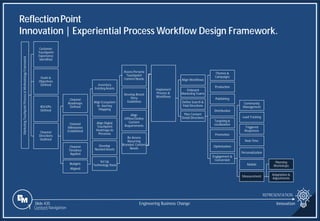
  • 169.
    Slide 169 Case Point GAFAnomics| Inspirational Learnings and Lessons. Source: FaberNovel Net Takeway | Everyone Is A Customer ˗ Even Without Money. Everyone who gives a company attention is considered a customer. Modeling for Business Change Inspirational Change 1 Content Navigation
  • 170.
    Slide 170 Case Point GAFAnomics| Inspirational Learnings and Lessons. Source: FaberNovel Net Takeaway | The Customer Base Is the Mother of All Growth. All GAFAdecisions are primarilyfocusedon gainingandretainingcustomers. Gettingcustomers to commit is the foundation on whicheverythingcan be built. It is the path towards revenue. “Show me the value, I will show you my money”. GAFA builds strong and direct relationships with their customers, who are hence more eager to transact with them. It acts as a barrier to entry. Great value helps build positive word-of-mouth. The larger the base of happy customers, the more attractive they become and the harder it is for competitors to challenge them. It leads to more value. GAFA leverages economies of scale to cover fixed costs more effectively and reflects this by lowering prices on products. It is an innovation catalyst. Data processing makes it possible to explore and experiment with new value pathways: add-on features, product innovation and revenue streams. Data paves the way to a new era: large-scale customization. Modeling for Business Change Inspirational Change 1 Content Navigation
  • 171.
    Slide 171 Case Point GAFAnomics| Inspirational Learnings and Lessons. 7.9 Billion People [Potential Customers] Source: FaberNovel GAFA doesn’t think in terms of geography or culture. They rely on the belief that any connected person is a potential connection and customer. Net Takeaway | The World Can Be Viewed Using A Different Lens. Modeling for Business Change Inspirational Change 1 Content Navigation
  • 172.
    Slide 172 Case Point GAFAnomics| Inspirational Learnings and Lessons. Source: FaberNovel Net Takeaway| Value Creation Now Defines Core Business Directions. 1. Make smart and meaningful things. GAFA are bolstered by a strong vocation: to help people save time and effort in their daily lives. Products & services are all the more valuable because they are intuitive to use reducing product adoption friction for mass market appeal. 2. Fostervalue creation rather than revenue. GAFA cares so much about meeting customers’ needs that they sacrifice short-term revenue and profits. Released from the obsession with short-term profit, they achieve excellence: delivering the best possible experience and making it truly accessible. 3. Reinvent how business is conducted. Commitment is a scarce commodity. The magic lies in meeting and anticipating customer demands in a timely manner, at the risk of letting competitors gain a lead. GAFA have set out to operate any type of business as long as they deliver value. Customer Value Modeling for Business Change Inspirational Change 1 Content Navigation
  • 173.
    Slide 173 Case Point GAFAnomics| Inspirational Learnings and Lessons. Source: FaberNovel Net Takeaway | Emphasis Should Be On Managing Customers – Not Products. Modeling for Business Change Inspirational Change 1 Content Navigation
  • 174.
    Slide 174 Case Point GAFAnomics| Inspirational Learnings and Lessons. Source: FaberNovel Net Takeaway | Touchpoints Create Integrated Seamless Experiences. Constantly re-evaluating their core business models, GAFA companies continually learn new skills and expertise to create seamless, integrated experiences across touchpoints to better service customers. The end result – core business models continue to evolve creating richer opportunities for business growth. Modeling for Business Change Inspirational Change 1 Content Navigation
  • 175.
    Slide 175 Case Point GAFAnomics| Inspirational Learnings and Lessons. Source: FaberNovel Net Takeaway | Touchpoints Create Daily Brand Engagements. GAFA sets out to operate any type of business as long as they can deliver value. Through differentiation and innovation, GAFA seeks to become the one and only digital destination for its customers. The end result – larger markets and customer base, an increase in average customer revenue, and higher retention rates through integrated experiences leading to greater lifetime customer value. The endgame is delivering the best possible digital experience. Modeling for Business Change Inspirational Change 1 Content Navigation
  • 176.
    Slide 176 GAFA businessandmarketingtransformationalmodelscanbereplicable. Thekeylearningis with VisionandLeadership,a CustomerCentricapproachfocused on the customerexperiencecanbe reimaginedto ensurebusinessrelevancyandsustainability in an everchangingconsumerlandscape. Modeling for Business Change Inspirational Change 1 Content Navigation
  • 177.
    Slide 177 Now witha bit of inspirationand understandingbehind us, takethe opportunityto re-review howbest youcannavigate the transformationlandscape. Modeling for Business Change Inspirational Change 1 Content Navigation
  • 178.
    Slide 178 NAVIGATING DIGITAL TRANSFORMATION LEVERAGINGA TRANSFORMATIVE GUIDING FRAMEWORK. Transformational Change Navigating Business Change 1 Content Navigation
  • 179.
    Slide 179 Changeis nevereasy. Tobeginchangeandtonavigatechange,we mustfirst address the commonbarrierstochange. 1 Content Navigation Transformational Change Navigating Business Change
  • 180.
    Slide 180 COMMON BARRIERS BUSINESSCHANGE IS NEVER EASY. 1 Content Navigation Transformational Change Navigating Business Change
  • 181.
    Slide 181 UnderstandingandNavigatingCommonHurdles. 1 ContentNavigation Transformational Change Navigating Business Change
  • 182.
    Slide 182 STRATEGY INA SILO THE EXPERIENCE FEELS DISJOINTED. Many of today’s marketing and digital strategies are practiced in a silo. Different departments manage different steps in the customer journey, let alone collaborate. They often act as their own fiefdom. They use different standards and metrics to measure success. 1 Content Navigation Transformational Change Navigating Business Change
  • 183.
    Slide 183 INTERNAL POLITICS TRANSFORMATIONTHREATENS THE STATUS QUO. This causes self defense mechanisms to kick in. Executives push back. They concentrate on their own priorities. Personal agendas win in favor of what’s right or best for the organization. 1 Content Navigation Transformational Change Navigating Business Change
  • 184.
    Slide 184 BUDGET ALLOCATION BUDGETSARE LOCKED WITHOUT PROOF OF ROI. Digital is still reasonably new and unproven. It requires continuous experimentation which often occurs in silos. Success and failure is rarely communicated beyond individual departments or teams making ROI difficult to measure. 1 Content Navigation Transformational Change Navigating Business Change
  • 185.
    Slide 185 DIGITAL FRAGMENTATION PRIORITIESARE MIS-ALIGNED. A lack of digital planning often exists in many organizations. System and platform efforts are typically strewn across multiple departments with no real dedicated teams. Singular digital initiatives including websites, channels, apps, and/or e-commerce is fragmented with lower priority given to a truly integrated digital ecosystem aligned to an omni-channel customer experience. 1 Content Navigation Transformational Change Navigating Business Change
  • 186.
    Slide 186 EDUCATION INTERNAL KNOWLEDGE,VALUE SYSTEMS AND BELIEFS ARE DISJOINTED. Vastly different levels of knowledge, skills and comfort exists in typical enterprises. Knowledge is scattered across the organization. A Millennial (Digital Natives) versus Baby Boomer (Digital Novices) divide may exist causing internal friction. 1 Content Navigation Transformational Change Navigating Business Change
  • 187.
    Slide 187 LEADERSHIP CHANGE CANBE HARD AND PAINFUL. Vision and someone to lead is critical. Employees will routinely follow a course of Business As Usual. Digital is kept at arms length or in fringe conversations. It may be viewed as a threat. A lack of digital specialists typically means strategy will often be viewed in silos or isolation. 1 Content Navigation Transformational Change Navigating Transformation
  • 188.
    Slide 188 CULTURAL CHANGE SUCCESSWILL ONLY COME WITH A WILLINGNESS TO FAIL. Without a culture in which employees can explore (and occasionally fail) without fear of reprimand, digital transformation benefits will likely never materialize and organizations will further be put at risk to survive the digital age. 1 Content Navigation Transformational Change Navigating Business Change
  • 189.
    Slide 189 DISPARATE DATA DATAINSIGHTS ARE KEY YET DATA REMAINS LOCKED IN SILOS. Existing infrastructures and processes lack a data model to gather and distribute data. Data remains in a silo, spread across departments or disparate systems. There exists a lack of understanding of what data is collected and who owns the data. There is no investment in staff and process to deliver data with actionable insight. 1 Content Navigation Transformational Change Navigating Business Change
  • 190.
    Slide 190 The startingpoint is knowing where the barriers are to be able to take steps to resolve them. For those willing to embrace change, barriers can be navigated. But it must begin with acknowledging them and then having insight into the nuances and depth of each barrier that will be unique to each organization. BARRIERS CAN BE OVERCOME. 1 Content Navigation Transformational Change Navigating Business Change
  • 191.
    Slide 191 As youreflecton the commonchangebarriers, it maybe relevantto reviewsomeadditionalguidingconsiderations organizationsare facingformoving theirtransformation initiativesforward. Transformational Change 1 Content Navigation Navigating Business Change
  • 192.
    Slide 192 CONSIDERATIONS ADDITIONAL REFLECTIONSFOR CHANGE. 1 Content Navigation Transformational Change Navigating Business Change
  • 193.
    Slide 193 q Theremay be staff, resource, skillset, and budget challenges which may exist within the organization to quickly adopt digital transformation. Transformation doesn’t just happen over night. Identifying early short falls should align to realistic roadmaps, timelines and expectations. A prioritized building block approach to transformation may be the most valued approached to the initiative. q The short-term goal for all initiatives should be to put into place progressive frameworks, strategies, processes, and roadmaps that will evolve, and which will allow your organization to begin executing against them to create a solid foundation for which can grow and mature overtime into future for longer-term success. q Reinforcing digital transformation will require activating and elevating champions, advocates, change agents, and working groups across the organization and in support (IT, sales, marketing, customer service, HR) for the adoption of the value proposition and the vision. However, how you get from where we are today to where you want to be in the future will come from the understanding that digital transformation is not a “set and execute” one time strategic initiative. q As stated, digital transformation has to naturally evolve over time… building on each past success and promoting them internally as the organization continues to develop best practices and grow its internal resources, skillsets and expertise at each phase in its digital transformation journey is a critical transformative step of the initiative. Reflection Point Additional Considerations for Guiding Transformation. Transformational Change 1 Content Navigation Navigating Business Change
  • 194.
    Slide 194 q Stewardshiproles for change agents and key stakeholders will need to apply an agile management approach leveraging expertise with scale and balance to execute a strategic transformative direction at the highest possible levels that will ‘phase in’ building block programs and initiatives based on capabilities and budgets unique to the realities facing the organization. q If you are a global organization, you must also be able to demonstrate you can leverage expertise, staff and resources across a global (IT, sales, customer service, marketing, HR) operations footprint in a cohesive, seamless team effort for applying the best possible resources for each transformation engagement and the aspirational Total Experience customer concept. q The key to all early success will hinge on the ability to quickly and effectively establish proof cases as credibility for demonstrating and reinforcing transformation is clearly and quantifiably impacting business milestones in all transformation areas impacted. q And the bigger picture point which needs continuous reinforcement is the appreciation that any progressive building blocks proposed and implemented today will be designed to grow and mature over time as ROI is demonstrated and as the organization’s internal expertise and skillsets grow and mature. It will be a recurring process of planning, experimentation, execution, measurement and refinement. Reflection Point Additional Considerations for Guiding Transformation. Transformational Change 1 Content Navigation Navigating Business Change
  • 195.
    Slide 195 With alltheseconsiderations inmind and as applicable, navigatingandactivating transformationwill requirea guidingframework to stewardongoingeffortsand to help solidify a structureddirectionalapproach to speedup planned progressivestepsin the initiative. Transformational Change 1 Content Navigation Navigating Business Change
  • 196.
    Slide 196 PILLARS OFCHANGE 1 Content Navigation Transformational Change SIX (6) CORE TRANSFORMATIVE PILLARS TO FUNDAMENTAL BUSINESS CHANGE. Framing Transformative Business Change
  • 197.
    Slide 197 A TRANSFORMATIVEFRAMEWORK ThereareSix(6)Core TransformativePillarstoFundamentalBusinessChange. Transformational Change 1 Content Navigation Framing Transformative Business Change
  • 198.
    Slide 198 Alignstrategicdirectionsfor transformationalchange. Transformational Change 1 Content Navigation Framing Transformative Business Change
  • 199.
    Slide 199 EXTERNAL DEGREEOF CHANGE INTERNAL ABILITY TO CHANGE EMPOWERMENT CUSTOMER CENTRICITY INNOVATION LEADERSHIP & VISION stewardship cultural change adaptive change risk & reward Vision Leadership Transformation Consider four core strategic directions to impact three fundamental business change areas. ReflectionPoint PromoteChange Through(4) TransformativeStrategicDirections. Customer Experiences Operational Processes Business Models TRANSFORMATION CORE PILLARS OF CHANGE 1 2 4 3 Transformational Change 1 Content Navigation Framing Transformative Business Change
  • 200.
    Slide 200 Roadmapthe majormilestonesforthetransformationalchange. Transformational Change 1 Content Navigation Framing Transformative Business Change
  • 201.
    Slide 201 Transform Marketing Define Strategic Directions Apply Process & Methodology Realign Workflows &Budgets Optimize Journeys Optimize Touchpoints Optimize Experience Engage & Collaborate Measure & Improve Reinforce Sponsorship Create Steering Committee Document Change Needs AdoptValue Proposition Define Vision Reinforce C-Suite Support Acquire Adequate Funding Enlist Change Agents Mobilize Efforts 1. LEADERSHIP AND VISION 2. EMPOWER THE ORGANIZATION Reflection Point There Is A Logical Navigation Flow To Digital Transformation. 3. MOBILIZE AND TRANSFORM WITH INNOVATION 4. REDEFINE THE CUSTOMER EXPERIENCE Promote Vision Build Roadmaps Governby Committee Expand Skillsets BuildTech Stacks ApplyData Analytics Encourage Change Be Risk Friendly Mobilize Organization Reinforce Cultural Change Align to Customer Centricity Reimagine Customer Experiences Emphasize Customer Loyalty Align Business Processes Focus on Customer Needs Use Data for Business Intelligence BuildLasting Relationships Continually Learn & Improve Creating a milestone roadmap will enable a guiding structure to manage transformation. Transformational Change 1 Content Navigation Framing Transformative Business Change
  • 202.
    Slide 202 Managetransformationalchangewith structuredstewardship. TransformationalChange 1 Content Navigation Framing Transformative Business Change
  • 203.
    Slide 203 ReflectionPoint StewardDigital TransformationViaA StructuredFramework. Steward the initiative across four distinct areas of agile management focus. Source: MIT, CG Frame the Digital Challenge Focus the Investment Mobilize the Organization Sustain the Digital Transition Build & Expand Awareness Across the Organization Fund the Transformation Promote New Behaviors and Evolve Culture Build Foundational Skills Establish Reachable Goals & Milestones Build Governance Earn the Right to Engage Employees Create Incentives and Rewards Craft the Vision and Align Top Team Translate Vision Into Action Align Workgroups and Signal Ambitions Measure, Monitor and Iterate FRAME FOCUS MOBILIZE SUSTAIN Transformational Change 1 Content Navigation Framing Transformative Business Change
  • 204.
  • 205.
    Slide 205 ReflectionPoint EmpowerTransformationWith aDigital BusinessCulture. Principles of Empowerment 1. RightMindset • agile, lean, disrupt, fail fast, customer-centricity, MVP, start with why, experimentation 2. RightToolset • modern, collaborative, lightweight and effective tools 3. RightBehavior • buy-in and support from leadership, aligned incentives across silos, no fear or rejection for new approaches 4. RightFeedback Loops • learn from digital experimentation, repeat and iterate, challenge results, develop risk and reward incentives Engageandincentivizestakeholdersacrossthe organizationto builda businesscultureof change. Transformational Change 1 Content Navigation Framing Transformative Business Change
  • 206.
    Slide 206 Leveragetransformationalchangethroughinnovation. Transformational Change 1Content Navigation Framing Transformative Business Change
  • 207.
    Slide 207 ReflectionPoint Start TransformationWithMarketingAsThe Initial Agentof Change. Reimagine the external-facing customer experience from different operational perspectives. Rework and/or redefine internal operating processes and business models. Marketing as the primary function within business will become the initial agent of change using a combinationofdigitalstrategies, channels,tactics,andtoolstoredefinethecustomerexperiencethroughbusinessmodelsandoperatingprocesses. Bring stakeholders together for collaborative business change across business operations. Transformational Change 1 Content Navigation Framing Transformative Business Change IT, Sales, Marketing, CustomerService, Human Resources. Offline Touchpoints Online Touchpoints Owned, Earned, Paid Media Web DigitalHub ORGANIZATION
  • 208.
  • 209.
    Slide 209 ReflectionPoint Customer CentricityPutsTheCustomer AtTheCenter ofAllBusinessChange. BEING CUSTOMER-CENTRIC MEANS § Align organization around the customer. § Put customers at the heart of the company leveraging experience design. § Create a company-wide customer- centric culture. § Reinforce customers’ needs first, no matter what. § Listen to customers, understanding their needs, acting and repeating. Monitor the online conversation. § Offer a positive customer experience from the start of the awareness stage all the way to the post-purchase process and advocacy stage. Articulate aclear valueproposition,visionandroadmapwith encouragedemployeefeedbackloops. Transformational Change 1 Content Navigation Framing Transformative Business Change
  • 210.
    Slide 210 Throughthese(6)corepillarsof transformativechange, youwill be able to plan and architectthe requisitebuilding blocks for activatingand mobilizing changethroughoutthe organization. Transformational Change 1 Content Navigation Framing Transformative Business Change
  • 211.
    Slide 211 ACTIVATING TRANSFORMATION ENVISIONING STRATEGICDIRECTIONS FOR CHANGE. Leading Business Change 1 Content Navigation Transformational Change
  • 212.
    Slide 212 Activationof anyTransformationInitiativemusthaveclearleadership. Leadershipmustenlistchangeagentsto guideand managethe effort and adopta value propositionand vision. Transformational Change 1 Content Navigation Leading Business Change
  • 213.
    Slide 213 LEADERSHIP CHANGE AGENTS,VALUE PROPOSITION, VISION. Leadership Leading Business Change 1 Content Navigation
  • 214.
    Slide 214 “ Organizationsthat destroy the status quo win. Whatever the status quo is, changing it gives you the opportunity to be remarkable.. Best Selling Author & Marketing Guru Seth Godin Leading Business Change Leadership 1 Content Navigation
  • 215.
    Slide 215 Change Agents EVERYTHINGSTARTS BY CHALLENGING THE STATUS QUO. Leading Business Change Leadership 1 Content Navigation
  • 216.
    Slide 216 Challengingthe statusquoforbusinesschangerequiresaninternal movement. ThroughLeadership+ Vision transformationalbusinesschangecan be willingly adopted to becomean organizationalreality. Leading Business Change Leadership 1 Content Navigation
  • 217.
    Slide 217 All MovementsBeginwith ChangeAgents. To build an internal movement,changeagentsmustbe enlisted to be the stewardsof the initiative, createa senseof urgencyamongC-Suiteexecutives, and expandmobilizationacrossthe organizationto expediteand setin motion the requisitebusinesschangeand digital transformationprocess. Leading Business Change Leadership 1 Content Navigation
  • 218.
    Slide 218 A personfrom inside or outside the organization who helps an organization transform itself by focusing on such matters as organizational effectiveness, improvement, and development. A change agent usually focuses his efforts on the effect of changing technologies, structures and tasks on interpersonal and group relationships in the organization. The focus is on the people in the organization and their interactions. Definition: Change Agent Leading Business Change Leadership 1 Content Navigation
  • 219.
    Slide 219 You’lllikelyneedto expandtherecruitmentandenlistmentof changeagents. Stakeholdersultimatelybecomethe face of organizationalchange to champion and drivethe businesstransformationprocess. Leading Business Change Leadership 1 Content Navigation
  • 220.
    Slide 220 It requiresateameffort. Key Roles,Purpose& FunctionsMayVarybyIndividual… Organizationaltransformationdoes trulyrequire a teamof changeagents. Keystakeholdersneed to be enlisted acrossall businessoperationsto impactand benefit businesschangethroughan internal movement. Leading Business Change Leadership 1 Content Navigation
  • 221.
    Slide 221 To recruitand enlist thesekeyinfluentialstakeholders, changeagentscan be identified usingleading questions. Leading Business Change Leadership 1 Content Navigation
  • 222.
    Slide 222 Reflection Point RecruitingChange Agents q Who will lead the movement?Who will be the internal voice to inspire change? q Who will be the internal champions and stewardsfor change? How will they be recruited? Across business operations? q Who will create the business case and business model for C-Suite|Board adoption? q Who will explain and document how a better “CX” can be a core business direction so that a wave of organizational-wide support begins to build? q Who are the internal departmentheads across Marketing, Sales, CustomerService, Human Resources, and IT which need to be recruited and/or motivated? How can distributed teams and efforts across a global footprint work in collaboration to create and reinforce a desired, integrated customer experience which will benefit both business and customers as well as employee careers? q Who needs to be recruited to form the requisite cross-functional steeringcommitteefrom Marketing, Sales, Customer Service, Human Resources, and IT to collaborate and support change across E-Commerce, Social, Mobile, Digital, and Real World? Leading Business Change Leadership REPRESENTATION 1 Content Navigation
  • 223.
    Slide 223 Oncechange agentshavebeenidentified,recruitedandenlisted… it will be imperativefor ChangeAgentsto workcollaborativelywith the executivesteeringcommitteeto developand/or refine the value proposition and vision througha needsanalysisto guidethe mobilizationof all transformativeefforts. Leading Business Change Leadership 1 Content Navigation
  • 224.
    Slide 224 Reflection Point NeedsAnalysis | Defining Operational Transformative Change q What is digital transformation for the organization? What is the customer value proposition?What are the goals and objectives? How can digital impact business change and efficiencies to impact the customer experience? q How can a cultural environment of innovation, employee empowerment, and risk and reward be built across the enterprise? q How can customer and channel marketingbreak out of silos for creating better omni-channel customer experiences to have greater business impact? q How will requiredbusiness systems,processes, methodologies,and technologies be integrated? What data is available? What data can be collected? What will be the data framework? How will data be governed and used? q How will the transformation efforts be rolled out and promotedacross the organization? What is the impact on business, departmental staffing and business models in place? q How can ROI or the promise of it be demonstratedacross at organizational levels? q What is the plan to reinforce sponsorship support from the Board and C-Suite executives? Who needs to be internal champions and are who are most likely to be receptive to business change, e.g., board members, CEO, CDO, CXO, CMO, et al? q How and when (at what stage in the movement)will the business case and/or progress updates be presented to key sponsors to reinforce continued sponsorship? Leading Business Change Leadership REPRESENTATION 1 Content Navigation
  • 225.
    Slide 225 ReinforcingAll MovementsMustConsiderTheOrganization… One sizewill not fit all. Asnoted, changeagentsmust be realisticto consider how transformativechangewill be unique to the organizationbasedon practicalities of availableresources,expertise,skillsets,and organizationalcommitment. Leading Business Change Leadership 1 Content Navigation
  • 226.
    Slide 226 And mostcriticalof allis changeagentsmust be ableto mobilizethe organizationintoactionthroughthe valuepropositionanda vision. Leading Business Change Leadership 1 Content Navigation
  • 227.
    Slide 227 As organizationspotentiallyexpandtheir circle of changeagents, the endgoalsmustbe clearlydefinedbeforeadvancingtransformation to ultimatelydrive,manageandguidethe initiativeto achievesuccess. Thereflectionpointis the valueproposition. Leading Business Change Leadership 1 Content Navigation
  • 228.
    Slide 228 Value Proposition REALIGNINGTO THE CUSTOMER EXPERIENCE. Leading Business Change Leadership 1 Content Navigation
  • 229.
    Slide 229 Not allcorporationsbegin as digitaland data-drivenentities. Tofullyembracedigitaltransformation,organizationswill need a customervaluepropositionto embracedigitalasa business model. Leading Business Change Leadership 1 Content Navigation
  • 230.
    Slide 230 Therefore,before realigningavisionfor businesschange, a clearDigitalTransformationValuePropositionmust be defined. It mustbe easilycommunicatedaimed atC-SuiteExecutives to leverageheightenedsponsorshipandfurtherserveto createa senseof urgency acrossthe organizationatall levels. Leading Business Change Leadership 1 Content Navigation
  • 231.
    Slide 231 Why doesa value proposition matter? Fully embracing digital transformations require companies to reimagine their business from a customer's perspective. Leading Business Change Leadership 1 Content Navigation
  • 232.
    Slide 232 An effectivevalue proposition will define a new way of thinking about an organization’s business. It will tell the ideal customer why they should buy from your company and not from competitor brands. Leading Business Change Leadership 1 Content Navigation
  • 233.
    Slide 233 It willput the customer at the center for defining and/or refining the vision for where your organization can make real change for business benefit which is at the core of the transformation effort. Leading Business Change Leadership 1 Content Navigation
  • 234.
    Slide 234 1 ContentNavigation Six out of 10 companies have produced new business models due to digital transformation strategies, and over half of company CEOs say that digital technologies have helped increase revenues. The most common benefits cited aligned to a customer centricity business model approach include: 40% improved operational efficiencies, 36% reduced time to market, 35% improved ability to match customer expectations. Source: Forbes Reflection Point RealigningBusinessTo The Value Proposition. 6 Leading Business Change Leadership
  • 235.
    Slide 235 Framing thevalue proposition will provide the direction required to realign the guiding vision for business transformation which underpins all efforts. Leading Business Change Leadership 1 Content Navigation
  • 236.
    Slide 236 Vision ALIGNING VISIONTO THE VALUE PROPOSITION. Leading Business Change Leadership 1 Content Navigation
  • 237.
    Slide 237 VISION ISCRITICAL There will be a need to embrace transformation with a clear vision. Transformation needs an actionable vision. Leading Business Change Leadership 1 Content Navigation
  • 238.
    Slide 238 Reinforcing everythingdiscussed so far, the Vision needs to align business benefits to the value proposition and then be adopted by the C-Suite and be promoted top > down into the organization. Leading Business Change Leadership 1 Content Navigation
  • 239.
    Slide 239 And tobe clear… the Vision must be driven from top > down for successful organizational adoption. This is the only path to success. Leading Business Change Leadership 1 Content Navigation
  • 240.
    Slide 240 q Casestudies reveal the most successful transformation initiatives will focus as much (or more) on how to drive change as on the detailed content of the change. q A compelling transformative vision, with related engagement, governance and KPIs will allow employees throughout the organization to identify new “whats” to meet or extend the vision as the organization is mobilized for the transformation initiative. q Successful transformation comes not from creating a new organization, but will reshape the organization to take advantage of valuable existing strategic assets in new ways. q The most successful transformative companies will gain value from investments they have already made, even as they envision radically new ways of working. ReflectionPoint AValuedVision WillFocusMoreOnthe “How”Thanthe “What”. Leading Business Change Leadership 1 Content Navigation
  • 241.
    Slide 241 ReflectionPoint VisionIdeation| FromEcosystemtoMecosystem. Where an ecosystem is a complex network or interconnected system of departmental operations in which business operates serving singular business functions, the concept of a new Mecosystem in the Age of New Consumerism is a re-orientation of this departmental model putting the customer at the center and reorganizing and integrating department operations and business systems re-aligned to support the brand experience for realization of greater business outcomes, customer loyalty and revenues. q Informed by data, the Mecosystem considers the "real- life" contexts surrounding the customer and seeks to architect synergies across touchpoint experiences, ensuring more relevant services and products are delivered. q The Mecosystem customer approach further helps calibrate brand experiences based on customer needs and preferencesthat are becoming increasingly social and multi-sensory as created by digital by harnessing collective intelligence through analysis and data. Source: Interbrand Leading Business Change Leadership 1 Content Navigation
  • 242.
    Slide 242 Source:IBM Institute Fashionistas Digirati Beginners Conservatives • Many advanced digital features (such as social, mobile) in silos • No overarching vision • Underdeveloped coordination • Digital culture may exist in silos • Strong overarching digital vision • Good digital governance • Many digital initiatives generating business value in measurable ways • Strong digital culture • Management skeptical of business value of advanced digital technologies • May carry out some experimentation • Immature digital culture • Overarching digital vision exists, but may be under developed • Basic digital capabilities may be mature • Strong digital governance across silos • Taking active steps to build digital skills and culture D i g i t a l I n t e n s i t y Transformation Management Intensity Every company’s path to Transformation will be unique. In parallel with defining the vision, one of the first steps to transformation is an organizational assessment to identify current strengths and weaknesses. Depending on a company’s current level of digital maturity,atransformationinitiative will need to be uniquely designed to move the business through progressive stages to reach full digital transformation. As digital maturity grows with each new success, the vision can evolve expanding the backbone to iterative roadmap planning. Reflection Point Vision Ideation | Digital Maturity Self Assessment. Leading Business Change Leadership 1 Content Navigation
  • 243.
    Slide 243 Fashionistas Digirati BeginnersConservatives D i g i t a l C a p a b i l i t y Leadership Capability Reflection Point Vision Ideation | Comparative Industry Maturity View. Source: MIT, CG Compared to industry transformation stages, some industriesare further along in the building of digital capabilities but may lag in vision and strategy to affect transformation. Leading Business Change Leadership D i g i t a l C a p a b i l i t y Leadership Capability 1 Content Navigation
  • 244.
    Slide 244 Reflection Point VisionIdeation|Change at Three(3) FundamentalBusinessLevels. T R A N S F O R M A T I V E C H A N G E • Customer Understanding • Top Line Growth • Customer Touch Points Customer Experiences • Process Digitization • Worker Enablement • Performance Management Operational Processes Business Models • Digitally Modified Business • New Digital Business • Digital Globalization Unified Data & Processes Analytics Capabilities Business and IT Integration Solution & Product Delivery Digital Capabilities 3 2 1 Leading Business Change Leadership 1 Content Navigation Reinforcing discussion points so far, a vision will impact business change at three fundamental levels.
  • 245.
    Slide 245 LeadingBusiness Change Linked to Organizational Needs & Circumstances A Vision will impact Transformation Benefits for C-Suite Embracement. q Competitive Advantage q Innovation and Business Value q Sales Growth & Revenues q Operating and Organizational Efficiencies q Market and Customer Management q Improved Customer Service q Create and Capture Consumer Value q Greater Brand Loyalty & Affinity q Product / Service Innovation Source: Altimeter C o m m o n T r a n s f o r m a t i o n B e n e f i t s Reflection Point Vision Ideation | Aligningand LinkingBusinessBenefits. Leadership 1 Content Navigation
  • 246.
    Slide 246 Digital FootprintEcosystems– digital hubs, owned digital assets, channels, platforms, content, integration, personalization, real-time, geo, screen appropriate tightly integrated with all other customer touchpoint owned assets (offline + online). Digital & Departmental Teams – well defined inter-departmental (IT, sales, marketing, customer service, HR) involvement, roles and responsibilities, monitoring & engagement to facilitate seamless positive experiences. Digital Communications– enhanced digital marketing strategies, campaigns, promotions, customer engagement, customer touchpoints, mobile, websites, apps, SMS, MMS, WAP sites, location-based services. Digital Support – internal operational integrated processes, skillsets, collaboration, employee empowerment, social employee guidelines, IT infrastructure and backbone, front-end systems and platforms, data frameworks, database integration, marketing, customer and operational performance analytics, and business intelligence management and mining. Reflection Point VisionIdeation |Realignment ToTheOrganization's Digital Journey. Leading Business Change Leadership 1 Content Navigation Expanding on discussion points so far, a vision will impact business across operations and departments.
  • 247.
    Slide 247 1 2 3 Innovate Improve Support Level 2Business Needs • Business network/process redesign • Enable business and partnerships • Management information • Process orientation Level 1 Business Needs • Foundation systems • Cost savings • Operational information • Functional orientation Level 2 IT Focus • Establish common IT infrastructure • Build IT credibility • Improve solution delivery • Establish Enterprise Architecture • Respond to ‘Consumerization of IT’ Level 3 Business Needs • Business growth and innovation • Rapid configuration capability • Market information • Business integration orientation Level 1 IT Focus • Provide basic systems and services • Stabilize operations and support • Improve service delivery • IT management fundamentals Level 3 IT Focus • Continuous strategy & planning • Converge business and IT • Expand and extend infrastructure • Enable flexibility and agility • Embrace ‘Consumerization of IT’ Time Value Demand Supply Reflection Point Vision Ideation | Transformative Phased Timeline Approach. Business Transformation Business Effectiveness Business Efficiency Leading Business Change Leadership 1 Content Navigation An effective vision will consider (3) stages and be able to communicate a roadmap to change based on milestone timelines.
  • 248.
    Slide 248 Source:UHL Glénai Reflection Point Vision Ideation | Implementing Transformative Lifecycles. Transformation Will Not Be A One Time Event. Lifecycle Planning Based on your own unique organizational assessment, transformation roadmaps should follow and align to lifecycles phases. Iterative planning is required to envision change, engage your staff, empower continuous transformation and optimize for lasting change to reap more efficient and greater outcomes. Leading Business Change Leadership 1 Content Navigation An effective vision will include progressive iterative lifecycle steps and goals in the business transformational journey. 1 2 3 4
  • 249.
    Slide 249 Although developinga vision may seem like a daunting task… with conviction and commitment the steps and considerations outlined can successfully begin to build an actionable vision leading to a roadmap for transformational change. Leading Business Change Leadership 1 Content Navigation
  • 250.
    Slide 250 C-Suite Support ADOPTINGAND EMBRACING DIGITAL TRANSFORMATION. Leading Business Change Leadership 1 Content Navigation
  • 251.
    Slide 251 A quicknote on C-Suite support and adoption. Leading Business Change Leadership 1 Content Navigation
  • 252.
    Slide 252 To achievereal transformation, you must emphasize a top / down approach to influence an empowered and customer-centric organizational culture which can be spearheaded and supported from within the C-Suite. Leading Business Change Leadership 1 Content Navigation
  • 253.
    Slide 253 Reflection Point Levelsof Typical C-Suite Digital Transformation Support. Source: Altimeter Surveyed across industries, C-Suite level champions varied with the CMO followed by the CEO most supportive of transformational change. Sponsors may vary by organization. However, C-Suite executive level functional support across organizational operations is required for successful transformation to be successful and realized. Leading Business Change Leadership 1 Content Navigation C-Suitesupportmaydifferbyorganization.Ideally,theinitiativewillinspireallC-Levelexecutivestobeactivechampionsforchange.
  • 254.
    Slide 254 As wehave discussed, transformation starts with Leadership which leads to the enlistment of change agents and the adoption of a value proposition and vision. The next step must be empowering the organization to affect change. Leading Business Change Leadership 1 Content Navigation
  • 255.
    Slide 255 EMPOWERMENT EMPOWERING THEORGANIZATION TO TRANSFORM AND CHANGE. Empowerment Mobilizing Business Change 1 Content Navigation
  • 256.
    Slide 256 Stewardship, Skills,Culture and Technology. Empowering transformation is about creating a mindset for adopting and impacting change internally within the business. Mobilizing Business Change Empowerment 1 Content Navigation
  • 257.
    Slide 257 To evolveand to empower is to lay the groundwork for sustainable change through four fundamental reinforcing directions as linked to the six pillars of transformative change. Mobilizing Business Change Empowerment 1 Content Navigation
  • 258.
    Slide 258 ARTICULATE VISION& PRIORITIES WHAT WILL SUCCESS LOOK LIKE? WHY DO WE NEED TO CHANGE? Employees will need to see that change is valuable for them and for customers. Because elevating digital maturity will involve numerous building block projects, it will require the need to prioritize the ”must haves” over the ”nice-to-haves” by developing actionable, governable roadmaps. Mobilizing Business Change Empowerment 1 Content Navigation
  • 259.
    Slide 259 CREATE CURIOSITY& A NEW MINDSET ENGAGE AND EMPOWER EMPLOYEES TO DEVELOP NEW COMPETENCIES. Digitally mature companies encourage employees to experiment and innovate while equipping them with the right tools to resolve challenges. It requires change agent leaders with the right qualities to inspire, influence, and encourage collaboration. Mobilizing Business Change Empowerment 1 Content Navigation
  • 260.
    Slide 260 LEVERAGE &USE DATA INNOVATE USING PROCESS AND DATA-DRIVEN DECISIONS. Leverage data to draw sound conclusions. Data is the lifeblood of a digitally mature organization and is essential to driving change and innovation. Good data enables an organization to calculate, understand, and articulate the value expected from digital initiatives and to respond to and satisfy customers. Mobilizing Business Change Empowerment 1 Content Navigation
  • 261.
    Slide 261 BUILD ACULTURE OF INNOVATION BALANCE FREEDOM TO EXPLORE WITH INCENTIVES TO ACCELERATE INNOVATION THROUGH CUSTOMER CENTRICTY. Innovation is key to staying ahead of both known and emerging competitors. For innovation to flourish, and for customer centricity to take root, organizations must encourage and elevate cross-functional collaboration, and adopt agile management approaches to strengthen the partnership between the business and IT function. Mobilizing Business Change Empowerment 1 Content Navigation
  • 262.
    Slide 262 To engagethe organization and to empower the organization at all levels will require implementing these four guiding fundamental directions. Mobilizing Business Change Empowerment 1 Content Navigation
  • 263.
    Slide 263 Reflection Point Empowerment| Establish and Communicate Priorities for Change. Identify Core Priorities. As previously highlighted, change can be difficult. All organizations face it. Digital transformation and priorities will be different and unique for each organization. A basic need is to identify your initial priorities and roadmap change as building blocks to mobilize efforts accordingly. Grow and mature with each success, replicate and iterate across the global operations to holistically transform the organization. Source: Altimeter Mobilizing Business Change Empowerment Survey results describe the importance from executives surveyed of different building block elements of digital transformation initiatives. 1 Content Navigation
  • 264.
    Slide 264 Reflection Point Empowerment| Disseminate, Promote Vision and Priorities. Prioritize Business Transformation Steps. Before organizations can truly impact business change, employees need to understand what success looks like and why the organization requires change. In the digital marketplace, the answer to “why?” should center around how the digital investment and strategy delivers incremental value to customers. This strategy should be based on exercises in design-thinking that reveal what customers value most. As the value proposition is articulated to employees, it is important to build emotional connections by explaining how change is valuable for employees. Once the value proposition has been defined for each building block initiative, determine which building blocks are critical “must-haves” to the digital strategy and which are “nice-to-haves” that may have to wait until time and resources are available. Source: UHL Glénai Mobilizing Business Change Empowerment 1 Content Navigation
  • 265.
    Slide 265 Reflection Point Empowerment| Plan and Govern Using Building Block Elements. Define The What and How. Successful transformation is executed by what some reference as Minimal Viable Products (MVPs) aka building block elements -- which is defined by the digital steering committee and as aligned and prioritized with the digital vision. Every organization will have differing priorities as initially defined by their unique core business needs identified in the needs analysis assessment. Each building block element should have a transitional, iterative roadmap to enable proper stewardship, governance and mobilization. Leveraging an agile management approach, each building block can be clearly managed for the What and How to become actionable. Source: UHL Glénai Mobilizing Business Change Empowerment 1 Content Navigation REPRESENTATION
  • 266.
    Slide 266 Reflection Point Empowerment|Be Agile To Engageand EmpowerThe Organization. Leverage Agile Management Frameworks. To elevate cross-functional collaboration, rather than organizing work within functional silos, an agile management approach enables cross-functional teams with diverse perspectives to solve problems together and uncover previously unknown opportunities. In this model, change agents will take on formal and informal management roles to govern and guide organizational efforts through each phase of building block implementation. Source: UHL Glénai Management Roles Transformational IT Management Mobilizing Business Change Empowerment 1 Content Navigation REPRESENTATION
  • 267.
    Slide 267 Reflection Point Empowerment| Activate and Mobilize The Organization. Manage by Building Block (MVP) Execution. Innovation and product management may require new ways of thinking and working rooted in agile methodology. Mature digital organizations increasingly embrace the concept of introducing a minimum viable product (MVP) and then improving it over time. It’s a stronger approach than striving for a full-featured big bang, which, in today’s market, could wind up being irrelevant by the time it is ready for launch. Each MVP can be mobilized as an essential building block leveraging Meta Management principles. Source: UHL Glénai Mobilizing Business Change Empowerment 1 Content Navigation Building Block (MVP) Execution REPRESENTATION
  • 268.
    Slide 268 Reflection Point Empowerment| Overcome Catalysts & Inhibitors to Change. Overcome Barriers. As discussed, there will be many barriers to change which may be foreseen and unforeseen in the transformation process. It will be the role of steering committees and change agents to resolve barriers as they occur to keep the initiative moving forward. Experimentation with the concept of a cross-functional catalyst teams to drive short-term initiatives can be a valued direction for many organizations. Source: UHL Glénai Mobilizing Business Change Empowerment 1 Content Navigation REPRESENTATION
  • 269.
    Slide 269 Reflection Point Empowerment| Expand Skillsets, Competencies & Innovation. Motivate and Empower Employees. It’s critical to allow employees to experiment and innovate without fear of failure, resolve challenges more resiliently, and champion change, while knowing they are supported. Consider the skills required to successfully lead organizational change (technology, digital savviness, collaboration, influence) and identify individuals who will be a good fit. As the digital journey evolves, organizations may need to identify and prepare change champions at additional levels. Digital maturity also requires employees to adopt a growth mindset that motivates them to develop and use new skills as operations become more digital. Training should be part of the mix, but it is important to recognize the value and importance of experiential, on-the-job learning. Source: UHL Glénai Mobilizing Business Change Empowerment 1 Content Navigation REPRESENTATION
  • 270.
    Slide 270 Reflection Point Empowerment|DeployTheRightToolStacks ForWorkflowEfficiencies. Provide The Right Platforms & Tools. When selecting and configuring a tech stack which becomes a critical backbone component to enable transformation, an integrated framework should reflect four (4) core considerations. 1. People | Usability and friendliness over back-end and admin needs. 2. Platforms | Best-of-Feature solutions over Best of Breed (Suite) or All in One Suites are best choices. 3. Features | Out of box solutions over alternative coding platforms to reduce IT resources and investments. 4. Integrations | Preferably native integrations for seamless exchange of business critical data over SAAS or API integrations. Source: martechtribe.com Digital & Content Management Platforms Supply-Chain, E-Commerce Tools Call Center, Community & Social Platforms Assorted Workflow & Collaboration Tools Business Intelligence & Research Tools Marketing & Email Automation Platforms ERP, SAP, CRM Platforms Mobile Marketing Automation Platform Reputation Mgmt. & Analytics Platforms Centralized Data Backbone Framework Mobilizing Business Change Empowerment 1 Content Navigation REPRESENTATION
  • 271.
    Slide 271 Reflection Point Empowerment| Become Data Driven To Drive Transformation. Make Data Essential for Decision Making. Data is the lifeblood of the digital organization. Mature digital companies foster a culture that pushes leaders and peers to use data when making decisions. Good data is essential to determine the value of change and to articulate the results you expect from digital initiatives. Without well-defined success measures, it will be difficult to inspire leaders to model the right behaviors and also evolve performance management systems and incentive structures to reward desired behaviors. One way to use data to promote the right behaviors for data use is to communicate “use cases” that demonstrate how a particular change is tangible and measurable. Examples can point to progress that a team is making and the impact of its work. This motivates others to find similar opportunities and demonstrate comparable behaviors. Source: UHL Glénai Mobilizing Business Change Empowerment 1 Content Navigation REPRESENTATION
  • 272.
    Slide 272 Reflection Point Empowerment|IntegrateFront-EndwithBack-EndOperational Processes. IntegrateCommonDomainsofExcellence. It’s essential to integrate and link business processes, platforms and systems. What this looks like and how this integration is facilitated will depend on the organization, and how it transacts business with its customer. It likely will influence all customer channel touchpoints (online and offline), across the entire customer journey at each point of customer engagement. It will influence back-end operational processes, platforms and systems for enablement of greater collaboration across operations to deliver requisite business intelligence to enhance the overall customer- facing experience. Source: MIT, CG Mobilizing Business Change Empowerment 1 Content Navigation REPRESENTATION
  • 273.
    Slide 273 Empowering theorganization for business change does require cultural change… embracing the right mindset, management, tools, skillsets and motivations. As empowerment is realized, innovation through process and methodology enables the delivery of a business transforming customer experience. Mobilizing Business Change Empowerment 1 Content Navigation
  • 274.
    Slide 274 INNOVATION REIMAGINING CUSTOMEREXPERIENCES VIA PROCESS & METHODOLOGY. . Innovation Architecting Business Change 1 Content Navigation
  • 275.
    Slide 275 “Digital marketingis at a crossroads, and it’s the brands that understand the role of context in delivering customer value that will excel in this new era of connectivity. Analyst, Best Selling Author, Speaker Brian Solis Architecting Business Change Innovation 1 Content Navigation
  • 276.
    Slide 276 Innovation beginswith process and methodology as underpinned by four key digital enabling requirements which forms the underlying foundation for delivering new brand experiences aligned to customer value. Architecting Business Change Innovation 1 Content Navigation
  • 277.
    Slide 277 Reflection Point Innovation| Four Underpinning Digital Enabling Requirements. CustomerValueCanOnlyBeRealizedIf InnovationisUnlockedandEnabled. To innovate and to transform is to apply process and methodology which can be empowered with leadership, collective experience and knowledge. All innovation is linked and starts with this premise using four key enablers. 1) A unwavering commitment to place the customer at the center of transformation. 2) A digital savvy workforce skilled across line- authority business disciplines. 3) Stewardship via process to drive operational excellence across building block element execution. 4) Organizational IT excellence and data governance to support the requisite digital business ecosystem. Source: UHL Glénai Architecting Business Change Innovation 1 Content Navigation 1 2 3 4
  • 278.
    Slide 278 To innovateand transform is to create customer value through experiential design delivered at each customer touchpoint. Architecting Business Change Innovation 1 Content Navigation
  • 279.
    Slide 279 Through processengineering and methodology, you can innovate and reimagine experiential marketing and the customer experience. Architecting Business Change Innovation 1 Content Navigation
  • 280.
    Slide 280 Marketing Design REIMAGININGEXPERIENTIAL MARKETING. Architecting Business Change 1 Content Navigation Innovation
  • 281.
    Slide 281 Reimagining marketingbegins with an experiential transformative framework. Architecting Business Change Innovation 1 Content Navigation
  • 282.
    Slide 282 Where youcan activate experiential design using a 12 step guiding process. Architecting Business Change Innovation 1 Content Navigation
  • 283.
    Slide 283 Advance Discovery Digital Ecosystem Optimization Strategic Directions Campaign Planning CustomerJourney Alignments Brand Experience Touchpoints Workflow Team Collaboration Measurement & ROI Analysis Digital Ecosystem Alignments Content Marketing Directions Community Management & Engagement Campaign Building Block Execution ReflectionPoint Innovation | Transformation Process Roadmap Framework. REPRESENTATION Architecting Business Change Innovation 1 Content Navigation
  • 284.
    Slide 284 ReflectionPoint Innovation |Experiential Transformation Marketing Framework. REPRESENTATION Architecting Business Change Innovation 1 Content Navigation ProcessRoadmap | Marketing TransformationMaster Frameworks Advance Discovery Digital Footprint Review Goals & Objectives Review KPI Review Benchmark Performance Audits Customer Journey Mapping Ecosystem Optimization SEO Alignments Digital Landscape Navigation Alignments Content & Publishing Schedule Alignments Brand Identity Alignments Design & Architectural Alignments Offline Touchpoint Integration Strategic Campaign Directions Vision, Goals, Objectives & KPIs Target Personas Digital Footprint & Touchpoints Brand Story Branding Online/Offline Integration Content Production Publishing Localization Mobile Lead Generation Employer Branding Milestone Management Process & Methodology Search Engine Marketing Search Engine Optimization Paid Media Experiential Marketing Social Media Marketing Mobile & App Marketing Email Marketing Content Strategy Inbound Marketing Employer Brand Marketing Workflow Alignments Global, Regional Alignments Team Structures Team Roles Corporate Models Hub & Spoke Models Decentralized Local Models Onboarding & Continued Learning Content Directions Owned Earned Paid User Generated Content (UGC) Campaigns & Promotions Technology Stacks Workflow Management Marketing Automation Community Management CRM & Lead Management Workflow Collaboration Data + Visual Analytics Business Intelligence (Insights) Listening & Monitoring Web & App Platforms Ecosystem Alignment Channel Use Optimization Seamless Integrated Footprint Customer Touchpoints Alignment Channel Content Optimization Building Block Execution Budget Alignments Objective Oriented Phased In Roadmaps & Timelines Omnichannel Brand Experience Optimization Global Workflow Management Engagement & Conversion Community Management Lead Tracking Lead Nurturing Mobile Optimization Web Design Real-Time Personalization Mobile First Design App Design Team Collaboration Intra-Office Global Management Inter- Department Agencies & Stakeholders Planning Workshops Workflow Tools Measure, Analyze, Optimize Measurement & Performance ROI Analysis Campaign Optimization Reporting Cycles Adaptation & Re-alignment Iterative Planning Cycles Brand Workflow Management
  • 285.
    Slide 285 Of notefor global companies, experiential marketing design may require hub and spoke activation with geo considerations where applicable. Architecting Business Change Innovation 1 Content Navigation
  • 286.
    Slide 286 However, ideallyexperiential marketing transformation enables a shift from product and brand marketing to… a focus on customer- and persona-based marketing. Architecting Business Change Innovation 1 Content Navigation
  • 287.
    Slide 287 Experiential Campaign Framework Objectives Budget Allocation CampaignPlanning Promotions Special Offers & Contests Content Marketing Loyalty, Rewards & Incentive Programs Membership Programs Community Portals Engagement Apps Offline - Commerce, Special Events Crowdsourcing Brand Evangelism User Generated Content Creative Direction & Campaign Design Brand Experience Reinforcement Execution Requirements Channel Selection Legal & Channel Compliance Technology Platforms Web, App, UX Development Publishing & Process Flow Resource Allocation Management & Maintenance Key Performance Indicators Measurement Cycles Promotion Plan Budget Re-alignment Execution Measurement, Analysis & Optimization Cycles Adjustments & Adaptation Reflection Point Innovation | Experiential Marketing Campaign Design Framework. REPRESENTATION Architecting Business Change Innovation 1 Content Navigation
  • 288.
    Slide 288 Once anexperiential framework is designed, process engineering will enable the transformation effort. Architecting Business Change Innovation 1 Content Navigation
  • 289.
    Slide 289 Process Enabled PROCESSENGINEERING MARKETING DESIGN. Enabling Business Change 1 Content Navigation Innovation
  • 290.
    Slide 290 “ Youcan only know where you’re going if you know where you’ve been. Legendary historian and documentarian James Burke Enabling Business Change Innovation 1 Content Navigation
  • 291.
    Slide 291 Discovery PROCESS ENGINEERINGMARKETING DESIGN. Enabling Business Change 1 Content Navigation Innovation
  • 292.
    Slide 292 Develop businessintelligence through discovery. Enabling Business Change Innovation 1 Content Navigation
  • 293.
    Slide 293 D i s c o v e r y F r a m e w o r k Digital Footprint& Integration Review Campaign Planning Review Benchmark Performance Audits Web SEM|SEO SMM Email Mobile, Apps & IoT Paid Media Content Lead Generation Competitive Landscape Departmental Collaboration Internal Process & Workflow Offline / Online Branding Integration Online Reputation Analysis Existing Goals & Objectives Review Existing KPIs Review Customer Journey Mapping Customer Persona & Needs Analysis Reimagining experiential marketing and design starts with DISCOVERY which is a critical early step to architecting a Digital Transformation effort. q Reveals what’s broken and what’s not. q Establishes a performance benchmark to measure against future ROI. q Identifies early baseline priority needs within the current digital ecosystem and as aligned to offline touchpoints which can be executed against a timeline in advance of defining strategic directions. q Provides the insights and intelligence required to architect strategy, internal process and executable tactical directions. ReflectionPoint Innovation | Advance Discovery Framework. REPRESENTATION Enabling Business Change Innovation 1 Content Navigation
  • 294.
    Slide 294 ReflectionPoint Innovation |Advance Discovery Framework. REPRESENTATION Enabling Business Change Innovation Discovery Review Process Audit Inclusion Digital Footprint (Ecosystem) What are the current digital assets? How are they linked (connected)?Managed and supported? Existing Goals & Objectives What are the current goals & objectivesdriving the digital efforts? Are they mapped to business goals and objectives? Are they measurable? Existing KPIs What does success look like? How is it currently being measured? What is the current performance? Search Engine Optimization (SEO) Brand and competitive SERP optimization (accessibility, indexability, on-page/ off-pageoptimization, keyword analysis, link building) for all digital assets Search Engine Marketing (SEM) Paid search & display (objectives,campaigns & ad groups, budgets, targeting, bidding, delivery, ad rotation, keywords,landing pages, device, ad schedules, A/B testing, overall performance). Social Media Marketing (SMM) Channel objectives & use, branding,profiles, descriptions,tags, links, practices and trends, content, targeting & publishing, SEO & web traffic influence,unclaimed properties, KPI metrics, performance. Email Marketing Objectives& use, campaign frequencies,content themes, open rates, CTRs, landing pages, opt-in lead gen, list management. Mobile Marketing Objectives& use, cross channel strategic direction, audience profile and needs, responsivedesigns (web, mobile, landing pages), SMS/MMS,app use, A/B testing, optimization, KPIs, performance. Advertising (Digital) Objectives& use (banner, display, rich media, video, pop-up,mobile, native, social), campaigns & ad groups, targeting, contextual delivery, media buys, ad rotation and schedules, design, landing pages, device optimization, A/B testing, ROAS performance. 1 Content Navigation
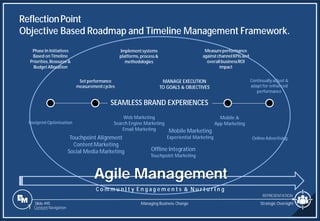
  • 295.
    Slide 295 Discovery ReviewProcess Audit Inclusion Content Marketing Content assets, strategy, optimization, objective-based use, production process,topics (brand, competitive, industry), audience needs, re-purposing,re-targeting, performance. Apps & IoT Objectives& use, strategy, design, development,promotion, in-app engagement, performance– opportunities. Lead Generation CRM platform, ecosystem integration, and process(lead acquisition, lead nurturing, triggered response, behavioral tracking, real-time contextual content delivery,lead stage tracking, database segmentation and management). Departmental Collaboration Inter-Departmental input (sales, customer service, HR, IT), information (data) sharing, independentdepartmental initiatives / assets, departmental cooperation and support. Internal Process & Workflow Staff and agency resources,processes,systems and technology platforms, internal champions for change, other stakeholder roles, C-Suite advocate support. Offline/ Online Branding Integration Street level consumer branding tie-ins and integration; sales, customer service, HR tie-ins. Online Brand Reputation Competitive landscape benchmark review, online brand amplitude and resonance,discussion topic themes, brand /productsentiments, levels of customer service and satisfaction, customer engagements and advocacy. Customer Journey Mapping Target persona development,online behavior and preferenceanalysis, digital touchpoints (heatmap), multiscreen behaviors,content needs assessment. ReflectionPoint Innovation | Advance Discovery Framework. REPRESENTATION Enabling Business Change Innovation 1 Content Navigation
  • 296.
    Slide 296 Digital Footprint PROCESSENGINEERING MARKETING DESIGN. Engineering Business Change 1 Content Navigation Innovation
  • 297.
    Slide 297 Optimize thedigital footprint for experiential marketing. Engineering Business Change Innovation 1 Content Navigation
  • 298.
    Slide 298 Social Media Ecosystem Optimization Framework SEO Alignments Keyword Optimization Assessability& Indexability On-Page / Off-Page Optimization Link Building Visual Branding Alignments Online / Offline Integration Seamless Experience Navigation Alignments Footprint Integration Content Organization Publishing Alignments Keyword Density Headline Optimization Publishing Schedules Channel Use Architectural Alignments Mobile Optimization Objectives & Roadmap Web & Social Design Flaws Layout & Click Path Corrections Web Properties As an actionable outcome of the discovery process, optimizingthe digital footprint allows the transformation effort to begin on a solid digital ecosystem foundation to align the benefits of experiential marketing. q Optimization of the digital footprint provides easier consumer discovery. q Aligns common and complementary branding across all digital assets. q Begins to implement channel best practices for content production and publishing. q Optimizes navigation for better digital consumer experiences. q Begins to address architectural and design flaws across owned digital assets as well as mobile optimization needs. ReflectionPoint Innovation | Digital Footprint Optimization Framework. REPRESENTATION Engineering Business Change Innovation 1 Content Navigation
  • 299.
    Slide 299 Campaigns PROCESS ENGINEERINGMARKETING DESIGN. Engineering Business Change 1 Content Navigation Innovation
  • 300.
    Slide 300 Develop anexperiential campaign design framework. Engineering Business Change Innovation 1 Content Navigation
  • 301.
    Slide 301 REPRESENTATION Engineering BusinessChange Innovation 1 Content Navigation ReflectionPoint Innovation | Experiential Campaign Harmonized Global Framework. Reinforcing the master Brand through to product marketing, experiential campaign design starts with understandingthe customer. q Country, Region, Global alignment. q Persona-focus targeted design. q Funnel stage considerations. q Omnichannel touchpoint integration. q Journey-based alignment with owned assets. q Multi-level experiential campaign executions. q Retargeting and Loyalty considerations. q Optimization based on leading KPIs. Master Brand
  • 302.
    Slide 302 ReflectionPoint Innovation |Experiential Campaign Design Flow Framework. Experiential Campaign Directions Framework Campaign Objective Defined Goals Aligned ROI KPIs Aligned Campaign Strategic Plan Developed Process& Methodology Frameworks Workflow Alignments Geo-Regional Onboarding Channel Touchpoint Directions Content & Asset Directions Themes& Campaigns Production Publishing Distribution Localization Promotion Optimization Engagement& Conversion Community Management Lead Tracking Lead Nurturing Real-Time Engagement Personalization Mobile Measurement& Optimization Planning Workshops Adaptation& Adjustments Roadmaps Defined Milestones Established Channel& AssetNeeds Assessment Ecosystem Alignedto Journey Mapping Persona Touchpoint Content Needs Assessment Brand Story Guidelines Online Offline Integration RegionalNeeds Assessment& Integration Personas Developed with Digital Touchpoint Heatmaps Assets Developed Technology Stack Setup Timelines Applied Budgets Aligned REPRESENTATION Engineering Business Change Innovation 1 Content Navigation
  • 303.
    Slide 303 Journeys PROCESS ENGINEERINGMARKETING DESIGN. Engineering Business Change 1 Content Navigation Innovation
  • 304.
    Slide 304 Map theexperiential touchpoint journey. Engineering Business Change Innovation 1 Content Navigation
  • 305.
    Slide 305 ReflectionPoint Innovation |Aligning Customer Journeys Framework. REPRESENTATION Engineering Business Change Innovation Review past journey analytics and/or conduct new research and analysis to map the current customer journey. Interview stakeholders for customer insights to identify opportunities and challenges. Document any differences or nuances between current journeys and changing digital customers. Observe persona traits or characteristics that are unique to the digital customer, and which influence all customer touchpoints. Map the ideal sample journey based on touchpoint experiences and consumer behaviors. Organize the journey by channel and device preferences. Observe the gaps in journey touchpoints, and where investments are being made and for where they are not being made. Assess the processes, policies, and systems that impact engagement with customers at each touchpoint. Pinpoint obstacles and reimagine and optimize the journey. Continue to analyze and study the “ultimate customer journey” in time cycle (six-month) periods to continually adapt marketing investments and to reinforce the customer experience. 1 2 3 4 5 6 1 Content Navigation
  • 306.
    Slide 306 Visually Mapand Align the Journey to Touchpoints. Engineering Business Change Innovation 1 Content Navigation
  • 307.
    Slide 307 awareness considerationpurchase retention advocacy PR Radio, TV Print Trade Shows Conferences Word of Mouth Display Ads Email PPC Social Ads Blog Website Direct Mail News / Influencer 3rd Party Sites Sales Call Retail E-Commerce Community Forum IM/Chat Call Center FAQ Knowledge Base Promotions Blog Social Networks Newsletter Email Social Media + Groups / Forums CTAs Paid Search Landing Page Email Social Engagements News Feed Content Website ReflectionPoint Innovation | Mapping Customer Journeys Framework. REPRESENTATION Engineering Business Change Innovation Slide 307 Visuallymappingeachcustomerjourneytouchpointallowsforclarityastohowcustomersareengagingandinteractingwiththeorganizationand/orbrand. Visualmappingalsoallowsforreflection andanalysisforoptimizingthejourney. Physical Touchpoints Digital Touchpoints 1 Content Navigation
  • 308.
    Slide 308 Re-Optimize theJourney and the Investments. Engineering Business Change Innovation 1 Content Navigation
  • 309.
    Slide 309 Digital TouchpointTraffic Trust Credibility Influence Website Portal Press | Articles Paid Media + PPC Testimonials Price Comparison Social + Communities Online Videos CTA Offers Email Blog Performance Dimension Awareness Consideration Product Research Compare Solutions Purchase Customer Service Product Support Retention Learn More Customer Relations Advocacy High Touchpoint Low Touchpoint Heatmapscanbeusedtoanalyzeandbetterunderstandhowcustomerstraverseandvaluethemulti-channeltouchpointlandscape. Heatmappingasatoolensures bestresources,tacticsandcontentarealwaysappliedandoptimizedattherighttimesforeachdigitaltouchpoint. ReflectionPoint Innovation|Optimizing Customer JourneysandInvestmentFramework. REPRESENTATION Engineering Business Change Innovation Slide 309 1 Content Navigation
  • 310.
    Slide 310 Touchpoints PROCESS ENGINEERINGMARKETING DESIGN. Engineering Business Change 1 Content Navigation Innovation
  • 311.
    Slide 311 Re-Align DigitalTouchpoints. Engineering Business Change Innovation 1 Content Navigation
  • 312.
    Slide 312 ReflectionPoint Innovation|Optimizing TheDigital CustomerTouchpoint Framework. REPRESENTATION Engineering Business Change Innovation Slide 312 1 Content Navigation Second,Successive,Last Click Consideration& PurposefulIntent. First Click Discovery,Awareness& Interest First or SuccessiveClick Awareness,Interest& Consideration. Second,Successive,Last Click Consideration& PurposefulIntent First or SuccessiveClick Awareness,Interest& Consideration. Second,Successive,Last Click Consideration& PurposefulIntent Direct Display Email Referral Social Search
  • 313.
    Slide 313 Define purposeand use of the owned digital channels footprint. Engineering Business Change Innovation 1 Content Navigation
  • 314.
    Slide 314 Websites brand image positioning credibility trust confidence SEO Portals| Blog brand image reputation building credibility trust WOM (sharing) SEO & backlinking LinkedIn brand image reputation building credibility competitive differentiation SEO & backlinking Twitter brand image reputation building awareness engagement credibility consideration SEO & backlinking Facebook brand image reputation building awareness engagement credibility consideration SEO & backlinking Email brand image reputation building CTAs & backlinking Instagram brand image reputation building awareness engagement credibility consideration SEO & backlinking YouTube brand image reputation building credibility trust SEO & backlinking Channel selection, purpose and use should match channel strengths and align to target persona preferences unique for targeted audiences and for how audiences use the channel for targeted community interests and topics. ReflectionPoint Innovation | Experiential Channel Footprint Framework. REPRESENTATION Engineering Business Change Innovation 1 Content Navigation
  • 315.
    Slide 315 Integration PROCESS ENGINEERINGMARKETING DESIGN. Engineering Business Change 1 Content Navigation Innovation
  • 316.
    Slide 316 Visually designand then build the integrated seamless brand experience. Engineering Business Change Innovation 1 Content Navigation
  • 317.
    Slide 317 • BrandStory • Branding Guidelines • Content Needs Seamless Brand Experience Web & Portal Assets Social Media Profiles Email & SMS Paid Media & SEM Mobile& Apps Offline Engagements • Content • Publishing • Distribution • Engagement • Conversion Campaigns Budgets Aligned STRATEGICDIRECTIONDEFINED • Measurement • Optimization • Workshops • Planning Cycles Ecosystem Alignment Asset Development & Upgrades Community Management Optimized Content Distribution Channel Journey Mapping Lead Nurturing Opt-in Lead Gen Multi-touch Alignment Reach & Discovery Preference & Multiscreen Managed Engagement Efficiencies Inbound Marketing Engineering Business Change Reflection Point Innovation | Experiential Seamless Brand Experience Framework. Innovation REPRESENTATION Slide 317 1 Content Navigation
  • 318.
    Slide 318 Leverage arequisite integrated experiential digital hub experience. Engineering Business Change Innovation 1 Content Navigation
  • 319.
    Slide 319 xx Linked In You Tube Twitter xx Twitter Face book V.me France Comms Info Incentives Rewards Collab. Hub Microsi te Membership Microsites Opt-In Topic Microsites Rewards Microsite Product Service Microsites xx Twitter Face book Twitter Face book You Tube Insta- gram Corp. Blog Snap Chat Twitter Linked In Parent Hub Website Localized Websites & Touchpoints Brandor Product Website Corporate Social Profiles Brand or Product Website Affiliated Websites Gateway Microsites Customer Portals Special Interest Microsites Campaign Microsites Linked navigation Objective is to navigate to any touchpoint destination with a minimal of clicks. Aside from the navigational benefits, a linked navigational digital footprint makes it easier to discover new content and brand engagement opportunities. ReflectionPoint Innovation|Experiential Integrated Digital HubFootprint Framework. REPRESENTATION Engineering Business Change Innovation 1 Content Navigation
  • 320.
    Slide 320 SEM PROCESS ENGINEERINGMARKETING DESIGN. Engineering Business Change 1 Content Navigation Innovation
  • 321.
    Slide 321 Design theexperiential SEM framework. Engineering Business Change Innovation 1 Content Navigation
  • 322.
    Slide 322 Brand Conversation •SHARING • MENTIONS • SHARES • REPOSTS • REVIEWS EARNED MEDIA • WEB PROPERTIES • PORTALS / MICROSITES • MOBILE + APPS • BLOGS • SOCIAL MEDIA • EMAIL + SMS Brand Experience OWNED MEDIA Brand Awareness • BANNER ADS • PAY PER CLICK • DISPLAYADS • RETARGETING • PAID INFLUENCERS • PAID CONTENT PROMOTION • SOCIAL MEDIA ADS PAID MEDIA SEO & brand content drive earned media (sharing) & traffic More exposure to web properties is gained with SEO and PPC Sharing& engagement is enhanced with paid promotion When leveraged together - owned, earned and paid media create a comprehensive SEM strategy ReflectionPoint Innovation | Experiential Search Engine Marketing Framework. REPRESENTATION Engineering Business Change Innovation 1 Content Navigation
  • 323.
    Slide 323 SEO PROCESS ENGINEERINGMARKETING DESIGN. Engineering Business Change 1 Content Navigation Innovation
  • 324.
    Slide 324 Implement anoptimized experiential SEO framework. Engineering Business Change Innovation 1 Content Navigation
  • 325.
    Slide 325 Search Engine Optimization Framework SEO Audit Keyword Analysis Brand Keywords Competitive Keywords Relevance Competitive Performance LongTail Keywords Optimization Footprint URLs, Meta Tags, Meta Data, Descriptions Site & Page Submission Sitemaps Content Siloing Content Owned Publishing Volume & Frequency On-Page (Web) Off-Page (Social) Mobile Paid Social Native Earned Engagements Advertising PPC Banner Display Measurement Continued Optimization Analysis Cycles Optimization UX Keyword Density & Use Rich Media Rich Snippets Multimedia Optimization Employee Sharing Link Building Backlinking ReflectionPoint Innovation | Experiential SEO Framework. REPRESENTATION Engineering Business Change Innovation 1 Content Navigation
  • 326.
    Slide 326 Paid Media PROCESSENGINEERING MARKETING DESIGN. Engineering Business Change 1 Content Navigation Innovation
  • 327.
    Slide 327 Align paidmedia to the experiential customer journey. Engineering Business Change Innovation 1 Content Navigation
  • 328.
    Slide 328 Programmatic Campaigns Objectives Channel Planning MediaBuy Analysis Display & Banner Re-Targeting Social Mobile Search Rich Media Native & Syndicated Ad Creation Tracking Developed Budget Allocated Campaign Launch A/B Testing Monitor Performance Campaign Adjustments Accounts Setup Landing Page Creation PPC Keyword Campaigns Objectives Search Engine Selection Keyword Groups Keyword Research Ad Creation Landing Page Creation Account Setup Campaign Launch A/B Testing Monitor Performance Campaign Adjustments Budget Allocated Tracking Installation ReflectionPoint Innovation | Experiential Paid Media Framework. REPRESENTATION Engineering Business Change Innovation Iterative Optimization Cycles Iterative Optimization Cycles 1 Content Navigation
  • 329.
    Slide 329 Email Marketing PROCESSENGINEERING MARKETING DESIGN. Engineering Business Change 1 Content Navigation Innovation
  • 330.
    Slide 330 Leverage multi-touchpointexperiential email frameworks. Engineering Business Change Innovation 1 Content Navigation
  • 331.
    Slide 331 Distribution Scheduling LiveDistribution Email & Web Traffic Analytics Engagement Optimization Adjustments List Management & Maintenance Email Marketing Framework Objectives Brand Experience Reinforcement Platform Selection CRM Integration Lead Generation Programs Opt-in Promotion Social Media Website Mobile Site Campaign Execution Target List Selection Campaign Design Campaign Schedules Managed Frequencies Budget Allocations HTML Design & Production Multi-Touch Theme Use Brand Engagements Site Traffic Call to Actions Landing Page Offers Content & Campaign Promotion Engagements, Reach, Traffic, Subscribers Social Media Community Building Engagements, Follower Growth, Social Sharing Lead Nurturing CRM Triggered Lead Responses Customer Loyalty & Advocacy Programs Rewards, Incentives, News, Information, Education Campaign Planning Workflow Management List Management Target Persona Segmentation Target Persona Content Needs q Campaign Segmentation q Target Segmentation q Recipient Personalization q Triggered Lead Responses q Custom or Template Formats q Automated Device Optimization q Social Sharing & Linking ReflectionPoint Innovation | Experiential Email Marketing Framework. REPRESENTATION Engineering Business Change Innovation 1 Content Navigation
  • 332.
    Slide 332 Clearly definethe use of experiential email. Engineering Business Change Innovation 1 Content Navigation
  • 333.
    Slide 333 ReflectionPoint Innovation |Experiential Email Distribution and Use Framework. REPRESENTATION Engineering Business Change Innovation 1 Content Navigation
  • 334.
    Slide 334 Social Media PROCESSENGINEERING MARKETING DESIGN. Engineering Business Change 1 Content Navigation Innovation
  • 335.
    Slide 335 Design socialmedia marketing for customer experiences. Engineering Business Change Innovation 1 Content Navigation
  • 336.
    Slide 336 Social Media Marketing Framework Overriding Objectives Purpose& Use Target Persona Channel Mapping Channel Selection Facebook Twitter YouTube & Vimeo Instagram & Pinterest Messaging Networks Live Streaming Networks Popular New Networks Business Networking LinkedIn & Xing Community Portals Popular Geo Networks Specialty Niche & Emerging Networks Target Persona Content Needs Product Information Community Services Special Offers Rewards & Incentives Membership Community Engagement Customer Voice Brand & Product Influence Brand Experience Reinforcement Moments of Truth Alignment Channel Purpose & Use Alignment Channel Aligned Content Strategies Channel Linking Alignment Resource & Budget Allocation Channel KPIs Execution Measurement Cycles Adjustments & Adaptation Budget Alignment & Optimization ReflectionPoint Innovation | Experiential Social Media Marketing Framework. REPRESENTATION Engineering Business Change Innovation 1 Content Navigation
  • 337.
    Slide 337 Mobile Marketing PROCESSENGINEERING MARKETING DESIGN. Engineering Business Change 1 Content Navigation Innovation
  • 338.
    Slide 338 Design mobilemarketing for experiential campaigns. Engineering Business Change Innovation 1 Content Navigation
  • 339.
    Slide 339 Use amobile optimized web design approach. Engineering Business Change Innovation 1 Content Navigation
  • 340.
    Slide 340 Mobile Site Separateversion of corporate site Separate domain Usually a scaled-down version of main site Customize format for mobile, but poor SEO due to separate domain More difficult to manage two separate sites rather than one Pro: Able to completely custom content for mobile Responsive Design Use same code across desktop and mobile website versions Design will automatically format content for mobile when it’s accessed from a mobile device Option is good for SEO because there’s only one website Always compatible with the latest mobile devices Quick set up but costs are usually higher than a mobile site costs Pro: Google-endorsed.SEO-friendly.Future- proof for the latest mobile devices Con: If not done correctly, responsivedesign can slow down the mobile version of the site Con: Responsivedesign may also require a site redesign without mobile-specific content Dynamic Serving Determines from where site is being accessed (mobile, desktop,or tablet), and it then servesa differentcode dependingon the device Strong SEO as it keeps the URL the same while offering a customized format for the user’s device Expensiveto maintain because new pages will need to be coded several times Pro: Only one URL so dynamic serving is another SEO-friendly option Pro: Can include mobile-specific content Con: Dynamic serving sites are tricky to maintain because every time a new mobile device comes out, there will be a need to update the list of user agents to reflect that new device Con: Fairly common for desktop and mobile devices to be served the wrong code Eachbrandgrouporbrandassetmaybedifferent. Eachimplementationwould bebasedonuniquetimelines,prioritiesandgoals. ReflectionPoint Innovation | Experiential Mobile Design Website Frameworks. Not Recommended REPRESENTATION Engineering Business Change Innovation 1 Content Navigation
  • 341.
    Slide 341 Leverage mobileacross touchpoints. Engineering Business Change Innovation 1 Content Navigation
  • 342.
    Slide 342 ReflectionPoint Innovation |Experiential Mobile Marketing Framework. Roadmaps Resource & Budget Allocation Prioritized Roll Outs Manage to Milestones AppMarketing Automation Platform Selection Content Directions PersonaNeeds Web (Mobile) Optimization Dynamic Serving Mobile Centric AppCentric Mobile First Design Mobile OptimizedSite Architecture& Design Hybridor Mobile CentricContent Target Persona Use Touchpoint Objectives Strategic Directions Web Assets Mobile Optimized Responsive Web Design Seamless Multi- Touch Experience Dynamic Mobile Specific Content Mobile Apps Purpose & Persona Use Competitive App Review Architecture & Design Content Considerations Engagement Retention Lifetime Value Real-Time Location i_Beacons & Geo-Fencing App Development Incremental Builds In-App Experience Optimization A/B Testing & Analytics Push Notifications Measure Mobile Engagements Optimize Mobile Platforms REPRESENTATION Engineering Business Change Innovation 1 Content Navigation
  • 343.
    Slide 343 Leverage mobileapps where value can be delivered. Engineering Business Change Innovation 1 Content Navigation
  • 344.
    Slide 344 Owned ContentNeeds Paid Media Needs App Promotion Framework App Store Submission App Store Optimization Cost Per Download Analysis Resource & Budget Allocation Active Promotion Mobile Advertising Mobile Search Social Media Profiles Social Media Advertising Web & Mobile Sites Email & Customer Statements SEO Content A/B Testing Measurement Optimization Resource & Budget Re-alignment ReflectionPoint Innovation | Experiential Mobile App Promotion Framework. REPRESENTATION Engineering Business Change Innovation 1 Content Navigation
  • 345.
    Slide 345 Content Marketing PROCESSENGINEERING MARKETING DESIGN. Engineering Business Change 1 Content Navigation Innovation
  • 346.
    Slide 346 Build anexperiential content marketing campaign strategies. Engineering Business Change Innovation 1 Content Navigation
  • 347.
    Slide 347 Systems Platforms Framework Process Analytics Email Campaigns Paid Media Retargeting Publishing Channels Content SEO Planning Marketing StrategyBrand Story CONTENT MARKETING ReflectionPoint Innovation | Experiential Content Marketing Framework. REPRESENTATION Engineering Business Change Innovation 1 Content Navigation
  • 348.
    Slide 348 Clearly articulatethe content marketing objectives. Engineering Business Change Innovation 1 Content Navigation
  • 349.
    Slide 349 Package thestructure, framework, process approach to be replicated and leveraged across geographies with corporate guidance and oversight. Universally build higher consumer engagements through aspiring and sharable generation-oriented content for all persona archetypes. Leverage storytelling content directions that build lifestyle experiences which identify with generational and pet owner values. Place emphasis, deliver content and build experiences on the most appropriate channels mapped to regional target generation appeal and use. Tightly integrate content directions with the digital ecosystem with links to the physical world to create a blended, seamless, and holistic brand experience. Build web traffic and commerce to support business goals and objectives aligned to sales revenue goals. ReflectionPoint Innovation | Experiential Content Strategy Framework. REPRESENTATION Engineering Business Change Innovation 1 Content Navigation Overriding Objective Build a Global, Omnichannel Brand Presence and Experience among target customers using timely, personalized and contextual content. Underlying Supporting Objectives BUILD GREATER ENGAGEMENTS & SHAREABILITY LEVERAGE EXPERIENTIAL MARKETING SUPPORT BUSINESS GOALS AND OBJECTIVES REPLICATE ACROSS GEOGRAPHIES USE CONSUMER BEHAVIORS TO BUILD COMMUNITIES CREATE SEAMLESS CONSUMER JOURNEYS 1 4 5 6 2 3
  • 350.
    Slide 350 Develop astrategic guiding content framework. Engineering Business Change Innovation 1 Content Navigation
  • 351.
    Slide 351 ReflectionPoint Innovation |Experiential Content Strategy Framework. REPRESENTATION Engineering Business Change Innovation 1 Content Navigation Hub and Spoke Model KPI & ROI Managed Engineered Efficiencies Content Analysis Steered Customer Journey Driven Iterative Planning Open Team Collaboration KPI & ROI Managed Process Engineered Efficiencies Content Analysis Steered Customer Journey Driven Hub and Spoke Model Iterative Planning Cycles
  • 352.
    Slide 352 Apply astructure to the framework with process. Engineering Business Change Innovation 1 Content Navigation
  • 353.
    Slide 353 Content StrategyFramework Planning (Structure) Objectives & Goals Guiding Framework Brand Story Development Messaging Platform Resource Planning & Allocation Business Intelligence Personas & Content Mapping Channel Mapping Competitive & Inspirational Review Benchmarking & Audits Content Inventory Audit Internal Performance Benchmark Development (Frameworks) Strategic Directions Campaign & App Creation Brand Promotion UGC Events & Retail Tie-ins Content Creation Personality, Style & Voice Guidelines Channel, Media & Content Mix Guidelines Re-Purposing Guidelines SEO, CTA & Landing Page Guidelines Performance Tracking Channel KPIs Measurement Analysis & Reporting Program Re- Alignments Management (Process) Content Engineering Workflows Publishing & Delivery Tools & Platforms Asset Library & Archival System Hub & Spoke Implementation Guide Content Distribution Channel Selection & Integration Paid Promotion Governance (Teams) Leadership & Team Roles Center of Excellence Consortium Editorial Board Content Leads Executive Steering Committee Content Departments Inter-Agency Collaboration Corporate Oversight ReflectionPoint Innovation | Experiential Content Strategy Framework. REPRESENTATION Engineering Business Change Innovation 1 Content Navigation
  • 354.
    Slide 354 Define theguiding process framework. Engineering Business Change Innovation 1 Content Navigation
  • 355.
    Slide 355 ReflectionPoint Innovation |Experiential Content Guiding Process Framework. REPRESENTATION Engineering Business Change Innovation 1 Content Navigation Planning Phase Development Phase Management Phase Governance Phase This phase builds the structure, framework and business intelligence to guide the overall initiative. As variouselements of the planningphase arecompleted, strategic directions and guidelines begin totake shape intocontent frameworks. In the management phase, Content Engineering is applied to define management and workflow best processes incl. automation. In the last phase, team structures including roles and processes are put into place to govern the execution of the overall initiative.
  • 356.
    Slide 356 Plan andgovern with specific guidelines. Engineering Business Change Innovation 1 Content Navigation
  • 357.
    Slide 357 ReflectionPoint Innovation |Experiential Content Strategic Process Framework. REPRESENTATION Engineering Business Change Innovation 1 Content Navigation • Objectivesare defined for the contentmarketing initiative mapped to business objectives and goals. • A strategic framework is built to guide, manage and govern the initiative. • The Brand Story is developed to be a common theme carried throughoutall contentdevelopment. • The message platform is reviewed and aligned to key core values as a guiding instrumentfor contentdevelopment. • Target demographic buyer personas are created to ascertain interests,likes, affinities, personalities and online preferences and habits. • Channel mapping is conducted toalign target demographics to channel use and influence. • Competitive and inspirational digital contentaudits are created to benchmark peerperformance,and to discover deeper insights into the psychographicsof targeted communityengagements. • An internal contentinventory audit is conductedto identify existing digital and physical assets which can be leveraged into the new initiative. • A performancebenchmarkaudit is conductedto measure past performance,and to gather insights into communities already built. Planning Phase This phase builds the structure, framework and business intelligence to guide the overall initiative.
  • 358.
    Slide 358 ReflectionPoint Innovation |Experiential Content Strategic Process Framework. REPRESENTATION Engineering Business Change Innovation 1 Content Navigation • Strategic contentdirections are defined to govern and steer contentproduction. • Personality, style and tone guidelines are developed. • Channel, media and contentmix guidelines are constructedto define contentdevelopmentand publishing best practices and directions. • Content re-use / re-purposing guidelines are developed. • SEO, CTAs and Landing Pages best practicesare outlined and documented. • Multi-device, mobile and cross targeting guidelines are developed and documented. • Campaign theme and style use guidelines by channel are documentedfor Brand Promotions,UGC campaigns, with added considerationsfor special events and any 'would be' retail tie-ins. • KPIs are identified and mapped to business objectivesand goals using four categories of metrics:consumption metrics, sharing metrics,lead generation metrics, and sales (e- commerce)metrics. • Analysis and reporting templates built. Review cycles outlined. • KPI thresholdsdetermined and documentedfor necessitating program re-alignments. Development Phase As various elements of the planning phase are completed,strategic directions and guidelines begin to take shape.
  • 359.
    Slide 359 ReflectionPoint Innovation |Experiential Content Strategic Process Framework. REPRESENTATION Engineering Business Change Innovation 1 Content Navigation • Workflows and processes willbe defined and documentedto deliver maximum organizational efficiencies. • Publishing tools and platforms will be selected,optimized and activated. • Processesfor analyzing ongoing content needsbased on past KPI performancewill be identified. • A digital asset library and archival processand system will be built and activated for worldwide accessand use. • Guidelines will be put into place for best practices to publish and cross-promotecontentacross channels for tighter digital integration. • Guidelines will be defined to govern the use of Paid Content Promotionbased on best practicesand per channeluse. • The Hub and Spoke Model implementation guidewill be written and published for promoting the initiative with countryoffices. Implementationguide will outline the contentstrategy in detail, and provide an easy step-by-step tutorial for developing and executingregional efforts. Management Phase ContentEngineering will be implementedtoo define automation& management best processes.
  • 360.
    Slide 360 ReflectionPoint Innovation |Experiential Content Strategic Process Framework. REPRESENTATION Engineering Business Change Innovation 1 Content Navigation • CoE (Center of Excellence)is a consortium ofexperts who provide strategic leadership and guidance on best practices. • The Editorial Board or Content Council is a team of content creators and/or marketing professionals who meet regularly to align content. • Content Leads are individuals who editorially or strategically lead individual content initiatives. • The ExecutiveSteering Committee is a cross functionalstrategic group to provide business oversight across the entire initiative. • The Content Department /Division is the in-house, country office (department)or agency group staff creating the content. • Inter-OfficeCorporate Oversight defines the roles and processes toprovide corporate oversight and governance to independentcountryoffice initiatives • AgencyCollaboration defines the roles and processes for collaboration among stakeholderagencies to ensure content reinforces a seamless brand experience. Governance Phase Organizes Teams, Roles and Processes to Govern the Execution of the Overall Initiative.
  • 361.
    Slide 361 Consider globalcontent needs and management. Engineering Business Change Innovation 1 Content Navigation
  • 362.
    Slide 362 ReflectionPoint Innovation |Experiential Content Global Needs Framework. REPRESENTATION Engineering Business Change Innovation 1 Content Navigation q Corporate activity across its digital platforms will serve as the benchmark for global efforts. q Corporate content production and use will be leveraged widely for individual country use with translation as required. q The Asset Archival System or Digital Asset Management System will serve to ensure country specific digital profiles are populated with quality, consistent, and daily content. q A support structure will provide near real- time communications to inform global offices and marketing teams of new best practices, recommended content themes and topics, and all relevant initiative re- alignments. Content Toolbox Articles, advertorials, ambassadors, blogging, branded apps, campaigning, consumerprofiles, UGC and crowd- sourcing, curation, digital Newsletters, email, endorsements, images, infographics, interactive tools, influencer, microsites,mobile applications, mobile content,news releases, online magazines, podcasts, print magazines, print newsletters,real-world events, research & surveys, social content,traditional media, videos and WOM should all be consideredas part of the tactical toolbox. Global Tactical Considerations
  • 363.
    Slide 363 Apply acontent SEO strategy. Engineering Business Change Innovation 1 Content Navigation
  • 364.
    Slide 364 ReflectionPoint Innovation |Experiential SEO Strategic Content Framework. REPRESENTATION Engineering Business Change Innovation 1 Content Navigation SEO Strategy Original, engaging stories always win. Publishing stories that people are compelled to share, link to, and write about is simply the most organic path to good performing SEO. Keyword and audience research still matters. Keywords may be more than the sum of their phrasing, but content marketers should still use the available research to help determine optimal content themes. Great headlines are key. Boring headlines don't build engagements; at the same time, misleading headlines may build lack of trust. To connect with audiences in a lasting way, smart headlines tested and optimized is the best approach. Better content. More content. Content volume cannot come at the expense of quality. Content actually has to provide meaningful insights against a specific topic or keyword to garner SEO benefit. Optimize on both the page and platform level. Meta tags and descriptions help search engines know what’s on your page. Failing to follow best practices can sabotage content discovery. Get inbound links. Even if you’re creating engaging, original content, it’s still important to find other ways to get links to your site from reputable sources. Content delivery (or distribution) networks can be leveraged to spark a large volume of traffic. Social matters to search, in more ways than one. Although Google and others are non- committal on the exact role social media plays in their complex set of considerations, the circle of influence between social media and search, including and beyond the traffic it drives, is indisputable.
  • 365.
    Slide 365 Apply acontent social media strategy. Engineering Business Change Innovation 1 Content Navigation
  • 366.
    Slide 366 ReflectionPoint Innovation |Experiential Social Media Strategic Content Framework. REPRESENTATION Engineering Business Change Innovation 1 Content Navigation Social Media Strategy Build a Content Hub. The website or blog should be a key component of the content marketing strategy (as well as your social media strategy), as this is where we will direct followers to forge a deeper relationships and conduct e-commerce. Dedicate a content plan for each channel. For each channel (profile), we need to understand why we are present, and what content we will deliver. Plan for each channel. Develop content based on identifying channel goals, how we want consumers to engage with us, what is the specific type of content that will resonate with the channel audience, the identification of the right tone, and what the anticipated volume of content will be and at what publishing cycle to keep followers engaged. Develop with emphasis on shareability. this is where the greatest influence can be realized. Apply adequate resources. Develop a consistent presence. Having an outdated presence on any social platform looks far worse that not having a presence there at all. Before we commit to a platform, we must make sure we have the resources to consistently produce content and engage with followers. Understand Pay to Play is the norm (especially on Facebook) and organic reach of content needs to be supported with paid native advertising. It's not enough to be social, we have to be socially involved. Building social relationships does require an active and purposeful effort to develop dialogue as a result of that content that engages followers.
  • 367.
    Slide 367 Develop needsand content development best practices. Engineering Business Change Innovation 1 Content Navigation
  • 368.
    Slide 368 Content Performance& Analytics Input NeedsAssessment Input Channel Mix Needs Review Persona Mix Needs Review Content Type Needs Review Tabulating & Cataloging ReflectionPoint Innovation | Experiential Content Needs Assessment Framework. REPRESENTATION Engineering Business Change Innovation 1 Content Navigation
  • 369.
    Slide 369 Ideation Process ReflectionPoint Innovation |Experiential Content Ideation Framework. REPRESENTATION Engineering Business Change Innovation 1 Content Navigation
  • 370.
    Slide 370 Content Re-Purposing ReflectionPoint Innovation |Experiential Content Re-Purposing Framework. REPRESENTATION Engineering Business Change Innovation 1 Content Navigation
  • 371.
    Slide 371 Develop aneditorial, publishing and distribution strategy. Engineering Business Change Innovation 1 Content Navigation
  • 372.
    Slide 372 Content Production Routing ReflectionPoint Innovation |Experiential Content Editorial Routing Framework. REPRESENTATION Engineering Business Change Innovation 1 Content Navigation
  • 373.
    Slide 373 Blog Post Distribution Example ReflectionPoint Innovation| Experiential Content Distribution Framework. REPRESENTATION Engineering Business Change Innovation 1 Content Navigation
  • 374.
    Slide 374 Apply aprocess for oversight, analysis and optimization. Engineering Business Change Innovation 1 Content Navigation
  • 375.
    Slide 375 Weekly Oversight Process The 4-1-1Rule suggests that you should post four pieces of new content, one repost and one self-serving post. When you follow this pattern, you will achieve the ideal ratio of original posts, engagement and self-serving posts. ReflectionPoint Innovation | Experiential Content Oversight Framework. REPRESENTATION Engineering Business Change Innovation Slide 375 1 Content Navigation
  • 376.
    Slide 376 ReflectionPoint Innovation|Experiential ContentPerformanceMeasurementFramework. REPRESENTATION Engineering Business Change Innovation 1 Content Navigation
  • 377.
    Slide 377 Build Trust SEOText Optimization Create Quality Match Intent Produce Calls to Action Establish Authority Continuously Measure Optimize Engagements with Visuals Word choice, objectivity within published content, UGC, and sharing expert advice all matters. Limit overt pushy sales approaches. One of the keystones of content creation is to match the user’s intent. Themes & topics should optimized and mapped to channel and customer needs. Always apply filters for context and relevancy with basic production criteria such as grammar & spelling, formatting, content length, focus, and readability. Leverage a content marketing effort that is both deep and wide. Create in-depth expert advice posts and articles. Guest blog for wider reach and influence. Optimized content is action oriented. Build into content calls to action to stimulate customers moving to the next step in the conversion process. Images and videos are extremely important for both engagement and conversion decisions. Ensure images or videos are in context with your content and provide value. Manage load times and SEO optimization. Content directions should leverage keywords for maximum user discovery. Keyword research stimulates content theme and topic ideation. Continuously adapt and evolve based on KPIs that govern channel and content performance. ReflectionPoint Innovation | Experiential Content Optimization Framework. REPRESENTATION Engineering Business Change Innovation 1 Content Navigation
  • 378.
    Slide 378 Do developinbound experiential marketing campaigns. Engineering Business Change Innovation 1 Content Navigation
  • 379.
    Slide 379 Content Marketing Campaign Framework Objectives Brand Experience Reinforcement PlatformSelection & Setup CRM Integration Content & Lead Gen Strategy Ideal Customer Profiles Target Persona Segmentation Competitor Analysis Keyword & PPC Analysis Website Readiness Assessment Campaign Planning Persona Segments Campaign Offer Campaign Timeline Triggered Response Lead Nurturing Rules Call to Action Offer Landing Page & Email Design Resource & Budget Allocation Social Media Tactical Plan Channel Selection & Use Content Themes Call to Action & Offer Lists Campaign Cycles & Frequencies Defined Measurement KPIs Resource & Budget Allocation Needs Campaign Execution Landing Page & Email Templates Built A/B Test Content Produced Campaign Launch Content Offers Published & Promoted A/B Testing & Optimization Lead Capture Lead Tracking Lead Nurturing Lead Classification Triggered Responses Measurement Optimization CRM Management ReflectionPoint Innovation | Experiential Content Marketing Campaign Framework. REPRESENTATION Engineering Business Change Innovation 1 Content Navigation
  • 380.
    Slide 380 Do leveragestorytelling in the design of experiential campaigns. Engineering Business Change Innovation 1 Content Navigation
  • 381.
    Slide 381 ReflectionPoint Innovation |Campaign Storytelling and Messaging Framework. REPRESENTATION Engineering Business Change Innovation Analytical What type of content is resonating with audiences? Common Center Creative Micro-moment conceptualization In serial format Persona Target Identity Traits Visual Cue Identifiers Message Cue Motivators Social Object Creation Optimized Distribution Events, Campaigns, Weekly Engagements 1. What’s the objective? 2. What’s the desired result? 3. Who are we targeting? 4. What’s the visual storyline? 5. How and where will we engage? 6. What is success? Everyone loves stories. Engaging audiences through relatable and entertaining stories. Emotive micro-moment campaignconceptseasily come to life using storyboardingto develop serial storyline visual assets. 1 Content Navigation
  • 382.
    Slide 382 ReflectionPoint Innovation |Campaign Storytelling and Messaging Framework. REPRESENTATION Engineering Business Change Innovation A Storytelling & Messaging Approach. q Each serial storyline would stand on its own to tell an expanded visual brand story over a series of multiple posts leveraging the concept “consumer attention is best realized through snackable micro-moments.” q Each individual post would also encapsulate a key visual/message takeaway that can also stand on its own or be recalled with ease and emotional contextual relevance when viewed as part of the more expanded storyline. q Serial storylines can be of any length (number of posts or duration). q Storylines can also overlap within a publishing calendar if strategically designed and scheduled for multiple, distinct segmented audience profiles to reinforce the ability to continuously deliver fresh content to all target audience newsfeeds on a consistent and regular basis. q The ultimate goal is to create a more consistent publishing schedule with an abundance and variety of contextual content in support of Campaigns and sustaining year-round levels of high engagements. q If successful, the Campaign and all marketing efforts can elicit far greater emotional attachment to the brand while increasing reach, awareness, engagements and influence with multiple targeted audiences – without being overtly promotional. 1 Content Navigation
  • 383.
    Slide 383 Community PROCESS ENGINEERINGMARKETING DESIGN. Engineering Business Change 1 Content Navigation Innovation
  • 384.
    Slide 384 Monitor theonline brand discussion and conversation. Engineering Business Change Innovation 1 Content Navigation
  • 385.
    Slide 385 ReflectionPoint Innovation |Social Listening and Monitoring Framework. REPRESENTATION Engineering Business Change Innovation 1 Content Navigation q Increase internal knowledge, discover feedback and unmet needs of audiences to deliver experiential brand engagements. q Understand brand sentiment. Maintain a pulse of community brand opinions and feelings. q Manage and build brand visibility and reputations. q Increase and enhance overall community engagements and experiences. (4) Goals of Social Listening
  • 386.
    Slide 386 ReflectionPoint Innovation |Social Listening and Monitoring Framework. REPRESENTATION Engineering Business Change Innovation 1 Content Navigation Methodology & Process Review Cycles Listening, monitoring and measuring should be conducted in iterative time period cycles benchmarking against baseline time periods. Analysis Objective The overall objective for the listening program is to continually benchmark, measure and analyze the brand and topical discussion across the digital landscape – especially among discussions occurring among the general population. It is the goal to be able to collect and leverage insights as value added intelligence to steer, adapt and optimize the planned content and publishing strategies. Topic Analysis Inter-related relevant topic categories can be defined across the pet pharmaceutical landscape. Each topic category would be chosen based on where the topical conversation may appear across the digital landscape without regard to commonly found semantic nuances that may be used within the overall general population discussion. Data Collection Data collection and analysis would be guided by applied data filters: e.g. >> chosen time period(s), >> the geography, >> language use, >> the inclusion of all core digital mainstream and social media outlets. Mainstream Outlets wold include regional and national news outlets, professional and industry news, company news, general news outlets, news agencies, and TV and radio digital outlets. Social Media Channel Outlets would include blogs, forums, Twitter, Facebook, Instagram, other social platforms of significance, video and photo sharing sites, consumer opinion sites and a variety of hosted communities. Keyword Queries Boolean query logic would be used to build the keyword sets for each of the defined topic categories to enable the platform tool to crawl the web and to collect the data insights according to API rights associated with each channel outlet. Measurement & Analysis Insights based on both quantitative with qualitative analysis would be collected, and which would be used to measure and analyze conversation amplitudes, discussion themes, content resonance, reach, influence, and evolving sentiments. Tool Platforms Various social listening & intelligence gathering platforms exist to manage the requirement.
  • 387.
    Slide 387 Develop andpublish content for community engagement. Engineering Business Change Innovation 1 Content Navigation
  • 388.
    Slide 388 ReflectionPoint Innovation |Content Marketing Engagement Guidelines. REPRESENTATION Engineering Business Change Innovation Content Don'ts § Don't neglect to produce content viewers actually want. Content cannot have influence if it doesn't identify with the target demographics. § Don't overtly sell. Engaging in conversations with target audiences for the purpose of satisfying follower needs will lead to greater credibility and trust. § Don’t forget about design. Digital followers are extremely visually cued and leading the eye to an attractive post can make a world of difference in engagements and influence. § Don’t think the touchpoint journey is linear. Content needs to be properly targeted and topically relevant across a mix of owned, earned, and paid media to establish many “starting lines” throughout the journey. Content Do's • Do create a documented strategy. The biggest fail today with content marketing is the absence of a documented strategy. • Do leverage ecology modeling and target personas. Produce a steady stream of experiential content that identifies with target audiences. • Do make content social, engaging and shareable. To overcome awareness problems, content must produce engagements. • Do be more strategic with short-form mobile content. An increasing mobile audience is becoming an audience of mobile-first users. • Do measure content performance. Establish a clear link between metrics and business objectives. 1 Content Navigation
  • 389.
    Slide 389 Do considerinfluencer marketing for greater community engagement. Engineering Business Change Innovation 1 Content Navigation
  • 390.
    Slide 390 EngineeringBusiness Change Innovation 1 Content Navigation ReflectionPoint Innovation | Influencer Marketing Value and Benefit Framework. Social Broadcasters Mass Influencers Mass Connectors & Mass Mavens Potential Influencers Source: Forrester Research Three categories of influencers. Reach Proximity Expertise Relevancy Credibility Trust Influence Behavior PILLARS OF INFLUENCE Outcome Six considerations of influence. q Help drive social media execution. q Enhance a search engine optimization strategy. q Help drive sales and position Brands as a leading expert in the field. Enhancing Community Engagements for Measurable Actions and Outcomes.
  • 391.
    Slide 391 Grow andmanage communities for brand experiences. Engineering Business Change Innovation 1 Content Navigation
  • 392.
    Slide 392 Community Managersare responsible for relationship building and management across all channels with a comprehensive list of roles to build an active and vibrant online Brand presence and community. Community Management Social Updates crafting posts & comments PersonalizedEngagement follows, mentions, dialogue, comments CommunityBuilding audience outreach & acquisition Research & Planning align strategy with content & editorial calendar Ideation tactical planning & defining best practices ContentAggregation reading RSS feeds, filtering & sharing KPI Measurement measurement & reporting Listening& Monitoring tracking brand, influencer, competitive & keyword mentions RelationshipBuilding influencer research, outreach & recruitment Advocacy relationships with high engagement followers Brand Awareness forum & group research & participation Experimentation exploration of changing trends & practices ReflectionPoint Innovation | Experiential Community Management Framework. REPRESENTATION Engineering Business Change Innovation 1 Content Navigation
  • 393.
    Slide 393 Data &Analytics PROCESS ENGINEERING MARKETING DESIGN. Engineering Business Change 1 Content Navigation Innovation
  • 394.
    Slide 394 Build actionabledata analytics frameworks across all touchpoints. Engineering Business Change Innovation 1 Content Navigation
  • 395.
    Slide 395 ReflectionPoint Data &Analytics | Data Hierarchy Guiding Framework. Leveraging analytics across the breadth of available marketing data will build Business Intelligence for creating customer experiences, while optimizing the experiential omnichannel experienceand business performanceacross all consumer touchpoints. . Dashboard Reporting Marketing Performance Visualization, Optimization Analysis Sales Lift Modeling Predictive Analysis, Forecasting Brand Unit CRMs Consumer Redemptions, Sales + Revenue Attributions eCommerce Partners Sales, Revenue Attribution Google Analytics Visitor Behaviors, Content Engagements Brand Websites & Portals Visitor Site Traffic Attribution Website Coding Landing Page & Conversion Pixel/Tag Placements Owned Channels & Touchpoints Campaigns, Content, CTAs, Online-Offline Tracking Paid Media + Search Programmatic + Varied + SEM + Partner Platforms Audience Persona Profiling (Geo-Socio-Demo Audience Targeting) Campaigns & Acquisition (Web, Display, Search, Social, Apps, Email, Offline) Website Traffic TrafficGeneration&Behaviors (Click-Thru, Funnel Paths, Leads, Conversions) PerformanceMeasurement (Marketing and Commerce KPIs and Optimization Metrics) OmnichannelOptimization (Campaigns, Channels, Platforms, Attribution Analyses) Branded Filterable Datasets Paid Media Performance Partner Media Performance Website Traffic & Behaviors Email Performance Social Media Performance Customer Portals UX Behaviors Mobile App Downloads & UX Behaviors Opt-In Survey Behaviors Trials, Rebates & Coupons Redemption Partner eCommerce Datasets Earned Media Press & Blogger Influence Trackable Offline Initiatives Performance Branded Sales Attribution REPRESENTATION Engineering Business Change 1 Content Navigation Innovation
  • 396.
    Slide 396 ReflectionPoint Data &Analytics | Performance Measurement Framework. Expanding process to include guiding measurement plans will identify relevant KPIs and actionable performance metrics by marketing attribution to deliver enhanced customer experiences and greater business benefit. REPRESENTATION KPI Measurement Plan AWARENESS – CONSIDERATION – ACQUISITION KPIs & Tactics AWARENESS Owned, Earned & Paid Influence CONSIDERATION Marketing Engagements ACQUISITION Marketing Conversions REVENUE Modeling Awareness | Audience Profiling Consideration | Campaigns & Content Acquisition | Website Traffic Orders | Revenues Metrics Owned (Earned) Reach & Frequency Imp. | Clicks CPM, CPC Paid Reach & Frequency Imp. | Clicks CPM, CPC Total Reach & Frequency Imp. | Clicks CPM, CPC Call to Action Performance Engagements CTR, Open Rate, ER, CPE Community Growth Platform Subscribers, Followers, ER Website Traffic Site Visits CPV, ER, Bounce Rate Micro Conversions Triggered Engagements CVR, CPA Sales Lead Pre-Qualification Purchase Intent Clicks CPL Marketing Attribution Orders, Revenues Sales Lift, AOV , CLV, ROAS Target Goals Benchmark + MoM Growth TBD Benchmark + MoM Growth TBD Benchmark + MoM Growth TBD Benchmark + MoM Growth TBD Benchmark + MoM Growth TBD Benchmark + MoM Growth TBD Benchmark + MoM Growth TBD Benchmark + MoM Growth TBD Benchmark + MoM Growth TBD Data Platform Analytics - DSP (Advertising) Analytics - DMP (Audience Profiling) Analytics - SEM Analytics - Social Media Analytics - Website & Portal Analytics - Email Analytics - - Attribution Modeling Analytics - [Offline Touchpoint] Analytics - Segments - Performance & Attribution Omni-Channels Online + Offline Marketing Consumer Touchpoints Demographic Profile Segmentation DMA | Geo Market Segmentation Desktop Mobile Cross-Device The keystone to any experiential design effort is to leverage a structured attribution KPI and metrics framework based on guiding strategic questions relevant to businessunit or brand group to deliver timely and actionable businessinsights measured against three core analytic pillars and as aligned to the marketing funnel. Engineering Business Change 1 Content Navigation GreaterReach > Greater Engagements > Greater Awareness > Greater Web Traffic > Greater Conversions Innovation
  • 397.
    Slide 397 ReflectionPoint Data &Analytics | Marketing Insights Framework. Expanding process to include the use of a guiding measurement plans to align measurement to the marketing funnel analytic pillars. REPRESENTATION Measurement plans will allow us to analyze and to collect leading business intelligence at each stage of the customer journey with the goal to optimize experiences across an omnichannel consumer touchpoint journey. Awareness Discovery Acquisition Outcomes Consideration Behaviors STEP 1: Awareness What campaigns are creating business and/or Brand awareness, and are attracting interest? STEP 2: Consideration What happens before and after people show business and/or product interest? STEP 3: Acquisition What was the impact of campaign performance on defined conversions? AWARENESS CONSIDERATION ACQUISITION Engineering Business Change 1 Content Navigation Innovation
  • 398.
    Slide 398 ReflectionPoint Data &Analytics | Marketing Insights Framework. Aligning KPI frameworks via business leading questions will guide marketing performance analytics for delivering customer insights while maximizing business performance. REPRESENTATION Awareness Website Traffic – How we are creating traffic for each branded website? How is Owned, Earned and Paid media contributing to brand awareness? Are we mapping to milestone target goals for awareness and website traffic? Are we continuously optimizing marketing campaign performance and the consumer touchpoint journey? Are we aligned to strategic priorities,seasonality trends and budget spend? Consideration Consumer Engagements – What does the user journey look like? What does it look like with and without e-commerce? What campaigns are resonating with people? What content? What CTAs? What ties into an optimal experience for the potential customer? Is there a measurable funnel clickpath once arriving on a Branded website? Which channels and marketing investments are performing best for consumer engagements? Are Brand engagements growing? Is the amplitude of the Brand conversation increasing? Are our owned digital channels growing an audience? Are we activating target audiences? Are engagement rates increasing? Acquisition Lead Conversions – What outcomes signifyvalue for delivering the desired consumer experience based on channel and spend? What outcomes are expected when people arrive at the website? Are micro conversions clearlyidentified? What pages should they see? What content? What videos should they watch? What does measurable conversion look like in the absence of owned e-commerce capabilities? Are consumers pre-qualifying themselves? Are we growing opt-in lists and portal accounts? Are potential leads downloading and using rebate offers and coupons? Are we tracking downloads and use? Are we able to statisticallyapply modeling to predict attributable revenue outcomes? Engineering Business Change 1 Content Navigation Innovation
  • 399.
    Slide 399 ReflectionPoint Data &Analytics | Marketing Insights Framework. Transforming collected business intelligence acquired through analytics into actionable intelligence to strategically drive future marketing performance and ultimately business outcomes via recurring Campaign Analysis and Reporting. REPRESENTATION Data analytics should support a process for quantitative and qualitative analytics with analysis reporting to deliver actionable insights to all relevant stakeholders to drive campaign optimization and enhanced marketing performance. Channel & Campaignperformance& influence (Measured Quantitative Analysis) Engineering Business Change 1 Content Navigation Innovation
  • 400.
    Slide 400 ReflectionPoint Data &Analytics | Marketing Insights Framework. Leveraging data methodology for delivering actionable attribution-based business intelligence required for campaign analysis, optimization and reporting via an ecosystem of data + segmentation + measurement + cross tabulation. REPRESENTATION Owned Media Channels, Campaigns & Content q Organic reach, frequency, impressions q Geo-socio-demo persona target goals q Campaign and owned channel engagements, engagement rates, performance metrics q Community growth (opt-ins, accounts, social media) q Attributed website traffic (visits,views, duration, bounce rate, CTAs) q Defined conversion counts q Conversion attribution: channels, platforms, markets, geo-socio-demos, device q MoM target milestone growth Shared & Earned Media Content Sharing & Publicity q Earned Reach, frequency, impressions q Geo-socio-demo persona target goals q Organic content shares, engagements, reach, clicks,performance metrics q Attributed website traffic (visits,views, duration, bounce rate, CTAs) q Defined conversion counts q Conversion Attribution: channels, platforms, markets, geo-socio-demos, device q MoM target milestone growth Paid Media Advertising Campaigns q Paid reach, frequency, impressions q Geo-socio-demo persona target goals q Campaign performance KPIs (CTR, CPC, CPM, CPV, CVR, CPL, AOV, ROAS) q Attributed website traffic (visits, views, duration, bounce rate, CTAs) q Defined conversion Counts q Conversion Attribution: channels, platforms, markets, geo-socio-demos, device q MoM target milestone growth Traffic Source Patterns Campaign Impact & Performance CTA | Content Resonance Device & Screen Preference Channel & Platform Influence Community Inspiration & Growth Geo-Socio-Demo Activation Audience Targeting Influence Acquisition & Conversion Costs Sales Lift Influence & Impact MoM Benchmark Performance Milestone Performance Targets Cross Tabulation Engineering Business Change 1 Content Navigation Innovation
  • 401.
    Slide 401 Leverage dashboardsand visual data analytics for business intelligence. Engineering Business Change 1 Content Navigation Innovation
  • 402.
    Slide 402 ReflectionPoint Data &Analytics | Dashboard Value Proposition Framework. Engineering Business Change Dashboards provide a central stakeholder location to quickly review and understand business performance. ü Quickly understand and monitor real-time performance. ü Offers data-driven business performance transparency. ü Enables the easy sharing of information across teams. ü Provides the ability to spot performance trends quicker. ü Facilitates faster data-driven business decisions. ü Saves time and valued resources via reporting efficiencies. Why build a dashboard? Dashboards offer many business and managerial benefits. Real-Time | Data Access Visual Formats Central Location Cost Effective Customizable Virtual Access …and much more 1 Content Navigation Innovation
  • 403.
    Slide 403 ReflectionPoint Data &Analytics | Dashboard Guiding Directional Framework. Engineering Business Change Expand methodology and process for aligning workflows for faster build cycles, rollouts and user adoptions. Identify and prioritize all relevant stakeholders and stakeholder groups. Document business/brand/campaign goals, objectives per each stakeholder group. Survey each stakeholder group via leading business questions to ascertain needs and requirements. Align and expand the data hierarchy ecosystem for each stakeholder group’s dashboard needs. Align each stakeholder group KPI map to available data source and the required dimensions and metrics. Map each data source to requisite data connection needs for each stakeholder dashboard. Make the required data connections to the dashboard platform, test, and QA. Develop, test, and QA custom data connectors and set data refresh cycles as needed. Design and develop Beta dashboards into usable environments for each stakeholder group by priority status. Build each stakeholder dashboard environment using a natural visual storytelling flow. Build and test each stakeholder dashboard aligned to defined KPIs and documented build criteria. Soft launch each stakeholder dashboard per scheduled timelines as a full beta and solicit user feedback. Modify, refine each dashboard environment per beta launch input as required. Officiallylaunch (publish) each stakeholder dashboard per scheduled timelines. Produce a series of quick reference user guides. Discovery Data Mapping Design & Build Publish Step 1 Step 2 Step 3 Step 4 Setup and schedule automated delta performance alerts and reporting. 1 Content Navigation Innovation
  • 404.
    Slide 404 ReflectionPoint Data &Analytics | Dashboard Foundational Design Framework. Engineering Business Change A dashboard is essentiallya data visualization tool that tracks, analyzes, and displays KPIs, metrics, and critical data points. Depending on stakeholder group needs, dashboards can be developed in one of three fundamental types. q The Strategic or Managerial dashboard focuseson providing the key performanceindicators (KPIs) in an easily consumableand quick-to-understandvisual. These at-a-glance dashboards rely on consistencyand clarity. End users are looking for immediate answers rather than digging deeper into the data. q The Tactical or Operational dashboard focuseson showing progress of work that is being managed. These dashboards are designed to show the current state of a program or business operations initiative which can visually highlight when there is a problem. These real-time dashboards typically aren’t used for digging deeper into data, however, there may be exceptionswhere drill-downs are needed. q The Analytical or Data Analysis dashboard focuseson allowing end users to explore the data in as many ways as possible. Specificpoints of data do not necessarily need to be called out and large summaries are usually not needed. Instead, this dynamic dashboard enables users to explore their data through filters and comparisonsto uncover meaningful insights. Usability Dashboard Design. For a dashboard to truly provide value and actionable insights, dashboard design must be approached leveraging meaningful data and analytics with the stakeholderin mind. It begins with understandingend user business needs and requirements. Three primary questionsneed to be answered: ü What does the dashboard need to communicate? ü Who will be using the dashboard? ü What KPIs and metrics are most relevant and provide value for the business insights required? 1 Content Navigation Innovation
  • 405.
    Slide 405 ReflectionPoint Data &Analytics | Dashboards: Media Performance KPI Impact. REPRESENTATION Engineering Business Change 1 Content Navigation Innovation
  • 406.
    Slide 406 ReflectionPoint Data &Analytics | Dashboards: Brand Waterfall Funnel Flow. REPRESENTATION Engineering Business Change 1 Content Navigation Innovation
  • 407.
    Slide 407 ReflectionPoint Data &Analytics | Dashboards: Media Spend by Objective Pacing. REPRESENTATION Engineering Business Change 1 Content Navigation Innovation
  • 408.
    Slide 408 ReflectionPoint Data &Analytics | Dashboards: Website Engagement Behaviors. REPRESENTATION Engineering Business Change 1 Content Navigation Innovation
  • 409.
    Slide 409 Leverage reportinganalysis to measure and optimize experiential designs. Engineering Business Change 1 Content Navigation Innovation
  • 410.
    Slide 410 ReflectionPoint Data &Analytics | Reporting: Campaign Attribution Impact. REPRESENTATION Engineering Business Change 1 Content Navigation Innovation
  • 411.
    Slide 411 ReflectionPoint Data &Analytics| Reporting:Paid MediaChannelPlacementImpact. REPRESENTATION Engineering Business Change 1 Content Navigation Innovation
  • 412.
    Slide 412 ReflectionPoint Data &Analytics | Reporting: Social Media Community Impact. REPRESENTATION Engineering Business Change 1 Content Navigation Innovation
  • 413.
    Slide 413 ReflectionPoint Data &Analytics | Reporting: Social Media Paid Media Impact. REPRESENTATION Engineering Business Change 1 Content Navigation Innovation
  • 414.
    Slide 414 ReflectionPoint Data &Analytics | Reporting: Social Media Attribution Impact. REPRESENTATION Engineering Business Change 1 Content Navigation Innovation
  • 415.
    Slide 415 ReflectionPoint Data &Analytics| Reporting:Email Opt-InSubscriberGrowthImpact. REPRESENTATION Engineering Business Change 1 Content Navigation 0 3,000 6,000 9,000 12,000 15,000 0 200 400 600 800 1000 19-May 19-Jul 19-Sep 19-Nov 20-Jan 20-Mar 20-May 20-Jul 20-Sep 20-Nov 21-Jan 21-Mar 21-May 21-Jul Total Subscribers Monthly New Subscribers Trendline Legacy Benchmark | April 01, 2019 thru August 10, 2021 Insights & Impact Legacy review shows a consistentgrowth pattern with a more recent slight 2021 increase in engagement among the target audience both in terms of subscribersand subscriptionsper subscriber. This is good news as it representstarget audiences are engaging at higher levels as new campaigns and programs are activated. 12,358 Total Subscribers 32,094 Total Subscriptions Key Vitals Benchmark Snapshot 202 Monthly Average New Subscribers 890 Monthly Average New Subscriptions Avg. 2.6 Subscriber Current to Date Innovation
  • 416.
    Slide 416 Leverage webanalytics and benchmarking to enhance customer experiences. Engineering Business Change 1 Content Navigation Innovation
  • 417.
    Slide 417 ReflectionPoint Data &Analytics | Benchmarking: Website Visitor Traffic Patterns. REPRESENTATION Engineering Business Change 1 Content Navigation Legacy Benchmark | June 01 thru August 31, 2021 Visitor Traffic Review | Master Data View v Data view comparison review represents there is not sizeable internal traffic inflating or impacting baseline metrics or device usage. v Engagement metrics including Pages per Session, Average Session Duration and Bounce Rate all perform within reasonable industry standards. v Of interest is the bounce rate of 51%. It can be reasonably assumed visitors are not randomly coming to the site and bouncing. High bounce rates would typically be an indicator of content not meeting user expectations and/or the result of a poor website design or user experience. v However, this may actually represent a positive indicator that visitors are landing on desired page content and have no need to navigate to another page. v The Bounce Rate for the Index (Home) page is measured at 25% reinforcing the premise the higher overall bounce rate is being influenced by interior landing pages for which content is fulfilling visitor needs. (More analysis could be performed upon request.) Data View Comparison Users New Users Sessions User Sessions Pageviews Pages Session Avg. Session Bounce Rate Master 36,118 31,173 2.03 73,162 198,306 2.71 00:02:37 51.07% External IPs 34,551 29,595 1.83 63,113 161,765 2.56 00:02:22 52.65% Internal IPs 2,384 1,603 4.31 10,283 36,542 3.55 00:04:03 41.96% Desktop overshadows mobile and tablet device use, but could easily shift with a renewed mobile and/or text effort. Innovation
  • 418.
    Slide 418 ReflectionPoint Data &Analytics|Benchmarking:WebsiteAcquisition TrafficPatterns. REPRESENTATION Engineering Business Change 1 Content Navigation Legacy Benchmark | June 01 thru August 31, 2021 Traffic Acquisition Review | Master Data View Organic Search and Direct traffic are the leading sources for website visits and sessions (with consideration default channel attribution may be mis-aligned due to the absence of a managed and properly set traffic acquisition tracking process in place). Attribution performance metrics for Default Channels are all within industry standards -- with the caveat -- without all-inclusive channel attribution tracking actionable insights can not be fully analyzed with degrees of confidence for strategic planning. Default Channel Users New Users Sessions Bounce Rate Avg. Session Duration Pages Session Organic Search 22,677 18,474 42,845 52.46% 02:28 2.61 Direct 13,554 11,923 28,127 48.36% 02:54 2.90 Social 553 507 681 64.61% 00:58 1.97 Referral 508 269 1,326 55.66% 03:07 2.31 Email 7 0 183 59.56% 03:27 2.36 Totals 37,299 31,173 73,162 51.07% 02:38 2.71 Google Analytics Default Channel Groupings • Organic Traffic: search engines • Direct Traffic: directly typing URL in browser • Social Traffic: social networks • Referral Traffic: backlinks from other websites • Email Traffic: email campaigns (properly tagged) • Paid Traffic: paid (PPC/CPC) advertisements • Display Traffic: paid (display) advertisements • Others Traffic: not identified as a channel group Innovation
  • 419.
    Slide 419 24,967 26,94332,454 22,565 55,784 58,529 67,075 53,917 0 100,000 Autumn Spring Summer Winter User Website Traffic Behavior Avg. Users Avg. Sessions Linear (Avg. Users) Linear (Avg. Sessions) 2.23 2.17 2.07 2.39 03:39 03:21 02:55 03:44 00:00 07:12 1.50 2.00 2.50 Autumn Spring Summer Winter User Site Engagement Behavior Avg. Sessions per User Avg. Session Duration 155,042 170,230 183,010 157,817 2.79 2.91 2.73 2.93 2.50 3.00 140,000 150,000 160,000 170,000 180,000 190,000 Autumn Spring Summer Winter User Page Content Behavior Pageviews Avg. Pages per Session ReflectionPoint Data &Analytics |Benchmarking:WebsiteSeasonality TrafficPatterns. REPRESENTATION Engineering Business Change 1 Content Navigation Baseline Differences | All Website Pageviews | Observations Visitor Traffic by Time of Year | Raw Data View Based on several baseline metrics, seasonal traffic to the website and engagement do have some nuances. Spring and Summer represent slightly higher website visits and activity. Conversely, users are more engaged during Autumn and notably Winter consuming more content by spending on average slightly longer times on the website. Of note, these metrics are simply a benchmark and should not be considered actionable alone as they can be easily skewed from outliers. However, it's quite possible these behaviors may represent seasonal indoor/outdoor resident lifestyles aligned to regional daylight and weather patterns. Further analysis may be required. Innovation
  • 420.
    Slide 420 ReflectionPoint Data &Analytics | Benchmarking : Website Journey Flow Patterns. REPRESENTATION Engineering Business Change 1 Content Navigation Legacy Benchmark | June 01 thru August 31, 2021 Journey Flows Review | Master Data View The aggregate journey flow is represented below. Overall,the deeper a visitor navigatesinto the site with greater pageviews, drop off percentages reverse as session durationandpage engagements increase and as more contentis consumed. This is a normal engagementbehavior. 71% Drop-Off 45% Drop-Off 43% Drop-Off 35% Drop-Off 35% Drop-Off 1st Page Interaction Site Entry 2nd Page Interaction Content 3rd Page Interaction Content 4th Page Interaction Content 5th Page Interaction Content Innovation
  • 421.
    Slide 421 Conduct websiteaudits for enhanced user engagements. Engineering Business Change Innovation 1 Content Navigation
  • 422.
    Slide 422 ReflectionPoint Data &Analytics | Channel Auditing Framework. Engineering Business Change 1 Content Navigation OBJECTIVE, PURPOSE & USE Auditsrepresenta simple snapshotin time. They should be used to serve as a preliminary step to identify what data is being collected, what data is available, what data can be collected, and what data is missing to align the digital transformation to business impact. Auditsshouldbe used to be a preliminarydiscoveryguidefor what data can be explored for deeper insights and business intelligence for which corporate executives, brand managersand other key stakeholders alike can leverage data analysis for steering strategic marketing directions and business initiatives. Auditsshouldbe used to identifyadvanceopportunitiesfor applying data, data analytics and data process to measure ongoing marketing and business performance as a measurable business process function for impacting positive future business outcomes as part of the Digital Transformation initiative. Auditsshouldbe used to identifydigital transformationneedsand requirementswhich impactdata frameworks, methodologies and processes. Auditsshouldbe used to identifyrelevantand meaningfuldata dimensionsand metricsto guidemarketinginitiativesand the marketing/sales funnel, e.g., journey and conversion paths, benchmarking, traffic acquisition, conversion attribution, user site behaviors, site navigation and content engagements, user attributes, device and platform usage, et al. Auditsshouldbe used to optimizethe user experienceacross digital touchpoints in the consumer journey. Auditsshouldbe used to help align data requirementsfor BI dashboardsbeneficial for stakeholder groups at all levels, while advancingbuild cycles linking meaningful measurablemarketing and website performance metrics to business outcomes across the entire digital ecosystem. Innovation
  • 423.
    Slide 423 Perform contentaudits to ensure valued experiences. Engineering Business Change Innovation 1 Content Navigation
  • 424.
    Slide 424 ReflectionPoint Data &Analytics | Auditing: Experiential Web Content Framework. REPRESENTATION Engineering Business Change Innovation REVIEW CRITERIA AUDIT INSIGHTS QUESTIONS Current Is it accurate and up to date? • Is it free of content that is redundant, outdated, or trivial? Functional Is it functioning properly? • Are links working properly? • Are images and videos displaying properly? Findable | Technical Can the user easily find it? (Requires Meta Tag Analyzer Tool) • Does it have an H1 tag? • Does it have metadata (title, descriptions, categories, and tags)? • Does it have at least two links in the body copy? • Does it have alt text for images? Accessible Is it usable for everyone? • Can it be used via all expected channels and devices (e.g. mobile)? • Does it meet the levels of accessibility compliance to be considerate of those users with disabilities? (Federal|State Guidelines - 20% or more of the worldʼs population has a disability.) Readable Is it easy to read? • Are sentences simple and short? • Does it avoid jargon? • Does it use active voice? • Does it use an inverted pyramid writing style (the most important info comes first)? • Does it use bulleted and numbered lists when possible? • Does it use headers, bulleted and numbered lists, and small chunks of text? • Does it use consistent style and terms? (Style can include grammar, punctuation, usage, and spelling. For example, do you write “healthcare” or “health care”? Do you format phone numbers as 555-555-555, 555.555.555, or (555) 555-555?) Clear & Understandable Is it easy to understand? • Does it use plain language? • Does it have a descriptive title and headings? • Is the information organized in a logical way? • Does the text match the reading level of the target demographic? • Is the navigation determined by your user decision paths, rather than your organizational structure? • Is the path to task completion obvious and free of distraction? 1 Content Navigation
  • 425.
    Slide 425 ReflectionPoint Data &Analytics | Auditing: Experiential Web Content Framework. REPRESENTATION Engineering Business Change Innovation REVIEW CRITERIA AUDIT INSIGHTS QUESTIONS Communicative Can the user see where they are? • Does the navigation and messaging make it obvious to the user where they are on the site and where they can go next? Useful Can the user effectively and efficiently complete the desired task? • Is it usable? Are users able to complete the tasks or gather the informtion that they set out to without massive frustration or abandon? • Does each chunk of content have a specific purpose? (For example, vague purpose: "invasive species notification”; specific purpose: “Alert: do your part to help Montana avoid harmful invasive species”) • Does it serve new users as well as loyal users in ways that satisfy their needs uniquely? • Are there a few navigation options that lead where users may want to go next? Are they clearly labeled? Credible Can the user trust you? • Is the content updated in a timely manner? • Is the design appropriate to the context of use and audience? • Is restraint used with promotionalcontent? (Not over promoting.) • Is it easy to contact a real person? • Is it easy to verify your credentials? • Do you have help/support content where it is needed? (Especially important when asking for sensitive personal data.) Controllable Does the user have freedom and control within interactions, particularly if something goes wrong? • Are tasks and information a user would reasonably want to accomplish available? • How well are errors anticipated and eliminated? • When errors do occur, how easily can a user recover? • Are features offered to allow the user to tailor information or functionality to their context? • Are exits and other important controls clearly marked? Valuable Is it desirable to the target user? • Can a user easily describe the value? • How is success being measured? Does it contribute to the bottom line? • Does it improve customer satisfaction? • Does it maintain conformity with expectations throughout the interaction across channels? 1 Content Navigation
  • 426.
    Slide 426 ReflectionPoint Data &Analytics | Auditing: Experiential Web Content Framework. REPRESENTATION Engineering Business Change Innovation REVIEW CRITERIA AUDIT INSIGHTS QUESTIONS Learnable Can it be grasped quickly? • Does it ease the more complicated processes? • Is it memorable? Is it easy to recount? • Does it behave consistently enough to be predictable? Delightful How are user expectations not just met but exceeded? • Does it differentiate you from your competitors? • Does it provide something unexpected or extraordinary in a way that is meaningful to users? Actionable Will the user want to take action? • Does it have a clear call to action (e.g. subscribe, apply, sign up, fill out a form)? • Does it invite the user to share? • Does it provide links to related content or a next step? • Does it have a way to comment or engage? • How many users “convert” and follow through on a desired action? Sustainable Does it have a responsiblesteward? • Does it have an owner who is responsiblefor ensuring the content is accurate and up to date? • Is the owner engaged? Do they have the time, training, and supportto manage the content? • What is their department, role, or name? Targeted Is the content targeting the right audience? • Based on the topic, tone, and calls to action, who is the content targeting? Is that the right audience? • Is the target audience consistent with the characteristics of the user personas? Compelling Does the content portray the desired voice and tone? • Does the page clearly embody the attributes of the defined voice? • Is the tone appropriate to the context? 1 Content Navigation
  • 427.
    Slide 427 Business ROI PROCESSENGINEERING MARKETING DESIGN. Engineering Business Change 1 Content Navigation Innovation
  • 428.
    Slide 428 Develop predictivemodels for campaign optimization and greater ROI. Engineering Business Change Innovation 1 Content Navigation
  • 429.
    Slide 429 ReflectionPoint Data &Analytics | Modeling: Marketing Performance Framework. Engineering Business Change Innovation Campaign Ad Format Placement Cost (Spend) CPM Impressions Clicks CTR CPC Conversions (Orders) CVR Gross Revenue AOV ROAS CPO Net Revenue Banner $2,894,415.25 $3.68 785,947,008 747,649 0.10% $3.87 166,864 22.32% $9,001,210.66 $53.94 311% $17.35 $6,106,795.41 NA $1,249,191.00 $7.19 173,725,752 93,809 0.05% $13.32 31,790 33.89% $1,837,035.00 $57.79 147% $39.30 $587,844.00 Product Targeting $51,364.19 $2.83 18,138,654 19,291 0.11% $2.66 2,859 14.82% $112,061.94 $39.20 218% $17.97 $60,697.75 Sponsored Brand $883,664.18 $24.09 36,687,046 267,099 0.73% $3.31 89,157 33.38% $6,083,742.56 $68.24 688% $9.91 $5,200,078.38 Sponsored Display $559.58 $9.31 60,128 470 0.78% $1.19 173 36.81% $6,418.23 $37.10 1147% $3.23 $5,858.65 Sponsored Product $6,356,668.72 $30.54 208,131,092 1,263,951 0.61% $5.03 477,292 37.76% $25,675,469.59 $53.79 404% $13.32 $19,318,800.87 Video $1,680,542.73 $10.80 155,547,673 1,427,093 0.92% $1.18 10,941 0.77% $521,164.49 $47.63 31% $153.60 ($1,159,378.24) Totals | Averages $13,116,405.65 $9.52 1,378,237,353 3,819,362 0.28% $3.43 779,076 20.40% $43,237,102.47 $55.50 330% $16.84 $30,120,696.82 Predictivemodelinguses past businessmarketingperformancebenchmarksto forecast (predict)futureoutcomesbased on changingvariables. Optimization models use predictive algorithms to optimize marketing performance based on a defined, desired and measurable outcomes. For many Campaigns,a desired outcome is enhanced revenues and a greater Return On Ad Spend (ROAS). Other campaignsmay be greater engagements or incentive redemptions. Modeling starts with benchmarking past campaign performance to establish a baseline to compare againstpredictive modeled results. Paid Media Campaign Representation Note: Benchmarking past performance allows for analysis of performance data to spot trends in both performance and spend. The objective of modeling is to help identify where efficiencies and inefficiencies are in the media spend. PAID MEDIA CAMPAIGNREPRESENTATION 1 Content Navigation
  • 430.
    Slide 430 ReflectionPoint Data &Analytics | Modeling: Predictive Optimization Framework. The objective of predictive modeling is to find spend efficienciesas measured against revenue attributionto find the best optimal predictedoutcome. MODEL PROBLEM - What is the Optimal Budget Spend by Ad Format for Maximizing Campaign ROAS? Predictive Models are able to optimize at dimensional levels as insights are required, e.g., brand, campaign, creative, creative format et al using varying constraint criteria. This model representation demonstrates the "what if" scenario if spend was optimized for ROAS by simply re-allocating budget spend to best performing Ad Formats and specifying the maximum spend and minimum number of Ad Format placements. Enhanced greater optimized results could be modeled based upon changing media spend constraint criteria for analyzing the ideal maximum revenue outcomes. RepresentativeModel Results: • $40M in revenue lift using same budget spend. • 300% lift in ROAS (return on Ad Spend) Engineering Business Change Innovation PAID MEDIA CAMPAIGNREPRESENTATION Slide 430 1 Content Navigation
  • 431.
    Slide 431 EngineeringBusiness Change Innovation Predictive modeling provides a tool to use historic benchmark marketing performance to optimize real-time performance. Optimization ideally is conducted in 90-day optimization cycles. Predictive modeling adds value for managing marketing performance as well as delivering “what if” scenarios and insights which can be used for strategic planning. q Predictive models are designed for analyzing, managing, optimizing, and steering strategic execution of marketing campaigns optimizing for maximum Engagements, Conversions, ROAS or Business ROI. q Models have been tested and validated aligned with AI algorithms used within many marketing platforms. q Models use baseline marketing performance to establish benchmarks and for the model’s predictive algorithms. q Model uses constraint criteria which guides the underlying algorithm whch can be constructed from varying and multiple campaign dimensions and considerations. q Models can be run in one of three linear or non-linear algorithm modes: GRG Non-Linear, Simplex LP and Evolutionary depending on defined constraint criteria. q Models have been designed with flexibility to adopt to media campaign needs and requirements aligned with budget, channel, platform, placement et al guiding marketing parameters. ReflectionPoint Data & Analytics | Modeling: Predictive Optimization Framework. 1 Content Navigation
  • 432.
    Slide 432 Workflows PROCESS ENGINEERINGMARKETING DESIGN. Engineering Business Change 1 Content Navigation Innovation
  • 433.
    Slide 433 Develop collaborativeworkflow process for touchpoint efficiencies. Engineering Business Change Innovation 1 Content Navigation
  • 434.
    Slide 434 To InnovateIs To Collaborate. Building customer experiences through process and methodology requires discovery of all marketing plans, sales promotions and associated business roadmaps from sales, marketing, customer service, agency partners and other relative stakeholders to develop the requisite foundation for architecting near, intermediate and long-term strategic marketing frameworks and experiential designs. Engineering Business Change Innovation 1 Content Navigation
  • 435.
    Slide 435 ReflectionPoint Innovation |Experiential Process Workflow Design Framework. REPRESENTATION Engineering Business Change Innovation Marketing Touchpoint Process & Methodology Framework Customer Touchpoint Experience Identified Goals & Objectives Defined ROI KPIs Defined Channel Directions Outlined Implement Process & Workflows Align Workflows Onboard Marketing Teams Define Search & Paid Directions Plan Content Detail Directions Themes & Campaigns Production Publishing Distribution Targeting & Localization Promotion Optimization Engagement & Conversion Community Management Lead Tracking Triggered Responses Real-Time Personalization Mobile Measurement Planning Workshops Adaptation & Adjustments Channel Roadmaps Defined Channel Milestones Established Inventory Existing Assets Align Ecosystem to Journey Mapping Assess Persona Touchpoint Content Needs Develop Brand Story Guidelines Align Offline/Online Content Requirements Re-Assess Recurring Branded Content Needs Align Digital Touchpoint Heatmaps to Personas Develop Needed Assets Set Up Technology Stack Channel Timelines Applied Budgets Aligned 1 Content Navigation
  • 436.
    Slide 436 ReflectionPoint Innovation |Experiential Process Workflow Design Framework. REPRESENTATION Engineering Business Change Innovation Strategic Processes Task Inclusion Vision, Goals, Objectives,KPIs & Channel Directions Articulation of governing touchpoint initiative, re-alignment of goals and objectives,documentation of KPI success factors and overall master strategic channel directions. Milestone Setting, Timelines, Roadmaps & Budget Alignments Establish milestone management parameters via aligned timelines, roadmaps and budgets. Ecosystem Alignments & Technology Stacks Re-align touchpointecosystem to journey mapping and digital touchpoints; identify and develop new asset needs; scheduleany asset major upgrade as discovered in audit discovery phase; acquire, setup new technology tools / systems / platforms as needed. Content & Branding Guidelines Clearly document all branding guidelines, incorporate offlinebranding with online branding, assess content needs for digital consumer and employer branding needs. Process, Workflows & Execution Customize and execute master processand workflowmodels per each unique channel engagement. Measurement, Planning, Adjustments Continually measure performanceand adjust execution and planning in iterative cycles. Hub and Spoke Model KPI & ROI Managed Engineered Efficiencies Content Analysis Steered Touchpoint Journey Driven Iterative Planning Open Team Collaboration 1 Content Navigation
  • 437.
    Slide 437 Conduct timelyrecurring strategic planning workshops. Engineering Business Change Innovation 1 Content Navigation
  • 438.
    Slide 438 ReflectionPoint Innovation |Strategic Planning Workshop Framework. REPRESENTATION Engineering Business Change Innovation 1 Content Navigation SEMI ANNUAL COLLABORATIVE PLANNING AND TRANSFORMATION REVIEW Who Should Attend q CxOs q Sales, Marketing, IT, HR Teams q Advertising & Branding Teams q PR & Communications Teams q Digital Marketing Teams q CRM Teams q Corporate & Regional Offices 1. PLACES AN EMPHASIS ON THE CONSUMER EXPERIENCE. Reinforces an organizational vision for digital change that can be shared with key stakeholders and employees across all regions while keeping digital strategy objectives clearly aligned with overall business goals. 2. CREATES AN OPEN COLLABORATIVE AND CREATIVE FORUM for sharing ideas, experiences, successes and challenges while nurturing an organizational-widecustomer- centric and team culture. 3. PROVIDES TIMELY CORPORATE ROADMAPS for refining, adapting, developing, planning and integrating future digital initiatives based on past performance and newly identified needs in a brainstormingenvironment. LISTENING ENGAGING INSPIRING TRANSFORMING IT’S ABOUT… CONNECTING PEOPLE TO PEOPLE FOR ENABLING CHANGE Common Goals ⃝ Shared Experiences for delivering better performing results across the client’s digital ecosystem.
  • 439.
    Slide 439 Workshops area valued necessity as it connects people for valuable exchange of ideas, strategic directions, and best practices. Workshops should be planned in iterative planning cycles across all geographies with an annual global summit to collaborate and advance building block components to the transformation effort. Engineering Business Change 1 Content Navigation Innovation
  • 440.
    Slide 440 Activation Review PROCESSENGINEERING MARKETING DESIGN. Engineering Business Change 1 Content Navigation Innovation
  • 441.
    Slide 441 Planning andoptimizing campaigns, customer engagements and touchpoints is paramount to ensure resonating, recurring customer experiences are created and reinforced. Engineering Business Change Innovation 1 Content Navigation
  • 442.
    Slide 442 Process engineering,driven by data and analysis, is the framework which enables all transformation at scale. Engineering Business Change Innovation 1 Content Navigation
  • 443.
    Slide 443 Bottom line… Innovationand experiential marketing only becomes possible through the process of planning, experimentation, measurement, and analysis and when applied in iterative cycles, organizations can build lasting, memorable and valued consumer experiences. Engineering Business Change 1 Content Navigation Innovation
  • 444.
    Slide 444 This iswhere the work really happens as the customer is elevated to front and center in the transformation process. Engineering Business Change 1 Content Navigation Innovation
  • 445.
    Slide 445 CUSTOMER CENTRICITY TRANSFORMINGFROM WITHIN FOR CULTURAL CHANGE. Customer Centricity Experiencing Business Change 1 Content Navigation
  • 446.
    Slide 446 “ Everydaywe’re saying how can we keep this customer happy. How can we get ahead… because if we don’t somebody else will. Bill Gates, Microsoft Chairman Customer Centricity Experiencing Business Change 1 Content Navigation
  • 447.
    Slide 447 To adopta customer centricity approach for transformation requires business change in three fundamental areas. Customer Centricity Experiencing Business Change 1 Content Navigation
  • 448.
    Slide 448 ReflectionPoint Customer Centricity| (3) Areas of Business Transformative Change. Customer Centricity Experiencing Business Change 1 Content Navigation
  • 449.
    Slide 449 CUSTOMER REIMAGINING TRANSFORMATIVECHANGE. Experiencing Business Change 1 Content Navigation Customer Centricity
  • 450.
    Slide 450 To transformis to develop and apply a new way of thinking. Customer Centricity Experiencing Business Change 1 Content Navigation
  • 451.
    Slide 451 Customer UX ENABLINGTRANSFORMATIVE CHANGE. Experiencing Business Change 1 Content Navigation Customer Centricity
  • 452.
    Slide 452 In orderto build a customer experience, we need to be able to define it and then measure and analyze it against the defined criteria established for success. Understanding current customers and changing behaviors is crucial not only because it drives future strategy, but also because the value of all future digital efforts will be judged according to this baseline. Customer Centricity Experiencing Business Change 1 Content Navigation
  • 453.
    Slide 453 In thisnew era of consumerism, creating real-world customer experiences has become paramount for all future business success. Consumers, now more than ever, expect a better personable Brand Experience from businesses for giving their support, purchase, and loyalty to a product and/or service. Experiencing Business Change Customer Centricity 1 Content Navigation
  • 454.
    Slide 454 Gather businessintelligence to understand the customer. Experiencing Business Change Customer Centricity 1 Content Navigation
  • 455.
    Slide 455 ReflectionPoint Today’s ConsumersAreLikeNoOthers InPastHistory. Customer Centricity Experiencing Business Change ü Without understanding what matters to customers and why… ü Without understanding how they communicate and connect… ü Without understanding how they learn and what drives their unique behaviors… ü Without knowing their decision-making cycles and how they take action… ü And without applying empathy… You cannot create meaningful connections and engagements to impact brand and business. 1 Content Navigation
  • 456.
    Slide 456 To providethe level of experiences consumers now demand requires a fundamental and core understanding of the new Customer Journey. Experiencing Business Change Customer Centricity 1 Content Navigation
  • 457.
    Slide 457 Without thoroughlyresearching, studying and analyzing consumer interests and behaviors, and the journey they take through to conversion, no Digital Transformation initiative can possibly be realized. Experiencing Business Change Customer Centricity 1 Content Navigation
  • 458.
    Slide 458 Develop customerpersonas for audience targeting. Customer Centricity Experiencing Business Change 1 Content Navigation
  • 459.
    Slide 459 ReflectionPoint Build CustomerPersonas Based on Behaviors… Not Demographics. Customer Centricity Experiencing Business Change 6% 31% 28% 16% 10% 9% Practical Shopper Bargain Hunter Educated Shopper Browser Shopper Brand Loyalist Impulse Buyer REPRESENTATION CUSTOMER PERSONAS 1 Content Navigation Location | Customer Type | Needs & Motivators | Goals | Challenges | Pain Points | PurchasingBehaviors|Other Research
  • 460.
    Slide 460 ReflectionPoint Link CustomerPersonas To Consumer Purchasing Behaviors. Customer Centricity Experiencing Business Change REPRESENTATION UMOT > ZMOT: Shared expressions from trusted impressions Shared experiences affect every moment of truth Discovery Pre Purchase Purchase Experience Awareness Initial Need Stimulus Zero Moment Of Truth First Moment Of Truth Second Moment Of Truth Ultimate Moment Of Truth Walk in the consumershoes, research how consumersconnect and communicate. Discoverhow consumers discoverinformation. Learn how consumers Make purchasingdecisions. Uncoverconsumerpreferences, expectations,values. 1 Content Navigation
  • 461.
    Slide 461 ReflectionPoint Use EmpathyMapsTo UnderstandAndSegmentPersonas. Customer Centricity Experiencing Business Change REPRESENTATION Empathy maps is a tool approach to get a better understanding of who audiences are and how best to identify content and messaging that will push them along through the purchasing journey. 1 Content Navigation
  • 462.
    Slide 462 ReflectionPoint LeveragePersonaSegmentsToDeliverUniqueCampaignExperiences. Customer Centricity ExperiencingBusiness Change REPRESENTATION Dog Enthusiast Current pet owner Location Anytown, USA Socio-Demo Target 40 years of age, female, married, college educated, parent of 3 kids, rural or urban household, income $50K+. Behaviors, Attitudes, Interests Becoming comfortable with life enjoying more of the little things. Family, age, position in life are driving decision making. Image conscious. Pets are a high priority family value. Nothing is too good for her pet and routine pet care is a core value as a pet owner. Pet Owner Goals Make sure pets are getting all the love and care they need to flourish. Needs and Motivators Information for understanding required pet care medicines. Understanding benefits, risks, alternatives, availability and Rx requirements. Challenges Is loyal to brands, but is a quiet brand ambassador outside a small group of well-known trusted friends and peers. Needs stimulation to actively advocate across a larger social circle. Key Research / Shopping Behaviors Trusts the advice of close friends and peers. Is open to trying new brands with peer recommendations. Open to receiving the latest recommendations and information. Enjoys Facebook as primary social media channel. Shops extensively online. Photos, video, messaging, and apps are core to his digital identity. 1 Content Navigation
  • 463.
    Slide 463 Top Line CustomerGrowth ENABLING TRANSFORMATIVE CHANGE. Experiencing Business Change 1 Content Navigation Customer Centricity
  • 464.
    Slide 464 Segment customerpersonas into classification pools for top line growth. Customer Centricity Experiencing Business Change 1 Content Navigation
  • 465.
    Slide 465 Emphasis ShouldBe On Managing Customers – Not Products. Experiencing Business Change 1 Content Navigation Customer Centricity ReflectionPoint DevelopPersonaSegmentsForMarketingInvestments andBusinessROI.
  • 466.
    Slide 466 Customer Touchpoints ENABLINGTRANSFORMATIVE CHANGE. Experiencing Business Change 1 Content Navigation Customer Centricity
  • 467.
    Slide 467 Deliver seamlessexperiential journeys per customer expectations. Customer Centricity Experiencing Business Change 1 Content Navigation
  • 468.
    Slide 468 ReflectionPoint Journeys NeedTo Be Seamless Brand Experiences. Customer Centricity Experiencing Business Change ELIMINATESILOMARKETING 1 Content Navigation
  • 469.
    Slide 469 ReflectionPoint Journeys NeedTo Be Optimized Before Optimizing The Touchpoint. Customer Centricity Experiencing Business Change There is a need to map journeys from end-to-end through each Moment of Truth to remove risks associated with silo marketing effects for greater positive seamless journeys. 1 Content Navigation
  • 470.
    Slide 470 ReflectionPoint Journeys NeedTo Manage Transitions Between Touchpoints. Customer Centricity Experiencing Business Change Journey building requires a focus for identifying customers as they cross touchpoint boundaries and to ensure transitional omnichannel experiences are delivered. Walk in the consumer shoes when mapping the transitions between touchpoints. Use mobile to link customer digital and physical behaviors. Leverage emails for added multi-touch engagements. 1 Content Navigation
  • 471.
    Slide 471 ReflectionPoint JourneysNeedTo BeDefinedFor Every CustomerPersonaArchetype. Customer Centricity Experiencing Business Change Journeys need to map online and offline experiencesby unique persona as not all consumers are the same. Express experiences in termsof action-orientedbrandengagement. Pinpoint brand engagement which adds tangible value. Focus on frequently occurring brand engagements. 1 Content Navigation
  • 472.
    Slide 472 awareness considerationpurchase retention advocacy PR Radio, TV Print Trade Shows Conferences Word of Mouth Display Ads Email PPC Social Ads Blog Website Direct Mail News / Influencer 3rd Party Sites Sales Call Retail E-Commerce Community Forum IM/Chat Call Center FAQ Knowledge Base Promotions Blog Social Networks Newsletter Email Social Media + Groups / Forums CTAs Paid Search Landing Page Email Social Engagements News Feed Content ReflectionPoint Journeys Need To Identify All Online and Offline Touchpoints. Customer Centricity Experiencing Business Change 1 Content Navigation Physical Touchpoints Digital Touchpoints Journeys and experiencesneed to identifiedacross the spectrum of online and offline touchpoints.
  • 473.
    Slide 473 ReflectionPoint Journeys NeedTo Connect All Online to Offline Touchpoints. Customer Centricity Experiencing Business Change Journeys need to map online experiencesto real-world brand experiencesfor a single seamlessbrand experience. 1 Content Navigation
  • 474.
    Slide 474 Distribution Content Placement andSyndication Measurement& Optimization Listening, Tracking and Performance Analysis Brand Experience Campaign Planning Research, Ideation, Strategy Context & Relevance Development Content Creation, Asset Management Optimization Search, Social, Usability Optimization Customer Centricity Experiencing Business Change 1 Content Navigation Identify with target personas. Reinforce a blended and seamless brand experience. Develop campaigns with clear objectives. Align to target personas and behaviors. Deliver via experiential, lifestyle designs. Complement offline touchpoints and real world brand image. Build engagements on the consumer's own terms. Relevance. Context. Right Place. Right time. Seek to create emotional response. Deliver aspirational themes for building brand affinity. Consistently deliver to create trust and credibility. Be flexible to evolve with digital change catalysts. ReflectionPoint Journeys Need To Deliver Experiences With Context and Relevance. Context and relevancy should never be sacrificed in support of volume & frequency. Content should always be managed from a perspective of Quality over Quantity.
  • 475.
    Slide 475 CustomerCentricity Experiencing Business Change 1 Content Navigation ReflectionPoint Journeys Need To Engage Customers Based On (4) Guiding Principals. Be a valued resource of information & education for solving customer needs. Create active community engagements and social sharing. Create a brand experience around the core value proposition. Build credibility & trust to drive website traffic and consideration. 1 3 4 2 The underlying foundation to a customer experience will be based on four key guiding principles: value, experience, community and trust.
  • 476.
    Slide 476 ReflectionPoint Journeys NeedTo Deliver Seamless Omnichannel BrandExperiences. Customer Centricity Experiencing Business Change 1 Content Navigation q Unified: One brand, one voice, different channels q A continuous experience across channels Brick-and-Mortar Web Mobile Email Social Media Unified Seamless Targeted Content Core Content Features Start Continue End q Contentdistributionis prioritized based on channel or context q Contentcore features remain the same across channels (e.g. products | services | costs | value propositions)
  • 477.
    Slide 477 OPERATIONS REIMAGINING TRANSFORMATIVECHANGE. Managing Business Change 1 Content Navigation Strategic Oversight
  • 478.
    Slide 478 To transformis to develop and apply a new way of thinking. Strategic Oversight Managing Business Change 1 Content Navigation
  • 479.
    Slide 479 Process Digitization ENABLINGTRANSFORMATIVE CHANGE. Managing Business Change 1 Content Navigation Strategic Oversight
  • 480.
    Slide 480 Mobilizing theorganization to successfully transform may require re-aligning operational and workflow efficiencies. Process digitization, worker enablement, and performance management will be dependent on applying the right skills, knowledge, expertise, stewardship and vision to the digital transformation initiative. Managing Business Change Strategic Oversight 1 Content Navigation
  • 481.
    Slide 481 Assess rolesand responsibilities via process digitization needs. Managing Business Change Strategic Oversight 1 Content Navigation
  • 482.
    Slide 482 Organizations areshifting the C-Suite landscape to align to a new digital corporate mindset with the proposed emphasis on customer centricity as the new business model. Managing Business Change Strategic Oversight 1 Content Navigation
  • 483.
    Slide 483 Source:Hinch Cliffe ReflectionPoint Reviewing Roles and Responsibilities for Transformation. Strategic Oversight The C-Suite landscape may need to slightly shift and change to align to the proposed emphasis on customer centricity as the new business model. REPRESENTATION Managing Business Change 1 Content Navigation
  • 484.
    Slide 484 Assessing thecurrent C-Suite landscape may be a barrier to change. Transformation with or without executive change may be realized if sponsorship can still be secured across areas of responsibility. Managing Business Change Strategic Oversight 1 Content Navigation
  • 485.
    Slide 485 Worker Enablement ENABLINGTRANSFORMATIVE CHANGE. Managing Business Change 1 Content Navigation Strategic Oversight
  • 486.
    Slide 486 To enableworkers is to implement viable workflow models. As a global organization, several workflow models can be implemented based upon operational and/or geography needs and requirements. Managing Business Change Strategic Oversight 1 Content Navigation
  • 487.
    Slide 487 Develop workflowmodels to facilitate global transformation needs. Managing Business Change Strategic Oversight 1 Content Navigation
  • 488.
    Slide 488 APPLY ABASELINE TIMELINE CADENCE 90 Days 180 Days 360 Days 360 + Days ReflectionPoint The Centralized Corporate Workflow Model Framework. Strategic Oversight REPRESENTATION Managing Business Change 1 Content Navigation Content Execution Corporate Building Block Execution ü PHASED-IN ROADMAPS ü OBJECTIVE & TIMELINE MANAGED ü Web & App Design ü SEM ü Content Marketing ü Experiential Marketing ü Social Media Marketing ü Mobile & App Marketing ü Email Marketing ü Inbound Marketing ü Employer Branding ü Online Advertising Measurement Adjustment Alignment Adaptation Collaboration Iterative Planning Cycles Milestone Management Centralized Corporate Workflow Alignment Model Discovery Discovery Input Workshop Stakeholder Introductions Audits Journey Mapping Findings Ecosystem Optimization Ecosystem Optimization Digital Footprint Strategy Strategic Directions ü Vision, Goals, Objectives ü Seamless Brand Experience ü Integrated Marketing ü Branding Guidelines ü Channel Use ü Content Needs ü Channel Optimization ü Localization ü Mobile Optimization ü Lead Generation ü Employer Branding ü KPIs & Milestone Mapping Conversion Engagement & Lead Nurturing Ecosystem Alignment Ecosystem Alignment Digital Footprint ü Channel Use Optimization ü Integrated Digital Footprint ü Customer Journey & Touchpoint Alignments ü Seamless Omnichannel Brand Presence
  • 489.
    Slide 489 Content Execution Corporate Building Block Execution üPHASED-IN ROADMAPS ü OBJECTIVE & TIMELINE MANAGED ü Web & App Design ü SEM ü Content Marketing ü Experiential Marketing ü Social Media Marketing ü Mobile & App Marketing ü Email Marketing ü Inbound Marketing ü Employer Branding ü Online Advertising Measurement Adjustment Alignment Adaptation Collaboration Iterative Planning Cycles Milestone Management Centralized Corporate Workflow Alignment Model Discovery Discovery Input Workshop Stakeholder Introduction s Audits Journey Mapping Findings Ecosystem Optimization Ecosystem Optimization Digital Footprint Strategy Strategic Directions ü Vision, Goals, Objectives ü Seamless Brand Experience ü Integrated Marketing ü Branding Guidelines ü Channel Use ü Content Needs ü Channel Optimization ü Localization ü Mobile Optimization ü Lead Generation ü Employer Branding ü KPIs & Milestone Mapping Conversion Engagement & Lead Nurturing Ecosystem Alignment Ecosystem Alignment Digital Footprint ü Channel Use Optimization ü Integrated Digital Footprint ü Customer Journey & Touchpoint Alignments ü Seamless Omnichannel Brand Presence ReflectionPoint The Hub and Spoke Workflow Model Frameworks. Strategic Oversight REPRESENTATION Managing Business Change 1 Content Navigation APPLY A BASELINE TIMELINE CADENCE 90 Days 180 Days 360 Days 360 + Days Local & Regional Presences Added Region Layers Added Region Layers Added Region Layers Managed Strategic Directions Regional Measurement Adjustment Alignment Adaptation Collaboration Iterative Planning Cycles Integrated Regional Footprint Corporate Governed Region Spokes Managed Oversight Leveraged Corporate Content Content Localization Region Specific Activity Regional Engagement & Lead Nurturing Collaborative Planning Cycles # COLLABORATIVE OFFICE ACTIVATION #
  • 490.
    Slide 490 Source:Hinch Cliffe ReflectionPoint Channels | Publishing – Hub & Spoke Model Frameworks. Strategic Oversight REPRESENTATION Managing Business Change 1 Content Navigation • Content production framework will be built on a Hub & Spoke model that can be packaged and documented for use across local offices. • Overall governance will bring disparate stakeholders together into core teams to ensure positioning and messaging reinforces corporate brand image and values, and leverages building a seamless brand experience. • Long-term rigid planning will be replaced with iterative planning cycles to provide a dynamic platform to respond and adjust content directions to transformative digital trends and change catalysts. • The customer journey and the customer experience will always be front and center as the keystone to content planning and development.
  • 491.
    Slide 491 Source:Hinch Cliffe ReflectionPoint Channels | Publishing – Hub & Spoke Model Frameworks. Strategic Oversight REPRESENTATION Managing Business Change 1 Content Navigation • Corporate content will be leveraged and re-purposed for use across local assets for better production/resource/cost efficiencies as well as benefit content volume and frequency needs. • Content analysis and planning will be an ongoing process to identify resonating content themes and topics that appeal to target personas. • Content engineering practices will leverage technology and structured processes to automate content distributionfor best efficiencies. • Real-time analytics and measurement based on objectives will constantly track KPI performance to govern evolutions and to continuously align best practices to drive maximum business ROI.
  • 492.
    Slide 492 ReflectionPoint The DecentralizedRegional Workflow Model Frameworks. Strategic Oversight Managing Business Change 1 Content Navigation # COLLABORATIVE OFFICE ACTIVATION # Local Content Local Execution Local Building Block Execution ü PHASED-IN ROADMAPS ü OBJECTIVE & TIMELINE MANAGED ü Web & App Design ü SEM ü Content Marketing ü Experiential Marketing ü Social Media Marketing ü Mobile & App Marketing ü Email Marketing ü Inbound Marketing ü Employer Branding ü Online Advertising Local Measurement Local Adjustment Local Alignment Local Adaptation Local Collaboration Local Planning Cycles Local Milestone Management Decentralized Regional Workflow Alignment Model Local Discovery Local Discovery Input Workshop Stakeholder Introductions Audits Journey Mapping Findings Local Ecosystem Optimization Local Ecosystem Optimization Digital Footprint Local Strategy Local Strategic Directions ü Vision, Goals, Objectives ü Seamless Brand Experience ü Integrated Marketing ü Branding Guidelines ü Channel Use ü Content Needs ü Channel Optimization ü Localization ü Mobile Optimization ü Lead Generation ü Employer Branding ü KPIs & Milestone Mapping Local Ecosystem Alignment Local Ecosystem Alignment Digital Footprint ü Channel Use Optimization ü Integrated Digital Footprint ü Customer Journey & Touchpoint Alignments ü Seamless Omnichannel Brand Presence Local Conversion Local Engagement & Lead Nurturing APPLY A BASELINE TIMELINE CADENCE 90 Days 180 Days 360 Days 360 + Days Seamless Integration with Corporate Footprint & Branding REPRESENTATION
  • 493.
    Slide 493 Performance Management ENABLINGTRANSFORMATIVE CHANGE. Managing Business Change 1 Content Navigation Strategic Oversight
  • 494.
    Slide 494 Upon implementingthe desired workflow model(s), stewardship of the transformation initiative should mirror an objective based roadmap and timeline management style using agile management principals. Managing Business Change Strategic Oversight 1 Content Navigation
  • 495.
    Slide 495 Measureperformance against channelKPIsand overallbusinessROI impact Implementsystems platforms, process& methodologies Set performance measurementcycles MANAGE EXECUTION TO GOALS & OBJECTIVES Mobile Marketing Experiential Marketing Offline Integration Touchpoint Marketing SEAMLESS BRAND EXPERIENCES ReflectionPoint Objective Based Roadmap and Timeline Management Framework. Strategic Oversight Managing Business Change 1 Content Navigation REPRESENTATION OnlineAdvertising Mobile & App Marketing Continuallyadjust & adapt for enhanced performance Agile Management C o m m u n I t y E n g a g e m e n t s & N u r t u r I n g Phase In Initiatives Based on Timeline Priorities,Resource& BudgetAllocation Web Marketing Search Engine Marketing Email Marketing Touchpoint Alignment ContentMarketing Social Media Marketing FootprintOptimization
  • 496.
    Slide 496 Applying anadaptable team structure and role framework will also be key for success. Collaboration across operations, departments and geographies with clear assignments of ownership and responsibilities for each building block element will be a necessity for advancing the initiative. Managing Business Change Strategic Oversight 1 Content Navigation
  • 497.
    Slide 497 ReflectionPoint Transformation Stewardship,Governance and Oversight Frameworks. Strategic Oversight Managing Business Change 1 Content Navigation REPRESENTATION Steering Committee Management Creative Directors Program Managers Analytics Managers Content Strategists Brand Marketing & Digital Leads Digital Strategists
  • 498.
    Slide 498 ReflectionPoint Transformation TeamStructure and Role Resource Frameworks. Strategic Oversight Managing Business Change 1 Content Navigation REPRESENTATION
  • 499.
    Slide 499 ReflectionPoint TransformationTeam WorkflowandResourceAllocationFrameworks. Strategic Oversight Managing Business Change 1 Content Navigation REPRESENTATION Select Digital Team Specialists SEM Specialists Social Media Manager Content Specialists IT & Web Developers Impacted Department Heads Local Impacted Interests Other Relevant Stakeholders & Agency Partners Select Digital Team Specialists Select Marketing Specialists Select Data Team Analysts Select Marketing Analysts Select Agency Stakeholders Select Relevant Stakeholders Internal Change Agents (Champions) All Digital Team Specialists All Marketing Team Specialists Departmental Stakeholders All Other Relevant Stakeholders All Impacted Dept. Interests Select Digital Team Specialists SEM Specialists Social Media Manager Content Specialists Impacted Dept. Interests Select Digital Team Specialists SEM Specialists Social Media Manager Content Specialists Impacted Dept. Interests Select Digital Team Specialists SEM Specialists Social Media Manager Content Specialists Media Planner Select Digital Team Specialists IT & Web Developers Social Media Manager Content Specialists Other Workflow Impacted Interests Impacted Department Heads Social Media Manager Content Specialists Select Digital Team Specialists Select Marketing Specialists Onboarding & Continued Learning Workflow Framework Audit Findings Journey Mapping Findings Ecosystem Optimization Strategic Directions Process & Methodology Workflow Alignments Content Directions Technology Stacks Ecosystem Alignment Building Block Execution Conversion Collaboration Workshops Measurement Brand Marketing and Digital Team Management Leads Impacted Department Heads Internal Change Agents (Champions) Other Relevant Stakeholders & Agency Partners Select Digital Team Specialists Select Marketing Specialists + ALIGNED IMPACTED CORPORATE & REGIONAL INTERESTS +
  • 500.
    Slide 500 OPTIMIZATION DISCOVERY STRATEGYALIGNMENT CONTENT EXECUTION ENGAGEMENT Digital & Brand Team Collaboration Digital Team Task Brand Marketing Task BRAND UNIT or BRAND MANAGEMENT & OVERSIGHT Vision, Goals, Objectives, KPIs Strategic Direction Planning Milestones Applied Process Roadmaps Applied Timelines & Budget Applied Overall Direction Approved Direction Re-alignments Budgets Allocated Stakeholder Meetings Benchmark Audits Audit Findings Journey Mapping Journey Mapping Findings Final Discovery & Alignments Initial Discovery Collection Workshops SEO Alignments Visual Branding Alignments Publishing Alignments Navigation Alignments Architectural Alignments Content Marketing Web & SEM Marketing Experiential Marketing Social Media Marketing Mobile & App Marketing Email Marketing Inbound Marketing Employer Branding Channel Use Optimization Seamless Footprint Integration Touchpoint Alignment Channel Content Optimization Process & Methodology Optimization Community Management Seamless Omnichannel Experiences Brand Engagements & Conversions Journey Optimization Web & App Design Performance Measurement Cycles Adaptation & Adjustment Iterative Milestone Planning Resource & Budget Management Timeline Management Content Publishing Community Engagements Brand Experience Management DIGITAL TEAM STEWARDSHIP, MANAGEMENT & OVERSIGHT ReflectionPoint Transformation Team Collaborative Workflow Frameworks. Strategic Oversight Managing Business Change 1 Content Navigation REPRESENTATION
  • 501.
    Slide 501 There maybe times allocating the right resources with the right expertise may stretch the capabilities of the organization… either due to bandwidth constraints, the lack of expertise in a specific marketing discipline or market category – or even based on local expertise and language needs. Managing Business Change Strategic Oversight 1 Content Navigation
  • 502.
    Slide 502 To beable to collaborate across offices and geographies ensures the initiative of being able to apply the best possible expertise at the right moment for the specific job task regardless of personnel location and without program interruption. Managing Business Change Strategic Oversight 1 Content Navigation
  • 503.
    Slide 503 BUSINESS MODEL REIMAGININGTRANSFORMATIVE CHANGE. Managing Business Change 1 Content Navigation Strategic Oversight
  • 504.
    Slide 504 To transformis to develop and apply a new way of thinking. Managing Business Change Strategic Oversight 1 Content Navigation
  • 505.
    Slide 505 Increasingly, wecan no longer build business based on traditional sales models, target demographics and marketing approaches. Managing Business Change Strategic Oversight 1 Content Navigation
  • 506.
    Slide 506 In thisnew economy, it takes more than transferring existing models and processes to digital touchpoints. It requires digital innovation centered around a connected customer with ever-evolving expectations. Managing Business Change Strategic Oversight 1 Content Navigation
  • 507.
    Slide 507 Digital Globalization ENABLINGTRANSFORMATIVE CHANGE. Managing Business Change 1 Content Navigation Strategic Oversight
  • 508.
    Slide 508 As afinal consideration and review, there are essentially five steps to transition to a for successful customer centric business model for which each step has been discussed throughout this document. Managing Business Change Strategic Oversight 1 Content Navigation
  • 509.
    Slide 509 Transitioning toa customer-focused business model will include five stages of transformation. ReflectionPoint The Five (5) Stages of Building a Customer Centric Business Model. Managing Business Change Strategic Oversight 1 Content Navigation Source: Harvard Business Review CUSTOMER INSIGHTS Customer- Centered MINDSET Customer- Centered DATA CULTURE Customer- Centered DIGITAL Transformation Customer- Centered OPERATIONAL Transformation Customer & Employee- Centered WORKPLACE STEP ONE STEP TWO STEP THREE STEP FOUR STEP FIVE Developing each of these capabilities will evolve an organization to a customer-centric business model.
  • 510.
    Slide 510 ADOPT ACUSTOMER-CENTRIC MINDSET COMMIT TO UNITING AROUND THE CUSTOMER AND THE EMPLOYEE. Set a vision and strategy for unified customer engagement across the organization. Make it easy for employees to make it easy for customers. Shift from selling to the customer (product-centric) to serving the customer. Form a cross-functional steering committee to chart and manage a customer innovation roadmap. Optimize decision making to accelerate experimentation and transformation. Managing Business Change 1 Content Navigation Strategic Oversight Source: Harvard Business Review
  • 511.
    Slide 511 FOSTER ADATA CULTURE PLACE CUSTOMER INSIGHTS AT THE CENTER OF OPERATIONAL TRANSFORMATION. Build a deliberate path to achieving a single source of customer truth. Embrace a data culture that helps every employee get closer to your customers. Train and educate employees on digital-first customer and data proficiency. Facilitate access to trusted real-time data sources across the customer’s journey, making it easy for customer-facing employees to find relevant information. Build a center of excellence to cultivate data expertise and promote the voice of the customer. Create defined customer feedback loops. Managing Business Change 1 Content Navigation Strategic Oversight Source: Harvard Business Review
  • 512.
    Slide 512 PRIORITIZE DIGITALTRANSFORMATION IMPROVEAND REIMAGINE THECUSTOMEREXPERIENCE FROMTHE FRONTTOTHEBACK OFFICE. Identify customer friction and opportunities to improve experiences—and deliver new value. Resolve customer issues as the primary justification for any new program. Define the new business and information technology (IT) functions and capabilities needed to support new experiences and agree on the most critical outcomes the organization needs, and how to measure them. Align IT and business leaders on a 360-degree digital operating model to improve CX and raise customer-facing performance. Create an enterprise digital governance model that underpins and supports the digital operating model. Use shared data, processes, apps, and APIs to create capabilities quickly. Managing Business Change 1 Content Navigation Strategic Oversight Source: Harvard Business Review
  • 513.
    Slide 513 PURSUE OPERATIONALTRANSFORMATION REIMAGINE OPERATIONSAROUNDCUSTOMERINSIGHTS,INTEGRATION, ANDCOLLABORATION. Align IT, sales, service, marketing, commerce, HR, digital governance, and analytics to create one team organized around the customer. Unify the organization’s functions and operational models to support cohesive customer engagement. Adopt customer-centric business processes. Make fundamental shifts in products and/or services, and how teams work together, to deliver the value and experiences customers seek. Anticipate and respond to changes in customer needs. Embrace agile methodologies to support infinite digital transformation. Managing Business Change 1 Content Navigation Strategic Oversight Source: Harvard Business Review
  • 514.
    Slide 514 EMBRACE ACUSTOMER AND EMPLOYEE-CENTERED WORKPLACE THE FORMULA FOR ENHANCING CX IS TO EMPOWER THE EMPLOYEE EXPERIENCE (EX). Design EX to deliver a unified CX. Invest in systems, tools, and processes that allow and encourage cross-team collaboration. Train managers and employees to empathize with customers and team members, to ask the right questions, and to be good listeners and storytellers. Apply incentives to individual behaviors that drive business goals. Encourage groups with different skill sets to solve customer problems together. Give teams the authority to act in the customer’s best interest. Managing Business Change 1 Content Navigation Strategic Oversight Source: Harvard Business Review
  • 515.
    Slide 515 In theend and reinforcing our discussion, customer behaviors and expectations have indeed changed the trajectory of digital transformation—and, more importantly, the future of business. Managing Business Change Strategic Oversight 1 Content Navigation
  • 516.
    Slide 516 Striving tobecome a global digital organization will enable the use of advanced technology and data to reimagine business and organizational models to become more human-centered. Managing Business Change Strategic Oversight 1 Content Navigation
  • 517.
    Slide 517 This Isand Will Be The Path To Your Success. Managing Business Change Strategic Oversight 1 Content Navigation
  • 518.
    Slide 518 FINAL THOUGHTS AREYOU READY TO TRANSFORM? 1 Content Navigation Transformational Change Realizing Business Change
  • 519.
    Slide 519 DIGITAL TRANSFORMATIONIS… THE RE-ALIGNMENT OF, OR NEW INVESTMENT IN, TECHNOLOGY, PROCESS, AND BUSINESS MODELS TO MORE EFFECTIVELY ENGAGE CONSUMERS AT EVERY TOUCHPOINT IN THE CUSTOMER EXPERIENCE LIFECYCLE. Realizing Business Change 1 Content Navigation Transformational Change
  • 520.
    Slide 520 To transformis to become a global digital organization. Realizing Business Change 1 Content Navigation Transformational Change
  • 521.
    Slide 521 Digital transformationIS NOT a technological advent. Realizing Business Change 1 Content Navigation Transformational Change
  • 522.
    Slide 522 Digital transformationIS a cultural mutation. Realizing Business Change 1 Content Navigation Transformational Change
  • 523.
    Slide 523 To transformis to act by changing the rules. 1 Content Navigation Transformational Change Realizing Business Change
  • 524.
    Slide 524 1 ContentNavigation Change the Rules. Action is KEY to reduce the resistance to change... to engage action is to Leverage Actionable Process & Methodology. Transformational Change Realizing Business Change
  • 525.
    Slide 525 1 ContentNavigation Change the Rules. From concept to MVP, every step should be a milestone… Build Progressive Building Blocks. Transformational Change Realizing Business Change
  • 526.
    Slide 526 1 ContentNavigation Change the Rules. Individuals and innovation over legacy process and tools. Business intelligence over antiquated workflows. Customer models over transactional models. Globalization over departmentalization… . Apply Agile Management and Process. Transformational Change Realizing Business Change
  • 527.
    Slide 527 1 ContentNavigation Change the Rules. Create change agents across the organization at all levels… Build An Internal Movement. Transformational Change Realizing Business Change
  • 528.
    Slide 528 1 ContentNavigation Change the Rules. Eliminate silos and methodology that become barriers... Promote A Startup Inspiration Mindset. Transformational Change Realizing Business Change
  • 529.
    Slide 529 1 ContentNavigation Change the Rules. Challenge status quo and historic directions… Continually Evolve To Make Possibilities Realities. Transformational Change Realizing Business Change
  • 530.
    Slide 530 1 ContentNavigation Change the Rules. Progressive Change Brings Lasting Change… . Promote Each Step As A Victory. Transformational Change Realizing Business Change
  • 531.
    Slide 531 A FINALCHECKLIST REVIEW TRANSFORMING ACTIONABLE STEPS. 1 Content Navigation Transformational Change Realizing Business Change
  • 532.
    Slide 532 Digital Transformationwill indeed be unique for every organization. To advance your own initiative, you can reflect on the following checklist to realign as necessary current efforts as needed to move your transformation to the next step. 1 Content Navigation Transformational Change Realizing Business Change
  • 533.
    Slide 533 1 ContentNavigation Transformational Change ReflectionPoint Getting Started | A Digital Transformation Checklist. Vision and Leadership Digital Customer Experience Digital Transformation Team Document the factors that are disrupting the market. Assemble data and proof points that help make the case to the C-Suite and sponsors. Identify past research related to the customer journey and map the digital customer journey. Interview stakeholders about customer behaviors to assess challenges and opportunities. Identify candidates for a cross-functional transformation team. Clearly articulate why transformation is critical for business using examples of other companies and the benefits they realized. Develop a SWOT to assess an organization’s actual position for transformation. Document the differences between the current journey and that of diogital customers. Observe persona traits or characteristics that are unique to segment customers into distinct audiences. Develop a cross-functional collaborative group to become the steering committee. Schedule recurring, timely meetings and reporting. For the prioritization and delegation of building block initiatives. Draft a sample vision statement and supporting narrative for what digital transformation looks like for your organization. Emphasize top-line advantages and benefits and how it enables business goals and improves customer experiences. Document both short-term and long-term visions. Chart a sample journey around what the right experiences may be for distinct persona groups based on changing consumer behaviors. Organize the journeys by channel and screen to represent an omnichannel touchpoint view. Build a strategic alliance with IT (they must be part of the steering committee and collaborative groups). Seek out executive sponsors to help rally support and act as leading champions for transformation efforts. Observe the gaps in touchpoints and where investments are being made today and where additional investment may be needed. Form a data collection and insights team as part of the transformation workgroup and steering committee. Create new roles as necessary to collect, analyze, and storify data. Ensure that executive sponsors communicate the vision, the benefits and recurring updates throughout the organization to rally employees across the enterprise. Assess the processes, policies, and systems that present barriers to change and pinpoint what it would take to overcome hurdles. Measure impact of transformation at the enterprise level and at each touchpoint to document progress and benefits. Establish a reporting process to disseminate progress to workgroups and stakeholders. Continue to study the “ultimate customer journey” every six months to adapt investments in relevant customer experience strategies. Develop a workshop and training regimen to beidge the gap between existing and required expertise for transfoamtion processes and technologies. Realizing Business Change
  • 534.
    Slide 534 In closing,as we have learned, new technologies is certainly part of our transformation effort. However, the value proposition remains to be strategically empowering the organization with a vision through the necessary transformational steps as discussed to realize customer and business benefit for all the possibilities that new technologies create. 1 Content Navigation Transformational Change Realizing Business Change
  • 535.
    Slide 535 This CanBe Your Transformation Journey… 1 Content Navigation Transformational Change Realizing Business Change
  • 536.
    Slide 536 With Vision,Commitment and Action… Business Change Becomes Possible. 1 Content Navigation Transformational Change Realizing Business Change
  • 537.
    Slide 537 Are YouReady? 1 Content Navigation Transformational Change Realizing Business Change
  • 538.
    Slide 538 APPENDIX A DIGITALCHALLENGE CHALLENGE YOUR TEAM TO JOIN THE INTERNAL MOVEMENT. Advocating for Business Change 1 Content Navigation Digital Challenge
  • 539.
    Slide 539 All movementsstart with a few key people. Advocating for Business Change 1 Content Navigation Digital Challenge
  • 540.
    Slide 540 To impactchange is to actively participate in change. Are you a change agent? Do you want to make a difference? Are you up to the challenge? Join the movement today and give us your pledge to positively make business change. The Digital Challenge Advocating for Business Change 1 Content Navigation Digital Challenge
  • 541.
    Slide 541 Sign meup. I want to join the Digital Challenge and be part of the Elanco movement. I, ____________________, choose to make a difference and I will support the 2022 Elanco Digital Challenge for impacting digital transformation and business change. This is my personal declaration and pledge to be a champion and change agent for transformational business change. ------------------------------------------------------------------------------------------------------------------ Fill in your name, take a screen shot or copy and paste this pledge note, and send it via email to Mel Halkyardto show your support. In appreciation, we’d like to send you some free swag. We’ll send you a branded Digital Challenge tee-shirt in the size and color of your choice to proudly declare your acceptance of the digital challenge with fellow colleagues. Simply send us your size and color preferences to [name] at [email address] to receive your Digital Challenge tee-shirt. The Digital Challenge Pledge Advocating for Business Change 1 Content Navigation Digital Challenge
  • 542.
    Slide 542 AUTHOR CREDITS 1Content Navigation A Blueprint for Inspiration & Aspiration Author Credentials
  • 543.
    Slide 543 Daniel McKean Bio& Credentials About The Author Daniel is a 30+ years marketing veteran and consultant who has provided agency and direct to client consulting services across all marketing disciplines, including 20+ years in digital marketing and 10+ years in marketing data analytics. As a principal consultant since 2002, Daniel has traveled the world and provided senior-level strategy and analytics expertise to large multi-national B2C and B2B brands; federal, state and local governments; clients in the entertainment and sporting industries, as well as internationally recognized marketing agencies. Sample work has included: Elizabeth Arden, Alés Group, FIVB, Microsoft, National Institutes of Health (NIH), New York State, PepsiCo, Stella Artois, Swatch, Swiss Army, Ticketmaster, United Nations, Visa, Wilson Sporting Goods, and many more. Daniel is married to his wife Lisa of 27 years, has two grown children (Ethan and Emma) and is an animal lover and proud owner of two Siberian Huskies and two Siamese cats. Education: BS/BA Advertising & Public Relations MIT Sloan School of Business, Digital Analytics MarketingDisciplineExpertise: Advertising, Digital Media, Social Media, Public Relations, Direct Marketing, Trade Show Marketing, Marketing Communications, Email Marketing, Content Marketing, Copywriting, SEO, SEM, Marketing Dashboards, Data Analytics. Certifications: Marketing Analytics, Data Visualization, Google Analytics, Google Tag Manager, Google Data Studio, DOMO, Tableau, Power BI, Excel Pivot Tables, Excel Solver, SEO, SQL. 1 Content Navigation W O R K I N G M O T T O : M A K E A D I F F E R E N C E E A C H A N D E V E R Y D AY. Author Credentials linkedin.com/in/danielmckean