Renee Hobbs
Professor of Communication Studies
Director, Media Education Lab
University of Rhode Island USA
Twitter: @reneehobbs
Digital Literacy
Decoded
#moboces
What essential competencies are needed to
be citizens in a digital age? How can we
support students in developing these
competencies in the 21st century learning
environment?
TODAY’S THEME
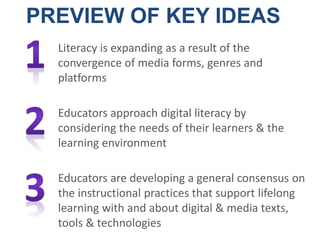
Literacy is expanding as a result of the
convergence of media forms, genres and
platforms
Educators approach digital literacy by
considering the needs of their learners & the
learning environment
Educators are developing a general consensus on
the instructional practices that support lifelong
learning with and about digital & media texts,
tools & technologies
PREVIEW OF KEY IDEAS
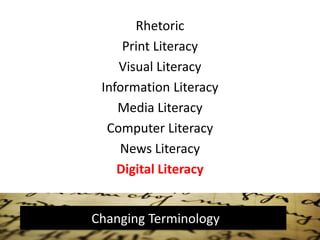
Rhetoric
Print Literacy
Visual Literacy
Information Literacy
Media Literacy
Computer Literacy
News Literacy
Digital Literacy
Changing Terminology
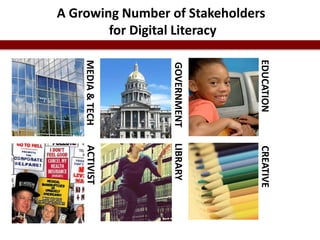
MEDIA&TECHACTIVIST
GOVERNMENTLIBRARY
EDUCATIONCREATIVE
A Growing Number of Stakeholders
for Digital Literacy
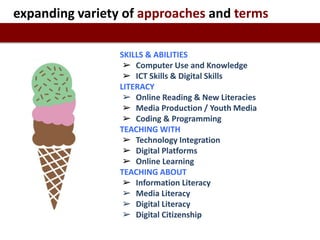
SKILLS & ABILITIES
➢ Computer Use and Knowledge
➢ ICT Skills & Digital Skills
LITERACY
➢ Online Reading & New Literacies
➢ Media Production / Youth Media
➢ Coding & Programming
TEACHING WITH
➢ Technology Integration
➢ Digital Platforms
➢ Online Learning
TEACHING ABOUT
➢ Information Literacy
➢ Media Literacy
➢ Digital Literacy
➢ Digital Citizenship
expanding variety of approaches and terms
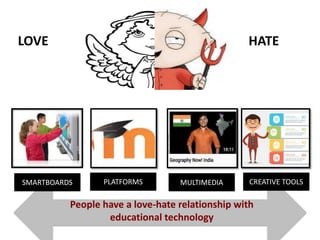
LOVE HATE
SMARTBOARDS PLATFORMS MULTIMEDIA CREATIVE TOOLS
People have a love-hate relationship with
educational technology
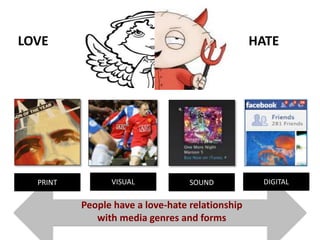
LOVE HATE
PRINT VISUAL SOUND DIGITAL
People have a love-hate relationship
with media genres and forms
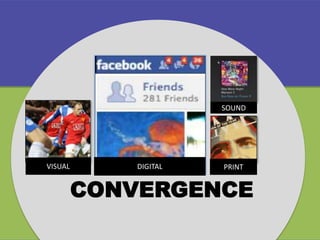
PRINTVISUAL
SOUND
DIGITAL
CONVERGENCE
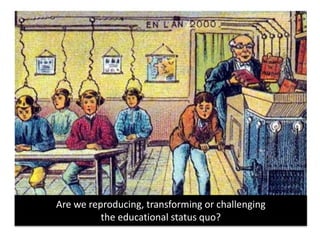
Are we reproducing, transforming or challenging
the educational status quo?
Educators have differing perspectives about
the most important priorities for the practice
of digital literacy
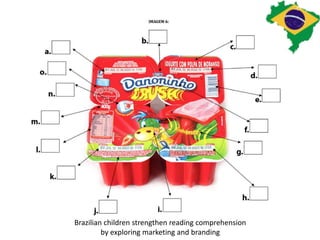
Brazilian children strengthen reading comprehension
by exploring marketing and branding
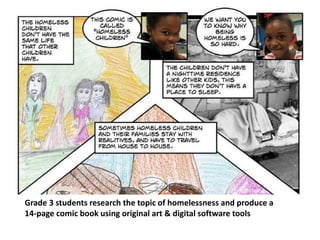
Grade 3 students research the topic of homelessness and produce a
14-page comic book using original art & digital software tools
https://newseumed.org/ed-tools/
http://uccollab.org/program/poppyn/
Educators have differing perspectives about
the most important priorities for the practice
of media education BUT
There is widespread consensus among US
educators about the learning processes that
promote lifelong learning
There is widespread consensus about the
instructional processes that promote lifelong
learning
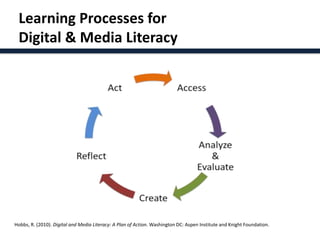
Learning Processes for
Digital & Media Literacy
Hobbs, R. (2010). Digital and Media Literacy: A Plan of Action. Washington DC: Aspen Institute and Knight Foundation.
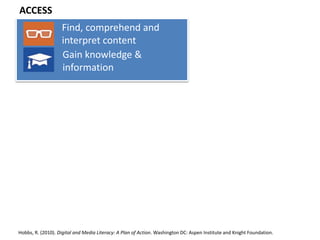
Find, comprehend and
interpret content
Gain knowledge &
information
Collaborate &
share ideas
through
dialogue &
discussion
Reflect on
expected &
unanticipated
consequences
Plan and
implement
action
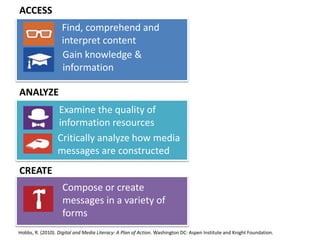
ACCESS
Hobbs, R. (2010). Digital and Media Literacy: A Plan of Action. Washington DC: Aspen Institute and Knight Foundation.
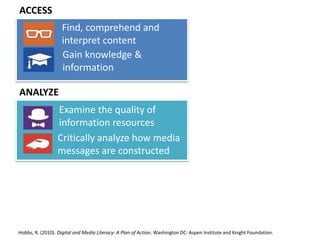
Find, comprehend and
interpret content
Gain knowledge &
information
Critically analyze how media
messages are constructed
Examine the quality of
information resources
Compose or create
messages in a variety of
forms
Reflect on
expected &
unanticipated
consequences
Plan and
implement
action
ACCESS
ANALYZE
Hobbs, R. (2010). Digital and Media Literacy: A Plan of Action. Washington DC: Aspen Institute and Knight Foundation.
Find, comprehend and
interpret content
Gain knowledge &
information
Critically analyze how media
messages are constructed
Examine the quality of
information resources
Compose or create
messages in a variety of
forms
Reflect on
expected &
unanticipated
consequences
ACCESS
ANALYZE
CREATE
Hobbs, R. (2010). Digital and Media Literacy: A Plan of Action. Washington DC: Aspen Institute and Knight Foundation.
Find, comprehend and
interpret content
Gain knowledge &
information
Critically analyze how media
messages are constructed
Examine the quality of
information resources
Compose or create
messages in a variety of
forms
Collaborate &
share ideas
through
dialogue &
discussion
Reflect on
expected &
unanticipated
consequences
Plan and
implement
action
ACCESS
ANALYZE
CREATE
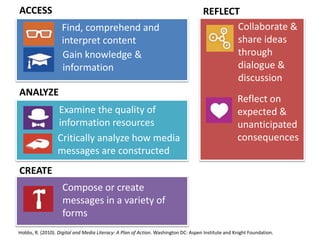
REFLECT
Hobbs, R. (2010). Digital and Media Literacy: A Plan of Action. Washington DC: Aspen Institute and Knight Foundation.
Find, comprehend and
interpret content
Gain knowledge &
information
Critically analyze how media
messages are constructed
Examine the quality of
information resources
Compose or create
messages in a variety of
forms
Collaborate &
share ideas
through
dialogue &
discussion
Reflect on
expected &
unanticipated
consequences
Plan and
implement
action
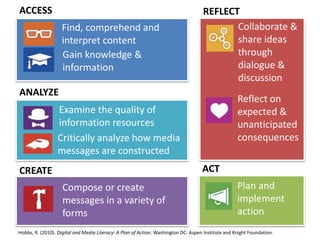
ACCESS
ANALYZE
CREATE ACT
REFLECT
Hobbs, R. (2010). Digital and Media Literacy: A Plan of Action. Washington DC: Aspen Institute and Knight Foundation.
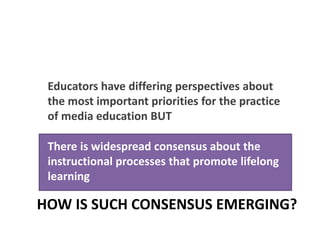
Educators have differing perspectives about
the most important priorities for the practice
of media education BUT
There is widespread consensus among US
educators about the learning processes that
promote lifelong learning
There is widespread consensus about the
instructional processes that promote lifelong
learning
HOW IS SUCH CONSENSUS EMERGING?
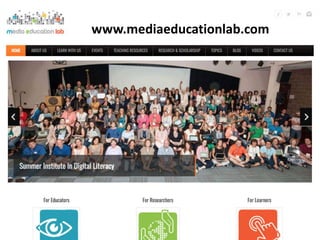
www.mediaeducationlab.com
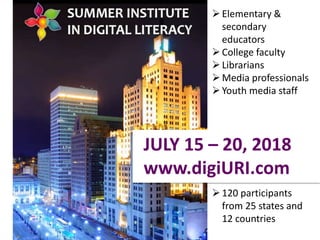
JULY 15 – 20, 2018
www.digiURI.com
Elementary &
secondary
educators
College faculty
Librarians
Media professionals
Youth media staff
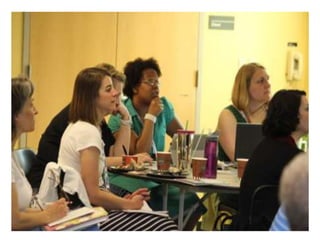
120 participants
from 25 states and
12 countries
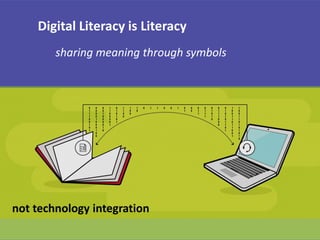
Digital Literacy is Literacy
not technology integration
sharing meaning through symbols
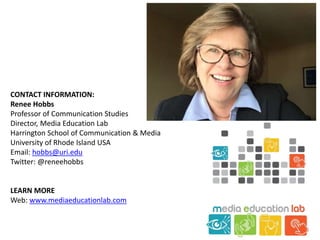
CONTACT INFORMATION:
Renee Hobbs
Professor of Communication Studies
Director, Media Education Lab
Harrington School of Communication & Media
University of Rhode Island USA
Email: hobbs@uri.edu
Twitter: @reneehobbs
LEARN MORE
Web: www.mediaeducationlab.com

Digital Literacy Decoded

  • 1.
    Renee Hobbs Professor ofCommunication Studies Director, Media Education Lab University of Rhode Island USA Twitter: @reneehobbs Digital Literacy Decoded #moboces
  • 2.
    What essential competenciesare needed to be citizens in a digital age? How can we support students in developing these competencies in the 21st century learning environment? TODAY’S THEME
  • 3.
    Literacy is expandingas a result of the convergence of media forms, genres and platforms Educators approach digital literacy by considering the needs of their learners & the learning environment Educators are developing a general consensus on the instructional practices that support lifelong learning with and about digital & media texts, tools & technologies PREVIEW OF KEY IDEAS
  • 4.
    Rhetoric Print Literacy Visual Literacy InformationLiteracy Media Literacy Computer Literacy News Literacy Digital Literacy Changing Terminology
  • 5.
  • 6.
    SKILLS & ABILITIES ➢Computer Use and Knowledge ➢ ICT Skills & Digital Skills LITERACY ➢ Online Reading & New Literacies ➢ Media Production / Youth Media ➢ Coding & Programming TEACHING WITH ➢ Technology Integration ➢ Digital Platforms ➢ Online Learning TEACHING ABOUT ➢ Information Literacy ➢ Media Literacy ➢ Digital Literacy ➢ Digital Citizenship expanding variety of approaches and terms
  • 7.
    LOVE HATE SMARTBOARDS PLATFORMSMULTIMEDIA CREATIVE TOOLS People have a love-hate relationship with educational technology
  • 8.
    LOVE HATE PRINT VISUALSOUND DIGITAL People have a love-hate relationship with media genres and forms
  • 9.
  • 11.
    Are we reproducing,transforming or challenging the educational status quo?
  • 12.
    Educators have differingperspectives about the most important priorities for the practice of digital literacy
  • 16.
    Brazilian children strengthenreading comprehension by exploring marketing and branding
  • 18.
    Grade 3 studentsresearch the topic of homelessness and produce a 14-page comic book using original art & digital software tools
  • 22.
  • 24.
  • 27.
    Educators have differingperspectives about the most important priorities for the practice of media education BUT There is widespread consensus among US educators about the learning processes that promote lifelong learning There is widespread consensus about the instructional processes that promote lifelong learning
  • 28.
    Learning Processes for Digital& Media Literacy Hobbs, R. (2010). Digital and Media Literacy: A Plan of Action. Washington DC: Aspen Institute and Knight Foundation.
  • 29.
    Find, comprehend and interpretcontent Gain knowledge & information Collaborate & share ideas through dialogue & discussion Reflect on expected & unanticipated consequences Plan and implement action ACCESS Hobbs, R. (2010). Digital and Media Literacy: A Plan of Action. Washington DC: Aspen Institute and Knight Foundation.
  • 30.
    Find, comprehend and interpretcontent Gain knowledge & information Critically analyze how media messages are constructed Examine the quality of information resources Compose or create messages in a variety of forms Reflect on expected & unanticipated consequences Plan and implement action ACCESS ANALYZE Hobbs, R. (2010). Digital and Media Literacy: A Plan of Action. Washington DC: Aspen Institute and Knight Foundation.
  • 31.
    Find, comprehend and interpretcontent Gain knowledge & information Critically analyze how media messages are constructed Examine the quality of information resources Compose or create messages in a variety of forms Reflect on expected & unanticipated consequences ACCESS ANALYZE CREATE Hobbs, R. (2010). Digital and Media Literacy: A Plan of Action. Washington DC: Aspen Institute and Knight Foundation.
  • 32.
    Find, comprehend and interpretcontent Gain knowledge & information Critically analyze how media messages are constructed Examine the quality of information resources Compose or create messages in a variety of forms Collaborate & share ideas through dialogue & discussion Reflect on expected & unanticipated consequences Plan and implement action ACCESS ANALYZE CREATE REFLECT Hobbs, R. (2010). Digital and Media Literacy: A Plan of Action. Washington DC: Aspen Institute and Knight Foundation.
  • 33.
    Find, comprehend and interpretcontent Gain knowledge & information Critically analyze how media messages are constructed Examine the quality of information resources Compose or create messages in a variety of forms Collaborate & share ideas through dialogue & discussion Reflect on expected & unanticipated consequences Plan and implement action ACCESS ANALYZE CREATE ACT REFLECT Hobbs, R. (2010). Digital and Media Literacy: A Plan of Action. Washington DC: Aspen Institute and Knight Foundation.
  • 34.
    Educators have differingperspectives about the most important priorities for the practice of media education BUT There is widespread consensus among US educators about the learning processes that promote lifelong learning There is widespread consensus about the instructional processes that promote lifelong learning HOW IS SUCH CONSENSUS EMERGING?
  • 38.
  • 39.
    JULY 15 –20, 2018 www.digiURI.com Elementary & secondary educators College faculty Librarians Media professionals Youth media staff 120 participants from 25 states and 12 countries
  • 40.
    Digital Literacy isLiteracy not technology integration sharing meaning through symbols
  • 41.
    CONTACT INFORMATION: Renee Hobbs Professorof Communication Studies Director, Media Education Lab Harrington School of Communication & Media University of Rhode Island USA Email: hobbs@uri.edu Twitter: @reneehobbs LEARN MORE Web: www.mediaeducationlab.com