Information and digital literacy at LSE Dr Jane Secker LSE Centre for Learning Technology COFHE LASEG / IL Group TeachMeet 23rd May 2011
Overview Definitions of information and digital literacy and useful models Information & digital literacy in practice at LSE Undergraduates PhD students Staff
Definition of information literacy Information literacy empowers people in all walks of life to seek, evaluate, use and create information effectively to achieve their personal, social, occupational and educational goals. It is a basic human right in a digital world and promotes social inclusion in all nations. UNESCO (2005) Alexandria Proclamation   “… Information literacy is knowing when and why you need information, where to find it, and how to evaluate, use and communicate it in an ethical manner. CILIP (2004) Information literacy definition
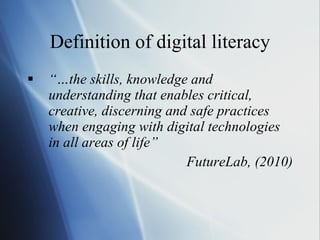
Definition of digital literacy “… the skills, knowledge and understanding that enables critical, creative, discerning and safe practices when engaging with digital technologies in all areas of life”  FutureLab, (2010)
 
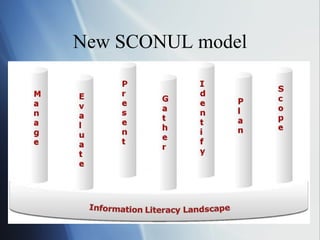
New SCONUL model
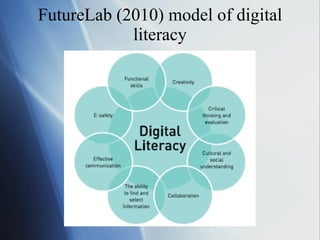
FutureLab (2010) model of digital literacy
IL in practice at LSE Information skills classes run by Library Open to all students – focus on PGTs and UGs Optional – run each term Covers using library resources, literature searching, internet searching, citing and referencing, Endnote, keeping up to date Taught by Library staff Full programme listed on  LSE Library website
Embedding IL in undergraduate study LSE100 is a core course for all undergraduate students (pilot in 2009/10 now compulsory) Understanding the cause of things: thinking like a social scientist Tackles the big questions in the social sciences and taught by leading academics Has information, methodological and communication skills embedded  An online tutorial is available to students in Moodle to support the essay writing process Evidence suggests students who use the tutorial perform better in final exam - need further research
DL in practice at LSE Digital literacy classes run by CLT and Library Open to all staff and PhD students Optional – run each term Cover using web 2.0 tools (social networking, social bookmarking, Twitter, blogging), internet searching, keeping up to date, managing your web presence Taught by CLT and Library staff Further information on  CLT website
The MI512 programme Information and digital literacy course comprising of six 2 hour workshops Aimed primarily at new PhD students Builds up skills over programme Specialist advice and support from liaison librarians Taught by CLT / Library staff Supported online in  Moodle
Course contents Week 1: Starting a literature search Week 2: Going beyond Google Week 3: Locating research publications  Week 4: Specialist materials: primary sources  Week 5: Managing information Week 6: Next steps and keeping up to date Overview on  LSE Library website
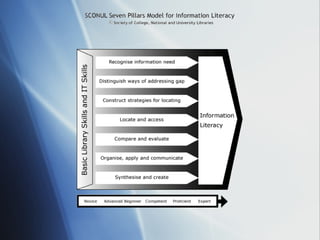
Course structure Pre-course assessment Activity based workshops all in computer classrooms Support in Moodle but primarily F2F Based around SCONUL 7 pillars and designed (and redesigned) to support student learning Post course evaluation Tailored feedback given to each student
What next at LSE? Draft information and digital literacy strategy needs to be adopted More closely align training programmes to the Researcher Development Framework Continue to work collaboratively with other training providers across LSE to avoid duplication and better target training Follow on course to MI512 Further evaluation of impact of LSE100
Useful references Jones, C, Ramanau, R, Cross, S and Healing, G (2010) ‘Net generation or Digital Natives: Is there a distinct new generation entering university?’,  Computers & Education ,  54, (3) , 722-732. Margaryan, A and Littlejohn, A. (2009). Are digital natives a myth or reality? Students use of technologies for learning. Available at:  http://www.academy. gcal .ac.uk/anoush/documents/DigitalNativesMythOrReality-MargaryanAndLittlejohn-draft-111208. pdf  (Accessed 2nd June 2010)  Rowlands, I. et al  ‘The Google generation: the information behaviour of the researcher of the future’,  Aslib Proceedings New Information Perspectives , 60, (4) 290-310.  SCONUL (2011) The SCONUL 7 Pillars Core model. Available at:  http://www. sconul .ac. uk/groups/information_literacy/seven_pillars .html   Secker, Jane and Macrae-Gibson, Rowena.  (2011) Evaluating MI512: an information literacy course for PhD students.  Library Review , 60 (2). pp. 96-107. ISSN 0024-2535. Available at:  http: //eprints . lse .ac.uk/32975/   Secker, Jane and Chatzigavriil, Athina and Leape, Jonathan (2010) The impact of technologies in a first year undergraduate course for social scientists. In: European Conference on E-learning (ECEL 2010), 4 - 5th November 2010, Porto, Portugal. Available at:  http: //eprints . lse .ac.uk/32968/
Contact details Email  j. [email_address] .ac. uk Twitter @jsecker Personal Blog  http: //elearning . lse .ac. uk/blogs/socialsoftware/   DELILA Project Blog http: //delilaopen . wordpress .com   Arcadia Fellow for Easter Term based at Wolfson College / CARET so do get in touch!

Digital literacies at LSE

  • 1.
    Information and digitalliteracy at LSE Dr Jane Secker LSE Centre for Learning Technology COFHE LASEG / IL Group TeachMeet 23rd May 2011
  • 2.
    Overview Definitions ofinformation and digital literacy and useful models Information & digital literacy in practice at LSE Undergraduates PhD students Staff
  • 3.
    Definition of informationliteracy Information literacy empowers people in all walks of life to seek, evaluate, use and create information effectively to achieve their personal, social, occupational and educational goals. It is a basic human right in a digital world and promotes social inclusion in all nations. UNESCO (2005) Alexandria Proclamation “… Information literacy is knowing when and why you need information, where to find it, and how to evaluate, use and communicate it in an ethical manner. CILIP (2004) Information literacy definition
  • 4.
    Definition of digitalliteracy “… the skills, knowledge and understanding that enables critical, creative, discerning and safe practices when engaging with digital technologies in all areas of life” FutureLab, (2010)
  • 5.
  • 6.
  • 7.
    FutureLab (2010) modelof digital literacy
  • 8.
    IL in practiceat LSE Information skills classes run by Library Open to all students – focus on PGTs and UGs Optional – run each term Covers using library resources, literature searching, internet searching, citing and referencing, Endnote, keeping up to date Taught by Library staff Full programme listed on LSE Library website
  • 9.
    Embedding IL inundergraduate study LSE100 is a core course for all undergraduate students (pilot in 2009/10 now compulsory) Understanding the cause of things: thinking like a social scientist Tackles the big questions in the social sciences and taught by leading academics Has information, methodological and communication skills embedded An online tutorial is available to students in Moodle to support the essay writing process Evidence suggests students who use the tutorial perform better in final exam - need further research
  • 10.
    DL in practiceat LSE Digital literacy classes run by CLT and Library Open to all staff and PhD students Optional – run each term Cover using web 2.0 tools (social networking, social bookmarking, Twitter, blogging), internet searching, keeping up to date, managing your web presence Taught by CLT and Library staff Further information on CLT website
  • 11.
    The MI512 programmeInformation and digital literacy course comprising of six 2 hour workshops Aimed primarily at new PhD students Builds up skills over programme Specialist advice and support from liaison librarians Taught by CLT / Library staff Supported online in Moodle
  • 12.
    Course contents Week1: Starting a literature search Week 2: Going beyond Google Week 3: Locating research publications Week 4: Specialist materials: primary sources Week 5: Managing information Week 6: Next steps and keeping up to date Overview on LSE Library website
  • 13.
    Course structure Pre-courseassessment Activity based workshops all in computer classrooms Support in Moodle but primarily F2F Based around SCONUL 7 pillars and designed (and redesigned) to support student learning Post course evaluation Tailored feedback given to each student
  • 14.
    What next atLSE? Draft information and digital literacy strategy needs to be adopted More closely align training programmes to the Researcher Development Framework Continue to work collaboratively with other training providers across LSE to avoid duplication and better target training Follow on course to MI512 Further evaluation of impact of LSE100
  • 15.
    Useful references Jones,C, Ramanau, R, Cross, S and Healing, G (2010) ‘Net generation or Digital Natives: Is there a distinct new generation entering university?’, Computers & Education , 54, (3) , 722-732. Margaryan, A and Littlejohn, A. (2009). Are digital natives a myth or reality? Students use of technologies for learning. Available at: http://www.academy. gcal .ac.uk/anoush/documents/DigitalNativesMythOrReality-MargaryanAndLittlejohn-draft-111208. pdf (Accessed 2nd June 2010) Rowlands, I. et al ‘The Google generation: the information behaviour of the researcher of the future’, Aslib Proceedings New Information Perspectives , 60, (4) 290-310. SCONUL (2011) The SCONUL 7 Pillars Core model. Available at: http://www. sconul .ac. uk/groups/information_literacy/seven_pillars .html Secker, Jane and Macrae-Gibson, Rowena. (2011) Evaluating MI512: an information literacy course for PhD students. Library Review , 60 (2). pp. 96-107. ISSN 0024-2535. Available at: http: //eprints . lse .ac.uk/32975/ Secker, Jane and Chatzigavriil, Athina and Leape, Jonathan (2010) The impact of technologies in a first year undergraduate course for social scientists. In: European Conference on E-learning (ECEL 2010), 4 - 5th November 2010, Porto, Portugal. Available at: http: //eprints . lse .ac.uk/32968/
  • 16.
    Contact details Email j. [email_address] .ac. uk Twitter @jsecker Personal Blog http: //elearning . lse .ac. uk/blogs/socialsoftware/ DELILA Project Blog http: //delilaopen . wordpress .com Arcadia Fellow for Easter Term based at Wolfson College / CARET so do get in touch!