Ed.Tech. 2 Teacher:
Ms. Mizpahgen Morrala
Septone H. Tafalla 3D3
BEED-Generalist
Tasked Reporter
Characteristics of
Online Interaction
Dr. Brent Muirhead
• a Senior Editor of Online Learning
• Brent makes substantial contributions behind the
scenes in addition to his personal commitment to
research, publication and teaching.
• Dr. Muirhead is the area chair for the program in
curriculum and technology for the University of
Phoenix Online (UOP). He teaches a variety of
undergraduate and graduate level courses in their
online and local Atlanta, Georgia campuses and
mentors faculty candidates.
• Interaction is a powerful facilitator for
learning, and this is especially true for online
learning.
• Recognition of the ability of adult learners to
assume responsibility for their own learning .
• The majority of professors in higher
education have little or no formal training as
teachers .
•Students - Instructor
•Students - Students
•Students - Content
Students - Instructor
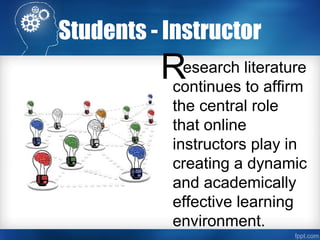
esearch literature
continues to affirm
the central role
that online
instructors play in
creating a dynamic
and academically
effective learning
environment.
R
P
Students - Instructor
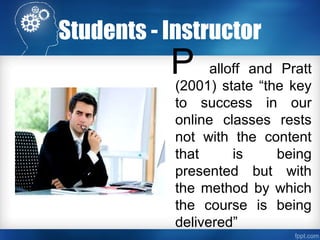
alloff and Pratt
(2001) state “the key
to success in our
online classes rests
not with the content
that is being
presented but with
the method by which
the course is being
delivered”
Students - Students
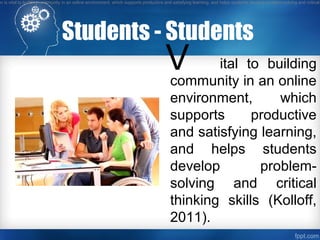
ital to building
community in an online
environment, which
supports productive
and satisfying learning,
and helps students
develop problem-
solving and critical
thinking skills (Kolloff,
2011).
on is vital to building community in an online environment, which supports productive and satisfying learning, and helps students develop problem-solving and critical
V
Students - Students
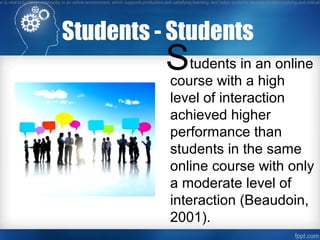
tudents in an online
course with a high
level of interaction
achieved higher
performance than
students in the same
online course with only
a moderate level of
interaction (Beaudoin,
2001).
on is vital to building community in an online environment, which supports productive and satisfying learning, and helps students develop problem-solving and critical
S
Ed.Tech. 2 Teacher:
Ms. Mizpahgen Morrala
Santy Lintuan 3D3
BEED-Generalist
Tasked Reporter
Students - Content
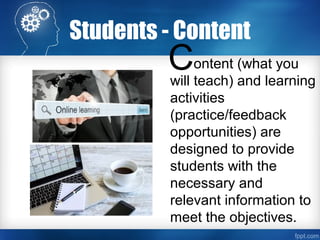
ontent (what you
will teach) and learning
activities
(practice/feedback
opportunities) are
designed to provide
students with the
necessary and
relevant information to
meet the objectives.
C
Students - Content
Students - Content
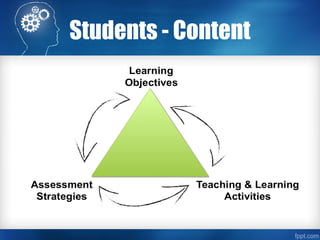
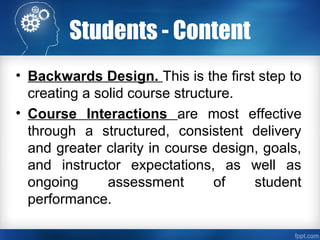
• Backwards Design. This is the first step to
creating a solid course structure.
• Course Interactions are most effective
through a structured, consistent delivery
and greater clarity in course design, goals,
and instructor expectations, as well as
ongoing assessment of student
performance.
Students - Content
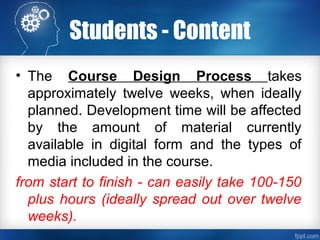
• The Course Design Process takes
approximately twelve weeks, when ideally
planned. Development time will be affected
by the amount of material currently
available in digital form and the types of
media included in the course.
from start to finish - can easily take 100-150
plus hours (ideally spread out over twelve
weeks).
Students - Content
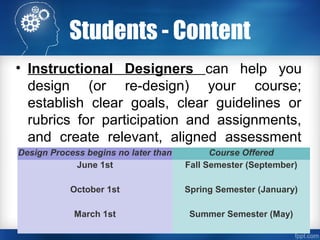
• Instructional Designers can help you
design (or re-design) your course;
establish clear goals, clear guidelines or
rubrics for participation and assignments,
and create relevant, aligned assessment
opportunities.Design Process begins no later than Course Offered
June 1st Fall Semester (September)
October 1st Spring Semester (January)
March 1st Summer Semester (May)
Students to Content
Conclusion
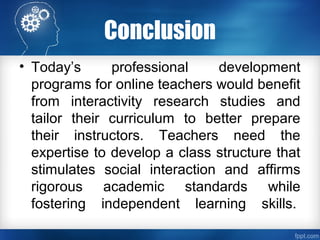
• Today’s professional development
programs for online teachers would benefit
from interactivity research studies and
tailor their curriculum to better prepare
their instructors. Teachers need the
expertise to develop a class structure that
stimulates social interaction and affirms
rigorous academic standards while
fostering independent learning skills.
Citations
• Bender, T. (2003). Discussion based online teaching to enhance student learning: Theory,
practice and assessment. Sterling, VA: Stylus.
• Collis, B. (1998). New didactics for university instruction: Why and how? Computers and
Education, 31 (4), 373-393.
• Collison, G., Elbaum, Haavind, S., and Tinker, R. (2000). Facilitating online learning. Effective
strategies for moderators. Madison, WI: Atwood Publishing.
• Farahani, G. O. (2003). Existence and importance of online interaction. Doctoral dissertation.
Virginia Polythechnic Institute and State University.
• Garrison, D. R. and Anderson, T. (2003). E-learning in the 21st
century: A framework for
research and practice. London, UK: RoutledgeFarmer.
• Gibson, C. C. (2003). Learners and learning: The need for theory. In M. G. Moore and W. G.
Anderson ( Eds.). Handbook of distance education. Mahwah, NJ: Lawrence Erlbaum
Associates.
• Hannafin, M. J., Hill, J. R. and Land, S. M., (1997). Student-centered learning and interactive
multimedia: Status, issues, and implications. Contemporary Education, 68 (2), 94-99.
• Janicki, T. and Liegle, J. O. (2001). Development and evaluation of a framework for creating
web-based learning modules: a pedagogical and systems approach. Journal of Asynchronous
Learning Networks, 5 (1). Available: http://www.aln.org/publications/jaln/v5n1/v5n1_janicki.asp
•
Citations
• Meyer, K. A. (2002). Quality in distance education: Focus on on-line learning. San Francisco,
CA: Jossey-Bass.
• Mortera-Gutierrez, F. (2002). Instructor interactions in distance education environments.
Journal of Interactive Learning Research, 13 (3), 191-209.
• Palloff, R. M. and Pratt, K. (2001). Lessons from the cbyerspace classroom: The realities of
online teaching. San Francisco: Jossey-Bass.
• Shearer, R. L. (2003). Interaction in distance education. Special Report 2 (1). Madison, WI:
Atwood Publishing.
• Spitzer, D. R., (1998). Rediscovering the social context of distance learning. Educational
Technology, 38 (2), 52-56.
• Swan, K. (2001). Virtual interaction: Design factors affecting student satisfaction and
perceived learning in asynchronous online courses. Distance Education, 22, 306-331.
• Thurmond, V. A. (2003). Examination of interaction variables as predictors of students’
satisfaction and willingness to enroll in future Web-based courses. Doctoral dissertation.
University of Kansas Medical Center, Kansas City, KS.
• Vrasidas, C. and Glass, G. V. (2002). A conceptual framework for studying distance
education. In C. Vrasidas and G. V. Glass (Eds.). Distance education and distributed
learning. Greenwich, CT: Information Age.
Importance of Interaction      Member: Septone H. Tafalla and Santy Lintuan 3D3 BEED

Importance of Interaction Member: Septone H. Tafalla and Santy Lintuan 3D3 BEED

  • 1.
    Ed.Tech. 2 Teacher: Ms.Mizpahgen Morrala Septone H. Tafalla 3D3 BEED-Generalist Tasked Reporter
  • 2.
  • 3.
    Dr. Brent Muirhead •a Senior Editor of Online Learning • Brent makes substantial contributions behind the scenes in addition to his personal commitment to research, publication and teaching. • Dr. Muirhead is the area chair for the program in curriculum and technology for the University of Phoenix Online (UOP). He teaches a variety of undergraduate and graduate level courses in their online and local Atlanta, Georgia campuses and mentors faculty candidates.
  • 4.
    • Interaction isa powerful facilitator for learning, and this is especially true for online learning. • Recognition of the ability of adult learners to assume responsibility for their own learning . • The majority of professors in higher education have little or no formal training as teachers .
  • 6.
    •Students - Instructor •Students- Students •Students - Content
  • 7.
    Students - Instructor esearchliterature continues to affirm the central role that online instructors play in creating a dynamic and academically effective learning environment. R
  • 8.
    P Students - Instructor alloffand Pratt (2001) state “the key to success in our online classes rests not with the content that is being presented but with the method by which the course is being delivered”
  • 9.
    Students - Students italto building community in an online environment, which supports productive and satisfying learning, and helps students develop problem- solving and critical thinking skills (Kolloff, 2011). on is vital to building community in an online environment, which supports productive and satisfying learning, and helps students develop problem-solving and critical V
  • 10.
    Students - Students tudentsin an online course with a high level of interaction achieved higher performance than students in the same online course with only a moderate level of interaction (Beaudoin, 2001). on is vital to building community in an online environment, which supports productive and satisfying learning, and helps students develop problem-solving and critical S
  • 11.
    Ed.Tech. 2 Teacher: Ms.Mizpahgen Morrala Santy Lintuan 3D3 BEED-Generalist Tasked Reporter
  • 12.
    Students - Content ontent(what you will teach) and learning activities (practice/feedback opportunities) are designed to provide students with the necessary and relevant information to meet the objectives. C
  • 13.
  • 14.
    Students - Content •Backwards Design. This is the first step to creating a solid course structure. • Course Interactions are most effective through a structured, consistent delivery and greater clarity in course design, goals, and instructor expectations, as well as ongoing assessment of student performance.
  • 15.
    Students - Content •The Course Design Process takes approximately twelve weeks, when ideally planned. Development time will be affected by the amount of material currently available in digital form and the types of media included in the course. from start to finish - can easily take 100-150 plus hours (ideally spread out over twelve weeks).
  • 16.
    Students - Content •Instructional Designers can help you design (or re-design) your course; establish clear goals, clear guidelines or rubrics for participation and assignments, and create relevant, aligned assessment opportunities.Design Process begins no later than Course Offered June 1st Fall Semester (September) October 1st Spring Semester (January) March 1st Summer Semester (May)
  • 17.
  • 18.
    Conclusion • Today’s professionaldevelopment programs for online teachers would benefit from interactivity research studies and tailor their curriculum to better prepare their instructors. Teachers need the expertise to develop a class structure that stimulates social interaction and affirms rigorous academic standards while fostering independent learning skills.
  • 19.
    Citations • Bender, T.(2003). Discussion based online teaching to enhance student learning: Theory, practice and assessment. Sterling, VA: Stylus. • Collis, B. (1998). New didactics for university instruction: Why and how? Computers and Education, 31 (4), 373-393. • Collison, G., Elbaum, Haavind, S., and Tinker, R. (2000). Facilitating online learning. Effective strategies for moderators. Madison, WI: Atwood Publishing. • Farahani, G. O. (2003). Existence and importance of online interaction. Doctoral dissertation. Virginia Polythechnic Institute and State University. • Garrison, D. R. and Anderson, T. (2003). E-learning in the 21st century: A framework for research and practice. London, UK: RoutledgeFarmer. • Gibson, C. C. (2003). Learners and learning: The need for theory. In M. G. Moore and W. G. Anderson ( Eds.). Handbook of distance education. Mahwah, NJ: Lawrence Erlbaum Associates. • Hannafin, M. J., Hill, J. R. and Land, S. M., (1997). Student-centered learning and interactive multimedia: Status, issues, and implications. Contemporary Education, 68 (2), 94-99. • Janicki, T. and Liegle, J. O. (2001). Development and evaluation of a framework for creating web-based learning modules: a pedagogical and systems approach. Journal of Asynchronous Learning Networks, 5 (1). Available: http://www.aln.org/publications/jaln/v5n1/v5n1_janicki.asp •
  • 20.
    Citations • Meyer, K.A. (2002). Quality in distance education: Focus on on-line learning. San Francisco, CA: Jossey-Bass. • Mortera-Gutierrez, F. (2002). Instructor interactions in distance education environments. Journal of Interactive Learning Research, 13 (3), 191-209. • Palloff, R. M. and Pratt, K. (2001). Lessons from the cbyerspace classroom: The realities of online teaching. San Francisco: Jossey-Bass. • Shearer, R. L. (2003). Interaction in distance education. Special Report 2 (1). Madison, WI: Atwood Publishing. • Spitzer, D. R., (1998). Rediscovering the social context of distance learning. Educational Technology, 38 (2), 52-56. • Swan, K. (2001). Virtual interaction: Design factors affecting student satisfaction and perceived learning in asynchronous online courses. Distance Education, 22, 306-331. • Thurmond, V. A. (2003). Examination of interaction variables as predictors of students’ satisfaction and willingness to enroll in future Web-based courses. Doctoral dissertation. University of Kansas Medical Center, Kansas City, KS. • Vrasidas, C. and Glass, G. V. (2002). A conceptual framework for studying distance education. In C. Vrasidas and G. V. Glass (Eds.). Distance education and distributed learning. Greenwich, CT: Information Age.