Building a Digital Library
              Ed Fay
     Digital Library Manager

        e.fay@lse.ac.uk
           @digitalfay
Building a Digital Library
  Context
      •Library collections and trends
      •Digital/physical and local/£
  What, Why, and How
      •Mission | strategy | operation
      •Business case
      •Roles and responsibilities
      •Skills
  Conclusions
      •Lessons learnt
  Questions
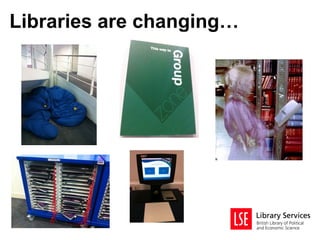
Libraries are changing…
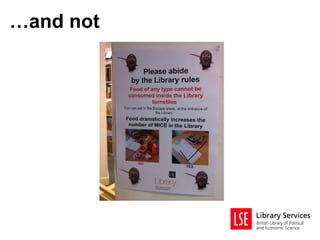
…and not
But, first:

Just to clear something up …

‘Digital’ vs ‘electronic’ is meaningless
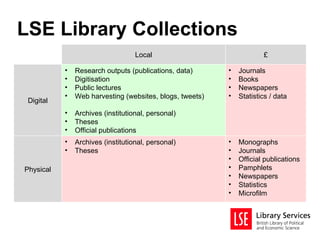
LSE Library Collections
                                   Local                              £

           •   Research outputs (publications, data)      •   Journals
           •   Digitisation                               •   Books
           •   Public lectures                            •   Newspapers
           •   Web harvesting (websites, blogs, tweets)   •   Statistics / data
 Digital
           •   Archives (institutional, personal)
           •   Theses
           •   Official publications
           •   Archives (institutional, personal)         •   Monographs
           •   Theses                                     •   Journals
                                                          •   Official publications
Physical                                                  •   Pamphlets
                                                          •   Newspapers
                                                          •   Statistics
                                                          •   Microfilm
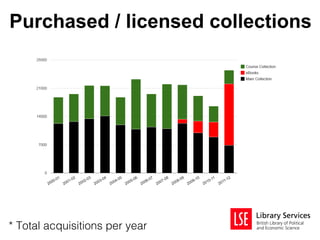
Purchased / licensed collections


* Total acquisitions per year
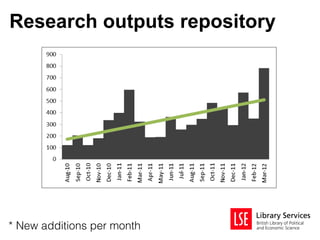
Research outputs repository


* New additions per month
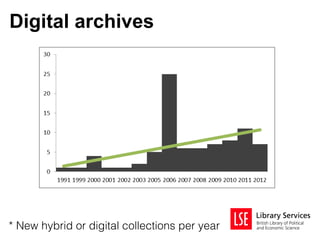
Digital archives


* New hybrid or digital collections per year
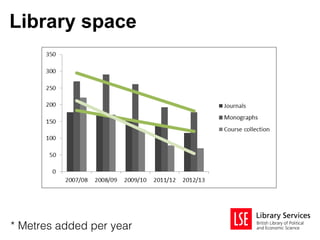
Library space


* Metres added per year
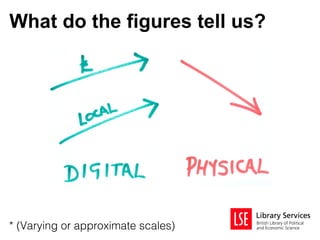
What do the figures tell us?


* (Varying or approximate scales)
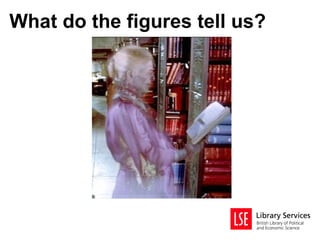
What do the figures tell us?
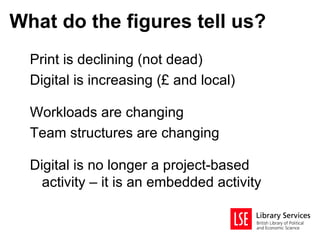
  Print is declining (not dead)
  Digital is increasing (£ and local)

  Workloads are changing
  Team structures are changing

  Digital is no longer a project-based
    activity – it is an embedded activity
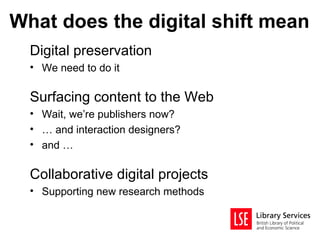
What does the digital shift mean
  Digital preservation
  • We need to do it

  Surfacing content to the Web
  • Wait, we’re publishers now?
  • … and interaction designers?
  • and …

  Collaborative digital projects
  • Supporting new research methods
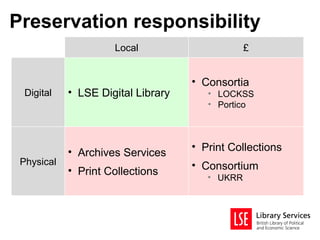
Preservation responsibility
                     Local                      £


                                    • Consortia
  Digital   • LSE Digital Library      • LOCKSS
                                       • Portico


            • Archives Services     • Print Collections
 Physical                           • Consortium
            • Print Collections
                                       • UKRR
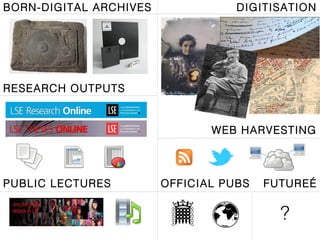
BORN-DIGITAL ARCHIVES              DIGITISATION


RESEARCH OUTPUTS


                               WEB HARVESTING


PUBLIC LECTURES         OFFICIAL PUBS   FUTURE…


                                          ?
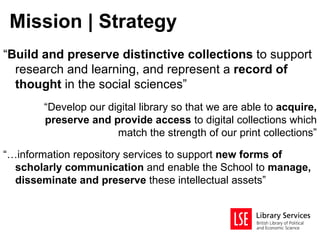
Mission | Strategy
“Build and preserve distinctive collections to support
  research and learning, and represent a record of
  thought in the social sciences”
       “Develop our digital library so that we are able to acquire,
       preserve and provide access to digital collections which
                      match the strength of our print collections”

“…information repository services to support new forms of
  scholarly communication and enable the School to manage,
  disseminate and preserve these intellectual assets”
Business Case
 • Collections audit
   • Formats, volume/growth

 • User and functional requirements
   • Preservation, access

 • Options appraisal (‘market survey’)
   • Best practice investigation, repository architectures

 • Proposal
   • Risk assessment: threats to our strategic objectives
   • Solution: working practices, skills, infrastructure
   • Development roadmap
Trust

  That’s what it’s all about.

  I mean everything.

  Seriously.

  Here’s why…
I [trust] LSE Digital Library
                                       Activity
                                   overlooked or
                                       under
                                     resourced
                  Inadequate
                   staff skills
   Media                             Failure of
degradation or                      authenticity,
obsolescence                         integrity,
                    Loss of         provenance
                   essential                        Loss of trust
                 characteristics                    or reputation
 Insufficient                         Cannot
  backups                           implement
                                   preservation
                 Infrastructure
                                       plans
                     cannot
                    support
                 requirements
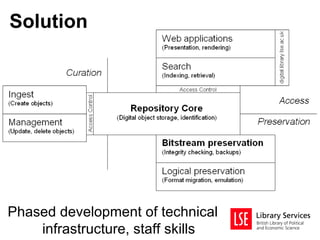
Solution


Phased development of technical
    infrastructure, staff skills
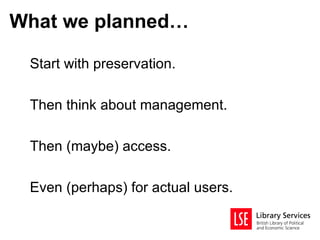
What we planned…

 Start with preservation.

 Then think about management.

 Then (maybe) access.

 Even (perhaps) for actual users.
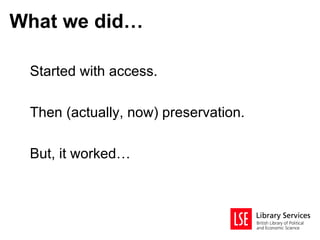
What we did…

 Started with access.

 Then (actually, now) preservation.

 But, it worked…
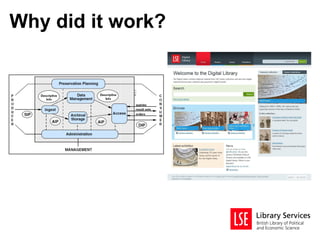
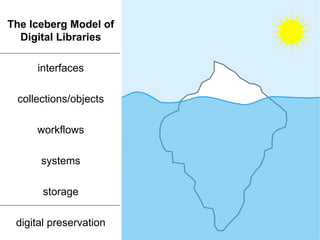
Why did it work?
The Iceberg Model of
  Digital Libraries

     interfaces

 collections/objects

     workflows

      systems

       storage

 digital preservation
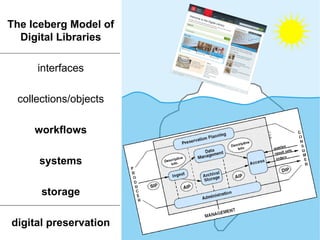
The Iceberg Model of
  Digital Libraries

     interfaces

 collections/objects

     workflows

      systems

      storage

digital preservation
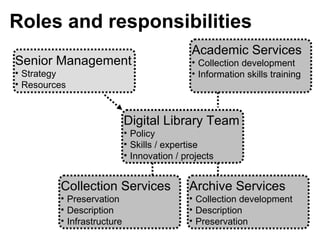
Roles and responsibilities
                                             Academic Services
Senior Management                            • Collection development
                                             Collection development
• Strategy                                   • Information skills training
                                             Information skills training
• Resources


                            Digital Library Team
                            • Policy
                            Policy
                            • Skills expertise
                            Skills / / expertise
                            • Innovation / projects
                            Innovation / projects


         Collection Services                Archive Services
         • Preservation
         Preservation                       • Collection development
                                            Collection development
         • Description
         Description                        • Description
                                            Description
         • Infrastructure
         Infrastructure                     • Preservation
                                            Preservation
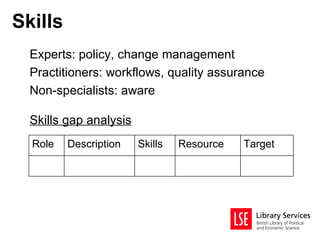
Skills
  Experts: policy, change management
  Practitioners: workflows, quality assurance
  Non-specialists: aware

  Skills gap analysis
  Role   Description    Skills   Resource   Target
SPRUCE
 a project to inspire, guide, support and enable UK HEIs
    to address preservation gaps; and to use the
    knowledge gathered from that support work to
    articulate a compelling business case for digital
    preservation

 • Events: digital preservation solutions
 • Embedding: grants to continue work
 • Business case: benefits, skills gaps
   http://dpconline.org/advocacy/spruce
DICE


 (Digital Communications Enhancement)
 Training materials to raise awareness of
   digital preservation in researchers and
   library training providers

       http://lsedice.wordpress.com
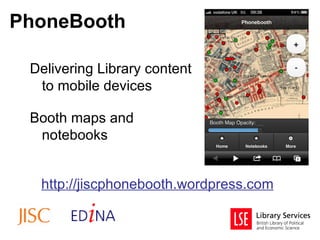
PhoneBooth

 Delivering Library content
  to mobile devices

 Booth maps and
  notebooks


  http://jiscphonebooth.wordpress.com
Conclusions
 Digital is changing the how of
  libraries, not the what or why
 Skills are fundamental, then working
  practices and infrastructure
 If we don’t do this, we fail …
            … but, digital is also fun 
Questions?
 me: twitter.com/digitalfay or e.fay@lse.ac.uk

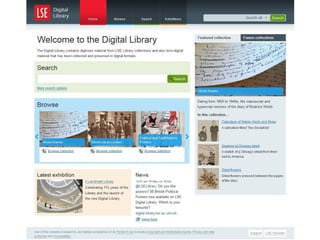
 LSE Digital Library: digital.library.lse.ac.uk

 SPRUCE: dpconline.org/advocacy/spruce

 PhoneBooth: jiscphonebooth.wordpress.com

 DICE: lsedice.wordpress.com
Image credits
    Egosiliqua malusymphonicus Guts              © Christopher Locke
                                                        (used with permission) http://heartlessmachine.com/
    Iceberg (Public Domain) Wuzur
                                                         http://commons.wikimedia.org/wiki/File:Iceberg.svg

    Simple Globe (CC-BY-SA) Tokyoship
                                                  http://commons.wikimedia.org/wiki/File:Simple_Globe.svg

    8” floppy disk (Public Domain) Pamporoff
                                          http://commons.wikimedia.org/wiki/File:8%60%60_floppy_disk.jpg

    Feed icon (GPL) Free Software Foundation
                                                              http://en.wikipedia.org/wiki/File:Feed-icon.svg

    Twitter logo © Twitter
                                                                   https://twitter.com/about/resources/logos

    Crowned Portcullis © UK Parliament
                                  http://www.parliament.uk/site-information/copyright/the-crowned-portcullis/

    OAIS Functional Entities © CCSDS
                                                    http://public.ccsds.org/publications/archive/650x0b1.pdf

    National Research Libraries logo © [unknown]
    [Still from Ghostbusters] © Columbia Pictures
    [Various Gnome icons] (GPL) Gnome icon artists

     All other images (CC-BY-NC-SA) LSE Library

Building a Digital Library

  • 1.
    Building a DigitalLibrary Ed Fay Digital Library Manager e.fay@lse.ac.uk @digitalfay
  • 3.
    Building a DigitalLibrary Context •Library collections and trends •Digital/physical and local/£ What, Why, and How •Mission | strategy | operation •Business case •Roles and responsibilities •Skills Conclusions •Lessons learnt Questions
  • 4.
  • 5.
  • 6.
    But, first: Just toclear something up … ‘Digital’ vs ‘electronic’ is meaningless
  • 7.
    LSE Library Collections Local £ • Research outputs (publications, data) • Journals • Digitisation • Books • Public lectures • Newspapers • Web harvesting (websites, blogs, tweets) • Statistics / data Digital • Archives (institutional, personal) • Theses • Official publications • Archives (institutional, personal) • Monographs • Theses • Journals • Official publications Physical • Pamphlets • Newspapers • Statistics • Microfilm
  • 8.
    Purchased / licensedcollections * Total acquisitions per year
  • 9.
    Research outputs repository *New additions per month
  • 10.
    Digital archives * Newhybrid or digital collections per year
  • 11.
    Library space * Metresadded per year
  • 12.
    What do thefigures tell us? * (Varying or approximate scales)
  • 13.
    What do thefigures tell us?
  • 14.
    What do thefigures tell us? Print is declining (not dead) Digital is increasing (£ and local) Workloads are changing Team structures are changing Digital is no longer a project-based activity – it is an embedded activity
  • 15.
    What does thedigital shift mean Digital preservation • We need to do it Surfacing content to the Web • Wait, we’re publishers now? • … and interaction designers? • and … Collaborative digital projects • Supporting new research methods
  • 16.
    Preservation responsibility Local £ • Consortia Digital • LSE Digital Library • LOCKSS • Portico • Archives Services • Print Collections Physical • Consortium • Print Collections • UKRR
  • 17.
    BORN-DIGITAL ARCHIVES DIGITISATION RESEARCH OUTPUTS WEB HARVESTING PUBLIC LECTURES OFFICIAL PUBS FUTURE… ?
  • 18.
    Mission | Strategy “Buildand preserve distinctive collections to support research and learning, and represent a record of thought in the social sciences” “Develop our digital library so that we are able to acquire, preserve and provide access to digital collections which match the strength of our print collections” “…information repository services to support new forms of scholarly communication and enable the School to manage, disseminate and preserve these intellectual assets”
  • 19.
    Business Case •Collections audit • Formats, volume/growth • User and functional requirements • Preservation, access • Options appraisal (‘market survey’) • Best practice investigation, repository architectures • Proposal • Risk assessment: threats to our strategic objectives • Solution: working practices, skills, infrastructure • Development roadmap
  • 20.
    Trust That’swhat it’s all about. I mean everything. Seriously. Here’s why…
  • 21.
    I [trust] LSEDigital Library Activity overlooked or under resourced Inadequate staff skills Media Failure of degradation or authenticity, obsolescence integrity, Loss of provenance essential Loss of trust characteristics or reputation Insufficient Cannot backups implement preservation Infrastructure plans cannot support requirements
  • 22.
    Solution Phased development oftechnical infrastructure, staff skills
  • 23.
    What we planned… Start with preservation. Then think about management. Then (maybe) access. Even (perhaps) for actual users.
  • 24.
    What we did… Started with access. Then (actually, now) preservation. But, it worked…
  • 25.
  • 26.
    The Iceberg Modelof Digital Libraries interfaces collections/objects workflows systems storage digital preservation
  • 27.
    The Iceberg Modelof Digital Libraries interfaces collections/objects workflows systems storage digital preservation
  • 28.
    Roles and responsibilities Academic Services Senior Management • Collection development Collection development • Strategy • Information skills training Information skills training • Resources Digital Library Team • Policy Policy • Skills expertise Skills / / expertise • Innovation / projects Innovation / projects Collection Services Archive Services • Preservation Preservation • Collection development Collection development • Description Description • Description Description • Infrastructure Infrastructure • Preservation Preservation
  • 29.
    Skills Experts:policy, change management Practitioners: workflows, quality assurance Non-specialists: aware Skills gap analysis Role Description Skills Resource Target
  • 30.
    SPRUCE a projectto inspire, guide, support and enable UK HEIs to address preservation gaps; and to use the knowledge gathered from that support work to articulate a compelling business case for digital preservation • Events: digital preservation solutions • Embedding: grants to continue work • Business case: benefits, skills gaps http://dpconline.org/advocacy/spruce
  • 31.
    DICE (Digital CommunicationsEnhancement) Training materials to raise awareness of digital preservation in researchers and library training providers http://lsedice.wordpress.com
  • 32.
    PhoneBooth Delivering Librarycontent to mobile devices Booth maps and notebooks http://jiscphonebooth.wordpress.com
  • 33.
    Conclusions Digital ischanging the how of libraries, not the what or why Skills are fundamental, then working practices and infrastructure If we don’t do this, we fail … … but, digital is also fun 
  • 34.
    Questions? me: twitter.com/digitalfayor e.fay@lse.ac.uk LSE Digital Library: digital.library.lse.ac.uk SPRUCE: dpconline.org/advocacy/spruce PhoneBooth: jiscphonebooth.wordpress.com DICE: lsedice.wordpress.com
  • 35.
    Image credits Egosiliqua malusymphonicus Guts © Christopher Locke (used with permission) http://heartlessmachine.com/ Iceberg (Public Domain) Wuzur http://commons.wikimedia.org/wiki/File:Iceberg.svg Simple Globe (CC-BY-SA) Tokyoship http://commons.wikimedia.org/wiki/File:Simple_Globe.svg 8” floppy disk (Public Domain) Pamporoff http://commons.wikimedia.org/wiki/File:8%60%60_floppy_disk.jpg Feed icon (GPL) Free Software Foundation http://en.wikipedia.org/wiki/File:Feed-icon.svg Twitter logo © Twitter https://twitter.com/about/resources/logos Crowned Portcullis © UK Parliament http://www.parliament.uk/site-information/copyright/the-crowned-portcullis/ OAIS Functional Entities © CCSDS http://public.ccsds.org/publications/archive/650x0b1.pdf National Research Libraries logo © [unknown] [Still from Ghostbusters] © Columbia Pictures [Various Gnome icons] (GPL) Gnome icon artists All other images (CC-BY-NC-SA) LSE Library