ICT in adult education:
tendencies in the
in the United States
R. Boyd Johnson, Ph.D,
Indiana Wesleyan University,
Indiana, USA

Presented at:
Eighth international conference
“New Information Technologies in
Education for All: Lifelong Learning”
(ITEA-2013)
November 26, 2013
Kiev, Ukraine
Dr. R. Boyd Johnson
Education: Dr. Johnson holds a
doctorate in International Studies
(Oxford University, England) and a
Masters in Anthropology (California
State University, USA)
Hometown: Indianapolis, IN, USA
Research interests: global leadership
and business, organizational
behavior, intercultural leadership.
Expertise: Experienced in all
components of publishing
academic work, has written/edited
three books and has taught over
200 courses.
2010 Sloan Foundation Report
Demonstrates the Growth of On-Line
• The 2010 Sloan Foundation
Report of Online Learning
reveals that enrollment rose
by almost one million
students from a year
earlier.
• Approximately 5.6 million
students were enrolled in at
least one online course in
fall 2009

Allen, I. E. and Seaman, J. (2010). Class differences:
Online Education in the United States, 2010 Needham
MA: Sloan Consortium
Latest Statistics
Allen & Seaman, 2013

6 714 792
Chief academic officers reporting online
education is critical to their institution’s long-term strategy
Allen & Seaman, 2013
Why?
• Professionals who are employed can keep their current jobs
while studying on-line. This is the case of many doctoral
students.
• Recent economic downturn in the US has increased
demand for online courses and programs.
• According to 2010 Sloan Report, there is widespread
agreement that higher fuel costs will lead to more students
selecting online courses.
• In addition to that institutions that offer programs to serve
working adults (adult learning programs) registered overall
enrollment growth driven by rising unemployment in the
US.
• Decreased availability of good jobs encourages more
people to seek education
Implementation: how does this work?
• software platforms (Angel, BlackBoard, etc)
used for delivering, tracking and managing
education within programs.
• It allows professors and administrators track
attendance, time on task, student progress,
deliver live chats, conduct online discussions
in the discussion boards, organize group work,
take quizzes, submit written assignments and
projects.
How does online University work?
• Teaching is asynchronous with help of online platform
BlackBoard.
• Elements of teaching: forum thematic discussions,
homework, assignments, tests, individual work.
• Additional work is done by e-mail, Skype, and also by
phone calls.
• Electronic Library(and access to other online libraries of
the country)
• Students are able to access the university platform at
any convenient for them time keeping up with terms of
turning in materials.
ICT role Easy access 1
• Easy access with help of smartphones,
touchpads, telephones (Iphone, Android,
Blackberry)

• Mobile campus is an opportunity to be the
part of students community any time and
anywhere.

• Learning process (asynchronous) can start any
time – whenever student had time and it can last
as long as student has time and energy, it can be
suddenly stopped or interrupted, for example,
urgent phone call, and can be continued from any
point.
ICT role -Easy access 2
• Learning is going by individual schedule (only weekly
deadlines are set up within classes)
• Permanent contact as with professor as with other students
and University administration
• It forms "presence" effect and generates electronic campus
phenomenon – a virtual University.
• Evolving smartphones, pocket PC and communicators
initiated development of a new branch of electronic
learning, the m-Learning (mobile learning). M-learning
means learning by means of mobile communication
devices. After downloading the course to the phone or
after getting connected to the Internet , people can read
materials, communicate with professors and take tests.
IWU MA program
https://blackboard.indwes.edu
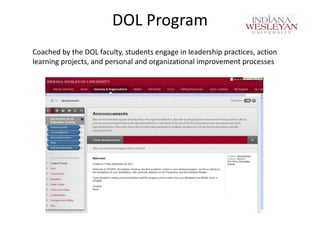
DOL Program
Coached by the DOL faculty, students engage in leadership practices, action
learning projects, and personal and organizational improvement processes
DOL Trip to Ukraine
ICT impact
• Information Communication Technologies
help educate/train adults with help of new
educational program, new teaching
approaches, new learning techniques.
• Blended learning programs (Online+onsite=
new generation of graduates).
Questions?

Thank you!
Contacts
• R. Boyd Johnson, Ph.D,
• Department of Organizational Leadership,
• Graduate Studies in Leadership,
• Indiana Wesleyan University, Indiana, USA
www.indwes.edu

R. Boyd Johnson (ITEA-2013)

  • 1.
    ICT in adulteducation: tendencies in the in the United States R. Boyd Johnson, Ph.D, Indiana Wesleyan University, Indiana, USA Presented at: Eighth international conference “New Information Technologies in Education for All: Lifelong Learning” (ITEA-2013) November 26, 2013 Kiev, Ukraine
  • 2.
    Dr. R. BoydJohnson Education: Dr. Johnson holds a doctorate in International Studies (Oxford University, England) and a Masters in Anthropology (California State University, USA) Hometown: Indianapolis, IN, USA Research interests: global leadership and business, organizational behavior, intercultural leadership. Expertise: Experienced in all components of publishing academic work, has written/edited three books and has taught over 200 courses.
  • 3.
    2010 Sloan FoundationReport Demonstrates the Growth of On-Line • The 2010 Sloan Foundation Report of Online Learning reveals that enrollment rose by almost one million students from a year earlier. • Approximately 5.6 million students were enrolled in at least one online course in fall 2009 Allen, I. E. and Seaman, J. (2010). Class differences: Online Education in the United States, 2010 Needham MA: Sloan Consortium
  • 4.
    Latest Statistics Allen &Seaman, 2013 6 714 792
  • 5.
    Chief academic officersreporting online education is critical to their institution’s long-term strategy Allen & Seaman, 2013
  • 6.
    Why? • Professionals whoare employed can keep their current jobs while studying on-line. This is the case of many doctoral students. • Recent economic downturn in the US has increased demand for online courses and programs. • According to 2010 Sloan Report, there is widespread agreement that higher fuel costs will lead to more students selecting online courses. • In addition to that institutions that offer programs to serve working adults (adult learning programs) registered overall enrollment growth driven by rising unemployment in the US. • Decreased availability of good jobs encourages more people to seek education
  • 7.
    Implementation: how doesthis work? • software platforms (Angel, BlackBoard, etc) used for delivering, tracking and managing education within programs. • It allows professors and administrators track attendance, time on task, student progress, deliver live chats, conduct online discussions in the discussion boards, organize group work, take quizzes, submit written assignments and projects.
  • 8.
    How does onlineUniversity work? • Teaching is asynchronous with help of online platform BlackBoard. • Elements of teaching: forum thematic discussions, homework, assignments, tests, individual work. • Additional work is done by e-mail, Skype, and also by phone calls. • Electronic Library(and access to other online libraries of the country) • Students are able to access the university platform at any convenient for them time keeping up with terms of turning in materials.
  • 9.
    ICT role Easyaccess 1 • Easy access with help of smartphones, touchpads, telephones (Iphone, Android, Blackberry) • Mobile campus is an opportunity to be the part of students community any time and anywhere. • Learning process (asynchronous) can start any time – whenever student had time and it can last as long as student has time and energy, it can be suddenly stopped or interrupted, for example, urgent phone call, and can be continued from any point.
  • 10.
    ICT role -Easyaccess 2 • Learning is going by individual schedule (only weekly deadlines are set up within classes) • Permanent contact as with professor as with other students and University administration • It forms "presence" effect and generates electronic campus phenomenon – a virtual University. • Evolving smartphones, pocket PC and communicators initiated development of a new branch of electronic learning, the m-Learning (mobile learning). M-learning means learning by means of mobile communication devices. After downloading the course to the phone or after getting connected to the Internet , people can read materials, communicate with professors and take tests.
  • 11.
  • 12.
    DOL Program Coached bythe DOL faculty, students engage in leadership practices, action learning projects, and personal and organizational improvement processes
  • 13.
    DOL Trip toUkraine
  • 14.
    ICT impact • InformationCommunication Technologies help educate/train adults with help of new educational program, new teaching approaches, new learning techniques. • Blended learning programs (Online+onsite= new generation of graduates).
  • 15.
  • 16.
    Contacts • R. BoydJohnson, Ph.D, • Department of Organizational Leadership, • Graduate Studies in Leadership, • Indiana Wesleyan University, Indiana, USA www.indwes.edu