LOGO
“ Add your company slogan ”
Use ICT In Research
A.Lecturer NABEEL SALIH ALI
MCS. in Internetworking Technology
(UTeM_Malaysia)
‫العلمية‬ ‫البحوث‬ ‫شعبة‬_‫المعلوماتي‬ ‫والتاهيل‬ ‫البحث‬ ‫مركز‬_‫الكوفة‬ ‫جامعة‬
Contents
INTRODUCTION1
ICT FACTORS AFFECTING FOR RESEARCH2
ICT CHALLENGES3
ICT SKILLS NEEDED BY RESEARCHER4
5 CONCLUSION
AIMS:
 This seminar is aimed to researchers across all
disciplines, at the end of this learning,
researchers should be able to:
1. Understand the process and skills needed to
successfully locate, access, and evaluate the
information they need while doing research.
2. Identify tools that are relevant to research works.
INTRODUCTION
 Information technology has and will change the
research process. New information and
communications technology landscape arising from
the existence of new media like Cloud Computing
and Web 2.0 technologies together with their
applications will bring a big change to the world of
research.
 Generally, ICT consists of hardware, software,
networks, and media for collection, storage,
processing, transmission, and presentation of
information (voice, data, text, images).
Using in Research
Influence
Factors
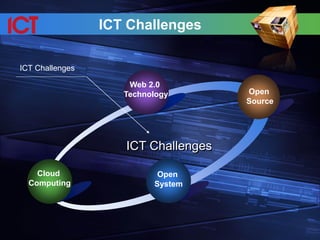
ICT Challenges
Web 2.0
Technology Open
Source
Open
System
Cloud
Computing
ICT Challenges
ICT Challenges
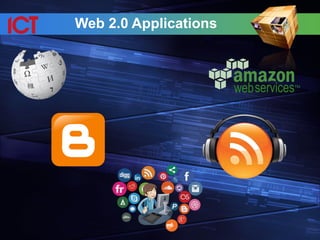
Web 2.0 Applications
Popular Web 2.0 Sites
Open Source and Systems
Cloud Computing
Software
Applications
Stored Data
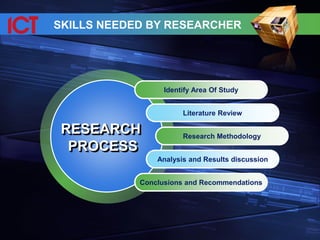
SKILLS NEEDED BY RESEARCHER
Identify Area Of Study
Literature Review
Research Methodology
Analysis and Results discussion
Conclusions and Recommendations
RESEARCH
PROCESS
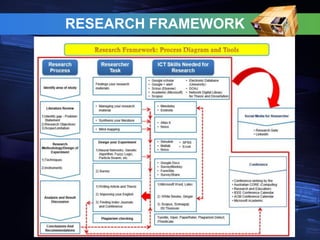
RESEARCH FRAMEWORK
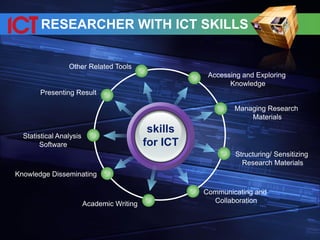
RESEARCHER WITH ICT SKILLS
skills
for ICT
Managing Research
Materials
Presenting Result
Structuring/ Sensitizing
Research Materials
Communicating and
Collaboration
Statistical Analysis
Software
Knowledge Disseminating
Other Related Tools
Accessing and Exploring
Knowledge
Academic Writing
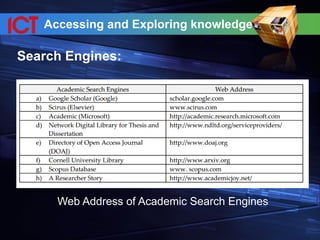
Accessing and Exploring knowledge
Search Engines:
Web Address of Academic Search Engines
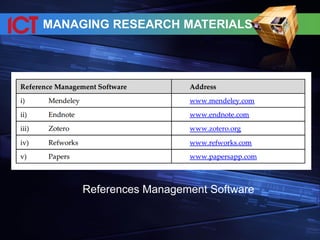
MANAGING RESEARCH MATERIALS
References Management Software
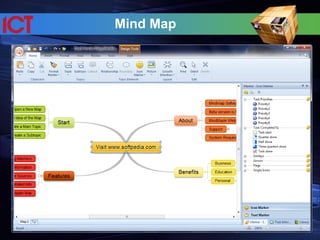
Mind Meinster
Mind Map
Docear
Structuring /
Sensitizing
research materials
Structuring/ Sensitizing Research Materials
Mind Meinster
Mind Map
Docear
Communicating and Collaboration
Research Gate Academia.edu LinkedIn
Virtual Research Environment (VRE)
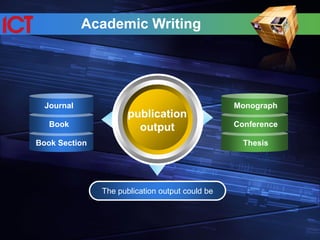
Academic Writing
publication
output
The publication output could be
Journal
Book
Book Section
Monograph
Conference
Thesis
Academic Writing
Academic Writing Software
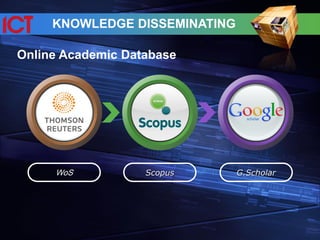
KNOWLEDGE DISSEMINATING
WoS Scopus G.Scholar
Online Academic Database
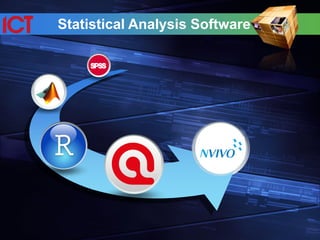
Statistical Analysis Software
Presenting Result
Presenting Results Software
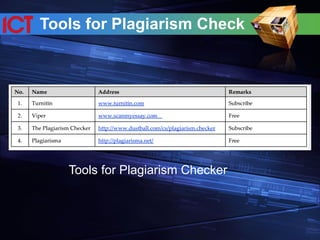
Tools for Plagiarism Check
Tools for Plagiarism Checker
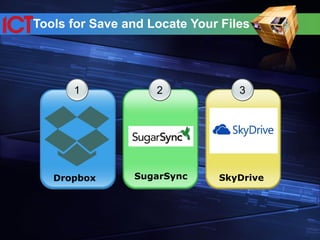
Tools for Save and Locate Your Files
1
Dropbox
2
SugarSync
3
SkyDrive
English Grammar Checker Tools
Conclusion
 Start from the beginning, the researcher is
emphasized to use ICT in their research work.
The tools given during the discussion above is
only a tip on ICT usage that can be
implemented as an aid in their research
process. It is hoped that, the researcher will
explore more tool and share with the others.
References
 1. L, Margaret (2005), “Towards a definition of the integration of ICT in the
classroom”. In AARE 2005, AARE, Eds. Proceedings AARE '05 Education
Research -Creative Dissent: Constructive Solutions, Parramatta, New South
Wales.
 2. Toomey, R. (2001). Schooling Issues Digest No 2: “Information and
Communication Technology for Teaching and Learning”.
 3. RAND Reading Study Group, RRSG, ( 2002), “Reading for Understanding:
Toward an R&D Program in Reading Comprehension”, CA.
 4. Atkins, D., E, Droegemeier, K. K., Garcia-Molina, H., Lein, M. L., Masserschmitt,
D. G., Messina, P, (2003). “National science foundation blue-ribbon advisory panel
on cyber infrastructure, revolutionizing science and engineering through cyber-
infrastructure”, National Science Foundation, USA.
 5. R Luecke and R Katz, (2003), Managing Creativity and Innovation, Boston:
Harvard Business School Press, p. 174
 6. S. Lawrence (2001), Nature, “Online or invisible”, Vol 411 (6837), p. 521.
 7. P. F. Camussone, Cuel, R. And Ponte, D. (2010), “Internet-Based Review
Models for
Scientific Knowledge: A Radical Innovation”, Proceedings of the 11th European
Conference on Knowledge Management: Universidade Lusiada de Vila Nova de
Famalico, Portugal 2-3 September 2010,p.182.
LOGO
“ Add your company slogan ”
Nabeel@uokufa.edu.iq
‫العلمية‬ ‫البحوث‬ ‫شعبة‬_‫المعلوماتي‬ ‫والتاهيل‬ ‫البحث‬ ‫مركز‬_‫الكوفة‬ ‫جامعة‬

Use ICT in Research

  • 1.
    LOGO “ Add yourcompany slogan ” Use ICT In Research A.Lecturer NABEEL SALIH ALI MCS. in Internetworking Technology (UTeM_Malaysia) ‫العلمية‬ ‫البحوث‬ ‫شعبة‬_‫المعلوماتي‬ ‫والتاهيل‬ ‫البحث‬ ‫مركز‬_‫الكوفة‬ ‫جامعة‬
  • 2.
    Contents INTRODUCTION1 ICT FACTORS AFFECTINGFOR RESEARCH2 ICT CHALLENGES3 ICT SKILLS NEEDED BY RESEARCHER4 5 CONCLUSION
  • 3.
    AIMS:  This seminaris aimed to researchers across all disciplines, at the end of this learning, researchers should be able to: 1. Understand the process and skills needed to successfully locate, access, and evaluate the information they need while doing research. 2. Identify tools that are relevant to research works.
  • 4.
    INTRODUCTION  Information technologyhas and will change the research process. New information and communications technology landscape arising from the existence of new media like Cloud Computing and Web 2.0 technologies together with their applications will bring a big change to the world of research.  Generally, ICT consists of hardware, software, networks, and media for collection, storage, processing, transmission, and presentation of information (voice, data, text, images).
  • 5.
  • 6.
    ICT Challenges Web 2.0 TechnologyOpen Source Open System Cloud Computing ICT Challenges ICT Challenges
  • 7.
  • 8.
  • 9.
  • 10.
  • 11.
    SKILLS NEEDED BYRESEARCHER Identify Area Of Study Literature Review Research Methodology Analysis and Results discussion Conclusions and Recommendations RESEARCH PROCESS
  • 12.
  • 13.
    RESEARCHER WITH ICTSKILLS skills for ICT Managing Research Materials Presenting Result Structuring/ Sensitizing Research Materials Communicating and Collaboration Statistical Analysis Software Knowledge Disseminating Other Related Tools Accessing and Exploring Knowledge Academic Writing
  • 14.
    Accessing and Exploringknowledge Search Engines: Web Address of Academic Search Engines
  • 15.
  • 16.
    Mind Meinster Mind Map Docear Structuring/ Sensitizing research materials Structuring/ Sensitizing Research Materials
  • 17.
  • 18.
  • 19.
  • 20.
    Communicating and Collaboration ResearchGate Academia.edu LinkedIn Virtual Research Environment (VRE)
  • 21.
    Academic Writing publication output The publicationoutput could be Journal Book Book Section Monograph Conference Thesis
  • 22.
  • 23.
    KNOWLEDGE DISSEMINATING WoS ScopusG.Scholar Online Academic Database
  • 24.
  • 25.
  • 26.
  • 27.
    Tools for PlagiarismCheck Tools for Plagiarism Checker
  • 28.
    Tools for Saveand Locate Your Files 1 Dropbox 2 SugarSync 3 SkyDrive
  • 29.
  • 30.
    Conclusion  Start fromthe beginning, the researcher is emphasized to use ICT in their research work. The tools given during the discussion above is only a tip on ICT usage that can be implemented as an aid in their research process. It is hoped that, the researcher will explore more tool and share with the others.
  • 31.
    References  1. L,Margaret (2005), “Towards a definition of the integration of ICT in the classroom”. In AARE 2005, AARE, Eds. Proceedings AARE '05 Education Research -Creative Dissent: Constructive Solutions, Parramatta, New South Wales.  2. Toomey, R. (2001). Schooling Issues Digest No 2: “Information and Communication Technology for Teaching and Learning”.  3. RAND Reading Study Group, RRSG, ( 2002), “Reading for Understanding: Toward an R&D Program in Reading Comprehension”, CA.  4. Atkins, D., E, Droegemeier, K. K., Garcia-Molina, H., Lein, M. L., Masserschmitt, D. G., Messina, P, (2003). “National science foundation blue-ribbon advisory panel on cyber infrastructure, revolutionizing science and engineering through cyber- infrastructure”, National Science Foundation, USA.  5. R Luecke and R Katz, (2003), Managing Creativity and Innovation, Boston: Harvard Business School Press, p. 174  6. S. Lawrence (2001), Nature, “Online or invisible”, Vol 411 (6837), p. 521.  7. P. F. Camussone, Cuel, R. And Ponte, D. (2010), “Internet-Based Review Models for Scientific Knowledge: A Radical Innovation”, Proceedings of the 11th European Conference on Knowledge Management: Universidade Lusiada de Vila Nova de Famalico, Portugal 2-3 September 2010,p.182.
  • 32.
    LOGO “ Add yourcompany slogan ” Nabeel@uokufa.edu.iq ‫العلمية‬ ‫البحوث‬ ‫شعبة‬_‫المعلوماتي‬ ‫والتاهيل‬ ‫البحث‬ ‫مركز‬_‫الكوفة‬ ‫جامعة‬