Distance Education:
Issues and Trends
Edel 536
Richard Styner Eddie Lavrov
Maria Morales
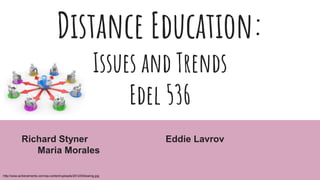
http://wow-achievements.com/wp-content/uploads/2012/05/learing.jpg
What is distance education?
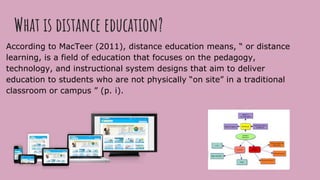
According to MacTeer (2011), distance education means, “ or distance
learning, is a field of education that focuses on the pedagogy,
technology, and instructional system designs that aim to deliver
education to students who are not physically “on site” in a traditional
classroom or campus ” (p. i).
characteristics
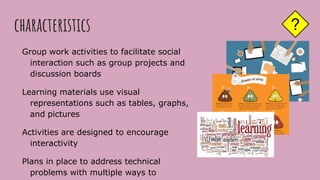
Group work activities to facilitate social
interaction such as group projects and
discussion boards
Learning materials use visual
representations such as tables, graphs,
and pictures
Activities are designed to encourage
interactivity
Plans in place to address technical
problems with multiple ways to
?
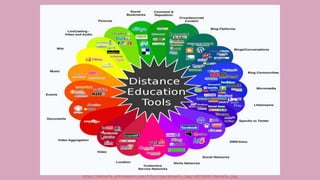
http://detools.wikispaces.com/file/view/detools.jpg/149759897/detools.jpg
misconceptions
1.Online classes are easier.
2.Online classes take less time.
3.Work entirely at your own pace.
4.You won’t get to know other
students.
5.You won’t get attention from the
teacher.
6.You won’t learn as much online.
https://youtu.be/3K_JoBkxVI0
X
Issues
According to Beldarrain, when conducting a
distance learning experience as a
teacher/professor:
Need to give constant feedback
Familiarity with technology and online tools
Rethink pedagogical practices and
instructional design
Provide flexible learning opportunities for ALL
learners
Think how to present information
Teachers need to keep lessons, activities, and
!
Issues
According to the International Association of
Distance Learning, when conducting a distance
learning experience as the student:
Lack of interaction
Poor student mentorship
Lack of motivation
Inability to promote motor skill development
Inefficient in promoting good attitudes
Absent student - teacher bonding
Failure in developing oral skills
!
Trends
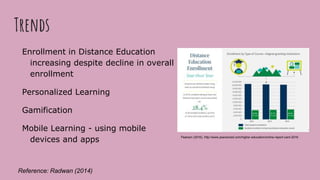
Enrollment in Distance Education
increasing despite decline in overall
enrollment
Personalized Learning
Gamification
Mobile Learning - using mobile
devices and apps
Reference: Radwan (2014)
Pearson (2016), http://www.pearsoned.com/higher-education/online-report-card-2016
References:
Beldarrain, Y. (2006). Distance Education Trends: Integrating new technologies to foster student
interaction and collaboration. Distance Education, 27:2, 139-153.
International Association of Distance Learning (2016, July 9). How to Develop a Distance Learning
Curriculum. Retrieved from http://www.iadl.org.uk/Article35.htmMacTeer, C. (2011). Distance Education.
n.p.:
Radwan, N. M., Senousy, M. B., & Alaa El Din, M. (2014). Current trends and challenges of developing and
evaluating learning management systems.International Journal of e-Education, e-Business, e-Management
and e-Learning, 4(5), 361. http://www.ijeeee.org/Papers/351-JZ0078.pdf
Smyth, R. (2011). Emerging technologies in distance education - by george veletsianos. British Journal of
Educational Technology, 42(4), E86.

Issues and trends

  • 1.
    Distance Education: Issues andTrends Edel 536 Richard Styner Eddie Lavrov Maria Morales http://wow-achievements.com/wp-content/uploads/2012/05/learing.jpg
  • 2.
    What is distanceeducation? According to MacTeer (2011), distance education means, “ or distance learning, is a field of education that focuses on the pedagogy, technology, and instructional system designs that aim to deliver education to students who are not physically “on site” in a traditional classroom or campus ” (p. i).
  • 3.
    characteristics Group work activitiesto facilitate social interaction such as group projects and discussion boards Learning materials use visual representations such as tables, graphs, and pictures Activities are designed to encourage interactivity Plans in place to address technical problems with multiple ways to ?
  • 4.
  • 5.
    misconceptions 1.Online classes areeasier. 2.Online classes take less time. 3.Work entirely at your own pace. 4.You won’t get to know other students. 5.You won’t get attention from the teacher. 6.You won’t learn as much online. https://youtu.be/3K_JoBkxVI0 X
  • 6.
    Issues According to Beldarrain,when conducting a distance learning experience as a teacher/professor: Need to give constant feedback Familiarity with technology and online tools Rethink pedagogical practices and instructional design Provide flexible learning opportunities for ALL learners Think how to present information Teachers need to keep lessons, activities, and !
  • 7.
    Issues According to theInternational Association of Distance Learning, when conducting a distance learning experience as the student: Lack of interaction Poor student mentorship Lack of motivation Inability to promote motor skill development Inefficient in promoting good attitudes Absent student - teacher bonding Failure in developing oral skills !
  • 8.
    Trends Enrollment in DistanceEducation increasing despite decline in overall enrollment Personalized Learning Gamification Mobile Learning - using mobile devices and apps Reference: Radwan (2014) Pearson (2016), http://www.pearsoned.com/higher-education/online-report-card-2016
  • 10.
    References: Beldarrain, Y. (2006).Distance Education Trends: Integrating new technologies to foster student interaction and collaboration. Distance Education, 27:2, 139-153. International Association of Distance Learning (2016, July 9). How to Develop a Distance Learning Curriculum. Retrieved from http://www.iadl.org.uk/Article35.htmMacTeer, C. (2011). Distance Education. n.p.: Radwan, N. M., Senousy, M. B., & Alaa El Din, M. (2014). Current trends and challenges of developing and evaluating learning management systems.International Journal of e-Education, e-Business, e-Management and e-Learning, 4(5), 361. http://www.ijeeee.org/Papers/351-JZ0078.pdf Smyth, R. (2011). Emerging technologies in distance education - by george veletsianos. British Journal of Educational Technology, 42(4), E86.