Preserving Performance:
An Archive-Making Guide
for Theatre Artists
WHO ARE WE?
The American Theater Archive
Project (ATAP) is a collaboration of
archivists, dramaturgs, and academics
who support theatre makers in saving
their work as they make it for the
benefit of artistic collaborators,
scholars, patrons, and the public.
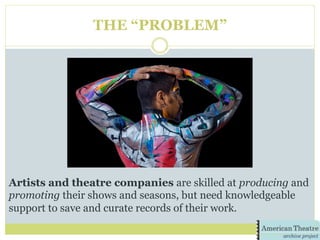
THE “PROBLEM”
Artists and theatre companies are skilled at producing and
promoting their shows and seasons, but need knowledgeable
support to save and curate records of their work.
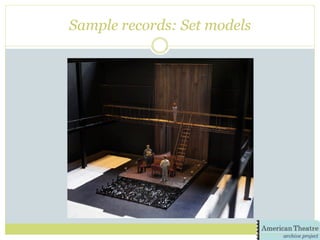
Sample records: Set models
Sample records: Rehearsal plans
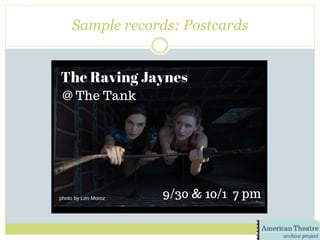
Sample records: Postcards
WHY ARCHIVE?
The American Theatre Archive Project
(ATAP) seeks to help artists and theatre
companies:
•  Curate their stories
•  Honor their legacies
•  Establish protocols to capture and safeguard their
work for posterity
•  Increase their visibility and attractiveness to
patrons and grant funders
PLEASE TELL US
•  Your name
•  What does archiving mean to you?
•  What materials do you archive?
•  What questions about archiving do you have?
ARCHIVISTS THINK ABOUT
•  Archival evidence and principles
•  Appraisal and analysis of records
•  Retention schedules and collection policies
•  Arrangement and description of materials
•  Long-term preservation issues
•  Public access
•  Staffing and training
(So you don’t have to)
ATAP HELPS YOU THINK ABOUT
•  How to begin or continue archiving your work
•  Separating the wheat from the chaff -- what should
be saved and what can be discarded?
•  How production-related materials contribute to
legacy
•  Considering long-term preservation strategies (e.g.
keep or donate to a repository?)
•  Whether and how to make history available to the
public
HOW TO BEGIN?
ISN’T THAT BETTER?
PRODUCTION RECORDS
•  Production history: Are projects and seasons
documented? How? Where?
•  Scripts and dramaturgy: Where are the script
versions, dramaturgical materials, and programs?
•  Designs: Where are set models, costumes, props?
•  Photos: Who has production or event images?
Who has the rights? How are they maintained?
•  Electronic files: What file formats are used and
where are they stored?
•  How do all of the above support your
mission and goals as artists?
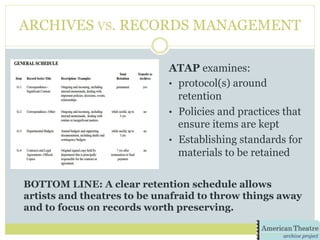
ARCHIVES VS. RECORDS MANAGEMENT
ATAP examines:
•  protocol(s) around
retention
•  Policies and practices that
ensure items are kept
•  Establishing standards for
materials to be retained
BOTTOM LINE: A clear retention schedule allows
artists and theatres to be unafraid to throw things away
and to focus on records worth preserving.
SHARING
Are there elements of the collection that you
would like to make available to the public?
•  To your audience?
•  To the community?
•  To theatre historians/scholars?
Would you like to create an online presence
with your materials?
SOME BENEFITS OF PUBLIC ACCESS
•  Enables permanent or pop-up displays of holdings
for public enjoyment.
•  Allows practitioners to generate new art and
researchers to generate new scholarship.
Promote your history
Highlight images from the archives
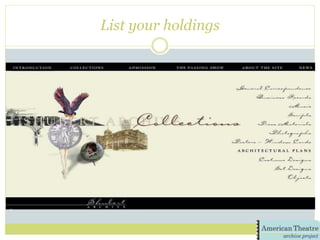
List your holdings
WHAT ATAP PROVIDES
•  Introduction to archiving
•  Survey of records and interviews with artistic collaborators
•  Assessment of records and recommendations for
establishing an archive
•  Workshop on archival practices
•  Suggested resources (e.g. grant opportunities, supply
sources, consultants, cloud services)
BOTTOM LINE: Together, we develop concrete steps
to organize your artifacts and records for posterity.
WHAT YOU CAN DO TO GET STARTED
Physical materials:
•  Archival boxes (banker’s or
manuscript size)
•  Acid-free folders
•  Mylar or polypropylene
sleeves
•  Pencils
•  External hard drive
Cloud storage
HOW TO GET STARTED
•  Survey what you have.
•  Sort shows and materials with like seasons.
•  Write a simple folder title: name of show, type of
material (correspondence, prompt book, photos), dates.
•  Video and audio: label contents, dates, any production
values (timestamp, camera angles, narration).
•  Obtain rights for use in your archive as historical artifact.
•  Place photos, if possible, in mylar or poly bags.
•  Document where, who, what, is portrayed in your photos.
•  Create box lists of folder titles for easy access.
BOX LIST
A CONVERSATION ABOUT ARCHIVING
•  Kim Whitener, Producing Director, HERE; Co-
Director, Prototype
•  Brad Burgess, Artistic Director, the Living Theatre
•  Richard Keyser, Technical Director, Medicine
Show Theatre Ensemble
•  David Elyha, Performer, Medicine Show Theatre
Ensemble
THE BIG PICTURE – ATAP’s GOALS
•  To preserve records of current theatrical process and
product for future generations.
•  To leverage your legacy to maintain and promote current
and future work.
•  To promote a better understanding of theatre as a vital
element of cultural history.
•  To encourage scholarly research in contemporary
American theatre.
•  To increase funding for establishing and maintaining
theatre archives.
•  To support collaborations among practitioners,
archivists, and scholars.
SELECTED PARTNER ORGANIZATIONS
American Society for Theatre Research (ASTR)
Theatre Library Association (TLA)
Literary Managers and Dramaturgs of the Americas
(LMDA)
Performing Arts Roundtable of the Society of
American Archivists (SAA)
Theatre Communications Group (TCG)
The Lucille Lortel Foundation
Alliance of Resident Theatres/New York
HOW TO GET IN TOUCH WITH ATAP
•  http://www.americantheatrearchiveproject.org/
•  @TheatreArchives

Prelude 16: Preserving Performance

  • 1.
  • 2.
    WHO ARE WE? TheAmerican Theater Archive Project (ATAP) is a collaboration of archivists, dramaturgs, and academics who support theatre makers in saving their work as they make it for the benefit of artistic collaborators, scholars, patrons, and the public.
  • 3.
    THE “PROBLEM” Artists andtheatre companies are skilled at producing and promoting their shows and seasons, but need knowledgeable support to save and curate records of their work.
  • 4.
  • 5.
  • 6.
  • 7.
    WHY ARCHIVE? The AmericanTheatre Archive Project (ATAP) seeks to help artists and theatre companies: •  Curate their stories •  Honor their legacies •  Establish protocols to capture and safeguard their work for posterity •  Increase their visibility and attractiveness to patrons and grant funders
  • 8.
    PLEASE TELL US • Your name •  What does archiving mean to you? •  What materials do you archive? •  What questions about archiving do you have?
  • 9.
    ARCHIVISTS THINK ABOUT • Archival evidence and principles •  Appraisal and analysis of records •  Retention schedules and collection policies •  Arrangement and description of materials •  Long-term preservation issues •  Public access •  Staffing and training (So you don’t have to)
  • 10.
    ATAP HELPS YOUTHINK ABOUT •  How to begin or continue archiving your work •  Separating the wheat from the chaff -- what should be saved and what can be discarded? •  How production-related materials contribute to legacy •  Considering long-term preservation strategies (e.g. keep or donate to a repository?) •  Whether and how to make history available to the public
  • 11.
  • 12.
  • 13.
    PRODUCTION RECORDS •  Productionhistory: Are projects and seasons documented? How? Where? •  Scripts and dramaturgy: Where are the script versions, dramaturgical materials, and programs? •  Designs: Where are set models, costumes, props? •  Photos: Who has production or event images? Who has the rights? How are they maintained? •  Electronic files: What file formats are used and where are they stored? •  How do all of the above support your mission and goals as artists?
  • 14.
    ARCHIVES VS. RECORDSMANAGEMENT ATAP examines: •  protocol(s) around retention •  Policies and practices that ensure items are kept •  Establishing standards for materials to be retained BOTTOM LINE: A clear retention schedule allows artists and theatres to be unafraid to throw things away and to focus on records worth preserving.
  • 15.
    SHARING Are there elementsof the collection that you would like to make available to the public? •  To your audience? •  To the community? •  To theatre historians/scholars? Would you like to create an online presence with your materials?
  • 16.
    SOME BENEFITS OFPUBLIC ACCESS •  Enables permanent or pop-up displays of holdings for public enjoyment. •  Allows practitioners to generate new art and researchers to generate new scholarship.
  • 17.
  • 18.
  • 19.
  • 20.
    WHAT ATAP PROVIDES • Introduction to archiving •  Survey of records and interviews with artistic collaborators •  Assessment of records and recommendations for establishing an archive •  Workshop on archival practices •  Suggested resources (e.g. grant opportunities, supply sources, consultants, cloud services) BOTTOM LINE: Together, we develop concrete steps to organize your artifacts and records for posterity.
  • 21.
    WHAT YOU CANDO TO GET STARTED Physical materials: •  Archival boxes (banker’s or manuscript size) •  Acid-free folders •  Mylar or polypropylene sleeves •  Pencils •  External hard drive Cloud storage
  • 22.
    HOW TO GETSTARTED •  Survey what you have. •  Sort shows and materials with like seasons. •  Write a simple folder title: name of show, type of material (correspondence, prompt book, photos), dates. •  Video and audio: label contents, dates, any production values (timestamp, camera angles, narration). •  Obtain rights for use in your archive as historical artifact. •  Place photos, if possible, in mylar or poly bags. •  Document where, who, what, is portrayed in your photos. •  Create box lists of folder titles for easy access.
  • 23.
  • 24.
    A CONVERSATION ABOUTARCHIVING •  Kim Whitener, Producing Director, HERE; Co- Director, Prototype •  Brad Burgess, Artistic Director, the Living Theatre •  Richard Keyser, Technical Director, Medicine Show Theatre Ensemble •  David Elyha, Performer, Medicine Show Theatre Ensemble
  • 25.
    THE BIG PICTURE– ATAP’s GOALS •  To preserve records of current theatrical process and product for future generations. •  To leverage your legacy to maintain and promote current and future work. •  To promote a better understanding of theatre as a vital element of cultural history. •  To encourage scholarly research in contemporary American theatre. •  To increase funding for establishing and maintaining theatre archives. •  To support collaborations among practitioners, archivists, and scholars.
  • 26.
    SELECTED PARTNER ORGANIZATIONS AmericanSociety for Theatre Research (ASTR) Theatre Library Association (TLA) Literary Managers and Dramaturgs of the Americas (LMDA) Performing Arts Roundtable of the Society of American Archivists (SAA) Theatre Communications Group (TCG) The Lucille Lortel Foundation Alliance of Resident Theatres/New York
  • 27.
    HOW TO GETIN TOUCH WITH ATAP •  http://www.americantheatrearchiveproject.org/ •  @TheatreArchives