Trevor Owens, July 11 2019, Workshop:
Forecasting Costs for Preserving, Archiving,
and Promoting Access to Biomedical Data.
National Academy of Sciences. Washington
D.C.
DIGITAL PRESERVATION
Ensuring long term access to
significant digital content. In
practice, fundamentally a process of
identifying and responding to
potential risks of loss of access and
usability.
NDSA LEVELS OF
DIGITAL PRESERVATION
Phillips, M., Bailey, J., Goethals, A., & Owens, T. (2013). The NDSA Levels of
Digital Preservation: An Explanation and Uses. In Proceedings of the 2013
IS&T Archiving Conference.
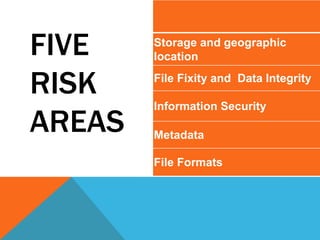
FIVE
RISK
AREAS
Storage and geographic
location
File Fixity and Data Integrity
Information Security
Metadata
File Formats
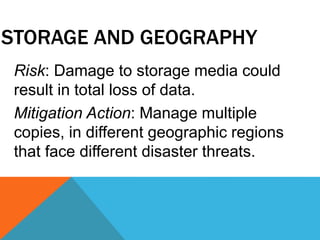
STORAGE AND GEOGRAPHY
Risk: Damage to storage media could
result in total loss of data.
Mitigation Action: Manage multiple
copies, in different geographic regions
that face different disaster threats.
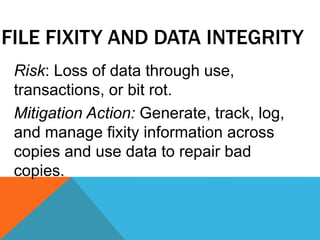
FILE FIXITY AND DATA INTEGRITY
Risk: Loss of data through use,
transactions, or bit rot.
Mitigation Action: Generate, track, log,
and manage fixity information across
copies and use data to repair bad
copies.
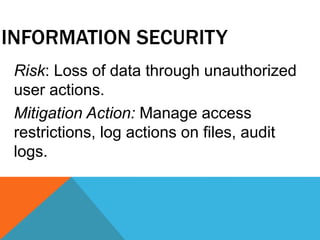
INFORMATION SECURITY
Risk: Loss of data through unauthorized
user actions.
Mitigation Action: Manage access
restrictions, log actions on files, audit
logs.
METADATA
Risk: Loss of usability of data or ability
to authenticate data.
Mitigation Action: Produce and manage
administrative, technical, descriptive,
and preservation metadata and
maintain non-co-located copies of
metadata.
FILE FORMATS
Risk: Loss of usability/renderability of
data.
Mitigation Actions: Articulate
preservation intent, limit format support
re sustainability factors, inventory
formats, validate files, produce
derivatives, virtualization & emulation.
PLANNING APPROACH
The best way to mitigate these risks
involves 1) hiring permanent trained
staff and 2) resourcing them as a
central cost center and to 3) plan on
a supporting a continual refresh
cycle for software and hardware.
LOOK AT THE LEDGER
If you want to know if an organization is
serious about digital preservation ask
their accountants. What part of core
operations resources are invested in
staffing, contracts, and software and
hardware dedicated to digital
preservation?

Digital Preservation: Understanding the Risks

  • 1.
    Trevor Owens, July11 2019, Workshop: Forecasting Costs for Preserving, Archiving, and Promoting Access to Biomedical Data. National Academy of Sciences. Washington D.C.
  • 2.
    DIGITAL PRESERVATION Ensuring longterm access to significant digital content. In practice, fundamentally a process of identifying and responding to potential risks of loss of access and usability.
  • 3.
    NDSA LEVELS OF DIGITALPRESERVATION Phillips, M., Bailey, J., Goethals, A., & Owens, T. (2013). The NDSA Levels of Digital Preservation: An Explanation and Uses. In Proceedings of the 2013 IS&T Archiving Conference.
  • 4.
    FIVE RISK AREAS Storage and geographic location FileFixity and Data Integrity Information Security Metadata File Formats
  • 5.
    STORAGE AND GEOGRAPHY Risk:Damage to storage media could result in total loss of data. Mitigation Action: Manage multiple copies, in different geographic regions that face different disaster threats.
  • 6.
    FILE FIXITY ANDDATA INTEGRITY Risk: Loss of data through use, transactions, or bit rot. Mitigation Action: Generate, track, log, and manage fixity information across copies and use data to repair bad copies.
  • 7.
    INFORMATION SECURITY Risk: Lossof data through unauthorized user actions. Mitigation Action: Manage access restrictions, log actions on files, audit logs.
  • 8.
    METADATA Risk: Loss ofusability of data or ability to authenticate data. Mitigation Action: Produce and manage administrative, technical, descriptive, and preservation metadata and maintain non-co-located copies of metadata.
  • 9.
    FILE FORMATS Risk: Lossof usability/renderability of data. Mitigation Actions: Articulate preservation intent, limit format support re sustainability factors, inventory formats, validate files, produce derivatives, virtualization & emulation.
  • 10.
    PLANNING APPROACH The bestway to mitigate these risks involves 1) hiring permanent trained staff and 2) resourcing them as a central cost center and to 3) plan on a supporting a continual refresh cycle for software and hardware.
  • 11.
    LOOK AT THELEDGER If you want to know if an organization is serious about digital preservation ask their accountants. What part of core operations resources are invested in staffing, contracts, and software and hardware dedicated to digital preservation?