Digital Cash 
Present By Kevin, Hiren, Amit, Kai
What is Digital Cash? 
¨ A payment message bearing a digital signature 
which functions as a medium of exchange or store 
of value 
¨ Need to be backed by a trusted third party, usually 
the government and the banking industry.
Key Properties 
¨ Secure 
¨ Anonymous 
¨ Portable 
¨ Reusable 
¨ User-friendly
Digital Cash vs Credit Card 
Anonymous Identified 
Online or Off-line Online 
Store money in 
digital wallet 
Money is in the 
Bank
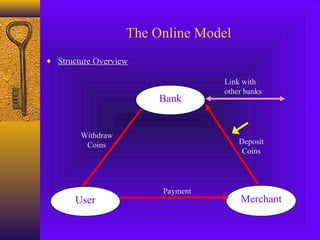
The Online Model 
¨ Structure Overview 
Link with 
other banks 
Deposit 
Coins 
Bank 
Withdraw 
Coins 
Payment 
User Merchant
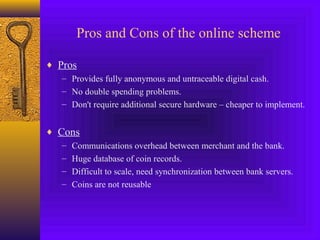
Pros and Cons of the online scheme 
¨ Pros 
– Provides fully anonymous and untraceable digital cash. 
– No double spending problems. 
– Don't require additional secure hardware – cheaper to implement. 

¨ Cons 
– Communications overhead between merchant and the bank. 
– Huge database of coin records. 
– Difficult to scale, need synchronization between bank servers. 
– Coins are not reusable
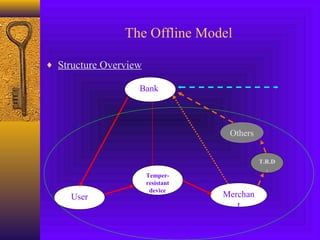
The Offline Model 
¨ Structure Overview 
Bank 
Merchan 
t 
User 
Temper-resistant 
device 
Others 
T.R.D 
.
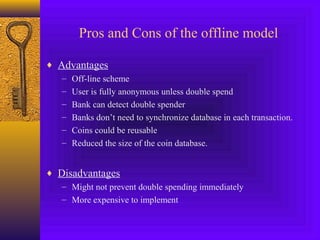
Pros and Cons of the offline model 
¨ Advantages 
– Off-line scheme 
– User is fully anonymous unless double spend 
– Bank can detect double spender 
– Banks don’t need to synchronize database in each transaction. 
– Coins could be reusable 
– Reduced the size of the coin database. 
¨ Disadvantages 
– Might not prevent double spending immediately 
– More expensive to implement
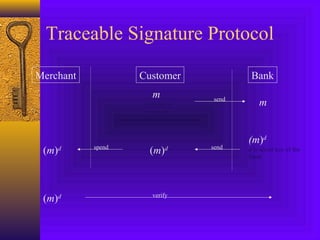
Traceable Signature Protocol 
Merchant Customer Bank 
m 
message m 
= amount, 
serial no 
(m)d 
d is secret key of the 
Bank 
(m)d spend 
send m 
(m)d send 
(m)d verify
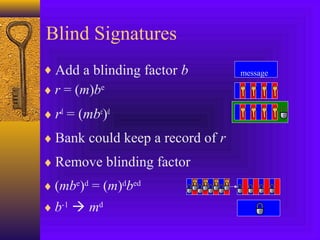
Blind Signatures 
¨Add a blinding factor b 
¨ r = (m)be 
¨rd = (mbe)d 
¨Bank could keep a record of r 
¨Remove blinding factor 
¨ (mbe)d = (m)dbed 
¨ b-1  md 
message
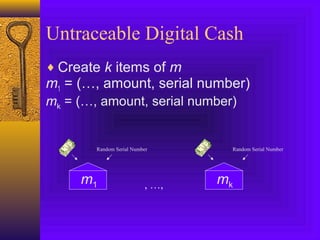
Untraceable Digital Cash 
¨Create k items of m 
m1 = (…, amount, serial number) 
mk = (…, amount, serial number) 
Random Serial Number 
m1 
Random Serial Number 
, …, mk
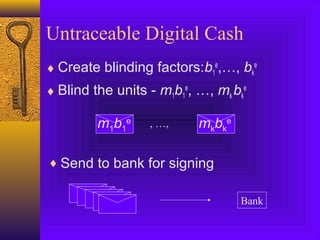
Untraceable Digital Cash 
¨Create blinding factors:b1 
e,…, bk 
e 
¨Blind the units - m1b1 
e, …, mk bk 
e 
m1b1 
e mkbk 
, …, e 
Bank 
¨Send to bank for signing
Untraceable Digital Cash 
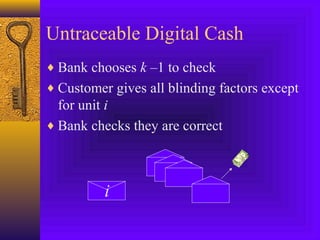
¨Bank chooses k –1 to check 
¨Customer gives all blinding factors except 
for unit i 
¨Bank checks they are correct 
i
Untraceable Digital Cash 
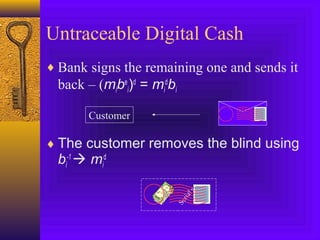
¨Bank signs the remaining one and sends it 
back – (mbe 
)d = mdbiii 
i 
Customer 
¨The customer removes the blind using 
bi 
Serial no 
-1  mi 
d
Problem! 
¨When the merchant receives the coin, it still 
has to be verified 
¨The merchant has to have a connection with 
the bank at the time of sale 
¨This protocol is anonymous but not portable
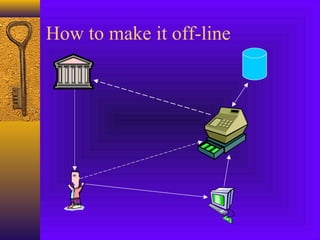
How to make it off-line
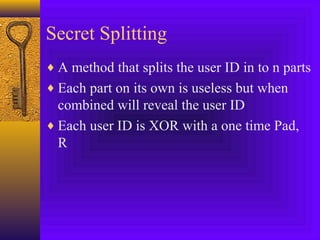
Secret Splitting 
¨A method that splits the user ID in to n parts 
¨Each part on its own is useless but when 
combined will reveal the user ID 
¨Each user ID is XOR with a one time Pad, 
R
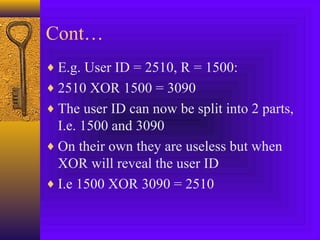
Cont… 
¨E.g. User ID = 2510, R = 1500: 
¨2510 XOR 1500 = 3090 
¨The user ID can now be split into 2 parts, 
I.e. 1500 and 3090 
¨On their own they are useless but when 
XOR will reveal the user ID 
¨I.e 1500 XOR 3090 = 2510
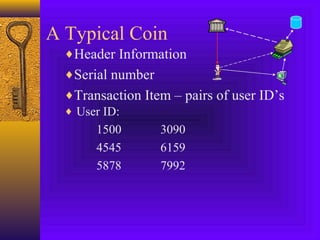
A Typical Coin 
¨Header Information 
¨Serial number 
¨Transaction Item – pairs of user ID’s 
¨ User ID: 
1500 3090 
4545 6159 
5878 7992
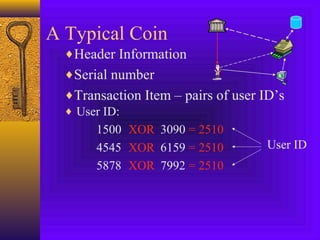
A Typical Coin 
¨Header Information 
¨Serial number 
¨Transaction Item – pairs of user ID’s 
¨ User ID: 
1500 XOR 3090 = 2510 
4545 XOR 6159 = 2510 
5878 XOR 7992 = 2510 
User ID
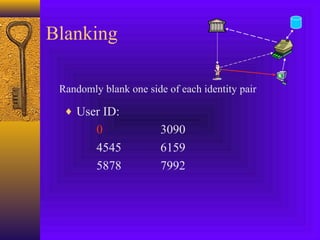
Blanking 
Randomly blank one side of each identity pair 
¨ User ID: 
0 3090 
4545 6159 
5878 7992
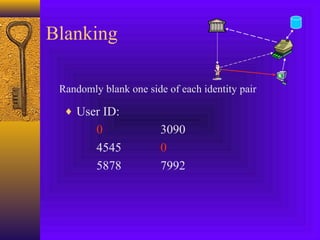
Blanking 
Randomly blank one side of each identity pair 
¨ User ID: 
0 3090 
4545 0 
5878 7992
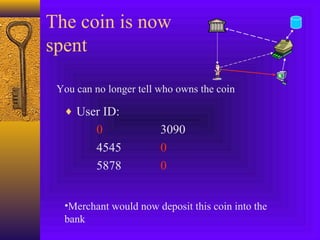
The coin is now 
spent 
You can no longer tell who owns the coin 
¨ User ID: 
0 3090 
4545 0 
5878 0 
•Merchant would now deposit this coin into the 
bank
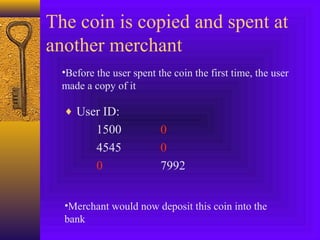
The coin is copied and spent at 
another merchant 
•Before the user spent the coin the first time, the user 
made a copy of it 
¨ User ID: 
1500 0 
4545 0 
0 7992 
•Merchant would now deposit this coin into the 
bank
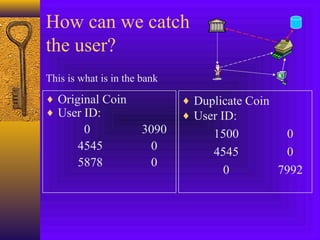
How can we catch 
the user? 
¨ Original Coin 
¨ User ID: 
0 3090 
4545 0 
5878 0 
¨ Duplicate Coin 
¨ User ID: 
1500 0 
4545 0 
0 7992 
This is what is in the bank
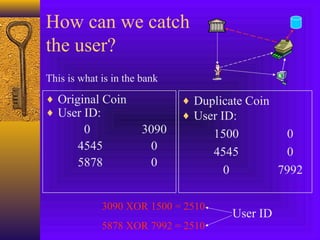
How can we catch 
the user? 
¨ Original Coin 
¨ User ID: 
0 3090 
4545 0 
5878 0 
¨ Duplicate Coin 
¨ User ID: 
1500 0 
4545 0 
0 7992 
This is what is in the bank 
3090 XOR 1500 = 2510 
5878 XOR 7992 = 2510 
User ID
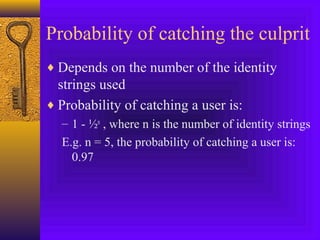
Probability of catching the culprit 
¨Depends on the number of the identity 
strings used 
¨Probability of catching a user is: 
– 1 - ½n , where n is the number of identity strings 
E.g. n = 5, the probability of catching a user is: 
0.97
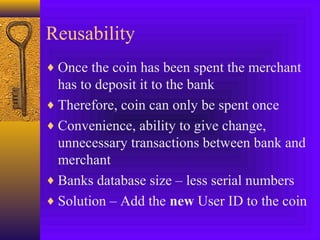
Reusability 
¨Once the coin has been spent the merchant 
has to deposit it to the bank 
¨Therefore, coin can only be spent once 
¨Convenience, ability to give change, 
unnecessary transactions between bank and 
merchant 
¨Banks database size – less serial numbers 
¨Solution – Add the new User ID to the coin
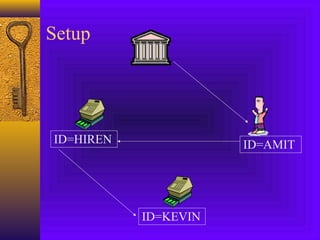
Setup 
ID=HIREN 
ID=KEVIN 
ID=AMIT
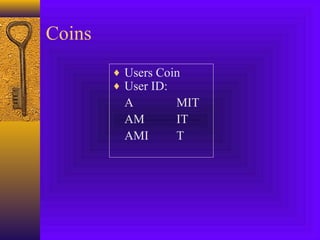
Coins 
¨ Users Coin 
¨ User ID: 
A MIT 
AM IT 
AMI T
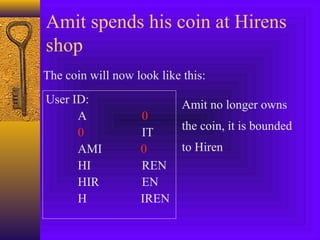
Amit spends his coin at Hirens 
shop 
The coin will now look like this: 
Amit no longer owns 
the coin, it is bounded 
to Hiren 
User ID: 
A 0 
0 IT 
AMI 0 
HI REN 
HIR EN 
H IREN
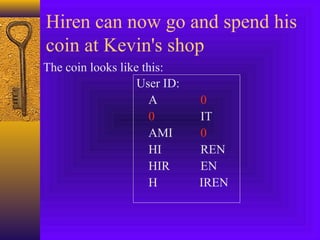
Hiren can now go and spend his 
coin at Kevin's shop 
The coin looks like this: 
User ID: 
A 0 
0 IT 
AMI 0 
HI REN 
HIR EN 
H IREN
Hiren can now go and spend his 
coin at Kevin's shop 
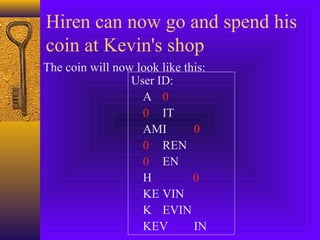
The coin will now look like this: 
User ID: 
A 0 
0 IT 
AMI 0 
0 REN 
0 EN 
H 0 
KE VIN 
K EVIN 
KEV IN
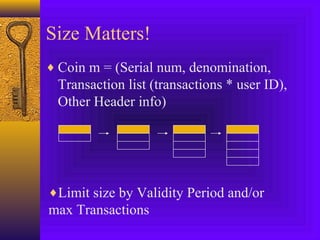
Size Matters! 
¨Coin m = (Serial num, denomination, 
Transaction list (transactions * user ID), 
Other Header info) 
¨Limit size by Validity Period and/or 
max Transactions
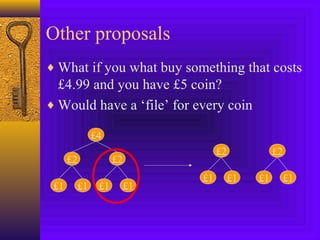
Other proposals 
¨What if you what buy something that costs 
£4.99 and you have £5 coin? 
¨Would have a ‘file’ for every coin 
£4 
£2 £2 
£1 £1 £1 £1 
£2 
£1 £1 
£2 
£1 £1
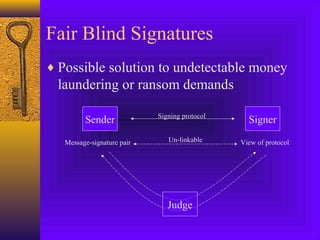
Fair Blind Signatures 
¨Possible solution to undetectable money 
laundering or ransom demands 
Sender Signing protocol Signer 
Message-signature pair Un-linkable View of protocol 
Judge
Conclusion 
¨Feasible from a purely technological 
perspective 
¨Anonymous is at the heart of the 
government's attack 
¨Cannot attract funding
Advantages: 
¨ Convenience 
¨ Secure 
¨ Handling costs 
¨ Time saving 
¨ Transaction Costs
Global Disadvantages 
¨ Safety Issue 
¨ Physical Securities 
¨ Users Issue 
¨ Legal problems
Questions?

Digital cash

  • 1.
    Digital Cash PresentBy Kevin, Hiren, Amit, Kai
  • 2.
    What is DigitalCash? ¨ A payment message bearing a digital signature which functions as a medium of exchange or store of value ¨ Need to be backed by a trusted third party, usually the government and the banking industry.
  • 3.
    Key Properties ¨Secure ¨ Anonymous ¨ Portable ¨ Reusable ¨ User-friendly
  • 4.
    Digital Cash vsCredit Card Anonymous Identified Online or Off-line Online Store money in digital wallet Money is in the Bank
  • 5.
    The Online Model ¨ Structure Overview Link with other banks Deposit Coins Bank Withdraw Coins Payment User Merchant
  • 6.
    Pros and Consof the online scheme ¨ Pros – Provides fully anonymous and untraceable digital cash. – No double spending problems. – Don't require additional secure hardware – cheaper to implement. ¨ Cons – Communications overhead between merchant and the bank. – Huge database of coin records. – Difficult to scale, need synchronization between bank servers. – Coins are not reusable
  • 7.
    The Offline Model ¨ Structure Overview Bank Merchan t User Temper-resistant device Others T.R.D .
  • 8.
    Pros and Consof the offline model ¨ Advantages – Off-line scheme – User is fully anonymous unless double spend – Bank can detect double spender – Banks don’t need to synchronize database in each transaction. – Coins could be reusable – Reduced the size of the coin database. ¨ Disadvantages – Might not prevent double spending immediately – More expensive to implement
  • 9.
    Traceable Signature Protocol Merchant Customer Bank m message m = amount, serial no (m)d d is secret key of the Bank (m)d spend send m (m)d send (m)d verify
  • 10.
    Blind Signatures ¨Adda blinding factor b ¨ r = (m)be ¨rd = (mbe)d ¨Bank could keep a record of r ¨Remove blinding factor ¨ (mbe)d = (m)dbed ¨ b-1  md message
  • 11.
    Untraceable Digital Cash ¨Create k items of m m1 = (…, amount, serial number) mk = (…, amount, serial number) Random Serial Number m1 Random Serial Number , …, mk
  • 12.
    Untraceable Digital Cash ¨Create blinding factors:b1 e,…, bk e ¨Blind the units - m1b1 e, …, mk bk e m1b1 e mkbk , …, e Bank ¨Send to bank for signing
  • 13.
    Untraceable Digital Cash ¨Bank chooses k –1 to check ¨Customer gives all blinding factors except for unit i ¨Bank checks they are correct i
  • 14.
    Untraceable Digital Cash ¨Bank signs the remaining one and sends it back – (mbe )d = mdbiii i Customer ¨The customer removes the blind using bi Serial no -1  mi d
  • 15.
    Problem! ¨When themerchant receives the coin, it still has to be verified ¨The merchant has to have a connection with the bank at the time of sale ¨This protocol is anonymous but not portable
  • 16.
    How to makeit off-line
  • 17.
    Secret Splitting ¨Amethod that splits the user ID in to n parts ¨Each part on its own is useless but when combined will reveal the user ID ¨Each user ID is XOR with a one time Pad, R
  • 18.
    Cont… ¨E.g. UserID = 2510, R = 1500: ¨2510 XOR 1500 = 3090 ¨The user ID can now be split into 2 parts, I.e. 1500 and 3090 ¨On their own they are useless but when XOR will reveal the user ID ¨I.e 1500 XOR 3090 = 2510
  • 19.
    A Typical Coin ¨Header Information ¨Serial number ¨Transaction Item – pairs of user ID’s ¨ User ID: 1500 3090 4545 6159 5878 7992
  • 20.
    A Typical Coin ¨Header Information ¨Serial number ¨Transaction Item – pairs of user ID’s ¨ User ID: 1500 XOR 3090 = 2510 4545 XOR 6159 = 2510 5878 XOR 7992 = 2510 User ID
  • 21.
    Blanking Randomly blankone side of each identity pair ¨ User ID: 0 3090 4545 6159 5878 7992
  • 22.
    Blanking Randomly blankone side of each identity pair ¨ User ID: 0 3090 4545 0 5878 7992
  • 23.
    The coin isnow spent You can no longer tell who owns the coin ¨ User ID: 0 3090 4545 0 5878 0 •Merchant would now deposit this coin into the bank
  • 24.
    The coin iscopied and spent at another merchant •Before the user spent the coin the first time, the user made a copy of it ¨ User ID: 1500 0 4545 0 0 7992 •Merchant would now deposit this coin into the bank
  • 25.
    How can wecatch the user? ¨ Original Coin ¨ User ID: 0 3090 4545 0 5878 0 ¨ Duplicate Coin ¨ User ID: 1500 0 4545 0 0 7992 This is what is in the bank
  • 26.
    How can wecatch the user? ¨ Original Coin ¨ User ID: 0 3090 4545 0 5878 0 ¨ Duplicate Coin ¨ User ID: 1500 0 4545 0 0 7992 This is what is in the bank 3090 XOR 1500 = 2510 5878 XOR 7992 = 2510 User ID
  • 27.
    Probability of catchingthe culprit ¨Depends on the number of the identity strings used ¨Probability of catching a user is: – 1 - ½n , where n is the number of identity strings E.g. n = 5, the probability of catching a user is: 0.97
  • 28.
    Reusability ¨Once thecoin has been spent the merchant has to deposit it to the bank ¨Therefore, coin can only be spent once ¨Convenience, ability to give change, unnecessary transactions between bank and merchant ¨Banks database size – less serial numbers ¨Solution – Add the new User ID to the coin
  • 29.
  • 30.
    Coins ¨ UsersCoin ¨ User ID: A MIT AM IT AMI T
  • 31.
    Amit spends hiscoin at Hirens shop The coin will now look like this: Amit no longer owns the coin, it is bounded to Hiren User ID: A 0 0 IT AMI 0 HI REN HIR EN H IREN
  • 32.
    Hiren can nowgo and spend his coin at Kevin's shop The coin looks like this: User ID: A 0 0 IT AMI 0 HI REN HIR EN H IREN
  • 33.
    Hiren can nowgo and spend his coin at Kevin's shop The coin will now look like this: User ID: A 0 0 IT AMI 0 0 REN 0 EN H 0 KE VIN K EVIN KEV IN
  • 34.
    Size Matters! ¨Coinm = (Serial num, denomination, Transaction list (transactions * user ID), Other Header info) ¨Limit size by Validity Period and/or max Transactions
  • 35.
    Other proposals ¨Whatif you what buy something that costs £4.99 and you have £5 coin? ¨Would have a ‘file’ for every coin £4 £2 £2 £1 £1 £1 £1 £2 £1 £1 £2 £1 £1
  • 36.
    Fair Blind Signatures ¨Possible solution to undetectable money laundering or ransom demands Sender Signing protocol Signer Message-signature pair Un-linkable View of protocol Judge
  • 37.
    Conclusion ¨Feasible froma purely technological perspective ¨Anonymous is at the heart of the government's attack ¨Cannot attract funding
  • 38.
    Advantages: ¨ Convenience ¨ Secure ¨ Handling costs ¨ Time saving ¨ Transaction Costs
  • 39.
    Global Disadvantages ¨Safety Issue ¨ Physical Securities ¨ Users Issue ¨ Legal problems
  • 40.