EARLY 
CHILDHOOD 
EDUCATION 
1 
www.invectura.com
2 
• What Does a Young 
Child Need? 
• What is the 
Caregiver’s Role? 
• Lessons That Last 
• Caregiver Hints 
• Developmental RED 
FLAG ALERTS 
• Early Childhood 
Programs 
• Early Childhood 
Resources 
• Car Seat Information 
www.invectura.com
3 
What Does a Young Child Need? 
• EVERYTHING… 
• Assistance to meet 
– Physical Needs: 
• Food 
• Clothing 
• Cleanliness 
• Shelter 
• Safety / protection 
• Play 
– Emotional Needs: 
• Security 
• Care 
• Nurturance 
• Love 
• Hope 
– Social Needs: 
• Interact with 
caregiver and others, 
including children the 
same age 
• Opportunity to play 
www.invectura.com with others
4 
What Does a Young Child Need? 
continued 
– Psychological 
Needs: 
• Know he/she is 
important to the 
caregiver 
• Learn who he/she is 
• Develop a positive 
self esteem 
– Cognitive Needs: 
• Read to the child 
• Build language skills. 
Talk with the child, 
even when they are 
too young to know all 
you are saying. 
• Play with the child www.invectura.com
What is the Role of the Caregiver? 
• The caregiver is the significant person 
who meets the child’s needs on an 
ongoing basis. 
5 
• Provides love, care, and 
nurturance for the child. 
• Makes sure the child is safe 
and healthy. 
• Engages the child in play, 
conversation, singing, and 
activities that expand learning. 
www.invectura.com
6 
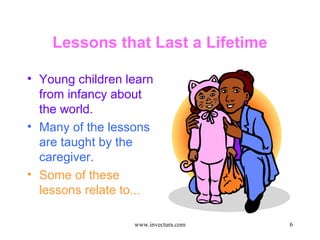
Lessons that Last a Lifetime 
• Young children learn 
from infancy about 
the world. 
• Many of the lessons 
are taught by the 
caregiver. 
• Some of these 
lessons relate to... 
www.invectura.com
7 
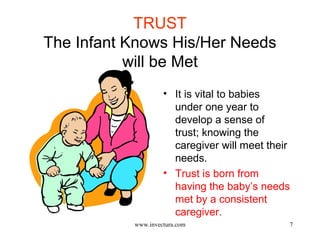
TRUST 
The Infant Knows His/Her Needs 
will be Met 
• It is vital to babies 
under one year to 
develop a sense of 
trust; knowing the 
caregiver will meet their 
needs. 
• Trust is born from 
having the baby’s needs 
met by a consistent 
caregiver. 
www.invectura.com
8 
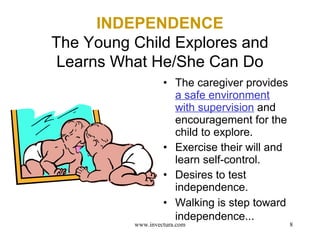
INDEPENDENCE 
The Young Child Explores and 
Learns What He/She Can Do 
• The caregiver provides 
a safe environment 
with supervision and 
encouragement for the 
child to explore. 
• Exercise their will and 
learn self-control. 
• Desires to test 
independence. 
• Walking is step toward 
independence... 
www.invectura.com
9 
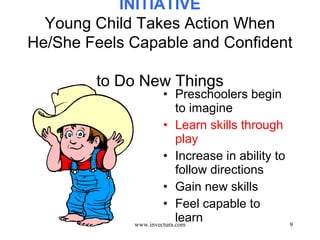
INITIATIVE 
Young Child Takes Action When 
He/She Feels Capable and Confident 
to Do New Things 
• Preschoolers begin 
to imagine 
• Learn skills through 
play 
• Increase in ability to 
follow directions 
• Gain new skills 
• Feel capable to 
learn www.invectura.com
10 
Caregiver Hints 
• Things to do together: 
– Talk (even to a baby) 
– Read books daily 
– Play with blocks, balls, 
trikes, puppets, and 
more 
– Draw (big crayons) 
– Teach a song 
–HAVE FUN... www.invectura.com
Developmental RED FLAG ALERTS 
• Refers to behavioral indicators that 
show that a child is not developing at a 
normal range. These behaviors are 
areas of concern when they are seen 
consistently over a period of time. 
Some children are “early bloomers” 
11 
and others may be delayed 
in some areas but still within 
the normal range of development. 
www.invectura.com
Developmental RED FLAG ALERTS 
12 
• Infants under 6 
months: 
– Failure to gain weight 
– Unable to make eye 
contact or follow 
objects 
– Failure to hold head up 
– Failure to hold on with 
hands 
– No response to loud 
sounds 
– Failure to show 
anticipatory behavior 
at feeding 
– Lack of interest in 
social stimuli 
– Does not grasp or 
reach for objects 
– Tight muscles or 
muscles appear stiff 
www.invectura.com
Developmental RED FLAG ALERTS 
• Infants 9 to 12 months - 
13 
– Does not gain weight 
– Lack of affect 
– Not able to say single 
words, such as “mama” 
– Does not look at 
caregiver for social 
cues or comfort 
– Does not crawl 
– Cannot stand when 
supported 
– Does not use 
gestures, such as 
waving or shaking 
head 
– Drags one side of 
body while crawling 
(for over one month) 
– Does not search for 
object that are 
hidden while s/he 
www.invectura.com watches
Developmental RED FLAG ALERTS 
• Toddler 18 to 24 months- 
14 
– No speech 
– Excessive body rocking 
– Sleep disturbance 
– Out of the ordinary play 
– Withholding and other 
bowel problems 
– Retarded development 
or persistent regression 
www.invectura.com
Developmental RED FLAG ALERTS 
• Three-Year-Olds - 
15 
– Frequent falling and 
difficulty with stairs 
– Persistent drooling or 
very unclear speech 
– Inability to build a tower 
of more than four blocks 
– Difficulty manipulating 
small objects 
– Inability to communicate 
in three word sentences 
– No involvement in 
“pretend” play 
– Little interest in other 
children 
www.invectura.com
Developmental RED FLAG ALERTS 
• Four-Year-Olds - 
16 
– Cannot throw a ball 
overhand 
– Cannot jump in place 
– Cannot grasp a crayon 
between thumb and 
finger 
– Has difficulty scribbling 
– Shows no interest in 
interactive games 
– Ignores other children 
– Resists dressing, 
sleeping, using the toilet 
– Does not use sentences 
of more than three words 
– Cannot copy a circle 
– Lashes out with no self 
control whenever angry 
or upset 
www.invectura.com
Developmental RED FLAG ALERTS 
17 
• Five-Year-Olds - 
– Extremely fearful or 
timid 
– Extremely aggressive 
– Easily distracted and 
unable to concentrate 
on a single activity for 
more than five minutes 
– Shows little interest in 
playing with other 
children 
– Severely unhappy or 
sad much of the time 
– Seems unusually 
passive 
– Cannot talk about daily 
activities 
– Has trouble taking off 
clothing 
– Cannot wash and dry 
his/her hands 
www.invectura.com
18 
What to Do 
When Red Flag Alerts are Noted? 
• Have the young 
child evaluated by 
the child’s 
pediatrician. 
• Obtain input from 
the childcare center 
professional. 
• Request a 
developmental 
assessment. 
www.invectura.com
Early Childhood Education Programs 
Components of Quality Childcare Programs 
19 
• Care center is licensed 
• Care provider is caring 
and focused on the 
needs of every child 
• Number and ages of 
children allow for good 
childcare practice 
• Area is clean and SAFE 
• Foods are nutritious 
• Equipment is 
appropriate to care for 
the child’s age 
• Toys and activities are 
appropriate for the 
child’s development 
• A routine is 
established for rest 
and play 
www.invectura.com
20 
Early Childhood Programs 
• HEAD START 
– Federally funded to serve children 3.9 
years 
– Some communities have programs 
beginning for young children as early as 
18-24 months. 
– Services available at NO COST 
– 3.5 hour daily programs - Monday through 
Friday 
– Lunch and snacks provided www.invectura.com
21 
Features of HEAD START Programs: 
• Assessment 
screening for special 
needs 
– Speech therapy 
– Developmental 
milestones, etc. 
• Emphasis on school 
readiness 
• Literacy 
Development 
• Field trips 
• Provide family 
support services 
– In home visits 
– Parenting classes 
• Individual Education 
Plan developed for 
each child 
• Assistance transition 
to a new school 
www.invectura.com
22 
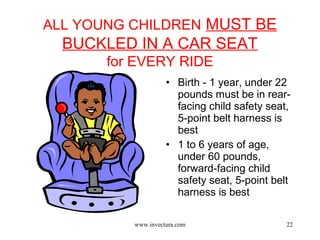
ALL YOUNG CHILDREN MUST BE 
BUCKLED IN A CAR SEAT 
for EVERY RIDE 
• Birth - 1 year, under 22 
pounds must be in rear-facing 
child safety seat, 
5-point belt harness is 
best 
• 1 to 6 years of age, 
under 60 pounds, 
forward-facing child 
safety seat, 5-point belt 
harness is best 
www.invectura.com
wwwwww..iinnvveeccttuurraa..ccoomm 
www.invectura.com 23

Early child education

  • 1.
    EARLY CHILDHOOD EDUCATION 1 www.invectura.com
  • 2.
    2 • WhatDoes a Young Child Need? • What is the Caregiver’s Role? • Lessons That Last • Caregiver Hints • Developmental RED FLAG ALERTS • Early Childhood Programs • Early Childhood Resources • Car Seat Information www.invectura.com
  • 3.
    3 What Doesa Young Child Need? • EVERYTHING… • Assistance to meet – Physical Needs: • Food • Clothing • Cleanliness • Shelter • Safety / protection • Play – Emotional Needs: • Security • Care • Nurturance • Love • Hope – Social Needs: • Interact with caregiver and others, including children the same age • Opportunity to play www.invectura.com with others
  • 4.
    4 What Doesa Young Child Need? continued – Psychological Needs: • Know he/she is important to the caregiver • Learn who he/she is • Develop a positive self esteem – Cognitive Needs: • Read to the child • Build language skills. Talk with the child, even when they are too young to know all you are saying. • Play with the child www.invectura.com
  • 5.
    What is theRole of the Caregiver? • The caregiver is the significant person who meets the child’s needs on an ongoing basis. 5 • Provides love, care, and nurturance for the child. • Makes sure the child is safe and healthy. • Engages the child in play, conversation, singing, and activities that expand learning. www.invectura.com
  • 6.
    6 Lessons thatLast a Lifetime • Young children learn from infancy about the world. • Many of the lessons are taught by the caregiver. • Some of these lessons relate to... www.invectura.com
  • 7.
    7 TRUST TheInfant Knows His/Her Needs will be Met • It is vital to babies under one year to develop a sense of trust; knowing the caregiver will meet their needs. • Trust is born from having the baby’s needs met by a consistent caregiver. www.invectura.com
  • 8.
    8 INDEPENDENCE TheYoung Child Explores and Learns What He/She Can Do • The caregiver provides a safe environment with supervision and encouragement for the child to explore. • Exercise their will and learn self-control. • Desires to test independence. • Walking is step toward independence... www.invectura.com
  • 9.
    9 INITIATIVE YoungChild Takes Action When He/She Feels Capable and Confident to Do New Things • Preschoolers begin to imagine • Learn skills through play • Increase in ability to follow directions • Gain new skills • Feel capable to learn www.invectura.com
  • 10.
    10 Caregiver Hints • Things to do together: – Talk (even to a baby) – Read books daily – Play with blocks, balls, trikes, puppets, and more – Draw (big crayons) – Teach a song –HAVE FUN... www.invectura.com
  • 11.
    Developmental RED FLAGALERTS • Refers to behavioral indicators that show that a child is not developing at a normal range. These behaviors are areas of concern when they are seen consistently over a period of time. Some children are “early bloomers” 11 and others may be delayed in some areas but still within the normal range of development. www.invectura.com
  • 12.
    Developmental RED FLAGALERTS 12 • Infants under 6 months: – Failure to gain weight – Unable to make eye contact or follow objects – Failure to hold head up – Failure to hold on with hands – No response to loud sounds – Failure to show anticipatory behavior at feeding – Lack of interest in social stimuli – Does not grasp or reach for objects – Tight muscles or muscles appear stiff www.invectura.com
  • 13.
    Developmental RED FLAGALERTS • Infants 9 to 12 months - 13 – Does not gain weight – Lack of affect – Not able to say single words, such as “mama” – Does not look at caregiver for social cues or comfort – Does not crawl – Cannot stand when supported – Does not use gestures, such as waving or shaking head – Drags one side of body while crawling (for over one month) – Does not search for object that are hidden while s/he www.invectura.com watches
  • 14.
    Developmental RED FLAGALERTS • Toddler 18 to 24 months- 14 – No speech – Excessive body rocking – Sleep disturbance – Out of the ordinary play – Withholding and other bowel problems – Retarded development or persistent regression www.invectura.com
  • 15.
    Developmental RED FLAGALERTS • Three-Year-Olds - 15 – Frequent falling and difficulty with stairs – Persistent drooling or very unclear speech – Inability to build a tower of more than four blocks – Difficulty manipulating small objects – Inability to communicate in three word sentences – No involvement in “pretend” play – Little interest in other children www.invectura.com
  • 16.
    Developmental RED FLAGALERTS • Four-Year-Olds - 16 – Cannot throw a ball overhand – Cannot jump in place – Cannot grasp a crayon between thumb and finger – Has difficulty scribbling – Shows no interest in interactive games – Ignores other children – Resists dressing, sleeping, using the toilet – Does not use sentences of more than three words – Cannot copy a circle – Lashes out with no self control whenever angry or upset www.invectura.com
  • 17.
    Developmental RED FLAGALERTS 17 • Five-Year-Olds - – Extremely fearful or timid – Extremely aggressive – Easily distracted and unable to concentrate on a single activity for more than five minutes – Shows little interest in playing with other children – Severely unhappy or sad much of the time – Seems unusually passive – Cannot talk about daily activities – Has trouble taking off clothing – Cannot wash and dry his/her hands www.invectura.com
  • 18.
    18 What toDo When Red Flag Alerts are Noted? • Have the young child evaluated by the child’s pediatrician. • Obtain input from the childcare center professional. • Request a developmental assessment. www.invectura.com
  • 19.
    Early Childhood EducationPrograms Components of Quality Childcare Programs 19 • Care center is licensed • Care provider is caring and focused on the needs of every child • Number and ages of children allow for good childcare practice • Area is clean and SAFE • Foods are nutritious • Equipment is appropriate to care for the child’s age • Toys and activities are appropriate for the child’s development • A routine is established for rest and play www.invectura.com
  • 20.
    20 Early ChildhoodPrograms • HEAD START – Federally funded to serve children 3.9 years – Some communities have programs beginning for young children as early as 18-24 months. – Services available at NO COST – 3.5 hour daily programs - Monday through Friday – Lunch and snacks provided www.invectura.com
  • 21.
    21 Features ofHEAD START Programs: • Assessment screening for special needs – Speech therapy – Developmental milestones, etc. • Emphasis on school readiness • Literacy Development • Field trips • Provide family support services – In home visits – Parenting classes • Individual Education Plan developed for each child • Assistance transition to a new school www.invectura.com
  • 22.
    22 ALL YOUNGCHILDREN MUST BE BUCKLED IN A CAR SEAT for EVERY RIDE • Birth - 1 year, under 22 pounds must be in rear-facing child safety seat, 5-point belt harness is best • 1 to 6 years of age, under 60 pounds, forward-facing child safety seat, 5-point belt harness is best www.invectura.com
  • 23.