


Microbial Diseases of the
   Digestive System
        Chapter 25
Normal Microbial Flora of the
       Digestive System
• Mouth
   • 1 ml saliva = millions of bacteria
• Stomach and small intestine
   • Few organisms due to HCl and rapid movement
    of food
• Large intestine
  • 100 billion bacteria per gram of feces
  • 40 % of fecal mass is microbial cell material
     • Lactobacillus, Bacteriodes, Enterobacter, E. coli.
       Proteus spp.
Bacterial Diseases of Lower G.I.
• Infections                       • Intoxications
   • Pathogens enters G.I. Tract      • Ingestion of a preformed
     and multiples                      toxin
   • Bacteria may penetrate the       • Sudden onset of symptoms
     intestinal mucosa or may           ( few hours )
     pass to other systemic           • Fever not always present
     organs
   • Delay in appearance of
     symptoms while pathogen
     increases in number or
     invades tissue
   • Usually a fever
Bacterial Diseases of Lower G.I.
• Diarrhea – infections and intoxications
  • Blood or mucus - dysentery
• Abdominal cramps, nausea and vomiting
  • Defense mechanism to rid body of harmful
    material
• Gastroenteritis
  • Inflammation of stomach or intestinal mucosa
Campylobacter Gastroenteritis
• Campylobacter jejuni
   • Gram (-), microaerophilic spiral
• Most common cause of food borne illness in the
  U.S.
• Found in the intestines of many animals,
  especially poultry
   • Almost all retail chicken is contaminated
   • 60 % of cattle is contaminated
   • 2 million cases per year
Escherichia Gastroenteritis
• 1. ETEC - enterotoxigenic E. coli
  • Not invasive
  • Enterotoxin – watery diarrhea
• 2. EIEC - enteroinvasive E. coli
  • Invades intestinal wall
  • Inflammation, fever & Shigella-like dysentery

• 3. EHEC - enterhemorrhagic E. coli
  •   E. coli O157: H7
  •   Found in intestines of animals, especially cattle
  •   Hemorrhagic colitis – inflammation of colon with bleeding
  •   HUS – Hemolytic Uremic Syndrome
       • Blood in urine leading to kidney failure (kidneys effected by toxin)
Shigellosis (Bacillary Dysentery)
• Bacterial infection - Shigella sp. Gram (-), facultative, rods
   • Shigella sonnei
   • Shigella dysenteriae
   • Shigella flexneri
   • Shigella boydii
   Incubation period:
   • 12 hours to 2 weeks
• Usually fever
• Mild case of Shigellosis
   • Traveler’s Diarrhea
   • Montezuma’s Revenge
   • Green Apple Two Step
       • Shigella sonnei
Toxin
• Shiga toxin            -       Kiyoshi Shiga
  •   Unusually virulent
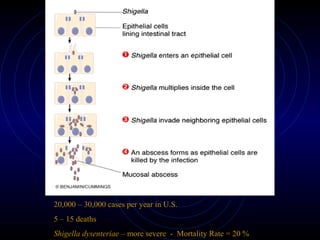
  •   Bacteria invade intestinal mucosa – produce toxin
  •   Severe diarrhea with blood in stool (dysentery)
  •   Toxin inhibits Protein Synthesis
       • Cells lining G.I. tract are shed
  • Up to 20 bowels movements a day
20,000 – 30,000 cases per year in U.S.
5 – 15 deaths
Shigella dysenteriae – more severe - Mortality Rate = 20 %
Salmonellosis
(Salmonella Gastroenteritis)
• Bacterial Infection – Salmonella sp.
• Salmonella
  • Gram (-), facultative, non-spore forming rods
  • Found in G.I. Tract of humans and many animals
  • All are considered pathogenic
• Taxonomy
  • Use serotype rather than species
  • Over 2000 serotypes (50 common in U.S.)
     • Salmonella arizonae              Salmonella
       brazil
     • Salmonella atlanta        Salmonella pakistan
Salmonellosis
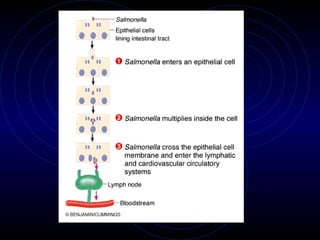
• Incubation time 12 – 36 hours
• Bacteria invade the intestinal mucosa and
  multiply
• May pass thru mucosa into lymphatic or
  circulatory system and become systemic
• Fever, abdominal pain, cramps and diarrhea
Salmonellosis
• 1 billion Salmonella per gram of feces
• Mortality rate < 1 %
  • Higher in infants and elderly
• Recovery in a few days
  • Some may shed bacteria in feces for 6 months
Salmonellosis
• Contamination
  • Meats, poultry, eggs, pet reptiles (turtles)

• Undercooked or Raw Eggs
  •   Hollandaise sauce
  •   Cookie batter
  •   Caesar salads
  •   “Sunny side up” fried eggs
Typhoid Fever
• Salmonella typhi - most virulent Salmonella
• Only found in humans (feces)
• Systemic disease
  • Spreads thru body, found in blood, urine, feces
• Mortality rate 1-2 %, used to be 10 %
  • Was common before days of proper sewage
     treatment
   • Still common in Third World countries
Typhoid Mary
• Mary Mallon – cook in N.Y.
• carrier
  • Responsible for several outbreaks and many
    deaths
  • Refused to leave her job
• 1 – 3 % become chronic carriers
  • Microbe lives in gallbladder and is shed in feces
Cholera
• Vibrio cholerae - Gram (-) curved rod

• Endemic in Asia and India
• Cholera toxin
  • Secretion of Cl- leads to H2O loss and diarrhea
  • 12 – 20 liters of fluid per day ( 3 – 5 gallons)
Food Poisoning from Seafood
• Vibrio parahaemolytica
  • Found in salt H2O estuaries
  • Associated with poisoning from
     •   Raw oysters
     •   Shell fish
     •   Shrimp
     •   crabs
Staphylococcal Food Poisoning
  (Staphylococcal intoxication)
• Ingesting an enterotoxin by Staph. aureus
• Staphylococci
   •   High resistance to heat
   •   Resistant to drying out
   •   Resistant to high osmotic pressures
   •   Resistant to high salt conc.

   • Found in nasal passages and hands
        • Contaminate food
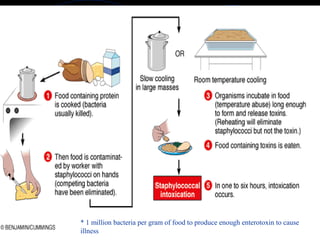
* 1 million bacteria per gram of food to produce enough enterotoxin to cause
illness
Most reliable method of preventing
     Staphylococcal intoxication:
• Adequate refrigeration during storage to
  prevent toxin production
• Toxin
   • Triggers vomiting reflex center of brain
   • Abdominal cramps & diarrhea
   • Recovery usually complete in 24 hours.
   • Mortality rate – 0 % in healthy people
Peptic Ulcers
• Helicobacter pylori – microaerophilic spiral
• 30% - 50 % of normal pop. are infected, but only
  15% of those develop ulcers
•                    urease

• H2O + urea                     ammonia + CO2


• Urea Breath Test
   • Swallow radio-active urea
   • If positive, patient will exhale radio-active CO2 within
Hepatitis
• Inflammation of the liver
• Viral Hepatitis - 2nd most frequently reported
  infectious disease in the U.S.
• 5 different viruses
   • Hepatitis A
   • Hepatitis B
   • Hepatitis C
   • Hepatitis D
   • Hepatitis E
Hepatitis A                 (Infectious Hepatitis)
• HAV            ss RNA no envelope
   • Enters via oral route, multiplies in G.I. Tract spreads to liver
   • Virus is shed in feces
   • HAV is resistant to normal chlorine disinfectants used for
     water
   • HAV can survive several days on surfaces (cutting boards)
• 50% of infections are subclinical
   • Symptoms
      • Nausea         diarrhea       abdominal discomfort
      • Fever          chills         jaundice
• Recovery results in lifelong Immunity
   • No chronic Hepatitis A
Hepatitis B                  (Serum Hepatitis)
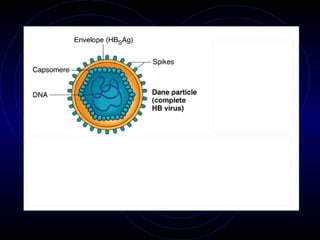
• HBV        ds DNA envelope
• Transmitted by blood, semen, saliva, breast milk
• 50% cases asymptomatic
  • Symptoms
      • Loss of appetite      fever joint pains       jaundice
• 10% become chronic carriers of HBV
  • Chronic carriers are 200 times more likely to develop liver
    cancer
• HBV Vaccination required in Illinois Schools
  • Recommended for high risk individuals (health care workers)
Hepatitis C   (Non A, Non B Hepatitis)

• HCV   ss RNA envelope
Digestive disease
Digestive disease

Digestive disease

  • 1.
    Microbial Diseases ofthe Digestive System Chapter 25
  • 2.
    Normal Microbial Floraof the Digestive System • Mouth • 1 ml saliva = millions of bacteria • Stomach and small intestine • Few organisms due to HCl and rapid movement of food • Large intestine • 100 billion bacteria per gram of feces • 40 % of fecal mass is microbial cell material • Lactobacillus, Bacteriodes, Enterobacter, E. coli. Proteus spp.
  • 3.
    Bacterial Diseases ofLower G.I. • Infections • Intoxications • Pathogens enters G.I. Tract • Ingestion of a preformed and multiples toxin • Bacteria may penetrate the • Sudden onset of symptoms intestinal mucosa or may ( few hours ) pass to other systemic • Fever not always present organs • Delay in appearance of symptoms while pathogen increases in number or invades tissue • Usually a fever
  • 4.
    Bacterial Diseases ofLower G.I. • Diarrhea – infections and intoxications • Blood or mucus - dysentery • Abdominal cramps, nausea and vomiting • Defense mechanism to rid body of harmful material • Gastroenteritis • Inflammation of stomach or intestinal mucosa
  • 5.
    Campylobacter Gastroenteritis • Campylobacterjejuni • Gram (-), microaerophilic spiral • Most common cause of food borne illness in the U.S. • Found in the intestines of many animals, especially poultry • Almost all retail chicken is contaminated • 60 % of cattle is contaminated • 2 million cases per year
  • 6.
    Escherichia Gastroenteritis • 1.ETEC - enterotoxigenic E. coli • Not invasive • Enterotoxin – watery diarrhea • 2. EIEC - enteroinvasive E. coli • Invades intestinal wall • Inflammation, fever & Shigella-like dysentery • 3. EHEC - enterhemorrhagic E. coli • E. coli O157: H7 • Found in intestines of animals, especially cattle • Hemorrhagic colitis – inflammation of colon with bleeding • HUS – Hemolytic Uremic Syndrome • Blood in urine leading to kidney failure (kidneys effected by toxin)
  • 7.
    Shigellosis (Bacillary Dysentery) •Bacterial infection - Shigella sp. Gram (-), facultative, rods • Shigella sonnei • Shigella dysenteriae • Shigella flexneri • Shigella boydii Incubation period: • 12 hours to 2 weeks • Usually fever • Mild case of Shigellosis • Traveler’s Diarrhea • Montezuma’s Revenge • Green Apple Two Step • Shigella sonnei
  • 8.
    Toxin • Shiga toxin - Kiyoshi Shiga • Unusually virulent • Bacteria invade intestinal mucosa – produce toxin • Severe diarrhea with blood in stool (dysentery) • Toxin inhibits Protein Synthesis • Cells lining G.I. tract are shed • Up to 20 bowels movements a day
  • 9.
    20,000 – 30,000cases per year in U.S. 5 – 15 deaths Shigella dysenteriae – more severe - Mortality Rate = 20 %
  • 10.
    Salmonellosis (Salmonella Gastroenteritis) • BacterialInfection – Salmonella sp. • Salmonella • Gram (-), facultative, non-spore forming rods • Found in G.I. Tract of humans and many animals • All are considered pathogenic • Taxonomy • Use serotype rather than species • Over 2000 serotypes (50 common in U.S.) • Salmonella arizonae Salmonella brazil • Salmonella atlanta Salmonella pakistan
  • 11.
    Salmonellosis • Incubation time12 – 36 hours • Bacteria invade the intestinal mucosa and multiply • May pass thru mucosa into lymphatic or circulatory system and become systemic • Fever, abdominal pain, cramps and diarrhea
  • 13.
    Salmonellosis • 1 billionSalmonella per gram of feces • Mortality rate < 1 % • Higher in infants and elderly • Recovery in a few days • Some may shed bacteria in feces for 6 months
  • 14.
    Salmonellosis • Contamination • Meats, poultry, eggs, pet reptiles (turtles) • Undercooked or Raw Eggs • Hollandaise sauce • Cookie batter • Caesar salads • “Sunny side up” fried eggs
  • 15.
    Typhoid Fever • Salmonellatyphi - most virulent Salmonella • Only found in humans (feces) • Systemic disease • Spreads thru body, found in blood, urine, feces • Mortality rate 1-2 %, used to be 10 % • Was common before days of proper sewage treatment • Still common in Third World countries
  • 16.
    Typhoid Mary • MaryMallon – cook in N.Y. • carrier • Responsible for several outbreaks and many deaths • Refused to leave her job • 1 – 3 % become chronic carriers • Microbe lives in gallbladder and is shed in feces
  • 17.
    Cholera • Vibrio cholerae- Gram (-) curved rod • Endemic in Asia and India • Cholera toxin • Secretion of Cl- leads to H2O loss and diarrhea • 12 – 20 liters of fluid per day ( 3 – 5 gallons)
  • 18.
    Food Poisoning fromSeafood • Vibrio parahaemolytica • Found in salt H2O estuaries • Associated with poisoning from • Raw oysters • Shell fish • Shrimp • crabs
  • 19.
    Staphylococcal Food Poisoning (Staphylococcal intoxication) • Ingesting an enterotoxin by Staph. aureus • Staphylococci • High resistance to heat • Resistant to drying out • Resistant to high osmotic pressures • Resistant to high salt conc. • Found in nasal passages and hands • Contaminate food
  • 20.
    * 1 millionbacteria per gram of food to produce enough enterotoxin to cause illness
  • 21.
    Most reliable methodof preventing Staphylococcal intoxication: • Adequate refrigeration during storage to prevent toxin production • Toxin • Triggers vomiting reflex center of brain • Abdominal cramps & diarrhea • Recovery usually complete in 24 hours. • Mortality rate – 0 % in healthy people
  • 22.
    Peptic Ulcers • Helicobacterpylori – microaerophilic spiral • 30% - 50 % of normal pop. are infected, but only 15% of those develop ulcers • urease • H2O + urea ammonia + CO2 • Urea Breath Test • Swallow radio-active urea • If positive, patient will exhale radio-active CO2 within
  • 24.
    Hepatitis • Inflammation ofthe liver • Viral Hepatitis - 2nd most frequently reported infectious disease in the U.S. • 5 different viruses • Hepatitis A • Hepatitis B • Hepatitis C • Hepatitis D • Hepatitis E
  • 25.
    Hepatitis A (Infectious Hepatitis) • HAV ss RNA no envelope • Enters via oral route, multiplies in G.I. Tract spreads to liver • Virus is shed in feces • HAV is resistant to normal chlorine disinfectants used for water • HAV can survive several days on surfaces (cutting boards) • 50% of infections are subclinical • Symptoms • Nausea diarrhea abdominal discomfort • Fever chills jaundice • Recovery results in lifelong Immunity • No chronic Hepatitis A
  • 26.
    Hepatitis B (Serum Hepatitis) • HBV ds DNA envelope • Transmitted by blood, semen, saliva, breast milk • 50% cases asymptomatic • Symptoms • Loss of appetite fever joint pains jaundice • 10% become chronic carriers of HBV • Chronic carriers are 200 times more likely to develop liver cancer • HBV Vaccination required in Illinois Schools • Recommended for high risk individuals (health care workers)
  • 27.
    Hepatitis C (Non A, Non B Hepatitis) • HCV ss RNA envelope

Editor's Notes

  • #5 Diarrhea – developing countries 1 child in 10 dies of diarrhea before age of 5 Most common causes – Rotaviruses, E.coli and Shigella
  • #8 Shigella found only in G.I. Tracts of humans, apes and monkeys
  • #17 1900’s Ended up isolated in a city hospital on Island in the East River off the Bronx shore