Chapter 1: Elements of Diffusion What is Diffusion?  “ the process by which an  innovation  is  communicated  through certain  channels  over  time  among the members of a  social system .” (Rogers, pp. 35) A special type of communication which is mainly focused with the spread of messages perceived as new ideas. Moreover, it creates a sense of uncertainty resulting with recognized risks involved in the diffusion process. Obtaining information, however, can reduce the degree of uncertainty because it provides a set of alternatives you can choose from.  Furthermore, a better sense of understanding. Four Main Elements in the Diffusion of Innovations: Innovation Communication Channels Time Social System “ Diffusion of Innovation” Chapters 1 & 2   James Ramos Com 499  September 9, 2007
Innovation “ an idea, practice, or object perceived as new by an individual or other  unit of adoption.” (Rogers, pp.36) Most innovations discussed in the book are technological ones. Technology “is a design for instrumental action that reduces the uncertainty in the cause-effect  relationships involved in achieving a desired outcome.” (Rogers, pp. 36) Furthermore, technology requires two components: Hardware- The tool that represents the technology as a material or physical object. Sofware- Consists of the knowledge base for the tool. Five attributes of innovation: 1. relative advantage 2. compatibility  3. complexity 4. trialability 5. observability  Re-invention “is the degree to which an innovation is changed or modified by a user in the process of its adoption and implementation.” (Rogers, pp.36)
Communication Channels “ means by which messages get from one individual to another.” (Rogers, pp. 36) Mass media channels are more effective in creating knowledge of innovations. In contrast, interpersonal channels are more effective in structuring and changing attitudes toward a new idea whether it is to reject or adopt it. Most people do not evaluate a new idea based on scientific research by experts, but mainly through the subjective evaluation of their peers who have adopted the new idea. Heterophily “is the degree to which two or more individuals who interact are different in certain attributes, such as beliefs, education, social status, and the like.” (Rogers, pp.36) In contrast, Homophily is “the degree to which two or more individuals who interact are similar in certain attributes.” (Rogers, pp.36) Most types of human communication happen between individuals who are homophilous, a situations that is more effective in communication. Futhermore, heterophily often occurs in the diffusion of innovation which then leads to problems in achieving effective communication.
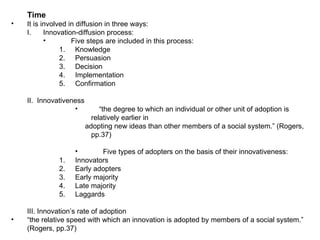
Time  It is involved in diffusion in three ways: Innovation-diffusion process: Five steps are included in this process: Knowledge Persuasion Decision Implementation Confirmation II.  Innovativeness “ the degree to which an individual or other unit of adoption is relatively earlier in  adopting new ideas than other members of a social system.” (Rogers, pp.37)  Five types of adopters on the basis of their innovativeness: Innovators Early adopters Early majority Late majority Laggards   III. Innovation’s rate of adoption “ the relative speed with which an innovation is adopted by members of a social system.” (Rogers, pp.37)
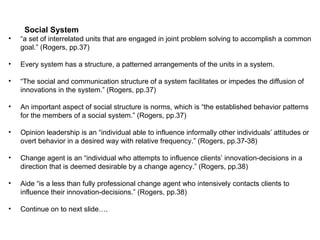
Social System “ a set of interrelated units that are engaged in joint problem solving to accomplish a common goal.” (Rogers, pp.37) Every system has a structure, a patterned arrangements of the units in a system. “ The social and communication structure of a system facilitates or impedes the diffusion of innovations in the system.” (Rogers, pp.37) An important aspect of social structure is norms, which is “the established behavior patterns for the members of a social system.” (Rogers, pp.37) Opinion leadership is an “individual able to influence informally other individuals’ attitudes or overt behavior in a desired way with relative frequency.” (Rogers, pp.37-38) Change agent is an “individual who attempts to influence clients’ innovation-decisions in a direction that is deemed desirable by a change agency.” (Rogers, pp.38) Aide “is a less than fully professional change agent who intensively contacts clients to influence their innovation-decisions.” (Rogers, pp.38) Continue on to next slide….
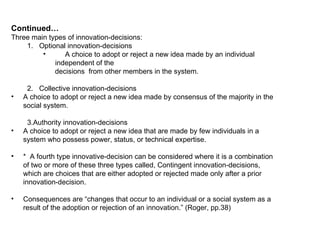
Continued… Three main types of innovation-decisions: Optional innovation-decisions A choice to adopt or reject a new idea made by an individual independent of the decisions  from other members in the system. Collective innovation-decisions A choice to adopt or reject a new idea made by consensus of the majority in the social system. 3.Authority innovation-decisions A choice to adopt or reject a new idea that are made by few individuals in a system who possess power, status, or technical expertise. *  A fourth type innovative-decision can be considered where it is a combination of two or more of these three types called, Contingent innovation-decisions, which are choices that are either adopted or rejected made only after a prior innovation-decision. Consequences are “changes that occur to an individual or a social system as a result of the adoption or rejection of an innovation.” (Roger, pp.38)
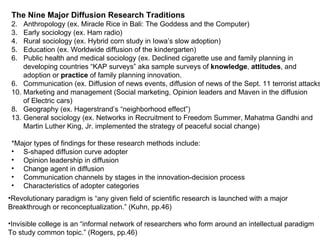
The Nine Major Diffusion Research Traditions Anthropology (ex. Miracle Rice in Bali: The Goddess and the Computer) Early sociology (ex. Ham radio) Rural sociology (ex. Hybrid corn study in Iowa’s slow adoption) Education (ex. Worldwide diffusion of the kindergarten) Public health and medical sociology (ex. Declined cigarette use and family planning in  developing countries “KAP surveys” aka sample surveys of  knowledge ,  attitudes , and  adoption or  practice  of family planning innovation. 6.  Communication (ex. Diffusion of news events, diffusion of news of the Sept. 11 terrorist attacks) Marketing and management (Social marketing, Opinion leaders and Maven in the diffusion of Electric cars) 8.  Geography (ex. Hagerstrand’s “neighborhood effect”) General sociology (ex. Networks in Recruitment to Freedom Summer, Mahatma Gandhi and  Martin Luther King, Jr. implemented the strategy of peaceful social change) *Major types of findings for these research methods include: S-shaped diffusion curve adopter  Opinion leadership in diffusion Change agent in diffusion Communication channels by stages in the innovation-decision process Characteristics of adopter categories Revolutionary paradigm is “any given field of scientific research is launched with a major  Breakthrough or reconceptualization.” (Kuhn, pp.46) Invisible college is an “informal network of researchers who form around an intellectual paradigm To study common topic.” (Rogers, pp.46)
8 Main Types of Diffusion Research: Earliness of knowing about innovation “ Challenger” diffusion of information through radio and/or television  2.  Rate of adoption of different innovations in a social system Adoption of innovation correlated with farmers values spread more rapidly compared to other types of innovation. 3.  Innovativeness Adoption of new ideas in public health departments. 4.  Opinion Leadership HIV prevention strategies utilized in a gay community. 5.  Diffusion networks Understanding that similarity in age, religion, hometown were important in the diffusion of new drugs provided by doctors. 6.  Rate of adoption in different social systems Koreans fastest rate of conceptive use with the help of mass media exposure, leaders highly connected to the community, and great number of change agents. 7.  Communication channel usage. Hybrid seed corn in Iowa Consequences of innovation. Steel ax usage in the Yir Yoront culture.  Disruption and negative on the cultures values and roles of men and women and the elders.

Diffusion Of Innovation Chapters 1 and 2

  • 1.
    Chapter 1: Elementsof Diffusion What is Diffusion? “ the process by which an innovation is communicated through certain channels over time among the members of a social system .” (Rogers, pp. 35) A special type of communication which is mainly focused with the spread of messages perceived as new ideas. Moreover, it creates a sense of uncertainty resulting with recognized risks involved in the diffusion process. Obtaining information, however, can reduce the degree of uncertainty because it provides a set of alternatives you can choose from. Furthermore, a better sense of understanding. Four Main Elements in the Diffusion of Innovations: Innovation Communication Channels Time Social System “ Diffusion of Innovation” Chapters 1 & 2 James Ramos Com 499 September 9, 2007
  • 2.
    Innovation “ anidea, practice, or object perceived as new by an individual or other unit of adoption.” (Rogers, pp.36) Most innovations discussed in the book are technological ones. Technology “is a design for instrumental action that reduces the uncertainty in the cause-effect relationships involved in achieving a desired outcome.” (Rogers, pp. 36) Furthermore, technology requires two components: Hardware- The tool that represents the technology as a material or physical object. Sofware- Consists of the knowledge base for the tool. Five attributes of innovation: 1. relative advantage 2. compatibility 3. complexity 4. trialability 5. observability Re-invention “is the degree to which an innovation is changed or modified by a user in the process of its adoption and implementation.” (Rogers, pp.36)
  • 3.
    Communication Channels “means by which messages get from one individual to another.” (Rogers, pp. 36) Mass media channels are more effective in creating knowledge of innovations. In contrast, interpersonal channels are more effective in structuring and changing attitudes toward a new idea whether it is to reject or adopt it. Most people do not evaluate a new idea based on scientific research by experts, but mainly through the subjective evaluation of their peers who have adopted the new idea. Heterophily “is the degree to which two or more individuals who interact are different in certain attributes, such as beliefs, education, social status, and the like.” (Rogers, pp.36) In contrast, Homophily is “the degree to which two or more individuals who interact are similar in certain attributes.” (Rogers, pp.36) Most types of human communication happen between individuals who are homophilous, a situations that is more effective in communication. Futhermore, heterophily often occurs in the diffusion of innovation which then leads to problems in achieving effective communication.
  • 4.
    Time Itis involved in diffusion in three ways: Innovation-diffusion process: Five steps are included in this process: Knowledge Persuasion Decision Implementation Confirmation II. Innovativeness “ the degree to which an individual or other unit of adoption is relatively earlier in adopting new ideas than other members of a social system.” (Rogers, pp.37) Five types of adopters on the basis of their innovativeness: Innovators Early adopters Early majority Late majority Laggards III. Innovation’s rate of adoption “ the relative speed with which an innovation is adopted by members of a social system.” (Rogers, pp.37)
  • 5.
    Social System “a set of interrelated units that are engaged in joint problem solving to accomplish a common goal.” (Rogers, pp.37) Every system has a structure, a patterned arrangements of the units in a system. “ The social and communication structure of a system facilitates or impedes the diffusion of innovations in the system.” (Rogers, pp.37) An important aspect of social structure is norms, which is “the established behavior patterns for the members of a social system.” (Rogers, pp.37) Opinion leadership is an “individual able to influence informally other individuals’ attitudes or overt behavior in a desired way with relative frequency.” (Rogers, pp.37-38) Change agent is an “individual who attempts to influence clients’ innovation-decisions in a direction that is deemed desirable by a change agency.” (Rogers, pp.38) Aide “is a less than fully professional change agent who intensively contacts clients to influence their innovation-decisions.” (Rogers, pp.38) Continue on to next slide….
  • 6.
    Continued… Three maintypes of innovation-decisions: Optional innovation-decisions A choice to adopt or reject a new idea made by an individual independent of the decisions from other members in the system. Collective innovation-decisions A choice to adopt or reject a new idea made by consensus of the majority in the social system. 3.Authority innovation-decisions A choice to adopt or reject a new idea that are made by few individuals in a system who possess power, status, or technical expertise. * A fourth type innovative-decision can be considered where it is a combination of two or more of these three types called, Contingent innovation-decisions, which are choices that are either adopted or rejected made only after a prior innovation-decision. Consequences are “changes that occur to an individual or a social system as a result of the adoption or rejection of an innovation.” (Roger, pp.38)
  • 7.
    The Nine MajorDiffusion Research Traditions Anthropology (ex. Miracle Rice in Bali: The Goddess and the Computer) Early sociology (ex. Ham radio) Rural sociology (ex. Hybrid corn study in Iowa’s slow adoption) Education (ex. Worldwide diffusion of the kindergarten) Public health and medical sociology (ex. Declined cigarette use and family planning in developing countries “KAP surveys” aka sample surveys of knowledge , attitudes , and adoption or practice of family planning innovation. 6. Communication (ex. Diffusion of news events, diffusion of news of the Sept. 11 terrorist attacks) Marketing and management (Social marketing, Opinion leaders and Maven in the diffusion of Electric cars) 8. Geography (ex. Hagerstrand’s “neighborhood effect”) General sociology (ex. Networks in Recruitment to Freedom Summer, Mahatma Gandhi and Martin Luther King, Jr. implemented the strategy of peaceful social change) *Major types of findings for these research methods include: S-shaped diffusion curve adopter Opinion leadership in diffusion Change agent in diffusion Communication channels by stages in the innovation-decision process Characteristics of adopter categories Revolutionary paradigm is “any given field of scientific research is launched with a major Breakthrough or reconceptualization.” (Kuhn, pp.46) Invisible college is an “informal network of researchers who form around an intellectual paradigm To study common topic.” (Rogers, pp.46)
  • 8.
    8 Main Typesof Diffusion Research: Earliness of knowing about innovation “ Challenger” diffusion of information through radio and/or television 2. Rate of adoption of different innovations in a social system Adoption of innovation correlated with farmers values spread more rapidly compared to other types of innovation. 3. Innovativeness Adoption of new ideas in public health departments. 4. Opinion Leadership HIV prevention strategies utilized in a gay community. 5. Diffusion networks Understanding that similarity in age, religion, hometown were important in the diffusion of new drugs provided by doctors. 6. Rate of adoption in different social systems Koreans fastest rate of conceptive use with the help of mass media exposure, leaders highly connected to the community, and great number of change agents. 7. Communication channel usage. Hybrid seed corn in Iowa Consequences of innovation. Steel ax usage in the Yir Yoront culture. Disruption and negative on the cultures values and roles of men and women and the elders.