Presentation by:
Zaib-un-Nisa
Tahira Sheikh
Presented To:
Sir Awais
Spiral of Silence
 Theory/Definition
 Background/Origin
 Assumptions of Theory
 Relation with Mass Media and Examples
 Features
 Criticism
Outlines/ points of Discussion
 Firstly, purposed in 1984 by German political
scientist Elisabeth Noelle-Neumann.
 The theory talks about the relationship
between minority and majority of people and
how they express themselves. It proves
minority people keep silent on their views on
any particular subject.
Spiral of Silence
 Spiral of silence, in the study of human
communication and public opinion, the theory that
people’s willingness to express their opinions on
controversial public issues is affected by their largely
unconscious perception of those opinions as being
either popular or unpopular.
 The spiral of silence theory more broadly attempts to
describe collective opinion formation and societal
decision making regarding issues that are
controversial or morally loaded.
Con…..
 The theory of the spiral of silence arose from a surprising discovery in connection
with election research conducted during the 1965 German federal election
campaign. Months before election day in September 1965, Noelle-Neumann and
her staff at the Allensbach Institute for Public Opinion Research launched a series
of surveys designed to track the political opinions of the electorate throughout the
campaign. There were two major parties Christian Democratic Union–Christian
Social Union (CDU-CSU) and the opposing Social Democratic Party of Germany
(SDP). about 45 percent of the population intending to vote for each party. In the
final few weeks of the campaign, however, the situation suddenly changed, with
survey findings showing a last-minute swing in favor of the CDU-CSU. The
percentage of respondents who said that they intended to vote for the CDU-CSU
suddenly climbed to almost 50 percent, while the share that intended to vote for
the SDP dropped to less than 40 percent. In the end, the result of the election
confirmed those findings: the CDU-CSU won with 48 percent of the vote, as against
39 percent for the SDP. This sudden change of mind of SDP supporters becomes
the source of develop spiral of silence theory.
Origin of the Theory
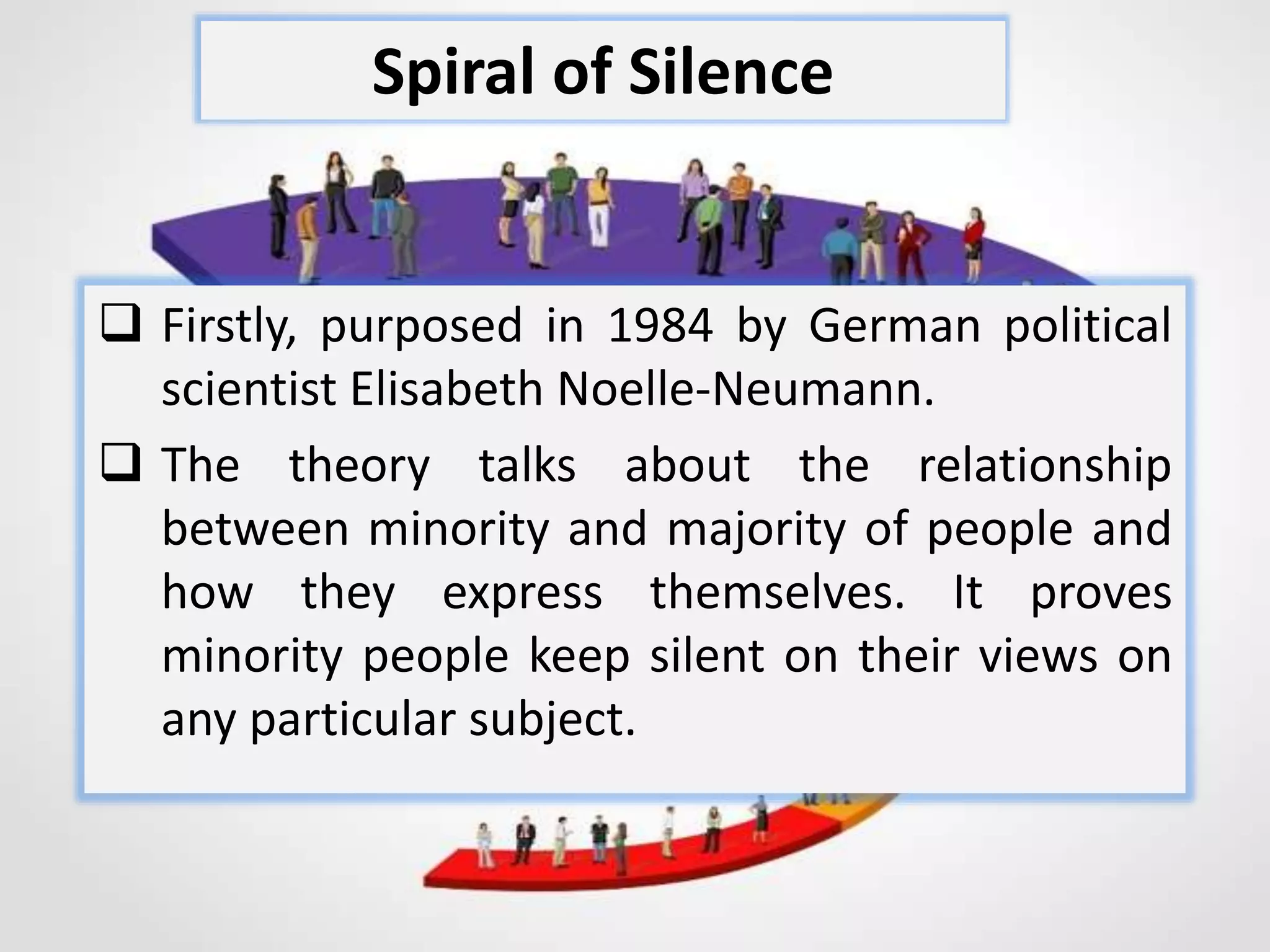
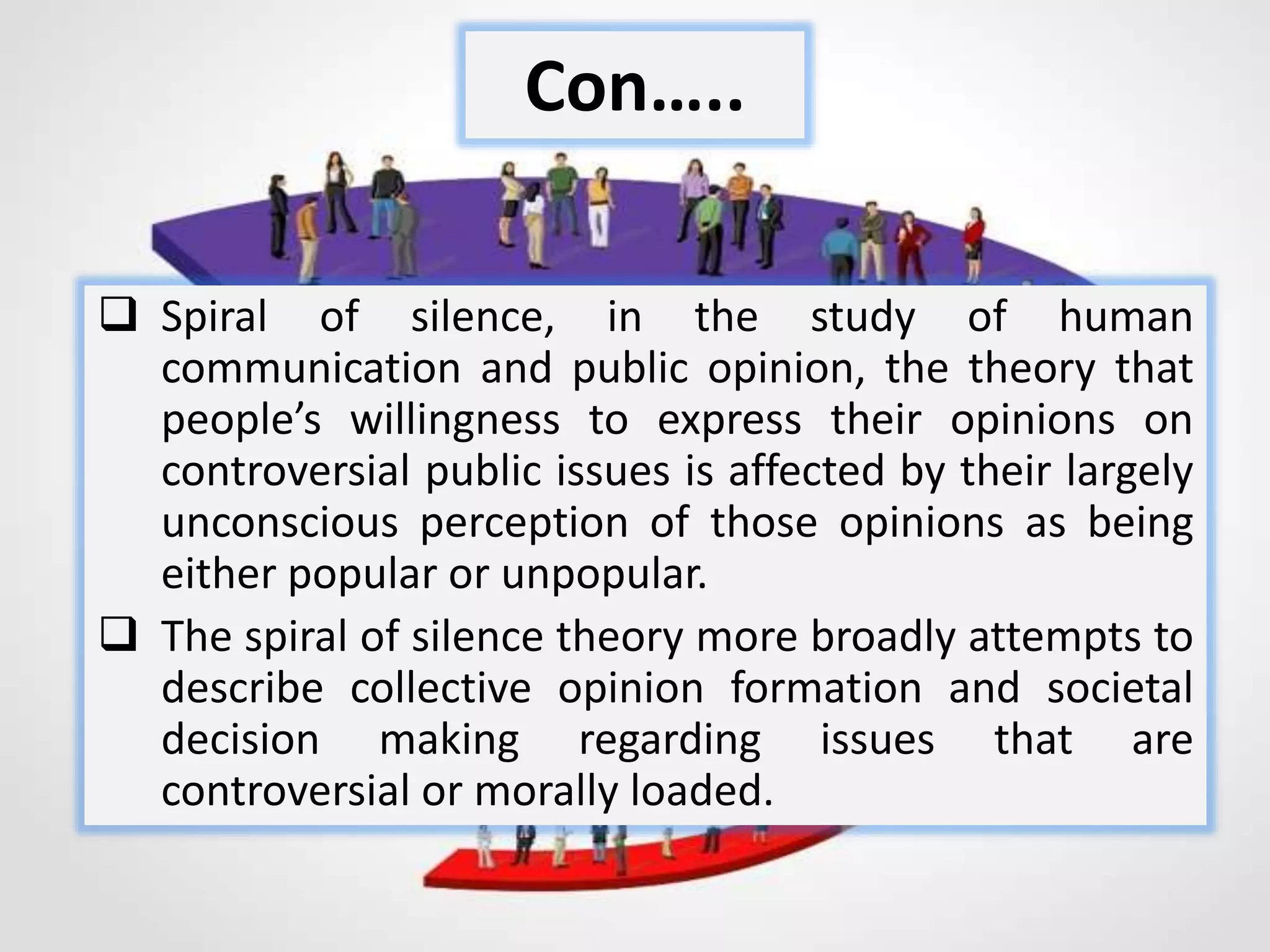
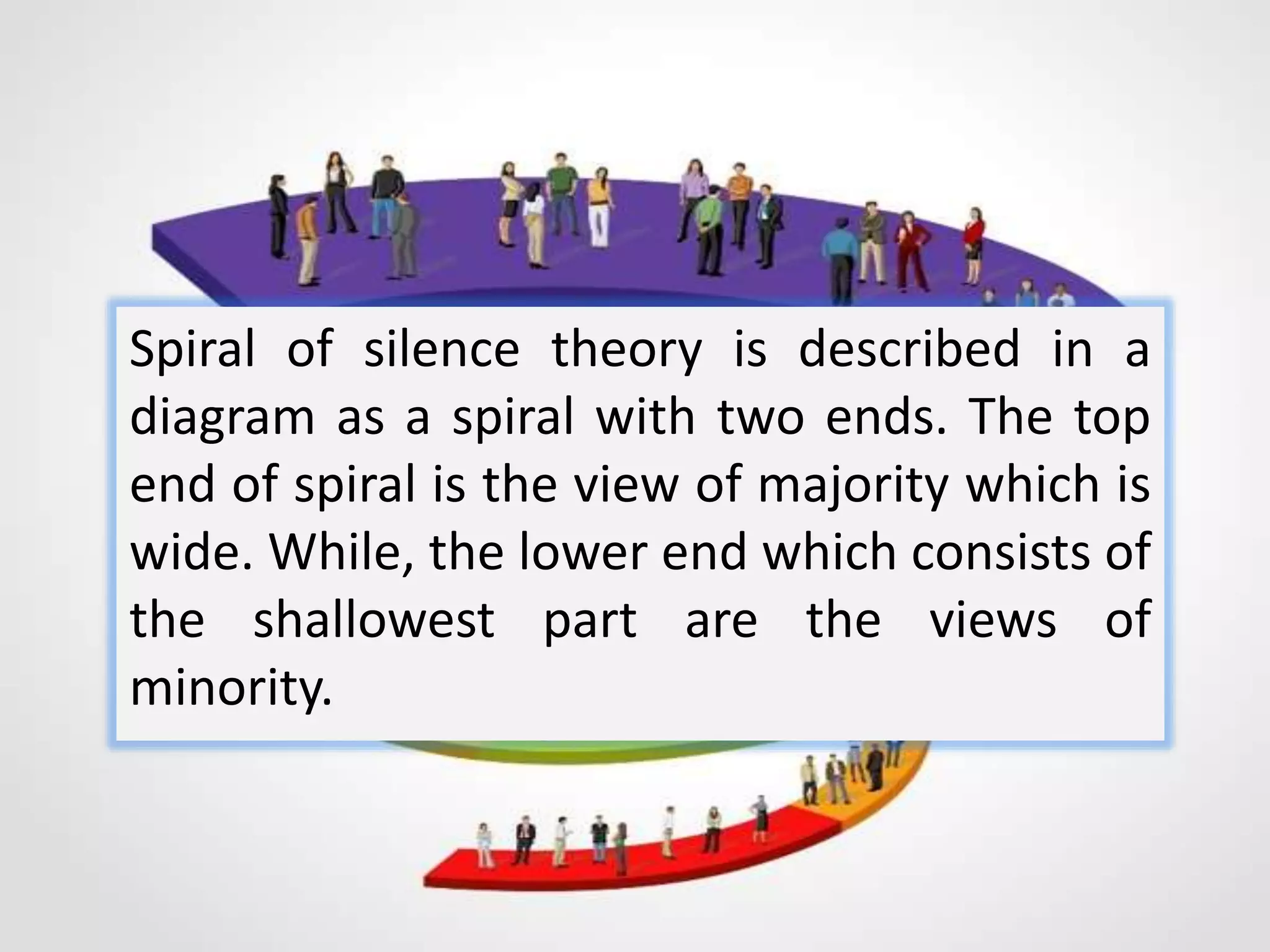
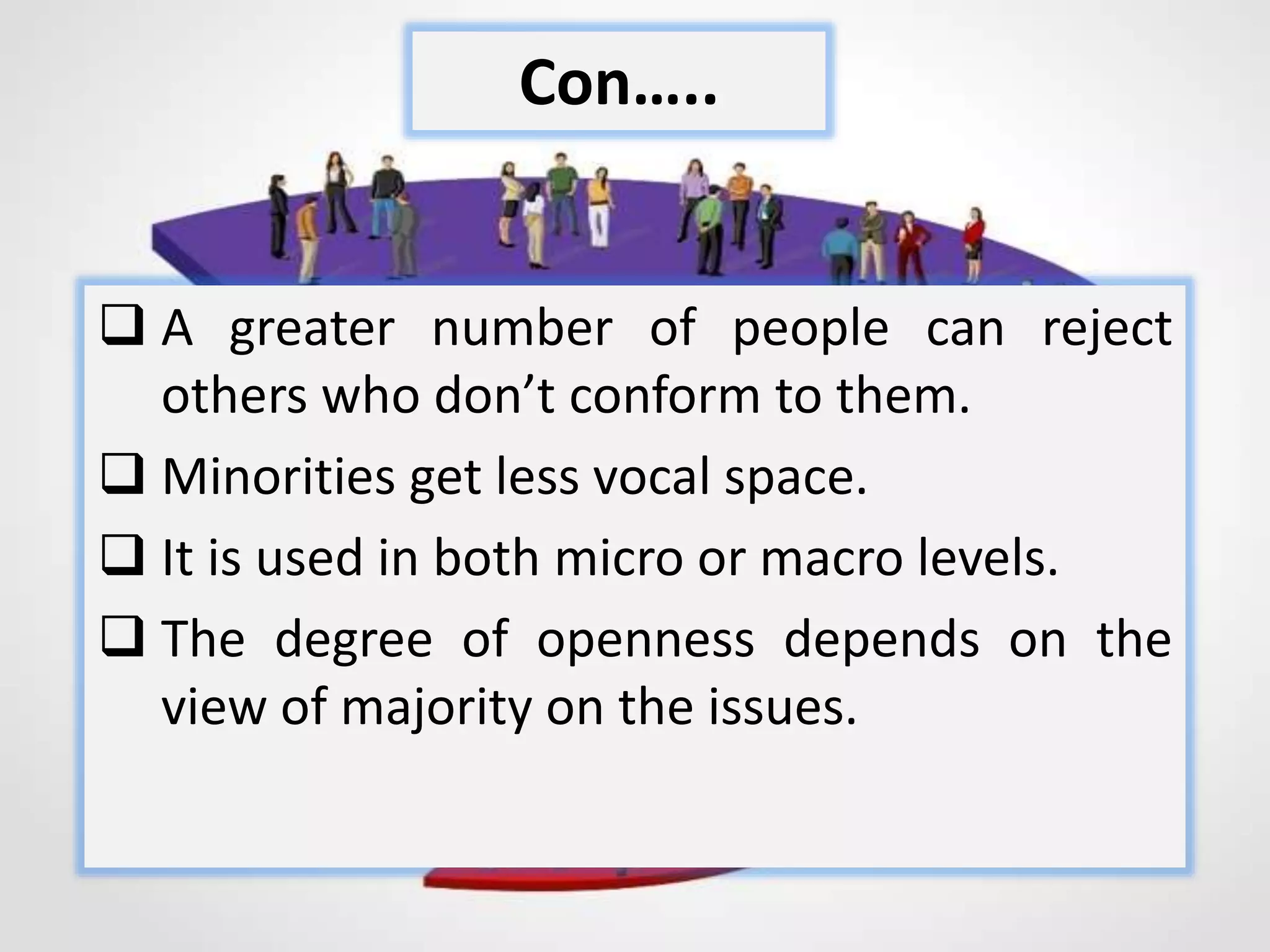
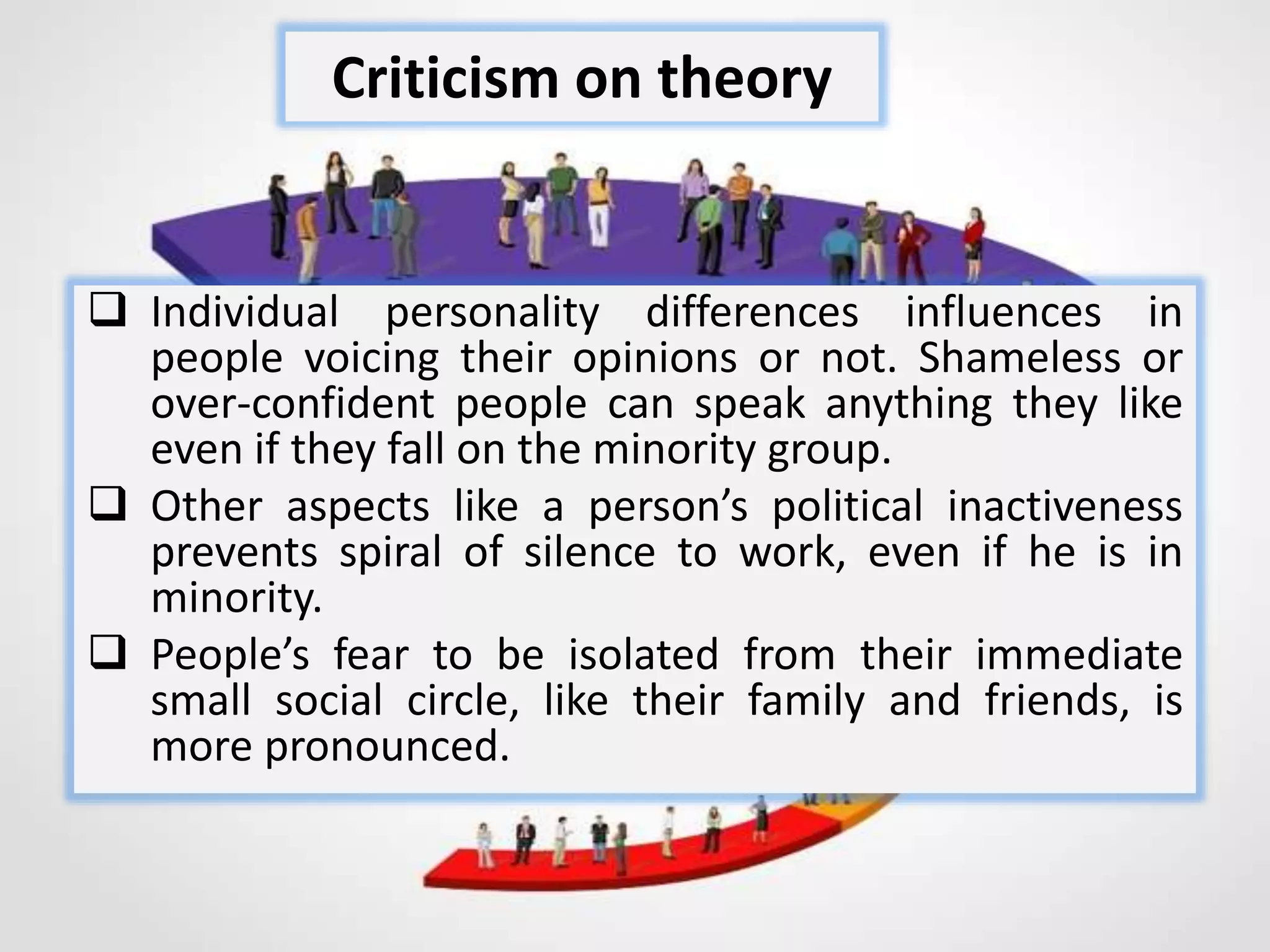
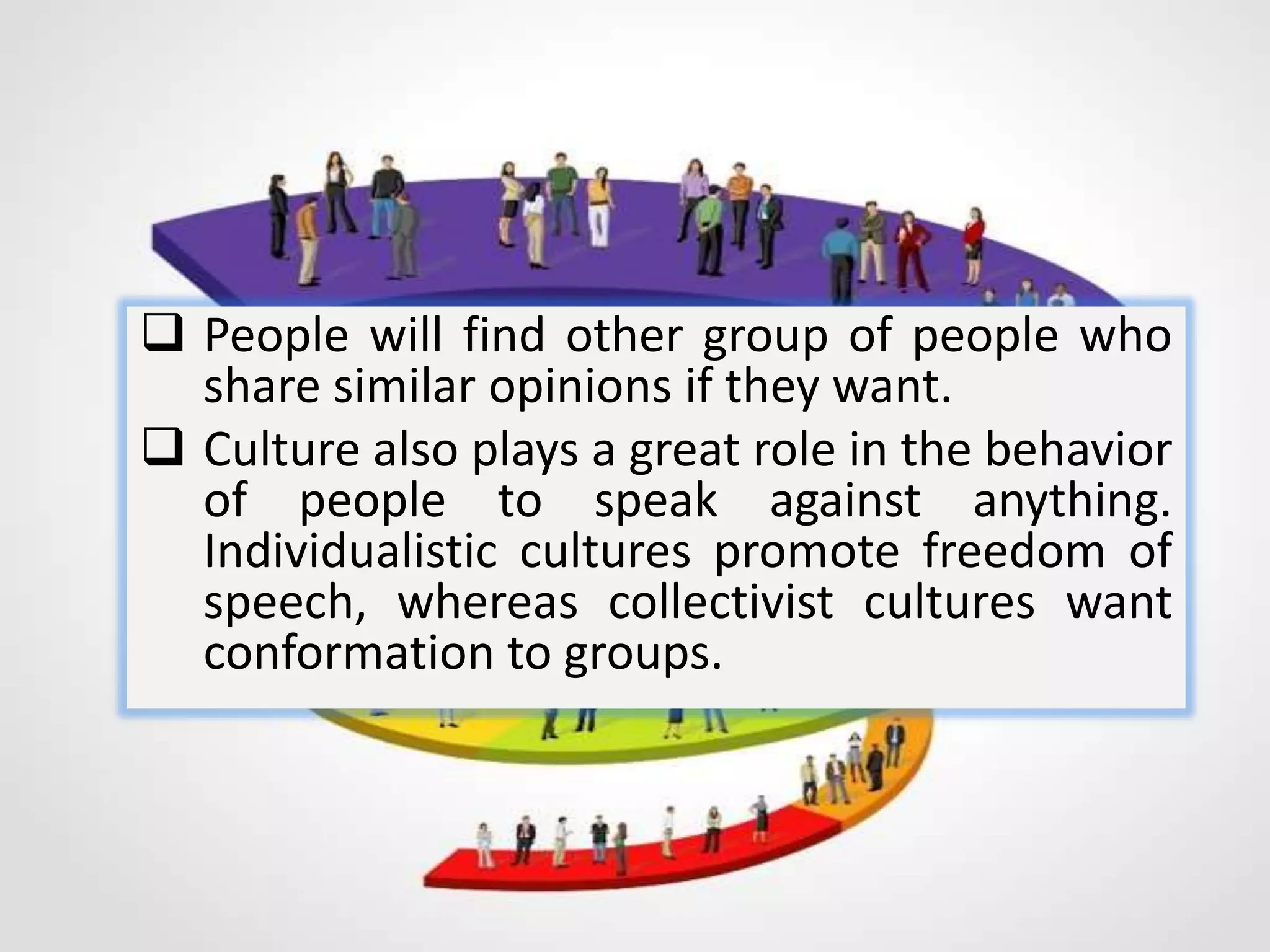
Spiral of silence theory is described in a
diagram as a spiral with two ends. The top
end of spiral is the view of majority which is
wide. While, the lower end which consists of
the shallowest part are the views of
minority.
The major assumptions of the theory why minority do not
speak up are:
 Every individual has a “quasi-statically organ” (sixth sense) that
makes them know prevailing majority public opinion.
 Individuals have fear of isolation from a group of people. He/she
could have divergent or negative opinions and might not support
status quo.
 Pluralistic Ignorance: the last stage of effect of pluralistic ignorance.
Pluralistic ignorance may occur in some cases, leading to the
minority opinion to be accepted as a norm. Group members may be
privately rejecting a norm, but may falsely assume that other group
members accept it. This phenomenon may cause a group to hold on
to a norm.
Assumptions of the theory
Ubiquity: The media are virtually
everywhere as sources of information.
Cumulation: Different forms of media
contribute in spiral of Silence.
Consonance: Dominant opinions by
media persons/ Opinion Leaders.
Reasons of Opposing views
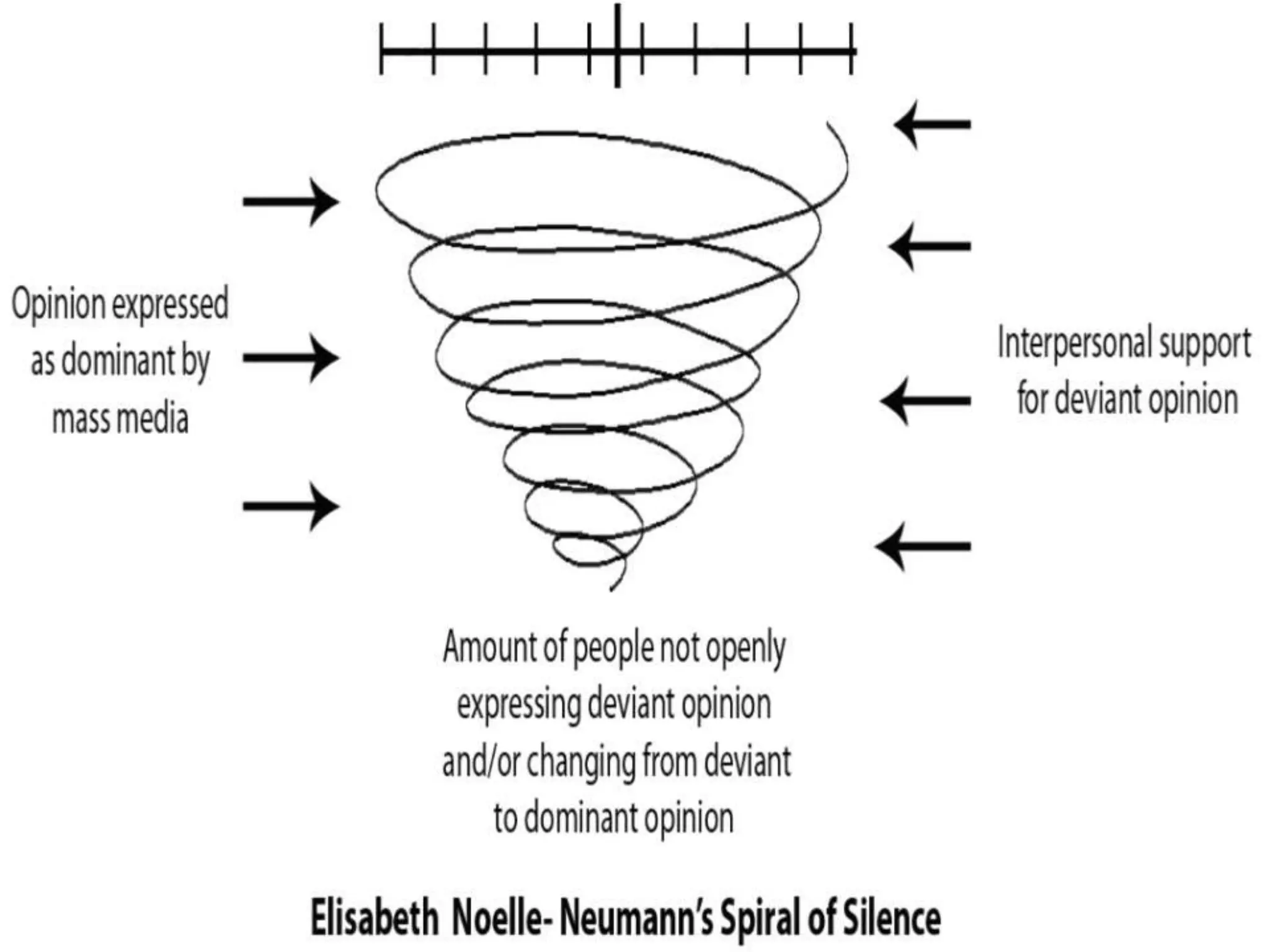
 The Spiral of Silence attempts to explain how media consumption,
interaction among key groups, and opinion expression all interact to form
opinions in society. Over time, a "spiraling" effect will occur, in which a
dominant opinion becomes more visible over one or more minority
opinions.
 Media shows what majority thinks to be true as true. It acts as a source to
influence public opinion and measure its rate. Spiral of Silence Theory
takes media as a reference. The theory explains its psychological influence
on individual behavior conforming them to majority views.
 Dominant opinions of mass media and interpersonal support work
together to suppress general public opinions. These opinions are different
than what most people think.
Relation of theory with Mass
Media
 In political elections, usually people are asked about their thoughts on candidates.
They try to support the popular candidate confidently or do not give out their
opinions because media inject the opinion to make it popular in minority’s mind by
suppressed their opinion.
 In 1991, support for Gulf War from the people of U.S. was measured through survey.
The results showed that most people were opposed to the war and were not
supportive. Rather, media, which was supportive of the government and war,
showed otherwise. People, who got information through media, were more
supportive of war as they wanted to be in the majority. This is spiral of silence.
People who did not support the war were many, but did not speak up against it.
They got the view that what media showed was the view of the majority.
 When a new rule is set in any organization, most of the employees do not complain.
The minority who want to protest also can’t do it due to the fear of isolation.
Examples
 It is a dynamic process.
 Mass media influences spiral of silence phenomena.
 Marginalization is a tool for elimination of
competition in political, social and organizational
scenarios.
 People are afraid to speak out due to their fear of
isolation.
 People can even withdraw their opinions to conform
to group.
Features of Spiral of Silence
 A greater number of people can reject
others who don’t conform to them.
 Minorities get less vocal space.
 It is used in both micro or macro levels.
 The degree of openness depends on the
view of majority on the issues.
Con…..
 Individual personality differences influences in
people voicing their opinions or not. Shameless or
over-confident people can speak anything they like
even if they fall on the minority group.
 Other aspects like a person’s political inactiveness
prevents spiral of silence to work, even if he is in
minority.
 People’s fear to be isolated from their immediate
small social circle, like their family and friends, is
more pronounced.
Criticism on theory
 People will find other group of people who
share similar opinions if they want.
 Culture also plays a great role in the behavior
of people to speak against anything.
Individualistic cultures promote freedom of
speech, whereas collectivist cultures want
conformation to groups.
Spiral of Silence

Spiral of Silence

  • 1.
  • 2.
     Theory/Definition  Background/Origin Assumptions of Theory  Relation with Mass Media and Examples  Features  Criticism Outlines/ points of Discussion
  • 3.
     Firstly, purposedin 1984 by German political scientist Elisabeth Noelle-Neumann.  The theory talks about the relationship between minority and majority of people and how they express themselves. It proves minority people keep silent on their views on any particular subject. Spiral of Silence
  • 4.
     Spiral ofsilence, in the study of human communication and public opinion, the theory that people’s willingness to express their opinions on controversial public issues is affected by their largely unconscious perception of those opinions as being either popular or unpopular.  The spiral of silence theory more broadly attempts to describe collective opinion formation and societal decision making regarding issues that are controversial or morally loaded. Con…..
  • 5.
     The theoryof the spiral of silence arose from a surprising discovery in connection with election research conducted during the 1965 German federal election campaign. Months before election day in September 1965, Noelle-Neumann and her staff at the Allensbach Institute for Public Opinion Research launched a series of surveys designed to track the political opinions of the electorate throughout the campaign. There were two major parties Christian Democratic Union–Christian Social Union (CDU-CSU) and the opposing Social Democratic Party of Germany (SDP). about 45 percent of the population intending to vote for each party. In the final few weeks of the campaign, however, the situation suddenly changed, with survey findings showing a last-minute swing in favor of the CDU-CSU. The percentage of respondents who said that they intended to vote for the CDU-CSU suddenly climbed to almost 50 percent, while the share that intended to vote for the SDP dropped to less than 40 percent. In the end, the result of the election confirmed those findings: the CDU-CSU won with 48 percent of the vote, as against 39 percent for the SDP. This sudden change of mind of SDP supporters becomes the source of develop spiral of silence theory. Origin of the Theory
  • 6.
    Spiral of silencetheory is described in a diagram as a spiral with two ends. The top end of spiral is the view of majority which is wide. While, the lower end which consists of the shallowest part are the views of minority.
  • 8.
    The major assumptionsof the theory why minority do not speak up are:  Every individual has a “quasi-statically organ” (sixth sense) that makes them know prevailing majority public opinion.  Individuals have fear of isolation from a group of people. He/she could have divergent or negative opinions and might not support status quo.  Pluralistic Ignorance: the last stage of effect of pluralistic ignorance. Pluralistic ignorance may occur in some cases, leading to the minority opinion to be accepted as a norm. Group members may be privately rejecting a norm, but may falsely assume that other group members accept it. This phenomenon may cause a group to hold on to a norm. Assumptions of the theory
  • 9.
    Ubiquity: The mediaare virtually everywhere as sources of information. Cumulation: Different forms of media contribute in spiral of Silence. Consonance: Dominant opinions by media persons/ Opinion Leaders. Reasons of Opposing views
  • 10.
     The Spiralof Silence attempts to explain how media consumption, interaction among key groups, and opinion expression all interact to form opinions in society. Over time, a "spiraling" effect will occur, in which a dominant opinion becomes more visible over one or more minority opinions.  Media shows what majority thinks to be true as true. It acts as a source to influence public opinion and measure its rate. Spiral of Silence Theory takes media as a reference. The theory explains its psychological influence on individual behavior conforming them to majority views.  Dominant opinions of mass media and interpersonal support work together to suppress general public opinions. These opinions are different than what most people think. Relation of theory with Mass Media
  • 11.
     In politicalelections, usually people are asked about their thoughts on candidates. They try to support the popular candidate confidently or do not give out their opinions because media inject the opinion to make it popular in minority’s mind by suppressed their opinion.  In 1991, support for Gulf War from the people of U.S. was measured through survey. The results showed that most people were opposed to the war and were not supportive. Rather, media, which was supportive of the government and war, showed otherwise. People, who got information through media, were more supportive of war as they wanted to be in the majority. This is spiral of silence. People who did not support the war were many, but did not speak up against it. They got the view that what media showed was the view of the majority.  When a new rule is set in any organization, most of the employees do not complain. The minority who want to protest also can’t do it due to the fear of isolation. Examples
  • 12.
     It isa dynamic process.  Mass media influences spiral of silence phenomena.  Marginalization is a tool for elimination of competition in political, social and organizational scenarios.  People are afraid to speak out due to their fear of isolation.  People can even withdraw their opinions to conform to group. Features of Spiral of Silence
  • 13.
     A greaternumber of people can reject others who don’t conform to them.  Minorities get less vocal space.  It is used in both micro or macro levels.  The degree of openness depends on the view of majority on the issues. Con…..
  • 14.
     Individual personalitydifferences influences in people voicing their opinions or not. Shameless or over-confident people can speak anything they like even if they fall on the minority group.  Other aspects like a person’s political inactiveness prevents spiral of silence to work, even if he is in minority.  People’s fear to be isolated from their immediate small social circle, like their family and friends, is more pronounced. Criticism on theory
  • 15.
     People willfind other group of people who share similar opinions if they want.  Culture also plays a great role in the behavior of people to speak against anything. Individualistic cultures promote freedom of speech, whereas collectivist cultures want conformation to groups.