DIFFUSION OF
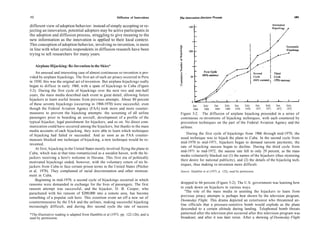
INNOVATIONS
Third Edition


     Everett M. Rogers


      THE FREE PRESS
      A Division of Macmillan Publishing Co., Inc.
      NEW YORK
      Collier Macmillan Publishers
      LONDON
Copyright © 1962, 1971, 1983 by The Free Press
                                A Division of Macmillan Publishing Co., Inc.                             Contents
All rights reserved. No part of this book may be reproduced or
transmitted in any form or by any means, electronic or mechanical,
including photocopying, recording, or by any information storage
and retrieval system, without permission in writing from the
Publisher.

The Free Press
A Division of Macmillan Publishing Co., Inc.
866 Third Avenue, New York, N. Y. 10022
Collier Macmillan Canada, Inc.                                                                                 List of Case Illustrations                         xiii
                                                                                                               Preface                                             xv
Library of Congress Catalog Card Number: 82-70998

Printed in the United States of America                                                            Chapter 1   ELEMENTS OF DIFFUSION                                1

printing number                                                                                                WHAT IS DIFFUSION?                                   5
6 7 8 9 10                                                                                                     FOUR MAIN ELEMENTS IN THE DIFFUSION
                                                                                                                 OF INNOVATIONS                                    10
                                                                                                                  1.   The Innovation                              11
Library of Congress Cataloging in Publication Data                                                                2.   Communication Channels                      17
                                                                                                                  3.   Time                                        20
Rogers, Everett M.                                                                                                4.   A Social System                             24
  Diffusion of innovations.                                                                                    SUMMARY                                             34
   Rev. ed. of: Communication of innovations. 2nd ed.
1971.
   Bibliography: p.
                                                                                                   Chapter 2 A HISTORY OF DIFFUSION RESEARCH . . . . 38
   Includes indexes.
   1. Diffusion of innovations. 2. Diffusion of innova-                                                        THE BEGINNINGS OF DIFFUSION RESEARCH
tions—Study and teaching—History. I. Title.                                                                      IN EUROPE                                         40
HM101.R57        1983       303.4'84       82-70998
                                                                                                                  Gabriel Tarde and The Laws of Imitation          40
ISBN 0-02-926650-5                         AACR2
                                                                                                                  The British and German-Austrian Diffusionists    41
                                                                                                               THE RISE OF DIFFUSION RESEARCH TRADITIONS.          42
    The first edition by Everett M. Rogers was published as Diffusion of Innovations; the second                  Paradigms and Invisible Colleges                 43
edition of this book, by Everett M. Rogers with F. Floyd Shoemaker, was published as Commu-
nication of Innovations: A Cross-Cultural Approach.                                                               The Anthropology Research Tradition              46
                                                                                                                  Early Sociology                                  50
                                                                                                                  Rural Sociology                                  57
                                                                                                                  Education                                        62
                                                                                                                  Public Health and Medical Sociology              65
                                                                                                                  Communication                                    72
                                                                                                                  Marketing                                        74
                                                                                                                  Geography                                        77
                                                                                                                  General Sociology                                78
                                                                                                                                                                     V
vi                                                                 Contents   Contents

         A TYPOLOGY OF DIFFUSION RESEARCH                               79    Chapter 5 THE INNOVATION-DECISION PROCESS                       163
         SUMMARY                                                        85
                                                                                         A MODEL OF THE INNOVATION-DECISION
                                                                                          PROCESS                                             163
Chapter 3 CONTRIBUTIONS AND CRITICISMS OF                                                KNOWLEDGE STAGE                                      164
          DIFFUSION RESEARCH                                            87                 Which Comes First, Needs or Awareness
                                                                                             of an Innovation ?                               164
         THE CONTRIBUTIONS AND STATUS OF                                                   Types of Knowledge about an Innovation             167
           DIFFUSION RESEARCH TODAY                                                        Early Versus Late Knowers of Innovations           168
         CRITICISMS OF DIFFUSION RESEARCH                               91               PERSUASION STAGE                                     169
           The Pro-Innovation Bias of Diffusion Research . . . .        92               DECISION STAGE                                       172
           The Individual-Blame Bias in Diffusion Research             103               IMPLEMENTATION STAGE                                 174
           The Recall Problem in Diffusion Research                    112
           The Issue of Equality in the Diffusion of Innovations       118                 The End of Implementation                          175
                                                                                           Re-Invention                                       175
         GENERALIZING ABOUT DIFFUSION VIA
          META-RESEARCH                                                126               CONFIRMATION STAGE                                   184
           Relating Theory and Research at the Middle Range            128                 Dissonance                                         185
           The Oversimplification of Two-Concept Generalizations.      130                 Discontinuance                                     186
           The Reliability of Diffusion Generalizations                131
                                                                                         ARE THERE STAGES IN THE PROCESS?                     191
         SUMMARY                                                       133
                                                                                           Evidence of the Stages                             192
                                                                                           Variance and Process Research                      194

Chapter 4 THE GENERATION OF INNOVATIONS . . .                         134                COMMUNICATION CHANNELS BY STAGES
                                                                                          IN THE INNOVATION-DECISION PROCESS                  197

         THE INNOVATION-DEVELOPMENT PROCESS                            135                 Categorizing Communication Channels                197
                                                                                           Mass Media Versus Interpersonal Channels           198
           1.   Recognizing a Problem or Need                          135                 Cosmopolite Versus Localite Channels               200
           2.   Basic and Applied Research                             138
           3.   Development                                            139               COMMUNICATION CHANNELS BY ADOPTER
           4.   Commercialization                                      143                CATEGORIES                                          201
           5.   Diffusion and Adoption                                 144               THE INNOVATION-DECISION PERIOD                       202
           6.   Consequences                                           149
                                                                                           Rate of Awareness-Knowledge and Rate of Adoption   202
         SOCIOECONOMIC STATUS, EQUALITY, AND                                               Length of the Period by Adopter Category           203
         INNOVATION DEVELOPMENT                                        153
                                                                                         SUMMARY                                              206
         TRACING THE INNOVATION-DEVELOPMENT
          PROCESS                                                      155
                                                                              Chapter 6 ATTRIBUTES OF INNOVATIONS AND
           Shortcomings of the Tracer Studies                          157
                                                                                        THEIR RATE OF ADOPTION                                210
           Questions for Future Research                               157
         CONVERTING RESEARCH INTO PRACTICE                             158               ATTRIBUTES OF INNOVATIONS                            211
           The Agricultural Extension Model                            159               RELATIVE ADVANTAGE                                   213
           Decentralized Diffusion Systems                             160
                                                                                           Economic factors and Rate of Adoption              214
         SUMMARY                                                       161                 Status Aspects of Innovations                      215
viii                                                           Contents   Contents


              Relative Advantage and Rate of Adoption              217                COMPUTER SIMULATION OF INNOVATION
              Effects of Incentives                                219                 DIFFUSION                                    267
            COMPATIBILITY                                          223                SUMMARY                                       268
              Compatibility with Values and Beliefs                223
              Compatibility with Previously Introduced Ideas       224    Chapter 8   OPINION LEADERSHIP AND
              Compatibility with Needs                             225                                                              271
                                                                                      DIFFUSION NETWORKS
              Compatibility and Rate of Adoption                   226
              Technology Clusters                                  226
              Naming an Innovation                                 227                MODELS OF MASS-COMMUNICATION FLOWS            272
              Positioning an Innovation                            228                  Hypodermic Needle Model                     272
            COMPLEXITY                                             230                  The Two-Step Flow Model                     272
            TRIALABILITY                                           231                HOMOPHILY-HETEROPHILY AND THE FLOW OF
                                                                                       COMMUNICATION                                274
            OBSERVABILITY                                          232
                                                                                        Homophily-Heterophily                       274
            EXPLAINING RATE OF ADOPTION                            232                  Homophily as a Barrier to Diffusion         275
            THE DIFFUSION EFFECT                                   234                MEASURING OPINION LEADERSHIP AND
            OVERADOPTION                                           236                 NETWORK LINKS                                277
            SUMMARY                                                238                CHARACTERISTICS OF OPINION LEADERS            281
                                                                                        External Communication                      282
Chapter 1   INNOVATIVENESS AND ADOPTER                                                  Accessibility                               282
            CATEGORIES                                            241                   Socioeconomic Status                        282
                                                                                        Innovativeness                              284
                                                                                        Innovativeness, Opinion Leadership, and
            CLASSIFYING ADOPTER CATEGORIES ON THE
             BASIS OF INNOVATIVENESS                               242                    System Norms                              284

              The S-Curve of Adoption and Normality                243                MONOMORPHIC AND POLYMORPHIC OPINION
              The Method of Adopter Categorization                 245                 LEADERSHIP                                   288

            ADOPTER CATEGORIES AS IDEAL TYPES                      247                DIFFUSION NETWORKS                            293

              Innovators: Venturesome                              248                  Communication Network Analysis              294
              Early Adopters: Respectable                          248                  The-Strength-of- Weak-Ties                  295
              Early Majority: Deliberate                           249                  Who Is Linked to Whom in Networks?          299
              Late Majority: Skeptical                             249                SOCIAL LEARNING THEORY                        304
              Laggards: Traditional                                250
                                                                                        Contrasting Social Learning and Diffusion   305
            CHARACTERISTICS OF ADOPTER CATEGORIES....              251                  Horizons for Social Modeling                307
              Socioeconomic Characteristics                        251                SUMMARY                                       307
            . Personality Variables                                257
              Communication Behavior                               258
              A Summary of the Characteristics of                         Chapter 9   THE CHANGE AGENT                              312
                Adopter Categories                                 259
              The Innovativeness-Needs Paradox                     263
                                                                                      CHANGE AGENTS AS LINKERS                      313
            PREDICTING INNOVATIVENESS WITH
              MULTIPLE CORRELATION TECHNIQUES .                    265                THE SEQUENCE OF CHANGE AGENT ROLES            315
Contents   Contents

             FACTORS IN CHANGE AGENT SUCCESS                                   317              CLASSIFICATIONS OF CONSEQUENCES                       379
               Change Agent Effort                                             317                 Desirable Versus Undesirable Consequences          380
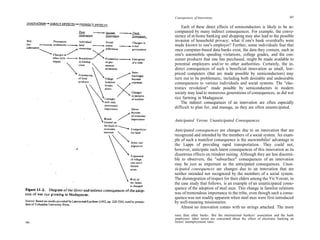
               Change Agency Versus Client Orientation                         318                 Direct Versus Indirect Consequences                384
               Compatibility with Clients' Needs                               319                 Anticipated Versus Unanticipated Consequences      387
               Change Agent Empathy                                            327
                                                                                                EQUALITY IN THE CONSEQUENCES
             HOMOPHILY AND CHANGE AGENT CONTACT . . . .                        321               OF INNOVATIONS                                       391
               Change Agent Contact with Lower-Status Clients                  323                The Issue of Equality in Development Programs       392
               Paraprofessional Aides                                          325                The Communication Effects Gap and
               Change Agent Credibility                                        328                   the Consequences of Diffusion                    394
               InauthenlicProfessionalization of Aides                         331                Gap-Widening Consequences of the Adoption
             OPINION LEADERS                                                   331                   of Innovations                                   398
                                                                                                  Social Structure and the Equality of Consequences   401
             CLIENTS' EVALUATIVE ABILITY                                       332                Strategies for Narrowing Gaps                       403
             CENTRALIZED AND DECENTRALIZED                                                        Wider Gaps Are Not Inevitable                       408
              DIFFUSION SYSTEMS                                                333              SUMMARY AND CONCLUSIONS                               410
               The Classical Diffusion Model                                   333
               Comparing Centralized Versus Decentralized                                       Bibliography                                          414
                 Diffusion Systems                                             334              Name Index                                            441
               Advantages and Disadvantages of Decentralized                                    Subject Index                                         447
                 Diffusion                                                     337
             SUMMARY                                                           343

Chapter 10 INNOVATION IN ORGANIZATIONS                                         347

             ORGANIZATIONS                                                     348
             ORGANIZATIONAL INNOVATIVENESS                                     355
               Shortcomings of Organizational Innovativeness
                  Studies                                                      356
               Size and Organizational Innovativeness                          358
               Structural Characteristics and Organizational
                 Innovativeness                                                359
             STAGES IN THE INNOVATION PROCESS IN
               ORGANIZATIONS                                                   361
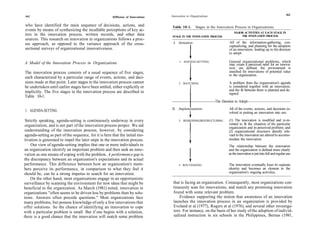
               A Model of the Innovation Process in Organizations              362
               Time Sequence of the Stages in the Innovation Process . . . .   365
             SUMMARY                                                           370

Chapter 11   CONSEQUENCES OF INNOVATIONS                                       371

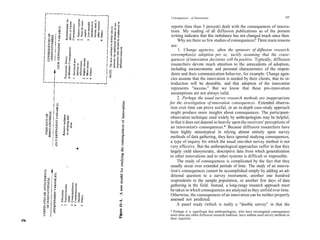
             A MODEL FOR STUDYING CONSEQUENCES                                 375
             WHY HAVEN'T CONSEQUENCES BEEN
              STUDIED MORE?                                                    375
List of Case Illustrations


Water Boiling in a Peruvian Village: A Diffusion Campaign that Failed             1
   The Village of Los Molinos                                                     2
     Mrs. A: Custom-oriented Adopter                                              2
     Mrs. B: Persuaded Adopter                                                    3
     Mrs. C: Rejector                                                             3
   Understanding Why the Diffusion of Water Boiling Failed                        4
Controlling Scurvy in the British Navy: Innovations Do Not Sell Themselves...     7
Nondiffusion of the Dvorak Keyboard                                               9
Diffusion of Hybrid Corn in Iowa                                                 32
Bottle Feeding Babies in the Third World and the Evil Eye                       100
The Natural History of an Innovation: Warfarin                                  149
Hard Tomatoes in California                                                     150
Airplane Hijacking: Re-Invention in the Skies                                   182
Forced Discontinuance of Innovations                                            189
Communication Channels in the Innovation-Decision Process
  for Gammanym                                                                  195
The CAT Scanner: Technology Run Wild?                                           237
Peer Networks in the Diffusion of a Medical Drug                                289
Network Structure and Solar Diffusion in a California Neighborhood              300
Barefoot Doctors in China                                                       326
The Agricultural Extension Services                                             338
Legitech                                                                        339
Tachai: Decentralized Diffusion in China                                        339
Davis: America's Energy Conservation Capital                                    341
A Hybrid Diffusion System: The National Diffusion Network                       342
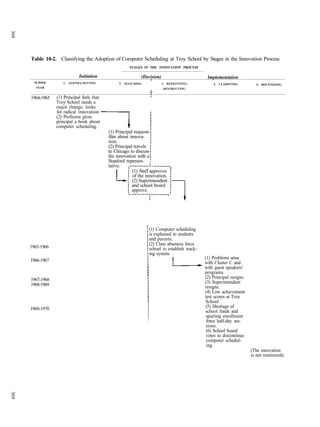
The Rise and Fall of a Radical Innovation at Troy School                        350
   Initiation of the Innovation                                                 351
   Implementing the Innovation of Computer Scheduling                           352
Implementation That Failed: Starting Too Big                                    366
The Snowmobile Revolution in the Artie                                          372
Steel Axes for Stone-Age Aborigines                                             388
   The Form, Function, and Meaning of an Innovation                             390
   Achieving a Dynamic Equilibrium                                              390
   To Whom an Innovation Is Introduced                                          391


                                                                                xiii
Preface
THE FIRST EDITION OF THIS BOOK, Diffusion of Innovations, was
published in 1962. At the time, there were 405 publications about this
topic available. The second edition and revision, Communication of
Innovations: A Cross-Cultural Approach (co-authored with F. Floyd
Shoemaker), was published in 1971, nine years later. By then the
number of diffusion publications had almost quadrupled to about
 1,500, of which approximately 1,200 were empirical research reports,
and the other 300 were bibliographies, syntheses, theoretical writings,
and other types of nonempirical publications.
    At present, 12 years later, the total number of diffusion publica-
tions has more than doubled again, to 3,085. And the number of em-
pirical diffusion research reports has increased from 1,500 to 2,297. I
think there is almost no other field of behavior science research that
represents more effort by more scholars in more nations.
    Because of this vast increase in the foundation of diffusion
research on which the present book is based, it is both (1) a revision of
the theoretical framework, and the research evidence supporting this
model of diffusion, and (2) a new intellectual venture, in the sense that
new concepts and new theoretical viewpoints are introduced. I
estimate that this book represents about equally (1) a continuity with
my two previous books on diffusion, and (2) differences and im-
provements in the basic framework. So the reader can regard the pres-
ent book as the third volume in a three-volume set on the diffusion of
innovations. The stream of diffusion scholarship over the past forty
years or so represents both similarities and differences, continuities
and discontinuities, and so must my three books, each published ap-
proximately a decade apart. By no means, however, do I seek only to
synthesize the important findings from past research; I also strive
herein to criticize this work (including my own), and to lay out direc-
tions for the future that are different from the recent past.
    I have titled the present book Diffusion of Innovations to identify
it with the forty-year sequential tradition of diffusion studies marked
by my 1962 book of the same title. In any event, most people refer to
xvi                                                                 Preface    Preface                                                                            xvii

this research field and its applications as the "diffusion of innova-          reflects a much more critical stance. During the past twenty years or
tions." By choosing a title somewhat different from my second book,            so, diffusion research has grown to be widely recognized, applied, and
I can help avoid confusion of these two volumes.                               admired, but it has also been subjected to constructive and destructive
     Most diffusion studies prior to 1962 were conducted in the United         criticism. This criticism is due in large part to the stereotyped and
States and Europe. In the period between the first and second editions         limited ways in which most diffusion scholars have come to define the
of my diffusion book, during the 1960s, an explosion occurred in the           scope and method of their field of study. Once diffusion researchers
number of diffusion investigations that were conducted in the devel-           came to represent an "invisible college,"* they began to limit unnec-
oping nations of Latin America, Africa, and Asia. It was realized that         essarily the ways in which they went about studying the diffusion of
the classical diffusion model could be usefully applied to the process         innovations. Such standardization of approaches has, especially in the
of socioeconomic development. In fact, the diffusion approach was a            past decade, begun to constrain the intellectual progress of diffusion
natural framework in which to evaluate the impact of development               research.
programs in agriculture, family planning, public health, and nutri-                Perhaps the diffusion case is rather similar to that of persuasion
tion. But in studying the diffusion of innovations in developing na-          research, another important sub field of communication research.
tions, we gradually realized that certain limitations existed in the dif-     Two of the leading persuasion scholars, Professors Gerald R. Miller
fusion framework. In some cases, development programs outran the              and Michael Burgoon (1978, p. 31), recently described the myopic
diffusion model on which they were originally based. One intellectual         view of the social-influence process held by most persuasion scholars:
outcome was certain modifications that have been made in the classi-           "Students of persuasion may have fallen captive to the limits imposed
cal diffusion model. As a result, the diffusion paradigm that is              by their own operational definitions of the area" [sentence was itali-
presented in this book is less culture-bound than in my previous              cized in the original]. This self-criticism applies to diffusion re-
books. And the study of diffusion has today become worldwide.                 searchers as well, because, in fact, many diffusion scholars have con-
     During the 1970s, I have also seen important changes, modifica-          ceptualized the diffusion process as one-way persuasion. As such,
tions, and improvements made in the diffusion model in the United             they also may be subject to the four shortcomings of persuasion
States and other industrialized nations. One important type of change         research listed by Miller and Burgoon (1978, pp. 31-35):
has been to view the diffusion process in a wider scope and to under-              1. Persuasion (and diffusion) are seen as a linear, unidirectional
stand that diffusion is one part of a larger process which begins with a      communication activity. An active source constructs messages in
perceived problem or need, through research and development on a              order to influence the attitudes and/or behaviors of passive receivers.
possible solution, the decision by a change agency that this innovation       Cause resides in the source, and effect in the receiver.
should be diffused, and then its diffusion (leading to certain conse-              2. Persuasion (and diffusion) are considered as a one-to-many
quences). Such a broader view of the innovation-development process           communication activity. This view is inconsistent with more recent
recognizes that many decisions and activities must happen before the          conceptions of persuasion: "Persuasion is not something one person
beginning of the diffusion of an innovation; often diffusion cannot be        does to another but something he or she does with another" (Rear-
very completely understood if these previous phases of the total proc-        don, 1981, p. 25).
ess are ignored. Chapter 4 of the present book deals with this issue of           3. Persuasion (and diffusion) scholars are preoccupied with an
where innovations come from, and how their origins affect their diffu-        action-centered and issue-centered communication activity, such as
sion.                                                                         selling products, actions, or policies. Largely ignored is the fact that
     Another important intellectual change of the past decade, re-            an important part of persuasion/diffusion is selling oneself and, per-
 flected in Chapter 10, is the greatly increased interest in the innovation   haps, other persons. It should be realized that one objective of certain
process in organizations. Such organizational decisions are different         diffusion activities is to enhance one's personal credibility in the eyes
in important ways from innovation decisions by individuals, we now            of others (as we detail in Chapters 8 and 9).
realize.                                                                        *An invisible college is an informal network of researchers who form around an intel-
     The present book also differs from its two predecessors in that it       lectual paradigm to study a common topic (Price, 1963; Kuhn, 1970; Crane, 1972).
Preface                                                              xix
xviii                                                                 Preface

                                                                                    about the innovation in order to cope with the uncertainty that it
      4. Persuasion (and diffusion) researchers often give allegiance to
                                                                                    creates.
the view that their dependent variable is to change attitudes rather                    So the present book is cast in a theoretical framework involving
than overt behavior. Diffusion researchers have been more oriented to               the concepts of information and uncertainty. Information about in-
the dependent variable of adoption (a decision to use and implement a               novations is often sought from near-peers, especially information
 new idea), than to actual implementation itself (or to studying the con-           about their subjective evaluations of the innovation. This information
 sequences of innovation).                                                          exchange about a new idea occurs through a convergence process in-
       Most past diffusion studies have been based upon a linear model              volving interpersonal networks. The diffusion of innovations, thus, is
 of communication, defined as the process by which messages are                     essentially a social process in which subjectively perceived informa-
 transferred from a source to a receiver. Such a one-way view of human              tion about a new idea is communicated.
 communication describes certain types of communication; many                           The general field of communication research has not been charac-
 kinds of diffusion do indeed consist of one individual, such as a                  terized by much "weed pulling," that is, the criticism of our scientific
  change agent, informing a potential adopter about a new idea. But                 activities so that the field's findings and fallacies can be publicly
  other types of diffusion are more accurately described by a con-                  understood (Siebold, 1979). Thus, it may be a healthy turn of events
  vergence model, in which communication is defined as a process in                 that, beginning in the early 1970s, criticisms of the diffusion frame-
  which the participants create and share information with one another              work began to appear. Of course, it would be a mistake to become so
  to reach a mutual understanding (Rogers and Kincaid, 1981, p. 63).                fond of weed pulling that the entire garden is destroyed (Reardon,
        In the present book we seek to show the improved understanding               1981, p. 261).
   that can often be achieved by conceptualizing certain kinds of diffu-                Throughout the present book we seek to represent a healthily criti-
   sion in light of this convergence model. This emphasis on diffusion as           cal stance. We do not just need more-of-the-same diffusion research.
   information exchange among participants in a communication proc-                 The challenge for diffusion scholars of the future is to move beyond
    ess is found particularly in our Chapter 8 on diffusion networks.                the proven methods and models of the past, to recognize their short-
         Conceptually, the present book makes use of the important con-              comings and limitations, and to broaden their conceptions of the dif-
    cepts of uncertainty and information. Uncertainty is the degree to               fusion of innovations. We offer this book as one step toward this goal.
    which a number of alternatives are perceived with respect to the occur-
    rence of an event and the relative probabilities of these alternatives.         Stanford, California                                 Everett M. Rogers
    Uncertainty implies a lack of predictability of the future. It motivates
     an individual to seek information. Information is a difference in
     matter-energy that affects uncertainty in a situation where a choice ex-
     ists among a set of alternatives (Rogers and Kincaid, 1981, p. 64). The
     concept of information is a favorite in the field of communication
     research, and in fact the field really began to grow as an intellectual
     enterprise once Claude Shannon and Warren Weaver (1949) had pro-
      posed a theory of communication that was organized around the no-
        tion of information.
            One kind of uncertainty is generated by an innovation, defined as
        an idea, practice, or object that is perceived as new by an individual or
         another unit of adoption. An innovation presents an individual or an
         organization with a new alternative or alternatives, with new means of
         solving problems. But the probabilities of the new alternatives being
         superior to previous practice are not exactly known by the individual
         problem solvers. Thus, they are motivated to seek further information
CHAPTER 1
         Elements of Diffusion

         To get the bad customs of a country changed and new ones, though
         better, introduced, it is necessary first to remove the prejudices of the
         people, enlighten their ignorance, and convince them that their interests
         will be promoted by the proposed changes; and this is not the work of a
         day.
                                                            Benjamin Franklin (1781)

         There is nothing more difficult to plan, more doubtful of success, nor
         more dangerous to manage than the creation of a new order of
         things. . . . Whenever his enemies have occasion to attack the innovator
         they do so with the passion of partisans, while the others defend him
         sluggishly so that the innovator and his party alike are vulnerable.
                                                                 Niccolo Machiavelli
                                                                 The Prince (1513)


        ONE REASON WHY THERE is so MUCH INTEREST in the diffusion
of innovations is because getting a new idea adopted, even when it has
obvious advantages, is often very difficult. There is a wide gap in
many fields, between what is known and what is actually put into use.
Many innovations require a lengthy period, often of some years, from
the time when they become available to the time when they are widely
adopted. Therefore, a common problem for many individuals and or-
ganizations is how to speed up the rate of diffusion of an innovation.
    The following case illustration provides insight into some common
difficulties facing programs of diffusion.

    Water Boiling in a Peruvian Village:
    A Diffusion Campaign that Failed*

    The public health service in Peru attempts to introduce innovations to
villagers to improve their health and lengthen their lives. This change agency

 This case illustration is adapted from Wellin (1955, pp. 71-103), and is used by per-
mission.
2                                                                                        Elements of Diffusion                                                         3
                                                            Diffusion of Innovations

                                                                                         has no understanding of germ theory, as explained by Nelida; her motivation
enjoys a reputation for efficiency throughout Latin America. It encourages               for water boiling is a complex local custom of "hot" and "cold" distinc-
people to install latrines, to burn garbage daily, to control house flies, to            tions. The basic principle of this belief system is that all foods, liquids,
report cases of infectious diseases, and to boil drinking water. These innova-           medicines, and other objects are inherently hot or cold, quite apart from
tions involve major changes in thinking and behavior for Peruvian villagers,             their actual temperature. In essence hot-cold distinctions serve as a series of
who do not understand how sanitation is related to illness.                              avoidances and approaches in such behavior as pregnancy, child rearing,
    Water boiling is an important health practice for villagers and urban                and the health-illness system.
 poor in Peru. Unless they boil their drinking water, patients who are cured of               Boiled water and illness are closely linked in the folkways of Los
 infectious diseases in village medical clinics often return within a month to be        Molinos; by custom, only the ill use cooked, or "hot" water. Once an in-
    treated again for the same disease.                                                  dividual becomes ill, it is unthinkable for him to eat pork (very cold) or to
         A two-year water-boiling campaign conducted in Los Molinos, a peasant           drink brandy (very hot). Extremes of hot and cold must be avoided by the
    village of 200 families in the coastal region of Peru, persuaded only Steven          sick; therefore, raw water, which is perceived to be very cold, must be boiled
     housewives to boil water. From the viewpoint of the public health agency,           to overcome the extreme temperature.
     the local health worker, Nelida, had a simple task: to persuade the house-               Villagers learn from childhood to dislike boiled water. Most can tolerate
     wives of Los Molinos to add water boiling to their pattern of daily behavior.        cooked water only if flavoring, such as sugar, cinnamon, lemon, or herbs, is
     Even with the aid of a medical doctor, who gave public talks on water boil-          added. Mrs. A likes a dash of cinnamon in her drinking water. The village
      ing, and fifteen village housewives who were already boiling water before the       belief system involves no notion of bacteriological contamination of water.
      campaign, Nelida's diffusion program failed. To understand why, we need             By tradition, boiling is aimed at eliminating the innate "cold" quality of un-
      to take a closer look at the culture, the local environment, and the in-            boiled water, not the harmful bacteria. Mrs. A drinks boiled water in obe-
     dividuals in Los Molinos.                                                            dience to local custom, because she is ill.
         THE VILLAGE OF Los MOLINOS. Most residents of Los Molinos are                        Mrs. B: Persuaded Adopter. The B family came to Los Molinos a
     peasants who work as field hands on local plantations. Water is carried by           generation ago, but they are still strongly oriented toward their birthplace
     can, pail, gourd, or cask. Children are the usual water carriers; it is not con-     high in the Andes Mountains. Mrs. B worries about lowland diseases that she
     sidered appropriate for adult men to carry water, and they seldom do. The            feels infest the village. It is partly because of this anxiety that the change
     three sources of water in Los Molinos include a seasonal irrigation ditch            agent, Nelida, was able to convince Mrs. B to boil water.
      close to the village, a spring more than a mile away from the village, and a            Nelida is a friendly authority to Mrs. B (rather than a "dirt inspector," as
      public well whose water the villagers dislike. All three are subject to pollu-       she is seen by most other housewives), who imparts knowledge and brings
      tion at all times and show contamination whenever tested. Of the three               protection. Mrs. B not only boils water but also has installed a latrine and
      sources, the irrigation ditch is most commonly used. It is closer to most            has sent her youngest child to the health center for a check-up.
      homes, it has the advantage of being running water rather than stagnant, and            Mrs. B is marked as an outsider in the community by her highland hairdo
      the villagers like its taste.                                                        and stumbling Spanish. She will never achieve more than marginal social ac-
           Although it is not feasible for the village to install a sanitary water         ceptance in the village. Because the community is not an important reference
      system, the incidence of typhoid and other water-borne diseases could be             group to her, Mrs. B deviates from village norms on health innovations.
       reduced by boiling the water before consumption. During her two-year                With nothing to lose socially, Mrs. B gains in personal security by heeding
       residence in Los Molinos, Nelida made several visits to every home in the           Nelida's advice. Mrs. B's practice of boiling water has no effect on her
       village but devoted especially intensive efforts to twenty-one families. She        marginal status. She is grateful to Nelida for teaching her how to neutralize
       visited each of these selected families between fifteen and twenty-five times;      the danger of contaminated water, a lowland peril as she perceives it.
        eleven of these families now boil their water regularly.                              Mrs. C: Rejector. This housewife represents the majority of Los
            What kinds of persons do these numbers represent? We describe three            Molinos families who are not persuaded by the efforts of the change agent
        village housewives—one who boils water to obey custom, one who was per-            during the two-year health campaign. In spite of Nelida's repeated explana-
        suaded to boil water by the health worker, and one of the many who rejected        tions, Mrs. C does not understand germ theory. How, she argues, can
        the innovation—in order to add further insight into the process of diffusion.      microbes survive in water that would drown people? Are they fish? If germs
             Mrs. A: Custom-Oriented Adopter. Mrs. A is about forty and suffers            are so small that they cannot be seen or felt, how can they hurt a grown per-
         from sinus infection. The Los Molinos villagers call her a "sickly one." Each     son? There are enough real threats in the world to worry about—poverty and
         morning Mrs. A boils a potful of water and uses it throughout the day. She
4                                                            Diffusion of Innovations     Elements of Diffusion                                                       5

                                                                                          Nelida about water boiling. Their contacts outside the community were
hunger—without bothering about tiny animals one cannot see, hear, touch,                  limited, and as a result, they saw the technically proficient Nelida with eyes
or smell. Mrs. C's allegiance to traditional customs is at odds with the boiling
                                                                                          bound by the social horizons and traditional beliefs of Los Molinos. They
of water. A firm believer in the hot-cold superstition, she feels that only the
                                                                                          distrusted this outsider, whom they perceived as a social stranger. Nelida,
sick must drink boiled water.                                                             who was middle class by Los Molinos standards, was able to secure more
      UNDERSTANDING WHY THE DIFFUSION OF WATER BOILING FAILED.
                                                                                          positive results from housewives whose socioeconomic level and cultural
This intensive two-year campaign by a public health worker in a Peruvian
                                                                                          background were more similar to hers. This tendency for more effective
village of 200 families, aimed at persuading housewives to boil drinking
                                                                                          communication to occur with those who are more similar to change agents
water, was largely unsuccessful. Nelida was able to encourage only about 5
percent of the population, eleven families, to adopt the innovation. In con-              occurs in most diffusion campaigns.
                                                                                              In general Nelida was too "innovation-oriented" and not "client-
 trast, change agents in other Peruvian villages were able to convince 15 to 20
                                                                                          oriented" enough. Unable to put herself in the role of the village housewives,
 percent of the housewives. Reasons for the relative failure of the diffusion
 campaign in Los Molinos can be traced partly to the cultural beliefs of the              her attempts at persuasion failed to reach her clients because the message was
                                                                                          not suited to their needs. Nelida did not begin where the villagers were; in-
 villagers. Local tradition links hot foods with illness. Boiling water makes it
                                                                                          stead she talked to them about germ theory, which they could not (and prob-
  less "cold," and hence, appropriate only for the sick. But if a person is not
  ill, he is prohibited by village norms from drinking boiled water. Only the in-         ably did not need to) understand.
                                                                                              We have cited only some of the factors that produced the diffusion
  dividuals who are least integrated into local networks risk defying commu-
                                                                                          failure with which Nelida is charged. It will be easier to understand the
 .nity norms on water boiling. An important factor affecting the adoption rate
                                                                                          water-boiling case once the remainder of this book has been read. We shall
   of any innovation is its compatibility with the values, beliefs, and past ex-
                                                                                          return to discuss lessons learned from the Los Molinos case in future
   periences of the social system. Nelida and her superiors in the public health
   agency should have understood the hot-cold belief system, as it is found               chapters.
   throughout Peru (and, in fact, in most nations of Latin America, Africa,
    and Asia).
         Nelida's failure demonstrates the importance of interpersonal networks
    in the adoption and rejection of an innovation. Socially an outsider, Mrs. B          What Is Diffusion?
    was marginal to the Los Molinos community, although she had lived there
    for years. Nelida was a more important referent for Mrs. B than were her              Diffusion is the process by which an innovation is communicated
    neighbors, who shunned her. Anxious to secure social acceptance from the              through certain channels over time among the members of a social
    higher-status Nelida, Mrs. B adopted water boiling, not because she under-
                                                                                          system. It is a special type of communication, in that the messages are.
     stood the correct health reasons, but because she wanted to obtain Nelida's
     approval. Thus we see that the diffusion of innovations is often a social proc-
                                                                                          concerned with new ideas. Communication is a process in which par-
                                                                                          ticipants create and share information with one another in order to
     ess, as well as a technical matter.
          Nelida worked with the wrong housewives if she wanted to launch a self-         reach a mutual understanding. This definition implies that communi-
     generating diffusion process in Los Molinos. She concentrated her efforts on         cation is a process of convergence (or divergence) as two or more in-
     village women like Mrs. A and Mrs. B. Unfortunately, they were perceived             dividuals exchange information in order to move toward each other
     as a sickly one and a social outsider and were not respected as social models        (or apart) in the meanings that they ascribe to certain events. We think
      of water-boiling behavior by the other women. The village opinion leaders,          of communication as a two-way process of convergence, rather than
      who could have activated local networks to spread the innovation, were ig-          as a one-way, linear act in which one individual seeks to transfer a
      nored by Nelida.                                                                    message to another (Rogers and Kincaid, 1981). Such a simple concep-
           How potential adopters view the change agent affects their willingness to      tion of human communication may accurately describe certain com-
      adopt his or her ideas. In Los Molinos, Nelida was perceived differently by         munication acts or events involved in diffusion, such as when a change
      lower- and middle-status housewives. Most poor families saw the health              agent seeks to persuade a client to adopt an innovation. But when we
      worker as a "snooper" sent to Los Molinos to pry for dirt and to press
                                                                                          look at what came before such an event, and at what follows, we often
      already harassed housewives into keeping cleaner homes. Because the lower-
       status housewives had less free time, they were unlikely to initiate visits with   realize that such an event is only one part of a total process in which in-
6                                                                                               Elements of Diffusion                                                       7
                                                                 Diffusion of Innovations

                                                                                                tion" for diffusion that is directed and managed. We use diffusion
formation is exchanged between the two individuals. For example, the                            and dissemination interchangeably in this book because the distinc-
client may come to the change agent with a problem or need, and the                             tion often is not very clear in actual practice. And the general conven-
innovation is recommended as a possible solution. And if we look at                             tion is to use the word "diffusion" to include both the planned and
the change agent-client interaction in a broader context, we may see                            the spontaneous spread of new ideas.
that their interaction continues through several cycles, and is indeed a                            But we do find it useful to distinguish between centralized and
process of information exchange.                                                                decentralized diffusion systems. In a centralized diffusion system,
    So diffusion is a special type of communication, in which the mes-                          decisions about such matters as when to begin diffusing an innova-
 sages are concerned with a new idea. It is this newness of the idea in the                     tion, who should evaluate it, and through what channels it will be dif-
 message content of communication that gives diffusion its special                              fused, are made by a small number of officials and/or technical ex-
 character. The newness means that some degree of uncertainty is in-                            perts at the head of a change agency. In a decentralized diffusion
    volved.                                                                                     system, such decisions are more widely shared by the clients and
         Uncertainty is the degree to which a number of alternatives are                        potential adopters; here, horizontal networks among the clients are
    perceived with respect to the occurrence of an event and the relative                       the main mechanism through which innovations spread. In fact, in ex-
    probability of these alternatives. Uncertainty implies a lack of predict-                   tremely decentralized diffusion systems there may not be a change
    ability, of structure, of information. In fact, information represents                       agency; potential adopters are solely responsible for the self-manage
    one of the main means of reducing uncertainty. Information is a dif-                        ment of the diffusion of innovations. New ideas may grow out of the
    ference in matter-energy that affects uncertainty in a situation where a                     practical experience of certain individuals in the client system, rather
     choice exists among a set of alternatives (Rogers and Kincaid, 1981, p.                    than coming from formal R & D activities. Originally, it was assumed
     64).* As we show in a later section of this chapter, a technological in-                    that relatively centralized diffusion systems like the agricultural exten-
     novation embodies information and thus reduces uncertainty about                            sion service were an essential ingredient in the diffusion process, but in
     cause-effect relationships in problem solving. For instance, my adop-                       recent years several relatively decentralized diffusion systems have
     tion of residential solar panels for water heating reduces my uncer-                        been investigated and evaluated, and found to represent an ap-
     tainty about future price increases in the cost of oil. We find it useful                   propriate alternative to centralized diffusion under certain conditions
     to conceptualize the diffusion and adoption of innovations in terms of                      (as detailed in Chapter 9).
      a framework based on information and uncertainty. The use of these
      key concepts helps us to understand the diffusion of technological in-
      novations as one type of communication process.                                               Controlling Scurvy in the British Navy:
          Diffusion is a kind of social change, defined as the process by                           Innovations Do Not Sell Themselves
      which alteration occurs in the structure and function of a social                             Many technologists think that advantageous innovations will sell them-
      system. When new ideas are invented, diffused, and are adopted or re-                     selves, that the obvious benefits of a new idea will be widely realized by
     jected, leading to certain consequences, social change occurs. Of                          potential adopters, and that the innovation will therefore diffuse rapidly.
       course, such change can happen in other ways too, for example,                           Unfortunately, this is very seldom the case. Most innovations, in fact, dif-
       through a political revolution or through a natural event like a                         fuse at a surprisingly slow rate.
       drought or earthquake.                                                                       Scurvy control provides an interesting historical case of how slowly an
           Some authors restrict the term "diffusion" to the spontaneous,                       obviously beneficial innovation spread (Mosteller, 1981). In the early days of
       unplanned spread of new ideas, and use the concept of "dissemina-                        long sea voyages, scurvy was the worst killer of the world's sailors, worse
                                                                                                than warfare, accidents, and all other causes of death. For instance, of
      *"Information is something which reduces uncertainty. Communication is exchange           Vasco de Gama's crew of 160 men who sailed with him around the Cape of
      of information. Most writers in the field of communication research would have no         Good Hope in 1497, 100 died of scurvy. In 1601, an English sea captain,
      difficulty in agreeing with the first definition above. Just as many writers, no doubt,   James Lancaster, conducted a kind of experiment to evaluate the ability of
      would like to change the second definition" (Wiio, 1980, p. 18).
Elements of Diffusion                                                            9
8                                                          Diffusion of Innovations
                                                                                             Nondiffusion of the Dvorak Keyboard*
lemon juice to prevent scurvy. Captain Lancaster commanded four ships                         Most of us who use a typewriter—and this includes about 18 million indi-
that sailed from England on a voyage to India; he served three teaspoonfuls              viduals who earn their living as typists—don't even know that our fingers tap
of lemon juice every day to the sailors on the biggest of his four ships. Most           out words on a keyboard that is called "QWERTY," named after the first
 of these men stayed healthy. But on the three smaller ships, by the halfway             six keys in the upper row of letters. Even fewer of us know just how ineffi-
 point in the journey, 110 out of 278 sailors had died from scurvy. The three            cient the QWERTY keyboard is. For example, this typewriter keyboard
 smaller ships constituted Lancaster's "control group"; they were not given              takes twice as long to learn as it should, requires twice as long to use as it
 any lemon juice. So many of these sailors were sick, in fact, that Lancaster            should, and makes us work about twenty times harder than we should. But
  had to transfer men from the large ship to staff the three smaller ships.              QWERTY has persisted out of inertia since 1873, and today unsuspecting in-
       These results were so clear-cut that one might expect that the British            dividuals are still being taught to use the QWERTY keyboard, unaware that
  Navy would decide to adopt citrus juice as a scurvy prevention on all its              a much more efficient typewriter keyboard is available.
   ships, or at least to carry out further investigations on the effects of citrus            Where did QWERTY come from, and why does it continue to be used,
   fruit. But it was not until 1747, about 150 years later, that James Lind, a           instead of much more efficient alternative keyboard designs? QWERTY was
   British Navy physician who knew of Lancaster's results, carried out another           invented by Christopher Latham Sholes in 1873, who designed this keyboard
   experiment on the ship Salisbury. To each scurvy patient on this ship, Lind           to slow the typist down. In that day, the type bars on a typewriter hung down
    prescribed either two oranges and one lemon, or one of five other diets; a            in a sort of basket, and pivoted up to strike the paper; then they fell back in
    half-pint of sea water, six spoonfuls of vinegar, a quart of cider, nutmeg, or        place by gravity. When two adjoining keys were struck rapidly in succession,
    seventy-five drops of vitriol elixir. The scurvy patients who got the citrus          they often jammed. Sholes rearranged the keys on a typewriter keyboard to
     fruits were cured in a few days, and were able to help Dr. Lind care for the         minimize such jamming; he "anti-engineered" the arrangement to make the
     other patients. Unfortunately, the supply of oranges and lemons was ex-              most commonly used letter sequences awkward and slow to use. By thus
    hausted in six with this further solid evidence of the ability of citrus fruits to    making it difficult for a typist to operate the machine, and slowing down typ-
        Certainly, days.                                                                  ing speed, Sholes' QWERTY keyboard allowed these old typewriters to
    combat scurvy, one would expect the British Navy to adopt this technologi-            operate satisfactorily. His design was used in the manufacture of all type-
    cal innovation for all ship's crews on long sea voyages, and in fact, it did so.      writers.
     But not until 1795, forty-eight years later. Scurvy was immediately wiped out.            Prior to about 1900, most typists used the two-finger, hunt-and-peck
     And after a further wait of only seventy more years, in 1865, the British            system. But thereafter, as touch typing became popular, dissatisfaction with
     Board of Trade adopted a similar policy, and eradicated scurvy in the mer-           the QWERTY keyboard began to grow. Typewriters became mechanically
     chant marine. naval authorities so slow to adopt the idea of citrus for scurvy        more efficient, and the QWERTY keyboard design was no longer necessary
         Why were                                                                          to prevent key jamming. The search for an improved design was led by Pro-
     prevention? Historians are not able to provide a very clear explanation. But          fessor August Dvorak at the University of Washington, who in 1932 used
     it seems that other, competing remedies for scurvy were also being proposed,          time-and-motion studies to create a much more efficient keyboard arrange-
      and each such cure had its champions. For example, Captain Cook's reports            ment. The Dvorak keyboard has the letters A, O, E, U, I, D, H, T, N, and S
      from his voyages in the Pacific did not provide support for curing scurvy            across the home row of the typewriter. Less frequently used letters were
      with citrus fruits. Further, Dr. Lind was not a very prominent figure in the         placed on the upper and lower rows of keys. About 70 percent of the typing is
      field of naval medicine, and so his experimental findings did not get much at-       done on the home row, 22 percent on the upper row, and 8 percent on the
      tention in the British Navy. While scurvy prevention was generally resisted          lower row. On the Dvorak keyboard, the amount of work assigned to each
       for years by the British Navy, other innovations like new ships and new guns        finger is proportionate to its skill and strength. Further, Professor Dvorak
      were accepted more readily.                                                          engineered his keyboard so that successive keystrokes fell on alternative
          Many other historical illustrations could also be cited to show that more        hands; thus, while a finger on one hand is stroking a key, a finger on the
      than just a beneficial innovation is necessary for its diffusion and adoption        other hand can be moving into position to hit the next key. Typing rhythm is
      to occur. The reader may think that such slow diffusion could only happen in         thus facilitated; this hand alternation was achieved by putting the vowels
      the distant past, before a scientific and experimental approach to evaluating
       innovations was very well accepted. We answer by calling the reader's atten-       * Further detail on the Dvorak keyboard may be found in Dvorak et al (1936), Parkin-
       tion to the contemporary case of the nondiffusion of the Dvorak typewriter         son (1972), and Lessley (1980).

        keyboard.
Elements of Diffusion                                                       11
                                                         Diffusion of Innovations

                                                                                      1. The Innovation
(which represent 40 percent of all letters typed) on the left-hand side, and
placing the major consonants that usually accompany these vowels on the               An innovation is an idea, practice, or object that is perceived as new
right-hand side of the keyboard.                                                      by an individual or other unit of adoption. It matters little, so far as
     Professor Dvorak was able to avoid many of the typing inefficiencies of          human behavior is concerned, whether or not an idea is "objectively"
the QWERTY keyboard. For instance, QWERTY overloads the left hand; it
                                                                                      new as measured by the lapse of time since its first use or discovery.
 must type 57 percent of ordinary copy. The Dvorak keyboard shifts this em-
 phasis to 56 percent on the stronger right hand and 44 percent on the weaker         The perceived newness of the idea for the individual determines his or
 left hand. Only 32 percent of typing is done on the home row with the                her reaction to it. If the idea seems new to the individual, it is an inno
 QWERTY system, compared to 70 percent with the Dvorak keyboard. And                  vation.
 the newer arrangement requires less jumping back and forth from row to                   Newness in an innovation need not just involve new knowledge.
  row; with the QWERTY keyboard, a good typist's fingertips travel more               Someone may have known about an innovation for some time but not
  than twelve miles a day, jumping from row to row. These unnecessary in-             yet developed a favorable or unfavorable attitude toward it, nor have
  tricate movements cause mental tension, typist fatique, and lead to more            adopted or rejected it. The "newness" aspect of an innovation may be
 typographical errors.                                                                expressed in terms of knowledge, persuasion, or a decision to adopt.
      One might expect, on the basis of its overwhelming advantages, that the
 Dvorak keyboard would have completely replaced the inferior QWERTY
 keyboard by now. On the contrary, after more than 40 years, almost all
  typists are still using the inefficient QWERTY keyboard. Even though the
  American National Standards Institute and the Computer and Business
  Equipment Manufacturers Association have approved the Dvorak keyboard
   as an alternate design, it is still almost impossible to find a typewriter (or a
   computer) keyboard that is arranged in the more efficient layout. Vested in-
   terests are involved in hewing to the old design: manufacturers, sales outlets,
   typing teachers, and typists themselves.
       No, technological innovations are not always diffused and adopted
   rapidly. Even when the innovation has obvious and proven advantages.
       As the reader may have guessed by now, the present pages were typed on
   a QWERTY keyboard.


   Four Main Elements in the Diffusion
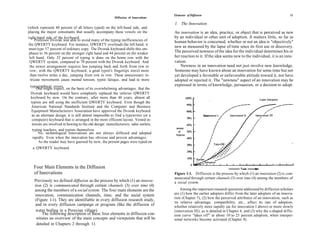
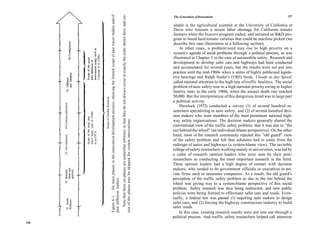
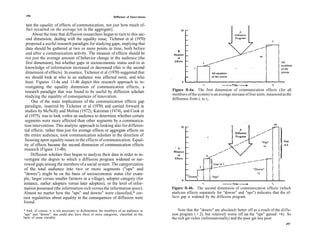
   of Innovations                                                                     Figure 1-1. Diffusion is the process by which (1) an innovation (2) is com-
                                                                                      municated through certain channels (3) over time (4) among the members of
    Previously we defined diffusion as the process by which (1) an innova-            a social system.
    tion (2) is communicated through certain channels (3) over time (4)
    among the members of a social system. The four main elements are the                  Among the important research questions addressed by diffusion scholars
    innovation, communication channels, time, and the social system                   are (1) how the earlier adopters differ from the later adopters of an innova-
                                                                                      tion (Chapter 7), (2) how the perceived attributes of an innovation, such as
    (Figure 1-1). They are identifiable in every diffusion research study,
                                                                                      its relative advantage, compatibility, etc., affect its rate of adoption,
     and in every diffusion campaign or program (like the diffusion of                whether relatively more rapidly (as for innovation I above) or more slowly
     water boiling in a Peruvian village).                                            (innovation III), as is detailed in Chapter 6, and (3) why the s-shaped diffu-
         The following description of these four elements in diffusion con-           sion curve "takes off" at about 10 to 25 percent adoption, when interper-
     stitutes an overview of the main concepts and viewpoints that will be            sonal networks become activated (Chapter 8).
     detailed in Chapters 2 through 11.
12                                                            Diffusion of Innovations         Elements of Diffusion                                                13


    It should not be assumed that the diffusion and adoption of all in-                        objective (MBO). The diffusion of such software innovations has
                                                                                               been investigated, although a methodological problem in such studies
novations are necessarily desirable. In fact, there are some studies of                        is that their adoption cannot be so easily traced or observed in a
harmful and uneconomical innovations that are generally not desir-
able for either the individual or his or her social system. Further, the                       physical sense.
                                                                                                    But even though the software component of a technology is often
same innovation may be desirable for one adopter in one situation but                          not so apparent to observation, we should not forget that technology
 undesirable for another potential adopter in a different situation. For                       almost always represents a mixture of hardware and software aspects.
 example, mechanical tomato pickers have been adopted rapidly by                               According to our definition of technology, it is a means of uncertainty
 large commercial farmers in California, but these machines were too                           reduction for individuals that is made possible by the information
 expensive for small-sized tomato growers, and thousands have thus                             about cause-effect relationships on which the technology is based.
 been forced out of tomato production (Chapter 4).                                             This information usually comes from scientific R & D activities when
                                                                                               the technology is being developed, but sometimes a new technology
                                                                                               comes out of practice (even then, it is often subjected to a scientific
     TECHNOLOGICAL INNOVATIONS, INFORMATION, AND                                               evaluation before it is widely diffused). Thus, there is generally an im
     UNCERTAINTY                                                                               plication that a technological innovation has at least some degree of
                                                                                               benefit or advantage for its potential adopters. But this advantage is
     Almost all of the new ideas analyzed in this book are technological in-                   not always very clear-cut or spectacular, at least not in the eyes of the
     novations, and we often use "innovation" and "technology" as                              intended adopters. They can seldom be very certain that an innovation
     synonyms. A technology is a design for instrumental action that                           represents a superior alternative to the previous practice that it might
     reduces the uncertainty in the cause-effect relationships involved in
                                                                                               replace.
     achieving a desired outcome.* A technology usually has two com-                               So a technological innovation creates one kind of uncertainty in
     ponents: (1) a hardware aspect, consisting of the tool that embodies                      the minds of potential adopters (about its expected consequences), as
      the technology as material or physical objects, and (2) a software                       well as representing an opportunity for reduced uncertainty in another
      aspect, consisting of the information base for the tool. For example,                    sense (that of the information base of the technology). The latter type
      we often speak of (1) "computer hardware," consisting of semicon-
                                                                                               of potential uncertainty reduction (the information embodied in the
       ductors, transistors, electrical connections, and the metal frame to                    technological innovation itself) represents the possible efficacy of the
       protect these electronic components, and (2) "computer software,"                       innovation in solving an individual's felt need or perceived problem;
       consisting of the coded commands, instructions, and other informa-
                                                                                               this advantage provides the motivation that impels an individual to ex
     rtion aspects of this tool that allow us to use it to extend human                        ert effort in order to learn about the innovation. Once such informa
       capabilities in solving certain problems. Here we see an illustration of
                                                                                               tion-seeking activities have reduced the uncertainty about the innova
       the close interaction between a tool and the way it is used. The social
                                                                                               tion's expected consequences to a tolerable level for the individual, a
        embedding of the hardware aspects of technology are usually less visi-
                                                                                               decision concerning adoption or rejection will be made. If the new
        ble than its machinery or equipment, and so we often think of technol-
                                                                                               idea is used by the individual, further evaluative information about
        ogy mainly in hardware terms. Indeed, sometimes the hardware side                      the technological innovation is thus obtained and uncertainty about
        of a technology is dominant. But in other cases, a technology may be                   its effects is further reduced. Thus, the innovation-decision process is
         almost entirely comprised of information; examples are a conservative                 essentially an information-seeking and information-processing activ-
        political philosophy, a religious idea like Transcendental Meditation,                 ity in which the individual is motivated to reduce uncertainty about
         a news event, a rumor, assembly-line production, and management by                    the advantages and disadvantages of the innovation (Chapter 5).
        *This definition is based upon Thompson (1967) and on personal communication               For the sake of clarity, we need to distinguish between the two
        with Dr. J. D. Eveland of the National Science Foundation. Both stress the uncer-      kinds of information that we have been discussing in respect to a tech-
        tainty-reduction aspect of technology, and thus the important role of information, a   nological innovation.
        view of technology that has not been very widely recognized.
Diffusion of Innovations   Elements of Diffusion                                                  15
14

     1. Software information, which is embodied in a technology and             or pocket calculators only five or six years to reach widespread adop-
        serves to reduce uncertainty about the cause-effect relation-           tion in the United States, other new ideas such as the metric system or
        ships involved in achieving a desired outcome.                          using seat belts in cars may require several decades to reach complete
     2. Innovation-evaluation information, which is the reduction in            use. The characteristics of innovations, as perceived by individuals,
        uncertainty about an innovation's expected consequences.                help to explain their different rate of adoption.
                                                                                     1. Relative advantage is the degree to which an innovation is
   The main questions that an individual typically asks in regard to            perceived as better than the idea it supersedes. The degree of relative
software information are, "What is the innovation?" "How does it                advantage may be measured in economic terms, but social-prestige
work?" and "Why does it work?" In contrast, the individual usually              factors, convenience, and satisfaction are also often important com-
wants to know such innovation-evaluation information as, "What are              ponents. It does not matter so much whether an innovation has a great
the innovation's consequences?" and "What will its advantages and               deal of "objective" advantage. What does matter is whether an in-
disadvantages be in my situation?"                                              dividual perceives the innovation as advantageous. The greater the
                                                                                perceived relative advantage of an innovation, the more rapid its rate
                                                                                of adoption is going to be.
 TECHNOLOGY CLUSTERS                                                                2. Compatibility is the degree to which an innovation is perceived
                                                                                as being consistent with the existing values, past experiences, and
 One of the conceptual and methodological issues facing diffusion re-
                                                                                needs of potential adopters. An idea that is not compatible with the
 searchers and practitioners is the determination of the boundaries
                                                                                prevalent values and norms of a social system will not be adopted as
 around a technological innovation. In essence, the practical problem
                                                                                rapidly as an innovation that is compatible. The adoption of an in-
 is how to determine where one innovation stops and another one be-
                                                                                compatible innovation often requires the prior adoption of a new
 gins. If an innovation is an idea that is perceived as new, the boundary
                                                                                value system. An example of an incompatible innovation is the use of
 question obviously ought to be answered by the potential adopters
                                                                                contraception in countries where religious beliefs discourage use of
 who do the perceiving. In fact, this approach is used by diffusion
                                                                                birth-control techniques, as in Moslem and Catholic nations.
  scholars and by market researchers in "positioning" studies (de-
                                                                                    3. Complexity is the degree to which an innovation is perceived as
  scribed in Chapter 6). For example, a California study of the diffusion
                                                                                difficult to understand and use. Some innovations are readily under-
  of recycling found that households that recycled paper were also likely
                                                                                stood by most members of a social system; others are more com-
  to recycle bottles and cans, but that many families only recycled paper
                                                                                plicated and will be adopted more slowly. For example, the villagers in
  (Leonard-Barton and Rogers, 1980a); presumably the two recycling
                                                                                Los Molinos did not understand germ theory, which the health worker
  behaviors represented two innovations that were part of an interre-
                                                                                tried to explain to them as a reason for boiling their drinking water. In
 lated cluster. A technology cluster consists of one or more distinguish-
                                                                                general, new ideas that are simpler to understand will be adopted more
   able elements of technology that are perceived as being closely in-
                                                                                rapidly than innovations that require the adopter to develop new skills
   terrelated. Some change agencies promote a cluster or package of             and understandings.
   innovations because they find that the innovations are thus adopted
                                                                                    4. Trialability is the degree to which an innovation may be ex-
   more rapidly.                                                                perimented with on a limited basis. New ideas that can be tried on the
                                                                                installment plan will generally be adopted more quickly than innova-
                                                                                tions that are not divisible. Ryan and Gross (1943) found that every
     CHARACTERISTICS OF INNOVATIONS
                                                                                one of their Iowa farmer respondents adopted hybrid-seed corn by
     It should not be assumed, as sometimes has been done in the past, that     first trying it on a partial basis. If the new seed could not have been
     all innovations are equivalent units of analysis. This is a gross over-    sampled experimentally, its rate of adoption would have been much
     simplification. While it may take consumer innovations like blue jeans     slower. An innovation that is trialable represents less uncertainty to
Elements of Diffusion                                                  17
                                                      Diffusion of Innovations
16
                                                                                 tion and implementation. Some researchers measured re-invention as
the individual who is considering it for adoption, as it is possible to          the degree to which an individual's use of a new idea departed from
                                                                                 the "mainline" version of the innovation that was promoted by a
learn by doing.
      5. Observability is the degree to which the results of an innovation       change agency (Eveland et al, 1977). Once scholars became aware of
 are visible to others. The easier it is for individuals to see the results of   the concept of re-invention and began to work out measures for it,
 an innovation, the more likely they are to adopt. Such visibility               they began to find that a fair degree of re-invention occurred for some
 stimulates peer discussion of a new idea, as friends and neighbors of           innovations. Other innovations are more difficult or impossible to re-
 an adopter ask him or her for innovation-evaluation information                 invent; for example, hybrid seed corn does not allow a farmer much
  about it. Solar panels on a household's roof are highly observable,             freedom to re-invent, as the hybrid vigor is genetically locked into seed
  and a California survey found that the typical solar adopter showed             (for the first generation) in ways that are too complicated for a farmer
  his equipment to about six of his peers (Rogers et al, 1979).                   to change. But certain other innovations are more flexible in nature,
       About one-fourth of all California homeowners know someone                 and they are re-invented by many adopters who implement them in
   who has adopted solar equipment (even though only about 2.5 percent            different ways.
   of the state's homeowners had adopted by 1979), and about two-                     We should remember, therefore, that an innovation is not neces-
   thirds of this one-fourth (15 percent of all homeowners) have seen             sarily invariant during the process of its diffusion. And adopting an
   their friend's solar panels. Solar adopters often are found in spatial         innovation is not necessarily a passive role of just implementing a
    clusters in California, with three or four adopters located on the same       standard template of the new idea.
    block. Other consumer innovations like home computers or videotape                Given that an innovation exists, communication must take place if
    recorders are relatively less observable, and thus may diffuse more           the innovation is to spread beyond its inventor. Now we turn our at-
                                                                                  tention to this second element in diffusion.
     slowly.
         In general, innovations that are perceived by receivers as having
     greater relative advantage, compatibility, trialability, observability,
     and less complexity will be adopted more rapidly than other innova-         2. Communication Channels
      tions. These are not the only qualities that affect adoption rates, but
      past research indicates that they are the most important characteristics   Previously we defined communication as the process by which partici-
      of innovations in explaining rate of adoption.                             pants create and share information with one another in order to reach
                                                                                 a mutual understanding. Diffusion is a particular type of communica-
                                                                                 tion in which the information that is exchanged is concerned with new
      RE-INVENTION                                                               ideas. The essence of the diffusion process is the information ex-
                                                                                 change by which one individual communicates a new idea to one or
      Until about the mid-1970s, it was assumed that an innovation was an        several others. At its most elementary form, the process involves: (1)
      invariant quality that was not changed as it diffused. I remember in-      an innovation, (2) an individual or other unit of adoption that has
      terviewing an Iowa farmer in 1954 about his adoption of 2,4-D weed         knowledge of, or experience with using, the innovation, (3) another
       spray. In answer to my question about whether he used this innova-        individual or other unit that does not yet have knowledge of the inno-
       tion, the farmer described in some detail the particular and unusual      vation, and (4) a communication channel connecting the two units. A
       ways in which he used the weed spray on his farm. At the end of his       communication channel is the means by which messages get from one
       remarks, I simply checked "adopter" on my questionnaire. The con-         individual to another. The nature of the information-exchange rela-
        cept of re-invention was not in my theoretical repertoire, so I con-     tionship between the pair of individuals determines the conditions
        densed his experience into one of my existing categories.                under which a source will or will not transmit the innovation to the
            Then, in the 1970s, diffusion scholars began to pay more attention   receiver, and the effect of the transfer.
        to the concept of re-invention, defined as the degree to which an in-        For example, mass media channels are often the most rapid and ef-
        novation is changed or modified by a user in the process of its adop-
Elements of Diffusion                                                                 19
18                                                               Diffusion of Innovations

                                                                                                   individuals usually belong to the same groups, live or work near each
ficient means to inform an audience of potential adopters about the                                other, and are drawn by the same interests. This physical and social
existence of an innovation, that is, to create awareness-knowledge.                                propinquity makes homophilous communication more likely. Such
Mass media channels are all those means of transmitting messages that                              communication is also more likely to be effective, and thus to be re-
involve a mass medium, such as radio, television, newspapers, and so                               warding. More effective communication occurs when two individuals
 on, which enable a source of one or a few individuals to reach an au-                             are homophilous. * When they share common meanings, a mutual
 dience of many. On the other hand, interpersonal channels are more                                subcultural language, and are alike in personal and social characteris-
 effective in persuading an individual to adopt a new idea, especially if                          tics, the communication of ideas is likely to have greater effects in
 the interpersonal channel links two or more individuals who are near-                             terms of knowledge gain, attitude formation and change, and overt
 peers. Interpersonal channels involve a face-to-face exchange between                             behavior change. When homophily is present, communication is
 two or more individuals.                                                                          therefore likely to be more rewarding to both individuals. As they be-
       The results of various diffusion investigations show that most indi-                        come gradually conditioned to homophily, the choice of other homo-
 viduals do not evaluate an innovation on the basis of scientific studies                          philous network partners is made even more likely.
  of its consequences, although such objective evaluations are not en-                                 One of the most distinctive problems in the communication of in-
  tirely irrelevant, especially to the very first individuals who adopt.                           novations is that the participants are usually quite heterophilous. A
  Instead, most people depend mainly upon a subjective evaluation of                               change agent, for instance, is more technically competent than his
   an innovation that is conveyed to them from other individuals like                              clients. This difference frequently leads to ineffective communica-
   themselves who have previously adopted the innovation. This depen-                              tion. They simply do not talk the same language. In fact, when two
   dence on the communicated experience of near-peers suggests that the                            individuals are identical regarding their technical grasp of an innova-
   heart of the diffusion process is the modeling and imitation by poten-                          tion, no diffusion can occur as there is no new information to ex-
    tial adopters of their network partners who have adopted previously                            change. The very nature of diffusion demands that at least some
     (Chapter 8).                                                                                  degree of heterophily be present between the two participants.*
                                                                                                    Ideally, they would be homophilous on all other variables (education,
                                                                                                    social status, and the like) even though they are heterophilous regard-
     HETEROPHILY AND DIFFUSION                                                                     ing the innovation. Usually, however, the two individuals are hetero-
                                                                                                   philous on all of these variables because knowledge and experience
     An obvious principle of human communication is that the transfer of                            with an innovation are highly related to social status, education, and
     ideas occurs most frequently between two individuals who are alike,                            the like.
     similar, or homophilous. Homophily * is the degree to which pairs of
     individuals who interact are similar in certain attributes, such as                           * A further refinement of this proposition includes the concept of empathy, defined as
      beliefs, education, social status, and the like. In a free-choice situa-                     the ability of an individual to project him- or herself into the role of another: more ef-
      tion, when an individual can interact with any one of a number of                            fective communication occurs when two individuals are homophilous, unless they
                                                                                                   have high empathy. Heterophilous individuals who have high empathy are, in a
      other individuals, there is a strong tendency for him to select someone                      social-psychological sense, really homophilous. The proposition about effective com-
      who is most like him- or herself.                                                            munication and homophily can also be reversed: effective communication between
          There are many reasons for this principle of homophily. Similar                          two individuals leads to greater homophily in knowledge, beliefs, and overt behavior.
                                                                                                    *We shall see in later chapters that individuals often seek network links with others
                                                                                                   who are slightly, but not too much, more technically competent about innovations
       *This concept and its opposite, heterophily, were first called to scientific attention by   than themselves. For instance, opinion leaders who are sought for information about
       Lazarsfeld and Merton (1964, p. 23). Heterophily, the mirror opposite of homophily,         innovations are usually somewhat more innovative in adopting new ideas than their
       is defined as the degree to which pairs of individuals who interact are different in cer-   followers, yet the opinion leaders are seldom innovators, seldom the very first to
       tain attributes. The term homophily derives from the Greek word homoios, meaning            adopt. This suggests that there is an optimal degree of heterophily in interpersonal
       alike or equal. Thus, homophily literally means affiliation or communication with a         networks for effective diffusion to occur.
       similar person.
Elements of Diffusion                                                 21
                                                     Diffusion of Innovations

20                                                                                   decision-making unit) seeks reinforcement of an innovation decision
                                                                                     that has already been made, but he or she may reverse this previous
3. Time                                                                              decision if exposed to conflicting messages about the innovation.
Time is an important element in the diffusion process. In fact, most                     Previously we stated that the innovation-decision process is an
 other behavioral science research is timeless in the sense that the time            information-seeking and information-processing activity in which an
 dimension is simply ignored. Time is an obvious aspect of any com-                  individual obtains information in order to decrease uncertainty about
 munication process, but most (nondiffusion) communication re-                       the innovation. At the knowledge stage an individual mainly seeks
 search does not deal with it explicitly. Perhaps it is a fundamental                software information that is embodied in a technological innovation,
  concept that cannot be explained in terms of something more fun-                   information that reduces uncertainty about the cause-effect relation-
  damental (Whitrow, 1980, p. 372). Time does not exist independently                ships that are involved in the innovation's capacity to solve a problem.
  of events, but it is an aspect of every activity.                                  At this stage an individual wants to know what the innovation is, and
       The inclusion of time as a variable in diffusion research is one of its       how and why it works. Mass-media channels can effectively transmit
   strengths, but the measurement of the time dimension (often by means              such software information.
   of respondents' recall) can be criticized (as we point out in Chapter 3).             But increasingly at the persuasion stage, and especially at the deci
   The time dimension is involved in diffusion (1) in the innovation-                sion stage, an individual seeks innovation-evaluation information in
    decision process by which an individual passes from first knowledge              order to reduce uncertainty about an innovation's expected conse-
    of an innovation through its adoption or rejection, (2) in the innova-           quences. Here an individual wants to know the innovation's advan-
    tiveness of an individual or other unit of adoption—that is, the                 tages and disadvantages in his or her own situation. Interpersonal net-
    relative earliness/lateness with which an innovation is adopted—com-             works with near-peers are particularly able to carry such evaluative
     pared with other members of a system, and (3) in an innovation's rate           information about an innovation. Such subjective evaluations of a
     of adoption in a system, usually measured as the number of members              new idea are especially likely to influence an individual at the decision
     of the system that adopt the innovation in a given time period.                 stage, and perhaps at the confirmation stage.
                                                                                         The innovation-decision process can lead to either adoption, a
                                                                                     decision to make full use of an innovation as the best course of action
     THE INNOVATION-DECISION PROCESS                                                 available, or to rejection, a decision not to adopt an innovation. Such
                                                                                     decisions can be reversed at a later point; for example, discontinuance
     The innovation-decision process is the process through which an indi-           is a decision to reject an innovation after it had previously been
     vidual (or other decision-making unit) passes from first knowledge of           adopted. Discontinuance may occur because an individual becomes
     an innovation to forming an attitude toward the innovation, to a deci-          dissatisfied with an innovation, or because the innovation is replaced
     sion to adopt or reject, to implementation of the new idea, and to con-         with an improved idea. It is also possible for an individual to adopt the
      firmation of this decision. We conceptualize five main steps in the            innovation after a previous decision to reject it. Such later adoption
      process: (1) knowledge, (2) persuasion, (3) decision, (4) implementa-          and discontinuance occur during the confirmation stage of the
      tion, and (5) confirmation. Knowledge occurs when an individual (or            innovation-decision process.
       other decision-making unit) is exposed to the innovation's existence              The innovation-decision process involves time in the sense that the
       and gains some understanding of how it functions. Persuasion occurs           five steps usually occur in a time-ordered sequence of knowledge, per-
       when an individual (or other decision-making unit) forms a favorable          suasion, decision, implementation, and confirmation. The innova-
       or unfavorable attitude toward the innovation. Decision occurs when           tion-decision period is the length of time required to pass through the
        an individual (or other decision-making unit) engages in activities that     innovation-decision process. Exceptions to the usual sequence of
        lead to a choice to adopt or reject the innovation. Implementation oc-       the five stages may occur, such as when the decision stage precedes the
        curs when an individual (or other decision-making unit) puts an inno-        persuasion phase.
         vation into use. Re-invention is especially likely to occur at the imple-       For purposes of simplicity, we have restricted our present discus-
         mentation stage. Confirmation occurs when an individual (or other
22                                                   Diffusion of Innovations   Elements of Diffusion                                                 23


sion of the innovation-decision process mainly to a single individual,          subjective evaluations of the innovation from other members of their
and thus to the case of individual-optional innovation-decisions. But           system.
many innovation-decisions are made by organizations or other types                  Obviously, the measure of innovativeness and the classification of
of adopting units, rather than by individuals. For example, an orga-            the system's members into adopter categories are based upon the rela-
nization may decide to purchase word-processing equipment on the                tive time at which an innovation is adopted.
basis of a staff decision or by an official's authority decision; the in-
dividual office worker in the organization may have little or no say in
the innovation-decision. When an innovation-decision is made by a               RATE OF ADOPTION
system, rather than by an individual, the decision process is usually
much more complicated (we discuss the innovation-decision process                There is a third specific way in which the time dimension is involved in
 in organizations in Chapter 10).                                                the diffusion of innovations. Rate of adoption is the relative speed
     Nevertheless, time is still an important dimension in this innova-          with which an innovation is adopted by members of a social system.
 tion-decision process.                                                          When the number of individuals adopting a new idea is plotted on a
                                                                                 cumulative frequency basis over time, the resulting distribution is an
                                                                                 s-shaped curve. At first, only a few individuals adopt the innovation
 INNOVATIVENESS AND ADOPTER CATEGORIES                                          in each time period (such as a year or a month, for example); these are
                                                                                the innovators. But soon the diffusion curve begins to climb, as more
 Innovativeness is the degree to which an individual or other unit of           and more individuals adopt. Then the trajectory of the rate of adop-
 adoption is relatively earlier in adopting new ideas than the other            tion begins to level off, as fewer and fewer individuals remain who
 members of a system. Rather than describing an individual as "less in-         have not yet adopted. Finally, the s-shaped curve reaches its asymp-
 novative than the average member of a social system," it is handier            tote, and the diffusion process is finished.
 and more efficient to refer to the individual as being in the "late ma-             Most innovations have an s-shaped rate of adoption. But there is
 jority" or some other adopter category. This short-hand notation               variation in the slope of the "s" from innovation to innovation; some
 saves words and contributes to clearer understanding, for diffusion            new ideas diffuse relatively rapidly and the s-curve is quite steep.
 research shows that members of each of the adopter categories have a           Another innovation may have a slower rate of adoption, and its
 great deal in common. If the individual is like most others in the late        s-curve will be more gradual, with a slope that is relatively lazy. One
  majority category, he is low in social status, makes little use of mass-      issue addressed by diffusion research is why some innovations have a
  media channels, and secures most of his new ideas from peers via in-          rapid rate of adoption, and why others are adopted more slowly
  terpersonal channels. In a similar manner, we shall present a concise         (Figure 1-1).
  word-picture of each of the other four adopter categories (in Chapter             The rate of adoption is usually measured by the length of time re-
  7). Adopter categories are the classifications of members of a social         quired for a certain percentage of the members of a system to adopt an
  system on the basis of innovativeness. The five adopter categories are:       innovation. Therefore, we see that rate of adoption is measured using
  (1) innovators, (2) early adopters, (3) early majority, (4) late majority,    an innovation or a system, rather than an individual, as the unit of
  and (5) laggards.                                                             analysis. Innovations that are perceived by individuals as possessing
       Innovators are active information seekers about new ideas. They          greater relative advantage, compatibility, and the like, have a more
  have a high degree of mass media exposure and their interpersonal             rapid rate of adoption (as we pointed out previously in this chapter).
   networks extend over a wide area, usually reaching outside of their              There are also differences in the rate of adoption for the same in-
   local system. Innovators are able to cope with higher levels of uncer-       novation in different social systems. Clearly, there are aspects of dif-
   tainty about an innovation than are other adopter categories. As the         fusion that cannot be explained only by the nature of individual
   first to adopt a new idea in their system, they cannot depend upon the       behavior. The system has a direct effect on diffusion, and also an in-
24                                                      Diffusion of Innovations    Elements of Diffusion                                                    25

                                                                                     tionships among the members of a system constitute social structure,
direct influence through its individual members. What is a social                    one type of structure.
system?                                                                                   In addition to this formal structure among the units in a social
                                                                                     system, there is also an informal type of structure that exists in the in-
                                                                                     terpersonal networks linking a system's members, determining who
4. A Social System                                                                   interacts with whom and under what circumstances. We define such
                                                                                     communication structure as the differentiated elements that can be
 A social system is defined as a set of interrelated units that are engaged          recognized in the patterned communication flows in a system. Pre-
 in joint problem solving to accomplish a common goal. The members                   viously we mentioned the homophily principle, that most individuals
 or units of a social system may be individuals, informal groups,
                                                                                     in a system talk with others who are similar to themselves; a communi-
 organizations, and/or subsystems. The system analyzed in a diffusion
                                                                                     cation structure is thus often created in a system in which homo-
  study may consist of all the peasants in an Asian village, high schools
                                                                                     philous sets of individuals are grouped together in cliques. A complete
  in Wisconsin, medical doctors in a hospital, or all the consumers in the
                                                                                     lack of communication structure in a system would be represented by
  United States. Each unit in a social system can be distinguished from
                                                                                     a situation in which each individual talked with equal probability to
  other units. All members cooperate at least to the extent of seeking to
                                                                                     each other member of the system. Such a situation might occur when a
   solve a common problem in order to reach a mutual goal. This sharing
                                                                                     set of complete strangers first come together. But regularized patterns
   of a common objective binds the system together.                                  soon begin to occur in the communication network of the system. And
       It is important to remember that diffusion occurs within a social
                                                                                     these aspects of communication structure predict, in part, the behav-
   system, because the social structure of the system affects the innova-
                                                                                     ior of individual members of the social system.
   tion's diffusion in several ways. The social system constitutes a boun-
                                                                                         The structure of a social system can facilitate or impede the diffu-
    dary within which an innovation diffuses. Here we shall deal with the
                                                                                     sion of innovations in the system. The impact of the social structure
    following topics: how the social structure affects diffusion, the effect
                                                                                    on diffusion is of special interest to sociologists and social psychol-
    of norms on diffusion, the roles of opinion leaders and change agents,
                                                                                    ogists, and the way in which the communication structure of a system
    types of innovation decisions, and the consequences of innovation.
                                                                                    affects diffusion is a particularly interesting topic for communication
    All these issues involve relationships between the social system and the
                                                                                    scholars. Katz (1961) remarked, "It is as unthinkable to study diffu-
    diffusion process that occurs within it.                                        sion without some knowledge of the social structures in which poten-
                                                                                    tial adopters are located as it is to study blood circulation without ade-
                                                                                    quate knowledge of the structure of veins and arteries."
     SOCIAL STRUCTURE AND DIFFUSION                                                      Compared to other aspects of diffusion research, however, there
                                                                                    have been relatively few studies of how the social or communication
     To the extent that the units in a social system are not all identical in
                                                                                    structure of a system affects the diffusion and adoption of innova-
     their behavior, structure then exists within the system. We define
                                                                                    tions in that system. One explanation may be that, methodologically,
     structure as the patterned arrangements of the units in a system. This
                                                                                    it is a rather tricky business to untangle the effects of a system's struc-
     structure gives regularity and stability to human behavior in a social
                                                                                    ture on diffusion, independent from the effects of the characteristics
      system; it allows one to predict behavior with some degree of ac-
                                                                                    of the individuals that make up the system. But let us consider an illus-
      curacy. Thus, structure represents one type of information in that it
                                                                                    tration of system effects, the influences of the structure and/or com-
      decreases uncertainty. Perhaps we see an illustration of this predict-
                                                                                    position of a system on the behavior of the members of the system.
      ability that is provided by structure in a bureaucratic organization like
                                                                                    Our example is drawn from a study by Rogers and Kincaid (1981, pp.
      a government agency; there is a well-developed social structure in such
                                                                                    239-240): two Korean women are both illiterate, married, have two
       a system consisting of hierarchical positions, giving officials in higher-
                                                                                    children, and are twenty-nine years of age. The husbands of both
       ranked positions the right to issue orders to individuals of lower rank.
                                                                                    women are high-school graduates, with farms of five acres. One might
       Their orders are expected to be carried out. Such patterned social rela-
26                                                   Diffusion of Innovations    Elements of Diffusion                                                 27

expect that both women would be about equally likely, or unlikely, to               Norms are the established behavior patterns for the members of a
adopt a contraceptive method.                                                   social system. They define a range of tolerable behavior and serve as a
    But the two women are different in one crucial respect: they live in        guide or a standard for the members of a social system.
different villages, one in Village A and one in Village B. The rate of              A system's norms can be a barrier to change, as was shown in our
adoption of family-planning methods is 57 percent in Village A, and             example of water boiling in a Peruvian community. Such resistance to
only 26 percent in Village B. Obviously, the social and communication           new ideas is often found in norms that relate to food habits. In India,
structures of these two villages are quite different regarding the diffu-       for example, sacred cows roam the countryside while millions of peo-
sion of contraception, even though these innovations had been pro-              ple are undernourished. Pork is not consumed by Moslems and Jews.
moted equally in both villages by the national family-planning pro-             Polished rice is eaten in most of Asia and the United States, even
gram in Korea. Certainly, we would predict that the woman in Village            though whole rice is more nutritious. These are examples of cultural
A would be more likely to adopt a contraceptive method (than her                and religious norms. Norms can operate at the level of a nation, a
counterpart in Village B) because of system effects: Mrs. A's friends           religious community, an organization, or a local system like a village.
and neighbors are more likely, since they themselves have adopted, to
encourage her to adopt, and the village leaders in Village A are
especially committed to family planning, while in Village B they are
not.                                                                            OPINION LEADERS AND CHANGE AGENTS
    From this example we can see how a system can have an effect on
the diffusion and adoption of innovations, over and above the effect             We have been discussing the influence of the structure of a system on
of such variables as the individual characteristics of the members of            its members' diffusion and adoption behavior. Now we turn to the
the system. Individual innovativeness is affected both by the individ-           different roles that certain individuals play in a social system and the
ual's characteristics, and by the nature of the social system in which           effect of these roles on diffusion. Specifically, we look at two roles:
the individual is a member.                                                      opinion leaders and change agents.
                                                                                     The most innovative member of a system is very often perceived as
                                                                                 a deviant from the social system, and he or she is accorded a somewhat
SYSTEM NORMS AND DIFFUSION                                                      dubious status of low credibility by the average members of the
                                                                                system. This individual's role in diffusion (especially in persuading
The Korean investigation by Rogers and Kincaid (1981, p. 249) also il-          others about the innovation) is therefore likely to be limited. On the
lustrates the importance of village norms in affecting the rate of diffu-       other hand, there are members of the system who function in the role
sion of family-planning methods. For example, our study of twenty-              of opinion leader. They provide information and advice about inno-
four villages found big differences from village to village, both in the        vations to many in the system.
level of adoption of family planning and in the adoption of particular               Opinion leadership is the degree to which an individual is able to
types of contraceptive methods. One village had 51 percent adoption             influence other individuals' attitudes or overt behavior informally in a
of the IUD (intrauterine device) and only one vasectomy adopter.                desired way with relative frequency. It is a type of informal leadership,
Another village had 23 percent adoption of vasectomy. Yet another               rather than a function of the individual's formal position or status in
was a "pill village" in which all of the adopters chose to use contra-          the system. Opinion leadership is earned and maintained by the indi-
ceptive pills. Clearly these differences were not due to the nature of the      vidual's technical competence, social accessibility, and conformity to
national family-planning program in Korea, which had promoted the               the system's norms. Much research indicates that when the social
same ' 'cafeteria'' of contraceptive methods in all villages for ten years      system is oriented to change, the opinion leaders are quite innovative;
prior to our data gathering. The explanation for the different contra-          but when the norms are opposed to change, the behavior of the leaders
ceptive behavior from village to village had to come mainly from                also reflects this norm. By their close conformity to the system's
within each village. One explanation was these systems' norms.                  norms, opinion leaders serve as an apt model for the innovation be-
Diffusion of Innovations   Elements of Diffusion                                                   29
28

havior of their followers. Opinion leaders thus exemplify and express           employ adequate numbers of them, many change agencies use change-
the system's structure.                                                         agent aides. An aide is a less than fully professional change agent who
      In any system, naturally, there may be both innovative opinion            intensively contacts clients to influence their innovation decisions.
leaders and also leaders who oppose change. These influential persons           Aides are usually more homophilous with their average client, and
can lead in the promotion of new ideas, or they can head an active op-          thus provide one means of bridging the heterophily gap frequently
position. In general, when opinion leaders are compared with their              found between professional change agents and their client audience.
followers, we find that they (1) are more exposed to all forms of exter-
nal communication, (2) are more cosmopolite, (3) have somewhat
higher social status, and (4) are more innovative (although the exact           TYPES OF INNOVATION-DECISIONS
 degree of innovativeness depends, in part, on the system's norms).
 But one of the most striking characteristics of opinion leaders is their       The social system has yet another important kind of influence on the
 unique and influential position in their system's communication struc-         diffusion of new ideas. Innovations can be adopted or rejected (1) by
 ture: they are at the center of interpersonal communication networks.          individual members of a system, or (2) by the entire social system,
 A communication network consists of interconnected individuals who             which can decide to adopt an innovation by a collective or an author-
 are linked by patterned flows of information. The opinion leader's in-         ity decision.
 terpersonal networks allow him or her to serve as a social model whose             1. Optional innovation-decisions are choices to adopt or reject an
 innovative behavior is imitated by many other members of the system.           innovation that are made by an individual independent of the deci-
  The influence and respect with which the opinion leader is held               sions of other members of the system. Even in this case, the individ-
  can be lost, however, as when an opinion leader deviates too far              ual's decision may be influenced by the norms of his system and by his
  from the norms of his or her system. There is research evidence that          interpersonal networks. The decision of an individual housewife in
  opinion leaders can be "worn out" by change agents who overuse                Los Molinos to adopt or reject water boiling was an optional innova-
  them. Opinion leaders may be perceived by their peers as too much             tion-decision, although this choice was often influenced by commu-
  like the change agents and may therefore lose their credibility with          nity factors, like the hot-cold complex. The distinctive aspect of op-
                                                                                tional innovation-decisions is that the individual is the unit of decision
  their former followers.
       Opinion leaders are members of the social system in which they ex-       making, rather than the social system.
  ert their influence. In some instances individuals with influence in the          As stated previously, the classical diffusion model evolved out of
   social system are professionals who represent change agencies external       early diffusion research, which comprised almost entirely investiga-
  to the system. A change agent is an individual who influences clients'        tions of optional innovation-decisions: the diffusion of hybrid corn
   innovation decisions in a direction deemed desirable by a change             among Iowa farmers, the spread of a new antibiotic drug among med-
   agency. He or she usually seeks to obtain the adoption of new ideas,         ical doctors, and the like. Only in the past decade have we begun to ex-
   but may also attempt to slow down diffusion and prevent the adoption         pand the scope of the diffusion paradigm also to include collective and
   of what he or she believes are undesirable innovations. Change agents        authority innovation-decisions.
   use opinion leaders within a given social system as lieutenants in diffu-        2. Collective innovation-decisions are choices to adopt or reject
                                                                                an innovation that are made by consensus among the members of a
   sion campaigns.
        Change agents are often professionals with university degrees in        System. All of the units in the system usually must conform to the
    technical fields. This professional training, and the social status that    system's decision once it is made. For example, the voters in some
    goes with it, usually means that change agents are heterophilous from       California cities and counties have decided that all new homes to be
    their typical clients, thus posing problems for effective communica-        constructed must be equipped with solar water heating, as must any
    tion about the innovations that they are promoting. However, be-            old home that is resold; the individual homeowner has little practical
    cause of a manpower shortage of professionally qualified change             choice but to adopt solar panels. On the other hand, once a city
     agents and/or because of a lack of adequate financial resources to         decides to have cable television, each household has to sign up individ-
Diffusion of Innovations   Elements of Diffusion                                                   31
30

ually for this new service. The freedom of choice allowed the individ-            ture reversed this law, and the fastening of auto seat belts again be-
ual depends on the nature of the collective innovation-decision.                  came an individual-optional decision.
      3. Authority innovation-decisions are choices to adopt or reject                There is yet a fourth type of innovation-decision that is a sequen-
an innovation that are made by a relatively few individuals in a system           tial combination of two or more of the three types we have just dis-
who possess power, status, or technical expertise. The individual                 cussed. Contingent innovation-decisions are choices to adopt or reject
member of the system has little or no influence in the innovation-                that can be made only after a prior innovation-decision. For example,
decision; he or she simply implements the decision. For instance, the             an individual member of a social system may be free to adopt or not to
president of a large U.S. electronics corporation some years ago                  adopt a new idea only after his system's innovation-decision. In the
decided that all of his male employees should wear white shirts and               example just discussed, until the 1968 law (a collective innovation-
dark suits; this authority decision had to be followed by every man               decision by elected legislators representing the public), it was difficult
who worked for this company.                                                      for an auto owner to make an optional decision to install seat belts. In
      These three types of innovation-decisions range on a continuum              a university setting, a professor may not be able to make an optional
 from optional decisions (where the adopting individual has almost                decision to use a word processor until a prior authority decision to
 complete responsibility for the decision), through collective decisions          purchase the word-processing equipment has been made by the pro-
 (where the individual has some influence in the decision), to authority          fessor's department chairperson.
 decisions (where the adopting individual has no influence in the inno-               One can also imagine other types of contingent innovation deci-
 vation decision). Collective and authority decisions are probably                sions in which the first decision is of an authority sort followed by a
 much more common than optional decisions in formal organizations,                collective decision. The distinctive aspect of contingent decision mak-
 such as factories, schools, or government organizations, in com-                 ing is that two (or more) tandem decisions are required; either of the
 parison with other fields like agriculture and consumer behavior,                innovation decisions may be optional, collective, or authority.
 where many of the innovation-decisions by farmers and consumers                      The social system is involved directly in collective, authority, and
                                                                                  contingent innovation-decisions, and perhaps indirectly in optional
  are optional.
       Generally, the fastest rate of adoption of innovations results from        innovation-decisions. There is a final way in which the social system
  authority decisions (depending, of course, on how innovative the                plays a role in the diffusion of innovations: it is involved in the conse-
  authorities are). Optional decisions can usually be made more rapidly           quences of innovations.
  than collective decisions. Although made more rapidly, authority
  decisions are often circumvented during their implementation.
       The type of innovation-decision for a given idea may change or be          CONSEQUENCES OF INNOVATIONS
  changed over time. Automobile seat belts, during the early years of
  their use, were installed in autos as optional decisions by the car's           A social system is involved in an innovation's consequences because
  owner, who had to pay the cost of installation. Then, in 1968, a                certain of these changes occur at the system level, in addition to those
  federal law was passed requiring that seat belts be included in all new         that affect the individual. We discuss consequences briefly here and in
  cars in the United States. An optional innovation-decision thus be-             an expanded form in Chapter 11.
  came a collective decision. But the decision by the auto driver or                  Consequences are the changes that occur to an individual or to a
  passengers to fasten the belts when in the car was still an optional deci-      social system as a result of the adoption or rejection of an innovation.
   sion—that is, except for 1974 model cars, which a federal law required         There are at least three classifications of consequences:
   to be equipped with a seat belt-ignition interlock system that pre-
   vented the driver from starting the engine until everyone in the auto's           1. Desirable versus undesirable consequences, depending on
   front seat had fastened their seat belt. So for one year, the fastening of           whether the effects of an innovation in a social system are func-
   seat belts became a collective authority-decision. But the public reac-              tional or dysfunctional.
   tion to this draconian approach was so negative that the U.S. legisla-            2. Direct versus indirect consequences, depending on whether the
Diffusion of Innovations   Elements of Diffusion                                                         33
32

          changes to an individual or to a social system occur in im-                    chase hybrid seed each year. Previously farmers had saved their own seed,
          mediate response to an innovation or as a second-order result                  selected from their best-looking corn plants. The adoption of hybrid corn
                                                                                         meant that a farmer had to make important changes in his behavior.
          of the direct consequences of an innovation.                                       In 1941, Bryce Ryan and Neal Gross (1943), two rural sociologists at
       3. Anticipated versus unanticipated consequences, depending on                    Iowa State University, personally interviewed 259 farmers living in two small
          whether the changes are recognized and intended by the mem-                   communities. Each of these respondents was asked to recall when and how
          bers of a social system or not.                                               he had adopted hybrid corn, and to provide certain information about them-
    Change agents usually introduce innovations into a client system                    selves and their farm operation.
                                                                                             All but 2 of the 259 farmers had adopted hybrid corn between 1928 and
that they expect will be desirable, direct, and anticipated. But often
                                                                                         1941, a rather rapid rate of adoption. When plotted cumulatively on a year-
such innovations result in at least some unanticipated consequences                     by-year basis, the adoption rate formed an s-shaped curve over time. After
that are indirect and undesirable for the system's members. An illus-                   the first five years, by 1933, only 10 percent of the Iowa farmers had
tration is the case of the steel ax introduced by missionaries to an                    adopted. Then, the adoption curve "took off," shooting up to 40 percent
Australian aborigine tribe (Sharp, 1952, pp. 69-72). The change                         adoption in the next three years (by 1936). Soon the rate of adoption began
 agents intended that the new tool should raise levels of living and                    to level off as fewer and fewer farmers remained to adopt the new idea. The
 material comfort for the tribe. But the new technology also led to a                   overall shape of the rate of adoption looked like an "S" (Figure 1-1).
 breakdown of the family structure, the rise of prostitution, and                            Farmers were assigned to adopter categories on the basis of when they
 "misuse" of the innovation itself. Change agents can often anticipate                  adopted the new seed (Gross, 1942). Compared to later adopters, the in-
 and predict the innovation's form, the directly observable physical ap-                novators had larger-sized farms, higher incomes, and more years of formal
 pearance of the innovation, and perhaps its function, the contribution                 education. The innovators were more cosmopolite, as measured by the
 of the idea to the way of life of the system's members. But seldom are                 number of trips they had taken to Des Moines (Iowa's largest city, located
                                                                                        about seventy-five miles away).
 change agents able to predict another aspect of an innovation's conse-
                                                                                            Although hybrid corn was an innovation with a high degree of relative
  quences, its meaning, the subjective perception of the innovation by                  advantage over the open-pollinated seed that it replaced, the typical farmer
 the clients.                                                                           moved rather slowly from awareness-knowledge of the innovation to adop-
                                                                                        tion. The innovation-decision period from first knowledge to the adoption
                                                                                        decision averaged about nine years for all respondents, a finding that led to a
        Diffusion of Hybrid Corn in Iowa                                                clearer realization that the innovation-decision process involved con-
          We have already mentioned the Ryan and Gross (1943) study of the dif-         siderable deliberation by most adopters, even in the case of an innovation
     fusion of hybrid seen corn as one of the most influential diffusion studies of     with spectacular results. The average respondent took three or four years
     all time. Although more will be said about this study in Chapter 2, it is an       after planting his first hybrid seed, usually on a small trial plot, before
     ideal illustration at this point because the hybrid corn investigation includes   deciding to plant 100 percent of his corn acreage in hybrid varieties.
     each of the four main elements of diffusion that we have just discussed.               Communication channels played different roles at various stages in the
          The innovation of hybrid corn was one of the most important new farm         innovation-decision process. The typical farmer first heard of hybrid seed
     technologies when it was released to Iowa farmers in 1928, and it ushered in a    from a salesman, but neighbors were the most frequent channel leading to
     whole set of agricultural innovations in the 1930s through the 1950s that         persuasion. Salesmen were more important channels for earlier adopters,
     amounted to an "agricultural revolution" in farm productivity. Hybrid seed        and neighbors were more important for later adopters. The Ryan and Gross
     had been developed by agricultural scientists at Iowa State University and at     (1943) findings suggested the important role of interpersonal networks in the
      other state land-grant universities. The diffusion of hybrid seed was heavily    diffusion process in a system. The farmer-to-farmer exchange of personal
      promoted by the Iowa agricultural extension service and by salesmen from         experiences with use of the hybrid seed seemed to lie at the heart of diffusion.
      seed companies. Hybrid corn yielded about 20 percent more per acre than          When enough such positive experiences were accumulated by farmers
      the open-pollinated varieties that it replaced, and it was also more drought     (especially the innovators and early adopters) and exchanged within the com-
      resistant and better suited to harvest with mechanical corn pickers. But the     munity, the rate of adoption really took off. This threshold seemed to occur
      seed lost its hybrid vigor after the first generation, so farmers had to pur-    in about 1935. After about that point, it would have been impossible to halt
Diffusion of Innovations    Elements of Diffusion                                                   35
34

the further diffusion of hybrid corn. The farm community as a social system,                the spread of messages that are new ideas. Communication is a proc-
including the networks linking the individual farmers within it, was a crucial              ess in which participants create and share information with one
element in the diffusion process.                                                           another in order to reach a mutual understanding. It is the newness of
     In order to understand the role of diffusion networks and opinion leader-              the idea in the message content that gives diffusion its special
ship, Ryan and Gross (1943) should have asked sociometric questions* of                     character, as some degree of uncertainty is thus involved. Uncertainty
their respondents, such as "From which other farmers have you obtained in-                  is the degree to which a number of alternatives are perceived with
 formation about hybrid corn?" The sample design, which consisted of a                      respect to the occurrence of an event and the relative probabilities of
 complete enumeration in two communities, would have made the use of                        these alternatives. The degree of uncertainty can be reduced by an in-
 sociometric questions easy. But "information was simply collected from all                 dividual by obtaining information. Information is a difference in
 community members as if they were unrelated respondents in a random sam-                   matter-energy that affects uncertainty in a situation where a choice ex-
 ple" (Katz et al, 1963).                                                                   ists among a set of alternatives.
      Even without sociometric data about diffusion networks, Ryan and
 Gross (1943) sensed that hybrid corn spread in the two Iowa communities as
                                                                                                The main elements in the diffusion of new ideas are: (1) an innova-
 a kind of social snowball. They wrote: "There is no doubt but that the                     tion, (2) which is communicated through certain channels, (3) over
 behavior of one individual in an interacting population affects the behavior               time, (4) among the members of a social system. An innovation is an
  of his fellows. Thus, the demonstrated success of hybrid seed on a few farms              idea, practice, or object perceived as new by an individual or other
  offers a changed situation to those who have not been so experimental. The                unit of adoption. Almost all of the new ideas discussed in this book
  very fact of acceptance by one or more farmers offers new stimulus to the re-             are technological innovations. A technology is a design for instrumen-
  maining ones." Thus, the two rural sociologists intuitively sensed what later             tal action that reduces the uncertainty in the cause-effect relationships
  diffusion scholars were to gather more detailed evidence to prove: that the               involved in achieving a desired outcome. Most technologies have two
  heart of the diffusion process consists of interpersonal network exchanges                components: (1) hardware, consisting of the tool that embodies the
  and social modeling between those individuals who had already adopted and                 technology as material or physical objects, and (2) software, consist-
  those who then would be influenced to do so.                                              ing of the knowledge base for the tool. The software information em-
       In her study of the invisible college of rural sociologists investigating dif-       bodied in a technology serves to reduce one type of uncertainty, that
   fusion as of the mid-1960s, Crane (1972, p. 74) identified the researchers
  who first utilized a new concept and/or methodological tool in studying dif-
                                                                                            concerned with the cause-effect relationships that are involved in
   fusion. According to her analysis, Ryan and Gross deserve credit for launch-             achieving a desired outcome. But a technological innovation also
  ing fifteen of the eighteen most widely used intellectual innovations in the              creates another kind of uncertainty because of its newness to the indi-
   rural sociology research tradition. This is perhaps another way of saying that           vidual, and motivates him or her to seek information by means of
   Bryce Ryan and Neal Gross really formed the classical diffusion paradigm.                which the new idea can be evaluated. We call this innovation-
       As such, the hybrid corn study has left an indelible stamp on the history            evaluation information; it leads to a reduction in uncertainty about an
   of diffusion research.                                                                  innovation's expected consequences.
                                                                                                The characteristics of an innovation, as perceived by the members
                                                                                           of a social system, determine its rate of adoption. Five attributes of in-
                                                                                           novations are: (1) relative advantage, (2) compatibility, (3) complex-
     Summary                                                                               ity, (4) trialability, and (5) observability.
                                                                                                Re-invention is the degree to which an innovation is changed or
     Diffusion is the process by which an innovation is communicated                       modified by a user in the process of its adoption and implementation.
     through certain channels over time among the members of a social                           A communication channel is the means by which messages get
     system. Diffusion is a special type of communication concerned with                   from one individual to another. Mass-media channels are more effec-
                                                                                           tive in creating knowledge of innovations, whereas interpersonal
     * Sociometry is a means of obtaining and analyzing quantitative data about communi-   channels are more effective in forming and changing attitudes toward
     cation patterns among the individuals in a system by asking each respondent to whom
     he or she is linked.
                                                                                           the new idea, and thus in influencing the decision to adopt or reject a
Diffusion of Innovations   Elements of Diffusion                                                  37
36

new idea. Most individuals evaluate an innovation, not on the basis of                A social system is a set of interrelated units that are engaged in
scientific research by experts, but through the subjective evaluations            joint problem solving to accomplish a common goal. A system has
of near-peers who have adopted the innovation. These near-peers thus              structure, defined as the patterned arrangements of the units in a
serve as social models, whose innovation behavior tends to be imitated            system, which gives stability and regularity to individual behavior in a
                                                                                  system. The social and communication structure of a system facili-
by others in their system.
      Another distinctive aspect of diffusion as a subfield of com-               tates or impedes the diffusion of innovations in the system.
munication is that some degree of heterophily is present. Heterophily                 Norms are the established behavior patterns for the members of a
is the degree to which pairs of individuals who interact are different in         social system. Norms are often exemplified in the behavior of the
certain attributes, such as beliefs, education, social status, and the            opinion leaders in a system. Opinion leadership is the degree to which
like. The opposite of heterophily is homophily, the degree to which               an individual is able to influence informally other individuals' at-
 pairs of individuals who interact are similar in certain attributes.            titudes or overt behavior in a desired way with relative frequency. A
 Generally, most human communication takes place between individ-                change agent is an individual who attempts to influence clients'
 uals who are homophilous, a situation that leads to more effective              innovation-decisions in a direction that is deemed desirable by a
 communication. Therefore, the heterophily that is often present in the          change agency. An aide is a less than fully professional change agent
 diffusion of innovations leads to special problems in securing effective        who intensively contacts clients to influence their innovation-
                                                                                 decisions.
 communication.
       Time is involved in diffusion in (1) the innovation-decision proc-             We distinguish three main types of innovation-decisions: (1) op-
 ess, (2) innovativeness, and (3) an innovation's rate of adoption. The          tional innovation-decisions, choices to adopt or reject an innovation
  innovation-decision process is the mental process through which an             that are made by an individual independent of the decisions of other
  individual (or other decision-making unit) passes from first knowl-            members of the system, (2) collective innovation-decisions, choices to
  edge of an innovation to forming an attitude toward the innovation,            adopt or reject an innovation that are made by consensus among the
  to a decision to adopt or reject, to implementation of the new idea,           members of a system, and (3) authority innovation-decisions, choices
  and to confirmation of this decision. We conceptualize five steps in           to adopt or reject an innovation that are made by relatively few indi-
  this process: (1) knowledge, (2) persuasion, (3) decision, (4) imple-          viduals in a system who possess power, status, or technical expertise.
  mentation, and (5) confirmation. An individual seeks information at            A fourth category consists of a sequential combination of two or more
  various stages in the innovation-decision process in order to decrease         of these types of innovation-decisions: contingent innovation-
   uncertainty about the innovation. At the knowledge stage, an individ-         decisions are choices to adopt or reject that can be made only after a
   ual obtains software information that is embedded in a technological          prior innovation-decision.
   innovation; he or she wants to know what the innovation is and how it             A final way in which a social system may function as an element in
   works. But at the persuasion and decision stages, an individual seeks         diffusion concerns consequences, the changes that occur to an indi-
   innovation-evaluation information in order to reduce uncertainty              vidual or to a social system as a result of the adoption or rejection of
   about an innovation's expected consequences. The decision stage               an innovation.
   leads (1) to adoption, a decision to make full use of an innovation as
   the best course of action available, or (2) to rejection, a decision not to
    adopt an innovation.
        Innovativeness is the degree to which an individual or other unit of
    adoption is relatively earlier in adopting new ideas than other mem-
    bers of a social system. We specify five adopter categories, classifica-
    tions of the members of a social system on the basis of innovativeness:
    (1) innovators, (2) early adopters, (3) early majority, (4) late majority,
    and (5) laggards. Rate of adoption is the relative speed with which an
    innovation is adopted by members of a social system.
A History of Diffusion Research                                          39

                                                                                            sion of diffusion-research, and to argue for greater awareness among
CHAPTER 2                                                                                  the diffusion research traditions. A research tradition is a series of in-
                                                                                           vestigations on a similar topic in which successive studies are influ-
                                                                                           enced by preceding inquiries. Essentially, each research tradition is an
       A History of                                                                         "invisible college" of researchers (or at least a "department" in such
                                                                                           an invisible college), a network of scholars who are spatially dispersed
       Diffusion Research                                                                  but who are closely interconnected by exchanging research findings
                                                                                           and other scientific information.
                                                                                               But in the mid-1960s a gradual breakdown began to occur in the
                                                                                           formerly impermeable boundaries between the diffusion research tra-
                                                                                           ditions. Evidence"of this trend was provided by Rogers with Shoe-
       Ironically, it almost seems as if diffusion research in the various research        maker (1971, pp. 46-47), who computed an index of cross-tradition
       traditions can be said to have been independently invented! Indeed, diffu-
       sion researchers in the several traditions which we have examined scarcely
                                                                                           citations for each diffusion publication available by 1968; this index
       know of each other's existence.                                                     was the number of research traditions (other than the author's) repre-
                                                        Elihu Katz et al (1963),           sented in the footnotes and bibliography of each empirical diffusion
                                                         "Traditions of Research on the    publication. The average index score (per diffusion publication)
                                                         Diffusion of Innovations."
                                                                                           hovered at less than 1.0 during the 1940s, 1950s, and early 1960s. But
                                                                                           between 1965 and 1968, the average score suddenly doubled. Clearly
       Diffusion research is thus emerging as a single, integrated body of con-
       cepts and generalizations, even though the investigations are conducted
                                                                                           there was a trend toward breaking down the "paper curtains" among
       by researchers in several scientific disciplines.                                   the diffusion research traditions.
                                                      Everett M. Rogers with F. Floyd          This trend toward a more unified and cross-disciplinary viewpoint
                                                      Shoemaker (1971, p. 47),            in diffusion research has continued until today; every diffusion
                                                      Communication of Innovations: A
                                                      Cross-Cultural Approach.             scholar is fully aware of the parallel methodologies and results in the
                                                                                          other traditions. All of the diffusion research traditions have now
                                                                                          merged, intellectually, toward one invisible college, although diffu-
                                                                                          sion studies are still conducted by scholars in several different
                                                                                          disciplines. But this merger of diffusion approaches has not been an
                                                                                          unmixed blessing. In fact, diffusion studies have begun to display a
         RESEARCH ON THE DIFFUSION OF INNOVATIONS started in a series                     kind of bland sameness, as they pursue a small number of research
of independent intellectual enclaves during its first several decades.                    issues with rather stereotyped approaches. It seems that the narrow
Each of these disciplinary cliques of diffusion researchers studied one                   perspectives of diffusion scholars in an earlier era has been replaced
kind of innovation; for example, rural sociologists investigated the                      lately by an unnecessary and unhealthy standardization in diffusion
diffusion of agricultural innovations to farmers while educational                        research. An observer might wonder whether the old days of separate
researchers studied the spread of new teaching ideas among school                         and varied research approaches might have been a richer intellectual
                                                                                          approach than the present era of well-informed sameness.
personnel. Despite the distinctiveness of these approaches to diffusion
research, each "invisible college" uncovered remarkably similar find-                          A major theme of this chapter is the story of the recent merging of
                                                                                          the diffusion research traditions, and both the good and the bad con-
ings; for example, that the diffusion of an innovation followed an
s-shaped curve over time and that innovators had higher socioeco-                         sequences of this intellectual convergence. In this chapter, we will ad-
                                                                                          dress such questions as: where did diffusion research come from?
nomic status than later adopters.
    My main motivation for writing my first book on this topic, Diffu-                    How and why did it grow to its present position of wide recognition by
sion of Innovations (Rogers, 1962), was to point out the lack of diffu-                   scholars, and its widespread use and application by policy makers?
38
Diffusion of Innovations   A History of Diffusion Research                                        41
40

How has acceptance of the classical diffusion model limited the origi-           above quotation indicates, Tarde identified the adoption or rejection
nality and appropriateness of the work of diffusion researchers?                of innovations as a crucial research question. He observed that the
    We think this chapter is important because anyone who wishes to             rate of adoption of a new idea usually followed an s-shaped curve over
learn about and understand diffusion research ought to know the his-            time. At first, only a few individuals adopt a new idea, then the rate of
tory of how it attained its present status. I have been involved in diffu-      adoption spurts as a large number of individuals accept the innova-
sion research since 1954, and so much of the twenty-eight-year history          tion, and finally the adoption rate slackens. Very astutely, Tarde rec-
described here is one that I know personally. I consider myself a loyal          ognized that the "take off" in the s-curve of adoption began to occur
and sympathetic, but critical, participant in the history of diffusion          when the opinion leaders in a system used the new idea. So diffusion
research. That viewpoint should be kept in mind when reading the                network thinking was involved in Tarde's explanation of the s-curve,
pages that follow.                                                              even though he did not use such present-day concepts as networks,
                                                                                homophily, and heterophily. For example, Tarde (1969, pp. 29-30)
                                                                                observed that an innovation is first adopted by an individual who is
                                                                                socially closest to the source of the new idea, and that it then spreads
The Beginnings of Diffusion Research in Europe                                  gradually from higher-status to lower-status individuals. Further,
                                                                                Tarde (1969, p. 27) proposed as one of his most fundamental "laws of
 Problems with the diffusion of innovations have been recognized for a          imitation" that the more similar an innovation is to those ideas that
 long time, and thus it should not be surprising that the roots of diffu-       have already been accepted, the more likely the innovation is to be
 sion research extend back to the European beginnings of social                 adopted (we discussed in Chapter 1 that the perceived compatibility of
 science.                                                                       an innovation is related to its rapid rate of adoption).
                                                                                    To Gabriel Tarde, the diffusion of innovations was a basic and
                                                                                fundamental explanation of human behavior change: "Invention and
 Gabriel Tarde and The Laws of Imitation                                        imitation are, as we know, the elementary social acts" (Tarde, 1969,
                                                                                p. 178). So Tarde was one of the European grandfathers of the diffu-
 Gabriel Tarde, one of the forefathers of sociology and social psychol-         sion field. But his creative insights were not followed up immediately
 ogy, was a French judge around the turn of the century who kept an             by empirical studies of diffusion. That was not to happen until after a
 analytical eye on trends in his society as represented by the legal cases      lapse of almost forty years. Perhaps social scientists of Tarde's day
 that came before his court. Tarde observed certain generalizations             lacked the methodological tools to mount diffusion studies; maybe
 about the diffusion of innovations that he called "the laws of imita-          they were just not inclined to follow up on his leads. In any event, his
 tion," and this became the title of his influential book, which was            suggested approach to diffusion research lay fallow for several dec-
 published in 1903. The purpose of his scholarly observations, Tarde            ades, until an invisible college of American scholars was to coalesce
 (1903, p. 140) said, was 'to learn why, given one hundred different in-        around Tarde's "laws of imitation."                              — "
 novations conceived of at the same time—innovations in the form of
 words, in "mythological ideas, in industrial processes, etc.—ten will
 spread abroad while ninety will be forgotten."                                 The British and German-Austrian Diffusionists
      Gabriel Tarde was undoubtedly an intellectual far ahead of his
 time in his thinking about diffusion. Even though he used slightly dif-        Another root in the ancestry of diffusion research was a group of early
 ferent concepts from those employed in the present book (for exam-             anthropologists that evolved in England and in Germany-Austria
 ple, what Tarde called "imitation" is today called the "adoption" of           soon after the time of Gabriel Tarde in France (although they were not
  an innovation), this sociological pioneer was on to several of the main       influenced by his writings). These anthropologists are called the
  research issues that were to be pursued by diffusion scholars in later        "British diffusionists" and the "German-Austrian diffusionists."
  decades, using more quantitative approaches. For example, as the              The viewpoint of each group was similar. Diffusionism was the point
Diffusion of Innovations       A History of Diffusion Research                                         43
42

of view in anthropology that explained change in a given society as a                           the main types of innovations studied, methods of data gathering and
result of the introduction of innovations from another society. The                             analysis, the unit of analysis, and the types of findings. This overview
diffusionists claimed that all innovations spread from one original                             and comparison of the nine diffusion research traditions is com-
source, which, of course, argued against the existence of parallel in-                          plemented by the following narrative description of each tradition.
vention (today we know that such parallel invention of new ideas has
frequently occurred in history).
     The diffusionism viewpoint does not have much of a following to-                           Paradigms and Invisible Colleges
day, owing to the extreme claim of the diffusionists that all social
change could be explained by diffusion alone. The dominant view-                                 Any given field of scientific research begins with a major break-
 point now is that social change is caused by both invention (the proc-                          through or reconceptualization, called a "revolutionary paradigm"
 ess by which a new idea is discovered or created) and diffusion, which                          by Kuhn (1970), that provides a new way of looking at some phenome-
 usually occur sequentially. Viewed in retrospect, we see that the main                          non. A paradigm is a scientific approach to some phenomena that
 contribution of the European diffusionists was in their calling the im-                         provides model problems and solutions to a community of scholars.
 portance of diffusion to the attention of other social scientists                               Recognition of a new paradigm typically sets off a furious amount of
 (Kroeber, 1937, pp. 137-142). The diffusionists would have had                                  intellectual effort as promising young scientists are attracted to the
 greater impact if they had not so overstated their case.                                        field, either to advance the new conceptualization with their research
     The scholars who picked up on the work of the European diffu-                               or to disprove certain of its aspects. Gradually, a scientific consensus
  sionists most directly, as one might expect, were anthropologists,                             about the field is developed, and, perhaps after several generations of
  especially those in the United States who, beginning in the 1920s,                             academic scholars, the invisible college (an informal network of
  began to investigate the diffusion of innovations.                                             researchers who form around an intellectual paradigm to study a com-
                                                                                                 mon topic) declines in scientific interest as fewer findings of an ex-
                                                                                                 citing nature are turned up. (We show the invisible college of rural
                                                                                                 sociologists studying diffusion later in this chapter, in Figure 2-2.)
 The Rise of Diffusion Research Traditions                                                       These are the usual stages in the normal growth of science, Kuhn
                                                                                                 (1970) claims. The research process is a very social activity in which
     The anthropological diffusion researchers constitute the oldest of the                     crucial decisions are influenced by a network of scientists, who are
     nine diffusion research traditions.* In the following sections of this                     organized around one important research idea.
     chapter we shall trace the intellectual ancestry of each of these nine                          As Abraham Kaplan (1964, p. 28) stated in his important book on
     traditions, as they help us to understand the history of diffusion                         research methods, "Give a small boy a hammer, and he will find
     research. Each research tradition consists of an academic discipline                       everything he encounters needs pounding." Most scientists in any
     (for example, anthropology, marketing, geography) or a subdiscipline                       field are much like Kaplan's little boy; in deciding which research
     (for instance, early sociology, rural sociology, medical sociology).                       problem to study and exactly how to study it, they face uncertainty. In
     Each tradition usually has concentrated on investigating the diffusion                     behavior parallel to that of the potential adopters of an innovation,
     of one main type of innovation: for example, rural sociologists have                       scientists rely on the subjective experiences of their peers. An invisible
      specialized in farm innovations. Table 2-1 shows, for each tradition,                     college centered in an intellectual paradigm provides the typical scien-
                                                                                                tist with the information he or she needs to reduce the uncertainty of
     * The exact number of major diffusion research traditions is, of course, somewhat ar-
                                                                                                the research process. Of the many alternative directions that a re-
     bitrary. We chose these nine because they represent the relatively greatest number of      search project might pursue, a paradigm structures a researcher
     empirical diffusion publications (an exception is the early sociology tradition, which     toward one general approach. Thus, the paradigm and the invisible
     is included because of its considerable influence on most of the other traditions which    college of scientists that follow the paradigm provide a researcher with
     develop later). The nine traditions represent a total of 2,585 of the 3,085 publications
     available in late 1981, or 84 percent of the total diffusion reports then available.       a source of security and stability in the uncertain world of research.
44


     Table 2-1. Comparison of the Nine Major Diffusion Research Traditions.
     DIFFUSION RESEARCH           NUMBER OF           TYPICAL INNOVATIONS            METHOD OF DATA             MAIN UNIT OF                MAJOR TYPES
     TRADITION                    DIFFUSION           STUDIED                        GATHERING AND              ANALYSIS                    OF FINDINGS
                                  PUBLICATIONS                                       ANALYSIS

     1. Anthropology                     134         Tec hnol ogical i deas          Parti cip an t an d     Tribes or peasant        Conse quence s of inno-
                                                     (stee l ax, the ho rse,         nonpart icipant         villages                 vations; relati ve suc-
                                                      water bo iling)                observat ion and                                 cess of ch ange ag ents

                                                                                     the ca se study
                                                                                     approach
     2. Ear ly soci ology                 10         City m anager gover n-          Data fro m sec-         Co mmunities or         S-shaped adop ter d is-
                                                     ment, postage stam ps,          ond ary sources         individuals             tributi on; char acter is-
                                                     ham radi os                     and statistical                                 tics o f adop ter catego-
                                                                                     analysis                                        ries
                                         791          Main ly agricu ltural          Survey in terv iews      Indi vidual farmers in S-shaped adop ter
                                                      ideas (wee d sprays,            and statis tica l       rural c ommunities     distribution; ch aracter-
     3. Ru ral so ciology*
                                                      hybrid see d, fert ilizers )    analysis                                       istics of adop ter cat e-

                                                                                                                                     gories; percei ved at tri-
                                                                                                                                     butes of innov ation s
                                                                                                                                      and t heir rate of adop-
                                                                                                                                      tion; com muni cation
                                                                                                                                      channels by stages in
                                                                                                                                      the innov ation-
                                                                                                                                      decision process; char-
                                                                                                                                      acteristics o f op inion
                                                                                                                                      leaders


      4. Education                       336           Teaching/learning               Mailed question-        School systems,           S-shaped adopter dis-
                                                      innovations (kinder-            naires, survey          teachers, or admin-       tribution; characteris-
                                                      gartens, modern math,                                   istrators                 tics of adopter catego-
                                                                                      interviews, and                                   ries
                                                      programmed instruc-             statistical analysis
                                                      tion, team teaching)



       5. Public health and               226          Medical and health             Survey interviews       Individuals or           Opinion leadership in
          medical sociology                            ideas (drugs, vaccina-         and statistical         organizations like       diffusion; characteris-
                                                       tions, family planning         analysis                hospitals                tics of adopter catego-
                                                       methods, CAT                                                                    ries; communication
                                                      scanner)                                                                         channels by stages in

                                                                                                                                       the innovation-
                                                                                                                                       decision process


      6. Communication                   372          News events, techno-            Survey in terv iews     Indi viduals or          Communication chan-
                                                      logi cal innovat ions           and statisti cal        organ ization s          nels by stages in the
                                                                                      analysis                                         innovation-decision
                                                                                                                                       process; characteristics
                                                                                                                                       of adopter categories,
                                                                                                                                       and of opinion leaders;
                                                                                                                                       diffusion networks
      7. M arketing                      304          New p roducts (a coffee        Survey in terv iews      Indi vidual con-         Characteristics of
                                                      brand, t he touch-t one        and statisti cal         sum ers                  adopter categories;
                                                      telephon e, cl othing          analysis; field                                   opinion leadership in
                                                      fashi ons )                    expe riments                                      diffusion
     8. Geo graphy                       130          Tech nological i nno va-       Seconda ry               Indi viduals an d        Role of spatial distance
                                                      tions                          rec ords and stati s-    organ ization s          in diffusion
                                                                                     tical a nalysis
     9. G eneral sociology               382          A wi de variety of ne w        Survey in terv iews      Individual s             Characteristics of
                                                      ideas                          and statisti cal                                  adopter categories;
                                                                                     analysis                                          various others.
     10. Ot her tradi tions †           500                       —                             —                               —                —
         Total                        3,085
     *The rural sociology tradition actually includes 147 publications by diffusion scholars in extension, whose work is closely related.
     † Includes general economics, political science, agricultural economics, psychology, statistics, industrial engineering, and various others.
     Source: Diffusion Documents Center, Stanford University, in 1981.
45
46                                                                Diffusion of Innovations


                                                                                                                                                                 The field of research on the diffusion of innovations took off after formation of the diffusion paradigm by Ryan and Gross
                                                                                                                                                             (1943). In each succeeding two-year period, the number of diffusion publications has increased considerably, until the late 1970s
                                                                                                                                                             when our data on the number of publications are only approximate due to the lag in obtaining those publications. We also show here
                                                                                                                                                             the number of diffusion research publications in developing versus developed countries; the former represent about 30 percent of all
    Research on the diffusion of innovations followed these rise-and-
fall stages rather closely (Crane, 1972), although the final stage of
demise does not seem to have begun. The hybrid corn diffusion study
by Bryce Ryan and Neal Gross (1943), described in Chapter 1, set
forth a new approach to the study of diffusion,* that was soon fol-
lowed up by an increasing number of scholars. Within ten years (by
 1953), over 146 diffusion researches were completed; during the next
decade (by 1963), another 647; and by 1973, another 1,417. In 1981
there were over 3,085 publications about the diffusion of innovations,
including about 2,297 empirical research reports and 788 other writ-
ings (Figure 2-1). Thus, we see that the amount of scientific activity
involved in investigating the diffusion of innovations has increased at


                                                                                                                                                             diffusion publications today, while about 70 percent have their setting in developed nations.
a very sharp rate since the revolutionary paradigm appeared about
forty years ago, as Kuhn's (1970) theory of the growth of science
would predict.
    Diffusion research is a particular type of communication research


                                                                                             Cumulative number of diffusion research publications by year.
(as we explained in Chapter 1), but it began outside of the academic
field of communication. Mostly this was a matter of timing, as for ex-
ample, the Ryan and Gross (1943) hybrid corn study preceded the first
university centers or departments of communication by about ten
years. The diffusion research approach was taken up in a variety of
fields: education, anthropology, medical sociology, marketing,
geography, and in rural sociology. Each of these disciplines pursued
diffusion research in its own specialized way, and for some time
without much interchange with the other diffusion research tradi-
tions, at least until the early 1960s when the boundaries between the
traditions began to break down.
    But before we describe this intellectual integration in the 1960s, we
must return to the beginnings of the anthropological research tradi-


                                                                                                                                                                                                                                                                                                    Source: Diffusion publications available in 1981.
tion on diffusion, in the 1920s.

The Anthropology Research Tradition

The anthropology tradition is not only the oldest of the nine traditions
analyzed in this book, it is also the most distinctive in its methodolog-
* Perhaps some question might be raised as to whether formulation of the diffusion
approach truly constituted a paradigm, or only a "quasi-paradigm." The diffusion
conceptualization was distinctive in the social sciences at the time of its formulation in


                                                                                             Figure 2 - 1 .
the 1940s, and it certainly set off a great number of following researches. So it seems to
meet our definition of a paradigm. But certainly the diffusion paradigm was not as
revolutionary as Copernicus' astronomy, Newtonian physics, Darwin's evolution, or
Einstein's theory of relativity. In comparison with these great ideas of science, the dif-
fusion model is but a mini-paradigm.
Diffusion of Innovations    A History of Diffusion Research                                                   49
48

ical approach to studying diffusion. As a rule, most anthropologists               and of the change agency with an in-depth understanding that other
are taught by their mentors to distrust numbers as a basis for describ-            social scientists can seldom match. This perspective helps the anthro-
ing and analyzing social behavior. The quantitative approach, based                pologist overcome the pro-innovation bias of most other diffusion re-
as it necessarily is on a social scientist learning'' a little about a lot," is    searchers. If anything, anthropologists sometimes seem to display an
 anathema to the anthropologist who strongly prefers to learn "a lot               inclination toward anti-innovation. Through total immersion in the
 about a little." This point of view means that the anthropologist who             respondents' system, the anthropologist gains a holistic perspective of
 studies diffusion usually prefers to avoid using such tools as personal           the lifestyles, world views, and social relationships of the respondents.
 interviews, random sample surveys, and computer data-analysis. In                 This capacity of anthropologists to understand the total culture of
 fact, such "number crunching" with a computer is abhorrent to most                their individuals of study, coupled with their over-time data gather-
                                                                                   ing, provides the anthropological diffusion scholars with a unique
 anthropologists.
        Anthropologists prefer to gather diffusion data more directly              means of understanding the consequences of innovation. It is no acci-
  from their respondents, by means of participant observation, a com-              dent that much of the research featured in our Chapter 11 was carried
  mitment by a researcher to adopt the perspective of the respondents by           out by anthropologists.
  sharing their day-to-day experiences. In order to get into his or her                In addition to their useful contributions to our understanding of
  subjects' skins, an anthropologist often goes to live among them,                consequences, a good deal of anthropological research also has been
  seeking to empathize into their everyday roles. Obviously, such a                conducted on the relationship of an innovation's compatibility with
  total-immersion approach requires a great deal of patience on the part           cultural values, to the innovation's rate of adoption.* In many of their
   of the anthropologist field researcher, who may have to wait for a long         research accounts, anthropologists show that the planners and offi-
   time indeed for what he or she has come to observe (such as diffusion          cials in charge of development programs failed to account fully for the
   and adoption behavior) to occur. The participant-observation method            cultural values of the expected adopters of an innovation. As a result,
   not only requires a long time for data gathering (anthropologists often        the diffusion program often failed, or at least it led to unanticipated
   live among their respondents for several years), it also means that an-        consequences.
    thropologists are limited to studying diffusion in rather tiny systems,           Compared to other research traditions, anthropology has been
    often a single village. Most anthropological research is a one-person         more concerned with the transfer of technological innovations from
    operation, and the investigator is therefore limited to what he or she        one society to another (as compared to the diffusion of a new idea
    can observe in a limited setting. The results of such inquiry provide         within a society or system). This emphasis on cross-cultural diffusion
    valuable insights into the microscopic details of diffusion and adop-         is consistent with anthropologists' interest in the concept of culture,
    tion. But one cannot be very certain that the results of anthropological      one of their favorite intellectual tools. An early illustration of this type
     diffusion studies are generalizable. For instance, to what extent can        of investigation was Wissler's (1923, pp. 111-121) study of the diffu-
     the administrators of the public health service in Peru apply the find-      sion of horses from Spanish explorers to American Indian tribes.
     ings from Wellin's (1955) anthropological investigation of the failure       More contemporary studies of cross-cultural diffusion in the anthro-
     of the water-boiling campaign in Los Molinos (described in Chapter 1):       pological diffusion tradition comprise research that evaluates the ef-
     to other Peruvian villages? Does Los Molinos have special characteris-       fectiveness of development programs in which Western technologies
     tics that affected the adoption and rejection of water boiling? Would        are introduced in the developing countries of Latin America, Africa,
                                                                                  and Asia.
      similar diffusion problems occur in other Peruvian villages? We do
                                                                                      In part owing to their early appearance on the diffusion research
      not know.
          There are, however, several special advantages of anthropological       scene, anthropologists have influenced the other eight diffusion
      research on diffusion. For one thing, if the anthropologist is suc-
                                                                                    Summaries of anthropological evidence on this point are provided by Spicer (1952),
      cessful in his or her attempt to empathize with the respondents of          Barnett (1953), Arensberg and Niehoff (1964), and Niehoff (1966). Linton (1936,
      study, the ensuing account of diffusion will tell the story from the        PP. 324-336) was one of the first scholars to recognize the relationship of the per-
      respondents' viewpoint, conveying their perceptions of the innovation       ceived characteristics of an innovation to its rate of adoption.
Diffusion of Innovations   A History of Diffusion Research                                          51
50

research traditions, particularly early sociology and rural sociology.              The ten studies in the early sociology diffusion tradition differed
The other traditions have seldom used participant observation as their          from their anthropological counterparts in that they used quantitative
data-gathering methodology, but they have carried forward into                  data analysis, a methodological approach that was to be followed by
quantitative research certain of the theoretical leads pioneered by an-         other research traditions. But the intellectual paradigm that was to set
                                                                                off widespread research on the diffusion of innovations had not yet
thropology diffusion scholars.
                                                                                happened. Creation of this paradigm had to wait for the rural sociol-
                                                                                ogy tradition.
Early Sociology
The intellectual tradition that we refer to as "early sociology" traces         Rural Sociology
its ancestry to the French sociologist Gabriel Tarde, but most of the
research publications in this tradition appeared from the late 1920s to          The research tradition that can claim major credit for initially forming
the early 1940s (about the same time that the anthropology diffusion             the intellectual paradigm for diffusion research, and that has pro-
tradition was getting under way). The social significance of the early           duced the largest number of diffusion studies and over the longest
 sociology tradition lies neither in its volume of investigations (there         period of years, is rural sociology. Dominance of the diffusion field by
 are only ten) nor in the sophistication of its research methods but in          rural sociology, however, as indexed by the percentage of all diffusion
 the considerable influence of early sociologists upon later diffusion           studies that were completed by rural sociologists, has declined over
                                                                                 the past twenty years as other diffusion research traditions have grown
 researchers.                                                                    more rapidly in size. Up to 1964, 423 of the 950 diffusion publications
       Most early sociologists traced the diffusion of a single innovation
 over a geographical area like a state or a region. The motivating in-           (45 percent) were in the rural sociology tradition. From 1965 to 1969,
  terest of the early sociologists was primarily in the diffusion of innova-     only 225 (26 percent) of the 849 diffusion publications were in rural
  tions that contributed to social change. With the exception of Bowers          sociology, and this percentage dropped further, to 14 percent (100 of
  (1937; 1938), who investigated the diffusion of ham radio sets, early          708 diffusion publications) from 1970 to 1974. Finally, since 1974,
  sociologists did not emphasize the innovation-decision process nor did         only 8 percent (45 of 578 publications) of all diffusion studies are in
  they concentrate upon the process by which opinion leaders influ-              rural sociology. Today the rural sociology tradition no longer hogs the
   enced others in their system to adopt or reject a new idea.                   field of diffusion research; this tradition has faded in both its relative
        Bowers' (1937; 1938) investigation was probably the first study in       and absolute role in the diffusion field. But 791 of the 3,085 diffusion
   the early sociology tradition that used primary data from respondents,        publications available in 1981 (26 percent) were by rural sociologists.
   in addition to data from secondary sources like government records.           Table 2-2 shows that rural sociology is still number one in its share of
   He contacted a sample of 312 ham-radio operators in the United                all diffusion studies. Perhaps it is a healthy sign that diffusion
   States by mailed questionnaire in order to determine the influences          research is becoming more multidisciplinary.
   that led to their adoption of the radios. Bowers (1938) was the first             Rural sociology is a subfield of sociology that focuses on the social
    researcher to find that interpersonal channels are more important           problems of rural life. Most rural sociologists are employed by land-
    than mass-media channels for later adopters than for earlier adopters.      grant universities in colleges of agriculture. These agriculture schools
    The number of amateur radio operators in the United States had in-          have three main functions: (1) to teach students, (2) to conduct
    creased sharply from about 3,000 in 1914 to 46,000 in 1935, and             research on agricultural problems, so as to help farmers and agricul-
    Bowers determined that this adopter distribution followed an                tural businesses, and (3) to operate a state extension service to diffuse
    s-shaped normal curve when the number of adopters were plotted by           the agricultural innovations (coming from research) to potential
    year. Bowers also related such ecological factors as city size and region   adopters, mainly farmers. The state colleges of agriculture and their
    in the United States to the rate of adoption of ham radios. Like others     research and extension subunits, the state agricultural experiment sta-
     in the early sociology tradition, Bowers thus correlated ecological fac-   tions, and the state agricultural extension services are dominated by
                                                                                administrators and scientists specializing in agricultural production
     tors to innovativeness.
52


      Table 2-2. Major Diffusion Research Traditions
                                                                                     PERCENTAGE OF
                                                                                     ALL DIFFUSION
                                                               PERCENTAGE            PUBLICATIONS IN
                                                                 OF ALL              THIS TRADITION
                                                                DIFFUSION               THAT WAS
                                         NUMBER OF             PUBLICATIONS           COMPLETED IN
      DIFFUSION RESEARCH                  DIFFUSION               IN THIS              DEVELOPING                                    HISTORICAL TRENDS
           TRADITION                     PUBLICATIONS           TRADITION              COUNTRIES                                      IN THE TRADITION

      1. Rural sociology*                      791                  26                       37               The dominant research tradition until about 1964, and
                                                                                                              with considerable diffusion research conducted until
                                                                                                              about 1972, but with relatively little research conducted
                                                                                                              after that date, especially in developing countries.
      2. Communication                         372                    12                     55               This tradition got under way in the early 1960s; it is
                                                                                                              important in developing nations.
      3. Education                             336                    11                       6              Largely consisted of the work of Dr. Paul Mort and his
                                                                                                              students until the early 1960s, when this tradition ex-
                                                                                                              panded rapidly, but it slowed again after the mid-1970s.
      4. Marketing †                           304                    10                       2              A major research tradition after the early 1960s in the
                                                                                                              United States.
      5. General sociology ≡                   232                     9                     22               Some publications were completed in the 1950s, and the
                                                                                                              tradition slowly grew in importance in the 1960s and
                                                                                                              1970s.


          6. Public health and
             medical sociology


                                                   226                      7                     47             This tradition really got underway in the 1960s, both in
                                                                                                                 developing nations and the United States, especially
                                                                                                                 with studies of the diffusion of family planning innova-
                                                                                                                 tions.
          7. Anthropology                          134                     4                      60             A pioneering tradition with a modest number of publi-
              —                                                                                                  cations completed each year.
          8. Geography                             130                     4                       16            After the creative approach to diffusion simulation by
                                                                                                                 Dr. Torsten Hägerstrand in the early 1950s, this
                                                                                                                 tradition began to grow in the U.S. after the mid-
         9. Early sociology                         10            (less than 1)                 —                1900s. Pioneering research leading to the diffusion
                                                                                                                 paradigm, conducted prior to 1940.
        10. Other traditions §                    500                    17                     —
             Totals                             3,085                   100                     30
     *The rural sociology tradition includes 147 publications (19 percent of the total) by diffusion scholars in extension, whose work is closely related.
     † This tradition includes publications by scholars affiliated with business schools, which may not all follow a strict marketing approach.
     ≡ This tradition is somewhat of a residual category in that it consists of publications by sociologists who are not early sociologists, rural sociologists or medical
     sociologists.
     § Includes (1) general economics (3 percent of diffusion publications), (2) political science (3 percent), (3) agricultural economics (3 percent), (4) psychology (2 percent),
     (5) statistics (I percent), (6) industrial engineering (I percent), and (7) various others (4 percent).
     Source: Diffusion publications available in 1981.
53
Diffusion of Innovations    A History of Diffusion Research                                           55
54

fields (for example, crop growing, milk production, beef farming, and                 open-pollinated seed they replaced, and hybrid corn was better suited
horticultural production). In such an organization, where the main                    to harvesting by mechanical corn pickers. Corn was the main farm
value is on raising farm production, most of the activities of rural                  crop in Iowa in the 1930s; in fact, Iowa's official state song bills it as
sociologists are considered rather superfluous by the agricultural                    "the tall corn state." It is no surprise that under these conditions, the
scientists who run the state colleges of agriculture.                                 hybrid seed was adopted rapidly. By 1941, about thirteen years after
     Except for diffusion research. It can provide helpful leads to agri-            its first release, the innovation was adopted by almost 100 percent of
 cultural researchers about how to get their scientific results put into              Iowa farmers.
 use by farmers. And diffusion research is greatly appreciated by exten-                 Presumably, administrators in the Iowa Agricultural Experiment
 sion service workers, who depend on the diffusion model as the main                 Station sponsored Professor Ryan's diffusion study because they
 theory guiding their efforts to transfer new agricultural technologies              wanted to improve their understanding of this case of successful diffu-
 to farmers (Rogers et al, 1982a). So diffusion research fits well with              sion in order to learn lessons that might be applied to the diffusion of
 the heavy value on agricultural production that dominates colleges of               future farm innovations. These officials may also have been puzzled
 agriculture. Other research by rural sociologists on such important                 and frustrated as to why such an obviously advantageous innovation
  social problems as the increase in rural crime rates, the decrease in              as hybrid corn was not adopted more rapidly. They wondered, for ex-
  farm population through migration to cities, and rural health prob-                ample, why some farmers waited thirteen years to adopt, a period dur-
  lems, is not so well appreciated by the agricultural biologists who run            ing which they were surrounded by neighbors who were using the in-
                                                                                    novation successfully.
  state colleges of agriculture. Under these organizational conditions, it
  is not surprising that the diffusion of agricultural innovations became                In the summer of 1941, Neal Gross, a new graduate student in
                                                                                    rural sociology, was hired by Professor Ryan as a research assistant on
  a popular research topic among rural sociologists.
                                                                                    the hybrid corn diffusion project. They selected two small Iowa com-
                                                                                    munities, located to the west of Ames, and proceeded to interview per-
                                                                                    sonally all of the 259 farmers living in the two systems. Using a struc-
     THE HYBRID CORN STUDY                                                          tured questionnaire, Neal Gross, who did most of the data gathering,
     Although a couple of diffusion studies had been completed during the           interviewed each respondent about when he decided to adopt hybrid
     1920s and 1930s, the Ryan and Gross (1943) investigation of the diffu-         corn (the year of adoption was to become the main dependent variable
     sion of hybrid-seed corn, more than any other study, influenced the            in Ryan and Gross' data analysis), the communication channels he
     methodology, theoretical framework, and interpretations of later               had used at each stage in the innovation-decision process, and how
     students in the rural sociology tradition, and in other research tradi-       much of his corn acreage he had planted in hybrid (rather than open-
     tions as well. Dr. Bryce Ryan was a professor of rural sociology at           pollinated) seed each year. In addition to these recall data about the
     Iowa State University, the state land-grant school at Ames. In 1941,          innovation, the rural sociologists also asked each respondent about
     he convinced the Iowa Agricultural Experiment Station (the research           his formal education, age, farm size, income, travel to Des Moines
     branch of the college of agriculture) to fund his proposed investiga-         and other cities, readership of farm magazines, and other variables
     tion of the spread of hybrid seed to Iowa farmers. This innovation was        that were later to be correlated with innovativeness (measured as the
      something of a success story for Iowa State University. The develop-         year in which each farmer decided to adopt hybrid corn).
      ment of hybrid seed corn had resulted from twenty years of genetic                When all the data were gathered, Ryan and Gross converted the
      research by agricultural scientists at Ames; finally, in 1928 hybrid seed    farmers' interview responses into coded form (that is, to numbers).
      was made available to Iowa farmers, promoted by the Iowa Agricul-            These diffusion researchers analyzed the data by hand tabulation and
      tural Extension Service and by the commercial seed companies that            with a desk calculator (the use of a computer for data analysis did not
      marketed the seed. As was pointed out in Chapter 1, the hybrid vigor         begin until about fifteen years later). Within a year, Neal Gross (1942)
      of the new seed typically increased corn yields on Iowa farms by about       completed his Master's thesis on the diffusion of hybrid corn, and
      20 percent, hybrid corn varieties withstood drought better than the          shortly thereafter Ryan and Gross (1943) published an article out of
56                                                   Diffusion of Innovations
                                                                                 A History of Diffusion Research                                                    57

the study in the journal, Rural Sociology (this article is the most              THE INVISIBLE COLLEGE OF RURAL SOCIOLOGY DIFFUSION
widely cited publication out of the study, although there are several            RESEARCHERS Is FORMED
others).
    We described the main findings from the hybrid corn study in                   During the 1950s, an explosion occurred in the number of diffusion
Chapter 1, and there is no need to repeat them here. This classic diffu-           studies by rural sociologists. Important pioneers in this tradition were
sion study headed later diffusion scholars toward pursuing certain                 (1) Dr. Eugene A. Wilkening, who moved to the University of Wis-
research questions such as: what variables are related to innovative-             consin in the early 1950s after several years of excellent diffusion
ness? What is the rate of adoption of an innovation, and what factors             studies in North Carolina, and (2) Dr. Herbert F. Lionberger of the
(like the perceived attributes of the innovation) explain this rate?              University of Missouri. A third center of research and training in
What role do different communication channels play at various stages              agricultural diffusion was at Iowa State University where Professors
in the innovation-decision process? These research directions have                George M. Beal and Joe M. Bohlen carried forward the diffusion
continued to dominate almost all diffusion research since 1943. The               studies launched by Ryan and Gross. New Ph.D.s in rural sociology,
intellectual influence of the hybrid corn study reached far beyond                produced at Madison, Columbia, and Ames in the 1950s, then became
Iowa, the study of agricultural innovations, and even outside the rural           professors of rural sociology at other state land-grant universities
sociology tradition of diffusion research. The research paradigm cre-             where they, in turn, established diffusion research programs. In fact, I
ated by the Ryan and Gross investigation became the academic tem-                 was one of these diffusion research missionaries.
plate that was to be mimicked, first by other rural sociologists in their             Crane (1972, p. 188) studied the invisible college of diffusion
agricultural diffusion researches, and then by almost all other diffu-            researchers in the rural sociology tradition in the mid-1960s, and con-
sion research traditions (whether they knew it or not).                          cluded that it was a highly interconnected network of scholars who
    The Iowa hybrid corn study has left an indelible stamp on the field          shared a common theoretical-methodological framework. Dominat-
of diffusion research up to the present. This lasting influence is not           ing the network were two large cliques,* one composed of twenty-
completely beneficial, intellectually speaking. An overly close copying          seven scholars and the other of thirty-two researchers; each centered
of the classical diffusion paradigm by later researchers, who were               in a leading scholar of diffusion whose network links reached out to
often investigating diffusion of a quite different type, led to inap-            former Ph.D. students and to the students of those students. Smaller
propriate methodologies and mistaken theoretical thrusts. Criticisms             cliques of thirteen, twelve, seven, etc. scholars were highly connected
such as these, caused by the dominance of the classical paradigm, are            to the two major cliques (Figure 2-2). This communication structure
discussed in Chapter 3. We argue that the overwhelming relative ad-              of the network of rural sociology diffusion researchers provided con-
vantage of hybrid corn (over open-pollinated seed) may have con-                 sensus and coherence to the field; it meant that these scholars shared a
tributed to both the pro-innovation bias of later diffusion studies and         common framework in studying diffusion, and that they were kept
to the lack of research attention paid to the consequences of techno-           abreast of each others' research findings. This helped the field to
logical innovations. Because the effects of hybrid corn were so ob-             progress in an ordered direction toward its research goals. There was a
viously beneficial, it was easy to assume that the consequences of              cumulative nature to these research directions, as each study built
other innovations would also be positive.                                       upon the accomplishments of previous work. Unfortunately, it also
    In addition to structuring the diffusion paradigm theoretically, the        meant that radical deviations from the diffusion paradigm were im-
Ryan and Gross hybrid corn study also established a prototypical                plicitly discouraged or stultified. Some of the reality of diffusion was
methodology for going about a diffusion investigation: one-shot sur-            ignored, because it was not part of the accepted diffusion paradigm.
vey interviews with the adopters of an innovation, who were asked to                 Another key factor in the 1950s-1960s proliferation of the rural
recall their behavior and decisions regarding the innovation. Thus, the         sociology diffusion research tradition, in addition to the intercon-
typical research design for studying diffusion was established in 1941.         nectedness of the invisible college of scholars, was the availability of
It has lived on, with only rare and minor modifications, to the present
day. The alternate methodological paths that were not taken by diffu-
                                                                                 A clique is a subsystem whose elements interact with each other relatively more fre-
sion scholars represent a shortcoming in the field today.                       quently than with other members of the communication system.
A History of Diffusion Research                                         59

                                                                                    research funds. During this period, the state agricultural experiment
                                                                                    stations, together with the U.S. Department of Agriculture which par-
                                                                                    tially funds the state agricultural research, were producing a tremen-
                                                                                    dous outpouring of farm innovations: weed sprays, chemical fer-
                                                                                    tilizers, new crop varieties, chemical feeds for livestock, and new farm
                                                                                    machinery. The result was an "agricultural revolution" in which the
                                                                                    number of persons fed and clothed by the average American farmer
                                                                                    shot up from fourteen in 1950, to twenty-six in 1960, to forty-seven in
                                                                                    1970. This rapid increase in agricultural productivity rested not only
                                                                                    on the availability of farm innovations, but also on their effective dif-
                                                                                    fusion to American farmers.
                                                                                        That is where the rural sociologists came in. Their diffusion studies
                                                                                   helped show agricultural extension workers how to communicate
                                                                                   these new technological ideas to farmers, and thus how to speed up the
                                                                                   diffusion process. Thanks to Ryan and Gross (1943), the rural sociolo-
                                                                                   gists had an appropriate paradigm to guide their diffusion studies.
                                                                                   Thanks to the agricultural revolution of the 1950s, these diffusion
Figure 2-2. Communication network structure of rural sociologists study-           scholars were in the right place (state university colleges of agriculture)
ing diffusion as of 1967, on the basis of their collaboration.                     at the right time. The result was a proliferation of diffusion studies by
     The invisible college of rural sociologists studying diffusion was rela-      the rural sociology tradition: 185 by 1960, 648 by 1970, and 791 by
tively interconnected in 1967 when Crane gathered these network data by            1981.
mailed questionnaire from the 221 scholars in this diffusion research tradi-
tion. The cliques shown here were identified by a network-analysis computer
program so that each clique included individuals who interact more fre-            RURAL SOCIOLOGY DIFFUSION RESEARCH IN DEVELOPING NATIONS
quently with each other than with others. For the sake of simplicity, we have
not shown the links within each clique, nor have we shown isolates in the           By the 1960s, American rural sociologists went international. This
sociogram. Direct collaboration between individuals in a pair of cliques is
                                                                                    decade marked a large-scale attempt to export the land-grant univer-
shown as a solid line, and a broken line indicates indirect collaboration (indi-
cating that any member of a clique is linked to an individual in another clique
                                                                                    sity/agricultural extension service complex to the developing nations
through someone else). The two largest cliques, containing twenty-seven and         of Latin America, Africa, and Asia. With funding from the U.S.
 thirty-two researchers, respectively, provide connectedness to the entire in-      Agency for International Development (AID) and from private foun-
 visible college; if they were removed, the network would tend to decompose.        dations, U.S. land-grant universities created overseas campuses in
 The four largest cliques include all eight of the "high producers" (each of        which American faculty members taught, conducted agricultural re-
 whom had ten or more diffusion publications); most of the clique members           search, and advised extension services and other development pro-
 were their collaborators or students. All eight high producers were in com-       grams (Rogers et al, 1982a). Rural sociologists were part of this over-
 munication with one another about current research. As in other invisible         seas operation, and they (in collaboration with graduate students
 colleges that have been studied, the most productive scientists are leaders of    from these developing nations that they had trained) launched diffu-
 cliques, and their contacts with each other link the cliques into a network.      sion studies in peasant villages. Agricultural development was the
 However, 101 of the 221 researchers are isolates or members of cliques not        main thrust of these international activities, so it was natural that the
 connected to the rest of the network. Few of these 101 individuals are pro-
                                                                                   topic of diffusion of farm innovations should be pursued. In addition,
 ductive scholars; many just completed their Master's or Ph.D. theses but
 had no further publications. Some do not live in the United States, having
                                                                                   rural sociologists branched out to investigate the diffusion of nutri-
  returned to their home country after finishing graduate study in America.        hon, health, and family-planning innovations to villagers.
Source: Based on data reported by Crane (1972, p. 188).
60                                                   Diffusion of Innovations    A History of Diffusion Research                                         61

    The early 1960s marked the beginning of a sharp take off in the               cally critical book written by James Hightower (1972), Hard Toma-
number of diffusion studies in developing countries (Figure 2-1). Pio-            toes, Hard Times: The Failure of America's Land-Grant College
neering ventures in this direction by Syed A. Rahim (1961) in Bangla-             Complex. The author used as a spectacular illustration the case of
desh, and by Paul J. Deutschmann and Orlando Fals Borda (1962b) in                mechanized tomato harvesting, which required that farmers plant to-
Colombia, suggested that new ideas spread among peasants in villages              mato varieties that are still very firm when they ripen. Both the har-
in a generally similar pattern to their diffusion in more media-                  vesting machine and the hard tomato varieties were developed by agri-
saturated settings like the United States and Europe. The diffusion               cultural researchers at state colleges of agriculture. One benefit of
process, and the concepts and models used to analyze it, seemed to be             these innovations was cheaper tomato prices for the consumer, but
cross-culturally valid, at least in the sense that comparable results were        unfortunately many consumers did not like the hard tomatoes. They
found in the new settings. In later years, however, the applicability of          expected ripe tomatoes to be soft. Indeed, the hard tomatoes con-
the diffusion paradigm that was exported from the United States to               tained somewhat fewer vitamins than the older, soft varieties. Fur-
developing nations, began to be questioned.                                      ther, the mechanized tomato harvesters put thousands of farm labor-
     There were compelling reasons for the fast growth of diffusion              ers out of work, and drove thousands of small farmers, who could not
studies in developing countries in the 1960s. Technology was assumed             afford to buy the expensive harvesting machines, out of tomato pro-
to be at the heart of development, at least as development was concep-           duction (the consequences of the tomato harvester are described in
tualized at that time, so microlevel investigations of the diffusion of          more detail in Chapter 4).
technological innovations among villagers were of direct relevance to                Hightower (1972) claimed that the state colleges of agriculture
development planners and other government officials in developing                were responsible for the "agricultural revolution" in the United States
nations. These research results, and the general framework of diffu-             through their development and diffusion of farm innovations, but
 sion, provided both a kind of theoretical approach to planning devel-           that they had almost totally ignored the consequences of these techno-
 opment programs and an evaluation procedure for measuring the suc-              logical innovations. Hightower said this technological irresponsibility
 cess of development activities.                                                 amounted to a failure on the part of U.S. colleges of agriculture. This
     The number of diffusion researches in developing nations totaled            critical analyst showed that almost all of the professional resources of
 only about 71 by 1960 (14 percent of all diffusion studies), but rose           the publicly supported land-grant colleges went into (1) biological
 steeply to 601 in 1970 (31 percent of the total), and to 912 by 1981,           science, to develop innovations, and (2) agricultural extension service
 when 30 percent of all diffusion studies had been conducted in Latin            activities to diffuse these new ideas to farmers. This overemphasis on
 America, Africa, and Asia. By no means were all of these studies con-           agricultural production technology meant that social science research
 ducted by rural sociologists, but this tradition played a pioneering role       on the consequences of innovation was severely shortchanged. High-
 in beginning diffusion research in developing nations (although since          tower's criticisms hit rural sociologists especially hard; they had been
 the mid-1970s, rural sociologists were conducting only a few diffusion         investigating diffusion for the past twenty years or so, in order to
 studies in developing nations). In the 1970s, there began to appear            speed up the rate of adoption, instead of studying the consequences of
 criticisms of the diffusion paradigm as it was applied in Latin                technology and what could be done about the social problems stem-
 America, Africa, and Asia (which will be discussed in Chapter 3).              ming from the agricultural revolution in the United States.
                                                                                     While a number of useful diffusion studies continue to be con-
                                                                                ducted in the rural sociology tradition today, more attention is now
 HARD TOMATOES AND HARD TIMES                                                   being paid to investigating the consequences of agricultural technol-
                                                                                ogy (several of these researches will be discussed in Chapter 11). Fur-
 During the 1970s some American rural sociologists began to question            ther, some rural sociologists have become much more questioning of
 whether conducting research on the diffusion of agricultural innova-           the emphasis placed upon agriculture production technology by col-
 tions was indeed their most useful role, as social scientists of rural         leges of agriculture. If the result is increased agricultural production in
 society. Such a questioning attitude was given a big boost by a radi-          the United States at the cost of driving many farm families out of
62
                                                               Diffusion of Innovations      A History of Diffusion Research                                                     63

agriculture, some rural sociologists wonder if colleges of agriculture                       naires mailed to school superintendents or principals.* The unit of
are really serving the U.S. farmer. Some rural sociologists have                             analysis was the school system in almost all these investigations. The
become a kind of social conscience for U.S. colleges of agriculture. It                      Columbia University diffusion studies found that the best single
is a quite different role from that played by the rural sociology tradi-                     predictor of school innovativeness was educational cost per pupil. The
tion prior to about 1970. And this is one reason why the interest of                         wealth factor almost appeared to be a necessary prerequisite for inno-
rural sociologists in diffusion research has faded somewhat in recent                        vativeness among public schools. One's stereotype of the rich sub-
years.                                                                                       urban school in the United States as highly innovative, was largely
                                                                                             confirmed by the early Teachers College studies. Further, Dr. Mort
                                                                                             and his fellow researchers found that a considerable time lag was re-
Education                                                                                   quired for the widespread adoption of new educational ideas: "The
                                                                                            average American school lags 25 years behind the best practice"
Although it is an important diffusion research tradition in terms of the                    (Mort, 1953, pp. 199-200).
number of studies completed,* education is less important in terms of                           There is, of course, a wide range in the rate of adoption of educa-
its contribution to the theoretical understanding of the diffusion of in-                   tional innovations. For instance, it took kindergartens about fifty
novations. But there is an exciting potential contribution to be made                       years (from 1900 to 1950) to reach complete adoption by U.S. schools
by the education research tradition, stemming from the fact that                            (Mort, 1953). But driver training needed only eighteen years (from
organizations are involved, in one way or another, in the adoption of                       1935 to 1953) to reach widespread adoption (Allen, 1956), and
an educational innovation. Unlike U.S. farmers, who mainly make                             modern math took only the five years from 1958 to 1963 (Carlson,
optional innovation-decisions, most teachers and school administra-                         1965). Driver training and modern math were heavily promoted by
 tors are involved in collective and/or authority innovation-decisions.                     change agencies: insurance companies and auto manufacturers in the
 Teachers, unlike farmers, work in organizations.                                           case of driver training, and the National Science Foundation and
                                                                                            the U.S. Department of Education in the case of modern math. The
                                                                                            post-1958 aftermath of Sputnik caused public dissatisfaction with
 THE TEACHERS COLLEGE STUDIES                                                               U.S. education and marked the beginning of an active federal govern-
                                                                                            ment role in diffusing educational innovations. This recent involve-
 A majority of early educational diffusion studies were completed at                        ment by federal and state-level governments in educational diffusion
 one institution, Columbia University's Teachers College, and under                         has somewhat eroded the degree of local school control which Mort
 the direction of one man, Dr. Paul Mort. This tradition traces its roots                   had originally set out to show was so valuable.
 to research in the 1920s and 1930s by Mort and others on local control
 over school financial decisions (as opposed to federal or state influ-
 ence on these decisions), and on whether this local control led to                         LATER STUDIES ON EDUCATIONAL DIFFUSION
 school innovativeness. In short, the Columbia University education
  diffusion studies set out to show that local school control was related                   After Paul Mort's death in 1959, Teachers College of Columbia
 to innovativeness, which was thought to be a desirable characteristic                      University lost its monopolistic control on educational diffusion.
  of schools.                                                                               More recent studies focused (1) upon teachers as respondents, rather
      The data in these studies were most often gathered by question-
                                                                                            * The financial support for these studies came largely from the public schools being
     * Education diffusion publications numbered 23 in 1961 (5 percent of all diffusion     studied. The total annual research budget for the Columbia University education dif-
     work), 71 in 1968 (6 percent), and 336 in 1981 (11 percent of all diffusion            fusion investigations was over one-quarter million dollars in 1959. Most of this finan-
     publications). Education ranks third among the nine diffusion traditions in terms of   cial support was donated by an annual fee from each school that was studied; these
     number of publications (see Table 2-2).                                                schools were organized by Mort into research associations.
64                                                 Diffusion of Innovations    A History of Diffusion Research                                                  65

than simply on school administrators, (2) on within-school as well as         thirty-five by 1962, and all thirty-eight superintendents had adopted
school-to-school diffusion, and (3) on educational diffusion in devel-        by the end of 1963. Thus, modern math spread to 100 percent adop-
oping nations. Many studies in the education tradition are sponsored          tion in about five years.
by the U.S. Department of Education, as a means to evaluate the                   The cosmopolite innovator was too innovative to serve as an ap-
various diffusion programs that this government agency carries out.           propriate role model for the other superintendents. They waited to
Many other diffusion studies are conducted by graduate students in            adopt until the opinion leaders in the six-member clique favored the
education for their doctoral dissertations.                                   innovation.
    Two of the academic leaders in educational diffusion research are             Carlson's focus on interpersonal networks in diffusion repre-
Dr. Ronald G. Havelock of American University and Dr. Matthew B.              sented a step forward from the Ryan and Gross (1943) hybrid corn
Miles of the Policy Research Institute in New York City; both have            study, which failed to gather sociometric data. And the school super-
been engaged in diffusion research for over fifteen years, and each has       intendent study reminds one of the investigation of the diffusion of a
written or edited a much-cited book (Miles, 1964; Havelock, 1969).            new drug among medical doctors, carried out by the medical sociol-
                                                                              ogy tradition, which is discussed in the following section.

THE DIFFUSION OF MODERN MATH IN ALLEGHENY COUNTY
                                                                              Public Health and Medical Sociology
Probably the best piece of educational diffusion research is Dr.
Richard O. Carlson's (1965) analysis of the spread of modern math
                                                                              This diffusion tradition began in the 1950s, about the same time that
among school administrators in Pennsylvania and West Virginia. He
                                                                              medical sociology began to be recognized as a field of sociological spe-
studied the opinion leadership patterns in the diffusion networks for
                                                                              cialization.* The innovations studied are (1) new drugs or other new
modern math among school superintendents, variables correlated to
                                                                              medical ideas, where the adopters are doctors, or (2) family-planning
innovativeness, perceived characteristics of innovations and their rate
                                                                              methods or health innovations, where the adopters are clients or pa-
of adoption, and the consequences of one educational innovation:              tients.
programmed instruction.
    But Carlson's study is most impressive in the insight that it pro-
vides into the diffusion networks through which modern math spread
from school to school in Allegheny County, Pennsylvania (this county          COLUMBIA UNIVERSITY DRUG STUDY
is the metropolitan area for Pittsburgh). Carlson conducted personal
interviews with each of the thirty-eight superintendents who headed           The classic study in this tradition was completed by three sociologists:
these school systems, asking each (1) in what year they had adopted           Elihu Katz, Herbert Menzel, and James Coleman, then of Columbia
modern math, (2) which other superintendents were their best friends,         University. This investigation is perhaps second only to the Ryan and
and (3) for certain other data. Modern math entered the local educa-          Gross analysis of hybrid corn in terms of its contribution to the diffu-
tional scene of Allegheny County by means of one school superinten-           sion paradigm. The most noted impact of the Columbia drug study
dent, who adopted in 1958. This innovator traveled widely outside of          was to orient future diffusion studies toward investigating the inter-
the Pittsburgh area, but he was a sociometric isolate in the local net-       personal networks through which subjective evaluations of an innova-
work; none of the thirty-seven other school administrators talked with        tion are exchanged among individuals in a system. The drug study
him. The s-shaped diffusion curve did not take off until 1959-1960            helped illuminate the nature of diffusion networks, suggesting the role
after a clique of six superintendents adopted; these six included the
three main opinion leaders in the system. The rate of adoption then             Although many diffusion researchers in the public health and medical sociology
                                                                              tradition do not necessarily identify themselves as "medical sociologists"; some are
began to climb rapidly. There was only one adopter in 1958 (the inno-         affiliated with university schools of public health, for example, and others with
vator), five by the end of 1959, fifteen by 1960, twenty-seven by 1961,       schools of medicine.
66                                                             Diffusion of Innovations
                                                                                           A History of Diffusion Research                                       67

that opinion leaders played in the "take off" of the s-shaped diffusion
curve.                                                                                       marked tendency for many doctors to report having adopted the drug
                                                                                             earlier than their prescription records indicated (Menzel, 1957),
    The market research department of Charles Pfizer and Company,
                                                                                             although this might simply be because only a 10 percent sample of
a large pharmaceutical firm in New York City provided a grant of
                                                                                             prescription records was consulted by the diffusion scholars.
about $40,000 to the Columbia sociologists for the project, which                                The Columbia University investigators were not aware of other re-
began in 1954. A pilot study of the spread of a new drug was carried                        search traditions on diffusion at the time the gammanym data were
out among thirty-three doctors in a New England town (Menzel and                            gathered. The researchers make no secret of their surprise upon dis-
Katz, 1955). The main investigation was conducted, after method-                            covery of the hybrid seed study. Katz (1961) states: "The drug study
ological techniques had been pretested in the pilot study, in four cities                   was completed ... without any real awareness of its many similarities
in Illinois in late 1954.*                                                                  to the study that had been undertaken by Ryan and Gross almost fif-
    The drug study analyzed the diffusion of a new antibiotic that had                      teen years before."
appeared in late 1953. The innovation was referred to by the Colum-                              Actually, there were some striking parallels between the hybrid
bia University researchers in most of their published reports by a                          corn study and the drug study, given the considerable differences be-
pseudonym, "gammanym." The drug had been tried at least once by                             tween farmers and physicians. For instance, innovative doctors at-
87 percent of the Illinois doctors, who had been using two other                           tended more out-of-town medical meetings than did later adopters,
closely related "miracle" drugs belonging to the same antibiotic fam-                      reminding one of the innovative Iowa farmers who similarly displayed
ily as gammanym. The new drug superseded an existing idea just as                          their cosmopoliteness by visiting Des Moines (later diffusion studies
hybrid corn had replaced open-pollinated seed.                                             have also reported that innovators have friendship networks that ex-
    It is the patient rather than the doctor who pays for a new drug,                      tend outside of their local system). Just as the innovative Iowa farmers
although it is the doctor who makes the innovation decision. The Col-                      had larger farms and higher incomes, the innovative doctors served
umbia University sociologists interviewed 125 general practitioners,                       richer patients.
internists, and pediatricians in the four Illinois cities. These were 85                        But the most important findings from the Columbia University
percent of the doctors practicing in specialities where 'the new drug                      drug study, as already noted, dealt with interpersonal diffusion net-
was of major potential significance" (Coleman et al, 1957). These 125                      works. Coleman et al (1966) found that almost all of the opinion
respondents sociometrically designated 103 additional doctors in                           leaders, defined as the doctors who received three or more sociometric
other specialities who were also interviewed. Whereas many of the                          choices as social friends, had adopted gammanym by the eighth
findings from the drug study are based upon the sample of 125 physi-                       month (of the seventeen-month diffusion period that they studied). At
cians, the sociometric analyses of diffusion networks come from the                        about this point, the s-shaped diffusion curve for the opinion leaders'
responses of the total sample of 228 doctors, which constituted 64 per-                    followers really took off. In other words, one reason for the s-shaped
cent of all doctors in active private practice in the four cities (Coleman                curve is that once the opinion leaders in a system adopt, they then con-
and others, 1957).                                                                        vey their subjective evaluations of the innovation to their many net-
    One of the neat methodological twists of the drug study was the                       work partners, who are thereby influenced to consider adopting the
use of an objective measure of time of adoption from the written                          new idea.
record of drugstore prescriptions. The drug study is one of very few                            Thus, a social system is a kind of collective-learning system in
diffusion investigations in which the researchers were not forced to                      which the experiences of the earlier adopters of an innovation, trans-
depend upon recall-type data on innovativeness. There was, in fact, a                     mitted through interpersonal networks, determine the rate of adop-
The Illinois data are reported in Burt (1980), Menzel et al (1959), Coleman et al
                                                                                          tion of their followers. Such "learning by doing" in a social system
(1957, 1959, and 1966), Katz (1956, 1957, and 1961), Katz et al (1963), and Menzel        could of course take a negative turn: if the new drug had not been very
(1957, 1959, and 1960). The present discussion features data mainly from the four Illi-   effective in curing the innovative doctors' patients, they would have
nois cities, rather than from the pilot study in New England.                             passed their dissatisfactions with the new drug along to their peers.
Diffusion of Innovations        A History of Diffusion Research                                                      69
68
                                                                                                health and medical sociology tradition.* Only a few of these studies
Then the s-shaped diffusion curve would have displayed a much
                                                                                                have dealt with the spread of new medical ideas to doctors; most are
slower rate of adoption. Or it might have reached a plateau and de-                             investigations of the adoption of health or family planning innova-
clined as a result of widespread discontinuance.*                                               tions by the public.
      It is important to note that the doctors had plenty of information                            An important boost to the internationalization of the diffusion
about the new drug. Gammanym had undergone clinical trials by
                                                                                                field was the rise of "KAP surveys" in developing countries during
pharmaceutical firms and by university medical schools prior to its                             the 1960s. KAP studies are sample surveys of knowledge (K), at-
release to doctors. The results of these scientific evaluations of the in-
                                                                                                titudes (A), and practice (P) (that is, adoption) of family planning in-
novation were communicated in medical journal articles to the physi-
                                                                                                novations. K, A, and P are the logical dependent variables in evalua-
 cians in Coleman and others' (1966) sample, and by "detailmen"
                                                                                                tions of family planning communication campaigns, and as national
 (employees of the drug firms who contacted the doctors with informa-
                                                                                                family planning programs arose after 1960 in many developing na-
 tion about the new drug and who gave the doctors free samples of
                                                                                                tions (at first in Asia, then in Latin America, and finally in Africa) to
 gammanym). These communication messages created awareness
                                                                                                cope with the population problem, KAP-type diffusion researches
 knowledge of the innovation among the medical community, but such
                                                                                                blossomed on all sides. Over 500 such KAP surveys were conducted in
 scientific evaluations of the new drug were not sufficient to persuade
                                                                                                72 nations by 1973 (Rogers, 1973, p. 377); India alone represented the
 the average doctor to adopt. Subjective evaluations of the new drug,
                                                                                                locale for over half of these investigations*.
  based on the personal experience by a doctor's peers, were key to con-                            With the exception of the Taichung experiment in Taiwan (Freed-
  vincing the typical doctor to adopt its use with his own patients. When
                                                                                               man and Takeshita, 1969), to be described shortly, the intellectual
  an office partner said to his colleague: "Look, doctor, I prescribe                          contribution of these KAP surveys "to scientific understanding of
  gammanym for my patients, and it cures them more effectively than
                                                                                               human behavior change has been dismal" (Rogers, 1973, p. 378). Al-
  other antibiotics," that kind of message often had an effect.                                though they may not have advanced the diffusion model very much,
        This important research finding by Coleman and others (1966) led
                                                                                               the KAP studies have served a useful function by generally showing
  the Columbia University sociologists to investigate which doctors                            that most parents in developing countries want fewer children than
  talked to whom. A doctor could talk to any one of the several hundred
                                                                                               they actually have, and that the majority of the public desired a
   other doctors in his community, but why did he choose the one, two,
                                                                                               government family planning program. Even the harshest critic of
   or three other doctors as friends? A dyadic network analysis disclosed
                                                                                               KAP studies, Professor Philip H. Hauser (1967), stated that "KAP
   that religion and age were the main determinants of friendship links,
                                                                                               survey results, erroneous or not, have helped to persuade prime minis-
   with home town and the medical school attended also of some impor-
                                                                                               ters, parliaments, and the general population to move in a desirable
   tance. But the main reasons for who-to-whom links in the medical
                                                                                               direction and have provided family planning program administrators
   community were professional affiliations, such as belonging to the                          with 'justification' for budgets and programs." So, the KAP surveys
   same hospital or clinic as another doctor or else participating with him                    had an important impact on policy makers in developing nations, ini-
   or her in an office partnership. This finding suggested that the
                                                                                               tially showing that national family planning programs were feasible,
    organizational affiliations of medical doctors played an important                         and later providing a means for evaluating the effectiveness of such
    role in the diffusion of the medical innovation.                                           programs.

     FAMILY PLANNING DIFFUSION IN DEVELOPING NATIONS                                             *The number of public health and medical sociology diffusion publications increased
                                                                                               from 36 in 1961 (7 percent of all diffusion publications), to 76 in 1968 (7 percent), to
     Since the classic investigation of drug diffusion, a considerable                         226 in 1981 (7 percent); many of the recent studies in this tradition deal with family
                                                                                               planning methods in developing nations.
     number of other diffusion studies have been completed in the public                       *Many of these fugitive studies could not be obtained and thus are not included in our
                                                                                               count of 226 publications in the public health and medical sociology tradition as of
     * The rate of adoption for the IUD contraceptive reached a plateau in India as a result   1981.
     of negative rumors about the side effects of this innovation (Rogers, 1973, p. 300).
Diffusion of Innovations     A History of Diffusion Research                                       71
70

     Intellectually speaking, the family-planning diffusion studies were                       extensive and elaborate social science experiments ever carried out in a
generally disappointing,* although several modifications in the                                natural setting" (Berelson and Freedman, 1964).
classical diffusion model were formulated: the payment of incentives                               The researchers implemented four different communication inter-
to promote the diffusion and adoption of contraception, the use of                             ventions in approximately 2,400 neighborhoods (each composed of
nonprofessional change agent aides, and the use of various communi-                            twenty to thirty families) in Taichung, a city in Taiwan: (1) neighbor-
cation strategies to help overcome the taboo nature of family plan-                            hood meetings about family planning, (2) neighborhood meetings,
ning. Such modifications in the classical diffusion model emerged                              plus mailed information about family planning to likely adopters, (3)
when family-planning programs in developing nations found the clas-                            neighborhood meetings, plus a personal visit to the home of likely
 sical model wanting (Rogers, 1973).                                                           adopters by a change agent who sought to persuade the women to
                                                                                               adopt family planning, and (4) neighborhood meetings, plus personal
                                                                                               visits by the change agent to both husband and wife in families likely
THE TAICHUNG FIELD EXPERIMENT                                                                  to adopt. In addition, all of the 2,400 neighborhoods in Taichung
                                                                                               were blanketed with family planning posters.
Family planning diffusion studies gave a boost to field experiment *                               The results of this diffusion experiment were truly spectacular: 40
research designs, as over a dozen such experiments in various nations                          percent of the eligible audience of about 10,000 women adopted some
have followed the Taichung study in Taiwan (Rogers and Agarwala-                               form of family planning. Pregnancy rates immediately decreased by
Rogers, 1975). This field experiment by Berelson and Freedman                                  about 20 percent. Seventy-eight percent of the contraceptives adopted
(1964)* was one of the earliest and most important of the KAP                                  were lUDs, the main family planning method promoted in the experi-
studies. Unlike the other KAP surveys, the Taichung study was a field                          ment. The Taichung study showed that home visits by change agents
experiment, that is, an experiment conducted in the "real world"                               were essential for the success of a family-planning program. Mass
 rather than in the laboratory. In a field experiment, data are gathered                       media communication (that is, the posters) created awareness-knowl-
 from a sample of respondents at two points in time by means of a                              edge, but interpersonal communication led more directly to adoption
 benchmark and a follow-up survey. Soon after the benchmark survey,                            of contraceptives. The Taichung researchers were surprised to find
 a treatment (or treatments) is applied to the sample. The effects of the                      that considerable interpersonal diffusion occurred between their
 treatment can be determined by measuring the change in some vari-                             2,400 neighborhoods of study and the rest of the city (which was con-
 able (for instance, adoption of innovations) between the benchmark                            sidered their control group). This unplanned diffusion spoiled their
 and the follow-up survey. One advantage of field experiment designs                           neat experimental design, but it may have been their most important
 is that they allow the researcher to determine the time order of his in-                      finding. Again, we see that interpersonal networks among near-peers
 dependent (treatment) variable on the dependent variable. As such,                            energized the diffusion process.
 field experiments are an ideal design for evaluating a diffusion pro-                             The spectacular results of the Taiwan diffusion experiment pro-
 gram. The Berelson and Freedman study in Taiwan was one of the                                vided optimism among development officials responsible for national
 best, as well as one of the biggest: "This e f f o r t . . . is one of the most               family planning programs which were then initiated in many develop-
     * Particularly because of the unoriginal way in which the KAP studies were designed       ing countries. In the years since the Berelson-Freedman study, how-
     and conducted. For example, the independent variables related to K, A, and P were         ever, it was impossible to secure results comparable to those achieved
     usually demographic variables like age, family size, formal education, and the like. It   in Taiwan. So perhaps the Taiwan experiment led to an unrealistically
     was as if the researchers who conducted the KAP surveys did not realize that diffusion
     is a particular type of communication process, in that mass media exposure and inter-     rosy glow about family planning diffusion, an optimism that was to be
     personal networks were not given much attention in the KAP surveys (Rogers, 1973,         dashed during the later 1960s and 1970s when many other nations
     pp. 379-389).                                                                             launched family-planning programs. In fact, the experience of these
     * A number of other publications report details on this research: Freedman (1964),        programs to date suggests that contraceptives are one of the most dif-
     Freedman and others (1964), Freedman and Takeshita (1965, 1969), Gillespie (1965),        ficult types of innovations to diffuse (Rogers, 1973) for reasons that
     Takeshita (1964, 1966), and Takeshita et al (1964). All of these publications are sum-
     marized in Freedman and Takeshita (1969).
                                                                                               we will discuss in Chapter 6.
Diffusion of Innovations   A History of Diffusion Research                                                       73
72

    But the general point made by the Taichung family-planning study           tising, and television and radio broadcasting had, of course, existed
is that diffusion researches need not be limited to conducting one-shot         for many years. These departments mainly teach applied communica-
surveys of the adopters of an innovation, with data gathering soon             tion skills to undergraduates; they are primarily concerned with pro-
after the new idea has diffused. A field experiment design allows a dif-       ducing professional communicators. Professors in these academic set-
                                                                               tings realized that the training that they provide would be much more
 fusion researcher to draw on diffusion theory in order to plan one or
                                                                               useful and more academically respectable if it were based on scientific
 more communication interventions that can then be evaluated by ana-
                                                                               research results and on communication theory. So they hired the new
 lyzing data from benchmark and follow-up surveys. The results of dif-
                                                                               Ph.D.s in communication research.
 fusion field experiments can lead both to advancing our understand-
                                                                                    One of the early concerns of communication researchers was the
 ing of diffusion behavior, and to helping policy makers mount more
                                                                               diffusion of news events carried by the mass media. Many such studies
 effective diffusion programs.                                                 have been completed, dealing with such headline news items as
                                                                               Russia's launching of Sputnik, President Kennedy's assassination,*
                                                                               and natural disasters. News events diffuse in a generally similar
 Communication                                                                 fashion to technological innovations that have a material basis. The
                                                                               distribution of knowers over time follows an s-shaped curve, interper-
 The communication tradition of diffusion research ranked as the sec-
                                                                               sonal and mass-media channels play comparable roles, and so on. One
 ond largest (after the rural sociology tradition) by 1968, with eighty-       difference from the diffusion of other innovations is that news events
 seven diffusion publications (8 percent of the total). At the time of my      spread much more rapidly; for example, 68 percent of the U.S. adult
 1962 book, Diffusion of Innovations, there were only five diffusion
                                                                               public was aware of the events in Dallas within thirty minutes of the
 publications (1 percent of the total), and I did not even consider com-       shot that felled the president. Soon thereafter, almost everyone knew
 munication as a diffusion research tradition. The rapid growth of the         of this event.
 communication tradition is shown by its position in 1981: 372 diffu-
                                                                                   In the early 1960s, communication researchers also began to inves-
 sion publications, 12 percent of the total, and ranking second (again
                                                                               tigate the transmission of technological ideas, especially agricultural,
 to rural sociology) among the diffusion research traditions.                  health, educational, and family-planning innovations in developing
       Diffusion research began before the academic field of communica-
                                                                               nations. Paul J. Deutschmann's study of the diffusion of innovations
  tion research got underway. A focus on human communication as a
                                                                               in a Colombian village* stands as a landmark and led to a focus of
  scientific field of study was not fully appreciated until an influential
                                                                               several communication researches upon peasant audiences in the
  book, The Mathematical Theory of Communication, was published
                                                                               1960s. During the 1970s communication scholars began to investigate
  by Claude E. Shannon and Warren Weaver (1949); these scholars
                                                                               the diffusion of technological innovations in the United States,
  identified the key concept of information and proposed a simple              sometimes when communities or organizations were the adopting
   model of communication. Then the field of communication research,           units (Chapter 10).
   organized especially around studying the effects of mass communica-             One of the special advantages of the communication research tra-
   tion, began to grow. At first, established scientists from political        dition is that it can analyze any particular type of innovation. There
   science, sociology, social psychology, and other social science fields      are no limitations, such as the education tradition's focus on educa-
   were attracted to communication research. Soon, departments of              tional innovations, the rural sociologist's main emphasis upon agri-
   communication were established at many universities, and began pro-
   ducing Ph.D.s in communication. These new scholars were often em-           * Greenberg's (1964) analysis of the diffusion of the news of the Dallas assassination is
   ployed as professors in university departments of applied communi-          somewhat typical of the approach used in the news event diffusion studies. Probably
    cation (such as journalism or advertising), and they helped inject an      the most noted news event diffusion study, however, is by Deutschmann and
    emphasis upon communication theory and research into the existing          Danielson (1960); it set the pattern for the other news diffusion studies that followed.
                                                                               *The publications from this study are Deutschmann (1963), Deutschmann and Fals
    curricula.                                                                 Borda (1962a,b), and Deutschmann and Havens (1965).
        Departments of journalism, speech, audio visual education, adver-
74                                                  Diffusion of Innovations   A History of Diffusion Research                                               75

cultural ideas, or the medical sociologist's concern with family-plan-          complemented by Glazer and Montgomery (1980) who carried out a
ning methods. This lack of a message-content orientation perhaps                comprehensive literature search of twenty-five relevant journals in
allows the communication researcher to concentrate on the process of            economics, marketing, and general management from 1960 to 1979.
diffusion. Further, the communication tradition has an appropriate              They found 407 articles and 81 books, a total of 488 publications, that
toolkit of useful concepts and methods (for example, credibility, net-          dealt with the diffusion of innovations.* This literature emphasized
work analysis, and the semantic differential) for studying diffusion.           the test marketing of new products, identifying markets for new prod-
In fact, the enthusiastic way in which communication scientists have            ucts, strategic planning for diffusion, and studies of how the per-
taken to diffusion research makes one wonder why they did not do so             ceived attributes of an innovation affect its purchase. Clearly, the dif-
even sooner. The multidisciplinary backgrounds of communication                 fusion approach has caught on in the field of marketing.
research help this tradition integrate the work of various other diffu-             "Marketing" has a pejorative ring in some academic circles be-
sion research traditions.                                                       cause the term is narrowly construed as synonymous with manipulat-
                                                                                ing human purchasing behavior for commercial advantage (Rogers
                                                                                and Leonard-Barton, 1978). Marketing scholars do not deny that
Marketing                                                                       some marketing efforts are conducted to try to sell products to people
                                                                                who do not really want them. But they argue that most marketing ac-
Another diffusion tradition that came on strong in the 1960s and                tivities, if they are to be very successful, must match consumers' needs
especially in the 1970s, is marketing. Marketing managers of firms in           and desires with commercial products and services. In fact, marketing
the United States have long been concerned with how to launch new               researchers argue that they are providing a useful contribution to
products most efficiently. Their interest in this topic is sparked by the       society by helping to identify consumer needs, and by fulfilling such
regular launching of large numbers of new consumer products, many               needs by making commercial products available.
of which fail. For instance, it is estimated that only one idea out of              The marketing approach can also be applied to selling noncom-
every 540 results in a successful new product (Marting, 1964, p. 9).            mercial products, in what is called "social marketing" (Kotler and
Only 8 percent of the approximately 6,000 new consumer items intro-             Zaltman, 1971). Here the objective is to diffuse socially beneficial
duced each year have a life expectancy of even one year (Conner,               ideas that do not entail the sale of commercial products. Social mar-
1964). Commercial companies, therefore, have a vital stake in the dif-          keting was launched about thirty years ago with the rhetorical ques-
fusion of new products, and a great number of such researches have             tion "Why can't you sell brotherhood like you sell soap?" (Wiebe,
undoubtedly been completed. A large proportion of these diffusion               1952). In the past decade or so, the social marketing approach has
research reports, however, are found only in the secret files of the           been applied to such causes as energy conservation, antismoking,
sponsoring companies. Unfortunately, the funding of marketing dif-             safer driving, family planning, preventing drug abuse, and improving
fusion studies by private sources, who wish to use the results to gain a       nutrition. Often social marketing campaigns seek to convince people
competitive advantage, leads to restrictions on scholarly access to the        to do something that is unpleasant. For instance, a recent survey
intellectual lessons learned from these studies in the marketing tradi-        showed that nine out of ten smokers in the United States said they
tion.                                                                          would like to quit, yet 57 percent expected that they would still be
    Even so, the available research literature in the marketing tradition      smoking in five years' time. Likewise, many individuals wish to lose
is quite impressive today. In 1961, there were only a handful of               weight, get more exercise, and floss their teeth, but they do not. The
marketing diffusion studies and I did not then consider that a market-         mam applications of social marketing, then, are to changing behav-
ing tradition existed (Rogers, 1962). By 1968, however, I could iden-          iors in directions desired by the individuals involved, but that seem to
tify sixty-four marketing diffusion publications, 5.9 percent of the           be impeded by inertia.
total (Rogers with Shoemaker, 1971). By 1981, there were 304 market-
ing publications, 10 percent of the total, and marketing ranked fourth         * The Glazer and Montgomery (1980) tabulation differs somewhat from ours because
in its contribution to diffusion research (Table 2-2)! Our tabulation is       of their use of somewhat different criteria for diffusion studies.
76                                                  Diffusion of Innovations   A History of Diffusion Research                                      77


    An assessment of the past decade of experiences with social mar-           know how they can influence the consumers' adoption behavior. In
keting by Fox and Kotler (1980) concludes "that most social market-            contrast, consumers may wish to know how to insulate themselves
ing problems will be more formidable than the typical marketing                from such influence attempts or, more generally, how they can evalu-
problems facing commercial marketers." One of the greatest suc-                ate new products (Rogers and Leonard-Barton, 1978). The source bias
cesses for social marketing has been its use by government family-             in many marketing diffusion studies may lead to highly applied
planning programs to diffuse birth control pills and condoms in India,         research that, although methodologically sophisticated, deals with
Kenya, Sri Lanka, Thailand, Bangladesh, and Mexico (Rogers, 1973).             trivial diffusion problems. As a result, we may know more about con-
For example, the condom campaign in India in the early 1970s in-               sumer preferences for deodorant scents and the taste of beer than
volved renaming the product as "Nirodh" (from a Sanskritic word                about product safety, or about how best to advance the theory of dif-
meaning "protection"); it had been known as "French letter" or                 fusion.
"FL," rather taboo terms. After trying out their Nirodh campaign in
a small test market near New Delhi, the social marketers expanded
their coverage to one-fifth of India, and then by careful stages to the        Geography
entire nation. A massive advertising campaign helped launch Nirodh,
and the condoms were sold by thousands of teashops and at cigarette            Although still one of the smallest of the nine main diffusion research
stands on every street corner. The government of India subsidized the          traditions described in this book, the geography tradition has ex-
product so that each condom only cost about two cents. Market re-              panded considerably in recent years, and it is unique in its emphasis
search was conducted at every step of the Nirodh campaign to provide           upon space as a factor affecting the diffusion of innovations.
feedback for decisions by the campaign planners: the selection of the              In 1961, there were only three diffusion publications in geography,
name Nirodh over various alternatives, which kind of distribution              all by Dr. Torsten Hagerstrand at the University of Lund in Sweden
outlet would be most accessible and most acceptable to the intended            (Rogers, 1962). By 1968, there were only seven publications in this
audience, and what information was needed by Indian men about how              tradition (0.6 percent of the total), with the four new studies being
to use condoms. Thus, the Nirodh campaign shows how marketing ex-              conducted in the U.S. (Rogers with Shoemaker, 1971). In 1981, there
pertise, along with diffusion strategies, were used in this social             were 130 diffusion publications by geographers, representing about 4
marketing activity.                                                            percent of the total.
    The marketing tradition of diffusion research has certain advan-               One's stereotype of the field of geography probably recognizes
tages and some attendant disadvantages compared with other research            that maps are one of the geographers' favorite tools. Space is the
traditions. Because marketing scholars usually conduct diffusion               crucial variable for geographers, and they specialize in investigating
studies with the sponsorship, or at least the collaboration, of the            how spatial distance affects all other aspects of human existence. Pro-
manufacturers of a new product, the researchers are able to conduct            fessor Hagerstrand (1952, 1953) pioneered a simulation approach to
field experiments (an especially powerful type of diffusion research           investigating how spatial distance affected diffusion. First, Hager-
design, as we discussed previously). Other than in marketing, diffu-           strand constructed a mathematical model of the diffusion process as it
sion scholars have seldom been in a position to control the interven-          should theoretically occur over time and through space. For instance,
tion strategies through which an innovation is introduced, so it has not       Hagerstrand's model contained, as one of its elements, the "neigh-
been possible to conduct field experiments. In fact, several field ex-         borhood effect," which expressed the tendency for an innovation to
periments on diffusion have been conducted by marketing scholars               be more likely to spread from an adopter to another adopter (in the
(for example, Arndt, 1967b, 1971).                                             next unit of time) who was close by, rather than far away. This neigh-
    But such close siding with the sources of innovations in diffusion         borhood effect was built into Hagerstrand's computer model of diffu-
research can also bring with it some intellectual and ethical problems.        sion by means of mathematical probabilities (of adoption) that de-
For example, the diffusion problems and needs of marketers are usu-            creased with distance away from the adopter. Hagerstrand then
ally given priority over those of the consumers. Sources often wish to         entered a map of the Swedish countryside in his computer, and, begin-
78                                                  Diffusion of Innovations   A History of Diffusion Research                                         79

ning with the location of the first adopter of an agricultural innova-         of the 3,085 diffusion publications available in 1981, or about 17 per-
tion, he simulated the diffusion process. He then compared the result-         cent. Today all of the behavioral science disciplines are represented by
ing simulation of diffusion with data on the actual rate of adoption           at least a certain degree of interest in the diffusion of innovations.
and geographical spread of the farm innovation.                                    We can expect further minor diffusion traditions to develop in the
     The basic research approach of diffusion simulation is an attempt         future as the diffusion approach continues to spread to other disci-
to mimick the reality of diffusion. If the simulated process does not          plines. But at the same time we expect a more complete merger of the
correspond to the reality data, then the researcher must adjust his            existing traditions, at least at the conceptual and methodological level.
theoretical model of diffusion and try again. Hagerstrand remained
the dean of the diffusion simulation approach, and for more than a
 decade few other researchers took up his novel and interesting ap-            A Typology of Diffusion Research
 proach. Not until the mid-1960s did a set of quantitative geographers
 in the United States begin to pick up on the simulation approach and
 carry it forward in a series of research studies.                              When showing a large city to a stranger it is often wise to take the
     American geographers also began to pursue nonsimulation diffu-             visitor first to the top of a skyscraper so that he may scan the entire
 sion research, but always with emphasis on the spatial variable. The           landscape prior to being immersed in the details of the city. Likewise,
 results show clearly that space is important in determining the adop-         in this section we hope to provide the reader with an overall impres-
 tion of an innovation. Dr. Lawrence A. Brown of Ohio State Univer-             sion of types of diffusion research before we move to a more detailed
 sity has become a leading figure in the geography diffusion tradition          discussion in later chapters. Our present concern differs from the
  during the 1970s, publishing a number of research papers and an im-           previous discussion of the history of diffusion research in that we now
  portant book (Brown, 1981).                                                   shall look at types of diffusion research, rather than at the traditions.
                                                                                    Table 2-3 shows eight different types of diffusion analysis that
                                                                               have been completed and the relative amount of attention paid to
 General Sociology                                                             each. By far the most popular diffusion research topic has been vari-
                                                                               ables related to individual innovativeness (type 3 in Table 2-3). More
 The general sociology tradition of diffusion research is a somewhat           than half (58 percent) of all the empirical generalizations reported in
 residual category, consisting of all other diffusion studies not included     available diffusion publications deal with innovativeness. We il-
 in early sociology, rural sociology, and medical sociology. In my             lustrate each of these eight types of diffusion research with one or two
 previous two books on diffusion, the number of diffusion publica-             studies, in order to convey the nature of such diffusion investigations.
 tions by general sociologists did not justify their consideration as a             1. Earliness of knowing about innovations. Greenberg (1964)
 major diffusion tradition. But since the late 1960s, diffusion studies        determined what, when, and how people first learned about the news
 by general sociologists have proliferated; in 1981, this research tradi-      of the assassination of President Kennedy. Data were gathered by
 tion included 282 diffusion publications, 9 percent of the total (see         telephone interviews with 419 adults in a California city. The respon-
 Table 2-2). General sociology had climbed to fifth place among the            dents were classified as "early knowers" or "late knowers." Most of
  diffusion research traditions.                                               the early knowers reported that they had heard of Kennedy's death by
      The rise of general sociology as a research tradition indicates that     radio or television, whereas most of the late knowers first learned of
  the diffusion approach is catching on among many sociologists today,         the assassination by means of interpersonal communication channels.
  not just those concerned with agricultural or medical or health inno-        Most of the individuals who first learned about this news event from a
                                                                               mass medium then told other individuals about the message. And
  vations.
      Table 2-2 shows six of the minor research traditions on diffusion,       most individuals who first learned about the news through an in-
  in addition to the nine traditions just discussed: general economics,        terpersonal network then turned to a mass media channel for further
  political science, agricultural economics, psychology, statistics, and       information and to obtain confirmation of the news event.
  industrial engineering. These and other minor traditions make up 500             2. Rate of adoption of different innovations in a social system.
80


        Table 2-3.       Types of Diffusion Research.
                                                                                                       APPROXIMATE
                                                                                                      PERCENTAGE OF
                                                                                                     GENERALIZATIONS
                                                                                                      OF THIS TYPE IN        CHAPTER IN THIS
                                                                                                        AVAILABLE             BOOK DEALING           REPRESENTATIVE
                      MAIN                                                         UNIT OF               DIFFUSION              WITH THIS               DIFFUSION
        TYPE    DEPENDENT VARIABLE            INDEPENDENT VARIABLES                ANALYSIS           PUBLICATIONS *        TYPE OF RESEARCH         RESEARCH STUDY

        1       Earliness of knowing        Characteristics of members         Members of a                     5           Chapter 5—The           Greenberg (1964a)
                about an innovation         (e.g., cosmopoliteness,            social system                                Innovation-
                by members of a             communication channel              (usually indi-                               Decision Process
                social system               behavior)                          viduals)
        2       Rate of adoption of         Attributes of innovations          Innovations                      1           Chapter 6—Per-          Fliegel and Kivlin
                different innovations       (e.g., complexity, compat-                                                      ceived Attributes       (1966b)
                in a social system          ibility, etc.) as perceived                                                     of Innovations
                                            by members of a system                                                          and Their Rate of
                                                                                                                            Adoption
        3       Innovativeness of           Characteristics of members         Members of a                   58            Chapter 7—              Deutschmann and
                members of a social         (e.g., cosmopoliteness,            social system                                Adopter Catego-         Fals Borda (1962b)
                system (the members         communication channel              (individuals or                              ries; and Chapter       Mohr(1969)
                may be individuals or       behavior, resources avail-         organizations)                                10—Innovation
                organizations)              able, social status, contact                                                    in Organizations
                                            with change agents);
                                            system-level variables
        4       Opinion leadership in       Characteristics of members          Members of a                    3           Chapter 8—              Rogers and van Es
                diffusing innovations       (e.g., cosmopoliteness);            social system                               Opinion Leader-         (1964)
                                            system norms and other              (usually indi-                              ship and Diffu-
                                            system variables; commu-            viduals)                                    sion Networks
                                            nication channel behavior


         5       Who interacts with         Whether or not a network           Dyadic net-               Less than         Chapter 8—              Rogers and Kin-
                whom in diffusion           link exists between two            work links con-                 1           Opinion Leader-         caid (1981)
                networks                    members of a system                necting pairs of                            ship and Diffu-         Coleman et al
                                                                               individuals (or                             sion Networks           (1966)
                                                                               organizations)
                                                                               in a system
        6       Rate of adoption of            System norms; characteris-      Social systems                  2           Some attention is       Rogers and
                innovations in differ-         tics of the social system                                                   given in Chapter        Kincaid (1981)
                ent social systems             (e.g., concentration of                                                     9—The Change
                                              opinion leadership);                                                         Agent; and also
                                              change agent variables                                                       in Chapter 10—
                                              (e.g., their strategies of                                                   Innovation in
                                              change); types of innova-                                                    Organizations
                                              tion decisions
        7       Communication                 Innovativeness and other         Members of a                    7           Chapter 9—The           Ryan and Gross
                channel use (e.g.,            characteristics of members       system (or the                              Change Agent;           (1943)
                whether mass media            of a social system (e.g.,        innovation                                  and Chapter 5—
                or interpersonal)             cosmopoliteness); system         decision)                                   The Innovation-
                                              norms; attributes of the                                                     Decision Process
                                              innovations diffusing
        8       Consequences of an            Characteristics of mem-          Members or                    0.2           Chapter 11—Con-         Sharp (1952)
                innovation                    bers, the nature of the          social systems                              sequences of
     Source: Diffusion publications available social system, and the
                                              in 1981.                         or innovations                              Innovations
                                              nature and use of the inno-
                                              vation
                Others                                                                                        24
                                                                              Total                          100
      * These percentages are based on a content analysis of the 6,811 generalizations identified in the diffusion literature available in 1968, which consisted of 1,084
      publications reporting empirical research results. As of 1981 there were 3,085 empirical publications available, but our impression (based on reading these
      studies) is that the percentages reported in this table have not changed much since 1968 (when the complete content analysis was conducted).
81
Diffusion of Innovations    A History of Diffusion Research                                      83
82

Fliegel and Kivlin (1966b) conducted personal interviews with 229                 modern villages, however, the opinion leaders were young and inno-
Pennsylvania dairy farmers. The investigation used farmers' percep-              vative, reflecting the norms, whereas in the traditional systems the
tions of fifteen attributes of each of thirty-three dairy innovations to         leaders were older and not very active in adopting new ideas (Rogers
predict the rate of adoption for this sample of Pennsylvania farmers.            with Svenning, 1969). Thus, the leaders tended to reflect the norms of
Innovations perceived as most economically rewarding and least risky             their village.
were adopted more rapidly. The complexity, observability, and trial-                  5. Who interacts with whom. Rogers and Kincaid (1981, pp. 303-
ability of the innovations were less highly related to the rate of adop-         SOS) conducted personal interviews with the sixty-nine married
tion, but innovations that were more compatible with farmers' values             women in a Korean village in order to determine the role of interper-
 were adopted more rapidly.                                                      sonal networks in the diffusion of family-planning innovations. Each
      3. Innovativeness. Deutschmann and Fals Borda (1962b) con-                 respondent was asked which other women she talked with about con-
 ducted a diffusion survey in a Colombian village to test the cross-             traceptive methods. Spatial location of each respondent's home was a
 cultural validity of correlates of innovativeness derived from prior            very important predictor of who talked with whom, even though the
 U.S. diffusion research. The primary hypothesis of the study was that           village was extremely small (only about two typical city blocks in
 after taking cultural differences into account, the basic pattern of dif-       diameter). But space was by no means a complete explanation of dif-
 fusion of new farm ideas would be substantially the same in Saucio              fusion networks links; in fact some women talked with a peer on the
 (the Colombian village) as in the United States. A striking similarity          opposite side of the village. Physically lengthy links were especially
 was found between the results obtained from the Colombia study and              characteristic of opinion leaders, which suggested that one of the im-
 those reported for Ohio farmers (by Rogers, 1961): The characteristics          portant roles of such leaders was to interconnect the spatially related
  of innovators such as greater cosmopoliteness, higher education, and           cliques in the village, and thus to increase the connectedness of the
  larger-sized farms were remarkably similar in Saucio and in Ohio.              village's communication structure. Social similarity also helped ex-
       Another variant of the correlates-of-innovativeness study is              plain who was linked to whom; women of similar social status and age
  Mohr's (1969) survey of the directors of county departments of public          were more likely to interact with each other. A general conclusion
  health in Michigan, Ohio, and Ontario (Canada). An innovativeness              from who-to-whom studies is that space and social distance (that is,
  score was computed for each of the 120 health departments of study,           heterophily/homophily) are the main determinants of who talks to
  indicating the degree to which each organization had adopted various          whom in diffusion networks.
   new ideas in public health. The most innovative health departments                We have already mentioned in this chapter the drug diffusion
   were characterized by more financial resources, a director who was           study by Coleman et al (1966). As one part of their investigation, these
   more highly committed to innovation, and larger size.                        diffusion scholars asked their respondents to name the other doctors
       4. Opinion leadership. The success or failure of diffusion pro-          who were their best friends. Coleman et al then determined the main
   grams rests in part on the role of opinion leaders and their relationship    variables that explained who talked to whom in network links. Simi-
   with change agents. Rogers and van Es (1964) sought (1) to identify          larity in age, religion, hometown, and the medical school attended
   opinion leaders in five Colombian villages; (2) to determine their           were important factors structuring who talked to whom. But the most
   social characteristics, communication behavior, and cosmopoliteness;         important variables determining who-to-whom links in the medical
   and (3) to determine the differences in these correlates of opinion          community were such professional affiliations as practicing in the
   leadership on the basis of systems with different norms. The data were       same clinic, hospital, or office partnership. Doctors were more likely
    gathered in personal interviews with 160 peasants in 3 modern villages      to talk about the new drug if they worked together.
    and with 95 peasants in two traditional communities. Rogers and van              6. Rate of adoption in different social systems. Rogers and Kin-
    Es found that opinion leaders, when compared to their followers in          caid (1981, pp. 279-281) sought to explain the rate of adoption of
    both modern and traditional systems, were characterized by more for-        family planning innovations in twenty-four Korean villages. Unlike
    mal education, higher levels of literacy, larger farms, greater innova-     diffusion research type 2, where the purpose is to explain why some in-
    tiveness, higher social status, and more mass-media exposure. In the        novations have a faster rate of adoption than others, in this type of
Diffusion of Innovations    A History of Diffusion Research                                         85
84

research we study why the same innovation is adopted more rapidly in             types of diffusion research in much greater detail. We hope that the
certain systems than it is in others. The Korean villages with the fastest       typology of diffusion research just discussed, although brief, will pro-
rates of family-planning adoption were composed of families with                 vide the reader with an overall research map of the entire field.
higher mass-media exposure to family planning, had leaders with
more highly connected networks in their village, and were villages
with more change agent contact. The economic resources of the
village were less important in explaining rate of adoption.                      Summary
       7. Communication channel usage. The Ryan and Gross (1943) in-
 vestigation of the diffusion of hybrid-seed corn in Iowa found that the        A theme of the present chapter is that although diffusion research
 typical Iowa farmer first heard of hybrid seed from a commercial               began as a series of scientific enclaves, it has emerged in recent years as
 salesman but that neighbors were the most influential channel in per-          a single, integrated body of concepts and generalizations, even though
 suading a farmer to adopt the innovation (although later research has          the investigations are conducted by researchers in several scientific
 generally shown that salesmen are not the most important channel at            disciplines. A research tradition is a series of investigations on a
 the knowledge stage). Ryan and Gross were the first researchers to             similar topic in which successive studies are influenced by preceding
  suggest that an individual passes through different stages (knowledge         inquiries. Nine major diffusion traditions are described: anthropol-
  and persuasion, for example) in adopting a new idea. Different com-           ogy, early sociology, rural sociology, education, medical sociology,
  munication channels play different roles at these various stages in the       communication, marketing, geography, and general sociology.
  innovation-decision process. Salesmen were more important channels                Eight main types of diffusion research are identified, and dealt
  about the innovation for earlier adopters, and neighbors were more            with in detail in future chapters:
  important for later adopters. This finding suggests that communica-               1.   Earliness of knowing about innovations.
  tion channel behavior is different for the various adopter categories, a
                                                                                    2.   Rate of adoption of different innovations in a social system.
  proposition that is supported by later diffusion researches.                      3.   Innovativeness.
        8. Consequences of innovation. The consequences of the use of               4.   Opinion leadership.
  the steel ax by a tribe of aborigines were studied by Sharp (1952). The
                                                                                    5.   Who interacts with whom in diffusion networks.
   Yir Yoront were relatively unaffected by modern civilization, owing
                                                                                    6.   Rate of adoption in different social systems.
   to their isolation in the Australian bush, until some missionaries               7.   Communication channel usage.
   moved in nearby. They distributed steel axes among the Yir Yoront as             8.   Consequences of innovation.
   gifts and as pay for work performed. Before the introduction of the
   steel ax, the stone ax had served as the Yir Yoront's principal tool and         Our tour in this chapter of the past forty years of diffusion
   as a symbol of masculinity and respect. Only men could own stone             research provides many examples of Thorsten Veblen's concept of
   axes, so the women and children, who were the main users of these            "trained incapacity": by being taught to "see" innovativeness, opin-
   tools, borrowed them according to a system prescribed by custom.             ion leadership, and other aspects of the classical model of diffusion,
    But the missionaries gave axes to anyone. The steel axes caused a ma-       we failed to "see" much else. Acceptance of an intellectual paradigm
    jor disruption of Yir Yoront culture, and a revolutionary confusion of      by scholars in a research field enables them to cope with uncertainty
    age and sex roles. Elders, once highly respected, now became depen-         and information overload, through the simplification of reality that
    dent upon women and younger men for steel axes. The consequences            the paradigm represents. It also imposes and standardizes a set of
    of the steel ax were unanticipated, far-reaching, and disruptive (as we     assumptions and conceptual biases that, once begun, are difficult to
    shall detail in Chapter 11).                                                recognize and overcome. That is the challenge for the next generation
         The reader has now been provided with a brief glimpse of the dif-      of diffusion scholars.
     fusion landscape in terms of the eight directions in which it has been         A critical statement that appeared in my first book on diffusion
     growing. In later chapters of this book, we shall probe these eight        (Rogers 1962, p. x) is perhaps still fitting today, twenty years later:
Diffusion of Innovations
86

"This book suggests that students of diffusion have been working
where the ground was soft.... The challenge for future research is to         CHAPTER 3
expand the area of digging and to search for different objectives than
those of the past. Perhaps there is a need to dig deeper, in directions
that theory suggests."
                                                                                      Contributions and Criticisms
                                                                                      of Diffusion Research

                                                                                     Innovation has emerged over the last decade as possibly the most
                                                                                     fashionable of social science areas.
                                                                                                                      George W. Downs and Lawrence
                                                                                                                      B. Mohr (1976), "Conceptual
                                                                                                                      Issues in the Study of Innovations."


                                                                                     Perhaps the most alarming characteristic of the body of empirical study
                                                                                     of innovation is the extreme variation among its findings, what we call in-
                                                                                     stability.
                                                                                                                               George W. Downs and Lawrence
                                                                                                                               B. Mohr (1976), "Conceptual
                                                                                                                               Issues in the Study of Innovations."


                                                                                      THE PURPOSE OF THIS CHAPTER is to review the main criticisms
                                                                              and shortcomings of diffusion research, and to point out directions
                                                                              for future amelioration of current weaknesses of diffusion studies.
                                                                              We discuss such issues as: what are the assumptions and biases of dif-
                                                                              fusion research, and how has acceptance of the classical diffusion
                                                                              model limited the originality and appropriateness of the work of dif-
                                                                              fusion researchers? Only during the 1970s did a few observers begin to
                                                                              raise criticisms about diffusion. We feel these criticisms should be
                                                                              taken seriously for they offer directions for future improvement of the
                                                                              diffusion field.
                                                                                  And despite these intellectual criticisms, we should not forget that
                                                                              the field of diffusion research has reached a point in which its con-
                                                                              tributions are highly regarded, both in providing theoretical under-

                                                                                                                                                                 87
88
                                                              Diffusion of Innovations        Contributions and Criticisms of Diffusion Research                      89

standing of human behavior change and at the level of practice and                               of academic scholars since the Fliegel and Kivlin assessment: for ex-
policy.                                                                                         ample, said one study, "Innovation has emerged over the last decade
                                                                                                as possibly the most fashionable of social science areas" (Downs and
                                                                                                Mohr, 1976). A variety of behavioral science disciplines are involved
The Contributions and Status of Diffusion                                                       in the study of innovation. Said the same study, "This popularity is
                                                                                                not surprising. The investigations by innovation research of the salient
Research Today                                                                                  behavior of individuals, organizations, and political parties can have
                                                                                                significant social consequences. [These studies] imbue even the most
The status of diffusion research today is impressive. During the 1960s                          obscure piece of research with generalizability that has become rare as
and 1970s, the results of diffusion research have been incorporated in                          social science becomes increasingly specialized" (Downs and Mohr,
basic textbooks in social psychology, communication, public rela-                               1976).
tions, advertising, marketing, consumer behavior, rural sociology,                                  What is the appeal of diffusion research to scholars, to sponsors of
and other fields. Both practitioners (like change agents) and theoreti-                        such research, and to students, practitioners, and policy-makers who
cians have come to regard the diffusion of innovations as a useful field                       use the results of diffusion research? Why has so much diffusion
of social science knowledge. Many U.S. government agencies have a                              literature been produced?
division devoted to diffusing technological innovations to the public                               1. The diffusion model is a conceptual paradigm with relevance
or to local governments; examples are the U.S. Department of Trans-                            for many disciplines. The multidisciplinary nature of diffusion re-
 portation, the National Institutes of Health, the U.S. Department of                          search cuts across various scientific fields; a diffusion approach pro-
 Agriculture, and the U.S. Department of Education. These same                                 vides a common conceptual ground that bridges these divergent disci-
 federal agencies also sponsor research on diffusion, as does the Na-                          plines and methodologies. There are few disciplinary limits on who
 tional Science Foundation and a number of private foundations. We                             studies innovation. Most social scientists are interested in social
 have previously discussed the applications of diffusion approaches in                        change; diffusion research offers a particularly useful means to gain
 agricultural development and family planning programs in Latin                               such understandings because innovations are a type of communica-
 America, Africa, and Asia. Further, most commercial companies                                tion message whose effects are relatively easy to isolate. Perhaps there
 have a marketing department that is responsible for diffusing new                            is a parallel to the use of radioactive tracers in studying the process of
 products and a market research activity that conducts diffusion inves-                       plant growth. One can understand social change processes more accu-
 tigations in order to aid the company's marketing efforts. Because in-                       rately if the spread of a new idea is followed over time as it courses
  novation is occurring throughout modern society, the applications of                        through the structure of a social system. Because of their salience, in-
  diffusion theory and research are found in many places.                                     novations usually leave deep scratches on individual minds, thus
      Diffusion research, thus, has achieved a prominent position to-                         aiding respondents' recall ability. The foreground of scientific interest
  day. Such has not always been the case. Some years ago, two members                        thus stands out distinctly from background "noise." The process of
  of the diffusion research fraternity, Fliegel and Kivlin (1966b), com-                     behavior change is illuminated in a way that is distinctive to the diffu-
  plained that this field had not yet received its deserved attention from                   sion research approach, especially in terms of the role of concepts like
  students of social change: "Diffusion of innovation has the status of a                    information and uncertainty. The focus of diffusion research on trac-
  bastard child with respect to the parent interests in social and cultural                  ing the spread of an innovation through a system in time and/or in
  change: Too big to ignore but unlikely to be given full recognition." *                  , space has the unique quality of giving "life" to a behavioral change
  The status of diffusion research has improved considerably in the eyes                    process. A conceptual and analytical strength is gained by incor-
                                                                                            porating time as an essential element in the analysis of human behav-
                                                                                            ior change.
     * Their impression was most directly based upon the writings of La Piere (1965) and
     Moore (1963, pp. 85-88).                                                                     Diffusion research offers something of value to each of the social
90                                                    Diffusion of Innovations    Contributions and Criticisms of Diffusion Research                      91


science disciplines. Economists are centrally interested in growth;              vidual innovativeness through cross-sectional analysis of survey data.
technological innovation is one means to foster the rate of economic             Although the methodological straightforwardness of such diffusion
growth in a society. The degree of diffusion of a technological innova-          studies encouraged the undertaking of many such investigations, it
tion is often used as an important indicator of socioeconomic develop-           also may have restricted their theoretic advance.
ment by scholars of development. Students of organization are con-
cerned with processes and patterns of change in and between formal
institutions, and in how organizational structure is altered by the in-
troduction of a new technology. Social psychologists try to under-               Criticisms of Diffusion Research
stand the sources and causes of human behavior change, especially as
such individual change is influenced by groups and networks to which              Although diffusion research has made numerous important contribu-
the individual belongs. Sociologists and anthropologists share an                 tions to our understanding of human behavior change, its potential
academic interest in social change, although they usually attack the              would have been even greater had it not been characterized by such
study of change with different methodological tools. The exchange of              shortcomings and biases as those discussed in this section. If the 1940s
information in order to reduce uncertainty is central to communica-               marked the original formulation of the diffusion paradigm, the 1950s
tion research. So the diffusion of innovations is of note to each of the          were a time of proliferation of diffusion studies in the United States,
social sciences.                                                                  the 1960s involved the expansion of such research in developing na-
     2. The apparent pragmatic appeal of diffusion research in solving            tions, and the 1970s have been the era of introspective criticism for
problems of research utilization is high. The diffusion approach seems            diffusion research. Until the past decade, almost nothing of a critical
to promise a means to provide solutions (1) to individuals and/or or-             nature was written about this field; such absence of critical viewpoints
ganizations who have invested in research on some topic and seek to               may have indeed been the greatest weakness of all of diffusion re-
get it utilized, and/or (2) those who desire to use the research results of       search.
others to solve a particular social problem or fulfill a need. This prom-             Every field of scientific research makes certain simplifying as-
ise has attracted many researchers to the diffusion arena even though             sumptions about the complex reality that it studies. Such assumptions
 fulfillment of this potential has yet to be fully proven in practice. The        are built into the intellectual paradigm that guides the scientific field.
 diffusion approach helps connect research-based innovations and the              Often these assumptions are not recognized, even as they affect such
 potential users of such innovations.                                             important matters as what is studied and what ignored, and which
     3. The diffusion paradigm allows scholars to repackage their em-             research methods are favored and which rejected. So when a scientist
pirical findings in the form of higher-level generalizations of a more            follows a theoretical paradigm, he or she puts on a set of intellectual
theoretical nature. Such an orderly procedure in the growth of the dif-          blinders that help the researcher to avoid seeing much of reality.' 'The
 fusion research field has allowed it to progress in the direction of a          prejudice of [research] training is always a certain 'trained
gradual accumulation of empirical evidence. Were it not for the gen-             incapacity': the more we know about how to do something, the harder
 eral directions for research activities provided by the diffusion               it is to learn to do it differently" (Kaplan, 1964, p. 31). Such "trained
paradigm, the impressive amount of research attention given to study-            incapacity" is, to a certain extent, necessary; without it, a scientist
 ing diffusion would not amount to much. Without the diffusion                   could not cope with the vast uncertainties of the research process in his
 model, this huge body of completed research would just be "a mile               field. Every research worker, and every field of science, has many
 wide and an inch deep."                                                         blind spots.
     4. The research methodology implied by the classical diffusion                   The growth and development of a research field is a gradual puz-
 model is clear-cut and relatively facile. The data are not especially dif-      zle-solving process by which important research questions are iden-
 ficult to gather; the methods of data analysis are well laid out. Diffu-        tified and eventually answered. The progress of a scientific field is
 sion scholars have focused especially on characteristics related to indi-       helped by realization of its assumptions, biases, and weaknesses. Such
92                                                           Diffusion of Innovations    Contributions and Criticisms of Diffusion Research                     93

self-realization is greatly assisted by intellectual criticism. That is why,              study, but most other innovations that have been studied do not have
as we stated in our Preface, it is healthy for the diffusion field now to                 this extremely high degree of relative advantage. Many individuals,
face the criticisms raised during the 1970s.                                              for their own good, should not adopt them. Perhaps if the field of dif-
                                                                                          fusion research had not begun with highly profitable agricultural in-
                                                                                          novations in the 1940s and 1950s, the pro-innovation bias would have
The Pro-Innovation Bias of Diffusion Research                                             been avoided, or at least recognized and dealt with properly.
                                                                                              During the 1970s, several critics of diffusion research recognized
One of the most serious shortcomings of diffusion research is the pro-                   the pro-innovation bias. For example, Downs and Mohr (1976) stated:
innovation bias. This problem was one of the first biases to be recog-                    ''The act of innovating is still heavily laden with positive value. Inno-
nized (Rogers with Shoemaker, 1971, pp. 78-79), but very little, at                      vativeness, like efficiency, is a characteristic we want social organisms
least so far, has been done to remedy this problem. What is the pro-in-                  to possess. Unlike the ideas of progress and growth, which have long
novation bias? Why does it exist in diffusion research? Why isn't                        since been casualties of a new consciousness, innovation, especially
something being done about it? And what could be done?                                   when seen as more than purely technological change, is still associated
    The pro-innovation bias is the implication of most diffusion                         with improvement."
research that an innovation should be diffused and adopted by all                             What causes the pro-innovation bias in diffusion research?
members of a social system, that it should be diffused more rapidly,                          1. Much diffusion research is funded by change agencies; they
and that the innovation should be neither re-invented nor rejected.*                     have a pro-innovation bias (understandably so, since they are in the
Seldom is the pro-innovation bias straightforwardly stated in diffu-                     business of promoting innovations) and this viewpoint has often been
sion publications. Rather, the bias is assumed and implied. This lack                    accepted by many of the diffusion researchers whose work they spon-
of recognition of the pro-innovation bias makes it especially trouble-                   sor, whom they call upon for consultation about their diffusion prob-
some and potentially dangerous in an intellectual sense. The bias leads                  lems, and whose students they may hire.
diffusion researchers to ignore the study of ignorance about innova-                         2. "Successful" diffusions leave a rate of adoption that can be
tions, to underemphasize the rejection or discontinuance of innova-                      retrospectively investigated by diffusion researchers, while an unsuc-
tions, to overlook re-invention, and to fail to study antidiffusion pro-                 cessful diffusion does not leave visible traces that can be very easily
                                                                                         studied. For instance, a rejected and/or a discontinued innovation is
grams designed to prevent the diffusion of "bad" innovations (like
                                                                                         not so easily identified and investigated by a researcher by inter
marijuana or drugs or cigarettes, for example). The net result of the
                                                                                        rogating the rejectors and/or discontinuers. For somewhat similar
pro-innovation bias in diffusion research is that we have failed to learn
                                                                                        reasons, the variety of forms taken by the re-inventions of an innova-
about certain very important aspects of diffusion; what we do know
                                                                                        tion make it more difficult to study, posing methodological problems
about diffusion is unnecessarily rather limited. But it need not be so.
                                                                                        of classifying just what an "adoption" is. The conventional method-
                                                                                        ologies used by diffusion researchers lead to a focus on investigating
                                                                                        successful diffusion. And thus, a pro-innovation bias results in diffu-
REASONS FOR THE PRO-INNOVATION BIAS                                                     sion research.
                                                                                             One of the important ways in which the pro-innovation bias creeps
How did the pro-innovation bias become injected in diffusion re-                        into many diffusion researches is through the selection of which inno-
search? Part of the reason is historical. Undoubtedly, hybrid corn was                  vations are studied. This aspect of the pro-innovation bias may be
profitable for each of the Iowa farmers in the Ryan and Gross (1943)                    especially dangerous because it is implicit, latent, and largely uninten-
                                                                                        tional. How are innovations of study selected in diffusion research?
* A more general case of the pro-innovation bias may be what Nelkin (1973) calls the    There are two main ways.
"technological fix," an overdependence on technological innovations to solve com-
plicated social problems. An illustration was the use of methadone to "solve" the            1. Sometimes the sponsor of an investigation comes to a diffusion
problem of heroin addiction in the United States in the 1970s.                          researcher with a particular innovation (or a class of innovations)
94                                                    Diffusion of Innovations   Contributions and Criticisms of Diffusion Research                   95

already in mind. For example, the manufacturer of home computers                 STEPS TOWARD OVERCOMING THE PRO-INNOVATION BIAS
may request a diffusion researcher to study how this product is diffus-
ing, and, on the basis of the ensuing research findings, provide recom-           How might the pro-innovation bias be overcome?
mendations for speeding up the diffusion process. Or a federal gov-                   1. Alternative research approaches to post hoc data gathering
ernment agency may provide funds to a university-based diffusion                  about how an innovation has diffused should be explored. We think
researcher for a research project on the diffusion of a technological in-         that diffusion research does not necessarily just have to be conducted
novation to local governments; an illustration is a federally promoted            after an innovation has diffused completely to the members of a
innovation like Dial-A-Ride, which is adopted and implemented by                  system (Figure 3-1). Such a rearward orientation to most diffusion
local transportation agencies (Rogers et al, 1979b).                              studies helps lead them to a concentration on successful innovations.
    2. In many other cases, the diffusion researcher selects the innova-          But it is also possible to investigate the diffusion of an innovation
tions of study (with little influence from the research sponsor) on the           while the diffusion process is still underway (Figure 3-2). In fact, a
basis of which innovations look intellectually interesting to the in-            particularly robust kind of diffusion inquiry would be one in which
vestigator. If everything else is equal, the researcher is likely to choose      data were gathered at two or more points during the diffusion process
for study innovations that are having a relatively rapid rate of adop-           (rather than just after diffusion is completed). The author has con-
tion. Such innovations are often perceived as particularly noteworthy            ducted such an in-process type of diffusion study. It faces certain
and dynamic. They are more likely to have policy implications. But               problems also (Rogers et al, 1975; Agarwala-Rogers et al, 1977). For
the unintended result is that the pro-innovation bias is injected into           instance, the results of our first data gathering (when the innovation
the diffusion study.                                                             was only adopted by a relatively few individuals) were implemented by
    As a general result of the pro-innovation bias, we know much                 the change agency into a series of new diffusion strategies that af-
more (1) about the diffusion of rapidly diffusing innovations than               fected the diffusion process which we then studied at a later point in
about the diffusion of slowly diffusing innovations, (2) about adop-
tion than about rejection, and (3) about continued use than about dis-
continuance. The pro-innovation bias in diffusion research is under-
standable from the viewpoint of financial, logistical, methodological,
and practical policy considerations. The problem is that the pro-
innovation bias is limiting in an intellectual sense; we know too much
about innovation successes, and not enough about innovation
failures.
    In the distant past, say the 1950s, when not so much diffusion
research had been completed, perhaps the pro-innovation bias was
not such a serious shortcoming. After all, diffusion investigations had
to start somewhere. But in the 1980s, with over 3,000 diffusion publi-
cations on our hands, we do not need "more of the same." Instead,
diffusion scholars need to emphasize originality and creativity in their
research designs. We need a different kind of diffusion study from
those of the past, one that stresses identification of yet-uninvestigated
aspects of diffusion. And one such underinvestigated aspect would be
diffusion studies that shed the pro-innovation bias. For balance, in
fact, we need a number of diffusion researches with an "anti-innova-
tion bias" in order to correct past tendencies.
Data gathering
                                                                            Figure 3-3. Diffusion research can also help shed the pro-innovation bias
                                                                            by investigating unsuccessful diffusion, where the rate of adoption has
                                                                            plateaued; an example might be the use of seat belts in the United States,
                                                                            which has plateaued at about 20-25 percent.
time. This feedback effect changed the diffusion process from what it
would otherwise have been, and limited the generalizability of the          rather than just "doees," relative to a new idea. They often feel that
findings to other diffusion situations. The problem is that our object      they know of relevant information about their local situation that the
of study, the diffusion process for an innovation, was changing during      external change agent may not know or understand. Re-invention is
the time that we were studying it. Nevertheless, such an in-process dif-    an important way in which the innovation is changed to fit the adopt -
fusion research design allows a scholar to investigate less successful as
well as more successful cases of innovation diffusion, and therefore
partly to avoid the pro-innovation bias.
     2. Diffusion researchers should become much more questioning
of, and careful about, how they select their innovations of study. Even
if a successful innovation is selected for investigation, a diffusion
 scholar might also investigate an unsuccessful innovation that failed
 to diffuse widely among members of the same system (Figure 3-3).
 Such a comparative analysis would help illuminate the seriousness of
 the pro-innovation bias. In general a much wider range of innovations
 should be studied in diffusion research.
     3. It should be acknowledged that rejection, discontinuance, and
 re-invention frequently occur during the diffusion of an innovation,
 and that such behavior may be rational and appropriate from the indi-
 vidual's point of view, if only the diffusion scholar could adequately
 understand the individual's perceptions of the innovation and of his
 or her own situation, problems, and needs (Figure 3-4). For instance,
  one motivation for re-invention is that adopters wish to be "doers"
98                                                  Diffusion of Innovations    Contributions and Criticisms of Diffusion Research                      99

ing unit's situation. As we show in Chapter 5, for the first thirty-five          to investigate. Some adopters may not be able to tell a researcher why
years or so of diffusion research, we simply did not recognize that re-           they decided to use a new idea. Other adopters may be unwilling to do
invention existed. An innovation was regarded by diffusion scholars               so. Seldom are simple, direct questions in a survey interview adequate
as an invariant during its diffusion process. Now we realize, belatedly,         to uncover an adopter's reasons for using an innovation. But we
that an innovation may be perceived somewhat differently by each                 should not give up on trying to find out the "why" of adoption just
adopter and modified to suit the individual's particular situation.              because valuable data about adoption motivations are difficult to ob-
Thus, diffusion scholars no longer assume that an innovation is ''per-           tain by the usual methods of diffusion research data gathering.
fect" for all potential adopters in solving their problems and meeting                It is often assumed that an economic motivation is the main thrust
their needs.                                                                     for adopting an innovation, especially if the new idea is expensive.
    4. Researchers should investigate the broader context in which an            Economic factors are undoubtedly very important for certain types of
innovation diffuses, such as how the initial decision is made that the           innovations and their adopters, such as the use of agricultural innova-
innovation should be diffused to members of a system, how public                 tions by U.S. farmers. But the prestige secured from adopting an in-
policies affect the rate of diffusion, how the innovation of study is            novation before most of one's peers may also be important. For in-
related to other innovations and to the existing practice(s) that it             stance, Becker (1970a, 1970b) found that prestige motives were very
replaces, and how it was decided to conduct the R&D that led to the              important for county health departments in deciding to launch new
innovation in the first place (Figure 3-5). This wider scope to diffu-          health programs. A desire to gain social prestige was also found to be
 sion studies helps illuminate the broader system in which the diffusion        important by Mohr (1969) in his investigation of the adoption of tech-
process occurs. As explained in Chapter 4, there is much more to dif-           nological innovations by health organizations. Mohr explained that
 fusion than just variables narrowly related to an innovation's rate of          "a great deal of innovation in [health] organizations, especially large
 adoption.                                                                      or successful ones, is 'slack' innovation. After solution of immediate
     5. We should increase our understanding of the motivations for             problems, the quest for prestige rather than the quest for organiza-
 adopting an innovation. Strangely, such "why" questions about                  tional effectiveness or corporate profit motivates the adoption of
 adopting an innovation have only seldom been probed by diffusion re-           most new programs and technologies." Perhaps prestige motivations
 searchers; undoubtedly, motivations for adoption are a difficult issue         are less important and profit considerations are paramount in private
                                                                                organizations, unlike the public organizations studied by Becker and
                                                                                Mohr. But we simply do not know because so few diffusion research-
                                                                                ers have tried to assess motivations for adoption.
                                                                                     I believe that if diffusion scholars could more adequately see an in-
                                                                                novation through the eyes of their respondents, including a better un-
                                                                                derstanding of why the innovation was adopted, the diffusion re-
                                                                                searchers would be in a better position to shed their pro-innovation
                                                                                bias of the past. A pro-innovation tilt is dangerous in that it may cloud
                                                                               the real variance in adopters' perceptions of an innovation. An astute
                                                                               observer of diffusion research, Dr. J. D. Eveland (1979), stated:
                                                                                "There is nothing inherently wrong with ... a pro-innovation value
                                                                               system. Many innovations currently on the market are good ideas in
                                                                               terms of almost any value system, and encouraging their spread can be
                                                                               viewed as virtually a public duty." But even in the case of an over-
                                                                               whelmingly advantageous innovation, a researcher should not forget
                                                                               that the various individuals in the potential audience for an innova-
                                                                               tion may perceive it in light of many possible sets of values. If the
100                                                      Diffusion of Innovations    Contributions and Criticisms of Diffusion Research                           101


researcher is to understand their behavior in adopting or rejecting the               implication, if a peasant family adopts bottle feeding, they are urged to think
innovation, the researcher must be capable of taking their various                    that they will become more like the modern, higher-socioeconomic-status
points of view (Eveland, 1979). Simply to regard adoption of the inno-                parents shown in the advertising. In many developing nations of Latin
vation as rational and wise and to classify rejection as irrational and               America, Africa, and Asia, bottle feeding is one of the most widely adver-
                                                                                      tised products in the mass media, surpassed only by alcoholic products and
stupid is to fail to understand that individual innovation decisions are              cigarettes. The result is that during the 1960s and 1970s, a major increase oc-
idiosyncratic and particularistic. They are based on the individual's                curred in the rate of adoption of bottle feeding by mothers in Third World
perceptions of the innovation. Whether considered as right or wrong                  nations. Bottle feeding rose from 5 percent of all babies born, to 10 percent,
by a scientific expert who seeks to evaluate an innovation objectively,              25 percent, and to over 50 percent in many nations.
an adoption/rejection decision is always right in the eyes of the indi-                   So what's wrong with bottle feeding? Nothing at all, under ideal condi-
vidual who is making the innovation-decision (at least at the time the               tions where a family has sufficient income to purchase the expensive
 decision is made).                                                                  powdered milk (which often costs up to one-third of a family's total
     In the past, we diffusion researchers have placed an overreliance               income), and where sanitary conditions are available to prepare the baby
 upon models of diffusion that are too rationalistic. The unfortunate                formula. But most Third World families cannot afford to buy sufficient
 consequence is that we have often assumed that all adopters perceive                amounts of powdered milk products, so they water down their baby's for-
 an innovation in a positive light, as we ourselves may perceive it. Now             mula. And they lack pure water or the resources to boil polluted water for
                                                                                     preparing the formula. Often these poor families are unable to clean the bot-
 we need to question this assumption of the innovation's advantage for
                                                                                     tles and other bottle-feeding equipment properly. Bacteria multiply in the
 adopters.                                                                           emptied milk bottles, which are then refilled without being sterilized. Instead
     Certainly the first and most important step in shedding a pro-inno-             of contributing to infant health (as bottle feeding can do under ideal condi-
 vation bias in diffusion research is to recognize that it may exist.                tions), the germ-ridden baby bottles become a life-threatening, even a lethal,
                                                                                     problem under the reality of village and urban slum conditions.
                                                                                          Consequently, bottle feeding contributes directly to widespread infant
      Bottle Feeding Babies in the Third World and the Evil Eye                      diarrhea in Third World countries. Diarrhea is the leading cause of infant
     While most diffusion programs that occur in most countries have                 deaths in many nations, often killing up to 50 percent of all babies. It is com-
 beneficial consequences for most people who adopt the innovations that are          mon to see many babies in developing nations with distended stomachs,
 promoted (thus at least partially justifying the pro-innovation bias of past        sticklike arms and legs, and glazed eyes, the likely symptoms of "bottle-
 diffusion research), there are many cases in which an innovation that is            feeding disease." Even if such babies are hospitalized for a month or two
 generally beneficial can be disastrous for certain adopters. And in a few          and fed intravenously to return them to good health, they are often bottle-
 cases, an innovation that diffuses widely has disastrous consequences for          fed again after their hospital discharge and succumb to diarrheal malnutri-
                                                                                    tion.
 most adopters.
     One illustration is the diffusion of bottle feeding among poor mothers in           During the late 1970s, a number of religious, student, and other protest
 the Third World countries of Latin America, Africa, and Asia. Bottle               groups began to raise public consciousness about the problem of bottle-
 feeding with prepared infant formulas (as a replacement for breast feeding         feeding diffusion. Lawsuits were initiated against the multinational corpora-
 of babies) has been promoted by several multinational corporations (head-          tions, seeking to force them to halt their advertising campaigns aimed at
 quartered mainly in the United States, Switzerland, and England). These            poor parents in Third World nations. The World Health Organization
 huge multinationals use massive mass-media campaigns to diffuse the inno-          (WHO) took a position against bottle feeding, and began to assist national
 vation of bottle feeding to poor parents in developing nations. The ads, car-      ministries of public health in promoting breast feeding as a healthier practice
 ried mainly on radio and in newspapers, portray bottle feeding as essential to     than bottle feeding. Some Third World nations banned all public advertising
 raising healthy babies; the infants depicted in the print ads are fat and happy,   of bottle-feeding products by the multinational corporations. Other nations
  and their mothers are shown as young and beautiful. One company's ads             forced these companies to halt their promotion of bottle-feeding products to
  stated: "Give your baby love and Lactogen." The advertising uses status           new mothers in the delivery wards of hospitals by "milk nurses" (employees
  and modernity appeals; bottle feeding is depicted as a practice used by           of the milk companies that wear nurses' uniforms).
  higher-income well-educated families who live in attractive urban homes. By            But the problem of infant diarrhea deaths due to bottle feeding is far
102                                                        Diffusion of Innovations    Contributions and Criticisms of Diffusion Research                     103

from solved today. A basic reason is because many poor parents in Third               the corporations to halt their dangerous sale of bottle-feeding products to
World nations attribute the cause of baby diarrhea to the "evil eye" (called          poor parents.
"ojo" in Spanish-speaking nations, for example). Evil eye is thought to be
caused by a potentially lethal glance from some envious individual at one's
healthy infant. The result of evil eye is believed to be diarrhea and eventually
death. In order to prevent evil eye, many mothers tie a red thread around a            The Individual-Blame Bias in Diffusion Research
baby's wrist or neck, or a bracelet of black stones, a crocodile's tooth, or a
tiger tooth. In Islamic nations, the amulet may contain a phrase from the              Not only is there a pro-innovation bias in much past diffusion
Koran written on a scrap of paper by a religious leader. And of course any            research, there has also been a source-bias, a tendency for diffusion
means of avoiding public envy is thought to prevent evil eye and diarrhea;            research to side with the change agencies that promote innovations
particularly handsome babies should be isolated by keeping them in the                rather than with the audience of potential adopters. This source-bias
home and away from public exposure. The thinking goes that if a fat,                  is perhaps even suggested by the words that we use to describe this
healthy baby cannot be seen in public, it will not be envied and thereby sub-         field of research: "diffusion" research might have been called some-
jected to the curse of the evil eye. Under these conditions, the last thing that a    thing like "problem solving," "innovation seeking," or the "evalua-
stranger should do in a Third World village is to compliment parents on what          tion of innovations" had the audience originally been a stronger
a beautiful baby they have.
                                                                                      influence on this research. One cannot help but wonder how the diffu-
    Government public health campaigns to promote breast feeding as a
healthier practice than bottle feeding are unlikely to be very successful in
                                                                                      sion research approach might have been different if the Ryan and
combating infant deaths due to diarrhea, as long as such diarrhea is per-             Gross (1943) hybrid corn study had been sponsored by the Iowa Farm
ceived by most Third World parents as caused by the evil eye. Labeling such           Bureau Federation (a farmers' organization) rather than by an agri-
parents as ignorant and superstitious for believing in the evil eye does not          cultural research center like the Iowa Agricultural Experiment Sta-
solve the problem of infant diarrhea death. Why not blame the multinational           tion. And what if the Columbia University drug study had been spon-
companies that promote bottle feeding?                                                sored by the American Medical Association, rather than by the Pfizer
    The role of diffusion research in the infant diarrhea problem has changed         Drug Company? The source-sponsorship of early diffusion studies
over recent decades. In the 1950s and 1960s, the multinational corporations           may have given these investigations not only a pro-innovation bias but
based their advertising campaigns for bottle feeding, in part, upon the               may have also structured the nature of diffusion research in other
results of diffusion research. Since the late 1970s, when public alarm about          ways.
the bottle-feeding syndrome began to rise, diffusion researchers initiated in-
vestigations of how to persuade parents to discontinue bottle feeding and to
return to breast feeding. These diffusion scholars, along with cultural an-
thropologists, played an important role in identifying popular beliefs by             INDIVIDUAL-BLAME VERSUS SYSTEM-BLAME
Third World parents in the evil eye, as one of the perceptual resistances to
public recognition of bottle feeding as the cause of diarrhea-related infant          As a result of who sponsors diffusion research, along with other pro-
deaths. Some diffusion scholars have recently assisted government health              source factors, one can detect a certain degree of individual-blame,
campaigns to promote breast feeding; such campaigns are now underway in               rather than system-blame, in much diffusion research. Individual-
several Third World nations.
    Bottle-feeding diffusion in developing nations illustrates, in an extreme
                                                                                      blame is the tendency to hold an individual responsible for his or her
case, the pro-innovation bias of past diffusion research, and how we have             problems, rather than the system of which the individual is a part
gradually begun to overcome this bias in recent years. This illustration also         (Caplan and Nelson, 1973). In other words, an individual-blame ori-
helps us see that blaming individual parents for the bottle-feeding cause of          entation implies that "if the shoe doesn't fit, there's something wrong
infant diarrhea does not go far toward solving the problem. It is necessary to        with your foot." An opposite point of view would blame the system,
recognize that the multinational milk companies play an important role in             not the individual; it might imply that the shoe manufacturer or the
creating the problem. This recognition of system-blame for the problem may            marketing system could be at fault for a shoe that does not fit.
be a first step toward its amelioriation. But it has not proven easy to convince          Of course it is likely that some of the factors underlying a par-
104                                                  Diffusion of Innovations    Contributions and Criticisms of Diffusion Research                     105

ticular social problem may indeed be individual in nature, and that               stronger car bumpers, as well as impact absorbers placed in front of
any effective solution to the problem may have to deal with changing              viaduct columns on highways. But the post-1965 redefinition of the
these individual factors. But in many cases the causes of the social              traffic safety problem did not deny that individual drivers' behavior,
problem lie in the system of which the individual is a part. Ameliora-            if it could be effectively changed, could also contribute to safer driv-
tive social policies that are limited to individual interventions will not        ing. When the fifty-five mile-per-hour speed limit was instituted in late
be very effective in solving system-level problems. How a social prob-            1973 (as an energy-saving policy), the number of highway deaths
lem is defined is an important determinant of how we go about solving             promptly dropped about 16 percent below the long-range downward
it, and therefore of the effectiveness of the attempted solution. A fre-          trend.
quent error is to overstress individual-blame in defining a social prob-               3. A large training program in Chicago sought to improve the em-
lem, and to underestimate system-blame. We define system-blame as                ployability of black inner-city men. The training course stressed the
the tendency to hold a system responsible for the problems of individ-           importance of punctuality in getting and holding a job but was not
ual members of the system.                                                       able to achieve many results with such an individual-blame approach.
     Consider the following cases in which a social problem was defined          Caplan and Nelson (1974), social psychologists at the University of
 initially in terms of individual-blame.                                         Michigan, were called upon to assess the punctuality problem. They
      1. Posters produced by a pharmaceutical manufacturer were cap-             found that only one-fourth of the trainees had alarm clocks or wrist
 tioned: "LEAD PAINT CAN KILL!" The posters place the blame on                   watches, so most had to rely on someone else to wake them up. Fur-
 parents for allowing their children to eat paint. In one city, with the         ther, the retrained workers had to depend upon unreliable public
 highest reported rates of lead-paint poisoning of children in the               transportation and to cope with traffic congestion in traveling from
 United States, this problem was solved by legally prohibiting land-             their inner-city homes to suburban work places. On the basis of their
 lords from using lead paint on the inside of residences (Ryan, 1971).           analysis, Caplan and Nelson (1974) recommended that the training
 But the posters blame the parent, not the paint manufacturers or the            program provide alarm clocks to the trainees. Their suggestion was re-
 landlords. This tendency toward stressing individual-blame rather              jected as inappropriate and unrealistic. The government reemploy-
 than system-blame is very common in many health and safety cam-                ment program could spend thousands for training, but would not
 paigns.                                                                        spend a few dollars for alarm clocks.
      2. Motor vehicle accidents are the leading cause of death for indi-             4. When the energy crisis began in 1973, the American public was
 viduals in the United States under thirty-five years of age. Until the         told that the solution lay in energy conservation, encouraged by gov-
 mid-1960s, highway safety problems were defined in terms of speed-             ernment programs and emphasized by much higher gas prices. A U.S.
 ing, reckless driving, and drinking. Massive public communication              president told his citizens that the problem was "the moral equivalent
 campaigns were aimed at the individual driver, urging him or her:              of war," and that they should conserve energy for patriotic reasons.
  "Don't Drink and Drive"; "Buckle Up for Safety"; and "Slow                    Their wasteful use of energy had to change, they were told. Only a few
 Down and Live.'' Unfortunately, the highway accident rate continued            observers took a system-blame perspective, in which the behavior of
 to climb. Ralph Nader's (1965) book, Unsafe at Any Speed, helped to            oil companies, public utilities, OPEC, and the U.S. government was
 redefine the problem from mainly one of persuading "the nut behind             questioned.
 the wheel" to drive slower, more carefully, and to drink less alcohol,               5. During the 1960s and 1970s the government leaders of many de-
 to a system-blame problem of unsafely designed automobiles and                 veloping nations launched national family-planning programs in
 highways (Whiteside, 1972). Once the problem was defined as one of             order to reduce the rate of population growth. Government officials
 system-blame as well as individual-blame, federal legislative mandates         urged their citizens to have fewer children, usually only two or three.
 for safer cars and highways followed, and since 1966 the traffic fatal-        But most parents, especially the rural and urban poor, wanted four or
 ity rate has decreased (Walker, 1976, pp. 26-32; 1977). For instance,          five children, including at least two sons, to provide them with cheap
 the 1966 safety laws required more padding on auto dashboards and              family labor on their farms or in their businesses and with care in their
106                                                  Diffusion of Innovations     Contributions and Criticisms of Diffusion Research                  107


old age. Instead of seeking a system-blame solution, by creating public           mendations to use an innovation. They attribute such an improper
programs like agricultural mechanization and a social security system             response to the explanation that these individuals are traditionally
to substitute for large families, government officials criticized parents         resistant to change, and/or "irrational." In some cases, a more
for not adopting contraceptives and for having "too many" children.               careful analysis showed that the innovation was not as appropriate for
Such an individual-blame strategy for solving the overpopulation                  later adopters, perhaps because of their smaller-sized operations and
problem has not been very successful in most developing nations, ex-              more limited resources. Indeed they may have been extremely rational
cept in certain countries where rapid socioeconomic development has              in not adopting (if rationality is defined as use of the most effective
changed the system-level reasons for having large families (Rogers,              means to reach a given goal). In this case, an approach with more em-
1973).                                                                           phasis on system-blame might question whether the R&D source of in-
    In each of these five illustrations, a social problem was initially          novations was properly tuned to the actual needs and problems of the
defined in terms of individual-blame. The resulting diffusion program            later adopters in the system, and whether the change agency, in recom-
to change human behavior was not very successful until, in some                  mending the innovation, was fully informed about the actual life
cases, system-blame factors were also recognized. These five cases               situation of the later adopters.
suggest that we frequently make the mistake of defining social prob-                  In fact, a stereotype of later adopters by change agents and others
lems solely in terms of individual-blame.                                        as traditional, uneducated, and/or resistant to change may become a
                                                                                 self-fulfilling prophecy. Change agents do not contact the later
                                                                                 adopters in their system because they feel, on the basis of their
INDIVIDUAL-BLAME AND THE DIFFUSION OF INNOVATIONS                                stereotypic image, that such contact will not lead to adoption. The
                                                                                 eventual result, obviously, is that without the information inputs and
"The variables used in diffusion models [to predict innovativeness],             other assistance from the change agents, the later adopters are even
then, are conceptualized so as to indicate the success or failure of the         less likely to adopt. Thus, the individual-blame image of the later
individual within the system rather than as indications of success or            adopters fulfills itself. Person-blame interpretations are often in
failure of the system" (Havens, 1975, p. 107, emphasis in original).             everybody's interest except those who are subjected to individual-
Examples of such individual-blame variables that have been cor-                  blame.
related with individual innovativeness in past diffusion investigations
include formal education, size of operation, income, cosmopolite-
ness, and mass media exposure. In addition, these past studies of indi-          REASONS FOR SYSTEM-BLAME
vidual innovativeness have included some predictor variables that
might be considered system-blame factors, like change agent contact               It may be understandable (although regrettable) that change agents
with clients and the degree to which a change agency provides finan-              fall into the mental trap of individual-blame thinking about why their
cial assistance (such as in the form of credit to purchase an                     clients do not adopt an innovation. But why and how does diffusion
innovation). But seldom is it implied in diffusion research publica-              research also reflect such an individual-blame orientation?
tions that the source or the channel may be at fault for not providing                 1. As we have implied previously, some diffusion researchers ac-
more adequate information, for promoting inappropriate innova-                   cept a definition of the problem that they are to study from the spon-
tions, or for failing to contact less-educated members of the audience           sors of their research. And so if the research sponsor is a change
who may especially need the change agent's help.                                 agency with an individual-blame bias, the diffusion scholar often
    Late adopters and laggards are often most likely to be individually         picks up an individual-blame orientation. The ensuing research may
blamed for not adopting an innovation and/or for being much later in             then contribute, in turn, toward social policies of an individual-blame
adopting than the other members of their system. Change agents feel              nature. "Such research frequently plays an integral role in a chain of
that such later adopters are not dutifully following the experts' recom-         events that results in blaming people in difficult situations for their
108                                                  Diffusion of Innovations    Contributions and Criticisms of Diffusion Research                    109

own predicament" (Caplan and Nelson, 1973, emphasis in original).                 and/or the R&D organizations that produced the innovations was not
The series of events is thus:                                                     part of the prototypical diffusion study. Officials in such systems may
                                                                                  be at least equally to "blame" for certain diffusion problems, as are
                                                                                  the potential adopters (who are the usual objects of diffusion study).
                                                                                  But it is not very easy for diffusion scholars to study these officials.
                                                                                  The pay-off, however, from such research on system-level variables
                                                                                  (as we argue in Chapter 4) might in some cases be greater than the pay-
                                                                                 off from just another diffusion survey of adopters.
                                                                                      Caplan and Nelson (1973) raise the rhetorical question: "Why do
                                                                                 we constantly study the poor rather than the nonpoor in order to un-
                                                                                 derstand the origins of poverty?" One answer is that most social scien-
    The essential error on the part of some diffusion researchers in the         tists who conduct diffusion research are specialists in conducting
past is that they may have inadvertently equated the cause of an event           surveys of potential adopters. This particular research skill helps
or a condition, which is a matter to be scientifically and empirically           channel them into an individual-blame definition of diffusion prob-
ascertained in a nonevaluative fashion, with the blame for an event or           lems, and away from a system-blame viewpoint. Here we see an exam-
a condition, which may be a matter of opinion, based upon certain                ple of Kaplan's (1964) Law of the Hammer: " It comes as no particular
values and beliefs (Caplan and Nelson, 1973). Cause and blame are                surprise to discover that a scientist formulates problems in a way
thus two different things. But the individual-blame bias in past diffu-          which requires for their solution just those techniques in which he
sion research sometimes occurred, it seems, when the researchers un-             himself is especially skilled" (Kaplan, 1964, p. 31). It may be note-
critically accepted others' definitions of blame as a scientific cause.          worthy that the anthropological diffusion research tradition, which
The investigators should have attributed cause among their variables             does not conduct surveys, has probably been least accepting of an in-
of study only on the basis of empirical evidence, not on the basis of            dividual-blame point of view, and most likely to point to system-
others' beliefs and judgments.                                                   blame aspects of diffusion problems.
     2. Another possible reason for the individual-blame bias in some                 Not only is diffusion research especially oriented toward investi-
diffusion research is that the researcher may feel that he or she is             gating individuals as units of analysis, so is almost all communication
largely helpless to change system-blame factors, but that individual-            research, which has generally followed a mechanistic and atomistic
blame variables may be more amenable to change. System-level vari-               research approach in concentrating on the study of the effects of com-
ables, especially if they involve changing the social structure of a            munication (Rogers and Kincaid, 1981, pp. 32-42). The statistical
system, may indeed be difficult to alter. But a first step toward system        tools, research methods, and theoretical paradigms all headed com-
change might be for social scientists to define (or redefine) a social          munication researchers toward the study of individual-level effects. In
problem more accurately. We shall have more to say about structural             the particular case of diffusion research, the effects variables consist
change in a later section on diffusion research in developing countries,        of innovativeness or of individual knowledge of innovations. In recent
where social structure is often a powerful barrier to the diffusion of in-      years, network analysis and other research approaches have become
novations.                                                                      recognized and available—methodologies appropriate for investi-
     3. Individuals are often more accessible to diffusion researchers as       gating more holistic aspects of diffusion that allow us to use dyads,
objects for study than are systems, and the research tools of most dif-         cliques, or systems as units of analysis, rather than just individuals.
fusion investigators lead them to focus on individuals as units of                   The overwhelming focus on the individual as the unit of analysis in
analysis. The diffusion paradigm headed diffusion scholars in the               diffusion research, while largely ignoring the importance of network
direction of conducting surveys of individual potential adopters; for           relationships, is often due to the assumption that if the individual is
example, Ryan and Gross (1943) studied individual Iowa farmers.                 the unit of response, he must consequently be the unit of analysis
Data gathering from the change agencies diffusing the innovations               (Coleman, 1958). The use of survey methods in diffusion research
110                                                      Diffusion of Innovations    Contributions and Criticisms of Diffusion Research                                 111

tended to "destructure" human behavior: "Using random sampling                       whom in this system did you obtain information that led you to adopt
of individuals, the survey is a sociological meat-grinder, tearing the in-           this innovation?" The sociometric dyad represented by each answer
dividual from his social context and guaranteeing that nobody in the                 to this question could consequently be identified (including data on
study interacts with anyone else in it. It is a little like a biologist putting      the characteristics of the seeker and the sought), which then became
his experimental animals through a hamburger machine and looking                     the basic unit of analysis. Now the network link, rather than the indi-
at every hundredth cell through a microscope; anatomy and physiol-                   vidual, became the unit of analysis.
ogy get lost; structure and function disappear and one is left with cell                 The first, and very partial, attempts toward network analysis of
biology" (Barton, 1968).                                                            the diffusion process simply identified opinion leaders in a system and
     Even when the individual is the unit of response, network relation-             determined their characteristics. This approach was only a slight ex-
ships (even though they can't "speak") can be the unit of analysis via              tension of the usual monadic analysis toward network analysis.
some type of network analysis. Sampling and data-analysis proce-                         Next, diffusion scholars began to plot sequential-over-time socio-
dures for network analysis are being worked out (Rogers and Kincaid,                grams of the diffusion of an innovation among the members of a
 1981). Until diffusion scholars begin to think in network terms, there             system. And tentative steps were taken toward using network links as
will not be much analysis of system-level variables in diffusion                    the units of analysis. This advance allowed the data analysis of a
research.                                                                            "who-to-whom" communication network, and facilitated inquiry
     Communication network analysis is defined as a method of re-                   into the identification (1) of cliques within a total system and how such
 search for identifying the communication structure in a system, in                 structural subgroupings affected the diffusion of an innovation, and
 which relational data about communication flows are analyzed by us-                (2) of specialized communication roles such as liaisons,* bridges, and
 ing some type of interpersonal relationships as the units of analysis              isolates, thus allowing diffusion research to proceed well beyond the
 (Rogers and Kincaid, 1981). Network analysis is a tool that promises               relatively simpler issue of studying just the characteristics of opinion
 to capitalize on the unique ability of diffusion inquiry to reconstruct            leaders. Further detail on network analysis of diffusion behavior is
 specific message flows in a system. The innovation's diffusion brings              provided in Chapter 8.
 life to the otherwise static nature of the communication structure
 variables; network analysis permits understanding of this structure as
 it channels the process of diffusion.
     Relational data about diffusion networks, once obtained, were                  OVERCOMING THE INDIVIDUAL-BLAME BIAS
used to provide deeper insight into the role of opinion leaders in the
two-step flow of communication, a conceptualization that was origi-                 We have just been discussing one means of overcoming the past
nated prior to most diffusion research by Lazarsfeld et al (1944). The              tendency of survey research designs to head diffusion scholars toward
two-step flow hypothesis turned out mainly to be an oversimplifica-                 using individuals as their units of analysis, and thus to accept mainly
tion (as the flow of communication messages about an innovation                     an individual-blame bias. How else can the person-blame bias be over-
may have any number of steps) later research showed, but the concept                come?
of opinion leadership has much theoretical and practical utility                        1. Researchers must attempt to keep an open mind about the
(Chapter 8).                                                                               causes of a social problem, at least until exploratory data are
     As explained previously, the influential Ryan and Gross (1943)                        gathered, and by guarding against accepting change agencies'
study did not obtain data about diffusion networks. The refocusing of                      definitions of diffusion problems, which tend to be in terms of
diffusion researches had to wait until later investigations, especially                    individual-blame.
the drug study among medical doctors by Coleman and other (1966).
Then it became a common procedure for diffusion scholars to ask
                                                                                    * A liaison is defined as an individual who links two or more cliques in a system, but
their respondents sociometric questions of the general form: "From                  who is not a member of any clique.
112                                                   Diffusion of Innovations   Contributions and Criticisms of Diffusion Research                      113

      2. All the participants should be involved, including potential            PROBLEMS IN MEASURING TIME OF ADOPTION
         adopters, in the definition of the diffusion problem, rather
         than just those persons who are seeking amelioration of a prob-           Diffusion is set off from most other fields of social science research by
         lem.                                                                     the fact that the time variable is not ignored. Time is one of the four
      3. Social and communication structural variables should be con-             essential elements of diffusion (Chapter 1), even though it is not often
         sidered, as well as intraindividual variables, in diffusion re-          explicitly taken into account in other kinds of behavior research. Dif-
         search. Past diffusion studies largely consisted of audience re-         fusion is a process that occurs over time, so there is no way to avoid in-
         search, while seriously neglecting source research. The broader          cluding time when one studies diffusion. Although there are blessings
         issues of who owns and controls (1) the R&D system that pro-             that accrue from inclusion of the time variable in diffusion studies (for
         duces innovations, and (2) the communication system that dif-            example, the tracerlike qualities of innovations), there are also some
         fuses them, and to whose benefit, also need attention in future          methodological curses.
         diffusion investigations.                                                    One weakness of diffusion research is its dependence upon recall
                                                                                  data from respondents as to their date of adoption of a new idea.
    As in the case of the pro-innovation bias in diffusion research,
                                                                                  Essentially, the respondent is asked to look back over his or her
perhaps one of the first and most important ways to guard against the
                                                                                  shoulder in time and reconstruct his or her past history of innovation
individual-blame bias is to be aware that it exists. To what extent does
                                                                                  experiences. This hindsight ability is clearly not completely accurate
diffusion research have an individual-blame bias? It is difficult to
                                                                                  (Menzel, 1957; Cougheriour, 1965) for the typical respondent. It
assess the degree of individual-blame in past researches accurately,
                                                                                  probably varies on the basis of the innovation's salience, the length of
but, on careful reading, there seems to be a certain flavor of individ-
                                                                                  time over which the recall is requested, and on the basis of individual
ual-blame in many diffusion publications. An individual-blame orien-
                                                                                  differences in education, memory, and the like.
tation is not, in and of itself, always inappropriate. Perhaps indi-
                                                                                      Most social science research methods are better suited to obtaining
vidual-level variables are the most appropriate to investigate in a
                                                                                  snapshots of behavior, rather than moving pictures, which would be
particular diffusion study. By no means do we advocate the complete
                                                                                 more appropriate for determining the time-order of variables. Diffu-
discarding of all individual-level, psychological variables in diffusion
                                                                                 sion research designs consist mainly of correlational analyses of cross-
research. But in almost all cases such a psychological approach,
                                                                                 sectional data gathered in one-shot surveys of respondents (who are
centering on individual-level variables, is not a complete explanation
                                                                                 usually the adopters and/or potential adopters of an innovation), thus
of the diffusion behavior being investigated.
                                                                                 exactly following the method pioneered by Ryan and Gross (1943) in
    Diffusion scholars should keep a much more open mind toward
                                                                                 the hybrid corn study. Diffusion studies should be particularly able to
system-blame explanations of diffusion behavior than they have in the
                                                                                 rely on "moving pictures" of behavior, rather than "snapshots,"
past. And the availability of handy research designs like one-shot au-
                                                                                 because of their unique capacity to trace the sequential flow of an in-
dience surveys should not unduly influence diffusion scholars into
                                                                                 novation as it spreads through a social system. Diffusion researchers
overemphasizing individual-level explanations of diffusion behavior.
                                                                                 have mainly relied, however, upon a one-shot survey of their respon-
                                                                                 dents, a methodology that amounts to making the diffusion process
                                                                                 almost "timeless," by its stop-action effect of freezing the action in a
 The Recall Problem in Diffusion Research                                        continuous process over time. Survey research on the diffusion proc-
                                                                                 ess is a convenient methodology for the researcher, but it is intellectu-
Time is one of the main methodological enemies in studying a process             ally destructive of the "process" aspect of the diffusion of innova-
like diffusion. By definition, an innovation diffuses through time. It           tions. If data about a diffusion process are only gathered at one point
might seem a simple enough matter to obtain data from respondents                in time, the investigator can only measure time through respondents'
about the time at which they decided to adopt an innovation, but it is           recall, and that is a rather weak reed on which to base the measure-
not.                                                                             ment of such an important variable as time.
114                                                 Diffusion of Innovations   Contributions and Criticisms of Diffusion Research                      115

    There are more appropriate research designs for gathering data                   The pro-innovation bias in diffusion research, and the overwhelm-
about the time dimension in the diffusion process: (1) field ex-                ing reliance on correlational analysis of survey data, often led in the
periments, (2) longitudinal panel studies, (3) use of archival records,         past to avoiding or ignoring the issue of causality among the variables
and (4) case studies of the innovation process with data from multiple          of study. We often speak of "independent" and "dependent" vari-
respondents (each of whom provides a validity check on the others'              ables in diffusion research, having taken these terms from experi-
data). (We shall describe these case study approaches to the innova-            mental design and then used them rather loosely with correlational
tion process in organizations in Chapter 10.) These methodologies               analysis. A dependent variable usually means the main variable in
provide moving pictures, rather than still photos, of the diffusion             which the investigator is interested; in about 60 percent of all diffusion
process, and thus reflect the time dimension more accurately. Unfor-            researches, this dependent variable is innovativeness, as we showed in
tunately, these alternatives to the one-shot survey have not been               Table 2-2. It is usually implied in diffusion research that the indepen-
widely used in past diffusion research. The last time that a tabulation         dent variables "lead to" innovativeness, although it is often unstated
was made of the data-gathering designs used in diffusion research (in           or unclear whether this really means that an independent variable
1968 when there were 1,084 empirical diffusion publications), about             causes innovativeness.
88 percent of all diffusion researches were one-time surveys. About 6               In order for variable X to be the cause of variable Y, (1) X must
percent were longitudinal panel studies with data gathered at two or            precede Y in time-order, (2) the two variables must be related, or co-
more points in time, and 6 percent were field experiments. Our im-              vary, and (3) X must have a "forcing quality" on Y. Most diffusion
pression is that these proportions would be about the same today. The          researches only determine that various independent variables co-vary
research design predominantly used in diffusion research, therefore,           with innovativeness; correlational analysis of one-shot survey data
cannot tell us much about the process of diffusion over time, other            does not allow the determination of time-order. Such correlational
than what can be reconstituted from respondents' recall data.                  studies face a particular problem of time-order that I call "yesterday's
                                                                               innovativeness": in most diffusion surveys, innovativeness is mea-
                                                                               sured as of "today" with recall data about past adoption behavior,
PROBLEMS IN DETERMINING CAUSALITY                                              while the independent variables are measured in the present tense. It is
                                                                               obviously impossible for an individual's attitudes or personal charac-
 The problem here is not just that such recall data may not be perfectly       teristics, formed and measured now, to have caused his adoption of an
 accurate (they assuredly are not), but that the cross-sectional survey        innovation three years or five years previously (this would amount to
 data are unable to answer many of the "why" questions about diffu-            X following Fin time-order, making it impossible for X to cause Y).
 sion. The one-shot survey provides grist for description, of course,               Here again we see the importance of research designs that allow us
 and also enables cross-sectional correlational analysis: various in-          to more clearly understand the over-time aspects of diffusion. Field
 dependent variables are associated with a dependent variable, which is        experiments are ideally suited to the purpose of assessing the effect of
 usually innovativeness. But little can be learned from such a correla-        various independent variables (the interventions or treatments) on a
 tional analysis approach about why a particular independent variable          dependent variable (like innovativeness). A field experiment is an ex-
 covaries with innovativeness.                                                 periment conducted under realistic conditions (rather than in the
     "Such factors (as wealth, size, cosmopoliteness, etc.) may be             laboratory) in which preintervention and postintervention measure-
 causes of innovation, or effects of innovativeness, or they may be in-        ments are usually obtained by surveys. In the typical diffusion field ex-
 volved with innovation in cycles of reciprocal causality through time,        periment, the intervention is some communication strategy to speed
 or both they and the adoption of new ideas may be caused by an out-           up the diffusion of an innovation. For example, the diffusion inter-
 side factor not considered in a given study" (Mohr, 1966, p. 20).             vention may be an incentive payment for adopting family planning
 Future diffusion research must be designed so as to probe the time-           that is offered in one village and not in another (Rogers, 1973, pp.
.ordered linkages among the independent and dependent variables.               215-217). "The best way to understand any dynamic process [like dif-
 And one-shot surveys can't tell us much about time-order, or about            fusion] is to intervene in it, and to see what happens" (Tornatzky et al,
 the broader issue of causality.                                               1980, p. 17). Most past diffusion research has studied "what is,"
116                                                  Diffusion of Innovations                                                                          117
                                                                                Contributions and Criticisms of Diffusion Research

rather than "what could be"; the implication is thus that the present            would not put much faith in such data, even if they were provided by a
process of diffusion is basically satisfactory and only needs a minor            cooperative respondent who was trying to offer valid data.
tune-up, rather than a major overhaul. Roling et al (1976) heavily                   In addition to field experiments, another kind of solution to the
scored diffusion research on this count, arguing that it has often led to        respondent recall problem in diffusion studies is to gather data at
increased inequity in the socioeconomic consequences of innovation.              multiple points in the diffusion process. Instead of waiting until the
Field experimental designs are needed to test alternatives to current            innovation is widely diffused to gather the data via respondents'
diffusion strategies, policies, and practices, rather than just studying         recall, the researcher gathers data at several points during the diffu-
the "what is" of present diffusion through surveys of adopters. We               sion process (see Figure 2-2). At each data point, respondents are
recommend that much greater use should be made of field experi-                  asked whether or not they have adopted, and for the details about
ments in diffusion research so as to help avoid the respondent recall            their innovation-decision.
problem and to evaluate policy departures from current diffusion                     In essence, such a multiple data-points approach amounts to di-
policies. To date, field experiments have especially been conducted by           viding the total length of the recall period up into smaller segments for
marketing scholars and by researchers investigating the effect of                the average respondent. Thus, more accurate recall is facilitated. Un-
paraprofessional field workers and incentives in the diffusion of fam-           fortunately the data gathering (especially when it occurs prior to the
ily planning innovations in developing nations (as explained in                 respondent's adoption of the innovation) may intrude into that inno-
Chapter 2).                                                                     vation decision; when one is asked repeatedly over time as to whether
    In order for X to cause Y, they must co-vary. If such co-variance is        an innovation has been adopted, one's interest in that innovation is
very low, X is probably not a cause of Y. If their common variance is           quite likely to be piqued. So the multiple data-gathering approach is
high, X may be a cause of Y. Diffusion researchers have specialized in          obtrusive, even though it is compensated by certain advantages.
determining the correlates of dependent variables like innovativeness;              Another alternative solution to the respondent recall problem is
this approach allows them to reject possible causes of change in a              the ' 'point-of-adoption'' study in which respondents are asked to pro-
dependent variable, but it cannot tell much about the time-order of             vide details about their adoption of an innovation at the time that they
the variables or their forcing quality.                                         adopt, such as when they come to a clinic (in the case of a health or
    Forcing quality, the way in which X acts on Y, is a theoretical             family planning innovation), a dealer or a warehouse (such as for an
rather than an empirical issue. Much greater attention needs to be              agricultural innovation), or to a store (to purchase a consumer inno-
given in diffusion research to the theoretical reasoning why certain            vation, for example). This data-gathering strategy solves the recall
variables might have a forcing quality on a given dependent variable.           problem, obviously, because data are gathered at the time of adop-
Theoretical work is the key to conceptualizing the forcing quality of           tion. But it has disadvantages; for example, data about the conse-
certain independent variables on innovativeness, and other dependent            quences of the innovation cannot be obtained. Very few point-of-
variables in diffusion research.                                                adoption studies have been conducted to date, but they might be feasi-
                                                                                ble in certain situations.
                                                                                    In this section we have discussed various alternatives to the
                                                                                adopter survey, which necessarily depends mainly upon respondent
ALTERNATIVES TO DIFFUSION SURVEYS                                               recall of time of adoption (innovativeness): field experiments, longitu-
                                                                                dinal panel studies at several points in time during the diffusion proc-
Social science data-gathering techniques like the personal interview do         ess, and point-of-adoption studies. In addition, various research
not work very well when the researcher is asking the respondent to              strategies may be used to minimize the seriousness of the respondent
recall his or her previous mind-states over a long time period. For ex-         recall problem in diffusion surveys:
ample, consider questioning a respondent as to his or her sources or
channels of communication for an innovation that he or she adopted                 1. Select innovations for study that have recently diffused rapidly
ten years previously. Or asking the respondent when he or she began                   and are salient to the adopters (unfortunately, this strategy in-
to develop a favorable attitude toward the innovation. Obviously, we               • creases the possibility of a pro-innovation bias).
118                                                    Diffusion of Innovations   Contributions and Criticisms of Diffusion Research                                119

      2. Gather data about respondents' time of adoption from alter-               ized these diffusion researches in the Third World. At first, during the
         native sources, such as archival records. An example is the               1960s, it seemed that most diffusion research methods and theoretical
         Coleman et al (1966) drug study in which doctors' recall data            generalizations were cross-culturally valid; that is, the diffusion proc-
         were checked against drugstore prescription records.                     ess in Third World nations seemed to be generally similar to its coun-
      3. Careful pretesting of the survey questions and high-quality in-          terpart in the richer, industrialized nations of Euro-America (Rogers
         terviewing by well-trained interviewers, so as to maximize the           with Shoemaker, 1971). Even though a peasant village in the Third
         likelihood of obtaining recall data that are as valid as possible.       World was characterized by much more limited financial resources,
                                                                                  lower levels of formal education, and a paucity of mass media, in-
                                                                                  novations seemed to diffuse in approximately the same way as in the
The Issue of Equality in the Diffusion of Innovations                             United States. Similarities in the diffusion process were more striking
                                                                                  than differences. For example, the rate of adoption followed the
As we will show in Chapter 11, diffusion researchers have not paid                familiar S-shaped curve over time. As in the United States, innovators
much attention to the consequences of innovation. They have been                  were characterized by higher social status, greater cosmopoliteness,
especially inattentive to the issue of how the socioeconomic benefits of          and more tolerance for uncertainty than were other adopter categories
innovation are distributed within a social system. When the issue of              in villages in Colombia (Deutschmann and Fals Borda, 1962a, 1962b)
equality has been investigated, we often find that the diffusion of in-           and in Bangladesh (Rahim, 1961).
novations usually widens the socioeconomic gap between the higher                      But during the 1970s, questioning and critical voices began to be
and the lower status segments of a system. This tendency for the diffu-           raised about the cultural importation of diffusion research to Third
sion of innovations to increase socioeconomic inequalities can occur              World nations. Some of the critics were Americans or Europeans who
in any system, but it has especially been noted in the developing na-             had conducted diffusion studies in developing nations; other critics
tions of Latin America, Africa, and Asia. We therefore begin our dis-             were Third World social scientists (especially in Latin America), who
cussion of equality issues with an examination of the geography of dif-           raised troubling questions about the conduct and the results of diffu-
fusion research.                                                                  sion research as it was carried out in their nations. We think these
                                                                                  criticisms by respected diffusion scholars have a valid basis and
                                                                                  deserve careful consideration. The key intellectual issue here is the
THE GEOGRAPHY OF DIFFUSION RESEARCH                                               cultural appropriateness of social science research as it originally grew
                                                                                  to strength in the United States, and was then applied under very dif-
As we showed in Chapter 2, research on the diffusion of innovations               ferent sociocultural conditions in the Third World.
began in the United States by social scientists of the "empirical                      One reason that diffusion research is particularly subject to criti-
school," whose work was characterized by quantitative empiricism,                 cism in developing nations is because, compared to any other field of
functionalism, and positivism (Rogers, 1981). In the late 1950s, diffu-           behavioral science, it received so much more attention in Latin
sion studies were conducted by European scholars who generally fol-               America, Africa, and Asia. Figure 2-1 showed that even though diffu-
lowed the classical diffusion paradigm that had been pioneered by                 sion research got under way much later in developing nations than in
Ryan and Gross (1943).                                                            the United States and other developed countries, it has been catching
    Then, during the 1960s, diffusion research caught on in the                   up fast. Today, approximately 30 percent of all diffusion studies have
developing nations of Latin America, Africa, and Asia. The diffusion              been conducted in Latin America, Africa, and Asia.* The total
paradigm was followed rather closely. Many of the Third World dif-
fusion studies were conducted by sojourners from the United States or             * Although there are still important gaps in the geographical scope of diffusion
Europe, or else by Latin American, African, or Asian scholars who                 research, one of the most striking is the lack of much diffusion inquiry in communist
had learned the diffusion approach during their graduate studies in               nations like Russia, the People's Republic of China, and Cuba. Imagine how dif-
                                                                                  ferent the diffusion of hybrid corn on a collective farm in the Ukraine would be from
the United States. A strong stamp of "made in America" character-                 the spread of this innovation in Iowa.
120                                                    Diffusion of Innovations   Contributions and Criticisms of Diffusion Research                                       121


number of empirical diffusion research publications in developing na-             development implied that the transfer of technological innovations
tions increased from 54 in 1960 to 912 in 1981 (and this number is un-            from development agencies to their clients lay at the heart of develop-
doubtedly an underestimate). Given the large number of diffusion                  ment. So diffusion studies began to proliferate in Latin America,
studies in developing nations, it is understandable that this scientific          Africa, and Asia, especially after about 1960.
field is particularly subject to critical questioning as to its cultural ap-          But as a major shift occurred in the conceptualization of develop-
propriateness. Certain of these criticisms could be made of any type of           ment in the early 1970s (Table 3-1), the role of the diffusion of innova-
social science research, and diffusion inquiry, owing to its ubiquity,            tions also began to be more widely questioned. Actually, a newer de-
faces the point of the intellectual attack. Certain other criticisms are          velopment paradigm (or paradigms) is only emerging, and there is not
special to the nature of diffusion research.                                      consensus in various nations about its exact nature. Nevertheless,
                                                                                  emerging alternatives to the dominant paradigm of development con-
                                                                                  tain certain implications for diffusion's role in development. Today,
THE PASSING OF THE DOMINANT PARADIGM OF DEVELOPMENT                               development is usually defined as a widely participatory process of
                                                                                  social change in a society intended to bring about both social and
Around the year 1970,I think that an intellectual shift occurred in our           material advancement (including greater equality, freedom, and other
basic conception of development. It was in this context of the passing            valued qualities) for the majority of people through their gaining
of the dominant paradigm of development that diffusion research                   greater control over their environment.
came to be evaluated by its critics in the 1970s, and found wanting.                  The much greater concern with equality of the benefits of develop-
What is the dominant paradigm of development? There were four
main elements in the dominant paradigm (Rogers, 1976).
      1. Economic growth through industrialization and accompanying                Table 3-1.     Emerging Alternatives to the Dominant Paradigm of Development.
         urbanization, approximately equivalent to passing through the               MAIN ELEMENTS

         Industrial Revolution. Development performance was quan-                    IN THE DOMINANT         EMERGING ALTERNATIVES            POSSIBLE FACTORS LEADING TO
                                                                                      PARADIGM OF               TO THE DOMINANT             ALTERNATIVES TO THE DOMINANT
         tified in such economic terms as GNP (gross national product)                DEVELOPMENT                   PARADIGM                          PARADIGM
         and per capita income. For instance, the GNP of a given nation
                                                                                   1. Economic growth       1. Equality of                 1. Discouraging rates of economic
         might have increased at 5 percent per year during the 1960s; this                                     distribution                   growth during the 1950s and
         aggregate rate of growth was taken as the index of development                                                                       1960s in most developing nations.
                                                                                                                                           2. A growing loss of faith in the
         success without much consideration for which individuals ac-                                                                         "trickle-down" theory of distrib-
         tually got the higher incomes and who did not.                                                                                       uting development benefits.
      2. Capital-intensive, labor-saving technology, mainly transferred            2. Capital-intensive     I. Improving the quality       1. Environmental pollution prob-
                                                                                      technology               of life                        lems in Euro-America and Japan.
         from industrialized nations.                                                                       2. Greater emphasis on         2. Realization that there are limits to
      3. Centralized planning, mainly by government economists and                                             appropriate technology.        growth.
                                                                                                                                           3. The post-1973 energy crisis.
         bankers, in order to guide and speed up the process of develop-           3. Centralized plan-     1. Self-reliance in develop-   1. The experience of the People's
         ment. Development became the highest priority for most na-                   ning of develop-         ment at the focal level.       Republic of China with decentral-
                                                                                      ment
         tional governments in developing nations, once they obtained                                                                         ized, participatory development,
                                                                                                                                              which became widely known else-
         their independence from colonial powers.                                                                                             where in the 1970s.
      4. The causes of underdevelopment lay mainly within the develop-             4. Mainly internal       1. Internal and external       1. The rise of OPEC power.
                                                                                      causes of under-         causes of under develop-    2. Shifts in world power, illustrated
         ing nation, rather than in their trade or other external relation-           development              ment (amounting to a           by voting behavior in the UN
         ships with industrialized countries.                                                                  redefinition of the prob-      General Assembly and in various
                                                                                                               lem by developing              international bodies.
   The classical diffusion model fit this dominant paradigm of                                                 nations).
development quite well (as we showed previously). The paradigm of
122                                                   Diffusion of Innovations   Contributions and Criticisms of Diffusion Research                     123

ment in the 1970s pointed toward the priority of villagers and urban             planning for a more just social structure as the result of national
poor as the main target audience for development in developing na-               development programs:
tions. This audience represented the majority of a nation's population                1. What criteria guide the choice of innovations that are to be dif-
in most developing countries. Development policies had to become                 fused: (1) the public welfare, (2) increased production of goods for ex-
less elite-oriented, and more concerned with equalizing the socioeco-            port, (3) maintaining low prices for urban consumers, or (4) increased
nomic benefits of technological innovations. When concerns about                 profits for society's elites like large landowners and industrialists?
equity in development programs had been raised prior to the 1970s,                   2. Who decides which innovations should be developed by R&D
they were often answered in terms of the "trickle-down" theory, that             workers, and diffused to adopters?
certain sectors of society would lead in adopting technological innova-              3. What is the nature of the society's social structure, and what in-
tions but that these benefits would soon be passed down to the lagging           fluence does it have over individual innovation-decisions?
sectors. The trickle-down theory was rejected, however, by develop-                  4. Are the technological innovations being diffused appropriate,
ment planners in the 1970s as just an excuse for not directly attacking          well proven, and adequate for the stage of socioeconomic develop-
the socioeconomic inequities owing to the social structure of develop-           ment of the nation? Are the innovations designed especially for com-
ing nations.                                                                     mercial farmers or for subsistence peasants, for elites or for the urban
                                                                                 poor?
                                                                                     5. Who controls the communication sources and channels by
APPROPRIATENESS OF THE DIFFUSION PARADIGM                                        which the innovations are to be diffused? Is there monopoly, censor-
TO DEVELOPING NATIONS                                                            ship, blockage, or distortion of innovation messages in the present
                                                                                 communication system?
An eminent Latin American communication scholar who has con-                         6. What are the likely consequences of technological innovation
ducted diffusion research for over twenty years on his continent, Dr.            in terms of employment and unemployment, migration of rural peo-
Juan Diaz Bordenave (1976), concluded that "Latin American com-                  ple to already overcrowded cities, and to a more equitable distribution
munication scholars must overcome their mental compulsion to per-                of individual incomes? Will the innovation widen or narrow socioeco-
ceive their own reality through foreign concepts and ideologies, and             nomic gaps?
they must learn to look at the communication and adoption of innova-                 These important issues have seldom been addressed by diffusion
tions from their own perspective." Because the classical diffusion               research in Latin America, nor in Africa or Asia. Perhaps they also
model was formulated under quite different socioeconomic condi-                  should be considered for study in nations like the United States. These
tions, and by scholars with an ideological position not compatible               questions promise to carry diffusion research in directions that would
with the Latin American reality, Bordenave (1976) argues that the dif-           help overcome the pro-innovation bias and individual-blame assump-
fusion research questions asked by Latin American researchers do not             tions. Perhaps the most important single way in which diffusion re-
get to the main issues affecting development. Specifically, the typical          search in developing nations should be different from the past is in
research issues in past diffusion studies have been:                             regard to the equity issue, especially as diffusion is affected by a rigid
      1. How are technological innovations diffused in a social system?          social structure in developing nations.
      2. What are the characteristics of innovators, early adopters, and
         other adopter categories?
                                                                                 SOCIAL STRUCTURE AND DIFFUSION
      3. What is the role of opinion leaders in the interpersonal net-
         works through which a new idea diffuses in a system like a peas-
                                                                                 In Latin America, Africa, and Asia, the social structure of a nation or
         ant village?
                                                                                 of a local community is often in sharp contrast to that in Euro-
    Bordenave (1976) suggests that the following research questions              America. Power, economic wealth, and information are usually more
are more appropriate to the needs of a government official who is                highly concentrated in a few hands, and this aspect of social structure
124                                                            Diffusion of Innovations   Contributions and Criticisms of Diffusion Research                   125

 affects not only the nature of an innovation's diffusion but also who                    media in many developing nations do not carry useful information
reaps the main advantages and disadvantages of such technological                         about technological innovations to the majority of the population
 change. If innovations diffused more rapidly, but if the basic socio-                    who are villagers and urban poor (Barghouti, 1974). Media content is
 economic inequities reflected in the social structure were not changed,                  mainly devoted to entertainment and advertising, content that may
 had development really occurred?                                                         actually work against development, especially rural development. The
      Third World scholars in the 1970s began to question whether the                     media are often owned by a minority elite, and devoted to urban issues
 classical diffusion model, even if it were cross-culturally valid in its                 and to increasing the consumption of consumer products, thus divert-
 functioning, was contributing much to development. The issue was                         ing public attention from the issues of sociopolitical structural
 not simply one of putting social structural variables into diffusion                     change.
 analyses, nor even just one of a wider sharing of the consequences of                        So, in moving beyond its pre-1960 "Made in the U.S." origins
 innovation, but of a change in the very social structure of society. In                  through transfer to developing nations in the 1960s and 1970s, diffu-
 other words, a social revolution. The social problem of underdevelop-                    sion research came to be perceived in a different perspective, and
 ment was thus being redefined, and along lines that seriously ques-                      judged by the criteria of different objectives. A means to social
 tioned whether the diffusion of innovations could play an important                      revolution it is not. A helpful tool for social change and development,
 role in changing the social structure of society.                                        when accompanied by a basic restructuring of society, it may be.
      The classical diffusion model was conceived in sociocultural con-
 ditions that were substantially different from those in Latin America
 (or Africa and Asia), and hence, Bordenave (1976) argued, when the                       SOCIOECONOMIC GAPS AND DIFFUSION
 model was used uncritically, it did not touch such basic issues as
 changing the social structure in these countries: "If there is one thing                 The social structure in developing nations has been found to be a
 we are learning in Latin America, it is that studies of the communica-                   powerful determinant of individuals' access to technological innova-
 tion of innovations cannot exist as ideologically free and politically                   tion; often, structural rigidities must be overcome before the commu-
 neutral research. The scientist who says that he wants to do research                    nication of innovations can have much effect (Bordenave, 1976). For
 without committing himself to any of the ways of changing ... society                    example, farmers who own larger farms than most others, who enjoy
 is, in fact, as ideologically committed as the one who believes in                       a higher socioeconomic status, and who have more ample mass-
 research as a tool for forging his chosen path to human and social                       communication opportunities, are most innovative in adopting new
 change."* In Latin America, and in Africa and Asia, diffusion re-                        agricultural technologies. Perhaps a farmer's failure to adopt innova-
 search has tended to ignore the social structural context in which it is                 tions is due more to a lack of opportunities, rather than to an in-built
 conducted. This criticism is also true in the United States, but perhaps                 traditional resistance to change. Farmers with more land, more
 its results are less serious.                                                            money, and more knowledge can more easily obtain credit, further in-
      Constructive critics of the basic assumptions of the diffusion ap-                  formation, and other inputs to adopt technical innovations. Since
 proach have questioned whether "communication itself can generate                        they adopt innovations relatively earlier, they gain more of the
 development regardless of socio-economic and political conditions"                       benefits of innovations, such as "windfall profits" that accrue
 (Beltran, 1976). Instead, these scholars argue that the diffusion of in-                 especially to innovators. The majority of poorer farmers in develop-
 novations can have little effect "unless structural changes come first                   ing nations lack resources and either cannot adopt innovations or else
 to initiate the development process" (Grunig, 1971). In fact, the mass                   must adopt relatively later. Most farmers in developing nations simply
                                                                                          are not free to implement their own innovation decisions.
*This viewpoint that communication research and communication researchers are                 Development agencies tend to provide assistance especially to their
themselves a part of the society they study, has been more fully recognized by certain    innovative, wealthy, educated, and information-seeking clients. Fol-
European and Latin American critical scholars than by their North American coun-          lowing this progressive (or "easy-to-convince") diffusion strategy
terparts, who tend to think of empirical research as neutral and valuefree (Rogers,
1981a). Critical communication scholars raise the important question: how valuable is     leads to less equitable development. For example, more progressive
it to be scientifically precise in studying a problem in a way that doesn't matter?       farmers are eager for new ideas, and have the economic means to
126                                                  Diffusion of Innovations   Contributions and Criticisms of Diffusion Research                                  127


adopt; they can also more easily obtain credit if they need it. Because          and Mohr (1976) for what they consider its lack of highly consistent
they have large-sized farms, the direct effect of their adoption on total        findings.* We shall discuss this criticism shortly, but first we explain
agricultural production is also greater. Rural development workers               how one draws knowledge at a more general level from empirical stud-
follow this progressive client strategy because they cannot reach all of         ies of diffusion. Most readers of this book want to learn what is
their clients, so they concentrate on their most responsive clients, with        generally known about the diffusion of innovations, rather than just
whom they are most homophilous. In other words, individuals who                  the details of how water boiling spread in a Peruvian village, how
have greater resources usually benefit more from the innovations in-             gammanym diffused to medical doctors, and how modern math was
troduced by development agencies than those individuals who have                 adopted by schools in Pittsburgh. With this need for more abstracted
fewer resources, thus widening the socioeconomic benefits gap.                   understandings of diffusion in mind, the present book is organized
     But does the diffusion of innovations necessarily have to widen so-         around a series of ninety-one generalizations. They result from meta-
cioeconomic gaps in a social system? Some reason for optimism on                 research, the synthesis of empirical research results into more general
this issue has been provided by two field experiments in developing na-          conclusions at a theoretical level (Rogers, 1981b). The main method
tions. Shingi and Mody (1976) in India and Roling et al (1976) in                of meta-research used here is the propositional inventory, in which the
 Kenya designed and evaluated diffusion approaches that narrowed,                written conclusions from each empirical research are tabulated in a
rather than widened, socioeconomic gaps. Essentially, these ap-                  series of propositions and then more general conclusions are drawn in
proaches sought, with some success, to overcome the inequity bias of            the form of generalizations.
usual diffusion programs; they introduced appropriate innovations to                 Meta-research can provide scientific information that cannot be
 lower socioeconomic clients via a special kind of development pro-             obtained in any other way. Let us assume that there are one hundred
 gram. These two studies (which will be detailed in Chapter 11) suggest         empirical studies on the relationship of socioeconomic status and in-
 that if communication strategies are used effectively in narrowing the         novativeness (there are actually several hundred). Each of the one
 socioeconomic benefits gap, then the socioeconomic structure may no            hundred researches may have measured status and innovativeness in
 longer be such a major barrier to the diffusion of innovations for the         somewhat different ways. In some studies the respondents are
 most disadvantaged segment of the population. Thus, it may be possi-           farmers, in others they are educators, in other cases medical doctors,
 ble to bring about a more equitable development through appropriate            and so forth. Would you like to read all one hundred diffusion publi-
 diffusion strategies, even when social structural changes at the               cations, and draw your own conclusions? You would likely get lost in
 macrolevel have not occurred.                                                  the information overload caused by the huge Rile, of research publica-
                                                                                tions. And the overall generalization might not be very clear-cut,
    We have just reviewed four of the major shortcomings of diffu-              unless you read the reports carefully and categorized their findings in
sion research; they lead us to conclude that the beginnings of diffusion        a propositional inventory. In essence, I have helped guide your way
research left an indelible stamp on the approaches, concepts,                   through the maze by diffusion research literature by synthesizing the
methods, and assumptions of the field, some 40 years and 3,000 publi-           ninety-one generalizations around which future chapters of this book
cations later. The biases that we inherited from our research ancestors         are organized.
have been quite inappropriate for the important diffusion research                  Meta-research is uniquely able to provide information about the
tasks of today. It is ironic that the study of innovation has itself been       reliability of a research finding across a number of studies. Most of us
so traditional.                                                                 want more than a single study to provide confirmatory evidence about

                                                                                * Schmidt (1976) also criticized the 103 generalizations in Rogers with Shoemaker
Generalizing about Diffusion Via Meta-Research                                  (1971) for their lack of very complete support, but then he argued for the importance
                                                                                of explaining why a generalization is supported in certain empirical studies and not in
                                                                                others. In fact, Schmidt seeks to bring his theoretical approach (based on the German
The meta-research used to synthesize 103 generalizations about diffu-           sociologist K. D. Opp and the work of George Homans) to bear in explaining certain
sion by Rogers with Shoemaker (1971) has been criticized by Downs               of the 103 generalizations.
128                                                          Diffusion of Innovations    Contributions and Criticisms of Diffusion Research                     129

a particular research finding, as a single research study is a rather thin               network links with others outside of a social system, greater deviation
reed upon which to base a policy or practice. So knowing the reliabil-                   from that system's expectations for one's behavior is likely, and the
ity of the research evidence for some generalization as a result of meta-                adoption of new ideas probably results. Also, the cosmopolite net-
research is usually a necessary step in translating research results into                work links may provide a channel through which one may learn about
practice. Only rarely can the knowledge provided by a single research                    innovations.
study lead us directly to solving some social problem.                                        Notice that the theoretical hypothesis illustrated here is limited in
    Now we shall describe the meta-research steps through which we                       scope to the diffusion of innovations. That is why our type of analysis
derived the ninety-one generalizations about the diffusion of innova-                    is termed "middle range"; application of our hypothesis is explicitly
tions in this book.                                                                      confined to one type of human behavior. Such limitation, however,
                                                                                         should encourage the postulation of similar hypothesized relation-
                                                                                         ships dealing with other types of behavior; middle-range analysis can
Relating Theory and Research at the Middle Range                                         offer one route toward more general theories.
                                                                                             3. A theoretical hypothesis is tested by means of an empirical
We prefer to operate at the "middle range,"* relating theory to                         hypothesis (or hypotheses), defined as the postulated relationship be-
research and research to theory. This means that our theoretical basis                  tween two operational measures of concepts. An operation is the em-
must be specific enough to be empirically testable, and our data must                   pirical referent of a concept; it may be an index, an observation, or the
test theoretical hypotheses. Theory that cannot be tested is useless,                   answer to a single direct question. Whereas concepts exist only at
and data that are not related to theoretic hypotheses become irrele-                    the theoretical level, operations exist only at the empirical level. The
vant. The essential procedural steps in our meta-research at the middle                 degree to which an operation is a valid measure of a concept is called
range are:                                                                              an epjstemic relationship. The isomorphism of this linkage between a
    1. All concepts must be expressed as variables. A concept is a                      concept and its operation can be evaluated only by intuitive means.
dimension stated in its most basic terms. A conceptual variable used                         A middle-range analysis of the relationship between innovative-
throughout this book is innovativeness, defined as the degree to which                  ness and cosmopoliteness is illustrated by an example from the Ryan
an individual or other unit of adoption is relatively earlier in adopting               and Gross (1943) hybrid corn study (Figure 3-6).
new ideas than other members of a system. Ideally, a concept should                          4. An empirical hypothesis may be accepted or rejected on the
be as general or abstract as possible so that it may be used to describe                basis of statistical tests of significance, by visual observation of the
behavior in many different types of social systems. For example, the                    data, or according to other criteria. In the hybrid corn study, Ryan
innovativeness concept has been studied in industry, education,                         and Gross (1943) report a positive, significant relationship between a
medicine, and agriculture.
    2. The postulated relationship between two (or more) concepts is
called a theoretical hypothesis. An example of a theoretical hypothesis
tested in several research studies (that will be cited in Chapter 7) is:
"Innovativeness is positively related to cosmopoliteness." In this ex-
ample, innovativeness and cosmopoliteness are concepts, and the
theoretical hypothesis postulates a positive relationship between
them. The hypothesis states that individuals who have communication
with sources external to their system are more innovative. If one has
*This idea comes from Merton (1968) who asks for "theories of the middle range,"
that is, postulated relationships that are testable but that deal with only a rather
limited, particular type of behavior. These middle-range theories may eventually be
consolidated into more abstract general conceptual schemes.
130                                                  Diffusion of Innovations    Contributions and Criticisms of Diffusion Research                     131

farmer's time of adoption of hybrid seed and his number of trips to             tiveness is positively related to cosmopoliteness (Figure 3-2) does not
Des Moines.                                                                     indicate that the relationship between innovativeness and cosmopo-
     5. A theoretical hypothesis is supported or rejected on the basis of       liteness may be due to the relationships of both variables with a third
the tests of corresponding empirical hypotheses. Truth claims may be            concept such as social status. We know, for example, that more in-
added to a theoretical hypothesis by similar findings from other                novative individuals are often of relatively higher socioeconomic
analyses of the two conceptual variables in a variety of different social       status, as are cosmopolites (Chapter 7). Then should not social status
systems. As additional support is added to a general hypothesis,                also be included in the innovativeness-cosmopoliteness generaliza-
greater confidence may be placed in the relationship between the two            tion? Unfortunately, it cannot be. Most of the empirical diffusion
concepts, and this relationship may be considered a generalization and          studies reviewed in this book focus upon only two-variable
eventually perhaps a principle or even a law. Generalizations, prin-            hypotheses, and we cannot summarize findings that do not exist. Fur-
ciples, and laws represent three points on a continuum that indicates           ther, the ability to understand three-variable, four-variable, and so on
the degree of validity established for a relationship between two or            generalizations usually suffers in direct proportion to the number of
more concepts.                                                                  variables included.
     6. The relationships between each of the two concepts and other                Therefore, for the sake of clarity and because we lack an empirical
concepts may be analyzed, and, as findings of this nature gradually             basis to do otherwise, the generalizations in this book, with only a few
accumulate, a more general body of theory is developed. Evidence is             exceptions, deal with two concepts. We should not forget that we are
accumulated in an integrated and consistent manner. For instance,               artificially and heuristically chopping up reality into conceptual bite-
 Coleman et al (1966) found that innovative doctors in adopting a new           sized pieces. Although such processing may aid digestibility, it also
drug made more trips to out-of-town medical-specialty meetings. This            adds an ersatz flavor.
 finding, and many others reported in Chapter 7, lend further support
to the generalization about innovativeness and cosmopoliteness.
     We relate the theoretical and empirical levels by the joint processes
of deduction (going from theoretical to empirical hypotheses) and in-           The Reliability of Diffusion Generalizations
duction (from empirical results to the conceptual level.) The eventual
goal of middle-range analysis is the development of an interrelated, in-         Middle range analysis is not only useful in synthesizing past research
 tegrated series of concepts, linked in a matrix of theories and of              findings, but it also provides useful leads for future diffusion inquiry.
 established relationships.                                                      In several chapters of this book that deal with topics where relatively
     In the present book we fit a great number of empirical relation-            little past investigation has been done, our generalizations possess few
 ships that resulted from diffusion investigations into a series of              claims to truth. In these cases our generalizations more closely resem-
 middle-range generalizations. These generalizations form the organi-            ble a research map for future studies than a summary of past results.
 zational skeleton of our book.                                                 The generalizations in this book range in their degree of existing
                                                                                research support from very little, where the generalizations are not
                                                                                much more than theoretical hypotheses, to a great deal, where the
 The Oversimplification of Two-Concept                                          generalizations approach the level of principles.
 Generalizations                                                                      The number of empirical diffusion studies bearing upon each of
                                                                                our generalizations in this book is provided in the following chapters.
One shortcoming of our generalizations in the following chapters is             This tabulation is based upon our content analysis of all empirical dif-
the deceit of their neatness and simplicity. Our generalizations deal           fusion publications available in 1968 (Rogers with Shoemaker, 1971,
almost entirely with pairs of concepts, whereas the real nature of dif-         pp. 346-385), reorganized, reclassified, and updated in several cases
fusion is certainly a cobweb of interrelationships among numerous               to reflect current changes in the directions of diffusion research since
conceptual variables. For instance, our generalization that innova-             1968. For example, most of the generalizations about innovation in
132                                                   Diffusion of Innovations   Contributions and Criticisms of Diffusion Research                      133


organizations (Chapter 10) are based upon research conducted since               Summary
 1968. In other cases, such as the generalizations about variables
related to innovativeness (Chapter 7), the available diffusion research
has not changed direction in important ways since 1968, so we feel               In this chapter, we discussed four major criticism of diffusion re-
fairly safe in mainly relying on our earlier content analysis. Since             search: (1) its pro-innovation bias, the implication of most diffusion
 1968, the total volume of diffusion publications about innovativeness           research that an innovation should be diffused and adopted by all
has approximately doubled, and the task of content analyzing all of              members of a social system, that it should be diffused more rapidly,
the more recent studies would be so large as to be discouraging. But I           and that the innovation should be neither re-invented nor rejected; (2)
have read each of these post-1968 diffusion publications that are now            the individual-blame bias, the tendency to hold an individual responsi-
available, and have intuitively brought their findings into the present          ble for his or her problems, rather than the system of which the indi-
book.                                                                            vidual is a part; (3) the recall problem in diffusion research that may
    Not surprisingly, the empirical support for the generalizations in           occur owing to inaccuracies when respondents are asked to remember
this book varies rather widely. Some generalizations are supported by            the time at which they adopted a new idea; and (4) the issue of equality
a fairly high percentage of the relevant empirical studies, ranging up to        in the diffusion of innovations, as socioeconomic gaps among the
60 or 70 or even 80 percent in many cases. Is this a satisfactory level of       members of a social system are often widened as a result of the spread
reliabiltiy? Downs and Mohr (1976), after reviewing the reliability of           of new ideas. Alternatives to usual diffusion research approaches were
diffusion generalizations in my previous diffusion book (Rogers and              proposed for overcoming each of these four criticisms of diffusion
Shoemaker, 1971), did not think so: "Perhaps the most alarming                   research.
characteristic of the body of empirical study of innovation is the ex-               Finally, we describe the meta-research procedures through which
treme variance among its findings, what we call instability.. . . This           the generalizations in this book were derived. Meta-research is the
phenomenon occurs with relentless regularity. One should certainly               synthesis of empirical research results into more general conclusions
expect some variation of results in social science research, but the             at a theoretical level. The first step in this approach is to explicate all
record in the field of innovation is beyond interpretation."                     concepts. A concept is a dimension stated in its most basic terms.
    We are not entirely convinced by Downs and Mohr's dire view of               Next, we postulate a relationship between two concepts in the form of
the reliability of diffusion generalizations. When I have compared               a theoretical hypothesis. A theoretical hypothesis is tested by a cor-
the reliability of our present generalizations with those in other fields        responding empirical hypothesis, which is the postulated relationship
of social science, biological science, and physical science, I do not find       between two operational measures of concepts. An operation is the
them to be less reliable. So if the comparison is relative, diffusion            empirical referent of a concept. Empirical hypotheses are often ac-
generalizations are as reliable as those in other research fields,               cepted or rejected on the basis of statistical tests of significance, but
especially given the diverse range of scientific disciplines, methodolo-         other criteria may be used. Finally, a theoretical hypothesis is sup-
gies, and types of innovations and adopting systems involved in diffu-           ported or rejected by testing its corresponding empirical hypotheses,
sion research. In an absolute sense, there is no exact standard on               resulting eventually in a series of middle range generalizations. We
which to judge the reliability of diffusion generalizations. But like            believe that middle range generalizations are the stepping stones to
Downs and Mohr (1976), I generally wish for higher levels of agree-              more general theories of human behavior change, once they are ab-
ment in the findings from diffusion research.                                    stracted to a yet higher level of generality.
    And one step in achieving such higher reliability is to make a prop-
ositional inventory of the diffusion field like the present book, so that
we know how we stand, and to help identify priority directions for
future study. It is in this sense that we offer the meta-research in this
book.
The Generation of Innovations                                         135


CHAPTER 4                                                                          the diffusion process began: a perceived problem, funding decisions
                                                                                   about R&D activities that led to research work, invention of the inno-
                                                                                   vation and then its development and commercialization, a decision
                                                                                   that it should be diffused, transfer of the innovation to a diffusion
        The Generation of                                                          agency, and its communication to an audience of potential adopters.
                                                                                   Then the first adoption occurs.
        Innovations                                                                    This entire prediffusion series of activities and decisions is cer-
                                                                                   tainly an important part of the innovation-development process, of
                                                                                   which the diffusion phase is one component. The importance of what
                                                                                   happens prior to the beginning of an innovation's diffusion (especially
                                                                                   those events that affect the nature of diffusion later on) has been
        Ben-Adhem picked up a stone from beside the road. Written on it were
        these words: "Turn me over and read " He picked it up and looked at        almost entirely ignored in past diffusion research. This serious defi-
        the other side. There was written, "Why do you seek more knowledge         ciency in previous diffusion investigations should be overcome.
        when you pay no heed to what you know already?"                                We shall review in this chapter some of the researches that have
                                                      I Shah (1968),               been completed on these prediffusion aspects of the technology-
                                                      Caravan of Dreams, p 110
                                                                                   development process. Unfortunately, there are relatively few such in-
                                                                                   vestigations of the early phases in the technology-development proc-
        The fundamental impulse that sets and keeps the capitalist engine in mo-
        tion comes from the new consumer's goods, the new methods of produc-       ess. As a result, our grasp of the topics in this chapter are necessarily
        tion or transportation, the new markets, the new forms of industrial       more tentative than in the rest of this book.
        organization that capitalist enterprise creates.
                                                     Joseph A Schumpeter (1950),
                                                     Capitalism, Socialism, and
                                                     Democracy                     The Innovation-Development Process

                                                                                   In Chapter 1, we defined an innovation as an idea, practice, or object
                                                                                   that is perceived as new to an individual or another unit of adoption.
                                                                                   The innovation-development process consists of all of the decisions,
                                                                                   activities, and their impacts that occur from recognition of a need or
         THIS CHAPTER is CONCERNED WITH where innovations come                     problem, through research, development, and commercialization of
from, and how their origins cast a later influence on their diffusion              an innovation, through diffusion and adoption of the innovation by
and consequences. As we pointed out in Chapter 3, all past diffusion               users, to its consequences. Now we take up each of the main steps in
studies began with the left-hand tail of the S-shaped diffusion curve,             the innovation-development process.
that is, with the first adopter of an innovation. As we showed in Figure
3-4, the decisions and events occurring previous to this point have a
strong influence on the diffusion process. In this wider-scope view of             /. Recognizing a Problem or Need
the innovation-development process, diffusion is but one phase of the
total sequence through which an innovation goes from the decision to               One of the ways in which the innovation-development process begins
begin research on a recognized problem to the consequences of an in-               is by recognition of a problem or need, which stimulates research and
novation.                                                                          development activities designed to create an innovation to solve the
    Past diffusion investigations have overlooked the fact that a great            problem/need (Figure 4-1). In certain cases, a scientist may perceive a
deal of relevant activities and decisions usually occurred long before             forthcoming problem and launch research to find a solution. An ex-
134
Note that these six phases are somewhat arbitrary in that they do not always occur in exactly the order shown here, and cer-
                                                                                                                                Figure 4 - 1 . Six main phases in the innovation development process, showing the limited scope of past tracer studies and of
                                                                                                                                                                                                                                                                                                                                                                                                   The Generation of Innovations                                            137


                                                                                                                                                                                                                                                                                                                                                                                                    ample is the agricultural scientist at the University of California at
                                                                                                                                                                                                                                                                                                                                                                                                    Davis who foresaw a severe labor shortage for California tomato
                                                                                                                                                                                                                                                                                                                                                                                                    farmers when the bracero program ended, and initiated an R&D pro-
                                                                                                                                                                                                                                                                                                                                                                                                   gram to breed hard tomato varieties that could be machine picked (we


                             #6. Constquences
                                                                                                                                                                                                                                                                                                                                                                                                    describe this case illustration in a following section).
                                                                                                                                                                                                                                                                                                                                                                                                        In other cases, a problem/need may rise to high priority on a
                                                                                                                                                                                                                                                                                                                                                                                                    system's agenda of social problems through a political process, as was


                                                                              Coleman et al (1966)
                                                                                                                                                                                                                                                                                                                                                                                                   illustrated in Chapter 3 in the case of automobile safety. Research and
                                                                                                                                                                                                                                                                                                                                                                                                   development to develop safer cars and highways had been conducted
                                                                                                                                                                                                                                                                                                                                                                                                   and accumulated for several years, but the results were not put into
                   and Adoption
                                                                                                                                                                                                                                                                                                                                                                                                   practice until the mid-1960s when a series of highly publicized legisla-
                                                                                                                                                                                                                                                                                                                                                                                                   tive hearings and Ralph Nader's (1965) book, Unsafe at Any Speed,
               #5. Diffusion


                                                                                                                                                                                                                                                                                                                                                                                                   called national attention to the high rate of traffic fatalities. The social
                                                                                                                                                                                                                                                                                                                                                                                                   problem of auto safety rose to a high national priority owing to higher
                                                                                                                                                                                                                                                                                                                                                                                                   fatality rates in the early 1960s, when the annual death rate reached
                                                                                                                                                                                                                                                                                                                                                                                                   50,000. But the interpretation of this dangerous trend was in large part

                                                                                                     Scope of Needed Research
                                                                                                                                                                                                                                                                                                                                                                                                   a political activity.
      #4.Commercialization


                                                                                                                                                                                                                                                                                                                                                                                                       Havelock (1972) conducted a survey (1) of several hundred re-
                                                                                                                                                                                                                                                                                                                                                                                                   searchers specializing in auto safety, and (2) of several hundred deci-
                                                tracer study, such as Globe


                                                                                                                                                                                                                                                                                                                                                                                                   sion makers who were members of the most prominent national high-
                                                Scope of the usual past


                                                                                                                                                                                                                                                                tain of the phases may be skipped for certain innovations.
                                                                                                                                                                                                                                                                                                                                                                                                   way safety organizations. The decision makers generally shared the
                                                                                                                                                                                                                                                                                                                                                                                                   conventional view of the traffic safety problem: that it was due to ''the
                                                                                                                                                                                                                                                                                                                                                                                                   nut behind the wheel" (an individual-blame perspective). On the other
                                                el al (1973)


                                                                                                                                                                                                                                                                                                                                                                                                   hand, most of the research community rejected this "old guard" view
      #3. Development


                                                                                                                                                                                                                                                                                                                                                                                                   of the safety problem and felt that solutions had to come from the
                                                                                                                                                                                                                                                                                                                                                                                                   redesign of autos and highways (a system-blame view). The invisible
                                                                                                                                                                                                                                                                                                                                                                                                   college of safety researchers working mainly in universities, was led by
                                                                                                                                                                                                                                                                                                                                                                                                   a cadre of research opinion leaders who were seen by their peer-
                                                                                                                                                                                                                                                                                                                                                                                                   researchers as conducting the most important research in the field.
                                                                                                                                                                                                                                                                                                                                                                                                   These opinion leaders had a high degree of contact with decision
                                                                                                                                                                                                                                                                                                                                                                                                   makers, who tended to be government officials or executives in pri-
          (basic and
      #2. Research

          applied)


                                                                                                                                                                                                                                                                                                                                                                                                   vate firms such as insurance companies. As a result, the old guard's
                                                                                                                                                                                                                                                                                                                                                                                                   perception of the traffic safety problem as due to the nut behind the
                                                                                                                                past diffusion studies.


                                                                                                                                                                                                                                                                                                                                                                                                   wheel was giving way to a system-blame perspective of this social
                                                                                                                                                                                                                                                                                                                                                                                                   problem. Safety research was thus being redirected, and new public
                                                                                                                                                                                                                                                                                                                                                                                                   policies were being formed to effectuate safer cars and roads. Even-
                                                                                                                                                                                                                                                                                                                                                                                                   tually, a federal law was passed (1) requiring auto makers to design
              #1 Needs/
              Problems


                                                                                                                                                                                                                                                                                                                                                                                                   safer cars, and (2) forcing the highway construction industry to build
                                                                                                                                                                                                                                                                                                                                                                                                   safer roads.
                                                                                                                                                                                                                                                                                                                                                                                                       In this case, existing research results were put into use through a
                                                                                                                                                                                                                                                                                                                                                                                                   political process. And traffic safety researchers helped call attention
136
138                                                              Diffusion of Innovations   The Generation of Innovations                                           139


to the social problem by means of their research, which led to the                           clause was introduced in the U.S. Constitution by our nation's found-
redefinition of the problem from one of individual-blame to system-                          ing fathers in order to provide a capitalistic motivation for invention.
blame.                                                                                      A patent guards the rights of an inventor during the period in which
                                                                                            the new idea is being commercialized (that is, converted into a new
                                                                                            product for sale). In order to be awarded a patent, an inventor must
2. Basic and Applied Research                                                               prove to the U.S. Patent Office that his or her new idea is genuinely
                                                                                            original, that it does not overlap with any existing knowledge.
Most innovations that have been investigated in diffusion researches                             Once a patent is granted and published, the public, of course,
have been technological innovations, and so the term "technology" is                        knows the details of the new idea. In high-technology industries like
often used as a synonym for innovation. What is a technology? As we                         the semiconductor electronics firms in Silicon Valley, California,
stated in Chapter 1, technology is a design for instrumental action that                    many new ideas are not patented in order to prevent a firm's com-
reduces the uncertainty in the cause-effect relationships involved in                       petitors from learning of a technological innovation. The inventing
achieving a desired outcome. A technology usually has hardware and                          firm fears that competitors will "invent around" the patented idea,
software components. Our definition implies some need or problem.                           and thus take advantage of the technological knowledge represented
The tool has (1) a material aspect (the equipment, products, etc.), and                     by the patent, without having to pay for obtaining it. Thus, a patent
(2) a software aspect, consisting of knowledge, skills, procedures,                         can sometimes encourage application and diffusion of a new idea, as
and/or principles that are an information base for the tool. Almost                         well as restricting such use of the patented knowledge. Ordinarily,
every technology embodies software aspects, although they are often                         however, an inventor will sell a license to use the new idea for an initial
less easily visible than the hardware aspects. Some technologies are                        fee plus a royalty which is usually a percentage of sales). Many impor-
almost purely software in nature; an illustration is Henry Ford's idea                      tant research findings are not patented, of course, and many of those
of assembly-line manufacturing, or the Japanese management con-                             that are patented are not licensed, because no one has devised a profit-
cept of quality-control circles. These are mainly social technologies.                      able application for the new idea. For example, the U.S. government
    As explained previously, most technological innovations are cre-                        has sponsored research leading to about 30,000 patents, but only
ated by scientific research activities, although they often result from                     about 1,500 are licensed at present.
an interplay of scientific method and practical operations. The knowl-                          We do not yet generally understand the role of the patenting of in-
edge base for a technology usually derives from basic research, de-                         novations in the process of innovation development. Study is needed
fined as original investigations for the advancement of scientific                          on how a patent facilitates or restricts the application of scientific
knowledge that do not have the specific objective of applying this                          findings to form useful innovations.
knowledge to practical problems. In contrast, applied research con-
sists of scientific investigations that are intended to solve practical
problems. Scientific knowledge is put into practice in order to design                      3. Development
an innovation that will solve a perceived need or problem. Applied
researchers are the main users of basic research.                                           The acronym R&D corresponds closely to the concept that it repre-
    Thus, an invention* may result from a sequence of (1) basic                             sents": "R" always appears together with "D" and, moreover, always
research followed by (2) applied research leading to (3) development.                       precedes "D"; development is always based on research. In fact, it is
One measure of the success of research is whether or not it leads to a                      usually difficult or impossible to separate research and development,
patent, through which the federal government legally protects the                           which is why the term "R&D" is so often used. But for present pur-
rights of the inventor for a period of seventeen years. The patent                          poses at least in a heuristic sense, we argue that research and develop-
                                                                                            ment are distinct phases in the innovation-development process.
* Invention is the process by which a new idea is discovered or created. In contrast, in-       Development of an innovation is the process of putting a new idea
novation (as defined previously) occurs when a new idea is adopted or used.                 in a form that is expected to meet the needs of an audience of potential
140                                                  Diffusion of Innovations    The Generation of Innovations                                        141


adopters. This phase customarily occurs after research but prior to the         ductor industry, the electronics engineers who work in it must ex-
innovation that stems from research. In the case illustration of the            change information with the other R&D workers in competing firms.
mechanized tomato harvester, the innovation was developed by agri-              Thus, Silicon Valley is an information system for the exchange of
cultural researchers at the University of California at Davis. They             technical knowledge. Naturally, a semiconductor company wishes to
designed a tomato-harvesting machine and built a prototype model,               prevent its technological secrets from spreading to its competitors by
but then they contracted with a farm machinery company to manufac-              means of patents, security against industrial espionage, and by other
ture the mechanized harvester. This later phase is called commer-               means. But there is a 30 percent job-mobility rate among Silicon
cialization, and will be discussed in the following section.                    Valley R&D workers, which shows us that one means of obtaining
                                                                                another firm's technical secrets is to hire one of its key engineers. Of
                                                                                course, there is a counter-strategy: the other firm may rehire its
THE ROLE OF UNCERTAINTY IN R&D                                                  original employee six months or a year later, when he knows many of
                                                                                the competitor's technical secrets (Rogers et al, 1980b).
If the adopter of an innovation is faced with a high degree of uncer-
tainty, the inventor-developer of a new idea must cope with even
greater uncertainty. The inventor-developer must understand not just            DEVELOPMENT OF A NEW HIGH-TECHNOLOGY INDUSTRY
his or her own problems (as an innovation-adopter must do), but also
the problems of various other individuals and organizations who will             The case of the Silicon Valley semiconductor industry illustrates how
be the ultimate adopters of the innovation that he or she is creating. In        certain industries grow up around the introduction of a radical new
addition, the behavior of others in his or her own R&D organization,             product. Such a major innovation often gives rise to the development
his or her competitors, government policy makers, and a host of                  of an entirely new industry. Mueller and Tilton (1969) point out that a
others may all affect the success of an inventor's new idea. The system          sequential process occurs: "A new industry is created by a major proc-
of information exchange about technological innovation is thus a                 ess or product innovation, and develops technologically as less
crucial component affecting innovation. R&D workers must devote                 radical, follow-on innovations are introduced." Four phases typically
much effort to obtaining and using information: data about the per-             occur in the development of a new high-technology industry:
formance of the innovation they are seeking to create and market,                    1. Innovation, a period of very high uncertainty where trial-and-
about the materials and components they are fabricating into the in-            error problem solving leads to the innovation, with makeshift produc-
novation, information about competitors' innovations, the nature of             tion in a small facility such as a garage. A few new firms are founded
existing patents related to their proposed innovation, government               and the industry begins.
policies affecting their proposed innovation, and the problems faced                 2. Imitation, when there is decreasing uncertainty as many new
by consumers in their market and how the proposed innovation might              firms enter the industry and develop their own variants of the basic in-
help solve certain of these perceived problems.                                 novation, which is gradually improved through R&D and by closer at-
     So the innovation-development process is, most of all, driven by           tention to marketing. The new firms are often spinoffs from existing
the exchange of technical information in the face of a high degree of           companies in the industry, in which an entrepreneur with a ''hot idea''
uncertainty. This point is illustrated by the case of the U.S. semicon-         for a new product launches a firm to produce it. Most of the Silicon
ductor industry, which is highly concentrated in the Silicon Valley of          Valley semiconductor firms were spinoffs from Fairchild Semicon-
Northern California, a ten-by-thirty-mile area between San Francisco            ductor, one of the first firms in the industry (Rogers et al, 1980b).
and San Jose. All but three of the approximately seventy-five                        3. Technological competition, where R&D laboratories improve
American semiconductor firms are located in Silicon Valley. Why?                the innovation through production-process changes, while smaller
The main reason is because the semiconductor business is a high-tech-           firms find it difficult to enter the industry and competition eliminates
nology industry characterized by continuous innovation, as a larger             existing firms that cannot succeed in making important improvements
and larger number of computer functions are put on a tiny silicon chip          on the basic innovation.
as big as one's little fingernail. In order to compete in the semicon-               4. Standardization, where the ideal product has been found and
142                                                               Diffusion of Innovations    The Generation of Innovations                                                     143

R&D activities concentrate on improving the production process and
on prolonging the product life cycle, and where technological com-                           innovation, to imitation, to technological competition, and finally to
petition has shifted to price competition (Baker and Sweeney, 1977,                          standardization, we expect:
pp. 119-123).
    Table 4-1 shows these four phases with illustrative industries of                           • Uncertainty about the innovation to decrease.
each. These industries are all examples of high-technology industries                           • Average firm size to increase.
                                                                                                •The R&D function to become more formalized.
that were founded on the basis of a radical innovation. The solar in-
                                                                                                • The influence of marketing on R&D to increase.
dustry presently seems to be in the imitation stage, as the basic innova-                       • The innovation to become more standardized in the industry.
tion of the solar flat-plate collector is gradually improved through the
closer interface of R&D and marketing. In contrast, the semiconduc-
tor industry seems to be in the third stage of technological competi-                        4. Commercialization
tion. Large investments are made in R&D in order to advance the in-
novation; the original, basic innovation of putting a computer on a                           Innovations often result from research activities; they thus represent
chip is now being modified to put larger and more powerful computer                          scientific results packaged in a form ready to be adopted by users.
functions on a chip. Stiff barriers exist to the entry of new firms into                     Because such packaging of research results is usually done by private
the semiconductor industry, and competition has eliminated many ex-                          firms, this stage in the technology-development process is usually
isting firms in recent years.                                                                called "commercialization." Commercialization is the production,
    The stage in the development of an industry affects the nature of                        manufacturing, packaging, marketing, and distribution of a product
innovation behavior. As a new industry moves from the first phase of                         that embodies an innovation.
                                                                                                 Not all innovations come from research and development, of
                                                                                             course. They may instead arise from practice as certain practitioners
  Table 4-1. Stages in the Technological Development of a New Industry
  around a Radical Innovation.
                                                                                             seek new solutions to their needs/problems. For example, most
                                                                                             medical innovations are the product of research and development ac-
      STAGE IN THE TECHNOLOGICAL DEVELOPMENT
                 OF A NEW INDUSTRY                         REPRESENTATIVE INDUSTRIES
                                                                                             tivities by specialized experts, but occasionally an innovation comes
                                                                                             from practice. An illustration is radial keratotomy, a surgical pro-
  1. Innovation, a period of very high uncertainty in     1. Bioengineering industry, in     cedure for correcting certain eyesight problems.* This innovation was
     which trial-and-error problem solving leads to          which the basic invention of
     the innovation, with makeshift production in a          recombinant DNA is              adopted by several thousand practitioners before its scientific evalua-
     small facility.                                         applied.                        tion was begun by the National Institutes of Health (NIH). Another il-
  2. Imitation, when there is decreasing uncertainty as   2. Solar-collector industry.       lustration is laetrile, a substance that was purportedly a cure for
     many new firms enter the industry and develop           built around the basic idea
     their own variants of the basic innovation, which       of the solar flat-plate         cancer, until it was subjected a few years ago to clinical trials to deter-
     is gradually improved through R&D and by                collector.                      mine its effectiveness. There are similar examples of innovations com-
     closer attention to marketing.
  3. Technological competition, where R&D labora-         3. Semiconductor industry.         ing out of practice in education, public transportation, agriculture,
     tories improve the innovation through process                                           and other fields.
     changes, while smaller firms find it difficult to                                           Two or more innovations are often packaged together in order to
     enter the industry and competition eliminates
     existing firms that cannot succeed in making                                            facilitate their diffusion because the several innovations have a func-
     important improvements on the basic innova-                                             tional interrelatedness, or at least they are so perceived by potential
  4. Standardization, where the ideal product has         4. Pocket-calculator industry.     adopters. A technology cluster (also called an innovation package in
     been found and R&D activities concentrate on                                            Chapter 5) consists of one or more distinguishable elements of tech-
     improving production and on prolonging the                                              nology that are perceived as being interrelated closely.
     product life cycle, and where technological com-
     petition has shifted to price competition.
                                                                                             * By making a series of tiny incision in the eye. One concern is whether the long-term
                                                                                             effect of radial keratotomy might be loss of vision.
144                                                  Diffusion of Innovations   The Generation of Innovations                                         145

5. Diffusion and Adoption                                                        approach to gatekeeping medical innovations is followed by the Na-
                                                                                 tional Institutes of Health through the conduct of ''consensus develop-
Perhaps the most crucial decision in the entire innovation-                      ment conferences." Consensus development is a process that brings
development process is the decision to begin diffusing the innovation            together biomedical research scientists, practicing physicians, con-
to potential adopters. On the one hand, there is usually pressure to ap-         sumers, and others in an effort to reach general agreement on whether
prove an innovation for diffusion as soon as possible, as the social             a given medical technology is safe and effective (Lowe, 1980). The
problem/need that it seeks to solve may have been given a high prior-            technology may be a device, a drug, or a medical or surgical pro-
ity. Public funds may have been used to sponsor the research and such            cedure. A consensus conference differs from the usual state-of-the-art
financial support is an unrealized public investment until the innova-           scientific meeting in that a broadly based panel is constituted to
tion is adopted by users. On the other hand, the change agency's                 address a set of predetermined questions regarding the particular med-
reputation and credibility in the eyes of its clients rests on only recom-       ical innovation under review. A three-day consensus conference typi-
mending innovations that will have beneficial consequences for their             cally begins with a series of research synthesis papers that are dis-
adopters. Scientists tend to be cautious when it comes time to translate         cussed by the expert investigators, users of the technology, and their
their scientific findings into practice.                           »             consumers. A consensus statement is prepared by the panel and read
                                                                                 on the final day of the conference to the audience who then react to it.
                                                                                 The final consensus statement is then published by the U.S. Govern-
TECHNOLOGY GATEKEEPING                                                           ment Printing Office and widely disseminated to physicians, the mass
                                                                                 media, medical journals, and the public.
Innovation gatekeeping intended to determine which innovations                       Consensus conferences were begun in 1978 in recognition of the
should be diffused is performed in a variety of ways by different               fact that the medical field lacked a formal process to assure that
organizations. Agricultural experiment stations in each of the fifty            medical research discoveries were identified and scientifically evalu-
states develop farm innovations and then turn them over to their state          ated to determine if they were ready to be used by doctors and other
agricultural extension services to diffuse; each innovation that is             health-care workers. It was feared that some new technologies might
judged ready for diffusion is recommended to farmers for their adop-            have been disseminated without an adequate scientific test, while
tion by agricultural experts. The innovation may be given a blanket             other well-validated medical technologies might be diffusing too
approval, or it may just be recommended for certain farmers, for cer-           slowly. The consensus panels have, in fact, occasionally recom-
tain climatic or soil conditions, or for other special conditions. We see       mended against using a given medical or surgical procedure, device, or
in the case of agriculture that an organizational interface is involved at      drug under certain conditions. So they serve an important function in
the point of the decision to begin diffusing an innovation, as the new          gatekeeping the flow of medical innovations from research into prac-
technology passes from R&D workers (in agricultural experiment sta-             tice.
tions) to a diffusion agency (the agricultural extension service). A                A similar function to the consensus development conference is
similar organizational interface between R&D and a diffusion agency             performed by other mechanisms in certain other federal mission agen-
is also involved in many other fields.                                          cies. For instance, the National Diffusion Network (NDN) of the U.S.
    There is a strong concern in medical diffusion with exerting                Department of Education uses a standing committee (called the Joint
"quality control" over the technologies that diffuse to practitioners,          Dissemination Review Panel) as a scientific jury to decide which new
so that (1) the only innovations that spread have desirable conse-              educational innovations shall be diffused after these new teaching and
quences, (2) certain innovations do not diffuse too rapidly, and (3)            learning ideas have been developed by local school personnel (Chapter
some innovations, once adopted, are not overused. This concern with             8). But in most change agencies the crucial decision as to which inno-
regulating the diffusion of medical technologies is understandable,             vations to diffuse to users is made less formally and hence responsibil-
given the possible threat to human life that may be involved. A novel           ity for this choice may be rather loose.                     "
146                                                   Diffusion of Innovations                                                                                     147
                                                                                 The Generation of Innovations

CLINICAL TRIALS                                                                   is where the research/development/commercialization systems must
                                                                                  relate to the diffusion agencies that will communicate the innovation
Innovations may be approved or disapproved for diffusion to users on              to its users. Researchers and diffusers may not share a common per-
the basis of their evaluation in clinical trials that may have been con-          spective of the innovation, and conflict is sometimes involved in the
ducted at the commercialization phase of the innovation-development               decision about whether to begin diffusing a new idea. For example,
process. Clinical trials are scientific experiments designed to deter-            observers of the research/extension interface in agriculture report that
mine prospectively the effects of an innovation in terms of its efficacy,         sometimes a time lag occurs before the dissemination of a technologi-
safety, and other factors. In the field of medicine, clinical trials cost        cal innovation by the agricultural extension service begins, after
on the average about $1,000 to $2,000 per patient per year. If a new             research and development of the technology is completed. In other
drug is administered in clinical trials to 100 patients, the total budget        cases, diffusion of a new technology may begin even before agricul-
would thus be $100,000 to $200,000. Clinical trials for cardiovascular           tural researchers consider that sufficient scientific evidence has been
disease therapies often involve thousands of patients and hundreds of            gathered for the innovation to be recommended for adoption. This
medical investigators and cost as much as $100 million (Finkelstein et           diffusion before research may prove to be problematic in some cases.
al, 1981). In the case of medicine, where a very precise scientific                   Another problem of organizational relationships can occur in the
evaluation of technological innovation is important, the high cost of            innovation-development process when one state's agricultural re-
clinical trials may be justified.                                                search and extension organization recommends an innovation, while
    The purpose of clinical trials is to evaluate the effects of an innova-      the parallel organization in another state does not recommend the
tion under real-life conditions, as a basis for making a go/no-go deci-          same innovation. Farm magazines and other mass media channels in-
sion as to the diffusion of the innovation.                                      form farm audiences in both states about this inconsistency in the
                                                                                 state policies regarding the innovation. An example of this coordina-
                                                                                 tion problem was reported by Consumer Dynamics, Inc. (1980) for
THE DECISION TO DIFFUSE AN INNOVATION                                            the innovation of no-till farming in Washington County, Iowa. This
                                                                                 technology cluster consists of a one-pass tillage and planting opera-
It would be highly oversimplistic to picture the innovation-                     tion that leaves crop residues on the soil surface; it eliminates the use
development process as consisting of new technologies that emerge                of a molboard plow.*
from research, and then spread to users and practitioners where they                  No-till farming was researched in the 1950s, and it began to diffuse
are adopted and used in an invariant form. A more realistic picture is           in Virginia and Kentucky in the 1960s. Researchers at the Iowa Agri-
provided by Braun and MacDonald (1978, p. 1): "A technological in-               cultural Experiment Station and extension specialists at the Iowa Ex-
novation is like a river—its growth and development depending on its             tension Service, however, opposed no-till farming for many years.
tributaries and on the conditions it encounters on its way." Re-                 They felt that a modification of no-till farming called minimum tillage
invention represents changes in an innovation that are made by its               (in which the ground is worked somewhat) was more appropriate for
adopters in order to fit the technology to their specific conditions. The        Iowa conditions. By 1970, some Iowa farmers heard about no-till
cost, size, functioning, and other characteristics of a particular inno-         farming from their contacts with farmers in other states, and from ar-
vation frequently" are determined by R&D workers in light of the                 ticles in farm magazines. In 1976, some Washington County farmers
needs/problems of potential adopters. So the reality of the innova-              became interested in this innovation, and the first adoptions occurred
tion-development process suggests that the distinction between the               in 1977. The John Deere Implement Company dealer in Washington
R&D phase versus the diffusion/adoption phase may not be as clear-
cut as our present discussion might imply, even though these two                 * No-till farming is defined as planting seed (usually corn or soybeans) into untilled
phases are heuristically distinct.                                               soil by opening a narrow slot or trench of sufficient depth for seed coverage and soil
    A very crucial point in the innovation-development process is the            contact, and using herbicides to control weeds and unwanted plants, thus eliminating
                                                                                 such conventional methods of seed-bed preparation and cultivation as plowing, disk-
decision to begin diffusing the innovation to potential adopters. Here           ing, harrowing, cultivating, and so on.
148                                                          Diffusion of Innovations    The Generation of Innovations                                              149

County began to sell no-till planters, and a local chemical dealer began                Kentucky and, thus, in the important consequences of this technology
to sell the weedicide that is used to kill existing vegetation, in place of             cluster (Consumer Dynamics, Inc., 1980; Choi, 1979; Choi and
plowing.                                                                                Coughenour, 1979).
     Finally, in 1978, the county extension agent in Washington County
began holding farmer meetings to diffuse this innovation, and three or
four more adoptions occurred in 1978-1979. The savings in tractor                       6. Consequences
fuel and in farm labor, plus the increased soil conservation provided
by no-till farming, quickly convinced many Washington County                            The final phase in the innovation-development process is the conse-
farmers to adopt this innovation cluster, and about fifty farmers                       quences of an innovation. Here the original problem/need that began
adopted in 1980. Thus, the s-curve of diffusion got under way.                          the entire process either is or is not solved by the innovation. Often
     What implications about organizational linkages in the innovation                  new problems/needs may be caused by the innovation so another cy-
development process are suggested by the Consumer Dynamics, Inc.                        cle of the innovation development process is set off. Further detail on
(1980) study of no-till farming in Washington County, Iowa?                             the consequences of an innovation is presented in Chapter 11.
     1. The research/extension support for an innovation cluster, or                        We have implied in the present section that the six phases in the in-
lack of it, can speed up or retard the rate of adoption of the cluster in a             novation-development process occur in the linear sequence in which
state or in a county. Iowa Tanners are about fifteen years behind those                 they were discussed. On the contrary, in many cases certain of these
in Kentucky, Virginia, Maryland, and Tennessee in their adoption of                     phases do not occur, or the time-order of the phases may be changed.
no-till farming, largely because Iowa State University was relatively
late in recommending the innovation.
                                                                                            The Natural History of an Innovation: Warfarin*
     2. Commercial vendors of the purchased products/equipment
can affect the rate of adoption of a technology cluster on the basis of                      The story of warfarin, the most widely used rat poison in the world to-
when (and if) they make available the inputs necessary for adoption.                    day, helps illustrate how scientific research aimed at solving one problem led
For example, the very early adopters of no-till farming in the 1960s ini-               to a technological innovation that is tremendously effective at solving a dif-
tially could not purchase no-till planters (the Allis-Chalmers Com-                     ferent problem. Research by Dr. K. P. Link and his associates at the Univer-
pany manufactured the first commercial machine in 1967), so they had                    sity of Wisconsin in 1934 was designed to find the chemical agent in spoiled
to improvise in making their own no-till planters with the help of a                    sweet clover that led cattle to hemorrhage. Many Midwestern farmers fed
                                                                                        their cattle sweet clover hay in those days, in part because sweet clover was
home welder.* And paraquat weed spray, an essential element in the
                                                                                        recommended by experts as a crop with the ability to "sweeten" an acidic
no-till technology cluster, did not become widely available until about                 soil. As an extra bonus, sweet clover had the desirable ability to minimize soil
 1968. When these two commercial products became easily available                       erosion.
for purchase in western Kentucky, the rate of adoption of no-till farm-                     But when sweet clover hay was fed to cattle, they sometimes became ill
ing took off rapidly (Choi and Coughenour, 1979).                                       and, unless treated, died from internal hemorrhaging. Farmers called this
     Perhaps this case of no-till farming helps indicate the importance                 mysterious illness "sweet clover disease."
of interorganizational relationships in the innovation-development                          Professor Link and his co-researchers at Madison set out to isolate the
process. The linkages between the research and development versus                       hemorrhagic agent in spoiled sweet clover. They found the anticoagulent to
the diffusion phases, between one state's diffusion system and                          be coumarin, and biomedical researchers soon began to test the usefulness of
another state's, and public organizations and private firms, were all                   this agent in certain types of surgery and on some heart conditions. But the
involved in determining farmers' use of no-till farming in Iowa and                     most important application of Dr. Link's findings from his research on
                                                                                        sweet clover disease did not occur until a dozen years later, when Link began
* Harry Young, a farmer in Christian County, Kentucky, played an important role in      to experiment in 1945 with using coumarin and its derivatives as a roden-
the history of no-till farming when he helped the Allis-Chalmers Company realize that   ticide.
they had actually designed the first commercially manufactured no-till planter in
1962, although this machine had been intended for a different use.                      * This case illustration is based somewhat on Lowe (1981).
150                                                           Diffusion of Innovations                                                                               151
                                                                                          The Generation of Innovations

    Dr. Link applied to the Wisconsin Alumni Research Foundation                            occurred prior to the first adoption, in the case of the mechanized tomato
(WARF), the University of Wisconsin's R&D "kitty," for funds to pursue                      harvester in California.
his research on coumarin as a rat killer. A derivative of coumarin was found                    California is the number-one agricultural state in America, and tomatoes
to be a highly effective rat poison. In 1948, this chemical derivative, now                 are one of California's most important farm products. And much of U.S.
called "warfarin" (after WARF), was released to commercial manufac-                        tomato production is concentrated in California. Prior to the introduction
turers with the royalties going back to WARF. These returns from warfarin                   of the mechanized harvester in 1962 about 4,000 farmers produced tomatoes
have given a tremendous boost to scientists at the University of Wisconsin;                in California; nine years later, only 600 of these growers were still in busi-
today the profits from warfarin fund many of the Madison professors' pet                   ness. One effect of the new machine was, thus, to reduce the number of
research projects, research assistantships for doctoral students, and other                tomato farmers to about one-sixth of what it had been. In 1962, about
research expenses.                                                                         50,000 farmworkers, most of them immigrant Mexican men, were employed
    Today, over 400 different companies market rat killers containing war-                 as tomato pickers in California. They were replaced by 1,152 machines (each
farin, usually in only very minute amounts; the most common products that                  costing about $65,000), plus about 18,000 workers who rode the harvesters
are sold only contain 0.025 percent warfarin with the rest of the product con-             to sort the damaged and i m m a t u r e tomatoes. About 80 percent of these
sisting of grain or other bait that rats like to eat. But warfarin poison is               sorters were women; only a few were Mexican Americans.
highly lethal to rats. One quality of warfarin's rat-killing ability was                        There were many other consequences of the mechanized harvesters.
especially important in its diffusion. Because warfarin kills rats by causing              Tomato growing moved out of California's San Joaquin County into Yolo
internal bleeding, the stricken rodents seek water and thus do not usually die             and Fresno Counties, where the soil and weather conditions were more
in their burrows. So farmers and homeowners can readily observe the effec-                 ideally suited to mechanized farming. And the tomatoes changed too. To
tiveness of warfarin in eradicating rats; the observability of the innovation is           enable machine picking, agricultural scientists bred hard tomatoes that
thus enhanced by its biochemical nature. And warfarin is not dangerous to                  would not bruise so easily. Unfortunately, American consumers prefer soft
dogs, cats, or humans who may happen to consume it.                                        tomatoes. Even though the hard tomatoes tasted the same, they contained
    Today, over 3.5 tons of warfarin are sold each year, with about half of                somewhat fewer vitamins. But the housewives who purchased tomatoes
this rat poison being used by farmers. Total retail sales of warfarin-based                gained one important advantage: the mechanized tomatoes were cheaper in
rodenticides are about $50 to 100 million per year. Overall savings from war-              price than they would otherwise have been.
farin in the form of avoiding grain loss and property damage are undoubt-                       So the development of the mechanized tomato picker had many and far-
edly many times this $50-100-million figure. But the exact benefits to society             reaching consequences. Were these effects anticipated by the R&D workers
derived from warfarin are difficult to estimate.                                           who developed the mechanized pickers at the University of California at
    Today, it is easy to forget that Professor Link began the research that                Davis? Not at all, say analysts of this case, such as Friedland and Barton
eventually led to the rat killer warfarin as an exploration of "sweet clover               (1975, p. 28), who conclude that these agricultural scientists were "social
disease." The innovation-development process is highly uncertain and un-                 ' Sleepwalkers." The creators of the mechanical harvesters were motivated to
predictable, with serendipity and accident playing a major role. So our pres-              save the tomato industry for California when it was threatened by the termi-
ent model of the six-phased process of innovation development should be                    nation of the Mexican bracero program in 1964 (which meant the end of
considered only a general guide from which most innovations in reality                     cheap labor). The scientists showed little concern for how the social conse-
deviate.                                                                                   quences of this new technology would adversely affect human lives, leading 
                                                                                           Hightower (1972) to title his book, Hard Tomatoes, Hard Times.
      Hard Tomatoes in California*                                                             Almost all of the research to develop this technology was conducted by
                                                                                           agricultural professors at the University of California at Davis, using over
    The nature of an innovation's diffusion and its consequences are often                one million dollars of public funds (Schmitz and Seckler, 1970). The chief re-
determined in part during the R&D work to create the innovation. We see an                searcher was G. C. "Jack" Hanna, a specialist in vegetable crops. He took
illustration of how diffusion is predetermined by decisions and events that               the lead in breeding a hard-tomato variety that could be machine harvested,
                                                                                          despite the vigorous opposition of his colleagues and administrators who
*This case illustration is based upon Rasmussen (1968), Schmitz and Seckler (1970),       believed that his idea of mechanical picking was ridiculous. In fact, they
Hightower (1975), Friedland et al (1981), Fiske (1980), and especially, Friedland and     feared that his bizarre project would damage the reputation of their depart-
Barton (1975).                                                                            ment and of the University of California. But Hanna was so certain that his
152                                                           Diffusion of Innovations   The Generation of Innovations                                               153

approach was correct that in 1947, he went on leave for six weeks to visit New           technology on employment and on tomato consumers might have been antic-
 York in his search for hard-tomato varieties. He returned with some seeds of            ipated, and perhaps mitigated?
the "Red Top" variety, a tomato that was almost as hard as an apple when it                  These issues are discussed later in Chapter 11, in a discussion of the con-
 was ripe. Hanna began to adapt this New York tomato to California condi-                sequences of technological innovation. Our main point here is that the deci-
tions.                                                                                   sions and activities occurring in the R&D phase of the technology develop-
     Finally, Hanna teamed with an agricultural engineer at Davis named                  ment process directly affect the later diffusion phase. Diffusion scholars
Coby Lorenzen in a systems approach to mechanizing tomato harvesting.                    have in the past ignored this fact too long.
 Lorenzen worked to design a machine that would cut off the tomato plant at
 soil level, pluck the fruits from the Vine, and elevate them past a crew of
 female tomato-sorters into a gondola truck for transportation to market. In
 1971, Hanna developed a tomato variety, VF-145, that was ideal for                      Socioeconomic Status, Equality, and Innovation
machine picking. It was firm enough for machine harvesting, the fruits were              Development
 easily detachable from the vein, and most of the tomatoes ripened at about
the same time.
     The other key element in the new technology cluster was the harvester,               One of the important policy shifts in international development and
designed by Lorenzen, and produced by Hanna's friend, Ernest Black-                      on the part of the federal government during the 1970s was to pay
 welder, a farm machinery manufacturer who contracted with the University                much greater attention to issues of socioeconomic equality. These
of California.* Twenty-five machines were produced in that year. They had                policy issues are directly related with every phase of the innovation-
 many technical problems at first: eighteen broke down immediately, and, of              development process.
the seven remaining machines, only one completed the harvest season suc-                     For example, a consistent finding from past researches on the dif-
 cessfully. But the mechanical harvesters cut labor in half. In 1962, the
                                                                                         fusion phase is that individuals' socioeconomic status is highly related
twenty-five machines were improved, and harvested 1 percent of the crop.
                                                                                         to their degree of change agent contact, and that status (and change
 By 1963, there were sixty-six machines in use, and they picked about 3 per-
cent of all the tomatoes.                                                                agent contact) are in turn highly related to their degree of innovative-
     The big boost occurred in 1964, when 224 tomato-picking machines                    ness (Chapter 9). Thus, some observers claim that change agencies
brought in 25 percent of all tomatoes grown. This sudden increase in adop-               cause increased inequality among their audience through the introduc-
tion occurred because the U.S. Congress ended the bracero program through                tion of innovation clusters.
which Mexican workers were brought to California. Professors Hanna and                       Further, the socioeconomic status of individual adopters is inter-
Lorenzen had foreseen this possibility, and that is one reason why they had              faced with the nature of the innovation at the research and develop-
rushed to develop the mechanized harvester. The tomato industry honored                  ment phases of the innovation-development process. For example,
Hanna as the individual who "saved the tomato for California." Six years                 whether a new agricultural machine is produced as a four-row, a six-
later, 1,521 of the machines harvested 99. 9 percent of the tomato crop. And             row, or as an eight-row model has an important influence on whether
32,000 former hand pickers were out of work.                                             larger or smaller farmers will purchase it. In fact, whether research
     In retrospect, one might wonder how differently the diffusion and adop-
                                                                                         topics likely to benefit larger or smaller farmers are investigated by
tion of this innovation might have been had the R&D workers designed a
smaller machine, one that more of the 4,000 tomato farmers (as of 1962)                  public R&D workers has much to say about who will eventually adopt
could have adopted. What if the impending threat of a severe labor shortage              the results of such research (Hightower, 1973).
in 1964 had not forced Hanna, Lorenzen, and Blackwelder to rush their pro-                   Several illustrations of the interrelationships of socioeconomic
totype machine into production? What if the University of California at                  status and various aspects of the innovation-development process can
Davis had conducted social and economic research on the impact of farm                   be suggested from studies in agriculture. One example is an evaluation
mechanization prior to 1962, so that the destructive consequences of the new             of the impact of the "Green Thumb" project among Kentucky
                                                                                         farmers (Case et al, 1982). Green Thumb is a computer-based infor-
* By 1969, Blackwelder paid $225,000 in royalties to the University of California for    mation system that delivers frames of weather, market, and other in-
the right to produce the tomato harvester (Schmitz and Seckler, 1970).                   formation on request to a farmer on his home TV set. The Green
154                                                  Diffusion of Innovations   The Generation of Innovations                                        155

Thumb boxes were provided by the U.S. Department of Agriculture                 conserving aspects of no-till farming especially advantageous. But
to 200 small-, medium-, and large-sized farmers at no cost for fifteen          there is no inherent reason why the no-till technology cluster could not
months in 1980-1981. So socioeconomic factors did not influence ac-             have been equally appropriate for smaller farmers.
cess or adoption of this technology cluster. But the degree of use of the           Could these technology clusters (such as the Green Thumb system,
Green Thumb system by a farmer was somewhat related to socioeco-                home computers for farm-business analysis, and no-till farming) have
nomic status; larger farmers value information as a factor in farming           been developed and diffused in a way that would have led to greater
success more highly, they depend on such information as an impor-               equality in their socioeconomic consequences? The answer lies in a
tant ingredient in their decision making, and they are willing to devote        more thorough analysis of how socioeconomic status factors affect
time and effort to information acquisition. The Green Thumb evalua-             each step in the innovation-development process, including the conse-
tion shows that even when a special effort is made to eliminate socio-          quences of this process. And this need for future research on social
economic status as a factor in the adoption of a technology cluster,            status in consequences should not be limited to agriculture.
status variables still may impact on the consequences of the technol-
ogy cluster.
    A further example is also provided by the diffusion of home com-
puters among farmers in Shelby and Todd Counties in Kentucky.                   Tracing the Innovation-Development Process
Three or four farmers in each county were already using such personal
computers when the present author conducted a survey there in 1981,             There is a long background of research on tracing the research,
and another ten to fifteen farmers in each county expected to adopt a           development, and commercialization phases of the innovation-
home computer within the next year. All of the current and expected             development process (as we showed in Figure 4-1). These retrospec-
adopters were very large and well-educated farmers; this socioeco-              tive tracer studies try to reconstruct the sequence of main events and
nomic relationship with adoption of home computers is partly due (1)            decisions in the innovation-development process. The sources of data
to the relatively high cost (typically about $4,000) of a home com-             are usually personal interviews with key investigators and other par-
puter, and (2) to the fact that few software programs appropriate for           ticipants, research publications, and archival records of research
farm-business analysis were available, so they had to be formulated by          grants, patents, and change agency records.
each farmer for his own purposes, and only the better-educated                      One of the first, and best-known, retrospective tracer studies of
farmers were able to use computer-programming languages to write                the research and development phases of the innovation-development
their programs. Perhaps this situation will change as computer prices           process is Project Hindsight (Isenson, 1969). This massive tracer study
decline, or as agricultural extension services launch educational pro-          investigated the role of various R&D variables in the research and
grams about computer use, so that less elite farmers can also learn             development activities leading to twenty different military weapons
about computer use.                                                             systems, such as the Minuteman missile, the Polaris submarine, the
    Yet another example of status relationships with an innovation              C-141 transport aircraft, and the M-61 nuclear warhead. The major
cluster is demonstrated by no-till farming. This technology cluster is          events and decisions in the process of creating each of the twenty tech-
not inherently farm-size-dependent, although surveys (for example,              nological innovations were identified, an average of about thirty-five
Choi, 1979) show that farmers adopting no-till farming (compared                events per innovation. Project Hindsight concluded that most of the
with nonadopters) are elites. This connection of socioeconomic status           research that contributed to creation of the twenty innovations was
with the adoption of no-till farming may be due (1) to the cost of              highly applied, and was funded in order to produce the particular
equipment (about $9,000 to $10,000 for a six-row planter; while two-            weapons system that eventually resulted. The findings of Project
row no-till planters are manufactured by several companies, they are            Hindsight are usually interpreted to mean that applied research con-
not available at local dealers), and (2) to the fact that higher-status         tributes more directly to creation of a technological innovation than
farmers with larger-sized operations find the labor-saving and energy-          does basic research—hardly a surprising conclusion.
156                                                    Diffusion of Innovations   The Generation of Innovations                                          157

     The most significant result of Project Hindsight, however, may be            Shortcomings of the Tracer Studies
 that it led to further innovation tracer studies, first by the Illinois In-
 stitute of Technology Research Institute (1968) in Project TRACES                There are several weaknesses in the innovation tracer studies that need
 (Technology in Retrospect and Critical Events in Science), and later             to be improved in future research. For one, these studies are retrospec-
 by the Battelle-Columbus Laboratories in what was termed TRACES                  tive; much could also be learned from conducting prospective studies
 II (Globe et al, 1973) and TRACES III (Battelle-Columbus Laborato-               of the innovation-development process. Further, past tracer studies
 ries, 1976). These investigations, along with Project Sappho in                  focused upon very important technological innovations like the heart
 England (Achilladelis et al, 1971), represent further improvements in            pacemaker, oral contraceptives, and the Minuteman missile. We do
 the methodology of retrospective tracer studies, and a broadening of             not know if similar results would obtain for less significant innova-
 the technological studies from military weapons to a variety of                  tions.
 biomedical, agricultural, consumer, and other innovations.                           Further, the data sources for these tracer studies are rather limited:
     These tracer studies generally show that a major technological ad-
vance in such fields as military weapons, medicine, or agriculture re-                1. These tracer studies depended almost entirely upon the avail-
 quires not just one innovation, but a cluster of innovations, often as                  ability of research publications about the technology, in order
 many as a dozen. For example, the heart pacemaker was an innova-                        to reconstruct a partial view of the R&D phases of the innova-
 tion cluster that depended upon the prior invention of electronic tran-                 tion-development process.
 sistors, compact batteries, and other developments (Globe et al,                     2. In light of these limited data sources, the tracer studies gener-
 1973).                                                                                  ally describe the research and development phases of the proc-
     Further, the innovation tracer studies show that a lengthy period,                  ess but do not tell much about the diffusion/adoption phase,
 often about twenty years, occurs between an invention in basic re-                      and almost nothing about the consequences of the innovation.
 search, and its application in a weaponry or medical innovation. It                  3. Also because of the nature of the data sources, the tracer
 seems that the basic research results have to "age" before they can be                  studies give the impression that the research and development
packaged into a useful innovation. For example, the length of time                       phases are relatively rational and planned, the serendipitous
from first conception of a technological innovation to its first realiza-                and accidental aspects of invention and development may be
tion was nine years (from 1951 to 1960) for oral contraceptives (Globe                   less likely to be fully reported in research publications by the in-
et al, 1973). The comparable period for two agricultural innovations                     ventors and researchers.
was much longer: twenty-five years for hybrid corn (1908 to 1933),
and thirteen years for insecticides (1934 to 1947). The ten innovations               Finally, as we showed in Figure 4-1, the tracer studies are too
studied in the TRACES II study required an average of nineteen years              limited because they only deal with the research, development, and
from first conception to first realization (Globe et al, 1973).                   commercialization phases. Investigations of the entire innovation-
     Finally, the tracer studies show that research is often conducted            development process are needed.
without a practical application to a social problem in mind. This point
is made by Comroe (1977), who traced the innovation-development
process for the ten most important technologies in cardiopulmonary                Questions for Future Research
medicine. Of the 500 or so key research articles leading to these inno-
vations, 41 percent reported research that, at the time it was con-               At the beginning of this chapter we pointed out that our discussion of
ducted, had no relationship whatever to the disease that it helped                the innovation-development process is based on a rather thin research
treat. This widely quoted finding implies that the innovation-                    base. What research questions should be studied in the future?
development process does not always begin with a perceived problem                    1. How is the annual agenda of research priorities in a field set?
or need.                                                                          How are users' needs and problems communicated to R&D workers?
158
                                                             Diffusion of Innovations   The Generation of Innovations                                          159

   What role does a change agency play in translating users' needs into                 cal-fire retardant were widely used by foresters in one or two of the ten
   R&D projects?                                                                        Forest Service regions, but not adopted at all in adjoining areas. This
      2. What is the impact on users' credibility in a change agency                    unequal rate of adoption made the GAO evaluators shake their heads.
  when it reverses its policy concerning an innovation, for example, by                 Their analysis of the ineffective diffusion of research-based innova-
  recommending the innovation's discontinuance?                                         tions in the Forest Service suggested that the problem was due (1) to
      3. To what extent are technological innovations developed by                      Forest Service researchers who were not oriented to the practical prob-
  users, rather than by R&D experts?                                                    lems of forest rangers, nor were they rewarded for utilization of their
      4. What are the consequences of a technological innovation on so-                 research results, (2) to the fact that most practitioners (forest rangers)
  cioeconomic equality, and how is this impact of an innovation af-                     perceived of research as not having useful solutions to their practical
  fected by its form (such as its size and cost), which was determined at               problems, and (3) to the lack of an adequate diffusion system linking
 the development and commercialization phases?                                          the research system with the practice system. Under pressure from the
      5. What are the key linkages and interrelationships among the                     U.S. Congress, the Forest Service has experimented with various
 various organizations involved in the innovation development proc-                     strategies to improve the effectiveness of the innovation development
 ess? Particularly, how do researchers and change agents come                           process in achieving more utilization of research-based technologies.
 together in making the decision to begin to diffuse an innovation?

                                                                                        The Agricultural Extension Model
 Converting Research into Practice
                                                                                        This experience of the U.S. Forest Service has had a strong effect on
                                                                                        most other government research programs, who know that they will
  There are often strong pressures from legislators on the federal ad-                  be held accountable for the adoption by practitioners of the innova-
  ministrators of research programs to show that the results of their                   tions produced by federally funded research. By far the government
 research are being communicated to users and that these innovations                    agency that has been most successful in securing users' adoption of its
 are being adopted. A few years ago, one U.S. congressman became                        research results is the agricultural extension services. Although this
 known for his grilling of Federal research directors in annual budget                  system is commonly called "the agricultural extension model," it ac-
 hearings. One might imagine an inquisition somewhat like the follow-                   tually consists of three main components: (1) a research subsystem,
 ing:
                                                                                        the fifty state agricultural experiment stations and the U.S. Depart-
    CONGRESSMAN: Now Director, I have figures here showing that your agency spent       ment of Agriculture, which conduct agricultural research, (2) county
     $600 million for research last year.                                               extension agents, who work as change agents with farmers and other
    RESEARCH DIRECTOR: Yes, Mr. Congressman, I believe that figure is correct.          rural people at the local level, and (3) state extension specialists who
    CONGRESSMAN: Now can you tell us how this public investment in research has
     actually helped users' practice?                                                   link agricultural researchers to the county agents (Rogers et al, 1982).
                                                                                        Both the researchers arid the extension specialists are located in state
    Often, there would be a long pause before the research director                     agricultural universities, and have similar levels of expertise (both are
could respond. The chief of the U.S. Forest Service, which conducts a                   usually Ph.D.s in agriculture). So the agricultural extension model is
large program of federally sponsored research, was asked by U.S.                        actually an integrated system for the innovation-development pro-
congressmen at a 1971 budget hearing to identify the most widely                        cess.
adopted innovations to come out of research. For example, one of                            The agricultural extension services were established by the Smith-
these innovations was chemical-fire retardant, which is dropped from                    Lever Act of 1914, which stated that the purpose of this agency was:
planes to control forest fires. The congressmen then asked for an in-                   ''To aid in diffusing among the people of the United States useful and
vestigation of the actual rate of adoption by the U.S. Government Ac-                   practical information on subjects relating to agriculture and home
counting Office (1972). The GAO found that innovations like chemi-                      economics, and to encourage the application of same." So the agricul-
160                                                  Diffusion of Innovations                                                                          161
                                                                                The Generation of Innovations

 tural extension service has a long history; in fact, it is probably the        types of diffusion systems that might be possible. Much agricultural
 oldest diffusion system in the United States. Certainly, by reputation         diffusion is relatively centralized, in that key decisions about which in-
 it is the most successful.                                                     novations to diffuse, how to diffuse them, and to whom, are made by
      The budget for the extension services comes from federal, state,          a small number of technically expert officials near the top of a diffu-
 and county governments, and for this reason the term "Cooperative              sion system.
 Extension Service" is often used for the entire system to indicate the             A quite different type of diffusion, we now realize, is also possible,
 collaboration of these three levels of government. The total annual            in which there is a wide sharing of power and control among the
budget for the agricultural extension services is presently around $600         members of the diffusion system. Local users may invent and develop
million, an amount approximately equal to the annual public invest-             the innovations to solve their problems, and then diffuse these new
ment in agricultural research. This fifty-fifty level of funding for dif-       ideas to other users via horizontal networks. Such decentralized diffu-
fusion activities in agriculture is one reason for the success of the           sion systems are not run by a small set of technical experts, and formal
agricultural extension services; no other federal mission agency                R&D may play a minor role.
spends more than 4 or 5 percent of its research program on diffusion                From the viewpoint of getting innovations put into practice, such
activities.                                                                     decentralized systems have some obvious advantages. For one thing,
      In fact, several other government agencies have tried to copy the         heterophily on technical expertise does not exist as a barrier in the
agricultural extension model, but with only rather mixed success.               innovation-development process. The clients are their own change
 Often the problem is that these attempts to extend the agricultural ex-        agents, for example. But such decentralized diffusion systems also
tension model have ignored one or more of the main elements in the              come with certain disadvantages for particular situations, as we will
model (Rogers et al, 1982). Some federal agencies install a diffusion           show in Chapter 9. Thus, we feel that relatively centralized diffusion
system with the equivalent of extension specialists, but they fail to           systems are most appropriate under certain conditions, and that more
establish local-level change agents to contact clients directly (the            decentralized systems may best fit other circumstances. Or perhaps a
counterpart to county extension agents). Other federal agencies forget          combination of some elements of both centralized and decentralized
that the agricultural extension services were established in 1914, and          diffusion are most appropriate.
that it took over forty years for this change agency to cause the
 "agricultural revolution" in the 1950s and 1960s, in which the exten-
sion services diffused farming innovations so effectively that a
tremendous increase in U.S. agricultural productivity resulted. Yet             Summary
other extensions of the agricultural extension model overlooked the
important fact that much agricultural research is geared toward                 Past diffusion researches all began with the first adopter of an innova-
farmers' problems; if this were not the case, most of the research              tion, that is, with the beginning of the left-hand tail of the S-shaped
results would be unusable. The attempts to copy the agricultural ex-            diffusion process. The events and decisions occurring previous to this
tension model in such fields as education, public transportation,               point have a considerable influence upon the diffusion process, and in
social rehabilitation, energy, family planning, and others have                 this chapter we have urged that the scope of future diffusion research
therefore not been very successful to date.                                     should be broadened to include study of the entire process of how an
                                                                                innovation is generated.
                                                                                    The innovation-development process consists of all the decisions,
Decentralized Diffusion Systems                                                 activities, and their impacts that occur from recognition of a need or
                                                                                problem, through research, development, and commercialization of
One unfortunate effect of the great impact of the agricultural exten-           an innovation, through diffusion and adoption of the innovation by
sion model, and of the fact that diffusion research began with the              users, to its consequences. Recognition of a problem or need may hap-
study of farming innovations, was to limit our thinking about the               pen by means of a political process through which a social problem
162                                                 Diffusion of Innovations

rises to a high priority on the agenda of problems that deserve re-
search; in other cases, a scientist may perceive a future problem or
                                                                               CHAPTER 5
sense a present difficulty and begin a research program to seek solu-
tions.
    Most, but not all, innovations come out of research. Basic re-                     The Innovation-Decision
search consists of original investigations for the advancement of scien-
tific knowledge that do not have the specific objective of applying this
                                                                                       Process
knowledge to practical problems. The results of basic research are
used in applied research, which consists of scientific investigations
that are intended to solve practical problems.
    The usual next phase in the innovation-development process is                      One must learn by doing the thing, for though you think you know it—
development, defined as the process of putting a new idea into a form                  you have no certainty, until you try.
that is expected to meet the needs of an audience of potential                                                                           (Sophocles, 400 B.C.)
adopters. The next phase, commercialization, is defined as the pro-
duction, manufacturing, packaging, marketing, and distribution of a
product that embodies an innovation. Commercialization is usually
done by private firms, as the name of this phase implies.                               THE INNOVATION-DECISION PROCESS is the process through
     One of the most crucial points in the innovation-development              which an individual (or other decision-making unit) passes from first
process is the decision to begin diffusing an innovation to potential          knowledge of an innovation, to forming an attitude toward the inno-
adopters; this choice point represents an arena in which researchers           vation, to a decision to adopt or reject, to implementation of the new
come together with change agents. Clinical trials are scientific ex-           idea, and to confirmation of this decision. This process consists of a
periments that are designed to determine prospectively the effects of          series of actions and choices over time through which an individual or
an innovation in terms of its efficacy, safety, and the like.                  an organization evaluates a new idea and decides whether or not to in-
     Finally, the innovation diffuses, is adopted, and eventually causes       corporate the new idea into ongoing practice. This behavior consists
consequences, the final step in the innovation-development process.            essentially of dealing with the uncertainty that is inherently involved in
The six phases described here may not always occur in a linear se-             deciding about a new alternative to those previously in existence. It is
quence, the time-order of the phases may be different, or certain              the perceived newness of the innovation, and the uncertainty
phases may not occur at all.                                                   associated with this newness, that is a distinctive aspect of innovation
                                                                               decision making (compared to other types of decision making).
                                                                                   The purpose of this chapter is to describe a model of the innova-
                                                                               tion-decision process, to propose five stages in this process, and to
                                                                               summarize evidence that these stages exist. Our main concern here is
                                                                               with optional innovation-decisions that are made by individuals,
                                                                               although much of what is said contributes a basis for our later discus-
                                                                               sion of the innovation-decision process in organizations (Chapter 10).


                                                                               A Model of the Innovation-Decision Process
                                                                               Diffusion scholars have long recognized that an individual's decision
                                                                               about an innovation is not an instantaneous act. Rather, it is a process
                                                                                                                                                            163
164                                                      Diffusion of Innovations

that occurs over time and consists of a series of actions. What is the ex-
act nature of these sequential stages in the process of innovation deci-
sion making?
    Our present model of the innovation-decision process is depicted
in Figure 5-1. The present conceptualization consists of five stages:
      1. Knowledge occurs when an individual (or other decision-
         making unit) is exposed to the innovation's existence and gains
         some understanding of how it functions.
      2. Persuasion occurs when an individual (or other decision-
         making unit) forms a favorable or unfavorable attitude toward
         the innovation.
      3. Decision occurs when an individual (or other decision-making
         unit) engages in activities that lead to a choice to adopt or reject
         the innovation.
      4. Implementation occurs when an individual (or other decision-
         making unit) puts an innovation into use.
      5. Confirmation occurs when an individual (or other decision-
         making unit) seeks reinforcement of an innovation-decision
         already made, but he or she may reverse this previous deci-
         sion if exposed to conflicting messages about the innovation.
   In the following pages we describe in greater detail behaviors that
occur at each of the five stages in the innovation-decision process.


Knowledge Stage

We conceive of the innovation-decision process as beginning with the
knowledge stage which commences when the individual (or other deci-
sion-making unit) is exposed to the innovation's existence and gains
some understanding of how it functions.


 Which Comes First, Needs or Awareness of an
Innovation?

Some observers claim that an individual plays a passive role in being
exposed to awareness-knowledge about an innovation. It is argued
that one becomes aware of an innovation quite by accident, as one
cannot actively seek an innovation until one knows that it exists. For
example, Coleman et al (1966, p. 59) concluded that initial knowledge
166                                                         Diffusion of Innovations   The Innovation-Decision Process                                      167


 about a new medical drug mainly occurred through communication                           By no means are perceived needs or problems a very complete ex-
 channels and messages (such as salespersons and advertising) that                     planation of why individuals begin the innovation-decision process.
physicians did not seek; at later stages in the innovation-decision proc-              In part, this is because individuals do not always recognize when they
ess, however, doctors became active information seekers, usually                       have a problem, nor do individuals' needs always agree with what ex-
 from network peers.                                                                   perts might think the individuals need. Professor Edgar Dale was fond
    Other scholars of diffusion feel that an individual gains awareness-               of saying:''We may want food but not need it. And we may need vita-
knowledge only through behavior that must be initiated, and that                       mins and minerals and fail to want them."
 awareness is not just a passive activity. The predispositions of individ-                  What can we conclude? Does a need precede knowledge of a new
uals influence their behavior toward communication messages and the                    idea, or does knowledge of an innovation create a need for that new
effects that such messages are likely to have. Individuals generally                   idea? Perhaps this is a chicken-or-egg problem. In any event, available
tend to expose themselves to ideas that are in accordance with their in-               research does not provide a clear answer to this question of whether
terests, needs, or existing attitudes. We consciously or unconsciously                 awareness of a need or awareness of an innovation (that creates a
avoid messages that are in conflict with our predispositions. This                     need) comes first. The need for certain innovations, such as a pesticide
tendency is called selective exposure. * Hassinger (1959) argues that in-              to treat a new bug that is destroying a farmer's crops, probably comes
dividuals will seldom expose themselves to messages about an innova-                   first. But for many other new ideas the innovation may create the
tion unless they first feel a need for the innovation, and that even if                need. This sequence may be especially likely for consumer innovations
such individuals are exposed to these innovation messages, such                        like clothing fashions.
exposure will have little effect unless the individual perceives the in-
novation as relevant to his needs and as consistent with his existing at-
titudes and beliefs.* For example, a farmer can drive past one hun-                    Types of Knowledge about an Innovation
dred miles of hybrid corn in Iowa and never "see" the innovation. A
Californian can walk past a house with solar panels on the roof and                    As we stated in Chapter 1, the innovation-decision process is essen-
not perceive this innovation. Selective exposure and selective percep-                 tially an information-seeking and information-processing activity in
tion act as particularly tight shutters on the windows of our minds in                 which the individual is motivated to reduce uncertainty about the
the case of innovation messages, because such ideas are new. We can-                   advantages and the disadvantages of the innovation. An innovation
not have consistent and favorable attitudes and beliefs about ideas                    typically contains software information, which is embodied in the in-
that we have not previously encountered. There is, then, much in the                   novation and serves to reduce uncertainty about the cause-effect rela-
ideas of selective exposure and selective perception to support Hass-                  tionships that are involved in achieving a desired outcome (such as
inger's viewpoint that need for an innovation must usually precede                     meeting a need or problem of the individual). Questions such as
awareness-knowledge of the innovation.                                                 "What is the innovation?" "How does it work?" and "Why does it
    But how are needs created? A need is a state of dissatisfaction or                 work?'' are the main concerns of an individual, once he or she is aware
frustration that occurs when one's desires outweigh one's actualities,                 that an innovation exists. So awareness-knowledge motivates an indi-
when "wants" outrun "gets." An individual may develop a need                           vidual to seek "how-to" knowledge and principles knowledge. This
when he or she learns that an innovation exists. Therefore, innova-                    type of information seeking is concentrated at the knowledge stage of
tions can lead to needs as well as vice versa. Some change agents create               the innovation-decision process, but it may also occur at the persua-
needs among their clients through pointing out the existence of desir-                 sion and decision stages.
able new ideas. Thus knowledge of the existence of an innovation can                        How-to knowledge consists of information necessary to use an in-
create motivation for its adoption.                                                    novation properly. The adopter must understand what quantity of an
                                                                                       innovation to secure, how to use it correctly, and so on. In the case of
* Selective exposure is the tendency to attend to communication messages that are       innovations that are relatively more complex, the amount of how-to
consistent with one's existing attitudes and beliefs.
*This is selective perception, the tendency to interpret communication messages in      knowledge needed for proper adoption is much greater than in the
terms of one's existing attitudes and beliefs.                                          case of less complex ideas. And when an adequate level of how-to
168                                                            Diffusion of Innovations   The Innovation-Decision Process                                                        169

    knowledge is not obtained prior to the trial and adoption of an inno-                        Generalization 5-3: Earlier knowers of an innovation have more
    vation, rejection or discontinuance is likely to result. To date, we have                 exposure to mass media channels of communication than later
    few diffusion investigations that deal with how-to knowledge.*                            knowers.
        Principles knowledge consists of information dealing with the                            Generalization 5-4: Earlier knowers of an innovation have more
    functioning principles underlying how the innovation works. Ex-                          exposure to interpersonal channels of communication than later
    amples of principles knowledge are: the notion of germ theory, which                     knowers.
   underlies the functioning of vaccinations and latrines in village sanita-                     Generalization 5-5: Earlier knowers of an innovation have more
   tion and health campaigns; the fundamentals of human reproduction,                        change agent contact than later knowers.
   which form a basis for family-planning innovations; and the biology                           Generalization 5-6: Earlier knowers of an innovation have more
   of plant growth, which underlies fertilizer innovations. It is usually                    social participation than later knowers.
   possible to adopt an innovation without principles knowledge, but the                         Generalization 5-7: Earlier knowers of an innovation are more
   danger of misusing the new idea is greater, and discontinuance may                        cosmopolite than later knowers.
   result. Certainly, the long-range competence of individuals to judge                          The characteristics of earlier knowers of an innovation are similar
   future innovations is facilitated by principles know-how.                                 to the characteristics of innovators: more education, higher social
       What is the role of change agents in bringing about the three types                   status, and the like. But of course this does not mean that earlier
   of knowledge? Most change agents seem to concentrate their efforts                        knowers are necessarily innovators.
  on creating awareness-knowledge, although this goal often can be                               Knowing about an innovation is often quite different from using
  achieved more efficiently in many client systems by mass media chan-                       the idea. Most individuals know about many innovations that they
  nels. Change agents could perhaps play their most distinctive and im-                      have not adopted. Why? One reason is because an individual may
  portant role in the innovation-decision process if they concentrated on                    know about a new idea but not regard it as relevant to his situation, as
  how-to knowledge, which is probably most essential to clients at the                       potentially useful. Attitudes toward an innovation, therefore, fre-
  trial and decision stage in the process. Most change agents perceive                       quently intervene between the knowledge and decision functions. In
  that creation of principles knowledge is outside the purview of their                      other words, the individual's attitudes or beliefs about the innovation
 responsibilities and is a more appropriate task for formal schooling                        have much to say about his passage through the innovation decision
 and general education. It is admittedly difficult for change agents to                      process. Consideration of a new idea does not pass beyond the knowl-
 teach basic understanding of principles. But when such understanding                        edge function if an individual does not define the information as rele-
 is lacking, the change agent's long-run task remains very difficult.                        vant to his or her situation or if sufficient knowledge is not obtained to
                                                                                             become adequately informed so that persuasion can take place. What
                                                                                             do we know about this persuasion stage?
 Early Versus Late Knowers of Innovations

 The following generalizations summarize the results of findings re-                         Persuasion Stage
garding early knowing about an innovation:
    Generalization 5-1: Earlier knowers of an innovation have more
education than later knowers.                                                                At the persuasion * stage in the innovation-decision process the indi-
    Generalization 5-2: Earlier knowers of an innovation have higher                         vidual forms a favorable or unfavorable attitude* toward the innova-
social status than later knowers.                                                            *We do not define persuasion with exactly the same connotation as certain other
                                                                                             communication researchers, who use the term to imply a source's communication
 * Among the few inquiries of this type are Keith (1968), who determined the variables       with an intent to induce attitude change in a desired direction on the part of a receiver.
correlated with knowledge of 14 agricultural innovations among 1,347 Nigerian                Our meaning for persuasion is equivalent to attitude formation and change on the
peasants, White (1968), who studied the correlates of knowledge of innovations               part of an individual, but not necessarily in the direction intended by some particular
among Canadian farmers, and Shingi and Mody (1976), who studied the impact of                source, such as a change agent. Our meaning of persuasion is oriented toward the
television in changing Indian farmers' knowledge of agricultural innovations. Their          receiver rather than toward the source.
findings (and those of other researchers) about the characteristics of early and late
knowers about innovations are summarized later in this chapter.                              * Attitude is a relatively enduring organization of an individual's beliefs about an ob-
                                                                                             ject that predisposes his or her actions.
170                                                                                The Innovation-Decision Process                                        171
                                                        Diffusion of Innovations

tion. Whereas the mental activity at the knowledge stage was mainly                      The main outcome of the persuasion stage in the decision process
cognitive (or knowing), the main type of thinking at the persuasion                is either a favorable or an unfavorable attitude toward the innovation.
 function is affective (or feeling). Until the individual knows about a             It is assumed that such persuasion will lead to a subsequent change in
 new idea, of course, he or she cannot begin to form an attitude toward            overt behavior (that is, adoption or rejection) consistent with the at-
it.                                                                                titude held. But we know of many cases in which attitudes and actions
     At the persuasion stage the individual becomes more psychologi-               are quite disparate.
 cally involved with the innovation; he or she actively seeks informa-                   Such a discrepancy between favorable attitudes and actual adop-
tion about the new idea. Here the important behaviors are where he or              tion is frequently found for contraceptive ideas in developing nations.
 she seeks information, what messages he or she receives, and how he               For instance, surveys of parents of child-bearing age in nations like In-
 or she interprets the information that is received. Thus, selective               dia and Pakistan show that 80 percent or more of these individuals say
perception is important in determining the individual's behavior at the            they are informed about family-planning methods and have a favor-
persuasion stage, for it is at the persuasion stage that a general percep-         able attitude toward using them. But only 15 or 20 percent of the
tion of the innovation is developed. Such perceived attributes of an in-           parents have actually adopted contraceptives (Rogers, 1973, p. 288).
novation as its relative advantage, compatibility, and complexity are              This attitude-use discrepancy is called the ' 'KAP-gap" (KAP refers to
especially important at this stage (Figure 5-1).                                   knowledge-attitude-practice) in the family planning field. Presumably
     In developing a favorable or unfavorable attitude toward the inno-            this "gap" occurs because (1) contraceptives are not readily accessi-
vation, an individual may mentally apply the new idea to his or her                ble, and/or (2) the available family planning methods are not very ac-
present or anticipated future situation before deciding whether or not             ceptable to parents owing to certain undesirable side effects that are
to try it. This is a kind of vicarious trial. The ability to think hypotheti-      associated with them in the minds of potential adopters.
cally and counter-factually and to project into the future is an impor-                  Perhaps the important point here is that formation of a favorable
tant mental capacity at the persuasion stage where forward planning is             or unfavorable attitude toward an innovation does not always lead
involved.                                                                          directly or immediately to an adoption or rejection decision. Never-
     All innovations carry some degree of uncertainty for the individ-             theless, there is a tendency in this direction, that is, for attitudes and
ual, who is typically unsure of the new idea's results and thus feels a            behavior to become more consistent.
need for social reinforcement of his or her attitudes toward the new                     A preventive innovation is a new idea that an individual adopts in
idea. The individual wants to know that his or her thinking is on the              order to avoid the possible occurrence of some unwanted event in the
right track in the opinion of his or her peers. Mass media messages are            future. The undesired event may, or may not, occur if the innovation
too general to provide the specific kind of reinforcement that the in-             is not adopted. So the desired consequences of a preventive innova-
dividual needs to confirm his or her beliefs about the innovation.                 tion are uncertain. Under such circumstances, the individual's
     At the persuasion stage, and especially at the decision stage, an in-         motivation to adopt are rather weak. Examples of preventive innova-
dividual typically is motivated to seek innovation-evaluation informa-             tions are contraceptives, the use of automobile seat belts, buying in-
tion, which is the reduction in uncertainty about an innovation's ex-              surance, and making preparations for a possible disaster such as an
pected consequences. Here an individual usually wants to know the                  earthquake or a hurricane. Even when an individual perceives a need
answers to such questions as "What are the innovation's conse-                     for the innovation, and when it is accessible, adoption often does not
quences?" and "What will its advantages and disadvantages be in my                 occur. So the rate of adoption of preventive innovations is often quite
situation?" This type of information, while often easily available                 slow.
from scientific evaluations of an innovation, is usually sought by most                 The persuasion-adoption discrepancy for preventive innovations
individuals from their near-peers whose subjective opinion of the in-              can sometimes be closed by a cue-to-action, an event occurring at a
novation (based on their personal experience with adoption of the                  time that crystallizes a favorable attitude into overt behavior change.
new idea) is most convincing. When someone like ourselves tells us                 Some cues-to-action occur naturally; for instance, many women
of their positive evaluation of a new idea, we are often motivated to              adopt contraception when they experience a pregnancy scare or an
adopt it.                                                                          abortion (Rogers, 1973, pp. 295-296). In other cases, a cue-to-action
172                                                   Diffusion of Innovations   The Innovation-Decision Process                                        173

can sometimes be created by a change agency; for instance, some na-              each stage in the process is a potential rejection point. For instance, it
tional family planning programs pay incentives in order to provide a             is possible to reject an innovation at the knowledge stage by simply
cue-to-action to potential adopters.                                             forgetting about it after initial awareness. And, of course, rejection
                                                                                 can occur even after a prior decision to adopt. This is discontinuance,
                                                                                 which can occur in the confirmation function. Two different types of
                                                                                 rejection can be distinguished (Eveland, 1979):
Decision Stage
                                                                                     1. Active rejection, which consists of considering adoption of the
The decision stage in the innovation-decision process occurs when an                    innovation (including even its trial) but then deciding not to
individual (or other decision-making unit) engages in activities that                   adopt it.
lead to a choice to adopt or reject the innovation. Adoption is a deci-              2. Passive rejection (also called nonadoption), which consists of
sion to make full use of an innovation as the best course of action                     never really considering use of the innovation.
available. Rejection is a decision not to adopt an innovation.
    For most individuals, one means of coping with the inherent un-                   Obviously, these two types of rejection represent quite different
certainty about an innovation's consequences is to try out the new idea           types of behavior. Unfortunately they have often not been distin-
on a partial basis. In fact, most individuals will not adopt an innova-           guished in past diffusion researches. Perhaps owing to the pro-
tion without trying it first on a probationary basis to determine its             innovation bias that pervades much diffusion inquiry (Chapter 3),
usefulness in their own situation. This small-scale trial is often part of        investigation of rejection behavior has not received much scientific at-
the decision to adopt, and is important as a means to decrease the                tention.
perceived uncertainty of the innovation for the adopter. In some                      Further, there is usually an implicit assumption in diffusion
cases, an innovation cannot be divided for trial and so it must be                studies of a linear sequence of the first three stages in the innovation-
adopted or rejected in toto. Innovations that can be divided for trial            decision process: knowledge-persuasion-decision. In some cases, the
use are generally adopted more rapidly. Most individuals who try an              actual sequence of stages may be knowledge-decision-persuasion. For
innovation then move to an adoption decision, if the innovation has at           example, in a Korean village that I once studied, a meeting of married
least a certain degree of relative advantage. Methods to facilitate the          women was called, and, after a lecture by a government official about
trial of innovations such as the distribution to clients of free samples         the IUD (intrauterine device) a show of hands was called for to in-
of a new idea, usually will speed up the rate of adoption. Evidence for          dicate the women who wanted to adopt (Rogers and Kincaid, 1981, p.
this point is provided from a field experiment among Iowa farmers,                15). Eighteen women volunteered, and promptly marched off to a
where it was found that the free trial of a new weed spray speeded the           nearby clinic to have lUDs inserted. In this case, a presumably op-
innovation-decision period by about a year (Klonglan, 1962, 1963;                tional innovation decision almost became a collective innovation-
Klonglan et al, 1960a, 1963).                                                    decision as a result of strong group pressure. A similar group-oriented
    For some individuals and for some innovations the trial of a new             strategy for family planning is followed in the "group planning of
idea by a peer like themselves can substitute, at least in part, for their       births" in the People's Republic of China and in the banjar approach
own trial of an innovation. This "trial by others" provides a kind of            of Bali, an Indonesian province (Rogers and Chen, 1980). In both
vicarious trial for an individual. Change agents often seek to speed up          places, the community decides who should have babies, and then
the innovation-process for individuals by sponsoring demonstrations              parents are influenced to follow these group birth plans. Such strong
of a new idea in a social system, and there is evidence that this                group pressure for adoption of an innovation would be abhorrent to
demonstration strategy can be quite effective, especially if the                 values on freedom in many cultures, but it is not in Korea, China, and
demonstrator is an opinion leader (Magill and Rogers, 1981).                     Indonesia. So the knowledge-persuasion-decision sequence proposed
    It is important to remember that the innovation-decision process             in our model of the innovation-decision process (Figure 5-1) may be
can just as logically lead to a rejection decision as to adoption. In fact,      somewhat culture-bound. In some sociocultural settings, the knowl-
174                                                  Diffusion of Innovations                                                                           175
                                                                                The Innovation-Decision Process

edge-decision-persuasion sequence may frequently occur, at least for            quate studies of the implementation stage for individual/optional in-
certain innovations.                                                            novation decisions.


Implementation Stage                                                            The End of Implementation

                                                                                When does the implementation stage end? It may continue for a
Implementation occurs when an individual (or other decision-making              lengthy period of time, depending on the nature of the innovation.
unit) puts an innovation into use. Until the implementation stage, the          But eventually a point is reached at which the new idea becomes an in-
innovation-decision process has been a strictly mental exercise. But            stitutionalized and regularized part of the adopter's ongoing opera-
implementation involves overt behavior change, as the new idea is ac-           tions. The innovation finally loses its distinctive quality as the separate
tually put into practice. Past conceptualizations of the innovation-            identity of the new idea disappears. This point is usually considered
decision process have generally not fully recognized the importance,            the end of the implementation stage, and is often referred to as
or even the existence, of the implementation stage (for example,                routinization or institutionalization.
Rogers with Shoemaker, 1971, pp. 98-133). It is often one thing for                 It may also represent the termination of the innovation-decision
the individual to decide to adopt a new idea, and quite a different             process, at least for most individuals. But for others, a fifth stage of
thing to put the innovation into use. Problems in exactly how to use            confirmation may occur, as we explain in a following section. But first
the innovation may crop up at the implementation stage. Implementa-             we shall discuss the concept of re-invention, which is often one impor-
tion usually follows The decision stage rather directly unless it is held       tant part of the implementation stage.
up by some logistical problem, like the temporary unavailability of the
innovation.
    A certain degree of uncertainty about the expected consequences             Re-Invention
of the innovation still exist for the individual at the implementation
stage, even though the decision to adopt has been made previously.              Until very recently we assumed that adoption of an innovation meant
When it comes to implementation, an individual particularly wants to            the exact copying or imitation of how the innovation had been used
know the answers to such questions as "Where do I obtain the innova-            previously in a different setting. Sometimes the adoption of an inno-
tion?" "How do I use it?" and "What operational problems am I                   vation does indeed represent Identical behavior; for example, the
likely to encounter, and how can I solve them?" So active informa-              California Fair Trade Law of 1931, the first law of its kind, was
tion seeking usually takes place at the implementation stage. Here the          adopted by ten other states complete with three serious typographical
role of the change agent is mainly to provide technical assistance to the       errors that appeared in the California bill (Walker, 1971). In many
client as he or she begins to operate the innovation.                           other cases, however, an innovation is not invariant as it diffuses.
    Problems of implementation are likely to be more serious when the
adopter is an organization rather than an individual. In an organiza-
tional setting, a number of individuals are usually involved in the             DEFINING RE-INVENTION
innovation-decision process, and the implementers are often a dif-
ferent set of people from the decision makers. Also, the organiza-              As we recounted in Chapter 1, diffusion scholars now recognize the
tional structure that gives stability and continuity to an organization,        concept of re-invention, defined as the degree to which an innovation
may be a resistant force to implementation of an innovation. As we              is changed or modified by a user in the process of its adoption and im-
show in Chapter 10, it was not until diffusion scholars began to study          plementation. Until about the mid-1970s, re-invention was not
the innovation-decision process in organizations that the importance            thought to occur, or was considered at most a very infrequent behav-
of the implementation stage was fully recognized. We still lack ade-            ior. When a respondent in a diffusion survey told about his or her re-
176                                                                                                                                                                            177
                                                                  Diffusion of Innovations   The Innovation-Decision Process

   invention of a new idea, it was considered as a very unusual kind of                      These researchers traced the adoption and implementation of the edu-
   behavior, and was treated as "noise" in diffusion research. Adopters                      cational innovation of ''differentiated staffing" in four schools over a
   were considered to be passive acceptors of innovations, rather than                       one-year period. They concluded that "differentiated staffing was lit-
   active modifiers and adapters of new ideas. Once diffusion scholars                       tle more than a word for most participants [that is, teachers and
   made the mental breakthrough of recognizing that re-invention could                       school administrators], lacking concrete parameters with respect to
  happen, they began to find that quite a lot of it occurred, at least for                   the role performance of participants... .The word could (and did)
  certain innovations. Naturally, re-invention could not really be in-                       mean widely differing things to the staff, and nothing to some....
  vestigated until diffusion researchers began to gather data about im-                      The innovation was to be invented on the inside, not implemented
  plementation, for most re-invention occurs at the implementation                            from the outside." These scholars noted the degree to which the inno-
  stage of the innovation-decision process. In fact, the recent finding                      vation was shaped differently in each of the four organizations they
  that a great deal of re-invention occurs for certain innovations sug-                       studied.*
  gests that previous diffusion research, by measuring adoption as a                              When investigations are designed with the concept of re-invention
  stated intention to adopt (at the decision stage), may have erred by                        in mind, a certain degree of re-invention is usually found. For in-
 measuring innovation that did not actually occur in some cases, or at                        stance, previous research on innovation in organizations had assumed
 least that did not occur in the way that was expected. The fact that re-                     that a new technological idea enters a system from external sources
 invention may occur is a strong argument for measuring adoption at                           and then is adopted (with relatively little adaptation of the innovation)
 the implementation stage, as change that has actually happened. As                           and implemented as part of the organization's ongoing operations.
 action by the adopter, rather than as intention.                                             The assumption is that adoption of an innovation by individual or
      Most scholars in the past have made a distinction between inven-                        organization A will look much like adoption of this same innovation
 tion and innovation. Invention is the process by which a new idea is                         by individual or organization B. Recent investigations call this
 discovered or created, while adoption is a decision to make full use of                      assumption into serious question. For instance:
an innovation as the best course of action available. Thus, adoption is                           • A national survey of schools adopting educational innovations
the process of adopting an existing idea. This difference between in-                               promoted by the National Diffusion Network, a decentralized
vention and adoption, however, is not so clear-cut when we acknowl-                                 diffusion system, found that 56 percent of the adopters imple-
edge that an innovation is not necessarily a fixed entity as it diffuses                            mented only selected aspects of an innovation; much such re-
within a social system. For this reason, "re-invention" seems like a                                invention was relatively minor, but 20 percent of the adoptions
rather appropriate word to describe the degree to which an innovation                               amounted to large changes in the innovation (Emrick et al, 1977,
is changed or modified by the user in the process of its adoption and
implementation.*                                                                                    pp. 116-119).
                                                                                                  • An investigation of 111 innovations in scientific instruments by
                                                                                                    von Hippel (1976) found that in about 80 percent of the cases, the
How MUCH RE-INVENTION OCCURS?                                                                       innovation process was dominated by the user (that is, a
                                                                                                    customer). The user might even build a prototype model of the
                                                                                                    new product, and then turn it over to a manufacturer. So the
The recent focus on re-invention was launched by Charters and
                                                                                                    "adopters" played a very important role in designing and rede-
Pellegrin (1972), who were the first scholars to recognize the occur-
rence of re-invention (although they did not use the term per se).                                  signing these industrial innovations.
                                                                                                  • Of the 104 adoptions of innovations by mental health agencies
                                                                                                    that were studied in California, re-invention occurred somewhat
* At least re-invention is a more apt term than others proposed for this behavior, like
the anthropological concept of reinterpretation, the process in which the adopters of          * Undoubtedly one reason why Charters and Pellegrin became aware of re-invention
an innovation use it in a different way and/or for different purposes than when it was         was due (1) to their use of a process research approach rather than a variance research
invented or diffused to them. Although the idea of reinterpretation has been around            approach (as explained later in this chapter), and (2) to their focus on the implementa-
for years, it has never caught on among diffusion scholars.                                    tion stage in the innovation-decision process for differentiated staffing.
The Innovation-Decision Process                                                   179
178                                                           Diffusion of Innovations

        more often (in 55 cases) than did unchanged adoption (in 49                      predictable by nature, so changes in the originally planned innovation
        cases) (Larsen and Agarwala-Rogers, 1977a, p. 37, 1977b).                        often should occur.
      • A study of the adoption by fifty-three local government agencies                     Re-invention can be beneficial to adapters of an innovation. Flexi-
        of a computer-based planning tool (called GBF/DIME) that was                     bility in the process of adopting an innovation may reduce mistakes
        promoted to them by a federal agency, found that about half of                   and encourage customization of the innovation to fit it more appro-
        the "adoptions" represented at least some degree of re-invention                 priately to local and/or changing conditions. As a result of re-
        (Eveland et al, 1977; Rogers et al, 1977a).                                      invention, an innovation may be more appropriate in matching the
                                                                                         systems' preexisting problems and more responsive to new problems
    On the basis of these investigations and a number of other recent                    that arise during the innovation-decision process. Not surprisingly, a
studies of re-invention,* we suggest Generalization 5-8: Re-invention                    national survey of innovation in public schools found that when an
occurs at the implementation stage for certain innovations and for                        educational innovation was re-invented by a school, its adoption was
certain adopters.                                                                         more likely to be continued and less likely to be discontinued (Berman
                                                                                          and Pauley, 1975). Discontinuance happened less often because the
                                                                                          re-invented innovations fit a school's circumstances better. This inves-
                                                                                          tigation disclosed that a rather high degree of re-invention occurred:
RE-INVENTION Is NOT NECESSARILY BAD
                                                                                         the innovations and the schools engaged in a kind of mutually influ-
                                                                                          encing interaction, as the new idea and the school adapted to each
Whether re-invention is good or bad depends on one's point of view.                       other (Berman and McLaughlin, 1974, 1975, 1978; Berman et al,
Re-invention generally does not receive much favorable attention                          1975, 1977). Usually, the school changed very little, and the innova-
from research and development agencies, who may consider re-
                                                                                         tion substantially.*
invention a distortion of their original research product. In fact, some                      Individuals and organizations come to the innovation-decision
designers of innovation form it so that it is particularly difficult to re-               process for the same innovation with a wide variety of different needs,
invent; they may feel that "re-invention proofing" is a means of                          problems, and situations. These differences shape the actual innova-
maintaining the quality control of their innovation. Diffusion agen-                      tion that is implemented, even though it may still be called by the same
cies may also be unfavorable toward re-invention, feeling that they                       name as the "mainline" innovation. In fact, many of the elements in
know best as to the form of the innovation that the users should                          the mainline innovation may be adopted by an individual, while also
adopt. Also, change agents often find it difficult to measure their per-                  departing from the original model in several important respects.**
formance if a specific innovation changes over time and across dif-
ferent adopters. Their usual measure, the rate of adoption of an                          * Professor Yoshiyasu Uno and his colleagues, sociologists at Keio University in
innovation, can become an ambiguous index when a high degree of re-                       Tokyo, have developed the concept of intercultural refraction in a series of recent
invention occurs.                                                                         investigations and theoretic writings (Rogers, 1982). This research on refraction in
                                                                                          Japan takes a somewhat similar point of view to that of scholars of re-invention in the
    Adopters, on the other hand, generally think that re-invention is                     United States, although the two sets of researchers developed their similar approaches
good. They tend to emphasize or even overemphasize the amount of                          while working independently. Refraction is the degree to which an innovation or the
re-invention that they have accomplished (Rice and Rogers, 1980).                         context of the innovation is changed when it is introduced into a new setting or situa-
                                                                                          tion. The term refraction comes from physics, where refraction in a beam of light oc-
The choices available to a potential adopter are not just adoption or                     curs as it bends when passing from one substance into another, such as from air to
rejection; modification of the innovation or selective rejection of                       water. The concept of refraction is a somewhat broader concept than re-invention as
some components of the innovation may also be options. Some im-                           it includes changes in the innovation's context, as well as in the innovation itself.
plementation problems by an individual or an organization are un-                          ** Eveland et al (1977) used one procedure for measuring re-invention: they identified
                                                                                          the number of elements in each implementation of an innovation that were similar to,
                                                                                           or different from, the "mainline" version of the innovation (that was promoted by a
*Including Agarwala-Rogers et al (1977); Berman and McLaughlin (1974, 1975,                change agency). Whether such a measure of re-invention can be constructed for other
1978); Berman et al (1975, 1977); Berman and Pauly (1975); Charters and Pellegrin          innovations remains to be seen, but we believe that most innovations can be decom-
(1972); Hall (1974); Hall and Loucks (1978); Rice and Rogers (1980); Rogers (1977);        posed analytically into constituent elements, thus offering one means of indexing the
and Rogers et al (1975, 1979).                                                             degree of re-invention.
180                                                  Diffusion of Innovations   The Innovation-Decision Process                                     181

WHY DOES RE-INVENTION OCCUR?
                                                                                some cases of such pseudo-re-invention, the innovation may just be
                                                                                given a new name, without any more fundamental changes in the in-
 Some of the reasons for re-invention are in the innovation itself, while       novation. Such localization may be motivated by a desire for status on
 others involve the individual or organization that is adopting the new         the part of the adapter, or by a desire to make the innovation more ac-
 idea.
                                                                                ceptable to the local system. Often, when they are asked, "locals say
     1. Innovations that are relatively more complex and difficult to           that innovation is local," as Havelock (1974) found in a survey of 353
 understand are more likely to be re-invented (Larsen and Agarwala-             U.S. school superintendents. Perhaps as Professor Nathan Caplan at
 Rogers, 1977a, 1977b).
                                                                                the University of Michigan has suggested, innovations may be some-
     2. Re-invention can occur owing to the adapter's lack of detailed          what like a toothbrush in that people do not like to borrow them from
 knowledge about the innovation, such as when there is relatively little        one another. They want their own. Or at least they want to put their
 direct contact between the adapter and change agents or previous               own "bells and whistles" on the basic innovation, so that it looks dif-
 adopters (Rogers et al, 1977a; Eveland et al, 1977; Larsen and Agar-           ferent from others` adoptions of the innovation. There appears to be a
wala-Rogers, 1977a, p. 38). For example, re-invention of GBF/DIME               strong psychological need to re-invent.
 occurred more frequently when change agents only created awareness-                An illustration is provided by the diffusion of computers to local
 knowledge of the innovation, than when consultation was provided at            governments in the United States. During the 1970s there was a tre-
the implementation stage. Re-invention, thus, sometimes happens                 mendous expansion in the use of computers for data processing by
owing to ignorance and to inadequate learning.                                  local city and county governments. These organizations soon were
     3. An innovation that is a general concept or that is a tool (like a       spending more than $1 billion per year for computer equipment and
computer) with many possible applications is more likely to be re-              for computer software programs to perform such data-handling tasks
invented (Rogers, 1978). The elements comprising an innovation may              as accounting, payrolls, and record keeping. An investigation by Dan-
be tightly or loosely bundled or packaged (Koontz, 1976). A tight-              ziger (1977) of how twelve cities and counties adopted the innovation
bundle innovation is a collection of highly interdependent com-                 of computer data processing found a surprisingly high rate of re-
ponents; it is difficult to adopt one element without adopting the              invention. One of the reasons for such re-invention is that computer
other elements. A loose-bundle innovation consists of elements that             programmers working in a local government viewed such modifica-
are not highly interrelated; such an innovation can be flexibly suited          tion of packaged innovations as a challenging and creative task. It was
by adapters to their conditions. So the designer or manufacturer of an          more fun to re-invent a computer program than simply to transfer it
innovation can affect the degree of re-invention by making the inno-            from another local government or to purchase it from a commercial
vation easy or difficult to re-invent (von Hippel and Finkelstein,              supplier, which was viewed as unstimulating and filled with drudgery.
 1979).                                                                         Further, Danziger (1977) found that local government officials em-
     4. When an innovation is implemented in order to solve a wide              phasized the degree of re-invention that they had performed with each
range of users' problems, re-invention is more likely to occur. A basic         of them stressing the uniqueness of their adoption. This pride in their
reason for re-invention is that one individual or organization matches          re-invention is an example of what Freud called "the narcissism of
the innovation with a different problem from another. The problem               small differences." The relatively petty bells and whistles that the
that originally motivates search for an innovation determines in part           adapters had re-invented appeared to them to be major improve-
how the innovation will be used. We expect that the degree of re-               ments.
invention for an innovation is likely to be greater when there is a wide            6. Finally, re-invention may occur because a change agency influ-
degree of heterogeneity in the individual and organizational problems           ences its clients to modify or adapt an innovation. As we discussed
with which the innovation is matched.                                           previously, change agencies generally oppose re-invention. Decen-
    5. Local pride of ownership of an innovation may also be a cause            tralized diffusion systems (Chapter 9), however, may encourage their
of re-invention. Here the innovation is modified in certain, perhaps            clients to re-invent new ideas.
rather cosmetic, minor ways so that it appears to be a local product. In            Recognition of the existence of re-invention brings into focus a
182                                                         Diffusion of Innovations

different view of adoption behavior: instead of simply accepting or re-
jecting an innovation, potential adopters may be active participants in
the adoption and diffusion process, struggling to give meaning to the
new information as the innovation is applied to their local context.
This conception of adoption behavior, involving re-invention, is more
in line with what certain respondents in diffusion research have been
trying to tell researchers for many years.

      Airplane Hijacking: Re-Invention in the Skies*
    An unusual and interesting case of almost continuous re-invention is pro-
vided by airplane hijackings. The first act of such air piracy occurred in Peru
in 1930; this was the original act of invention. But airplane hijackings really
began to diffuse in early 1968, with a spate of hijackings to Cuba (Figure
5-2). During the first cycle of hijackings over the next two and one-half
years, the mass media described each event in great detail, allowing future
hijackers to learn useful lessons from previous attempts. About 80 percent
of these seventy hijackings (occurring in 1968-1970) were successful, even                      Jan.    July     Jan.    July   Jan.    July       Jan.   July   Jan.   July
though the Federal Aviation Agency (FAA) took more and more counter-                            1968    1968     1969    1969   1970    1970       1971   1971   1972   1972
measures to prevent the hijacking attempts: the screening of all airline               Figure 5-2. The diffusion of airplane hijacking proceeded in a series of
passengers prior to boarding an aircraft, development of a profile of the              continuous re-inventions of hijacking techniques, with each countered by
typical hijacker, legal punishment for hijackers, and so on. No direct com-            prevention techniques on the part of the Federal Aviation Agency and the
munication could have occurred among the hijackers, but thanks to the mass             airlines.
media accounts of each hijacking, they were able to learn which techniques
of hijacking had failed or succeeded. And as soon as an FAA counter-                       During the first cycle of hijackings from 1968 through mid-1970, the
measure blocked one technique of hijacking, a new technique would be re-               usual technique was to hijack the plane to Cuba. In the second cycle from
invented.                                                                              mid-1970 to mid-1971, hijackers began to demand ransom payments; the
                                                                                       rate of hijacking success began to decline. During the third cycle from
    At first, hijacking in the United States mostly involved flying the plane to
                                                                                       mid-1971 to mid-1972, the success rate fell to only 29 percent, as the mass
Cuba, which was at that time romanticized as a socialist haven, with the hi-
                                                                                       media voluntarily blacked out (1) the names of the hijackers (thus stymieing
jackers receiving a hero's welcome in Havana. This first era of politically
                                                                                       their desire for national publicity), and (2) the details of the hijacking tech-
motivated hijackings ended, however, with the voluntary return of six hi-
                                                                                       niques, thus making re-invention more difficult.
jackers from Cuba to face certain prison terms in the United States (Pitcher
et al, 1978). They complained of racial discrimination and other mistreat-             Source: Hamblin et al (1973, p. 122), used by permission.
ment in Cuba.
    Beginning in mid-1970, a second cycle of hijackings occurred in which
ransoms were demanded in exchange for the lives of passengers. The first               dropped to 66 percent (Figure 5-2). The U.S. government was learning how
ransom attempt was successful, and the hijacker, D. B. Cooper, who                     to crack down on hijackers in various ways.
parachuted with his ransom of $200,000 into a remote area, has become                     "The role of the mass media in assisting the hijackers to learn from
something of a popular cult hero. This extortion event set off a new set of            previous piracy attempts is perhaps best shown by the television program,
countermeasures by the FAA and the airlines, making successful hijacking               Doomsday Flight. This drama depicted an extortionist who threatened air-
increasingly difficult, and during this second cycle the rate of success               line officials that a pressure-sensitive bomb would explode as the plane
                                                                                       descended to a certain altitude during landing. Telephoned bomb threats
*The illustrative reading is adapted from Hamblin et al (1973, pp. 122-126), and is    patterned after the television plot occurred after this television program was
used by permission.                                                                    broadcast, and after it was later rerun. After a showing of Doomsday Flight
184                                                        Diffusion of Innovations   The Innovation-Decision Process                                                 185

on Montreal television, an extortionist used the bomb threat to demand a              Dissonance
quarter of a million dollars from an airline; he said he had planted a bomb
that would explode when the plane descended to 5,000 feet. But the hijacker            Human behavior change is motivated in part by a state of internal
was foiled when the airline diverted their plane to land at Denver airport             disequilibrium or dissonance, an uncomfortable state of mind that the
(altitude 5,339 feet). Other occurrences of the altitude-sensitive bomb threat         individual seeks to reduce or eliminate. When an individual feels
also happened, usually shortly after showing the Doomsday Flight program.
                                                                                       dissonant, he or she will ordinarily be motivated to reduce this condi-
    During the third cycle of hijackings, in late 1971 and 1972, the FAA
gained a marked superiority over each new wave of re-invented hijacking
                                                                                       tion by changing his or her knowledge, attitudes, or actions. In the
techniques, and the success rate dropped to only 29 percent (Hamblin and               case of innovative behavior, this dissonance reduction may occur:
others, 1973, p. 125). This occurred because the mass media voluntarily                     1. When the individual becomes aware of a felt need or problem
agreed to black out the details of hijacking techniques. Psychiatrists who             and seeks information about some means such as an innovation to
studied hijackers found that notoriety was one of their major motivations,             meet this need. Hence, a receiver's knowledge of a need for innova-
so the media stopped publicizing the names of the air pirates. Once the desire         tion can motivate information-seeking activity about the innovation.
for national publicity was blocked, the rate of attempted hijackings began to          This occurs mainly at the knowledge stage in the innovation-decision
fall off (Figure 5-2).                                                                 process.
    So the continuous re-invention of hijacking methods made the control of                 2. When the individual knows about a new idea and has a favor-
aerial piracy by the FAA an especially difficult task. Psychiatrists consider          able attitude toward it, but has not adopted. Then the individual is
hijackers dangerously psychotic, but also logically brilliant in working out           motivated to adopt the innovation by the dissonance between what he
and executing their plans. Their creative ability to re-invent new variations
                                                                                       or she believes and what he or she is doing. This behavior occurs at the
on the basic innovation of hijacking made the hijackers particularly difficult
to control, until the American mass media made it impossible for them to
                                                                                       decision and implementation stages in the innovation-decision proc-
learn from the trial-and-error process of the diffusion of hijacking.
                                                                                       ess.
    Airline hijacking is relatively rare in the United States today, but the idea           3. After the innovation-decision to adopt and implementation of
has spread to other countries, and international air piracy has become                the innovation, when the individual secures further information that
relatively common.                                                                    persuades him or her that he or she should not have adopted. This
                                                                                      dissonance may be reduced by discontinuing the innovation. Or if he
                                                                                      or she originally decided to reject the innovation, the individual may
Confirmation Stage                                                                    become exposed to pro-innovation messages, causing a state of disso-
                                                                                      nance that can be reduced by adoption. These types of behavior (dis-
Empirical evidence supplied by several researchers* indicates that a                  continuance or later adoption) occur during the confirmation func-
decision to adopt or reject is often not the terminal stage in the                    tion in the innovation-decision process (Figure 5-1).
innovation-decision process. For example, Mason (1962a) found that                         These three methods of dissonance reduction consist of changing
his respondents, who were Oregon farmers, sought information after                    behavior so that attitudes and actions are more closely in line. But it is
they had decided to adopt as well as before. At the confirmation stage                often difficult to change one's prior decision to adopt or reject; ac-
the individual (or other decision-making unit) seeks reinforcement for                tivities have been set in motion that tend to stabilize the original deci-
the innovation decision already made, but he or she may reverse this                  sion. Perhaps a considerable cash outlay was involved in adoption of
decision if exposed to conflicting messages about the innovation. The                 the innovation, for instance. Therefore, individuals frequently try to
                                                                                      avoid becoming dissonant by seeking only that information that they
confirmation stage continues after the decision to adopt or reject for
                                                                                      expect will support or confirm a decision already made. This is an ex-
an indefinite period in time (Figure 5-1). Throughout the confirma-
                                                                                      ample of selective exposure.* During the confirmation stage the indi-
tion stage the individual seeks to avoid a state of dissonance or to
reduce it if it occurs.
                                                                                      * Similarly, dissonance can be reduced by selective perception (message distortion)
*Such as Mason (1962b, 1963, 1964, 1966a, 1966b), and Francis and Rogers (1960).      and by the selective forgetting of dissonant information.
186                                                   Diffusion of Innovations   The Innovation-Decision Process                                         187


vidual wants supportive messages that will prevent dissonance from
 occurring, but nevertheless some information reaches the individual
that leads to questioning the adoption-rejection decision made previ-
ously in the innovation-decision process.
    At the confirmation stage in the innovation-decision process, the
change agent has a special role. In the past, change agents have
primarily been interested in achieving adoption decisions, but at the
confirmation stage they have the additional responsibility of pro-
viding supporting messages to individuals who have previously
adopted. Possibly one of the reasons for the relatively high rate of                            First two months                   Last two months
discontinuance of some innovations is that change agents assume that                            of the diffusion                    of the diffusion
                                                                                                of gammanym                        of gammanym
once adoption is secured, it will continue. But without continued ef-
fort there is no assurance against discontinuance, because negative              Figure 5-3. The increasing adoption of gammanym (a new drug) by
                                                                                 medical doctors led to the replacement discontinuance of two previously
messages about an innovation exist in most client systems. For exam-
ple, the rate of adoption of family-planning innovations has "pla-               used drugs.
teaued" and declined in several Asian nations, owing to rumors about                 Data are shown here for the use of gammanym, a new antibiotic drug, at
                                                                                 the beginning and at the end of its diffusion among one hundred medical
the side effects of these contraceptives. Such negative messages at the
                                                                                 doctors in Illinois. During a period of about seventeen months, each of the
confirmation stage in the innovation-decision process may lead to                physicians adopted the new drug after initially prescribing it on a very
discontinuance.                                                                  limited basis. Gammanym's use became much more important than that of
                                                                                 alphanym and betanym, two other antibiotic drugs of the same family, as
                                                                                 show here by the size of the circles. Here we see an example of replacement
Discontinuance                                                                   discontinuance, a decision to cease using an idea in order to adopt a better
                                                                                 idea that supercedes it. But doctors did not give up using alphanym and
 A discontinuance is a decision to reject an innovation after having             betanym completely as gammanym made its way into their practice.
previously adopted it. A rather surprisingly high rate of discontinu-            Although 70 percent of the doctors were using gammanym by the end of its
 ance has been found for several innovations. In fact, Leuthold (1967,           diffusion, only 22 percent were using gammanym exclusively.
p. 106) concluded from his study of a statewide sample of Wisconsin              Source: Coleman et al (1966, p. 30), used by permission.
farmers that the rate of discontinuance was just as important as the
rate of adoption in determining the level of adoption of an innovation           rules. There are many examples of replacement discontinuances in
at any particular time. In other words, for any given year there were            everyday life.
about as many discontinuers of an innovation as there were first-time                A disenchantment discontinuance is a decision to reject an idea as
adopters. As a result, change agents have devoted increasing attention           a result of dissatisfaction with its performance. The dissatisfaction
to prevent discontinuance of such innovations.                                   may come about because the innovation is inappropriate for the indi-
    There are at least two types of discontinuances: (1) replacement             vidual and does not result in a perceived relative advantage over alter-
and (2) disenchantment. A replacement discontinuance is a decision to            native practice. Perhaps a government agency has ordered that the in-
reject an idea in order to adopt a better idea that supersedes it. In            novation is no longer safe and/or that it has side effects that are
many fields, there are constant waves of innovations. And each new               dangerous to health. Or discontinuance may result from misuse of an
idea replaces an existing practice that was an innovation in its day too.        innovation that could have functioned advantageously for the individ-
Figure 5-3 shows how adoption of gammanym led to the discontinu-                 ual. This later type of disenchantment seems to be more common
ance of two other medical drugs. Pocket calculators replaced slide               among later adopters than among earlier adopters, who have more ed-
188                                                                                                                                                            189
                                                          Diffusion of Innovations   The Innovation-Decision Process

 ucation and an understanding of the scientific method, so they know                 advantage to have a slow rate of adoption and a fast rate of discon-
 how to generalize the results of an innovation's trial to its full-scale            tinuance. And innovations that have a high rate of adoption should
 use. Later adopters also have fewer resources, which may either pre-                have a low rate of discontinuance. The findings of Coughenour
 vent adoption or cause discontinuance because the innovations do not                (1961), Silverman and Bailey (1961), Johnson and van den Ban (1959),
 fit their limited financial position.                                               and Leuthold (1965) support Generalization 5-10: Innovations with a
      This reasoning is consistent with the findings of Johnson and van              high rate of adoption have a low rate of discontinuance.
 den Ban (1959), Leuthold (1965, 1967), Bishop and Coughenour
 (1964), Silverman and Bailey (1961), and Deutschmann and Havens
 (1965), which supports Generalization 5-9: Later adopters are more                      Forced Discontinuance of Innovations
 likely to discontinue innovations than are earlier adopters.                             A unique and theoretically interesting type of discontinuance has oc-
      Researchers previously assumed that later adopters are relatively              curred in fairly recent years with bans on the use of certain innovations by
 less innovative because they did not adopt or were slower to adopt.                 federal regulatory agencies, especially the Food and Drug Administration.
 But the evidence on discontinuances suggests that many laggards                     Such forced, immediate discontinuance often results from research results
 adopt but then discontinue, usually owing to disenchantment. For in-                that indicate a chemical innovation may cause cancer or involve some other
 stance, Bishop and Coughenour (1964) reported that the percentage                   threat to consumer health.
of discontinuance for Ohio farmers ranged from 14 percent for in-                         In 1954, for my Ph.D. dissertation study, I gathered data from 148
novators and early adopters, to 27 percent for early majority, to 34                 farmers in an Iowa farm community about their adoption of such agricul-
                                                                                     tural innovations as 2,4-D weed spray, antibiotic swine-feeding sup-
percent for late majority, to 40 percent for laggards. Leuthold (1965)
                                                                                     plements, diethyl-stibestrol (DES) for cattle feeding, and chemical fer-
reported comparable figures of 18 percent, 24 percent, 26 percent, and               tilizers. These chemical innovations represented the wave of post-World
37 percent, respectively, for Canadian farmers.                                      War II agricultural technologies that were recommended to farmers by
     Several investigators * have determined the characteristics of indi-            agricultural scientists at Iowa State University and by the Iowa extension ser-
viduals with a high and a low rate of discontinuance. Generally, high                vice. The impact of these innovations brought about an "agricultural revolu-
discontinuers have less education, lower socioeconomic status, less                  tion" in farm production during the 1950s and 1960s, such that one of the
change agent contact, and the like, which are the opposites of the                   main problems for U.S. agriculture was then to dispose of the crop surpluses
characteristics of innovators (Chapter 7). Discontinuers share the                   that accumulated in government grain storage bins.
same characteristics as laggards, who indeed have a higher rate of                         In 1954, like most other diffusion investigators, I accepted the recom-
discontinuance.                                                                       mendations of the agricultural scientists about these chemical innovations as
     The discontinuance of an innovation is one indication that the idea              valid. So did most of the Iowa farmers that I interviewed in my diffusion
                                                                                      study. I remember, however, one farmer who had rejected all of these
may not have been fully institutionalized and routinized into the on-
                                                                                      agricultural chemicals because, he claimed, they killed the earthworms and
going practice and way of life of the adopter at the implementation                   songbirds in his fields. At the time, I personally regarded his organic atti-
stage of the innovation-decision process. Such routinization is less                  tudes as irrational; certainly his farming behavior was measured as "tradi-
likely (and discontinuance is more frequent) when the innovation is                   tional" by my innovativeness scale (composed of a dozen or so agricultural
less compatible with the individual's beliefs and past experiences. Per-              innovations recommended by agricultural experts).
haps (1) there are innovation-to-innovation differences in rates of dis-                   A few years later, when I read Rachel Carson's (1962) book, Silent
continuance, just as there are such differences in rates of adoption,                 Spring, I regarded her antichemical argument as extreme and absurd. I
and (2) the perceived attributes of innovations (for example, relative                agreed with an agronomist friend of mine who called Carson "a very
advantage and compatibility) are negatively related to the rate of dis-               dangerous and mistaken woman, who is a threat to the progress of American
continuance. For instance, we expect an innovation with a low relative                agriculture."
                                                                                            But the rise of the environmental movement in the United States in the
                                                                                       1960s and the results of certain researches on the long-term effects of
*For example, Leuthold (1967), Leuthold (1965), Deutschmann and Havens (1965),
and Wilkening (1952).                                                                 agricultural chemicals began to make me wonder. In 1972, the U.S. Environ-
190                                                            Diffusion of Innovations   The Innovation-Decision Process                                                   191

     mental Protection Agency banned the use of DDT as an insecticide because                 when spraying with a chemical pesticide would thus be justified. Farmers
     of its threats to human health (Dunlap, 1981). In following years, DES was               who adopt IPM typically report important savings from decreased use of
     banned for cattle feeding, as were antibiotic swine-feeding supplements, and             pesticides. Some large farmers may save thousands of dollars.
     2,4,5-D weed spray. The concentration of such chemicals was found to in-                    Today, looking back to my 1954 Iowa diffusion investigation, the
     crease owing to biomagnification in the food chain, until levels dangerous to            organic farmer whom I interviewed certainly has had the last laugh over
     human health sometimes occurred.
                                                                                              agricultural experts. My research procedures classified him as a laggard in
         An increasing proportion of U.S. consumers who preferred to pay a                    1954; by present-day standards he was a superinnovator in organic farming.
     premium price for organically grown foods patronized health food stores.                     The forced discontinuance of various chemical innovations in recent
     Correspondingly, the number of organic farmers and gardeners increased,                  years, caused by rulings of such federal agencies as the Food and Drug Ad-
    as a result of growing distrust in the effects of chemical pesticides and fer-            ministration, suggests important issues to diffusion researchers:
    tilizers. By 1980, an estimated 30,000 U.S. farmers (about 1 percent of the
    total) considered themselves "organic farmers." They achieved somewhat                        1. What is the effect of such a forced discontinuance on the perceived
    lower crop yields than "chemical farmers," but their costs of production                         credibility of the diffusion agency, like the agricultural extension ser-
    were also lower (in part because of the rise in the costs of pesticides and fer-                 vices, that had previously promoted the innovation that is now
   tilizers, tracing from the sharp increase in petroleum prices), and they often                    banned?
   could secure an increased price for their organic food production from                         2. Does such a forced discontinuance of a chemical innovation lead to a
   natural food stores.                                                                              general loss of faith in science and research on the part of the discon-
        In 1980, the U.S. Department of Agriculture reversed its policy of oppos-                    tinuers?
   ing organic farming and gardening, and began to advise U.S. farmers and                        3. What role does such forced discontinuance play in motivating the
  gardeners to consider alternative production methods that used fewer                               adoption of alternative innovations (such as organic farming)? *
  chemicals.* The USDA also began a research program to develop appropri-                         Although we have used agricultural chemical innovations in this section
  ate seed varieties for organic farming and gardening (U.S. Department of                    to illustrate forced discontinuance, and we have discussed the impact of such
  Agriculture, 1980). Surveys of organic farmers indicated that most were not                 discontinuance on farmer behavior, there is also undoubtedly an effect on
  "hippies," nor were they lower-educated traditionalists; in fact, most                      food consumers. For instance, is the rise of natural food consumption due in
  organic farmers are commercial operators with the general characteristics of                part to the consumer health problems that have been found to be associated
 progressive farmers (such as above-average education, larger farms, and so                   with DDT, 2,4,5-D, DES, and other agricultural chemicals?
 on). Nevertheless, most organic farmers at present are viewed by their                            The technological vulnerability of certain nonagricultural innovations
 neighbors as deviants from conventional farming practices (Lockeretz et al,                  has also been demonstrated by events in recent years: the Three-Mile-Island
  1981; Lockeretz and Wennick, 1980).
                                                                                              disaster, side effects of the oral contraceptive pill and the Dalkon shield (an
       For several years prior to the 1980 policy reversal, the USDA had realized             IUD), the Santa Barbara oil spill, saccharin in soft drinks, and the recall of
 that chemical pesticides were overused by many farmers, and had accord-                      numerous autos, tires, and other consumer products. What is the net effect
ingly launched a program called "integrated pest management" (IPM). A                         of these forced discontinuances on the public mind?
key factor in initiating the IPM program was the fact that over 400 varieties
of insects have developed resistance to existing pesticides, along with a con-
cern with the consumer health problems resulting from biomagnification
through food chains. Integrated pest management consists of careful                            Are There Stages in the Process?
scouting of a farmer's fields, usually by trained scouts, who advise the
farmer when a pest problem has increased above an economic threshold, and
                                                                                               What empirical evidence is available that the stages posited in our
                                                                                               model of the innovation-decision process (Figure 5-1) exist in reality?
 *This policy reversal was initiated by then U.S. Secretary of Agriculture Bob
Berglund, as a result of his contact with a farmer friend in Minnesota who farmed              * This research question was pursued by Mason and Halter (1980), who gathered data
 1,500 acres organically. Secretary Berglund ordered a study of U.S. organic farmers,          from forty-four Oregon grass-seed growers when air pollution authorities in the
who were matched with a sample of neighboring "chemical farmers" on similar soils              Willamette Valley banned field burning of postharvest crop residues as a means of
and who produced similar crops. The results of this study helped convince the USDA             grass-disease control in 1975. This ruling led to adoption of a new machine, the field
to reverse its previous antiorganic policy.                                                    sanitizer, as a means of disease control.
192                                                                                                                                                            193
                                                                 Diffusion of Innovations   The Innovation-Decision Process

     Before we seek to answer this question, we should point out that a                     passed through a stage in the innovation-decision process for a given
 really definitive answer is difficult to provide. It is not easy for a                     innovation, some question would thus be raised as to whether that
 researcher to probe the mental processes of individual respondents.                        stage should be included in the model. Beal and Rogers found, how-
 Nevertheless, there is tentative evidence from several studies that the                    ever, that most farmers described their behavior at each of the first
 concept of stages in the innovation-decision process is supported.                         three stages in the process: knowledge, persuasion, and decision.
                                                                                            None reported skipping the knowledge or decision stages, but a few
 Evidence of the Stages                                                                     farmers did not seem to pass through the persuasion function, and
                                                                                            some did not report a trial prior to adoption.
  Empirical evidence of the validity of stages in the innovation-decision                        Similar evidence to that of Beal and Rogers (1960) for the existence
  process comes from an Iowa study (Beal and Rogers, 1960) that shows                       of stages in the innovation-decision process is provided by Mason
 that most farmer-respondents recognized that they went through a                           (1962b, 1963,1964,1966a, 1966b), Beal et al( 1957), Wilkening(1956),
  series of stages as they moved from awareness-knowledge to a decision                     and Copp et al (1958) among U.S. farmers, and by Rahim (1961) and
 to adopt.* Specifically, they realized that they had received informa-                      Singh and Pareek (1968) among Asian villagers. One limitation is that
 tion from different sources and channels at different stages. Of                            all of these studies deal with farmer respondents. How do we know
 course, it is possible for an individual to use the same sources or chan-                   that our innovation-decision process model also describes the behav-
 nels, perhaps in a different way, at several functions in the innovation-                   iors of other types of individuals and other kinds of innovations? For-
 decision process. If, however, respondents report different sources or                      tunately, we now have additional studies of nonfarmers. For example,
 channels at each function, this tends to indicate some differentiation                      one is of physicians (Coleman et al, 1966) and two are of school per-
 of the functions. Beal and Rogers (1960) found that all their respon-                       sonnel (LaMar, 1966; Kohl, 1966); the results generally support the
 dents reported different communication channels for two agricultural                        validity of stages in the innovation-decision process. For instance,
 innovations at the knowledge and at the decision functions, and there                       Coleman et al (1966) found that most physicians reported different
 was a good deal of channel differentiation between the knowledge and                        communication channels about a new drug at the knowledge function
 persuasion stages. There are many other research studies, reviewed                          from those reported at the persuasion function. LaMar (1966, p. 72)
later in this chapter, that also indicate a differentiation of channels at                   studied the innovation-decision process among 262 teachers in 20
different stages in the innovation-decision process.                                          California schools. He found that the teachers went through the
     Beal and Rogers (1960) also found that none of their 148 respon-                         stages in the process, much as had been found in the studies of
dents reported adopting immediately after becoming aware of the two                           farmers. Kohl (1966, p. 68) found that all fifty-eight Oregon school
new farm ideas. Instead, 73 percent of the adopters of a new weed                             superintendents in his sample reported that they passed through all the
spray and 63 percent of the adopters of a new livestock feed, reported                        stages for such innovations as team teaching, language laboratories,
different years for knowledge and for the decision to adopt. Most in-                         and flexible scheduling.
dividuals seemed to require a period of time that could be measured in                            In summary, we suggest Generalization 5-11: Stages exist in the in-
years to pass through the innovation-decision process. This provides                          novation-decision process. The evidence is most clear-cut for the
some indication that adoption behavior is a process that contains                             knowledge and decision stages and somewhat less so for the persua-
various stages and that these stages occur over time.                                         sion stage. There are rather poor data on distinctiveness of the imple-
     Yet another type of evidence provided by Beal and Rogers (1960)                          mentation and confirmation stages. Given the importance of the
deals with skipped stages. If most respondents report not having                              stages concept in diffusion research, it is rather puzzling that more
                                                                                              research has not been directed toward understanding the innovation-
* Actually there is nothing inherent in the conception of stages in the innovation-           decision process. Perhaps it is because the "process" nature of this
decision process that would require that individuals passing through the process
would realize just what stage they are at, as Dr. J. D. Eveland of the National Science       research topic does not fit the "variance" type of research methods
Foundation has pointed out.                                                                   used by most diffusion researchers.
194
                                                         Diffusion of Innovations   The Innovation-Decision Process                                              195

  Variance and Process Research                                                     ''tracer" studies of a process nature in which less-structured methods
                                                                                    are used to gather data about the sequence of events, decisions, and
     Research designed to answer the question of whether stages exist in the        actions. This process research provides understanding into the special
    innovation-decision process obviously needs to be quite different               nature of the innovation-decision process in organizations. Note that
    from the study of the independent variables associated with the depen-          the unit of analysis is no longer the organization (as it was in the
    dent variable of innovativeness. The first is process research, defined         studies of organizational innovativeness), but the innovation-decision
    as a type of data gathering and analysis that seeks to determine the            process in an organization. If one were studying the adoption of 10 in-
    time-ordered sequence of a set of events. In contrast, variance                 novations in 100 organizations, there would be 1,000 innovation-
    research is a type of data gathering and analysis that consists of deter-       decisions to investigate (Downs and Mohr, 1976).
    mining the co-variances among a set of variables, but not their time-                The general point here is that research on a process like the innova-
   order.
                                                                                    tion-decision process must be quite different from the variance re-
       Most diffusion research (and in fact, most social science research)          search that has predominated in the diffusion field in the past. And
   is variance-type investigation. It uses highly structured data gathering         the first step toward gaining a better understanding of the innovation-
   and quantitative data analysis of cross-sectional data, such as comes            decision process, both at the individual level and at the organizational
   from one-shot surveys. Because only one point in time is represented             level, is to recognize that the appropriate research design is for process
   in the data, variance in a dependent variable is related to the variance         research.
   in a set of independent variables. Variance research is entirely ap-                  We turn now to the role of different communication channels in
   propriate for investigating certain research problems, such as to deter-         the innovation-decision process.
   mine variables related to innovativeness (Chapter 7). But it cannot
  probe backward in time to understand what happened first, next, and
  so on, and how each of these events influenced the next.                              Communication Channels in the Innovation-Decision
       Variance research, thus, is inappropriate for exploring the nature               Process for Gammanym *
  of the innovation-decision process. Here one needs a dynamic per-                     Particular insight into the role of different communication channels at
  spective to explain the causes and sequence of a series of events over            various stages of the innovation-decision process is provided by the classic
  time. Data-gathering methods in process research are usually less                 study of the diffusion of gammanym, a new antibiotic "wonder drug,"
  structured and the data are typically more qualitative in nature, than            among the doctors in a medical community (Coleman et al, 1966). This inno-
 they are in variance research. Seldom are statistical methods used to              vation was spectacular in its results, and it was adopted very rapidly. Within
 analyze the data in process research.                                              two months of its release, 15 percent of the physicians had tried it; this figure
                                                                                    reached 50 percent four months later, and by the end of seventeen months,
      Most of the research reported in this chapter is basically process,           gammanym dominated the doctors' antibiotic prescriptions (as we saw
 as it must be. But diffusion scholars have frequently failed to recog-             previously in Figure 5-3). Because gammanym had such a striking relative
 nize the important distinction between variance and process research               advantage over previous antibiotic drugs, we might expect that most of a
 in the past, and Mohr (1978) has performed an important intellectual               doctor's peer networks would typically convey very positive messages about
 service for the field of diffusion research by pointing out the main dif-          the innovation to him or her. In fact, one of the most important contribu-
 ferences. In fact, Mohr shows that variance and process approaches                 tions of the drug study was to establish the importance of interpersonal net-
have often been confused in the past, with, for example, attempts to                works as a communication channel in the innovation-decision process.
use variance research to understand a process.                                          Information that creates awareness-knowledge of an innovation seldom
      Process research has been used in a series of recent studies of the           comes to individuals from a source or channel of communication that they
innovation-decision process in organizations, which we shall review                 must actively seek (as we showed earlier in this chapter). Information about
in Chapter 10. Here, instead of studying the characteristics of more in-            a new idea can only be actively sought by individuals (1) after they are aware
                                                                                    that the new idea exists, and (2) when they know which sources or channels
novative and less innovative organizations (a variance approach to in-
vestigating innovativeness), diffusion scholars have conducted                      *This illustrative reading is based on Coleman et al (1966).
197
  196                                                             Diffusion of Innovations   The Innovation-Decision Process


   can provide information about the innovation.* Further, the relative impor-               adopters of an innovation use the new idea completely at the time of their
  tance of different sources or channels of communication about an innova-                   first trial. A common finding from several diffusion studies is that innova-
  tion depends in part, obviously, on what is available to the audience of                   tors are much more tentative in adopting an innovation than later adopters.
  potential adopters. For example, if a new idea is initially promoted only by               For example, the first medical doctors to adopt gammanym did so on a very
  the commercial firm that sells it, it is unlikely that other sources or channels           partial basis; the nineteen physicians who adopted the new drug in the first
  will be very important, at least at the knowledge stage of the innovation-                 and second months of its use only wrote prescriptions for an average of 1.5
  decision process. Coleman et al (1966, p. 53) found that 80 percent of the                 patients. The twenty-two doctors who adopted the innovation in the third
  medical doctors in their drug study reported first learning about gammanym                 and fourth months wrote 2.0 prescriptions, while the twenty-three doctors
  from drug companies (57 percent from pharmaceutical detail men, 18 per-                    adopting in the fifth through the eighth month wrote an average of 2.7
  cent from drug-house mailings, 4 percent from drug-house magazines, and 1                  prescriptions (Coleman et al, 1966, p. 32).*
  percent from drug ads in medical journals).                                                     Why are the first individuals in a system to adopt an innovation usually
                                                                                             most tentative in their degree of trial use of the new idea? The answer lies in
      But later in the innovation-decision process, at the persuasion and deci-
  sion stages, near-peer networks were the major sources or channels of com-                 the role of uncertainty in the diffusion process. Even though the most inno-
                                                                                             vative adopters of gammanym and hybrid corn were fully informed of the
  munication about the new drug and the commercial role was unimportant.
                                                                                              scientific evaluations that had been made of the new idea, this information
  Information that a new drug existed could be credibly communicated by
                                                                                              did not reduce their uncertainty about how the innovation would work for
  commercial sources or channels, but doctors relied on the experiences of
                                                                                              doctors or for farmers. The innovators had to conduct their own personal
 their peers, conveyed via interpersonal networks, for evaluative information
                                                                                              experimentation with the new idea in order to assure themselves that it was
 about the innovation. They did not regard the pharmaceutical firms that
                                                                                              indeed advantageous. They could not depend on the experience of peers with
 sold gammanym as credible sources or channels for such evaluative informa-
                                                                                              the innovation, because no one else had adopted the innovation at the time
 tion. Adopters of other types of innovations have been found similarly to de-
                                                                                              that the innovators adopted. But later adopters can profit from their peers'
 pend on near-peers rather than commercial or other change agents at the per-
 suasion and decision stages of the innovation-decision process.                              accumulated personal experiences with the innovation; thus, much of the
                                                                                              uncertainty of the innovation is removed by the time the later adopters first
      Scientific evaluations of gammanym were communicated to the doctors,
                                                                                              use a new idea, making a personal trial of the new idea less necessary for
 but such information did not convince them to adopt the innovation. Cole-
 man et al (1966) concluded that "the extensive trials and tests by manufac-                  them.
 turer, medical schools, and teaching hospitals—tests that a new drug must
pass before it is released—are not enough for the average doctor" (pp.
 31-32). They found that "testing at the expert level cannot substitute for the
doctor's own testing of the new drug; but testing through the everyday expe-
                                                                                              Communication Channels by Stages in the
riences of colleagues on the doctor's own level can substitute, at least in                   Innovation-Decision Process
part" (p. 32). Again, we see that individuals depend on near-peers for inno-
vation-evaluation information, which decreases their uncertainty about the                    One importance of the five stages in the innovation-decision process is
innovation's expected consequences.                                                           to help our understanding of the role of different communication
     One type of evidence that the interpersonally communicated experience                    channels, as was just illustrated in the case of gammanym.
of near-peers can substitute, in part, for one's personal experience with an
innovation is provided by analyses of the degree to which earlier versus later
                                                                                              Categorizing Communication Channels
*One way to classify communication channels (in addition to interpersonal versus
mass media) is whether they are "active" or "passive." Passive communication chan-            It is often difficult for individuals to distinguish between the source of
nels provide information to an individual about an innovation's existence, how it
works, where it can be obtained, and how to adopt it. This information is applicable          a message and the channel that carries the message. A source is an in-
to a mass audience, and so the mass media can be effective in disseminating it. Active         * Similarly, Ryan (1948) found that Iowa farmers adopting hybrid corn prior to 1939
communication channels provide information to an individual that motivates him or              initially planted only 15 percent of their corn acreage with hybrids, but those who
her to adopt. Active channels carry messages that are tailored closely to the particular       adopted in 1939 and 1940 planted 60 percent of their acreage in hybrid seed in their
needs of an individual. Thus, active channels are often interpersonal network links.           first year of adoption. This figure was 90 percent for those starting in 1941-1942 (the
So the active/passive channel classification often corresponds closely to the mass
media/interpersonal categorization.                                                            laggards).
199
  198                                                  Diffusion of Innovations   The Innovation-Decision Process

   dividual or an institution that originates a message. A channel is the         lively more important at the persuasion stage in the innovation-
   means by which a message gets from a source to a receiver. In the pres-        decision process. The importance of interpersonal and mass media
  ent section, we mainly speak of "channels," but often "source/                  channels in the innovation-decision process was first investigated in a
  channel" would probably be more accurate.                                       series of researches with farmers, and then largely confirmed in
      Researchers categorize communication channels as either (1) inter-          studies of other types of respondents. For example, Sill (1958) found
  personal or mass media in nature, or (2) originating from either                that if the probability of adoption were to be maximized, communica-
  localite or cosmopolite sources. Past research studies show that these          tion channels must be used in an ideal time sequence, progressing
  channels play different roles in creating knowledge or in persuading            from mass media to interpersonal channels. Copp et al (1958, p. 70)
 individuals to change their attitude toward an innovation. The chan-             found that "A temporal sequence is involved in agricultural commu-
 nels also are different for earlier adopters of new ideas than for later         nication in that messages are sent out through media directed to
 adopters.                                                                        awareness, then to groups, and finally to individuals. A farmer upset-
      Mass media channels are all those means of transmitting messages            ting this sequence in any way prejudices progress at some point in the
 that involve a mass medium, such as radio, television, newspapers,                adoption process." The greatest thrust out from the knowledge stage
 and so on, which enable a source of one or a few individuals to reach             was provided by the use of the mass media, while interpersonal chan-
 an audience of many. Mass media can:                                              nels were salient in moving individuals out of the persuasion stage. Us-
     1. Reach a large audience rapidly.                                            ing a communication channel that was inappropriate to a given stage
     2. Create knowledge and spread information.                                   in the innovation-decision process (such as an interpersonal channel
     3. Lead to changes in weakly held attitudes.                                  at the knowledge stage) was associated with later adoption of the
                                                                                   new idea because such channel use delayed progress through the
    The formation and change of strongly held attitudes, however, is               process.
 best accomplished by interpersonal channels. Interpersonal channels                     Data on the relative importance of interpersonal and mass-media
 involve a face-to-face exchange between two or more individuals.                  channels at each function in the adoption of 2,4-D weed spray were
 These channels have greater effectiveness in dealing with resistance or           obtained by Beal and Rogers (1960, p. 6) from 148 Iowa farmers.
 apathy on the part of the communicatee. What can interpersonal                     Mass-media channels, such as farm magazines, bulletins, and con-
 channels do best?                                                                  tainer labels, were more important than interpersonal channels at the
    1. Provide a two-way exchange of information. One individual                    knowledge function for this innovation. The percentage of respon-
        can secure clarification or additional information about the in-            dents mentioning an interpersonal channel increased from 37 percent
        novation from another individual. This characteristic of in-                at the knowledge function to 63 percent at the persuasion function.
        terpersonal networks sometimes allows them to overcome the                       The evidence just presented in support of Generalization 5-12
       social-psychological barriers of selective exposure, perception,             came from research done in the United States, where the mass media
       and retention.                                                               are widely available. The first condition, however, for mass media ef-
    2. Persuade an individual to form or to change a strongly held at-               fects—availability of the media—may not be met in many developing
       titude. This role of interpersonal channels is especially impor-              countries. For example, Deutschmann and Fals Borda (1962b, p. 33)
       tant in persuading an individual to adopt an innovation.                      found that interpersonal channels were heavily used even at the
                                                                                     knowledge function by Colombian villagers. In Bangladesh villages,
                                                                                     Rahim (1961, 1965) found that mass media channels were seldom
                                                                                     mentioned as channels about agricultural innovations, whereas cos-
Mass Media Versus Interpersonal Channels                                             mopolite interpersonal channels were very important, and in some
                                                                                      ways seemed to perform a similar role to that played by mass media
Generalization 5-12 states: Mass media channels are relatively more                   channels in more developed countries. An example of a cosmopolite
important at the knowledge stage and interpersonal channels are rela-                 interpersonal channel is an Iowa farmer attending a farm machinery
200                                                                                                                                                                     201
                                                              Diffusion of Innovations   The Innovation-Decision Process

  show in Des Moines, or a doctor traveling to an out-of-town medical                    developed countries (creating awareness-knowledge) is perhaps partly
  specialty meeting.                                                                     replaced by cosmopolite-interpersonal channels in developing coun-
      Rogers with Shoemaker (1971, p. 257) made a comparative analy-                     tries. These channels include change agents, visits outside the local
  sis of the role played by mass media and cosmopolite interpersonal                     community, and visitors to the local system from the city.
  channels by stages in the innovation-decision process for twenty-three
  different innovations (mostly agricultural) in the United States,
  Canada, India, Bangladesh, and Colombia.* Mass media channels
  are of relatively greater importance at the knowledge function in both                 Communication Channels by Adopter Categories
  developing and developed countries, although there is a higher level of
 mass media channel usage in the developed nations, as we would ex-                      The preceding discussion of communication channels by functions in
 pect. Mass media channels are used by 52 percent of the respondents                     the innovation-decision process ignored the effects of the respon-
 at the knowledge stage in developed nations, falling to 15 percent at                   dents' adopter category. Now we probe channel usage by different
 the persuasion stage, and 18 percent at the decision stage. The com-                    adopter categories.
 parable figures for respondents in developing nations are 29 percent, 6                     Generalization 5-14: Mass media channels are relatively more im-
 percent, and 8 percent. This meta-research showed that cosmopolite                      portant than interpersonal channels for earlier adopters than for later
 interpersonal channels were especially important at the knowledge                       adopters. This generalization seems logical, since at the time that in-
 stage in developing nations, as Rahim's (1961, 1965) work had sug-                      novators adopt a new idea there is almost no one else in the system
 gested.                                                                                 who has experience with the innovation. Later adopters do not need to
                                                                                         rely so much on mass media channels because a bank of interpersonal,
                                                                                         local experience has accumulated in their system by the time they
 Cosmopolite Versus Localite Channels                                                    decide to adopt. Perhaps interpersonal influence is not so necessary to
                                                                                         motivate earlier adopters to decide favorably on an innovation. They
  Generalization 5-13: Cosmopolite channels are relatively more impor-                   possess a need for venturesomeness, and the mass media message
  tant at the knowledge stage, and localite channels are relatively more                  stimulus is enough to move them over the mental threshold to adop-
 important at the persuasion stage in the innovation-decision process.                   tion. But the less change-oriented, later adopters require a stronger
 Cosmopolite communication channels are those from outside the so-                        and more immediate influence, like that from interpersonal networks.
 cial system being investigated; other channels about new ideas reach                         There is strong support for Generalization 5-14 from researches in
 individuals from sources inside their social system. Interpersonal                       both developed and developing nations. Data illustrating the proposi-
 channels may be either local or cosmopolite, while mass media chan-                      tion are shown in Figure 5-4 for the adoption of a weed spray by Iowa
 nels are almost entirely cosmopolite. The meta-research for twenty-                      farmers.
three different innovations in ten nations (mentioned previously)                             Reasoning similar to that just presented leads to Generalization
shows that if cosmopolite interpersonal and mass media channels are                       5-15: Cosmopolite channels are relatively more important than
combined to form the composite category of cosmopolite channels, in                       localite channels for earlier adopters than for later adopters. * Innova-
the developed nations the percentage of such channels is 81 percent at                    tions enter a system from external sources; those who adopt first are
the knowledge function and 58 percent at the persuasion function. In                      more likely to depend upon cosmopolite channels. These earlier
developing nations, the percentages are 74 percent at the knowledge                       adopters, in turn, act as interpersonal and localite channels for their
function and 34 percent at the persuasion function. These meta-                           later adopting peers.
research data hint that the role played by mass media channels in
                                                                                          *This proposition bears close resemblance to Generalization 7-25, which states that
*This meta-research includes the following studies: Beal and Rogers (1957), Rogers        earlier adopters are more cosmopolite than later adopters. Generalization 5-14, how-
and Meynen (1965), Ryan and Gross (1943), Sawhney (1966), Singh and Jha (1965),           ever, refers to cosmopolite channel usage, rather than to cosmopolite behavior in
and Wilkening (1956).                                                                     general.
202                                                                                                                                                               203
                                                                     Diffusion of Innovations   The Innovation-Decision Process

                                                                                                about new ideas more rapidly or more adequately so that knowledge is
                                                                                                created at an earlier date. Another method is to shorten the amount of
                                                                                                time required for the innovation-decision after an individual is aware
                                                                                                of a new idea. Many potential adopters are often aware of an innova-
                                                                                                tion but are not motivated to try it. For example, almost all of the
                                                                                                Iowa farmers in the hybrid corn study heard about the innovation
                                                                                                before more than a handful were planting it. "It is evident that.. .iso-
                                                                                                lation from knowledge was not a determining factor in late adoption
                                                                                                for many operators" (Ryan and Gross, 1950, p. 679). Shortening the
                                                                                                innovation-decision period is thus one of the main methods of speed-
                                                                                                ing the diffusion of an innovation.
                                                                                                     Figure 5-5 illustrates the interrelationships between rate of aware-
                                                                                                ness-knowledge, rate of adoption, and the innovation-decision period
                                                                                                 for a new weed spray. The slope of the curve for rate of awareness-
                                                                                                 knowledge is steeper than that for the rate of adoption. These data,
                                                                                                 along with evidence from supporting studies, suggest Generalization
                                                                                                 5-16: The rate of awareness-knowledge for an innovation is more
                                                                                                 rapid than its rate of adoption. When looked at in another way, these
                                       Innovation-decision process                               data (in Figure 5-5) indicate that later adopters have longer innova-
  Figure 5-4. Interpersonal channels are relatively less important for earlier                   tion-decision periods than earlier adopters, a point to which we shall
  adopters than for later adopters of 2,4-D weed spray in Iowa.                                  soon return.
 Source: Beal and Rogers (1960, p. 19), used by permission.
                                                                                                     There is a great deal of variation in the average length of the
                                                                                                 innovation-decision period from innovation to innovation. For in-
                                                                                                 stance, 9.0 years was the average period for hybrid corn in Iowa
 The Innovation-Decision Period                                                                  (Gross, 1942, p. 57), while 2.1 years was the average for the weed
                                                                                                 spray depicted in Figure 5-5 (Beal and Rogers, 1960, p. 10). How can
The innovation-decision period is the length of time required to pass                            we explain these differences? Innovations with certain characteristics
through the innovation-decision process.* The time elapsing from                                 are generally adopted more quickly; they have a shorter innovation-
                                                                                                 decision period. For example, innovations that are relatively simple in
awareness-knowledge of an innovation to decision for an individual is
measured in days, months, or years. The period is thus a gestation                               nature, divisible for trial, and compatible with previous experience
period during which a new idea ferments in an individual's mind.                                 usually have a shorter period than innovations that lack these charac-
                                                                                                 teristics. The main dimension of analysis in the following discussion,
                                                                                                  however, is individual difference in length of the innovation-decision
                                                                                                  period, rather than difference in this period among various innova-
Rate of Awareness-Knowledge and Rate of Adoption
                                                                                                  tions.
Most change agents wish to speed up the process by which innovations
are adopted. One method for doing so is to communicate information                               Length of the Period by Adopter Category
* The length of the innovation-decision period is usually measured from first knowl-
edge until the decision to adopt (or reject), although in a strict sense it should perhaps       One of the important individual differences in length of the innova-
be measured to the time of confirmation. This later procedure is often impractical or            tion-decision period is on the basis of adopter category. We pointed
impossible because the confirmation function may continue over an indefinite period.
The Innovation-Decision Process                                              205

                                                                                                out previously that the data in Figure 5-5 show a longer period for
                                                                                                later adopters. We show this relationship in greater detail in Figure
                                                                                                5-6, where the average length of the period is shown for the five
                                                                                                adopter categories. These data and those from several other studies
                                                                                                support Generalization 5-17: Earlier adopters have a shorter innova-
                                                                                                tion-decision period than later adopters. Thus, the first individuals to
                                                                                                adopt a new idea (the innovators) do so not only because they become
                                                                                                aware of the innovation somewhat sooner than their peers (Figure
                                                                                                 5-5), but also because they require fewer months or years to move
                                                                                                 from knowledge to decision. Innovators perhaps gain part of their
                                                                                                 innovative position (relative to later adopters) by learning about inno-
                      Rate of Awareness-                                                         vations at an earlier time, but the present data also suggest that inno-
                          Knowledge
                                                                                                 vators are the first to adopt because they require a shorter innovation-
                                                                                                 decision period.
                                                                                                     Why do innovators require a shorter period? Research studies
                                                                                                 show that innovators have more favorable attitudes toward new ideas
                                                                                                 and so less resistance to change must be overcome by communication
                                                                                                 messages about the new ideas. Innovators may also have shorter inno-


    The shaded area in this figure illustrates the aggregate innovation-
decision period between awareness-knowledge and adoption of a weed
spray. Knowledge proceeds at a more rapid rate than does adoption. This
suggests that relatively later adopters have a longer average innovation-
decision period than earlier adopters. For example, there are 1.7 years be-
tween 10 percent awareness and 10 percent adoption, but 3.1 years between
92 percent awareness and 92 percent adoption.                                                                                     Length of the Innovation-Decision Period
                                                                                                                                                   (in years)
Source: A reanalysis of data originally gathered by Beal and Rogers (1960, p. 8), and used by     Figure 5-6.     Innovators have shorter innovation-decision periods than lag-
permission.
                                                                                                  gards.
                                                                                                  Source: Beal and Rogers (1960, p. 14), used by permission.
204
206                                                   Diffusion of Innovations

vation-decision periods because (1) they use more technically accurate


                                                                                                                                                                                                                                                                                            (cont.)
                                                                                                                                                                                     PERCENTAGE OF RESEARCH
                                                                                                                                                                                      STUDIES SUPPORTING THE
sources and channels about innovations, such as direct contact with
scientists, and (2) they place higher credibility in these sources than the


                                                                                                                                                                                         GENERALIZATION
average individual. Innovators may also possess a type of mental abil-


                                                                                                                                                                                                                                                                                     100
ity that better enables them to cope with uncertainty and to deal with


                                                                                                                                                                                                                                                                   100

                                                                                                                                                                                                                                                                         100

                                                                                                                                                                                                                                                                               100
                                                                                                                                                                                                                                                         81
                                                                                                                                                                                                                                                              85
                                                                                                                                                                                                                                               62


                                                                                                                                                                                                                                                    89
                                                                                                                                                                                                                                          64
                                                                                                                                                                                                                                     71
                                                                                 Table 5-1. A Summary of the Evidence Supporting and Not Supporting Generalizations about the
abstractions. An innovator must be able to conceptualize relatively
abstract information about innovations and apply this new informa-
tion to his or her own situation. Later adopters can observe the results
of innovations by earlier adopters and may not require this type of
mental ability.


                                                                                                                                                                                                                 Not Supporting
                                                                                                                                                                                SUPPORT FOR THE GENERALIZATION
                                                                                                                                                                                 (NUMBER OF RESEARCH STUDIES)


                                                                                                                                                                                                                                                         3


                                                                                                                                                                                                                                                                               0
                                                                                                                                                                                                                                          10

                                                                                                                                                                                                                                               11


                                                                                                                                                                                                                                                    2


                                                                                                                                                                                                                                                              2
                                                                                                                                                                                                                                                                   0

                                                                                                                                                                                                                                                                         0


                                                                                                                                                                                                                                                                                     0
                                                                                                                                                                                                                                     7
Summary

 The innovation-decision process is the process through which an indi-
vidual (or other decision-making unit) passes from first knowledge of
 an innovation, to forming an attitude toward the innovation, to a
decision to adopt or reject, to implementation of the new idea, and to


                                                                                                                                                                                                                 Supporting
confirmation of this decision. This process consists of five stages: (1)


                                                                                                                                                                                                                                                    16
                                                                                                                                                                                                                                          18

                                                                                                                                                                                                                                               18


                                                                                                                                                                                                                                                                               6
                                                                                                                                                                                                                                                         13
                                                                                                                                                                                                                                                              11
                                                                                                                                                                                                                                     17


                                                                                                                                                                                                                                                                         20
                                                                                                                                                                                                                                                                   5


                                                                                                                                                                                                                                                                                     4
knowledge—the individual (or other decision-making unit) is exposed
to the innovation's existence and gains some understanding of how it
functions; (2) persuasion—the individual (or other decision-making
unit) forms a favorable or unfavorable attitude toward the innova-
tion; (3) decision—the individual (or other decision-making unit)
engages in activities that lead to a choice to adopt or reject the innova-


                                                                                                                                                                                                                                  5-7: Earlier knowers of an innovation are
                                                                                                                                                                                                                                        have more exposure to interpersonal


                                                                                                                                                                                                                                        discontinue innovations than earlier
                                                                                                                                                                                                                                        mentation stage for certain innova-
                                                                                                                                                                                                                                        have more exposure to mass media
tion; (4) implementation—the individual (or other decision-making


                                                                                                                                                                                                                                        doption have a low rate of discon-
                                                                                                                                                                                                                                  5-10: Innovations with a high rate of a-
                                                                                                                                                                                                                                  5-9: Later adopters are more likely to
                                                                                                                                                                                                                                  5-2: Earlier knowers of an innovation
                                                                                                                                                                                                                                  5-1: Earlier knowers of an innovation


                                                                                                                                                                                                                                  5-8: Re-invention occurs at the imple-
                                                                                                                                                                                                                                  5-6: Earlier knowers of an innovation
                                                                                                                                                                                                                                  5-4: Earlier knowers of an innovation

                                                                                                                                                                                                                                  5-5: Earlier knowers of an innovation
                                                                                                                                                                                                                                        have more change agent contact.
                                                                                                                                                                                                                                        have more education than later
unit) puts an innovation into use; and (5) confirmation—the in-


                                                                                                                                                                                                                                        have more social participation.
                                                                                                                                                                                                                                  5-3: Earlier knowers of innovation


                                                                                                                                                                                                                                        tions and for certain adopters.
                                                                                                                                                                                                                                        channels of communication.


                                                                                                                                                                                                                                        channels of communication.
dividual (or other decision-making unit) seeks reinforcement for an


                                                                                 Innovation-Decision Process.


                                                                                                                                                                                                                                        have higher social status.
innovation-decision already made, but he or she may reverse this deci-


                                                                                                                                                                                                                 GENERALIZATION
sion if exposed to conflicting messages about the innovation.


                                                                                                                                                                                                                                        more cosmopolite
    Earlier knowers of an innovation, when compared to later
knowers, are characterized by more education, higher social status,
greater exposure to mass media channels of communication, greater


                                                                                                                                                                                                                                        knowers.


                                                                                                                                                                                                                                        adopters.

                                                                                                                                                                                                                                        tinuance
exposure to interpersonal channels of communication, greater change
agent contact, greater social participation, and more cosmopolite-
ness. Generalizations 5-1 to 5-7, with a summary of the evidence for
each, are detailed in Table 5-1.
    Re-invention is the degree to which an innovation is changed or
modified by a user in the process of its adoption and implementation.
Re-invention occurs at the implementation stage for certain innova-
tions and for certain adopters (Generalization 5-8).                                                                                                                                                                                                                                       207
The Innovation-Decision Process                                      209


                                                                                                                               A discontinuance is a decision to reject an innovation after having
                       PERCENTAGE OF RESEARCH                                                                              previously adopted it. There are two types of discontinuance: (1)
                        STUDIES SUPPORTING THE                                                                             replacement discontinuance, in which an idea is rejected in order to
                           GENERALIZATION
                                                                                                                           adopt a better idea which supercedes it, and (2) disenchantment
                                                                                                                           discontinuance, in which an idea is rejected as a result of dissatisfac-
                                                                          100


                                                                                             86


                                                                                                   80


                                                                                                          100

                                                                                                                100
                                                                                    90


                                                                                                                      S3
                                                                                                                           tion with its performance. Later adopters are more likely to discon-
                                                                                                                           tinue innovations than are earlier adopters (Generalization 5-9).
                                                                                                                           Innovations with a high rate of adoption have a low rate of discon-
                                                                                                                           tinuance (Generalization 5-10).
                                                                                                                               We conclude on the basis of research evidence that stages exist in
                                                                                                                           the innovation-decision process (Generalization 5-11). Needed in the
                                                      Not Supporting
                     SUPPORT FOR THE GENERALIZATION
                      (NUMBER O F RESEARCH STUDIES)


                                                                                                                           future is process research, a type of data gathering and analysis that
                                                                                                                           seeks to determine the time-ordered sequence of a set of events. Most
                                                                                             1


                                                                                                                      1
                                                                                                   2


                                                                                                          0

                                                                                                                0
                                                                                    2
                                                                          0


                                                                                                                           past diffusion study has been variance research, a type of data gather-
                                                                                                                           ing and analysis that consists of determining the covariances among a
                                                                                                                           set of variables but not their time-order.
                                                                                                                               A communication channel is the means by which a message gets
                                                                                                                           from a source to a receiver. We categorize communication channels as
                                                      Supporting


                                                                                                                           either interpersonal or mass media in nature, and as originating from
                                                                                    18
                                                                          13


                                                                                             6


                                                                                                                           either localite or cosmopolite sources. Mass media channels are all
                                                                                                   8


                                                                                                                      5
                                                                                                          9

                                                                                                                2
                                                                                                                           those means of transmitting messages that involve a mass medium
                                                                                                                           such as radio, television, newspapers, and so on, that enable a source
                                                                                                                           of one or a few individuals to reach an audience of many. Interper-
                                                                                                                           sonal channels involve a face-to-face exchange between two or more
                                                                                                                           individuals.
                                                                                for an innovation is more rapid than
                                                                                sion stage in the innovation-decision
                                                                                tively more important at the persua-


                                                                                                                               Mass media channels are relatively more important at the knowl-
                                                                                are relatively more important at the


                                                                                Stage and localite channels are rela-


                                                                          5-15: Cosmopolite channels are relatively
                                                                         5-13: Cosmopolite channels are relatively


                                                                                more important than localite chan-
                                                                          5-12: Mass media channels are relatively


                                                                                more important than interpersonal
                                                                          5-14: Mass media channels are relatively
                                                                                persuasion stage in the innovation
                                                                                more important at the knowledge


                                                                                more important at the knowledge


                                                                                channels for earlier adopters than
                                                                                stage, and interpersonal channels


                                                                                nels for earlier adopters than for


                                                                                                                           edge stage, and interpersonal channels are relatively more important
                                                                         5-16: The rate of awarenes knowledge


                                                                                innovation-decision period than
                                                                          5-17: Earlier adopters have a shorter
                                                                          5-11: Stages exist in the innovation-


                                                                                                                           at the persuasion stage in the innovation-decision process (Generaliza-
                                                                                                                           tion 5-12). Cosmopolite channels are relatively more important at the
                                                        GENERALIZATION


                                                                                                                           knowledge stage, and localite channels are relatively more important
                                                                                its rate of adoption.


                                                                                                                           at the persuasion stage in the innovation-decision process (Generaliza-
                                                                                for later adopters.
                                                                                decision process.
                                                                                decision process.


                                                                                                                           tion 5-13). Mass media channels are relatively more important than
                                                                                later adopters.
                                                                                later adopters.
Table 5-1. (cont.)


                                                                                                                           interpersonal channels for earlier adopters than for later adopters
                                                                                process.


                                                                                                                           (Generalization 5-14). Cosmopolite channels are relatively more im-
                                                                                                                           portant than localite channels for earlier adopters than for later
                                                                                                                           adopters (Generalization 5-15).
                                                                                                                               The innovation-decision period is the length of time required to
                                                                                                                           pass through the innovation-decision process. The rate of awareness-
                                                                                                                           knowledge for an innovation is more rapid than its rate of adoption
                                                                                                                           (Generalization 5-16). Earlier adopters have a shorter innovation-
                                                                                                                           decision period than later adopters (Generalization 5-17).
Attributes of Innovations and Their Rate of Adoption                  211


  CHAPTER 6                                                                             fort has been devoted to analyzing "innovation" differences (that is,
                                                                                        in investigating how the properties of an innovation affect its rate of
                                                                                        adoption). The latter type of research can be of great value to change
         Attributes of Innovations                                                      agents seeking to predict the reactions of their clients to an innova-
                                                                                        tion, and perhaps to modify certain of these reactions by the way they
                                                                                        name and position an innovation and relate the new idea to existing
         and Their Rate of Adoption                                                     beliefs.
                                                                                            Diffusion researchers in the past tended to regard all innovations
                                                                                        as equivalent units from the viewpoint of study and analysis. This is an
                                                                                        oversimplification, and a dangerous one. That all innovations are not
                                                                                        equivalent units is evidenced by the fact that some new products fail
         The reception given to a new idea is not so fortuitous and unpredictable
         as it sometimes appears to be. The character of the idea is itself an im-      and others succeed. The U.S. Department of Commerce estimates
         portant determinant.                                                           that 90 percent of all new products fail within four years of their
                                                    Homer G. Barnett (1953, p 313),     release.
                                                    Innovation: The Basis of Cultural
                                                    Change.


         A new medium is never an addition to an old one, nor does it leave the         Attributes of Innovations
         old one in peace. It never ceases to oppress the older media until it finds
         new shapes and positions for them.
                                                           Marshall McLuhan (1964),     We need a standard classification scheme for describing the perceived
                                                           Understanding Media.         attributes of innovations in universal terms. One would not then have
                                                                                        to study each innovation as a special case in order to predict its rate of
                                                                                        adoption. We could say, for example, that innovation A is more like
                                                                                        innovation B (in the eyes of the adopters) than it is like innovation C.
                                                                                        This general classification system is an eventual objective of diffusion
                                                                                        research on innovation attributes. We have not reached this goal, but
         AMONG THE MEMBERS OF A SOCIAL SYSTEM, some innovations                         the present section discusses one approach that has been widely used
 diffuse from first introduction to widespread use in a few years. For                  for the past twenty years. Five different attributes of innovations will
 example, pocket calculators gained very rapid adoption during the                      be described. Each of these is somewhat empirically interrelated with
 mid-1970s. Yet another electronic innovation like home videotape                       the other four, but they are conceptually distinct. Selection of these
 equipment has only reached about 3 percent use in the past eight                       five characteristics is based on past writings and research as well as on
 years. What characteristics of innovations affect the rate at which they               a desire for maximum generality and succinctness. We are working
 diffuse and are adopted?                                                               toward a comprehensive set of characteristics of innovations that are
     This chapter suggests five characteristics by which an innovation                   as mutually exclusive and as universally relevant as possible. The five
 may be described, shows how individuals' perceptions of these                          attributes of innovations are (1) relative advantage, (2) compatibility,
 characteristics predict their rate of adoption, and discusses overadop-                 (3) complexity, (4) trialability, and (5) observability. Each attribute is
tion.                                                                                    discussed in detail in the following sections of this chapter.
    When one peruses the diffusion research literature, one may be im-                       The crucial importance of perceptions in explaining human
pressed with how much effort has been expended in studying                               behavior was emphasized by an early sociological dictum, "If men
"people" differences in innovativeness (that is, in determining the                      perceive situations as real, they are real in their consequences"
characteristics of the different adopter categories) and how little ef-                  (Thomas and Znaniecki, 1927, p. 81). This same viewpoint was em-
210
212
                                                         Diffusion of Innovations   Attributes of Innovations and Their Rate of Adoption                          213

   phasized by Wasson (1960), who said that "The ease or difficulty of                  Nevertheless, an ideal research design would actually measure the
   introduction [of ideas] depends basically on the nature of the 'new' in          attributes of innovations at t1 in order to predict the rate of adoption
   the new product—the new as the customer views the bundle of services             for these innovations at t2 (Tornatzky and Klein, 1981). Unfortu-
   he perceives in the newborn.'' It is the receivers' perceptions of the at-       nately, the conventional repertoire of social science research methods
   tributes of innovations, not the attributes as classified by experts or          is generally ill suited to the task of gathering data on behavior in the
   change agents, that affect their rate of adoption. Like beauty, innova-          "here and now" to predict behavior in the "there and then." There is
   tions exist only in the eye of the beholder. And it is the beholder's            no perfect solution to this problem, but several research approaches
   perceptions that influence the beholder`s behavior.                              are useful for helping predict into the future:
       Although the first research on attributes of innovations and their
   rate of adoption was conducted with farmers, several recent studies of               1. Extrapolation from the rate of adoption of past innovations
  teachers and school administrators suggest that similar attributes may                    into the future for the other innovations.
  be important in predicting the rate of adoption for educational in-                   2. Describing a hypothetical innovation to its potential adopters,
  novations. Holloway (1977) designed his research with one hundred                         and determine its perceived attributes, so as to predict its rate of
  high school principals around the five attributes described in this                       adoption.
  chapter. General support for the present framework was found,                         3. Investigating the acceptability of an innovation in its prediffu-
  although the distinction between relative advantage and compatibility                     sion stages, such as when it is just being test marketed and
  was not very clear-cut, and the status-conferring aspects of educa-                       evaluated in trials.
  tional innovations emerged as a sixth dimension predicting rate of                    None of these methods of studying the attributes of innovations is
  adoption. Holloway (1977) factor-analyzed Likert-type scale items                 an ideal means for predicting the future rate of adoption of innova-
 measuring his respondents' perceptions of new educational ideas to                 tions. But when they are used, especially in concert, they are better
 derive his six attributes. The method of factor analysis has similarly             than nothing. And in any event, research on predicting an
 been used with data from teachers (Hahn, 1974; Clinton, 1973) and                  innovation's rate of adoption would be more valuable if data on the
 from farmers (Elliott, 1968; Kivlin, 1960); the results vary somewhat              attributes of the innovation were gathered prior to, or concurrently
 from study to study, but the strongest support is generally found for              with, individuals' decisions to adopt the innovation (Tornatzky and
 the attribute dimensions of relative advantage, compatibility, and                  Klein, 1981, p. 5).*
 complexity, with somewhat weaker support for the existence of
 trialability and observability.
      We conclude that the most important attributes of innovations for
most respondents can be subsumed under the five attributes that we                  Relative Advantage
use as our general framework.
      The usefulnes of research on the attributes of innovations is                 Relative advantage is the degree to which an innovation is perceived as
mainly to predict their future rate of adoption. Most past research,                being better than the idea it supersedes. The degree of relative advan-
however, has been postdiction instead of prediction. That is, the at-               tage is often expressed in economic profitability, in status giving, or in
tributes of innovations are considered independent variables in ex-                 other ways. The nature of the innovation largely determines what
plaining variance in the dependent variable of rate of adoption of in-              specific type of relative advantage (such as economic, social, and the
novations. The dependent variable is measured in the recent past, and               like) is important to adopters, although the characteristics of the
the independent variables are measured in the present; so attributes                potential adopters also affect which dimensions of relative advantage
are hardly predictors of the rate of adoption in past research.                     are most important (as we shall show in this section).
Generalizations, however, about such attributes as relative advantage
or compatibility to explain rate of adoption have been derived from                 *Just such a research approach was used by Ostlund (1974) who gathered
past research, and these generalizations can be used to predict the rate            respondents' ratings on the perceived attributes of consumer innovations prior to
                                                                                    their introduction on the commercial market, in order to predict the new products'
of adoption for innovations in the future.                                          rate of adoption.
214                                                                                                                                                    215
                                                        Diffusion of Innovations   Attributes of Innovations and Their Rate of Adoption

  Economic Factors and Rate of Adoption                                            the most important single predictor of rate of adoption. But to argue
                                                                                   that economic factors are the sole predictors of rate of adoption is
    Some new products involve a series of successful technological im-             ridiculous. Perhaps if Dr. Griliches had ever personally interviewed
    provements that result in a reduced cost of production for the prod-           one of the Midwestern farmers whose adoption of hybrid corn he was
    uct, leading to a lower selling price to consumers. Economists call this       trying to understand (instead of just statistically analyzing their ag-
    "learning by doing" (Arrow, 1962).                                             gregated behavior from secondary data sources), he would have
        A good example is the pocket calculator, which sold for about              understood that farmers are not 100 percent economic men.
   $250 in 1972; within a few years, thanks to technological im-                        Not surprisingly, rather strong evidence refuting Griliches' asser-
   provements in the production of the semiconductors that are a vital             tion has been brought to bear on the controversy: (1) in the case of
   part of the calculator, a similar (four-function) product sold for only         hybrid sorghum adoption in Kansas (Brandner and Straus, 1959;
   about $10.                                                                       Brandner, 1960; Brandner and Kearl, 1964), where compatibility was
       When the price of a new product decreases so dramatically during             more important than profitability, and (2) for hybrid-seed corn adop-
   its diffusion process, a rapid rate of adoption is obviously facilitated.        tion in Iowa (Havens and Rogers, 1961b; Griliches, 1962; Rogers and
   In fact, one might even question whether an innovation like the poc-             Havens, 1962b), where it was concluded that a combination of an in-
   ket calculator is really the same in 1976, when it cost $10, as in 1972          novation's profitability plus its observability were most important in
  when it cost twenty-five times as much. Certainly, its absolute relative          determining its rate of adoption. For other commentaries in this con-
  advantage has increased tremendously. Here we see an illustration of              troversy, see Griliches (1960b) and Babcock (1962). A recent re-
  how a characteristic of an innovation changed as its rate of adoption             analysis of Griliches' hybrid corn data by another economist (Dixon,
  progressed. Thus, measuring the perceived characteristics of an inno-              1980) led to the general conclusion that profitability and compatibility
  vation cross-sectionally at one point in time provides only a very                are complements, not substitutes, in explaining the rate of adoption.
  incomplete picture of the relationship of such characteristics to an in-          So the original controversy seems to have died now to a close approx-
  novation's rate of adoption. The characteristics may change as the in-            imation of consensus.
  novation diffuses.
       A controversy regarding the relative importance of profitability
  versus other perceived attributes of innovations for U.S. farmers can             Status Aspects of Innovations
 be traced through diffusion literature. Griliches (1957), an economist,
 explained about 30 percent of the variation in rate of adoption of                 Undoubtedly one of the important motivations for almost any in-
 hybrid corn on the basis of profitability. He used aggregate data from             dividual to adopt an innovation is the desire to gain social status. For
 U.S. crop-reporting districts and states, and hence, could not claim               certain innovations, such as new clothing fashions, the social prestige
 that similar results would obtain when individual farmers were the                 that the innovation conveys to its wearer is almost the sole benefit that
 units of analysis. Griliches (1957) concluded: "It is my belief that in            the adopter receives. In fact, when many other members of a system
 the long run, and cross-sectionally, [sociological] variables tend to              have also adopted the same fashion, the innovation (such as longer
 cancel themselves out, leaving the economic variables as the major                 skirts or designer jeans) may lose much of its social value to the
determinants of the pattern of technological change." Griliches'                    adopters. This gradual loss of status giving on the part of a particular
strong assertion of the importance of profitability as a sole explana-              clothing innovation provides a continual pressure for yet newer
tion of rate of adoption is consistent with the "Chicago School" of                 fashions.
economists, who assume that, in the absence of evidence to the con-                     The point here is not that certain new clothing styles do not have
trary, the market works. Market forces undoubtedly are of impor-                    functional utility for the wearer; for instance, jeans are an eminently
tance in explaining the rate of adoption of farm innovations. For                   practical and durable type of clothing. But certainly the main reason
some innovations (such as high-cost and highly profitable ideas) and                for buying designer jeans has more to do with the designer's name on
for some farmers, economic aspects of relative advantage may even be                the rear pocket, a status-conferring attribute of the innovation, than
216                                                   Diffusion of Innovations                                                                         217
                                                                                 Attributes of innovations and Their Rate of Adoption

 with the durability, or utility, of the jeans. Perhaps the importance of        they would threaten their social prestige in the eyes of the local com-
 social status in decisions to purchase new clothing is indicated by the         munity if they accepted the disgrace of government help, even though
 fact that an individual's old clothing is very seldom really worn out           they needed it. So the striving toward social status was strong for both
 before it is replaced by new clothes.                                           the adopters and rejecters, but government assistance as an innova-
     Clothing fashions are by no means the only class of innovations             tion had a totally different social meaning for each of the two groups.
 for which status-conferring considerations are a main reason for                Social status motivations were more important than economic need
 adoption, and upper-class women are by no means the only members                for the Dutch small businessmen who decided to reject this innova-
 of a population who are attracted to status-giving innovations.                 tion.
 Generally speaking, the adoption of highly visible innovations (for in-              We believe that the status motivations for adopting innovations
 stance, clothing, new cars, and hair styles) is especially likely to be         have been understudied in past diffusion research. This may be due in
 status motivated. A spectacular example of the status-providing                 part to the reluctance of respondents to admit that they adopted a new
 capacity of certain farm innovations is provided by the diffusion of            idea in order to secure the status aspects associated with the innova-
 "Harvestore" silos in the rural United States. These silos are con-             tion. Direct questioning of adopters about this motivation is likely to
structed of steel and glass, painted navy blue, and prominently display          underestimate its real importance in adoption decisions. Perhaps im-
the maker's name; their height dominates a farmer's skyline, so they              proved measurement approaches to investigating different motiva-
are easily visible from public roads. Because Harvestores are so ex-              tions for adopting an innovation are needed.
tremely expensive (from $30,000 to $70,000, depending on their size),                 Certainly it is not safe to assume, as it often has been in the past,
most agricultural experts recommend that U.S. farmers buy a cheaper               that economic dimensions of relative advantage are the only predic-
type of silo for storing their corn and hay sileage. But the status-              tors of rate of adoption. Even though every innovation is judged on
conferring quality of the Harvestores appeals to many farmers. In                 economic grounds to a certain degree (by its potential adopters), every
fact, some American farmers own, and prominently display, two                     innovation also has some degree of status conferral.
Harvestores, perhaps the rural equivalent of a two-car garage in a
suburban home.
     As we stated previously, certain individuals (who adopt an innova-          Relative Advantage and Rate of Adoption
tion at a certain time) are more highly motivated by status seeking
than are others. For example, many lower-income individuals could                Throughout this book we have emphasized that the diffusion of an in-
care less about clothing fashions. In general, the middle and upper-             novation is an uncertainty-reduction process. When individuals (or an
middle class seem to exhibit a stronger concern with the status aspects          organization) pass through the innovation-decision process, they are
of innovations. Status motivations for adoption seem to be more im-              motivated to seek information in order to decrease uncertainty about
portant for innovators, early adopters, and early majority, and less             the relative advantage of an innovation. Potential adopters want to
important for the late majority and laggards.                                    know the degree to which a new idea is better than an existing practice.
    Evidence for this proposition is provided by van der Haak (1972),            So relative advantage is often the content of the network messages
who interviewed two samples of Dutch small businessmen, one who                  about an innovation. The exchange of such innovation-evaluation in-
had accepted financial assistance under terms of a new government                formation lies at the heart of the diffusion process.
program, and the other sample who had rejected such assistance (even                 Given this, it is not surprising that diffusion scholars have found
though they were eligible for it). The adopters of government                    relative advantage to be one of the best predictors of an innovation's
assistance were in such business enterprises as selling second-hand              rate of adoption. Relative advantage, in one sense, indicates the
goods (including pawn shops); to them, the government assistance                 strength of the reward or punishment resulting from adoption of an
was perceived as a means of acquiring higher socioeconomic status.               innovation. There are a number of subdimensions of relative advan-
But the more bourgeois businessmen, who rejected the innovation of               tage: the degree of economic profitability, low initial cost, a decrease
government assistance, perceived it as shameful to accept; they felt             in discomfort, a savings in time and effort, and the immediacy of the
218                                                             Diffusion of Innovations   Attributes of Innovations and Their Rate of Adoption                    Z19

    reward. This latter factor explains in part why preventive innovations                    Effects of Incentives
    have an especially low rate of adoption. A preventive innovation is a
    new idea that an individual adopts in order to avoid the possibility of                   Many change agencies award incentives or subsidies to clients in order
    some unwanted future event. Such ideas as buying insurance, using                         to speed the rate of adoption of innovations. One function of an in-
   auto seat belts, adopting soil-conservation practices, getting innocula-                   centive for adopters is to increase the degree of relative advantage of
   tions against disease, and adopting contraceptive methods are ex-                          the new idea. Incentives are direct or indirect payments of cash or in
   amples. The relative advantage of preventive innovations is difficult                      kind that are given to an individual or a system in order to encourage
   for change agents to demonstrate to their clients, because it occurs at                    some overt behavioral change. Often, the change entails the adoption
   some future, unknown time.*
                                                                                              of an innovation.
       A summary of investigations of perceived attributes of innova-                              Incentives have been paid in order to speed up the diffusion of in-
   tions and their rate of adoption is shown in Table 6-1. Almost every                       novations in a variety of fields: agriculture, health, medicine, and
   one of these studies reports a positive relationship between relative ad-                  family planning. More research has undoubtedly been conducted on
   vantage and rate of adoption.
                                                                                              family-planning incentives than in any other field. Actually, there are
       We may summarize these research findings on relative advantage                         many different forms that incentives can take (Rogers, 1973, pp.
  with Generalization 6-1: The relative advantage of an innovation, as
                                                                                               157-159):
  perceived by members of a social system, is positively related to its rate                        1. Adopter versus diffuser incentives. Incentives may be paid
  of adoption. Unfortunately, for purposes of generalizability, the                            either directly to an adopter, or to another individual to encourage
  respondents in most of these studies are U.S. commercial farmers,                           him or her to persuade an adopter. An illustration of a diffuser incen-
  and their motivation for adoption of these innovations is centered on                       tive is that paid to vasectomy canvassers in India (described in Chapter
  economic aspects of relative advantage. As Fliegel and Kivlin (1966a)                        9). A diffuser incentive increases the observability of an innovation,
  point out: "Since we are dealing here with innovations having direct                         rather than its relative advantage.
  economic significance for the acceptor, it is not surprising that in-                             2. Individual versus system incentives. Payments may be paid to
  novations perceived as most rewarding and involving least risk and                           individual adopters or change agents, or to social systems to which
  uncertainty should be accepted most rapidly." In fact, a study by                            they belong. For example, the government family-planning agency in
  Kivlin and Fliegel (1967a) that includes U.S. small-scale farmers (who                       Indonesia pays a community incentive to villages that achieve a high
 are oriented less to profit considerations) finds that a decrease in                          rate of adoption of contraceptives; such an incentive policy increases
 discomfort, one subdimension of relative advantage, but not                                   the relative advantage of birth control.
 economic profitability, is positively related to rate of adoption.                                 3. Positive versus negative incentives. Most incentives are positive
      Economic aspects of relative advantage may be even less impor-                           in that they reward a desired behavior change (like adoption of a new
 tant for peasants in developing nations. In fact, Fliegel and others                          idea), but it is also possible to penalize an individual by imposing an
 (1968) found that Punjab farmers in India behaved more like small-                            unwanted penalty or by withdrawing some desiderata for not adopt-
 scale Pennsylvania farmers (actually, even more so) than like large-                          ing an innovation. For example, the government of Singapore has
scale U.S. farmers, regarding their perceptions of innovations:                                decreed that any family that has a third (or further) child is not eligible
 "Much more than financial incentives will be necessary to obtain                              to receive maternity leave and must pay all hospital and delivery costs
widespread and rapid adoption of improved practices. . . . Unlike                               (which are otherwise free to all citizens).
the Pennsylvania dairy farmers, the Punjabi respondents apparently                                  4. Monetary versus nonmonetary incentives. While incentives are
attach greater importance to social approval and less to financial                             often financial payments, they may also take the form of some com-
return" (Fliegel et al, 1968).
                                                                                               modity or object that is desired by the recipient. For instance, in one
*A lack of observability is also a characteristic of preventive innovations that slows          state in India a sari with red triangles (the symbol of family planning in
their rate of adoption.                                                                         India) was awarded to each woman who was sterilized.
220


       Table 6-1.           Perceived Attributes of Innovations and Their Rate of Adoption.
                                                                                      Number of            Percentage of
                                                                 Number of           Attributes of          Variance in                   Attributes of Innovations
              Author(s) of                   Type of             Innovations         Innovations          Rate of Adoption                Found to be Significantly
             Investigations                Respondents             Studied            Measured               Explained                   Related to Rate of Adoption
        1. Kivlin (1960); Fliegel    229 Pennsylvania                 43                   []                        51              (1) Relative advantage
           and Kivlin (1962).        farmers                                                                                         (2) Compatibility
                                                                                                                                     (3) Complexity
        2. Tucker (1961)             88 Ohio farmers                  13                      6                   —                  None
        3, Mansfield (1961)          Coal, steel, brewing,            12                      2                   50                 (1) Relative advantage (profit-
                                     and railroad firms                                                                                  ability)
                                                                                                                                     (2) Observability (rale of inter-
                                                                                                                                         action about the innovation
                                                                                                                                         among the adopters)
       4. Fliegel and Kivlin         229 Pennsylvania                 33                   15                     51                 (1) Trialabilily
          (1966a)                    farmers*                                                                                        (2) Relative advantage (initial cost)
        5. Petrini (1966)            1,845 Swedish                    14                      2                   71                 (1) Relative advantage
                                     farmers                                                                                         (2) Complexity
        6. Singh (1966)              130 Canadian                     22                   10                     87                 (1) Relative advantage (rate of
                                     farmers                                                                                             cost recovery, financial
                                                                                                                                           return, and low initial cost)
                                                                                                                                     (2) Complexity
                                                                                                                                     (3) Trialability
                                                                                                                                     (4) Observability
        7. Kivlin and Fliegel        80 small-scale                   33                   15                     51                 (1) Relative advantage (savings
           (1967a); Kivlin and       Pennsylvania                                                                                        of discomfort)
           Fliegel (1967b)           farmers (and 229
                                     large-scale
                                     farmers)


      8. Fliegel et al              387 Indian peasants              50                  12                     58                 (1) Relative advantage (social
         (1968)                                                                                                                        approval, continuing cost,
                                                                                                                                        and time-saving)
                                                                                                                                   (2) Observability (clarity of
                                                                                                                                       results)

                                    SO small-scale                   33                  12                     62                 (1) Relative advantage (savings
                                    Pennsylvania                                                                                       of discomfort, payoff, and
                                    farmers †                                                                                          time saving)
                                    229 large-scale                  33                  12                     49                 (1) Trialability
                                    Pennsylvania                                                                                   (2) Relative advantage (initial
                                    farmers‡                                                                                           cost)

      9. Clinton (1973)             383 elementary                   18                  16                     55                 (1) Relative advantage (including
                                    school teachers                                                                                    cost)
                                    in Canada                                                                                      (2) Complexity
                                                                                                                                   (3) Compatibility
                                                                                                                                   (4) Observability

      10. Hahn (1974)               209 U.S.                         22                  5+                                         (1) Observability
                                    teachers                                                                                        (2) Complexity
                                                                                                                                    (3) Compatibility

      11. Holloway (1977)           100 high-school                   1                  5+                                         (1) Relative advantage and
                                    principals                                                                                          compatibility
                                                                                                                                    (2) Complexity
                                                                                                                                    (3) Trialability
                                                                                                                                    (4) Observability

      12. Allan and Wolf            100 school staff                 —                    5                      —                  (1) Complexity
          (1978)                    members
      *The same 229 Pennsylvania farmers are involved in this study as in Kivlin (1960) above, but 33 instead of 43 innovations, and 15 instead of 11 attributes, were
      analyzed. Hence, the results are different.
      † These are the same 80 small-scale Pennsylvania farmers as in Kivlin and Fliegel (l%7a), but 12 instead of 15 attributes are included in the multiple-correlation
      prediction of rate of adoption; the results obtained are therefore different,
      ‡ These are the 229 large-scale Pennsylvania farmers in Kivlin (1960) above, but a different number of innovations and attributes are included in the analysis;
      hence, the results are different.
221
222                                                   Diffusion of Innovations   Attributes of Innovations and Their Rate of Adoption                  223


       5. Immediate versus delayed incentives. Most incentives are paid                3. Although incentives increase the quantity of adopters of an in-
  at the time of adoption, but others can only be awarded at a later time.        novation, the quality of such adoption decisions may be relatively
  For example, some developing nations provide a cost-free education              low, leading to limitations in the intended consequences of adoption.
  for the children of a couple who have a small family.                           If individuals adopt an innovation partly in order to obtain an incen-
      Any combination of these five types of incentive policies can be            tive, there is relatively less motivation to continue using the innovation
 paid in any given situation. Gradually, evidence is being accumulated            (if it can be discontinued).
 as to which particular combination has a desired influence on the dif-                There are serious ethical aspects involved in paying incentives. But
 fusion of innovation. As such, incentives offer one diffusion strategy           the design of incentive policies can be improved by empirical studies
 that affects the perceived attributes of innovations, especially relative        that evaluate the effects of incentives on the rate of adoption, con-
 advantage, and thus an innovation's rate of adoption. Some incentive             tinuation, and consequences of innovations.
 policies are designed only to encourage trial of a new idea; an illustra-
 tion is the free samples of a new product that many commercial com-
 panies offer to their customers. The strategy here is that by facilitating
 trial use, full-scale adoption will follow (if the innovation possesses a        Compatibility
 potential relative advantage that can be perceived by the receiver).
 Other incentive policies are designed only to secure adoption of a new           Compatibility is the degree to which an innovation is perceived as con-
 idea by earlier adopters; once a level of 20 or 30 percent adoption is           sistent with the existing values, past experiences, and needs of poten-
 reached in a social system, the economic incentive is discontinued by            tial adopters. An idea that is more compatible is less uncertain to the
 the change agency. For example, the federal and several state govern-            potential adopter. An innovation can be compatible or incompatible
 ments offer tax-rebate incentives for the adoption of residential solar          (1) with sociocultural values and beliefs, (2) with previously intro-
 heating. But the cost of such incentives would become too large to be            duced ideas, or (3) with client needs for innovations.
 acceptable, once a level of 5 or 10 percent adoption is reached. So they
 are just pump-priming incentives, intended to launch the diffusion
 process.                                                                         Compatibility with Values and Beliefs
      On the basis of research and experience with family planning in-
novations, Rogers (1973, pp. 159-174) draws the following conclu-                 Many illustrations can be provided of how the incompatibility of an
sions.                                                                            innovation with cultural values blocks its adoption. We cited, in
      1. Incentives increase the rate of adoption of an innovation.               Chapter 1, how the residents in the Peruvian village of Los Molinos
Adopter incentives increase relative advantage, and diffuser incen-               perceived water boiling as incompatible with their cultural values on
tives increase the communicability with which an innovation is                    the hot-cold classification. American farmers place a strong value on
perceived. Further, an adopter incentive can act as a cue-to-action (an           increasing farm production; soil-conservation innovations are per-
event occurring at a point in time that crystallizes a favorable attitude         cieved as conflicting with this production value, and have generally
into overt behavior change) in triggering the adoption of an innova-              been adopted very slowly.
tion.                                                                                 In modern urban India there is a strong norm against eating food
     2. Adopter incentives lead to adoption of an innovation by in-               with the left hand, which is believed to be unclean. This habit began in
dividuals different from those who would otherwise adopt. In-                     past centuries when Indian villagers used their left hand for certain
novators and early adopters usually have higher socioeconomic status              functions associated with defecation. At that time there were inade-
and other characteristics that set them off from later adopters                   quate washing and sanitary facilities and the left-hand-as-unclean
(Chapter 7). But when a large adopter incentive is paid to family plan-           complex was functional. But today it is easy for urban, middle-class
ning accepters, individuals of lowest socioeconomic status seem to be             Indians to wash their hands before meals. Nevertheless, the unclean-
most innovative.                                                                  hand habit rigidly persists as an element in urban India. How would
224                                                                              Attributes of Innovations and Their Rate of Adoption                             225
                                                       Diffusion of Innovations

 you like to be the change agent who is responsible for persuading In-            gruent with existing practice, there would be no innovation, at least in
 dians to eat with their left hands? Many change agents face equally              the mind of the potential adopters.* In other words, the more com-
 difficult assignments in promoting innovations that run counter to               patible an innovation is, the less of a change it represents. How useful,
 strongly held values.                                                            then, is the introduction of a very highly compatible innovation?
                                                                                  Quite useful, perhaps, if the compatible innovation is seen as the first
                                                                                  step in a series of innovations that are to be introduced sequentially.
 Compatibility with Previously Introduced Ideas                                   The compatible innovation paves the way for later, less compatible in-
                                                                                  novations.
  An innovation may be compatible not only with deeply imbedded                       A negative experience with one innovation can damn the adoption
  cultural values but also with previously adopted ideas. Compatibility           of future innovations. Such innovation negativism (Arensberg and
  of an innovation with a preceding idea can either speed up or retard its        Niehoff, 1964) is an undesirable aspect of compatibility. Innovation
  rate of adoption. Old ideas are the main tools with which new ideas are         negativism is the degree to which an innovation's failure conditions a
  assessed. One cannot deal with an innovation except on the basis of             potential adopter to reject future innovations. When one idea fails,
 the familiar and the old fashioned. Previous practice is a familiar stan-        potential adopters are conditioned to view all future innovations with
 dard against which the innovation can be interpreted, thus decreasing            apprehension.
 uncertainty.
      Examples of the use of past experience to judge new ideas come
 from a diffusion study in a Colombian peasant community (Fals
 Borda, 1960). At first, farmers applied chemical fertilizers on top of           Compatibility with Needs
 their potato seed (as they had done with cattle manure), thereby
 damaging their seed and causing a negative evaluation of the innova-             One indication of the compatibility of an innovation is the degree to
 tion. Other peasants excessively sprayed their potatoes with insec-              which it meets a need felt by the clients. Change agents seek to deter-
 ticides, transferring to the new idea their old methods of watering              mine the needs of their clients, and then recommend innovations to
 their plants.                                                                    fulfill these needs. The difficulty often lies in how to feel felt needs;
      Hawley (1946) sought to determine why the Roman Catholic                    change agents must have a high degree of empathy and rapport with
religion, as offered by proselytizing Spanish priests, was readily ac-            their clients in order to assess their needs accurately. Informal probing
cepted by Eastern Pueblo Indians in Arizona and New Mexico,                       in interpersonal contacts with individual clients, client advisory com-
whereas the Western Pueblos, "after a brief taste of Catholicism, re-             mittees to change agencies, and surveys are sometimes used to deter-
jected it forcefully, killed the priests, burned the missions, and even           mine needs for innovations.
annihilated the village of Awatobi when its inhabitants showed a                      Clients may not recognize that they have needs for an innovation
tendency to accept the acculturation so ardently proffered." Hawley               until they are aware of the new idea or of its consequences. In these
concluded that the Eastern Pueblos, whose family structure was                    cases, change agents may seek to generate needs among their clients
heavily patrilineal and father oriented, were attracted by a new                  but this must be done carefully or else the felt needs upon which diffu-
religion in which the deity was a male figure. Catholicism, however,              sion campaigns are based may be only a reflection of the change
was incompatible with the mother-centered beliefs of the Western                  agent's needs, rather than those of his clients. Therefore, one dimen-
Pueblos. Perhaps if the change agents had been able to emphasize the              sion of compatibility is the degree to which an innovation is perceived
female-image aspect of Catholicism (the Virgin Mary), they would
                                                                                  *Just such a case is reported by Hahn (1974), who found that the U.S. social studies
have achieved greater success among the Western Pueblo tribes.                    teachers he studied rejected educational innovations that were too similar to existing
     The rate of adoption of a new idea is affected by the old idea that it       practices. If an innovation is too similar, it appears to offer no advantage over the
supersedes. Obviously, however, if a new idea were completely con-                status quo.
226                                                   Diffusion of Innovations   Attributes of Innovations and Their Rate of Adoption                227


 as meeting the needs of the client system. When felt needs are met, a            diffusion research even though it may seem to make sense intuitively.
 faster rate of adoption usually occurs.                                          Naturally, the packaging should be based on the user's perceptions of
                                                                                  the innovations, but this has not been done. Factor analysis of the in-
                                                                                  tercorrelations among adopters' time of adoption (or their percep-
 Compatibility and Rate of Adoption                                               tions) of a series of innovations can be used to determine which of the
                                                                                  innovations cluster together, as Crouch (1981) demonstrated for
The examples just reviewed, and other evidence, support Generaliza-               Australian sheep farmers.
tion 6-2: The compatibility of an innovation, as perceived by                          One of the few investigations of a complex of new ideas is Silver-
members of a social system, is positively related to its rate of adop-            man and Bailey's (1961) analysis of the adoption of three corn-
tion. Statistical analyses of this proposition, which control the effects         growing innovations by 107 Mississippi farmers. The three ideas
of other attributes of innovations (Table 6-1), show compatibility to             (fertilization, hybrid-seed, and thicker planting) were functionally in-
be of relatively less importance in predicting rate of adoption than              terrelated in such a way that adoption of the latter innovation without
other attributes, such as relative advantage. This result may be in part          concurrent use of the other two ideas resulted in lower corn yields than
an artifact of difficulties in measuring perceived compatibility. In              if none of the ideas was used. Most farmers either adopted all three of
most of the studies shown in Table 6-1, compatibility was found to be             the ideas or none of them, but 8 percent used unsuccessful combina-
positively related to rate of adoption, even though the correlation was           tions. Silverman and Bailey suggest the need for change agents to
often not significant when the effects of other attributes were removed            show farmers the interrelationships among the three ideas in the corn-
statistically.                                                                     growing complex.
                                                                                       Some merchandisers offer tie-in sales, a technique that recognizes
                                                                                   the high degree of compatibility among several new products. A new
Technology Clusters                                                                clothes washer may be offered to housewives as a package deal along
                                                                                   with a dryer. Some marketing schemes ''hook on'' an unwanted prod-
 Innovations often are not viewed singularly by individuals. They may              uct to a compatible innovation that possesses a high degree of relative
 be perceived as an interrelated bundle of new ideas. The adoption of              advantage.
 one new idea may trigger the adoption of several others.                              There is need to analyze complexes of innovations in future
     A technology cluster consists of one or more distinguishable                  research, to study new ideas in an evolutionary sequence, and to deter-
 elements of technology that are perceived as being closely interrelated.          mine the degree of compatibility perceived by individuals among in-
 The boundaries around any given innovation are often not very clear-              terrelated ideas. We would then have a sounder basis for the assem-
 cut or distinct. In the minds of potential adopters, one innovation may           bling of innovations in easier-to-adopt packages.
be perceived as closely related to another new idea. If this is the case, a
change agency might find it useful to promote a cluster or package of
innovations to clients, rather than to treat each new idea separately.             Naming an Innovation
    For instance, in India and other developing nations, a package of
agricultural innovations, usually including improved crop varieties,               The name given to an innovation often affects its compatibility, and
fertilizer, and other agricultural chemicals, is recommended in toto to            therefore its rate of adoption. Not enough attention has been paid to
farmers. Experience indicates that villagers adopt the package more                what innovations are called by potential adopters, and as a result
easily and rapidly than they would adopt if each of the innovations                many serious mistakes have been made. For instance, a major U.S.
had been diffused individually. More importantly, by adopting all at               soap company introduced its trademarked product "Cue" into
once, farmers get the total yield effects of all the innovations, plus the         French-speaking nations, where the word has an obscene connota-
interaction effects of each practice on the others.                                tion. Such egregious errors have shown commercial companies the im-
    Unfortunately, the package approach has little empirical basis in              portance of market research to pretest the name for a new product
228                                                                                                                                                            229
                                                             Diffusion of Innovations   Attributes of Innovations and Their Rate of Adoption

  prior to its release. On the other hand, public change agencies gener-                she behaves toward other ideas that the individual perceives as similar
  ally do not realize the importance of what an innovation is called.                   to the new idea. For instance, consider a category of existing products
      The perception of an innovation is colored by the word-symbols                    consisting of products A, B, and C. If a new product, X, is introduced
  used to refer to it. The selection of an innovation's name is a delicate              to the audience for these products, and if they perceive X as similar to
  and important matter. Words are the thought units that structure our                  B, but unlike A and C, then consumers who bought B will be just as
  perceptions. And of course it is the potential adopters' perceptions of               likely to buy X as B. If other factors (like price) are equal, X should at-
  an innovation's name that affect its rate of adoption. Sometimes a                    tain about one-half of the former B consumers, but the introduction
 medical or a chemical name is used for an innovation that comes from                   of X should not affect the sales of products A and C. Further, if we
 medical or chemical research and development; unfortunately, such                       can learn why consumers perceive B and X as similar, but different
 names are not very meaningful to potential adopters (unless they are                    from A and C, X can be positioned (through its name, color, packag-
 physicians or chemists). Examples are "2,4-D weed spray," "IR-20                        ing, taste, and the like) so as to maximize its distance from A, B, and C
 rice variety," and "intrauterine device," terms that were confusing                     in the minds of consumers, and thus to gain a unique niche for the new
 and misunderstood by farmers or family planning adopters. A new in-                     idea.
 trauterine device, the "copper-T," was introduced in South Korea                             Obviously, the positioning of an innovation rests on accurately
 without careful consideration of an appropriate Korean name. The                        measuring its compatibility with previous ideas.
 letter "T" does not exist in the Korean alphabet, and copper is con-                          Research to position new products is often conducted by market
 sidered a very base metal and has a very unfavorable perception.                        researchers, and many of the methods for positioning an innovation
 Thus, one could hardly have chosen a worse name (Harding et al,                         have been developed by commercial researchers. But these positioning
 1973).                                                                                   techniques can be used to ease the introduction of any type of innova-
     In contrast, the word "Nirodh" was carefully chosen in India in                      tion. For instance, Harding et al (1973, p. 21) used positioning
 1970 as the most appropriate term for condoms. Prior to this time,                       methods to introduce the copper-T, a new intrauterine device in
condoms had a very negative perception as a contraceptive method;                         Korea. First, they asked a small sample of potential adopters to help
they were thought of mainly as a means of preventing venereal                             identify twenty-nine perceived attributes of eighteen contraceptive
disease. When the government of India decided to promote condoms                          methods in an open-ended, unstructured approach. Then another
as a contraceptive method, they pretested a variety of terms.                              sample of Korean respondents were asked to rate each of the eighteen
"Nirodh," a Sanskritic word meaning "protection," was selected,                            family planning methods (including the copper-T, the only new
and then promoted in a huge advertising campaign to the intended au-                       method) on these thirty-nine attributes (which included numerous
dience (Rogers, 1973, p. 237). The result was a sharp increase in the                      subdimensions of the five main attributes discussed in this chapter).
rate of adoption of "Nirodhs."*                                                            The result was a series of recommendations about which attributes of
     We recommend such a receiver-oriented, empirical approach to                          the copper-T should be stressed in its diffusion campaign, in order to
naming an innovation, so that a word-symbol that has the desired                           maximize its rate of adoption. For instance, Harding et al (1973, p. 10)
meaning to the audience is chosen.                                                         recommended stressing the copper-T's long lifetime, its reliability (in
                                                                                           preventing unwanted pregnancies), its lack of interference with sexual
                                                                                           life, and its newness. These researchers also recommended a change in
Positioning an Innovation                                                                  the physical nature of the copper-T: "Certain features of the copper -
                                                                                           T, such as the string [a plastic thread used to remove the intrauterine
A basic assumption of positioning research is that an individual will                      device], perhaps should be altered since the string is associated with
behave toward a new idea in a manner that is similar to the way he or                       causing bacteria to enter the womb and with causing an inflammation
                                                                                            of the womb" (Harding et al, 1973, p. 11).
*In part, because use of the word "Nirodh" helped overcome the tabooness of con-                Positioning research, thus, can help identify an ideal niche for an
doms. Taboo communication is a type of message transfer in which the messages are           innovation to fill relative to existing ideas in the same field. This ideal
perceived as extremely private and personal in nature because they deal with pro-_
scribed behavior.                                                                           niche is determined on the basis of the new idea's position (in the
230                                                                            Attributes of Innovations and Their Rate of Adoption                 231
                                                     Diffusion of Innovations

  perceptions of potential adopters) relative (1) to previous ideas, and        classified on the complexity-simplicity continuum. Some innovations
  (2) to the characteristics of the new idea that make it similar to, and       are clear in their meaning to potential adopters while others are not.
  different from, existing ideas. The positioning approach views an in-         Although the research evidence is far from conclusive, we suggest
  novation's perceived characteristics (at least some of them) as               Generalization 6-3: The complexity of an innovation, as perceived by
  changeable.                                                                   members of a social system, is negatively related to its rate of adop-
      Positioning research puts the diffusion researcher in the role of         tion.
  designer (or at least co-designer) of innovations.                                Kivlin (1960) found that the complexity of farm innovations was
      One special kind of positioning research is that conducted in order       more highly related (in a negative direction) to their rate of adoption
 to provide guidance to R&D activities on what kind of innovations to           than any other characteristic of the innovations except relative advan-
 produce. The logic here is that if innovations of type X will not be ac-       tage. Similar results were reported by Singh (1966) in Canada and by
 cepted by potential adopters but innovations of type Y will be ac-             Petrini (1966) in Sweden (Table 6-1).
 cepted, R&D workers should concentrate their efforts to develop type               Graham (1956) sought to determine why canasta and television
  Y innovations. An example of this approach is provided by the World           diffused at different adoption rates among the upper and lower
 Health Organization's (WHO) Human Reproduction Unit in Geneva,                 socioeconomic classes. One reason was the difference in complexity of
 which directs a worldwide program of research on contraceptives for            the two ideas. Canasta had to be learned through detailed personal ex-
 use in developing nations. In the past, most contraceptive methods              planation from other card players. Its procedures were complex and
 have faced difficult problems of acceptability (Rogers, 1973). So               difficult to master. Television, however, appeared to be a relatively
 WHO conducts diffusion studies of what types of contraceptives                  simple idea that required only the ability to turn a knob.
 would be accepted if they were available. These recommendations are
 then used to give directions to WHO biomedical researchers to create
 a new contraceptive with an "ideal" set of attributes.
     For example, diffusion studies on contraceptives show that men             Trialability
and women in developing nations are very adverse to using a birth
control method that requires manipulation of human genitals. Unfor-             Trialability is the degree to which an innovation may be experimented
tunately, the main contraceptives promoted by government family                 with on a limited basis. New ideas that can be tried on the installment
planning programs in developing nations in the 1960s and 1970s re-              plan will generally be adopted more rapidly than innovations that are
quired genital manipulation: the intrauterine device, condoms, and              not divisible. An innovation that is trialable is less uncertain for the
the diaphragm, for instance. Perhaps the lack of compatibility of               adopter. Some innovations are more difficult to divide for trial than
these contraceptive methods with the value against genital handling is          others. In spite of the lack of strong evidence, we suggest Generaliza-
one reason why their rate of adoption has been generally discourag-             tion 6-4: The trialability of an innovation, as perceived by members of
ing. Future WHO biomedical research has been directed, in part,                 a social system, is positively related to its rate of adoption. Studies by
toward developing contraceptives that do not require genital han-               Fliegel and Kivlin (1966a), Singh (1966), and Fliegel et al (1968) sup-
dling, for example, an injectable contraceptive (Rogers and Pareek,             port this statement (Table 6-1).
1982).                                                                               Relatively earlier adopters perceive trialability as more important
                                                                                than do later adopters (Gross, 1942; Ryan, 1948). Laggards move
                                                                                from initial trial to full-scale use more rapidly than do innovators and
                                                                                early adopters. The more innovative individuals have no precedent to
Complexity                                                                       follow when they adopt, while the later adopters are surrounded by
                                                                                 peers who have already adopted the innovation. These peers may act
Complexity is the degree to which an innovation is perceived as                  as a psychological or vicarious trial for the later adopters, and hence,
relatively difficult to understand and use. Any new idea may be                  the actual trial of a new idea is of less significance for them.
232                                                                              Attributes of Innovations and Their Rate of Adoption                233
                                                       Diffusion of Innovations


 Observability

  Observability is the degree to which the results of an innovation are
 visible to others. The results of some ideas are easily observed and
 communicated to others, whereas some innovations are difficult to
 describe to others. We suggest Generalization 6-5: The observability
 of an innovation, as perceived by members of a social system, is
positively related to its rate of adoption.
     Most of the innovations studied in diffusion research are
 technological ideas. A technology is a design for instrumental action
 that reduces the uncertainty in the cause-effect relationships involved
in achieving a desired outcome. A technology has two components:                  III. Communication Channels (e.g., mass
 (1) a hardware aspect that consists of the tool that embodies, the                    media or interpersonal)
technology as material or physical objects, and (2) a software aspect
                                                                                  IV. Nature of the Social System
that consists of the information base for the tool. An example, cited in              (e.g., its norms, degree of interconnectedness, etc
Chapter 1, is computer hardware (the equipment) and software (the
                                                                                   V. Extent of Change Agents' Promotion Efforts
computer programs). Usually the software component of a
technological innovation is not so apparent to observation, so innova-            Figure 6-1. A paradigm of variables determining the rate of adoption of
tions in which the software aspect is dominant possess less observabil-           innovations.
ity, and usually have relatively slower rates of adoption.
                                                                                      The type of innovation-decision is related to an innovation's rate
                                                                                  of adoption. We generally expect that innovations requiring an
Explaining Rate of Adoption                                                       individual-optional innovation-decision will be adopted more rapidly
                                                                                  than when an innovation is adopted by an organization (Chapter 10).
 Rate of adoption is the relative speed with which an innovation is               The more persons involved in making an innovation-decision, the
 adopted by members of a social system. It is generally measured as the           slower the rate of adoption. If so, one route to speeding the rate of
 number of individuals who adopt a new idea in a specified period. So             adoption is to attempt to alter, the unit of decision so that fewer in-
 rate of adoption is a numerical indicant of the steepness of the adop-           dividuals are involved. For instance, it has been found in the United
 tion curve for an innovation.                                                    States that when the decision to adopt fluoridation of municipal water
     We showed previously in this chapter that one important type of              supplies is made by a mayor or city manager, the rate of adoption is
variable in explaining the rate of adoption of an innovation is its               quicker than when the decision is made collectively by a public
perceived attributes. Table 6-1 indicated that 49 to 87 percent of the            referendum.
variance in rate of adoption is explained by the five attributes (relative            The communication channels used to diffuse an innovation also
advantage, compatibility, complexity, trialability, and observability).           may have an influence on the innovation's rate of adoption (Figure
In addition to these perceived attributes of an innovation, such other            6-1). For example, if interpersonal channels must be used to create
variables as (1) the type of innovation-decision, (2) the nature of com-          awareness-knowledge, as frequently occurs among later adopters, the
munication channels diffusing the innovation at various stages in the             rate of adoption will be slowed.
innovation-decision process, (3) the nature of the social system, and                 The relationship between communication channels and rate of
(4) the extent of change agents' promotion efforts in diffusing the in-           adoption are even more complicated than Figure 6-1 suggests. The at-
novation, affect an innovation's rate of adoption (Figure 6-1).                   tributes of the innovation and the communication channels probably
234                                                                             Attributes of Innovations and Their Rate of Adoption                 235
                                                      Diffusion of Innovations

 interact to yield a slower or faster rate of adoption. For example,             system are aware of a new idea, the degree of influence upon an in-
 Petrini et al (1968) found differences in communication-channel use             dividual to adopt or reject the innovation is quite different from when
 on the basis of the perceived complexity of innovations among                   95 percent have adopted. In other words, the norms of the system
 Swedish farmers. Mass media channels, such as agricultural maga-                toward the innovation change over time as the diffusion process pro-
zines, were satisfactory for less complex innovations, but interper-             ceeds, and the new idea is gradually incorporated into the lifestream
sonal contact with extension change agents was more important for                of the system. The communication environment of the system regard-
innovations that were perceived by farmers as more complex. And if               ing the innovation changes as increasing numbers of individuals in the
an inappropriate channel was used, such as mass media channels, for              system adopt.
complex ideas, a slower rate of adoption resulted.                                   There is a complex but important interrelationship between the
     There is also a further consideration (see Figure 6-1): the nature of       rate of knowledge about an innovation in a system and its rate of
the social system. Especially important are the norms of the system              adoption. In one sense, the level of knowledge at any given time is an
and the degree to which communication network structure displays a               indication of the total amount of information about the innovation
high degree of interconnectedness, as we discuss in the following sec-           available to the average individual in the system. When such a level of
tion on the diffusion effect.                                                    information (and accompanying network influence) is very low, adop-
    Last, as suggested by Figure 6-1, an innovation's rate of adoption           tion of the innovation is unlikely for any given individual. As the level
is affected by the extent of change agents' promotion efforts. The               of innovation-evaluation information increases past a certain thresh-
relationship between rate of adoption and change agents' efforts,                old, adoption is more likely to occur as the self-generated network
however, is not usually direct and linear. There is a greater pay-off             pressures toward adoption increase. This relationship is positive but
from a given amount of change agent activity at certain stages in an in-          not linear and direct. As the rate of awareness-knowledge of the in-
novation's diffusion. Stone (1952) and Petrini (1966) show that the               novation increases up to about 20 to 30 percent, there is very little
greatest response to change agent effort occurs when opinion leaders              adoption. Then, once this threshold point is passed, each additional
are adopting, which usually occurs somewhere between 3 and 16 per-                percentage of awareness-knowledge in the system is usually associated
cent adoption in most systems.                                                    with several percentage increases in the rate of adoption. The diffu-
    As yet, there has been very little diffusion research designed to             sion effect means that until an individual has a certain minimum level
determine the relative contribution of each of the five types of                  of information and peer influence from his or her system's environ-
variables (shown in Figure 6-1).                                                  ment, he or she is unlikely to adopt. But once this threshold is passed
                                                                                  (the exact threshold point is different for every innovation and every
                                                                                  system), adoption of the idea is further increased by each additional
                                                                                  input of knowledge and influence to the system's communication en-
The Diffusion Effect                                                              vironment. A threshold seems to occur at about the point where the
                                                                                  opinion leaders in a system begin to favor the innovation.
Not only does change agent effort have a different effect at different                An Investigation of the rate of adoption of five food innovations
points in the sequence of an innovation's rate of adoption, but the               among 1,028 housewives in five Guatemalan villages provides some
system's self-generated pressures toward adoption also change as an               further evidence of the importance of the diffusion effect in explain-
increasing proportion of the members of the system adopt. We term                 ing adoption rates (Mendez, 1968). Faster rates of adoption were
this increasing pressure from interpersonal networks the "diffusion               found in more highly interconnected villages where there was more
effect."                                                                          network interaction among the villagers and where more of them were
    The diffusion effect is the cumulatively increasing degree of in-             reached by interpersonal networks. Supporting evidence is provided
fluence upon an individual to adopt or reject an innovation, resulting            by Guimaraes (1968), Yadav (1967), Coughenour (1964), and Cole-
from the activation of peer networks about an innovation in a social              man et al (1966). In all cases it seems that social systems whose
system. For example, when only 5 percent of the individuals in a                  members are more closely linked by communication networks have a
236                                                                                                                                                       237
                                                       Diffusion of Innovations   Attributes of Innovations and Their Rate of Adoption

 stronger diffusion effect and a faster rate of adoption of innovations.              The CAT Scanner: Technology Run Wild?
 We conclude this discussion with Generalization 6-6: The degree of
                                                                                      A well-known illustration of Overadoption is the CAT (computerized ax-
 interconnectedness in a social system is positively related to the rate of       ial tomography) scanner. This technology builds upon the principle of
 adoption of innovations.
                                                                                  x-rays, which lose energy when they pass through more dense objects (such
     An elsewhere in this book, we see how subjective evaluation of an            as bone), thus leaving a darker image on the x-ray photograph. The CAT
 innovation, conveyed by interpersonal networks, drives the diffusion             scanner builds on this principle by indicating the exact amount of energy ab-
 process.                                                                         sorbed by an object from a number of different angles, processing this infor-
                                                                                  mation in a computer, and reconstructing it on a television screen. The CAT
                                                                                  scanner is a major improvement over x-rays, and its British co-inventors
                                                                                  were awarded the Nobel Prize in physiology and medicine. The technology is
 Overadoption                                                                     expensive; each CAT scanner costs over half a million, and each individual
                                                                                  workup costs from 450 to 500 dollars in private clinics and about half this
  Overadoption is the adoption of an innovation by an individual when             amount in public medical facilities.
                                                                                       Banta (1980) and Shell (1981) estimate the rate of adoption of CAT scan-
  experts feel that he or she should reject. There are several possible
                                                                                   ners in the United States as:
  reasons for Overadoption, including insufficient knowledge about the
  new idea on the part of the adopter, an inability to predict its conse-              Year       Cumulative Number of CAT Scanners
  quences, and/or the status-conferring aspect of a new idea. The                      1973                           6
 general point is that certain individuals have such a penchant for                    1974                          45
 anything that is new that they occasionally appear to be suckers for                  1975                         202
 change.                                                                               1976                         475
     It is often difficult to determine whether an individual should or                1977                         901
                                                                                       1978                       1,042
 should not adopt an innovation. Rationality, defined as the use of the                                           1,248
                                                                                       1979
 most effective means to reach a given goal, is not easily measurable.                 1980                       1,471
 The classification can sometimes be made by an expert on the innova-
 tion under study. In one sense, most individuals perceive their actions              This rapid diffusion, the high cost of the equipment, and a concern-
 to be rational. Through lack of knowledge or through inaccurate                  that the CAT scanner might be overutilized, led to several assessments
perceptions, the individual's evaluation of an innovation may not                 of this innovation by federal agencies. For instance, the Congressional
agree with the expert's. Our main concern is with objective rationality           Office of Technology Assessment (OTA) concluded: "The develop-
in the present case, rather than with subjective rationality as perceived         ment and diffusion of CAT scanners occurred without formal and
by the individual.                                                                detailed proof of their safety and efficacy" (Shell, 1981). Further,
     The idea of Overadoption implies that one role of the change agent           David Banta (1980), Director of Health Programs for OTA, argued
is to prevent "too much" adoption of an innovation, as well as to try             that "federal policies designed to slow diffusion or to assure optimal
to speed up the diffusion process. In many fields Overadoption is a               placement or wise use of scanners have not had demonstrable
major problem. Elsewhere we mentioned the adoption of Harvestore                  effects." Banta shows that a disproportionate number of CAT scan-
silos by American farmers, an innovation that is not recommended by               ners are found in wealthy areas like Beverly Hills, New York City's
agricultural experts. In the field of medicine, expensive equipment is            Upper East Side, and West Palm Beach while rural and low-income
sometimes purchased whose use cannot be justified. For example,                   areas are unlikely to be served by a CAT scanner (Banta, 1980). Some
Scannel et al (1971) indicated that there were at least twice as many             hospitals may adopt a CAT scanner in order to enhance their status
establishments for open-heart surgery in the United States as were                 (Shell, 1981). A good part of the high cost of the CAT scanner can be
needed. As a result, many of the surgical teams were not operating fre-            obtained by a local adopter from federal government health agencies,
quently enough to keep their skills at a safe level of performance.                through their reimbursement of patient fees. Unfortunately, one ef-
238                                                                                                                                                                      239
                                                               Diffusion of Innovations     Attributes of Innovations and Their Rate of Adoption

fect of medical innovations like the CAT scanner is that they can drive                   Table 6-2. A Summary of the Research Evidence Supporting and Not Supporting
up the cost of medical care to the American public. Some critics                          Generalizations about the Rate of Adoption of Innovations.
charge that the CAT scanner was not properly evaluated by the U.S.
                                                                                                                                                             PERCENTAGE OF
government prior to its diffusion. Further, federal policies designed to                                                         SUPPORT OF THE             RESEARCH STUDIES
slow the rate of adoption and to assure proper distribution of equip-                                                            GENERALIZATION              SUPPORTING THE
ment and its wise use have not been very effective (Banta, 1980).                              GENERALIZATION              (NUMBER OF RESEARCH STUDIES)
Nevertheless, a 1981 conference on CAT scanners sponsored by the                                                           Supporting      Not Supporting
National Institutes of Health concluded that some hospitals in major                                                            29                 14             67
                                                                                          6-1: The relative advantage
cities still do not have a CAT scanner. This meeting, however, was                             of an innovation, as
mainly concerned about the possible overuse of CAT scans with small                            perceived by members
children where repeated doses of such low-level radiation might have                           of a social system, is
                                                                                               positively related to its
ill effects.                                                                                   rate of adoption.
     In summary, Banta (1980) claims this case of overadoption ex-                        6-2: The compatibility of             18                 9              67
emplifies the problem of "technology run wild." As we have seen,                               an innovation, as per-
                                                                                               ceived by members of
however, the case is much more complicated, with the distribution of                           a social system, is pos-
the CAT scanner as much a problem as its overadoption.                                         itively related to its
                                                                                               rate of adoption.
                                                                                          6-3: The complexity of an              9                 7               56
                                                                                               innovation, as per-
                                                                                               ceived by members of
Summary                                                                                        a social system, is neg-
                                                                                               atively related to its
                                                                                               rate of adoption.
This chapter suggested five attributes of innovations by which an in-                     6-4: The trialability of an           9                  4              69
novation can be described, and showed that individuals' perceptions                       innovation, as per-
of these characteristics are predictive of the rate of adoption. We em-                        ceived by members of
                                                                                               a social system, is pos-
phasize that it is the receiver's perceptions of innovations' attributes                       itively related to its
that affect their rate of adoption (Table 6-2).*                                               rate of adoption.
    Relative advantage is the degree to which an innovation is per-                       6-5: The observability of             7                  2              78
                                                                                               an innovation, as per-
ceived as better than the idea it supersedes. The relative advantage of                        ceived by members of
an innovation, as perceived by members of a social system, is positive-                        a social system, is pos-
ly related to its rate of adoption (Generalization 6-1).                                       itively related to its
                                                                                               rate of adoption.
    Compatibility is the degree to which an innovation is perceived as                    6-6: The degree of inter-              8                 0               100
consistent with the existing values, past experiences, and needs of                            connectedness in a
potential adopters. The compatibility of an innovation, as perceived                           social system is posi-
                                                                                               tively related to the
by members of a social system, is positively related to its rate of adop-                      rate of adoption of in-
tion (Generalization 6-2).                                                                     novations.
    Complexity is the degree to which an innovation is perceived as
                                                                                              relatively difficult to understand and to use. The complexity of an in-
* Our synthesis of the research evidence supporting the generalizations in this chapter       novation, as perceived by members of a social system, is negatively
(Table 6-2) generally agrees with the results of a recent meta-research of seventy-five       related to its rate of adoption (Generalization 6-3).
research studies by Tornatzky and Klein (1981); they found the strongest support for
the relationships of relative advantage, compatibility, and complexity with rate of               Trialability is the degree to which an innovation may be ex-
adoption, and less support for trialability and observability.                                perimented with on a limited basis. The trialability of an innovation,
240                                                   Diffusion of Innovations

as perceived by members of a social system, is positively related to its
rate of adoption (Generalization 6-4).                                           CHAPTER 7
     Observability is the degree to which the results of an innovation
 are visible to others. The observability of an innovation, as perceived
 by members of a social system, is positively related to its rate of adop-             Innovativeness and Adopter
 tion (Generalization 6-5).
     Rate of adoption is the relative speed with which an innovation is                Categories
 adopted by members of a social system. In addition to the perceived
attributes of an innovation, such other variables affect its rate of
adoption as (1) the type of innovation decision, (2) the nature of com-
munication channels diffusing the innovation at various stages in the                  Be not the first by whom the new are tried,
innovation-decision process, (3) the nature of the social system, and                  Nor the last to lay the old aside.
 (4) the extent of change agents' efforts in diffusing the innovation.                                   Alexander Pope (1711),
     The diffusion effect is the cumulatively increasing degree of in-                                  An Essay of Criticism, Part II.
fluence upon an individual to adopt or reject an innovation, resulting
from the activation of peer networks about an innovation in a social                   The innovator makes enemies of all those who prospered under the old
                                                                                       order, and only luke-warm support is forthcoming from those who would
system. As the rate of awareness knowledge in a social system in-
                                                                                       prosper under the new.
creases up to about 20 or 30 percent, there is very little adoption, but                                                                       Niccolo Machiavelli
once this threshold is passed, further increases in awareness                                                                                  (1513, p. 51), The Prince.
knowledge lead to increases in adoption. The diffusion effect is
greater in a social system with a higher degree of interconnectedness                   A slow advance in the beginning, followed by rapid and uniformly ac-
(the degree to which the units in a social system are linked by interper-               celerated progress, followed again by progress that continues to slacken—
sonal networks). The degree of interconnectedness in a social system is                 until it finally stops: These are the three ages o f . . . invention . . . . If
                                                                                        taken as a guide by the statistician and by the sociologist, [they] would
positively related to the rate of adoption of innovations (Generaliza-                  save many illusions.
tion 6-6).
     Overadoption is the adoption of an innovation when experts feel                                                                      Gabriel Tarde (1903, p. 127),
that it should be rejected.                                                                                                               The Laws of Imitation.


                                                                                          NOT ALL INDIVIDUALS IN A SOCIAL SYSTEM adopt an innovation
                                                                                 at the same time. Rather, they adopt in a time sequence, and they may
                                                                                 be classified into adopter categories on the basis of when they first
                                                                                 begin using a new idea. We could describe each individual adopter in a
                                                                                 social system in terms of his or her time of adoption, but this would be
                                                                                 tedious work. It is much easier and more meaningful to describe
                                                                                 adopter categories (the classifications of members of a system on the
                                                                                 basis of innovativeness), each of which contains individuals with a
                                                                                 similar degree of innovativeness. There is much practical usefulness
                                                                                                                                                                          241
242
                                                     Diffusion of Innovations   Innovativeness and Adopter Categories                                    243

  for change agents if they can identify potential innovators and lag-          by Rogers (1962) gained a dominant position. It is based upon the
 gards in their client audience and use different strategies with each          s-shaped curve of adoption.
 such subaudience.
     We know more about innovativeness, the degree to which an in-
 dividual or other unit of adoption is relatively earlier in adopting new       The S-Curve of Adoption and Normality
 ideas than other members of a system, than about any other concept
 in diffusion research (Chapter 2). The expressed short-term goal of            The time variable allows researchers to classify adopter categories and
 most change agencies is to facilitate the adoption of innovations by           to plot diffusion curves. Past research has generally shown that the
 their clients. Because increased innovativeness is the objective of            adoption of an innovation follows a normal, bell-shaped curve when
change agencies, it became the main dependent variable in the diffu-            plotted over time on a frequency basis. If the cumulative number of
sion research sponsored by these change agencies. A further reason              adopters is plotted, the result is an s-shaped curve. Figure 7-1 shows
for the prime focus on innovativeness in diffusion research, especially         that the same adoption data can be represented by either a bell-shaped
in developing countries, is that innovativeness is one of the best single       (frequency) or an s-shaped (cumulative) curve.
indicators of the success of development programs. Innovativeness in-
dicates behavioral change, the ultimate goal of most diffusion pro-
grams, rather than cognitive or attitudinal change.
     This chapter suggests one method of categorizing adopters and
demonstrates the usefulness of this technique with research findings
about the characteristics of adopter categories. We shall discuss the
normality of adopter distributions, the method of classifying
adopters, characteristics of adopter categories, and predicting in-
novativeness.


Classifying Adopter Categories
on the Basis of Innovativeness

 Titles of adopter categories were once about as numerous as diffusion
 researchers themselves. The inability of diffusion researchers (in the
early days of diffusion research) to agree on common semantic ground
in assigning terminology led to a plethora of adopter descriptions. The
most innovative individuals were termed "progressists," "high-
triers," "experimentals," "lighthouses," "advance scouts," and
                                                                                Figure 7-1. The bell-shaped frequency curve and the s-shaped cumulative
"ultraadopters." Least innovative individuals were called "drones,"             curve for an adopter distribution.
"parochials," and "diehards." The fertile disarray of adopter
categories and methods of categorization, illustrated by the adopter               Note that both of these curves are for the same data, the adoption of an
categories, emphasized the need for standardization. How could a                innovation over time by the members of a social system. But the bell-shaped
reader compare research findings about adopter categories until there           curve shows these data in terms of the number of individuals adopting each
                                                                                year, whereas the s-shaped curve shows these data on a cumulative basis. The
was standardization of both the nomenclature and the classification             shaded area marks the time period during which the s-curve of diffusion
system? Fortunately, one method of adopter categorization proposed              "takes off."
244                                                                                                                                                   245
                                                        Diffusion of Innovations   Innovativeness and Adopter Categories

       The s-shaped adopter distribution rises slowly at first when there          example are seldom found in reality. For instance, members of a social
   are few adopters in each time period. It then accelerates to a maximum          system do not have completely free access to interact with one
   until half of the individuals in the system have adopted. It then in-           another. Status barriers, geographical location, and other variables
   creases at a gradually slower rate as the few remaining individuals             affect diffusion patterns. The diffusion effect begins to level off after
   finally adopt. This s-shaped curve is normal. Why? The reasoning                half of the individuals in a social system have adopted, because each
   rests on the role of information and uncertainty reduction in the diffu-        new adopter finds it increasingly difficult to tell the new idea to a peer
   sion of an innovation.                                                          who has not yet adopted, for such nonknowers become increasingly
       Psychological research indicates that individuals learn a new skill,        scarce.
   or bit of knowledge, or set of facts, through a learning process that,              Previously (in Chapter 2) we argued that the S-shaped curve of dif-
   when plotted over time, follows a normal curve. When an individual is           fusion "takes off" once interpersonal networks become activated in
   confronted with a new situation in the psychologist's laboratory, the           spreading subjective evaluations of an innovation from peer to peer in
   subject initially makes many errors. After a series of trials, the errors       a social system (Figure 7-1). The area of the diffusion curve after
   decrease until learning capacity has been reached. When plotted, these          about 10 percent adoption and up to 20 or 25 percent adoption is the
   data yield a curve of increasing gains at first and later become a curve        heart of the diffusion process. After that point, it is probably impossi-
   of decreasing gains. The gain in learning per trial is proportionate to         ble to stop the further diffusion of a new idea, even if one wishes to do
   (1) the product of the amount already learned, and (2) the amount re-           so.
   maining to be learned before the limit of learning is reached. The                  Generalization 7-1 states that: Adopter distributions follow a bell-
  learning curve provides reason to expect adopter distributions to be             shaped curve over time and approach normality. Evidence supporting
   normal. Many human traits are normally distributed, whether the                 this statement comes from investigations of agricultural, consumer,
  trait is a physical characteristic, such as weight or height, or a               and other innovations in a variety of social systems, in the United
  behavioral trait, such as intelligence or the learning of information.            States, India, and other nations (Rogers, 1958; Bose, 1964; Ryan,
  Hence, a variable such as degree of innovativeness might be expected              1948; Beal and Rogers, 1960; Dimit, 1954; and Hamblin et al, 1973). A
  also to be normally distributed. If a social system is substituted for the       variety of different mathematical formulae have been proposed fit,
  individual in the learning curve, it seems reasonable to expect that ex-          and explain, the shape of adopter distributions. But all of this work is
  perience with the innovation is gained as each successive member in               generally in agreement that the s-shaped curves are essentially normal.
  the social system adopts it. Each adoption in the social system is in a           This point has useful implications for classifying adopter categories.
  sense equivalent to a learning trial by an individual.
       In other words, we expect normal adopter distributions because of
  the diffusion effect, defined in Chapter 6 as the cumulatively increas-           The Method of Adopter Categorization
  ing degree of influence upon an individual to adopt or reject an
  innovation, resulting from the activation of peer networks about the              A researcher seeking standardization of adopter categories faces three
  innovation in the social system. This influence results from the in-              problems: (1) determining the number of adopter categories to con-
  creasing rate of knowledge and adoption or rejection of the innova-               ceptualize, (2) deciding on the portion of the members of a system to
  tion in the system. Adoption of a new idea is the result of human in-             include in each category, and (3) determining the method, statistical
  teraction through interpersonal networks. If the first adopter of the             or otherwise, of defining the adopter categories.
« innovation discusses it with two other members of a social system, and                There is no question, however, about the criterion for adopter
  each of these two adopters passes the new idea along to two peers, the            categorization. It is innovativeness, the degree to which an individual
  resulting distribution follows a binomial expansion, a mathematical               or other unit of adoption is relatively earlier in adopting new ideas
  function that follows a normal shape when plotted over a series of suc-           than other members of a social system. Innovativeness is a "relative"
  cessive generations. The process is similar to that of an unchecked in-           dimension, in that one has either more or less of it than others in a
  fectious epidemic (Bailey, 1957, pp. 29-37, 155-159).                             social system. Innovativeness is a continuous variable, and partition-
       Of course, several of the assumptions underlying this hypothetical          Jug-it into discrete categories is only a conceptual device, much like
246                                                    Diffusion of Innovations   Innovativeness and Adopter Categories                                247


  dividing the continuum of social status into upper, middle, and lower
 classes. Such classification is a simplification that aids understanding,
 although it loses data.
     Before describing a proposed method of adopter categorization, it
 is important to specify the characteristics that a set of categories
 should possess. Ideally, categories should be: (1) exhaustive, or in-
 clude all the units of study, (2) mutually exclusive, or exclude from
 any other category a unit of study that appears in one category, and
 (3) derived from one classificatory principle.
     We have previously demonstrated that adopter distributions
 closely approach normality. This is important because the normal fre-
 quency distribution has several characteristics that may be used in
 clasifying adopters. One of these characteristics or parameters is the
 mean (x), or average, of the sample. Another parameter of a distribu-
 tion is the standard deviation (sd), a measure of dispersion about the
 mean. The standard deviation explains the average amount of
 variance on either side of the mean for a sample.                                 seem to form a fairly homogeneous category. Similarly, innovators
     These two statistics, the mean (x) and the standard deviation (sd),           and early adopters could be combined into a single class to achieve
 can be used to divide a normal adopter distribution into categories. If           symmetry, but their quite different characteristics mark them as two
 vertical lines are drawn to mark off the standard deviations on either            distinct categories.
 side of the mean, the curve is divided into categories in a way that                  Another difficulty in our method of adopter classification is in-
 results in a standardized percentage of respondents in each category.             complete adoption, which occurs for innovations that have not
 Figure 7-2 shows the normal frequency distribution divided into five              reached 100 percent use at the time of their study. This means that our
 adopter categories: (1) innovators, (2) early adopters, (3) early major-          fivefold classification scheme is not exhaustive. But the problem of in-
ity, (4) later majority, and (5) laggards. These five adopter categories           complete adoption or nonadoption is eliminated when a series of in-
and the approximate percentage of individuals included in each are                 novations is combined into a composite innovativeness scale.
located on the adopter distribution in Figure 7-2.                                     Three principles of categorization were suggested previously. In-
     The area lying to the left of the mean time of adoption minus two             novativeness as a criterion fulfills each of these requirements. The five
standard deviations includes the first 2.5 percent of the individuals to           adopter categories are exhaustive (except for nonadopters), mutually
adopt an innovation—the innovators. The next 13.5 percent to adopt                 exclusive, and derived from one classification principle. The method
the new idea are included in the area between the mean minus one                   of adopter categorization just described is the most widely used in dif-
standard deviation and the mean minus two standard deviations; they                fusion research today.                                    *
are labeled early adopters. The next 34 percent of the adopters, called
early majority, are included in the area between the mean date of
adoption and minus one standard deviation. Between the mean and
one standard deviation to the right of the mean are located the next 34             Adopter Categories as Ideal Types
percent to adopt the new idea, the late majority. The last 16 percent
are called laggards.                                                                The five adopter categories set forth in this chapter are ideal types.
    This method of adopter classification is not a symmetrical                      Ideal types are conceptualizations based on observations of reality
classification in that there are three adopter categories to the left of the        and designed to make comparisons possible. The function of ideal
mean and only two to the right. One solution would be to break lag-                 types is to guide research efforts and to serve as a framework for the
gards into two categories, such as early and late laggards, but laggards            synthesis of research findings.
249
 248                                                Diffusion of Innovations   Innovativeness and Adopter Categories


    Actually, there are no pronounced breaks in the innovativeness             adopters are localites. This adopter category, more than any other,
continuum between each of the five categories. Ideal types are not             has the greatest degree of opinion leadership in most social systems.
simply an average of all observations about an adopter category. Ex-           Potential adopters look to early adopters for advice and information
ceptions to the ideal types must be found. If no exceptions or devia-          about the innovation. The early adopter is considered by many as "the
tions could be located, ideal types would not be necessary. Ideal types        individual to check with" before using a new idea. This adopter
are based on abstractions from empirical cases and are intended as a           category is generally sought by change agents to be a local missionary
guide for theoretical formulations and empirical investigations. They          for speeding the diffusion process. Because early adopters are not too
are not, however, a substitute for these investigations.                       far ahead of the average individual in innovativeness, they serve as a
    We now present a thumbnail sketch of the dominant characteris-             role model for many other members of a social system. The early
tics and values of each adopter category, which will be followed by            adopter is respected by his or her peers, and is the embodiment of suc-
more detailed generalizations.                                                 cessful and discrete use of new ideas. And the early adopter knows
                                                                               that to continue to earn this esteem of colleagues and to maintain a
                                                                               central position in the communication structure of the system, he or
Innovators: Venturesome                                                        she must make judicious innovation decisions. So the role of the early
                                                                                adopter is to decrease uncertainty about a new idea by adopting it, and
 Observers have noted that venturesomeness is almost an obsession               then conveying a subjective evaluation of the innovation to near-peers
 with innovators. They are very eager to try new ideas. This interest           by means of interpersonal networks.
 leads them out of a local circle of peer networks and into more
 cosmopolite social relationships. Communication patterns and
 friendships among a clique of innovators are common, even though
                                                                               Early Majority: Deliberate
 the geographical distance between the innovators may be con-
 siderable. Being an innovator has several prerequisites. These include        The early majority adopt new ideas just before the average member of
 control of substantial financial resources to absorb the possible loss        a social system. The early majority interact frequently with their
 owing to an unprofitable innovation and the ability to understand and         peers, but seldom hold leadership positions. The early majority's
 apply complex technical knowledge. The innovator must be able to              unique position between the very early and the relatively late to adopt
cope with the high degree of uncertainty about an innovation at the            makes them an important link in the diffusion process. They provide
time that the innovator adopts.
                                                                               interconnectedness in the system's networks.
     The salient value of the innovator is venturesomeness. He or she              The early majority may deliberate for some time before completely
desires the hazardous, the rash, the daring, and the risky. The in-            adopting a new idea. Their innovation-decision period is relatively
novator must also be willing to accept an occasional setback when one          longer than that of the innovator and the early adopter. "Be not the
of the new ideas he or she adopts proves unsuccessful, as inevitably           first by which the new is tried,/Nor the last to lay the old aside"
happens. While an innovator may not be respected by the other                  (quoted from Alexander Pope at the beginning of this chapter), might
members of a social system, the innovator plays an important role in           be the early majority's motto. They follow with deliberate willingness
the diffusion process: that of launching the new idea in the social
                                                                               in adopting innovations, but seldom lead.
system by importing the innovation from outside of the system's
boundaries. Thus, the innovator plays a gatekeeping role in the flow
of new ideas into a social system.
                                                                                Late Majority: Skeptical

Early Adopters: Respectable                                                     The late majority adopt new ideas just after the average member of a
                                                                                social system. Adoption may be both an economic necessity and the
Early adopters are a more integrated part of the local social system            answer to increasing network pressures. Innovations are approached
than are innovators. Whereas innovators are cosmopolites, early                 with a skeptical and cautious air, and the late majority do not adopt
250                                                                                                                                                                 251
                                                        Diffusion of Innovations   Innovativeness and Adopter Categories

 until most others in their social system have done so. The weight of              where system-blame may more accurately describe much of the reality
 system norms must definitely favor the innovation before the late ma-             of the laggards' situation.
 jority are convinced. They can be persuaded of the utility of new
 ideas, but the pressure of peers is necessary to motivate adoption.
 Their relatively scarce resources mean that almost all of the uncer-
 tainty about a new idea must be removed before the late majority feel             Characteristics of Adopter Categories
 that it is safe to adopt.
                                                                                   A tremendous research literature has accumulated about variables
 Laggards: Traditional                                                             related to innovativeness, and here we summarize this diffusion
                                                                                   research in a series of generalizations under the following headings:
                                                                                   (1) socioeconomic status, (2) personality variables, and (3) com-
  Laggards are the last in a social system to adopt an innovation. They
  possess almost no opinion leadership. They are the most localite in              munication behavior.
  their outlook of all adopter categories; many are near isolates in social
  networks. The point of reference for the laggard is the past. Decisions
  are often made in terms of what has been done in previous generations            Socioeconomic Characteristics
  and these individuals interact primarily with others who also have
  relatively traditional values. When laggards finally adopt an innova-            Generalization 7-2: Earlier adopters are not different from later
  tion, it may already have been superseded by another more recent idea            adopters in age. There is inconsistent evidence about the relationship
  that is already being used by the innovators. Laggards tend to be                of age and innovativeness; about half of the 228 studies on this subject
  frankly suspicious of innovations and change agents. Their traditional           show no relationship, 19 percent show that earlier adopters are
  orientation slows the innovation-decision process to a crawl, with               younger, and 33 percent indicate they are older.*
  adoption lagging far behind awareness-knowledge of a new idea.                        Generalization 7-3: Earlier adopters have more years of education
  While most individuals in a social system are looking to the road of             than later adopters have.
 change ahead, the laggard's attention is fixed on the rear-view mirror.                Generalization 7-4: Earlier adopters are more likely to be literate
 This resistance to innovations on the part of laggards may be entirely            than are later adopters.
 rational from the laggards' viewpoint, as their resources are limited                 ' Generalization 7-5: Earlier adopters have higher social status than
 and so they must be relatively certain that a new idea will not fail              later adopters. Status is indicated by such variables as income, level of
 before they can afford to adopt. The laggard's precarious economic                living, possession of wealth, occupational prestige, self-perceived
 position forces these individuals to be extremely cautious in adopting            identification with a social class, and the like. But however measured,
 innovations.                                                                      about two-thirds of such inquiries find a positive relationship of social
     Many observers have noted that "laggard" is a bad name, and it is             status with innovativeness.
undoubtedly true that this title of the adopter category carries an in-                  Generalization 7-6: Earlier adopters have a greater degree of up-
vidious distinction (in much the same way that "lower class" is a                   ward social mobility than later adopters. Although definitive em-
negative nomenclature). Laggard is a bad name because most nonlag-                  pirical support is lacking, our evidence suggests that earlier adopters
gards have a strong pro-innovation bias. Diffusion scholars who use                 are not only of higher status but are on the move in the direction of
adopter categories in their research do not mean any particular                     still higher levels of social status. In fact, they may be using the adop-
disrespect by the term "laggard." Indeed if they used any other term                tion of innovations as one means of getting there.
instead of laggards, it would soon have a similar negative connota-
                                                                                    *Rogers (1962, pp. 173-174) reanalyzed Gross' (1942) original data to demonstrate
tion. But it is a mistake to imply that laggards are somehow at fault for           that there are wider differences in age between adopter categories when age at the time
being relatively late to adopt; this is an illustration of individual-blame         of adoption of hybrid seed was used, rather than age at the time of interview.
252
                                                       Diffusion of Innovations

      Generalization 7-7: Earlier adopters have larger-sized units
  (farms, companies, and so on) than later adopters (Figure 7-3).
      Generalization 7-8: Earlier adopters are more likely to have a com-
 mercial (rather than a subsistence) economic orientation than are later
 adopters. A subsistence orientation is typified by a village farmer who
 produces only for his own consumption and not for sale In-
 novativeness is higher with the advent of a commercial orientation in
 which farm products are raised for market.
      Generalization 7-9: Earlier adopters have a more favorable at-
 titude toward credit (borrowing money) than later adopters.
      Generalization 7-10: Earlier adopters have more specialized
 operations than later adopters.


 WHY SOCIOECONOMIC STATUS Is RELATED
 WITH INNOVATIVENESS

   The social characteristics of earlier adopters generally mark them as
  more educated, of higher social status, and the like. They are
  wealthier, more specialized, and have larger-sized units. Socioeco-
  nomic status and innovativeness appear to go hand in hand. Do in-
  novators innovate because they are rich, or are they rich because they
  innovate? The answer to this cause-and-effect question cannot be
  answered solely on the basis of available correlational data. There are,
  however, adequate reasons why social status and innovativeness vary
 together. Greatest profits go to the first to adopt; therefore, the in-
 novator gams a financial advantage through his or her innovation
 Some new ideas are costly to adopt and require large initial outlays of
 capital. Only the wealthy units in a social system may be able to adopt
 these innovations. The innovators become richer and the laggards
 become relatively poorer through this process. Because the innovator
is the first to adopt, he or she must take risks that can be avoided by                                          Number of Change Agent Contacts in the Past Year
later adopters, who do not wish to cope with the high degree of uncer-            Figure 7-3. Innovators have large farms and more change agent contact
tainty concerning the innovation when it is first introduced into the             than any other adopter category.
system. Certain of the innovator's new ideas are likely to fail. He or                These data were obtained from personal interviews with 1,207 Brazilian
she must be wealthy enough to absorb the loss from these occasional               farmers in 1966. The five adopter categories were classified on the basis of
failures. Although wealth and innovativeness are highly related                   the farmers' agricultural innovativeness scores, composed of a number of
economic factors do not offer a complete explanation of innovative                new farming ideas. The generally linear trend across the five adopter
behavior (or even approach doing so). For example, although                       categories, from innovators to laggards, in average farm size and change
agricultural innovators tend to be wealthy, there are many rich                   agent contact depicted here, also exists for many other characteristics of
farmers who are not innovators.                                                   adopter categories (both in this Brazilian project and most other research
                                                                                  studies).
                                                                                  Source: Rogers et al (1970).
254                                                                                                                                                                255
                                                        Diffusion of Innovations   Innovativeness and Adopter Categories

 THE "CANCIAN DIP": UNCERTAINTY, INNOVATIVENESS,
 AND SOCIOECONOMIC STATUS

   All of the generalizations just presented concerning socioeconomic
   status and innovativeness assume a positive and linear relationship
   between these pairs of variables. That is, it is assumed that individuals
   adopt innovations in direct proportion to their socioeconomic status;
   with each added unit of income, size, and other socioeconomic status
  variables, an individual is expected to become more innovative.
       The linearity of the socioeconomic-innovativeness relationship,
  however, began to be questioned by Professor Frank Cancian, an an-
  thropologist at the University of California at Irvine, in 1967. The
  Cancian theory does not dispute that innovativeness and socioeco-
  nomic status go together at the extremes; that is, individuals of highest
  socioeconomic status are highly innovative, and those of lowest
  socioeconomic status are least innovative. But between these two ex-
  tremes, Cancian argues that individuals of low-middle socioeconomic
  status are more innovative than individuals of high-middle status,
  especially in the early stages of the diffusion of an innovation (say, un-
  til about 25 percent adoption has occurred in the social system) when
                                                                                                                           Quartile Ranks on Socioeconomic Status
  the degree of uncertainty concerning the innovation is highest. Later,
  when, say, 50 percent adoption has been reached, Cancian proposes                 Figure 7-4. A linear relationship between innovativeness and various
 that the high-middle individuals catch up and pass the low-middle in-              measures of socioeconomic status has generally been assumed in past
 dividuals, thus resulting in a more linear relationship between                    research but reanalyses of these data suggest that the "Cancian Dip" may
 socioeconomic variables and innovativeness.                                        sometimes be present, in which low-middle individuals are more innovative
                                                                                    than high-middle individuals, at least in the early phase of the diffusion
      This "Cancian Dip," as it has come to be called by diffusion
 researchers, is depicted in Figure 7-4. Cancian's theory is based upon             process.
 the degree of uncertainty regarding an innovation's performance, and                   Professor Frank Cancian proposed a nonlinear theory of innovativeness
 how such uncertainty gradually decreases as the rate of adoption of an             and socioeconomic status, in which low-middle individuals are more in-
 innovation increases in a social system. Such thinking is certainly con-           novative than high-middle individuals because they stand to gain more and
 sistent with the main theme of the present book. Basically, Cancian                to lose less by such innovativeness. There is some support for the "Cancian
                                                                                    dip" hypothesis although there is also a good deal of contradictory evidence.
 proposes that when uncertainty is high (early in an innovation's diffu-
 sion), low-middle individuals will be more innovative than the high-
middle individuals in a social system because they have less to lose.                   Dr. Cancian also makes quite a point of the necessity to measure
Later, when the innovation has diffused more widely and is perceived                 local socioeconomic status rather than societal stratification; that is,
as less uncertain, the greater socioeconomic resources of the high-                  socioeconomic status is measured as an individual's status relative to
middle individuals enable them to adopt at a faster rate than the low-               other members of his or her social system, not in comparison to
middle individuals, and to catch up and surpass them in in-                          everyone else in the nation. For example, if Cancian is analyzing data
novativeness. So the curvilinear relationship of socioeconomic status                from a sample of Mexican farmers, he would prefer to express each
and innovativeness owing to the "Cancian dip" is a temporary condi-                  farmer's income in rank order to all other farmer's incomes in the
tion, replaced by a linear relationship later in the diffusion process.              same village, rather than using absolute income figures; so an in-
256                                                              Diffusion of Innovations                                                                          257
                                                                                             Innovativeness and Adopter Categories

  dividual with an annual income of $ 1,000 might be in the top 5 percent                    of the Cancian thesis, that the high-middle individuals catch up with
  of his village, but only in the 60 percentile rank of all Mexicans in a na-                the low-middle later in the diffusion process (at about a 50 percent rate
 tional sample. In other words, Cancian feels that relative social posi-                     of adoption) was supported twenty-five to twenty-four (Cancian,
 tion in one's local system is a better predictor of innovative behavior                     1979b, p. 73).
 than is absolute position in a larger system (in which the individual                           Certainly, further research is needed before the Cancian notion of
 presumably does not compare him or herself): "Behavior is better                            high-middle conservatism in facing innovation uncertainty can be ac-
 understood when people are seen as occupants of social positions                            cepted or rejected. To date, Professor Cancian has made an important
 defined relative to a social system" (Cancian, 1981). Professor Can-                        contribution in alerting diffusion scholars and change agents that the
 cian notes, however, that the measurement of relative socioeconomic                         relationships of socioeconomic status (and perhaps other independent
 status is often very difficult for diffusion researchers.                                   variables) with innovativeness should not be assumed to be linear.
      Needless to say, the "Cancian dip" hypothesis is a complicated
 and difficult thesis to test with empirical data. Cancian himself has
 pioneered in such research, proposing the main measures and                                 Personality Variables
 methodologies to be used (Cancian, 1967, 1976, 1977, 1979a, 1979b,
 1980). His work has set off a wide variety of retests, refutations, and                     Personality variables associated with innovativeness have not yet
 discussions of this theory.* Much of the research, Both by Cancian                          received much research attention, in part because of difficulties of
 and by other diffusion scholars, consists of reanalysis of existing data                    measuring personality dimensions in field interviews.
 sets that were originally collected without the intention of testing the                         Generalization 7-11: Earlier adopters have greater empathy than
 "Cancian dip" hypothesis.* By far the most enthusiastic of these                            later adopters. Empathy is the ability of an individual to project him
reanalyses consists of data from over 6,000 farmers who were inter-                          or herself into the role of another person. This ability is an important
viewed in twenty-three different research studies; each of these                             quality for the innovator, who must be able to think counterfactually,
original investigators provided their data to Cancian (1976). What                           to be imaginative, and to take the roles of heterophilous others in
conclusions can be reached from this analysis? In twenty-three of the                        order to communicate effectively with them. To a certain extent, the
forty-nine data sets (each representing a farming system in which an                         innovator must be able to project into the role of individuals outside
agricultural innovation was at approximately 25 percent adoption),                           of the local system (as the innovator is the first to adopt in the local
the "Cancian dip" was supported in that the low-middle individuals                           social system): innovators in other systems, change agents, and even
were more innovative than the upper-middle. In twenty-six of the                             R&D workers.
forty-nine situations, the "Cancian dip" was not found (Cancian,                                  Generalization 7-12: Earlier adopters may be less dogmatic than
1979a, p. 73).                                                                               later adopters. Dogmatism is the degree to which an individual has a
     So overwhelming evidence in support of the "Cancian dip"                                relatively closed belief system, that is, a set of beliefs that are strongly
hypothesis was not found, although it seems that it is no longer safe to                     held. We would not expect a highly dogmatic person to welcome new
assume that socioeconomic status and innovativeness are related in a                         ideas; such an individual would instead prefer to hew to the past in a
linear fashion, especially at an early stage in the diffusion process. If                    closed manner. Evidence in support of this generalization is not very
only the data sets from developing nations were considered, the                               strong.
cian dip" hypothesis is supported seventeen to nine. The second part                              Generalization 7-13: Earlier adopters have a greater ability to deal
                                                                                              with abstractions than later adopters. Innovators must be able to
*These publications include Boyd (1980), Gartrell (1977), Gartrell et al (1973), Frey         adopt a new idea largely on the basis of abstract stimuli, such as are
and Freeman (1981), Frey et al (1979), Morrison et al (1976), Rogers et al (1970),
Wagener et al (1981), and Wilkening et al (1969).                                             received from the mass media. But later adopters can observe the in-
* Thus these researches represent a special type of meta-research, defined as the syn-
                                                                                              novation in the here and now of a peer's operation. They may,
thesis of empirical research results into more general conclusions at a theoretical level     therefore, need less ability to deal with abstractions.
(Rogers, 1981b).                                                                                  Generalization 7-14: Earlier adopters have greater rationality than
258                                                                                                                                                259
                                                      Diffusion of Innovations   Innovativeness and Adopter Categories

 later adopters. Rationality is use of the most effective means to reach a       attended more out-of-town professional meetings than noninnovators
 given end.                                                                      (Coleman et al, 1966). Cosmopoliteness is the degree to which an in-
     Generalization 7-15: Earlier adopters have greater intelligence             dividual is oriented outside the social system.
 than later adopters.                                                                Generalization 7-26: Earlier adopters have more change agent
     Generalization 7-16: Earlier adopters have a more favorable at-             contact than later adopters (Figure 7-3).
 titude toward change than later adopters.                                           Generalization 7-27: Earlier adopters have greater exposure to
     Generalization 7-17: Earlier adopters are more able to cope with            mass media communication channels than later adopters.
 uncertainty and risk than later adopters.                                            Generalization 7-28: Earlier adopters have greater exposure to in-
     Generalization 7-18: Earlier adopters have a more favorable at-             terpersonal communication channels than later adopters.
 titude toward education than later adopters.                                         Generalization 7-29: Earlier adopters seek information about in-
     Generalization 7-19: Earlier adopters have a more favorable at-             novations more actively than later adopters.
 titude toward science than later adopters. Because most innovations                  Generalization 7-30: Earlier adopters have greater knowledge of
are the products of scientific research, it is logical that innovators           innovations than later adopters.
should be more favorably inclined toward science.                                     Generalization 7-31: Earlier adopters have a higher degree of opi-
     Generalization 7-20: Earlier adopters are less fatalistic than later        nion leadership than later adopters. Although innovativeness and opi-
adopters. Fatalism is the degree to which an individual perceives a lack         nion leadership are positively related, the exact degree to which these
of ability to control his or her future. An individual is more likely to         two variables are related depends in part on the norms of the social
adopt an innovation if he or she believes that he or she is in control,           system. In a system with norms favorable to change, opinion leaders
rather than thinking that the future is determined by fate.                       are more likely to be innovators (Chapter 8).
     Generalization 7-21: Earlier adopters have higher levels of                      Generalization 7-32: Earlier adopters are more likely to belong to
achievement motivation than later adopters. Achievement motivation                highly interconnected systems than are later adopters. The internal
is a social value that emphasizes a desire for excellence in order for an         "trickle-down" of new ideas in a well-integrated system is faster,
individual to attain a sense of personal accomplishment.                          enabling the members of such systems to learn about new ideas more
     Generalization 7-22: Earlier adopters have higher aspirations (for           rapidly.
education, occupations, and so on) than later adopters.

                                                                                 A Summary of the Characteristics of Adopter Categories
Communication Behavior
                                                                                  In summary, we see that in most of the previous generalizations, an in-
 Generalization 7-23: Earlier adopters have more social participation             dependent variable is positively related to innovativeness (Figure 7-5
 than later adopters.                                                             and Table 7-1). This means that innovators will score higher on these
    Generalization 7-24: Earlier adopters are more highly intercon-               variables than laggards. For instance, Rogers with Svenning (1969,
nected in the social system than later adopters. Connectedness is the             p. 300) found that in traditional Colombian villages the innovators
degree to which a unit is linked to other units.                                  averaged 30 trips a year to cities whereas the laggards averaged only
    Generalization 7-25: Earlier adopters are more cosmopolite than               0.3 trips. Figure 7-4 provided two other examples of the positive rela-
later adopters. The innovators' networks are more likely to be out-               tionships between innovativeness and the characteristics of adopter
side, rather than within, their social system. They travel widely and are         categories: Brazilian innovators were shown to have much larger-sized
involved in matters beyond the boundaries of their local system. For              farms and more change agent contact than other adopter categories.
instance, as shown in Chapter 2, Iowa hybrid corn innovators traveled                 A few variables, such as dogmatism and fatalism, are negatively
to urban centers like Des Moines more often than the average farmer               related to innovativeness (Figure 7-5), and opinion leadership is
(Ryan and Gross, 1943). Medical doctors who innovated a new drug                  greatest for early adopters, at least in most systems.
260


      Table 7-1. A Summary of the Research Evidence Supporting and Not Supporting Generalizations about the Characteristics of
      Adopter Categories.

                                                                                                                                              PERCENTAGE OF
                              DIRECTION IN WHICH THE                                  SUPPORT FOR THE GENERALIZATION
      GENERAL-                                                                                                                                RESEARCH STUDIES
                              INDEPENDENT VARIABLE IS                                  (NUMBER OF RESEARCH STUDIES)
      IZATION                                                                                                                                 SUPPORTING THE
                              RELATED TO INNOVATIVENESS
                                                                                   Supporting                  Not Supporting                 GENERALIZATION
      I. Socioeconomic Characteristics
      7-2                    Age (not related)                                          108                            120*                            48
      7-3                    Education (positive)                                       203                             72                             74
      7-4                    Literacy (positive)                                         24                             14                             63
      7-5                   Higher social status (positive)                             275                            127                             68
      7-6                   Upward social mobility (positive)                             5                              0                            100
      7-7                   Larger-sized units (positive)                               152                             75                             67
      7-8                   A commercial, rather than a sub-
                            sistence, economic orientation
                            (positive)                                                   20                             8                              71
      7-9                   A more favorable attitude
                            toward credit (positive)                                     19                             6                              76
      7-10                  More specialized operations
                            (positive)                                                    9                             6                              60
      II. Personality Variables
      7-11                  Empathy (positive)                                            9                             5                              64
      7-12                  Dogmatism (negative)                                         17                            19                              47
      7-13                  Ability to deal with abstractions
                            (positive)                                                    5                             3                             63
      7-14                  Rationality (positive)                                       11                             3                             79
      7-15                  Intelligence (positive)                                       5                             0                            100
      7-16                  A more favorable attitude toward
                            change (positive)                                           43                             14                             75


      7-17                Ability to cope with uncertainty
                         (positive)                                                      27                            10                             73
      7-18                A more favorable attitude toward
                         education (positive)                                            25                             6                              81
      7-19               A more favorable attitude toward
                         science (positive)                                              20                             7                              74
      7-20               Fatalism (negative)                                             14                             3                              82
      7-21               Achievement motivation (positive)                               14                             9                              61
      7-22               Higher aspirations for education,
                         occupations, etc. (positive)                                    29                            10                              74
      III. Communication Behavior
      7-23               Social participation (positive)                                109                            40                              73
      7-24                Interconnectedness with the social
                         system (positive)                                                6                             0                             100
      7-25               Cosmopoliteness (positive)                                     132                            42                              76
      7-26               Change agent contact (positive)                                135                            21                              87
      7-27                Mass media exposure (positive)                                 80                            36                              69
      7-28                Exposure to interpersonal com-
                         munication channels (positive)                                  46                             14                             77
      7-29                More active information seeking
                          (positive)                                                     12                             2                              86
      7-30                Knowledge of innovations
                          (positive)                                                     61                             19                             76
      7-31                Opinion Leadership (positive)                                  42                             13                             76
      7-32                Belonging to highly interconnected
                          systems (positive)                                              8                             7                              53
      *Of these 120 studies, 44 show that earlier adopters are younger, and 76 show that earlier adopters are older.
      Source: A content analysis of the approximately 900 empirical publications dealing with the diffusion of innovations available in July 1968 (Rogers with
      Shoemaker, 1971, pp. 352-376). While considerable further research has been conducted on the characteristics of adopter categories since 1968 (the total
      number of diffusion publications has approximately doubled), most of this investigation has followed the same directions as previously and my reading of all
      these studies suggests that the present conclusions would not be changed much if they were more up to date.
261
263
262                                                                Diffusion of Innovations   Innovativeness and Adopter Categories

                                                                                              novators who adopted an innovation because it was soundly tested
                                                                                              and developed by credible scientists, but this approach would not be
                                                                                              effective with the late majority and the laggards, who do not have such
                                                                                              a favorable attitude toward science. They will not adopt a new idea
                                                                                              until they feel that most uncertainty about the innovation's perfor-
                                                                                              mance has been removed; these later adopters place greatest credibil-
                                                                                              ity in the subjective experiences of their peers with the innovation,
                                                                                              conveyed to them through interpersonal networks.
                                                                                                   An implication for change agents from research on the correlates
                                                                                              of innovativeness is that if we could change the characteristics of in-
                                                                                              dividuals or organizations so that they more closely resembled the
                                                                                              characteristics of the highly innovative, we would then make the in-
                                                                                              dividuals or organizations more innovative (Eveland, 1979). This
                                                                                              veiwpoint rests on the assumption that the characteristics associated
                                                                                               with innovativeness are flexible and dynamic, so as to be altered by
                                                                                               change agents (on the contrary, several of the variables associated
                                                                                               with innovativeness—for example, age and size of unit—are difficult
                                                                                               or impossible to change). Further, the innovativeness-creation
                                                                                               strategy assumes that the independent variables (such as socioeco-
                                                                                               nomic status or cosmopoliteness) cause innovativeness; actually, we
                                                                                               only know that these variables are associated with innovativeness. So
                             Adopters Categories (a categorization of the dependent            even if we could change these characteristics variables, there is no
                                          variable of innovativeness)                          reason to believe that greater innovativeness would result. Finally, one
Figure 7-5. Most of the independent variables are positively related to the                    might question whether increased innovativeness for all the members
dependent variable of innovativeness in the thirty-one generalizations about
characteristics of adopter categories.                                                         of a social system would always be a desirable end (unless, of course,
                                                                                               one had a strong pro-innovation bias).
    Twenty-seven of the independent variables, such as social status,                               We conclude that one of the main uses of research on the
cosmopoliteness, and the like, are positively related with innovativeness.                     characteristics of adopter categories is to provide a basis for audience
Two variables, however, dogmatism and fatalism, are negatively related,                         segmentation strategies by diffusion agencies. Further, our under-
and opinion leadership seems greatest for early adopters, at least in most
systems. We have not shown the              Dip" here, which may occur for
                                                                                                standing of the variables associated with innovativeness helps provide
certain socioeconomic variables related to innovativeness.                                      insight into the socioeconomic consequences of diffusion, a topic
                                                                                                discussed in the following section and in Chapter 11.
    Thus, a set of general characteristics of each adopter category has
emerged from diffusion research. The important differences among
these categories suggest that change agents should use somewhat dif-                            The Innovativeness-Needs Paradox
ferent approaches with each adopter category, thus following a
strategy of audience segmentation.* Thus, one might appeal to in-                              Those individuals or other units in a social system who most need the
                                                                                               benefits of a new technological idea (the less educated, less wealthy,
* Audience segmentation is a diffusion strategy in which different communication               and the like) are generally the last to adopt that innovation. The units
channels or messages are used with each audience segment. This strategy has the ad-            in a system who adopt first generally least need the benefits of the in-
vantage of breaking down a heterophilous audience into a series of relatively more
homophilous subaudiences.                                                                      novation. This paradoxical relationship between innovativeness and
265
264                                                   Diffusion of Innovations   Innovativeness and Adopter Categories

  the need for benefits of an innovation tends to result in a wider              adopt (Rogers, 1973, p. 408). An unfortunate consequence of the
  socioeconomic gap between the higher and lower socioeconomic in-               tendency of change agents to concentrate their efforts on their elite
  dividuals in a social system. Thus, one consequence of many                    clients, while largely ignoring the hard-to-get subaudience of late ma-
  technological innovations is to widen socioeconomic gaps in a social           jority and laggards, is widening gaps between the information-rich
  system (as is detailed in Chapter 11).                                         and the information-poor in a social system (Chapter 11).
      One illustration of this paradox is the adoption of contraceptive
  innovations in developing nations. Elite families in these societies are
  already relatively small in size, even though these families could well        Predicting Innovativeness with
 afford to raise many children properly. When a national family plan-            Multiple Correlation Techniques
 ning program was launched by the government, these elite families
 were the first to adopt contraceptives (Rogers, 1973, p. 408). While
 elite families average two or three children, lower-status families             So far in this chapter, we have looked only at two-variable generaliza-
 average five or six children (that they often cannot afford to feed,            tions, each consisting of an independent variable (a characteristic of
 clothe, or educate). The poorer families generally do not adopt con-            adopter categories) that is related to the dependent variable of in-
 traceptive innovations, even though one might think those families              novativeness. The resulting generalizations somewhat oversimplify
 would feel a stronger need for family planning. Thus, the paradox oc-           reality, of course, by treating each independent variable separately in
 curs in which those who might seem to need an innovation most are               its relationship to innovativeness. Many of the independent variables
 the last to adopt it.                                                           are interrelated with each other, as well as with innovativeness. For in-
      What creates this paradox? In the case of family planning, poor            stance, education and social status are both positively related to in-
 families believe that having many children (especially sons) is an              novativeness (Generalizations 7-3 and 7-5), but education and social
 economic asset, in that the sons can assist with farm work, as well as          status are also positively related with each other. Statistical techniques
 providing a source of admiration from peers. Thus poor parents do               like multiple correlation allow us to determine how much of the
 not believe the officials who tell them that the small family is a happy        variance in innovativeness is uniquely explained by its co-variance
 family. A second reason for the paradoxical tendency of those who               with education, while removing the co-variance of both in-
 most need an innovation to adopt it last, is that change agents often            novativeness and education with social status (and other independent
 follow a segmentation strategy of least resistance, in that they                variables).
especially contact the socioeconomic elites, who are often most recep-                Multiple correlation is a statistical procedure designed to analyze
tive to innovations (as we showed previously in Generalizations 7-3,              and explain the variance in a dependent variable in components that
7-5, 7-7, and 7-26). Most contraceptive innovations require at least              are due to the effects of various independent variables. The goal of the
some degree of resources, skills, and/or training to adopt, which the             multiple correlation approach is to predict a maximum of the variance
nonelite members of a system are unlikely to possess. For example,                in the dependent variable, which in the present case is innovativeness.
most family-planning innovations are used more easily and more cor-               Multiple correlation analyses of innovativeness began in the
rectly by elite parents, as these technologies require the planning of            mid-1950s, and over sixty such studies have been completed with a
time, and understanding of the human reproduction function, and                   trend toward explaining more and more of the variance in in-
other skills. So even when family-planning methods are provided at                novativeness, until by the late 1960s up to about 80 percent of the
no cost by a government program, the socioeconomic elites tend to be              variance in innovativeness was explained (Rogers with Shoemaker,
more innovative, and adopt first.                                                  1971, p. 193). This may be partly attributable to the advent of com-
     The innovativeness-needs paradox need not occur, of course.                  puter data analysis, which allows the inclusion of a greater number of
Change agents could pursue a segmentation strategy of greatest                    independent variables in these analyses. Further, a greater variety of
resistance, in which communication efforts are concentrated on the                independent variables were included in these studies: economic and
subaudiences who are lowest in socioeconomic status, who feel the                 social-psychological dimensions, along with variables indicating
least need for the innovation, and who would otherwise be the last to              social-structural aspects.
266                                                                                                                                                           267
                                                               Diffusion of Innovations   Innovativeness and Adopter Categories

      In the late 1960s, a number of multiple correlation analyses were                   among each of the independent variables, acting together, in their
  made of organizational innovativeness, in which the dependent                           association with innovativeness.
  variable is the degree to which an organization (rather than an in-                         To date, diffusion research has concentrated too much (1) on in-
  dividual) is innovative; here the unit of analysis is an organization. An               vestigating the characteristics of adopter categories, and (2) in study-
 illustration is Mohr's (1969) study of the innovativeness of county                      ing a rather limited range of such characteristics variables. Do we
 health departments, in which each such organization is credited with a                   really need a 276th study of the relationship of education to in-
 higher innovativeness score for adopting new public health ideas.                        novativeness (Table 7-1)? I think not. A much wiser use of research
 About 63 percent of the variance in organizational innovativeness was                    resources would be to explore other independent variables in their
 explained by such independent variables as the resources available to                    relationship with innovativeness, especially network variables and
 the organization, the attitudes of the director of the health depart-                    system-level variables that could help us escape the overwhelming "in-
 ment, and various organizational characteristics (Chapter 10).                           dividualism" of past research on innovativeness, in which most of the
     Another recent trend in innovativeness-prediction research is to in-                 independent variables of study were individual characteristics that did
 clude independent variables that use (1) system-level variables, and (2)                 not encompass the interpersonal relationships that are also an impor-
 communication network variables, along with (3) individual-level                         tant part of diffusion.
 variables, to predict individual innovativeness (Rogers and Kincaid,                         Perhaps instead of further research on innovativeness, future
 1981, pp. 239-243). For example, system-level independent variables                      scholars should direct their investigations to other important aspects
 used by Lee (1977) included the average level of education in Korean                     of the diffusion process.
 villages and the average number of change agent contacts with the
 villagers. Network variables were also measured, such as the degree to
 which the individual is interconnected by network links with the rest                    Computer Simulation of Innovation Diffusion
 of the village. Lee (1977) found that the individual-level and network
 variables were more important in explaining individual innovativeness
in adopting family planning, than were the system-level variables.                        Diffusion researchers have traditionally been bound by their research
These results suggest that communication network variables should be                      tools to examinations of slices or cross-sections of the process at one
considered for inclusion in future innovativeness-prediction studies                      point in time. Methodological limits have necessitated slow-motion
(Rogers and Kincaid, 1981, p. 242). System-level variables (like a                        analyses that hold a slice of the process stationary while the dynamics
system's norms) may influence individual behavior (like in-                               of diffusion may be observed. Now, with the flexible time considera-
novativeness) through the individual's network links.                                     tions provided by the computer, it is possible to fuse the stationary
     Future prediction studies of innovativeness need to continue these                   analysis with the continuing process and capture the important
recent trends of including a wider diversity of types of independent                      variables in action. This can be achieved with the technique of com-
variables, of levels of the units of analysis, and to consider other                      puter simulation.
methods of prediction to supplement the technique of multiple cor-                            The result of computer simulation is the reproduction of the social
relation (such as clinical prediction and the configurational method of                   process that one seeks to mimic. If the simulated process does not cor-
prediction*). The eventual goal of research to predict innovativeness                     respond to reality data, one knows that adjustments are needed in the
is an improved understanding of the complex interrelationships                             model (or set of rules) governing the simulated process.
                                                                                              Torsten Hagerstrand, a quantitative geographer at the University
*The configurational method of prediction consists of dividing a sample of                 of Lund, Sweden, is the father of diffusion simulation research. His
respondents into relatively homogeneous subsamples on the basis of the independent
variables. Each subsample is regarded as a separate unit for analysis, since it has a      work on computer simulation began in the early 1950s, but was
unique configuration of independent variables. After these successive breakdowns on        published only in Swedish so that for many years the language barrier
the basis of the independent variables, the probability of a certain outcome (such as      prevented the diffusion of his important work to U.S. researchers.
adoption) is calculated. For illustrations of the configurational approach to predic-
ting innovativeness, see Finley (1968), Rogers and Havens (1962a), Keith (1968), and       From the mid-1960s, however, Hagarstrand's work has been carried
Herzog et al (1968).                                                                       forward in a series of interesting investigations by quantitative
268                                                                                                                                                                269
                                                                  Diffusion of Innovations   Innovativeness and Adopter Categories

  geographers and others. Examples of such simulations are the diffu-                        ideas than other members of a system. A variety of categorization
  sion of deep well drilling in Colorado (Bowden, 1965a, 1965b) and of                       systems and titles for adopters have been used in past research studies.
 agricultural innovations in Colombia (Hanneman, 1969, 1971) and                             This chapter suggests the standard set of adopter categories that is
 Brazil (Carroll, 1969). These studies and others like them suggest that                     widely followed today.
 computer simulation of diffusion holds promise as a means to explore                              Adopter distributions tend to follow an s-shaped curve over time
 the complexities of the diffusion process as it unfolds over time. This                     and to approach normality (Generalization 7-1). One reason is
 potential, however, has not yet been fully realized.                                        because of the diffusion effect, defined as the cumulatively increasing
     In the typical example of the Hagerstrand approach to diffusion                         degree of influence upon an individual to adopt or reject an innova-
 simulation, the process begins with the first adopter of an innovation.                     tion, resulting from the activation of peer networks about the innova-
 The simulation's rules predict that the next adopter (1) will be rela-                       tion in the social system. This influence results from the increasing
 tively homophilous with the previous adopter in personal-                                    rate of knowledge and adoption or rejection of the innovation in the
 socioeconomic characteristics (Hagerstrand, 1952, 1953, 1965, and                            system.
 1969). These rules of simulated diffusion are carried out by a com-                               The continuum of innovativeness can be partitioned into five
 puter program that repeats them in a sequence of "generations," each                         adopter categories (innovators, early adopters, early majority, late
 of which is a period of time such as a month or a year (Pitts, 1967).                        majority, and laggards) on the basis of two characteristics of a normal
 Then, the simulated diffusion process is compared with data about the                        distribution, the mean and the standard deviation. These five
 actual rate of adoption in order to determine the effectiveness of the                       categories are ideal types, conceptualizations based on observations
 simulation model.*                                                                           of reality and designed to make comparisons possible. Dominant at-
     One of the contemporary intellectual leaders in diffusion simula-                        tributes of each category are: innovators—venturesome; early
tion research is Professor Lawrence A. Brown of Ohio State Univer-                             adopters—respectable; early majority—deliberate; late majority-
sity; his results and those of his colleagues (Brown, 1966; Brown and                          skeptical; and laggards—traditional. A series of generalizations sum-
Moore, 1969; Brown et al, 1976; Garst, 1973, 1974, and 1975)                                   marize research findings about the socioeconomic characteristics of
demonstrate the important role of spatial distance in the person-to-                           adopter categories. The relatively earlier adopters in a social system
person diffusion of an innovation. Unfortunately, nongeographical                              are no different from later adopters in age (Generalization 7-2), but
diffusion scholars have not paid sufficient attention to space as an im-                       they have more years of education (Generalization 7-3), are more
portant variable affecting the diffusion of innovations. In fact, space                        likely to be literate (Generalization 7-4), have higher social status
is probably one of the least-studied variables in the diffusion process                        (Generalization 7-5), a greater degree of upward social mobility
(Brown, 1981).                                                                                 (Generalization 7-6), larger-sized units, like farms, companies, and so
                                                                                               on (Generalization 7-7), a commercial rather than a subsistence
                                                                                               economic orientation (Generalization 7-8), a more favorable attitude
Summary                                                                                        toward credit (Generalization 7-9), and more specialized operations
                                                                                                (Generalization 7-10). These characteristics of adopter categories in-
Adopter categories are the classifications of members of a social                               dicate generally that earlier adopters have higher socioeconomic
system on the basis of innovativeness, the degree to which an in-                               status than later adopters. The                dip" questions whether the
dividual or other unit of adoption is relatively earlier in adopting new                        relationship between innovativeness and socioeconomic status is
                                                                                                linear; this theory proposes that individuals of low-middle socioecon-
*In addition to its potential for diffusion research, computer simulation techniques            omic status are more innovative than individuals of high-middle
can be used for training purposes. For instance, I designed a change agent training
simulation game in the mid-1960s in which the trainee must choose among various dif-            status, especially in the early stages of diffusion of an innovation when
fusion strategies in order to maximize the rate of adoption of an innovation in a social        the degree of uncertainty about the innovation is greatest. Reanalysis
system. This diffusion game was converted to a computer simulation training device              of various data sets provides some support for the Cancian dip, but
by Professor Charles Weinberg when he was at the Stanford Business School. It is
presently distributed at cost by the CONDUIT system, and may be obtained from                   there is also a good deal of contradictory evidence.
James Johnson of the Computer Center at the University of Iowa, Iowa City.                          Earlier adopters in a system also differ from later adopters in per-
270                                                 Diffusion of Innovations

sonality variables. Earlier adopters have greater empathy (Generaliza-
tion 7-11), less dogmatism (Generalization 7-12), a greater ability to         CHAPTER 8
deal with abstractions (Generalization 7-13), greater rationality
(Generalization 7-14), greater intelligence (Generalization 7-15), a
more favorable attitude toward change (Generalization 7-16), a                   Opinion Leadership
greater ability to cope with uncertainty and risk (Generalization 7-17),
a more favorable attitude toward education (Generalization 7-18), a              and Diffusion Networks
more favorable attitude toward science (Generalization 7-19), less
fatalism (Generalization 7-20), higher achievement motivation
(Generalization 7-21), and higher aspirations for education, occupa-
tions, and so on (Generalization 7-22).
                                                                                      Men are generally incredulous, never really trusting new things unless
    Finally, the adopter categories have different communication                      they have tested them by experience.
behavior. Earlier adopters have more social participation (Generaliza-                                                       Niccolo Machiavelli (1513, p. 51),
tion 7-23), are more highly interconnected in the social system                                                              The Prince.
(Generalization 7-24), are more cosmopolite (Generalization 7-25),
have more change agent contact (Generalization 7-26), greater ex-                     Every herd of wild cattle has its leaders, its influential heads.
posure to mass-media channels (Generalization 7-27), greater ex-                                                            Gabriel Tarde (1903, p. 4),
                                                                                                                             The Laws of Imitation.
posure to interpersonal communication channels (Generalization
7-28), engage in more active information seeking (Generalization
7-29), have greater knowledge of innovations (Generalization 7-30), a
higher degree of opinion leadership (Generalization 7-31), and are
more likely to belong to highly interconnected systems (Generaliza-
tion 7-32).
    Past research, thus, shows many important differences between                      THROUGHOUT THE PREVIOUS CHAPTERS of this book we em-
earlier and later adopters of innovations in (1) socioeconomic status,         phasized the central importance of interpersonal network influences
(2) personality variables, and (3) communication behavior.                     on individuals in convincing them to adopt innovations. Here we ex-
                                                                               plore what is known about such diffusion networks and how they
                                                                               function to convey innovation-evaluation information to decrease
                                                                               uncertainty about use of a new idea. We begin with a discussion of
                                                                               opinion leadership, the degree to which an individual is able inform-
                                                                               ally to influence other individuals' attitudes or overt behavior in a
                                                                               desired way with relative frequency. Opinion leaders are individuals
                                                                               who lead in influencing others' opinions about innovations. The
                                                                               behavior of opinion leaders is important in determining the rate of
                                                                               adoption of an innovation in a social system; in fact, the diffusion
                                                                               curve has its usual s-shape because of the time at which the opinion
                                                                               leaders adopt and owing to their ability to activate diffusion networks
                                                                               in a social system. In order to understand the nature of opinion
                                                                               leadership, we shall discuss (1) the various models of mass com-
                                                                                munication flow, such as the two-step flow and its revisions, (2) how
                                                                                homophily-heterophily affects the flow of communication, (3) mea-
                                                                                                                                                                  271
272                                                                                                                                                273
                                                     Diffusion of Innovations   Opinion Leadership and Diffusion Networks

 sures of opinion leadership, and (4) characteristics of opinion leaders.       media in clinching political decisions. To the researchers' surprise, the
 We shall then explore the role of social modeling in diffusion net-            evidence indicated that almost no voting choices were directly in-
 works, and how such interpersonnal communication drives the diffu-             fluenced by the mass media. Lazarsfeld and Menzel (1963, p. 96) ad-
 sion process.                                                                  mitted that: "This study went to great lengths to determine how the
                                                                                mass media brought about such changes. To our surprise we found the
                                                                                effect to be rather small. . . . People appeared to be much more in-
 Models of Mass Communication Flows                                             fluenced in their political decisions by face-to-face contact with other
                                                                                people . . . than by the mass media directly." Instead the data
                                                                                seemed to indicate "that ideas often flow from radio and print to
 In order to understand better the nature of opinion leadership in dif-         opinion leaders and from these to the less active sections of the
 fusion, we now examine several models of mass communication                    population" (Lazarsfeld et al, 1944, p. 151). The first step, from
 flows, roughly in the temporal sequence of their entrance on the com-          sources to opinion leaders, is mainly a transfer of information,
 munication research scene.                                                     whereas the second step, from opinion leaders to their followers, also
                                                                                involves the spread of influence. This two-step flow hypothesis has
                                                                                since been tested in a variety of communication situations and found
 Hypodermic Needle Model                                                        generally to provide a usable conceptual framework for examining the
                                                                                 flow of mass communication.
 The hypodermic needle model postulated that the mass media had                      The two-step flow model helped focus attention upon the interface
 direct, immediate, and powerful effects on a mass audience. The mass            between mass media and interpersonal influence. It implied that the
 media in the 1940s and 1950s were perceived as an all-powerful in-              mass media were not so powerful nor so direct as was once thought.
 fluence on human behavior. The omnipotent media were pictured as                One may be exposed to a new idea either through mass media or in-
 conveying messages to atomized masses waiting to receive them, with             terpersonal channels, and then engage in communication exchanges
 nothing intervening (Katz and Lazarfeld, 1955, p. 16). Evidence of the          about the message with one's peers. The view that the mass com-
 manipulative power of the mass media were drawn from such                       munication process consists essentially of two steps limits analysis
 historical events as: (1) the role of the Hearst newspapers in arousing         of the process. The mass communication process may involve more or
public support for the Spanish-American War, (2) the power of Goeb-              fewer than two steps. In some instances there may be only one step:
bel's propaganda machine during World War II, and (3) the influence              the mass media may have direct impact on a receiver. In other in-
of Madison Avenue advertising on consumer and voting behavior.                   stances the impetus of the mass media may lead to a multistage com-
     Eventually, when more sophisticated research methods were used
                                                                                 munication process.
in communication research, considerable doubt was cast on the                         Different communication sources/channels function at different
hypodermic needle model. It was based primarily on intuitive theoriz-             stages in an individual's innovation-decision process. The original
ing about historical events and was too simple, too mechanistic, and              two-step flow model did not recognize the role of different
too gross to give an accurate account of mass media effects.                      sources/channels at the varying stages of innovation decision. We
                                                                                  know from Chapter 5 that individuals pass from (1) knowledge of an
                                                                                  innovation, to (2) persuasion, to (3) a decision to adopt or reject, to
The Two-Step Flow Model                                                           (4) implementation, and then to (5) confirmation of this decision.
                                                                                  Mass-media channels are primarily knowledge creators, whereas in-
The decisive discarding of the hypodermic needle model resulted                   terpersonal networks are more important at persuading individuals to
serendipitously from a classic study of the 1940 presidential election            adopt or reject. This notion was masked in the original statement of
(Lazarsfeld et al, 1944). This inquiry was designed with the hypoder-             the two-step model because the time sequence involved in the decision-
mic needle model in mind and was aimed at analyzing the role of mass              making process was ignored. Such source/channel differences at the
274                                                  Diffusion of Innovations                                                                                     275
                                                                                Opinion Leadership and Diffusion Networks

knowledge versus the persuasion stages exist for both opinion leaders           communication between them is more likely to be effective. Most in-
and followers. Thus, the opinion leaders are not the only ones to use           dividuals enjoy the comfort of interacting with others who are quite
mass-media channels, as the original statement of the two-step flow             similar. Talking with those who are quite different from ourselves re-
model seemed to suggest.                                                        quires more effort to make communication effective. Heterophilous
    An overall criticism of the two-step flow model, as originally              communication may cause cognitive dissonance because an individual
postulated, is mainly that it did not tell us enough. The flow of com-          is exposed to messages that are inconsistent with existing beliefs, caus-
munication in a mass audience is far more complicated than two steps.           ing an uncomfortable psychological state. Homophily and effective
What is known about the mass communication process is too detailed              communication breed each other. The more communication there is
to be expressed in one sentence or in two steps. Nevertheless, two in-          between members of a dyad, the more likely they are to become
tellectual benefits from the two-step flow hypothesis are evident in            homophilous;* the more homophilous they are, the more likely it is
communication research: (1) a focus upon opinion leadership, and (2)            that their communication will be effective. Individuals who break the
several revisions of the two-step flow, such as the one-step and                homophily boundary and attempt to communicate with others who
multistep flow.                                                                 are different from themselves face the frustration of ineffective com-
                                                                                munication. Differences in technical competence, social status, and
                                                                                beliefs all contribute to heterophily in language and meaning, thereby
Homophily-Heterophily and the                                                   leading to messages that go unheeded.
Flow of Communication                                                                But heterophilous communication has a special informational
                                                                                 potential, even though it may be realized only rarely. As we shall ex-
                                                                                 plain in a later section, heterophilous network links often connect two
One's understanding of the nature of communication flows through                 cliques, spanning two sets of socially dissimilar individuals. These in-
interpersonal networks can be enhanced by the concepts of homophily              terpersonal links are especially important in carrying information
and heterophily. The nature of who relays messages to whom is                    about innovations, as is implied in Granovetter's (1973) theory of
brought out in such network analysis.                                            "the-strength-of-weak-ties," so homophilous communication may be
                                                                                 frequent and easy but may not be so crucial as the less frequent
                                                                                 heterophilous communication in diffusing innovations.
Homophily-Heterophily

A fundamental principle of human communication is that the transfer             Homophily as a Barrier to Diffusion
of ideas occurs most frequently between individuals who are alike, or
homophilous. Homophily is the degree to which pairs of individuals               Homophily can act as an invisible barrier to the flow of innovations
who interact are similar in certain attributes, such as beliefs, educa-          within a system. New ideas usually enter a system through higher
tion, social status, and the like. Although a conceptual label—                  status and more innovative members. A high degree of homophily
homophily—was assigned to this phenomenon only in fairly recent                  means that these elite individuals interact mainly with each other, and
years by Lazarsfeld and Merton (1964, p. 23), the existence of                   the innovation does not "trickle down" to non-elites. Homophilous
homophilous behavior was noted a half-century ago by Tarde (1903,                diffusion patterns cause new ideas to spread horizontally, rather than
p. 64): "Social relations, I repeat, are much closer between individuals         vertically, within a system. Homophily therefore acts to slow down
who resemble each other in occupation and education."                            the rate of diffusion. One implication of homophily as a barrier to dif-
    Homophily occurs so frequently because communication is more
effective when source and receiver are homophilous. Such effective               * Although similarities in static variables like age and other demographic characteris-
communication is rewarding to those involved in it. When two in-                 tics obviously cannot be explained as the result of communication leading to increased
dividuals share common meanings, beliefs, and a mutual language,                 homogeneity.
276                                                   Diffusion of Innovations                                                                       277
                                                                                 Opinion Leadership and Diffusion Networks

  fusion is that change agents should work with different sets of opinion        downward across the caste lines through heterophilous network
  leaders throughout the social structure. If a system were characterized        links.
  by extreme heterophily, a change agent could concentrate his or her                Now we look at a series of generalizations that specify
 efforts on only one or a few opinion leaders near the top in social             characteristics of leaders and followers when a certain degree of
  status and innovativeness.                                                     heterophily occurs.
      Available evidence suggests Generalization 8-1: Interpersonal dif-             Generalization 8-2: When interpersonal diffusion networks are
fusion networks are mostly homophilous. For instance, seldom do                  heterophilous, followers seek opinion leaders of higher socioeco-
 those of highest status in a system interact directly with those of lowest      nomic status.
 status. Likewise, innovators seldom converse with laggards. Although                Generalization 8-3: When interpersonal diffusion networks are
 this homophily pattern in interpersonal diffusion acts to slow the dif-         heterophilous, followers seek opinion leaders with more education.
 fusion of innovations within a system, it may also have some benefits.              Generalization 8-4: When interpersonal diffusion networks are
 For example, a high-status opinion leader might be an inappropriate             heterophilous, followers seek opinion leaders with greater mass media
 role model for someone of lower status, so interaction between them             exposure.
 might not be beneficial to the latter. An illustration of this point                 Generalization 8-5: When interpersonal diffusion networks are
 comes from an investigation by van den Ban (1963) in a Netherlands               heterophilous, followers seek opinion leaders who are more
 agricultural community. He found that only 3 percent of the opinion             cosmopolite.
 leaders had farms smaller than fifty acres in size, but 38 percent of all            Generalization 8-6: When interpersonal diffusion networks are
 farms in the community were smaller than fifty acres. The wisest                 heterophilous, followers seek opinion leaders with greater change
 farm management decision for the large farmers was to purchase                   agent contact.
 mechanized farm equipment, such as tractors and milking machines,                    Generalization 8-7: When interpersonal diffusion networks are
 as a substitute for hired labor. The best economic choice for those on           heterophilous, followers seek opinion leaders who are more in-
 the smaller farms, however, was to ignore the expensive equipment                novative.
 and concentrate on horticultural farming. As might be expected,                      These six generalizations indicate a tendency for followers to seek
 however, the small farmers were following the example of the opinion             information and advice from opinion leaders who are perceived as
 leaders on the large farms, even though the example was inappropriate            more technically competent than themselves. When heterophily oc-
 for their situation. In this case a high degree of homophily, in which           curs, it is usually in the direction of greater competency, but not too
small farmers would interact mainly with opinion leaders who were                 much greater. But we should not forget that the general pattern is one
themselves small farmers, would probably be beneficial.                           of homophily in interpersonal diffusion. This homophily means that
     An illustration of homophilous and heterophilous diffusion net-              the dyadic followers of opinion leaders usually learn appropriate
works is provided by Rao and Rogers' (1980) study in two Indian                   lessons about innovations through their ties with their near-peer opin-
villages. One village was very innovative, and the other village was              ion leaders. But these homophilous diffusion networks also slow the
quite traditional. Diffusion networks for a new rice variety were more            percolation of an innovation through the structure of a social system.
homophilous in the traditional village, as we would expect. The opin-
ion leaders here were elderly and had little education. In comparison,
the opinion leaders in the innovative village were younger, highly               Measuring Opinion Leadership and Network Links
educated, and high in social caste. Each Indian belongs to a caste, a
social position fixed by traditional occupation and religious sanctions.         Four main methods of measuring opinion leadership and diffusion
In the more traditional village, diffusion networks links were highly            networks links have been used in past research: (1) sociometric, (2) in-
homophilous on caste. But in the progressive village, the rice variety           formants' ratings, (3) self-designating techniques, and (4) observa-
innovation started at the top of the social structure and spread                 tions (Table 8-1).
Opinion Leadership and Diffusion Networks                                          279


                                                                                                                         Not applicable to sample


                                                                                                                                                                                                         in a very small system,
                                                                                                                                                                                                         and may require much
                                                                                                                           data is often complex.
                                                                                                                         Requires a large number
                                                                                                                           locate a small number


                                                                                                                         Each informant must be
                                                                                                                           system is interviewed.
                                                                                                                         Analysis of soctometric


                                                                                                                           designs where only a
                                                                                                                           portion of the social


                                                                                                                                                                              accuracy with which
                                                                                                                           thoroughly familiar


                                                                                                                                                                                                        Obtrusive, works best
                                                                                                                           of opinion leaders.


                                                                                                                                                                              identify and report
Advantages and Limitations of Four Methods of Measuring Opinion Leadership and Diffusion Networks.


                                                                                                                                                                             Dependent upon the
                                                                                                                           of respondents to
                                                                                                                                                                                                                                        The sociometric method consists of asking respondents whom they
                                                                                                           LIMITATIONS


                                                                                                                                                                              their self-images.
                                                                                                                           with the system.


                                                                                                                                                                              respondents can


                                                                                                                                                                                                         patience by the
                                                                                                                                                                                                                                   sought (or hypothetically might seek) for information or advice about
                                                                                                                                                                                                                                   a given topic, such as an innovation. Opinion leaders are those


                                                                                                                                                                                                         observer.
                                                                                                                                                                                                                                   members of a system who receive the greatest number of sociometric
                                                                                                                                                                                                                                   choices (that is, who are involved in the largest number of network
                                                                                                                                                                                                                                   links). Undoubtedly, the sociometric technique is a highly valid
                                                                                                                                                                                                                                   measure of opinion leadership, as it is measured through the eyes of
                                                                                                                                                                                                                                   the followers. It necessitates, however, interrogating a large number
                                                                                                                           are easy to administer


                                                                                                                                                                              of his opinion leader-
                                                                                                                                                                              ship, which influence
                                                                                                                           and are adaptable to


                                                                                                                                                                                                                                   of respondents in order to locate a small number of opinion leaders.


                                                                                                                                                      sociometric method
                                                                                                                         Sociometric questions


                                                                                                                                                      time-saving method


                                                                                                                                                                             Measures the individ-
                                                                                                                                                      as compared to the
                                                                                                                           settings and issues
                                                                                                                           different types of


                                                                                                                                                                              ual's perceptions
                                                                                                                                                                                                                                   And the sociometric method is most applicable to a sampling design in
                                                                                                           ADVANTAGES


                                                                                                                                                    A cost-saving and
                                                                                                                         Highest validity


                                                                                                                                                                                                                                   which all members of a social system are interviewed, rather than


                                                                                                                                                                              his behavior


                                                                                                                                                                                                        Unquestioned
                                                                                                                                                                                                                                   where a small sample within a large population is contacted.*


                                                                                                                                                                                                         validity
                                                                                                                                                                                                                                        It is common to specify the number of sociometric partners that
                                                                                                                                                                                                                                   can be named by a respondent; for example, "Who are the three (or
                                                                                                                                                                                                                                   four, or five) other women in this village with whom you have dis-
                                                                                                                                                                                                                                   cussed family-planning methods?" Such limited-choice questioning
                                                                                                                                                                                                                                   leads the respondent to name only her strongest network partners. It is
                                                                                                                                                                             Are you a leader in this
                                                                                                                                                    Who are the leaders in


                                                                                                                                                                                                                                   possible that others with whom she converses less often may exchange
                                                                                                                                                     this social system?
                                                                                                                         Who is your leader?


                                                                                                                                                                                                                                   information with the respondent that is most crucial in diffusing an in-
                                                                                                     QUESTIONS


                                                                                                                                                                               social system?
                                                                                                      ASKED


                                                                                                                                                                                                                                   novation; in fact, Granovetter's (1973) "strength-of-weak-ties"

                                                                                                                                                                                                        None
                                                                                                                                                                                                                                   theory (discussed later in this chapter) tells us that these less-frequent
                                                                                                                                                                                                                                   network partners may be particularly crucial in diffusion. So perhaps
                                                                                                                                                                                                                                   sociometric questions should allow an unlimited number of choices,
                                                                                                                                                                                                                                   letting the respondent name any number of partners with whom a
                                                                                                                                                                                                                                   topic is discussed. Another approach is to conduct a "roster study,"
                                                                                                                                                                                                                                   in which each respondent is presented with a list of all the other
                                                                                                                         Ask system members


                                                                                                                                                      a social system are
                                                                                                                                                      asked to designate

                                                                                                                                                    Ask each respondent

                                                                                                                                                      tions to determine
                                                                                                                                                    Subjectively selected


                                                                                                                                                      which he/she per-
                                                                                                                           for advice and in-


                                                                                                                                                      key informants in
                                                                                                                           to whom they go


                                                                                                                                                    Identify and record
                                                                                                                           formation about


                                                                                                                                                      network links as
                                                                                                                                                      a series of ques-


                                                                                                                                                      communication
                                                                                                                                                      herself to be an
                                                                                                                                                      opinion leaders


                                                                                                                                                                                                                                   members of the system, and asked whether he or she talks with each of
                                                                                                                                                      ceives himself/
                                                                                                           DESCRIPTION


                                                                                                                                                      opinion leader
                                                                                                                                                      the degree to


                                                                                                                                                                                                                                   them, and how often. The roster technique has the advantage of
                                                                                                                                                      they occur


                                                                                                                                                                                                                                   measuring "weak" as well as "strong" sociometric network partners.
                                                                                                                          an idea


                                                                                                                                                                                                                                        An alternative to using sociometry to identify opinion leaders is to
                                                                                                                                                                                                                                   ask key informants who are especially knowledgeable about the com-
                                                                                                                                                                                                                                   munication networks in a system. Experience shows that often a hand-
                                                                                                                                                                                                                                   ful of informants can identify the opinion leaders in a system, and
                                                                                                                                                                                                                                   almost as accurately as sociometric techniques, particularly when the
                                                                                                                         1. Sociometric method


                                                                                                                                                    2. Informants' ratings


                                                                                                                                                                                                                                   system is small and the informants are well informed.
                                                                                                     MEASUREMENT


                                                                                                                                                                             3. Self-designating


                                                                                                                                                                                                                                        The self-designating technique asks respondents to indicate the
                                                                                                       METHOD


                                                                                                                                                                                                        4. Observation
                                                                                                                                                                                  method
Table 8-1.


                                                                                                                                                                                                                                   * Although it is possible to locate sociometric opinion leaders with survey sampling by
                                                                                                                                                                                                                                   means of snowball sampling in which an original sample of respondents in a system
                                                                                                                                                                                                                                   are interrogated. Then the individuals sociometrically designated by this sample are
                                                                                                                                                                                                                                   interviewed as a second sample, and so on (Rogers and Kincaid, 1981, pp. 109-110).
280
                                                               Diffusion of Innovations                                                                                                       281
                                                                                           Opinion Leadership and Diffusion Networks

  tendency for others to regard them as influential. A typical self-
                                                                                                        100%
  designating question is: "Do you think people come to you for infor-
  mation or advice more often than to others?" The self-designating                                     90%
  method depends upon the accuracy with which respondents can iden-                                     80%         Curved Distribution of
  tify and report their self-images. This measure of opinion leadership is                                          Opinion Leadership
                                                                                                        70%
  especially appropriate when interrogating a random sample of
  respondents in a system, a sampling design that often precludes use of                                60%
                                                                                          Percentage
  sociometric methods. An advantage of the self-designating technique                         of        50%
 is that it measures the individual's perceptions of his or her opinion                   Respondants
 leadership, which is actually what affects his or her behavior.                                        40%
      A fourth means of measuring opinion leadership is observation, in                                 30%
 which an investigator identifies and records the communication
 behavior in a system. One advantage of observation is that the data                                    20%

 usually have a high degree of validity. If network links are ap-                                       10%
 propriately observed, there is little doubt about whether they occur or
 not. Observation works best in a very small system, where the                                                  0     1-10   11-20   21-30   31-10   41-50   51-60   61-70   71-80   81-90   91-100

 observer can actually see and record interpersonal interaction as it                                                        Percentage of Sociometric Opinion Leadership
 happens. Unfortunately, in such small systems observation may be a
 very obtrusive data-gathering technique. Because the members of a                          Figure 8-1. The distribution of sociometric opinion leadership is highly
                                                                                            skewed with a few individuals having very high opinion leadership and many
 system know they are being observed, they may act differently.* Fur-                       individuals having none.
 ther, an observer may need to be very patient if the diffusion network
 behavior that he or she wants to observe occurs only rarely.                                   A similarly skewed distribution of opinion leadership has been found in
     In practice, observation is seldom used to measure diffusion net-                      most social systems. These data were gathered from personal interviews with
works and opinion leadership. By far the most popular means of                              a sample of 1,142 Nigerian farmers in 17 villages in 1967. Most individuals
measurement is survey sociometry.                                                           (66 percent) received no sociometric choices as opinion leaders. At the other
     When two or three types of opinion leadership operations have                          extreme, a very few individuals (1 percent) were sociometrically nominated
been used with the same respondents, positive correlations among the                        by more than 71 percent of all the other individuals in their villages.
measures have been obtained, although these relationships are much                          Source: Rogers et al (1970).
less than perfect.* This finding suggests that the choice of any one of
the four methods might be based on convenience, as all four are about                       leadership, while most individuals have none. The most influential
equally valid.                                                                              opinion leaders are key targets for the efforts of change agents.
     Figure 8-1 shows a typical distribution of opinion leadership in a
social system. A very few individuals receive a great deal of opinion                       Characteristics of Opinion Leaders
*Very unobtrusive methods of measuring network links may sometimes be used,
where the data were often recorded for other purposes (Rogers and Kincaid, 1981, pp.        How do opinion leaders differ from their followers? The following
113-118). For example, a computer teleconferencing network (like Legitech described         generalizations summarize a considerable volume of empirical studies
in the next chapter) leaves a computer record of who talks to whom, and what they
said; these data can sometimes be accessed as an unobtrusive measure, with the per-
                                                                                            designed to answer this question. In each we refer to "opinion
mission of the respondents of course.                                                       leaders" and "followers" as if opinion leadership were a dichotomy
* Among these studies are Rogers and Burdge (1962) in Ohio, Rogers with Svenning            and as if nonleaders were all followers. These oversimplifications are
(1969, pp. 224-225) in Colombia, and Sollie (1966) in Mississippi.                          necessary for the sake of clarity.   |
282
                                                       Diffusion of Innovations

  External Communication

  Generalization 8-8: Opinion leaders have greater exposure to mass
  media than their followers. The original conception of the two-step
  flow hypothesis stated that opinion leaders attend more to mass media
 channels. One way in which opinion leaders gain their competency is
 by serving as an avenue for the entrance of new ideas into their social
 system. The linkage may be provided by mass media channels, by the
 leader's cosmopoliteness, or by the leader's greater change agent con-
 tact.
     Generalization 8-9: Opinion leaders are more cosmopolite than
 their followers.
     Generalization 8-10: Opinion leaders have greater change agent
 contact than their followers (Figure 8-2).


 Accessibility

  In order for opinion leaders to spread messages about an innovation,
  they must have interpersonal networks with their followers. Opinion
 leaders must be accessible. One indicant of such accessibility is social
 participation; face-to-face communication about new ideas occurs at
 meetings of formal organizations and through informal discussions.
     Generalization 8-11: Opinion leaders have greater social participa-
 tion than their followers. An illustration of this point is provided by
 the two key opinion leaders in the Solera diffusion network for solar
 panels (shown later in Figure 8-7).

                                                                                                                      Farm Size in Hectares
Socioeconomic Status
                                                                                  Figure 8-2. Opinion leaders have more change agent contact, higher
                                                                                  agricultural innovativeness, and larger farm size, among Brazilian farmers.
  We expect that a follower typically seeks an opinion leader of
 somewhat higher status than their own, as suggested in Generalization               These data come from personal interviews with 1,307 Brazilian farmers
                                                                                  in 1966. Sociometric opinion leadership scores are divided into three
 8-2. So opinion leaders, on the average, should be of higher status.
                                                                                  categories here: (1) "High," 6 percent of the respondents with highest opin-
 This point was stated by Tarde (1903, p. 221): "Invention can start              ion leadership scores, (2) "Medium," the 16 percent of the respondents with
 from the lowest ranks of the people, but its extension depends upon              some opinion leadership, and (3) "Low," the 78 percent of the Brazilian
 the existence of some lofty social elevation." Generalization 8-12:              farmers with almost no opinion leadership.
 Opinion leaders have higher socioeconomic status than their
followers. Figure 8-2 shows this relationship for Brazilian farmers;              Source Rogers et al (1970)
the opinion leaders have much larger farms than their followers.

                                                                                                                                                           283
284                                                  Diffusion of Innovations                                                                        285
                                                                                 Opinion Leadership and Diffusion Networks

 Innovativeness                                                                  novative. In the middle range communities, where modernization is
                                                                                 just getting underway, divisions occur and the community opinion
 If opinion leaders are to be recognized by their peers as competent ex-         leaders lead the way toward modernization, by trying new ideas before
 perts about innovations, it is likely that they adopt new ideas before          the other farmers in the community."
 their followers. There is strong empirical support for Generalization                 There is an important implication for change agents in the present
 8-13: Opinion leaders are more innovative than their followers                  generalization about opinion leader conformity to norms. A common
 (Figure 8-2). The research findings do not indicate, however, that              error made by change agents is that they select opinion leaders who are
 opinion leaders are necessarily innovators. Sometimes they are;                 too innovative. We point out in Chapter 9 that change agents work
 sometimes they are not. At first glance, there appears to be contradic-         through opinion leaders in order to close the heterophily gap with
 tory evidence on whether opinion leaders are innovators. What ex-               their clients. But if opinion leaders are too much more innovative than
 plains this apparent paradox? We must consider the effect of system             the average client, the heterophily that formerly existed between the
 norms on the innovativeness of opinion leaders, because the degree to           change agent and his or her clients now exists between the opinion
 which opinion leaders are innovative depends in large part on their             leaders and their followers. Innovators are poor opinion leaders in
 followers.                                                                       systems with traditional norms: they are too elite and too change
                                                                                  oriented. The innovator serves as an unrealistic model for the average
                                                                                  client, and he or she knows this. The adopter category of the opinion
Innovativeness, Opinion Leadership, and System Norms                              leaders in a system, then, depends on their position relative to the
                                                                                  norms of the system.
  How can opinion leaders be most conforming to system norms and at                    A parallel case to that among farmer opinion leaders is found in
  the same time lead in the adoption of new ideas? The answer is ex-              the case of the former "laboratory schools" in the United States.
 pressed as Generalization 8-14: When a social system's norms favor               These schools were usually affiliated with a college of education,
 change, opinion leaders are more innovative, but when the norms do               located on a university campus, and used for the introduction and trial
 not favor change, opinion leaders are not especially innovative. In              of new teaching methods. The typical lab school had almost unlimited
 systems with more traditional norms, the opinion leaders are usually a           funds, and its student body was composed of bright faculty children.
 separate set of individuals from the innovators. The innovators are              Supposedly, the lab school was an attempt to demonstrate educa-
 perceived with suspicion and often with disrespect by the members of             tional innovations that would then spread to other schools. But the lab
 such systems, who do not trust their sense of judgment about innova-             schools, with their enriched environments and talented students, were
 tions. For instance, in a study of Colombian farmers, Rogers with                perceived as too heterophilous by the average school. Visiting teachers
 Svenning (1969, pp. 230-231) found that opinion leaders in the                   and administrators would come to the lab schools, impelled by
 relatively progressive villages were more innovative than their                  curiosity, but would go away unconvinced by the innovations they
 followers, but in the traditional villages the opinion leaders were only         had observed. As a result, laboratory schools throughout the United
slightly more innovative than their followers and were older and less              States have fallen into disrepute as a means of diffusion, and almost
cosmopolite. So the system's norms determine whether or not opinion                all of them have been terminated in recent years. They were failures as
leaders are innovators.                                                            demonstrations of educational innovations.
     Data from inquiries in various nations support the notion of opin-                 Sometimes change agents identify potentially effective opinion
ion leaders as highly conforming to system norms. For instance, Her-               leaders among their clients, but they concentrate their contacts too
zog et al (1968, p. 72) concluded from their study of Brazilian villages           much on these leaders, who soon become innovators and lose their
that: "In most traditional communities, neither the leaders nor their              former following. The respect relationship between opinion leaders
followers are innovative, and as a result, the community remains                   and their followers is a rather delicate balance. If an opinion leader
traditional. In the most modern communities, community norms                       becomes too innovative, or adopts a new idea too quickly, his or her
favor innovativeness and both the leaders and followers are in-                    followers may begin to doubt the opinion leaders' judgment. One role
286                                                                               Opinion Leadership and Diffusion Networks                                  287
                                                        Diffusion of Innovations

  of the opinion leader in a social system is to help reduce the uncer-                The Becker (1970b) investigation of health department directors is
  tainty about an innovation for his or her followers. To fulfill this role,       distinctive in that the respondents were heads of organizations. Can
  the opinion leader should demonstrate prudent judgment in his or her             organizations have opinion leadership, as individuals do? A study by
  decisions to adopt new ideas. So the innovator must continually look             Walker (1966) suggests that innovations can diffuse from organiza-
  over his or her shoulder, and consider where the rest of his or her              tion to organization through interorganizational networks, in a
  system is at.                                                                    parallel process to that among individuals in a social system.* The
      The opinion leaders' influence in a social system may vary not only          organizations studied by Professor Walker were the fifty state govern-
  on the basis of his or her innovativeness relative to the norms of the           ments in America. Each state was scored on its innovativeness on the
  system, but also on the basis of the nature of the innovation that is dif-       basis of when it adopted (by enacting a state law) each of eighty-eight
  fusing. An interesting illustration of the role of opinion leaders in the        state programs in welfare, health, education, conservation, high ways,
 diffusion of a high-uncertainty and a low-uncertainty innovation is               civil rights, police, and the like. Each adoption by a state amounted to
 provided by Becker's (1970b) survey of ninety-five directors of local             offering a new service, establishing a new regulation, or creating a new
 health departments in three states. The low-uncertainty innovation                agency. Examples are having a gasoline tax, enacting a civil rights bill,
 was a measles immunization program, a new idea that fit easily with               providing for slaughterhouse inspection, and having a state health
 the purposes of health departments and that was compatible with the               board. The five most innovative states, Walker (1971, p. 358) found,
 professional norms of the directors of the health departments (who                were New York, Massachusetts, California, New Jersey, and Michi-
 are medical doctors). The measles immunization program spread                     gan. At the bottom of Walker's list was Mississippi. The pioneering
 quickly among the ninety-five health departments. The innovators in               states, which Professor Walker called "the national league," have
 adopting this new program were the opinion leaders among the                      large populations and are urbanized and industrialized. Perhaps they
 ninety-five health department directors (in other words, the behavior             faced social problems some years before the more rural smaller states,
 of the opinion leaders served to speed up the diffusion process).                 and enacted new types of laws in order to cope with these problems.
     The high-uncertainty innovation was diabetes screening, a pro-                     In each region of the United States, certain states emerged as opin-
gram that was a radical departure from the usual activities of public              ion leaders; once they adopted a new program, other states in their
health departments. This innovation was socially risky because it in-              region followed along. If an innovation was first adopted by other
 fringed upon an activity usually performed by medical doctors in                  than one of these regional opinion leader states, it then spread to the
private practice (screening for chronic diseases). So this innovation               other states slowly or not at all. Thus, a communication structure
did not fit with the norms of the system. The innovators in adopting                seemed to exist for innovation diffusion among the states.
this innovation were not opinion leaders; instead they were the direc-                  In a further analysis, Walker (1971) gathered sociometric data
tors of health departments whom their peers rated as socially                       from personal interviews with state officials in ten states to determine
marginal. The opinion leaders knew about this innovation, but they                  the actual patterns of opinion leadership and diffusion networks
waited to adopt. Once these innovators had implemented the innova-                  among the American states. State officials looked to their immediate
tion of diabetes screening and found that its social risks were not ex-             neighbors when searching for information about innovations: "State
cessive, the opinion leaders adopted. The innovation of diabetes                    administrators communicate most readily with their counterparts in
screening then diffused fairly rapidly, but only after an initially slow            states that they believe have similar resources, social problems, and
start.                                                                              administrative styles" (Walker, 1971, p. 381). For instance, Iowa of-
    Becker (1970b) interpreted his findings to mean that the time at                ficials followed Michigan's and California's lead in certain innova-
which an individual adopts an innovation depends on whether the in-                 tions, although they were much more influenced by Wisconsin, a
dividual is an opinion leader or not. Normally innovative individuals
might hold back in adopting a high-uncertainty innovation in order to               *The publications bearing on the Walker study of innovativeness among the U.S.
maintain or to increase their opinion leadership.                                   states are Walker (1966, 1971, 1973) and Gray (1973a, 1973b).
288                                                       Diffusion of Innovations                                                                              289
                                                                                      Opinion Leadership and Diffusion Networks

  bordering state to Iowa that was considered a more appropriate                      leadership was measured for individuals as the number of interpersonal
  model. Wisconsin ranked tenth on Walker's index of innovativeness;                  choices they received). The next step was to begin using the diffusion net-
  Iowa ranked twenty-ninth.                                                           work links as units of analysis. Such network analysis would allow deeper
      In summary, one can think of the diffusion process among the                    understanding of the previously hidden mechanics of the diffusion process.
  fifty American states as beginning with a new law that is adopted by                    The first diffusion investigation" to research the nature of diffusion net-
                                                                                      works was the classic study of a new drug's spread among doctors (Coleman
 one or more of the five "national league" states, which after a few
                                                                                      et al, 1966), which we have mentioned in other chapters. What set this splen-
 years may be adopted by one of the regional opinion leader states.
                                                                                      did investigation apart from the several hundred other diffusion studies that
 Then the new law spreads rapidly among the surrounding states in the                 had been completed prior to it was the insightful way in which Professor
 region. Notice that the opinion leader states generally mediated be-                 James Coleman and his colleagues investigated the interpersonal networks
 tween the five innovators and the other forty-five states. They pro-                 that actually impel the diffusion process. Like most previous diffusion
 vided interconnectedness to the nationwide diffusion network. Here                   scholars, Coleman et al first studied various independent variables related to
 we are beginning to look at more than just the characteristics of opin-              individual innovativeness (the date of adoption of the new drug, gam-
 ion leaders versus followers. We have taken the next step toward gain-               manym). Unlike most previous scholars, however, Coleman and his co-
 ing an improved understanding of diffusion networks.                                 researchers included various indicators of network communication behavior
                                                                                      among their independent variables of study; they found these network
                                                                                      variables to be the most important predictors of innovativeness (that is,
 Monomorphic and Polymorphic                                                          more important than such individual characteristics as age, cosmopoliteness,
 Opinion Leadership                                                                   and socioeconomic status), as we shall detail shortly.
                                                                                          But Coleman et al (1966) did not stop there, as previous diffusion re-
                                                                                      searchers had done. Instead, they proceeded to study the way in which in-
 Is there one set of all-purpose opinion leaders in a system, or are there            terpersonal networks explained the very nature of the diffusion process. In
 different opinion leaders for each issue? Polymorphism is the degree                 this way, the Colombia University scholars departed from the previous
to which an individual acts as an opinion leader for a variety of topics.             reliance of diffusion scholars on the individual as the unit of analysis; they
 Its opposite, monomorphism, is the tendency for an individual to act                 pioneered in using the network links as their units of data analysis. This
as an opinion leader for only a single topic. The degree of polymor-                  methodological advance allowed Coleman et al to gain important under-
                                                                                      standings into the interpersonal mechanism causing the S-shaped diffusion
phic opinion leadership in a given social system seems to vary with
                                                                                      curve. Their work stands out as a model for gaining in-depth insight into the
such factors as the diversity of the topics on which opinion leadership
                                                                                      nature of diffusion, and their approach has attracted the later attention of
is measured, whether system norms are progressive or not, and so on.                  various other diffusion scholars who have probed the dynamics of diffusion
An analysis of opinion leadership among housewives in Decatur, Il-                    networks.
linois, for four different topics (fashions, movies, public affairs, and                  For this reason, we describe the methodology and findings of the drug
consumer products) by Katz and Lazarsfeld (1955, p. 334) found that                   study in some detail here, especially illustrating how Coleman et al studied
one-third of the opinion leaders exerted their influence in more than                 diffusion networks.
one of the four areas. Other studies report more, or less, polymor-                        First, it is important to point out that gammanym was a powerful drug
phism.                                                                                and one that was widely used in the treatment of acute conditions. So the in-
                                                                                      novation had a potential for almost daily use by a physician in general prac-
    Peer Networks in the Diffusion of a Medical Drug                                  tice. Gammanym's efficacy in any particular case could be quickly and easily
                                                                                      determined. The new drug seemed to be the approximate equivalent for doc-
    It was an easy step for diffusion scholars to count the number of network         tors of what hybrid corn meant to Iowa farmers: a major change in previous
links for each individual in a social system, in order to measure their degree        behavior, whose results (in terms of relative advantage) were strikingly evi-
of opinion leadership, and then to determine the characteristics of opinion           dent. Only two months after the drug became available, 15 percent of the
leaders and followers. But this was still just a type of investigation in which       doctors tried it, and four months later this figure reached 50 percent (Cole-
individuals were the units of analysis (even though the variable of opinion           man et al, 1966, p. 25). Undoubtedly, the nature of gammanym affected its
290                                                                                      Opinion Leadership and Diffusion Networks                                   291
                                                                Diffusion of Innovations

  rapid rate of adoption, and tended to emphasize the importance of peer net-              posure to communication channels, patients' incomes, and the like. It
  works in its diffusion. Although there was a high degree of uncertainty in a             seemed that the "between-people" variables were more important than the
  doctor's first use of the new drug, its results were strikingly positive and             "within-people" variables. Among the various network connectedness
  almost all of the network messages about the innovation encouraged other                 measures, the best predictor of innovativeness was the friendship variable
  doctors to adopt. Almost no discontinuance of gammanym occurred during                   (the sixth variable in the above list); in fact, more than half of the forty-six
  the seventeen-month period of its diffusion.                                             isolate doctors (who received only one or no friendship sociometric choices,
      In many respects, gammanym was an ideal innovation to trace as it                    and who practiced medicine alone rather than in an office partnership) had
 spread through diffusion networks in the medical community. Coleman et al                 still not adopted the new drug ten months after it began to diffuse in the
 (1966) constructed a measure of interconnectedness, the degree to which the               medical community (Coleman et al, 1966, p. 90). In comparison, at this same
 units in a social system are linked by interpersonal networks. Generalization             ten-month point, almost all of the interconnected doctors (who received two
 8-15 states that: The interconnectedness of an individual in a social system is           or more network choices) had adopted gammanym.
 positively related to the individual's innovativeness. The logic for this                      Coleman et al (1966, pp. 95-112) explained the greater innovativeness of
 generalization is fairly obvious. If individuals are convinced to adopt new               the interconnected doctors on the basis of a chain-reaction kind of contagion
 ideas in part by the experience of near-peers with the innovation, then the               process that seemed to take place during the early months of the diffusion
 more interpersonal communication that an individual has with such near-
 peers, the relatively earlier he or she should be in adopting a new idea.
     Empirical evidence from a variety of diffusion network studies* supports
 this generalization, that originated in the medical drug study. Coleman et al
 (1966, pp. 79-92) found that innovativeness in adopting the new drug was
 associated with several measures of interconnectedness for their sample of
 medical doctors:
    1.  Affiliation with a hospital as a regular staff member.
    2.  More regular attendance at hospital staff meetings.
    3.  Sharing an office with one or more other doctors.
    4.  Being named as a source of information and advice by other doctors.
    5.  Being named by other doctors as someone with whom they discussed
       their patients' cases.
    6. Being named as a best friend by other doctors.
    7. Reciprocating the sociometric network links reported by other doc-
       tors who chose them as discussion partners.
    On each of three sociometric questions, doctors with more network links
were the most innovative in adopting gammanym, while doctors who were
isolates (that is, who received no sociometric choices from their peers) were                                          Months Since the Release of Gammanym
latest in adopting the new drug (Figure 8-3).* In fact, the degree of network               Figure 8-3. The rate of adoption for interconnected doctors ''took off' in
interconnectedness of a physician was a better predictor of his or her in-                  a snowballing contagion process, while the rate of adoption for relatively
novativeness than any of the other independent variables investigated by                    isolated doctors approached a straight line.
Coleman et al (1966, p. 89), such as a doctor's personal characteristics, ex-                   The present rates of adoption are a generalized and somewhat stylized
*For example, Rogers and Kincaid (1981), Lee (1977), and Hong (1976).                       version of the actual rates of adoption of gammanym reported by Coleman
* Similar evidence that network isolates are less innovative than nonisolates is pro-
                                                                                            et al (1966, p. 89) for interconnected versus isolated doctors, when this
vided by Rogers and Kincaid's (1973, p. 224) study of the diffusion of family planning      categorization was made for each of a variety of sociometric measures. The
among 1,025 Korean women. The isolates were only about one-fourth as likely to              chain-reaction contagion process occurs for interconnected doctors because
adopt contraceptive methods in these Korean villages as were the nonisolates. The           they are closely linked by communication networks.
isolate versus nonisolate dichotomy is a crude measure of the concept of intercon-
nectedness.                                                                                 Source: Based upon Coleman et al (1966, p. 89)
292                                                       Diffusion of Innovations   Opinion Leadership and Diffusion Networks                                     293

   process for gammanym. Figure 8-3 shows a stylized rate of adoption for the          tion of the innovation. This shared opinion led the interconnected doctors to
   interconnected versus the isolated doctors, which is based on the general           adopt the new drug rapidly, and eventually the medical community's
   results of plotting actual adoption rates for the interconnected and isolated       favorable view of the innovation trickled out to the relatively isolated doc-
   physicians for various sociometric measures (such as friendship, the discus-        tors on the social margins of the network.
   sion of patient cases, and office partnerships). It can be observed in Figure           Thus, one can think of a social system as going through a gradual learn-
   8-3 that the s-curve for the interconnected doctors takes off rapidly in a kind     ing process regarding an innovation, as the aggregated experience of the in-
   of snowballing process in which an innovator conveys his or her personal ex-        dividuals with the new idea builds up and is shared among them through in-
   perience with the innovation to two or more of his or her peers, who each           terpersonal networks.
  may then adopt and, in the next time period, interpersonally convey their                What were the actual contents of the network messages exchanged
  personal experience with the new idea to two or more other doctors, and so           among the medical doctors about gammanym? Coleman et al (1966) did not
  on. Within several months, almost all of the interconnected doctors have             find out, unfortunately. They speculate that the doctors may have talked
  adopted and their rate of adoption then necessarily begins to level off. This        about the drug's existence, its price, its efficacy as a cure, or about the occur-
  contagion process occurs because of the interpersonal networks that link the         rence of undesirable side effects: "Perhaps Dr. A, who had used the drug,
  individuals, thus providing communication avenues for the exchange of                advised Dr. B to do likewise; perhaps Dr. B copied Dr. A without being told;
  evaluative information about the innovation.                                          perhaps Drs. A and B made a joint decision" (Coleman et al, 1966, pp.
       The chain-reaction snowballing of adoption does not happen, however,             111-112). Future research needs to investigate the content of interpersonal
  for the relatively isolated individuals, who lack peer-network contacts from          messages about an innovation; the usual methodology of diffusion research
  which to learn about their subjective evaluations of the innovation. So the           and of communication network analysis does not provide feasible means of
  isolated individuals' rate of adoption is almost a straight line, curving             obtaining such network message content (Rogers and Kincaid, 1981). But
  slightly because the number of new adopters in each period remains a con-             appropriate techniques of study could easily be devised to capture these
  stant percentage of those who have not already adopted the innovation                 previously invisible message contents.
  (Figure 8-3). There is no sudden take-off in the rate of adoption for the
  isolated individuals. But eventually most or all of these isolated individuals
  will adopt; this is not shown in Figure 8-3 because Coleman et al (1966) con-
  ducted their data gathering in the seventeenth month after the release of
                                                                                       Diffusion Networks
 gammanym, when only about 75 percent of their isolated doctors had
 adopted the drug.                                                                     As we have just shown, the heart of the diffusion process is the model-
      In other words, interconnected doctors were more innovative in adopting          ing and imitation by potential adopters of their near-peers who have
 gammanym mainly because their rate of adoption was shaped differently                 previously adopted a new idea. In deciding whether or not to adopt an
 from the rate of adoption for more isolated doctors. Thanks to their in-              innovation, we all depend mainly on the communicated experience of
 terpersonal networks, interconnected individuals have a faster trajectory to          others much like ourselves who have already adopted. These subjec-
 their S-shaped diffusion curve; hence, on the average they are more in-
                                                                                       tive evaluations of an innovation mainly flow through interpersonal
 novative than the isolated doctors whose rate of adoption is almost a straight
 line. Presumably, if the more isolated doctors had indeed been completely             networks. For this reason, we must understand the nature of networks
 isolated, they would have adopted even more slowly, if at all. "The impact            if we are to comprehend the diffusion of innovations fully.
 [of networks] upon the integrated doctors was quick and strong; the impact                Networks can serve as important connections to information
 upon isolated doctors was slower and weaker, but not absent" (Coleman et              resources, as the following examples (provided by Johnson and
"al, 1966, p. 126).                                                                    Browning, 1979) imply:
      When the doctors were confronted with making a decision about the new
 drug in an ambiguous situation that did not speak for itself, they turned to
                                                                                           • A public relations executive receives a phone call from the owner
 each other for information that would help them make sense out of the new                   of an airport where he occasionally rents hot air balloons. The
 stimulus. Doctors who are closely linked in networks tend to interpret the in-              owner is interested in contacting movie actor Jerry Lewis to
 novation similarly. In the case of gammanym, the medical community                          donate balloon rides for the Lewis annual telethon; he has heard
 studied by Coleman et al (1966, p. 119) gradually arrived at a positive percep-             that the executive knows Lewis. . . .
295
294                                                    Diffusion of Innovations   Opinion Leadership and Diffusion Networks


      • A lobbyist for a multinational corporation learns that his com-           system of 200 members, 19,900 links are possible; with 1,000
        pany needs to contact one of its employees who is somewhere in            members, almost a half-million links are possible. Obviously, a com-
        the Middle East. The lobbyist calls an acquaintance in the Middle         puter is necessary to analyze the patterns among these myriad of net-
        East desk of the U.S. Department of State; the employee is                work links. Communication network analysis is a method of research
        located the next day. . . .                                               for identifying the communication structure in a system, in which rela-
      • A University of Pennsylvania faculty member has a friend whose            tional data about communication flows are analyzed by using some
        brother was hurt in an automobile accident in southern Mexico;            type of interpersonal relationships as the units of analysis.
        because the brother was at fault in the accident, the friend's                 Methods of network analysis put individuals in cliques on the basis
        parents have not been able to arrange with the Mexican police for         of their proximity in network links, so that individuals who are closer
        him to be moved to a hospital where he can receive adequate               are assigned to the same clique. Communication proximity is the
        care. The professor calls his cousin, a surgeon in San Antonio,           degree to which two linked individuals in a network have personal
        who then calls a doctor he met at a conference in Mexico City.            communication networks that overlap (Figure 8-4). A personal com-
        This doctor, in turn, calls a doctor he knows in the southern             munication network consists of those interconnected individuals who
        Mexico province. The brother is flown home to the U.S. in a few            are linked by patterned communication flows to a given individual.
        hours.                                                                     One can think of each individual possessing such a personal network,
                                                                                   consisting of the set of other individuals to whom the focal individual
  So networks are the invisible routes through which individuals                   is linked in network relationships. The focal individual's behavior is
make things happen. Now, how do we understand them?                                determined, in part, by information and influence that is com-
                                                                                   municated through the individual's personal network.
Communication Network Analysis                                                          Some personal networks consist of a set of individuals who in-
                                                                                   teract with each other; these are interlocking personal networks. In
In very recent years, important advances have been made in methods                 contrast, radial personal networks consist of a set of individuals who
of investigating communication networks and in theorizing about                    do not interact with each other. Such radial personal networks are
them (Rogers and Kincaid, 1981). What is a communication network?                  more open,* and thus allow the focal individual to exchange informa-
A communication network consists of interconnected individuals who                 tion with a wider environment. Obviously, such radial networks are
are linked by patterned flows of information. The point here is that               particularly important in the diffusion of innovations because their
networks have a certain degree of structure, of stability. It is this pat-         links reach out into the entire system, while an interlocking network is
terned aspect of networks that provides predictability to human                     more ingrown in nature.
behavior. The study of networks helps illuminate communication
structure, the differentiated elements that can be recognized in the
patterned communication flows in a system. This structure consists of              The-Strength-of- Weak-Ties
the cliques and their interconnections (through liaisons and bridges).
    The communication structure is so complex in any but a very small              The notion of classifying network links on the basis of the degree to
system that even the members of a social system usually do not under-              which they convey information began with Granovetter's (1973)
stand the communication structure of which they are a part. This is                theory of "the-strength-of-weak-ties." This network scholar sought
because there are so many possible network links in a system, causing              to determine how people living in the Boston suburb of Newton got
a problem of information overload for the individual who tries to                  jobs. Granovetter gathered data from a sample of 282 respondents
detect the communication structure. For instance, in a social system               who had taken a new job within the past year. To his complete sur-
with 100 members, 4,950 links are possible (computed by the formula                prise, most of these individuals heard about their positions from
 N(N-1) where N is the number of individuals in the system). In a
   2                                                                                * Openness is the degree to which a unit exchanges information with its environment.
Opinion Leadership and Diffusion Networks                                        297


                                                                                heterophilous individuals who were not very close friends. These
                                                                                "weak ties" occurred with individuals "only marginally included in
                                                                                the current network of contacts, such as an old college friend or a
                                                                                former workmate or employer, with whom sporadic contact had been
                                                                                maintained"(Granovetter, 1973). Chance meetings with such ac-
                                                                                quaintances sometimes reactivated these weak ties, leading to the ex-
                                                                                change of job information with the individual.
                                                                                    Only 17 percent of Granovetter's Newton respondents said they
                                                                                found their new job through close friends or relatives.* Why were
                                                                                weak ties so much more important than strong network links? Be-
                                                                                cause an individual's close friends seldom know much that the in-
                                                                                dividual does not also know. One's intimate friends are usually friends
                                                                                of each other's, forming a close-knit clique; such an ingrown system is
                                                                                an extremely poor net in which to catch new information fron one's
                                                                                environment. Much more useful as a channel for gaining such infor-
                                                                                mation are an individual's more distant acquaintances; they are more
                                                                                likely to possess information that the individual does not already
                                                                                possess, such as about a new job or about an innovation. Weak ties
                                                                                connect an individual's small clique of intimate friends with another,
                                                                                distant clique; as such, it is the weak ties that provide intercon-
                                                                                nectedness to a total system. The weak ties are often bridging links,*
                                                                                connecting two or more cliques. If these weak ties were somehow
                                                                                removed from a system, the result would be an unconnected set of
                                                                                separate cliques. So even though the weak ties are not a frequent path
                                                                                for the flow of communication, the information that does flow
                                                                                through them plays a crucial role for individuals and for the system.
                                                                                This great importance of weak ties in conveying new information is
                                   CD have high
                               communication proximity                          why Granovetter (1973) called his theory "the-[informational]
Figure 8-4. Communication proximity is the degree to which two in-              strength-of-weak [network]-ties.''
dividuals have overlapping personal communication networks.                         The weak-versus-strong-ties dimension is more correctly and
                                                                                precisely called communication proximity, defined previously as the
    Both pairs of individuals A-B and C-D have direct communication, but
C-D are more proximate because they are also connected by four indirect         degree to which two individuals in a network have personal com-
links. In other words, individuals C and D have personal communication          munication networks that overlap. Figure 8-5 shows that weak ties are
networks that overlap, while A and B do not. This means that C-D are more       low in communication proximity. At least some degree of heterophily
likely to exchange information than are A-B. Communication proximity is         must be present in network links in order for the diffusion of innova-
the basis for assigning individuals to cliques, and thus is the criterion for   tions to occur, as we have shown previously in this chapter. The low-
determining the communication structure of a system.
                                                                                * Similar evidence of the importance of weak ties in the diffusion of information
Source: Adopted from Alba and Kadushin (1976).                                  about new jobs is provided by Langlois (1977), Lin et al (1981), and Friedkin (1980),
                                                                                but not by Murray et al (1981). An overall summary is provided by Granovetter
                                                                                (1980).
                                                                                * A bridge is an individual who links two or more cliques in a system from his or her
                                                                                position as a member of one of the cliques.
296
298                                                                                                                                                                      299
                                                                 Diffusion of Innovations   Opinion Leadership and Diffusion Networks

                                                                                             (2) homophily. * Heterophilous links of low proximity (Granovetter's
                                                                                             "weak ties"), while rare, seem to play a crucial role in the flow of in-
                                                                                            formation about an innovation. This information may be influential
                                                                                             if it consists of a personal evaluation of an innovation by someone
                                                                                             who has already adopted it. In the case of diffusion, it is often rather
                                                                                             difficult to distinguish between information and influence because
                                                                                             many of the informative messages that are conveyed interpersonally
                                                                                             are also high in their potential to change behavior.
                                                                                                  But it is possible that while there is a strength-of-weak-ties in net-
                                                                                             works that convey information about an innovation, there may also
                                                                                             be a "strength-of-strong-ties" in networks that convey interpersonal
                                                                                             influence. Certainly we would expect that the influence potential of
                                                                               Clique II
                                                                                             network ties with an individual's intimate friends in his or her personal
                                                                                             network would be stronger than the opportunity for influence from an
                                                                                             individual's "weak ties" with seldom-contacted acquaintances. Note
 Figure 8-5. Low-proximity network links are important channels for the                      that we are talking about potential influence here, not actual in-
 flow of information between cliques in a network.
                                                                                             fluence. One's closely linked peers in an interlocking network seldom
    Note that the bridge tie from individual A to individual B has low com-                  exert their potential influence because this type of homophilous, high-
munication proximity because there is no overlap between the personal com-                   proximity personal network is seldom activated by information about
munication networks of individuals A and B. This communication link plays                    innovations. One's intimates rarely possess much information that
a crucial function in the flow of information in this network; if it were                    one does not already know. Information must flow into such an in-
removed, the network would collapse into two unconnected cliques. Accord-                    terlocking network to provide energy for further information ex-
ing to Granovetter's (1973) theory of the-strength-of-weak-ties, the low-
proximity A-B link is "strong" in its potential for carrying information be-
                                                                                             change.
tween the two unalike cliques, thus playing a crucial role in the diffusion of                    The reader should remember that very few investigations have
innovativeness.                                                                              been conducted to date on the strength-of-weak-ties theory as it ap-
                                                                                             plies to the diffusion of innovations. So Generalization 8-16 should
Source: Rogers and Kincaid (1981, p. 130), used by permission.
                                                                                             be regarded as somewhat tentative at present. Perhaps there are diffu-
                                                                                             sion situations in which a strength-of-strong-ties may occur.
 proximity weak ties are often heterophilous, and this is one reason for
 their central importance in the diffusion process. For example, Liu
and Duff (1972) and Duff and Liu (1975) found that a family planning                         Who Is Linked to Whom in Networks?
innovation spread rather quickly among the members of small cliques
of Filippino housewives. But this new idea did not diffuse throughout                       We have shown throughout this book that networks play a very
the total community until weak ties conveyed information about the                          crucial role in diffusion. Now we explore the issue of who is linked to
contraceptive from one tight-knit clique to another. The weak ties                          whom in these networks. Generalization 8-17 states: Individuals tend
were usually heterophilous on socioeconomic status, linking, for ex-                        to be linked to others who are close to them in physical distance and
ample, a high-status clique with a lower-status clique.
    We summarize this discussion with Generalization 8-16: The                               *In addition to the support for this generalization provided by the Liu and Duff
                                                                                             (1972) and the Duff and Liu (1975) study in the Philippines, the research by Rogers
information-exchange potential of communication network links is                             and Kincaid (1981) on diffusion networks for family planning in Korea also supports
negatively related to their degree of(1) communication proximity, and                        Generalization 8-16.
301
300                                                          Diffusion of Innovations   Opinion Leadership and Diffusion Networks

who are relatively homophilous in social characteristics. * If
everything else is equal, individuals form network links that require
the least effort and that are most rewarding. So both spatial and social
proximity can be interpreted as indicators of least effort. Communica-
tion network links with neighboring and homophilous partners are
relatively easy and require less effort. But such low-effort network
links are usually of limited value for obtaining information (as we
argued in the previous section). In contrast, heterophilous links with
socially and spatially distant others are usually stronger in carrying
useful information to an individual. Easy networks, thus, are least
valuable informationally.
    The implication for individuals in managing their personal net-
works, if they wish to improve their reception of information, is to
break out of the comfortability of close links in the direction of more
heterophilous and spatially distant network links.

      Network Structure and Solar Diffusion
      in a California Neighborhood*
    At the time of the Arab oil embargo in 1973, there were fewer than one
hundred solar homes in the United States. By 1982, this number approached
400,000 households, or about 1 percent of the total U.S. population.
California leads the nation in the rate of adoption of solar, with about 5 per-
cent of homeowners adopting. Here we present data for a small California
neighborhood, "Solera," in which seven of the forty-four homes (about 16
percent) have adopted this innovation. Solera thus represents an atypical
situation in its rate of solar adoption. But it is a useful illustration of the
microanalysis of diffusion networks.
    With several colleagues, I personally interviewed the forty-four residents
of Solera in 1979 and 1980, and have closely observed the progress of solar
diffusion in this social system. We obtained network data from our two
sociometric surveys and by observation. Figures 8-6 and 8-7 show that the                Figure 8-6.     The diffusion of solar panels in the Solera neighborhood.
spatial location of these households was a very major determinant of the
communication structure of this system; when the forty-four household                    on the cul-de-sac by that name. The East Florestra clique includes fifteen
were asked how frequently they talked with each of the other members of the              households along another cul-de-sac, and the third clique is composed of
system (not just about solar heating), three main cliques could be                       eleven families on one side of La Cuesta Drive. Housewives #10, #24, and
identified.* The Berenda Way clique consists of the eighteen families living             #40 are the most important opinion leaders in the system; they also provide
                                                                                         interconnectedness to the total network through their "weak ties" to
* Research evidence supporting this generalization is reviewed in Rogers and Kincaid     households who are not members of their own clique.
(1981, pp. 197-324).
                                                                                             To what extent does this network structure, shown in Figure 8-7, predict
*This case illustration is based on Rogers (198Id).
                                                                                         the diffusion of solar panels, shown in Figure 8-6? Respondent #38 was the
* These cliques are visually apparent in the who-to-whom matrix of the network data
(Figure 8-7), and were also identified by use of the NEGOPY computer program             first solar adopter, constructing his own solar pool-heating equipment in
(described in Rogers and Kincaid, 1981).                                                  1975. Mr. 38 is an electrical engineer who works in an R&D laboratory. This
302
                                                            Diffusion of Innovations   Opinion Leadership and Diffusion Networks

                                                                                        water heating to be distinctive from #38's pool heating. Mr. 24's decision to
                                                                                        adopt was triggered by the need to reroof his house. His wife is well known
                                                                                        and respected in the neighborhood, and she became an opinion leader for the
                                                                                        innovation among her friends, including Mrs. 10.
                                                                                             Three solar adoptions occurred during 1978. Number 10 installed a hot
                                                                                        tub (for health reasons), and this triggered a decision to adopt solar (which
                                                                                       -Mr. 10 had been considering for over a year, along with his close friend, Mr.
                                                                                        24). Number 10 is a psychologist and solar heating fit his strong desire to
                                                                                        conserve energy. Mrs. 10 is the most influential opinion leader in the
                                                                                        neighborhood, and she showed her solar equipment to several of her friends.
                                                                                             Among these is Mrs. 7, who adopted in 1978; her decision was triggered
                                                                           La Cuesta    by the construction of a new room and bathroom (with a Jacuzzi). Mrs. 7 is
                                                                             Drive
                                                                            Clique
                                                                                        also somewhat of an opinion leader on her street.
                                                                                             In contrast is #30, who adopted solar collectors for pool heating in 1978.
                                                                                         The 30s are older and not well integrated into the neighborhood; at the time
                                                                                         of our 1980 interviews with these homeowners, almost no one even knew that
                                                                                         #30 had adopted. The solar panels are mounted on an inward-sloping roof,
                                                                                         and cannot be easily seen from the street.
                                                                                             During 1979, #8 adopted solar panels for domestic hot water heating and
                                                                                         for space heating a bedroom. A cluster of solar adopters is now building up
                                                                                         on the Berenda Way cul-de-sac, and it became denser in 1980 when #5
                                                                                         adopted. An elderly lady, Mrs. 5, had a serious fire" in her house, and while
                                                                                         her home was being reconstructed, she stayed with her friends, Mrs. 7 and
                                                                                         Mrs. 10, both of whom were solar adopters. Mrs. 5's house was rebuilt with
                                                                                         a hot tub, which helped convince her to purchase solar panels.
                                                                                              By 1981, 16 percent of the forty-four households had adopted solar
                                                                                         equipment. The rate of adoption is highest on Berenda Way, where five out
                                                                                         of eighteen households (28 percent) have solar. These eighteen families form
                                                                                         a tight-knit clique, as do the fifteen households (#30 through #44) on East
                                                                                         Florestra.
                                                                                              Why has solar adoption progressed more rapidly in the Berenda Way
                                                                                         clique than on East Florestra? In the latter clique, neither of the two adopters
    Notice that spatial location is almost a complete explanation of clique              (#30 and#38) are opinion leaders, and the most important leader (#40) does
membership of these forty-four households; the one exception is household                not think that solar adoption is practical. But on Berenda Way, the first solar
30, a semiisolate member of the East Florestra clique, even though this house            adopters are opinion leaders (especially #10), and thus the "take-off" in the
faces on La Cuesta Drive.                                                                s-curve of adoption occurred.
                                                                                              Who will adopt solar next? Number 6 looks like a good bet; this family is
 first adopter is located at the end of a cul-de-sac, and is not socially well-           surrounded by solar adopters, and is very friendly with these neighbors.
connected with the neighborhood (as is characteristic of innovators).                     Number 9 might also appear to be a future adopter, but Mr. 9 works at a dis-
     The second residential adoption occurred two years later in 1977, when               tant site and is not home much. Another likely adopter might be #33, but this
family #24 purchased solar collectors for domestic hot water heating. Mr. 24              home on East Florestra is heavily shaded by several of the family's favorite
has an M.B.A. and is a computer specialist. He likes to work with his hands,              trees.
and installed his solar panels himself. Although aware of #38's prior adop-                   Solar adopters often are found in spatial clusters in California, with
tion of solar, Mr. 24 considered his application of solar for domestic hot                three, four, or more adopters located on the same block. Such clusters occur
304                                                       Diffusion of Innovations   Opinion Leadership and Diffusion Networks                             305

because the nearby neighbors of an initial adopter are influenced to adopt by        learning theory recognizes external factors to the individual as impor-
the innovator's example, conveyed to them by interpersonal network chan-             tant in behavior change, it is essentially "social," viewing com-
nels. Soon a critical mass of adopters may build up in a neighborhood, and           munication as causing change, along with the individual's
then the other homeowners are convinced to adopt. This "tipping point" oc-           psychological make-up. The individual can learn a new behavior by
curs when a diffusion threshold of 10 to 20 percent adoption is reached, as
has occurred in the Berenda Way clique.
                                                                                     observing another individual in person or via the mass media
    This case illustration of solar diffusion in the Solera neighborhood helps
                                                                                     (especially the visual media like television or film). Social modeling
show how the network structure of a system explains the time-order of who            can occur in interpersonal networks or by a public display by someone
adopts an innovation. In Solera, communication networks are heavily                  with whom one is unacquainted.
dependent on spatial location, even for an innovation that is generally highly
observable. Notice, however, that networks are by no means the sole deter-
minant of adoption. Also important in this case are such cues-to-action as in-       Contrasting Social Learning and Diffusion
stalling a hot tub or Jacuzzi (which require large amounts of energy for water
heating), the need to reroof, and the accidental fire that required rebuilding a     There is obviously much in common between social learning and dif-
house.                                                                               fusion: both theories seek to explain how individuals change their
                                                                                     overt behavior as a result of communication with another individual.
                                                                                     Interpersonal networks are thus thought to be fundamental to
                                                                                     behavior change, although neither theory claims that identical
Social Learning Theory                                                               mimicking must occur. Both theories stress information exchange as
                                                                                     essential to behavior change, and view such network links as the main
 A social-psychological theory with direct applicability to diffusion                explanation of how individuals alter their behavior.
 networks is social learning theory. Most psychological approaches to                    Surprisingly few scholars have commented on this basic similarity
 human learning look within the individual in order to understand how                of diffusion and social learning. Professor Bandura, in a recent text-
 learning occurs. But the social learning approach looks outside of the              book on social learning theory, provides a brief discussion of diffu-
 individual at information exchanges with others in order to explain                 sion (Bandura, 1977, pp. 50-55), and his forthcoming book on ap-
 how behavior changes. The intellectual leader of the social learning                plications of social learning theory features a chapter on the diffusion
viewpoint is Professor Albert Bandura (1977) of Stanford University.                 of innovations. A set of sociologists at the University of Arizona
    The central idea of social learning theory is that an individual                 (Hamblin et al, 1973,1979; Pitcher et al, 1978; Kunkel, 1977) have ap-
learns from another by means of observational modeling; that is, one                 plied social learning theory to data sets about the diffusion of innova-
observes what another person is doing, and then does something                       tions, such as the rate of airplane hijackings (Chapter 5). Their view-
similar. But not exactly the same thing. That would be simple imita-                 point is that "diffusion models portray society as a huge learning
tion or blind mimicry. But social modeling permits the observer to ex-                system where individuals are continually behaving and making deci-
tract the essential elements from an observed behavior pattern in                     sions through time but not independently of one another. . . . Every-
order to create a similar behavior. Modeling allows the learner to                    one makes his own decisions, not just on the basis of his own in-
adopt the observed behavior (much like the re-invention of an innova-                 dividual experiences, but to a large extent on the basis of the observed
tion).                                                                                or talked about experiences of others" (Hamblin et al, 1979).
    The basic perspective of social learning theory is that the in-                       So there is a basic similarity between social learning theory and the
dividual can learn from observation of other people's activities, so the              diffusion of innovations. But there are also important differences.
individual does not actually need to experience a verbal exchange of                      1. In comparison to social learning, diffusion research has been
information in order for the individual's behavior to be influenced by                more aggregate in measuring the effects of modeling as a crude
the model. Thus, nonverbal communication is considered important                      dichotomy of either adopting or rejecting an innovation. Social learn-
in behavior change (as well as verbal communication). Because social -                ing perspectives would encourage diffusion researchers to measure
306                                                    Diffusion of Innovations                                                                      307
                                                                                    Opinion Leadership and Diffusion Networks

     more exactly what the individual learns through a network link with            Perhaps their essential differences are mainly artifacts of discipline
     an adopter of an innovation. This detailed learning might include:             and method. We shall see.
     what resources of time, money, effort, skills, and mastery of technical
    jargon are necessary for the individual to adopt an innovation? Will
 ' the innovation solve the focal individual's perceived problem/need?              Horizons for Social Modeling
     What is the innovation's relative advantage over previous practice?
    How satisfied is the adopter-peer with the innovation? Such issues as           In order for social modeling to occur, a focal individual obviously
    these would focus diffusion research on the informational content               must be aware of the behavior of another individual in his personal
    that is exchanged in diffusion networks. The pursuit of such detailed           communication network who has adopted the innovation to be
    issues might improve our understanding of exactly what information              modeled. An important research question, then, concerns the degree
   about an innovation diffuses via interpersonal networks.                         to which a focal individual is aware of the innovation behavior of
        2. A diffusion perspective, if more fully brought into social learn-        various other individuals who are at different degrees of proximity
   ing research, might provide greater attention to time as a variable in           from the focal individual. For example, we would expect a focal in-
   behavior change, thus making the social learning work focus more                 dividual to be informed about the innovation behavior of a person
   centrally on behavior change as a process. Unfortunately, social                 with whom he or she has a direct network link, and to whom he or she
   science research does not deal very adequately with analyzing over-              may talk frequently. But what about a person who is two or three or
   time data. But more explicit attention to the time variable might                more steps removed from the focal individual?
   enrich social learning research. In the past, however, the microlevel                Several researchers have tried to answer this important research
   focus of social learning research on dyadic exchanges has distracted             question. Lee (1977) found that women in Korean villages seemed to
  the attention of psychologists from time as a main variable. The more             be influenced by the innovation behavior of other women who were
  aggregate focus of diffusion studies meant that they could not easily             directly linked to them, and by those who were linked through one in-
  avoid attempting to include time in their analyses.                               termediary. But beyond these two-step links, not much social model-
       3. Both social learning and recent diffusion research recognize              ing seemed to occur.
  that the individual does not always exactly mimic the model (diffusion                Another investigation bearing on this issue of the size of personal
  researchers call this "re-invention"). Instead, the individual learner-           communication networks through which innovation influence flows is
  adopter may abstract or generalize the information learned from the               that by Friedkin (1981). This network scholar traced the influences of
  model. So the resulting behavior change may be a modification of that             one scientist on the work of another, in six university departments,
 being modeled.                                                                     and found a similar ''horizon" to observability in social modeling net-
       4. Both social learning and diffusion researchers have recently              works. Observability was restricted to persons who are in direct con-
 emphasized the exchange/convergence aspects of behavior change.                    tact with a focal individual, or who have at least one friend in com-
 Conventional learning research and mass communication research                      mon. Unless scientists were linked by a minimum of at least two-step
 looked at individualistic aspects of learning/effects. Social learning              flows, little social modeling seemed to occur.
 and diffusion theory emphasize interpersonal information exchange
 as the basis for behavior change, but they were originally influenced
by linear, one-way thinking. Recently, both sets of scholars have
begun to move more forcefully toward focus on the mutual exchange                   Summary
of information between two or more individuals as the basis for the
convergence in cognitive and behavioral change. Social learning                     Opinion leadership is the degree to which an individual is able to in-
theory has led diffusion theory in this promising direction.                        fluence informally other individuals' attitudes or overt behavior in a
      Thus, it seems that the dialogue between these two theoretic view-            desired way with relative frequency. Opinion leaders play an impor-
points, social-learning theory and diffusion, has begun in earnest.                 tant role in activating diffusion networks. The concept of opinion
308


       Table 8-2. A Summary of Research Evidence Supporting and Not Supporting Generalizations about
       Opinion Leadership and Diffusion Networks.
                                                             SUPPORT FOR THE GENERALIZATION PERCENTAGE OF RESEARCH
                                                              (NUMBER OF RESEARCH STUDIES)    STUDIES SUPPORTING
       GENERALIZATION                                          Supporting Not Supporting      THE GENERALIZATION

       8-1:     Interpersonal diffusion networks are
                mostly homophilous.                                22             13                  62
       8-2:     When interpersonal diffusion networks
                are heterophilous, followers seek opinion
                leaders of higher socioeconomic status.            14                0               100
       8-3:     When interpersonal diffusion networks
               are heterophilous, followers seek opinion
               leaders with more education.                            6             2                75
      8-4:     When interpersonal diffusion networks
               are heterophilous, followers seek opinion
               leaders with greater mass media exposure.               5          0                  100
      8-5:     When interpersonal diffusion networks
               are heterophilous, followers seek opinion
               leaders who are more cosmopolite.                       1          0                  100
      8-6:     When interpersonal diffusion networks
               are heterophilous, followers seek opinion
               leaders with greater change agent contact.           2             0                  100
      8-7:     When interpersonal diffusion networks
               are heterophilous, followers seek opinion
               leaders who are more innovative.                    10             1                  91


      5-8:    Opinion leaders have gre
Diffusion of innovations (3rd ed.)

Diffusion of innovations (3rd ed.)

  • 1.
    DIFFUSION OF INNOVATIONS Third Edition Everett M. Rogers THE FREE PRESS A Division of Macmillan Publishing Co., Inc. NEW YORK Collier Macmillan Publishers LONDON
  • 2.
    Copyright © 1962,1971, 1983 by The Free Press A Division of Macmillan Publishing Co., Inc. Contents All rights reserved. No part of this book may be reproduced or transmitted in any form or by any means, electronic or mechanical, including photocopying, recording, or by any information storage and retrieval system, without permission in writing from the Publisher. The Free Press A Division of Macmillan Publishing Co., Inc. 866 Third Avenue, New York, N. Y. 10022 Collier Macmillan Canada, Inc. List of Case Illustrations xiii Preface xv Library of Congress Catalog Card Number: 82-70998 Printed in the United States of America Chapter 1 ELEMENTS OF DIFFUSION 1 printing number WHAT IS DIFFUSION? 5 6 7 8 9 10 FOUR MAIN ELEMENTS IN THE DIFFUSION OF INNOVATIONS 10 1. The Innovation 11 Library of Congress Cataloging in Publication Data 2. Communication Channels 17 3. Time 20 Rogers, Everett M. 4. A Social System 24 Diffusion of innovations. SUMMARY 34 Rev. ed. of: Communication of innovations. 2nd ed. 1971. Bibliography: p. Chapter 2 A HISTORY OF DIFFUSION RESEARCH . . . . 38 Includes indexes. 1. Diffusion of innovations. 2. Diffusion of innova- THE BEGINNINGS OF DIFFUSION RESEARCH tions—Study and teaching—History. I. Title. IN EUROPE 40 HM101.R57 1983 303.4'84 82-70998 Gabriel Tarde and The Laws of Imitation 40 ISBN 0-02-926650-5 AACR2 The British and German-Austrian Diffusionists 41 THE RISE OF DIFFUSION RESEARCH TRADITIONS. 42 The first edition by Everett M. Rogers was published as Diffusion of Innovations; the second Paradigms and Invisible Colleges 43 edition of this book, by Everett M. Rogers with F. Floyd Shoemaker, was published as Commu- nication of Innovations: A Cross-Cultural Approach. The Anthropology Research Tradition 46 Early Sociology 50 Rural Sociology 57 Education 62 Public Health and Medical Sociology 65 Communication 72 Marketing 74 Geography 77 General Sociology 78 V
  • 3.
    vi Contents Contents A TYPOLOGY OF DIFFUSION RESEARCH 79 Chapter 5 THE INNOVATION-DECISION PROCESS 163 SUMMARY 85 A MODEL OF THE INNOVATION-DECISION PROCESS 163 Chapter 3 CONTRIBUTIONS AND CRITICISMS OF KNOWLEDGE STAGE 164 DIFFUSION RESEARCH 87 Which Comes First, Needs or Awareness of an Innovation ? 164 THE CONTRIBUTIONS AND STATUS OF Types of Knowledge about an Innovation 167 DIFFUSION RESEARCH TODAY Early Versus Late Knowers of Innovations 168 CRITICISMS OF DIFFUSION RESEARCH 91 PERSUASION STAGE 169 The Pro-Innovation Bias of Diffusion Research . . . . 92 DECISION STAGE 172 The Individual-Blame Bias in Diffusion Research 103 IMPLEMENTATION STAGE 174 The Recall Problem in Diffusion Research 112 The Issue of Equality in the Diffusion of Innovations 118 The End of Implementation 175 Re-Invention 175 GENERALIZING ABOUT DIFFUSION VIA META-RESEARCH 126 CONFIRMATION STAGE 184 Relating Theory and Research at the Middle Range 128 Dissonance 185 The Oversimplification of Two-Concept Generalizations. 130 Discontinuance 186 The Reliability of Diffusion Generalizations 131 ARE THERE STAGES IN THE PROCESS? 191 SUMMARY 133 Evidence of the Stages 192 Variance and Process Research 194 Chapter 4 THE GENERATION OF INNOVATIONS . . . 134 COMMUNICATION CHANNELS BY STAGES IN THE INNOVATION-DECISION PROCESS 197 THE INNOVATION-DEVELOPMENT PROCESS 135 Categorizing Communication Channels 197 Mass Media Versus Interpersonal Channels 198 1. Recognizing a Problem or Need 135 Cosmopolite Versus Localite Channels 200 2. Basic and Applied Research 138 3. Development 139 COMMUNICATION CHANNELS BY ADOPTER 4. Commercialization 143 CATEGORIES 201 5. Diffusion and Adoption 144 THE INNOVATION-DECISION PERIOD 202 6. Consequences 149 Rate of Awareness-Knowledge and Rate of Adoption 202 SOCIOECONOMIC STATUS, EQUALITY, AND Length of the Period by Adopter Category 203 INNOVATION DEVELOPMENT 153 SUMMARY 206 TRACING THE INNOVATION-DEVELOPMENT PROCESS 155 Chapter 6 ATTRIBUTES OF INNOVATIONS AND Shortcomings of the Tracer Studies 157 THEIR RATE OF ADOPTION 210 Questions for Future Research 157 CONVERTING RESEARCH INTO PRACTICE 158 ATTRIBUTES OF INNOVATIONS 211 The Agricultural Extension Model 159 RELATIVE ADVANTAGE 213 Decentralized Diffusion Systems 160 Economic factors and Rate of Adoption 214 SUMMARY 161 Status Aspects of Innovations 215
  • 4.
    viii Contents Contents Relative Advantage and Rate of Adoption 217 COMPUTER SIMULATION OF INNOVATION Effects of Incentives 219 DIFFUSION 267 COMPATIBILITY 223 SUMMARY 268 Compatibility with Values and Beliefs 223 Compatibility with Previously Introduced Ideas 224 Chapter 8 OPINION LEADERSHIP AND Compatibility with Needs 225 271 DIFFUSION NETWORKS Compatibility and Rate of Adoption 226 Technology Clusters 226 Naming an Innovation 227 MODELS OF MASS-COMMUNICATION FLOWS 272 Positioning an Innovation 228 Hypodermic Needle Model 272 COMPLEXITY 230 The Two-Step Flow Model 272 TRIALABILITY 231 HOMOPHILY-HETEROPHILY AND THE FLOW OF COMMUNICATION 274 OBSERVABILITY 232 Homophily-Heterophily 274 EXPLAINING RATE OF ADOPTION 232 Homophily as a Barrier to Diffusion 275 THE DIFFUSION EFFECT 234 MEASURING OPINION LEADERSHIP AND OVERADOPTION 236 NETWORK LINKS 277 SUMMARY 238 CHARACTERISTICS OF OPINION LEADERS 281 External Communication 282 Chapter 1 INNOVATIVENESS AND ADOPTER Accessibility 282 CATEGORIES 241 Socioeconomic Status 282 Innovativeness 284 Innovativeness, Opinion Leadership, and CLASSIFYING ADOPTER CATEGORIES ON THE BASIS OF INNOVATIVENESS 242 System Norms 284 The S-Curve of Adoption and Normality 243 MONOMORPHIC AND POLYMORPHIC OPINION The Method of Adopter Categorization 245 LEADERSHIP 288 ADOPTER CATEGORIES AS IDEAL TYPES 247 DIFFUSION NETWORKS 293 Innovators: Venturesome 248 Communication Network Analysis 294 Early Adopters: Respectable 248 The-Strength-of- Weak-Ties 295 Early Majority: Deliberate 249 Who Is Linked to Whom in Networks? 299 Late Majority: Skeptical 249 SOCIAL LEARNING THEORY 304 Laggards: Traditional 250 Contrasting Social Learning and Diffusion 305 CHARACTERISTICS OF ADOPTER CATEGORIES.... 251 Horizons for Social Modeling 307 Socioeconomic Characteristics 251 SUMMARY 307 . Personality Variables 257 Communication Behavior 258 A Summary of the Characteristics of Chapter 9 THE CHANGE AGENT 312 Adopter Categories 259 The Innovativeness-Needs Paradox 263 CHANGE AGENTS AS LINKERS 313 PREDICTING INNOVATIVENESS WITH MULTIPLE CORRELATION TECHNIQUES . 265 THE SEQUENCE OF CHANGE AGENT ROLES 315
  • 5.
    Contents Contents FACTORS IN CHANGE AGENT SUCCESS 317 CLASSIFICATIONS OF CONSEQUENCES 379 Change Agent Effort 317 Desirable Versus Undesirable Consequences 380 Change Agency Versus Client Orientation 318 Direct Versus Indirect Consequences 384 Compatibility with Clients' Needs 319 Anticipated Versus Unanticipated Consequences 387 Change Agent Empathy 327 EQUALITY IN THE CONSEQUENCES HOMOPHILY AND CHANGE AGENT CONTACT . . . . 321 OF INNOVATIONS 391 Change Agent Contact with Lower-Status Clients 323 The Issue of Equality in Development Programs 392 Paraprofessional Aides 325 The Communication Effects Gap and Change Agent Credibility 328 the Consequences of Diffusion 394 InauthenlicProfessionalization of Aides 331 Gap-Widening Consequences of the Adoption OPINION LEADERS 331 of Innovations 398 Social Structure and the Equality of Consequences 401 CLIENTS' EVALUATIVE ABILITY 332 Strategies for Narrowing Gaps 403 CENTRALIZED AND DECENTRALIZED Wider Gaps Are Not Inevitable 408 DIFFUSION SYSTEMS 333 SUMMARY AND CONCLUSIONS 410 The Classical Diffusion Model 333 Comparing Centralized Versus Decentralized Bibliography 414 Diffusion Systems 334 Name Index 441 Advantages and Disadvantages of Decentralized Subject Index 447 Diffusion 337 SUMMARY 343 Chapter 10 INNOVATION IN ORGANIZATIONS 347 ORGANIZATIONS 348 ORGANIZATIONAL INNOVATIVENESS 355 Shortcomings of Organizational Innovativeness Studies 356 Size and Organizational Innovativeness 358 Structural Characteristics and Organizational Innovativeness 359 STAGES IN THE INNOVATION PROCESS IN ORGANIZATIONS 361 A Model of the Innovation Process in Organizations 362 Time Sequence of the Stages in the Innovation Process . . . . 365 SUMMARY 370 Chapter 11 CONSEQUENCES OF INNOVATIONS 371 A MODEL FOR STUDYING CONSEQUENCES 375 WHY HAVEN'T CONSEQUENCES BEEN STUDIED MORE? 375
  • 6.
    List of CaseIllustrations Water Boiling in a Peruvian Village: A Diffusion Campaign that Failed 1 The Village of Los Molinos 2 Mrs. A: Custom-oriented Adopter 2 Mrs. B: Persuaded Adopter 3 Mrs. C: Rejector 3 Understanding Why the Diffusion of Water Boiling Failed 4 Controlling Scurvy in the British Navy: Innovations Do Not Sell Themselves... 7 Nondiffusion of the Dvorak Keyboard 9 Diffusion of Hybrid Corn in Iowa 32 Bottle Feeding Babies in the Third World and the Evil Eye 100 The Natural History of an Innovation: Warfarin 149 Hard Tomatoes in California 150 Airplane Hijacking: Re-Invention in the Skies 182 Forced Discontinuance of Innovations 189 Communication Channels in the Innovation-Decision Process for Gammanym 195 The CAT Scanner: Technology Run Wild? 237 Peer Networks in the Diffusion of a Medical Drug 289 Network Structure and Solar Diffusion in a California Neighborhood 300 Barefoot Doctors in China 326 The Agricultural Extension Services 338 Legitech 339 Tachai: Decentralized Diffusion in China 339 Davis: America's Energy Conservation Capital 341 A Hybrid Diffusion System: The National Diffusion Network 342 The Rise and Fall of a Radical Innovation at Troy School 350 Initiation of the Innovation 351 Implementing the Innovation of Computer Scheduling 352 Implementation That Failed: Starting Too Big 366 The Snowmobile Revolution in the Artie 372 Steel Axes for Stone-Age Aborigines 388 The Form, Function, and Meaning of an Innovation 390 Achieving a Dynamic Equilibrium 390 To Whom an Innovation Is Introduced 391 xiii
  • 7.
    Preface THE FIRST EDITIONOF THIS BOOK, Diffusion of Innovations, was published in 1962. At the time, there were 405 publications about this topic available. The second edition and revision, Communication of Innovations: A Cross-Cultural Approach (co-authored with F. Floyd Shoemaker), was published in 1971, nine years later. By then the number of diffusion publications had almost quadrupled to about 1,500, of which approximately 1,200 were empirical research reports, and the other 300 were bibliographies, syntheses, theoretical writings, and other types of nonempirical publications. At present, 12 years later, the total number of diffusion publica- tions has more than doubled again, to 3,085. And the number of em- pirical diffusion research reports has increased from 1,500 to 2,297. I think there is almost no other field of behavior science research that represents more effort by more scholars in more nations. Because of this vast increase in the foundation of diffusion research on which the present book is based, it is both (1) a revision of the theoretical framework, and the research evidence supporting this model of diffusion, and (2) a new intellectual venture, in the sense that new concepts and new theoretical viewpoints are introduced. I estimate that this book represents about equally (1) a continuity with my two previous books on diffusion, and (2) differences and im- provements in the basic framework. So the reader can regard the pres- ent book as the third volume in a three-volume set on the diffusion of innovations. The stream of diffusion scholarship over the past forty years or so represents both similarities and differences, continuities and discontinuities, and so must my three books, each published ap- proximately a decade apart. By no means, however, do I seek only to synthesize the important findings from past research; I also strive herein to criticize this work (including my own), and to lay out direc- tions for the future that are different from the recent past. I have titled the present book Diffusion of Innovations to identify it with the forty-year sequential tradition of diffusion studies marked by my 1962 book of the same title. In any event, most people refer to
  • 8.
    xvi Preface Preface xvii this research field and its applications as the "diffusion of innova- reflects a much more critical stance. During the past twenty years or tions." By choosing a title somewhat different from my second book, so, diffusion research has grown to be widely recognized, applied, and I can help avoid confusion of these two volumes. admired, but it has also been subjected to constructive and destructive Most diffusion studies prior to 1962 were conducted in the United criticism. This criticism is due in large part to the stereotyped and States and Europe. In the period between the first and second editions limited ways in which most diffusion scholars have come to define the of my diffusion book, during the 1960s, an explosion occurred in the scope and method of their field of study. Once diffusion researchers number of diffusion investigations that were conducted in the devel- came to represent an "invisible college,"* they began to limit unnec- oping nations of Latin America, Africa, and Asia. It was realized that essarily the ways in which they went about studying the diffusion of the classical diffusion model could be usefully applied to the process innovations. Such standardization of approaches has, especially in the of socioeconomic development. In fact, the diffusion approach was a past decade, begun to constrain the intellectual progress of diffusion natural framework in which to evaluate the impact of development research. programs in agriculture, family planning, public health, and nutri- Perhaps the diffusion case is rather similar to that of persuasion tion. But in studying the diffusion of innovations in developing na- research, another important sub field of communication research. tions, we gradually realized that certain limitations existed in the dif- Two of the leading persuasion scholars, Professors Gerald R. Miller fusion framework. In some cases, development programs outran the and Michael Burgoon (1978, p. 31), recently described the myopic diffusion model on which they were originally based. One intellectual view of the social-influence process held by most persuasion scholars: outcome was certain modifications that have been made in the classi- "Students of persuasion may have fallen captive to the limits imposed cal diffusion model. As a result, the diffusion paradigm that is by their own operational definitions of the area" [sentence was itali- presented in this book is less culture-bound than in my previous cized in the original]. This self-criticism applies to diffusion re- books. And the study of diffusion has today become worldwide. searchers as well, because, in fact, many diffusion scholars have con- During the 1970s, I have also seen important changes, modifica- ceptualized the diffusion process as one-way persuasion. As such, tions, and improvements made in the diffusion model in the United they also may be subject to the four shortcomings of persuasion States and other industrialized nations. One important type of change research listed by Miller and Burgoon (1978, pp. 31-35): has been to view the diffusion process in a wider scope and to under- 1. Persuasion (and diffusion) are seen as a linear, unidirectional stand that diffusion is one part of a larger process which begins with a communication activity. An active source constructs messages in perceived problem or need, through research and development on a order to influence the attitudes and/or behaviors of passive receivers. possible solution, the decision by a change agency that this innovation Cause resides in the source, and effect in the receiver. should be diffused, and then its diffusion (leading to certain conse- 2. Persuasion (and diffusion) are considered as a one-to-many quences). Such a broader view of the innovation-development process communication activity. This view is inconsistent with more recent recognizes that many decisions and activities must happen before the conceptions of persuasion: "Persuasion is not something one person beginning of the diffusion of an innovation; often diffusion cannot be does to another but something he or she does with another" (Rear- very completely understood if these previous phases of the total proc- don, 1981, p. 25). ess are ignored. Chapter 4 of the present book deals with this issue of 3. Persuasion (and diffusion) scholars are preoccupied with an where innovations come from, and how their origins affect their diffu- action-centered and issue-centered communication activity, such as sion. selling products, actions, or policies. Largely ignored is the fact that Another important intellectual change of the past decade, re- an important part of persuasion/diffusion is selling oneself and, per- flected in Chapter 10, is the greatly increased interest in the innovation haps, other persons. It should be realized that one objective of certain process in organizations. Such organizational decisions are different diffusion activities is to enhance one's personal credibility in the eyes in important ways from innovation decisions by individuals, we now of others (as we detail in Chapters 8 and 9). realize. *An invisible college is an informal network of researchers who form around an intel- The present book also differs from its two predecessors in that it lectual paradigm to study a common topic (Price, 1963; Kuhn, 1970; Crane, 1972).
  • 9.
    Preface xix xviii Preface about the innovation in order to cope with the uncertainty that it 4. Persuasion (and diffusion) researchers often give allegiance to creates. the view that their dependent variable is to change attitudes rather So the present book is cast in a theoretical framework involving than overt behavior. Diffusion researchers have been more oriented to the concepts of information and uncertainty. Information about in- the dependent variable of adoption (a decision to use and implement a novations is often sought from near-peers, especially information new idea), than to actual implementation itself (or to studying the con- about their subjective evaluations of the innovation. This information sequences of innovation). exchange about a new idea occurs through a convergence process in- Most past diffusion studies have been based upon a linear model volving interpersonal networks. The diffusion of innovations, thus, is of communication, defined as the process by which messages are essentially a social process in which subjectively perceived informa- transferred from a source to a receiver. Such a one-way view of human tion about a new idea is communicated. communication describes certain types of communication; many The general field of communication research has not been charac- kinds of diffusion do indeed consist of one individual, such as a terized by much "weed pulling," that is, the criticism of our scientific change agent, informing a potential adopter about a new idea. But activities so that the field's findings and fallacies can be publicly other types of diffusion are more accurately described by a con- understood (Siebold, 1979). Thus, it may be a healthy turn of events vergence model, in which communication is defined as a process in that, beginning in the early 1970s, criticisms of the diffusion frame- which the participants create and share information with one another work began to appear. Of course, it would be a mistake to become so to reach a mutual understanding (Rogers and Kincaid, 1981, p. 63). fond of weed pulling that the entire garden is destroyed (Reardon, In the present book we seek to show the improved understanding 1981, p. 261). that can often be achieved by conceptualizing certain kinds of diffu- Throughout the present book we seek to represent a healthily criti- sion in light of this convergence model. This emphasis on diffusion as cal stance. We do not just need more-of-the-same diffusion research. information exchange among participants in a communication proc- The challenge for diffusion scholars of the future is to move beyond ess is found particularly in our Chapter 8 on diffusion networks. the proven methods and models of the past, to recognize their short- Conceptually, the present book makes use of the important con- comings and limitations, and to broaden their conceptions of the dif- cepts of uncertainty and information. Uncertainty is the degree to fusion of innovations. We offer this book as one step toward this goal. which a number of alternatives are perceived with respect to the occur- rence of an event and the relative probabilities of these alternatives. Stanford, California Everett M. Rogers Uncertainty implies a lack of predictability of the future. It motivates an individual to seek information. Information is a difference in matter-energy that affects uncertainty in a situation where a choice ex- ists among a set of alternatives (Rogers and Kincaid, 1981, p. 64). The concept of information is a favorite in the field of communication research, and in fact the field really began to grow as an intellectual enterprise once Claude Shannon and Warren Weaver (1949) had pro- posed a theory of communication that was organized around the no- tion of information. One kind of uncertainty is generated by an innovation, defined as an idea, practice, or object that is perceived as new by an individual or another unit of adoption. An innovation presents an individual or an organization with a new alternative or alternatives, with new means of solving problems. But the probabilities of the new alternatives being superior to previous practice are not exactly known by the individual problem solvers. Thus, they are motivated to seek further information
  • 10.
    CHAPTER 1 Elements of Diffusion To get the bad customs of a country changed and new ones, though better, introduced, it is necessary first to remove the prejudices of the people, enlighten their ignorance, and convince them that their interests will be promoted by the proposed changes; and this is not the work of a day. Benjamin Franklin (1781) There is nothing more difficult to plan, more doubtful of success, nor more dangerous to manage than the creation of a new order of things. . . . Whenever his enemies have occasion to attack the innovator they do so with the passion of partisans, while the others defend him sluggishly so that the innovator and his party alike are vulnerable. Niccolo Machiavelli The Prince (1513) ONE REASON WHY THERE is so MUCH INTEREST in the diffusion of innovations is because getting a new idea adopted, even when it has obvious advantages, is often very difficult. There is a wide gap in many fields, between what is known and what is actually put into use. Many innovations require a lengthy period, often of some years, from the time when they become available to the time when they are widely adopted. Therefore, a common problem for many individuals and or- ganizations is how to speed up the rate of diffusion of an innovation. The following case illustration provides insight into some common difficulties facing programs of diffusion. Water Boiling in a Peruvian Village: A Diffusion Campaign that Failed* The public health service in Peru attempts to introduce innovations to villagers to improve their health and lengthen their lives. This change agency This case illustration is adapted from Wellin (1955, pp. 71-103), and is used by per- mission.
  • 11.
    2 Elements of Diffusion 3 Diffusion of Innovations has no understanding of germ theory, as explained by Nelida; her motivation enjoys a reputation for efficiency throughout Latin America. It encourages for water boiling is a complex local custom of "hot" and "cold" distinc- people to install latrines, to burn garbage daily, to control house flies, to tions. The basic principle of this belief system is that all foods, liquids, report cases of infectious diseases, and to boil drinking water. These innova- medicines, and other objects are inherently hot or cold, quite apart from tions involve major changes in thinking and behavior for Peruvian villagers, their actual temperature. In essence hot-cold distinctions serve as a series of who do not understand how sanitation is related to illness. avoidances and approaches in such behavior as pregnancy, child rearing, Water boiling is an important health practice for villagers and urban and the health-illness system. poor in Peru. Unless they boil their drinking water, patients who are cured of Boiled water and illness are closely linked in the folkways of Los infectious diseases in village medical clinics often return within a month to be Molinos; by custom, only the ill use cooked, or "hot" water. Once an in- treated again for the same disease. dividual becomes ill, it is unthinkable for him to eat pork (very cold) or to A two-year water-boiling campaign conducted in Los Molinos, a peasant drink brandy (very hot). Extremes of hot and cold must be avoided by the village of 200 families in the coastal region of Peru, persuaded only Steven sick; therefore, raw water, which is perceived to be very cold, must be boiled housewives to boil water. From the viewpoint of the public health agency, to overcome the extreme temperature. the local health worker, Nelida, had a simple task: to persuade the house- Villagers learn from childhood to dislike boiled water. Most can tolerate wives of Los Molinos to add water boiling to their pattern of daily behavior. cooked water only if flavoring, such as sugar, cinnamon, lemon, or herbs, is Even with the aid of a medical doctor, who gave public talks on water boil- added. Mrs. A likes a dash of cinnamon in her drinking water. The village ing, and fifteen village housewives who were already boiling water before the belief system involves no notion of bacteriological contamination of water. campaign, Nelida's diffusion program failed. To understand why, we need By tradition, boiling is aimed at eliminating the innate "cold" quality of un- to take a closer look at the culture, the local environment, and the in- boiled water, not the harmful bacteria. Mrs. A drinks boiled water in obe- dividuals in Los Molinos. dience to local custom, because she is ill. THE VILLAGE OF Los MOLINOS. Most residents of Los Molinos are Mrs. B: Persuaded Adopter. The B family came to Los Molinos a peasants who work as field hands on local plantations. Water is carried by generation ago, but they are still strongly oriented toward their birthplace can, pail, gourd, or cask. Children are the usual water carriers; it is not con- high in the Andes Mountains. Mrs. B worries about lowland diseases that she sidered appropriate for adult men to carry water, and they seldom do. The feels infest the village. It is partly because of this anxiety that the change three sources of water in Los Molinos include a seasonal irrigation ditch agent, Nelida, was able to convince Mrs. B to boil water. close to the village, a spring more than a mile away from the village, and a Nelida is a friendly authority to Mrs. B (rather than a "dirt inspector," as public well whose water the villagers dislike. All three are subject to pollu- she is seen by most other housewives), who imparts knowledge and brings tion at all times and show contamination whenever tested. Of the three protection. Mrs. B not only boils water but also has installed a latrine and sources, the irrigation ditch is most commonly used. It is closer to most has sent her youngest child to the health center for a check-up. homes, it has the advantage of being running water rather than stagnant, and Mrs. B is marked as an outsider in the community by her highland hairdo the villagers like its taste. and stumbling Spanish. She will never achieve more than marginal social ac- Although it is not feasible for the village to install a sanitary water ceptance in the village. Because the community is not an important reference system, the incidence of typhoid and other water-borne diseases could be group to her, Mrs. B deviates from village norms on health innovations. reduced by boiling the water before consumption. During her two-year With nothing to lose socially, Mrs. B gains in personal security by heeding residence in Los Molinos, Nelida made several visits to every home in the Nelida's advice. Mrs. B's practice of boiling water has no effect on her village but devoted especially intensive efforts to twenty-one families. She marginal status. She is grateful to Nelida for teaching her how to neutralize visited each of these selected families between fifteen and twenty-five times; the danger of contaminated water, a lowland peril as she perceives it. eleven of these families now boil their water regularly. Mrs. C: Rejector. This housewife represents the majority of Los What kinds of persons do these numbers represent? We describe three Molinos families who are not persuaded by the efforts of the change agent village housewives—one who boils water to obey custom, one who was per- during the two-year health campaign. In spite of Nelida's repeated explana- suaded to boil water by the health worker, and one of the many who rejected tions, Mrs. C does not understand germ theory. How, she argues, can the innovation—in order to add further insight into the process of diffusion. microbes survive in water that would drown people? Are they fish? If germs Mrs. A: Custom-Oriented Adopter. Mrs. A is about forty and suffers are so small that they cannot be seen or felt, how can they hurt a grown per- from sinus infection. The Los Molinos villagers call her a "sickly one." Each son? There are enough real threats in the world to worry about—poverty and morning Mrs. A boils a potful of water and uses it throughout the day. She
  • 12.
    4 Diffusion of Innovations Elements of Diffusion 5 Nelida about water boiling. Their contacts outside the community were hunger—without bothering about tiny animals one cannot see, hear, touch, limited, and as a result, they saw the technically proficient Nelida with eyes or smell. Mrs. C's allegiance to traditional customs is at odds with the boiling bound by the social horizons and traditional beliefs of Los Molinos. They of water. A firm believer in the hot-cold superstition, she feels that only the distrusted this outsider, whom they perceived as a social stranger. Nelida, sick must drink boiled water. who was middle class by Los Molinos standards, was able to secure more UNDERSTANDING WHY THE DIFFUSION OF WATER BOILING FAILED. positive results from housewives whose socioeconomic level and cultural This intensive two-year campaign by a public health worker in a Peruvian background were more similar to hers. This tendency for more effective village of 200 families, aimed at persuading housewives to boil drinking communication to occur with those who are more similar to change agents water, was largely unsuccessful. Nelida was able to encourage only about 5 percent of the population, eleven families, to adopt the innovation. In con- occurs in most diffusion campaigns. In general Nelida was too "innovation-oriented" and not "client- trast, change agents in other Peruvian villages were able to convince 15 to 20 oriented" enough. Unable to put herself in the role of the village housewives, percent of the housewives. Reasons for the relative failure of the diffusion campaign in Los Molinos can be traced partly to the cultural beliefs of the her attempts at persuasion failed to reach her clients because the message was not suited to their needs. Nelida did not begin where the villagers were; in- villagers. Local tradition links hot foods with illness. Boiling water makes it stead she talked to them about germ theory, which they could not (and prob- less "cold," and hence, appropriate only for the sick. But if a person is not ill, he is prohibited by village norms from drinking boiled water. Only the in- ably did not need to) understand. We have cited only some of the factors that produced the diffusion dividuals who are least integrated into local networks risk defying commu- failure with which Nelida is charged. It will be easier to understand the .nity norms on water boiling. An important factor affecting the adoption rate water-boiling case once the remainder of this book has been read. We shall of any innovation is its compatibility with the values, beliefs, and past ex- return to discuss lessons learned from the Los Molinos case in future periences of the social system. Nelida and her superiors in the public health agency should have understood the hot-cold belief system, as it is found chapters. throughout Peru (and, in fact, in most nations of Latin America, Africa, and Asia). Nelida's failure demonstrates the importance of interpersonal networks in the adoption and rejection of an innovation. Socially an outsider, Mrs. B What Is Diffusion? was marginal to the Los Molinos community, although she had lived there for years. Nelida was a more important referent for Mrs. B than were her Diffusion is the process by which an innovation is communicated neighbors, who shunned her. Anxious to secure social acceptance from the through certain channels over time among the members of a social higher-status Nelida, Mrs. B adopted water boiling, not because she under- system. It is a special type of communication, in that the messages are. stood the correct health reasons, but because she wanted to obtain Nelida's approval. Thus we see that the diffusion of innovations is often a social proc- concerned with new ideas. Communication is a process in which par- ticipants create and share information with one another in order to ess, as well as a technical matter. Nelida worked with the wrong housewives if she wanted to launch a self- reach a mutual understanding. This definition implies that communi- generating diffusion process in Los Molinos. She concentrated her efforts on cation is a process of convergence (or divergence) as two or more in- village women like Mrs. A and Mrs. B. Unfortunately, they were perceived dividuals exchange information in order to move toward each other as a sickly one and a social outsider and were not respected as social models (or apart) in the meanings that they ascribe to certain events. We think of water-boiling behavior by the other women. The village opinion leaders, of communication as a two-way process of convergence, rather than who could have activated local networks to spread the innovation, were ig- as a one-way, linear act in which one individual seeks to transfer a nored by Nelida. message to another (Rogers and Kincaid, 1981). Such a simple concep- How potential adopters view the change agent affects their willingness to tion of human communication may accurately describe certain com- adopt his or her ideas. In Los Molinos, Nelida was perceived differently by munication acts or events involved in diffusion, such as when a change lower- and middle-status housewives. Most poor families saw the health agent seeks to persuade a client to adopt an innovation. But when we worker as a "snooper" sent to Los Molinos to pry for dirt and to press look at what came before such an event, and at what follows, we often already harassed housewives into keeping cleaner homes. Because the lower- status housewives had less free time, they were unlikely to initiate visits with realize that such an event is only one part of a total process in which in-
  • 13.
    6 Elements of Diffusion 7 Diffusion of Innovations tion" for diffusion that is directed and managed. We use diffusion formation is exchanged between the two individuals. For example, the and dissemination interchangeably in this book because the distinc- client may come to the change agent with a problem or need, and the tion often is not very clear in actual practice. And the general conven- innovation is recommended as a possible solution. And if we look at tion is to use the word "diffusion" to include both the planned and the change agent-client interaction in a broader context, we may see the spontaneous spread of new ideas. that their interaction continues through several cycles, and is indeed a But we do find it useful to distinguish between centralized and process of information exchange. decentralized diffusion systems. In a centralized diffusion system, So diffusion is a special type of communication, in which the mes- decisions about such matters as when to begin diffusing an innova- sages are concerned with a new idea. It is this newness of the idea in the tion, who should evaluate it, and through what channels it will be dif- message content of communication that gives diffusion its special fused, are made by a small number of officials and/or technical ex- character. The newness means that some degree of uncertainty is in- perts at the head of a change agency. In a decentralized diffusion volved. system, such decisions are more widely shared by the clients and Uncertainty is the degree to which a number of alternatives are potential adopters; here, horizontal networks among the clients are perceived with respect to the occurrence of an event and the relative the main mechanism through which innovations spread. In fact, in ex- probability of these alternatives. Uncertainty implies a lack of predict- tremely decentralized diffusion systems there may not be a change ability, of structure, of information. In fact, information represents agency; potential adopters are solely responsible for the self-manage one of the main means of reducing uncertainty. Information is a dif- ment of the diffusion of innovations. New ideas may grow out of the ference in matter-energy that affects uncertainty in a situation where a practical experience of certain individuals in the client system, rather choice exists among a set of alternatives (Rogers and Kincaid, 1981, p. than coming from formal R & D activities. Originally, it was assumed 64).* As we show in a later section of this chapter, a technological in- that relatively centralized diffusion systems like the agricultural exten- novation embodies information and thus reduces uncertainty about sion service were an essential ingredient in the diffusion process, but in cause-effect relationships in problem solving. For instance, my adop- recent years several relatively decentralized diffusion systems have tion of residential solar panels for water heating reduces my uncer- been investigated and evaluated, and found to represent an ap- tainty about future price increases in the cost of oil. We find it useful propriate alternative to centralized diffusion under certain conditions to conceptualize the diffusion and adoption of innovations in terms of (as detailed in Chapter 9). a framework based on information and uncertainty. The use of these key concepts helps us to understand the diffusion of technological in- novations as one type of communication process. Controlling Scurvy in the British Navy: Diffusion is a kind of social change, defined as the process by Innovations Do Not Sell Themselves which alteration occurs in the structure and function of a social Many technologists think that advantageous innovations will sell them- system. When new ideas are invented, diffused, and are adopted or re- selves, that the obvious benefits of a new idea will be widely realized by jected, leading to certain consequences, social change occurs. Of potential adopters, and that the innovation will therefore diffuse rapidly. course, such change can happen in other ways too, for example, Unfortunately, this is very seldom the case. Most innovations, in fact, dif- through a political revolution or through a natural event like a fuse at a surprisingly slow rate. drought or earthquake. Scurvy control provides an interesting historical case of how slowly an Some authors restrict the term "diffusion" to the spontaneous, obviously beneficial innovation spread (Mosteller, 1981). In the early days of unplanned spread of new ideas, and use the concept of "dissemina- long sea voyages, scurvy was the worst killer of the world's sailors, worse than warfare, accidents, and all other causes of death. For instance, of *"Information is something which reduces uncertainty. Communication is exchange Vasco de Gama's crew of 160 men who sailed with him around the Cape of of information. Most writers in the field of communication research would have no Good Hope in 1497, 100 died of scurvy. In 1601, an English sea captain, difficulty in agreeing with the first definition above. Just as many writers, no doubt, James Lancaster, conducted a kind of experiment to evaluate the ability of would like to change the second definition" (Wiio, 1980, p. 18).
  • 14.
    Elements of Diffusion 9 8 Diffusion of Innovations Nondiffusion of the Dvorak Keyboard* lemon juice to prevent scurvy. Captain Lancaster commanded four ships Most of us who use a typewriter—and this includes about 18 million indi- that sailed from England on a voyage to India; he served three teaspoonfuls viduals who earn their living as typists—don't even know that our fingers tap of lemon juice every day to the sailors on the biggest of his four ships. Most out words on a keyboard that is called "QWERTY," named after the first of these men stayed healthy. But on the three smaller ships, by the halfway six keys in the upper row of letters. Even fewer of us know just how ineffi- point in the journey, 110 out of 278 sailors had died from scurvy. The three cient the QWERTY keyboard is. For example, this typewriter keyboard smaller ships constituted Lancaster's "control group"; they were not given takes twice as long to learn as it should, requires twice as long to use as it any lemon juice. So many of these sailors were sick, in fact, that Lancaster should, and makes us work about twenty times harder than we should. But had to transfer men from the large ship to staff the three smaller ships. QWERTY has persisted out of inertia since 1873, and today unsuspecting in- These results were so clear-cut that one might expect that the British dividuals are still being taught to use the QWERTY keyboard, unaware that Navy would decide to adopt citrus juice as a scurvy prevention on all its a much more efficient typewriter keyboard is available. ships, or at least to carry out further investigations on the effects of citrus Where did QWERTY come from, and why does it continue to be used, fruit. But it was not until 1747, about 150 years later, that James Lind, a instead of much more efficient alternative keyboard designs? QWERTY was British Navy physician who knew of Lancaster's results, carried out another invented by Christopher Latham Sholes in 1873, who designed this keyboard experiment on the ship Salisbury. To each scurvy patient on this ship, Lind to slow the typist down. In that day, the type bars on a typewriter hung down prescribed either two oranges and one lemon, or one of five other diets; a in a sort of basket, and pivoted up to strike the paper; then they fell back in half-pint of sea water, six spoonfuls of vinegar, a quart of cider, nutmeg, or place by gravity. When two adjoining keys were struck rapidly in succession, seventy-five drops of vitriol elixir. The scurvy patients who got the citrus they often jammed. Sholes rearranged the keys on a typewriter keyboard to fruits were cured in a few days, and were able to help Dr. Lind care for the minimize such jamming; he "anti-engineered" the arrangement to make the other patients. Unfortunately, the supply of oranges and lemons was ex- most commonly used letter sequences awkward and slow to use. By thus hausted in six with this further solid evidence of the ability of citrus fruits to making it difficult for a typist to operate the machine, and slowing down typ- Certainly, days. ing speed, Sholes' QWERTY keyboard allowed these old typewriters to combat scurvy, one would expect the British Navy to adopt this technologi- operate satisfactorily. His design was used in the manufacture of all type- cal innovation for all ship's crews on long sea voyages, and in fact, it did so. writers. But not until 1795, forty-eight years later. Scurvy was immediately wiped out. Prior to about 1900, most typists used the two-finger, hunt-and-peck And after a further wait of only seventy more years, in 1865, the British system. But thereafter, as touch typing became popular, dissatisfaction with Board of Trade adopted a similar policy, and eradicated scurvy in the mer- the QWERTY keyboard began to grow. Typewriters became mechanically chant marine. naval authorities so slow to adopt the idea of citrus for scurvy more efficient, and the QWERTY keyboard design was no longer necessary Why were to prevent key jamming. The search for an improved design was led by Pro- prevention? Historians are not able to provide a very clear explanation. But fessor August Dvorak at the University of Washington, who in 1932 used it seems that other, competing remedies for scurvy were also being proposed, time-and-motion studies to create a much more efficient keyboard arrange- and each such cure had its champions. For example, Captain Cook's reports ment. The Dvorak keyboard has the letters A, O, E, U, I, D, H, T, N, and S from his voyages in the Pacific did not provide support for curing scurvy across the home row of the typewriter. Less frequently used letters were with citrus fruits. Further, Dr. Lind was not a very prominent figure in the placed on the upper and lower rows of keys. About 70 percent of the typing is field of naval medicine, and so his experimental findings did not get much at- done on the home row, 22 percent on the upper row, and 8 percent on the tention in the British Navy. While scurvy prevention was generally resisted lower row. On the Dvorak keyboard, the amount of work assigned to each for years by the British Navy, other innovations like new ships and new guns finger is proportionate to its skill and strength. Further, Professor Dvorak were accepted more readily. engineered his keyboard so that successive keystrokes fell on alternative Many other historical illustrations could also be cited to show that more hands; thus, while a finger on one hand is stroking a key, a finger on the than just a beneficial innovation is necessary for its diffusion and adoption other hand can be moving into position to hit the next key. Typing rhythm is to occur. The reader may think that such slow diffusion could only happen in thus facilitated; this hand alternation was achieved by putting the vowels the distant past, before a scientific and experimental approach to evaluating innovations was very well accepted. We answer by calling the reader's atten- * Further detail on the Dvorak keyboard may be found in Dvorak et al (1936), Parkin- tion to the contemporary case of the nondiffusion of the Dvorak typewriter son (1972), and Lessley (1980). keyboard.
  • 15.
    Elements of Diffusion 11 Diffusion of Innovations 1. The Innovation (which represent 40 percent of all letters typed) on the left-hand side, and placing the major consonants that usually accompany these vowels on the An innovation is an idea, practice, or object that is perceived as new right-hand side of the keyboard. by an individual or other unit of adoption. It matters little, so far as Professor Dvorak was able to avoid many of the typing inefficiencies of human behavior is concerned, whether or not an idea is "objectively" the QWERTY keyboard. For instance, QWERTY overloads the left hand; it new as measured by the lapse of time since its first use or discovery. must type 57 percent of ordinary copy. The Dvorak keyboard shifts this em- phasis to 56 percent on the stronger right hand and 44 percent on the weaker The perceived newness of the idea for the individual determines his or left hand. Only 32 percent of typing is done on the home row with the her reaction to it. If the idea seems new to the individual, it is an inno QWERTY system, compared to 70 percent with the Dvorak keyboard. And vation. the newer arrangement requires less jumping back and forth from row to Newness in an innovation need not just involve new knowledge. row; with the QWERTY keyboard, a good typist's fingertips travel more Someone may have known about an innovation for some time but not than twelve miles a day, jumping from row to row. These unnecessary in- yet developed a favorable or unfavorable attitude toward it, nor have tricate movements cause mental tension, typist fatique, and lead to more adopted or rejected it. The "newness" aspect of an innovation may be typographical errors. expressed in terms of knowledge, persuasion, or a decision to adopt. One might expect, on the basis of its overwhelming advantages, that the Dvorak keyboard would have completely replaced the inferior QWERTY keyboard by now. On the contrary, after more than 40 years, almost all typists are still using the inefficient QWERTY keyboard. Even though the American National Standards Institute and the Computer and Business Equipment Manufacturers Association have approved the Dvorak keyboard as an alternate design, it is still almost impossible to find a typewriter (or a computer) keyboard that is arranged in the more efficient layout. Vested in- terests are involved in hewing to the old design: manufacturers, sales outlets, typing teachers, and typists themselves. No, technological innovations are not always diffused and adopted rapidly. Even when the innovation has obvious and proven advantages. As the reader may have guessed by now, the present pages were typed on a QWERTY keyboard. Four Main Elements in the Diffusion of Innovations Figure 1-1. Diffusion is the process by which (1) an innovation (2) is com- municated through certain channels (3) over time (4) among the members of Previously we defined diffusion as the process by which (1) an innova- a social system. tion (2) is communicated through certain channels (3) over time (4) among the members of a social system. The four main elements are the Among the important research questions addressed by diffusion scholars innovation, communication channels, time, and the social system are (1) how the earlier adopters differ from the later adopters of an innova- tion (Chapter 7), (2) how the perceived attributes of an innovation, such as (Figure 1-1). They are identifiable in every diffusion research study, its relative advantage, compatibility, etc., affect its rate of adoption, and in every diffusion campaign or program (like the diffusion of whether relatively more rapidly (as for innovation I above) or more slowly water boiling in a Peruvian village). (innovation III), as is detailed in Chapter 6, and (3) why the s-shaped diffu- The following description of these four elements in diffusion con- sion curve "takes off" at about 10 to 25 percent adoption, when interper- stitutes an overview of the main concepts and viewpoints that will be sonal networks become activated (Chapter 8). detailed in Chapters 2 through 11.
  • 16.
    12 Diffusion of Innovations Elements of Diffusion 13 It should not be assumed that the diffusion and adoption of all in- objective (MBO). The diffusion of such software innovations has been investigated, although a methodological problem in such studies novations are necessarily desirable. In fact, there are some studies of is that their adoption cannot be so easily traced or observed in a harmful and uneconomical innovations that are generally not desir- able for either the individual or his or her social system. Further, the physical sense. But even though the software component of a technology is often same innovation may be desirable for one adopter in one situation but not so apparent to observation, we should not forget that technology undesirable for another potential adopter in a different situation. For almost always represents a mixture of hardware and software aspects. example, mechanical tomato pickers have been adopted rapidly by According to our definition of technology, it is a means of uncertainty large commercial farmers in California, but these machines were too reduction for individuals that is made possible by the information expensive for small-sized tomato growers, and thousands have thus about cause-effect relationships on which the technology is based. been forced out of tomato production (Chapter 4). This information usually comes from scientific R & D activities when the technology is being developed, but sometimes a new technology comes out of practice (even then, it is often subjected to a scientific TECHNOLOGICAL INNOVATIONS, INFORMATION, AND evaluation before it is widely diffused). Thus, there is generally an im UNCERTAINTY plication that a technological innovation has at least some degree of benefit or advantage for its potential adopters. But this advantage is Almost all of the new ideas analyzed in this book are technological in- not always very clear-cut or spectacular, at least not in the eyes of the novations, and we often use "innovation" and "technology" as intended adopters. They can seldom be very certain that an innovation synonyms. A technology is a design for instrumental action that represents a superior alternative to the previous practice that it might reduces the uncertainty in the cause-effect relationships involved in replace. achieving a desired outcome.* A technology usually has two com- So a technological innovation creates one kind of uncertainty in ponents: (1) a hardware aspect, consisting of the tool that embodies the minds of potential adopters (about its expected consequences), as the technology as material or physical objects, and (2) a software well as representing an opportunity for reduced uncertainty in another aspect, consisting of the information base for the tool. For example, sense (that of the information base of the technology). The latter type we often speak of (1) "computer hardware," consisting of semicon- of potential uncertainty reduction (the information embodied in the ductors, transistors, electrical connections, and the metal frame to technological innovation itself) represents the possible efficacy of the protect these electronic components, and (2) "computer software," innovation in solving an individual's felt need or perceived problem; consisting of the coded commands, instructions, and other informa- this advantage provides the motivation that impels an individual to ex rtion aspects of this tool that allow us to use it to extend human ert effort in order to learn about the innovation. Once such informa capabilities in solving certain problems. Here we see an illustration of tion-seeking activities have reduced the uncertainty about the innova the close interaction between a tool and the way it is used. The social tion's expected consequences to a tolerable level for the individual, a embedding of the hardware aspects of technology are usually less visi- decision concerning adoption or rejection will be made. If the new ble than its machinery or equipment, and so we often think of technol- idea is used by the individual, further evaluative information about ogy mainly in hardware terms. Indeed, sometimes the hardware side the technological innovation is thus obtained and uncertainty about of a technology is dominant. But in other cases, a technology may be its effects is further reduced. Thus, the innovation-decision process is almost entirely comprised of information; examples are a conservative essentially an information-seeking and information-processing activ- political philosophy, a religious idea like Transcendental Meditation, ity in which the individual is motivated to reduce uncertainty about a news event, a rumor, assembly-line production, and management by the advantages and disadvantages of the innovation (Chapter 5). *This definition is based upon Thompson (1967) and on personal communication For the sake of clarity, we need to distinguish between the two with Dr. J. D. Eveland of the National Science Foundation. Both stress the uncer- kinds of information that we have been discussing in respect to a tech- tainty-reduction aspect of technology, and thus the important role of information, a nological innovation. view of technology that has not been very widely recognized.
  • 17.
    Diffusion of Innovations Elements of Diffusion 15 14 1. Software information, which is embodied in a technology and or pocket calculators only five or six years to reach widespread adop- serves to reduce uncertainty about the cause-effect relation- tion in the United States, other new ideas such as the metric system or ships involved in achieving a desired outcome. using seat belts in cars may require several decades to reach complete 2. Innovation-evaluation information, which is the reduction in use. The characteristics of innovations, as perceived by individuals, uncertainty about an innovation's expected consequences. help to explain their different rate of adoption. 1. Relative advantage is the degree to which an innovation is The main questions that an individual typically asks in regard to perceived as better than the idea it supersedes. The degree of relative software information are, "What is the innovation?" "How does it advantage may be measured in economic terms, but social-prestige work?" and "Why does it work?" In contrast, the individual usually factors, convenience, and satisfaction are also often important com- wants to know such innovation-evaluation information as, "What are ponents. It does not matter so much whether an innovation has a great the innovation's consequences?" and "What will its advantages and deal of "objective" advantage. What does matter is whether an in- disadvantages be in my situation?" dividual perceives the innovation as advantageous. The greater the perceived relative advantage of an innovation, the more rapid its rate of adoption is going to be. TECHNOLOGY CLUSTERS 2. Compatibility is the degree to which an innovation is perceived as being consistent with the existing values, past experiences, and One of the conceptual and methodological issues facing diffusion re- needs of potential adopters. An idea that is not compatible with the searchers and practitioners is the determination of the boundaries prevalent values and norms of a social system will not be adopted as around a technological innovation. In essence, the practical problem rapidly as an innovation that is compatible. The adoption of an in- is how to determine where one innovation stops and another one be- compatible innovation often requires the prior adoption of a new gins. If an innovation is an idea that is perceived as new, the boundary value system. An example of an incompatible innovation is the use of question obviously ought to be answered by the potential adopters contraception in countries where religious beliefs discourage use of who do the perceiving. In fact, this approach is used by diffusion birth-control techniques, as in Moslem and Catholic nations. scholars and by market researchers in "positioning" studies (de- 3. Complexity is the degree to which an innovation is perceived as scribed in Chapter 6). For example, a California study of the diffusion difficult to understand and use. Some innovations are readily under- of recycling found that households that recycled paper were also likely stood by most members of a social system; others are more com- to recycle bottles and cans, but that many families only recycled paper plicated and will be adopted more slowly. For example, the villagers in (Leonard-Barton and Rogers, 1980a); presumably the two recycling Los Molinos did not understand germ theory, which the health worker behaviors represented two innovations that were part of an interre- tried to explain to them as a reason for boiling their drinking water. In lated cluster. A technology cluster consists of one or more distinguish- general, new ideas that are simpler to understand will be adopted more able elements of technology that are perceived as being closely in- rapidly than innovations that require the adopter to develop new skills terrelated. Some change agencies promote a cluster or package of and understandings. innovations because they find that the innovations are thus adopted 4. Trialability is the degree to which an innovation may be ex- more rapidly. perimented with on a limited basis. New ideas that can be tried on the installment plan will generally be adopted more quickly than innova- tions that are not divisible. Ryan and Gross (1943) found that every CHARACTERISTICS OF INNOVATIONS one of their Iowa farmer respondents adopted hybrid-seed corn by It should not be assumed, as sometimes has been done in the past, that first trying it on a partial basis. If the new seed could not have been all innovations are equivalent units of analysis. This is a gross over- sampled experimentally, its rate of adoption would have been much simplification. While it may take consumer innovations like blue jeans slower. An innovation that is trialable represents less uncertainty to
  • 18.
    Elements of Diffusion 17 Diffusion of Innovations 16 tion and implementation. Some researchers measured re-invention as the individual who is considering it for adoption, as it is possible to the degree to which an individual's use of a new idea departed from the "mainline" version of the innovation that was promoted by a learn by doing. 5. Observability is the degree to which the results of an innovation change agency (Eveland et al, 1977). Once scholars became aware of are visible to others. The easier it is for individuals to see the results of the concept of re-invention and began to work out measures for it, an innovation, the more likely they are to adopt. Such visibility they began to find that a fair degree of re-invention occurred for some stimulates peer discussion of a new idea, as friends and neighbors of innovations. Other innovations are more difficult or impossible to re- an adopter ask him or her for innovation-evaluation information invent; for example, hybrid seed corn does not allow a farmer much about it. Solar panels on a household's roof are highly observable, freedom to re-invent, as the hybrid vigor is genetically locked into seed and a California survey found that the typical solar adopter showed (for the first generation) in ways that are too complicated for a farmer his equipment to about six of his peers (Rogers et al, 1979). to change. But certain other innovations are more flexible in nature, About one-fourth of all California homeowners know someone and they are re-invented by many adopters who implement them in who has adopted solar equipment (even though only about 2.5 percent different ways. of the state's homeowners had adopted by 1979), and about two- We should remember, therefore, that an innovation is not neces- thirds of this one-fourth (15 percent of all homeowners) have seen sarily invariant during the process of its diffusion. And adopting an their friend's solar panels. Solar adopters often are found in spatial innovation is not necessarily a passive role of just implementing a clusters in California, with three or four adopters located on the same standard template of the new idea. block. Other consumer innovations like home computers or videotape Given that an innovation exists, communication must take place if recorders are relatively less observable, and thus may diffuse more the innovation is to spread beyond its inventor. Now we turn our at- tention to this second element in diffusion. slowly. In general, innovations that are perceived by receivers as having greater relative advantage, compatibility, trialability, observability, and less complexity will be adopted more rapidly than other innova- 2. Communication Channels tions. These are not the only qualities that affect adoption rates, but past research indicates that they are the most important characteristics Previously we defined communication as the process by which partici- of innovations in explaining rate of adoption. pants create and share information with one another in order to reach a mutual understanding. Diffusion is a particular type of communica- tion in which the information that is exchanged is concerned with new RE-INVENTION ideas. The essence of the diffusion process is the information ex- change by which one individual communicates a new idea to one or Until about the mid-1970s, it was assumed that an innovation was an several others. At its most elementary form, the process involves: (1) invariant quality that was not changed as it diffused. I remember in- an innovation, (2) an individual or other unit of adoption that has terviewing an Iowa farmer in 1954 about his adoption of 2,4-D weed knowledge of, or experience with using, the innovation, (3) another spray. In answer to my question about whether he used this innova- individual or other unit that does not yet have knowledge of the inno- tion, the farmer described in some detail the particular and unusual vation, and (4) a communication channel connecting the two units. A ways in which he used the weed spray on his farm. At the end of his communication channel is the means by which messages get from one remarks, I simply checked "adopter" on my questionnaire. The con- individual to another. The nature of the information-exchange rela- cept of re-invention was not in my theoretical repertoire, so I con- tionship between the pair of individuals determines the conditions densed his experience into one of my existing categories. under which a source will or will not transmit the innovation to the Then, in the 1970s, diffusion scholars began to pay more attention receiver, and the effect of the transfer. to the concept of re-invention, defined as the degree to which an in- For example, mass media channels are often the most rapid and ef- novation is changed or modified by a user in the process of its adop-
  • 19.
    Elements of Diffusion 19 18 Diffusion of Innovations individuals usually belong to the same groups, live or work near each ficient means to inform an audience of potential adopters about the other, and are drawn by the same interests. This physical and social existence of an innovation, that is, to create awareness-knowledge. propinquity makes homophilous communication more likely. Such Mass media channels are all those means of transmitting messages that communication is also more likely to be effective, and thus to be re- involve a mass medium, such as radio, television, newspapers, and so warding. More effective communication occurs when two individuals on, which enable a source of one or a few individuals to reach an au- are homophilous. * When they share common meanings, a mutual dience of many. On the other hand, interpersonal channels are more subcultural language, and are alike in personal and social characteris- effective in persuading an individual to adopt a new idea, especially if tics, the communication of ideas is likely to have greater effects in the interpersonal channel links two or more individuals who are near- terms of knowledge gain, attitude formation and change, and overt peers. Interpersonal channels involve a face-to-face exchange between behavior change. When homophily is present, communication is two or more individuals. therefore likely to be more rewarding to both individuals. As they be- The results of various diffusion investigations show that most indi- come gradually conditioned to homophily, the choice of other homo- viduals do not evaluate an innovation on the basis of scientific studies philous network partners is made even more likely. of its consequences, although such objective evaluations are not en- One of the most distinctive problems in the communication of in- tirely irrelevant, especially to the very first individuals who adopt. novations is that the participants are usually quite heterophilous. A Instead, most people depend mainly upon a subjective evaluation of change agent, for instance, is more technically competent than his an innovation that is conveyed to them from other individuals like clients. This difference frequently leads to ineffective communica- themselves who have previously adopted the innovation. This depen- tion. They simply do not talk the same language. In fact, when two dence on the communicated experience of near-peers suggests that the individuals are identical regarding their technical grasp of an innova- heart of the diffusion process is the modeling and imitation by poten- tion, no diffusion can occur as there is no new information to ex- tial adopters of their network partners who have adopted previously change. The very nature of diffusion demands that at least some (Chapter 8). degree of heterophily be present between the two participants.* Ideally, they would be homophilous on all other variables (education, social status, and the like) even though they are heterophilous regard- HETEROPHILY AND DIFFUSION ing the innovation. Usually, however, the two individuals are hetero- philous on all of these variables because knowledge and experience An obvious principle of human communication is that the transfer of with an innovation are highly related to social status, education, and ideas occurs most frequently between two individuals who are alike, the like. similar, or homophilous. Homophily * is the degree to which pairs of individuals who interact are similar in certain attributes, such as * A further refinement of this proposition includes the concept of empathy, defined as beliefs, education, social status, and the like. In a free-choice situa- the ability of an individual to project him- or herself into the role of another: more ef- tion, when an individual can interact with any one of a number of fective communication occurs when two individuals are homophilous, unless they have high empathy. Heterophilous individuals who have high empathy are, in a other individuals, there is a strong tendency for him to select someone social-psychological sense, really homophilous. The proposition about effective com- who is most like him- or herself. munication and homophily can also be reversed: effective communication between There are many reasons for this principle of homophily. Similar two individuals leads to greater homophily in knowledge, beliefs, and overt behavior. *We shall see in later chapters that individuals often seek network links with others who are slightly, but not too much, more technically competent about innovations *This concept and its opposite, heterophily, were first called to scientific attention by than themselves. For instance, opinion leaders who are sought for information about Lazarsfeld and Merton (1964, p. 23). Heterophily, the mirror opposite of homophily, innovations are usually somewhat more innovative in adopting new ideas than their is defined as the degree to which pairs of individuals who interact are different in cer- followers, yet the opinion leaders are seldom innovators, seldom the very first to tain attributes. The term homophily derives from the Greek word homoios, meaning adopt. This suggests that there is an optimal degree of heterophily in interpersonal alike or equal. Thus, homophily literally means affiliation or communication with a networks for effective diffusion to occur. similar person.
  • 20.
    Elements of Diffusion 21 Diffusion of Innovations 20 decision-making unit) seeks reinforcement of an innovation decision that has already been made, but he or she may reverse this previous 3. Time decision if exposed to conflicting messages about the innovation. Time is an important element in the diffusion process. In fact, most Previously we stated that the innovation-decision process is an other behavioral science research is timeless in the sense that the time information-seeking and information-processing activity in which an dimension is simply ignored. Time is an obvious aspect of any com- individual obtains information in order to decrease uncertainty about munication process, but most (nondiffusion) communication re- the innovation. At the knowledge stage an individual mainly seeks search does not deal with it explicitly. Perhaps it is a fundamental software information that is embodied in a technological innovation, concept that cannot be explained in terms of something more fun- information that reduces uncertainty about the cause-effect relation- damental (Whitrow, 1980, p. 372). Time does not exist independently ships that are involved in the innovation's capacity to solve a problem. of events, but it is an aspect of every activity. At this stage an individual wants to know what the innovation is, and The inclusion of time as a variable in diffusion research is one of its how and why it works. Mass-media channels can effectively transmit strengths, but the measurement of the time dimension (often by means such software information. of respondents' recall) can be criticized (as we point out in Chapter 3). But increasingly at the persuasion stage, and especially at the deci The time dimension is involved in diffusion (1) in the innovation- sion stage, an individual seeks innovation-evaluation information in decision process by which an individual passes from first knowledge order to reduce uncertainty about an innovation's expected conse- of an innovation through its adoption or rejection, (2) in the innova- quences. Here an individual wants to know the innovation's advan- tiveness of an individual or other unit of adoption—that is, the tages and disadvantages in his or her own situation. Interpersonal net- relative earliness/lateness with which an innovation is adopted—com- works with near-peers are particularly able to carry such evaluative pared with other members of a system, and (3) in an innovation's rate information about an innovation. Such subjective evaluations of a of adoption in a system, usually measured as the number of members new idea are especially likely to influence an individual at the decision of the system that adopt the innovation in a given time period. stage, and perhaps at the confirmation stage. The innovation-decision process can lead to either adoption, a decision to make full use of an innovation as the best course of action THE INNOVATION-DECISION PROCESS available, or to rejection, a decision not to adopt an innovation. Such decisions can be reversed at a later point; for example, discontinuance The innovation-decision process is the process through which an indi- is a decision to reject an innovation after it had previously been vidual (or other decision-making unit) passes from first knowledge of adopted. Discontinuance may occur because an individual becomes an innovation to forming an attitude toward the innovation, to a deci- dissatisfied with an innovation, or because the innovation is replaced sion to adopt or reject, to implementation of the new idea, and to con- with an improved idea. It is also possible for an individual to adopt the firmation of this decision. We conceptualize five main steps in the innovation after a previous decision to reject it. Such later adoption process: (1) knowledge, (2) persuasion, (3) decision, (4) implementa- and discontinuance occur during the confirmation stage of the tion, and (5) confirmation. Knowledge occurs when an individual (or innovation-decision process. other decision-making unit) is exposed to the innovation's existence The innovation-decision process involves time in the sense that the and gains some understanding of how it functions. Persuasion occurs five steps usually occur in a time-ordered sequence of knowledge, per- when an individual (or other decision-making unit) forms a favorable suasion, decision, implementation, and confirmation. The innova- or unfavorable attitude toward the innovation. Decision occurs when tion-decision period is the length of time required to pass through the an individual (or other decision-making unit) engages in activities that innovation-decision process. Exceptions to the usual sequence of lead to a choice to adopt or reject the innovation. Implementation oc- the five stages may occur, such as when the decision stage precedes the curs when an individual (or other decision-making unit) puts an inno- persuasion phase. vation into use. Re-invention is especially likely to occur at the imple- For purposes of simplicity, we have restricted our present discus- mentation stage. Confirmation occurs when an individual (or other
  • 21.
    22 Diffusion of Innovations Elements of Diffusion 23 sion of the innovation-decision process mainly to a single individual, subjective evaluations of the innovation from other members of their and thus to the case of individual-optional innovation-decisions. But system. many innovation-decisions are made by organizations or other types Obviously, the measure of innovativeness and the classification of of adopting units, rather than by individuals. For example, an orga- the system's members into adopter categories are based upon the rela- nization may decide to purchase word-processing equipment on the tive time at which an innovation is adopted. basis of a staff decision or by an official's authority decision; the in- dividual office worker in the organization may have little or no say in the innovation-decision. When an innovation-decision is made by a RATE OF ADOPTION system, rather than by an individual, the decision process is usually much more complicated (we discuss the innovation-decision process There is a third specific way in which the time dimension is involved in in organizations in Chapter 10). the diffusion of innovations. Rate of adoption is the relative speed Nevertheless, time is still an important dimension in this innova- with which an innovation is adopted by members of a social system. tion-decision process. When the number of individuals adopting a new idea is plotted on a cumulative frequency basis over time, the resulting distribution is an s-shaped curve. At first, only a few individuals adopt the innovation INNOVATIVENESS AND ADOPTER CATEGORIES in each time period (such as a year or a month, for example); these are the innovators. But soon the diffusion curve begins to climb, as more Innovativeness is the degree to which an individual or other unit of and more individuals adopt. Then the trajectory of the rate of adop- adoption is relatively earlier in adopting new ideas than the other tion begins to level off, as fewer and fewer individuals remain who members of a system. Rather than describing an individual as "less in- have not yet adopted. Finally, the s-shaped curve reaches its asymp- novative than the average member of a social system," it is handier tote, and the diffusion process is finished. and more efficient to refer to the individual as being in the "late ma- Most innovations have an s-shaped rate of adoption. But there is jority" or some other adopter category. This short-hand notation variation in the slope of the "s" from innovation to innovation; some saves words and contributes to clearer understanding, for diffusion new ideas diffuse relatively rapidly and the s-curve is quite steep. research shows that members of each of the adopter categories have a Another innovation may have a slower rate of adoption, and its great deal in common. If the individual is like most others in the late s-curve will be more gradual, with a slope that is relatively lazy. One majority category, he is low in social status, makes little use of mass- issue addressed by diffusion research is why some innovations have a media channels, and secures most of his new ideas from peers via in- rapid rate of adoption, and why others are adopted more slowly terpersonal channels. In a similar manner, we shall present a concise (Figure 1-1). word-picture of each of the other four adopter categories (in Chapter The rate of adoption is usually measured by the length of time re- 7). Adopter categories are the classifications of members of a social quired for a certain percentage of the members of a system to adopt an system on the basis of innovativeness. The five adopter categories are: innovation. Therefore, we see that rate of adoption is measured using (1) innovators, (2) early adopters, (3) early majority, (4) late majority, an innovation or a system, rather than an individual, as the unit of and (5) laggards. analysis. Innovations that are perceived by individuals as possessing Innovators are active information seekers about new ideas. They greater relative advantage, compatibility, and the like, have a more have a high degree of mass media exposure and their interpersonal rapid rate of adoption (as we pointed out previously in this chapter). networks extend over a wide area, usually reaching outside of their There are also differences in the rate of adoption for the same in- local system. Innovators are able to cope with higher levels of uncer- novation in different social systems. Clearly, there are aspects of dif- tainty about an innovation than are other adopter categories. As the fusion that cannot be explained only by the nature of individual first to adopt a new idea in their system, they cannot depend upon the behavior. The system has a direct effect on diffusion, and also an in-
  • 22.
    24 Diffusion of Innovations Elements of Diffusion 25 tionships among the members of a system constitute social structure, direct influence through its individual members. What is a social one type of structure. system? In addition to this formal structure among the units in a social system, there is also an informal type of structure that exists in the in- terpersonal networks linking a system's members, determining who 4. A Social System interacts with whom and under what circumstances. We define such communication structure as the differentiated elements that can be A social system is defined as a set of interrelated units that are engaged recognized in the patterned communication flows in a system. Pre- in joint problem solving to accomplish a common goal. The members viously we mentioned the homophily principle, that most individuals or units of a social system may be individuals, informal groups, in a system talk with others who are similar to themselves; a communi- organizations, and/or subsystems. The system analyzed in a diffusion cation structure is thus often created in a system in which homo- study may consist of all the peasants in an Asian village, high schools philous sets of individuals are grouped together in cliques. A complete in Wisconsin, medical doctors in a hospital, or all the consumers in the lack of communication structure in a system would be represented by United States. Each unit in a social system can be distinguished from a situation in which each individual talked with equal probability to other units. All members cooperate at least to the extent of seeking to each other member of the system. Such a situation might occur when a solve a common problem in order to reach a mutual goal. This sharing set of complete strangers first come together. But regularized patterns of a common objective binds the system together. soon begin to occur in the communication network of the system. And It is important to remember that diffusion occurs within a social these aspects of communication structure predict, in part, the behav- system, because the social structure of the system affects the innova- ior of individual members of the social system. tion's diffusion in several ways. The social system constitutes a boun- The structure of a social system can facilitate or impede the diffu- dary within which an innovation diffuses. Here we shall deal with the sion of innovations in the system. The impact of the social structure following topics: how the social structure affects diffusion, the effect on diffusion is of special interest to sociologists and social psychol- of norms on diffusion, the roles of opinion leaders and change agents, ogists, and the way in which the communication structure of a system types of innovation decisions, and the consequences of innovation. affects diffusion is a particularly interesting topic for communication All these issues involve relationships between the social system and the scholars. Katz (1961) remarked, "It is as unthinkable to study diffu- diffusion process that occurs within it. sion without some knowledge of the social structures in which poten- tial adopters are located as it is to study blood circulation without ade- quate knowledge of the structure of veins and arteries." SOCIAL STRUCTURE AND DIFFUSION Compared to other aspects of diffusion research, however, there have been relatively few studies of how the social or communication To the extent that the units in a social system are not all identical in structure of a system affects the diffusion and adoption of innova- their behavior, structure then exists within the system. We define tions in that system. One explanation may be that, methodologically, structure as the patterned arrangements of the units in a system. This it is a rather tricky business to untangle the effects of a system's struc- structure gives regularity and stability to human behavior in a social ture on diffusion, independent from the effects of the characteristics system; it allows one to predict behavior with some degree of ac- of the individuals that make up the system. But let us consider an illus- curacy. Thus, structure represents one type of information in that it tration of system effects, the influences of the structure and/or com- decreases uncertainty. Perhaps we see an illustration of this predict- position of a system on the behavior of the members of the system. ability that is provided by structure in a bureaucratic organization like Our example is drawn from a study by Rogers and Kincaid (1981, pp. a government agency; there is a well-developed social structure in such 239-240): two Korean women are both illiterate, married, have two a system consisting of hierarchical positions, giving officials in higher- children, and are twenty-nine years of age. The husbands of both ranked positions the right to issue orders to individuals of lower rank. women are high-school graduates, with farms of five acres. One might Their orders are expected to be carried out. Such patterned social rela-
  • 23.
    26 Diffusion of Innovations Elements of Diffusion 27 expect that both women would be about equally likely, or unlikely, to Norms are the established behavior patterns for the members of a adopt a contraceptive method. social system. They define a range of tolerable behavior and serve as a But the two women are different in one crucial respect: they live in guide or a standard for the members of a social system. different villages, one in Village A and one in Village B. The rate of A system's norms can be a barrier to change, as was shown in our adoption of family-planning methods is 57 percent in Village A, and example of water boiling in a Peruvian community. Such resistance to only 26 percent in Village B. Obviously, the social and communication new ideas is often found in norms that relate to food habits. In India, structures of these two villages are quite different regarding the diffu- for example, sacred cows roam the countryside while millions of peo- sion of contraception, even though these innovations had been pro- ple are undernourished. Pork is not consumed by Moslems and Jews. moted equally in both villages by the national family-planning pro- Polished rice is eaten in most of Asia and the United States, even gram in Korea. Certainly, we would predict that the woman in Village though whole rice is more nutritious. These are examples of cultural A would be more likely to adopt a contraceptive method (than her and religious norms. Norms can operate at the level of a nation, a counterpart in Village B) because of system effects: Mrs. A's friends religious community, an organization, or a local system like a village. and neighbors are more likely, since they themselves have adopted, to encourage her to adopt, and the village leaders in Village A are especially committed to family planning, while in Village B they are not. OPINION LEADERS AND CHANGE AGENTS From this example we can see how a system can have an effect on the diffusion and adoption of innovations, over and above the effect We have been discussing the influence of the structure of a system on of such variables as the individual characteristics of the members of its members' diffusion and adoption behavior. Now we turn to the the system. Individual innovativeness is affected both by the individ- different roles that certain individuals play in a social system and the ual's characteristics, and by the nature of the social system in which effect of these roles on diffusion. Specifically, we look at two roles: the individual is a member. opinion leaders and change agents. The most innovative member of a system is very often perceived as a deviant from the social system, and he or she is accorded a somewhat SYSTEM NORMS AND DIFFUSION dubious status of low credibility by the average members of the system. This individual's role in diffusion (especially in persuading The Korean investigation by Rogers and Kincaid (1981, p. 249) also il- others about the innovation) is therefore likely to be limited. On the lustrates the importance of village norms in affecting the rate of diffu- other hand, there are members of the system who function in the role sion of family-planning methods. For example, our study of twenty- of opinion leader. They provide information and advice about inno- four villages found big differences from village to village, both in the vations to many in the system. level of adoption of family planning and in the adoption of particular Opinion leadership is the degree to which an individual is able to types of contraceptive methods. One village had 51 percent adoption influence other individuals' attitudes or overt behavior informally in a of the IUD (intrauterine device) and only one vasectomy adopter. desired way with relative frequency. It is a type of informal leadership, Another village had 23 percent adoption of vasectomy. Yet another rather than a function of the individual's formal position or status in was a "pill village" in which all of the adopters chose to use contra- the system. Opinion leadership is earned and maintained by the indi- ceptive pills. Clearly these differences were not due to the nature of the vidual's technical competence, social accessibility, and conformity to national family-planning program in Korea, which had promoted the the system's norms. Much research indicates that when the social same ' 'cafeteria'' of contraceptive methods in all villages for ten years system is oriented to change, the opinion leaders are quite innovative; prior to our data gathering. The explanation for the different contra- but when the norms are opposed to change, the behavior of the leaders ceptive behavior from village to village had to come mainly from also reflects this norm. By their close conformity to the system's within each village. One explanation was these systems' norms. norms, opinion leaders serve as an apt model for the innovation be-
  • 24.
    Diffusion of Innovations Elements of Diffusion 29 28 havior of their followers. Opinion leaders thus exemplify and express employ adequate numbers of them, many change agencies use change- the system's structure. agent aides. An aide is a less than fully professional change agent who In any system, naturally, there may be both innovative opinion intensively contacts clients to influence their innovation decisions. leaders and also leaders who oppose change. These influential persons Aides are usually more homophilous with their average client, and can lead in the promotion of new ideas, or they can head an active op- thus provide one means of bridging the heterophily gap frequently position. In general, when opinion leaders are compared with their found between professional change agents and their client audience. followers, we find that they (1) are more exposed to all forms of exter- nal communication, (2) are more cosmopolite, (3) have somewhat higher social status, and (4) are more innovative (although the exact TYPES OF INNOVATION-DECISIONS degree of innovativeness depends, in part, on the system's norms). But one of the most striking characteristics of opinion leaders is their The social system has yet another important kind of influence on the unique and influential position in their system's communication struc- diffusion of new ideas. Innovations can be adopted or rejected (1) by ture: they are at the center of interpersonal communication networks. individual members of a system, or (2) by the entire social system, A communication network consists of interconnected individuals who which can decide to adopt an innovation by a collective or an author- are linked by patterned flows of information. The opinion leader's in- ity decision. terpersonal networks allow him or her to serve as a social model whose 1. Optional innovation-decisions are choices to adopt or reject an innovative behavior is imitated by many other members of the system. innovation that are made by an individual independent of the deci- The influence and respect with which the opinion leader is held sions of other members of the system. Even in this case, the individ- can be lost, however, as when an opinion leader deviates too far ual's decision may be influenced by the norms of his system and by his from the norms of his or her system. There is research evidence that interpersonal networks. The decision of an individual housewife in opinion leaders can be "worn out" by change agents who overuse Los Molinos to adopt or reject water boiling was an optional innova- them. Opinion leaders may be perceived by their peers as too much tion-decision, although this choice was often influenced by commu- like the change agents and may therefore lose their credibility with nity factors, like the hot-cold complex. The distinctive aspect of op- tional innovation-decisions is that the individual is the unit of decision their former followers. Opinion leaders are members of the social system in which they ex- making, rather than the social system. ert their influence. In some instances individuals with influence in the As stated previously, the classical diffusion model evolved out of social system are professionals who represent change agencies external early diffusion research, which comprised almost entirely investiga- to the system. A change agent is an individual who influences clients' tions of optional innovation-decisions: the diffusion of hybrid corn innovation decisions in a direction deemed desirable by a change among Iowa farmers, the spread of a new antibiotic drug among med- agency. He or she usually seeks to obtain the adoption of new ideas, ical doctors, and the like. Only in the past decade have we begun to ex- but may also attempt to slow down diffusion and prevent the adoption pand the scope of the diffusion paradigm also to include collective and of what he or she believes are undesirable innovations. Change agents authority innovation-decisions. use opinion leaders within a given social system as lieutenants in diffu- 2. Collective innovation-decisions are choices to adopt or reject an innovation that are made by consensus among the members of a sion campaigns. Change agents are often professionals with university degrees in System. All of the units in the system usually must conform to the technical fields. This professional training, and the social status that system's decision once it is made. For example, the voters in some goes with it, usually means that change agents are heterophilous from California cities and counties have decided that all new homes to be their typical clients, thus posing problems for effective communica- constructed must be equipped with solar water heating, as must any tion about the innovations that they are promoting. However, be- old home that is resold; the individual homeowner has little practical cause of a manpower shortage of professionally qualified change choice but to adopt solar panels. On the other hand, once a city agents and/or because of a lack of adequate financial resources to decides to have cable television, each household has to sign up individ-
  • 25.
    Diffusion of Innovations Elements of Diffusion 31 30 ually for this new service. The freedom of choice allowed the individ- ture reversed this law, and the fastening of auto seat belts again be- ual depends on the nature of the collective innovation-decision. came an individual-optional decision. 3. Authority innovation-decisions are choices to adopt or reject There is yet a fourth type of innovation-decision that is a sequen- an innovation that are made by a relatively few individuals in a system tial combination of two or more of the three types we have just dis- who possess power, status, or technical expertise. The individual cussed. Contingent innovation-decisions are choices to adopt or reject member of the system has little or no influence in the innovation- that can be made only after a prior innovation-decision. For example, decision; he or she simply implements the decision. For instance, the an individual member of a social system may be free to adopt or not to president of a large U.S. electronics corporation some years ago adopt a new idea only after his system's innovation-decision. In the decided that all of his male employees should wear white shirts and example just discussed, until the 1968 law (a collective innovation- dark suits; this authority decision had to be followed by every man decision by elected legislators representing the public), it was difficult who worked for this company. for an auto owner to make an optional decision to install seat belts. In These three types of innovation-decisions range on a continuum a university setting, a professor may not be able to make an optional from optional decisions (where the adopting individual has almost decision to use a word processor until a prior authority decision to complete responsibility for the decision), through collective decisions purchase the word-processing equipment has been made by the pro- (where the individual has some influence in the decision), to authority fessor's department chairperson. decisions (where the adopting individual has no influence in the inno- One can also imagine other types of contingent innovation deci- vation decision). Collective and authority decisions are probably sions in which the first decision is of an authority sort followed by a much more common than optional decisions in formal organizations, collective decision. The distinctive aspect of contingent decision mak- such as factories, schools, or government organizations, in com- ing is that two (or more) tandem decisions are required; either of the parison with other fields like agriculture and consumer behavior, innovation decisions may be optional, collective, or authority. where many of the innovation-decisions by farmers and consumers The social system is involved directly in collective, authority, and contingent innovation-decisions, and perhaps indirectly in optional are optional. Generally, the fastest rate of adoption of innovations results from innovation-decisions. There is a final way in which the social system authority decisions (depending, of course, on how innovative the plays a role in the diffusion of innovations: it is involved in the conse- authorities are). Optional decisions can usually be made more rapidly quences of innovations. than collective decisions. Although made more rapidly, authority decisions are often circumvented during their implementation. The type of innovation-decision for a given idea may change or be CONSEQUENCES OF INNOVATIONS changed over time. Automobile seat belts, during the early years of their use, were installed in autos as optional decisions by the car's A social system is involved in an innovation's consequences because owner, who had to pay the cost of installation. Then, in 1968, a certain of these changes occur at the system level, in addition to those federal law was passed requiring that seat belts be included in all new that affect the individual. We discuss consequences briefly here and in cars in the United States. An optional innovation-decision thus be- an expanded form in Chapter 11. came a collective decision. But the decision by the auto driver or Consequences are the changes that occur to an individual or to a passengers to fasten the belts when in the car was still an optional deci- social system as a result of the adoption or rejection of an innovation. sion—that is, except for 1974 model cars, which a federal law required There are at least three classifications of consequences: to be equipped with a seat belt-ignition interlock system that pre- vented the driver from starting the engine until everyone in the auto's 1. Desirable versus undesirable consequences, depending on front seat had fastened their seat belt. So for one year, the fastening of whether the effects of an innovation in a social system are func- seat belts became a collective authority-decision. But the public reac- tional or dysfunctional. tion to this draconian approach was so negative that the U.S. legisla- 2. Direct versus indirect consequences, depending on whether the
  • 26.
    Diffusion of Innovations Elements of Diffusion 33 32 changes to an individual or to a social system occur in im- chase hybrid seed each year. Previously farmers had saved their own seed, mediate response to an innovation or as a second-order result selected from their best-looking corn plants. The adoption of hybrid corn meant that a farmer had to make important changes in his behavior. of the direct consequences of an innovation. In 1941, Bryce Ryan and Neal Gross (1943), two rural sociologists at 3. Anticipated versus unanticipated consequences, depending on Iowa State University, personally interviewed 259 farmers living in two small whether the changes are recognized and intended by the mem- communities. Each of these respondents was asked to recall when and how bers of a social system or not. he had adopted hybrid corn, and to provide certain information about them- Change agents usually introduce innovations into a client system selves and their farm operation. All but 2 of the 259 farmers had adopted hybrid corn between 1928 and that they expect will be desirable, direct, and anticipated. But often 1941, a rather rapid rate of adoption. When plotted cumulatively on a year- such innovations result in at least some unanticipated consequences by-year basis, the adoption rate formed an s-shaped curve over time. After that are indirect and undesirable for the system's members. An illus- the first five years, by 1933, only 10 percent of the Iowa farmers had tration is the case of the steel ax introduced by missionaries to an adopted. Then, the adoption curve "took off," shooting up to 40 percent Australian aborigine tribe (Sharp, 1952, pp. 69-72). The change adoption in the next three years (by 1936). Soon the rate of adoption began agents intended that the new tool should raise levels of living and to level off as fewer and fewer farmers remained to adopt the new idea. The material comfort for the tribe. But the new technology also led to a overall shape of the rate of adoption looked like an "S" (Figure 1-1). breakdown of the family structure, the rise of prostitution, and Farmers were assigned to adopter categories on the basis of when they "misuse" of the innovation itself. Change agents can often anticipate adopted the new seed (Gross, 1942). Compared to later adopters, the in- and predict the innovation's form, the directly observable physical ap- novators had larger-sized farms, higher incomes, and more years of formal pearance of the innovation, and perhaps its function, the contribution education. The innovators were more cosmopolite, as measured by the of the idea to the way of life of the system's members. But seldom are number of trips they had taken to Des Moines (Iowa's largest city, located about seventy-five miles away). change agents able to predict another aspect of an innovation's conse- Although hybrid corn was an innovation with a high degree of relative quences, its meaning, the subjective perception of the innovation by advantage over the open-pollinated seed that it replaced, the typical farmer the clients. moved rather slowly from awareness-knowledge of the innovation to adop- tion. The innovation-decision period from first knowledge to the adoption decision averaged about nine years for all respondents, a finding that led to a Diffusion of Hybrid Corn in Iowa clearer realization that the innovation-decision process involved con- We have already mentioned the Ryan and Gross (1943) study of the dif- siderable deliberation by most adopters, even in the case of an innovation fusion of hybrid seen corn as one of the most influential diffusion studies of with spectacular results. The average respondent took three or four years all time. Although more will be said about this study in Chapter 2, it is an after planting his first hybrid seed, usually on a small trial plot, before ideal illustration at this point because the hybrid corn investigation includes deciding to plant 100 percent of his corn acreage in hybrid varieties. each of the four main elements of diffusion that we have just discussed. Communication channels played different roles at various stages in the The innovation of hybrid corn was one of the most important new farm innovation-decision process. The typical farmer first heard of hybrid seed technologies when it was released to Iowa farmers in 1928, and it ushered in a from a salesman, but neighbors were the most frequent channel leading to whole set of agricultural innovations in the 1930s through the 1950s that persuasion. Salesmen were more important channels for earlier adopters, amounted to an "agricultural revolution" in farm productivity. Hybrid seed and neighbors were more important for later adopters. The Ryan and Gross had been developed by agricultural scientists at Iowa State University and at (1943) findings suggested the important role of interpersonal networks in the other state land-grant universities. The diffusion of hybrid seed was heavily diffusion process in a system. The farmer-to-farmer exchange of personal promoted by the Iowa agricultural extension service and by salesmen from experiences with use of the hybrid seed seemed to lie at the heart of diffusion. seed companies. Hybrid corn yielded about 20 percent more per acre than When enough such positive experiences were accumulated by farmers the open-pollinated varieties that it replaced, and it was also more drought (especially the innovators and early adopters) and exchanged within the com- resistant and better suited to harvest with mechanical corn pickers. But the munity, the rate of adoption really took off. This threshold seemed to occur seed lost its hybrid vigor after the first generation, so farmers had to pur- in about 1935. After about that point, it would have been impossible to halt
  • 27.
    Diffusion of Innovations Elements of Diffusion 35 34 the further diffusion of hybrid corn. The farm community as a social system, the spread of messages that are new ideas. Communication is a proc- including the networks linking the individual farmers within it, was a crucial ess in which participants create and share information with one element in the diffusion process. another in order to reach a mutual understanding. It is the newness of In order to understand the role of diffusion networks and opinion leader- the idea in the message content that gives diffusion its special ship, Ryan and Gross (1943) should have asked sociometric questions* of character, as some degree of uncertainty is thus involved. Uncertainty their respondents, such as "From which other farmers have you obtained in- is the degree to which a number of alternatives are perceived with formation about hybrid corn?" The sample design, which consisted of a respect to the occurrence of an event and the relative probabilities of complete enumeration in two communities, would have made the use of these alternatives. The degree of uncertainty can be reduced by an in- sociometric questions easy. But "information was simply collected from all dividual by obtaining information. Information is a difference in community members as if they were unrelated respondents in a random sam- matter-energy that affects uncertainty in a situation where a choice ex- ple" (Katz et al, 1963). ists among a set of alternatives. Even without sociometric data about diffusion networks, Ryan and Gross (1943) sensed that hybrid corn spread in the two Iowa communities as The main elements in the diffusion of new ideas are: (1) an innova- a kind of social snowball. They wrote: "There is no doubt but that the tion, (2) which is communicated through certain channels, (3) over behavior of one individual in an interacting population affects the behavior time, (4) among the members of a social system. An innovation is an of his fellows. Thus, the demonstrated success of hybrid seed on a few farms idea, practice, or object perceived as new by an individual or other offers a changed situation to those who have not been so experimental. The unit of adoption. Almost all of the new ideas discussed in this book very fact of acceptance by one or more farmers offers new stimulus to the re- are technological innovations. A technology is a design for instrumen- maining ones." Thus, the two rural sociologists intuitively sensed what later tal action that reduces the uncertainty in the cause-effect relationships diffusion scholars were to gather more detailed evidence to prove: that the involved in achieving a desired outcome. Most technologies have two heart of the diffusion process consists of interpersonal network exchanges components: (1) hardware, consisting of the tool that embodies the and social modeling between those individuals who had already adopted and technology as material or physical objects, and (2) software, consist- those who then would be influenced to do so. ing of the knowledge base for the tool. The software information em- In her study of the invisible college of rural sociologists investigating dif- bodied in a technology serves to reduce one type of uncertainty, that fusion as of the mid-1960s, Crane (1972, p. 74) identified the researchers who first utilized a new concept and/or methodological tool in studying dif- concerned with the cause-effect relationships that are involved in fusion. According to her analysis, Ryan and Gross deserve credit for launch- achieving a desired outcome. But a technological innovation also ing fifteen of the eighteen most widely used intellectual innovations in the creates another kind of uncertainty because of its newness to the indi- rural sociology research tradition. This is perhaps another way of saying that vidual, and motivates him or her to seek information by means of Bryce Ryan and Neal Gross really formed the classical diffusion paradigm. which the new idea can be evaluated. We call this innovation- As such, the hybrid corn study has left an indelible stamp on the history evaluation information; it leads to a reduction in uncertainty about an of diffusion research. innovation's expected consequences. The characteristics of an innovation, as perceived by the members of a social system, determine its rate of adoption. Five attributes of in- novations are: (1) relative advantage, (2) compatibility, (3) complex- Summary ity, (4) trialability, and (5) observability. Re-invention is the degree to which an innovation is changed or Diffusion is the process by which an innovation is communicated modified by a user in the process of its adoption and implementation. through certain channels over time among the members of a social A communication channel is the means by which messages get system. Diffusion is a special type of communication concerned with from one individual to another. Mass-media channels are more effec- tive in creating knowledge of innovations, whereas interpersonal * Sociometry is a means of obtaining and analyzing quantitative data about communi- channels are more effective in forming and changing attitudes toward cation patterns among the individuals in a system by asking each respondent to whom he or she is linked. the new idea, and thus in influencing the decision to adopt or reject a
  • 28.
    Diffusion of Innovations Elements of Diffusion 37 36 new idea. Most individuals evaluate an innovation, not on the basis of A social system is a set of interrelated units that are engaged in scientific research by experts, but through the subjective evaluations joint problem solving to accomplish a common goal. A system has of near-peers who have adopted the innovation. These near-peers thus structure, defined as the patterned arrangements of the units in a serve as social models, whose innovation behavior tends to be imitated system, which gives stability and regularity to individual behavior in a system. The social and communication structure of a system facili- by others in their system. Another distinctive aspect of diffusion as a subfield of com- tates or impedes the diffusion of innovations in the system. munication is that some degree of heterophily is present. Heterophily Norms are the established behavior patterns for the members of a is the degree to which pairs of individuals who interact are different in social system. Norms are often exemplified in the behavior of the certain attributes, such as beliefs, education, social status, and the opinion leaders in a system. Opinion leadership is the degree to which like. The opposite of heterophily is homophily, the degree to which an individual is able to influence informally other individuals' at- pairs of individuals who interact are similar in certain attributes. titudes or overt behavior in a desired way with relative frequency. A Generally, most human communication takes place between individ- change agent is an individual who attempts to influence clients' uals who are homophilous, a situation that leads to more effective innovation-decisions in a direction that is deemed desirable by a communication. Therefore, the heterophily that is often present in the change agency. An aide is a less than fully professional change agent diffusion of innovations leads to special problems in securing effective who intensively contacts clients to influence their innovation- decisions. communication. Time is involved in diffusion in (1) the innovation-decision proc- We distinguish three main types of innovation-decisions: (1) op- ess, (2) innovativeness, and (3) an innovation's rate of adoption. The tional innovation-decisions, choices to adopt or reject an innovation innovation-decision process is the mental process through which an that are made by an individual independent of the decisions of other individual (or other decision-making unit) passes from first knowl- members of the system, (2) collective innovation-decisions, choices to edge of an innovation to forming an attitude toward the innovation, adopt or reject an innovation that are made by consensus among the to a decision to adopt or reject, to implementation of the new idea, members of a system, and (3) authority innovation-decisions, choices and to confirmation of this decision. We conceptualize five steps in to adopt or reject an innovation that are made by relatively few indi- this process: (1) knowledge, (2) persuasion, (3) decision, (4) imple- viduals in a system who possess power, status, or technical expertise. mentation, and (5) confirmation. An individual seeks information at A fourth category consists of a sequential combination of two or more various stages in the innovation-decision process in order to decrease of these types of innovation-decisions: contingent innovation- uncertainty about the innovation. At the knowledge stage, an individ- decisions are choices to adopt or reject that can be made only after a ual obtains software information that is embedded in a technological prior innovation-decision. innovation; he or she wants to know what the innovation is and how it A final way in which a social system may function as an element in works. But at the persuasion and decision stages, an individual seeks diffusion concerns consequences, the changes that occur to an indi- innovation-evaluation information in order to reduce uncertainty vidual or to a social system as a result of the adoption or rejection of about an innovation's expected consequences. The decision stage an innovation. leads (1) to adoption, a decision to make full use of an innovation as the best course of action available, or (2) to rejection, a decision not to adopt an innovation. Innovativeness is the degree to which an individual or other unit of adoption is relatively earlier in adopting new ideas than other mem- bers of a social system. We specify five adopter categories, classifica- tions of the members of a social system on the basis of innovativeness: (1) innovators, (2) early adopters, (3) early majority, (4) late majority, and (5) laggards. Rate of adoption is the relative speed with which an innovation is adopted by members of a social system.
  • 29.
    A History ofDiffusion Research 39 sion of diffusion-research, and to argue for greater awareness among CHAPTER 2 the diffusion research traditions. A research tradition is a series of in- vestigations on a similar topic in which successive studies are influ- enced by preceding inquiries. Essentially, each research tradition is an A History of "invisible college" of researchers (or at least a "department" in such an invisible college), a network of scholars who are spatially dispersed Diffusion Research but who are closely interconnected by exchanging research findings and other scientific information. But in the mid-1960s a gradual breakdown began to occur in the formerly impermeable boundaries between the diffusion research tra- ditions. Evidence"of this trend was provided by Rogers with Shoe- Ironically, it almost seems as if diffusion research in the various research maker (1971, pp. 46-47), who computed an index of cross-tradition traditions can be said to have been independently invented! Indeed, diffu- sion researchers in the several traditions which we have examined scarcely citations for each diffusion publication available by 1968; this index know of each other's existence. was the number of research traditions (other than the author's) repre- Elihu Katz et al (1963), sented in the footnotes and bibliography of each empirical diffusion "Traditions of Research on the publication. The average index score (per diffusion publication) Diffusion of Innovations." hovered at less than 1.0 during the 1940s, 1950s, and early 1960s. But between 1965 and 1968, the average score suddenly doubled. Clearly Diffusion research is thus emerging as a single, integrated body of con- cepts and generalizations, even though the investigations are conducted there was a trend toward breaking down the "paper curtains" among by researchers in several scientific disciplines. the diffusion research traditions. Everett M. Rogers with F. Floyd This trend toward a more unified and cross-disciplinary viewpoint Shoemaker (1971, p. 47), in diffusion research has continued until today; every diffusion Communication of Innovations: A Cross-Cultural Approach. scholar is fully aware of the parallel methodologies and results in the other traditions. All of the diffusion research traditions have now merged, intellectually, toward one invisible college, although diffu- sion studies are still conducted by scholars in several different disciplines. But this merger of diffusion approaches has not been an unmixed blessing. In fact, diffusion studies have begun to display a RESEARCH ON THE DIFFUSION OF INNOVATIONS started in a series kind of bland sameness, as they pursue a small number of research of independent intellectual enclaves during its first several decades. issues with rather stereotyped approaches. It seems that the narrow Each of these disciplinary cliques of diffusion researchers studied one perspectives of diffusion scholars in an earlier era has been replaced kind of innovation; for example, rural sociologists investigated the lately by an unnecessary and unhealthy standardization in diffusion diffusion of agricultural innovations to farmers while educational research. An observer might wonder whether the old days of separate researchers studied the spread of new teaching ideas among school and varied research approaches might have been a richer intellectual approach than the present era of well-informed sameness. personnel. Despite the distinctiveness of these approaches to diffusion research, each "invisible college" uncovered remarkably similar find- A major theme of this chapter is the story of the recent merging of the diffusion research traditions, and both the good and the bad con- ings; for example, that the diffusion of an innovation followed an s-shaped curve over time and that innovators had higher socioeco- sequences of this intellectual convergence. In this chapter, we will ad- dress such questions as: where did diffusion research come from? nomic status than later adopters. My main motivation for writing my first book on this topic, Diffu- How and why did it grow to its present position of wide recognition by sion of Innovations (Rogers, 1962), was to point out the lack of diffu- scholars, and its widespread use and application by policy makers? 38
  • 30.
    Diffusion of Innovations A History of Diffusion Research 41 40 How has acceptance of the classical diffusion model limited the origi- above quotation indicates, Tarde identified the adoption or rejection nality and appropriateness of the work of diffusion researchers? of innovations as a crucial research question. He observed that the We think this chapter is important because anyone who wishes to rate of adoption of a new idea usually followed an s-shaped curve over learn about and understand diffusion research ought to know the his- time. At first, only a few individuals adopt a new idea, then the rate of tory of how it attained its present status. I have been involved in diffu- adoption spurts as a large number of individuals accept the innova- sion research since 1954, and so much of the twenty-eight-year history tion, and finally the adoption rate slackens. Very astutely, Tarde rec- described here is one that I know personally. I consider myself a loyal ognized that the "take off" in the s-curve of adoption began to occur and sympathetic, but critical, participant in the history of diffusion when the opinion leaders in a system used the new idea. So diffusion research. That viewpoint should be kept in mind when reading the network thinking was involved in Tarde's explanation of the s-curve, pages that follow. even though he did not use such present-day concepts as networks, homophily, and heterophily. For example, Tarde (1969, pp. 29-30) observed that an innovation is first adopted by an individual who is socially closest to the source of the new idea, and that it then spreads The Beginnings of Diffusion Research in Europe gradually from higher-status to lower-status individuals. Further, Tarde (1969, p. 27) proposed as one of his most fundamental "laws of Problems with the diffusion of innovations have been recognized for a imitation" that the more similar an innovation is to those ideas that long time, and thus it should not be surprising that the roots of diffu- have already been accepted, the more likely the innovation is to be sion research extend back to the European beginnings of social adopted (we discussed in Chapter 1 that the perceived compatibility of science. an innovation is related to its rapid rate of adoption). To Gabriel Tarde, the diffusion of innovations was a basic and fundamental explanation of human behavior change: "Invention and Gabriel Tarde and The Laws of Imitation imitation are, as we know, the elementary social acts" (Tarde, 1969, p. 178). So Tarde was one of the European grandfathers of the diffu- Gabriel Tarde, one of the forefathers of sociology and social psychol- sion field. But his creative insights were not followed up immediately ogy, was a French judge around the turn of the century who kept an by empirical studies of diffusion. That was not to happen until after a analytical eye on trends in his society as represented by the legal cases lapse of almost forty years. Perhaps social scientists of Tarde's day that came before his court. Tarde observed certain generalizations lacked the methodological tools to mount diffusion studies; maybe about the diffusion of innovations that he called "the laws of imita- they were just not inclined to follow up on his leads. In any event, his tion," and this became the title of his influential book, which was suggested approach to diffusion research lay fallow for several dec- published in 1903. The purpose of his scholarly observations, Tarde ades, until an invisible college of American scholars was to coalesce (1903, p. 140) said, was 'to learn why, given one hundred different in- around Tarde's "laws of imitation." — " novations conceived of at the same time—innovations in the form of words, in "mythological ideas, in industrial processes, etc.—ten will spread abroad while ninety will be forgotten." The British and German-Austrian Diffusionists Gabriel Tarde was undoubtedly an intellectual far ahead of his time in his thinking about diffusion. Even though he used slightly dif- Another root in the ancestry of diffusion research was a group of early ferent concepts from those employed in the present book (for exam- anthropologists that evolved in England and in Germany-Austria ple, what Tarde called "imitation" is today called the "adoption" of soon after the time of Gabriel Tarde in France (although they were not an innovation), this sociological pioneer was on to several of the main influenced by his writings). These anthropologists are called the research issues that were to be pursued by diffusion scholars in later "British diffusionists" and the "German-Austrian diffusionists." decades, using more quantitative approaches. For example, as the The viewpoint of each group was similar. Diffusionism was the point
  • 31.
    Diffusion of Innovations A History of Diffusion Research 43 42 of view in anthropology that explained change in a given society as a the main types of innovations studied, methods of data gathering and result of the introduction of innovations from another society. The analysis, the unit of analysis, and the types of findings. This overview diffusionists claimed that all innovations spread from one original and comparison of the nine diffusion research traditions is com- source, which, of course, argued against the existence of parallel in- plemented by the following narrative description of each tradition. vention (today we know that such parallel invention of new ideas has frequently occurred in history). The diffusionism viewpoint does not have much of a following to- Paradigms and Invisible Colleges day, owing to the extreme claim of the diffusionists that all social change could be explained by diffusion alone. The dominant view- Any given field of scientific research begins with a major break- point now is that social change is caused by both invention (the proc- through or reconceptualization, called a "revolutionary paradigm" ess by which a new idea is discovered or created) and diffusion, which by Kuhn (1970), that provides a new way of looking at some phenome- usually occur sequentially. Viewed in retrospect, we see that the main non. A paradigm is a scientific approach to some phenomena that contribution of the European diffusionists was in their calling the im- provides model problems and solutions to a community of scholars. portance of diffusion to the attention of other social scientists Recognition of a new paradigm typically sets off a furious amount of (Kroeber, 1937, pp. 137-142). The diffusionists would have had intellectual effort as promising young scientists are attracted to the greater impact if they had not so overstated their case. field, either to advance the new conceptualization with their research The scholars who picked up on the work of the European diffu- or to disprove certain of its aspects. Gradually, a scientific consensus sionists most directly, as one might expect, were anthropologists, about the field is developed, and, perhaps after several generations of especially those in the United States who, beginning in the 1920s, academic scholars, the invisible college (an informal network of began to investigate the diffusion of innovations. researchers who form around an intellectual paradigm to study a com- mon topic) declines in scientific interest as fewer findings of an ex- citing nature are turned up. (We show the invisible college of rural sociologists studying diffusion later in this chapter, in Figure 2-2.) The Rise of Diffusion Research Traditions These are the usual stages in the normal growth of science, Kuhn (1970) claims. The research process is a very social activity in which The anthropological diffusion researchers constitute the oldest of the crucial decisions are influenced by a network of scientists, who are nine diffusion research traditions.* In the following sections of this organized around one important research idea. chapter we shall trace the intellectual ancestry of each of these nine As Abraham Kaplan (1964, p. 28) stated in his important book on traditions, as they help us to understand the history of diffusion research methods, "Give a small boy a hammer, and he will find research. Each research tradition consists of an academic discipline everything he encounters needs pounding." Most scientists in any (for example, anthropology, marketing, geography) or a subdiscipline field are much like Kaplan's little boy; in deciding which research (for instance, early sociology, rural sociology, medical sociology). problem to study and exactly how to study it, they face uncertainty. In Each tradition usually has concentrated on investigating the diffusion behavior parallel to that of the potential adopters of an innovation, of one main type of innovation: for example, rural sociologists have scientists rely on the subjective experiences of their peers. An invisible specialized in farm innovations. Table 2-1 shows, for each tradition, college centered in an intellectual paradigm provides the typical scien- tist with the information he or she needs to reduce the uncertainty of * The exact number of major diffusion research traditions is, of course, somewhat ar- the research process. Of the many alternative directions that a re- bitrary. We chose these nine because they represent the relatively greatest number of search project might pursue, a paradigm structures a researcher empirical diffusion publications (an exception is the early sociology tradition, which toward one general approach. Thus, the paradigm and the invisible is included because of its considerable influence on most of the other traditions which college of scientists that follow the paradigm provide a researcher with develop later). The nine traditions represent a total of 2,585 of the 3,085 publications available in late 1981, or 84 percent of the total diffusion reports then available. a source of security and stability in the uncertain world of research.
  • 32.
    44 Table 2-1. Comparison of the Nine Major Diffusion Research Traditions. DIFFUSION RESEARCH NUMBER OF TYPICAL INNOVATIONS METHOD OF DATA MAIN UNIT OF MAJOR TYPES TRADITION DIFFUSION STUDIED GATHERING AND ANALYSIS OF FINDINGS PUBLICATIONS ANALYSIS 1. Anthropology 134 Tec hnol ogical i deas Parti cip an t an d Tribes or peasant Conse quence s of inno- (stee l ax, the ho rse, nonpart icipant villages vations; relati ve suc- water bo iling) observat ion and cess of ch ange ag ents the ca se study approach 2. Ear ly soci ology 10 City m anager gover n- Data fro m sec- Co mmunities or S-shaped adop ter d is- ment, postage stam ps, ond ary sources individuals tributi on; char acter is- ham radi os and statistical tics o f adop ter catego- analysis ries 791 Main ly agricu ltural Survey in terv iews Indi vidual farmers in S-shaped adop ter ideas (wee d sprays, and statis tica l rural c ommunities distribution; ch aracter- 3. Ru ral so ciology* hybrid see d, fert ilizers ) analysis istics of adop ter cat e- gories; percei ved at tri- butes of innov ation s and t heir rate of adop- tion; com muni cation channels by stages in the innov ation- decision process; char- acteristics o f op inion leaders 4. Education 336 Teaching/learning Mailed question- School systems, S-shaped adopter dis- innovations (kinder- naires, survey teachers, or admin- tribution; characteris- gartens, modern math, istrators tics of adopter catego- interviews, and ries programmed instruc- statistical analysis tion, team teaching) 5. Public health and 226 Medical and health Survey interviews Individuals or Opinion leadership in medical sociology ideas (drugs, vaccina- and statistical organizations like diffusion; characteris- tions, family planning analysis hospitals tics of adopter catego- methods, CAT ries; communication scanner) channels by stages in the innovation- decision process 6. Communication 372 News events, techno- Survey in terv iews Indi viduals or Communication chan- logi cal innovat ions and statisti cal organ ization s nels by stages in the analysis innovation-decision process; characteristics of adopter categories, and of opinion leaders; diffusion networks 7. M arketing 304 New p roducts (a coffee Survey in terv iews Indi vidual con- Characteristics of brand, t he touch-t one and statisti cal sum ers adopter categories; telephon e, cl othing analysis; field opinion leadership in fashi ons ) expe riments diffusion 8. Geo graphy 130 Tech nological i nno va- Seconda ry Indi viduals an d Role of spatial distance tions rec ords and stati s- organ ization s in diffusion tical a nalysis 9. G eneral sociology 382 A wi de variety of ne w Survey in terv iews Individual s Characteristics of ideas and statisti cal adopter categories; analysis various others. 10. Ot her tradi tions † 500 — — — — Total 3,085 *The rural sociology tradition actually includes 147 publications by diffusion scholars in extension, whose work is closely related. † Includes general economics, political science, agricultural economics, psychology, statistics, industrial engineering, and various others. Source: Diffusion Documents Center, Stanford University, in 1981. 45
  • 33.
    46 Diffusion of Innovations The field of research on the diffusion of innovations took off after formation of the diffusion paradigm by Ryan and Gross (1943). In each succeeding two-year period, the number of diffusion publications has increased considerably, until the late 1970s when our data on the number of publications are only approximate due to the lag in obtaining those publications. We also show here the number of diffusion research publications in developing versus developed countries; the former represent about 30 percent of all Research on the diffusion of innovations followed these rise-and- fall stages rather closely (Crane, 1972), although the final stage of demise does not seem to have begun. The hybrid corn diffusion study by Bryce Ryan and Neal Gross (1943), described in Chapter 1, set forth a new approach to the study of diffusion,* that was soon fol- lowed up by an increasing number of scholars. Within ten years (by 1953), over 146 diffusion researches were completed; during the next decade (by 1963), another 647; and by 1973, another 1,417. In 1981 there were over 3,085 publications about the diffusion of innovations, including about 2,297 empirical research reports and 788 other writ- ings (Figure 2-1). Thus, we see that the amount of scientific activity involved in investigating the diffusion of innovations has increased at diffusion publications today, while about 70 percent have their setting in developed nations. a very sharp rate since the revolutionary paradigm appeared about forty years ago, as Kuhn's (1970) theory of the growth of science would predict. Diffusion research is a particular type of communication research Cumulative number of diffusion research publications by year. (as we explained in Chapter 1), but it began outside of the academic field of communication. Mostly this was a matter of timing, as for ex- ample, the Ryan and Gross (1943) hybrid corn study preceded the first university centers or departments of communication by about ten years. The diffusion research approach was taken up in a variety of fields: education, anthropology, medical sociology, marketing, geography, and in rural sociology. Each of these disciplines pursued diffusion research in its own specialized way, and for some time without much interchange with the other diffusion research tradi- tions, at least until the early 1960s when the boundaries between the traditions began to break down. But before we describe this intellectual integration in the 1960s, we must return to the beginnings of the anthropological research tradi- Source: Diffusion publications available in 1981. tion on diffusion, in the 1920s. The Anthropology Research Tradition The anthropology tradition is not only the oldest of the nine traditions analyzed in this book, it is also the most distinctive in its methodolog- * Perhaps some question might be raised as to whether formulation of the diffusion approach truly constituted a paradigm, or only a "quasi-paradigm." The diffusion conceptualization was distinctive in the social sciences at the time of its formulation in Figure 2 - 1 . the 1940s, and it certainly set off a great number of following researches. So it seems to meet our definition of a paradigm. But certainly the diffusion paradigm was not as revolutionary as Copernicus' astronomy, Newtonian physics, Darwin's evolution, or Einstein's theory of relativity. In comparison with these great ideas of science, the dif- fusion model is but a mini-paradigm.
  • 34.
    Diffusion of Innovations A History of Diffusion Research 49 48 ical approach to studying diffusion. As a rule, most anthropologists and of the change agency with an in-depth understanding that other are taught by their mentors to distrust numbers as a basis for describ- social scientists can seldom match. This perspective helps the anthro- ing and analyzing social behavior. The quantitative approach, based pologist overcome the pro-innovation bias of most other diffusion re- as it necessarily is on a social scientist learning'' a little about a lot," is searchers. If anything, anthropologists sometimes seem to display an anathema to the anthropologist who strongly prefers to learn "a lot inclination toward anti-innovation. Through total immersion in the about a little." This point of view means that the anthropologist who respondents' system, the anthropologist gains a holistic perspective of studies diffusion usually prefers to avoid using such tools as personal the lifestyles, world views, and social relationships of the respondents. interviews, random sample surveys, and computer data-analysis. In This capacity of anthropologists to understand the total culture of fact, such "number crunching" with a computer is abhorrent to most their individuals of study, coupled with their over-time data gather- ing, provides the anthropological diffusion scholars with a unique anthropologists. Anthropologists prefer to gather diffusion data more directly means of understanding the consequences of innovation. It is no acci- from their respondents, by means of participant observation, a com- dent that much of the research featured in our Chapter 11 was carried mitment by a researcher to adopt the perspective of the respondents by out by anthropologists. sharing their day-to-day experiences. In order to get into his or her In addition to their useful contributions to our understanding of subjects' skins, an anthropologist often goes to live among them, consequences, a good deal of anthropological research also has been seeking to empathize into their everyday roles. Obviously, such a conducted on the relationship of an innovation's compatibility with total-immersion approach requires a great deal of patience on the part cultural values, to the innovation's rate of adoption.* In many of their of the anthropologist field researcher, who may have to wait for a long research accounts, anthropologists show that the planners and offi- time indeed for what he or she has come to observe (such as diffusion cials in charge of development programs failed to account fully for the and adoption behavior) to occur. The participant-observation method cultural values of the expected adopters of an innovation. As a result, not only requires a long time for data gathering (anthropologists often the diffusion program often failed, or at least it led to unanticipated live among their respondents for several years), it also means that an- consequences. thropologists are limited to studying diffusion in rather tiny systems, Compared to other research traditions, anthropology has been often a single village. Most anthropological research is a one-person more concerned with the transfer of technological innovations from operation, and the investigator is therefore limited to what he or she one society to another (as compared to the diffusion of a new idea can observe in a limited setting. The results of such inquiry provide within a society or system). This emphasis on cross-cultural diffusion valuable insights into the microscopic details of diffusion and adop- is consistent with anthropologists' interest in the concept of culture, tion. But one cannot be very certain that the results of anthropological one of their favorite intellectual tools. An early illustration of this type diffusion studies are generalizable. For instance, to what extent can of investigation was Wissler's (1923, pp. 111-121) study of the diffu- the administrators of the public health service in Peru apply the find- sion of horses from Spanish explorers to American Indian tribes. ings from Wellin's (1955) anthropological investigation of the failure More contemporary studies of cross-cultural diffusion in the anthro- of the water-boiling campaign in Los Molinos (described in Chapter 1): pological diffusion tradition comprise research that evaluates the ef- to other Peruvian villages? Does Los Molinos have special characteris- fectiveness of development programs in which Western technologies tics that affected the adoption and rejection of water boiling? Would are introduced in the developing countries of Latin America, Africa, and Asia. similar diffusion problems occur in other Peruvian villages? We do In part owing to their early appearance on the diffusion research not know. There are, however, several special advantages of anthropological scene, anthropologists have influenced the other eight diffusion research on diffusion. For one thing, if the anthropologist is suc- Summaries of anthropological evidence on this point are provided by Spicer (1952), cessful in his or her attempt to empathize with the respondents of Barnett (1953), Arensberg and Niehoff (1964), and Niehoff (1966). Linton (1936, study, the ensuing account of diffusion will tell the story from the PP. 324-336) was one of the first scholars to recognize the relationship of the per- respondents' viewpoint, conveying their perceptions of the innovation ceived characteristics of an innovation to its rate of adoption.
  • 35.
    Diffusion of Innovations A History of Diffusion Research 51 50 research traditions, particularly early sociology and rural sociology. The ten studies in the early sociology diffusion tradition differed The other traditions have seldom used participant observation as their from their anthropological counterparts in that they used quantitative data-gathering methodology, but they have carried forward into data analysis, a methodological approach that was to be followed by quantitative research certain of the theoretical leads pioneered by an- other research traditions. But the intellectual paradigm that was to set off widespread research on the diffusion of innovations had not yet thropology diffusion scholars. happened. Creation of this paradigm had to wait for the rural sociol- ogy tradition. Early Sociology The intellectual tradition that we refer to as "early sociology" traces Rural Sociology its ancestry to the French sociologist Gabriel Tarde, but most of the research publications in this tradition appeared from the late 1920s to The research tradition that can claim major credit for initially forming the early 1940s (about the same time that the anthropology diffusion the intellectual paradigm for diffusion research, and that has pro- tradition was getting under way). The social significance of the early duced the largest number of diffusion studies and over the longest sociology tradition lies neither in its volume of investigations (there period of years, is rural sociology. Dominance of the diffusion field by are only ten) nor in the sophistication of its research methods but in rural sociology, however, as indexed by the percentage of all diffusion the considerable influence of early sociologists upon later diffusion studies that were completed by rural sociologists, has declined over the past twenty years as other diffusion research traditions have grown researchers. more rapidly in size. Up to 1964, 423 of the 950 diffusion publications Most early sociologists traced the diffusion of a single innovation over a geographical area like a state or a region. The motivating in- (45 percent) were in the rural sociology tradition. From 1965 to 1969, terest of the early sociologists was primarily in the diffusion of innova- only 225 (26 percent) of the 849 diffusion publications were in rural tions that contributed to social change. With the exception of Bowers sociology, and this percentage dropped further, to 14 percent (100 of (1937; 1938), who investigated the diffusion of ham radio sets, early 708 diffusion publications) from 1970 to 1974. Finally, since 1974, sociologists did not emphasize the innovation-decision process nor did only 8 percent (45 of 578 publications) of all diffusion studies are in they concentrate upon the process by which opinion leaders influ- rural sociology. Today the rural sociology tradition no longer hogs the enced others in their system to adopt or reject a new idea. field of diffusion research; this tradition has faded in both its relative Bowers' (1937; 1938) investigation was probably the first study in and absolute role in the diffusion field. But 791 of the 3,085 diffusion the early sociology tradition that used primary data from respondents, publications available in 1981 (26 percent) were by rural sociologists. in addition to data from secondary sources like government records. Table 2-2 shows that rural sociology is still number one in its share of He contacted a sample of 312 ham-radio operators in the United all diffusion studies. Perhaps it is a healthy sign that diffusion States by mailed questionnaire in order to determine the influences research is becoming more multidisciplinary. that led to their adoption of the radios. Bowers (1938) was the first Rural sociology is a subfield of sociology that focuses on the social researcher to find that interpersonal channels are more important problems of rural life. Most rural sociologists are employed by land- than mass-media channels for later adopters than for earlier adopters. grant universities in colleges of agriculture. These agriculture schools The number of amateur radio operators in the United States had in- have three main functions: (1) to teach students, (2) to conduct creased sharply from about 3,000 in 1914 to 46,000 in 1935, and research on agricultural problems, so as to help farmers and agricul- Bowers determined that this adopter distribution followed an tural businesses, and (3) to operate a state extension service to diffuse s-shaped normal curve when the number of adopters were plotted by the agricultural innovations (coming from research) to potential year. Bowers also related such ecological factors as city size and region adopters, mainly farmers. The state colleges of agriculture and their in the United States to the rate of adoption of ham radios. Like others research and extension subunits, the state agricultural experiment sta- in the early sociology tradition, Bowers thus correlated ecological fac- tions, and the state agricultural extension services are dominated by administrators and scientists specializing in agricultural production tors to innovativeness.
  • 36.
    52 Table 2-2. Major Diffusion Research Traditions PERCENTAGE OF ALL DIFFUSION PERCENTAGE PUBLICATIONS IN OF ALL THIS TRADITION DIFFUSION THAT WAS NUMBER OF PUBLICATIONS COMPLETED IN DIFFUSION RESEARCH DIFFUSION IN THIS DEVELOPING HISTORICAL TRENDS TRADITION PUBLICATIONS TRADITION COUNTRIES IN THE TRADITION 1. Rural sociology* 791 26 37 The dominant research tradition until about 1964, and with considerable diffusion research conducted until about 1972, but with relatively little research conducted after that date, especially in developing countries. 2. Communication 372 12 55 This tradition got under way in the early 1960s; it is important in developing nations. 3. Education 336 11 6 Largely consisted of the work of Dr. Paul Mort and his students until the early 1960s, when this tradition ex- panded rapidly, but it slowed again after the mid-1970s. 4. Marketing † 304 10 2 A major research tradition after the early 1960s in the United States. 5. General sociology ≡ 232 9 22 Some publications were completed in the 1950s, and the tradition slowly grew in importance in the 1960s and 1970s. 6. Public health and medical sociology 226 7 47 This tradition really got underway in the 1960s, both in developing nations and the United States, especially with studies of the diffusion of family planning innova- tions. 7. Anthropology 134 4 60 A pioneering tradition with a modest number of publi- — cations completed each year. 8. Geography 130 4 16 After the creative approach to diffusion simulation by Dr. Torsten Hägerstrand in the early 1950s, this tradition began to grow in the U.S. after the mid- 9. Early sociology 10 (less than 1) — 1900s. Pioneering research leading to the diffusion paradigm, conducted prior to 1940. 10. Other traditions § 500 17 — Totals 3,085 100 30 *The rural sociology tradition includes 147 publications (19 percent of the total) by diffusion scholars in extension, whose work is closely related. † This tradition includes publications by scholars affiliated with business schools, which may not all follow a strict marketing approach. ≡ This tradition is somewhat of a residual category in that it consists of publications by sociologists who are not early sociologists, rural sociologists or medical sociologists. § Includes (1) general economics (3 percent of diffusion publications), (2) political science (3 percent), (3) agricultural economics (3 percent), (4) psychology (2 percent), (5) statistics (I percent), (6) industrial engineering (I percent), and (7) various others (4 percent). Source: Diffusion publications available in 1981. 53
  • 37.
    Diffusion of Innovations A History of Diffusion Research 55 54 fields (for example, crop growing, milk production, beef farming, and open-pollinated seed they replaced, and hybrid corn was better suited horticultural production). In such an organization, where the main to harvesting by mechanical corn pickers. Corn was the main farm value is on raising farm production, most of the activities of rural crop in Iowa in the 1930s; in fact, Iowa's official state song bills it as sociologists are considered rather superfluous by the agricultural "the tall corn state." It is no surprise that under these conditions, the scientists who run the state colleges of agriculture. hybrid seed was adopted rapidly. By 1941, about thirteen years after Except for diffusion research. It can provide helpful leads to agri- its first release, the innovation was adopted by almost 100 percent of cultural researchers about how to get their scientific results put into Iowa farmers. use by farmers. And diffusion research is greatly appreciated by exten- Presumably, administrators in the Iowa Agricultural Experiment sion service workers, who depend on the diffusion model as the main Station sponsored Professor Ryan's diffusion study because they theory guiding their efforts to transfer new agricultural technologies wanted to improve their understanding of this case of successful diffu- to farmers (Rogers et al, 1982a). So diffusion research fits well with sion in order to learn lessons that might be applied to the diffusion of the heavy value on agricultural production that dominates colleges of future farm innovations. These officials may also have been puzzled agriculture. Other research by rural sociologists on such important and frustrated as to why such an obviously advantageous innovation social problems as the increase in rural crime rates, the decrease in as hybrid corn was not adopted more rapidly. They wondered, for ex- farm population through migration to cities, and rural health prob- ample, why some farmers waited thirteen years to adopt, a period dur- lems, is not so well appreciated by the agricultural biologists who run ing which they were surrounded by neighbors who were using the in- novation successfully. state colleges of agriculture. Under these organizational conditions, it is not surprising that the diffusion of agricultural innovations became In the summer of 1941, Neal Gross, a new graduate student in rural sociology, was hired by Professor Ryan as a research assistant on a popular research topic among rural sociologists. the hybrid corn diffusion project. They selected two small Iowa com- munities, located to the west of Ames, and proceeded to interview per- sonally all of the 259 farmers living in the two systems. Using a struc- THE HYBRID CORN STUDY tured questionnaire, Neal Gross, who did most of the data gathering, Although a couple of diffusion studies had been completed during the interviewed each respondent about when he decided to adopt hybrid 1920s and 1930s, the Ryan and Gross (1943) investigation of the diffu- corn (the year of adoption was to become the main dependent variable sion of hybrid-seed corn, more than any other study, influenced the in Ryan and Gross' data analysis), the communication channels he methodology, theoretical framework, and interpretations of later had used at each stage in the innovation-decision process, and how students in the rural sociology tradition, and in other research tradi- much of his corn acreage he had planted in hybrid (rather than open- tions as well. Dr. Bryce Ryan was a professor of rural sociology at pollinated) seed each year. In addition to these recall data about the Iowa State University, the state land-grant school at Ames. In 1941, innovation, the rural sociologists also asked each respondent about he convinced the Iowa Agricultural Experiment Station (the research his formal education, age, farm size, income, travel to Des Moines branch of the college of agriculture) to fund his proposed investiga- and other cities, readership of farm magazines, and other variables tion of the spread of hybrid seed to Iowa farmers. This innovation was that were later to be correlated with innovativeness (measured as the something of a success story for Iowa State University. The develop- year in which each farmer decided to adopt hybrid corn). ment of hybrid seed corn had resulted from twenty years of genetic When all the data were gathered, Ryan and Gross converted the research by agricultural scientists at Ames; finally, in 1928 hybrid seed farmers' interview responses into coded form (that is, to numbers). was made available to Iowa farmers, promoted by the Iowa Agricul- These diffusion researchers analyzed the data by hand tabulation and tural Extension Service and by the commercial seed companies that with a desk calculator (the use of a computer for data analysis did not marketed the seed. As was pointed out in Chapter 1, the hybrid vigor begin until about fifteen years later). Within a year, Neal Gross (1942) of the new seed typically increased corn yields on Iowa farms by about completed his Master's thesis on the diffusion of hybrid corn, and 20 percent, hybrid corn varieties withstood drought better than the shortly thereafter Ryan and Gross (1943) published an article out of
  • 38.
    56 Diffusion of Innovations A History of Diffusion Research 57 the study in the journal, Rural Sociology (this article is the most THE INVISIBLE COLLEGE OF RURAL SOCIOLOGY DIFFUSION widely cited publication out of the study, although there are several RESEARCHERS Is FORMED others). We described the main findings from the hybrid corn study in During the 1950s, an explosion occurred in the number of diffusion Chapter 1, and there is no need to repeat them here. This classic diffu- studies by rural sociologists. Important pioneers in this tradition were sion study headed later diffusion scholars toward pursuing certain (1) Dr. Eugene A. Wilkening, who moved to the University of Wis- research questions such as: what variables are related to innovative- consin in the early 1950s after several years of excellent diffusion ness? What is the rate of adoption of an innovation, and what factors studies in North Carolina, and (2) Dr. Herbert F. Lionberger of the (like the perceived attributes of the innovation) explain this rate? University of Missouri. A third center of research and training in What role do different communication channels play at various stages agricultural diffusion was at Iowa State University where Professors in the innovation-decision process? These research directions have George M. Beal and Joe M. Bohlen carried forward the diffusion continued to dominate almost all diffusion research since 1943. The studies launched by Ryan and Gross. New Ph.D.s in rural sociology, intellectual influence of the hybrid corn study reached far beyond produced at Madison, Columbia, and Ames in the 1950s, then became Iowa, the study of agricultural innovations, and even outside the rural professors of rural sociology at other state land-grant universities sociology tradition of diffusion research. The research paradigm cre- where they, in turn, established diffusion research programs. In fact, I ated by the Ryan and Gross investigation became the academic tem- was one of these diffusion research missionaries. plate that was to be mimicked, first by other rural sociologists in their Crane (1972, p. 188) studied the invisible college of diffusion agricultural diffusion researches, and then by almost all other diffu- researchers in the rural sociology tradition in the mid-1960s, and con- sion research traditions (whether they knew it or not). cluded that it was a highly interconnected network of scholars who The Iowa hybrid corn study has left an indelible stamp on the field shared a common theoretical-methodological framework. Dominat- of diffusion research up to the present. This lasting influence is not ing the network were two large cliques,* one composed of twenty- completely beneficial, intellectually speaking. An overly close copying seven scholars and the other of thirty-two researchers; each centered of the classical diffusion paradigm by later researchers, who were in a leading scholar of diffusion whose network links reached out to often investigating diffusion of a quite different type, led to inap- former Ph.D. students and to the students of those students. Smaller propriate methodologies and mistaken theoretical thrusts. Criticisms cliques of thirteen, twelve, seven, etc. scholars were highly connected such as these, caused by the dominance of the classical paradigm, are to the two major cliques (Figure 2-2). This communication structure discussed in Chapter 3. We argue that the overwhelming relative ad- of the network of rural sociology diffusion researchers provided con- vantage of hybrid corn (over open-pollinated seed) may have con- sensus and coherence to the field; it meant that these scholars shared a tributed to both the pro-innovation bias of later diffusion studies and common framework in studying diffusion, and that they were kept to the lack of research attention paid to the consequences of techno- abreast of each others' research findings. This helped the field to logical innovations. Because the effects of hybrid corn were so ob- progress in an ordered direction toward its research goals. There was a viously beneficial, it was easy to assume that the consequences of cumulative nature to these research directions, as each study built other innovations would also be positive. upon the accomplishments of previous work. Unfortunately, it also In addition to structuring the diffusion paradigm theoretically, the meant that radical deviations from the diffusion paradigm were im- Ryan and Gross hybrid corn study also established a prototypical plicitly discouraged or stultified. Some of the reality of diffusion was methodology for going about a diffusion investigation: one-shot sur- ignored, because it was not part of the accepted diffusion paradigm. vey interviews with the adopters of an innovation, who were asked to Another key factor in the 1950s-1960s proliferation of the rural recall their behavior and decisions regarding the innovation. Thus, the sociology diffusion research tradition, in addition to the intercon- typical research design for studying diffusion was established in 1941. nectedness of the invisible college of scholars, was the availability of It has lived on, with only rare and minor modifications, to the present day. The alternate methodological paths that were not taken by diffu- A clique is a subsystem whose elements interact with each other relatively more fre- sion scholars represent a shortcoming in the field today. quently than with other members of the communication system.
  • 39.
    A History ofDiffusion Research 59 research funds. During this period, the state agricultural experiment stations, together with the U.S. Department of Agriculture which par- tially funds the state agricultural research, were producing a tremen- dous outpouring of farm innovations: weed sprays, chemical fer- tilizers, new crop varieties, chemical feeds for livestock, and new farm machinery. The result was an "agricultural revolution" in which the number of persons fed and clothed by the average American farmer shot up from fourteen in 1950, to twenty-six in 1960, to forty-seven in 1970. This rapid increase in agricultural productivity rested not only on the availability of farm innovations, but also on their effective dif- fusion to American farmers. That is where the rural sociologists came in. Their diffusion studies helped show agricultural extension workers how to communicate these new technological ideas to farmers, and thus how to speed up the diffusion process. Thanks to Ryan and Gross (1943), the rural sociolo- gists had an appropriate paradigm to guide their diffusion studies. Thanks to the agricultural revolution of the 1950s, these diffusion Figure 2-2. Communication network structure of rural sociologists study- scholars were in the right place (state university colleges of agriculture) ing diffusion as of 1967, on the basis of their collaboration. at the right time. The result was a proliferation of diffusion studies by The invisible college of rural sociologists studying diffusion was rela- the rural sociology tradition: 185 by 1960, 648 by 1970, and 791 by tively interconnected in 1967 when Crane gathered these network data by 1981. mailed questionnaire from the 221 scholars in this diffusion research tradi- tion. The cliques shown here were identified by a network-analysis computer program so that each clique included individuals who interact more fre- RURAL SOCIOLOGY DIFFUSION RESEARCH IN DEVELOPING NATIONS quently with each other than with others. For the sake of simplicity, we have not shown the links within each clique, nor have we shown isolates in the By the 1960s, American rural sociologists went international. This sociogram. Direct collaboration between individuals in a pair of cliques is decade marked a large-scale attempt to export the land-grant univer- shown as a solid line, and a broken line indicates indirect collaboration (indi- cating that any member of a clique is linked to an individual in another clique sity/agricultural extension service complex to the developing nations through someone else). The two largest cliques, containing twenty-seven and of Latin America, Africa, and Asia. With funding from the U.S. thirty-two researchers, respectively, provide connectedness to the entire in- Agency for International Development (AID) and from private foun- visible college; if they were removed, the network would tend to decompose. dations, U.S. land-grant universities created overseas campuses in The four largest cliques include all eight of the "high producers" (each of which American faculty members taught, conducted agricultural re- whom had ten or more diffusion publications); most of the clique members search, and advised extension services and other development pro- were their collaborators or students. All eight high producers were in com- grams (Rogers et al, 1982a). Rural sociologists were part of this over- munication with one another about current research. As in other invisible seas operation, and they (in collaboration with graduate students colleges that have been studied, the most productive scientists are leaders of from these developing nations that they had trained) launched diffu- cliques, and their contacts with each other link the cliques into a network. sion studies in peasant villages. Agricultural development was the However, 101 of the 221 researchers are isolates or members of cliques not main thrust of these international activities, so it was natural that the connected to the rest of the network. Few of these 101 individuals are pro- topic of diffusion of farm innovations should be pursued. In addition, ductive scholars; many just completed their Master's or Ph.D. theses but had no further publications. Some do not live in the United States, having rural sociologists branched out to investigate the diffusion of nutri- returned to their home country after finishing graduate study in America. hon, health, and family-planning innovations to villagers. Source: Based on data reported by Crane (1972, p. 188).
  • 40.
    60 Diffusion of Innovations A History of Diffusion Research 61 The early 1960s marked the beginning of a sharp take off in the cally critical book written by James Hightower (1972), Hard Toma- number of diffusion studies in developing countries (Figure 2-1). Pio- toes, Hard Times: The Failure of America's Land-Grant College neering ventures in this direction by Syed A. Rahim (1961) in Bangla- Complex. The author used as a spectacular illustration the case of desh, and by Paul J. Deutschmann and Orlando Fals Borda (1962b) in mechanized tomato harvesting, which required that farmers plant to- Colombia, suggested that new ideas spread among peasants in villages mato varieties that are still very firm when they ripen. Both the har- in a generally similar pattern to their diffusion in more media- vesting machine and the hard tomato varieties were developed by agri- saturated settings like the United States and Europe. The diffusion cultural researchers at state colleges of agriculture. One benefit of process, and the concepts and models used to analyze it, seemed to be these innovations was cheaper tomato prices for the consumer, but cross-culturally valid, at least in the sense that comparable results were unfortunately many consumers did not like the hard tomatoes. They found in the new settings. In later years, however, the applicability of expected ripe tomatoes to be soft. Indeed, the hard tomatoes con- the diffusion paradigm that was exported from the United States to tained somewhat fewer vitamins than the older, soft varieties. Fur- developing nations, began to be questioned. ther, the mechanized tomato harvesters put thousands of farm labor- There were compelling reasons for the fast growth of diffusion ers out of work, and drove thousands of small farmers, who could not studies in developing countries in the 1960s. Technology was assumed afford to buy the expensive harvesting machines, out of tomato pro- to be at the heart of development, at least as development was concep- duction (the consequences of the tomato harvester are described in tualized at that time, so microlevel investigations of the diffusion of more detail in Chapter 4). technological innovations among villagers were of direct relevance to Hightower (1972) claimed that the state colleges of agriculture development planners and other government officials in developing were responsible for the "agricultural revolution" in the United States nations. These research results, and the general framework of diffu- through their development and diffusion of farm innovations, but sion, provided both a kind of theoretical approach to planning devel- that they had almost totally ignored the consequences of these techno- opment programs and an evaluation procedure for measuring the suc- logical innovations. Hightower said this technological irresponsibility cess of development activities. amounted to a failure on the part of U.S. colleges of agriculture. This The number of diffusion researches in developing nations totaled critical analyst showed that almost all of the professional resources of only about 71 by 1960 (14 percent of all diffusion studies), but rose the publicly supported land-grant colleges went into (1) biological steeply to 601 in 1970 (31 percent of the total), and to 912 by 1981, science, to develop innovations, and (2) agricultural extension service when 30 percent of all diffusion studies had been conducted in Latin activities to diffuse these new ideas to farmers. This overemphasis on America, Africa, and Asia. By no means were all of these studies con- agricultural production technology meant that social science research ducted by rural sociologists, but this tradition played a pioneering role on the consequences of innovation was severely shortchanged. High- in beginning diffusion research in developing nations (although since tower's criticisms hit rural sociologists especially hard; they had been the mid-1970s, rural sociologists were conducting only a few diffusion investigating diffusion for the past twenty years or so, in order to studies in developing nations). In the 1970s, there began to appear speed up the rate of adoption, instead of studying the consequences of criticisms of the diffusion paradigm as it was applied in Latin technology and what could be done about the social problems stem- America, Africa, and Asia (which will be discussed in Chapter 3). ming from the agricultural revolution in the United States. While a number of useful diffusion studies continue to be con- ducted in the rural sociology tradition today, more attention is now HARD TOMATOES AND HARD TIMES being paid to investigating the consequences of agricultural technol- ogy (several of these researches will be discussed in Chapter 11). Fur- During the 1970s some American rural sociologists began to question ther, some rural sociologists have become much more questioning of whether conducting research on the diffusion of agricultural innova- the emphasis placed upon agriculture production technology by col- tions was indeed their most useful role, as social scientists of rural leges of agriculture. If the result is increased agricultural production in society. Such a questioning attitude was given a big boost by a radi- the United States at the cost of driving many farm families out of
  • 41.
    62 Diffusion of Innovations A History of Diffusion Research 63 agriculture, some rural sociologists wonder if colleges of agriculture naires mailed to school superintendents or principals.* The unit of are really serving the U.S. farmer. Some rural sociologists have analysis was the school system in almost all these investigations. The become a kind of social conscience for U.S. colleges of agriculture. It Columbia University diffusion studies found that the best single is a quite different role from that played by the rural sociology tradi- predictor of school innovativeness was educational cost per pupil. The tion prior to about 1970. And this is one reason why the interest of wealth factor almost appeared to be a necessary prerequisite for inno- rural sociologists in diffusion research has faded somewhat in recent vativeness among public schools. One's stereotype of the rich sub- years. urban school in the United States as highly innovative, was largely confirmed by the early Teachers College studies. Further, Dr. Mort and his fellow researchers found that a considerable time lag was re- Education quired for the widespread adoption of new educational ideas: "The average American school lags 25 years behind the best practice" Although it is an important diffusion research tradition in terms of the (Mort, 1953, pp. 199-200). number of studies completed,* education is less important in terms of There is, of course, a wide range in the rate of adoption of educa- its contribution to the theoretical understanding of the diffusion of in- tional innovations. For instance, it took kindergartens about fifty novations. But there is an exciting potential contribution to be made years (from 1900 to 1950) to reach complete adoption by U.S. schools by the education research tradition, stemming from the fact that (Mort, 1953). But driver training needed only eighteen years (from organizations are involved, in one way or another, in the adoption of 1935 to 1953) to reach widespread adoption (Allen, 1956), and an educational innovation. Unlike U.S. farmers, who mainly make modern math took only the five years from 1958 to 1963 (Carlson, optional innovation-decisions, most teachers and school administra- 1965). Driver training and modern math were heavily promoted by tors are involved in collective and/or authority innovation-decisions. change agencies: insurance companies and auto manufacturers in the Teachers, unlike farmers, work in organizations. case of driver training, and the National Science Foundation and the U.S. Department of Education in the case of modern math. The post-1958 aftermath of Sputnik caused public dissatisfaction with THE TEACHERS COLLEGE STUDIES U.S. education and marked the beginning of an active federal govern- ment role in diffusing educational innovations. This recent involve- A majority of early educational diffusion studies were completed at ment by federal and state-level governments in educational diffusion one institution, Columbia University's Teachers College, and under has somewhat eroded the degree of local school control which Mort the direction of one man, Dr. Paul Mort. This tradition traces its roots had originally set out to show was so valuable. to research in the 1920s and 1930s by Mort and others on local control over school financial decisions (as opposed to federal or state influ- ence on these decisions), and on whether this local control led to LATER STUDIES ON EDUCATIONAL DIFFUSION school innovativeness. In short, the Columbia University education diffusion studies set out to show that local school control was related After Paul Mort's death in 1959, Teachers College of Columbia to innovativeness, which was thought to be a desirable characteristic University lost its monopolistic control on educational diffusion. of schools. More recent studies focused (1) upon teachers as respondents, rather The data in these studies were most often gathered by question- * The financial support for these studies came largely from the public schools being * Education diffusion publications numbered 23 in 1961 (5 percent of all diffusion studied. The total annual research budget for the Columbia University education dif- work), 71 in 1968 (6 percent), and 336 in 1981 (11 percent of all diffusion fusion investigations was over one-quarter million dollars in 1959. Most of this finan- publications). Education ranks third among the nine diffusion traditions in terms of cial support was donated by an annual fee from each school that was studied; these number of publications (see Table 2-2). schools were organized by Mort into research associations.
  • 42.
    64 Diffusion of Innovations A History of Diffusion Research 65 than simply on school administrators, (2) on within-school as well as thirty-five by 1962, and all thirty-eight superintendents had adopted school-to-school diffusion, and (3) on educational diffusion in devel- by the end of 1963. Thus, modern math spread to 100 percent adop- oping nations. Many studies in the education tradition are sponsored tion in about five years. by the U.S. Department of Education, as a means to evaluate the The cosmopolite innovator was too innovative to serve as an ap- various diffusion programs that this government agency carries out. propriate role model for the other superintendents. They waited to Many other diffusion studies are conducted by graduate students in adopt until the opinion leaders in the six-member clique favored the education for their doctoral dissertations. innovation. Two of the academic leaders in educational diffusion research are Carlson's focus on interpersonal networks in diffusion repre- Dr. Ronald G. Havelock of American University and Dr. Matthew B. sented a step forward from the Ryan and Gross (1943) hybrid corn Miles of the Policy Research Institute in New York City; both have study, which failed to gather sociometric data. And the school super- been engaged in diffusion research for over fifteen years, and each has intendent study reminds one of the investigation of the diffusion of a written or edited a much-cited book (Miles, 1964; Havelock, 1969). new drug among medical doctors, carried out by the medical sociol- ogy tradition, which is discussed in the following section. THE DIFFUSION OF MODERN MATH IN ALLEGHENY COUNTY Public Health and Medical Sociology Probably the best piece of educational diffusion research is Dr. Richard O. Carlson's (1965) analysis of the spread of modern math This diffusion tradition began in the 1950s, about the same time that among school administrators in Pennsylvania and West Virginia. He medical sociology began to be recognized as a field of sociological spe- studied the opinion leadership patterns in the diffusion networks for cialization.* The innovations studied are (1) new drugs or other new modern math among school superintendents, variables correlated to medical ideas, where the adopters are doctors, or (2) family-planning innovativeness, perceived characteristics of innovations and their rate methods or health innovations, where the adopters are clients or pa- of adoption, and the consequences of one educational innovation: tients. programmed instruction. But Carlson's study is most impressive in the insight that it pro- vides into the diffusion networks through which modern math spread from school to school in Allegheny County, Pennsylvania (this county COLUMBIA UNIVERSITY DRUG STUDY is the metropolitan area for Pittsburgh). Carlson conducted personal interviews with each of the thirty-eight superintendents who headed The classic study in this tradition was completed by three sociologists: these school systems, asking each (1) in what year they had adopted Elihu Katz, Herbert Menzel, and James Coleman, then of Columbia modern math, (2) which other superintendents were their best friends, University. This investigation is perhaps second only to the Ryan and and (3) for certain other data. Modern math entered the local educa- Gross analysis of hybrid corn in terms of its contribution to the diffu- tional scene of Allegheny County by means of one school superinten- sion paradigm. The most noted impact of the Columbia drug study dent, who adopted in 1958. This innovator traveled widely outside of was to orient future diffusion studies toward investigating the inter- the Pittsburgh area, but he was a sociometric isolate in the local net- personal networks through which subjective evaluations of an innova- work; none of the thirty-seven other school administrators talked with tion are exchanged among individuals in a system. The drug study him. The s-shaped diffusion curve did not take off until 1959-1960 helped illuminate the nature of diffusion networks, suggesting the role after a clique of six superintendents adopted; these six included the three main opinion leaders in the system. The rate of adoption then Although many diffusion researchers in the public health and medical sociology tradition do not necessarily identify themselves as "medical sociologists"; some are began to climb rapidly. There was only one adopter in 1958 (the inno- affiliated with university schools of public health, for example, and others with vator), five by the end of 1959, fifteen by 1960, twenty-seven by 1961, schools of medicine.
  • 43.
    66 Diffusion of Innovations A History of Diffusion Research 67 that opinion leaders played in the "take off" of the s-shaped diffusion curve. marked tendency for many doctors to report having adopted the drug earlier than their prescription records indicated (Menzel, 1957), The market research department of Charles Pfizer and Company, although this might simply be because only a 10 percent sample of a large pharmaceutical firm in New York City provided a grant of prescription records was consulted by the diffusion scholars. about $40,000 to the Columbia sociologists for the project, which The Columbia University investigators were not aware of other re- began in 1954. A pilot study of the spread of a new drug was carried search traditions on diffusion at the time the gammanym data were out among thirty-three doctors in a New England town (Menzel and gathered. The researchers make no secret of their surprise upon dis- Katz, 1955). The main investigation was conducted, after method- covery of the hybrid seed study. Katz (1961) states: "The drug study ological techniques had been pretested in the pilot study, in four cities was completed ... without any real awareness of its many similarities in Illinois in late 1954.* to the study that had been undertaken by Ryan and Gross almost fif- The drug study analyzed the diffusion of a new antibiotic that had teen years before." appeared in late 1953. The innovation was referred to by the Colum- Actually, there were some striking parallels between the hybrid bia University researchers in most of their published reports by a corn study and the drug study, given the considerable differences be- pseudonym, "gammanym." The drug had been tried at least once by tween farmers and physicians. For instance, innovative doctors at- 87 percent of the Illinois doctors, who had been using two other tended more out-of-town medical meetings than did later adopters, closely related "miracle" drugs belonging to the same antibiotic fam- reminding one of the innovative Iowa farmers who similarly displayed ily as gammanym. The new drug superseded an existing idea just as their cosmopoliteness by visiting Des Moines (later diffusion studies hybrid corn had replaced open-pollinated seed. have also reported that innovators have friendship networks that ex- It is the patient rather than the doctor who pays for a new drug, tend outside of their local system). Just as the innovative Iowa farmers although it is the doctor who makes the innovation decision. The Col- had larger farms and higher incomes, the innovative doctors served umbia University sociologists interviewed 125 general practitioners, richer patients. internists, and pediatricians in the four Illinois cities. These were 85 But the most important findings from the Columbia University percent of the doctors practicing in specialities where 'the new drug drug study, as already noted, dealt with interpersonal diffusion net- was of major potential significance" (Coleman et al, 1957). These 125 works. Coleman et al (1966) found that almost all of the opinion respondents sociometrically designated 103 additional doctors in leaders, defined as the doctors who received three or more sociometric other specialities who were also interviewed. Whereas many of the choices as social friends, had adopted gammanym by the eighth findings from the drug study are based upon the sample of 125 physi- month (of the seventeen-month diffusion period that they studied). At cians, the sociometric analyses of diffusion networks come from the about this point, the s-shaped diffusion curve for the opinion leaders' responses of the total sample of 228 doctors, which constituted 64 per- followers really took off. In other words, one reason for the s-shaped cent of all doctors in active private practice in the four cities (Coleman curve is that once the opinion leaders in a system adopt, they then con- and others, 1957). vey their subjective evaluations of the innovation to their many net- One of the neat methodological twists of the drug study was the work partners, who are thereby influenced to consider adopting the use of an objective measure of time of adoption from the written new idea. record of drugstore prescriptions. The drug study is one of very few Thus, a social system is a kind of collective-learning system in diffusion investigations in which the researchers were not forced to which the experiences of the earlier adopters of an innovation, trans- depend upon recall-type data on innovativeness. There was, in fact, a mitted through interpersonal networks, determine the rate of adop- The Illinois data are reported in Burt (1980), Menzel et al (1959), Coleman et al tion of their followers. Such "learning by doing" in a social system (1957, 1959, and 1966), Katz (1956, 1957, and 1961), Katz et al (1963), and Menzel could of course take a negative turn: if the new drug had not been very (1957, 1959, and 1960). The present discussion features data mainly from the four Illi- effective in curing the innovative doctors' patients, they would have nois cities, rather than from the pilot study in New England. passed their dissatisfactions with the new drug along to their peers.
  • 44.
    Diffusion of Innovations A History of Diffusion Research 69 68 health and medical sociology tradition.* Only a few of these studies Then the s-shaped diffusion curve would have displayed a much have dealt with the spread of new medical ideas to doctors; most are slower rate of adoption. Or it might have reached a plateau and de- investigations of the adoption of health or family planning innova- clined as a result of widespread discontinuance.* tions by the public. It is important to note that the doctors had plenty of information An important boost to the internationalization of the diffusion about the new drug. Gammanym had undergone clinical trials by field was the rise of "KAP surveys" in developing countries during pharmaceutical firms and by university medical schools prior to its the 1960s. KAP studies are sample surveys of knowledge (K), at- release to doctors. The results of these scientific evaluations of the in- titudes (A), and practice (P) (that is, adoption) of family planning in- novation were communicated in medical journal articles to the physi- novations. K, A, and P are the logical dependent variables in evalua- cians in Coleman and others' (1966) sample, and by "detailmen" tions of family planning communication campaigns, and as national (employees of the drug firms who contacted the doctors with informa- family planning programs arose after 1960 in many developing na- tion about the new drug and who gave the doctors free samples of tions (at first in Asia, then in Latin America, and finally in Africa) to gammanym). These communication messages created awareness cope with the population problem, KAP-type diffusion researches knowledge of the innovation among the medical community, but such blossomed on all sides. Over 500 such KAP surveys were conducted in scientific evaluations of the new drug were not sufficient to persuade 72 nations by 1973 (Rogers, 1973, p. 377); India alone represented the the average doctor to adopt. Subjective evaluations of the new drug, locale for over half of these investigations*. based on the personal experience by a doctor's peers, were key to con- With the exception of the Taichung experiment in Taiwan (Freed- vincing the typical doctor to adopt its use with his own patients. When man and Takeshita, 1969), to be described shortly, the intellectual an office partner said to his colleague: "Look, doctor, I prescribe contribution of these KAP surveys "to scientific understanding of gammanym for my patients, and it cures them more effectively than human behavior change has been dismal" (Rogers, 1973, p. 378). Al- other antibiotics," that kind of message often had an effect. though they may not have advanced the diffusion model very much, This important research finding by Coleman and others (1966) led the KAP studies have served a useful function by generally showing the Columbia University sociologists to investigate which doctors that most parents in developing countries want fewer children than talked to whom. A doctor could talk to any one of the several hundred they actually have, and that the majority of the public desired a other doctors in his community, but why did he choose the one, two, government family planning program. Even the harshest critic of or three other doctors as friends? A dyadic network analysis disclosed KAP studies, Professor Philip H. Hauser (1967), stated that "KAP that religion and age were the main determinants of friendship links, survey results, erroneous or not, have helped to persuade prime minis- with home town and the medical school attended also of some impor- ters, parliaments, and the general population to move in a desirable tance. But the main reasons for who-to-whom links in the medical direction and have provided family planning program administrators community were professional affiliations, such as belonging to the with 'justification' for budgets and programs." So, the KAP surveys same hospital or clinic as another doctor or else participating with him had an important impact on policy makers in developing nations, ini- or her in an office partnership. This finding suggested that the tially showing that national family planning programs were feasible, organizational affiliations of medical doctors played an important and later providing a means for evaluating the effectiveness of such role in the diffusion of the medical innovation. programs. FAMILY PLANNING DIFFUSION IN DEVELOPING NATIONS *The number of public health and medical sociology diffusion publications increased from 36 in 1961 (7 percent of all diffusion publications), to 76 in 1968 (7 percent), to Since the classic investigation of drug diffusion, a considerable 226 in 1981 (7 percent); many of the recent studies in this tradition deal with family planning methods in developing nations. number of other diffusion studies have been completed in the public *Many of these fugitive studies could not be obtained and thus are not included in our count of 226 publications in the public health and medical sociology tradition as of * The rate of adoption for the IUD contraceptive reached a plateau in India as a result 1981. of negative rumors about the side effects of this innovation (Rogers, 1973, p. 300).
  • 45.
    Diffusion of Innovations A History of Diffusion Research 71 70 Intellectually speaking, the family-planning diffusion studies were extensive and elaborate social science experiments ever carried out in a generally disappointing,* although several modifications in the natural setting" (Berelson and Freedman, 1964). classical diffusion model were formulated: the payment of incentives The researchers implemented four different communication inter- to promote the diffusion and adoption of contraception, the use of ventions in approximately 2,400 neighborhoods (each composed of nonprofessional change agent aides, and the use of various communi- twenty to thirty families) in Taichung, a city in Taiwan: (1) neighbor- cation strategies to help overcome the taboo nature of family plan- hood meetings about family planning, (2) neighborhood meetings, ning. Such modifications in the classical diffusion model emerged plus mailed information about family planning to likely adopters, (3) when family-planning programs in developing nations found the clas- neighborhood meetings, plus a personal visit to the home of likely sical model wanting (Rogers, 1973). adopters by a change agent who sought to persuade the women to adopt family planning, and (4) neighborhood meetings, plus personal visits by the change agent to both husband and wife in families likely THE TAICHUNG FIELD EXPERIMENT to adopt. In addition, all of the 2,400 neighborhoods in Taichung were blanketed with family planning posters. Family planning diffusion studies gave a boost to field experiment * The results of this diffusion experiment were truly spectacular: 40 research designs, as over a dozen such experiments in various nations percent of the eligible audience of about 10,000 women adopted some have followed the Taichung study in Taiwan (Rogers and Agarwala- form of family planning. Pregnancy rates immediately decreased by Rogers, 1975). This field experiment by Berelson and Freedman about 20 percent. Seventy-eight percent of the contraceptives adopted (1964)* was one of the earliest and most important of the KAP were lUDs, the main family planning method promoted in the experi- studies. Unlike the other KAP surveys, the Taichung study was a field ment. The Taichung study showed that home visits by change agents experiment, that is, an experiment conducted in the "real world" were essential for the success of a family-planning program. Mass rather than in the laboratory. In a field experiment, data are gathered media communication (that is, the posters) created awareness-knowl- from a sample of respondents at two points in time by means of a edge, but interpersonal communication led more directly to adoption benchmark and a follow-up survey. Soon after the benchmark survey, of contraceptives. The Taichung researchers were surprised to find a treatment (or treatments) is applied to the sample. The effects of the that considerable interpersonal diffusion occurred between their treatment can be determined by measuring the change in some vari- 2,400 neighborhoods of study and the rest of the city (which was con- able (for instance, adoption of innovations) between the benchmark sidered their control group). This unplanned diffusion spoiled their and the follow-up survey. One advantage of field experiment designs neat experimental design, but it may have been their most important is that they allow the researcher to determine the time order of his in- finding. Again, we see that interpersonal networks among near-peers dependent (treatment) variable on the dependent variable. As such, energized the diffusion process. field experiments are an ideal design for evaluating a diffusion pro- The spectacular results of the Taiwan diffusion experiment pro- gram. The Berelson and Freedman study in Taiwan was one of the vided optimism among development officials responsible for national best, as well as one of the biggest: "This e f f o r t . . . is one of the most family planning programs which were then initiated in many develop- * Particularly because of the unoriginal way in which the KAP studies were designed ing countries. In the years since the Berelson-Freedman study, how- and conducted. For example, the independent variables related to K, A, and P were ever, it was impossible to secure results comparable to those achieved usually demographic variables like age, family size, formal education, and the like. It in Taiwan. So perhaps the Taiwan experiment led to an unrealistically was as if the researchers who conducted the KAP surveys did not realize that diffusion is a particular type of communication process, in that mass media exposure and inter- rosy glow about family planning diffusion, an optimism that was to be personal networks were not given much attention in the KAP surveys (Rogers, 1973, dashed during the later 1960s and 1970s when many other nations pp. 379-389). launched family-planning programs. In fact, the experience of these * A number of other publications report details on this research: Freedman (1964), programs to date suggests that contraceptives are one of the most dif- Freedman and others (1964), Freedman and Takeshita (1965, 1969), Gillespie (1965), ficult types of innovations to diffuse (Rogers, 1973) for reasons that Takeshita (1964, 1966), and Takeshita et al (1964). All of these publications are sum- marized in Freedman and Takeshita (1969). we will discuss in Chapter 6.
  • 46.
    Diffusion of Innovations A History of Diffusion Research 73 72 But the general point made by the Taichung family-planning study tising, and television and radio broadcasting had, of course, existed is that diffusion researches need not be limited to conducting one-shot for many years. These departments mainly teach applied communica- surveys of the adopters of an innovation, with data gathering soon tion skills to undergraduates; they are primarily concerned with pro- after the new idea has diffused. A field experiment design allows a dif- ducing professional communicators. Professors in these academic set- tings realized that the training that they provide would be much more fusion researcher to draw on diffusion theory in order to plan one or useful and more academically respectable if it were based on scientific more communication interventions that can then be evaluated by ana- research results and on communication theory. So they hired the new lyzing data from benchmark and follow-up surveys. The results of dif- Ph.D.s in communication research. fusion field experiments can lead both to advancing our understand- One of the early concerns of communication researchers was the ing of diffusion behavior, and to helping policy makers mount more diffusion of news events carried by the mass media. Many such studies effective diffusion programs. have been completed, dealing with such headline news items as Russia's launching of Sputnik, President Kennedy's assassination,* and natural disasters. News events diffuse in a generally similar Communication fashion to technological innovations that have a material basis. The distribution of knowers over time follows an s-shaped curve, interper- The communication tradition of diffusion research ranked as the sec- sonal and mass-media channels play comparable roles, and so on. One ond largest (after the rural sociology tradition) by 1968, with eighty- difference from the diffusion of other innovations is that news events seven diffusion publications (8 percent of the total). At the time of my spread much more rapidly; for example, 68 percent of the U.S. adult 1962 book, Diffusion of Innovations, there were only five diffusion public was aware of the events in Dallas within thirty minutes of the publications (1 percent of the total), and I did not even consider com- shot that felled the president. Soon thereafter, almost everyone knew munication as a diffusion research tradition. The rapid growth of the of this event. communication tradition is shown by its position in 1981: 372 diffu- In the early 1960s, communication researchers also began to inves- sion publications, 12 percent of the total, and ranking second (again tigate the transmission of technological ideas, especially agricultural, to rural sociology) among the diffusion research traditions. health, educational, and family-planning innovations in developing Diffusion research began before the academic field of communica- nations. Paul J. Deutschmann's study of the diffusion of innovations tion research got underway. A focus on human communication as a in a Colombian village* stands as a landmark and led to a focus of scientific field of study was not fully appreciated until an influential several communication researches upon peasant audiences in the book, The Mathematical Theory of Communication, was published 1960s. During the 1970s communication scholars began to investigate by Claude E. Shannon and Warren Weaver (1949); these scholars the diffusion of technological innovations in the United States, identified the key concept of information and proposed a simple sometimes when communities or organizations were the adopting model of communication. Then the field of communication research, units (Chapter 10). organized especially around studying the effects of mass communica- One of the special advantages of the communication research tra- tion, began to grow. At first, established scientists from political dition is that it can analyze any particular type of innovation. There science, sociology, social psychology, and other social science fields are no limitations, such as the education tradition's focus on educa- were attracted to communication research. Soon, departments of tional innovations, the rural sociologist's main emphasis upon agri- communication were established at many universities, and began pro- ducing Ph.D.s in communication. These new scholars were often em- * Greenberg's (1964) analysis of the diffusion of the news of the Dallas assassination is ployed as professors in university departments of applied communi- somewhat typical of the approach used in the news event diffusion studies. Probably cation (such as journalism or advertising), and they helped inject an the most noted news event diffusion study, however, is by Deutschmann and emphasis upon communication theory and research into the existing Danielson (1960); it set the pattern for the other news diffusion studies that followed. *The publications from this study are Deutschmann (1963), Deutschmann and Fals curricula. Borda (1962a,b), and Deutschmann and Havens (1965). Departments of journalism, speech, audio visual education, adver-
  • 47.
    74 Diffusion of Innovations A History of Diffusion Research 75 cultural ideas, or the medical sociologist's concern with family-plan- complemented by Glazer and Montgomery (1980) who carried out a ning methods. This lack of a message-content orientation perhaps comprehensive literature search of twenty-five relevant journals in allows the communication researcher to concentrate on the process of economics, marketing, and general management from 1960 to 1979. diffusion. Further, the communication tradition has an appropriate They found 407 articles and 81 books, a total of 488 publications, that toolkit of useful concepts and methods (for example, credibility, net- dealt with the diffusion of innovations.* This literature emphasized work analysis, and the semantic differential) for studying diffusion. the test marketing of new products, identifying markets for new prod- In fact, the enthusiastic way in which communication scientists have ucts, strategic planning for diffusion, and studies of how the per- taken to diffusion research makes one wonder why they did not do so ceived attributes of an innovation affect its purchase. Clearly, the dif- even sooner. The multidisciplinary backgrounds of communication fusion approach has caught on in the field of marketing. research help this tradition integrate the work of various other diffu- "Marketing" has a pejorative ring in some academic circles be- sion research traditions. cause the term is narrowly construed as synonymous with manipulat- ing human purchasing behavior for commercial advantage (Rogers and Leonard-Barton, 1978). Marketing scholars do not deny that Marketing some marketing efforts are conducted to try to sell products to people who do not really want them. But they argue that most marketing ac- Another diffusion tradition that came on strong in the 1960s and tivities, if they are to be very successful, must match consumers' needs especially in the 1970s, is marketing. Marketing managers of firms in and desires with commercial products and services. In fact, marketing the United States have long been concerned with how to launch new researchers argue that they are providing a useful contribution to products most efficiently. Their interest in this topic is sparked by the society by helping to identify consumer needs, and by fulfilling such regular launching of large numbers of new consumer products, many needs by making commercial products available. of which fail. For instance, it is estimated that only one idea out of The marketing approach can also be applied to selling noncom- every 540 results in a successful new product (Marting, 1964, p. 9). mercial products, in what is called "social marketing" (Kotler and Only 8 percent of the approximately 6,000 new consumer items intro- Zaltman, 1971). Here the objective is to diffuse socially beneficial duced each year have a life expectancy of even one year (Conner, ideas that do not entail the sale of commercial products. Social mar- 1964). Commercial companies, therefore, have a vital stake in the dif- keting was launched about thirty years ago with the rhetorical ques- fusion of new products, and a great number of such researches have tion "Why can't you sell brotherhood like you sell soap?" (Wiebe, undoubtedly been completed. A large proportion of these diffusion 1952). In the past decade or so, the social marketing approach has research reports, however, are found only in the secret files of the been applied to such causes as energy conservation, antismoking, sponsoring companies. Unfortunately, the funding of marketing dif- safer driving, family planning, preventing drug abuse, and improving fusion studies by private sources, who wish to use the results to gain a nutrition. Often social marketing campaigns seek to convince people competitive advantage, leads to restrictions on scholarly access to the to do something that is unpleasant. For instance, a recent survey intellectual lessons learned from these studies in the marketing tradi- showed that nine out of ten smokers in the United States said they tion. would like to quit, yet 57 percent expected that they would still be Even so, the available research literature in the marketing tradition smoking in five years' time. Likewise, many individuals wish to lose is quite impressive today. In 1961, there were only a handful of weight, get more exercise, and floss their teeth, but they do not. The marketing diffusion studies and I did not then consider that a market- mam applications of social marketing, then, are to changing behav- ing tradition existed (Rogers, 1962). By 1968, however, I could iden- iors in directions desired by the individuals involved, but that seem to tify sixty-four marketing diffusion publications, 5.9 percent of the be impeded by inertia. total (Rogers with Shoemaker, 1971). By 1981, there were 304 market- ing publications, 10 percent of the total, and marketing ranked fourth * The Glazer and Montgomery (1980) tabulation differs somewhat from ours because in its contribution to diffusion research (Table 2-2)! Our tabulation is of their use of somewhat different criteria for diffusion studies.
  • 48.
    76 Diffusion of Innovations A History of Diffusion Research 77 An assessment of the past decade of experiences with social mar- know how they can influence the consumers' adoption behavior. In keting by Fox and Kotler (1980) concludes "that most social market- contrast, consumers may wish to know how to insulate themselves ing problems will be more formidable than the typical marketing from such influence attempts or, more generally, how they can evalu- problems facing commercial marketers." One of the greatest suc- ate new products (Rogers and Leonard-Barton, 1978). The source bias cesses for social marketing has been its use by government family- in many marketing diffusion studies may lead to highly applied planning programs to diffuse birth control pills and condoms in India, research that, although methodologically sophisticated, deals with Kenya, Sri Lanka, Thailand, Bangladesh, and Mexico (Rogers, 1973). trivial diffusion problems. As a result, we may know more about con- For example, the condom campaign in India in the early 1970s in- sumer preferences for deodorant scents and the taste of beer than volved renaming the product as "Nirodh" (from a Sanskritic word about product safety, or about how best to advance the theory of dif- meaning "protection"); it had been known as "French letter" or fusion. "FL," rather taboo terms. After trying out their Nirodh campaign in a small test market near New Delhi, the social marketers expanded their coverage to one-fifth of India, and then by careful stages to the Geography entire nation. A massive advertising campaign helped launch Nirodh, and the condoms were sold by thousands of teashops and at cigarette Although still one of the smallest of the nine main diffusion research stands on every street corner. The government of India subsidized the traditions described in this book, the geography tradition has ex- product so that each condom only cost about two cents. Market re- panded considerably in recent years, and it is unique in its emphasis search was conducted at every step of the Nirodh campaign to provide upon space as a factor affecting the diffusion of innovations. feedback for decisions by the campaign planners: the selection of the In 1961, there were only three diffusion publications in geography, name Nirodh over various alternatives, which kind of distribution all by Dr. Torsten Hagerstrand at the University of Lund in Sweden outlet would be most accessible and most acceptable to the intended (Rogers, 1962). By 1968, there were only seven publications in this audience, and what information was needed by Indian men about how tradition (0.6 percent of the total), with the four new studies being to use condoms. Thus, the Nirodh campaign shows how marketing ex- conducted in the U.S. (Rogers with Shoemaker, 1971). In 1981, there pertise, along with diffusion strategies, were used in this social were 130 diffusion publications by geographers, representing about 4 marketing activity. percent of the total. The marketing tradition of diffusion research has certain advan- One's stereotype of the field of geography probably recognizes tages and some attendant disadvantages compared with other research that maps are one of the geographers' favorite tools. Space is the traditions. Because marketing scholars usually conduct diffusion crucial variable for geographers, and they specialize in investigating studies with the sponsorship, or at least the collaboration, of the how spatial distance affects all other aspects of human existence. Pro- manufacturers of a new product, the researchers are able to conduct fessor Hagerstrand (1952, 1953) pioneered a simulation approach to field experiments (an especially powerful type of diffusion research investigating how spatial distance affected diffusion. First, Hager- design, as we discussed previously). Other than in marketing, diffu- strand constructed a mathematical model of the diffusion process as it sion scholars have seldom been in a position to control the interven- should theoretically occur over time and through space. For instance, tion strategies through which an innovation is introduced, so it has not Hagerstrand's model contained, as one of its elements, the "neigh- been possible to conduct field experiments. In fact, several field ex- borhood effect," which expressed the tendency for an innovation to periments on diffusion have been conducted by marketing scholars be more likely to spread from an adopter to another adopter (in the (for example, Arndt, 1967b, 1971). next unit of time) who was close by, rather than far away. This neigh- But such close siding with the sources of innovations in diffusion borhood effect was built into Hagerstrand's computer model of diffu- research can also bring with it some intellectual and ethical problems. sion by means of mathematical probabilities (of adoption) that de- For example, the diffusion problems and needs of marketers are usu- creased with distance away from the adopter. Hagerstrand then ally given priority over those of the consumers. Sources often wish to entered a map of the Swedish countryside in his computer, and, begin-
  • 49.
    78 Diffusion of Innovations A History of Diffusion Research 79 ning with the location of the first adopter of an agricultural innova- of the 3,085 diffusion publications available in 1981, or about 17 per- tion, he simulated the diffusion process. He then compared the result- cent. Today all of the behavioral science disciplines are represented by ing simulation of diffusion with data on the actual rate of adoption at least a certain degree of interest in the diffusion of innovations. and geographical spread of the farm innovation. We can expect further minor diffusion traditions to develop in the The basic research approach of diffusion simulation is an attempt future as the diffusion approach continues to spread to other disci- to mimick the reality of diffusion. If the simulated process does not plines. But at the same time we expect a more complete merger of the correspond to the reality data, then the researcher must adjust his existing traditions, at least at the conceptual and methodological level. theoretical model of diffusion and try again. Hagerstrand remained the dean of the diffusion simulation approach, and for more than a decade few other researchers took up his novel and interesting ap- A Typology of Diffusion Research proach. Not until the mid-1960s did a set of quantitative geographers in the United States begin to pick up on the simulation approach and carry it forward in a series of research studies. When showing a large city to a stranger it is often wise to take the American geographers also began to pursue nonsimulation diffu- visitor first to the top of a skyscraper so that he may scan the entire sion research, but always with emphasis on the spatial variable. The landscape prior to being immersed in the details of the city. Likewise, results show clearly that space is important in determining the adop- in this section we hope to provide the reader with an overall impres- tion of an innovation. Dr. Lawrence A. Brown of Ohio State Univer- sion of types of diffusion research before we move to a more detailed sity has become a leading figure in the geography diffusion tradition discussion in later chapters. Our present concern differs from the during the 1970s, publishing a number of research papers and an im- previous discussion of the history of diffusion research in that we now portant book (Brown, 1981). shall look at types of diffusion research, rather than at the traditions. Table 2-3 shows eight different types of diffusion analysis that have been completed and the relative amount of attention paid to General Sociology each. By far the most popular diffusion research topic has been vari- ables related to individual innovativeness (type 3 in Table 2-3). More The general sociology tradition of diffusion research is a somewhat than half (58 percent) of all the empirical generalizations reported in residual category, consisting of all other diffusion studies not included available diffusion publications deal with innovativeness. We il- in early sociology, rural sociology, and medical sociology. In my lustrate each of these eight types of diffusion research with one or two previous two books on diffusion, the number of diffusion publica- studies, in order to convey the nature of such diffusion investigations. tions by general sociologists did not justify their consideration as a 1. Earliness of knowing about innovations. Greenberg (1964) major diffusion tradition. But since the late 1960s, diffusion studies determined what, when, and how people first learned about the news by general sociologists have proliferated; in 1981, this research tradi- of the assassination of President Kennedy. Data were gathered by tion included 282 diffusion publications, 9 percent of the total (see telephone interviews with 419 adults in a California city. The respon- Table 2-2). General sociology had climbed to fifth place among the dents were classified as "early knowers" or "late knowers." Most of diffusion research traditions. the early knowers reported that they had heard of Kennedy's death by The rise of general sociology as a research tradition indicates that radio or television, whereas most of the late knowers first learned of the diffusion approach is catching on among many sociologists today, the assassination by means of interpersonal communication channels. not just those concerned with agricultural or medical or health inno- Most of the individuals who first learned about this news event from a mass medium then told other individuals about the message. And vations. Table 2-2 shows six of the minor research traditions on diffusion, most individuals who first learned about the news through an in- in addition to the nine traditions just discussed: general economics, terpersonal network then turned to a mass media channel for further political science, agricultural economics, psychology, statistics, and information and to obtain confirmation of the news event. industrial engineering. These and other minor traditions make up 500 2. Rate of adoption of different innovations in a social system.
  • 50.
    80 Table 2-3. Types of Diffusion Research. APPROXIMATE PERCENTAGE OF GENERALIZATIONS OF THIS TYPE IN CHAPTER IN THIS AVAILABLE BOOK DEALING REPRESENTATIVE MAIN UNIT OF DIFFUSION WITH THIS DIFFUSION TYPE DEPENDENT VARIABLE INDEPENDENT VARIABLES ANALYSIS PUBLICATIONS * TYPE OF RESEARCH RESEARCH STUDY 1 Earliness of knowing Characteristics of members Members of a 5 Chapter 5—The Greenberg (1964a) about an innovation (e.g., cosmopoliteness, social system Innovation- by members of a communication channel (usually indi- Decision Process social system behavior) viduals) 2 Rate of adoption of Attributes of innovations Innovations 1 Chapter 6—Per- Fliegel and Kivlin different innovations (e.g., complexity, compat- ceived Attributes (1966b) in a social system ibility, etc.) as perceived of Innovations by members of a system and Their Rate of Adoption 3 Innovativeness of Characteristics of members Members of a 58 Chapter 7— Deutschmann and members of a social (e.g., cosmopoliteness, social system Adopter Catego- Fals Borda (1962b) system (the members communication channel (individuals or ries; and Chapter Mohr(1969) may be individuals or behavior, resources avail- organizations) 10—Innovation organizations) able, social status, contact in Organizations with change agents); system-level variables 4 Opinion leadership in Characteristics of members Members of a 3 Chapter 8— Rogers and van Es diffusing innovations (e.g., cosmopoliteness); social system Opinion Leader- (1964) system norms and other (usually indi- ship and Diffu- system variables; commu- viduals) sion Networks nication channel behavior 5 Who interacts with Whether or not a network Dyadic net- Less than Chapter 8— Rogers and Kin- whom in diffusion link exists between two work links con- 1 Opinion Leader- caid (1981) networks members of a system necting pairs of ship and Diffu- Coleman et al individuals (or sion Networks (1966) organizations) in a system 6 Rate of adoption of System norms; characteris- Social systems 2 Some attention is Rogers and innovations in differ- tics of the social system given in Chapter Kincaid (1981) ent social systems (e.g., concentration of 9—The Change opinion leadership); Agent; and also change agent variables in Chapter 10— (e.g., their strategies of Innovation in change); types of innova- Organizations tion decisions 7 Communication Innovativeness and other Members of a 7 Chapter 9—The Ryan and Gross channel use (e.g., characteristics of members system (or the Change Agent; (1943) whether mass media of a social system (e.g., innovation and Chapter 5— or interpersonal) cosmopoliteness); system decision) The Innovation- norms; attributes of the Decision Process innovations diffusing 8 Consequences of an Characteristics of mem- Members or 0.2 Chapter 11—Con- Sharp (1952) innovation bers, the nature of the social systems sequences of Source: Diffusion publications available social system, and the in 1981. or innovations Innovations nature and use of the inno- vation Others 24 Total 100 * These percentages are based on a content analysis of the 6,811 generalizations identified in the diffusion literature available in 1968, which consisted of 1,084 publications reporting empirical research results. As of 1981 there were 3,085 empirical publications available, but our impression (based on reading these studies) is that the percentages reported in this table have not changed much since 1968 (when the complete content analysis was conducted). 81
  • 51.
    Diffusion of Innovations A History of Diffusion Research 83 82 Fliegel and Kivlin (1966b) conducted personal interviews with 229 modern villages, however, the opinion leaders were young and inno- Pennsylvania dairy farmers. The investigation used farmers' percep- vative, reflecting the norms, whereas in the traditional systems the tions of fifteen attributes of each of thirty-three dairy innovations to leaders were older and not very active in adopting new ideas (Rogers predict the rate of adoption for this sample of Pennsylvania farmers. with Svenning, 1969). Thus, the leaders tended to reflect the norms of Innovations perceived as most economically rewarding and least risky their village. were adopted more rapidly. The complexity, observability, and trial- 5. Who interacts with whom. Rogers and Kincaid (1981, pp. 303- ability of the innovations were less highly related to the rate of adop- SOS) conducted personal interviews with the sixty-nine married tion, but innovations that were more compatible with farmers' values women in a Korean village in order to determine the role of interper- were adopted more rapidly. sonal networks in the diffusion of family-planning innovations. Each 3. Innovativeness. Deutschmann and Fals Borda (1962b) con- respondent was asked which other women she talked with about con- ducted a diffusion survey in a Colombian village to test the cross- traceptive methods. Spatial location of each respondent's home was a cultural validity of correlates of innovativeness derived from prior very important predictor of who talked with whom, even though the U.S. diffusion research. The primary hypothesis of the study was that village was extremely small (only about two typical city blocks in after taking cultural differences into account, the basic pattern of dif- diameter). But space was by no means a complete explanation of dif- fusion of new farm ideas would be substantially the same in Saucio fusion networks links; in fact some women talked with a peer on the (the Colombian village) as in the United States. A striking similarity opposite side of the village. Physically lengthy links were especially was found between the results obtained from the Colombia study and characteristic of opinion leaders, which suggested that one of the im- those reported for Ohio farmers (by Rogers, 1961): The characteristics portant roles of such leaders was to interconnect the spatially related of innovators such as greater cosmopoliteness, higher education, and cliques in the village, and thus to increase the connectedness of the larger-sized farms were remarkably similar in Saucio and in Ohio. village's communication structure. Social similarity also helped ex- Another variant of the correlates-of-innovativeness study is plain who was linked to whom; women of similar social status and age Mohr's (1969) survey of the directors of county departments of public were more likely to interact with each other. A general conclusion health in Michigan, Ohio, and Ontario (Canada). An innovativeness from who-to-whom studies is that space and social distance (that is, score was computed for each of the 120 health departments of study, heterophily/homophily) are the main determinants of who talks to indicating the degree to which each organization had adopted various whom in diffusion networks. new ideas in public health. The most innovative health departments We have already mentioned in this chapter the drug diffusion were characterized by more financial resources, a director who was study by Coleman et al (1966). As one part of their investigation, these more highly committed to innovation, and larger size. diffusion scholars asked their respondents to name the other doctors 4. Opinion leadership. The success or failure of diffusion pro- who were their best friends. Coleman et al then determined the main grams rests in part on the role of opinion leaders and their relationship variables that explained who talked to whom in network links. Simi- with change agents. Rogers and van Es (1964) sought (1) to identify larity in age, religion, hometown, and the medical school attended opinion leaders in five Colombian villages; (2) to determine their were important factors structuring who talked to whom. But the most social characteristics, communication behavior, and cosmopoliteness; important variables determining who-to-whom links in the medical and (3) to determine the differences in these correlates of opinion community were such professional affiliations as practicing in the leadership on the basis of systems with different norms. The data were same clinic, hospital, or office partnership. Doctors were more likely gathered in personal interviews with 160 peasants in 3 modern villages to talk about the new drug if they worked together. and with 95 peasants in two traditional communities. Rogers and van 6. Rate of adoption in different social systems. Rogers and Kin- Es found that opinion leaders, when compared to their followers in caid (1981, pp. 279-281) sought to explain the rate of adoption of both modern and traditional systems, were characterized by more for- family planning innovations in twenty-four Korean villages. Unlike mal education, higher levels of literacy, larger farms, greater innova- diffusion research type 2, where the purpose is to explain why some in- tiveness, higher social status, and more mass-media exposure. In the novations have a faster rate of adoption than others, in this type of
  • 52.
    Diffusion of Innovations A History of Diffusion Research 85 84 research we study why the same innovation is adopted more rapidly in types of diffusion research in much greater detail. We hope that the certain systems than it is in others. The Korean villages with the fastest typology of diffusion research just discussed, although brief, will pro- rates of family-planning adoption were composed of families with vide the reader with an overall research map of the entire field. higher mass-media exposure to family planning, had leaders with more highly connected networks in their village, and were villages with more change agent contact. The economic resources of the village were less important in explaining rate of adoption. Summary 7. Communication channel usage. The Ryan and Gross (1943) in- vestigation of the diffusion of hybrid-seed corn in Iowa found that the A theme of the present chapter is that although diffusion research typical Iowa farmer first heard of hybrid seed from a commercial began as a series of scientific enclaves, it has emerged in recent years as salesman but that neighbors were the most influential channel in per- a single, integrated body of concepts and generalizations, even though suading a farmer to adopt the innovation (although later research has the investigations are conducted by researchers in several scientific generally shown that salesmen are not the most important channel at disciplines. A research tradition is a series of investigations on a the knowledge stage). Ryan and Gross were the first researchers to similar topic in which successive studies are influenced by preceding suggest that an individual passes through different stages (knowledge inquiries. Nine major diffusion traditions are described: anthropol- and persuasion, for example) in adopting a new idea. Different com- ogy, early sociology, rural sociology, education, medical sociology, munication channels play different roles at these various stages in the communication, marketing, geography, and general sociology. innovation-decision process. Salesmen were more important channels Eight main types of diffusion research are identified, and dealt about the innovation for earlier adopters, and neighbors were more with in detail in future chapters: important for later adopters. This finding suggests that communica- 1. Earliness of knowing about innovations. tion channel behavior is different for the various adopter categories, a 2. Rate of adoption of different innovations in a social system. proposition that is supported by later diffusion researches. 3. Innovativeness. 8. Consequences of innovation. The consequences of the use of 4. Opinion leadership. the steel ax by a tribe of aborigines were studied by Sharp (1952). The 5. Who interacts with whom in diffusion networks. Yir Yoront were relatively unaffected by modern civilization, owing 6. Rate of adoption in different social systems. to their isolation in the Australian bush, until some missionaries 7. Communication channel usage. moved in nearby. They distributed steel axes among the Yir Yoront as 8. Consequences of innovation. gifts and as pay for work performed. Before the introduction of the steel ax, the stone ax had served as the Yir Yoront's principal tool and Our tour in this chapter of the past forty years of diffusion as a symbol of masculinity and respect. Only men could own stone research provides many examples of Thorsten Veblen's concept of axes, so the women and children, who were the main users of these "trained incapacity": by being taught to "see" innovativeness, opin- tools, borrowed them according to a system prescribed by custom. ion leadership, and other aspects of the classical model of diffusion, But the missionaries gave axes to anyone. The steel axes caused a ma- we failed to "see" much else. Acceptance of an intellectual paradigm jor disruption of Yir Yoront culture, and a revolutionary confusion of by scholars in a research field enables them to cope with uncertainty age and sex roles. Elders, once highly respected, now became depen- and information overload, through the simplification of reality that dent upon women and younger men for steel axes. The consequences the paradigm represents. It also imposes and standardizes a set of of the steel ax were unanticipated, far-reaching, and disruptive (as we assumptions and conceptual biases that, once begun, are difficult to shall detail in Chapter 11). recognize and overcome. That is the challenge for the next generation The reader has now been provided with a brief glimpse of the dif- of diffusion scholars. fusion landscape in terms of the eight directions in which it has been A critical statement that appeared in my first book on diffusion growing. In later chapters of this book, we shall probe these eight (Rogers 1962, p. x) is perhaps still fitting today, twenty years later:
  • 53.
    Diffusion of Innovations 86 "Thisbook suggests that students of diffusion have been working where the ground was soft.... The challenge for future research is to CHAPTER 3 expand the area of digging and to search for different objectives than those of the past. Perhaps there is a need to dig deeper, in directions that theory suggests." Contributions and Criticisms of Diffusion Research Innovation has emerged over the last decade as possibly the most fashionable of social science areas. George W. Downs and Lawrence B. Mohr (1976), "Conceptual Issues in the Study of Innovations." Perhaps the most alarming characteristic of the body of empirical study of innovation is the extreme variation among its findings, what we call in- stability. George W. Downs and Lawrence B. Mohr (1976), "Conceptual Issues in the Study of Innovations." THE PURPOSE OF THIS CHAPTER is to review the main criticisms and shortcomings of diffusion research, and to point out directions for future amelioration of current weaknesses of diffusion studies. We discuss such issues as: what are the assumptions and biases of dif- fusion research, and how has acceptance of the classical diffusion model limited the originality and appropriateness of the work of dif- fusion researchers? Only during the 1970s did a few observers begin to raise criticisms about diffusion. We feel these criticisms should be taken seriously for they offer directions for future improvement of the diffusion field. And despite these intellectual criticisms, we should not forget that the field of diffusion research has reached a point in which its con- tributions are highly regarded, both in providing theoretical under- 87
  • 54.
    88 Diffusion of Innovations Contributions and Criticisms of Diffusion Research 89 standing of human behavior change and at the level of practice and of academic scholars since the Fliegel and Kivlin assessment: for ex- policy. ample, said one study, "Innovation has emerged over the last decade as possibly the most fashionable of social science areas" (Downs and Mohr, 1976). A variety of behavioral science disciplines are involved The Contributions and Status of Diffusion in the study of innovation. Said the same study, "This popularity is not surprising. The investigations by innovation research of the salient Research Today behavior of individuals, organizations, and political parties can have significant social consequences. [These studies] imbue even the most The status of diffusion research today is impressive. During the 1960s obscure piece of research with generalizability that has become rare as and 1970s, the results of diffusion research have been incorporated in social science becomes increasingly specialized" (Downs and Mohr, basic textbooks in social psychology, communication, public rela- 1976). tions, advertising, marketing, consumer behavior, rural sociology, What is the appeal of diffusion research to scholars, to sponsors of and other fields. Both practitioners (like change agents) and theoreti- such research, and to students, practitioners, and policy-makers who cians have come to regard the diffusion of innovations as a useful field use the results of diffusion research? Why has so much diffusion of social science knowledge. Many U.S. government agencies have a literature been produced? division devoted to diffusing technological innovations to the public 1. The diffusion model is a conceptual paradigm with relevance or to local governments; examples are the U.S. Department of Trans- for many disciplines. The multidisciplinary nature of diffusion re- portation, the National Institutes of Health, the U.S. Department of search cuts across various scientific fields; a diffusion approach pro- Agriculture, and the U.S. Department of Education. These same vides a common conceptual ground that bridges these divergent disci- federal agencies also sponsor research on diffusion, as does the Na- plines and methodologies. There are few disciplinary limits on who tional Science Foundation and a number of private foundations. We studies innovation. Most social scientists are interested in social have previously discussed the applications of diffusion approaches in change; diffusion research offers a particularly useful means to gain agricultural development and family planning programs in Latin such understandings because innovations are a type of communica- America, Africa, and Asia. Further, most commercial companies tion message whose effects are relatively easy to isolate. Perhaps there have a marketing department that is responsible for diffusing new is a parallel to the use of radioactive tracers in studying the process of products and a market research activity that conducts diffusion inves- plant growth. One can understand social change processes more accu- tigations in order to aid the company's marketing efforts. Because in- rately if the spread of a new idea is followed over time as it courses novation is occurring throughout modern society, the applications of through the structure of a social system. Because of their salience, in- diffusion theory and research are found in many places. novations usually leave deep scratches on individual minds, thus Diffusion research, thus, has achieved a prominent position to- aiding respondents' recall ability. The foreground of scientific interest day. Such has not always been the case. Some years ago, two members thus stands out distinctly from background "noise." The process of of the diffusion research fraternity, Fliegel and Kivlin (1966b), com- behavior change is illuminated in a way that is distinctive to the diffu- plained that this field had not yet received its deserved attention from sion research approach, especially in terms of the role of concepts like students of social change: "Diffusion of innovation has the status of a information and uncertainty. The focus of diffusion research on trac- bastard child with respect to the parent interests in social and cultural ing the spread of an innovation through a system in time and/or in change: Too big to ignore but unlikely to be given full recognition." * , space has the unique quality of giving "life" to a behavioral change The status of diffusion research has improved considerably in the eyes process. A conceptual and analytical strength is gained by incor- porating time as an essential element in the analysis of human behav- ior change. * Their impression was most directly based upon the writings of La Piere (1965) and Moore (1963, pp. 85-88). Diffusion research offers something of value to each of the social
  • 55.
    90 Diffusion of Innovations Contributions and Criticisms of Diffusion Research 91 science disciplines. Economists are centrally interested in growth; vidual innovativeness through cross-sectional analysis of survey data. technological innovation is one means to foster the rate of economic Although the methodological straightforwardness of such diffusion growth in a society. The degree of diffusion of a technological innova- studies encouraged the undertaking of many such investigations, it tion is often used as an important indicator of socioeconomic develop- also may have restricted their theoretic advance. ment by scholars of development. Students of organization are con- cerned with processes and patterns of change in and between formal institutions, and in how organizational structure is altered by the in- troduction of a new technology. Social psychologists try to under- Criticisms of Diffusion Research stand the sources and causes of human behavior change, especially as such individual change is influenced by groups and networks to which Although diffusion research has made numerous important contribu- the individual belongs. Sociologists and anthropologists share an tions to our understanding of human behavior change, its potential academic interest in social change, although they usually attack the would have been even greater had it not been characterized by such study of change with different methodological tools. The exchange of shortcomings and biases as those discussed in this section. If the 1940s information in order to reduce uncertainty is central to communica- marked the original formulation of the diffusion paradigm, the 1950s tion research. So the diffusion of innovations is of note to each of the were a time of proliferation of diffusion studies in the United States, social sciences. the 1960s involved the expansion of such research in developing na- 2. The apparent pragmatic appeal of diffusion research in solving tions, and the 1970s have been the era of introspective criticism for problems of research utilization is high. The diffusion approach seems diffusion research. Until the past decade, almost nothing of a critical to promise a means to provide solutions (1) to individuals and/or or- nature was written about this field; such absence of critical viewpoints ganizations who have invested in research on some topic and seek to may have indeed been the greatest weakness of all of diffusion re- get it utilized, and/or (2) those who desire to use the research results of search. others to solve a particular social problem or fulfill a need. This prom- Every field of scientific research makes certain simplifying as- ise has attracted many researchers to the diffusion arena even though sumptions about the complex reality that it studies. Such assumptions fulfillment of this potential has yet to be fully proven in practice. The are built into the intellectual paradigm that guides the scientific field. diffusion approach helps connect research-based innovations and the Often these assumptions are not recognized, even as they affect such potential users of such innovations. important matters as what is studied and what ignored, and which 3. The diffusion paradigm allows scholars to repackage their em- research methods are favored and which rejected. So when a scientist pirical findings in the form of higher-level generalizations of a more follows a theoretical paradigm, he or she puts on a set of intellectual theoretical nature. Such an orderly procedure in the growth of the dif- blinders that help the researcher to avoid seeing much of reality.' 'The fusion research field has allowed it to progress in the direction of a prejudice of [research] training is always a certain 'trained gradual accumulation of empirical evidence. Were it not for the gen- incapacity': the more we know about how to do something, the harder eral directions for research activities provided by the diffusion it is to learn to do it differently" (Kaplan, 1964, p. 31). Such "trained paradigm, the impressive amount of research attention given to study- incapacity" is, to a certain extent, necessary; without it, a scientist ing diffusion would not amount to much. Without the diffusion could not cope with the vast uncertainties of the research process in his model, this huge body of completed research would just be "a mile field. Every research worker, and every field of science, has many wide and an inch deep." blind spots. 4. The research methodology implied by the classical diffusion The growth and development of a research field is a gradual puz- model is clear-cut and relatively facile. The data are not especially dif- zle-solving process by which important research questions are iden- ficult to gather; the methods of data analysis are well laid out. Diffu- tified and eventually answered. The progress of a scientific field is sion scholars have focused especially on characteristics related to indi- helped by realization of its assumptions, biases, and weaknesses. Such
  • 56.
    92 Diffusion of Innovations Contributions and Criticisms of Diffusion Research 93 self-realization is greatly assisted by intellectual criticism. That is why, study, but most other innovations that have been studied do not have as we stated in our Preface, it is healthy for the diffusion field now to this extremely high degree of relative advantage. Many individuals, face the criticisms raised during the 1970s. for their own good, should not adopt them. Perhaps if the field of dif- fusion research had not begun with highly profitable agricultural in- novations in the 1940s and 1950s, the pro-innovation bias would have The Pro-Innovation Bias of Diffusion Research been avoided, or at least recognized and dealt with properly. During the 1970s, several critics of diffusion research recognized One of the most serious shortcomings of diffusion research is the pro- the pro-innovation bias. For example, Downs and Mohr (1976) stated: innovation bias. This problem was one of the first biases to be recog- ''The act of innovating is still heavily laden with positive value. Inno- nized (Rogers with Shoemaker, 1971, pp. 78-79), but very little, at vativeness, like efficiency, is a characteristic we want social organisms least so far, has been done to remedy this problem. What is the pro-in- to possess. Unlike the ideas of progress and growth, which have long novation bias? Why does it exist in diffusion research? Why isn't since been casualties of a new consciousness, innovation, especially something being done about it? And what could be done? when seen as more than purely technological change, is still associated The pro-innovation bias is the implication of most diffusion with improvement." research that an innovation should be diffused and adopted by all What causes the pro-innovation bias in diffusion research? members of a social system, that it should be diffused more rapidly, 1. Much diffusion research is funded by change agencies; they and that the innovation should be neither re-invented nor rejected.* have a pro-innovation bias (understandably so, since they are in the Seldom is the pro-innovation bias straightforwardly stated in diffu- business of promoting innovations) and this viewpoint has often been sion publications. Rather, the bias is assumed and implied. This lack accepted by many of the diffusion researchers whose work they spon- of recognition of the pro-innovation bias makes it especially trouble- sor, whom they call upon for consultation about their diffusion prob- some and potentially dangerous in an intellectual sense. The bias leads lems, and whose students they may hire. diffusion researchers to ignore the study of ignorance about innova- 2. "Successful" diffusions leave a rate of adoption that can be tions, to underemphasize the rejection or discontinuance of innova- retrospectively investigated by diffusion researchers, while an unsuc- tions, to overlook re-invention, and to fail to study antidiffusion pro- cessful diffusion does not leave visible traces that can be very easily studied. For instance, a rejected and/or a discontinued innovation is grams designed to prevent the diffusion of "bad" innovations (like not so easily identified and investigated by a researcher by inter marijuana or drugs or cigarettes, for example). The net result of the rogating the rejectors and/or discontinuers. For somewhat similar pro-innovation bias in diffusion research is that we have failed to learn reasons, the variety of forms taken by the re-inventions of an innova- about certain very important aspects of diffusion; what we do know tion make it more difficult to study, posing methodological problems about diffusion is unnecessarily rather limited. But it need not be so. of classifying just what an "adoption" is. The conventional method- ologies used by diffusion researchers lead to a focus on investigating successful diffusion. And thus, a pro-innovation bias results in diffu- REASONS FOR THE PRO-INNOVATION BIAS sion research. One of the important ways in which the pro-innovation bias creeps How did the pro-innovation bias become injected in diffusion re- into many diffusion researches is through the selection of which inno- search? Part of the reason is historical. Undoubtedly, hybrid corn was vations are studied. This aspect of the pro-innovation bias may be profitable for each of the Iowa farmers in the Ryan and Gross (1943) especially dangerous because it is implicit, latent, and largely uninten- tional. How are innovations of study selected in diffusion research? * A more general case of the pro-innovation bias may be what Nelkin (1973) calls the There are two main ways. "technological fix," an overdependence on technological innovations to solve com- plicated social problems. An illustration was the use of methadone to "solve" the 1. Sometimes the sponsor of an investigation comes to a diffusion problem of heroin addiction in the United States in the 1970s. researcher with a particular innovation (or a class of innovations)
  • 57.
    94 Diffusion of Innovations Contributions and Criticisms of Diffusion Research 95 already in mind. For example, the manufacturer of home computers STEPS TOWARD OVERCOMING THE PRO-INNOVATION BIAS may request a diffusion researcher to study how this product is diffus- ing, and, on the basis of the ensuing research findings, provide recom- How might the pro-innovation bias be overcome? mendations for speeding up the diffusion process. Or a federal gov- 1. Alternative research approaches to post hoc data gathering ernment agency may provide funds to a university-based diffusion about how an innovation has diffused should be explored. We think researcher for a research project on the diffusion of a technological in- that diffusion research does not necessarily just have to be conducted novation to local governments; an illustration is a federally promoted after an innovation has diffused completely to the members of a innovation like Dial-A-Ride, which is adopted and implemented by system (Figure 3-1). Such a rearward orientation to most diffusion local transportation agencies (Rogers et al, 1979b). studies helps lead them to a concentration on successful innovations. 2. In many other cases, the diffusion researcher selects the innova- But it is also possible to investigate the diffusion of an innovation tions of study (with little influence from the research sponsor) on the while the diffusion process is still underway (Figure 3-2). In fact, a basis of which innovations look intellectually interesting to the in- particularly robust kind of diffusion inquiry would be one in which vestigator. If everything else is equal, the researcher is likely to choose data were gathered at two or more points during the diffusion process for study innovations that are having a relatively rapid rate of adop- (rather than just after diffusion is completed). The author has con- tion. Such innovations are often perceived as particularly noteworthy ducted such an in-process type of diffusion study. It faces certain and dynamic. They are more likely to have policy implications. But problems also (Rogers et al, 1975; Agarwala-Rogers et al, 1977). For the unintended result is that the pro-innovation bias is injected into instance, the results of our first data gathering (when the innovation the diffusion study. was only adopted by a relatively few individuals) were implemented by As a general result of the pro-innovation bias, we know much the change agency into a series of new diffusion strategies that af- more (1) about the diffusion of rapidly diffusing innovations than fected the diffusion process which we then studied at a later point in about the diffusion of slowly diffusing innovations, (2) about adop- tion than about rejection, and (3) about continued use than about dis- continuance. The pro-innovation bias in diffusion research is under- standable from the viewpoint of financial, logistical, methodological, and practical policy considerations. The problem is that the pro- innovation bias is limiting in an intellectual sense; we know too much about innovation successes, and not enough about innovation failures. In the distant past, say the 1950s, when not so much diffusion research had been completed, perhaps the pro-innovation bias was not such a serious shortcoming. After all, diffusion investigations had to start somewhere. But in the 1980s, with over 3,000 diffusion publi- cations on our hands, we do not need "more of the same." Instead, diffusion scholars need to emphasize originality and creativity in their research designs. We need a different kind of diffusion study from those of the past, one that stresses identification of yet-uninvestigated aspects of diffusion. And one such underinvestigated aspect would be diffusion studies that shed the pro-innovation bias. For balance, in fact, we need a number of diffusion researches with an "anti-innova- tion bias" in order to correct past tendencies.
  • 58.
    Data gathering Figure 3-3. Diffusion research can also help shed the pro-innovation bias by investigating unsuccessful diffusion, where the rate of adoption has plateaued; an example might be the use of seat belts in the United States, which has plateaued at about 20-25 percent. time. This feedback effect changed the diffusion process from what it would otherwise have been, and limited the generalizability of the rather than just "doees," relative to a new idea. They often feel that findings to other diffusion situations. The problem is that our object they know of relevant information about their local situation that the of study, the diffusion process for an innovation, was changing during external change agent may not know or understand. Re-invention is the time that we were studying it. Nevertheless, such an in-process dif- an important way in which the innovation is changed to fit the adopt - fusion research design allows a scholar to investigate less successful as well as more successful cases of innovation diffusion, and therefore partly to avoid the pro-innovation bias. 2. Diffusion researchers should become much more questioning of, and careful about, how they select their innovations of study. Even if a successful innovation is selected for investigation, a diffusion scholar might also investigate an unsuccessful innovation that failed to diffuse widely among members of the same system (Figure 3-3). Such a comparative analysis would help illuminate the seriousness of the pro-innovation bias. In general a much wider range of innovations should be studied in diffusion research. 3. It should be acknowledged that rejection, discontinuance, and re-invention frequently occur during the diffusion of an innovation, and that such behavior may be rational and appropriate from the indi- vidual's point of view, if only the diffusion scholar could adequately understand the individual's perceptions of the innovation and of his or her own situation, problems, and needs (Figure 3-4). For instance, one motivation for re-invention is that adopters wish to be "doers"
  • 59.
    98 Diffusion of Innovations Contributions and Criticisms of Diffusion Research 99 ing unit's situation. As we show in Chapter 5, for the first thirty-five to investigate. Some adopters may not be able to tell a researcher why years or so of diffusion research, we simply did not recognize that re- they decided to use a new idea. Other adopters may be unwilling to do invention existed. An innovation was regarded by diffusion scholars so. Seldom are simple, direct questions in a survey interview adequate as an invariant during its diffusion process. Now we realize, belatedly, to uncover an adopter's reasons for using an innovation. But we that an innovation may be perceived somewhat differently by each should not give up on trying to find out the "why" of adoption just adopter and modified to suit the individual's particular situation. because valuable data about adoption motivations are difficult to ob- Thus, diffusion scholars no longer assume that an innovation is ''per- tain by the usual methods of diffusion research data gathering. fect" for all potential adopters in solving their problems and meeting It is often assumed that an economic motivation is the main thrust their needs. for adopting an innovation, especially if the new idea is expensive. 4. Researchers should investigate the broader context in which an Economic factors are undoubtedly very important for certain types of innovation diffuses, such as how the initial decision is made that the innovations and their adopters, such as the use of agricultural innova- innovation should be diffused to members of a system, how public tions by U.S. farmers. But the prestige secured from adopting an in- policies affect the rate of diffusion, how the innovation of study is novation before most of one's peers may also be important. For in- related to other innovations and to the existing practice(s) that it stance, Becker (1970a, 1970b) found that prestige motives were very replaces, and how it was decided to conduct the R&D that led to the important for county health departments in deciding to launch new innovation in the first place (Figure 3-5). This wider scope to diffu- health programs. A desire to gain social prestige was also found to be sion studies helps illuminate the broader system in which the diffusion important by Mohr (1969) in his investigation of the adoption of tech- process occurs. As explained in Chapter 4, there is much more to dif- nological innovations by health organizations. Mohr explained that fusion than just variables narrowly related to an innovation's rate of "a great deal of innovation in [health] organizations, especially large adoption. or successful ones, is 'slack' innovation. After solution of immediate 5. We should increase our understanding of the motivations for problems, the quest for prestige rather than the quest for organiza- adopting an innovation. Strangely, such "why" questions about tional effectiveness or corporate profit motivates the adoption of adopting an innovation have only seldom been probed by diffusion re- most new programs and technologies." Perhaps prestige motivations searchers; undoubtedly, motivations for adoption are a difficult issue are less important and profit considerations are paramount in private organizations, unlike the public organizations studied by Becker and Mohr. But we simply do not know because so few diffusion research- ers have tried to assess motivations for adoption. I believe that if diffusion scholars could more adequately see an in- novation through the eyes of their respondents, including a better un- derstanding of why the innovation was adopted, the diffusion re- searchers would be in a better position to shed their pro-innovation bias of the past. A pro-innovation tilt is dangerous in that it may cloud the real variance in adopters' perceptions of an innovation. An astute observer of diffusion research, Dr. J. D. Eveland (1979), stated: "There is nothing inherently wrong with ... a pro-innovation value system. Many innovations currently on the market are good ideas in terms of almost any value system, and encouraging their spread can be viewed as virtually a public duty." But even in the case of an over- whelmingly advantageous innovation, a researcher should not forget that the various individuals in the potential audience for an innova- tion may perceive it in light of many possible sets of values. If the
  • 60.
    100 Diffusion of Innovations Contributions and Criticisms of Diffusion Research 101 researcher is to understand their behavior in adopting or rejecting the implication, if a peasant family adopts bottle feeding, they are urged to think innovation, the researcher must be capable of taking their various that they will become more like the modern, higher-socioeconomic-status points of view (Eveland, 1979). Simply to regard adoption of the inno- parents shown in the advertising. In many developing nations of Latin vation as rational and wise and to classify rejection as irrational and America, Africa, and Asia, bottle feeding is one of the most widely adver- tised products in the mass media, surpassed only by alcoholic products and stupid is to fail to understand that individual innovation decisions are cigarettes. The result is that during the 1960s and 1970s, a major increase oc- idiosyncratic and particularistic. They are based on the individual's curred in the rate of adoption of bottle feeding by mothers in Third World perceptions of the innovation. Whether considered as right or wrong nations. Bottle feeding rose from 5 percent of all babies born, to 10 percent, by a scientific expert who seeks to evaluate an innovation objectively, 25 percent, and to over 50 percent in many nations. an adoption/rejection decision is always right in the eyes of the indi- So what's wrong with bottle feeding? Nothing at all, under ideal condi- vidual who is making the innovation-decision (at least at the time the tions where a family has sufficient income to purchase the expensive decision is made). powdered milk (which often costs up to one-third of a family's total In the past, we diffusion researchers have placed an overreliance income), and where sanitary conditions are available to prepare the baby upon models of diffusion that are too rationalistic. The unfortunate formula. But most Third World families cannot afford to buy sufficient consequence is that we have often assumed that all adopters perceive amounts of powdered milk products, so they water down their baby's for- an innovation in a positive light, as we ourselves may perceive it. Now mula. And they lack pure water or the resources to boil polluted water for preparing the formula. Often these poor families are unable to clean the bot- we need to question this assumption of the innovation's advantage for tles and other bottle-feeding equipment properly. Bacteria multiply in the adopters. emptied milk bottles, which are then refilled without being sterilized. Instead Certainly the first and most important step in shedding a pro-inno- of contributing to infant health (as bottle feeding can do under ideal condi- vation bias in diffusion research is to recognize that it may exist. tions), the germ-ridden baby bottles become a life-threatening, even a lethal, problem under the reality of village and urban slum conditions. Consequently, bottle feeding contributes directly to widespread infant Bottle Feeding Babies in the Third World and the Evil Eye diarrhea in Third World countries. Diarrhea is the leading cause of infant While most diffusion programs that occur in most countries have deaths in many nations, often killing up to 50 percent of all babies. It is com- beneficial consequences for most people who adopt the innovations that are mon to see many babies in developing nations with distended stomachs, promoted (thus at least partially justifying the pro-innovation bias of past sticklike arms and legs, and glazed eyes, the likely symptoms of "bottle- diffusion research), there are many cases in which an innovation that is feeding disease." Even if such babies are hospitalized for a month or two generally beneficial can be disastrous for certain adopters. And in a few and fed intravenously to return them to good health, they are often bottle- cases, an innovation that diffuses widely has disastrous consequences for fed again after their hospital discharge and succumb to diarrheal malnutri- tion. most adopters. One illustration is the diffusion of bottle feeding among poor mothers in During the late 1970s, a number of religious, student, and other protest the Third World countries of Latin America, Africa, and Asia. Bottle groups began to raise public consciousness about the problem of bottle- feeding with prepared infant formulas (as a replacement for breast feeding feeding diffusion. Lawsuits were initiated against the multinational corpora- of babies) has been promoted by several multinational corporations (head- tions, seeking to force them to halt their advertising campaigns aimed at quartered mainly in the United States, Switzerland, and England). These poor parents in Third World nations. The World Health Organization huge multinationals use massive mass-media campaigns to diffuse the inno- (WHO) took a position against bottle feeding, and began to assist national vation of bottle feeding to poor parents in developing nations. The ads, car- ministries of public health in promoting breast feeding as a healthier practice ried mainly on radio and in newspapers, portray bottle feeding as essential to than bottle feeding. Some Third World nations banned all public advertising raising healthy babies; the infants depicted in the print ads are fat and happy, of bottle-feeding products by the multinational corporations. Other nations and their mothers are shown as young and beautiful. One company's ads forced these companies to halt their promotion of bottle-feeding products to stated: "Give your baby love and Lactogen." The advertising uses status new mothers in the delivery wards of hospitals by "milk nurses" (employees and modernity appeals; bottle feeding is depicted as a practice used by of the milk companies that wear nurses' uniforms). higher-income well-educated families who live in attractive urban homes. By But the problem of infant diarrhea deaths due to bottle feeding is far
  • 61.
    102 Diffusion of Innovations Contributions and Criticisms of Diffusion Research 103 from solved today. A basic reason is because many poor parents in Third the corporations to halt their dangerous sale of bottle-feeding products to World nations attribute the cause of baby diarrhea to the "evil eye" (called poor parents. "ojo" in Spanish-speaking nations, for example). Evil eye is thought to be caused by a potentially lethal glance from some envious individual at one's healthy infant. The result of evil eye is believed to be diarrhea and eventually death. In order to prevent evil eye, many mothers tie a red thread around a The Individual-Blame Bias in Diffusion Research baby's wrist or neck, or a bracelet of black stones, a crocodile's tooth, or a tiger tooth. In Islamic nations, the amulet may contain a phrase from the Not only is there a pro-innovation bias in much past diffusion Koran written on a scrap of paper by a religious leader. And of course any research, there has also been a source-bias, a tendency for diffusion means of avoiding public envy is thought to prevent evil eye and diarrhea; research to side with the change agencies that promote innovations particularly handsome babies should be isolated by keeping them in the rather than with the audience of potential adopters. This source-bias home and away from public exposure. The thinking goes that if a fat, is perhaps even suggested by the words that we use to describe this healthy baby cannot be seen in public, it will not be envied and thereby sub- field of research: "diffusion" research might have been called some- jected to the curse of the evil eye. Under these conditions, the last thing that a thing like "problem solving," "innovation seeking," or the "evalua- stranger should do in a Third World village is to compliment parents on what tion of innovations" had the audience originally been a stronger a beautiful baby they have. influence on this research. One cannot help but wonder how the diffu- Government public health campaigns to promote breast feeding as a healthier practice than bottle feeding are unlikely to be very successful in sion research approach might have been different if the Ryan and combating infant deaths due to diarrhea, as long as such diarrhea is per- Gross (1943) hybrid corn study had been sponsored by the Iowa Farm ceived by most Third World parents as caused by the evil eye. Labeling such Bureau Federation (a farmers' organization) rather than by an agri- parents as ignorant and superstitious for believing in the evil eye does not cultural research center like the Iowa Agricultural Experiment Sta- solve the problem of infant diarrhea death. Why not blame the multinational tion. And what if the Columbia University drug study had been spon- companies that promote bottle feeding? sored by the American Medical Association, rather than by the Pfizer The role of diffusion research in the infant diarrhea problem has changed Drug Company? The source-sponsorship of early diffusion studies over recent decades. In the 1950s and 1960s, the multinational corporations may have given these investigations not only a pro-innovation bias but based their advertising campaigns for bottle feeding, in part, upon the may have also structured the nature of diffusion research in other results of diffusion research. Since the late 1970s, when public alarm about ways. the bottle-feeding syndrome began to rise, diffusion researchers initiated in- vestigations of how to persuade parents to discontinue bottle feeding and to return to breast feeding. These diffusion scholars, along with cultural an- thropologists, played an important role in identifying popular beliefs by INDIVIDUAL-BLAME VERSUS SYSTEM-BLAME Third World parents in the evil eye, as one of the perceptual resistances to public recognition of bottle feeding as the cause of diarrhea-related infant As a result of who sponsors diffusion research, along with other pro- deaths. Some diffusion scholars have recently assisted government health source factors, one can detect a certain degree of individual-blame, campaigns to promote breast feeding; such campaigns are now underway in rather than system-blame, in much diffusion research. Individual- several Third World nations. Bottle-feeding diffusion in developing nations illustrates, in an extreme blame is the tendency to hold an individual responsible for his or her case, the pro-innovation bias of past diffusion research, and how we have problems, rather than the system of which the individual is a part gradually begun to overcome this bias in recent years. This illustration also (Caplan and Nelson, 1973). In other words, an individual-blame ori- helps us see that blaming individual parents for the bottle-feeding cause of entation implies that "if the shoe doesn't fit, there's something wrong infant diarrhea does not go far toward solving the problem. It is necessary to with your foot." An opposite point of view would blame the system, recognize that the multinational milk companies play an important role in not the individual; it might imply that the shoe manufacturer or the creating the problem. This recognition of system-blame for the problem may marketing system could be at fault for a shoe that does not fit. be a first step toward its amelioriation. But it has not proven easy to convince Of course it is likely that some of the factors underlying a par-
  • 62.
    104 Diffusion of Innovations Contributions and Criticisms of Diffusion Research 105 ticular social problem may indeed be individual in nature, and that stronger car bumpers, as well as impact absorbers placed in front of any effective solution to the problem may have to deal with changing viaduct columns on highways. But the post-1965 redefinition of the these individual factors. But in many cases the causes of the social traffic safety problem did not deny that individual drivers' behavior, problem lie in the system of which the individual is a part. Ameliora- if it could be effectively changed, could also contribute to safer driv- tive social policies that are limited to individual interventions will not ing. When the fifty-five mile-per-hour speed limit was instituted in late be very effective in solving system-level problems. How a social prob- 1973 (as an energy-saving policy), the number of highway deaths lem is defined is an important determinant of how we go about solving promptly dropped about 16 percent below the long-range downward it, and therefore of the effectiveness of the attempted solution. A fre- trend. quent error is to overstress individual-blame in defining a social prob- 3. A large training program in Chicago sought to improve the em- lem, and to underestimate system-blame. We define system-blame as ployability of black inner-city men. The training course stressed the the tendency to hold a system responsible for the problems of individ- importance of punctuality in getting and holding a job but was not ual members of the system. able to achieve many results with such an individual-blame approach. Consider the following cases in which a social problem was defined Caplan and Nelson (1974), social psychologists at the University of initially in terms of individual-blame. Michigan, were called upon to assess the punctuality problem. They 1. Posters produced by a pharmaceutical manufacturer were cap- found that only one-fourth of the trainees had alarm clocks or wrist tioned: "LEAD PAINT CAN KILL!" The posters place the blame on watches, so most had to rely on someone else to wake them up. Fur- parents for allowing their children to eat paint. In one city, with the ther, the retrained workers had to depend upon unreliable public highest reported rates of lead-paint poisoning of children in the transportation and to cope with traffic congestion in traveling from United States, this problem was solved by legally prohibiting land- their inner-city homes to suburban work places. On the basis of their lords from using lead paint on the inside of residences (Ryan, 1971). analysis, Caplan and Nelson (1974) recommended that the training But the posters blame the parent, not the paint manufacturers or the program provide alarm clocks to the trainees. Their suggestion was re- landlords. This tendency toward stressing individual-blame rather jected as inappropriate and unrealistic. The government reemploy- than system-blame is very common in many health and safety cam- ment program could spend thousands for training, but would not paigns. spend a few dollars for alarm clocks. 2. Motor vehicle accidents are the leading cause of death for indi- 4. When the energy crisis began in 1973, the American public was viduals in the United States under thirty-five years of age. Until the told that the solution lay in energy conservation, encouraged by gov- mid-1960s, highway safety problems were defined in terms of speed- ernment programs and emphasized by much higher gas prices. A U.S. ing, reckless driving, and drinking. Massive public communication president told his citizens that the problem was "the moral equivalent campaigns were aimed at the individual driver, urging him or her: of war," and that they should conserve energy for patriotic reasons. "Don't Drink and Drive"; "Buckle Up for Safety"; and "Slow Their wasteful use of energy had to change, they were told. Only a few Down and Live.'' Unfortunately, the highway accident rate continued observers took a system-blame perspective, in which the behavior of to climb. Ralph Nader's (1965) book, Unsafe at Any Speed, helped to oil companies, public utilities, OPEC, and the U.S. government was redefine the problem from mainly one of persuading "the nut behind questioned. the wheel" to drive slower, more carefully, and to drink less alcohol, 5. During the 1960s and 1970s the government leaders of many de- to a system-blame problem of unsafely designed automobiles and veloping nations launched national family-planning programs in highways (Whiteside, 1972). Once the problem was defined as one of order to reduce the rate of population growth. Government officials system-blame as well as individual-blame, federal legislative mandates urged their citizens to have fewer children, usually only two or three. for safer cars and highways followed, and since 1966 the traffic fatal- But most parents, especially the rural and urban poor, wanted four or ity rate has decreased (Walker, 1976, pp. 26-32; 1977). For instance, five children, including at least two sons, to provide them with cheap the 1966 safety laws required more padding on auto dashboards and family labor on their farms or in their businesses and with care in their
  • 63.
    106 Diffusion of Innovations Contributions and Criticisms of Diffusion Research 107 old age. Instead of seeking a system-blame solution, by creating public mendations to use an innovation. They attribute such an improper programs like agricultural mechanization and a social security system response to the explanation that these individuals are traditionally to substitute for large families, government officials criticized parents resistant to change, and/or "irrational." In some cases, a more for not adopting contraceptives and for having "too many" children. careful analysis showed that the innovation was not as appropriate for Such an individual-blame strategy for solving the overpopulation later adopters, perhaps because of their smaller-sized operations and problem has not been very successful in most developing nations, ex- more limited resources. Indeed they may have been extremely rational cept in certain countries where rapid socioeconomic development has in not adopting (if rationality is defined as use of the most effective changed the system-level reasons for having large families (Rogers, means to reach a given goal). In this case, an approach with more em- 1973). phasis on system-blame might question whether the R&D source of in- In each of these five illustrations, a social problem was initially novations was properly tuned to the actual needs and problems of the defined in terms of individual-blame. The resulting diffusion program later adopters in the system, and whether the change agency, in recom- to change human behavior was not very successful until, in some mending the innovation, was fully informed about the actual life cases, system-blame factors were also recognized. These five cases situation of the later adopters. suggest that we frequently make the mistake of defining social prob- In fact, a stereotype of later adopters by change agents and others lems solely in terms of individual-blame. as traditional, uneducated, and/or resistant to change may become a self-fulfilling prophecy. Change agents do not contact the later adopters in their system because they feel, on the basis of their INDIVIDUAL-BLAME AND THE DIFFUSION OF INNOVATIONS stereotypic image, that such contact will not lead to adoption. The eventual result, obviously, is that without the information inputs and "The variables used in diffusion models [to predict innovativeness], other assistance from the change agents, the later adopters are even then, are conceptualized so as to indicate the success or failure of the less likely to adopt. Thus, the individual-blame image of the later individual within the system rather than as indications of success or adopters fulfills itself. Person-blame interpretations are often in failure of the system" (Havens, 1975, p. 107, emphasis in original). everybody's interest except those who are subjected to individual- Examples of such individual-blame variables that have been cor- blame. related with individual innovativeness in past diffusion investigations include formal education, size of operation, income, cosmopolite- ness, and mass media exposure. In addition, these past studies of indi- REASONS FOR SYSTEM-BLAME vidual innovativeness have included some predictor variables that might be considered system-blame factors, like change agent contact It may be understandable (although regrettable) that change agents with clients and the degree to which a change agency provides finan- fall into the mental trap of individual-blame thinking about why their cial assistance (such as in the form of credit to purchase an clients do not adopt an innovation. But why and how does diffusion innovation). But seldom is it implied in diffusion research publica- research also reflect such an individual-blame orientation? tions that the source or the channel may be at fault for not providing 1. As we have implied previously, some diffusion researchers ac- more adequate information, for promoting inappropriate innova- cept a definition of the problem that they are to study from the spon- tions, or for failing to contact less-educated members of the audience sors of their research. And so if the research sponsor is a change who may especially need the change agent's help. agency with an individual-blame bias, the diffusion scholar often Late adopters and laggards are often most likely to be individually picks up an individual-blame orientation. The ensuing research may blamed for not adopting an innovation and/or for being much later in then contribute, in turn, toward social policies of an individual-blame adopting than the other members of their system. Change agents feel nature. "Such research frequently plays an integral role in a chain of that such later adopters are not dutifully following the experts' recom- events that results in blaming people in difficult situations for their
  • 64.
    108 Diffusion of Innovations Contributions and Criticisms of Diffusion Research 109 own predicament" (Caplan and Nelson, 1973, emphasis in original). and/or the R&D organizations that produced the innovations was not The series of events is thus: part of the prototypical diffusion study. Officials in such systems may be at least equally to "blame" for certain diffusion problems, as are the potential adopters (who are the usual objects of diffusion study). But it is not very easy for diffusion scholars to study these officials. The pay-off, however, from such research on system-level variables (as we argue in Chapter 4) might in some cases be greater than the pay- off from just another diffusion survey of adopters. Caplan and Nelson (1973) raise the rhetorical question: "Why do we constantly study the poor rather than the nonpoor in order to un- derstand the origins of poverty?" One answer is that most social scien- The essential error on the part of some diffusion researchers in the tists who conduct diffusion research are specialists in conducting past is that they may have inadvertently equated the cause of an event surveys of potential adopters. This particular research skill helps or a condition, which is a matter to be scientifically and empirically channel them into an individual-blame definition of diffusion prob- ascertained in a nonevaluative fashion, with the blame for an event or lems, and away from a system-blame viewpoint. Here we see an exam- a condition, which may be a matter of opinion, based upon certain ple of Kaplan's (1964) Law of the Hammer: " It comes as no particular values and beliefs (Caplan and Nelson, 1973). Cause and blame are surprise to discover that a scientist formulates problems in a way thus two different things. But the individual-blame bias in past diffu- which requires for their solution just those techniques in which he sion research sometimes occurred, it seems, when the researchers un- himself is especially skilled" (Kaplan, 1964, p. 31). It may be note- critically accepted others' definitions of blame as a scientific cause. worthy that the anthropological diffusion research tradition, which The investigators should have attributed cause among their variables does not conduct surveys, has probably been least accepting of an in- of study only on the basis of empirical evidence, not on the basis of dividual-blame point of view, and most likely to point to system- others' beliefs and judgments. blame aspects of diffusion problems. 2. Another possible reason for the individual-blame bias in some Not only is diffusion research especially oriented toward investi- diffusion research is that the researcher may feel that he or she is gating individuals as units of analysis, so is almost all communication largely helpless to change system-blame factors, but that individual- research, which has generally followed a mechanistic and atomistic blame variables may be more amenable to change. System-level vari- research approach in concentrating on the study of the effects of com- ables, especially if they involve changing the social structure of a munication (Rogers and Kincaid, 1981, pp. 32-42). The statistical system, may indeed be difficult to alter. But a first step toward system tools, research methods, and theoretical paradigms all headed com- change might be for social scientists to define (or redefine) a social munication researchers toward the study of individual-level effects. In problem more accurately. We shall have more to say about structural the particular case of diffusion research, the effects variables consist change in a later section on diffusion research in developing countries, of innovativeness or of individual knowledge of innovations. In recent where social structure is often a powerful barrier to the diffusion of in- years, network analysis and other research approaches have become novations. recognized and available—methodologies appropriate for investi- 3. Individuals are often more accessible to diffusion researchers as gating more holistic aspects of diffusion that allow us to use dyads, objects for study than are systems, and the research tools of most dif- cliques, or systems as units of analysis, rather than just individuals. fusion investigators lead them to focus on individuals as units of The overwhelming focus on the individual as the unit of analysis in analysis. The diffusion paradigm headed diffusion scholars in the diffusion research, while largely ignoring the importance of network direction of conducting surveys of individual potential adopters; for relationships, is often due to the assumption that if the individual is example, Ryan and Gross (1943) studied individual Iowa farmers. the unit of response, he must consequently be the unit of analysis Data gathering from the change agencies diffusing the innovations (Coleman, 1958). The use of survey methods in diffusion research
  • 65.
    110 Diffusion of Innovations Contributions and Criticisms of Diffusion Research 111 tended to "destructure" human behavior: "Using random sampling whom in this system did you obtain information that led you to adopt of individuals, the survey is a sociological meat-grinder, tearing the in- this innovation?" The sociometric dyad represented by each answer dividual from his social context and guaranteeing that nobody in the to this question could consequently be identified (including data on study interacts with anyone else in it. It is a little like a biologist putting the characteristics of the seeker and the sought), which then became his experimental animals through a hamburger machine and looking the basic unit of analysis. Now the network link, rather than the indi- at every hundredth cell through a microscope; anatomy and physiol- vidual, became the unit of analysis. ogy get lost; structure and function disappear and one is left with cell The first, and very partial, attempts toward network analysis of biology" (Barton, 1968). the diffusion process simply identified opinion leaders in a system and Even when the individual is the unit of response, network relation- determined their characteristics. This approach was only a slight ex- ships (even though they can't "speak") can be the unit of analysis via tension of the usual monadic analysis toward network analysis. some type of network analysis. Sampling and data-analysis proce- Next, diffusion scholars began to plot sequential-over-time socio- dures for network analysis are being worked out (Rogers and Kincaid, grams of the diffusion of an innovation among the members of a 1981). Until diffusion scholars begin to think in network terms, there system. And tentative steps were taken toward using network links as will not be much analysis of system-level variables in diffusion the units of analysis. This advance allowed the data analysis of a research. "who-to-whom" communication network, and facilitated inquiry Communication network analysis is defined as a method of re- into the identification (1) of cliques within a total system and how such search for identifying the communication structure in a system, in structural subgroupings affected the diffusion of an innovation, and which relational data about communication flows are analyzed by us- (2) of specialized communication roles such as liaisons,* bridges, and ing some type of interpersonal relationships as the units of analysis isolates, thus allowing diffusion research to proceed well beyond the (Rogers and Kincaid, 1981). Network analysis is a tool that promises relatively simpler issue of studying just the characteristics of opinion to capitalize on the unique ability of diffusion inquiry to reconstruct leaders. Further detail on network analysis of diffusion behavior is specific message flows in a system. The innovation's diffusion brings provided in Chapter 8. life to the otherwise static nature of the communication structure variables; network analysis permits understanding of this structure as it channels the process of diffusion. Relational data about diffusion networks, once obtained, were OVERCOMING THE INDIVIDUAL-BLAME BIAS used to provide deeper insight into the role of opinion leaders in the two-step flow of communication, a conceptualization that was origi- We have just been discussing one means of overcoming the past nated prior to most diffusion research by Lazarsfeld et al (1944). The tendency of survey research designs to head diffusion scholars toward two-step flow hypothesis turned out mainly to be an oversimplifica- using individuals as their units of analysis, and thus to accept mainly tion (as the flow of communication messages about an innovation an individual-blame bias. How else can the person-blame bias be over- may have any number of steps) later research showed, but the concept come? of opinion leadership has much theoretical and practical utility 1. Researchers must attempt to keep an open mind about the (Chapter 8). causes of a social problem, at least until exploratory data are As explained previously, the influential Ryan and Gross (1943) gathered, and by guarding against accepting change agencies' study did not obtain data about diffusion networks. The refocusing of definitions of diffusion problems, which tend to be in terms of diffusion researches had to wait until later investigations, especially individual-blame. the drug study among medical doctors by Coleman and other (1966). Then it became a common procedure for diffusion scholars to ask * A liaison is defined as an individual who links two or more cliques in a system, but their respondents sociometric questions of the general form: "From who is not a member of any clique.
  • 66.
    112 Diffusion of Innovations Contributions and Criticisms of Diffusion Research 113 2. All the participants should be involved, including potential PROBLEMS IN MEASURING TIME OF ADOPTION adopters, in the definition of the diffusion problem, rather than just those persons who are seeking amelioration of a prob- Diffusion is set off from most other fields of social science research by lem. the fact that the time variable is not ignored. Time is one of the four 3. Social and communication structural variables should be con- essential elements of diffusion (Chapter 1), even though it is not often sidered, as well as intraindividual variables, in diffusion re- explicitly taken into account in other kinds of behavior research. Dif- search. Past diffusion studies largely consisted of audience re- fusion is a process that occurs over time, so there is no way to avoid in- search, while seriously neglecting source research. The broader cluding time when one studies diffusion. Although there are blessings issues of who owns and controls (1) the R&D system that pro- that accrue from inclusion of the time variable in diffusion studies (for duces innovations, and (2) the communication system that dif- example, the tracerlike qualities of innovations), there are also some fuses them, and to whose benefit, also need attention in future methodological curses. diffusion investigations. One weakness of diffusion research is its dependence upon recall data from respondents as to their date of adoption of a new idea. As in the case of the pro-innovation bias in diffusion research, Essentially, the respondent is asked to look back over his or her perhaps one of the first and most important ways to guard against the shoulder in time and reconstruct his or her past history of innovation individual-blame bias is to be aware that it exists. To what extent does experiences. This hindsight ability is clearly not completely accurate diffusion research have an individual-blame bias? It is difficult to (Menzel, 1957; Cougheriour, 1965) for the typical respondent. It assess the degree of individual-blame in past researches accurately, probably varies on the basis of the innovation's salience, the length of but, on careful reading, there seems to be a certain flavor of individ- time over which the recall is requested, and on the basis of individual ual-blame in many diffusion publications. An individual-blame orien- differences in education, memory, and the like. tation is not, in and of itself, always inappropriate. Perhaps indi- Most social science research methods are better suited to obtaining vidual-level variables are the most appropriate to investigate in a snapshots of behavior, rather than moving pictures, which would be particular diffusion study. By no means do we advocate the complete more appropriate for determining the time-order of variables. Diffu- discarding of all individual-level, psychological variables in diffusion sion research designs consist mainly of correlational analyses of cross- research. But in almost all cases such a psychological approach, sectional data gathered in one-shot surveys of respondents (who are centering on individual-level variables, is not a complete explanation usually the adopters and/or potential adopters of an innovation), thus of the diffusion behavior being investigated. exactly following the method pioneered by Ryan and Gross (1943) in Diffusion scholars should keep a much more open mind toward the hybrid corn study. Diffusion studies should be particularly able to system-blame explanations of diffusion behavior than they have in the rely on "moving pictures" of behavior, rather than "snapshots," past. And the availability of handy research designs like one-shot au- because of their unique capacity to trace the sequential flow of an in- dience surveys should not unduly influence diffusion scholars into novation as it spreads through a social system. Diffusion researchers overemphasizing individual-level explanations of diffusion behavior. have mainly relied, however, upon a one-shot survey of their respon- dents, a methodology that amounts to making the diffusion process almost "timeless," by its stop-action effect of freezing the action in a The Recall Problem in Diffusion Research continuous process over time. Survey research on the diffusion proc- ess is a convenient methodology for the researcher, but it is intellectu- Time is one of the main methodological enemies in studying a process ally destructive of the "process" aspect of the diffusion of innova- like diffusion. By definition, an innovation diffuses through time. It tions. If data about a diffusion process are only gathered at one point might seem a simple enough matter to obtain data from respondents in time, the investigator can only measure time through respondents' about the time at which they decided to adopt an innovation, but it is recall, and that is a rather weak reed on which to base the measure- not. ment of such an important variable as time.
  • 67.
    114 Diffusion of Innovations Contributions and Criticisms of Diffusion Research 115 There are more appropriate research designs for gathering data The pro-innovation bias in diffusion research, and the overwhelm- about the time dimension in the diffusion process: (1) field ex- ing reliance on correlational analysis of survey data, often led in the periments, (2) longitudinal panel studies, (3) use of archival records, past to avoiding or ignoring the issue of causality among the variables and (4) case studies of the innovation process with data from multiple of study. We often speak of "independent" and "dependent" vari- respondents (each of whom provides a validity check on the others' ables in diffusion research, having taken these terms from experi- data). (We shall describe these case study approaches to the innova- mental design and then used them rather loosely with correlational tion process in organizations in Chapter 10.) These methodologies analysis. A dependent variable usually means the main variable in provide moving pictures, rather than still photos, of the diffusion which the investigator is interested; in about 60 percent of all diffusion process, and thus reflect the time dimension more accurately. Unfor- researches, this dependent variable is innovativeness, as we showed in tunately, these alternatives to the one-shot survey have not been Table 2-2. It is usually implied in diffusion research that the indepen- widely used in past diffusion research. The last time that a tabulation dent variables "lead to" innovativeness, although it is often unstated was made of the data-gathering designs used in diffusion research (in or unclear whether this really means that an independent variable 1968 when there were 1,084 empirical diffusion publications), about causes innovativeness. 88 percent of all diffusion researches were one-time surveys. About 6 In order for variable X to be the cause of variable Y, (1) X must percent were longitudinal panel studies with data gathered at two or precede Y in time-order, (2) the two variables must be related, or co- more points in time, and 6 percent were field experiments. Our im- vary, and (3) X must have a "forcing quality" on Y. Most diffusion pression is that these proportions would be about the same today. The researches only determine that various independent variables co-vary research design predominantly used in diffusion research, therefore, with innovativeness; correlational analysis of one-shot survey data cannot tell us much about the process of diffusion over time, other does not allow the determination of time-order. Such correlational than what can be reconstituted from respondents' recall data. studies face a particular problem of time-order that I call "yesterday's innovativeness": in most diffusion surveys, innovativeness is mea- sured as of "today" with recall data about past adoption behavior, PROBLEMS IN DETERMINING CAUSALITY while the independent variables are measured in the present tense. It is obviously impossible for an individual's attitudes or personal charac- The problem here is not just that such recall data may not be perfectly teristics, formed and measured now, to have caused his adoption of an accurate (they assuredly are not), but that the cross-sectional survey innovation three years or five years previously (this would amount to data are unable to answer many of the "why" questions about diffu- X following Fin time-order, making it impossible for X to cause Y). sion. The one-shot survey provides grist for description, of course, Here again we see the importance of research designs that allow us and also enables cross-sectional correlational analysis: various in- to more clearly understand the over-time aspects of diffusion. Field dependent variables are associated with a dependent variable, which is experiments are ideally suited to the purpose of assessing the effect of usually innovativeness. But little can be learned from such a correla- various independent variables (the interventions or treatments) on a tional analysis approach about why a particular independent variable dependent variable (like innovativeness). A field experiment is an ex- covaries with innovativeness. periment conducted under realistic conditions (rather than in the "Such factors (as wealth, size, cosmopoliteness, etc.) may be laboratory) in which preintervention and postintervention measure- causes of innovation, or effects of innovativeness, or they may be in- ments are usually obtained by surveys. In the typical diffusion field ex- volved with innovation in cycles of reciprocal causality through time, periment, the intervention is some communication strategy to speed or both they and the adoption of new ideas may be caused by an out- up the diffusion of an innovation. For example, the diffusion inter- side factor not considered in a given study" (Mohr, 1966, p. 20). vention may be an incentive payment for adopting family planning Future diffusion research must be designed so as to probe the time- that is offered in one village and not in another (Rogers, 1973, pp. .ordered linkages among the independent and dependent variables. 215-217). "The best way to understand any dynamic process [like dif- And one-shot surveys can't tell us much about time-order, or about fusion] is to intervene in it, and to see what happens" (Tornatzky et al, the broader issue of causality. 1980, p. 17). Most past diffusion research has studied "what is,"
  • 68.
    116 Diffusion of Innovations 117 Contributions and Criticisms of Diffusion Research rather than "what could be"; the implication is thus that the present would not put much faith in such data, even if they were provided by a process of diffusion is basically satisfactory and only needs a minor cooperative respondent who was trying to offer valid data. tune-up, rather than a major overhaul. Roling et al (1976) heavily In addition to field experiments, another kind of solution to the scored diffusion research on this count, arguing that it has often led to respondent recall problem in diffusion studies is to gather data at increased inequity in the socioeconomic consequences of innovation. multiple points in the diffusion process. Instead of waiting until the Field experimental designs are needed to test alternatives to current innovation is widely diffused to gather the data via respondents' diffusion strategies, policies, and practices, rather than just studying recall, the researcher gathers data at several points during the diffu- the "what is" of present diffusion through surveys of adopters. We sion process (see Figure 2-2). At each data point, respondents are recommend that much greater use should be made of field experi- asked whether or not they have adopted, and for the details about ments in diffusion research so as to help avoid the respondent recall their innovation-decision. problem and to evaluate policy departures from current diffusion In essence, such a multiple data-points approach amounts to di- policies. To date, field experiments have especially been conducted by viding the total length of the recall period up into smaller segments for marketing scholars and by researchers investigating the effect of the average respondent. Thus, more accurate recall is facilitated. Un- paraprofessional field workers and incentives in the diffusion of fam- fortunately the data gathering (especially when it occurs prior to the ily planning innovations in developing nations (as explained in respondent's adoption of the innovation) may intrude into that inno- Chapter 2). vation decision; when one is asked repeatedly over time as to whether In order for X to cause Y, they must co-vary. If such co-variance is an innovation has been adopted, one's interest in that innovation is very low, X is probably not a cause of Y. If their common variance is quite likely to be piqued. So the multiple data-gathering approach is high, X may be a cause of Y. Diffusion researchers have specialized in obtrusive, even though it is compensated by certain advantages. determining the correlates of dependent variables like innovativeness; Another alternative solution to the respondent recall problem is this approach allows them to reject possible causes of change in a the ' 'point-of-adoption'' study in which respondents are asked to pro- dependent variable, but it cannot tell much about the time-order of vide details about their adoption of an innovation at the time that they the variables or their forcing quality. adopt, such as when they come to a clinic (in the case of a health or Forcing quality, the way in which X acts on Y, is a theoretical family planning innovation), a dealer or a warehouse (such as for an rather than an empirical issue. Much greater attention needs to be agricultural innovation), or to a store (to purchase a consumer inno- given in diffusion research to the theoretical reasoning why certain vation, for example). This data-gathering strategy solves the recall variables might have a forcing quality on a given dependent variable. problem, obviously, because data are gathered at the time of adop- Theoretical work is the key to conceptualizing the forcing quality of tion. But it has disadvantages; for example, data about the conse- certain independent variables on innovativeness, and other dependent quences of the innovation cannot be obtained. Very few point-of- variables in diffusion research. adoption studies have been conducted to date, but they might be feasi- ble in certain situations. In this section we have discussed various alternatives to the adopter survey, which necessarily depends mainly upon respondent ALTERNATIVES TO DIFFUSION SURVEYS recall of time of adoption (innovativeness): field experiments, longitu- dinal panel studies at several points in time during the diffusion proc- Social science data-gathering techniques like the personal interview do ess, and point-of-adoption studies. In addition, various research not work very well when the researcher is asking the respondent to strategies may be used to minimize the seriousness of the respondent recall his or her previous mind-states over a long time period. For ex- recall problem in diffusion surveys: ample, consider questioning a respondent as to his or her sources or channels of communication for an innovation that he or she adopted 1. Select innovations for study that have recently diffused rapidly ten years previously. Or asking the respondent when he or she began and are salient to the adopters (unfortunately, this strategy in- to develop a favorable attitude toward the innovation. Obviously, we • creases the possibility of a pro-innovation bias).
  • 69.
    118 Diffusion of Innovations Contributions and Criticisms of Diffusion Research 119 2. Gather data about respondents' time of adoption from alter- ized these diffusion researches in the Third World. At first, during the native sources, such as archival records. An example is the 1960s, it seemed that most diffusion research methods and theoretical Coleman et al (1966) drug study in which doctors' recall data generalizations were cross-culturally valid; that is, the diffusion proc- were checked against drugstore prescription records. ess in Third World nations seemed to be generally similar to its coun- 3. Careful pretesting of the survey questions and high-quality in- terpart in the richer, industrialized nations of Euro-America (Rogers terviewing by well-trained interviewers, so as to maximize the with Shoemaker, 1971). Even though a peasant village in the Third likelihood of obtaining recall data that are as valid as possible. World was characterized by much more limited financial resources, lower levels of formal education, and a paucity of mass media, in- novations seemed to diffuse in approximately the same way as in the The Issue of Equality in the Diffusion of Innovations United States. Similarities in the diffusion process were more striking than differences. For example, the rate of adoption followed the As we will show in Chapter 11, diffusion researchers have not paid familiar S-shaped curve over time. As in the United States, innovators much attention to the consequences of innovation. They have been were characterized by higher social status, greater cosmopoliteness, especially inattentive to the issue of how the socioeconomic benefits of and more tolerance for uncertainty than were other adopter categories innovation are distributed within a social system. When the issue of in villages in Colombia (Deutschmann and Fals Borda, 1962a, 1962b) equality has been investigated, we often find that the diffusion of in- and in Bangladesh (Rahim, 1961). novations usually widens the socioeconomic gap between the higher But during the 1970s, questioning and critical voices began to be and the lower status segments of a system. This tendency for the diffu- raised about the cultural importation of diffusion research to Third sion of innovations to increase socioeconomic inequalities can occur World nations. Some of the critics were Americans or Europeans who in any system, but it has especially been noted in the developing na- had conducted diffusion studies in developing nations; other critics tions of Latin America, Africa, and Asia. We therefore begin our dis- were Third World social scientists (especially in Latin America), who cussion of equality issues with an examination of the geography of dif- raised troubling questions about the conduct and the results of diffu- fusion research. sion research as it was carried out in their nations. We think these criticisms by respected diffusion scholars have a valid basis and deserve careful consideration. The key intellectual issue here is the THE GEOGRAPHY OF DIFFUSION RESEARCH cultural appropriateness of social science research as it originally grew to strength in the United States, and was then applied under very dif- As we showed in Chapter 2, research on the diffusion of innovations ferent sociocultural conditions in the Third World. began in the United States by social scientists of the "empirical One reason that diffusion research is particularly subject to criti- school," whose work was characterized by quantitative empiricism, cism in developing nations is because, compared to any other field of functionalism, and positivism (Rogers, 1981). In the late 1950s, diffu- behavioral science, it received so much more attention in Latin sion studies were conducted by European scholars who generally fol- America, Africa, and Asia. Figure 2-1 showed that even though diffu- lowed the classical diffusion paradigm that had been pioneered by sion research got under way much later in developing nations than in Ryan and Gross (1943). the United States and other developed countries, it has been catching Then, during the 1960s, diffusion research caught on in the up fast. Today, approximately 30 percent of all diffusion studies have developing nations of Latin America, Africa, and Asia. The diffusion been conducted in Latin America, Africa, and Asia.* The total paradigm was followed rather closely. Many of the Third World dif- fusion studies were conducted by sojourners from the United States or * Although there are still important gaps in the geographical scope of diffusion Europe, or else by Latin American, African, or Asian scholars who research, one of the most striking is the lack of much diffusion inquiry in communist had learned the diffusion approach during their graduate studies in nations like Russia, the People's Republic of China, and Cuba. Imagine how dif- ferent the diffusion of hybrid corn on a collective farm in the Ukraine would be from the United States. A strong stamp of "made in America" character- the spread of this innovation in Iowa.
  • 70.
    120 Diffusion of Innovations Contributions and Criticisms of Diffusion Research 121 number of empirical diffusion research publications in developing na- development implied that the transfer of technological innovations tions increased from 54 in 1960 to 912 in 1981 (and this number is un- from development agencies to their clients lay at the heart of develop- doubtedly an underestimate). Given the large number of diffusion ment. So diffusion studies began to proliferate in Latin America, studies in developing nations, it is understandable that this scientific Africa, and Asia, especially after about 1960. field is particularly subject to critical questioning as to its cultural ap- But as a major shift occurred in the conceptualization of develop- propriateness. Certain of these criticisms could be made of any type of ment in the early 1970s (Table 3-1), the role of the diffusion of innova- social science research, and diffusion inquiry, owing to its ubiquity, tions also began to be more widely questioned. Actually, a newer de- faces the point of the intellectual attack. Certain other criticisms are velopment paradigm (or paradigms) is only emerging, and there is not special to the nature of diffusion research. consensus in various nations about its exact nature. Nevertheless, emerging alternatives to the dominant paradigm of development con- tain certain implications for diffusion's role in development. Today, THE PASSING OF THE DOMINANT PARADIGM OF DEVELOPMENT development is usually defined as a widely participatory process of social change in a society intended to bring about both social and Around the year 1970,I think that an intellectual shift occurred in our material advancement (including greater equality, freedom, and other basic conception of development. It was in this context of the passing valued qualities) for the majority of people through their gaining of the dominant paradigm of development that diffusion research greater control over their environment. came to be evaluated by its critics in the 1970s, and found wanting. The much greater concern with equality of the benefits of develop- What is the dominant paradigm of development? There were four main elements in the dominant paradigm (Rogers, 1976). 1. Economic growth through industrialization and accompanying Table 3-1. Emerging Alternatives to the Dominant Paradigm of Development. urbanization, approximately equivalent to passing through the MAIN ELEMENTS Industrial Revolution. Development performance was quan- IN THE DOMINANT EMERGING ALTERNATIVES POSSIBLE FACTORS LEADING TO PARADIGM OF TO THE DOMINANT ALTERNATIVES TO THE DOMINANT tified in such economic terms as GNP (gross national product) DEVELOPMENT PARADIGM PARADIGM and per capita income. For instance, the GNP of a given nation 1. Economic growth 1. Equality of 1. Discouraging rates of economic might have increased at 5 percent per year during the 1960s; this distribution growth during the 1950s and aggregate rate of growth was taken as the index of development 1960s in most developing nations. 2. A growing loss of faith in the success without much consideration for which individuals ac- "trickle-down" theory of distrib- tually got the higher incomes and who did not. uting development benefits. 2. Capital-intensive, labor-saving technology, mainly transferred 2. Capital-intensive I. Improving the quality 1. Environmental pollution prob- technology of life lems in Euro-America and Japan. from industrialized nations. 2. Greater emphasis on 2. Realization that there are limits to 3. Centralized planning, mainly by government economists and appropriate technology. growth. 3. The post-1973 energy crisis. bankers, in order to guide and speed up the process of develop- 3. Centralized plan- 1. Self-reliance in develop- 1. The experience of the People's ment. Development became the highest priority for most na- ning of develop- ment at the focal level. Republic of China with decentral- ment tional governments in developing nations, once they obtained ized, participatory development, which became widely known else- their independence from colonial powers. where in the 1970s. 4. The causes of underdevelopment lay mainly within the develop- 4. Mainly internal 1. Internal and external 1. The rise of OPEC power. causes of under- causes of under develop- 2. Shifts in world power, illustrated ing nation, rather than in their trade or other external relation- development ment (amounting to a by voting behavior in the UN ships with industrialized countries. redefinition of the prob- General Assembly and in various lem by developing international bodies. The classical diffusion model fit this dominant paradigm of nations). development quite well (as we showed previously). The paradigm of
  • 71.
    122 Diffusion of Innovations Contributions and Criticisms of Diffusion Research 123 ment in the 1970s pointed toward the priority of villagers and urban planning for a more just social structure as the result of national poor as the main target audience for development in developing na- development programs: tions. This audience represented the majority of a nation's population 1. What criteria guide the choice of innovations that are to be dif- in most developing countries. Development policies had to become fused: (1) the public welfare, (2) increased production of goods for ex- less elite-oriented, and more concerned with equalizing the socioeco- port, (3) maintaining low prices for urban consumers, or (4) increased nomic benefits of technological innovations. When concerns about profits for society's elites like large landowners and industrialists? equity in development programs had been raised prior to the 1970s, 2. Who decides which innovations should be developed by R&D they were often answered in terms of the "trickle-down" theory, that workers, and diffused to adopters? certain sectors of society would lead in adopting technological innova- 3. What is the nature of the society's social structure, and what in- tions but that these benefits would soon be passed down to the lagging fluence does it have over individual innovation-decisions? sectors. The trickle-down theory was rejected, however, by develop- 4. Are the technological innovations being diffused appropriate, ment planners in the 1970s as just an excuse for not directly attacking well proven, and adequate for the stage of socioeconomic develop- the socioeconomic inequities owing to the social structure of develop- ment of the nation? Are the innovations designed especially for com- ing nations. mercial farmers or for subsistence peasants, for elites or for the urban poor? 5. Who controls the communication sources and channels by APPROPRIATENESS OF THE DIFFUSION PARADIGM which the innovations are to be diffused? Is there monopoly, censor- TO DEVELOPING NATIONS ship, blockage, or distortion of innovation messages in the present communication system? An eminent Latin American communication scholar who has con- 6. What are the likely consequences of technological innovation ducted diffusion research for over twenty years on his continent, Dr. in terms of employment and unemployment, migration of rural peo- Juan Diaz Bordenave (1976), concluded that "Latin American com- ple to already overcrowded cities, and to a more equitable distribution munication scholars must overcome their mental compulsion to per- of individual incomes? Will the innovation widen or narrow socioeco- ceive their own reality through foreign concepts and ideologies, and nomic gaps? they must learn to look at the communication and adoption of innova- These important issues have seldom been addressed by diffusion tions from their own perspective." Because the classical diffusion research in Latin America, nor in Africa or Asia. Perhaps they also model was formulated under quite different socioeconomic condi- should be considered for study in nations like the United States. These tions, and by scholars with an ideological position not compatible questions promise to carry diffusion research in directions that would with the Latin American reality, Bordenave (1976) argues that the dif- help overcome the pro-innovation bias and individual-blame assump- fusion research questions asked by Latin American researchers do not tions. Perhaps the most important single way in which diffusion re- get to the main issues affecting development. Specifically, the typical search in developing nations should be different from the past is in research issues in past diffusion studies have been: regard to the equity issue, especially as diffusion is affected by a rigid 1. How are technological innovations diffused in a social system? social structure in developing nations. 2. What are the characteristics of innovators, early adopters, and other adopter categories? SOCIAL STRUCTURE AND DIFFUSION 3. What is the role of opinion leaders in the interpersonal net- works through which a new idea diffuses in a system like a peas- In Latin America, Africa, and Asia, the social structure of a nation or ant village? of a local community is often in sharp contrast to that in Euro- Bordenave (1976) suggests that the following research questions America. Power, economic wealth, and information are usually more are more appropriate to the needs of a government official who is highly concentrated in a few hands, and this aspect of social structure
  • 72.
    124 Diffusion of Innovations Contributions and Criticisms of Diffusion Research 125 affects not only the nature of an innovation's diffusion but also who media in many developing nations do not carry useful information reaps the main advantages and disadvantages of such technological about technological innovations to the majority of the population change. If innovations diffused more rapidly, but if the basic socio- who are villagers and urban poor (Barghouti, 1974). Media content is economic inequities reflected in the social structure were not changed, mainly devoted to entertainment and advertising, content that may had development really occurred? actually work against development, especially rural development. The Third World scholars in the 1970s began to question whether the media are often owned by a minority elite, and devoted to urban issues classical diffusion model, even if it were cross-culturally valid in its and to increasing the consumption of consumer products, thus divert- functioning, was contributing much to development. The issue was ing public attention from the issues of sociopolitical structural not simply one of putting social structural variables into diffusion change. analyses, nor even just one of a wider sharing of the consequences of So, in moving beyond its pre-1960 "Made in the U.S." origins innovation, but of a change in the very social structure of society. In through transfer to developing nations in the 1960s and 1970s, diffu- other words, a social revolution. The social problem of underdevelop- sion research came to be perceived in a different perspective, and ment was thus being redefined, and along lines that seriously ques- judged by the criteria of different objectives. A means to social tioned whether the diffusion of innovations could play an important revolution it is not. A helpful tool for social change and development, role in changing the social structure of society. when accompanied by a basic restructuring of society, it may be. The classical diffusion model was conceived in sociocultural con- ditions that were substantially different from those in Latin America (or Africa and Asia), and hence, Bordenave (1976) argued, when the SOCIOECONOMIC GAPS AND DIFFUSION model was used uncritically, it did not touch such basic issues as changing the social structure in these countries: "If there is one thing The social structure in developing nations has been found to be a we are learning in Latin America, it is that studies of the communica- powerful determinant of individuals' access to technological innova- tion of innovations cannot exist as ideologically free and politically tion; often, structural rigidities must be overcome before the commu- neutral research. The scientist who says that he wants to do research nication of innovations can have much effect (Bordenave, 1976). For without committing himself to any of the ways of changing ... society example, farmers who own larger farms than most others, who enjoy is, in fact, as ideologically committed as the one who believes in a higher socioeconomic status, and who have more ample mass- research as a tool for forging his chosen path to human and social communication opportunities, are most innovative in adopting new change."* In Latin America, and in Africa and Asia, diffusion re- agricultural technologies. Perhaps a farmer's failure to adopt innova- search has tended to ignore the social structural context in which it is tions is due more to a lack of opportunities, rather than to an in-built conducted. This criticism is also true in the United States, but perhaps traditional resistance to change. Farmers with more land, more its results are less serious. money, and more knowledge can more easily obtain credit, further in- Constructive critics of the basic assumptions of the diffusion ap- formation, and other inputs to adopt technical innovations. Since proach have questioned whether "communication itself can generate they adopt innovations relatively earlier, they gain more of the development regardless of socio-economic and political conditions" benefits of innovations, such as "windfall profits" that accrue (Beltran, 1976). Instead, these scholars argue that the diffusion of in- especially to innovators. The majority of poorer farmers in develop- novations can have little effect "unless structural changes come first ing nations lack resources and either cannot adopt innovations or else to initiate the development process" (Grunig, 1971). In fact, the mass must adopt relatively later. Most farmers in developing nations simply are not free to implement their own innovation decisions. *This viewpoint that communication research and communication researchers are Development agencies tend to provide assistance especially to their themselves a part of the society they study, has been more fully recognized by certain innovative, wealthy, educated, and information-seeking clients. Fol- European and Latin American critical scholars than by their North American coun- lowing this progressive (or "easy-to-convince") diffusion strategy terparts, who tend to think of empirical research as neutral and valuefree (Rogers, 1981a). Critical communication scholars raise the important question: how valuable is leads to less equitable development. For example, more progressive it to be scientifically precise in studying a problem in a way that doesn't matter? farmers are eager for new ideas, and have the economic means to
  • 73.
    126 Diffusion of Innovations Contributions and Criticisms of Diffusion Research 127 adopt; they can also more easily obtain credit if they need it. Because and Mohr (1976) for what they consider its lack of highly consistent they have large-sized farms, the direct effect of their adoption on total findings.* We shall discuss this criticism shortly, but first we explain agricultural production is also greater. Rural development workers how one draws knowledge at a more general level from empirical stud- follow this progressive client strategy because they cannot reach all of ies of diffusion. Most readers of this book want to learn what is their clients, so they concentrate on their most responsive clients, with generally known about the diffusion of innovations, rather than just whom they are most homophilous. In other words, individuals who the details of how water boiling spread in a Peruvian village, how have greater resources usually benefit more from the innovations in- gammanym diffused to medical doctors, and how modern math was troduced by development agencies than those individuals who have adopted by schools in Pittsburgh. With this need for more abstracted fewer resources, thus widening the socioeconomic benefits gap. understandings of diffusion in mind, the present book is organized But does the diffusion of innovations necessarily have to widen so- around a series of ninety-one generalizations. They result from meta- cioeconomic gaps in a social system? Some reason for optimism on research, the synthesis of empirical research results into more general this issue has been provided by two field experiments in developing na- conclusions at a theoretical level (Rogers, 1981b). The main method tions. Shingi and Mody (1976) in India and Roling et al (1976) in of meta-research used here is the propositional inventory, in which the Kenya designed and evaluated diffusion approaches that narrowed, written conclusions from each empirical research are tabulated in a rather than widened, socioeconomic gaps. Essentially, these ap- series of propositions and then more general conclusions are drawn in proaches sought, with some success, to overcome the inequity bias of the form of generalizations. usual diffusion programs; they introduced appropriate innovations to Meta-research can provide scientific information that cannot be lower socioeconomic clients via a special kind of development pro- obtained in any other way. Let us assume that there are one hundred gram. These two studies (which will be detailed in Chapter 11) suggest empirical studies on the relationship of socioeconomic status and in- that if communication strategies are used effectively in narrowing the novativeness (there are actually several hundred). Each of the one socioeconomic benefits gap, then the socioeconomic structure may no hundred researches may have measured status and innovativeness in longer be such a major barrier to the diffusion of innovations for the somewhat different ways. In some studies the respondents are most disadvantaged segment of the population. Thus, it may be possi- farmers, in others they are educators, in other cases medical doctors, ble to bring about a more equitable development through appropriate and so forth. Would you like to read all one hundred diffusion publi- diffusion strategies, even when social structural changes at the cations, and draw your own conclusions? You would likely get lost in macrolevel have not occurred. the information overload caused by the huge Rile, of research publica- tions. And the overall generalization might not be very clear-cut, We have just reviewed four of the major shortcomings of diffu- unless you read the reports carefully and categorized their findings in sion research; they lead us to conclude that the beginnings of diffusion a propositional inventory. In essence, I have helped guide your way research left an indelible stamp on the approaches, concepts, through the maze by diffusion research literature by synthesizing the methods, and assumptions of the field, some 40 years and 3,000 publi- ninety-one generalizations around which future chapters of this book cations later. The biases that we inherited from our research ancestors are organized. have been quite inappropriate for the important diffusion research Meta-research is uniquely able to provide information about the tasks of today. It is ironic that the study of innovation has itself been reliability of a research finding across a number of studies. Most of us so traditional. want more than a single study to provide confirmatory evidence about * Schmidt (1976) also criticized the 103 generalizations in Rogers with Shoemaker Generalizing about Diffusion Via Meta-Research (1971) for their lack of very complete support, but then he argued for the importance of explaining why a generalization is supported in certain empirical studies and not in others. In fact, Schmidt seeks to bring his theoretical approach (based on the German The meta-research used to synthesize 103 generalizations about diffu- sociologist K. D. Opp and the work of George Homans) to bear in explaining certain sion by Rogers with Shoemaker (1971) has been criticized by Downs of the 103 generalizations.
  • 74.
    128 Diffusion of Innovations Contributions and Criticisms of Diffusion Research 129 a particular research finding, as a single research study is a rather thin network links with others outside of a social system, greater deviation reed upon which to base a policy or practice. So knowing the reliabil- from that system's expectations for one's behavior is likely, and the ity of the research evidence for some generalization as a result of meta- adoption of new ideas probably results. Also, the cosmopolite net- research is usually a necessary step in translating research results into work links may provide a channel through which one may learn about practice. Only rarely can the knowledge provided by a single research innovations. study lead us directly to solving some social problem. Notice that the theoretical hypothesis illustrated here is limited in Now we shall describe the meta-research steps through which we scope to the diffusion of innovations. That is why our type of analysis derived the ninety-one generalizations about the diffusion of innova- is termed "middle range"; application of our hypothesis is explicitly tions in this book. confined to one type of human behavior. Such limitation, however, should encourage the postulation of similar hypothesized relation- ships dealing with other types of behavior; middle-range analysis can Relating Theory and Research at the Middle Range offer one route toward more general theories. 3. A theoretical hypothesis is tested by means of an empirical We prefer to operate at the "middle range,"* relating theory to hypothesis (or hypotheses), defined as the postulated relationship be- research and research to theory. This means that our theoretical basis tween two operational measures of concepts. An operation is the em- must be specific enough to be empirically testable, and our data must pirical referent of a concept; it may be an index, an observation, or the test theoretical hypotheses. Theory that cannot be tested is useless, answer to a single direct question. Whereas concepts exist only at and data that are not related to theoretic hypotheses become irrele- the theoretical level, operations exist only at the empirical level. The vant. The essential procedural steps in our meta-research at the middle degree to which an operation is a valid measure of a concept is called range are: an epjstemic relationship. The isomorphism of this linkage between a 1. All concepts must be expressed as variables. A concept is a concept and its operation can be evaluated only by intuitive means. dimension stated in its most basic terms. A conceptual variable used A middle-range analysis of the relationship between innovative- throughout this book is innovativeness, defined as the degree to which ness and cosmopoliteness is illustrated by an example from the Ryan an individual or other unit of adoption is relatively earlier in adopting and Gross (1943) hybrid corn study (Figure 3-6). new ideas than other members of a system. Ideally, a concept should 4. An empirical hypothesis may be accepted or rejected on the be as general or abstract as possible so that it may be used to describe basis of statistical tests of significance, by visual observation of the behavior in many different types of social systems. For example, the data, or according to other criteria. In the hybrid corn study, Ryan innovativeness concept has been studied in industry, education, and Gross (1943) report a positive, significant relationship between a medicine, and agriculture. 2. The postulated relationship between two (or more) concepts is called a theoretical hypothesis. An example of a theoretical hypothesis tested in several research studies (that will be cited in Chapter 7) is: "Innovativeness is positively related to cosmopoliteness." In this ex- ample, innovativeness and cosmopoliteness are concepts, and the theoretical hypothesis postulates a positive relationship between them. The hypothesis states that individuals who have communication with sources external to their system are more innovative. If one has *This idea comes from Merton (1968) who asks for "theories of the middle range," that is, postulated relationships that are testable but that deal with only a rather limited, particular type of behavior. These middle-range theories may eventually be consolidated into more abstract general conceptual schemes.
  • 75.
    130 Diffusion of Innovations Contributions and Criticisms of Diffusion Research 131 farmer's time of adoption of hybrid seed and his number of trips to tiveness is positively related to cosmopoliteness (Figure 3-2) does not Des Moines. indicate that the relationship between innovativeness and cosmopo- 5. A theoretical hypothesis is supported or rejected on the basis of liteness may be due to the relationships of both variables with a third the tests of corresponding empirical hypotheses. Truth claims may be concept such as social status. We know, for example, that more in- added to a theoretical hypothesis by similar findings from other novative individuals are often of relatively higher socioeconomic analyses of the two conceptual variables in a variety of different social status, as are cosmopolites (Chapter 7). Then should not social status systems. As additional support is added to a general hypothesis, also be included in the innovativeness-cosmopoliteness generaliza- greater confidence may be placed in the relationship between the two tion? Unfortunately, it cannot be. Most of the empirical diffusion concepts, and this relationship may be considered a generalization and studies reviewed in this book focus upon only two-variable eventually perhaps a principle or even a law. Generalizations, prin- hypotheses, and we cannot summarize findings that do not exist. Fur- ciples, and laws represent three points on a continuum that indicates ther, the ability to understand three-variable, four-variable, and so on the degree of validity established for a relationship between two or generalizations usually suffers in direct proportion to the number of more concepts. variables included. 6. The relationships between each of the two concepts and other Therefore, for the sake of clarity and because we lack an empirical concepts may be analyzed, and, as findings of this nature gradually basis to do otherwise, the generalizations in this book, with only a few accumulate, a more general body of theory is developed. Evidence is exceptions, deal with two concepts. We should not forget that we are accumulated in an integrated and consistent manner. For instance, artificially and heuristically chopping up reality into conceptual bite- Coleman et al (1966) found that innovative doctors in adopting a new sized pieces. Although such processing may aid digestibility, it also drug made more trips to out-of-town medical-specialty meetings. This adds an ersatz flavor. finding, and many others reported in Chapter 7, lend further support to the generalization about innovativeness and cosmopoliteness. We relate the theoretical and empirical levels by the joint processes of deduction (going from theoretical to empirical hypotheses) and in- The Reliability of Diffusion Generalizations duction (from empirical results to the conceptual level.) The eventual goal of middle-range analysis is the development of an interrelated, in- Middle range analysis is not only useful in synthesizing past research tegrated series of concepts, linked in a matrix of theories and of findings, but it also provides useful leads for future diffusion inquiry. established relationships. In several chapters of this book that deal with topics where relatively In the present book we fit a great number of empirical relation- little past investigation has been done, our generalizations possess few ships that resulted from diffusion investigations into a series of claims to truth. In these cases our generalizations more closely resem- middle-range generalizations. These generalizations form the organi- ble a research map for future studies than a summary of past results. zational skeleton of our book. The generalizations in this book range in their degree of existing research support from very little, where the generalizations are not much more than theoretical hypotheses, to a great deal, where the The Oversimplification of Two-Concept generalizations approach the level of principles. Generalizations The number of empirical diffusion studies bearing upon each of our generalizations in this book is provided in the following chapters. One shortcoming of our generalizations in the following chapters is This tabulation is based upon our content analysis of all empirical dif- the deceit of their neatness and simplicity. Our generalizations deal fusion publications available in 1968 (Rogers with Shoemaker, 1971, almost entirely with pairs of concepts, whereas the real nature of dif- pp. 346-385), reorganized, reclassified, and updated in several cases fusion is certainly a cobweb of interrelationships among numerous to reflect current changes in the directions of diffusion research since conceptual variables. For instance, our generalization that innova- 1968. For example, most of the generalizations about innovation in
  • 76.
    132 Diffusion of Innovations Contributions and Criticisms of Diffusion Research 133 organizations (Chapter 10) are based upon research conducted since Summary 1968. In other cases, such as the generalizations about variables related to innovativeness (Chapter 7), the available diffusion research has not changed direction in important ways since 1968, so we feel In this chapter, we discussed four major criticism of diffusion re- fairly safe in mainly relying on our earlier content analysis. Since search: (1) its pro-innovation bias, the implication of most diffusion 1968, the total volume of diffusion publications about innovativeness research that an innovation should be diffused and adopted by all has approximately doubled, and the task of content analyzing all of members of a social system, that it should be diffused more rapidly, the more recent studies would be so large as to be discouraging. But I and that the innovation should be neither re-invented nor rejected; (2) have read each of these post-1968 diffusion publications that are now the individual-blame bias, the tendency to hold an individual responsi- available, and have intuitively brought their findings into the present ble for his or her problems, rather than the system of which the indi- book. vidual is a part; (3) the recall problem in diffusion research that may Not surprisingly, the empirical support for the generalizations in occur owing to inaccuracies when respondents are asked to remember this book varies rather widely. Some generalizations are supported by the time at which they adopted a new idea; and (4) the issue of equality a fairly high percentage of the relevant empirical studies, ranging up to in the diffusion of innovations, as socioeconomic gaps among the 60 or 70 or even 80 percent in many cases. Is this a satisfactory level of members of a social system are often widened as a result of the spread reliabiltiy? Downs and Mohr (1976), after reviewing the reliability of of new ideas. Alternatives to usual diffusion research approaches were diffusion generalizations in my previous diffusion book (Rogers and proposed for overcoming each of these four criticisms of diffusion Shoemaker, 1971), did not think so: "Perhaps the most alarming research. characteristic of the body of empirical study of innovation is the ex- Finally, we describe the meta-research procedures through which treme variance among its findings, what we call instability.. . . This the generalizations in this book were derived. Meta-research is the phenomenon occurs with relentless regularity. One should certainly synthesis of empirical research results into more general conclusions expect some variation of results in social science research, but the at a theoretical level. The first step in this approach is to explicate all record in the field of innovation is beyond interpretation." concepts. A concept is a dimension stated in its most basic terms. We are not entirely convinced by Downs and Mohr's dire view of Next, we postulate a relationship between two concepts in the form of the reliability of diffusion generalizations. When I have compared a theoretical hypothesis. A theoretical hypothesis is tested by a cor- the reliability of our present generalizations with those in other fields responding empirical hypothesis, which is the postulated relationship of social science, biological science, and physical science, I do not find between two operational measures of concepts. An operation is the them to be less reliable. So if the comparison is relative, diffusion empirical referent of a concept. Empirical hypotheses are often ac- generalizations are as reliable as those in other research fields, cepted or rejected on the basis of statistical tests of significance, but especially given the diverse range of scientific disciplines, methodolo- other criteria may be used. Finally, a theoretical hypothesis is sup- gies, and types of innovations and adopting systems involved in diffu- ported or rejected by testing its corresponding empirical hypotheses, sion research. In an absolute sense, there is no exact standard on resulting eventually in a series of middle range generalizations. We which to judge the reliability of diffusion generalizations. But like believe that middle range generalizations are the stepping stones to Downs and Mohr (1976), I generally wish for higher levels of agree- more general theories of human behavior change, once they are ab- ment in the findings from diffusion research. stracted to a yet higher level of generality. And one step in achieving such higher reliability is to make a prop- ositional inventory of the diffusion field like the present book, so that we know how we stand, and to help identify priority directions for future study. It is in this sense that we offer the meta-research in this book.
  • 77.
    The Generation ofInnovations 135 CHAPTER 4 the diffusion process began: a perceived problem, funding decisions about R&D activities that led to research work, invention of the inno- vation and then its development and commercialization, a decision that it should be diffused, transfer of the innovation to a diffusion The Generation of agency, and its communication to an audience of potential adopters. Then the first adoption occurs. Innovations This entire prediffusion series of activities and decisions is cer- tainly an important part of the innovation-development process, of which the diffusion phase is one component. The importance of what happens prior to the beginning of an innovation's diffusion (especially those events that affect the nature of diffusion later on) has been Ben-Adhem picked up a stone from beside the road. Written on it were these words: "Turn me over and read " He picked it up and looked at almost entirely ignored in past diffusion research. This serious defi- the other side. There was written, "Why do you seek more knowledge ciency in previous diffusion investigations should be overcome. when you pay no heed to what you know already?" We shall review in this chapter some of the researches that have I Shah (1968), been completed on these prediffusion aspects of the technology- Caravan of Dreams, p 110 development process. Unfortunately, there are relatively few such in- vestigations of the early phases in the technology-development proc- The fundamental impulse that sets and keeps the capitalist engine in mo- tion comes from the new consumer's goods, the new methods of produc- ess. As a result, our grasp of the topics in this chapter are necessarily tion or transportation, the new markets, the new forms of industrial more tentative than in the rest of this book. organization that capitalist enterprise creates. Joseph A Schumpeter (1950), Capitalism, Socialism, and Democracy The Innovation-Development Process In Chapter 1, we defined an innovation as an idea, practice, or object that is perceived as new to an individual or another unit of adoption. The innovation-development process consists of all of the decisions, activities, and their impacts that occur from recognition of a need or THIS CHAPTER is CONCERNED WITH where innovations come problem, through research, development, and commercialization of from, and how their origins cast a later influence on their diffusion an innovation, through diffusion and adoption of the innovation by and consequences. As we pointed out in Chapter 3, all past diffusion users, to its consequences. Now we take up each of the main steps in studies began with the left-hand tail of the S-shaped diffusion curve, the innovation-development process. that is, with the first adopter of an innovation. As we showed in Figure 3-4, the decisions and events occurring previous to this point have a strong influence on the diffusion process. In this wider-scope view of /. Recognizing a Problem or Need the innovation-development process, diffusion is but one phase of the total sequence through which an innovation goes from the decision to One of the ways in which the innovation-development process begins begin research on a recognized problem to the consequences of an in- is by recognition of a problem or need, which stimulates research and novation. development activities designed to create an innovation to solve the Past diffusion investigations have overlooked the fact that a great problem/need (Figure 4-1). In certain cases, a scientist may perceive a deal of relevant activities and decisions usually occurred long before forthcoming problem and launch research to find a solution. An ex- 134
  • 78.
    Note that thesesix phases are somewhat arbitrary in that they do not always occur in exactly the order shown here, and cer- Figure 4 - 1 . Six main phases in the innovation development process, showing the limited scope of past tracer studies and of The Generation of Innovations 137 ample is the agricultural scientist at the University of California at Davis who foresaw a severe labor shortage for California tomato farmers when the bracero program ended, and initiated an R&D pro- gram to breed hard tomato varieties that could be machine picked (we #6. Constquences describe this case illustration in a following section). In other cases, a problem/need may rise to high priority on a system's agenda of social problems through a political process, as was Coleman et al (1966) illustrated in Chapter 3 in the case of automobile safety. Research and development to develop safer cars and highways had been conducted and accumulated for several years, but the results were not put into and Adoption practice until the mid-1960s when a series of highly publicized legisla- tive hearings and Ralph Nader's (1965) book, Unsafe at Any Speed, #5. Diffusion called national attention to the high rate of traffic fatalities. The social problem of auto safety rose to a high national priority owing to higher fatality rates in the early 1960s, when the annual death rate reached 50,000. But the interpretation of this dangerous trend was in large part Scope of Needed Research a political activity. #4.Commercialization Havelock (1972) conducted a survey (1) of several hundred re- searchers specializing in auto safety, and (2) of several hundred deci- tracer study, such as Globe sion makers who were members of the most prominent national high- Scope of the usual past tain of the phases may be skipped for certain innovations. way safety organizations. The decision makers generally shared the conventional view of the traffic safety problem: that it was due to ''the nut behind the wheel" (an individual-blame perspective). On the other el al (1973) hand, most of the research community rejected this "old guard" view #3. Development of the safety problem and felt that solutions had to come from the redesign of autos and highways (a system-blame view). The invisible college of safety researchers working mainly in universities, was led by a cadre of research opinion leaders who were seen by their peer- researchers as conducting the most important research in the field. These opinion leaders had a high degree of contact with decision makers, who tended to be government officials or executives in pri- (basic and #2. Research applied) vate firms such as insurance companies. As a result, the old guard's perception of the traffic safety problem as due to the nut behind the past diffusion studies. wheel was giving way to a system-blame perspective of this social problem. Safety research was thus being redirected, and new public policies were being formed to effectuate safer cars and roads. Even- tually, a federal law was passed (1) requiring auto makers to design #1 Needs/ Problems safer cars, and (2) forcing the highway construction industry to build safer roads. In this case, existing research results were put into use through a political process. And traffic safety researchers helped call attention 136
  • 79.
    138 Diffusion of Innovations The Generation of Innovations 139 to the social problem by means of their research, which led to the clause was introduced in the U.S. Constitution by our nation's found- redefinition of the problem from one of individual-blame to system- ing fathers in order to provide a capitalistic motivation for invention. blame. A patent guards the rights of an inventor during the period in which the new idea is being commercialized (that is, converted into a new product for sale). In order to be awarded a patent, an inventor must 2. Basic and Applied Research prove to the U.S. Patent Office that his or her new idea is genuinely original, that it does not overlap with any existing knowledge. Most innovations that have been investigated in diffusion researches Once a patent is granted and published, the public, of course, have been technological innovations, and so the term "technology" is knows the details of the new idea. In high-technology industries like often used as a synonym for innovation. What is a technology? As we the semiconductor electronics firms in Silicon Valley, California, stated in Chapter 1, technology is a design for instrumental action that many new ideas are not patented in order to prevent a firm's com- reduces the uncertainty in the cause-effect relationships involved in petitors from learning of a technological innovation. The inventing achieving a desired outcome. A technology usually has hardware and firm fears that competitors will "invent around" the patented idea, software components. Our definition implies some need or problem. and thus take advantage of the technological knowledge represented The tool has (1) a material aspect (the equipment, products, etc.), and by the patent, without having to pay for obtaining it. Thus, a patent (2) a software aspect, consisting of knowledge, skills, procedures, can sometimes encourage application and diffusion of a new idea, as and/or principles that are an information base for the tool. Almost well as restricting such use of the patented knowledge. Ordinarily, every technology embodies software aspects, although they are often however, an inventor will sell a license to use the new idea for an initial less easily visible than the hardware aspects. Some technologies are fee plus a royalty which is usually a percentage of sales). Many impor- almost purely software in nature; an illustration is Henry Ford's idea tant research findings are not patented, of course, and many of those of assembly-line manufacturing, or the Japanese management con- that are patented are not licensed, because no one has devised a profit- cept of quality-control circles. These are mainly social technologies. able application for the new idea. For example, the U.S. government As explained previously, most technological innovations are cre- has sponsored research leading to about 30,000 patents, but only ated by scientific research activities, although they often result from about 1,500 are licensed at present. an interplay of scientific method and practical operations. The knowl- We do not yet generally understand the role of the patenting of in- edge base for a technology usually derives from basic research, de- novations in the process of innovation development. Study is needed fined as original investigations for the advancement of scientific on how a patent facilitates or restricts the application of scientific knowledge that do not have the specific objective of applying this findings to form useful innovations. knowledge to practical problems. In contrast, applied research con- sists of scientific investigations that are intended to solve practical problems. Scientific knowledge is put into practice in order to design 3. Development an innovation that will solve a perceived need or problem. Applied researchers are the main users of basic research. The acronym R&D corresponds closely to the concept that it repre- Thus, an invention* may result from a sequence of (1) basic sents": "R" always appears together with "D" and, moreover, always research followed by (2) applied research leading to (3) development. precedes "D"; development is always based on research. In fact, it is One measure of the success of research is whether or not it leads to a usually difficult or impossible to separate research and development, patent, through which the federal government legally protects the which is why the term "R&D" is so often used. But for present pur- rights of the inventor for a period of seventeen years. The patent poses at least in a heuristic sense, we argue that research and develop- ment are distinct phases in the innovation-development process. * Invention is the process by which a new idea is discovered or created. In contrast, in- Development of an innovation is the process of putting a new idea novation (as defined previously) occurs when a new idea is adopted or used. in a form that is expected to meet the needs of an audience of potential
  • 80.
    140 Diffusion of Innovations The Generation of Innovations 141 adopters. This phase customarily occurs after research but prior to the ductor industry, the electronics engineers who work in it must ex- innovation that stems from research. In the case illustration of the change information with the other R&D workers in competing firms. mechanized tomato harvester, the innovation was developed by agri- Thus, Silicon Valley is an information system for the exchange of cultural researchers at the University of California at Davis. They technical knowledge. Naturally, a semiconductor company wishes to designed a tomato-harvesting machine and built a prototype model, prevent its technological secrets from spreading to its competitors by but then they contracted with a farm machinery company to manufac- means of patents, security against industrial espionage, and by other ture the mechanized harvester. This later phase is called commer- means. But there is a 30 percent job-mobility rate among Silicon cialization, and will be discussed in the following section. Valley R&D workers, which shows us that one means of obtaining another firm's technical secrets is to hire one of its key engineers. Of course, there is a counter-strategy: the other firm may rehire its THE ROLE OF UNCERTAINTY IN R&D original employee six months or a year later, when he knows many of the competitor's technical secrets (Rogers et al, 1980b). If the adopter of an innovation is faced with a high degree of uncer- tainty, the inventor-developer of a new idea must cope with even greater uncertainty. The inventor-developer must understand not just DEVELOPMENT OF A NEW HIGH-TECHNOLOGY INDUSTRY his or her own problems (as an innovation-adopter must do), but also the problems of various other individuals and organizations who will The case of the Silicon Valley semiconductor industry illustrates how be the ultimate adopters of the innovation that he or she is creating. In certain industries grow up around the introduction of a radical new addition, the behavior of others in his or her own R&D organization, product. Such a major innovation often gives rise to the development his or her competitors, government policy makers, and a host of of an entirely new industry. Mueller and Tilton (1969) point out that a others may all affect the success of an inventor's new idea. The system sequential process occurs: "A new industry is created by a major proc- of information exchange about technological innovation is thus a ess or product innovation, and develops technologically as less crucial component affecting innovation. R&D workers must devote radical, follow-on innovations are introduced." Four phases typically much effort to obtaining and using information: data about the per- occur in the development of a new high-technology industry: formance of the innovation they are seeking to create and market, 1. Innovation, a period of very high uncertainty where trial-and- about the materials and components they are fabricating into the in- error problem solving leads to the innovation, with makeshift produc- novation, information about competitors' innovations, the nature of tion in a small facility such as a garage. A few new firms are founded existing patents related to their proposed innovation, government and the industry begins. policies affecting their proposed innovation, and the problems faced 2. Imitation, when there is decreasing uncertainty as many new by consumers in their market and how the proposed innovation might firms enter the industry and develop their own variants of the basic in- help solve certain of these perceived problems. novation, which is gradually improved through R&D and by closer at- So the innovation-development process is, most of all, driven by tention to marketing. The new firms are often spinoffs from existing the exchange of technical information in the face of a high degree of companies in the industry, in which an entrepreneur with a ''hot idea'' uncertainty. This point is illustrated by the case of the U.S. semicon- for a new product launches a firm to produce it. Most of the Silicon ductor industry, which is highly concentrated in the Silicon Valley of Valley semiconductor firms were spinoffs from Fairchild Semicon- Northern California, a ten-by-thirty-mile area between San Francisco ductor, one of the first firms in the industry (Rogers et al, 1980b). and San Jose. All but three of the approximately seventy-five 3. Technological competition, where R&D laboratories improve American semiconductor firms are located in Silicon Valley. Why? the innovation through production-process changes, while smaller The main reason is because the semiconductor business is a high-tech- firms find it difficult to enter the industry and competition eliminates nology industry characterized by continuous innovation, as a larger existing firms that cannot succeed in making important improvements and larger number of computer functions are put on a tiny silicon chip on the basic innovation. as big as one's little fingernail. In order to compete in the semicon- 4. Standardization, where the ideal product has been found and
  • 81.
    142 Diffusion of Innovations The Generation of Innovations 143 R&D activities concentrate on improving the production process and on prolonging the product life cycle, and where technological com- innovation, to imitation, to technological competition, and finally to petition has shifted to price competition (Baker and Sweeney, 1977, standardization, we expect: pp. 119-123). Table 4-1 shows these four phases with illustrative industries of • Uncertainty about the innovation to decrease. each. These industries are all examples of high-technology industries • Average firm size to increase. •The R&D function to become more formalized. that were founded on the basis of a radical innovation. The solar in- • The influence of marketing on R&D to increase. dustry presently seems to be in the imitation stage, as the basic innova- • The innovation to become more standardized in the industry. tion of the solar flat-plate collector is gradually improved through the closer interface of R&D and marketing. In contrast, the semiconduc- tor industry seems to be in the third stage of technological competi- 4. Commercialization tion. Large investments are made in R&D in order to advance the in- novation; the original, basic innovation of putting a computer on a Innovations often result from research activities; they thus represent chip is now being modified to put larger and more powerful computer scientific results packaged in a form ready to be adopted by users. functions on a chip. Stiff barriers exist to the entry of new firms into Because such packaging of research results is usually done by private the semiconductor industry, and competition has eliminated many ex- firms, this stage in the technology-development process is usually isting firms in recent years. called "commercialization." Commercialization is the production, The stage in the development of an industry affects the nature of manufacturing, packaging, marketing, and distribution of a product innovation behavior. As a new industry moves from the first phase of that embodies an innovation. Not all innovations come from research and development, of course. They may instead arise from practice as certain practitioners Table 4-1. Stages in the Technological Development of a New Industry around a Radical Innovation. seek new solutions to their needs/problems. For example, most medical innovations are the product of research and development ac- STAGE IN THE TECHNOLOGICAL DEVELOPMENT OF A NEW INDUSTRY REPRESENTATIVE INDUSTRIES tivities by specialized experts, but occasionally an innovation comes from practice. An illustration is radial keratotomy, a surgical pro- 1. Innovation, a period of very high uncertainty in 1. Bioengineering industry, in cedure for correcting certain eyesight problems.* This innovation was which trial-and-error problem solving leads to which the basic invention of the innovation, with makeshift production in a recombinant DNA is adopted by several thousand practitioners before its scientific evalua- small facility. applied. tion was begun by the National Institutes of Health (NIH). Another il- 2. Imitation, when there is decreasing uncertainty as 2. Solar-collector industry. lustration is laetrile, a substance that was purportedly a cure for many new firms enter the industry and develop built around the basic idea their own variants of the basic innovation, which of the solar flat-plate cancer, until it was subjected a few years ago to clinical trials to deter- is gradually improved through R&D and by collector. mine its effectiveness. There are similar examples of innovations com- closer attention to marketing. 3. Technological competition, where R&D labora- 3. Semiconductor industry. ing out of practice in education, public transportation, agriculture, tories improve the innovation through process and other fields. changes, while smaller firms find it difficult to Two or more innovations are often packaged together in order to enter the industry and competition eliminates existing firms that cannot succeed in making facilitate their diffusion because the several innovations have a func- important improvements on the basic innova- tional interrelatedness, or at least they are so perceived by potential 4. Standardization, where the ideal product has 4. Pocket-calculator industry. adopters. A technology cluster (also called an innovation package in been found and R&D activities concentrate on Chapter 5) consists of one or more distinguishable elements of tech- improving production and on prolonging the nology that are perceived as being interrelated closely. product life cycle, and where technological com- petition has shifted to price competition. * By making a series of tiny incision in the eye. One concern is whether the long-term effect of radial keratotomy might be loss of vision.
  • 82.
    144 Diffusion of Innovations The Generation of Innovations 145 5. Diffusion and Adoption approach to gatekeeping medical innovations is followed by the Na- tional Institutes of Health through the conduct of ''consensus develop- Perhaps the most crucial decision in the entire innovation- ment conferences." Consensus development is a process that brings development process is the decision to begin diffusing the innovation together biomedical research scientists, practicing physicians, con- to potential adopters. On the one hand, there is usually pressure to ap- sumers, and others in an effort to reach general agreement on whether prove an innovation for diffusion as soon as possible, as the social a given medical technology is safe and effective (Lowe, 1980). The problem/need that it seeks to solve may have been given a high prior- technology may be a device, a drug, or a medical or surgical pro- ity. Public funds may have been used to sponsor the research and such cedure. A consensus conference differs from the usual state-of-the-art financial support is an unrealized public investment until the innova- scientific meeting in that a broadly based panel is constituted to tion is adopted by users. On the other hand, the change agency's address a set of predetermined questions regarding the particular med- reputation and credibility in the eyes of its clients rests on only recom- ical innovation under review. A three-day consensus conference typi- mending innovations that will have beneficial consequences for their cally begins with a series of research synthesis papers that are dis- adopters. Scientists tend to be cautious when it comes time to translate cussed by the expert investigators, users of the technology, and their their scientific findings into practice. » consumers. A consensus statement is prepared by the panel and read on the final day of the conference to the audience who then react to it. The final consensus statement is then published by the U.S. Govern- TECHNOLOGY GATEKEEPING ment Printing Office and widely disseminated to physicians, the mass media, medical journals, and the public. Innovation gatekeeping intended to determine which innovations Consensus conferences were begun in 1978 in recognition of the should be diffused is performed in a variety of ways by different fact that the medical field lacked a formal process to assure that organizations. Agricultural experiment stations in each of the fifty medical research discoveries were identified and scientifically evalu- states develop farm innovations and then turn them over to their state ated to determine if they were ready to be used by doctors and other agricultural extension services to diffuse; each innovation that is health-care workers. It was feared that some new technologies might judged ready for diffusion is recommended to farmers for their adop- have been disseminated without an adequate scientific test, while tion by agricultural experts. The innovation may be given a blanket other well-validated medical technologies might be diffusing too approval, or it may just be recommended for certain farmers, for cer- slowly. The consensus panels have, in fact, occasionally recom- tain climatic or soil conditions, or for other special conditions. We see mended against using a given medical or surgical procedure, device, or in the case of agriculture that an organizational interface is involved at drug under certain conditions. So they serve an important function in the point of the decision to begin diffusing an innovation, as the new gatekeeping the flow of medical innovations from research into prac- technology passes from R&D workers (in agricultural experiment sta- tice. tions) to a diffusion agency (the agricultural extension service). A A similar function to the consensus development conference is similar organizational interface between R&D and a diffusion agency performed by other mechanisms in certain other federal mission agen- is also involved in many other fields. cies. For instance, the National Diffusion Network (NDN) of the U.S. There is a strong concern in medical diffusion with exerting Department of Education uses a standing committee (called the Joint "quality control" over the technologies that diffuse to practitioners, Dissemination Review Panel) as a scientific jury to decide which new so that (1) the only innovations that spread have desirable conse- educational innovations shall be diffused after these new teaching and quences, (2) certain innovations do not diffuse too rapidly, and (3) learning ideas have been developed by local school personnel (Chapter some innovations, once adopted, are not overused. This concern with 8). But in most change agencies the crucial decision as to which inno- regulating the diffusion of medical technologies is understandable, vations to diffuse to users is made less formally and hence responsibil- given the possible threat to human life that may be involved. A novel ity for this choice may be rather loose. "
  • 83.
    146 Diffusion of Innovations 147 The Generation of Innovations CLINICAL TRIALS is where the research/development/commercialization systems must relate to the diffusion agencies that will communicate the innovation Innovations may be approved or disapproved for diffusion to users on to its users. Researchers and diffusers may not share a common per- the basis of their evaluation in clinical trials that may have been con- spective of the innovation, and conflict is sometimes involved in the ducted at the commercialization phase of the innovation-development decision about whether to begin diffusing a new idea. For example, process. Clinical trials are scientific experiments designed to deter- observers of the research/extension interface in agriculture report that mine prospectively the effects of an innovation in terms of its efficacy, sometimes a time lag occurs before the dissemination of a technologi- safety, and other factors. In the field of medicine, clinical trials cost cal innovation by the agricultural extension service begins, after on the average about $1,000 to $2,000 per patient per year. If a new research and development of the technology is completed. In other drug is administered in clinical trials to 100 patients, the total budget cases, diffusion of a new technology may begin even before agricul- would thus be $100,000 to $200,000. Clinical trials for cardiovascular tural researchers consider that sufficient scientific evidence has been disease therapies often involve thousands of patients and hundreds of gathered for the innovation to be recommended for adoption. This medical investigators and cost as much as $100 million (Finkelstein et diffusion before research may prove to be problematic in some cases. al, 1981). In the case of medicine, where a very precise scientific Another problem of organizational relationships can occur in the evaluation of technological innovation is important, the high cost of innovation-development process when one state's agricultural re- clinical trials may be justified. search and extension organization recommends an innovation, while The purpose of clinical trials is to evaluate the effects of an innova- the parallel organization in another state does not recommend the tion under real-life conditions, as a basis for making a go/no-go deci- same innovation. Farm magazines and other mass media channels in- sion as to the diffusion of the innovation. form farm audiences in both states about this inconsistency in the state policies regarding the innovation. An example of this coordina- tion problem was reported by Consumer Dynamics, Inc. (1980) for THE DECISION TO DIFFUSE AN INNOVATION the innovation of no-till farming in Washington County, Iowa. This technology cluster consists of a one-pass tillage and planting opera- It would be highly oversimplistic to picture the innovation- tion that leaves crop residues on the soil surface; it eliminates the use development process as consisting of new technologies that emerge of a molboard plow.* from research, and then spread to users and practitioners where they No-till farming was researched in the 1950s, and it began to diffuse are adopted and used in an invariant form. A more realistic picture is in Virginia and Kentucky in the 1960s. Researchers at the Iowa Agri- provided by Braun and MacDonald (1978, p. 1): "A technological in- cultural Experiment Station and extension specialists at the Iowa Ex- novation is like a river—its growth and development depending on its tension Service, however, opposed no-till farming for many years. tributaries and on the conditions it encounters on its way." Re- They felt that a modification of no-till farming called minimum tillage invention represents changes in an innovation that are made by its (in which the ground is worked somewhat) was more appropriate for adopters in order to fit the technology to their specific conditions. The Iowa conditions. By 1970, some Iowa farmers heard about no-till cost, size, functioning, and other characteristics of a particular inno- farming from their contacts with farmers in other states, and from ar- vation frequently" are determined by R&D workers in light of the ticles in farm magazines. In 1976, some Washington County farmers needs/problems of potential adopters. So the reality of the innova- became interested in this innovation, and the first adoptions occurred tion-development process suggests that the distinction between the in 1977. The John Deere Implement Company dealer in Washington R&D phase versus the diffusion/adoption phase may not be as clear- cut as our present discussion might imply, even though these two * No-till farming is defined as planting seed (usually corn or soybeans) into untilled phases are heuristically distinct. soil by opening a narrow slot or trench of sufficient depth for seed coverage and soil A very crucial point in the innovation-development process is the contact, and using herbicides to control weeds and unwanted plants, thus eliminating such conventional methods of seed-bed preparation and cultivation as plowing, disk- decision to begin diffusing the innovation to potential adopters. Here ing, harrowing, cultivating, and so on.
  • 84.
    148 Diffusion of Innovations The Generation of Innovations 149 County began to sell no-till planters, and a local chemical dealer began Kentucky and, thus, in the important consequences of this technology to sell the weedicide that is used to kill existing vegetation, in place of cluster (Consumer Dynamics, Inc., 1980; Choi, 1979; Choi and plowing. Coughenour, 1979). Finally, in 1978, the county extension agent in Washington County began holding farmer meetings to diffuse this innovation, and three or four more adoptions occurred in 1978-1979. The savings in tractor 6. Consequences fuel and in farm labor, plus the increased soil conservation provided by no-till farming, quickly convinced many Washington County The final phase in the innovation-development process is the conse- farmers to adopt this innovation cluster, and about fifty farmers quences of an innovation. Here the original problem/need that began adopted in 1980. Thus, the s-curve of diffusion got under way. the entire process either is or is not solved by the innovation. Often What implications about organizational linkages in the innovation new problems/needs may be caused by the innovation so another cy- development process are suggested by the Consumer Dynamics, Inc. cle of the innovation development process is set off. Further detail on (1980) study of no-till farming in Washington County, Iowa? the consequences of an innovation is presented in Chapter 11. 1. The research/extension support for an innovation cluster, or We have implied in the present section that the six phases in the in- lack of it, can speed up or retard the rate of adoption of the cluster in a novation-development process occur in the linear sequence in which state or in a county. Iowa Tanners are about fifteen years behind those they were discussed. On the contrary, in many cases certain of these in Kentucky, Virginia, Maryland, and Tennessee in their adoption of phases do not occur, or the time-order of the phases may be changed. no-till farming, largely because Iowa State University was relatively late in recommending the innovation. The Natural History of an Innovation: Warfarin* 2. Commercial vendors of the purchased products/equipment can affect the rate of adoption of a technology cluster on the basis of The story of warfarin, the most widely used rat poison in the world to- when (and if) they make available the inputs necessary for adoption. day, helps illustrate how scientific research aimed at solving one problem led For example, the very early adopters of no-till farming in the 1960s ini- to a technological innovation that is tremendously effective at solving a dif- tially could not purchase no-till planters (the Allis-Chalmers Com- ferent problem. Research by Dr. K. P. Link and his associates at the Univer- pany manufactured the first commercial machine in 1967), so they had sity of Wisconsin in 1934 was designed to find the chemical agent in spoiled to improvise in making their own no-till planters with the help of a sweet clover that led cattle to hemorrhage. Many Midwestern farmers fed their cattle sweet clover hay in those days, in part because sweet clover was home welder.* And paraquat weed spray, an essential element in the recommended by experts as a crop with the ability to "sweeten" an acidic no-till technology cluster, did not become widely available until about soil. As an extra bonus, sweet clover had the desirable ability to minimize soil 1968. When these two commercial products became easily available erosion. for purchase in western Kentucky, the rate of adoption of no-till farm- But when sweet clover hay was fed to cattle, they sometimes became ill ing took off rapidly (Choi and Coughenour, 1979). and, unless treated, died from internal hemorrhaging. Farmers called this Perhaps this case of no-till farming helps indicate the importance mysterious illness "sweet clover disease." of interorganizational relationships in the innovation-development Professor Link and his co-researchers at Madison set out to isolate the process. The linkages between the research and development versus hemorrhagic agent in spoiled sweet clover. They found the anticoagulent to the diffusion phases, between one state's diffusion system and be coumarin, and biomedical researchers soon began to test the usefulness of another state's, and public organizations and private firms, were all this agent in certain types of surgery and on some heart conditions. But the involved in determining farmers' use of no-till farming in Iowa and most important application of Dr. Link's findings from his research on sweet clover disease did not occur until a dozen years later, when Link began * Harry Young, a farmer in Christian County, Kentucky, played an important role in to experiment in 1945 with using coumarin and its derivatives as a roden- the history of no-till farming when he helped the Allis-Chalmers Company realize that ticide. they had actually designed the first commercially manufactured no-till planter in 1962, although this machine had been intended for a different use. * This case illustration is based somewhat on Lowe (1981).
  • 85.
    150 Diffusion of Innovations 151 The Generation of Innovations Dr. Link applied to the Wisconsin Alumni Research Foundation occurred prior to the first adoption, in the case of the mechanized tomato (WARF), the University of Wisconsin's R&D "kitty," for funds to pursue harvester in California. his research on coumarin as a rat killer. A derivative of coumarin was found California is the number-one agricultural state in America, and tomatoes to be a highly effective rat poison. In 1948, this chemical derivative, now are one of California's most important farm products. And much of U.S. called "warfarin" (after WARF), was released to commercial manufac- tomato production is concentrated in California. Prior to the introduction turers with the royalties going back to WARF. These returns from warfarin of the mechanized harvester in 1962 about 4,000 farmers produced tomatoes have given a tremendous boost to scientists at the University of Wisconsin; in California; nine years later, only 600 of these growers were still in busi- today the profits from warfarin fund many of the Madison professors' pet ness. One effect of the new machine was, thus, to reduce the number of research projects, research assistantships for doctoral students, and other tomato farmers to about one-sixth of what it had been. In 1962, about research expenses. 50,000 farmworkers, most of them immigrant Mexican men, were employed Today, over 400 different companies market rat killers containing war- as tomato pickers in California. They were replaced by 1,152 machines (each farin, usually in only very minute amounts; the most common products that costing about $65,000), plus about 18,000 workers who rode the harvesters are sold only contain 0.025 percent warfarin with the rest of the product con- to sort the damaged and i m m a t u r e tomatoes. About 80 percent of these sisting of grain or other bait that rats like to eat. But warfarin poison is sorters were women; only a few were Mexican Americans. highly lethal to rats. One quality of warfarin's rat-killing ability was There were many other consequences of the mechanized harvesters. especially important in its diffusion. Because warfarin kills rats by causing Tomato growing moved out of California's San Joaquin County into Yolo internal bleeding, the stricken rodents seek water and thus do not usually die and Fresno Counties, where the soil and weather conditions were more in their burrows. So farmers and homeowners can readily observe the effec- ideally suited to mechanized farming. And the tomatoes changed too. To tiveness of warfarin in eradicating rats; the observability of the innovation is enable machine picking, agricultural scientists bred hard tomatoes that thus enhanced by its biochemical nature. And warfarin is not dangerous to would not bruise so easily. Unfortunately, American consumers prefer soft dogs, cats, or humans who may happen to consume it. tomatoes. Even though the hard tomatoes tasted the same, they contained Today, over 3.5 tons of warfarin are sold each year, with about half of somewhat fewer vitamins. But the housewives who purchased tomatoes this rat poison being used by farmers. Total retail sales of warfarin-based gained one important advantage: the mechanized tomatoes were cheaper in rodenticides are about $50 to 100 million per year. Overall savings from war- price than they would otherwise have been. farin in the form of avoiding grain loss and property damage are undoubt- So the development of the mechanized tomato picker had many and far- edly many times this $50-100-million figure. But the exact benefits to society reaching consequences. Were these effects anticipated by the R&D workers derived from warfarin are difficult to estimate. who developed the mechanized pickers at the University of California at Today, it is easy to forget that Professor Link began the research that Davis? Not at all, say analysts of this case, such as Friedland and Barton eventually led to the rat killer warfarin as an exploration of "sweet clover (1975, p. 28), who conclude that these agricultural scientists were "social disease." The innovation-development process is highly uncertain and un- ' Sleepwalkers." The creators of the mechanical harvesters were motivated to predictable, with serendipity and accident playing a major role. So our pres- save the tomato industry for California when it was threatened by the termi- ent model of the six-phased process of innovation development should be nation of the Mexican bracero program in 1964 (which meant the end of considered only a general guide from which most innovations in reality cheap labor). The scientists showed little concern for how the social conse- deviate. quences of this new technology would adversely affect human lives, leading Hightower (1972) to title his book, Hard Tomatoes, Hard Times. Hard Tomatoes in California* Almost all of the research to develop this technology was conducted by agricultural professors at the University of California at Davis, using over The nature of an innovation's diffusion and its consequences are often one million dollars of public funds (Schmitz and Seckler, 1970). The chief re- determined in part during the R&D work to create the innovation. We see an searcher was G. C. "Jack" Hanna, a specialist in vegetable crops. He took illustration of how diffusion is predetermined by decisions and events that the lead in breeding a hard-tomato variety that could be machine harvested, despite the vigorous opposition of his colleagues and administrators who *This case illustration is based upon Rasmussen (1968), Schmitz and Seckler (1970), believed that his idea of mechanical picking was ridiculous. In fact, they Hightower (1975), Friedland et al (1981), Fiske (1980), and especially, Friedland and feared that his bizarre project would damage the reputation of their depart- Barton (1975). ment and of the University of California. But Hanna was so certain that his
  • 86.
    152 Diffusion of Innovations The Generation of Innovations 153 approach was correct that in 1947, he went on leave for six weeks to visit New technology on employment and on tomato consumers might have been antic- York in his search for hard-tomato varieties. He returned with some seeds of ipated, and perhaps mitigated? the "Red Top" variety, a tomato that was almost as hard as an apple when it These issues are discussed later in Chapter 11, in a discussion of the con- was ripe. Hanna began to adapt this New York tomato to California condi- sequences of technological innovation. Our main point here is that the deci- tions. sions and activities occurring in the R&D phase of the technology develop- Finally, Hanna teamed with an agricultural engineer at Davis named ment process directly affect the later diffusion phase. Diffusion scholars Coby Lorenzen in a systems approach to mechanizing tomato harvesting. have in the past ignored this fact too long. Lorenzen worked to design a machine that would cut off the tomato plant at soil level, pluck the fruits from the Vine, and elevate them past a crew of female tomato-sorters into a gondola truck for transportation to market. In 1971, Hanna developed a tomato variety, VF-145, that was ideal for Socioeconomic Status, Equality, and Innovation machine picking. It was firm enough for machine harvesting, the fruits were Development easily detachable from the vein, and most of the tomatoes ripened at about the same time. The other key element in the new technology cluster was the harvester, One of the important policy shifts in international development and designed by Lorenzen, and produced by Hanna's friend, Ernest Black- on the part of the federal government during the 1970s was to pay welder, a farm machinery manufacturer who contracted with the University much greater attention to issues of socioeconomic equality. These of California.* Twenty-five machines were produced in that year. They had policy issues are directly related with every phase of the innovation- many technical problems at first: eighteen broke down immediately, and, of development process. the seven remaining machines, only one completed the harvest season suc- For example, a consistent finding from past researches on the dif- cessfully. But the mechanical harvesters cut labor in half. In 1962, the fusion phase is that individuals' socioeconomic status is highly related twenty-five machines were improved, and harvested 1 percent of the crop. to their degree of change agent contact, and that status (and change By 1963, there were sixty-six machines in use, and they picked about 3 per- cent of all the tomatoes. agent contact) are in turn highly related to their degree of innovative- The big boost occurred in 1964, when 224 tomato-picking machines ness (Chapter 9). Thus, some observers claim that change agencies brought in 25 percent of all tomatoes grown. This sudden increase in adop- cause increased inequality among their audience through the introduc- tion occurred because the U.S. Congress ended the bracero program through tion of innovation clusters. which Mexican workers were brought to California. Professors Hanna and Further, the socioeconomic status of individual adopters is inter- Lorenzen had foreseen this possibility, and that is one reason why they had faced with the nature of the innovation at the research and develop- rushed to develop the mechanized harvester. The tomato industry honored ment phases of the innovation-development process. For example, Hanna as the individual who "saved the tomato for California." Six years whether a new agricultural machine is produced as a four-row, a six- later, 1,521 of the machines harvested 99. 9 percent of the tomato crop. And row, or as an eight-row model has an important influence on whether 32,000 former hand pickers were out of work. larger or smaller farmers will purchase it. In fact, whether research In retrospect, one might wonder how differently the diffusion and adop- topics likely to benefit larger or smaller farmers are investigated by tion of this innovation might have been had the R&D workers designed a smaller machine, one that more of the 4,000 tomato farmers (as of 1962) public R&D workers has much to say about who will eventually adopt could have adopted. What if the impending threat of a severe labor shortage the results of such research (Hightower, 1973). in 1964 had not forced Hanna, Lorenzen, and Blackwelder to rush their pro- Several illustrations of the interrelationships of socioeconomic totype machine into production? What if the University of California at status and various aspects of the innovation-development process can Davis had conducted social and economic research on the impact of farm be suggested from studies in agriculture. One example is an evaluation mechanization prior to 1962, so that the destructive consequences of the new of the impact of the "Green Thumb" project among Kentucky farmers (Case et al, 1982). Green Thumb is a computer-based infor- * By 1969, Blackwelder paid $225,000 in royalties to the University of California for mation system that delivers frames of weather, market, and other in- the right to produce the tomato harvester (Schmitz and Seckler, 1970). formation on request to a farmer on his home TV set. The Green
  • 87.
    154 Diffusion of Innovations The Generation of Innovations 155 Thumb boxes were provided by the U.S. Department of Agriculture conserving aspects of no-till farming especially advantageous. But to 200 small-, medium-, and large-sized farmers at no cost for fifteen there is no inherent reason why the no-till technology cluster could not months in 1980-1981. So socioeconomic factors did not influence ac- have been equally appropriate for smaller farmers. cess or adoption of this technology cluster. But the degree of use of the Could these technology clusters (such as the Green Thumb system, Green Thumb system by a farmer was somewhat related to socioeco- home computers for farm-business analysis, and no-till farming) have nomic status; larger farmers value information as a factor in farming been developed and diffused in a way that would have led to greater success more highly, they depend on such information as an impor- equality in their socioeconomic consequences? The answer lies in a tant ingredient in their decision making, and they are willing to devote more thorough analysis of how socioeconomic status factors affect time and effort to information acquisition. The Green Thumb evalua- each step in the innovation-development process, including the conse- tion shows that even when a special effort is made to eliminate socio- quences of this process. And this need for future research on social economic status as a factor in the adoption of a technology cluster, status in consequences should not be limited to agriculture. status variables still may impact on the consequences of the technol- ogy cluster. A further example is also provided by the diffusion of home com- puters among farmers in Shelby and Todd Counties in Kentucky. Tracing the Innovation-Development Process Three or four farmers in each county were already using such personal computers when the present author conducted a survey there in 1981, There is a long background of research on tracing the research, and another ten to fifteen farmers in each county expected to adopt a development, and commercialization phases of the innovation- home computer within the next year. All of the current and expected development process (as we showed in Figure 4-1). These retrospec- adopters were very large and well-educated farmers; this socioeco- tive tracer studies try to reconstruct the sequence of main events and nomic relationship with adoption of home computers is partly due (1) decisions in the innovation-development process. The sources of data to the relatively high cost (typically about $4,000) of a home com- are usually personal interviews with key investigators and other par- puter, and (2) to the fact that few software programs appropriate for ticipants, research publications, and archival records of research farm-business analysis were available, so they had to be formulated by grants, patents, and change agency records. each farmer for his own purposes, and only the better-educated One of the first, and best-known, retrospective tracer studies of farmers were able to use computer-programming languages to write the research and development phases of the innovation-development their programs. Perhaps this situation will change as computer prices process is Project Hindsight (Isenson, 1969). This massive tracer study decline, or as agricultural extension services launch educational pro- investigated the role of various R&D variables in the research and grams about computer use, so that less elite farmers can also learn development activities leading to twenty different military weapons about computer use. systems, such as the Minuteman missile, the Polaris submarine, the Yet another example of status relationships with an innovation C-141 transport aircraft, and the M-61 nuclear warhead. The major cluster is demonstrated by no-till farming. This technology cluster is events and decisions in the process of creating each of the twenty tech- not inherently farm-size-dependent, although surveys (for example, nological innovations were identified, an average of about thirty-five Choi, 1979) show that farmers adopting no-till farming (compared events per innovation. Project Hindsight concluded that most of the with nonadopters) are elites. This connection of socioeconomic status research that contributed to creation of the twenty innovations was with the adoption of no-till farming may be due (1) to the cost of highly applied, and was funded in order to produce the particular equipment (about $9,000 to $10,000 for a six-row planter; while two- weapons system that eventually resulted. The findings of Project row no-till planters are manufactured by several companies, they are Hindsight are usually interpreted to mean that applied research con- not available at local dealers), and (2) to the fact that higher-status tributes more directly to creation of a technological innovation than farmers with larger-sized operations find the labor-saving and energy- does basic research—hardly a surprising conclusion.
  • 88.
    156 Diffusion of Innovations The Generation of Innovations 157 The most significant result of Project Hindsight, however, may be Shortcomings of the Tracer Studies that it led to further innovation tracer studies, first by the Illinois In- stitute of Technology Research Institute (1968) in Project TRACES There are several weaknesses in the innovation tracer studies that need (Technology in Retrospect and Critical Events in Science), and later to be improved in future research. For one, these studies are retrospec- by the Battelle-Columbus Laboratories in what was termed TRACES tive; much could also be learned from conducting prospective studies II (Globe et al, 1973) and TRACES III (Battelle-Columbus Laborato- of the innovation-development process. Further, past tracer studies ries, 1976). These investigations, along with Project Sappho in focused upon very important technological innovations like the heart England (Achilladelis et al, 1971), represent further improvements in pacemaker, oral contraceptives, and the Minuteman missile. We do the methodology of retrospective tracer studies, and a broadening of not know if similar results would obtain for less significant innova- the technological studies from military weapons to a variety of tions. biomedical, agricultural, consumer, and other innovations. Further, the data sources for these tracer studies are rather limited: These tracer studies generally show that a major technological ad- vance in such fields as military weapons, medicine, or agriculture re- 1. These tracer studies depended almost entirely upon the avail- quires not just one innovation, but a cluster of innovations, often as ability of research publications about the technology, in order many as a dozen. For example, the heart pacemaker was an innova- to reconstruct a partial view of the R&D phases of the innova- tion cluster that depended upon the prior invention of electronic tran- tion-development process. sistors, compact batteries, and other developments (Globe et al, 2. In light of these limited data sources, the tracer studies gener- 1973). ally describe the research and development phases of the proc- Further, the innovation tracer studies show that a lengthy period, ess but do not tell much about the diffusion/adoption phase, often about twenty years, occurs between an invention in basic re- and almost nothing about the consequences of the innovation. search, and its application in a weaponry or medical innovation. It 3. Also because of the nature of the data sources, the tracer seems that the basic research results have to "age" before they can be studies give the impression that the research and development packaged into a useful innovation. For example, the length of time phases are relatively rational and planned, the serendipitous from first conception of a technological innovation to its first realiza- and accidental aspects of invention and development may be tion was nine years (from 1951 to 1960) for oral contraceptives (Globe less likely to be fully reported in research publications by the in- et al, 1973). The comparable period for two agricultural innovations ventors and researchers. was much longer: twenty-five years for hybrid corn (1908 to 1933), and thirteen years for insecticides (1934 to 1947). The ten innovations Finally, as we showed in Figure 4-1, the tracer studies are too studied in the TRACES II study required an average of nineteen years limited because they only deal with the research, development, and from first conception to first realization (Globe et al, 1973). commercialization phases. Investigations of the entire innovation- Finally, the tracer studies show that research is often conducted development process are needed. without a practical application to a social problem in mind. This point is made by Comroe (1977), who traced the innovation-development process for the ten most important technologies in cardiopulmonary Questions for Future Research medicine. Of the 500 or so key research articles leading to these inno- vations, 41 percent reported research that, at the time it was con- At the beginning of this chapter we pointed out that our discussion of ducted, had no relationship whatever to the disease that it helped the innovation-development process is based on a rather thin research treat. This widely quoted finding implies that the innovation- base. What research questions should be studied in the future? development process does not always begin with a perceived problem 1. How is the annual agenda of research priorities in a field set? or need. How are users' needs and problems communicated to R&D workers?
  • 89.
    158 Diffusion of Innovations The Generation of Innovations 159 What role does a change agency play in translating users' needs into cal-fire retardant were widely used by foresters in one or two of the ten R&D projects? Forest Service regions, but not adopted at all in adjoining areas. This 2. What is the impact on users' credibility in a change agency unequal rate of adoption made the GAO evaluators shake their heads. when it reverses its policy concerning an innovation, for example, by Their analysis of the ineffective diffusion of research-based innova- recommending the innovation's discontinuance? tions in the Forest Service suggested that the problem was due (1) to 3. To what extent are technological innovations developed by Forest Service researchers who were not oriented to the practical prob- users, rather than by R&D experts? lems of forest rangers, nor were they rewarded for utilization of their 4. What are the consequences of a technological innovation on so- research results, (2) to the fact that most practitioners (forest rangers) cioeconomic equality, and how is this impact of an innovation af- perceived of research as not having useful solutions to their practical fected by its form (such as its size and cost), which was determined at problems, and (3) to the lack of an adequate diffusion system linking the development and commercialization phases? the research system with the practice system. Under pressure from the 5. What are the key linkages and interrelationships among the U.S. Congress, the Forest Service has experimented with various various organizations involved in the innovation development proc- strategies to improve the effectiveness of the innovation development ess? Particularly, how do researchers and change agents come process in achieving more utilization of research-based technologies. together in making the decision to begin to diffuse an innovation? The Agricultural Extension Model Converting Research into Practice This experience of the U.S. Forest Service has had a strong effect on most other government research programs, who know that they will There are often strong pressures from legislators on the federal ad- be held accountable for the adoption by practitioners of the innova- ministrators of research programs to show that the results of their tions produced by federally funded research. By far the government research are being communicated to users and that these innovations agency that has been most successful in securing users' adoption of its are being adopted. A few years ago, one U.S. congressman became research results is the agricultural extension services. Although this known for his grilling of Federal research directors in annual budget system is commonly called "the agricultural extension model," it ac- hearings. One might imagine an inquisition somewhat like the follow- tually consists of three main components: (1) a research subsystem, ing: the fifty state agricultural experiment stations and the U.S. Depart- CONGRESSMAN: Now Director, I have figures here showing that your agency spent ment of Agriculture, which conduct agricultural research, (2) county $600 million for research last year. extension agents, who work as change agents with farmers and other RESEARCH DIRECTOR: Yes, Mr. Congressman, I believe that figure is correct. rural people at the local level, and (3) state extension specialists who CONGRESSMAN: Now can you tell us how this public investment in research has actually helped users' practice? link agricultural researchers to the county agents (Rogers et al, 1982). Both the researchers arid the extension specialists are located in state Often, there would be a long pause before the research director agricultural universities, and have similar levels of expertise (both are could respond. The chief of the U.S. Forest Service, which conducts a usually Ph.D.s in agriculture). So the agricultural extension model is large program of federally sponsored research, was asked by U.S. actually an integrated system for the innovation-development pro- congressmen at a 1971 budget hearing to identify the most widely cess. adopted innovations to come out of research. For example, one of The agricultural extension services were established by the Smith- these innovations was chemical-fire retardant, which is dropped from Lever Act of 1914, which stated that the purpose of this agency was: planes to control forest fires. The congressmen then asked for an in- ''To aid in diffusing among the people of the United States useful and vestigation of the actual rate of adoption by the U.S. Government Ac- practical information on subjects relating to agriculture and home counting Office (1972). The GAO found that innovations like chemi- economics, and to encourage the application of same." So the agricul-
  • 90.
    160 Diffusion of Innovations 161 The Generation of Innovations tural extension service has a long history; in fact, it is probably the types of diffusion systems that might be possible. Much agricultural oldest diffusion system in the United States. Certainly, by reputation diffusion is relatively centralized, in that key decisions about which in- it is the most successful. novations to diffuse, how to diffuse them, and to whom, are made by The budget for the extension services comes from federal, state, a small number of technically expert officials near the top of a diffu- and county governments, and for this reason the term "Cooperative sion system. Extension Service" is often used for the entire system to indicate the A quite different type of diffusion, we now realize, is also possible, collaboration of these three levels of government. The total annual in which there is a wide sharing of power and control among the budget for the agricultural extension services is presently around $600 members of the diffusion system. Local users may invent and develop million, an amount approximately equal to the annual public invest- the innovations to solve their problems, and then diffuse these new ment in agricultural research. This fifty-fifty level of funding for dif- ideas to other users via horizontal networks. Such decentralized diffu- fusion activities in agriculture is one reason for the success of the sion systems are not run by a small set of technical experts, and formal agricultural extension services; no other federal mission agency R&D may play a minor role. spends more than 4 or 5 percent of its research program on diffusion From the viewpoint of getting innovations put into practice, such activities. decentralized systems have some obvious advantages. For one thing, In fact, several other government agencies have tried to copy the heterophily on technical expertise does not exist as a barrier in the agricultural extension model, but with only rather mixed success. innovation-development process. The clients are their own change Often the problem is that these attempts to extend the agricultural ex- agents, for example. But such decentralized diffusion systems also tension model have ignored one or more of the main elements in the come with certain disadvantages for particular situations, as we will model (Rogers et al, 1982). Some federal agencies install a diffusion show in Chapter 9. Thus, we feel that relatively centralized diffusion system with the equivalent of extension specialists, but they fail to systems are most appropriate under certain conditions, and that more establish local-level change agents to contact clients directly (the decentralized systems may best fit other circumstances. Or perhaps a counterpart to county extension agents). Other federal agencies forget combination of some elements of both centralized and decentralized that the agricultural extension services were established in 1914, and diffusion are most appropriate. that it took over forty years for this change agency to cause the "agricultural revolution" in the 1950s and 1960s, in which the exten- sion services diffused farming innovations so effectively that a tremendous increase in U.S. agricultural productivity resulted. Yet Summary other extensions of the agricultural extension model overlooked the important fact that much agricultural research is geared toward Past diffusion researches all began with the first adopter of an innova- farmers' problems; if this were not the case, most of the research tion, that is, with the beginning of the left-hand tail of the S-shaped results would be unusable. The attempts to copy the agricultural ex- diffusion process. The events and decisions occurring previous to this tension model in such fields as education, public transportation, point have a considerable influence upon the diffusion process, and in social rehabilitation, energy, family planning, and others have this chapter we have urged that the scope of future diffusion research therefore not been very successful to date. should be broadened to include study of the entire process of how an innovation is generated. The innovation-development process consists of all the decisions, Decentralized Diffusion Systems activities, and their impacts that occur from recognition of a need or problem, through research, development, and commercialization of One unfortunate effect of the great impact of the agricultural exten- an innovation, through diffusion and adoption of the innovation by sion model, and of the fact that diffusion research began with the users, to its consequences. Recognition of a problem or need may hap- study of farming innovations, was to limit our thinking about the pen by means of a political process through which a social problem
  • 91.
    162 Diffusion of Innovations rises to a high priority on the agenda of problems that deserve re- search; in other cases, a scientist may perceive a future problem or CHAPTER 5 sense a present difficulty and begin a research program to seek solu- tions. Most, but not all, innovations come out of research. Basic re- The Innovation-Decision search consists of original investigations for the advancement of scien- tific knowledge that do not have the specific objective of applying this Process knowledge to practical problems. The results of basic research are used in applied research, which consists of scientific investigations that are intended to solve practical problems. The usual next phase in the innovation-development process is One must learn by doing the thing, for though you think you know it— development, defined as the process of putting a new idea into a form you have no certainty, until you try. that is expected to meet the needs of an audience of potential (Sophocles, 400 B.C.) adopters. The next phase, commercialization, is defined as the pro- duction, manufacturing, packaging, marketing, and distribution of a product that embodies an innovation. Commercialization is usually done by private firms, as the name of this phase implies. THE INNOVATION-DECISION PROCESS is the process through One of the most crucial points in the innovation-development which an individual (or other decision-making unit) passes from first process is the decision to begin diffusing an innovation to potential knowledge of an innovation, to forming an attitude toward the inno- adopters; this choice point represents an arena in which researchers vation, to a decision to adopt or reject, to implementation of the new come together with change agents. Clinical trials are scientific ex- idea, and to confirmation of this decision. This process consists of a periments that are designed to determine prospectively the effects of series of actions and choices over time through which an individual or an innovation in terms of its efficacy, safety, and the like. an organization evaluates a new idea and decides whether or not to in- Finally, the innovation diffuses, is adopted, and eventually causes corporate the new idea into ongoing practice. This behavior consists consequences, the final step in the innovation-development process. essentially of dealing with the uncertainty that is inherently involved in The six phases described here may not always occur in a linear se- deciding about a new alternative to those previously in existence. It is quence, the time-order of the phases may be different, or certain the perceived newness of the innovation, and the uncertainty phases may not occur at all. associated with this newness, that is a distinctive aspect of innovation decision making (compared to other types of decision making). The purpose of this chapter is to describe a model of the innova- tion-decision process, to propose five stages in this process, and to summarize evidence that these stages exist. Our main concern here is with optional innovation-decisions that are made by individuals, although much of what is said contributes a basis for our later discus- sion of the innovation-decision process in organizations (Chapter 10). A Model of the Innovation-Decision Process Diffusion scholars have long recognized that an individual's decision about an innovation is not an instantaneous act. Rather, it is a process 163
  • 92.
    164 Diffusion of Innovations that occurs over time and consists of a series of actions. What is the ex- act nature of these sequential stages in the process of innovation deci- sion making? Our present model of the innovation-decision process is depicted in Figure 5-1. The present conceptualization consists of five stages: 1. Knowledge occurs when an individual (or other decision- making unit) is exposed to the innovation's existence and gains some understanding of how it functions. 2. Persuasion occurs when an individual (or other decision- making unit) forms a favorable or unfavorable attitude toward the innovation. 3. Decision occurs when an individual (or other decision-making unit) engages in activities that lead to a choice to adopt or reject the innovation. 4. Implementation occurs when an individual (or other decision- making unit) puts an innovation into use. 5. Confirmation occurs when an individual (or other decision- making unit) seeks reinforcement of an innovation-decision already made, but he or she may reverse this previous deci- sion if exposed to conflicting messages about the innovation. In the following pages we describe in greater detail behaviors that occur at each of the five stages in the innovation-decision process. Knowledge Stage We conceive of the innovation-decision process as beginning with the knowledge stage which commences when the individual (or other deci- sion-making unit) is exposed to the innovation's existence and gains some understanding of how it functions. Which Comes First, Needs or Awareness of an Innovation? Some observers claim that an individual plays a passive role in being exposed to awareness-knowledge about an innovation. It is argued that one becomes aware of an innovation quite by accident, as one cannot actively seek an innovation until one knows that it exists. For example, Coleman et al (1966, p. 59) concluded that initial knowledge
  • 93.
    166 Diffusion of Innovations The Innovation-Decision Process 167 about a new medical drug mainly occurred through communication By no means are perceived needs or problems a very complete ex- channels and messages (such as salespersons and advertising) that planation of why individuals begin the innovation-decision process. physicians did not seek; at later stages in the innovation-decision proc- In part, this is because individuals do not always recognize when they ess, however, doctors became active information seekers, usually have a problem, nor do individuals' needs always agree with what ex- from network peers. perts might think the individuals need. Professor Edgar Dale was fond Other scholars of diffusion feel that an individual gains awareness- of saying:''We may want food but not need it. And we may need vita- knowledge only through behavior that must be initiated, and that mins and minerals and fail to want them." awareness is not just a passive activity. The predispositions of individ- What can we conclude? Does a need precede knowledge of a new uals influence their behavior toward communication messages and the idea, or does knowledge of an innovation create a need for that new effects that such messages are likely to have. Individuals generally idea? Perhaps this is a chicken-or-egg problem. In any event, available tend to expose themselves to ideas that are in accordance with their in- research does not provide a clear answer to this question of whether terests, needs, or existing attitudes. We consciously or unconsciously awareness of a need or awareness of an innovation (that creates a avoid messages that are in conflict with our predispositions. This need) comes first. The need for certain innovations, such as a pesticide tendency is called selective exposure. * Hassinger (1959) argues that in- to treat a new bug that is destroying a farmer's crops, probably comes dividuals will seldom expose themselves to messages about an innova- first. But for many other new ideas the innovation may create the tion unless they first feel a need for the innovation, and that even if need. This sequence may be especially likely for consumer innovations such individuals are exposed to these innovation messages, such like clothing fashions. exposure will have little effect unless the individual perceives the in- novation as relevant to his needs and as consistent with his existing at- titudes and beliefs.* For example, a farmer can drive past one hun- Types of Knowledge about an Innovation dred miles of hybrid corn in Iowa and never "see" the innovation. A Californian can walk past a house with solar panels on the roof and As we stated in Chapter 1, the innovation-decision process is essen- not perceive this innovation. Selective exposure and selective percep- tially an information-seeking and information-processing activity in tion act as particularly tight shutters on the windows of our minds in which the individual is motivated to reduce uncertainty about the the case of innovation messages, because such ideas are new. We can- advantages and the disadvantages of the innovation. An innovation not have consistent and favorable attitudes and beliefs about ideas typically contains software information, which is embodied in the in- that we have not previously encountered. There is, then, much in the novation and serves to reduce uncertainty about the cause-effect rela- ideas of selective exposure and selective perception to support Hass- tionships that are involved in achieving a desired outcome (such as inger's viewpoint that need for an innovation must usually precede meeting a need or problem of the individual). Questions such as awareness-knowledge of the innovation. "What is the innovation?" "How does it work?" and "Why does it But how are needs created? A need is a state of dissatisfaction or work?'' are the main concerns of an individual, once he or she is aware frustration that occurs when one's desires outweigh one's actualities, that an innovation exists. So awareness-knowledge motivates an indi- when "wants" outrun "gets." An individual may develop a need vidual to seek "how-to" knowledge and principles knowledge. This when he or she learns that an innovation exists. Therefore, innova- type of information seeking is concentrated at the knowledge stage of tions can lead to needs as well as vice versa. Some change agents create the innovation-decision process, but it may also occur at the persua- needs among their clients through pointing out the existence of desir- sion and decision stages. able new ideas. Thus knowledge of the existence of an innovation can How-to knowledge consists of information necessary to use an in- create motivation for its adoption. novation properly. The adopter must understand what quantity of an innovation to secure, how to use it correctly, and so on. In the case of * Selective exposure is the tendency to attend to communication messages that are innovations that are relatively more complex, the amount of how-to consistent with one's existing attitudes and beliefs. *This is selective perception, the tendency to interpret communication messages in knowledge needed for proper adoption is much greater than in the terms of one's existing attitudes and beliefs. case of less complex ideas. And when an adequate level of how-to
  • 94.
    168 Diffusion of Innovations The Innovation-Decision Process 169 knowledge is not obtained prior to the trial and adoption of an inno- Generalization 5-3: Earlier knowers of an innovation have more vation, rejection or discontinuance is likely to result. To date, we have exposure to mass media channels of communication than later few diffusion investigations that deal with how-to knowledge.* knowers. Principles knowledge consists of information dealing with the Generalization 5-4: Earlier knowers of an innovation have more functioning principles underlying how the innovation works. Ex- exposure to interpersonal channels of communication than later amples of principles knowledge are: the notion of germ theory, which knowers. underlies the functioning of vaccinations and latrines in village sanita- Generalization 5-5: Earlier knowers of an innovation have more tion and health campaigns; the fundamentals of human reproduction, change agent contact than later knowers. which form a basis for family-planning innovations; and the biology Generalization 5-6: Earlier knowers of an innovation have more of plant growth, which underlies fertilizer innovations. It is usually social participation than later knowers. possible to adopt an innovation without principles knowledge, but the Generalization 5-7: Earlier knowers of an innovation are more danger of misusing the new idea is greater, and discontinuance may cosmopolite than later knowers. result. Certainly, the long-range competence of individuals to judge The characteristics of earlier knowers of an innovation are similar future innovations is facilitated by principles know-how. to the characteristics of innovators: more education, higher social What is the role of change agents in bringing about the three types status, and the like. But of course this does not mean that earlier of knowledge? Most change agents seem to concentrate their efforts knowers are necessarily innovators. on creating awareness-knowledge, although this goal often can be Knowing about an innovation is often quite different from using achieved more efficiently in many client systems by mass media chan- the idea. Most individuals know about many innovations that they nels. Change agents could perhaps play their most distinctive and im- have not adopted. Why? One reason is because an individual may portant role in the innovation-decision process if they concentrated on know about a new idea but not regard it as relevant to his situation, as how-to knowledge, which is probably most essential to clients at the potentially useful. Attitudes toward an innovation, therefore, fre- trial and decision stage in the process. Most change agents perceive quently intervene between the knowledge and decision functions. In that creation of principles knowledge is outside the purview of their other words, the individual's attitudes or beliefs about the innovation responsibilities and is a more appropriate task for formal schooling have much to say about his passage through the innovation decision and general education. It is admittedly difficult for change agents to process. Consideration of a new idea does not pass beyond the knowl- teach basic understanding of principles. But when such understanding edge function if an individual does not define the information as rele- is lacking, the change agent's long-run task remains very difficult. vant to his or her situation or if sufficient knowledge is not obtained to become adequately informed so that persuasion can take place. What do we know about this persuasion stage? Early Versus Late Knowers of Innovations The following generalizations summarize the results of findings re- Persuasion Stage garding early knowing about an innovation: Generalization 5-1: Earlier knowers of an innovation have more education than later knowers. At the persuasion * stage in the innovation-decision process the indi- Generalization 5-2: Earlier knowers of an innovation have higher vidual forms a favorable or unfavorable attitude* toward the innova- social status than later knowers. *We do not define persuasion with exactly the same connotation as certain other communication researchers, who use the term to imply a source's communication * Among the few inquiries of this type are Keith (1968), who determined the variables with an intent to induce attitude change in a desired direction on the part of a receiver. correlated with knowledge of 14 agricultural innovations among 1,347 Nigerian Our meaning for persuasion is equivalent to attitude formation and change on the peasants, White (1968), who studied the correlates of knowledge of innovations part of an individual, but not necessarily in the direction intended by some particular among Canadian farmers, and Shingi and Mody (1976), who studied the impact of source, such as a change agent. Our meaning of persuasion is oriented toward the television in changing Indian farmers' knowledge of agricultural innovations. Their receiver rather than toward the source. findings (and those of other researchers) about the characteristics of early and late knowers about innovations are summarized later in this chapter. * Attitude is a relatively enduring organization of an individual's beliefs about an ob- ject that predisposes his or her actions.
  • 95.
    170 The Innovation-Decision Process 171 Diffusion of Innovations tion. Whereas the mental activity at the knowledge stage was mainly The main outcome of the persuasion stage in the decision process cognitive (or knowing), the main type of thinking at the persuasion is either a favorable or an unfavorable attitude toward the innovation. function is affective (or feeling). Until the individual knows about a It is assumed that such persuasion will lead to a subsequent change in new idea, of course, he or she cannot begin to form an attitude toward overt behavior (that is, adoption or rejection) consistent with the at- it. titude held. But we know of many cases in which attitudes and actions At the persuasion stage the individual becomes more psychologi- are quite disparate. cally involved with the innovation; he or she actively seeks informa- Such a discrepancy between favorable attitudes and actual adop- tion about the new idea. Here the important behaviors are where he or tion is frequently found for contraceptive ideas in developing nations. she seeks information, what messages he or she receives, and how he For instance, surveys of parents of child-bearing age in nations like In- or she interprets the information that is received. Thus, selective dia and Pakistan show that 80 percent or more of these individuals say perception is important in determining the individual's behavior at the they are informed about family-planning methods and have a favor- persuasion stage, for it is at the persuasion stage that a general percep- able attitude toward using them. But only 15 or 20 percent of the tion of the innovation is developed. Such perceived attributes of an in- parents have actually adopted contraceptives (Rogers, 1973, p. 288). novation as its relative advantage, compatibility, and complexity are This attitude-use discrepancy is called the ' 'KAP-gap" (KAP refers to especially important at this stage (Figure 5-1). knowledge-attitude-practice) in the family planning field. Presumably In developing a favorable or unfavorable attitude toward the inno- this "gap" occurs because (1) contraceptives are not readily accessi- vation, an individual may mentally apply the new idea to his or her ble, and/or (2) the available family planning methods are not very ac- present or anticipated future situation before deciding whether or not ceptable to parents owing to certain undesirable side effects that are to try it. This is a kind of vicarious trial. The ability to think hypotheti- associated with them in the minds of potential adopters. cally and counter-factually and to project into the future is an impor- Perhaps the important point here is that formation of a favorable tant mental capacity at the persuasion stage where forward planning is or unfavorable attitude toward an innovation does not always lead involved. directly or immediately to an adoption or rejection decision. Never- All innovations carry some degree of uncertainty for the individ- theless, there is a tendency in this direction, that is, for attitudes and ual, who is typically unsure of the new idea's results and thus feels a behavior to become more consistent. need for social reinforcement of his or her attitudes toward the new A preventive innovation is a new idea that an individual adopts in idea. The individual wants to know that his or her thinking is on the order to avoid the possible occurrence of some unwanted event in the right track in the opinion of his or her peers. Mass media messages are future. The undesired event may, or may not, occur if the innovation too general to provide the specific kind of reinforcement that the in- is not adopted. So the desired consequences of a preventive innova- dividual needs to confirm his or her beliefs about the innovation. tion are uncertain. Under such circumstances, the individual's At the persuasion stage, and especially at the decision stage, an in- motivation to adopt are rather weak. Examples of preventive innova- dividual typically is motivated to seek innovation-evaluation informa- tions are contraceptives, the use of automobile seat belts, buying in- tion, which is the reduction in uncertainty about an innovation's ex- surance, and making preparations for a possible disaster such as an pected consequences. Here an individual usually wants to know the earthquake or a hurricane. Even when an individual perceives a need answers to such questions as "What are the innovation's conse- for the innovation, and when it is accessible, adoption often does not quences?" and "What will its advantages and disadvantages be in my occur. So the rate of adoption of preventive innovations is often quite situation?" This type of information, while often easily available slow. from scientific evaluations of an innovation, is usually sought by most The persuasion-adoption discrepancy for preventive innovations individuals from their near-peers whose subjective opinion of the in- can sometimes be closed by a cue-to-action, an event occurring at a novation (based on their personal experience with adoption of the time that crystallizes a favorable attitude into overt behavior change. new idea) is most convincing. When someone like ourselves tells us Some cues-to-action occur naturally; for instance, many women of their positive evaluation of a new idea, we are often motivated to adopt contraception when they experience a pregnancy scare or an adopt it. abortion (Rogers, 1973, pp. 295-296). In other cases, a cue-to-action
  • 96.
    172 Diffusion of Innovations The Innovation-Decision Process 173 can sometimes be created by a change agency; for instance, some na- each stage in the process is a potential rejection point. For instance, it tional family planning programs pay incentives in order to provide a is possible to reject an innovation at the knowledge stage by simply cue-to-action to potential adopters. forgetting about it after initial awareness. And, of course, rejection can occur even after a prior decision to adopt. This is discontinuance, which can occur in the confirmation function. Two different types of rejection can be distinguished (Eveland, 1979): Decision Stage 1. Active rejection, which consists of considering adoption of the The decision stage in the innovation-decision process occurs when an innovation (including even its trial) but then deciding not to individual (or other decision-making unit) engages in activities that adopt it. lead to a choice to adopt or reject the innovation. Adoption is a deci- 2. Passive rejection (also called nonadoption), which consists of sion to make full use of an innovation as the best course of action never really considering use of the innovation. available. Rejection is a decision not to adopt an innovation. For most individuals, one means of coping with the inherent un- Obviously, these two types of rejection represent quite different certainty about an innovation's consequences is to try out the new idea types of behavior. Unfortunately they have often not been distin- on a partial basis. In fact, most individuals will not adopt an innova- guished in past diffusion researches. Perhaps owing to the pro- tion without trying it first on a probationary basis to determine its innovation bias that pervades much diffusion inquiry (Chapter 3), usefulness in their own situation. This small-scale trial is often part of investigation of rejection behavior has not received much scientific at- the decision to adopt, and is important as a means to decrease the tention. perceived uncertainty of the innovation for the adopter. In some Further, there is usually an implicit assumption in diffusion cases, an innovation cannot be divided for trial and so it must be studies of a linear sequence of the first three stages in the innovation- adopted or rejected in toto. Innovations that can be divided for trial decision process: knowledge-persuasion-decision. In some cases, the use are generally adopted more rapidly. Most individuals who try an actual sequence of stages may be knowledge-decision-persuasion. For innovation then move to an adoption decision, if the innovation has at example, in a Korean village that I once studied, a meeting of married least a certain degree of relative advantage. Methods to facilitate the women was called, and, after a lecture by a government official about trial of innovations such as the distribution to clients of free samples the IUD (intrauterine device) a show of hands was called for to in- of a new idea, usually will speed up the rate of adoption. Evidence for dicate the women who wanted to adopt (Rogers and Kincaid, 1981, p. this point is provided from a field experiment among Iowa farmers, 15). Eighteen women volunteered, and promptly marched off to a where it was found that the free trial of a new weed spray speeded the nearby clinic to have lUDs inserted. In this case, a presumably op- innovation-decision period by about a year (Klonglan, 1962, 1963; tional innovation decision almost became a collective innovation- Klonglan et al, 1960a, 1963). decision as a result of strong group pressure. A similar group-oriented For some individuals and for some innovations the trial of a new strategy for family planning is followed in the "group planning of idea by a peer like themselves can substitute, at least in part, for their births" in the People's Republic of China and in the banjar approach own trial of an innovation. This "trial by others" provides a kind of of Bali, an Indonesian province (Rogers and Chen, 1980). In both vicarious trial for an individual. Change agents often seek to speed up places, the community decides who should have babies, and then the innovation-process for individuals by sponsoring demonstrations parents are influenced to follow these group birth plans. Such strong of a new idea in a social system, and there is evidence that this group pressure for adoption of an innovation would be abhorrent to demonstration strategy can be quite effective, especially if the values on freedom in many cultures, but it is not in Korea, China, and demonstrator is an opinion leader (Magill and Rogers, 1981). Indonesia. So the knowledge-persuasion-decision sequence proposed It is important to remember that the innovation-decision process in our model of the innovation-decision process (Figure 5-1) may be can just as logically lead to a rejection decision as to adoption. In fact, somewhat culture-bound. In some sociocultural settings, the knowl-
  • 97.
    174 Diffusion of Innovations 175 The Innovation-Decision Process edge-decision-persuasion sequence may frequently occur, at least for quate studies of the implementation stage for individual/optional in- certain innovations. novation decisions. Implementation Stage The End of Implementation When does the implementation stage end? It may continue for a Implementation occurs when an individual (or other decision-making lengthy period of time, depending on the nature of the innovation. unit) puts an innovation into use. Until the implementation stage, the But eventually a point is reached at which the new idea becomes an in- innovation-decision process has been a strictly mental exercise. But stitutionalized and regularized part of the adopter's ongoing opera- implementation involves overt behavior change, as the new idea is ac- tions. The innovation finally loses its distinctive quality as the separate tually put into practice. Past conceptualizations of the innovation- identity of the new idea disappears. This point is usually considered decision process have generally not fully recognized the importance, the end of the implementation stage, and is often referred to as or even the existence, of the implementation stage (for example, routinization or institutionalization. Rogers with Shoemaker, 1971, pp. 98-133). It is often one thing for It may also represent the termination of the innovation-decision the individual to decide to adopt a new idea, and quite a different process, at least for most individuals. But for others, a fifth stage of thing to put the innovation into use. Problems in exactly how to use confirmation may occur, as we explain in a following section. But first the innovation may crop up at the implementation stage. Implementa- we shall discuss the concept of re-invention, which is often one impor- tion usually follows The decision stage rather directly unless it is held tant part of the implementation stage. up by some logistical problem, like the temporary unavailability of the innovation. A certain degree of uncertainty about the expected consequences Re-Invention of the innovation still exist for the individual at the implementation stage, even though the decision to adopt has been made previously. Until very recently we assumed that adoption of an innovation meant When it comes to implementation, an individual particularly wants to the exact copying or imitation of how the innovation had been used know the answers to such questions as "Where do I obtain the innova- previously in a different setting. Sometimes the adoption of an inno- tion?" "How do I use it?" and "What operational problems am I vation does indeed represent Identical behavior; for example, the likely to encounter, and how can I solve them?" So active informa- California Fair Trade Law of 1931, the first law of its kind, was tion seeking usually takes place at the implementation stage. Here the adopted by ten other states complete with three serious typographical role of the change agent is mainly to provide technical assistance to the errors that appeared in the California bill (Walker, 1971). In many client as he or she begins to operate the innovation. other cases, however, an innovation is not invariant as it diffuses. Problems of implementation are likely to be more serious when the adopter is an organization rather than an individual. In an organiza- tional setting, a number of individuals are usually involved in the DEFINING RE-INVENTION innovation-decision process, and the implementers are often a dif- ferent set of people from the decision makers. Also, the organiza- As we recounted in Chapter 1, diffusion scholars now recognize the tional structure that gives stability and continuity to an organization, concept of re-invention, defined as the degree to which an innovation may be a resistant force to implementation of an innovation. As we is changed or modified by a user in the process of its adoption and im- show in Chapter 10, it was not until diffusion scholars began to study plementation. Until about the mid-1970s, re-invention was not the innovation-decision process in organizations that the importance thought to occur, or was considered at most a very infrequent behav- of the implementation stage was fully recognized. We still lack ade- ior. When a respondent in a diffusion survey told about his or her re-
  • 98.
    176 177 Diffusion of Innovations The Innovation-Decision Process invention of a new idea, it was considered as a very unusual kind of These researchers traced the adoption and implementation of the edu- behavior, and was treated as "noise" in diffusion research. Adopters cational innovation of ''differentiated staffing" in four schools over a were considered to be passive acceptors of innovations, rather than one-year period. They concluded that "differentiated staffing was lit- active modifiers and adapters of new ideas. Once diffusion scholars tle more than a word for most participants [that is, teachers and made the mental breakthrough of recognizing that re-invention could school administrators], lacking concrete parameters with respect to happen, they began to find that quite a lot of it occurred, at least for the role performance of participants... .The word could (and did) certain innovations. Naturally, re-invention could not really be in- mean widely differing things to the staff, and nothing to some.... vestigated until diffusion researchers began to gather data about im- The innovation was to be invented on the inside, not implemented plementation, for most re-invention occurs at the implementation from the outside." These scholars noted the degree to which the inno- stage of the innovation-decision process. In fact, the recent finding vation was shaped differently in each of the four organizations they that a great deal of re-invention occurs for certain innovations sug- studied.* gests that previous diffusion research, by measuring adoption as a When investigations are designed with the concept of re-invention stated intention to adopt (at the decision stage), may have erred by in mind, a certain degree of re-invention is usually found. For in- measuring innovation that did not actually occur in some cases, or at stance, previous research on innovation in organizations had assumed least that did not occur in the way that was expected. The fact that re- that a new technological idea enters a system from external sources invention may occur is a strong argument for measuring adoption at and then is adopted (with relatively little adaptation of the innovation) the implementation stage, as change that has actually happened. As and implemented as part of the organization's ongoing operations. action by the adopter, rather than as intention. The assumption is that adoption of an innovation by individual or Most scholars in the past have made a distinction between inven- organization A will look much like adoption of this same innovation tion and innovation. Invention is the process by which a new idea is by individual or organization B. Recent investigations call this discovered or created, while adoption is a decision to make full use of assumption into serious question. For instance: an innovation as the best course of action available. Thus, adoption is • A national survey of schools adopting educational innovations the process of adopting an existing idea. This difference between in- promoted by the National Diffusion Network, a decentralized vention and adoption, however, is not so clear-cut when we acknowl- diffusion system, found that 56 percent of the adopters imple- edge that an innovation is not necessarily a fixed entity as it diffuses mented only selected aspects of an innovation; much such re- within a social system. For this reason, "re-invention" seems like a invention was relatively minor, but 20 percent of the adoptions rather appropriate word to describe the degree to which an innovation amounted to large changes in the innovation (Emrick et al, 1977, is changed or modified by the user in the process of its adoption and implementation.* pp. 116-119). • An investigation of 111 innovations in scientific instruments by von Hippel (1976) found that in about 80 percent of the cases, the How MUCH RE-INVENTION OCCURS? innovation process was dominated by the user (that is, a customer). The user might even build a prototype model of the new product, and then turn it over to a manufacturer. So the The recent focus on re-invention was launched by Charters and "adopters" played a very important role in designing and rede- Pellegrin (1972), who were the first scholars to recognize the occur- rence of re-invention (although they did not use the term per se). signing these industrial innovations. • Of the 104 adoptions of innovations by mental health agencies that were studied in California, re-invention occurred somewhat * At least re-invention is a more apt term than others proposed for this behavior, like the anthropological concept of reinterpretation, the process in which the adopters of * Undoubtedly one reason why Charters and Pellegrin became aware of re-invention an innovation use it in a different way and/or for different purposes than when it was was due (1) to their use of a process research approach rather than a variance research invented or diffused to them. Although the idea of reinterpretation has been around approach (as explained later in this chapter), and (2) to their focus on the implementa- for years, it has never caught on among diffusion scholars. tion stage in the innovation-decision process for differentiated staffing.
  • 99.
    The Innovation-Decision Process 179 178 Diffusion of Innovations more often (in 55 cases) than did unchanged adoption (in 49 predictable by nature, so changes in the originally planned innovation cases) (Larsen and Agarwala-Rogers, 1977a, p. 37, 1977b). often should occur. • A study of the adoption by fifty-three local government agencies Re-invention can be beneficial to adapters of an innovation. Flexi- of a computer-based planning tool (called GBF/DIME) that was bility in the process of adopting an innovation may reduce mistakes promoted to them by a federal agency, found that about half of and encourage customization of the innovation to fit it more appro- the "adoptions" represented at least some degree of re-invention priately to local and/or changing conditions. As a result of re- (Eveland et al, 1977; Rogers et al, 1977a). invention, an innovation may be more appropriate in matching the systems' preexisting problems and more responsive to new problems On the basis of these investigations and a number of other recent that arise during the innovation-decision process. Not surprisingly, a studies of re-invention,* we suggest Generalization 5-8: Re-invention national survey of innovation in public schools found that when an occurs at the implementation stage for certain innovations and for educational innovation was re-invented by a school, its adoption was certain adopters. more likely to be continued and less likely to be discontinued (Berman and Pauley, 1975). Discontinuance happened less often because the re-invented innovations fit a school's circumstances better. This inves- tigation disclosed that a rather high degree of re-invention occurred: RE-INVENTION Is NOT NECESSARILY BAD the innovations and the schools engaged in a kind of mutually influ- encing interaction, as the new idea and the school adapted to each Whether re-invention is good or bad depends on one's point of view. other (Berman and McLaughlin, 1974, 1975, 1978; Berman et al, Re-invention generally does not receive much favorable attention 1975, 1977). Usually, the school changed very little, and the innova- from research and development agencies, who may consider re- tion substantially.* invention a distortion of their original research product. In fact, some Individuals and organizations come to the innovation-decision designers of innovation form it so that it is particularly difficult to re- process for the same innovation with a wide variety of different needs, invent; they may feel that "re-invention proofing" is a means of problems, and situations. These differences shape the actual innova- maintaining the quality control of their innovation. Diffusion agen- tion that is implemented, even though it may still be called by the same cies may also be unfavorable toward re-invention, feeling that they name as the "mainline" innovation. In fact, many of the elements in know best as to the form of the innovation that the users should the mainline innovation may be adopted by an individual, while also adopt. Also, change agents often find it difficult to measure their per- departing from the original model in several important respects.** formance if a specific innovation changes over time and across dif- ferent adopters. Their usual measure, the rate of adoption of an * Professor Yoshiyasu Uno and his colleagues, sociologists at Keio University in innovation, can become an ambiguous index when a high degree of re- Tokyo, have developed the concept of intercultural refraction in a series of recent invention occurs. investigations and theoretic writings (Rogers, 1982). This research on refraction in Japan takes a somewhat similar point of view to that of scholars of re-invention in the Adopters, on the other hand, generally think that re-invention is United States, although the two sets of researchers developed their similar approaches good. They tend to emphasize or even overemphasize the amount of while working independently. Refraction is the degree to which an innovation or the re-invention that they have accomplished (Rice and Rogers, 1980). context of the innovation is changed when it is introduced into a new setting or situa- tion. The term refraction comes from physics, where refraction in a beam of light oc- The choices available to a potential adopter are not just adoption or curs as it bends when passing from one substance into another, such as from air to rejection; modification of the innovation or selective rejection of water. The concept of refraction is a somewhat broader concept than re-invention as some components of the innovation may also be options. Some im- it includes changes in the innovation's context, as well as in the innovation itself. plementation problems by an individual or an organization are un- ** Eveland et al (1977) used one procedure for measuring re-invention: they identified the number of elements in each implementation of an innovation that were similar to, or different from, the "mainline" version of the innovation (that was promoted by a *Including Agarwala-Rogers et al (1977); Berman and McLaughlin (1974, 1975, change agency). Whether such a measure of re-invention can be constructed for other 1978); Berman et al (1975, 1977); Berman and Pauly (1975); Charters and Pellegrin innovations remains to be seen, but we believe that most innovations can be decom- (1972); Hall (1974); Hall and Loucks (1978); Rice and Rogers (1980); Rogers (1977); posed analytically into constituent elements, thus offering one means of indexing the and Rogers et al (1975, 1979). degree of re-invention.
  • 100.
    180 Diffusion of Innovations The Innovation-Decision Process 181 WHY DOES RE-INVENTION OCCUR? some cases of such pseudo-re-invention, the innovation may just be given a new name, without any more fundamental changes in the in- Some of the reasons for re-invention are in the innovation itself, while novation. Such localization may be motivated by a desire for status on others involve the individual or organization that is adopting the new the part of the adapter, or by a desire to make the innovation more ac- idea. ceptable to the local system. Often, when they are asked, "locals say 1. Innovations that are relatively more complex and difficult to that innovation is local," as Havelock (1974) found in a survey of 353 understand are more likely to be re-invented (Larsen and Agarwala- U.S. school superintendents. Perhaps as Professor Nathan Caplan at Rogers, 1977a, 1977b). the University of Michigan has suggested, innovations may be some- 2. Re-invention can occur owing to the adapter's lack of detailed what like a toothbrush in that people do not like to borrow them from knowledge about the innovation, such as when there is relatively little one another. They want their own. Or at least they want to put their direct contact between the adapter and change agents or previous own "bells and whistles" on the basic innovation, so that it looks dif- adopters (Rogers et al, 1977a; Eveland et al, 1977; Larsen and Agar- ferent from others` adoptions of the innovation. There appears to be a wala-Rogers, 1977a, p. 38). For example, re-invention of GBF/DIME strong psychological need to re-invent. occurred more frequently when change agents only created awareness- An illustration is provided by the diffusion of computers to local knowledge of the innovation, than when consultation was provided at governments in the United States. During the 1970s there was a tre- the implementation stage. Re-invention, thus, sometimes happens mendous expansion in the use of computers for data processing by owing to ignorance and to inadequate learning. local city and county governments. These organizations soon were 3. An innovation that is a general concept or that is a tool (like a spending more than $1 billion per year for computer equipment and computer) with many possible applications is more likely to be re- for computer software programs to perform such data-handling tasks invented (Rogers, 1978). The elements comprising an innovation may as accounting, payrolls, and record keeping. An investigation by Dan- be tightly or loosely bundled or packaged (Koontz, 1976). A tight- ziger (1977) of how twelve cities and counties adopted the innovation bundle innovation is a collection of highly interdependent com- of computer data processing found a surprisingly high rate of re- ponents; it is difficult to adopt one element without adopting the invention. One of the reasons for such re-invention is that computer other elements. A loose-bundle innovation consists of elements that programmers working in a local government viewed such modifica- are not highly interrelated; such an innovation can be flexibly suited tion of packaged innovations as a challenging and creative task. It was by adapters to their conditions. So the designer or manufacturer of an more fun to re-invent a computer program than simply to transfer it innovation can affect the degree of re-invention by making the inno- from another local government or to purchase it from a commercial vation easy or difficult to re-invent (von Hippel and Finkelstein, supplier, which was viewed as unstimulating and filled with drudgery. 1979). Further, Danziger (1977) found that local government officials em- 4. When an innovation is implemented in order to solve a wide phasized the degree of re-invention that they had performed with each range of users' problems, re-invention is more likely to occur. A basic of them stressing the uniqueness of their adoption. This pride in their reason for re-invention is that one individual or organization matches re-invention is an example of what Freud called "the narcissism of the innovation with a different problem from another. The problem small differences." The relatively petty bells and whistles that the that originally motivates search for an innovation determines in part adapters had re-invented appeared to them to be major improve- how the innovation will be used. We expect that the degree of re- ments. invention for an innovation is likely to be greater when there is a wide 6. Finally, re-invention may occur because a change agency influ- degree of heterogeneity in the individual and organizational problems ences its clients to modify or adapt an innovation. As we discussed with which the innovation is matched. previously, change agencies generally oppose re-invention. Decen- 5. Local pride of ownership of an innovation may also be a cause tralized diffusion systems (Chapter 9), however, may encourage their of re-invention. Here the innovation is modified in certain, perhaps clients to re-invent new ideas. rather cosmetic, minor ways so that it appears to be a local product. In Recognition of the existence of re-invention brings into focus a
  • 101.
    182 Diffusion of Innovations different view of adoption behavior: instead of simply accepting or re- jecting an innovation, potential adopters may be active participants in the adoption and diffusion process, struggling to give meaning to the new information as the innovation is applied to their local context. This conception of adoption behavior, involving re-invention, is more in line with what certain respondents in diffusion research have been trying to tell researchers for many years. Airplane Hijacking: Re-Invention in the Skies* An unusual and interesting case of almost continuous re-invention is pro- vided by airplane hijackings. The first act of such air piracy occurred in Peru in 1930; this was the original act of invention. But airplane hijackings really began to diffuse in early 1968, with a spate of hijackings to Cuba (Figure 5-2). During the first cycle of hijackings over the next two and one-half years, the mass media described each event in great detail, allowing future hijackers to learn useful lessons from previous attempts. About 80 percent of these seventy hijackings (occurring in 1968-1970) were successful, even Jan. July Jan. July Jan. July Jan. July Jan. July though the Federal Aviation Agency (FAA) took more and more counter- 1968 1968 1969 1969 1970 1970 1971 1971 1972 1972 measures to prevent the hijacking attempts: the screening of all airline Figure 5-2. The diffusion of airplane hijacking proceeded in a series of passengers prior to boarding an aircraft, development of a profile of the continuous re-inventions of hijacking techniques, with each countered by typical hijacker, legal punishment for hijackers, and so on. No direct com- prevention techniques on the part of the Federal Aviation Agency and the munication could have occurred among the hijackers, but thanks to the mass airlines. media accounts of each hijacking, they were able to learn which techniques of hijacking had failed or succeeded. And as soon as an FAA counter- During the first cycle of hijackings from 1968 through mid-1970, the measure blocked one technique of hijacking, a new technique would be re- usual technique was to hijack the plane to Cuba. In the second cycle from invented. mid-1970 to mid-1971, hijackers began to demand ransom payments; the rate of hijacking success began to decline. During the third cycle from At first, hijacking in the United States mostly involved flying the plane to mid-1971 to mid-1972, the success rate fell to only 29 percent, as the mass Cuba, which was at that time romanticized as a socialist haven, with the hi- media voluntarily blacked out (1) the names of the hijackers (thus stymieing jackers receiving a hero's welcome in Havana. This first era of politically their desire for national publicity), and (2) the details of the hijacking tech- motivated hijackings ended, however, with the voluntary return of six hi- niques, thus making re-invention more difficult. jackers from Cuba to face certain prison terms in the United States (Pitcher et al, 1978). They complained of racial discrimination and other mistreat- Source: Hamblin et al (1973, p. 122), used by permission. ment in Cuba. Beginning in mid-1970, a second cycle of hijackings occurred in which ransoms were demanded in exchange for the lives of passengers. The first dropped to 66 percent (Figure 5-2). The U.S. government was learning how ransom attempt was successful, and the hijacker, D. B. Cooper, who to crack down on hijackers in various ways. parachuted with his ransom of $200,000 into a remote area, has become "The role of the mass media in assisting the hijackers to learn from something of a popular cult hero. This extortion event set off a new set of previous piracy attempts is perhaps best shown by the television program, countermeasures by the FAA and the airlines, making successful hijacking Doomsday Flight. This drama depicted an extortionist who threatened air- increasingly difficult, and during this second cycle the rate of success line officials that a pressure-sensitive bomb would explode as the plane descended to a certain altitude during landing. Telephoned bomb threats *The illustrative reading is adapted from Hamblin et al (1973, pp. 122-126), and is patterned after the television plot occurred after this television program was used by permission. broadcast, and after it was later rerun. After a showing of Doomsday Flight
  • 102.
    184 Diffusion of Innovations The Innovation-Decision Process 185 on Montreal television, an extortionist used the bomb threat to demand a Dissonance quarter of a million dollars from an airline; he said he had planted a bomb that would explode when the plane descended to 5,000 feet. But the hijacker Human behavior change is motivated in part by a state of internal was foiled when the airline diverted their plane to land at Denver airport disequilibrium or dissonance, an uncomfortable state of mind that the (altitude 5,339 feet). Other occurrences of the altitude-sensitive bomb threat individual seeks to reduce or eliminate. When an individual feels also happened, usually shortly after showing the Doomsday Flight program. dissonant, he or she will ordinarily be motivated to reduce this condi- During the third cycle of hijackings, in late 1971 and 1972, the FAA gained a marked superiority over each new wave of re-invented hijacking tion by changing his or her knowledge, attitudes, or actions. In the techniques, and the success rate dropped to only 29 percent (Hamblin and case of innovative behavior, this dissonance reduction may occur: others, 1973, p. 125). This occurred because the mass media voluntarily 1. When the individual becomes aware of a felt need or problem agreed to black out the details of hijacking techniques. Psychiatrists who and seeks information about some means such as an innovation to studied hijackers found that notoriety was one of their major motivations, meet this need. Hence, a receiver's knowledge of a need for innova- so the media stopped publicizing the names of the air pirates. Once the desire tion can motivate information-seeking activity about the innovation. for national publicity was blocked, the rate of attempted hijackings began to This occurs mainly at the knowledge stage in the innovation-decision fall off (Figure 5-2). process. So the continuous re-invention of hijacking methods made the control of 2. When the individual knows about a new idea and has a favor- aerial piracy by the FAA an especially difficult task. Psychiatrists consider able attitude toward it, but has not adopted. Then the individual is hijackers dangerously psychotic, but also logically brilliant in working out motivated to adopt the innovation by the dissonance between what he and executing their plans. Their creative ability to re-invent new variations or she believes and what he or she is doing. This behavior occurs at the on the basic innovation of hijacking made the hijackers particularly difficult to control, until the American mass media made it impossible for them to decision and implementation stages in the innovation-decision proc- learn from the trial-and-error process of the diffusion of hijacking. ess. Airline hijacking is relatively rare in the United States today, but the idea 3. After the innovation-decision to adopt and implementation of has spread to other countries, and international air piracy has become the innovation, when the individual secures further information that relatively common. persuades him or her that he or she should not have adopted. This dissonance may be reduced by discontinuing the innovation. Or if he or she originally decided to reject the innovation, the individual may Confirmation Stage become exposed to pro-innovation messages, causing a state of disso- nance that can be reduced by adoption. These types of behavior (dis- Empirical evidence supplied by several researchers* indicates that a continuance or later adoption) occur during the confirmation func- decision to adopt or reject is often not the terminal stage in the tion in the innovation-decision process (Figure 5-1). innovation-decision process. For example, Mason (1962a) found that These three methods of dissonance reduction consist of changing his respondents, who were Oregon farmers, sought information after behavior so that attitudes and actions are more closely in line. But it is they had decided to adopt as well as before. At the confirmation stage often difficult to change one's prior decision to adopt or reject; ac- the individual (or other decision-making unit) seeks reinforcement for tivities have been set in motion that tend to stabilize the original deci- the innovation decision already made, but he or she may reverse this sion. Perhaps a considerable cash outlay was involved in adoption of decision if exposed to conflicting messages about the innovation. The the innovation, for instance. Therefore, individuals frequently try to avoid becoming dissonant by seeking only that information that they confirmation stage continues after the decision to adopt or reject for expect will support or confirm a decision already made. This is an ex- an indefinite period in time (Figure 5-1). Throughout the confirma- ample of selective exposure.* During the confirmation stage the indi- tion stage the individual seeks to avoid a state of dissonance or to reduce it if it occurs. * Similarly, dissonance can be reduced by selective perception (message distortion) *Such as Mason (1962b, 1963, 1964, 1966a, 1966b), and Francis and Rogers (1960). and by the selective forgetting of dissonant information.
  • 103.
    186 Diffusion of Innovations The Innovation-Decision Process 187 vidual wants supportive messages that will prevent dissonance from occurring, but nevertheless some information reaches the individual that leads to questioning the adoption-rejection decision made previ- ously in the innovation-decision process. At the confirmation stage in the innovation-decision process, the change agent has a special role. In the past, change agents have primarily been interested in achieving adoption decisions, but at the confirmation stage they have the additional responsibility of pro- viding supporting messages to individuals who have previously adopted. Possibly one of the reasons for the relatively high rate of First two months Last two months discontinuance of some innovations is that change agents assume that of the diffusion of the diffusion of gammanym of gammanym once adoption is secured, it will continue. But without continued ef- fort there is no assurance against discontinuance, because negative Figure 5-3. The increasing adoption of gammanym (a new drug) by medical doctors led to the replacement discontinuance of two previously messages about an innovation exist in most client systems. For exam- ple, the rate of adoption of family-planning innovations has "pla- used drugs. teaued" and declined in several Asian nations, owing to rumors about Data are shown here for the use of gammanym, a new antibiotic drug, at the beginning and at the end of its diffusion among one hundred medical the side effects of these contraceptives. Such negative messages at the doctors in Illinois. During a period of about seventeen months, each of the confirmation stage in the innovation-decision process may lead to physicians adopted the new drug after initially prescribing it on a very discontinuance. limited basis. Gammanym's use became much more important than that of alphanym and betanym, two other antibiotic drugs of the same family, as show here by the size of the circles. Here we see an example of replacement Discontinuance discontinuance, a decision to cease using an idea in order to adopt a better idea that supercedes it. But doctors did not give up using alphanym and A discontinuance is a decision to reject an innovation after having betanym completely as gammanym made its way into their practice. previously adopted it. A rather surprisingly high rate of discontinu- Although 70 percent of the doctors were using gammanym by the end of its ance has been found for several innovations. In fact, Leuthold (1967, diffusion, only 22 percent were using gammanym exclusively. p. 106) concluded from his study of a statewide sample of Wisconsin Source: Coleman et al (1966, p. 30), used by permission. farmers that the rate of discontinuance was just as important as the rate of adoption in determining the level of adoption of an innovation rules. There are many examples of replacement discontinuances in at any particular time. In other words, for any given year there were everyday life. about as many discontinuers of an innovation as there were first-time A disenchantment discontinuance is a decision to reject an idea as adopters. As a result, change agents have devoted increasing attention a result of dissatisfaction with its performance. The dissatisfaction to prevent discontinuance of such innovations. may come about because the innovation is inappropriate for the indi- There are at least two types of discontinuances: (1) replacement vidual and does not result in a perceived relative advantage over alter- and (2) disenchantment. A replacement discontinuance is a decision to native practice. Perhaps a government agency has ordered that the in- reject an idea in order to adopt a better idea that supersedes it. In novation is no longer safe and/or that it has side effects that are many fields, there are constant waves of innovations. And each new dangerous to health. Or discontinuance may result from misuse of an idea replaces an existing practice that was an innovation in its day too. innovation that could have functioned advantageously for the individ- Figure 5-3 shows how adoption of gammanym led to the discontinu- ual. This later type of disenchantment seems to be more common ance of two other medical drugs. Pocket calculators replaced slide among later adopters than among earlier adopters, who have more ed-
  • 104.
    188 189 Diffusion of Innovations The Innovation-Decision Process ucation and an understanding of the scientific method, so they know advantage to have a slow rate of adoption and a fast rate of discon- how to generalize the results of an innovation's trial to its full-scale tinuance. And innovations that have a high rate of adoption should use. Later adopters also have fewer resources, which may either pre- have a low rate of discontinuance. The findings of Coughenour vent adoption or cause discontinuance because the innovations do not (1961), Silverman and Bailey (1961), Johnson and van den Ban (1959), fit their limited financial position. and Leuthold (1965) support Generalization 5-10: Innovations with a This reasoning is consistent with the findings of Johnson and van high rate of adoption have a low rate of discontinuance. den Ban (1959), Leuthold (1965, 1967), Bishop and Coughenour (1964), Silverman and Bailey (1961), and Deutschmann and Havens (1965), which supports Generalization 5-9: Later adopters are more Forced Discontinuance of Innovations likely to discontinue innovations than are earlier adopters. A unique and theoretically interesting type of discontinuance has oc- Researchers previously assumed that later adopters are relatively curred in fairly recent years with bans on the use of certain innovations by less innovative because they did not adopt or were slower to adopt. federal regulatory agencies, especially the Food and Drug Administration. But the evidence on discontinuances suggests that many laggards Such forced, immediate discontinuance often results from research results adopt but then discontinue, usually owing to disenchantment. For in- that indicate a chemical innovation may cause cancer or involve some other stance, Bishop and Coughenour (1964) reported that the percentage threat to consumer health. of discontinuance for Ohio farmers ranged from 14 percent for in- In 1954, for my Ph.D. dissertation study, I gathered data from 148 novators and early adopters, to 27 percent for early majority, to 34 farmers in an Iowa farm community about their adoption of such agricul- tural innovations as 2,4-D weed spray, antibiotic swine-feeding sup- percent for late majority, to 40 percent for laggards. Leuthold (1965) plements, diethyl-stibestrol (DES) for cattle feeding, and chemical fer- reported comparable figures of 18 percent, 24 percent, 26 percent, and tilizers. These chemical innovations represented the wave of post-World 37 percent, respectively, for Canadian farmers. War II agricultural technologies that were recommended to farmers by Several investigators * have determined the characteristics of indi- agricultural scientists at Iowa State University and by the Iowa extension ser- viduals with a high and a low rate of discontinuance. Generally, high vice. The impact of these innovations brought about an "agricultural revolu- discontinuers have less education, lower socioeconomic status, less tion" in farm production during the 1950s and 1960s, such that one of the change agent contact, and the like, which are the opposites of the main problems for U.S. agriculture was then to dispose of the crop surpluses characteristics of innovators (Chapter 7). Discontinuers share the that accumulated in government grain storage bins. same characteristics as laggards, who indeed have a higher rate of In 1954, like most other diffusion investigators, I accepted the recom- discontinuance. mendations of the agricultural scientists about these chemical innovations as The discontinuance of an innovation is one indication that the idea valid. So did most of the Iowa farmers that I interviewed in my diffusion study. I remember, however, one farmer who had rejected all of these may not have been fully institutionalized and routinized into the on- agricultural chemicals because, he claimed, they killed the earthworms and going practice and way of life of the adopter at the implementation songbirds in his fields. At the time, I personally regarded his organic atti- stage of the innovation-decision process. Such routinization is less tudes as irrational; certainly his farming behavior was measured as "tradi- likely (and discontinuance is more frequent) when the innovation is tional" by my innovativeness scale (composed of a dozen or so agricultural less compatible with the individual's beliefs and past experiences. Per- innovations recommended by agricultural experts). haps (1) there are innovation-to-innovation differences in rates of dis- A few years later, when I read Rachel Carson's (1962) book, Silent continuance, just as there are such differences in rates of adoption, Spring, I regarded her antichemical argument as extreme and absurd. I and (2) the perceived attributes of innovations (for example, relative agreed with an agronomist friend of mine who called Carson "a very advantage and compatibility) are negatively related to the rate of dis- dangerous and mistaken woman, who is a threat to the progress of American continuance. For instance, we expect an innovation with a low relative agriculture." But the rise of the environmental movement in the United States in the 1960s and the results of certain researches on the long-term effects of *For example, Leuthold (1967), Leuthold (1965), Deutschmann and Havens (1965), and Wilkening (1952). agricultural chemicals began to make me wonder. In 1972, the U.S. Environ-
  • 105.
    190 Diffusion of Innovations The Innovation-Decision Process 191 mental Protection Agency banned the use of DDT as an insecticide because when spraying with a chemical pesticide would thus be justified. Farmers of its threats to human health (Dunlap, 1981). In following years, DES was who adopt IPM typically report important savings from decreased use of banned for cattle feeding, as were antibiotic swine-feeding supplements, and pesticides. Some large farmers may save thousands of dollars. 2,4,5-D weed spray. The concentration of such chemicals was found to in- Today, looking back to my 1954 Iowa diffusion investigation, the crease owing to biomagnification in the food chain, until levels dangerous to organic farmer whom I interviewed certainly has had the last laugh over human health sometimes occurred. agricultural experts. My research procedures classified him as a laggard in An increasing proportion of U.S. consumers who preferred to pay a 1954; by present-day standards he was a superinnovator in organic farming. premium price for organically grown foods patronized health food stores. The forced discontinuance of various chemical innovations in recent Correspondingly, the number of organic farmers and gardeners increased, years, caused by rulings of such federal agencies as the Food and Drug Ad- as a result of growing distrust in the effects of chemical pesticides and fer- ministration, suggests important issues to diffusion researchers: tilizers. By 1980, an estimated 30,000 U.S. farmers (about 1 percent of the total) considered themselves "organic farmers." They achieved somewhat 1. What is the effect of such a forced discontinuance on the perceived lower crop yields than "chemical farmers," but their costs of production credibility of the diffusion agency, like the agricultural extension ser- were also lower (in part because of the rise in the costs of pesticides and fer- vices, that had previously promoted the innovation that is now tilizers, tracing from the sharp increase in petroleum prices), and they often banned? could secure an increased price for their organic food production from 2. Does such a forced discontinuance of a chemical innovation lead to a natural food stores. general loss of faith in science and research on the part of the discon- In 1980, the U.S. Department of Agriculture reversed its policy of oppos- tinuers? ing organic farming and gardening, and began to advise U.S. farmers and 3. What role does such forced discontinuance play in motivating the gardeners to consider alternative production methods that used fewer adoption of alternative innovations (such as organic farming)? * chemicals.* The USDA also began a research program to develop appropri- Although we have used agricultural chemical innovations in this section ate seed varieties for organic farming and gardening (U.S. Department of to illustrate forced discontinuance, and we have discussed the impact of such Agriculture, 1980). Surveys of organic farmers indicated that most were not discontinuance on farmer behavior, there is also undoubtedly an effect on "hippies," nor were they lower-educated traditionalists; in fact, most food consumers. For instance, is the rise of natural food consumption due in organic farmers are commercial operators with the general characteristics of part to the consumer health problems that have been found to be associated progressive farmers (such as above-average education, larger farms, and so with DDT, 2,4,5-D, DES, and other agricultural chemicals? on). Nevertheless, most organic farmers at present are viewed by their The technological vulnerability of certain nonagricultural innovations neighbors as deviants from conventional farming practices (Lockeretz et al, has also been demonstrated by events in recent years: the Three-Mile-Island 1981; Lockeretz and Wennick, 1980). disaster, side effects of the oral contraceptive pill and the Dalkon shield (an For several years prior to the 1980 policy reversal, the USDA had realized IUD), the Santa Barbara oil spill, saccharin in soft drinks, and the recall of that chemical pesticides were overused by many farmers, and had accord- numerous autos, tires, and other consumer products. What is the net effect ingly launched a program called "integrated pest management" (IPM). A of these forced discontinuances on the public mind? key factor in initiating the IPM program was the fact that over 400 varieties of insects have developed resistance to existing pesticides, along with a con- cern with the consumer health problems resulting from biomagnification through food chains. Integrated pest management consists of careful Are There Stages in the Process? scouting of a farmer's fields, usually by trained scouts, who advise the farmer when a pest problem has increased above an economic threshold, and What empirical evidence is available that the stages posited in our model of the innovation-decision process (Figure 5-1) exist in reality? *This policy reversal was initiated by then U.S. Secretary of Agriculture Bob Berglund, as a result of his contact with a farmer friend in Minnesota who farmed * This research question was pursued by Mason and Halter (1980), who gathered data 1,500 acres organically. Secretary Berglund ordered a study of U.S. organic farmers, from forty-four Oregon grass-seed growers when air pollution authorities in the who were matched with a sample of neighboring "chemical farmers" on similar soils Willamette Valley banned field burning of postharvest crop residues as a means of and who produced similar crops. The results of this study helped convince the USDA grass-disease control in 1975. This ruling led to adoption of a new machine, the field to reverse its previous antiorganic policy. sanitizer, as a means of disease control.
  • 106.
    192 193 Diffusion of Innovations The Innovation-Decision Process Before we seek to answer this question, we should point out that a passed through a stage in the innovation-decision process for a given really definitive answer is difficult to provide. It is not easy for a innovation, some question would thus be raised as to whether that researcher to probe the mental processes of individual respondents. stage should be included in the model. Beal and Rogers found, how- Nevertheless, there is tentative evidence from several studies that the ever, that most farmers described their behavior at each of the first concept of stages in the innovation-decision process is supported. three stages in the process: knowledge, persuasion, and decision. None reported skipping the knowledge or decision stages, but a few Evidence of the Stages farmers did not seem to pass through the persuasion function, and some did not report a trial prior to adoption. Empirical evidence of the validity of stages in the innovation-decision Similar evidence to that of Beal and Rogers (1960) for the existence process comes from an Iowa study (Beal and Rogers, 1960) that shows of stages in the innovation-decision process is provided by Mason that most farmer-respondents recognized that they went through a (1962b, 1963,1964,1966a, 1966b), Beal et al( 1957), Wilkening(1956), series of stages as they moved from awareness-knowledge to a decision and Copp et al (1958) among U.S. farmers, and by Rahim (1961) and to adopt.* Specifically, they realized that they had received informa- Singh and Pareek (1968) among Asian villagers. One limitation is that tion from different sources and channels at different stages. Of all of these studies deal with farmer respondents. How do we know course, it is possible for an individual to use the same sources or chan- that our innovation-decision process model also describes the behav- nels, perhaps in a different way, at several functions in the innovation- iors of other types of individuals and other kinds of innovations? For- decision process. If, however, respondents report different sources or tunately, we now have additional studies of nonfarmers. For example, channels at each function, this tends to indicate some differentiation one is of physicians (Coleman et al, 1966) and two are of school per- of the functions. Beal and Rogers (1960) found that all their respon- sonnel (LaMar, 1966; Kohl, 1966); the results generally support the dents reported different communication channels for two agricultural validity of stages in the innovation-decision process. For instance, innovations at the knowledge and at the decision functions, and there Coleman et al (1966) found that most physicians reported different was a good deal of channel differentiation between the knowledge and communication channels about a new drug at the knowledge function persuasion stages. There are many other research studies, reviewed from those reported at the persuasion function. LaMar (1966, p. 72) later in this chapter, that also indicate a differentiation of channels at studied the innovation-decision process among 262 teachers in 20 different stages in the innovation-decision process. California schools. He found that the teachers went through the Beal and Rogers (1960) also found that none of their 148 respon- stages in the process, much as had been found in the studies of dents reported adopting immediately after becoming aware of the two farmers. Kohl (1966, p. 68) found that all fifty-eight Oregon school new farm ideas. Instead, 73 percent of the adopters of a new weed superintendents in his sample reported that they passed through all the spray and 63 percent of the adopters of a new livestock feed, reported stages for such innovations as team teaching, language laboratories, different years for knowledge and for the decision to adopt. Most in- and flexible scheduling. dividuals seemed to require a period of time that could be measured in In summary, we suggest Generalization 5-11: Stages exist in the in- years to pass through the innovation-decision process. This provides novation-decision process. The evidence is most clear-cut for the some indication that adoption behavior is a process that contains knowledge and decision stages and somewhat less so for the persua- various stages and that these stages occur over time. sion stage. There are rather poor data on distinctiveness of the imple- Yet another type of evidence provided by Beal and Rogers (1960) mentation and confirmation stages. Given the importance of the deals with skipped stages. If most respondents report not having stages concept in diffusion research, it is rather puzzling that more research has not been directed toward understanding the innovation- * Actually there is nothing inherent in the conception of stages in the innovation- decision process. Perhaps it is because the "process" nature of this decision process that would require that individuals passing through the process would realize just what stage they are at, as Dr. J. D. Eveland of the National Science research topic does not fit the "variance" type of research methods Foundation has pointed out. used by most diffusion researchers.
  • 107.
    194 Diffusion of Innovations The Innovation-Decision Process 195 Variance and Process Research ''tracer" studies of a process nature in which less-structured methods are used to gather data about the sequence of events, decisions, and Research designed to answer the question of whether stages exist in the actions. This process research provides understanding into the special innovation-decision process obviously needs to be quite different nature of the innovation-decision process in organizations. Note that from the study of the independent variables associated with the depen- the unit of analysis is no longer the organization (as it was in the dent variable of innovativeness. The first is process research, defined studies of organizational innovativeness), but the innovation-decision as a type of data gathering and analysis that seeks to determine the process in an organization. If one were studying the adoption of 10 in- time-ordered sequence of a set of events. In contrast, variance novations in 100 organizations, there would be 1,000 innovation- research is a type of data gathering and analysis that consists of deter- decisions to investigate (Downs and Mohr, 1976). mining the co-variances among a set of variables, but not their time- The general point here is that research on a process like the innova- order. tion-decision process must be quite different from the variance re- Most diffusion research (and in fact, most social science research) search that has predominated in the diffusion field in the past. And is variance-type investigation. It uses highly structured data gathering the first step toward gaining a better understanding of the innovation- and quantitative data analysis of cross-sectional data, such as comes decision process, both at the individual level and at the organizational from one-shot surveys. Because only one point in time is represented level, is to recognize that the appropriate research design is for process in the data, variance in a dependent variable is related to the variance research. in a set of independent variables. Variance research is entirely ap- We turn now to the role of different communication channels in propriate for investigating certain research problems, such as to deter- the innovation-decision process. mine variables related to innovativeness (Chapter 7). But it cannot probe backward in time to understand what happened first, next, and so on, and how each of these events influenced the next. Communication Channels in the Innovation-Decision Variance research, thus, is inappropriate for exploring the nature Process for Gammanym * of the innovation-decision process. Here one needs a dynamic per- Particular insight into the role of different communication channels at spective to explain the causes and sequence of a series of events over various stages of the innovation-decision process is provided by the classic time. Data-gathering methods in process research are usually less study of the diffusion of gammanym, a new antibiotic "wonder drug," structured and the data are typically more qualitative in nature, than among the doctors in a medical community (Coleman et al, 1966). This inno- they are in variance research. Seldom are statistical methods used to vation was spectacular in its results, and it was adopted very rapidly. Within analyze the data in process research. two months of its release, 15 percent of the physicians had tried it; this figure reached 50 percent four months later, and by the end of seventeen months, Most of the research reported in this chapter is basically process, gammanym dominated the doctors' antibiotic prescriptions (as we saw as it must be. But diffusion scholars have frequently failed to recog- previously in Figure 5-3). Because gammanym had such a striking relative nize the important distinction between variance and process research advantage over previous antibiotic drugs, we might expect that most of a in the past, and Mohr (1978) has performed an important intellectual doctor's peer networks would typically convey very positive messages about service for the field of diffusion research by pointing out the main dif- the innovation to him or her. In fact, one of the most important contribu- ferences. In fact, Mohr shows that variance and process approaches tions of the drug study was to establish the importance of interpersonal net- have often been confused in the past, with, for example, attempts to works as a communication channel in the innovation-decision process. use variance research to understand a process. Information that creates awareness-knowledge of an innovation seldom Process research has been used in a series of recent studies of the comes to individuals from a source or channel of communication that they innovation-decision process in organizations, which we shall review must actively seek (as we showed earlier in this chapter). Information about in Chapter 10. Here, instead of studying the characteristics of more in- a new idea can only be actively sought by individuals (1) after they are aware that the new idea exists, and (2) when they know which sources or channels novative and less innovative organizations (a variance approach to in- vestigating innovativeness), diffusion scholars have conducted *This illustrative reading is based on Coleman et al (1966).
  • 108.
    197 196 Diffusion of Innovations The Innovation-Decision Process can provide information about the innovation.* Further, the relative impor- adopters of an innovation use the new idea completely at the time of their tance of different sources or channels of communication about an innova- first trial. A common finding from several diffusion studies is that innova- tion depends in part, obviously, on what is available to the audience of tors are much more tentative in adopting an innovation than later adopters. potential adopters. For example, if a new idea is initially promoted only by For example, the first medical doctors to adopt gammanym did so on a very the commercial firm that sells it, it is unlikely that other sources or channels partial basis; the nineteen physicians who adopted the new drug in the first will be very important, at least at the knowledge stage of the innovation- and second months of its use only wrote prescriptions for an average of 1.5 decision process. Coleman et al (1966, p. 53) found that 80 percent of the patients. The twenty-two doctors who adopted the innovation in the third medical doctors in their drug study reported first learning about gammanym and fourth months wrote 2.0 prescriptions, while the twenty-three doctors from drug companies (57 percent from pharmaceutical detail men, 18 per- adopting in the fifth through the eighth month wrote an average of 2.7 cent from drug-house mailings, 4 percent from drug-house magazines, and 1 prescriptions (Coleman et al, 1966, p. 32).* percent from drug ads in medical journals). Why are the first individuals in a system to adopt an innovation usually most tentative in their degree of trial use of the new idea? The answer lies in But later in the innovation-decision process, at the persuasion and deci- sion stages, near-peer networks were the major sources or channels of com- the role of uncertainty in the diffusion process. Even though the most inno- vative adopters of gammanym and hybrid corn were fully informed of the munication about the new drug and the commercial role was unimportant. scientific evaluations that had been made of the new idea, this information Information that a new drug existed could be credibly communicated by did not reduce their uncertainty about how the innovation would work for commercial sources or channels, but doctors relied on the experiences of doctors or for farmers. The innovators had to conduct their own personal their peers, conveyed via interpersonal networks, for evaluative information experimentation with the new idea in order to assure themselves that it was about the innovation. They did not regard the pharmaceutical firms that indeed advantageous. They could not depend on the experience of peers with sold gammanym as credible sources or channels for such evaluative informa- the innovation, because no one else had adopted the innovation at the time tion. Adopters of other types of innovations have been found similarly to de- that the innovators adopted. But later adopters can profit from their peers' pend on near-peers rather than commercial or other change agents at the per- suasion and decision stages of the innovation-decision process. accumulated personal experiences with the innovation; thus, much of the uncertainty of the innovation is removed by the time the later adopters first Scientific evaluations of gammanym were communicated to the doctors, use a new idea, making a personal trial of the new idea less necessary for but such information did not convince them to adopt the innovation. Cole- man et al (1966) concluded that "the extensive trials and tests by manufac- them. turer, medical schools, and teaching hospitals—tests that a new drug must pass before it is released—are not enough for the average doctor" (pp. 31-32). They found that "testing at the expert level cannot substitute for the doctor's own testing of the new drug; but testing through the everyday expe- Communication Channels by Stages in the riences of colleagues on the doctor's own level can substitute, at least in Innovation-Decision Process part" (p. 32). Again, we see that individuals depend on near-peers for inno- vation-evaluation information, which decreases their uncertainty about the One importance of the five stages in the innovation-decision process is innovation's expected consequences. to help our understanding of the role of different communication One type of evidence that the interpersonally communicated experience channels, as was just illustrated in the case of gammanym. of near-peers can substitute, in part, for one's personal experience with an innovation is provided by analyses of the degree to which earlier versus later Categorizing Communication Channels *One way to classify communication channels (in addition to interpersonal versus mass media) is whether they are "active" or "passive." Passive communication chan- It is often difficult for individuals to distinguish between the source of nels provide information to an individual about an innovation's existence, how it works, where it can be obtained, and how to adopt it. This information is applicable a message and the channel that carries the message. A source is an in- to a mass audience, and so the mass media can be effective in disseminating it. Active * Similarly, Ryan (1948) found that Iowa farmers adopting hybrid corn prior to 1939 communication channels provide information to an individual that motivates him or initially planted only 15 percent of their corn acreage with hybrids, but those who her to adopt. Active channels carry messages that are tailored closely to the particular adopted in 1939 and 1940 planted 60 percent of their acreage in hybrid seed in their needs of an individual. Thus, active channels are often interpersonal network links. first year of adoption. This figure was 90 percent for those starting in 1941-1942 (the So the active/passive channel classification often corresponds closely to the mass media/interpersonal categorization. laggards).
  • 109.
    199 198 Diffusion of Innovations The Innovation-Decision Process dividual or an institution that originates a message. A channel is the lively more important at the persuasion stage in the innovation- means by which a message gets from a source to a receiver. In the pres- decision process. The importance of interpersonal and mass media ent section, we mainly speak of "channels," but often "source/ channels in the innovation-decision process was first investigated in a channel" would probably be more accurate. series of researches with farmers, and then largely confirmed in Researchers categorize communication channels as either (1) inter- studies of other types of respondents. For example, Sill (1958) found personal or mass media in nature, or (2) originating from either that if the probability of adoption were to be maximized, communica- localite or cosmopolite sources. Past research studies show that these tion channels must be used in an ideal time sequence, progressing channels play different roles in creating knowledge or in persuading from mass media to interpersonal channels. Copp et al (1958, p. 70) individuals to change their attitude toward an innovation. The chan- found that "A temporal sequence is involved in agricultural commu- nels also are different for earlier adopters of new ideas than for later nication in that messages are sent out through media directed to adopters. awareness, then to groups, and finally to individuals. A farmer upset- Mass media channels are all those means of transmitting messages ting this sequence in any way prejudices progress at some point in the that involve a mass medium, such as radio, television, newspapers, adoption process." The greatest thrust out from the knowledge stage and so on, which enable a source of one or a few individuals to reach was provided by the use of the mass media, while interpersonal chan- an audience of many. Mass media can: nels were salient in moving individuals out of the persuasion stage. Us- 1. Reach a large audience rapidly. ing a communication channel that was inappropriate to a given stage 2. Create knowledge and spread information. in the innovation-decision process (such as an interpersonal channel 3. Lead to changes in weakly held attitudes. at the knowledge stage) was associated with later adoption of the new idea because such channel use delayed progress through the The formation and change of strongly held attitudes, however, is process. best accomplished by interpersonal channels. Interpersonal channels Data on the relative importance of interpersonal and mass-media involve a face-to-face exchange between two or more individuals. channels at each function in the adoption of 2,4-D weed spray were These channels have greater effectiveness in dealing with resistance or obtained by Beal and Rogers (1960, p. 6) from 148 Iowa farmers. apathy on the part of the communicatee. What can interpersonal Mass-media channels, such as farm magazines, bulletins, and con- channels do best? tainer labels, were more important than interpersonal channels at the 1. Provide a two-way exchange of information. One individual knowledge function for this innovation. The percentage of respon- can secure clarification or additional information about the in- dents mentioning an interpersonal channel increased from 37 percent novation from another individual. This characteristic of in- at the knowledge function to 63 percent at the persuasion function. terpersonal networks sometimes allows them to overcome the The evidence just presented in support of Generalization 5-12 social-psychological barriers of selective exposure, perception, came from research done in the United States, where the mass media and retention. are widely available. The first condition, however, for mass media ef- 2. Persuade an individual to form or to change a strongly held at- fects—availability of the media—may not be met in many developing titude. This role of interpersonal channels is especially impor- countries. For example, Deutschmann and Fals Borda (1962b, p. 33) tant in persuading an individual to adopt an innovation. found that interpersonal channels were heavily used even at the knowledge function by Colombian villagers. In Bangladesh villages, Rahim (1961, 1965) found that mass media channels were seldom mentioned as channels about agricultural innovations, whereas cos- Mass Media Versus Interpersonal Channels mopolite interpersonal channels were very important, and in some ways seemed to perform a similar role to that played by mass media Generalization 5-12 states: Mass media channels are relatively more channels in more developed countries. An example of a cosmopolite important at the knowledge stage and interpersonal channels are rela- interpersonal channel is an Iowa farmer attending a farm machinery
  • 110.
    200 201 Diffusion of Innovations The Innovation-Decision Process show in Des Moines, or a doctor traveling to an out-of-town medical developed countries (creating awareness-knowledge) is perhaps partly specialty meeting. replaced by cosmopolite-interpersonal channels in developing coun- Rogers with Shoemaker (1971, p. 257) made a comparative analy- tries. These channels include change agents, visits outside the local sis of the role played by mass media and cosmopolite interpersonal community, and visitors to the local system from the city. channels by stages in the innovation-decision process for twenty-three different innovations (mostly agricultural) in the United States, Canada, India, Bangladesh, and Colombia.* Mass media channels are of relatively greater importance at the knowledge function in both Communication Channels by Adopter Categories developing and developed countries, although there is a higher level of mass media channel usage in the developed nations, as we would ex- The preceding discussion of communication channels by functions in pect. Mass media channels are used by 52 percent of the respondents the innovation-decision process ignored the effects of the respon- at the knowledge stage in developed nations, falling to 15 percent at dents' adopter category. Now we probe channel usage by different the persuasion stage, and 18 percent at the decision stage. The com- adopter categories. parable figures for respondents in developing nations are 29 percent, 6 Generalization 5-14: Mass media channels are relatively more im- percent, and 8 percent. This meta-research showed that cosmopolite portant than interpersonal channels for earlier adopters than for later interpersonal channels were especially important at the knowledge adopters. This generalization seems logical, since at the time that in- stage in developing nations, as Rahim's (1961, 1965) work had sug- novators adopt a new idea there is almost no one else in the system gested. who has experience with the innovation. Later adopters do not need to rely so much on mass media channels because a bank of interpersonal, local experience has accumulated in their system by the time they Cosmopolite Versus Localite Channels decide to adopt. Perhaps interpersonal influence is not so necessary to motivate earlier adopters to decide favorably on an innovation. They Generalization 5-13: Cosmopolite channels are relatively more impor- possess a need for venturesomeness, and the mass media message tant at the knowledge stage, and localite channels are relatively more stimulus is enough to move them over the mental threshold to adop- important at the persuasion stage in the innovation-decision process. tion. But the less change-oriented, later adopters require a stronger Cosmopolite communication channels are those from outside the so- and more immediate influence, like that from interpersonal networks. cial system being investigated; other channels about new ideas reach There is strong support for Generalization 5-14 from researches in individuals from sources inside their social system. Interpersonal both developed and developing nations. Data illustrating the proposi- channels may be either local or cosmopolite, while mass media chan- tion are shown in Figure 5-4 for the adoption of a weed spray by Iowa nels are almost entirely cosmopolite. The meta-research for twenty- farmers. three different innovations in ten nations (mentioned previously) Reasoning similar to that just presented leads to Generalization shows that if cosmopolite interpersonal and mass media channels are 5-15: Cosmopolite channels are relatively more important than combined to form the composite category of cosmopolite channels, in localite channels for earlier adopters than for later adopters. * Innova- the developed nations the percentage of such channels is 81 percent at tions enter a system from external sources; those who adopt first are the knowledge function and 58 percent at the persuasion function. In more likely to depend upon cosmopolite channels. These earlier developing nations, the percentages are 74 percent at the knowledge adopters, in turn, act as interpersonal and localite channels for their function and 34 percent at the persuasion function. These meta- later adopting peers. research data hint that the role played by mass media channels in *This proposition bears close resemblance to Generalization 7-25, which states that *This meta-research includes the following studies: Beal and Rogers (1957), Rogers earlier adopters are more cosmopolite than later adopters. Generalization 5-14, how- and Meynen (1965), Ryan and Gross (1943), Sawhney (1966), Singh and Jha (1965), ever, refers to cosmopolite channel usage, rather than to cosmopolite behavior in and Wilkening (1956). general.
  • 111.
    202 203 Diffusion of Innovations The Innovation-Decision Process about new ideas more rapidly or more adequately so that knowledge is created at an earlier date. Another method is to shorten the amount of time required for the innovation-decision after an individual is aware of a new idea. Many potential adopters are often aware of an innova- tion but are not motivated to try it. For example, almost all of the Iowa farmers in the hybrid corn study heard about the innovation before more than a handful were planting it. "It is evident that.. .iso- lation from knowledge was not a determining factor in late adoption for many operators" (Ryan and Gross, 1950, p. 679). Shortening the innovation-decision period is thus one of the main methods of speed- ing the diffusion of an innovation. Figure 5-5 illustrates the interrelationships between rate of aware- ness-knowledge, rate of adoption, and the innovation-decision period for a new weed spray. The slope of the curve for rate of awareness- knowledge is steeper than that for the rate of adoption. These data, along with evidence from supporting studies, suggest Generalization 5-16: The rate of awareness-knowledge for an innovation is more rapid than its rate of adoption. When looked at in another way, these Innovation-decision process data (in Figure 5-5) indicate that later adopters have longer innova- Figure 5-4. Interpersonal channels are relatively less important for earlier tion-decision periods than earlier adopters, a point to which we shall adopters than for later adopters of 2,4-D weed spray in Iowa. soon return. Source: Beal and Rogers (1960, p. 19), used by permission. There is a great deal of variation in the average length of the innovation-decision period from innovation to innovation. For in- stance, 9.0 years was the average period for hybrid corn in Iowa The Innovation-Decision Period (Gross, 1942, p. 57), while 2.1 years was the average for the weed spray depicted in Figure 5-5 (Beal and Rogers, 1960, p. 10). How can The innovation-decision period is the length of time required to pass we explain these differences? Innovations with certain characteristics through the innovation-decision process.* The time elapsing from are generally adopted more quickly; they have a shorter innovation- decision period. For example, innovations that are relatively simple in awareness-knowledge of an innovation to decision for an individual is measured in days, months, or years. The period is thus a gestation nature, divisible for trial, and compatible with previous experience period during which a new idea ferments in an individual's mind. usually have a shorter period than innovations that lack these charac- teristics. The main dimension of analysis in the following discussion, however, is individual difference in length of the innovation-decision period, rather than difference in this period among various innova- Rate of Awareness-Knowledge and Rate of Adoption tions. Most change agents wish to speed up the process by which innovations are adopted. One method for doing so is to communicate information Length of the Period by Adopter Category * The length of the innovation-decision period is usually measured from first knowl- edge until the decision to adopt (or reject), although in a strict sense it should perhaps One of the important individual differences in length of the innova- be measured to the time of confirmation. This later procedure is often impractical or tion-decision period is on the basis of adopter category. We pointed impossible because the confirmation function may continue over an indefinite period.
  • 112.
    The Innovation-Decision Process 205 out previously that the data in Figure 5-5 show a longer period for later adopters. We show this relationship in greater detail in Figure 5-6, where the average length of the period is shown for the five adopter categories. These data and those from several other studies support Generalization 5-17: Earlier adopters have a shorter innova- tion-decision period than later adopters. Thus, the first individuals to adopt a new idea (the innovators) do so not only because they become aware of the innovation somewhat sooner than their peers (Figure 5-5), but also because they require fewer months or years to move from knowledge to decision. Innovators perhaps gain part of their innovative position (relative to later adopters) by learning about inno- Rate of Awareness- vations at an earlier time, but the present data also suggest that inno- Knowledge vators are the first to adopt because they require a shorter innovation- decision period. Why do innovators require a shorter period? Research studies show that innovators have more favorable attitudes toward new ideas and so less resistance to change must be overcome by communication messages about the new ideas. Innovators may also have shorter inno- The shaded area in this figure illustrates the aggregate innovation- decision period between awareness-knowledge and adoption of a weed spray. Knowledge proceeds at a more rapid rate than does adoption. This suggests that relatively later adopters have a longer average innovation- decision period than earlier adopters. For example, there are 1.7 years be- tween 10 percent awareness and 10 percent adoption, but 3.1 years between 92 percent awareness and 92 percent adoption. Length of the Innovation-Decision Period (in years) Source: A reanalysis of data originally gathered by Beal and Rogers (1960, p. 8), and used by Figure 5-6. Innovators have shorter innovation-decision periods than lag- permission. gards. Source: Beal and Rogers (1960, p. 14), used by permission. 204
  • 113.
    206 Diffusion of Innovations vation-decision periods because (1) they use more technically accurate (cont.) PERCENTAGE OF RESEARCH STUDIES SUPPORTING THE sources and channels about innovations, such as direct contact with scientists, and (2) they place higher credibility in these sources than the GENERALIZATION average individual. Innovators may also possess a type of mental abil- 100 ity that better enables them to cope with uncertainty and to deal with 100 100 100 81 85 62 89 64 71 Table 5-1. A Summary of the Evidence Supporting and Not Supporting Generalizations about the abstractions. An innovator must be able to conceptualize relatively abstract information about innovations and apply this new informa- tion to his or her own situation. Later adopters can observe the results of innovations by earlier adopters and may not require this type of mental ability. Not Supporting SUPPORT FOR THE GENERALIZATION (NUMBER OF RESEARCH STUDIES) 3 0 10 11 2 2 0 0 0 7 Summary The innovation-decision process is the process through which an indi- vidual (or other decision-making unit) passes from first knowledge of an innovation, to forming an attitude toward the innovation, to a decision to adopt or reject, to implementation of the new idea, and to Supporting confirmation of this decision. This process consists of five stages: (1) 16 18 18 6 13 11 17 20 5 4 knowledge—the individual (or other decision-making unit) is exposed to the innovation's existence and gains some understanding of how it functions; (2) persuasion—the individual (or other decision-making unit) forms a favorable or unfavorable attitude toward the innova- tion; (3) decision—the individual (or other decision-making unit) engages in activities that lead to a choice to adopt or reject the innova- 5-7: Earlier knowers of an innovation are have more exposure to interpersonal discontinue innovations than earlier mentation stage for certain innova- have more exposure to mass media tion; (4) implementation—the individual (or other decision-making doption have a low rate of discon- 5-10: Innovations with a high rate of a- 5-9: Later adopters are more likely to 5-2: Earlier knowers of an innovation 5-1: Earlier knowers of an innovation 5-8: Re-invention occurs at the imple- 5-6: Earlier knowers of an innovation 5-4: Earlier knowers of an innovation 5-5: Earlier knowers of an innovation have more change agent contact. have more education than later unit) puts an innovation into use; and (5) confirmation—the in- have more social participation. 5-3: Earlier knowers of innovation tions and for certain adopters. channels of communication. channels of communication. dividual (or other decision-making unit) seeks reinforcement for an Innovation-Decision Process. have higher social status. innovation-decision already made, but he or she may reverse this deci- GENERALIZATION sion if exposed to conflicting messages about the innovation. more cosmopolite Earlier knowers of an innovation, when compared to later knowers, are characterized by more education, higher social status, greater exposure to mass media channels of communication, greater knowers. adopters. tinuance exposure to interpersonal channels of communication, greater change agent contact, greater social participation, and more cosmopolite- ness. Generalizations 5-1 to 5-7, with a summary of the evidence for each, are detailed in Table 5-1. Re-invention is the degree to which an innovation is changed or modified by a user in the process of its adoption and implementation. Re-invention occurs at the implementation stage for certain innova- tions and for certain adopters (Generalization 5-8). 207
  • 114.
    The Innovation-Decision Process 209 A discontinuance is a decision to reject an innovation after having PERCENTAGE OF RESEARCH previously adopted it. There are two types of discontinuance: (1) STUDIES SUPPORTING THE replacement discontinuance, in which an idea is rejected in order to GENERALIZATION adopt a better idea which supercedes it, and (2) disenchantment discontinuance, in which an idea is rejected as a result of dissatisfac- 100 86 80 100 100 90 S3 tion with its performance. Later adopters are more likely to discon- tinue innovations than are earlier adopters (Generalization 5-9). Innovations with a high rate of adoption have a low rate of discon- tinuance (Generalization 5-10). We conclude on the basis of research evidence that stages exist in the innovation-decision process (Generalization 5-11). Needed in the Not Supporting SUPPORT FOR THE GENERALIZATION (NUMBER O F RESEARCH STUDIES) future is process research, a type of data gathering and analysis that seeks to determine the time-ordered sequence of a set of events. Most 1 1 2 0 0 2 0 past diffusion study has been variance research, a type of data gather- ing and analysis that consists of determining the covariances among a set of variables but not their time-order. A communication channel is the means by which a message gets from a source to a receiver. We categorize communication channels as Supporting either interpersonal or mass media in nature, and as originating from 18 13 6 either localite or cosmopolite sources. Mass media channels are all 8 5 9 2 those means of transmitting messages that involve a mass medium such as radio, television, newspapers, and so on, that enable a source of one or a few individuals to reach an audience of many. Interper- sonal channels involve a face-to-face exchange between two or more individuals. for an innovation is more rapid than sion stage in the innovation-decision tively more important at the persua- Mass media channels are relatively more important at the knowl- are relatively more important at the Stage and localite channels are rela- 5-15: Cosmopolite channels are relatively 5-13: Cosmopolite channels are relatively more important than localite chan- 5-12: Mass media channels are relatively more important than interpersonal 5-14: Mass media channels are relatively persuasion stage in the innovation more important at the knowledge more important at the knowledge channels for earlier adopters than stage, and interpersonal channels nels for earlier adopters than for edge stage, and interpersonal channels are relatively more important 5-16: The rate of awarenes knowledge innovation-decision period than 5-17: Earlier adopters have a shorter 5-11: Stages exist in the innovation- at the persuasion stage in the innovation-decision process (Generaliza- tion 5-12). Cosmopolite channels are relatively more important at the GENERALIZATION knowledge stage, and localite channels are relatively more important its rate of adoption. at the persuasion stage in the innovation-decision process (Generaliza- for later adopters. decision process. decision process. tion 5-13). Mass media channels are relatively more important than later adopters. later adopters. Table 5-1. (cont.) interpersonal channels for earlier adopters than for later adopters process. (Generalization 5-14). Cosmopolite channels are relatively more im- portant than localite channels for earlier adopters than for later adopters (Generalization 5-15). The innovation-decision period is the length of time required to pass through the innovation-decision process. The rate of awareness- knowledge for an innovation is more rapid than its rate of adoption (Generalization 5-16). Earlier adopters have a shorter innovation- decision period than later adopters (Generalization 5-17).
  • 115.
    Attributes of Innovationsand Their Rate of Adoption 211 CHAPTER 6 fort has been devoted to analyzing "innovation" differences (that is, in investigating how the properties of an innovation affect its rate of adoption). The latter type of research can be of great value to change Attributes of Innovations agents seeking to predict the reactions of their clients to an innova- tion, and perhaps to modify certain of these reactions by the way they name and position an innovation and relate the new idea to existing and Their Rate of Adoption beliefs. Diffusion researchers in the past tended to regard all innovations as equivalent units from the viewpoint of study and analysis. This is an oversimplification, and a dangerous one. That all innovations are not equivalent units is evidenced by the fact that some new products fail The reception given to a new idea is not so fortuitous and unpredictable as it sometimes appears to be. The character of the idea is itself an im- and others succeed. The U.S. Department of Commerce estimates portant determinant. that 90 percent of all new products fail within four years of their Homer G. Barnett (1953, p 313), release. Innovation: The Basis of Cultural Change. A new medium is never an addition to an old one, nor does it leave the Attributes of Innovations old one in peace. It never ceases to oppress the older media until it finds new shapes and positions for them. Marshall McLuhan (1964), We need a standard classification scheme for describing the perceived Understanding Media. attributes of innovations in universal terms. One would not then have to study each innovation as a special case in order to predict its rate of adoption. We could say, for example, that innovation A is more like innovation B (in the eyes of the adopters) than it is like innovation C. This general classification system is an eventual objective of diffusion research on innovation attributes. We have not reached this goal, but AMONG THE MEMBERS OF A SOCIAL SYSTEM, some innovations the present section discusses one approach that has been widely used diffuse from first introduction to widespread use in a few years. For for the past twenty years. Five different attributes of innovations will example, pocket calculators gained very rapid adoption during the be described. Each of these is somewhat empirically interrelated with mid-1970s. Yet another electronic innovation like home videotape the other four, but they are conceptually distinct. Selection of these equipment has only reached about 3 percent use in the past eight five characteristics is based on past writings and research as well as on years. What characteristics of innovations affect the rate at which they a desire for maximum generality and succinctness. We are working diffuse and are adopted? toward a comprehensive set of characteristics of innovations that are This chapter suggests five characteristics by which an innovation as mutually exclusive and as universally relevant as possible. The five may be described, shows how individuals' perceptions of these attributes of innovations are (1) relative advantage, (2) compatibility, characteristics predict their rate of adoption, and discusses overadop- (3) complexity, (4) trialability, and (5) observability. Each attribute is tion. discussed in detail in the following sections of this chapter. When one peruses the diffusion research literature, one may be im- The crucial importance of perceptions in explaining human pressed with how much effort has been expended in studying behavior was emphasized by an early sociological dictum, "If men "people" differences in innovativeness (that is, in determining the perceive situations as real, they are real in their consequences" characteristics of the different adopter categories) and how little ef- (Thomas and Znaniecki, 1927, p. 81). This same viewpoint was em- 210
  • 116.
    212 Diffusion of Innovations Attributes of Innovations and Their Rate of Adoption 213 phasized by Wasson (1960), who said that "The ease or difficulty of Nevertheless, an ideal research design would actually measure the introduction [of ideas] depends basically on the nature of the 'new' in attributes of innovations at t1 in order to predict the rate of adoption the new product—the new as the customer views the bundle of services for these innovations at t2 (Tornatzky and Klein, 1981). Unfortu- he perceives in the newborn.'' It is the receivers' perceptions of the at- nately, the conventional repertoire of social science research methods tributes of innovations, not the attributes as classified by experts or is generally ill suited to the task of gathering data on behavior in the change agents, that affect their rate of adoption. Like beauty, innova- "here and now" to predict behavior in the "there and then." There is tions exist only in the eye of the beholder. And it is the beholder's no perfect solution to this problem, but several research approaches perceptions that influence the beholder`s behavior. are useful for helping predict into the future: Although the first research on attributes of innovations and their rate of adoption was conducted with farmers, several recent studies of 1. Extrapolation from the rate of adoption of past innovations teachers and school administrators suggest that similar attributes may into the future for the other innovations. be important in predicting the rate of adoption for educational in- 2. Describing a hypothetical innovation to its potential adopters, novations. Holloway (1977) designed his research with one hundred and determine its perceived attributes, so as to predict its rate of high school principals around the five attributes described in this adoption. chapter. General support for the present framework was found, 3. Investigating the acceptability of an innovation in its prediffu- although the distinction between relative advantage and compatibility sion stages, such as when it is just being test marketed and was not very clear-cut, and the status-conferring aspects of educa- evaluated in trials. tional innovations emerged as a sixth dimension predicting rate of None of these methods of studying the attributes of innovations is adoption. Holloway (1977) factor-analyzed Likert-type scale items an ideal means for predicting the future rate of adoption of innova- measuring his respondents' perceptions of new educational ideas to tions. But when they are used, especially in concert, they are better derive his six attributes. The method of factor analysis has similarly than nothing. And in any event, research on predicting an been used with data from teachers (Hahn, 1974; Clinton, 1973) and innovation's rate of adoption would be more valuable if data on the from farmers (Elliott, 1968; Kivlin, 1960); the results vary somewhat attributes of the innovation were gathered prior to, or concurrently from study to study, but the strongest support is generally found for with, individuals' decisions to adopt the innovation (Tornatzky and the attribute dimensions of relative advantage, compatibility, and Klein, 1981, p. 5).* complexity, with somewhat weaker support for the existence of trialability and observability. We conclude that the most important attributes of innovations for most respondents can be subsumed under the five attributes that we Relative Advantage use as our general framework. The usefulnes of research on the attributes of innovations is Relative advantage is the degree to which an innovation is perceived as mainly to predict their future rate of adoption. Most past research, being better than the idea it supersedes. The degree of relative advan- however, has been postdiction instead of prediction. That is, the at- tage is often expressed in economic profitability, in status giving, or in tributes of innovations are considered independent variables in ex- other ways. The nature of the innovation largely determines what plaining variance in the dependent variable of rate of adoption of in- specific type of relative advantage (such as economic, social, and the novations. The dependent variable is measured in the recent past, and like) is important to adopters, although the characteristics of the the independent variables are measured in the present; so attributes potential adopters also affect which dimensions of relative advantage are hardly predictors of the rate of adoption in past research. are most important (as we shall show in this section). Generalizations, however, about such attributes as relative advantage or compatibility to explain rate of adoption have been derived from *Just such a research approach was used by Ostlund (1974) who gathered past research, and these generalizations can be used to predict the rate respondents' ratings on the perceived attributes of consumer innovations prior to their introduction on the commercial market, in order to predict the new products' of adoption for innovations in the future. rate of adoption.
  • 117.
    214 215 Diffusion of Innovations Attributes of Innovations and Their Rate of Adoption Economic Factors and Rate of Adoption the most important single predictor of rate of adoption. But to argue that economic factors are the sole predictors of rate of adoption is Some new products involve a series of successful technological im- ridiculous. Perhaps if Dr. Griliches had ever personally interviewed provements that result in a reduced cost of production for the prod- one of the Midwestern farmers whose adoption of hybrid corn he was uct, leading to a lower selling price to consumers. Economists call this trying to understand (instead of just statistically analyzing their ag- "learning by doing" (Arrow, 1962). gregated behavior from secondary data sources), he would have A good example is the pocket calculator, which sold for about understood that farmers are not 100 percent economic men. $250 in 1972; within a few years, thanks to technological im- Not surprisingly, rather strong evidence refuting Griliches' asser- provements in the production of the semiconductors that are a vital tion has been brought to bear on the controversy: (1) in the case of part of the calculator, a similar (four-function) product sold for only hybrid sorghum adoption in Kansas (Brandner and Straus, 1959; about $10. Brandner, 1960; Brandner and Kearl, 1964), where compatibility was When the price of a new product decreases so dramatically during more important than profitability, and (2) for hybrid-seed corn adop- its diffusion process, a rapid rate of adoption is obviously facilitated. tion in Iowa (Havens and Rogers, 1961b; Griliches, 1962; Rogers and In fact, one might even question whether an innovation like the poc- Havens, 1962b), where it was concluded that a combination of an in- ket calculator is really the same in 1976, when it cost $10, as in 1972 novation's profitability plus its observability were most important in when it cost twenty-five times as much. Certainly, its absolute relative determining its rate of adoption. For other commentaries in this con- advantage has increased tremendously. Here we see an illustration of troversy, see Griliches (1960b) and Babcock (1962). A recent re- how a characteristic of an innovation changed as its rate of adoption analysis of Griliches' hybrid corn data by another economist (Dixon, progressed. Thus, measuring the perceived characteristics of an inno- 1980) led to the general conclusion that profitability and compatibility vation cross-sectionally at one point in time provides only a very are complements, not substitutes, in explaining the rate of adoption. incomplete picture of the relationship of such characteristics to an in- So the original controversy seems to have died now to a close approx- novation's rate of adoption. The characteristics may change as the in- imation of consensus. novation diffuses. A controversy regarding the relative importance of profitability versus other perceived attributes of innovations for U.S. farmers can Status Aspects of Innovations be traced through diffusion literature. Griliches (1957), an economist, explained about 30 percent of the variation in rate of adoption of Undoubtedly one of the important motivations for almost any in- hybrid corn on the basis of profitability. He used aggregate data from dividual to adopt an innovation is the desire to gain social status. For U.S. crop-reporting districts and states, and hence, could not claim certain innovations, such as new clothing fashions, the social prestige that similar results would obtain when individual farmers were the that the innovation conveys to its wearer is almost the sole benefit that units of analysis. Griliches (1957) concluded: "It is my belief that in the adopter receives. In fact, when many other members of a system the long run, and cross-sectionally, [sociological] variables tend to have also adopted the same fashion, the innovation (such as longer cancel themselves out, leaving the economic variables as the major skirts or designer jeans) may lose much of its social value to the determinants of the pattern of technological change." Griliches' adopters. This gradual loss of status giving on the part of a particular strong assertion of the importance of profitability as a sole explana- clothing innovation provides a continual pressure for yet newer tion of rate of adoption is consistent with the "Chicago School" of fashions. economists, who assume that, in the absence of evidence to the con- The point here is not that certain new clothing styles do not have trary, the market works. Market forces undoubtedly are of impor- functional utility for the wearer; for instance, jeans are an eminently tance in explaining the rate of adoption of farm innovations. For practical and durable type of clothing. But certainly the main reason some innovations (such as high-cost and highly profitable ideas) and for buying designer jeans has more to do with the designer's name on for some farmers, economic aspects of relative advantage may even be the rear pocket, a status-conferring attribute of the innovation, than
  • 118.
    216 Diffusion of Innovations 217 Attributes of innovations and Their Rate of Adoption with the durability, or utility, of the jeans. Perhaps the importance of they would threaten their social prestige in the eyes of the local com- social status in decisions to purchase new clothing is indicated by the munity if they accepted the disgrace of government help, even though fact that an individual's old clothing is very seldom really worn out they needed it. So the striving toward social status was strong for both before it is replaced by new clothes. the adopters and rejecters, but government assistance as an innova- Clothing fashions are by no means the only class of innovations tion had a totally different social meaning for each of the two groups. for which status-conferring considerations are a main reason for Social status motivations were more important than economic need adoption, and upper-class women are by no means the only members for the Dutch small businessmen who decided to reject this innova- of a population who are attracted to status-giving innovations. tion. Generally speaking, the adoption of highly visible innovations (for in- We believe that the status motivations for adopting innovations stance, clothing, new cars, and hair styles) is especially likely to be have been understudied in past diffusion research. This may be due in status motivated. A spectacular example of the status-providing part to the reluctance of respondents to admit that they adopted a new capacity of certain farm innovations is provided by the diffusion of idea in order to secure the status aspects associated with the innova- "Harvestore" silos in the rural United States. These silos are con- tion. Direct questioning of adopters about this motivation is likely to structed of steel and glass, painted navy blue, and prominently display underestimate its real importance in adoption decisions. Perhaps im- the maker's name; their height dominates a farmer's skyline, so they proved measurement approaches to investigating different motiva- are easily visible from public roads. Because Harvestores are so ex- tions for adopting an innovation are needed. tremely expensive (from $30,000 to $70,000, depending on their size), Certainly it is not safe to assume, as it often has been in the past, most agricultural experts recommend that U.S. farmers buy a cheaper that economic dimensions of relative advantage are the only predic- type of silo for storing their corn and hay sileage. But the status- tors of rate of adoption. Even though every innovation is judged on conferring quality of the Harvestores appeals to many farmers. In economic grounds to a certain degree (by its potential adopters), every fact, some American farmers own, and prominently display, two innovation also has some degree of status conferral. Harvestores, perhaps the rural equivalent of a two-car garage in a suburban home. As we stated previously, certain individuals (who adopt an innova- Relative Advantage and Rate of Adoption tion at a certain time) are more highly motivated by status seeking than are others. For example, many lower-income individuals could Throughout this book we have emphasized that the diffusion of an in- care less about clothing fashions. In general, the middle and upper- novation is an uncertainty-reduction process. When individuals (or an middle class seem to exhibit a stronger concern with the status aspects organization) pass through the innovation-decision process, they are of innovations. Status motivations for adoption seem to be more im- motivated to seek information in order to decrease uncertainty about portant for innovators, early adopters, and early majority, and less the relative advantage of an innovation. Potential adopters want to important for the late majority and laggards. know the degree to which a new idea is better than an existing practice. Evidence for this proposition is provided by van der Haak (1972), So relative advantage is often the content of the network messages who interviewed two samples of Dutch small businessmen, one who about an innovation. The exchange of such innovation-evaluation in- had accepted financial assistance under terms of a new government formation lies at the heart of the diffusion process. program, and the other sample who had rejected such assistance (even Given this, it is not surprising that diffusion scholars have found though they were eligible for it). The adopters of government relative advantage to be one of the best predictors of an innovation's assistance were in such business enterprises as selling second-hand rate of adoption. Relative advantage, in one sense, indicates the goods (including pawn shops); to them, the government assistance strength of the reward or punishment resulting from adoption of an was perceived as a means of acquiring higher socioeconomic status. innovation. There are a number of subdimensions of relative advan- But the more bourgeois businessmen, who rejected the innovation of tage: the degree of economic profitability, low initial cost, a decrease government assistance, perceived it as shameful to accept; they felt in discomfort, a savings in time and effort, and the immediacy of the
  • 119.
    218 Diffusion of Innovations Attributes of Innovations and Their Rate of Adoption Z19 reward. This latter factor explains in part why preventive innovations Effects of Incentives have an especially low rate of adoption. A preventive innovation is a new idea that an individual adopts in order to avoid the possibility of Many change agencies award incentives or subsidies to clients in order some unwanted future event. Such ideas as buying insurance, using to speed the rate of adoption of innovations. One function of an in- auto seat belts, adopting soil-conservation practices, getting innocula- centive for adopters is to increase the degree of relative advantage of tions against disease, and adopting contraceptive methods are ex- the new idea. Incentives are direct or indirect payments of cash or in amples. The relative advantage of preventive innovations is difficult kind that are given to an individual or a system in order to encourage for change agents to demonstrate to their clients, because it occurs at some overt behavioral change. Often, the change entails the adoption some future, unknown time.* of an innovation. A summary of investigations of perceived attributes of innova- Incentives have been paid in order to speed up the diffusion of in- tions and their rate of adoption is shown in Table 6-1. Almost every novations in a variety of fields: agriculture, health, medicine, and one of these studies reports a positive relationship between relative ad- family planning. More research has undoubtedly been conducted on vantage and rate of adoption. family-planning incentives than in any other field. Actually, there are We may summarize these research findings on relative advantage many different forms that incentives can take (Rogers, 1973, pp. with Generalization 6-1: The relative advantage of an innovation, as 157-159): perceived by members of a social system, is positively related to its rate 1. Adopter versus diffuser incentives. Incentives may be paid of adoption. Unfortunately, for purposes of generalizability, the either directly to an adopter, or to another individual to encourage respondents in most of these studies are U.S. commercial farmers, him or her to persuade an adopter. An illustration of a diffuser incen- and their motivation for adoption of these innovations is centered on tive is that paid to vasectomy canvassers in India (described in Chapter economic aspects of relative advantage. As Fliegel and Kivlin (1966a) 9). A diffuser incentive increases the observability of an innovation, point out: "Since we are dealing here with innovations having direct rather than its relative advantage. economic significance for the acceptor, it is not surprising that in- 2. Individual versus system incentives. Payments may be paid to novations perceived as most rewarding and involving least risk and individual adopters or change agents, or to social systems to which uncertainty should be accepted most rapidly." In fact, a study by they belong. For example, the government family-planning agency in Kivlin and Fliegel (1967a) that includes U.S. small-scale farmers (who Indonesia pays a community incentive to villages that achieve a high are oriented less to profit considerations) finds that a decrease in rate of adoption of contraceptives; such an incentive policy increases discomfort, one subdimension of relative advantage, but not the relative advantage of birth control. economic profitability, is positively related to rate of adoption. 3. Positive versus negative incentives. Most incentives are positive Economic aspects of relative advantage may be even less impor- in that they reward a desired behavior change (like adoption of a new tant for peasants in developing nations. In fact, Fliegel and others idea), but it is also possible to penalize an individual by imposing an (1968) found that Punjab farmers in India behaved more like small- unwanted penalty or by withdrawing some desiderata for not adopt- scale Pennsylvania farmers (actually, even more so) than like large- ing an innovation. For example, the government of Singapore has scale U.S. farmers, regarding their perceptions of innovations: decreed that any family that has a third (or further) child is not eligible "Much more than financial incentives will be necessary to obtain to receive maternity leave and must pay all hospital and delivery costs widespread and rapid adoption of improved practices. . . . Unlike (which are otherwise free to all citizens). the Pennsylvania dairy farmers, the Punjabi respondents apparently 4. Monetary versus nonmonetary incentives. While incentives are attach greater importance to social approval and less to financial often financial payments, they may also take the form of some com- return" (Fliegel et al, 1968). modity or object that is desired by the recipient. For instance, in one *A lack of observability is also a characteristic of preventive innovations that slows state in India a sari with red triangles (the symbol of family planning in their rate of adoption. India) was awarded to each woman who was sterilized.
  • 120.
    220 Table 6-1. Perceived Attributes of Innovations and Their Rate of Adoption. Number of Percentage of Number of Attributes of Variance in Attributes of Innovations Author(s) of Type of Innovations Innovations Rate of Adoption Found to be Significantly Investigations Respondents Studied Measured Explained Related to Rate of Adoption 1. Kivlin (1960); Fliegel 229 Pennsylvania 43 [] 51 (1) Relative advantage and Kivlin (1962). farmers (2) Compatibility (3) Complexity 2. Tucker (1961) 88 Ohio farmers 13 6 — None 3, Mansfield (1961) Coal, steel, brewing, 12 2 50 (1) Relative advantage (profit- and railroad firms ability) (2) Observability (rale of inter- action about the innovation among the adopters) 4. Fliegel and Kivlin 229 Pennsylvania 33 15 51 (1) Trialabilily (1966a) farmers* (2) Relative advantage (initial cost) 5. Petrini (1966) 1,845 Swedish 14 2 71 (1) Relative advantage farmers (2) Complexity 6. Singh (1966) 130 Canadian 22 10 87 (1) Relative advantage (rate of farmers cost recovery, financial return, and low initial cost) (2) Complexity (3) Trialability (4) Observability 7. Kivlin and Fliegel 80 small-scale 33 15 51 (1) Relative advantage (savings (1967a); Kivlin and Pennsylvania of discomfort) Fliegel (1967b) farmers (and 229 large-scale farmers) 8. Fliegel et al 387 Indian peasants 50 12 58 (1) Relative advantage (social (1968) approval, continuing cost, and time-saving) (2) Observability (clarity of results) SO small-scale 33 12 62 (1) Relative advantage (savings Pennsylvania of discomfort, payoff, and farmers † time saving) 229 large-scale 33 12 49 (1) Trialability Pennsylvania (2) Relative advantage (initial farmers‡ cost) 9. Clinton (1973) 383 elementary 18 16 55 (1) Relative advantage (including school teachers cost) in Canada (2) Complexity (3) Compatibility (4) Observability 10. Hahn (1974) 209 U.S. 22 5+ (1) Observability teachers (2) Complexity (3) Compatibility 11. Holloway (1977) 100 high-school 1 5+ (1) Relative advantage and principals compatibility (2) Complexity (3) Trialability (4) Observability 12. Allan and Wolf 100 school staff — 5 — (1) Complexity (1978) members *The same 229 Pennsylvania farmers are involved in this study as in Kivlin (1960) above, but 33 instead of 43 innovations, and 15 instead of 11 attributes, were analyzed. Hence, the results are different. † These are the same 80 small-scale Pennsylvania farmers as in Kivlin and Fliegel (l%7a), but 12 instead of 15 attributes are included in the multiple-correlation prediction of rate of adoption; the results obtained are therefore different, ‡ These are the 229 large-scale Pennsylvania farmers in Kivlin (1960) above, but a different number of innovations and attributes are included in the analysis; hence, the results are different. 221
  • 121.
    222 Diffusion of Innovations Attributes of Innovations and Their Rate of Adoption 223 5. Immediate versus delayed incentives. Most incentives are paid 3. Although incentives increase the quantity of adopters of an in- at the time of adoption, but others can only be awarded at a later time. novation, the quality of such adoption decisions may be relatively For example, some developing nations provide a cost-free education low, leading to limitations in the intended consequences of adoption. for the children of a couple who have a small family. If individuals adopt an innovation partly in order to obtain an incen- Any combination of these five types of incentive policies can be tive, there is relatively less motivation to continue using the innovation paid in any given situation. Gradually, evidence is being accumulated (if it can be discontinued). as to which particular combination has a desired influence on the dif- There are serious ethical aspects involved in paying incentives. But fusion of innovation. As such, incentives offer one diffusion strategy the design of incentive policies can be improved by empirical studies that affects the perceived attributes of innovations, especially relative that evaluate the effects of incentives on the rate of adoption, con- advantage, and thus an innovation's rate of adoption. Some incentive tinuation, and consequences of innovations. policies are designed only to encourage trial of a new idea; an illustra- tion is the free samples of a new product that many commercial com- panies offer to their customers. The strategy here is that by facilitating trial use, full-scale adoption will follow (if the innovation possesses a Compatibility potential relative advantage that can be perceived by the receiver). Other incentive policies are designed only to secure adoption of a new Compatibility is the degree to which an innovation is perceived as con- idea by earlier adopters; once a level of 20 or 30 percent adoption is sistent with the existing values, past experiences, and needs of poten- reached in a social system, the economic incentive is discontinued by tial adopters. An idea that is more compatible is less uncertain to the the change agency. For example, the federal and several state govern- potential adopter. An innovation can be compatible or incompatible ments offer tax-rebate incentives for the adoption of residential solar (1) with sociocultural values and beliefs, (2) with previously intro- heating. But the cost of such incentives would become too large to be duced ideas, or (3) with client needs for innovations. acceptable, once a level of 5 or 10 percent adoption is reached. So they are just pump-priming incentives, intended to launch the diffusion process. Compatibility with Values and Beliefs On the basis of research and experience with family planning in- novations, Rogers (1973, pp. 159-174) draws the following conclu- Many illustrations can be provided of how the incompatibility of an sions. innovation with cultural values blocks its adoption. We cited, in 1. Incentives increase the rate of adoption of an innovation. Chapter 1, how the residents in the Peruvian village of Los Molinos Adopter incentives increase relative advantage, and diffuser incen- perceived water boiling as incompatible with their cultural values on tives increase the communicability with which an innovation is the hot-cold classification. American farmers place a strong value on perceived. Further, an adopter incentive can act as a cue-to-action (an increasing farm production; soil-conservation innovations are per- event occurring at a point in time that crystallizes a favorable attitude cieved as conflicting with this production value, and have generally into overt behavior change) in triggering the adoption of an innova- been adopted very slowly. tion. In modern urban India there is a strong norm against eating food 2. Adopter incentives lead to adoption of an innovation by in- with the left hand, which is believed to be unclean. This habit began in dividuals different from those who would otherwise adopt. In- past centuries when Indian villagers used their left hand for certain novators and early adopters usually have higher socioeconomic status functions associated with defecation. At that time there were inade- and other characteristics that set them off from later adopters quate washing and sanitary facilities and the left-hand-as-unclean (Chapter 7). But when a large adopter incentive is paid to family plan- complex was functional. But today it is easy for urban, middle-class ning accepters, individuals of lowest socioeconomic status seem to be Indians to wash their hands before meals. Nevertheless, the unclean- most innovative. hand habit rigidly persists as an element in urban India. How would
  • 122.
    224 Attributes of Innovations and Their Rate of Adoption 225 Diffusion of Innovations you like to be the change agent who is responsible for persuading In- gruent with existing practice, there would be no innovation, at least in dians to eat with their left hands? Many change agents face equally the mind of the potential adopters.* In other words, the more com- difficult assignments in promoting innovations that run counter to patible an innovation is, the less of a change it represents. How useful, strongly held values. then, is the introduction of a very highly compatible innovation? Quite useful, perhaps, if the compatible innovation is seen as the first step in a series of innovations that are to be introduced sequentially. Compatibility with Previously Introduced Ideas The compatible innovation paves the way for later, less compatible in- novations. An innovation may be compatible not only with deeply imbedded A negative experience with one innovation can damn the adoption cultural values but also with previously adopted ideas. Compatibility of future innovations. Such innovation negativism (Arensberg and of an innovation with a preceding idea can either speed up or retard its Niehoff, 1964) is an undesirable aspect of compatibility. Innovation rate of adoption. Old ideas are the main tools with which new ideas are negativism is the degree to which an innovation's failure conditions a assessed. One cannot deal with an innovation except on the basis of potential adopter to reject future innovations. When one idea fails, the familiar and the old fashioned. Previous practice is a familiar stan- potential adopters are conditioned to view all future innovations with dard against which the innovation can be interpreted, thus decreasing apprehension. uncertainty. Examples of the use of past experience to judge new ideas come from a diffusion study in a Colombian peasant community (Fals Borda, 1960). At first, farmers applied chemical fertilizers on top of Compatibility with Needs their potato seed (as they had done with cattle manure), thereby damaging their seed and causing a negative evaluation of the innova- One indication of the compatibility of an innovation is the degree to tion. Other peasants excessively sprayed their potatoes with insec- which it meets a need felt by the clients. Change agents seek to deter- ticides, transferring to the new idea their old methods of watering mine the needs of their clients, and then recommend innovations to their plants. fulfill these needs. The difficulty often lies in how to feel felt needs; Hawley (1946) sought to determine why the Roman Catholic change agents must have a high degree of empathy and rapport with religion, as offered by proselytizing Spanish priests, was readily ac- their clients in order to assess their needs accurately. Informal probing cepted by Eastern Pueblo Indians in Arizona and New Mexico, in interpersonal contacts with individual clients, client advisory com- whereas the Western Pueblos, "after a brief taste of Catholicism, re- mittees to change agencies, and surveys are sometimes used to deter- jected it forcefully, killed the priests, burned the missions, and even mine needs for innovations. annihilated the village of Awatobi when its inhabitants showed a Clients may not recognize that they have needs for an innovation tendency to accept the acculturation so ardently proffered." Hawley until they are aware of the new idea or of its consequences. In these concluded that the Eastern Pueblos, whose family structure was cases, change agents may seek to generate needs among their clients heavily patrilineal and father oriented, were attracted by a new but this must be done carefully or else the felt needs upon which diffu- religion in which the deity was a male figure. Catholicism, however, sion campaigns are based may be only a reflection of the change was incompatible with the mother-centered beliefs of the Western agent's needs, rather than those of his clients. Therefore, one dimen- Pueblos. Perhaps if the change agents had been able to emphasize the sion of compatibility is the degree to which an innovation is perceived female-image aspect of Catholicism (the Virgin Mary), they would *Just such a case is reported by Hahn (1974), who found that the U.S. social studies have achieved greater success among the Western Pueblo tribes. teachers he studied rejected educational innovations that were too similar to existing The rate of adoption of a new idea is affected by the old idea that it practices. If an innovation is too similar, it appears to offer no advantage over the supersedes. Obviously, however, if a new idea were completely con- status quo.
  • 123.
    226 Diffusion of Innovations Attributes of Innovations and Their Rate of Adoption 227 as meeting the needs of the client system. When felt needs are met, a diffusion research even though it may seem to make sense intuitively. faster rate of adoption usually occurs. Naturally, the packaging should be based on the user's perceptions of the innovations, but this has not been done. Factor analysis of the in- tercorrelations among adopters' time of adoption (or their percep- Compatibility and Rate of Adoption tions) of a series of innovations can be used to determine which of the innovations cluster together, as Crouch (1981) demonstrated for The examples just reviewed, and other evidence, support Generaliza- Australian sheep farmers. tion 6-2: The compatibility of an innovation, as perceived by One of the few investigations of a complex of new ideas is Silver- members of a social system, is positively related to its rate of adop- man and Bailey's (1961) analysis of the adoption of three corn- tion. Statistical analyses of this proposition, which control the effects growing innovations by 107 Mississippi farmers. The three ideas of other attributes of innovations (Table 6-1), show compatibility to (fertilization, hybrid-seed, and thicker planting) were functionally in- be of relatively less importance in predicting rate of adoption than terrelated in such a way that adoption of the latter innovation without other attributes, such as relative advantage. This result may be in part concurrent use of the other two ideas resulted in lower corn yields than an artifact of difficulties in measuring perceived compatibility. In if none of the ideas was used. Most farmers either adopted all three of most of the studies shown in Table 6-1, compatibility was found to be the ideas or none of them, but 8 percent used unsuccessful combina- positively related to rate of adoption, even though the correlation was tions. Silverman and Bailey suggest the need for change agents to often not significant when the effects of other attributes were removed show farmers the interrelationships among the three ideas in the corn- statistically. growing complex. Some merchandisers offer tie-in sales, a technique that recognizes the high degree of compatibility among several new products. A new Technology Clusters clothes washer may be offered to housewives as a package deal along with a dryer. Some marketing schemes ''hook on'' an unwanted prod- Innovations often are not viewed singularly by individuals. They may uct to a compatible innovation that possesses a high degree of relative be perceived as an interrelated bundle of new ideas. The adoption of advantage. one new idea may trigger the adoption of several others. There is need to analyze complexes of innovations in future A technology cluster consists of one or more distinguishable research, to study new ideas in an evolutionary sequence, and to deter- elements of technology that are perceived as being closely interrelated. mine the degree of compatibility perceived by individuals among in- The boundaries around any given innovation are often not very clear- terrelated ideas. We would then have a sounder basis for the assem- cut or distinct. In the minds of potential adopters, one innovation may bling of innovations in easier-to-adopt packages. be perceived as closely related to another new idea. If this is the case, a change agency might find it useful to promote a cluster or package of innovations to clients, rather than to treat each new idea separately. Naming an Innovation For instance, in India and other developing nations, a package of agricultural innovations, usually including improved crop varieties, The name given to an innovation often affects its compatibility, and fertilizer, and other agricultural chemicals, is recommended in toto to therefore its rate of adoption. Not enough attention has been paid to farmers. Experience indicates that villagers adopt the package more what innovations are called by potential adopters, and as a result easily and rapidly than they would adopt if each of the innovations many serious mistakes have been made. For instance, a major U.S. had been diffused individually. More importantly, by adopting all at soap company introduced its trademarked product "Cue" into once, farmers get the total yield effects of all the innovations, plus the French-speaking nations, where the word has an obscene connota- interaction effects of each practice on the others. tion. Such egregious errors have shown commercial companies the im- Unfortunately, the package approach has little empirical basis in portance of market research to pretest the name for a new product
  • 124.
    228 229 Diffusion of Innovations Attributes of Innovations and Their Rate of Adoption prior to its release. On the other hand, public change agencies gener- she behaves toward other ideas that the individual perceives as similar ally do not realize the importance of what an innovation is called. to the new idea. For instance, consider a category of existing products The perception of an innovation is colored by the word-symbols consisting of products A, B, and C. If a new product, X, is introduced used to refer to it. The selection of an innovation's name is a delicate to the audience for these products, and if they perceive X as similar to and important matter. Words are the thought units that structure our B, but unlike A and C, then consumers who bought B will be just as perceptions. And of course it is the potential adopters' perceptions of likely to buy X as B. If other factors (like price) are equal, X should at- an innovation's name that affect its rate of adoption. Sometimes a tain about one-half of the former B consumers, but the introduction medical or a chemical name is used for an innovation that comes from of X should not affect the sales of products A and C. Further, if we medical or chemical research and development; unfortunately, such can learn why consumers perceive B and X as similar, but different names are not very meaningful to potential adopters (unless they are from A and C, X can be positioned (through its name, color, packag- physicians or chemists). Examples are "2,4-D weed spray," "IR-20 ing, taste, and the like) so as to maximize its distance from A, B, and C rice variety," and "intrauterine device," terms that were confusing in the minds of consumers, and thus to gain a unique niche for the new and misunderstood by farmers or family planning adopters. A new in- idea. trauterine device, the "copper-T," was introduced in South Korea Obviously, the positioning of an innovation rests on accurately without careful consideration of an appropriate Korean name. The measuring its compatibility with previous ideas. letter "T" does not exist in the Korean alphabet, and copper is con- Research to position new products is often conducted by market sidered a very base metal and has a very unfavorable perception. researchers, and many of the methods for positioning an innovation Thus, one could hardly have chosen a worse name (Harding et al, have been developed by commercial researchers. But these positioning 1973). techniques can be used to ease the introduction of any type of innova- In contrast, the word "Nirodh" was carefully chosen in India in tion. For instance, Harding et al (1973, p. 21) used positioning 1970 as the most appropriate term for condoms. Prior to this time, methods to introduce the copper-T, a new intrauterine device in condoms had a very negative perception as a contraceptive method; Korea. First, they asked a small sample of potential adopters to help they were thought of mainly as a means of preventing venereal identify twenty-nine perceived attributes of eighteen contraceptive disease. When the government of India decided to promote condoms methods in an open-ended, unstructured approach. Then another as a contraceptive method, they pretested a variety of terms. sample of Korean respondents were asked to rate each of the eighteen "Nirodh," a Sanskritic word meaning "protection," was selected, family planning methods (including the copper-T, the only new and then promoted in a huge advertising campaign to the intended au- method) on these thirty-nine attributes (which included numerous dience (Rogers, 1973, p. 237). The result was a sharp increase in the subdimensions of the five main attributes discussed in this chapter). rate of adoption of "Nirodhs."* The result was a series of recommendations about which attributes of We recommend such a receiver-oriented, empirical approach to the copper-T should be stressed in its diffusion campaign, in order to naming an innovation, so that a word-symbol that has the desired maximize its rate of adoption. For instance, Harding et al (1973, p. 10) meaning to the audience is chosen. recommended stressing the copper-T's long lifetime, its reliability (in preventing unwanted pregnancies), its lack of interference with sexual life, and its newness. These researchers also recommended a change in Positioning an Innovation the physical nature of the copper-T: "Certain features of the copper - T, such as the string [a plastic thread used to remove the intrauterine A basic assumption of positioning research is that an individual will device], perhaps should be altered since the string is associated with behave toward a new idea in a manner that is similar to the way he or causing bacteria to enter the womb and with causing an inflammation of the womb" (Harding et al, 1973, p. 11). *In part, because use of the word "Nirodh" helped overcome the tabooness of con- Positioning research, thus, can help identify an ideal niche for an doms. Taboo communication is a type of message transfer in which the messages are innovation to fill relative to existing ideas in the same field. This ideal perceived as extremely private and personal in nature because they deal with pro-_ scribed behavior. niche is determined on the basis of the new idea's position (in the
  • 125.
    230 Attributes of Innovations and Their Rate of Adoption 231 Diffusion of Innovations perceptions of potential adopters) relative (1) to previous ideas, and classified on the complexity-simplicity continuum. Some innovations (2) to the characteristics of the new idea that make it similar to, and are clear in their meaning to potential adopters while others are not. different from, existing ideas. The positioning approach views an in- Although the research evidence is far from conclusive, we suggest novation's perceived characteristics (at least some of them) as Generalization 6-3: The complexity of an innovation, as perceived by changeable. members of a social system, is negatively related to its rate of adop- Positioning research puts the diffusion researcher in the role of tion. designer (or at least co-designer) of innovations. Kivlin (1960) found that the complexity of farm innovations was One special kind of positioning research is that conducted in order more highly related (in a negative direction) to their rate of adoption to provide guidance to R&D activities on what kind of innovations to than any other characteristic of the innovations except relative advan- produce. The logic here is that if innovations of type X will not be ac- tage. Similar results were reported by Singh (1966) in Canada and by cepted by potential adopters but innovations of type Y will be ac- Petrini (1966) in Sweden (Table 6-1). cepted, R&D workers should concentrate their efforts to develop type Graham (1956) sought to determine why canasta and television Y innovations. An example of this approach is provided by the World diffused at different adoption rates among the upper and lower Health Organization's (WHO) Human Reproduction Unit in Geneva, socioeconomic classes. One reason was the difference in complexity of which directs a worldwide program of research on contraceptives for the two ideas. Canasta had to be learned through detailed personal ex- use in developing nations. In the past, most contraceptive methods planation from other card players. Its procedures were complex and have faced difficult problems of acceptability (Rogers, 1973). So difficult to master. Television, however, appeared to be a relatively WHO conducts diffusion studies of what types of contraceptives simple idea that required only the ability to turn a knob. would be accepted if they were available. These recommendations are then used to give directions to WHO biomedical researchers to create a new contraceptive with an "ideal" set of attributes. For example, diffusion studies on contraceptives show that men Trialability and women in developing nations are very adverse to using a birth control method that requires manipulation of human genitals. Unfor- Trialability is the degree to which an innovation may be experimented tunately, the main contraceptives promoted by government family with on a limited basis. New ideas that can be tried on the installment planning programs in developing nations in the 1960s and 1970s re- plan will generally be adopted more rapidly than innovations that are quired genital manipulation: the intrauterine device, condoms, and not divisible. An innovation that is trialable is less uncertain for the the diaphragm, for instance. Perhaps the lack of compatibility of adopter. Some innovations are more difficult to divide for trial than these contraceptive methods with the value against genital handling is others. In spite of the lack of strong evidence, we suggest Generaliza- one reason why their rate of adoption has been generally discourag- tion 6-4: The trialability of an innovation, as perceived by members of ing. Future WHO biomedical research has been directed, in part, a social system, is positively related to its rate of adoption. Studies by toward developing contraceptives that do not require genital han- Fliegel and Kivlin (1966a), Singh (1966), and Fliegel et al (1968) sup- dling, for example, an injectable contraceptive (Rogers and Pareek, port this statement (Table 6-1). 1982). Relatively earlier adopters perceive trialability as more important than do later adopters (Gross, 1942; Ryan, 1948). Laggards move from initial trial to full-scale use more rapidly than do innovators and early adopters. The more innovative individuals have no precedent to Complexity follow when they adopt, while the later adopters are surrounded by peers who have already adopted the innovation. These peers may act Complexity is the degree to which an innovation is perceived as as a psychological or vicarious trial for the later adopters, and hence, relatively difficult to understand and use. Any new idea may be the actual trial of a new idea is of less significance for them.
  • 126.
    232 Attributes of Innovations and Their Rate of Adoption 233 Diffusion of Innovations Observability Observability is the degree to which the results of an innovation are visible to others. The results of some ideas are easily observed and communicated to others, whereas some innovations are difficult to describe to others. We suggest Generalization 6-5: The observability of an innovation, as perceived by members of a social system, is positively related to its rate of adoption. Most of the innovations studied in diffusion research are technological ideas. A technology is a design for instrumental action that reduces the uncertainty in the cause-effect relationships involved in achieving a desired outcome. A technology has two components: III. Communication Channels (e.g., mass (1) a hardware aspect that consists of the tool that embodies, the media or interpersonal) technology as material or physical objects, and (2) a software aspect IV. Nature of the Social System that consists of the information base for the tool. An example, cited in (e.g., its norms, degree of interconnectedness, etc Chapter 1, is computer hardware (the equipment) and software (the V. Extent of Change Agents' Promotion Efforts computer programs). Usually the software component of a technological innovation is not so apparent to observation, so innova- Figure 6-1. A paradigm of variables determining the rate of adoption of tions in which the software aspect is dominant possess less observabil- innovations. ity, and usually have relatively slower rates of adoption. The type of innovation-decision is related to an innovation's rate of adoption. We generally expect that innovations requiring an Explaining Rate of Adoption individual-optional innovation-decision will be adopted more rapidly than when an innovation is adopted by an organization (Chapter 10). Rate of adoption is the relative speed with which an innovation is The more persons involved in making an innovation-decision, the adopted by members of a social system. It is generally measured as the slower the rate of adoption. If so, one route to speeding the rate of number of individuals who adopt a new idea in a specified period. So adoption is to attempt to alter, the unit of decision so that fewer in- rate of adoption is a numerical indicant of the steepness of the adop- dividuals are involved. For instance, it has been found in the United tion curve for an innovation. States that when the decision to adopt fluoridation of municipal water We showed previously in this chapter that one important type of supplies is made by a mayor or city manager, the rate of adoption is variable in explaining the rate of adoption of an innovation is its quicker than when the decision is made collectively by a public perceived attributes. Table 6-1 indicated that 49 to 87 percent of the referendum. variance in rate of adoption is explained by the five attributes (relative The communication channels used to diffuse an innovation also advantage, compatibility, complexity, trialability, and observability). may have an influence on the innovation's rate of adoption (Figure In addition to these perceived attributes of an innovation, such other 6-1). For example, if interpersonal channels must be used to create variables as (1) the type of innovation-decision, (2) the nature of com- awareness-knowledge, as frequently occurs among later adopters, the munication channels diffusing the innovation at various stages in the rate of adoption will be slowed. innovation-decision process, (3) the nature of the social system, and The relationship between communication channels and rate of (4) the extent of change agents' promotion efforts in diffusing the in- adoption are even more complicated than Figure 6-1 suggests. The at- novation, affect an innovation's rate of adoption (Figure 6-1). tributes of the innovation and the communication channels probably
  • 127.
    234 Attributes of Innovations and Their Rate of Adoption 235 Diffusion of Innovations interact to yield a slower or faster rate of adoption. For example, system are aware of a new idea, the degree of influence upon an in- Petrini et al (1968) found differences in communication-channel use dividual to adopt or reject the innovation is quite different from when on the basis of the perceived complexity of innovations among 95 percent have adopted. In other words, the norms of the system Swedish farmers. Mass media channels, such as agricultural maga- toward the innovation change over time as the diffusion process pro- zines, were satisfactory for less complex innovations, but interper- ceeds, and the new idea is gradually incorporated into the lifestream sonal contact with extension change agents was more important for of the system. The communication environment of the system regard- innovations that were perceived by farmers as more complex. And if ing the innovation changes as increasing numbers of individuals in the an inappropriate channel was used, such as mass media channels, for system adopt. complex ideas, a slower rate of adoption resulted. There is a complex but important interrelationship between the There is also a further consideration (see Figure 6-1): the nature of rate of knowledge about an innovation in a system and its rate of the social system. Especially important are the norms of the system adoption. In one sense, the level of knowledge at any given time is an and the degree to which communication network structure displays a indication of the total amount of information about the innovation high degree of interconnectedness, as we discuss in the following sec- available to the average individual in the system. When such a level of tion on the diffusion effect. information (and accompanying network influence) is very low, adop- Last, as suggested by Figure 6-1, an innovation's rate of adoption tion of the innovation is unlikely for any given individual. As the level is affected by the extent of change agents' promotion efforts. The of innovation-evaluation information increases past a certain thresh- relationship between rate of adoption and change agents' efforts, old, adoption is more likely to occur as the self-generated network however, is not usually direct and linear. There is a greater pay-off pressures toward adoption increase. This relationship is positive but from a given amount of change agent activity at certain stages in an in- not linear and direct. As the rate of awareness-knowledge of the in- novation's diffusion. Stone (1952) and Petrini (1966) show that the novation increases up to about 20 to 30 percent, there is very little greatest response to change agent effort occurs when opinion leaders adoption. Then, once this threshold point is passed, each additional are adopting, which usually occurs somewhere between 3 and 16 per- percentage of awareness-knowledge in the system is usually associated cent adoption in most systems. with several percentage increases in the rate of adoption. The diffu- As yet, there has been very little diffusion research designed to sion effect means that until an individual has a certain minimum level determine the relative contribution of each of the five types of of information and peer influence from his or her system's environ- variables (shown in Figure 6-1). ment, he or she is unlikely to adopt. But once this threshold is passed (the exact threshold point is different for every innovation and every system), adoption of the idea is further increased by each additional input of knowledge and influence to the system's communication en- The Diffusion Effect vironment. A threshold seems to occur at about the point where the opinion leaders in a system begin to favor the innovation. Not only does change agent effort have a different effect at different An Investigation of the rate of adoption of five food innovations points in the sequence of an innovation's rate of adoption, but the among 1,028 housewives in five Guatemalan villages provides some system's self-generated pressures toward adoption also change as an further evidence of the importance of the diffusion effect in explain- increasing proportion of the members of the system adopt. We term ing adoption rates (Mendez, 1968). Faster rates of adoption were this increasing pressure from interpersonal networks the "diffusion found in more highly interconnected villages where there was more effect." network interaction among the villagers and where more of them were The diffusion effect is the cumulatively increasing degree of in- reached by interpersonal networks. Supporting evidence is provided fluence upon an individual to adopt or reject an innovation, resulting by Guimaraes (1968), Yadav (1967), Coughenour (1964), and Cole- from the activation of peer networks about an innovation in a social man et al (1966). In all cases it seems that social systems whose system. For example, when only 5 percent of the individuals in a members are more closely linked by communication networks have a
  • 128.
    236 237 Diffusion of Innovations Attributes of Innovations and Their Rate of Adoption stronger diffusion effect and a faster rate of adoption of innovations. The CAT Scanner: Technology Run Wild? We conclude this discussion with Generalization 6-6: The degree of A well-known illustration of Overadoption is the CAT (computerized ax- interconnectedness in a social system is positively related to the rate of ial tomography) scanner. This technology builds upon the principle of adoption of innovations. x-rays, which lose energy when they pass through more dense objects (such An elsewhere in this book, we see how subjective evaluation of an as bone), thus leaving a darker image on the x-ray photograph. The CAT innovation, conveyed by interpersonal networks, drives the diffusion scanner builds on this principle by indicating the exact amount of energy ab- process. sorbed by an object from a number of different angles, processing this infor- mation in a computer, and reconstructing it on a television screen. The CAT scanner is a major improvement over x-rays, and its British co-inventors were awarded the Nobel Prize in physiology and medicine. The technology is Overadoption expensive; each CAT scanner costs over half a million, and each individual workup costs from 450 to 500 dollars in private clinics and about half this Overadoption is the adoption of an innovation by an individual when amount in public medical facilities. Banta (1980) and Shell (1981) estimate the rate of adoption of CAT scan- experts feel that he or she should reject. There are several possible ners in the United States as: reasons for Overadoption, including insufficient knowledge about the new idea on the part of the adopter, an inability to predict its conse- Year Cumulative Number of CAT Scanners quences, and/or the status-conferring aspect of a new idea. The 1973 6 general point is that certain individuals have such a penchant for 1974 45 anything that is new that they occasionally appear to be suckers for 1975 202 change. 1976 475 It is often difficult to determine whether an individual should or 1977 901 1978 1,042 should not adopt an innovation. Rationality, defined as the use of the 1,248 1979 most effective means to reach a given goal, is not easily measurable. 1980 1,471 The classification can sometimes be made by an expert on the innova- tion under study. In one sense, most individuals perceive their actions This rapid diffusion, the high cost of the equipment, and a concern- to be rational. Through lack of knowledge or through inaccurate that the CAT scanner might be overutilized, led to several assessments perceptions, the individual's evaluation of an innovation may not of this innovation by federal agencies. For instance, the Congressional agree with the expert's. Our main concern is with objective rationality Office of Technology Assessment (OTA) concluded: "The develop- in the present case, rather than with subjective rationality as perceived ment and diffusion of CAT scanners occurred without formal and by the individual. detailed proof of their safety and efficacy" (Shell, 1981). Further, The idea of Overadoption implies that one role of the change agent David Banta (1980), Director of Health Programs for OTA, argued is to prevent "too much" adoption of an innovation, as well as to try that "federal policies designed to slow diffusion or to assure optimal to speed up the diffusion process. In many fields Overadoption is a placement or wise use of scanners have not had demonstrable major problem. Elsewhere we mentioned the adoption of Harvestore effects." Banta shows that a disproportionate number of CAT scan- silos by American farmers, an innovation that is not recommended by ners are found in wealthy areas like Beverly Hills, New York City's agricultural experts. In the field of medicine, expensive equipment is Upper East Side, and West Palm Beach while rural and low-income sometimes purchased whose use cannot be justified. For example, areas are unlikely to be served by a CAT scanner (Banta, 1980). Some Scannel et al (1971) indicated that there were at least twice as many hospitals may adopt a CAT scanner in order to enhance their status establishments for open-heart surgery in the United States as were (Shell, 1981). A good part of the high cost of the CAT scanner can be needed. As a result, many of the surgical teams were not operating fre- obtained by a local adopter from federal government health agencies, quently enough to keep their skills at a safe level of performance. through their reimbursement of patient fees. Unfortunately, one ef-
  • 129.
    238 239 Diffusion of Innovations Attributes of Innovations and Their Rate of Adoption fect of medical innovations like the CAT scanner is that they can drive Table 6-2. A Summary of the Research Evidence Supporting and Not Supporting up the cost of medical care to the American public. Some critics Generalizations about the Rate of Adoption of Innovations. charge that the CAT scanner was not properly evaluated by the U.S. PERCENTAGE OF government prior to its diffusion. Further, federal policies designed to SUPPORT OF THE RESEARCH STUDIES slow the rate of adoption and to assure proper distribution of equip- GENERALIZATION SUPPORTING THE ment and its wise use have not been very effective (Banta, 1980). GENERALIZATION (NUMBER OF RESEARCH STUDIES) Nevertheless, a 1981 conference on CAT scanners sponsored by the Supporting Not Supporting National Institutes of Health concluded that some hospitals in major 29 14 67 6-1: The relative advantage cities still do not have a CAT scanner. This meeting, however, was of an innovation, as mainly concerned about the possible overuse of CAT scans with small perceived by members children where repeated doses of such low-level radiation might have of a social system, is positively related to its ill effects. rate of adoption. In summary, Banta (1980) claims this case of overadoption ex- 6-2: The compatibility of 18 9 67 emplifies the problem of "technology run wild." As we have seen, an innovation, as per- ceived by members of however, the case is much more complicated, with the distribution of a social system, is pos- the CAT scanner as much a problem as its overadoption. itively related to its rate of adoption. 6-3: The complexity of an 9 7 56 innovation, as per- ceived by members of Summary a social system, is neg- atively related to its rate of adoption. This chapter suggested five attributes of innovations by which an in- 6-4: The trialability of an 9 4 69 novation can be described, and showed that individuals' perceptions innovation, as per- of these characteristics are predictive of the rate of adoption. We em- ceived by members of a social system, is pos- phasize that it is the receiver's perceptions of innovations' attributes itively related to its that affect their rate of adoption (Table 6-2).* rate of adoption. Relative advantage is the degree to which an innovation is per- 6-5: The observability of 7 2 78 an innovation, as per- ceived as better than the idea it supersedes. The relative advantage of ceived by members of an innovation, as perceived by members of a social system, is positive- a social system, is pos- ly related to its rate of adoption (Generalization 6-1). itively related to its rate of adoption. Compatibility is the degree to which an innovation is perceived as 6-6: The degree of inter- 8 0 100 consistent with the existing values, past experiences, and needs of connectedness in a potential adopters. The compatibility of an innovation, as perceived social system is posi- tively related to the by members of a social system, is positively related to its rate of adop- rate of adoption of in- tion (Generalization 6-2). novations. Complexity is the degree to which an innovation is perceived as relatively difficult to understand and to use. The complexity of an in- * Our synthesis of the research evidence supporting the generalizations in this chapter novation, as perceived by members of a social system, is negatively (Table 6-2) generally agrees with the results of a recent meta-research of seventy-five related to its rate of adoption (Generalization 6-3). research studies by Tornatzky and Klein (1981); they found the strongest support for the relationships of relative advantage, compatibility, and complexity with rate of Trialability is the degree to which an innovation may be ex- adoption, and less support for trialability and observability. perimented with on a limited basis. The trialability of an innovation,
  • 130.
    240 Diffusion of Innovations as perceived by members of a social system, is positively related to its rate of adoption (Generalization 6-4). CHAPTER 7 Observability is the degree to which the results of an innovation are visible to others. The observability of an innovation, as perceived by members of a social system, is positively related to its rate of adop- Innovativeness and Adopter tion (Generalization 6-5). Rate of adoption is the relative speed with which an innovation is Categories adopted by members of a social system. In addition to the perceived attributes of an innovation, such other variables affect its rate of adoption as (1) the type of innovation decision, (2) the nature of com- munication channels diffusing the innovation at various stages in the Be not the first by whom the new are tried, innovation-decision process, (3) the nature of the social system, and Nor the last to lay the old aside. (4) the extent of change agents' efforts in diffusing the innovation. Alexander Pope (1711), The diffusion effect is the cumulatively increasing degree of in- An Essay of Criticism, Part II. fluence upon an individual to adopt or reject an innovation, resulting from the activation of peer networks about an innovation in a social The innovator makes enemies of all those who prospered under the old order, and only luke-warm support is forthcoming from those who would system. As the rate of awareness knowledge in a social system in- prosper under the new. creases up to about 20 or 30 percent, there is very little adoption, but Niccolo Machiavelli once this threshold is passed, further increases in awareness (1513, p. 51), The Prince. knowledge lead to increases in adoption. The diffusion effect is greater in a social system with a higher degree of interconnectedness A slow advance in the beginning, followed by rapid and uniformly ac- (the degree to which the units in a social system are linked by interper- celerated progress, followed again by progress that continues to slacken— sonal networks). The degree of interconnectedness in a social system is until it finally stops: These are the three ages o f . . . invention . . . . If taken as a guide by the statistician and by the sociologist, [they] would positively related to the rate of adoption of innovations (Generaliza- save many illusions. tion 6-6). Overadoption is the adoption of an innovation when experts feel Gabriel Tarde (1903, p. 127), that it should be rejected. The Laws of Imitation. NOT ALL INDIVIDUALS IN A SOCIAL SYSTEM adopt an innovation at the same time. Rather, they adopt in a time sequence, and they may be classified into adopter categories on the basis of when they first begin using a new idea. We could describe each individual adopter in a social system in terms of his or her time of adoption, but this would be tedious work. It is much easier and more meaningful to describe adopter categories (the classifications of members of a system on the basis of innovativeness), each of which contains individuals with a similar degree of innovativeness. There is much practical usefulness 241
  • 131.
    242 Diffusion of Innovations Innovativeness and Adopter Categories 243 for change agents if they can identify potential innovators and lag- by Rogers (1962) gained a dominant position. It is based upon the gards in their client audience and use different strategies with each s-shaped curve of adoption. such subaudience. We know more about innovativeness, the degree to which an in- dividual or other unit of adoption is relatively earlier in adopting new The S-Curve of Adoption and Normality ideas than other members of a system, than about any other concept in diffusion research (Chapter 2). The expressed short-term goal of The time variable allows researchers to classify adopter categories and most change agencies is to facilitate the adoption of innovations by to plot diffusion curves. Past research has generally shown that the their clients. Because increased innovativeness is the objective of adoption of an innovation follows a normal, bell-shaped curve when change agencies, it became the main dependent variable in the diffu- plotted over time on a frequency basis. If the cumulative number of sion research sponsored by these change agencies. A further reason adopters is plotted, the result is an s-shaped curve. Figure 7-1 shows for the prime focus on innovativeness in diffusion research, especially that the same adoption data can be represented by either a bell-shaped in developing countries, is that innovativeness is one of the best single (frequency) or an s-shaped (cumulative) curve. indicators of the success of development programs. Innovativeness in- dicates behavioral change, the ultimate goal of most diffusion pro- grams, rather than cognitive or attitudinal change. This chapter suggests one method of categorizing adopters and demonstrates the usefulness of this technique with research findings about the characteristics of adopter categories. We shall discuss the normality of adopter distributions, the method of classifying adopters, characteristics of adopter categories, and predicting in- novativeness. Classifying Adopter Categories on the Basis of Innovativeness Titles of adopter categories were once about as numerous as diffusion researchers themselves. The inability of diffusion researchers (in the early days of diffusion research) to agree on common semantic ground in assigning terminology led to a plethora of adopter descriptions. The most innovative individuals were termed "progressists," "high- triers," "experimentals," "lighthouses," "advance scouts," and Figure 7-1. The bell-shaped frequency curve and the s-shaped cumulative "ultraadopters." Least innovative individuals were called "drones," curve for an adopter distribution. "parochials," and "diehards." The fertile disarray of adopter categories and methods of categorization, illustrated by the adopter Note that both of these curves are for the same data, the adoption of an categories, emphasized the need for standardization. How could a innovation over time by the members of a social system. But the bell-shaped reader compare research findings about adopter categories until there curve shows these data in terms of the number of individuals adopting each year, whereas the s-shaped curve shows these data on a cumulative basis. The was standardization of both the nomenclature and the classification shaded area marks the time period during which the s-curve of diffusion system? Fortunately, one method of adopter categorization proposed "takes off."
  • 132.
    244 245 Diffusion of Innovations Innovativeness and Adopter Categories The s-shaped adopter distribution rises slowly at first when there example are seldom found in reality. For instance, members of a social are few adopters in each time period. It then accelerates to a maximum system do not have completely free access to interact with one until half of the individuals in the system have adopted. It then in- another. Status barriers, geographical location, and other variables creases at a gradually slower rate as the few remaining individuals affect diffusion patterns. The diffusion effect begins to level off after finally adopt. This s-shaped curve is normal. Why? The reasoning half of the individuals in a social system have adopted, because each rests on the role of information and uncertainty reduction in the diffu- new adopter finds it increasingly difficult to tell the new idea to a peer sion of an innovation. who has not yet adopted, for such nonknowers become increasingly Psychological research indicates that individuals learn a new skill, scarce. or bit of knowledge, or set of facts, through a learning process that, Previously (in Chapter 2) we argued that the S-shaped curve of dif- when plotted over time, follows a normal curve. When an individual is fusion "takes off" once interpersonal networks become activated in confronted with a new situation in the psychologist's laboratory, the spreading subjective evaluations of an innovation from peer to peer in subject initially makes many errors. After a series of trials, the errors a social system (Figure 7-1). The area of the diffusion curve after decrease until learning capacity has been reached. When plotted, these about 10 percent adoption and up to 20 or 25 percent adoption is the data yield a curve of increasing gains at first and later become a curve heart of the diffusion process. After that point, it is probably impossi- of decreasing gains. The gain in learning per trial is proportionate to ble to stop the further diffusion of a new idea, even if one wishes to do (1) the product of the amount already learned, and (2) the amount re- so. maining to be learned before the limit of learning is reached. The Generalization 7-1 states that: Adopter distributions follow a bell- learning curve provides reason to expect adopter distributions to be shaped curve over time and approach normality. Evidence supporting normal. Many human traits are normally distributed, whether the this statement comes from investigations of agricultural, consumer, trait is a physical characteristic, such as weight or height, or a and other innovations in a variety of social systems, in the United behavioral trait, such as intelligence or the learning of information. States, India, and other nations (Rogers, 1958; Bose, 1964; Ryan, Hence, a variable such as degree of innovativeness might be expected 1948; Beal and Rogers, 1960; Dimit, 1954; and Hamblin et al, 1973). A also to be normally distributed. If a social system is substituted for the variety of different mathematical formulae have been proposed fit, individual in the learning curve, it seems reasonable to expect that ex- and explain, the shape of adopter distributions. But all of this work is perience with the innovation is gained as each successive member in generally in agreement that the s-shaped curves are essentially normal. the social system adopts it. Each adoption in the social system is in a This point has useful implications for classifying adopter categories. sense equivalent to a learning trial by an individual. In other words, we expect normal adopter distributions because of the diffusion effect, defined in Chapter 6 as the cumulatively increas- The Method of Adopter Categorization ing degree of influence upon an individual to adopt or reject an innovation, resulting from the activation of peer networks about the A researcher seeking standardization of adopter categories faces three innovation in the social system. This influence results from the in- problems: (1) determining the number of adopter categories to con- creasing rate of knowledge and adoption or rejection of the innova- ceptualize, (2) deciding on the portion of the members of a system to tion in the system. Adoption of a new idea is the result of human in- include in each category, and (3) determining the method, statistical teraction through interpersonal networks. If the first adopter of the or otherwise, of defining the adopter categories. « innovation discusses it with two other members of a social system, and There is no question, however, about the criterion for adopter each of these two adopters passes the new idea along to two peers, the categorization. It is innovativeness, the degree to which an individual resulting distribution follows a binomial expansion, a mathematical or other unit of adoption is relatively earlier in adopting new ideas function that follows a normal shape when plotted over a series of suc- than other members of a social system. Innovativeness is a "relative" cessive generations. The process is similar to that of an unchecked in- dimension, in that one has either more or less of it than others in a fectious epidemic (Bailey, 1957, pp. 29-37, 155-159). social system. Innovativeness is a continuous variable, and partition- Of course, several of the assumptions underlying this hypothetical Jug-it into discrete categories is only a conceptual device, much like
  • 133.
    246 Diffusion of Innovations Innovativeness and Adopter Categories 247 dividing the continuum of social status into upper, middle, and lower classes. Such classification is a simplification that aids understanding, although it loses data. Before describing a proposed method of adopter categorization, it is important to specify the characteristics that a set of categories should possess. Ideally, categories should be: (1) exhaustive, or in- clude all the units of study, (2) mutually exclusive, or exclude from any other category a unit of study that appears in one category, and (3) derived from one classificatory principle. We have previously demonstrated that adopter distributions closely approach normality. This is important because the normal fre- quency distribution has several characteristics that may be used in clasifying adopters. One of these characteristics or parameters is the mean (x), or average, of the sample. Another parameter of a distribu- tion is the standard deviation (sd), a measure of dispersion about the mean. The standard deviation explains the average amount of variance on either side of the mean for a sample. seem to form a fairly homogeneous category. Similarly, innovators These two statistics, the mean (x) and the standard deviation (sd), and early adopters could be combined into a single class to achieve can be used to divide a normal adopter distribution into categories. If symmetry, but their quite different characteristics mark them as two vertical lines are drawn to mark off the standard deviations on either distinct categories. side of the mean, the curve is divided into categories in a way that Another difficulty in our method of adopter classification is in- results in a standardized percentage of respondents in each category. complete adoption, which occurs for innovations that have not Figure 7-2 shows the normal frequency distribution divided into five reached 100 percent use at the time of their study. This means that our adopter categories: (1) innovators, (2) early adopters, (3) early major- fivefold classification scheme is not exhaustive. But the problem of in- ity, (4) later majority, and (5) laggards. These five adopter categories complete adoption or nonadoption is eliminated when a series of in- and the approximate percentage of individuals included in each are novations is combined into a composite innovativeness scale. located on the adopter distribution in Figure 7-2. Three principles of categorization were suggested previously. In- The area lying to the left of the mean time of adoption minus two novativeness as a criterion fulfills each of these requirements. The five standard deviations includes the first 2.5 percent of the individuals to adopter categories are exhaustive (except for nonadopters), mutually adopt an innovation—the innovators. The next 13.5 percent to adopt exclusive, and derived from one classification principle. The method the new idea are included in the area between the mean minus one of adopter categorization just described is the most widely used in dif- standard deviation and the mean minus two standard deviations; they fusion research today. * are labeled early adopters. The next 34 percent of the adopters, called early majority, are included in the area between the mean date of adoption and minus one standard deviation. Between the mean and one standard deviation to the right of the mean are located the next 34 Adopter Categories as Ideal Types percent to adopt the new idea, the late majority. The last 16 percent are called laggards. The five adopter categories set forth in this chapter are ideal types. This method of adopter classification is not a symmetrical Ideal types are conceptualizations based on observations of reality classification in that there are three adopter categories to the left of the and designed to make comparisons possible. The function of ideal mean and only two to the right. One solution would be to break lag- types is to guide research efforts and to serve as a framework for the gards into two categories, such as early and late laggards, but laggards synthesis of research findings.
  • 134.
    249 248 Diffusion of Innovations Innovativeness and Adopter Categories Actually, there are no pronounced breaks in the innovativeness adopters are localites. This adopter category, more than any other, continuum between each of the five categories. Ideal types are not has the greatest degree of opinion leadership in most social systems. simply an average of all observations about an adopter category. Ex- Potential adopters look to early adopters for advice and information ceptions to the ideal types must be found. If no exceptions or devia- about the innovation. The early adopter is considered by many as "the tions could be located, ideal types would not be necessary. Ideal types individual to check with" before using a new idea. This adopter are based on abstractions from empirical cases and are intended as a category is generally sought by change agents to be a local missionary guide for theoretical formulations and empirical investigations. They for speeding the diffusion process. Because early adopters are not too are not, however, a substitute for these investigations. far ahead of the average individual in innovativeness, they serve as a We now present a thumbnail sketch of the dominant characteris- role model for many other members of a social system. The early tics and values of each adopter category, which will be followed by adopter is respected by his or her peers, and is the embodiment of suc- more detailed generalizations. cessful and discrete use of new ideas. And the early adopter knows that to continue to earn this esteem of colleagues and to maintain a central position in the communication structure of the system, he or Innovators: Venturesome she must make judicious innovation decisions. So the role of the early adopter is to decrease uncertainty about a new idea by adopting it, and Observers have noted that venturesomeness is almost an obsession then conveying a subjective evaluation of the innovation to near-peers with innovators. They are very eager to try new ideas. This interest by means of interpersonal networks. leads them out of a local circle of peer networks and into more cosmopolite social relationships. Communication patterns and friendships among a clique of innovators are common, even though Early Majority: Deliberate the geographical distance between the innovators may be con- siderable. Being an innovator has several prerequisites. These include The early majority adopt new ideas just before the average member of control of substantial financial resources to absorb the possible loss a social system. The early majority interact frequently with their owing to an unprofitable innovation and the ability to understand and peers, but seldom hold leadership positions. The early majority's apply complex technical knowledge. The innovator must be able to unique position between the very early and the relatively late to adopt cope with the high degree of uncertainty about an innovation at the makes them an important link in the diffusion process. They provide time that the innovator adopts. interconnectedness in the system's networks. The salient value of the innovator is venturesomeness. He or she The early majority may deliberate for some time before completely desires the hazardous, the rash, the daring, and the risky. The in- adopting a new idea. Their innovation-decision period is relatively novator must also be willing to accept an occasional setback when one longer than that of the innovator and the early adopter. "Be not the of the new ideas he or she adopts proves unsuccessful, as inevitably first by which the new is tried,/Nor the last to lay the old aside" happens. While an innovator may not be respected by the other (quoted from Alexander Pope at the beginning of this chapter), might members of a social system, the innovator plays an important role in be the early majority's motto. They follow with deliberate willingness the diffusion process: that of launching the new idea in the social in adopting innovations, but seldom lead. system by importing the innovation from outside of the system's boundaries. Thus, the innovator plays a gatekeeping role in the flow of new ideas into a social system. Late Majority: Skeptical Early Adopters: Respectable The late majority adopt new ideas just after the average member of a social system. Adoption may be both an economic necessity and the Early adopters are a more integrated part of the local social system answer to increasing network pressures. Innovations are approached than are innovators. Whereas innovators are cosmopolites, early with a skeptical and cautious air, and the late majority do not adopt
  • 135.
    250 251 Diffusion of Innovations Innovativeness and Adopter Categories until most others in their social system have done so. The weight of where system-blame may more accurately describe much of the reality system norms must definitely favor the innovation before the late ma- of the laggards' situation. jority are convinced. They can be persuaded of the utility of new ideas, but the pressure of peers is necessary to motivate adoption. Their relatively scarce resources mean that almost all of the uncer- tainty about a new idea must be removed before the late majority feel Characteristics of Adopter Categories that it is safe to adopt. A tremendous research literature has accumulated about variables Laggards: Traditional related to innovativeness, and here we summarize this diffusion research in a series of generalizations under the following headings: (1) socioeconomic status, (2) personality variables, and (3) com- Laggards are the last in a social system to adopt an innovation. They possess almost no opinion leadership. They are the most localite in munication behavior. their outlook of all adopter categories; many are near isolates in social networks. The point of reference for the laggard is the past. Decisions are often made in terms of what has been done in previous generations Socioeconomic Characteristics and these individuals interact primarily with others who also have relatively traditional values. When laggards finally adopt an innova- Generalization 7-2: Earlier adopters are not different from later tion, it may already have been superseded by another more recent idea adopters in age. There is inconsistent evidence about the relationship that is already being used by the innovators. Laggards tend to be of age and innovativeness; about half of the 228 studies on this subject frankly suspicious of innovations and change agents. Their traditional show no relationship, 19 percent show that earlier adopters are orientation slows the innovation-decision process to a crawl, with younger, and 33 percent indicate they are older.* adoption lagging far behind awareness-knowledge of a new idea. Generalization 7-3: Earlier adopters have more years of education While most individuals in a social system are looking to the road of than later adopters have. change ahead, the laggard's attention is fixed on the rear-view mirror. Generalization 7-4: Earlier adopters are more likely to be literate This resistance to innovations on the part of laggards may be entirely than are later adopters. rational from the laggards' viewpoint, as their resources are limited ' Generalization 7-5: Earlier adopters have higher social status than and so they must be relatively certain that a new idea will not fail later adopters. Status is indicated by such variables as income, level of before they can afford to adopt. The laggard's precarious economic living, possession of wealth, occupational prestige, self-perceived position forces these individuals to be extremely cautious in adopting identification with a social class, and the like. But however measured, innovations. about two-thirds of such inquiries find a positive relationship of social Many observers have noted that "laggard" is a bad name, and it is status with innovativeness. undoubtedly true that this title of the adopter category carries an in- Generalization 7-6: Earlier adopters have a greater degree of up- vidious distinction (in much the same way that "lower class" is a ward social mobility than later adopters. Although definitive em- negative nomenclature). Laggard is a bad name because most nonlag- pirical support is lacking, our evidence suggests that earlier adopters gards have a strong pro-innovation bias. Diffusion scholars who use are not only of higher status but are on the move in the direction of adopter categories in their research do not mean any particular still higher levels of social status. In fact, they may be using the adop- disrespect by the term "laggard." Indeed if they used any other term tion of innovations as one means of getting there. instead of laggards, it would soon have a similar negative connota- *Rogers (1962, pp. 173-174) reanalyzed Gross' (1942) original data to demonstrate tion. But it is a mistake to imply that laggards are somehow at fault for that there are wider differences in age between adopter categories when age at the time being relatively late to adopt; this is an illustration of individual-blame of adoption of hybrid seed was used, rather than age at the time of interview.
  • 136.
    252 Diffusion of Innovations Generalization 7-7: Earlier adopters have larger-sized units (farms, companies, and so on) than later adopters (Figure 7-3). Generalization 7-8: Earlier adopters are more likely to have a com- mercial (rather than a subsistence) economic orientation than are later adopters. A subsistence orientation is typified by a village farmer who produces only for his own consumption and not for sale In- novativeness is higher with the advent of a commercial orientation in which farm products are raised for market. Generalization 7-9: Earlier adopters have a more favorable at- titude toward credit (borrowing money) than later adopters. Generalization 7-10: Earlier adopters have more specialized operations than later adopters. WHY SOCIOECONOMIC STATUS Is RELATED WITH INNOVATIVENESS The social characteristics of earlier adopters generally mark them as more educated, of higher social status, and the like. They are wealthier, more specialized, and have larger-sized units. Socioeco- nomic status and innovativeness appear to go hand in hand. Do in- novators innovate because they are rich, or are they rich because they innovate? The answer to this cause-and-effect question cannot be answered solely on the basis of available correlational data. There are, however, adequate reasons why social status and innovativeness vary together. Greatest profits go to the first to adopt; therefore, the in- novator gams a financial advantage through his or her innovation Some new ideas are costly to adopt and require large initial outlays of capital. Only the wealthy units in a social system may be able to adopt these innovations. The innovators become richer and the laggards become relatively poorer through this process. Because the innovator is the first to adopt, he or she must take risks that can be avoided by Number of Change Agent Contacts in the Past Year later adopters, who do not wish to cope with the high degree of uncer- Figure 7-3. Innovators have large farms and more change agent contact tainty concerning the innovation when it is first introduced into the than any other adopter category. system. Certain of the innovator's new ideas are likely to fail. He or These data were obtained from personal interviews with 1,207 Brazilian she must be wealthy enough to absorb the loss from these occasional farmers in 1966. The five adopter categories were classified on the basis of failures. Although wealth and innovativeness are highly related the farmers' agricultural innovativeness scores, composed of a number of economic factors do not offer a complete explanation of innovative new farming ideas. The generally linear trend across the five adopter behavior (or even approach doing so). For example, although categories, from innovators to laggards, in average farm size and change agricultural innovators tend to be wealthy, there are many rich agent contact depicted here, also exists for many other characteristics of farmers who are not innovators. adopter categories (both in this Brazilian project and most other research studies). Source: Rogers et al (1970).
  • 137.
    254 255 Diffusion of Innovations Innovativeness and Adopter Categories THE "CANCIAN DIP": UNCERTAINTY, INNOVATIVENESS, AND SOCIOECONOMIC STATUS All of the generalizations just presented concerning socioeconomic status and innovativeness assume a positive and linear relationship between these pairs of variables. That is, it is assumed that individuals adopt innovations in direct proportion to their socioeconomic status; with each added unit of income, size, and other socioeconomic status variables, an individual is expected to become more innovative. The linearity of the socioeconomic-innovativeness relationship, however, began to be questioned by Professor Frank Cancian, an an- thropologist at the University of California at Irvine, in 1967. The Cancian theory does not dispute that innovativeness and socioeco- nomic status go together at the extremes; that is, individuals of highest socioeconomic status are highly innovative, and those of lowest socioeconomic status are least innovative. But between these two ex- tremes, Cancian argues that individuals of low-middle socioeconomic status are more innovative than individuals of high-middle status, especially in the early stages of the diffusion of an innovation (say, un- til about 25 percent adoption has occurred in the social system) when Quartile Ranks on Socioeconomic Status the degree of uncertainty concerning the innovation is highest. Later, when, say, 50 percent adoption has been reached, Cancian proposes Figure 7-4. A linear relationship between innovativeness and various that the high-middle individuals catch up and pass the low-middle in- measures of socioeconomic status has generally been assumed in past dividuals, thus resulting in a more linear relationship between research but reanalyses of these data suggest that the "Cancian Dip" may socioeconomic variables and innovativeness. sometimes be present, in which low-middle individuals are more innovative than high-middle individuals, at least in the early phase of the diffusion This "Cancian Dip," as it has come to be called by diffusion researchers, is depicted in Figure 7-4. Cancian's theory is based upon process. the degree of uncertainty regarding an innovation's performance, and Professor Frank Cancian proposed a nonlinear theory of innovativeness how such uncertainty gradually decreases as the rate of adoption of an and socioeconomic status, in which low-middle individuals are more in- innovation increases in a social system. Such thinking is certainly con- novative than high-middle individuals because they stand to gain more and sistent with the main theme of the present book. Basically, Cancian to lose less by such innovativeness. There is some support for the "Cancian dip" hypothesis although there is also a good deal of contradictory evidence. proposes that when uncertainty is high (early in an innovation's diffu- sion), low-middle individuals will be more innovative than the high- middle individuals in a social system because they have less to lose. Dr. Cancian also makes quite a point of the necessity to measure Later, when the innovation has diffused more widely and is perceived local socioeconomic status rather than societal stratification; that is, as less uncertain, the greater socioeconomic resources of the high- socioeconomic status is measured as an individual's status relative to middle individuals enable them to adopt at a faster rate than the low- other members of his or her social system, not in comparison to middle individuals, and to catch up and surpass them in in- everyone else in the nation. For example, if Cancian is analyzing data novativeness. So the curvilinear relationship of socioeconomic status from a sample of Mexican farmers, he would prefer to express each and innovativeness owing to the "Cancian dip" is a temporary condi- farmer's income in rank order to all other farmer's incomes in the tion, replaced by a linear relationship later in the diffusion process. same village, rather than using absolute income figures; so an in-
  • 138.
    256 Diffusion of Innovations 257 Innovativeness and Adopter Categories dividual with an annual income of $ 1,000 might be in the top 5 percent of the Cancian thesis, that the high-middle individuals catch up with of his village, but only in the 60 percentile rank of all Mexicans in a na- the low-middle later in the diffusion process (at about a 50 percent rate tional sample. In other words, Cancian feels that relative social posi- of adoption) was supported twenty-five to twenty-four (Cancian, tion in one's local system is a better predictor of innovative behavior 1979b, p. 73). than is absolute position in a larger system (in which the individual Certainly, further research is needed before the Cancian notion of presumably does not compare him or herself): "Behavior is better high-middle conservatism in facing innovation uncertainty can be ac- understood when people are seen as occupants of social positions cepted or rejected. To date, Professor Cancian has made an important defined relative to a social system" (Cancian, 1981). Professor Can- contribution in alerting diffusion scholars and change agents that the cian notes, however, that the measurement of relative socioeconomic relationships of socioeconomic status (and perhaps other independent status is often very difficult for diffusion researchers. variables) with innovativeness should not be assumed to be linear. Needless to say, the "Cancian dip" hypothesis is a complicated and difficult thesis to test with empirical data. Cancian himself has pioneered in such research, proposing the main measures and Personality Variables methodologies to be used (Cancian, 1967, 1976, 1977, 1979a, 1979b, 1980). His work has set off a wide variety of retests, refutations, and Personality variables associated with innovativeness have not yet discussions of this theory.* Much of the research, Both by Cancian received much research attention, in part because of difficulties of and by other diffusion scholars, consists of reanalysis of existing data measuring personality dimensions in field interviews. sets that were originally collected without the intention of testing the Generalization 7-11: Earlier adopters have greater empathy than "Cancian dip" hypothesis.* By far the most enthusiastic of these later adopters. Empathy is the ability of an individual to project him reanalyses consists of data from over 6,000 farmers who were inter- or herself into the role of another person. This ability is an important viewed in twenty-three different research studies; each of these quality for the innovator, who must be able to think counterfactually, original investigators provided their data to Cancian (1976). What to be imaginative, and to take the roles of heterophilous others in conclusions can be reached from this analysis? In twenty-three of the order to communicate effectively with them. To a certain extent, the forty-nine data sets (each representing a farming system in which an innovator must be able to project into the role of individuals outside agricultural innovation was at approximately 25 percent adoption), of the local system (as the innovator is the first to adopt in the local the "Cancian dip" was supported in that the low-middle individuals social system): innovators in other systems, change agents, and even were more innovative than the upper-middle. In twenty-six of the R&D workers. forty-nine situations, the "Cancian dip" was not found (Cancian, Generalization 7-12: Earlier adopters may be less dogmatic than 1979a, p. 73). later adopters. Dogmatism is the degree to which an individual has a So overwhelming evidence in support of the "Cancian dip" relatively closed belief system, that is, a set of beliefs that are strongly hypothesis was not found, although it seems that it is no longer safe to held. We would not expect a highly dogmatic person to welcome new assume that socioeconomic status and innovativeness are related in a ideas; such an individual would instead prefer to hew to the past in a linear fashion, especially at an early stage in the diffusion process. If closed manner. Evidence in support of this generalization is not very only the data sets from developing nations were considered, the strong. cian dip" hypothesis is supported seventeen to nine. The second part Generalization 7-13: Earlier adopters have a greater ability to deal with abstractions than later adopters. Innovators must be able to *These publications include Boyd (1980), Gartrell (1977), Gartrell et al (1973), Frey adopt a new idea largely on the basis of abstract stimuli, such as are and Freeman (1981), Frey et al (1979), Morrison et al (1976), Rogers et al (1970), Wagener et al (1981), and Wilkening et al (1969). received from the mass media. But later adopters can observe the in- * Thus these researches represent a special type of meta-research, defined as the syn- novation in the here and now of a peer's operation. They may, thesis of empirical research results into more general conclusions at a theoretical level therefore, need less ability to deal with abstractions. (Rogers, 1981b). Generalization 7-14: Earlier adopters have greater rationality than
  • 139.
    258 259 Diffusion of Innovations Innovativeness and Adopter Categories later adopters. Rationality is use of the most effective means to reach a attended more out-of-town professional meetings than noninnovators given end. (Coleman et al, 1966). Cosmopoliteness is the degree to which an in- Generalization 7-15: Earlier adopters have greater intelligence dividual is oriented outside the social system. than later adopters. Generalization 7-26: Earlier adopters have more change agent Generalization 7-16: Earlier adopters have a more favorable at- contact than later adopters (Figure 7-3). titude toward change than later adopters. Generalization 7-27: Earlier adopters have greater exposure to Generalization 7-17: Earlier adopters are more able to cope with mass media communication channels than later adopters. uncertainty and risk than later adopters. Generalization 7-28: Earlier adopters have greater exposure to in- Generalization 7-18: Earlier adopters have a more favorable at- terpersonal communication channels than later adopters. titude toward education than later adopters. Generalization 7-29: Earlier adopters seek information about in- Generalization 7-19: Earlier adopters have a more favorable at- novations more actively than later adopters. titude toward science than later adopters. Because most innovations Generalization 7-30: Earlier adopters have greater knowledge of are the products of scientific research, it is logical that innovators innovations than later adopters. should be more favorably inclined toward science. Generalization 7-31: Earlier adopters have a higher degree of opi- Generalization 7-20: Earlier adopters are less fatalistic than later nion leadership than later adopters. Although innovativeness and opi- adopters. Fatalism is the degree to which an individual perceives a lack nion leadership are positively related, the exact degree to which these of ability to control his or her future. An individual is more likely to two variables are related depends in part on the norms of the social adopt an innovation if he or she believes that he or she is in control, system. In a system with norms favorable to change, opinion leaders rather than thinking that the future is determined by fate. are more likely to be innovators (Chapter 8). Generalization 7-21: Earlier adopters have higher levels of Generalization 7-32: Earlier adopters are more likely to belong to achievement motivation than later adopters. Achievement motivation highly interconnected systems than are later adopters. The internal is a social value that emphasizes a desire for excellence in order for an "trickle-down" of new ideas in a well-integrated system is faster, individual to attain a sense of personal accomplishment. enabling the members of such systems to learn about new ideas more Generalization 7-22: Earlier adopters have higher aspirations (for rapidly. education, occupations, and so on) than later adopters. A Summary of the Characteristics of Adopter Categories Communication Behavior In summary, we see that in most of the previous generalizations, an in- Generalization 7-23: Earlier adopters have more social participation dependent variable is positively related to innovativeness (Figure 7-5 than later adopters. and Table 7-1). This means that innovators will score higher on these Generalization 7-24: Earlier adopters are more highly intercon- variables than laggards. For instance, Rogers with Svenning (1969, nected in the social system than later adopters. Connectedness is the p. 300) found that in traditional Colombian villages the innovators degree to which a unit is linked to other units. averaged 30 trips a year to cities whereas the laggards averaged only Generalization 7-25: Earlier adopters are more cosmopolite than 0.3 trips. Figure 7-4 provided two other examples of the positive rela- later adopters. The innovators' networks are more likely to be out- tionships between innovativeness and the characteristics of adopter side, rather than within, their social system. They travel widely and are categories: Brazilian innovators were shown to have much larger-sized involved in matters beyond the boundaries of their local system. For farms and more change agent contact than other adopter categories. instance, as shown in Chapter 2, Iowa hybrid corn innovators traveled A few variables, such as dogmatism and fatalism, are negatively to urban centers like Des Moines more often than the average farmer related to innovativeness (Figure 7-5), and opinion leadership is (Ryan and Gross, 1943). Medical doctors who innovated a new drug greatest for early adopters, at least in most systems.
  • 140.
    260 Table 7-1. A Summary of the Research Evidence Supporting and Not Supporting Generalizations about the Characteristics of Adopter Categories. PERCENTAGE OF DIRECTION IN WHICH THE SUPPORT FOR THE GENERALIZATION GENERAL- RESEARCH STUDIES INDEPENDENT VARIABLE IS (NUMBER OF RESEARCH STUDIES) IZATION SUPPORTING THE RELATED TO INNOVATIVENESS Supporting Not Supporting GENERALIZATION I. Socioeconomic Characteristics 7-2 Age (not related) 108 120* 48 7-3 Education (positive) 203 72 74 7-4 Literacy (positive) 24 14 63 7-5 Higher social status (positive) 275 127 68 7-6 Upward social mobility (positive) 5 0 100 7-7 Larger-sized units (positive) 152 75 67 7-8 A commercial, rather than a sub- sistence, economic orientation (positive) 20 8 71 7-9 A more favorable attitude toward credit (positive) 19 6 76 7-10 More specialized operations (positive) 9 6 60 II. Personality Variables 7-11 Empathy (positive) 9 5 64 7-12 Dogmatism (negative) 17 19 47 7-13 Ability to deal with abstractions (positive) 5 3 63 7-14 Rationality (positive) 11 3 79 7-15 Intelligence (positive) 5 0 100 7-16 A more favorable attitude toward change (positive) 43 14 75 7-17 Ability to cope with uncertainty (positive) 27 10 73 7-18 A more favorable attitude toward education (positive) 25 6 81 7-19 A more favorable attitude toward science (positive) 20 7 74 7-20 Fatalism (negative) 14 3 82 7-21 Achievement motivation (positive) 14 9 61 7-22 Higher aspirations for education, occupations, etc. (positive) 29 10 74 III. Communication Behavior 7-23 Social participation (positive) 109 40 73 7-24 Interconnectedness with the social system (positive) 6 0 100 7-25 Cosmopoliteness (positive) 132 42 76 7-26 Change agent contact (positive) 135 21 87 7-27 Mass media exposure (positive) 80 36 69 7-28 Exposure to interpersonal com- munication channels (positive) 46 14 77 7-29 More active information seeking (positive) 12 2 86 7-30 Knowledge of innovations (positive) 61 19 76 7-31 Opinion Leadership (positive) 42 13 76 7-32 Belonging to highly interconnected systems (positive) 8 7 53 *Of these 120 studies, 44 show that earlier adopters are younger, and 76 show that earlier adopters are older. Source: A content analysis of the approximately 900 empirical publications dealing with the diffusion of innovations available in July 1968 (Rogers with Shoemaker, 1971, pp. 352-376). While considerable further research has been conducted on the characteristics of adopter categories since 1968 (the total number of diffusion publications has approximately doubled), most of this investigation has followed the same directions as previously and my reading of all these studies suggests that the present conclusions would not be changed much if they were more up to date. 261
  • 141.
    263 262 Diffusion of Innovations Innovativeness and Adopter Categories novators who adopted an innovation because it was soundly tested and developed by credible scientists, but this approach would not be effective with the late majority and the laggards, who do not have such a favorable attitude toward science. They will not adopt a new idea until they feel that most uncertainty about the innovation's perfor- mance has been removed; these later adopters place greatest credibil- ity in the subjective experiences of their peers with the innovation, conveyed to them through interpersonal networks. An implication for change agents from research on the correlates of innovativeness is that if we could change the characteristics of in- dividuals or organizations so that they more closely resembled the characteristics of the highly innovative, we would then make the in- dividuals or organizations more innovative (Eveland, 1979). This veiwpoint rests on the assumption that the characteristics associated with innovativeness are flexible and dynamic, so as to be altered by change agents (on the contrary, several of the variables associated with innovativeness—for example, age and size of unit—are difficult or impossible to change). Further, the innovativeness-creation strategy assumes that the independent variables (such as socioeco- nomic status or cosmopoliteness) cause innovativeness; actually, we only know that these variables are associated with innovativeness. So Adopters Categories (a categorization of the dependent even if we could change these characteristics variables, there is no variable of innovativeness) reason to believe that greater innovativeness would result. Finally, one Figure 7-5. Most of the independent variables are positively related to the might question whether increased innovativeness for all the members dependent variable of innovativeness in the thirty-one generalizations about characteristics of adopter categories. of a social system would always be a desirable end (unless, of course, one had a strong pro-innovation bias). Twenty-seven of the independent variables, such as social status, We conclude that one of the main uses of research on the cosmopoliteness, and the like, are positively related with innovativeness. characteristics of adopter categories is to provide a basis for audience Two variables, however, dogmatism and fatalism, are negatively related, segmentation strategies by diffusion agencies. Further, our under- and opinion leadership seems greatest for early adopters, at least in most systems. We have not shown the Dip" here, which may occur for standing of the variables associated with innovativeness helps provide certain socioeconomic variables related to innovativeness. insight into the socioeconomic consequences of diffusion, a topic discussed in the following section and in Chapter 11. Thus, a set of general characteristics of each adopter category has emerged from diffusion research. The important differences among these categories suggest that change agents should use somewhat dif- The Innovativeness-Needs Paradox ferent approaches with each adopter category, thus following a strategy of audience segmentation.* Thus, one might appeal to in- Those individuals or other units in a social system who most need the benefits of a new technological idea (the less educated, less wealthy, * Audience segmentation is a diffusion strategy in which different communication and the like) are generally the last to adopt that innovation. The units channels or messages are used with each audience segment. This strategy has the ad- in a system who adopt first generally least need the benefits of the in- vantage of breaking down a heterophilous audience into a series of relatively more homophilous subaudiences. novation. This paradoxical relationship between innovativeness and
  • 142.
    265 264 Diffusion of Innovations Innovativeness and Adopter Categories the need for benefits of an innovation tends to result in a wider adopt (Rogers, 1973, p. 408). An unfortunate consequence of the socioeconomic gap between the higher and lower socioeconomic in- tendency of change agents to concentrate their efforts on their elite dividuals in a social system. Thus, one consequence of many clients, while largely ignoring the hard-to-get subaudience of late ma- technological innovations is to widen socioeconomic gaps in a social jority and laggards, is widening gaps between the information-rich system (as is detailed in Chapter 11). and the information-poor in a social system (Chapter 11). One illustration of this paradox is the adoption of contraceptive innovations in developing nations. Elite families in these societies are already relatively small in size, even though these families could well Predicting Innovativeness with afford to raise many children properly. When a national family plan- Multiple Correlation Techniques ning program was launched by the government, these elite families were the first to adopt contraceptives (Rogers, 1973, p. 408). While elite families average two or three children, lower-status families So far in this chapter, we have looked only at two-variable generaliza- average five or six children (that they often cannot afford to feed, tions, each consisting of an independent variable (a characteristic of clothe, or educate). The poorer families generally do not adopt con- adopter categories) that is related to the dependent variable of in- traceptive innovations, even though one might think those families novativeness. The resulting generalizations somewhat oversimplify would feel a stronger need for family planning. Thus, the paradox oc- reality, of course, by treating each independent variable separately in curs in which those who might seem to need an innovation most are its relationship to innovativeness. Many of the independent variables the last to adopt it. are interrelated with each other, as well as with innovativeness. For in- What creates this paradox? In the case of family planning, poor stance, education and social status are both positively related to in- families believe that having many children (especially sons) is an novativeness (Generalizations 7-3 and 7-5), but education and social economic asset, in that the sons can assist with farm work, as well as status are also positively related with each other. Statistical techniques providing a source of admiration from peers. Thus poor parents do like multiple correlation allow us to determine how much of the not believe the officials who tell them that the small family is a happy variance in innovativeness is uniquely explained by its co-variance family. A second reason for the paradoxical tendency of those who with education, while removing the co-variance of both in- most need an innovation to adopt it last, is that change agents often novativeness and education with social status (and other independent follow a segmentation strategy of least resistance, in that they variables). especially contact the socioeconomic elites, who are often most recep- Multiple correlation is a statistical procedure designed to analyze tive to innovations (as we showed previously in Generalizations 7-3, and explain the variance in a dependent variable in components that 7-5, 7-7, and 7-26). Most contraceptive innovations require at least are due to the effects of various independent variables. The goal of the some degree of resources, skills, and/or training to adopt, which the multiple correlation approach is to predict a maximum of the variance nonelite members of a system are unlikely to possess. For example, in the dependent variable, which in the present case is innovativeness. most family-planning innovations are used more easily and more cor- Multiple correlation analyses of innovativeness began in the rectly by elite parents, as these technologies require the planning of mid-1950s, and over sixty such studies have been completed with a time, and understanding of the human reproduction function, and trend toward explaining more and more of the variance in in- other skills. So even when family-planning methods are provided at novativeness, until by the late 1960s up to about 80 percent of the no cost by a government program, the socioeconomic elites tend to be variance in innovativeness was explained (Rogers with Shoemaker, more innovative, and adopt first. 1971, p. 193). This may be partly attributable to the advent of com- The innovativeness-needs paradox need not occur, of course. puter data analysis, which allows the inclusion of a greater number of Change agents could pursue a segmentation strategy of greatest independent variables in these analyses. Further, a greater variety of resistance, in which communication efforts are concentrated on the independent variables were included in these studies: economic and subaudiences who are lowest in socioeconomic status, who feel the social-psychological dimensions, along with variables indicating least need for the innovation, and who would otherwise be the last to social-structural aspects.
  • 143.
    266 267 Diffusion of Innovations Innovativeness and Adopter Categories In the late 1960s, a number of multiple correlation analyses were among each of the independent variables, acting together, in their made of organizational innovativeness, in which the dependent association with innovativeness. variable is the degree to which an organization (rather than an in- To date, diffusion research has concentrated too much (1) on in- dividual) is innovative; here the unit of analysis is an organization. An vestigating the characteristics of adopter categories, and (2) in study- illustration is Mohr's (1969) study of the innovativeness of county ing a rather limited range of such characteristics variables. Do we health departments, in which each such organization is credited with a really need a 276th study of the relationship of education to in- higher innovativeness score for adopting new public health ideas. novativeness (Table 7-1)? I think not. A much wiser use of research About 63 percent of the variance in organizational innovativeness was resources would be to explore other independent variables in their explained by such independent variables as the resources available to relationship with innovativeness, especially network variables and the organization, the attitudes of the director of the health depart- system-level variables that could help us escape the overwhelming "in- ment, and various organizational characteristics (Chapter 10). dividualism" of past research on innovativeness, in which most of the Another recent trend in innovativeness-prediction research is to in- independent variables of study were individual characteristics that did clude independent variables that use (1) system-level variables, and (2) not encompass the interpersonal relationships that are also an impor- communication network variables, along with (3) individual-level tant part of diffusion. variables, to predict individual innovativeness (Rogers and Kincaid, Perhaps instead of further research on innovativeness, future 1981, pp. 239-243). For example, system-level independent variables scholars should direct their investigations to other important aspects used by Lee (1977) included the average level of education in Korean of the diffusion process. villages and the average number of change agent contacts with the villagers. Network variables were also measured, such as the degree to which the individual is interconnected by network links with the rest Computer Simulation of Innovation Diffusion of the village. Lee (1977) found that the individual-level and network variables were more important in explaining individual innovativeness in adopting family planning, than were the system-level variables. Diffusion researchers have traditionally been bound by their research These results suggest that communication network variables should be tools to examinations of slices or cross-sections of the process at one considered for inclusion in future innovativeness-prediction studies point in time. Methodological limits have necessitated slow-motion (Rogers and Kincaid, 1981, p. 242). System-level variables (like a analyses that hold a slice of the process stationary while the dynamics system's norms) may influence individual behavior (like in- of diffusion may be observed. Now, with the flexible time considera- novativeness) through the individual's network links. tions provided by the computer, it is possible to fuse the stationary Future prediction studies of innovativeness need to continue these analysis with the continuing process and capture the important recent trends of including a wider diversity of types of independent variables in action. This can be achieved with the technique of com- variables, of levels of the units of analysis, and to consider other puter simulation. methods of prediction to supplement the technique of multiple cor- The result of computer simulation is the reproduction of the social relation (such as clinical prediction and the configurational method of process that one seeks to mimic. If the simulated process does not cor- prediction*). The eventual goal of research to predict innovativeness respond to reality data, one knows that adjustments are needed in the is an improved understanding of the complex interrelationships model (or set of rules) governing the simulated process. Torsten Hagerstrand, a quantitative geographer at the University *The configurational method of prediction consists of dividing a sample of of Lund, Sweden, is the father of diffusion simulation research. His respondents into relatively homogeneous subsamples on the basis of the independent variables. Each subsample is regarded as a separate unit for analysis, since it has a work on computer simulation began in the early 1950s, but was unique configuration of independent variables. After these successive breakdowns on published only in Swedish so that for many years the language barrier the basis of the independent variables, the probability of a certain outcome (such as prevented the diffusion of his important work to U.S. researchers. adoption) is calculated. For illustrations of the configurational approach to predic- ting innovativeness, see Finley (1968), Rogers and Havens (1962a), Keith (1968), and From the mid-1960s, however, Hagarstrand's work has been carried Herzog et al (1968). forward in a series of interesting investigations by quantitative
  • 144.
    268 269 Diffusion of Innovations Innovativeness and Adopter Categories geographers and others. Examples of such simulations are the diffu- ideas than other members of a system. A variety of categorization sion of deep well drilling in Colorado (Bowden, 1965a, 1965b) and of systems and titles for adopters have been used in past research studies. agricultural innovations in Colombia (Hanneman, 1969, 1971) and This chapter suggests the standard set of adopter categories that is Brazil (Carroll, 1969). These studies and others like them suggest that widely followed today. computer simulation of diffusion holds promise as a means to explore Adopter distributions tend to follow an s-shaped curve over time the complexities of the diffusion process as it unfolds over time. This and to approach normality (Generalization 7-1). One reason is potential, however, has not yet been fully realized. because of the diffusion effect, defined as the cumulatively increasing In the typical example of the Hagerstrand approach to diffusion degree of influence upon an individual to adopt or reject an innova- simulation, the process begins with the first adopter of an innovation. tion, resulting from the activation of peer networks about the innova- The simulation's rules predict that the next adopter (1) will be rela- tion in the social system. This influence results from the increasing tively homophilous with the previous adopter in personal- rate of knowledge and adoption or rejection of the innovation in the socioeconomic characteristics (Hagerstrand, 1952, 1953, 1965, and system. 1969). These rules of simulated diffusion are carried out by a com- The continuum of innovativeness can be partitioned into five puter program that repeats them in a sequence of "generations," each adopter categories (innovators, early adopters, early majority, late of which is a period of time such as a month or a year (Pitts, 1967). majority, and laggards) on the basis of two characteristics of a normal Then, the simulated diffusion process is compared with data about the distribution, the mean and the standard deviation. These five actual rate of adoption in order to determine the effectiveness of the categories are ideal types, conceptualizations based on observations simulation model.* of reality and designed to make comparisons possible. Dominant at- One of the contemporary intellectual leaders in diffusion simula- tributes of each category are: innovators—venturesome; early tion research is Professor Lawrence A. Brown of Ohio State Univer- adopters—respectable; early majority—deliberate; late majority- sity; his results and those of his colleagues (Brown, 1966; Brown and skeptical; and laggards—traditional. A series of generalizations sum- Moore, 1969; Brown et al, 1976; Garst, 1973, 1974, and 1975) marize research findings about the socioeconomic characteristics of demonstrate the important role of spatial distance in the person-to- adopter categories. The relatively earlier adopters in a social system person diffusion of an innovation. Unfortunately, nongeographical are no different from later adopters in age (Generalization 7-2), but diffusion scholars have not paid sufficient attention to space as an im- they have more years of education (Generalization 7-3), are more portant variable affecting the diffusion of innovations. In fact, space likely to be literate (Generalization 7-4), have higher social status is probably one of the least-studied variables in the diffusion process (Generalization 7-5), a greater degree of upward social mobility (Brown, 1981). (Generalization 7-6), larger-sized units, like farms, companies, and so on (Generalization 7-7), a commercial rather than a subsistence economic orientation (Generalization 7-8), a more favorable attitude Summary toward credit (Generalization 7-9), and more specialized operations (Generalization 7-10). These characteristics of adopter categories in- Adopter categories are the classifications of members of a social dicate generally that earlier adopters have higher socioeconomic system on the basis of innovativeness, the degree to which an in- status than later adopters. The dip" questions whether the dividual or other unit of adoption is relatively earlier in adopting new relationship between innovativeness and socioeconomic status is linear; this theory proposes that individuals of low-middle socioecon- *In addition to its potential for diffusion research, computer simulation techniques omic status are more innovative than individuals of high-middle can be used for training purposes. For instance, I designed a change agent training simulation game in the mid-1960s in which the trainee must choose among various dif- status, especially in the early stages of diffusion of an innovation when fusion strategies in order to maximize the rate of adoption of an innovation in a social the degree of uncertainty about the innovation is greatest. Reanalysis system. This diffusion game was converted to a computer simulation training device of various data sets provides some support for the Cancian dip, but by Professor Charles Weinberg when he was at the Stanford Business School. It is presently distributed at cost by the CONDUIT system, and may be obtained from there is also a good deal of contradictory evidence. James Johnson of the Computer Center at the University of Iowa, Iowa City. Earlier adopters in a system also differ from later adopters in per-
  • 145.
    270 Diffusion of Innovations sonality variables. Earlier adopters have greater empathy (Generaliza- tion 7-11), less dogmatism (Generalization 7-12), a greater ability to CHAPTER 8 deal with abstractions (Generalization 7-13), greater rationality (Generalization 7-14), greater intelligence (Generalization 7-15), a more favorable attitude toward change (Generalization 7-16), a Opinion Leadership greater ability to cope with uncertainty and risk (Generalization 7-17), a more favorable attitude toward education (Generalization 7-18), a and Diffusion Networks more favorable attitude toward science (Generalization 7-19), less fatalism (Generalization 7-20), higher achievement motivation (Generalization 7-21), and higher aspirations for education, occupa- tions, and so on (Generalization 7-22). Men are generally incredulous, never really trusting new things unless Finally, the adopter categories have different communication they have tested them by experience. behavior. Earlier adopters have more social participation (Generaliza- Niccolo Machiavelli (1513, p. 51), tion 7-23), are more highly interconnected in the social system The Prince. (Generalization 7-24), are more cosmopolite (Generalization 7-25), have more change agent contact (Generalization 7-26), greater ex- Every herd of wild cattle has its leaders, its influential heads. posure to mass-media channels (Generalization 7-27), greater ex- Gabriel Tarde (1903, p. 4), The Laws of Imitation. posure to interpersonal communication channels (Generalization 7-28), engage in more active information seeking (Generalization 7-29), have greater knowledge of innovations (Generalization 7-30), a higher degree of opinion leadership (Generalization 7-31), and are more likely to belong to highly interconnected systems (Generaliza- tion 7-32). Past research, thus, shows many important differences between THROUGHOUT THE PREVIOUS CHAPTERS of this book we em- earlier and later adopters of innovations in (1) socioeconomic status, phasized the central importance of interpersonal network influences (2) personality variables, and (3) communication behavior. on individuals in convincing them to adopt innovations. Here we ex- plore what is known about such diffusion networks and how they function to convey innovation-evaluation information to decrease uncertainty about use of a new idea. We begin with a discussion of opinion leadership, the degree to which an individual is able inform- ally to influence other individuals' attitudes or overt behavior in a desired way with relative frequency. Opinion leaders are individuals who lead in influencing others' opinions about innovations. The behavior of opinion leaders is important in determining the rate of adoption of an innovation in a social system; in fact, the diffusion curve has its usual s-shape because of the time at which the opinion leaders adopt and owing to their ability to activate diffusion networks in a social system. In order to understand the nature of opinion leadership, we shall discuss (1) the various models of mass com- munication flow, such as the two-step flow and its revisions, (2) how homophily-heterophily affects the flow of communication, (3) mea- 271
  • 146.
    272 273 Diffusion of Innovations Opinion Leadership and Diffusion Networks sures of opinion leadership, and (4) characteristics of opinion leaders. media in clinching political decisions. To the researchers' surprise, the We shall then explore the role of social modeling in diffusion net- evidence indicated that almost no voting choices were directly in- works, and how such interpersonnal communication drives the diffu- fluenced by the mass media. Lazarsfeld and Menzel (1963, p. 96) ad- sion process. mitted that: "This study went to great lengths to determine how the mass media brought about such changes. To our surprise we found the effect to be rather small. . . . People appeared to be much more in- Models of Mass Communication Flows fluenced in their political decisions by face-to-face contact with other people . . . than by the mass media directly." Instead the data seemed to indicate "that ideas often flow from radio and print to In order to understand better the nature of opinion leadership in dif- opinion leaders and from these to the less active sections of the fusion, we now examine several models of mass communication population" (Lazarsfeld et al, 1944, p. 151). The first step, from flows, roughly in the temporal sequence of their entrance on the com- sources to opinion leaders, is mainly a transfer of information, munication research scene. whereas the second step, from opinion leaders to their followers, also involves the spread of influence. This two-step flow hypothesis has since been tested in a variety of communication situations and found Hypodermic Needle Model generally to provide a usable conceptual framework for examining the flow of mass communication. The hypodermic needle model postulated that the mass media had The two-step flow model helped focus attention upon the interface direct, immediate, and powerful effects on a mass audience. The mass between mass media and interpersonal influence. It implied that the media in the 1940s and 1950s were perceived as an all-powerful in- mass media were not so powerful nor so direct as was once thought. fluence on human behavior. The omnipotent media were pictured as One may be exposed to a new idea either through mass media or in- conveying messages to atomized masses waiting to receive them, with terpersonal channels, and then engage in communication exchanges nothing intervening (Katz and Lazarfeld, 1955, p. 16). Evidence of the about the message with one's peers. The view that the mass com- manipulative power of the mass media were drawn from such munication process consists essentially of two steps limits analysis historical events as: (1) the role of the Hearst newspapers in arousing of the process. The mass communication process may involve more or public support for the Spanish-American War, (2) the power of Goeb- fewer than two steps. In some instances there may be only one step: bel's propaganda machine during World War II, and (3) the influence the mass media may have direct impact on a receiver. In other in- of Madison Avenue advertising on consumer and voting behavior. stances the impetus of the mass media may lead to a multistage com- Eventually, when more sophisticated research methods were used munication process. in communication research, considerable doubt was cast on the Different communication sources/channels function at different hypodermic needle model. It was based primarily on intuitive theoriz- stages in an individual's innovation-decision process. The original ing about historical events and was too simple, too mechanistic, and two-step flow model did not recognize the role of different too gross to give an accurate account of mass media effects. sources/channels at the varying stages of innovation decision. We know from Chapter 5 that individuals pass from (1) knowledge of an innovation, to (2) persuasion, to (3) a decision to adopt or reject, to The Two-Step Flow Model (4) implementation, and then to (5) confirmation of this decision. Mass-media channels are primarily knowledge creators, whereas in- The decisive discarding of the hypodermic needle model resulted terpersonal networks are more important at persuading individuals to serendipitously from a classic study of the 1940 presidential election adopt or reject. This notion was masked in the original statement of (Lazarsfeld et al, 1944). This inquiry was designed with the hypoder- the two-step model because the time sequence involved in the decision- mic needle model in mind and was aimed at analyzing the role of mass making process was ignored. Such source/channel differences at the
  • 147.
    274 Diffusion of Innovations 275 Opinion Leadership and Diffusion Networks knowledge versus the persuasion stages exist for both opinion leaders communication between them is more likely to be effective. Most in- and followers. Thus, the opinion leaders are not the only ones to use dividuals enjoy the comfort of interacting with others who are quite mass-media channels, as the original statement of the two-step flow similar. Talking with those who are quite different from ourselves re- model seemed to suggest. quires more effort to make communication effective. Heterophilous An overall criticism of the two-step flow model, as originally communication may cause cognitive dissonance because an individual postulated, is mainly that it did not tell us enough. The flow of com- is exposed to messages that are inconsistent with existing beliefs, caus- munication in a mass audience is far more complicated than two steps. ing an uncomfortable psychological state. Homophily and effective What is known about the mass communication process is too detailed communication breed each other. The more communication there is to be expressed in one sentence or in two steps. Nevertheless, two in- between members of a dyad, the more likely they are to become tellectual benefits from the two-step flow hypothesis are evident in homophilous;* the more homophilous they are, the more likely it is communication research: (1) a focus upon opinion leadership, and (2) that their communication will be effective. Individuals who break the several revisions of the two-step flow, such as the one-step and homophily boundary and attempt to communicate with others who multistep flow. are different from themselves face the frustration of ineffective com- munication. Differences in technical competence, social status, and beliefs all contribute to heterophily in language and meaning, thereby Homophily-Heterophily and the leading to messages that go unheeded. Flow of Communication But heterophilous communication has a special informational potential, even though it may be realized only rarely. As we shall ex- plain in a later section, heterophilous network links often connect two One's understanding of the nature of communication flows through cliques, spanning two sets of socially dissimilar individuals. These in- interpersonal networks can be enhanced by the concepts of homophily terpersonal links are especially important in carrying information and heterophily. The nature of who relays messages to whom is about innovations, as is implied in Granovetter's (1973) theory of brought out in such network analysis. "the-strength-of-weak-ties," so homophilous communication may be frequent and easy but may not be so crucial as the less frequent heterophilous communication in diffusing innovations. Homophily-Heterophily A fundamental principle of human communication is that the transfer Homophily as a Barrier to Diffusion of ideas occurs most frequently between individuals who are alike, or homophilous. Homophily is the degree to which pairs of individuals Homophily can act as an invisible barrier to the flow of innovations who interact are similar in certain attributes, such as beliefs, educa- within a system. New ideas usually enter a system through higher tion, social status, and the like. Although a conceptual label— status and more innovative members. A high degree of homophily homophily—was assigned to this phenomenon only in fairly recent means that these elite individuals interact mainly with each other, and years by Lazarsfeld and Merton (1964, p. 23), the existence of the innovation does not "trickle down" to non-elites. Homophilous homophilous behavior was noted a half-century ago by Tarde (1903, diffusion patterns cause new ideas to spread horizontally, rather than p. 64): "Social relations, I repeat, are much closer between individuals vertically, within a system. Homophily therefore acts to slow down who resemble each other in occupation and education." the rate of diffusion. One implication of homophily as a barrier to dif- Homophily occurs so frequently because communication is more effective when source and receiver are homophilous. Such effective * Although similarities in static variables like age and other demographic characteris- communication is rewarding to those involved in it. When two in- tics obviously cannot be explained as the result of communication leading to increased dividuals share common meanings, beliefs, and a mutual language, homogeneity.
  • 148.
    276 Diffusion of Innovations 277 Opinion Leadership and Diffusion Networks fusion is that change agents should work with different sets of opinion downward across the caste lines through heterophilous network leaders throughout the social structure. If a system were characterized links. by extreme heterophily, a change agent could concentrate his or her Now we look at a series of generalizations that specify efforts on only one or a few opinion leaders near the top in social characteristics of leaders and followers when a certain degree of status and innovativeness. heterophily occurs. Available evidence suggests Generalization 8-1: Interpersonal dif- Generalization 8-2: When interpersonal diffusion networks are fusion networks are mostly homophilous. For instance, seldom do heterophilous, followers seek opinion leaders of higher socioeco- those of highest status in a system interact directly with those of lowest nomic status. status. Likewise, innovators seldom converse with laggards. Although Generalization 8-3: When interpersonal diffusion networks are this homophily pattern in interpersonal diffusion acts to slow the dif- heterophilous, followers seek opinion leaders with more education. fusion of innovations within a system, it may also have some benefits. Generalization 8-4: When interpersonal diffusion networks are For example, a high-status opinion leader might be an inappropriate heterophilous, followers seek opinion leaders with greater mass media role model for someone of lower status, so interaction between them exposure. might not be beneficial to the latter. An illustration of this point Generalization 8-5: When interpersonal diffusion networks are comes from an investigation by van den Ban (1963) in a Netherlands heterophilous, followers seek opinion leaders who are more agricultural community. He found that only 3 percent of the opinion cosmopolite. leaders had farms smaller than fifty acres in size, but 38 percent of all Generalization 8-6: When interpersonal diffusion networks are farms in the community were smaller than fifty acres. The wisest heterophilous, followers seek opinion leaders with greater change farm management decision for the large farmers was to purchase agent contact. mechanized farm equipment, such as tractors and milking machines, Generalization 8-7: When interpersonal diffusion networks are as a substitute for hired labor. The best economic choice for those on heterophilous, followers seek opinion leaders who are more in- the smaller farms, however, was to ignore the expensive equipment novative. and concentrate on horticultural farming. As might be expected, These six generalizations indicate a tendency for followers to seek however, the small farmers were following the example of the opinion information and advice from opinion leaders who are perceived as leaders on the large farms, even though the example was inappropriate more technically competent than themselves. When heterophily oc- for their situation. In this case a high degree of homophily, in which curs, it is usually in the direction of greater competency, but not too small farmers would interact mainly with opinion leaders who were much greater. But we should not forget that the general pattern is one themselves small farmers, would probably be beneficial. of homophily in interpersonal diffusion. This homophily means that An illustration of homophilous and heterophilous diffusion net- the dyadic followers of opinion leaders usually learn appropriate works is provided by Rao and Rogers' (1980) study in two Indian lessons about innovations through their ties with their near-peer opin- villages. One village was very innovative, and the other village was ion leaders. But these homophilous diffusion networks also slow the quite traditional. Diffusion networks for a new rice variety were more percolation of an innovation through the structure of a social system. homophilous in the traditional village, as we would expect. The opin- ion leaders here were elderly and had little education. In comparison, the opinion leaders in the innovative village were younger, highly Measuring Opinion Leadership and Network Links educated, and high in social caste. Each Indian belongs to a caste, a social position fixed by traditional occupation and religious sanctions. Four main methods of measuring opinion leadership and diffusion In the more traditional village, diffusion networks links were highly networks links have been used in past research: (1) sociometric, (2) in- homophilous on caste. But in the progressive village, the rice variety formants' ratings, (3) self-designating techniques, and (4) observa- innovation started at the top of the social structure and spread tions (Table 8-1).
  • 149.
    Opinion Leadership andDiffusion Networks 279 Not applicable to sample in a very small system, and may require much data is often complex. Requires a large number locate a small number Each informant must be system is interviewed. Analysis of soctometric designs where only a portion of the social accuracy with which thoroughly familiar Obtrusive, works best of opinion leaders. identify and report Advantages and Limitations of Four Methods of Measuring Opinion Leadership and Diffusion Networks. Dependent upon the of respondents to The sociometric method consists of asking respondents whom they LIMITATIONS their self-images. with the system. respondents can patience by the sought (or hypothetically might seek) for information or advice about a given topic, such as an innovation. Opinion leaders are those observer. members of a system who receive the greatest number of sociometric choices (that is, who are involved in the largest number of network links). Undoubtedly, the sociometric technique is a highly valid measure of opinion leadership, as it is measured through the eyes of the followers. It necessitates, however, interrogating a large number are easy to administer of his opinion leader- ship, which influence and are adaptable to of respondents in order to locate a small number of opinion leaders. sociometric method Sociometric questions time-saving method Measures the individ- as compared to the settings and issues different types of ual's perceptions And the sociometric method is most applicable to a sampling design in ADVANTAGES A cost-saving and Highest validity which all members of a social system are interviewed, rather than his behavior Unquestioned where a small sample within a large population is contacted.* validity It is common to specify the number of sociometric partners that can be named by a respondent; for example, "Who are the three (or four, or five) other women in this village with whom you have dis- cussed family-planning methods?" Such limited-choice questioning leads the respondent to name only her strongest network partners. It is Are you a leader in this Who are the leaders in possible that others with whom she converses less often may exchange this social system? Who is your leader? information with the respondent that is most crucial in diffusing an in- QUESTIONS social system? ASKED novation; in fact, Granovetter's (1973) "strength-of-weak-ties" None theory (discussed later in this chapter) tells us that these less-frequent network partners may be particularly crucial in diffusion. So perhaps sociometric questions should allow an unlimited number of choices, letting the respondent name any number of partners with whom a topic is discussed. Another approach is to conduct a "roster study," in which each respondent is presented with a list of all the other Ask system members a social system are asked to designate Ask each respondent tions to determine Subjectively selected which he/she per- for advice and in- key informants in to whom they go Identify and record formation about network links as a series of ques- communication herself to be an opinion leaders members of the system, and asked whether he or she talks with each of ceives himself/ DESCRIPTION opinion leader the degree to them, and how often. The roster technique has the advantage of they occur measuring "weak" as well as "strong" sociometric network partners. an idea An alternative to using sociometry to identify opinion leaders is to ask key informants who are especially knowledgeable about the com- munication networks in a system. Experience shows that often a hand- ful of informants can identify the opinion leaders in a system, and almost as accurately as sociometric techniques, particularly when the 1. Sociometric method 2. Informants' ratings system is small and the informants are well informed. MEASUREMENT 3. Self-designating The self-designating technique asks respondents to indicate the METHOD 4. Observation method Table 8-1. * Although it is possible to locate sociometric opinion leaders with survey sampling by means of snowball sampling in which an original sample of respondents in a system are interrogated. Then the individuals sociometrically designated by this sample are interviewed as a second sample, and so on (Rogers and Kincaid, 1981, pp. 109-110).
  • 150.
    280 Diffusion of Innovations 281 Opinion Leadership and Diffusion Networks tendency for others to regard them as influential. A typical self- 100% designating question is: "Do you think people come to you for infor- mation or advice more often than to others?" The self-designating 90% method depends upon the accuracy with which respondents can iden- 80% Curved Distribution of tify and report their self-images. This measure of opinion leadership is Opinion Leadership 70% especially appropriate when interrogating a random sample of respondents in a system, a sampling design that often precludes use of 60% Percentage sociometric methods. An advantage of the self-designating technique of 50% is that it measures the individual's perceptions of his or her opinion Respondants leadership, which is actually what affects his or her behavior. 40% A fourth means of measuring opinion leadership is observation, in 30% which an investigator identifies and records the communication behavior in a system. One advantage of observation is that the data 20% usually have a high degree of validity. If network links are ap- 10% propriately observed, there is little doubt about whether they occur or not. Observation works best in a very small system, where the 0 1-10 11-20 21-30 31-10 41-50 51-60 61-70 71-80 81-90 91-100 observer can actually see and record interpersonal interaction as it Percentage of Sociometric Opinion Leadership happens. Unfortunately, in such small systems observation may be a very obtrusive data-gathering technique. Because the members of a Figure 8-1. The distribution of sociometric opinion leadership is highly skewed with a few individuals having very high opinion leadership and many system know they are being observed, they may act differently.* Fur- individuals having none. ther, an observer may need to be very patient if the diffusion network behavior that he or she wants to observe occurs only rarely. A similarly skewed distribution of opinion leadership has been found in In practice, observation is seldom used to measure diffusion net- most social systems. These data were gathered from personal interviews with works and opinion leadership. By far the most popular means of a sample of 1,142 Nigerian farmers in 17 villages in 1967. Most individuals measurement is survey sociometry. (66 percent) received no sociometric choices as opinion leaders. At the other When two or three types of opinion leadership operations have extreme, a very few individuals (1 percent) were sociometrically nominated been used with the same respondents, positive correlations among the by more than 71 percent of all the other individuals in their villages. measures have been obtained, although these relationships are much Source: Rogers et al (1970). less than perfect.* This finding suggests that the choice of any one of the four methods might be based on convenience, as all four are about leadership, while most individuals have none. The most influential equally valid. opinion leaders are key targets for the efforts of change agents. Figure 8-1 shows a typical distribution of opinion leadership in a social system. A very few individuals receive a great deal of opinion Characteristics of Opinion Leaders *Very unobtrusive methods of measuring network links may sometimes be used, where the data were often recorded for other purposes (Rogers and Kincaid, 1981, pp. How do opinion leaders differ from their followers? The following 113-118). For example, a computer teleconferencing network (like Legitech described generalizations summarize a considerable volume of empirical studies in the next chapter) leaves a computer record of who talks to whom, and what they said; these data can sometimes be accessed as an unobtrusive measure, with the per- designed to answer this question. In each we refer to "opinion mission of the respondents of course. leaders" and "followers" as if opinion leadership were a dichotomy * Among these studies are Rogers and Burdge (1962) in Ohio, Rogers with Svenning and as if nonleaders were all followers. These oversimplifications are (1969, pp. 224-225) in Colombia, and Sollie (1966) in Mississippi. necessary for the sake of clarity. |
  • 151.
    282 Diffusion of Innovations External Communication Generalization 8-8: Opinion leaders have greater exposure to mass media than their followers. The original conception of the two-step flow hypothesis stated that opinion leaders attend more to mass media channels. One way in which opinion leaders gain their competency is by serving as an avenue for the entrance of new ideas into their social system. The linkage may be provided by mass media channels, by the leader's cosmopoliteness, or by the leader's greater change agent con- tact. Generalization 8-9: Opinion leaders are more cosmopolite than their followers. Generalization 8-10: Opinion leaders have greater change agent contact than their followers (Figure 8-2). Accessibility In order for opinion leaders to spread messages about an innovation, they must have interpersonal networks with their followers. Opinion leaders must be accessible. One indicant of such accessibility is social participation; face-to-face communication about new ideas occurs at meetings of formal organizations and through informal discussions. Generalization 8-11: Opinion leaders have greater social participa- tion than their followers. An illustration of this point is provided by the two key opinion leaders in the Solera diffusion network for solar panels (shown later in Figure 8-7). Farm Size in Hectares Socioeconomic Status Figure 8-2. Opinion leaders have more change agent contact, higher agricultural innovativeness, and larger farm size, among Brazilian farmers. We expect that a follower typically seeks an opinion leader of somewhat higher status than their own, as suggested in Generalization These data come from personal interviews with 1,307 Brazilian farmers in 1966. Sociometric opinion leadership scores are divided into three 8-2. So opinion leaders, on the average, should be of higher status. categories here: (1) "High," 6 percent of the respondents with highest opin- This point was stated by Tarde (1903, p. 221): "Invention can start ion leadership scores, (2) "Medium," the 16 percent of the respondents with from the lowest ranks of the people, but its extension depends upon some opinion leadership, and (3) "Low," the 78 percent of the Brazilian the existence of some lofty social elevation." Generalization 8-12: farmers with almost no opinion leadership. Opinion leaders have higher socioeconomic status than their followers. Figure 8-2 shows this relationship for Brazilian farmers; Source Rogers et al (1970) the opinion leaders have much larger farms than their followers. 283
  • 152.
    284 Diffusion of Innovations 285 Opinion Leadership and Diffusion Networks Innovativeness novative. In the middle range communities, where modernization is just getting underway, divisions occur and the community opinion If opinion leaders are to be recognized by their peers as competent ex- leaders lead the way toward modernization, by trying new ideas before perts about innovations, it is likely that they adopt new ideas before the other farmers in the community." their followers. There is strong empirical support for Generalization There is an important implication for change agents in the present 8-13: Opinion leaders are more innovative than their followers generalization about opinion leader conformity to norms. A common (Figure 8-2). The research findings do not indicate, however, that error made by change agents is that they select opinion leaders who are opinion leaders are necessarily innovators. Sometimes they are; too innovative. We point out in Chapter 9 that change agents work sometimes they are not. At first glance, there appears to be contradic- through opinion leaders in order to close the heterophily gap with tory evidence on whether opinion leaders are innovators. What ex- their clients. But if opinion leaders are too much more innovative than plains this apparent paradox? We must consider the effect of system the average client, the heterophily that formerly existed between the norms on the innovativeness of opinion leaders, because the degree to change agent and his or her clients now exists between the opinion which opinion leaders are innovative depends in large part on their leaders and their followers. Innovators are poor opinion leaders in followers. systems with traditional norms: they are too elite and too change oriented. The innovator serves as an unrealistic model for the average client, and he or she knows this. The adopter category of the opinion Innovativeness, Opinion Leadership, and System Norms leaders in a system, then, depends on their position relative to the norms of the system. How can opinion leaders be most conforming to system norms and at A parallel case to that among farmer opinion leaders is found in the same time lead in the adoption of new ideas? The answer is ex- the case of the former "laboratory schools" in the United States. pressed as Generalization 8-14: When a social system's norms favor These schools were usually affiliated with a college of education, change, opinion leaders are more innovative, but when the norms do located on a university campus, and used for the introduction and trial not favor change, opinion leaders are not especially innovative. In of new teaching methods. The typical lab school had almost unlimited systems with more traditional norms, the opinion leaders are usually a funds, and its student body was composed of bright faculty children. separate set of individuals from the innovators. The innovators are Supposedly, the lab school was an attempt to demonstrate educa- perceived with suspicion and often with disrespect by the members of tional innovations that would then spread to other schools. But the lab such systems, who do not trust their sense of judgment about innova- schools, with their enriched environments and talented students, were tions. For instance, in a study of Colombian farmers, Rogers with perceived as too heterophilous by the average school. Visiting teachers Svenning (1969, pp. 230-231) found that opinion leaders in the and administrators would come to the lab schools, impelled by relatively progressive villages were more innovative than their curiosity, but would go away unconvinced by the innovations they followers, but in the traditional villages the opinion leaders were only had observed. As a result, laboratory schools throughout the United slightly more innovative than their followers and were older and less States have fallen into disrepute as a means of diffusion, and almost cosmopolite. So the system's norms determine whether or not opinion all of them have been terminated in recent years. They were failures as leaders are innovators. demonstrations of educational innovations. Data from inquiries in various nations support the notion of opin- Sometimes change agents identify potentially effective opinion ion leaders as highly conforming to system norms. For instance, Her- leaders among their clients, but they concentrate their contacts too zog et al (1968, p. 72) concluded from their study of Brazilian villages much on these leaders, who soon become innovators and lose their that: "In most traditional communities, neither the leaders nor their former following. The respect relationship between opinion leaders followers are innovative, and as a result, the community remains and their followers is a rather delicate balance. If an opinion leader traditional. In the most modern communities, community norms becomes too innovative, or adopts a new idea too quickly, his or her favor innovativeness and both the leaders and followers are in- followers may begin to doubt the opinion leaders' judgment. One role
  • 153.
    286 Opinion Leadership and Diffusion Networks 287 Diffusion of Innovations of the opinion leader in a social system is to help reduce the uncer- The Becker (1970b) investigation of health department directors is tainty about an innovation for his or her followers. To fulfill this role, distinctive in that the respondents were heads of organizations. Can the opinion leader should demonstrate prudent judgment in his or her organizations have opinion leadership, as individuals do? A study by decisions to adopt new ideas. So the innovator must continually look Walker (1966) suggests that innovations can diffuse from organiza- over his or her shoulder, and consider where the rest of his or her tion to organization through interorganizational networks, in a system is at. parallel process to that among individuals in a social system.* The The opinion leaders' influence in a social system may vary not only organizations studied by Professor Walker were the fifty state govern- on the basis of his or her innovativeness relative to the norms of the ments in America. Each state was scored on its innovativeness on the system, but also on the basis of the nature of the innovation that is dif- basis of when it adopted (by enacting a state law) each of eighty-eight fusing. An interesting illustration of the role of opinion leaders in the state programs in welfare, health, education, conservation, high ways, diffusion of a high-uncertainty and a low-uncertainty innovation is civil rights, police, and the like. Each adoption by a state amounted to provided by Becker's (1970b) survey of ninety-five directors of local offering a new service, establishing a new regulation, or creating a new health departments in three states. The low-uncertainty innovation agency. Examples are having a gasoline tax, enacting a civil rights bill, was a measles immunization program, a new idea that fit easily with providing for slaughterhouse inspection, and having a state health the purposes of health departments and that was compatible with the board. The five most innovative states, Walker (1971, p. 358) found, professional norms of the directors of the health departments (who were New York, Massachusetts, California, New Jersey, and Michi- are medical doctors). The measles immunization program spread gan. At the bottom of Walker's list was Mississippi. The pioneering quickly among the ninety-five health departments. The innovators in states, which Professor Walker called "the national league," have adopting this new program were the opinion leaders among the large populations and are urbanized and industrialized. Perhaps they ninety-five health department directors (in other words, the behavior faced social problems some years before the more rural smaller states, of the opinion leaders served to speed up the diffusion process). and enacted new types of laws in order to cope with these problems. The high-uncertainty innovation was diabetes screening, a pro- In each region of the United States, certain states emerged as opin- gram that was a radical departure from the usual activities of public ion leaders; once they adopted a new program, other states in their health departments. This innovation was socially risky because it in- region followed along. If an innovation was first adopted by other fringed upon an activity usually performed by medical doctors in than one of these regional opinion leader states, it then spread to the private practice (screening for chronic diseases). So this innovation other states slowly or not at all. Thus, a communication structure did not fit with the norms of the system. The innovators in adopting seemed to exist for innovation diffusion among the states. this innovation were not opinion leaders; instead they were the direc- In a further analysis, Walker (1971) gathered sociometric data tors of health departments whom their peers rated as socially from personal interviews with state officials in ten states to determine marginal. The opinion leaders knew about this innovation, but they the actual patterns of opinion leadership and diffusion networks waited to adopt. Once these innovators had implemented the innova- among the American states. State officials looked to their immediate tion of diabetes screening and found that its social risks were not ex- neighbors when searching for information about innovations: "State cessive, the opinion leaders adopted. The innovation of diabetes administrators communicate most readily with their counterparts in screening then diffused fairly rapidly, but only after an initially slow states that they believe have similar resources, social problems, and start. administrative styles" (Walker, 1971, p. 381). For instance, Iowa of- Becker (1970b) interpreted his findings to mean that the time at ficials followed Michigan's and California's lead in certain innova- which an individual adopts an innovation depends on whether the in- tions, although they were much more influenced by Wisconsin, a dividual is an opinion leader or not. Normally innovative individuals might hold back in adopting a high-uncertainty innovation in order to *The publications bearing on the Walker study of innovativeness among the U.S. maintain or to increase their opinion leadership. states are Walker (1966, 1971, 1973) and Gray (1973a, 1973b).
  • 154.
    288 Diffusion of Innovations 289 Opinion Leadership and Diffusion Networks bordering state to Iowa that was considered a more appropriate leadership was measured for individuals as the number of interpersonal model. Wisconsin ranked tenth on Walker's index of innovativeness; choices they received). The next step was to begin using the diffusion net- Iowa ranked twenty-ninth. work links as units of analysis. Such network analysis would allow deeper In summary, one can think of the diffusion process among the understanding of the previously hidden mechanics of the diffusion process. fifty American states as beginning with a new law that is adopted by The first diffusion investigation" to research the nature of diffusion net- works was the classic study of a new drug's spread among doctors (Coleman one or more of the five "national league" states, which after a few et al, 1966), which we have mentioned in other chapters. What set this splen- years may be adopted by one of the regional opinion leader states. did investigation apart from the several hundred other diffusion studies that Then the new law spreads rapidly among the surrounding states in the had been completed prior to it was the insightful way in which Professor region. Notice that the opinion leader states generally mediated be- James Coleman and his colleagues investigated the interpersonal networks tween the five innovators and the other forty-five states. They pro- that actually impel the diffusion process. Like most previous diffusion vided interconnectedness to the nationwide diffusion network. Here scholars, Coleman et al first studied various independent variables related to we are beginning to look at more than just the characteristics of opin- individual innovativeness (the date of adoption of the new drug, gam- ion leaders versus followers. We have taken the next step toward gain- manym). Unlike most previous scholars, however, Coleman and his co- ing an improved understanding of diffusion networks. researchers included various indicators of network communication behavior among their independent variables of study; they found these network variables to be the most important predictors of innovativeness (that is, Monomorphic and Polymorphic more important than such individual characteristics as age, cosmopoliteness, Opinion Leadership and socioeconomic status), as we shall detail shortly. But Coleman et al (1966) did not stop there, as previous diffusion re- searchers had done. Instead, they proceeded to study the way in which in- Is there one set of all-purpose opinion leaders in a system, or are there terpersonal networks explained the very nature of the diffusion process. In different opinion leaders for each issue? Polymorphism is the degree this way, the Colombia University scholars departed from the previous to which an individual acts as an opinion leader for a variety of topics. reliance of diffusion scholars on the individual as the unit of analysis; they Its opposite, monomorphism, is the tendency for an individual to act pioneered in using the network links as their units of data analysis. This as an opinion leader for only a single topic. The degree of polymor- methodological advance allowed Coleman et al to gain important under- standings into the interpersonal mechanism causing the S-shaped diffusion phic opinion leadership in a given social system seems to vary with curve. Their work stands out as a model for gaining in-depth insight into the such factors as the diversity of the topics on which opinion leadership nature of diffusion, and their approach has attracted the later attention of is measured, whether system norms are progressive or not, and so on. various other diffusion scholars who have probed the dynamics of diffusion An analysis of opinion leadership among housewives in Decatur, Il- networks. linois, for four different topics (fashions, movies, public affairs, and For this reason, we describe the methodology and findings of the drug consumer products) by Katz and Lazarsfeld (1955, p. 334) found that study in some detail here, especially illustrating how Coleman et al studied one-third of the opinion leaders exerted their influence in more than diffusion networks. one of the four areas. Other studies report more, or less, polymor- First, it is important to point out that gammanym was a powerful drug phism. and one that was widely used in the treatment of acute conditions. So the in- novation had a potential for almost daily use by a physician in general prac- Peer Networks in the Diffusion of a Medical Drug tice. Gammanym's efficacy in any particular case could be quickly and easily determined. The new drug seemed to be the approximate equivalent for doc- It was an easy step for diffusion scholars to count the number of network tors of what hybrid corn meant to Iowa farmers: a major change in previous links for each individual in a social system, in order to measure their degree behavior, whose results (in terms of relative advantage) were strikingly evi- of opinion leadership, and then to determine the characteristics of opinion dent. Only two months after the drug became available, 15 percent of the leaders and followers. But this was still just a type of investigation in which doctors tried it, and four months later this figure reached 50 percent (Cole- individuals were the units of analysis (even though the variable of opinion man et al, 1966, p. 25). Undoubtedly, the nature of gammanym affected its
  • 155.
    290 Opinion Leadership and Diffusion Networks 291 Diffusion of Innovations rapid rate of adoption, and tended to emphasize the importance of peer net- posure to communication channels, patients' incomes, and the like. It works in its diffusion. Although there was a high degree of uncertainty in a seemed that the "between-people" variables were more important than the doctor's first use of the new drug, its results were strikingly positive and "within-people" variables. Among the various network connectedness almost all of the network messages about the innovation encouraged other measures, the best predictor of innovativeness was the friendship variable doctors to adopt. Almost no discontinuance of gammanym occurred during (the sixth variable in the above list); in fact, more than half of the forty-six the seventeen-month period of its diffusion. isolate doctors (who received only one or no friendship sociometric choices, In many respects, gammanym was an ideal innovation to trace as it and who practiced medicine alone rather than in an office partnership) had spread through diffusion networks in the medical community. Coleman et al still not adopted the new drug ten months after it began to diffuse in the (1966) constructed a measure of interconnectedness, the degree to which the medical community (Coleman et al, 1966, p. 90). In comparison, at this same units in a social system are linked by interpersonal networks. Generalization ten-month point, almost all of the interconnected doctors (who received two 8-15 states that: The interconnectedness of an individual in a social system is or more network choices) had adopted gammanym. positively related to the individual's innovativeness. The logic for this Coleman et al (1966, pp. 95-112) explained the greater innovativeness of generalization is fairly obvious. If individuals are convinced to adopt new the interconnected doctors on the basis of a chain-reaction kind of contagion ideas in part by the experience of near-peers with the innovation, then the process that seemed to take place during the early months of the diffusion more interpersonal communication that an individual has with such near- peers, the relatively earlier he or she should be in adopting a new idea. Empirical evidence from a variety of diffusion network studies* supports this generalization, that originated in the medical drug study. Coleman et al (1966, pp. 79-92) found that innovativeness in adopting the new drug was associated with several measures of interconnectedness for their sample of medical doctors: 1. Affiliation with a hospital as a regular staff member. 2. More regular attendance at hospital staff meetings. 3. Sharing an office with one or more other doctors. 4. Being named as a source of information and advice by other doctors. 5. Being named by other doctors as someone with whom they discussed their patients' cases. 6. Being named as a best friend by other doctors. 7. Reciprocating the sociometric network links reported by other doc- tors who chose them as discussion partners. On each of three sociometric questions, doctors with more network links were the most innovative in adopting gammanym, while doctors who were isolates (that is, who received no sociometric choices from their peers) were Months Since the Release of Gammanym latest in adopting the new drug (Figure 8-3).* In fact, the degree of network Figure 8-3. The rate of adoption for interconnected doctors ''took off' in interconnectedness of a physician was a better predictor of his or her in- a snowballing contagion process, while the rate of adoption for relatively novativeness than any of the other independent variables investigated by isolated doctors approached a straight line. Coleman et al (1966, p. 89), such as a doctor's personal characteristics, ex- The present rates of adoption are a generalized and somewhat stylized *For example, Rogers and Kincaid (1981), Lee (1977), and Hong (1976). version of the actual rates of adoption of gammanym reported by Coleman * Similar evidence that network isolates are less innovative than nonisolates is pro- et al (1966, p. 89) for interconnected versus isolated doctors, when this vided by Rogers and Kincaid's (1973, p. 224) study of the diffusion of family planning categorization was made for each of a variety of sociometric measures. The among 1,025 Korean women. The isolates were only about one-fourth as likely to chain-reaction contagion process occurs for interconnected doctors because adopt contraceptive methods in these Korean villages as were the nonisolates. The they are closely linked by communication networks. isolate versus nonisolate dichotomy is a crude measure of the concept of intercon- nectedness. Source: Based upon Coleman et al (1966, p. 89)
  • 156.
    292 Diffusion of Innovations Opinion Leadership and Diffusion Networks 293 process for gammanym. Figure 8-3 shows a stylized rate of adoption for the tion of the innovation. This shared opinion led the interconnected doctors to interconnected versus the isolated doctors, which is based on the general adopt the new drug rapidly, and eventually the medical community's results of plotting actual adoption rates for the interconnected and isolated favorable view of the innovation trickled out to the relatively isolated doc- physicians for various sociometric measures (such as friendship, the discus- tors on the social margins of the network. sion of patient cases, and office partnerships). It can be observed in Figure Thus, one can think of a social system as going through a gradual learn- 8-3 that the s-curve for the interconnected doctors takes off rapidly in a kind ing process regarding an innovation, as the aggregated experience of the in- of snowballing process in which an innovator conveys his or her personal ex- dividuals with the new idea builds up and is shared among them through in- perience with the innovation to two or more of his or her peers, who each terpersonal networks. may then adopt and, in the next time period, interpersonally convey their What were the actual contents of the network messages exchanged personal experience with the new idea to two or more other doctors, and so among the medical doctors about gammanym? Coleman et al (1966) did not on. Within several months, almost all of the interconnected doctors have find out, unfortunately. They speculate that the doctors may have talked adopted and their rate of adoption then necessarily begins to level off. This about the drug's existence, its price, its efficacy as a cure, or about the occur- contagion process occurs because of the interpersonal networks that link the rence of undesirable side effects: "Perhaps Dr. A, who had used the drug, individuals, thus providing communication avenues for the exchange of advised Dr. B to do likewise; perhaps Dr. B copied Dr. A without being told; evaluative information about the innovation. perhaps Drs. A and B made a joint decision" (Coleman et al, 1966, pp. The chain-reaction snowballing of adoption does not happen, however, 111-112). Future research needs to investigate the content of interpersonal for the relatively isolated individuals, who lack peer-network contacts from messages about an innovation; the usual methodology of diffusion research which to learn about their subjective evaluations of the innovation. So the and of communication network analysis does not provide feasible means of isolated individuals' rate of adoption is almost a straight line, curving obtaining such network message content (Rogers and Kincaid, 1981). But slightly because the number of new adopters in each period remains a con- appropriate techniques of study could easily be devised to capture these stant percentage of those who have not already adopted the innovation previously invisible message contents. (Figure 8-3). There is no sudden take-off in the rate of adoption for the isolated individuals. But eventually most or all of these isolated individuals will adopt; this is not shown in Figure 8-3 because Coleman et al (1966) con- ducted their data gathering in the seventeenth month after the release of Diffusion Networks gammanym, when only about 75 percent of their isolated doctors had adopted the drug. As we have just shown, the heart of the diffusion process is the model- In other words, interconnected doctors were more innovative in adopting ing and imitation by potential adopters of their near-peers who have gammanym mainly because their rate of adoption was shaped differently previously adopted a new idea. In deciding whether or not to adopt an from the rate of adoption for more isolated doctors. Thanks to their in- innovation, we all depend mainly on the communicated experience of terpersonal networks, interconnected individuals have a faster trajectory to others much like ourselves who have already adopted. These subjec- their S-shaped diffusion curve; hence, on the average they are more in- tive evaluations of an innovation mainly flow through interpersonal novative than the isolated doctors whose rate of adoption is almost a straight line. Presumably, if the more isolated doctors had indeed been completely networks. For this reason, we must understand the nature of networks isolated, they would have adopted even more slowly, if at all. "The impact if we are to comprehend the diffusion of innovations fully. [of networks] upon the integrated doctors was quick and strong; the impact Networks can serve as important connections to information upon isolated doctors was slower and weaker, but not absent" (Coleman et resources, as the following examples (provided by Johnson and "al, 1966, p. 126). Browning, 1979) imply: When the doctors were confronted with making a decision about the new drug in an ambiguous situation that did not speak for itself, they turned to • A public relations executive receives a phone call from the owner each other for information that would help them make sense out of the new of an airport where he occasionally rents hot air balloons. The stimulus. Doctors who are closely linked in networks tend to interpret the in- owner is interested in contacting movie actor Jerry Lewis to novation similarly. In the case of gammanym, the medical community donate balloon rides for the Lewis annual telethon; he has heard studied by Coleman et al (1966, p. 119) gradually arrived at a positive percep- that the executive knows Lewis. . . .
  • 157.
    295 294 Diffusion of Innovations Opinion Leadership and Diffusion Networks • A lobbyist for a multinational corporation learns that his com- system of 200 members, 19,900 links are possible; with 1,000 pany needs to contact one of its employees who is somewhere in members, almost a half-million links are possible. Obviously, a com- the Middle East. The lobbyist calls an acquaintance in the Middle puter is necessary to analyze the patterns among these myriad of net- East desk of the U.S. Department of State; the employee is work links. Communication network analysis is a method of research located the next day. . . . for identifying the communication structure in a system, in which rela- • A University of Pennsylvania faculty member has a friend whose tional data about communication flows are analyzed by using some brother was hurt in an automobile accident in southern Mexico; type of interpersonal relationships as the units of analysis. because the brother was at fault in the accident, the friend's Methods of network analysis put individuals in cliques on the basis parents have not been able to arrange with the Mexican police for of their proximity in network links, so that individuals who are closer him to be moved to a hospital where he can receive adequate are assigned to the same clique. Communication proximity is the care. The professor calls his cousin, a surgeon in San Antonio, degree to which two linked individuals in a network have personal who then calls a doctor he met at a conference in Mexico City. communication networks that overlap (Figure 8-4). A personal com- This doctor, in turn, calls a doctor he knows in the southern munication network consists of those interconnected individuals who Mexico province. The brother is flown home to the U.S. in a few are linked by patterned communication flows to a given individual. hours. One can think of each individual possessing such a personal network, consisting of the set of other individuals to whom the focal individual So networks are the invisible routes through which individuals is linked in network relationships. The focal individual's behavior is make things happen. Now, how do we understand them? determined, in part, by information and influence that is com- municated through the individual's personal network. Communication Network Analysis Some personal networks consist of a set of individuals who in- teract with each other; these are interlocking personal networks. In In very recent years, important advances have been made in methods contrast, radial personal networks consist of a set of individuals who of investigating communication networks and in theorizing about do not interact with each other. Such radial personal networks are them (Rogers and Kincaid, 1981). What is a communication network? more open,* and thus allow the focal individual to exchange informa- A communication network consists of interconnected individuals who tion with a wider environment. Obviously, such radial networks are are linked by patterned flows of information. The point here is that particularly important in the diffusion of innovations because their networks have a certain degree of structure, of stability. It is this pat- links reach out into the entire system, while an interlocking network is terned aspect of networks that provides predictability to human more ingrown in nature. behavior. The study of networks helps illuminate communication structure, the differentiated elements that can be recognized in the patterned communication flows in a system. This structure consists of The-Strength-of- Weak-Ties the cliques and their interconnections (through liaisons and bridges). The communication structure is so complex in any but a very small The notion of classifying network links on the basis of the degree to system that even the members of a social system usually do not under- which they convey information began with Granovetter's (1973) stand the communication structure of which they are a part. This is theory of "the-strength-of-weak-ties." This network scholar sought because there are so many possible network links in a system, causing to determine how people living in the Boston suburb of Newton got a problem of information overload for the individual who tries to jobs. Granovetter gathered data from a sample of 282 respondents detect the communication structure. For instance, in a social system who had taken a new job within the past year. To his complete sur- with 100 members, 4,950 links are possible (computed by the formula prise, most of these individuals heard about their positions from N(N-1) where N is the number of individuals in the system). In a 2 * Openness is the degree to which a unit exchanges information with its environment.
  • 158.
    Opinion Leadership andDiffusion Networks 297 heterophilous individuals who were not very close friends. These "weak ties" occurred with individuals "only marginally included in the current network of contacts, such as an old college friend or a former workmate or employer, with whom sporadic contact had been maintained"(Granovetter, 1973). Chance meetings with such ac- quaintances sometimes reactivated these weak ties, leading to the ex- change of job information with the individual. Only 17 percent of Granovetter's Newton respondents said they found their new job through close friends or relatives.* Why were weak ties so much more important than strong network links? Be- cause an individual's close friends seldom know much that the in- dividual does not also know. One's intimate friends are usually friends of each other's, forming a close-knit clique; such an ingrown system is an extremely poor net in which to catch new information fron one's environment. Much more useful as a channel for gaining such infor- mation are an individual's more distant acquaintances; they are more likely to possess information that the individual does not already possess, such as about a new job or about an innovation. Weak ties connect an individual's small clique of intimate friends with another, distant clique; as such, it is the weak ties that provide intercon- nectedness to a total system. The weak ties are often bridging links,* connecting two or more cliques. If these weak ties were somehow removed from a system, the result would be an unconnected set of separate cliques. So even though the weak ties are not a frequent path for the flow of communication, the information that does flow through them plays a crucial role for individuals and for the system. This great importance of weak ties in conveying new information is CD have high communication proximity why Granovetter (1973) called his theory "the-[informational] Figure 8-4. Communication proximity is the degree to which two in- strength-of-weak [network]-ties.'' dividuals have overlapping personal communication networks. The weak-versus-strong-ties dimension is more correctly and precisely called communication proximity, defined previously as the Both pairs of individuals A-B and C-D have direct communication, but C-D are more proximate because they are also connected by four indirect degree to which two individuals in a network have personal com- links. In other words, individuals C and D have personal communication munication networks that overlap. Figure 8-5 shows that weak ties are networks that overlap, while A and B do not. This means that C-D are more low in communication proximity. At least some degree of heterophily likely to exchange information than are A-B. Communication proximity is must be present in network links in order for the diffusion of innova- the basis for assigning individuals to cliques, and thus is the criterion for tions to occur, as we have shown previously in this chapter. The low- determining the communication structure of a system. * Similar evidence of the importance of weak ties in the diffusion of information Source: Adopted from Alba and Kadushin (1976). about new jobs is provided by Langlois (1977), Lin et al (1981), and Friedkin (1980), but not by Murray et al (1981). An overall summary is provided by Granovetter (1980). * A bridge is an individual who links two or more cliques in a system from his or her position as a member of one of the cliques. 296
  • 159.
    298 299 Diffusion of Innovations Opinion Leadership and Diffusion Networks (2) homophily. * Heterophilous links of low proximity (Granovetter's "weak ties"), while rare, seem to play a crucial role in the flow of in- formation about an innovation. This information may be influential if it consists of a personal evaluation of an innovation by someone who has already adopted it. In the case of diffusion, it is often rather difficult to distinguish between information and influence because many of the informative messages that are conveyed interpersonally are also high in their potential to change behavior. But it is possible that while there is a strength-of-weak-ties in net- works that convey information about an innovation, there may also be a "strength-of-strong-ties" in networks that convey interpersonal influence. Certainly we would expect that the influence potential of Clique II network ties with an individual's intimate friends in his or her personal network would be stronger than the opportunity for influence from an individual's "weak ties" with seldom-contacted acquaintances. Note Figure 8-5. Low-proximity network links are important channels for the that we are talking about potential influence here, not actual in- flow of information between cliques in a network. fluence. One's closely linked peers in an interlocking network seldom Note that the bridge tie from individual A to individual B has low com- exert their potential influence because this type of homophilous, high- munication proximity because there is no overlap between the personal com- proximity personal network is seldom activated by information about munication networks of individuals A and B. This communication link plays innovations. One's intimates rarely possess much information that a crucial function in the flow of information in this network; if it were one does not already know. Information must flow into such an in- removed, the network would collapse into two unconnected cliques. Accord- terlocking network to provide energy for further information ex- ing to Granovetter's (1973) theory of the-strength-of-weak-ties, the low- proximity A-B link is "strong" in its potential for carrying information be- change. tween the two unalike cliques, thus playing a crucial role in the diffusion of The reader should remember that very few investigations have innovativeness. been conducted to date on the strength-of-weak-ties theory as it ap- plies to the diffusion of innovations. So Generalization 8-16 should Source: Rogers and Kincaid (1981, p. 130), used by permission. be regarded as somewhat tentative at present. Perhaps there are diffu- sion situations in which a strength-of-strong-ties may occur. proximity weak ties are often heterophilous, and this is one reason for their central importance in the diffusion process. For example, Liu and Duff (1972) and Duff and Liu (1975) found that a family planning Who Is Linked to Whom in Networks? innovation spread rather quickly among the members of small cliques of Filippino housewives. But this new idea did not diffuse throughout We have shown throughout this book that networks play a very the total community until weak ties conveyed information about the crucial role in diffusion. Now we explore the issue of who is linked to contraceptive from one tight-knit clique to another. The weak ties whom in these networks. Generalization 8-17 states: Individuals tend were usually heterophilous on socioeconomic status, linking, for ex- to be linked to others who are close to them in physical distance and ample, a high-status clique with a lower-status clique. We summarize this discussion with Generalization 8-16: The *In addition to the support for this generalization provided by the Liu and Duff (1972) and the Duff and Liu (1975) study in the Philippines, the research by Rogers information-exchange potential of communication network links is and Kincaid (1981) on diffusion networks for family planning in Korea also supports negatively related to their degree of(1) communication proximity, and Generalization 8-16.
  • 160.
    301 300 Diffusion of Innovations Opinion Leadership and Diffusion Networks who are relatively homophilous in social characteristics. * If everything else is equal, individuals form network links that require the least effort and that are most rewarding. So both spatial and social proximity can be interpreted as indicators of least effort. Communica- tion network links with neighboring and homophilous partners are relatively easy and require less effort. But such low-effort network links are usually of limited value for obtaining information (as we argued in the previous section). In contrast, heterophilous links with socially and spatially distant others are usually stronger in carrying useful information to an individual. Easy networks, thus, are least valuable informationally. The implication for individuals in managing their personal net- works, if they wish to improve their reception of information, is to break out of the comfortability of close links in the direction of more heterophilous and spatially distant network links. Network Structure and Solar Diffusion in a California Neighborhood* At the time of the Arab oil embargo in 1973, there were fewer than one hundred solar homes in the United States. By 1982, this number approached 400,000 households, or about 1 percent of the total U.S. population. California leads the nation in the rate of adoption of solar, with about 5 per- cent of homeowners adopting. Here we present data for a small California neighborhood, "Solera," in which seven of the forty-four homes (about 16 percent) have adopted this innovation. Solera thus represents an atypical situation in its rate of solar adoption. But it is a useful illustration of the microanalysis of diffusion networks. With several colleagues, I personally interviewed the forty-four residents of Solera in 1979 and 1980, and have closely observed the progress of solar diffusion in this social system. We obtained network data from our two sociometric surveys and by observation. Figures 8-6 and 8-7 show that the Figure 8-6. The diffusion of solar panels in the Solera neighborhood. spatial location of these households was a very major determinant of the communication structure of this system; when the forty-four household on the cul-de-sac by that name. The East Florestra clique includes fifteen were asked how frequently they talked with each of the other members of the households along another cul-de-sac, and the third clique is composed of system (not just about solar heating), three main cliques could be eleven families on one side of La Cuesta Drive. Housewives #10, #24, and identified.* The Berenda Way clique consists of the eighteen families living #40 are the most important opinion leaders in the system; they also provide interconnectedness to the total network through their "weak ties" to * Research evidence supporting this generalization is reviewed in Rogers and Kincaid households who are not members of their own clique. (1981, pp. 197-324). To what extent does this network structure, shown in Figure 8-7, predict *This case illustration is based on Rogers (198Id). the diffusion of solar panels, shown in Figure 8-6? Respondent #38 was the * These cliques are visually apparent in the who-to-whom matrix of the network data (Figure 8-7), and were also identified by use of the NEGOPY computer program first solar adopter, constructing his own solar pool-heating equipment in (described in Rogers and Kincaid, 1981). 1975. Mr. 38 is an electrical engineer who works in an R&D laboratory. This
  • 161.
    302 Diffusion of Innovations Opinion Leadership and Diffusion Networks water heating to be distinctive from #38's pool heating. Mr. 24's decision to adopt was triggered by the need to reroof his house. His wife is well known and respected in the neighborhood, and she became an opinion leader for the innovation among her friends, including Mrs. 10. Three solar adoptions occurred during 1978. Number 10 installed a hot tub (for health reasons), and this triggered a decision to adopt solar (which -Mr. 10 had been considering for over a year, along with his close friend, Mr. 24). Number 10 is a psychologist and solar heating fit his strong desire to conserve energy. Mrs. 10 is the most influential opinion leader in the neighborhood, and she showed her solar equipment to several of her friends. Among these is Mrs. 7, who adopted in 1978; her decision was triggered La Cuesta by the construction of a new room and bathroom (with a Jacuzzi). Mrs. 7 is Drive Clique also somewhat of an opinion leader on her street. In contrast is #30, who adopted solar collectors for pool heating in 1978. The 30s are older and not well integrated into the neighborhood; at the time of our 1980 interviews with these homeowners, almost no one even knew that #30 had adopted. The solar panels are mounted on an inward-sloping roof, and cannot be easily seen from the street. During 1979, #8 adopted solar panels for domestic hot water heating and for space heating a bedroom. A cluster of solar adopters is now building up on the Berenda Way cul-de-sac, and it became denser in 1980 when #5 adopted. An elderly lady, Mrs. 5, had a serious fire" in her house, and while her home was being reconstructed, she stayed with her friends, Mrs. 7 and Mrs. 10, both of whom were solar adopters. Mrs. 5's house was rebuilt with a hot tub, which helped convince her to purchase solar panels. By 1981, 16 percent of the forty-four households had adopted solar equipment. The rate of adoption is highest on Berenda Way, where five out of eighteen households (28 percent) have solar. These eighteen families form a tight-knit clique, as do the fifteen households (#30 through #44) on East Florestra. Why has solar adoption progressed more rapidly in the Berenda Way clique than on East Florestra? In the latter clique, neither of the two adopters Notice that spatial location is almost a complete explanation of clique (#30 and#38) are opinion leaders, and the most important leader (#40) does membership of these forty-four households; the one exception is household not think that solar adoption is practical. But on Berenda Way, the first solar 30, a semiisolate member of the East Florestra clique, even though this house adopters are opinion leaders (especially #10), and thus the "take-off" in the faces on La Cuesta Drive. s-curve of adoption occurred. Who will adopt solar next? Number 6 looks like a good bet; this family is first adopter is located at the end of a cul-de-sac, and is not socially well- surrounded by solar adopters, and is very friendly with these neighbors. connected with the neighborhood (as is characteristic of innovators). Number 9 might also appear to be a future adopter, but Mr. 9 works at a dis- The second residential adoption occurred two years later in 1977, when tant site and is not home much. Another likely adopter might be #33, but this family #24 purchased solar collectors for domestic hot water heating. Mr. 24 home on East Florestra is heavily shaded by several of the family's favorite has an M.B.A. and is a computer specialist. He likes to work with his hands, trees. and installed his solar panels himself. Although aware of #38's prior adop- Solar adopters often are found in spatial clusters in California, with tion of solar, Mr. 24 considered his application of solar for domestic hot three, four, or more adopters located on the same block. Such clusters occur
  • 162.
    304 Diffusion of Innovations Opinion Leadership and Diffusion Networks 305 because the nearby neighbors of an initial adopter are influenced to adopt by learning theory recognizes external factors to the individual as impor- the innovator's example, conveyed to them by interpersonal network chan- tant in behavior change, it is essentially "social," viewing com- nels. Soon a critical mass of adopters may build up in a neighborhood, and munication as causing change, along with the individual's then the other homeowners are convinced to adopt. This "tipping point" oc- psychological make-up. The individual can learn a new behavior by curs when a diffusion threshold of 10 to 20 percent adoption is reached, as has occurred in the Berenda Way clique. observing another individual in person or via the mass media This case illustration of solar diffusion in the Solera neighborhood helps (especially the visual media like television or film). Social modeling show how the network structure of a system explains the time-order of who can occur in interpersonal networks or by a public display by someone adopts an innovation. In Solera, communication networks are heavily with whom one is unacquainted. dependent on spatial location, even for an innovation that is generally highly observable. Notice, however, that networks are by no means the sole deter- minant of adoption. Also important in this case are such cues-to-action as in- Contrasting Social Learning and Diffusion stalling a hot tub or Jacuzzi (which require large amounts of energy for water heating), the need to reroof, and the accidental fire that required rebuilding a There is obviously much in common between social learning and dif- house. fusion: both theories seek to explain how individuals change their overt behavior as a result of communication with another individual. Interpersonal networks are thus thought to be fundamental to behavior change, although neither theory claims that identical Social Learning Theory mimicking must occur. Both theories stress information exchange as essential to behavior change, and view such network links as the main A social-psychological theory with direct applicability to diffusion explanation of how individuals alter their behavior. networks is social learning theory. Most psychological approaches to Surprisingly few scholars have commented on this basic similarity human learning look within the individual in order to understand how of diffusion and social learning. Professor Bandura, in a recent text- learning occurs. But the social learning approach looks outside of the book on social learning theory, provides a brief discussion of diffu- individual at information exchanges with others in order to explain sion (Bandura, 1977, pp. 50-55), and his forthcoming book on ap- how behavior changes. The intellectual leader of the social learning plications of social learning theory features a chapter on the diffusion viewpoint is Professor Albert Bandura (1977) of Stanford University. of innovations. A set of sociologists at the University of Arizona The central idea of social learning theory is that an individual (Hamblin et al, 1973,1979; Pitcher et al, 1978; Kunkel, 1977) have ap- learns from another by means of observational modeling; that is, one plied social learning theory to data sets about the diffusion of innova- observes what another person is doing, and then does something tions, such as the rate of airplane hijackings (Chapter 5). Their view- similar. But not exactly the same thing. That would be simple imita- point is that "diffusion models portray society as a huge learning tion or blind mimicry. But social modeling permits the observer to ex- system where individuals are continually behaving and making deci- tract the essential elements from an observed behavior pattern in sions through time but not independently of one another. . . . Every- order to create a similar behavior. Modeling allows the learner to one makes his own decisions, not just on the basis of his own in- adopt the observed behavior (much like the re-invention of an innova- dividual experiences, but to a large extent on the basis of the observed tion). or talked about experiences of others" (Hamblin et al, 1979). The basic perspective of social learning theory is that the in- So there is a basic similarity between social learning theory and the dividual can learn from observation of other people's activities, so the diffusion of innovations. But there are also important differences. individual does not actually need to experience a verbal exchange of 1. In comparison to social learning, diffusion research has been information in order for the individual's behavior to be influenced by more aggregate in measuring the effects of modeling as a crude the model. Thus, nonverbal communication is considered important dichotomy of either adopting or rejecting an innovation. Social learn- in behavior change (as well as verbal communication). Because social - ing perspectives would encourage diffusion researchers to measure
  • 163.
    306 Diffusion of Innovations 307 Opinion Leadership and Diffusion Networks more exactly what the individual learns through a network link with Perhaps their essential differences are mainly artifacts of discipline an adopter of an innovation. This detailed learning might include: and method. We shall see. what resources of time, money, effort, skills, and mastery of technical jargon are necessary for the individual to adopt an innovation? Will ' the innovation solve the focal individual's perceived problem/need? Horizons for Social Modeling What is the innovation's relative advantage over previous practice? How satisfied is the adopter-peer with the innovation? Such issues as In order for social modeling to occur, a focal individual obviously these would focus diffusion research on the informational content must be aware of the behavior of another individual in his personal that is exchanged in diffusion networks. The pursuit of such detailed communication network who has adopted the innovation to be issues might improve our understanding of exactly what information modeled. An important research question, then, concerns the degree about an innovation diffuses via interpersonal networks. to which a focal individual is aware of the innovation behavior of 2. A diffusion perspective, if more fully brought into social learn- various other individuals who are at different degrees of proximity ing research, might provide greater attention to time as a variable in from the focal individual. For example, we would expect a focal in- behavior change, thus making the social learning work focus more dividual to be informed about the innovation behavior of a person centrally on behavior change as a process. Unfortunately, social with whom he or she has a direct network link, and to whom he or she science research does not deal very adequately with analyzing over- may talk frequently. But what about a person who is two or three or time data. But more explicit attention to the time variable might more steps removed from the focal individual? enrich social learning research. In the past, however, the microlevel Several researchers have tried to answer this important research focus of social learning research on dyadic exchanges has distracted question. Lee (1977) found that women in Korean villages seemed to the attention of psychologists from time as a main variable. The more be influenced by the innovation behavior of other women who were aggregate focus of diffusion studies meant that they could not easily directly linked to them, and by those who were linked through one in- avoid attempting to include time in their analyses. termediary. But beyond these two-step links, not much social model- 3. Both social learning and recent diffusion research recognize ing seemed to occur. that the individual does not always exactly mimic the model (diffusion Another investigation bearing on this issue of the size of personal researchers call this "re-invention"). Instead, the individual learner- communication networks through which innovation influence flows is adopter may abstract or generalize the information learned from the that by Friedkin (1981). This network scholar traced the influences of model. So the resulting behavior change may be a modification of that one scientist on the work of another, in six university departments, being modeled. and found a similar ''horizon" to observability in social modeling net- 4. Both social learning and diffusion researchers have recently works. Observability was restricted to persons who are in direct con- emphasized the exchange/convergence aspects of behavior change. tact with a focal individual, or who have at least one friend in com- Conventional learning research and mass communication research mon. Unless scientists were linked by a minimum of at least two-step looked at individualistic aspects of learning/effects. Social learning flows, little social modeling seemed to occur. and diffusion theory emphasize interpersonal information exchange as the basis for behavior change, but they were originally influenced by linear, one-way thinking. Recently, both sets of scholars have begun to move more forcefully toward focus on the mutual exchange Summary of information between two or more individuals as the basis for the convergence in cognitive and behavioral change. Social learning Opinion leadership is the degree to which an individual is able to in- theory has led diffusion theory in this promising direction. fluence informally other individuals' attitudes or overt behavior in a Thus, it seems that the dialogue between these two theoretic view- desired way with relative frequency. Opinion leaders play an impor- points, social-learning theory and diffusion, has begun in earnest. tant role in activating diffusion networks. The concept of opinion
  • 164.
    308 Table 8-2. A Summary of Research Evidence Supporting and Not Supporting Generalizations about Opinion Leadership and Diffusion Networks. SUPPORT FOR THE GENERALIZATION PERCENTAGE OF RESEARCH (NUMBER OF RESEARCH STUDIES) STUDIES SUPPORTING GENERALIZATION Supporting Not Supporting THE GENERALIZATION 8-1: Interpersonal diffusion networks are mostly homophilous. 22 13 62 8-2: When interpersonal diffusion networks are heterophilous, followers seek opinion leaders of higher socioeconomic status. 14 0 100 8-3: When interpersonal diffusion networks are heterophilous, followers seek opinion leaders with more education. 6 2 75 8-4: When interpersonal diffusion networks are heterophilous, followers seek opinion leaders with greater mass media exposure. 5 0 100 8-5: When interpersonal diffusion networks are heterophilous, followers seek opinion leaders who are more cosmopolite. 1 0 100 8-6: When interpersonal diffusion networks are heterophilous, followers seek opinion leaders with greater change agent contact. 2 0 100 8-7: When interpersonal diffusion networks are heterophilous, followers seek opinion leaders who are more innovative. 10 1 91 5-8: Opinion leaders have gre