A Chemistry Project
on
Study of
Constituents of
Alloy
----------2----------
AIM
GENERAL OBJECTIVE:
This project was carried out to gain knowledge regarding
alloys, their constituents and uses. The projects mainly
stressed on analyzing the alloys for their constituents and
appreciate the chemistry behind it.
SPECIFIC OBJECTIVE:
In this project the alloys, bronze and brass have been
qualitatively analyzed in order to find out their constituents.
----------3----------
Contents
1. Certificate …1
2. Aim …2
3. Introduction …4
4. Apparatus …9
5. Theory …10
6. Procedure …11
7. Observations …13
8. Declaration …14
9. Bibliography …15
Actuallyacknowledgement page
mustbe onthe beginningpage of the
projectbefore the Aim..
Sorry forthe mistake…
----------4----------
Introduction
Pure metals possess few important physical and
metallic properties such as melting point, boiling
point, density, specific gravity, high malleability,
ductility, and heat and electrical conductivity. For
many human needs
the extents of these
properties possessed
by these pure metals
don’t become much
beneficial.
Therefore to change
(or improve) the
properties, often
these metals are
combined with other metals or non-metals. This
process of mixing a metal with other metals or a
non-metal is called alloying and the resultant solid
solution obtained in the process is termed as an
Alloy. The constituent elements are combined in
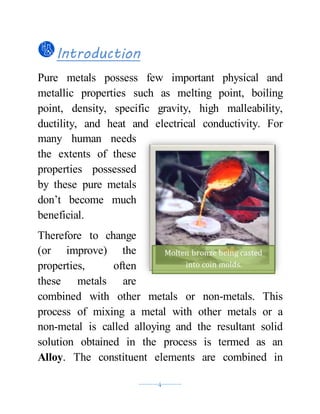
Molten bronze being casted
into coin molds.
----------5----------
such a way that they cannot be separated merely by
physical means. More than 90% of the metals used
are in the form of alloys.
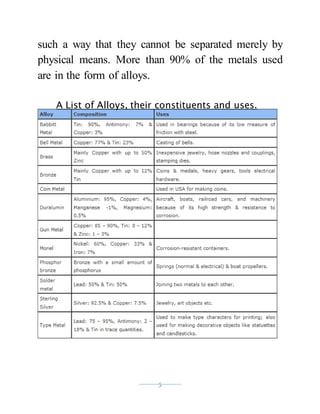
A List of Alloys, their constituents and uses.
----------6----------
Alloys are generally made to:
 Enhance the hardness of a metal: An alloy is
generally harder than its constituents. The pure
metals are generally soft.
 Lower the melting point: Pure metals have a
high melting point. The melting point lowers
when pure metals are alloyed with other metals
or nonmetals. This makes the metals easily
fusible.
 Enhance tensile strength: Alloy formation
increases the tensile strength of the parent metal.
 Enhance corrosion and/or heat resistance: Alloys
are more resistant to corrosion than pure metals.
Metals in pure form are chemically reactive and
can be easily corroded by the surrounding
atmospheric gases and moisture. Alloying a
metal increases the inertness of the metal, which,
in turn, increases corrosion resistance.
 Modify color: The color of pure metal can be
modified by alloying it with other metals or
nonmetals containing suitable color pigments.
----------7----------
 Obtain superconductivity: Some metals can be
alloyed in such a way that their alloy behaves as
a superconductor which is of high importance in
technological advancement.
 Provide better castability: One of the most
essential requirements of getting good castings
is the expansion of the metal on solidification.
Pure molten metals undergo contraction on
solidification. Metals need to be alloyed to
obtain good castings because alloys expand...
Few examples of alloys are stainless steel, brass,
bronze, nichrome, constantan, crown gold, solder,
amalgam etc…which are used in soldering, super
conduction making utensils, mechanical materials
like screws and blots etc…
onze
----------8----------
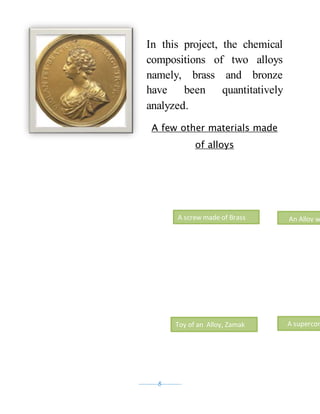
In this project, the chemical
compositions of two alloys
namely, brass and bronze
have been quantitatively
analyzed.
A few other materials made
of alloys
A screw made of Brass An Alloy w
Toy of an Alloy, Zamak A supercon
----------9----------
----------10----------
Apparatus
1. Brass and Bronze pieces
2. China dishes
3. Filtration apparatus
4. Nitric acid
5. Hydrogen sulphide gas
6. Ammonium chloride
7. Ammonium sulphide
8. Dil. hydrochloric acid
9. Mercuric chloride
10. Potassium Ferro cyanide
----------11----------
Theory
Brass:
Brass is an alloy constituting Cu and Zn. Both the
ions dissolve in 50% of nitric acid due
to the formation of nitrates which are soluble.
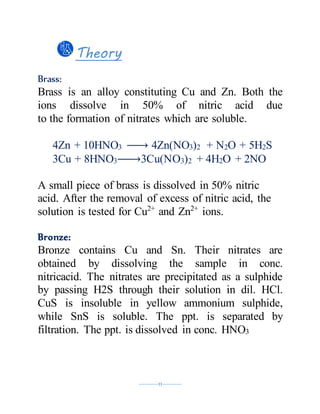
4Zn + 10HNO3 → 4Zn(NO3)2 + N2O + 5H2S
3Cu + 8HNO3→ 3Cu(NO3)2 + 4H2O + 2NO
A small piece of brass is dissolved in 50% nitric
acid. After the removal of excess of nitric acid, the
solution is tested for Cu2+
and Zn2+
ions.
Bronze:
Bronze contains Cu and Sn. Their nitrates are
obtained by dissolving the sample in conc.
nitricacid. The nitrates are precipitated as a sulphide
by passing H2S through their solution in dil. HCl.
CuS is insoluble in yellow ammonium sulphide,
while SnS is soluble. The ppt. is separated by
filtration. The ppt. is dissolved in conc. HNO3
----------12----------
and then Ammonium hydroxide solution is passed
through it. Blue coloration confirms the presence of
Cu.
The filtrate is treated with conc. HCl followed by
Zinc dust to obtain SnCl2.
Then HgCl2solution is added. Formation of slate-
coloured ppt. indicates the presence of Sn.
Procedure
For Brass:
1. A small piece of brass was taken in a china dish
and was heated with a small quantity of 50% HNO3
so as to dissolve the piece completely.
2. The solution was heated till a solid residue was
obtained.
3. The solid residue was dissolved in dil.HCl and
filtered. Distilled water was later added to the
filtrate.
----------13----------
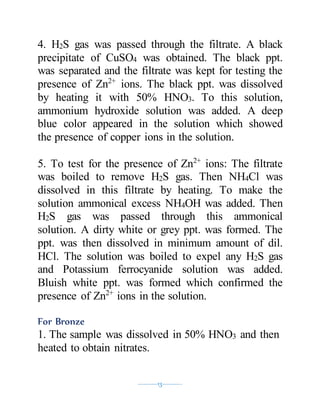
4. H2S gas was passed through the filtrate. A black
precipitate of CuSO4 was obtained. The black ppt.
was separated and the filtrate was kept for testing the
presence of Zn2+
ions. The black ppt. was dissolved
by heating it with 50% HNO3. To this solution,
ammonium hydroxide solution was added. A deep
blue color appeared in the solution which showed
the presence of copper ions in the solution.
5. To test for the presence of Zn2+
ions: The filtrate
was boiled to remove H2S gas. Then NH4Cl was
dissolved in this filtrate by heating. To make the
solution ammonical excess NH4OH was added. Then
H2S gas was passed through this ammonical
solution. A dirty white or grey ppt. was formed. The
ppt. was then dissolved in minimum amount of dil.
HCl. The solution was boiled to expel any H2S gas
and Potassium ferrocyanide solution was added.
Bluish white ppt. was formed which confirmed the
presence of Zn2+
ions in the solution.
For Bronze
1. The sample was dissolved in 50% HNO3 and then
heated to obtain nitrates.
----------14----------
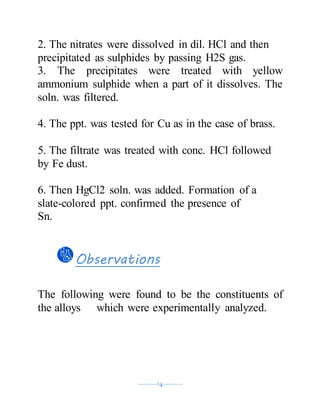
2. The nitrates were dissolved in dil. HCl and then
precipitated as sulphides by passing H2S gas.
3. The precipitates were treated with yellow
ammonium sulphide when a part of it dissolves. The
soln. was filtered.
4. The ppt. was tested for Cu as in the case of brass.
5. The filtrate was treated with conc. HCl followed
by Fe dust.
6. Then HgCl2 soln. was added. Formation of a
slate-colored ppt. confirmed the presence of
Sn.
Observations
The following were found to be the constituents of
the alloys which were experimentally analyzed.
----------15----------
Alloy Constituents
Brass Zinc, Copper
Bronze Tin, Copper
----------16----------
Declaration
I hereby declare that the project entitled “Study of
Constituents of an Alloy” submitted to XYZ222
School, Bengaluru, is a record of an original work
done by me by gaining the knowledge related to the
project from certain resources.
- M.S.Somanna
Student, Class 12,
XYZ222 Central School,
Bengaluru.
Bibliography
----------17----------
List of alloys. - Wikipedia.org
en.wikipedia.org/wiki/List_of_alloys
Alloys and their purposes. - Globalspec.com
www.globalspec.com/reference/46877/2
03279/purpose-of-making-alloys
NCERT Chemistry - Class 12.
Comprehensive Class 12 Chemistry Practicals.
Alloys And their properties – gcsescience.com
www.gcsescience.com/ex29.htm
----------18----------
ACCKNOWLEDGEMENT
I hereby like to express my
gratitude to my school authorities
for suggesting and encouraging
me to undertake the project
entitled “Study the constituents
of an alloy”.
I would also express my special
thanks to the members of the
school chemistry dept. for
supporting me.
-M.S.Somanna
Class XII
Actuallyacknowledgement mustbe
on the beginningpage of the project.
Sorry forthe mistake…
----------19----------

Chemistry Investigatory project on "Study of constituents of an alloy"

  • 1.
    A Chemistry Project on Studyof Constituents of Alloy
  • 2.
    ----------2---------- AIM GENERAL OBJECTIVE: This projectwas carried out to gain knowledge regarding alloys, their constituents and uses. The projects mainly stressed on analyzing the alloys for their constituents and appreciate the chemistry behind it. SPECIFIC OBJECTIVE: In this project the alloys, bronze and brass have been qualitatively analyzed in order to find out their constituents.
  • 3.
    ----------3---------- Contents 1. Certificate …1 2.Aim …2 3. Introduction …4 4. Apparatus …9 5. Theory …10 6. Procedure …11 7. Observations …13 8. Declaration …14 9. Bibliography …15 Actuallyacknowledgement page mustbe onthe beginningpage of the projectbefore the Aim.. Sorry forthe mistake…
  • 4.
    ----------4---------- Introduction Pure metals possessfew important physical and metallic properties such as melting point, boiling point, density, specific gravity, high malleability, ductility, and heat and electrical conductivity. For many human needs the extents of these properties possessed by these pure metals don’t become much beneficial. Therefore to change (or improve) the properties, often these metals are combined with other metals or non-metals. This process of mixing a metal with other metals or a non-metal is called alloying and the resultant solid solution obtained in the process is termed as an Alloy. The constituent elements are combined in Molten bronze being casted into coin molds.
  • 5.
    ----------5---------- such a waythat they cannot be separated merely by physical means. More than 90% of the metals used are in the form of alloys. A List of Alloys, their constituents and uses.
  • 6.
    ----------6---------- Alloys are generallymade to:  Enhance the hardness of a metal: An alloy is generally harder than its constituents. The pure metals are generally soft.  Lower the melting point: Pure metals have a high melting point. The melting point lowers when pure metals are alloyed with other metals or nonmetals. This makes the metals easily fusible.  Enhance tensile strength: Alloy formation increases the tensile strength of the parent metal.  Enhance corrosion and/or heat resistance: Alloys are more resistant to corrosion than pure metals. Metals in pure form are chemically reactive and can be easily corroded by the surrounding atmospheric gases and moisture. Alloying a metal increases the inertness of the metal, which, in turn, increases corrosion resistance.  Modify color: The color of pure metal can be modified by alloying it with other metals or nonmetals containing suitable color pigments.
  • 7.
    ----------7----------  Obtain superconductivity:Some metals can be alloyed in such a way that their alloy behaves as a superconductor which is of high importance in technological advancement.  Provide better castability: One of the most essential requirements of getting good castings is the expansion of the metal on solidification. Pure molten metals undergo contraction on solidification. Metals need to be alloyed to obtain good castings because alloys expand... Few examples of alloys are stainless steel, brass, bronze, nichrome, constantan, crown gold, solder, amalgam etc…which are used in soldering, super conduction making utensils, mechanical materials like screws and blots etc… onze
  • 8.
    ----------8---------- In this project,the chemical compositions of two alloys namely, brass and bronze have been quantitatively analyzed. A few other materials made of alloys A screw made of Brass An Alloy w Toy of an Alloy, Zamak A supercon
  • 9.
  • 10.
    ----------10---------- Apparatus 1. Brass andBronze pieces 2. China dishes 3. Filtration apparatus 4. Nitric acid 5. Hydrogen sulphide gas 6. Ammonium chloride 7. Ammonium sulphide 8. Dil. hydrochloric acid 9. Mercuric chloride 10. Potassium Ferro cyanide
  • 11.
    ----------11---------- Theory Brass: Brass is analloy constituting Cu and Zn. Both the ions dissolve in 50% of nitric acid due to the formation of nitrates which are soluble. 4Zn + 10HNO3 → 4Zn(NO3)2 + N2O + 5H2S 3Cu + 8HNO3→ 3Cu(NO3)2 + 4H2O + 2NO A small piece of brass is dissolved in 50% nitric acid. After the removal of excess of nitric acid, the solution is tested for Cu2+ and Zn2+ ions. Bronze: Bronze contains Cu and Sn. Their nitrates are obtained by dissolving the sample in conc. nitricacid. The nitrates are precipitated as a sulphide by passing H2S through their solution in dil. HCl. CuS is insoluble in yellow ammonium sulphide, while SnS is soluble. The ppt. is separated by filtration. The ppt. is dissolved in conc. HNO3
  • 12.
    ----------12---------- and then Ammoniumhydroxide solution is passed through it. Blue coloration confirms the presence of Cu. The filtrate is treated with conc. HCl followed by Zinc dust to obtain SnCl2. Then HgCl2solution is added. Formation of slate- coloured ppt. indicates the presence of Sn. Procedure For Brass: 1. A small piece of brass was taken in a china dish and was heated with a small quantity of 50% HNO3 so as to dissolve the piece completely. 2. The solution was heated till a solid residue was obtained. 3. The solid residue was dissolved in dil.HCl and filtered. Distilled water was later added to the filtrate.
  • 13.
    ----------13---------- 4. H2S gaswas passed through the filtrate. A black precipitate of CuSO4 was obtained. The black ppt. was separated and the filtrate was kept for testing the presence of Zn2+ ions. The black ppt. was dissolved by heating it with 50% HNO3. To this solution, ammonium hydroxide solution was added. A deep blue color appeared in the solution which showed the presence of copper ions in the solution. 5. To test for the presence of Zn2+ ions: The filtrate was boiled to remove H2S gas. Then NH4Cl was dissolved in this filtrate by heating. To make the solution ammonical excess NH4OH was added. Then H2S gas was passed through this ammonical solution. A dirty white or grey ppt. was formed. The ppt. was then dissolved in minimum amount of dil. HCl. The solution was boiled to expel any H2S gas and Potassium ferrocyanide solution was added. Bluish white ppt. was formed which confirmed the presence of Zn2+ ions in the solution. For Bronze 1. The sample was dissolved in 50% HNO3 and then heated to obtain nitrates.
  • 14.
    ----------14---------- 2. The nitrateswere dissolved in dil. HCl and then precipitated as sulphides by passing H2S gas. 3. The precipitates were treated with yellow ammonium sulphide when a part of it dissolves. The soln. was filtered. 4. The ppt. was tested for Cu as in the case of brass. 5. The filtrate was treated with conc. HCl followed by Fe dust. 6. Then HgCl2 soln. was added. Formation of a slate-colored ppt. confirmed the presence of Sn. Observations The following were found to be the constituents of the alloys which were experimentally analyzed.
  • 15.
  • 16.
    ----------16---------- Declaration I hereby declarethat the project entitled “Study of Constituents of an Alloy” submitted to XYZ222 School, Bengaluru, is a record of an original work done by me by gaining the knowledge related to the project from certain resources. - M.S.Somanna Student, Class 12, XYZ222 Central School, Bengaluru. Bibliography
  • 17.
    ----------17---------- List of alloys.- Wikipedia.org en.wikipedia.org/wiki/List_of_alloys Alloys and their purposes. - Globalspec.com www.globalspec.com/reference/46877/2 03279/purpose-of-making-alloys NCERT Chemistry - Class 12. Comprehensive Class 12 Chemistry Practicals. Alloys And their properties – gcsescience.com www.gcsescience.com/ex29.htm
  • 18.
    ----------18---------- ACCKNOWLEDGEMENT I hereby liketo express my gratitude to my school authorities for suggesting and encouraging me to undertake the project entitled “Study the constituents of an alloy”. I would also express my special thanks to the members of the school chemistry dept. for supporting me. -M.S.Somanna Class XII Actuallyacknowledgement mustbe on the beginningpage of the project. Sorry forthe mistake…
  • 19.