Differentiation
  Developing a shared language


                    Dr Catherine Hart
                    www.crowther.org.au
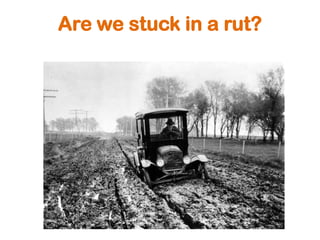
Are we stuck in a rut?
Do we work in a
system that demands
    conformity?
Cat herding clip – super bowl
“The biggest mistake ... in teaching
has been to treat all children as if
they are variants of the same
individual and thus to feel justified in
teaching them all the same subjects
in the same way”

Howard Gardner
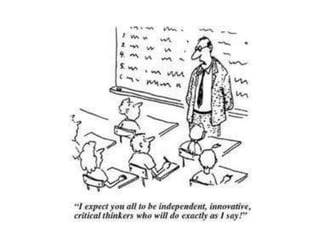
Great minds do NOT think alike
Using your non-dominant hand...

Write your name in the left hand corner
of the page


Activities from Glen Weibe
You have 20 seconds to do this
190124752000
Using your non-dominant hand, write
down the number shown.

You have 20 seconds to do this
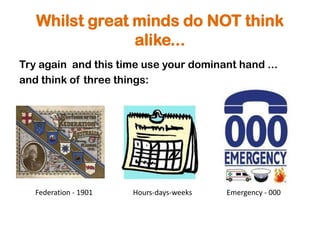
Whilst great minds do NOT think
                alike...
Try again and this time use your dominant hand ...
and think of three things:


   Federation - 1901   Hours-days-weeks   Emergency - 000
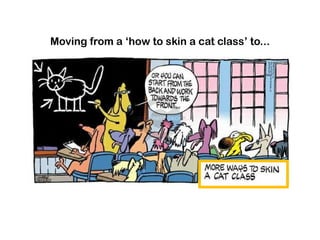
Moving from a „how to skin a cat class‟ to...
Differentiation is...
A flexible approach to teaching in
which the teacher plans and carries out
varied approaches to content, process,
and product in anticipation and in
response to student differences in
readiness, interest and learning needs”

Carol Ann Tomlinson
Or more simply...

is an appropriate teacher response to
learners‟ needs
Differentiation is NOT...
• A brand-new way of teaching
• IEPs for every student
• Tracking or ability grouping
• Constant group work
• Allowing students to work only in
  preferred ways on preferred topics
• Occasional variations in teaching style
  or level of questions asked of
  individuals

Cindy Strickland
Differentiation is NOT an add-on, it‟s a
build-on, it is the foundation of your „house‟


Glenn Weibe
Clarifying terms
Individualisation

Differentiation

Personalisation

In pairs:
Do you have the same expectations for
all your students?
Do you want all your students to
succeed?

“Emphasise excellence for all – not just
the top, bottom or middle of the
distribution – and recognise diverse
forms of excellence”

Robert Sternberg
Why differentiate?
Learner Diversity
•   ESL
•   Learning difficulties
•   disabilities
•   Gifted & Talented
•   Cultural differences
•   Gender differences
•   Everyone.. . Not just at ends of the
    spectrum
Proactive not reactive
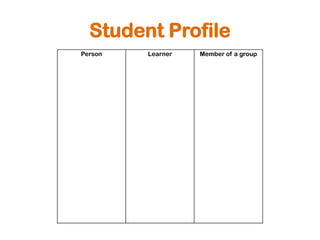
Student Profile
Person   Learner   Member of a group
In pairs:

How do you currently cater for learner
diversity in your classroom? Your PLT?
Your school?
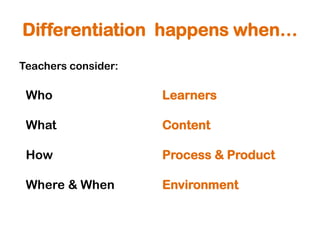
Differentiation happens when…
Teachers consider:

 Who                 Learners

 What                Content

 How                 Process & Product

 Where & When        Environment
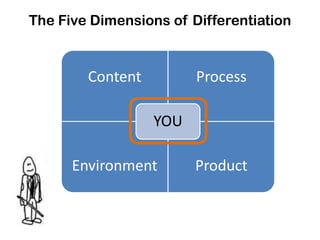
The Five Dimensions of Differentiation


        Content         Process

                  YOU

      Environment       Product
Differentiation: developing a shared language

Differentiation: developing a shared language

Editor's Notes

  • #7 Need to make clear that belief is diff is happening; organisation of this may need to be improved; transparency in planning & documentation
  • #24 Individualisation refers to instruction that is paced to the learning needs of different learners. Learning goals are the same for all students, but students can progress through the material at different speeds according to their learning needs. For example, students might take longer to progress through a given topic, skip topics that cover information they already know, or repeat topics they need more help on.Differentiation refers to instruction that is tailored to the learning preferences of different learners. Learning goals are the same for all students, but the method or approach of instruction varies according to the preferences of each student or what research has found works best for students like them.Personalisation refers to instruction that is paced to learning needs, tailored to learning preferences, and tailored to the specific interests of different learners. In an environment that is fully personalized, the learning objectives and content as well as the method and pace may all vary (so personalization encompasses differentiation and individualization).
  • #29 Consider one student in one of your classes you think you ‘know’ under the three headings of the foldable – what did you do to find out; what strategies did you use what tools did you avail yourself of?