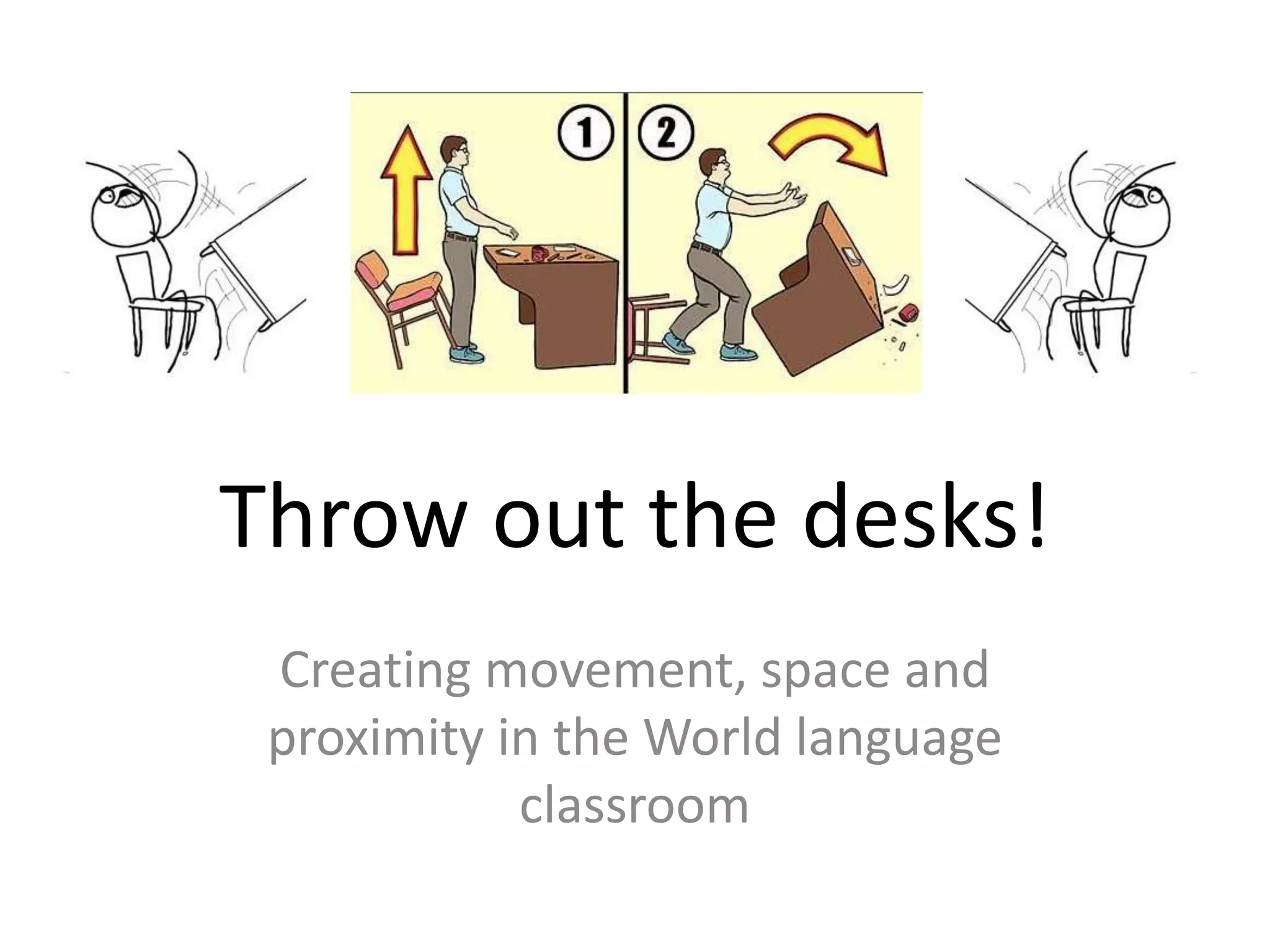
Throw out the desks!
Creating engagement, movement,
space, community and visibility in the
World Language classroom
Three main problems
1. Large classroom sizes
1. Desks limit space
1. Desks are barriers
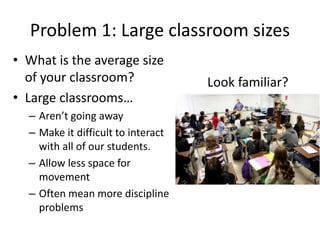
Problem 1: Large classroom sizes
• What is the average size of your classroom?
• What is the function of the physical space in your
classroom?
• How well can you see your students’ work or hear your
students’ speech?
• Can you easily move around your classroom?
• How quickly can you make it from one side to the other?
Problem 2: Desks limit space
• Have you ever tripped over a backpack?
• Have you ever been trapped at the front of your classroom?
• Have you ever had to rearrange 40 desks?
• Have you ever forgotten to remind you kids to straighten their
desks?
• How well/quickly can you transition into a movement activity?
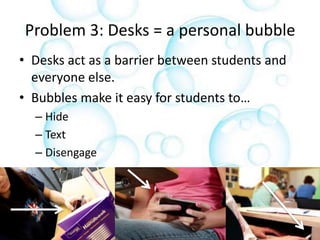
Problem 3: Desks are barriers
• Have your students struggled to hear each
other?
• Have you noticed them texting under their
desks?
• Do your students put their heads down on
their desks? Lean on them?
What does eliminating desks create?
• Visibility
• Space
• Movement
• Community
• Engagement
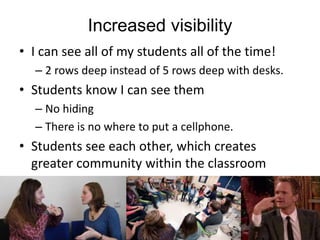
Visibility
• How well can you see your students?
– Their hands, feet, work
• Who’s Gabe?
• Do your students see and notice each other?
• Partner question:
– What do you do to build community within your classroom?
– Is it happening?
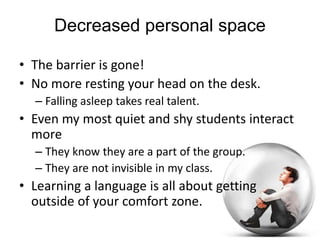
Space
Personal space vs. communal space
• How does maintaining personal space impede
communication and interaction?
• How are we getting our students out of their
personal bubbles?
• How well de we encourage risk taking and
error making?
• How often do we, as teachers, hide at the
front of the classroom?
Movement
• What movement activities would you
implement if you had more space?
Community
• How eagerly do our students contribute to
class?
• How comfortable are our students with sharing
their ideas and personal experiences?
• How well do our students know each other?
• How often do we laugh with our students?
Engagement
• How does your current classroom set-up
encourage engagement?
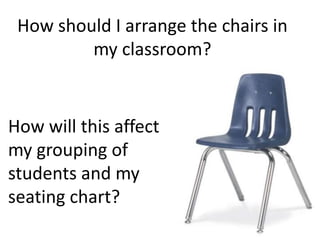
How should I arrange the chairs in
my classroom?
How will this affect
my grouping of
students and my
seating chart?
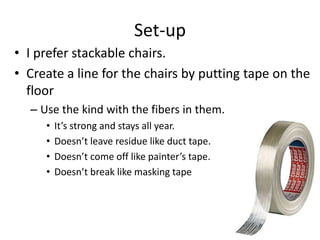
Set-up
• I prefer stackable chairs.
• Create a line for the chairs by putting tape on the
floor
– Use the kind with the fibers in them.
• It’s strong and stays all year.
• Doesn’t leave residue like duct tape.
• Doesn’t come off like painter’s tape.
• Doesn’t break like masking tape
The U and the O
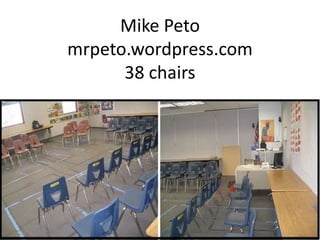
• The majority of teachers with desk-less
classrooms prefer to arrange their chairs in a
U-shape or in a circle
• This allows for more movement in the center
of the classroom.
• And it opens up the classroom where students
see and notice each other.
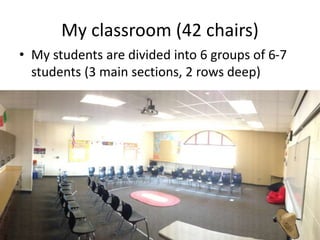
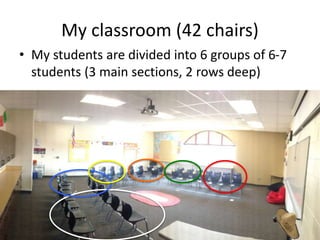
My classroom (42 chairs)
• My students are divided into 6 groups of 6-7
students (3 main sections, 2 rows deep)
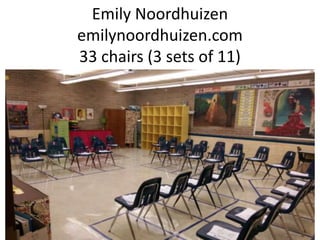
Emily Noordhuizen
emilynoordhuizen.com
33 chairs (3 sets of 11)
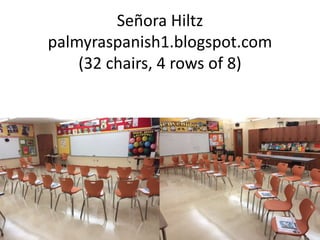
Señora Hiltz
palmyraspanish1.blogspot.com
(32 chairs, 4 rows of 8)
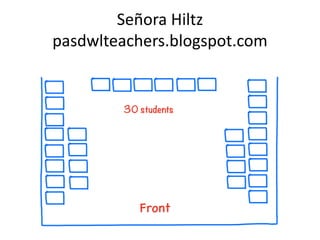
Señora Hiltz
palmyraspanish1.blogspot.com
Aaron Wilkerson
Sir Francis Drake High School- Spanish teacher
Will my students complain
about not having desks?
• Some will at the very beginning of the year.
Most won’t.
• It will take them a couple weeks to get used
to.
• Once they realize class is interactive, they
stop asking about the desks being gone.
(they, being maybe 1 kid per class)
What will my students write on?
• Use individual whiteboards. (as a hard writing surface)
• Writing tasks/Computer work:
– Give students freedom to sit around the room- to your comfort
level.
– For longer writing tasks or assessments, I let my students
» lay down on the floor
» sit against the wall
» use a chair as a table or a foot stool.
» Some teachers use pop-up tables they store against a wall
How will this affect my routines and
procedures?
• It will speed things up.
• Some of my procedures:
• Backpacks & Phones
• Students seated at bell
• Straighten before leaving
• Grab paper from center of room
• Break timer (credit: Ben Slavic)
Backpacks go in here
Or put backpacks here
How do I get their attention when they
aren’t organized?
Attention getters:
I call out the beginning of a phrase. And they say the end.
Expectation:
After they finish the end, they are to look up and be quiet.
Examples: (in Spanish)
• Me: ¡Clase! *clap clap*, Students: ¡Profe! *clap clap*
• Me: ¿Qué dice el pollito?, Students: ¡Pío, Pío, Pío!
• Me: ¡Feliz navidad!, Students: ¡Prospero año y felicidad!
• Me: ¿Qué da el sol?, Students: ¡Luz!
• Me: ¡Achoo Achoo Achoo!, Students: ¡Salud, Dinero, Amor!
How will kids handle the freedom of
space this allows?
• My students generally do really well.
• For squirrely kids…
Can they handle sitting in a chair
without a desk to lean on?
• Get them moving!
• It’s easier and quicker to do with the space
you have created.
Draw-backs
• Students have to be reminded/encouraged to
sit-up in chairs (my reminder for movement)
• Students try to text behind their legs.
• Students find odd places to hide phones.
Brain Break Games
• Brain breaks – most involve circles
• La bebé mala (Bad baby)
• Sillas musicales (Musical chairs)
• Cuatro rincones (4 corners)
• Casa, arbol, roca (House, tree, rock)
• Pasa la sonrisa (Pass the smile)
• Globo en el aire (Balloon in the air)
• No me mires (Don’t look at me)
• Eiminación (Elimination)
Movement Activities
• Learning Centers/Small Group Work
– Quickly form small circles
– Or stack chairs in a corner.
• TPR (Total Physical Response)
– Learn actions for vocabulary
– Stand in a line back to back with a partner.
– Listen for the word/phrase
– Turn and face partner with the action.
• Dances- easier to teach & do
– Student initiation & improvisation happens more
Review Games
• Mala pelota- Bad ball (with basketball hoop)
• Kahoot: Easier to see & monitor students during game
• Curitas- Bandaide game (With whiteboards) Credit: Melody Ream
• Fly swatter game: way easier to set-up w/o desks
• Tengo: (AKA BINGO) Credit Martina Bex
Lingering concerns and questions
• Any questions or concerns?

Throw out the desks UFLA 2016

  • 1.
    Throw out thedesks! Creating engagement, movement, space, community and visibility in the World Language classroom
  • 2.
    Three main problems 1.Large classroom sizes 1. Desks limit space 1. Desks are barriers
  • 3.
    Problem 1: Largeclassroom sizes • What is the average size of your classroom? • What is the function of the physical space in your classroom? • How well can you see your students’ work or hear your students’ speech? • Can you easily move around your classroom? • How quickly can you make it from one side to the other?
  • 4.
    Problem 2: Deskslimit space • Have you ever tripped over a backpack? • Have you ever been trapped at the front of your classroom? • Have you ever had to rearrange 40 desks? • Have you ever forgotten to remind you kids to straighten their desks? • How well/quickly can you transition into a movement activity?
  • 5.
    Problem 3: Desksare barriers • Have your students struggled to hear each other? • Have you noticed them texting under their desks? • Do your students put their heads down on their desks? Lean on them?
  • 6.
    What does eliminatingdesks create? • Visibility • Space • Movement • Community • Engagement
  • 7.
    Visibility • How wellcan you see your students? – Their hands, feet, work • Who’s Gabe? • Do your students see and notice each other? • Partner question: – What do you do to build community within your classroom? – Is it happening?
  • 8.
    Space Personal space vs.communal space • How does maintaining personal space impede communication and interaction? • How are we getting our students out of their personal bubbles? • How well de we encourage risk taking and error making? • How often do we, as teachers, hide at the front of the classroom?
  • 9.
    Movement • What movementactivities would you implement if you had more space?
  • 10.
    Community • How eagerlydo our students contribute to class? • How comfortable are our students with sharing their ideas and personal experiences? • How well do our students know each other? • How often do we laugh with our students?
  • 11.
    Engagement • How doesyour current classroom set-up encourage engagement?
  • 12.
    How should Iarrange the chairs in my classroom? How will this affect my grouping of students and my seating chart?
  • 13.
    Set-up • I preferstackable chairs. • Create a line for the chairs by putting tape on the floor – Use the kind with the fibers in them. • It’s strong and stays all year. • Doesn’t leave residue like duct tape. • Doesn’t come off like painter’s tape. • Doesn’t break like masking tape
  • 14.
    The U andthe O • The majority of teachers with desk-less classrooms prefer to arrange their chairs in a U-shape or in a circle • This allows for more movement in the center of the classroom. • And it opens up the classroom where students see and notice each other.
  • 15.
  • 16.
    My classroom (42chairs) • My students are divided into 6 groups of 6-7 students (3 main sections, 2 rows deep)
  • 17.
  • 18.
  • 19.
  • 20.
    Aaron Wilkerson Sir FrancisDrake High School- Spanish teacher
  • 21.
    Will my studentscomplain about not having desks? • Some will at the very beginning of the year. Most won’t. • It will take them a couple weeks to get used to. • Once they realize class is interactive, they stop asking about the desks being gone. (they, being maybe 1 kid per class)
  • 22.
    What will mystudents write on? • Use individual whiteboards. (as a hard writing surface) • Writing tasks/Computer work: – Give students freedom to sit around the room- to your comfort level. – For longer writing tasks or assessments, I let my students » lay down on the floor » sit against the wall » use a chair as a table or a foot stool. » Some teachers use pop-up tables they store against a wall
  • 23.
    How will thisaffect my routines and procedures? • It will speed things up. • Some of my procedures: • Backpacks & Phones • Students seated at bell • Straighten before leaving • Grab paper from center of room • Break timer (credit: Ben Slavic)
  • 24.
  • 25.
  • 26.
    How do Iget their attention when they aren’t organized? Attention getters: I call out the beginning of a phrase. And they say the end. Expectation: After they finish the end, they are to look up and be quiet. Examples: (in Spanish) • Me: ¡Clase! *clap clap*, Students: ¡Profe! *clap clap* • Me: ¿Qué dice el pollito?, Students: ¡Pío, Pío, Pío! • Me: ¡Feliz navidad!, Students: ¡Prospero año y felicidad! • Me: ¿Qué da el sol?, Students: ¡Luz! • Me: ¡Achoo Achoo Achoo!, Students: ¡Salud, Dinero, Amor!
  • 27.
    How will kidshandle the freedom of space this allows? • My students generally do really well. • For squirrely kids…
  • 28.
    Can they handlesitting in a chair without a desk to lean on? • Get them moving! • It’s easier and quicker to do with the space you have created.
  • 29.
    Draw-backs • Students haveto be reminded/encouraged to sit-up in chairs (my reminder for movement) • Students try to text behind their legs. • Students find odd places to hide phones.
  • 30.
    Brain Break Games •Brain breaks – most involve circles • La bebé mala (Bad baby) • Sillas musicales (Musical chairs) • Cuatro rincones (4 corners) • Casa, arbol, roca (House, tree, rock) • Pasa la sonrisa (Pass the smile) • Globo en el aire (Balloon in the air) • No me mires (Don’t look at me) • Eiminación (Elimination)
  • 31.
    Movement Activities • LearningCenters/Small Group Work – Quickly form small circles – Or stack chairs in a corner. • TPR (Total Physical Response) – Learn actions for vocabulary – Stand in a line back to back with a partner. – Listen for the word/phrase – Turn and face partner with the action. • Dances- easier to teach & do – Student initiation & improvisation happens more
  • 32.
    Review Games • Malapelota- Bad ball (with basketball hoop) • Kahoot: Easier to see & monitor students during game • Curitas- Bandaide game (With whiteboards) Credit: Melody Ream • Fly swatter game: way easier to set-up w/o desks • Tengo: (AKA BINGO) Credit Martina Bex
  • 33.
    Lingering concerns andquestions • Any questions or concerns?