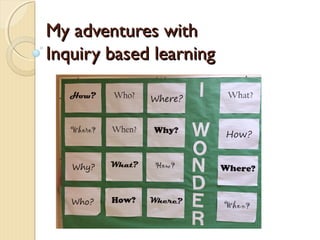
My adventures withMy adventures with
Inquiry based learningInquiry based learning
BCTLA versionBCTLA version
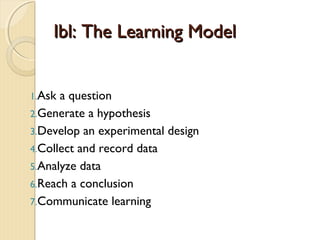
Ibl: The Learning ModelIbl: The Learning Model
1.Ask a question
2.Generate a hypothesis
3.Develop an experimental design
4.Collect and record data
5.Analyze data
6.Reach a conclusion
7.Communicate learning
How do we start this process?How do we start this process?
Seek out learning
Interact with facts
K-W-LK-W-L
Even more!Even more!
Improving QuestionsImproving Questions
Thin / Fat questions
Driving questions
Adrienne Gear
◦ Non fiction Reading Power
◦ Interact with what we learn
📐 📐 Solve a Problem: Solve a Problem: 
There’s a real-world predicament with
multiple solutions.
How can we stop phantom traffic jams?
How can we beautify the vacant lot across
the street for $200?
What’s the best way to stop the flu at our
school?
Design a better lunch menu for our school.
Design a safe and sturdy bridge to replace
one in our city.
📐 📐 Educational:Educational:
 The purpose of the project is to teach
others.
How can we teach second graders about
helpful insects.
Create a campaign to teach senior
citizens how to use an iPad.
What do the students at our school need
to know about being respectful?
Convince Others: Convince Others: 
Students persuade a specified audience to
do something or change their opinions.
Create a public service announcement (PSA)
that persuades teens to drink more water.
Drive yourself to define a question and then 
Prove It to your classmates.
Convince grocery shoppers to return their
shopping carts.
How can we convince our principal that we
should have a party in December?
Broad Theme: Broad Theme: 
The project tackles big ideas.
What does it mean to read?
How does conflict lead to change?
How does math influence art?
How do writers persuade others?
How are good and evil depicted in
different cultures?
📐 📐 Opinion:Opinion:
 Students need to consider all sides of an
issue in order to form and justify their
opinions.
Should pets be allowed to attend class?
Why has a woman never been a U.S.
president?
What makes a good astronaut?
Divergent:Divergent:
 Students make predictions about
alternative timelines and scenarios.
What if Rosa Parks gave up her seat?
What if the world ran out of oil
tomorrow?
How might your city change if the climate
became an average of 10°F warmer?
What if the USA switched to the metric
system?
Scenario-Based:Scenario-Based:
  Students take on a fictional role with a mission to
accomplish.
 You’re a NASA engineer, and you are in charge of building a
moon base. What are the ten most important things to
include and why?
 Imagine that you are King George. What would you have
done differently to keep American part of England?
 You are the CEO of a company that is designing a new social
media app. Present a business plan to your investors that
explains how your company will make money.
 You’ve been hired to revamp your local shopping mall.
Come up with a plan to increase business.
 How would you spend $1,000,000 to help your community?
Branching QuestionsBranching Questions
 A good driving question will lead to more questions.
Students will generate these sub questions and their answers
are important for the project. These sub questions branch
off of the driving questions and each other. They are specific
and can guide student research.
 Let’s take the driving question, "What if we had a chicken
house at our school?” Students might brainstorm branching
questions like:
 What do chickens eat?
 How often do they eat?
 How large of a house do they need?
 Does the house need to have different rooms?
 Do chickens fight with each other?
 How many eggs will they lay?
My grade 4 exampleMy grade 4 example
 What a cheetah does all day
  
 it wakes up at about 9:00 am
  
 Hunts for about 5 min.
  
 Can only run for a few min. until it needs a
rest and go again
  
 Eats for a few min.
  
 Teaches young
  
 Play
  
 Gets a drink
  
 Teach and play again
  
 Hunts again and get a drink
  
 Eats
  
 Sleeps for about 6 hours
  
 Hunt eats
  
 Teach and play
  
 Run and run
  
 Go to sleep and wakes up at 9:00 am
  
BCTLA versionBCTLA version
InvestigateInvestigate
Research skills
◦ Encyclopedia
◦ Books
◦ Websites
 Teach advanced searches
◦ 1st
hand Sources
◦ Interviews
How have our sources changed?
- Non fiction sections in our library
- Grade level specific
- Stable? or stagnant?
- Information is limited and therefore not so
overwhelming
- Determining importance – non fiction reading
power
FactFact
monstermonster
Readwritethink.orgReadwritethink.org
Pros andPros and
ConsCons
PrimaryPrimary
Where to from here?Where to from here?
Blogs about inquiry based learning
Also sometimes project based learning
My favorite – passion based learning
http://essinquiry.weebly.com/
Genius Hour
20% time / projects
If you assign a project
and you get back 30 of the
same –
that is not a project.
That is a recipe
Inquiry based learning

Inquiry based learning

  • 1.
    My adventures withMyadventures with Inquiry based learningInquiry based learning
  • 2.
  • 3.
    Ibl: The LearningModelIbl: The Learning Model 1.Ask a question 2.Generate a hypothesis 3.Develop an experimental design 4.Collect and record data 5.Analyze data 6.Reach a conclusion 7.Communicate learning
  • 4.
    How do westart this process?How do we start this process? Seek out learning Interact with facts
  • 20.
  • 21.
  • 22.
    Improving QuestionsImproving Questions Thin/ Fat questions Driving questions Adrienne Gear ◦ Non fiction Reading Power ◦ Interact with what we learn
  • 24.
    📐 📐 Solve a Problem: Solvea Problem:  There’s a real-world predicament with multiple solutions. How can we stop phantom traffic jams? How can we beautify the vacant lot across the street for $200? What’s the best way to stop the flu at our school? Design a better lunch menu for our school. Design a safe and sturdy bridge to replace one in our city.
  • 25.
    📐 📐 Educational:Educational:  The purpose ofthe project is to teach others. How can we teach second graders about helpful insects. Create a campaign to teach senior citizens how to use an iPad. What do the students at our school need to know about being respectful?
  • 26.
    Convince Others: Convince Others:  Studentspersuade a specified audience to do something or change their opinions. Create a public service announcement (PSA) that persuades teens to drink more water. Drive yourself to define a question and then  Prove It to your classmates. Convince grocery shoppers to return their shopping carts. How can we convince our principal that we should have a party in December?
  • 27.
    Broad Theme: Broad Theme:  Theproject tackles big ideas. What does it mean to read? How does conflict lead to change? How does math influence art? How do writers persuade others? How are good and evil depicted in different cultures?
  • 28.
    📐 📐 Opinion:Opinion:  Students need toconsider all sides of an issue in order to form and justify their opinions. Should pets be allowed to attend class? Why has a woman never been a U.S. president? What makes a good astronaut?
  • 29.
    Divergent:Divergent:  Students make predictionsabout alternative timelines and scenarios. What if Rosa Parks gave up her seat? What if the world ran out of oil tomorrow? How might your city change if the climate became an average of 10°F warmer? What if the USA switched to the metric system?
  • 30.
    Scenario-Based:Scenario-Based:   Students takeon a fictional role with a mission to accomplish.  You’re a NASA engineer, and you are in charge of building a moon base. What are the ten most important things to include and why?  Imagine that you are King George. What would you have done differently to keep American part of England?  You are the CEO of a company that is designing a new social media app. Present a business plan to your investors that explains how your company will make money.  You’ve been hired to revamp your local shopping mall. Come up with a plan to increase business.  How would you spend $1,000,000 to help your community?
  • 31.
    Branching QuestionsBranching Questions A good driving question will lead to more questions. Students will generate these sub questions and their answers are important for the project. These sub questions branch off of the driving questions and each other. They are specific and can guide student research.  Let’s take the driving question, "What if we had a chicken house at our school?” Students might brainstorm branching questions like:  What do chickens eat?  How often do they eat?  How large of a house do they need?  Does the house need to have different rooms?  Do chickens fight with each other?  How many eggs will they lay?
  • 32.
    My grade 4exampleMy grade 4 example  What a cheetah does all day     it wakes up at about 9:00 am     Hunts for about 5 min.     Can only run for a few min. until it needs a rest and go again     Eats for a few min.     Teaches young     Play     Gets a drink     Teach and play again     Hunts again and get a drink     Eats     Sleeps for about 6 hours     Hunt eats     Teach and play     Run and run     Go to sleep and wakes up at 9:00 am   
  • 33.
  • 34.
    InvestigateInvestigate Research skills ◦ Encyclopedia ◦Books ◦ Websites  Teach advanced searches ◦ 1st hand Sources ◦ Interviews
  • 35.
    How have oursources changed? - Non fiction sections in our library - Grade level specific - Stable? or stagnant? - Information is limited and therefore not so overwhelming - Determining importance – non fiction reading power
  • 36.
  • 37.
  • 39.
  • 40.
  • 42.
    Where to fromhere?Where to from here? Blogs about inquiry based learning Also sometimes project based learning My favorite – passion based learning http://essinquiry.weebly.com/ Genius Hour 20% time / projects
  • 43.
    If you assigna project and you get back 30 of the same – that is not a project. That is a recipe