Series: EMF Theory
Lecture: # 0.13
Dr R S Rao
Professor, ECE
Paths, surfaces and volumes, gradient theorem, divergence theorem and curl theorem,
differential length, surface and volumes in different Coordinate systems
Passionate
Teaching
Joyful
Learning
Paths, Surfaces and Volumes
Electromagnetic
Fields
Vector
Calculus-III
2
• In integral calculus, volume, surface and paths are mathematical
entities with very clear definitions.
• The volume, by definition, is a region, always surrounded by a
closed surface.
• And surface, once again by definition is an entity always
surrounded by a closed path.
• The path, by definition, is a curve with direction. Usually, the terms
paths and curves are used to mean the same.
Paths, Surfaces and Volumes
Electromagnetic
Fields
Vector
Calculus-III
3
• Volumes/differential volumes are scalar quantities whereas
surfaces/differential surfaces and paths/differential lengths are
vectors.
• Direction of path is tangential to the path and indicated with an
arrow.
• For straight line path, direction remains same all along its length.
And for curved line paths, direction naturally varies from point to
point.
• Two types of paths are encountered in electromagnetics: open paths
and closed paths.
• In case of open paths, starting point and terminating points are
different whereas in case of closed paths they are same.
Electromagnetic
Fields
Vector
Calculus-III
4
• Direction of surface, by definition, is normal to the surface. If the
surface is a flat plane, the direction remains same at all points
over its surface.
• For curved surfaces, direction varies from point to point.
• At an arbitrary point over the surface, direction can be found by
wrapping the point with right hand fingers in the direction of the
enclosing curve, direction pointed by the thumb then giving
direction of the surface at that point.
Paths, Surfaces and Volumes
Electromagnetic
Fields
Vector
Calculus-III
5
Paths, Surfaces and Volumes
Electromagnetic
Fields
VECTOR
CALCULUS-II
6
Differential elements
•Differential length is vector joining two points whose
coordinates differ by differential amounts.
•Differential area is surface of a parallelepiped formed around
differential length as diagonal
•Differential volume is volume of the parallelepiped.
Electromagnetic
Fields
VECTOR
CALCULUS-II
7
Differential elements
Differential length:
ˆ ˆ ˆ
Differential areas:
ˆ
ˆ
ˆ
Differential volume:
x
y
z
d dx dy dz
d dydz
d dzdx
d dxdy
d dxdydz

  




l x y z
a x
a y
a z
Cartesian system :::
Electromagnetic
Fields
VECTOR
CALCULUS-II
8
Differential elements
Differential length:
ˆ
ˆ ˆ
Differential areas:
ˆ
ˆ
ˆ
Differential volume:
z
d d d dz
d d dz
d d dz
d d d
d d d dz


  
 

  
   
  




l ρ z
a ρ
a
a z
Cylindrical system :::


Electromagnetic
Fields
VECTOR
CALCULUS-II
9
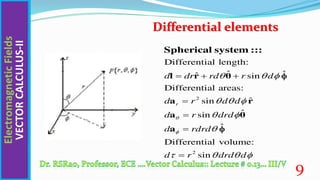
Differential elements
2
2
Differential length:
ˆ ˆ
ˆ sin
Differential areas:
ˆ
sin
ˆ
sin
ˆ
Differential volume:
sin
r
d dr rd r d
d r d d
d r drd
d rdrd
d r drd d


  
  
 

   
  




l r θ
a r
a θ
a
Spherical system :::


Calculus theorems
Electromagnetic
Fields
Vector
Calculus-III
10
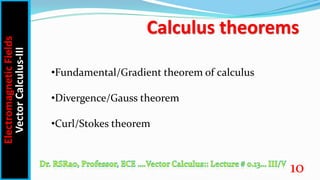
•Fundamental/Gradient theorem of calculus
•Divergence/Gauss theorem
•Curl/Stokes theorem
     
l
b
a
f d f b f a
   

Electromagnetic
Fields
Vector
Calculus-III
11
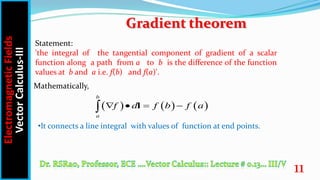
Statement:
'the integral of the tangential component of gradient of a scalar
function along a path from a to b is the difference of the function
values at b and a i.e. f(b) and f(a)'.
Mathematically,
•It connects a line integral with values of function at end points.
Gradient theorem
d d

   
 
F F a
Electromagnetic
Fields
Vector
Calculus-III
12
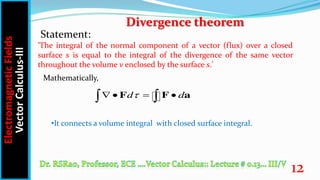
Statement:
'The integral of the normal component of a vector (flux) over a closed
surface s is equal to the integral of the divergence of the same vector
throughout the volume v enclosed by the surface s.'
Mathematically,
•It connects a volume integral with closed surface integral.
Divergence theorem
  d d
    
 
F a F l
Electromagnetic
Fields
Vector
Calculus-III
13
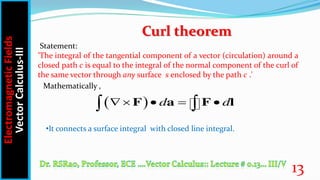
Statement:
'The integral of the tangential component of a vector (circulation) around a
closed path c is equal to the integral of the normal component of the curl of
the same vector through any surface s enclosed by the path c .'
Mathematically ,
•It connects a surface integral with closed line integral.
Curl theorem
ENOUGH
FOR
TODAY
ENOUGH
FOR
TODAY
ENOUGH
FOR
TODAY
ENOUGH
FOR
TODAY
ENOUGH
FOR
TODAY
14

EMF.0.13.VectorCalculus-III.pdf

  • 1.
    Series: EMF Theory Lecture:# 0.13 Dr R S Rao Professor, ECE Paths, surfaces and volumes, gradient theorem, divergence theorem and curl theorem, differential length, surface and volumes in different Coordinate systems Passionate Teaching Joyful Learning
  • 2.
    Paths, Surfaces andVolumes Electromagnetic Fields Vector Calculus-III 2 • In integral calculus, volume, surface and paths are mathematical entities with very clear definitions. • The volume, by definition, is a region, always surrounded by a closed surface. • And surface, once again by definition is an entity always surrounded by a closed path. • The path, by definition, is a curve with direction. Usually, the terms paths and curves are used to mean the same.
  • 3.
    Paths, Surfaces andVolumes Electromagnetic Fields Vector Calculus-III 3 • Volumes/differential volumes are scalar quantities whereas surfaces/differential surfaces and paths/differential lengths are vectors. • Direction of path is tangential to the path and indicated with an arrow. • For straight line path, direction remains same all along its length. And for curved line paths, direction naturally varies from point to point. • Two types of paths are encountered in electromagnetics: open paths and closed paths. • In case of open paths, starting point and terminating points are different whereas in case of closed paths they are same.
  • 4.
    Electromagnetic Fields Vector Calculus-III 4 • Direction ofsurface, by definition, is normal to the surface. If the surface is a flat plane, the direction remains same at all points over its surface. • For curved surfaces, direction varies from point to point. • At an arbitrary point over the surface, direction can be found by wrapping the point with right hand fingers in the direction of the enclosing curve, direction pointed by the thumb then giving direction of the surface at that point. Paths, Surfaces and Volumes
  • 5.
  • 6.
    Electromagnetic Fields VECTOR CALCULUS-II 6 Differential elements •Differential lengthis vector joining two points whose coordinates differ by differential amounts. •Differential area is surface of a parallelepiped formed around differential length as diagonal •Differential volume is volume of the parallelepiped.
  • 7.
    Electromagnetic Fields VECTOR CALCULUS-II 7 Differential elements Differential length: ˆˆ ˆ Differential areas: ˆ ˆ ˆ Differential volume: x y z d dx dy dz d dydz d dzdx d dxdy d dxdydz         l x y z a x a y a z Cartesian system :::
  • 8.
    Electromagnetic Fields VECTOR CALCULUS-II 8 Differential elements Differential length: ˆ ˆˆ Differential areas: ˆ ˆ ˆ Differential volume: z d d d dz d d dz d d dz d d d d d d dz                       l ρ z a ρ a a z Cylindrical system :::  
  • 9.
    Electromagnetic Fields VECTOR CALCULUS-II 9 Differential elements 2 2 Differential length: ˆˆ ˆ sin Differential areas: ˆ sin ˆ sin ˆ Differential volume: sin r d dr rd r d d r d d d r drd d rdrd d r drd d                       l r θ a r a θ a Spherical system :::  
  • 10.
  • 11.
         l b a f d f b f a      Electromagnetic Fields Vector Calculus-III 11 Statement: 'the integral of the tangential component of gradient of a scalar function along a path from a to b is the difference of the function values at b and a i.e. f(b) and f(a)'. Mathematically, •It connects a line integral with values of function at end points. Gradient theorem
  • 12.
    d d       F F a Electromagnetic Fields Vector Calculus-III 12 Statement: 'The integral of the normal component of a vector (flux) over a closed surface s is equal to the integral of the divergence of the same vector throughout the volume v enclosed by the surface s.' Mathematically, •It connects a volume integral with closed surface integral. Divergence theorem
  • 13.
      dd        F a F l Electromagnetic Fields Vector Calculus-III 13 Statement: 'The integral of the tangential component of a vector (circulation) around a closed path c is equal to the integral of the normal component of the curl of the same vector through any surface s enclosed by the path c .' Mathematically , •It connects a surface integral with closed line integral. Curl theorem
  • 14.