This document discusses different theories of drug dissolution. It describes the diffusion layer model, also known as the film theory, which states that dissolution occurs in two steps: 1) formation of a saturated liquid film at the solid-liquid interface and 2) diffusion of the drug from the film into the bulk solution. It also discusses Danckwert's model, which accounts for eddies in the liquid that renew the solid surface, and the interfacial barrier model, where an intermediate concentration exists at the interface due to solvation effects. Equations for each model are provided.
DIFFERENT THEORY OFDRUG
DISSOLUTION
AMIT MANDAL
B.PHARM ,6TH SEMESTER.ROLL-
17401915005
2.
WHAT IS DRUGDISSOLUTION?
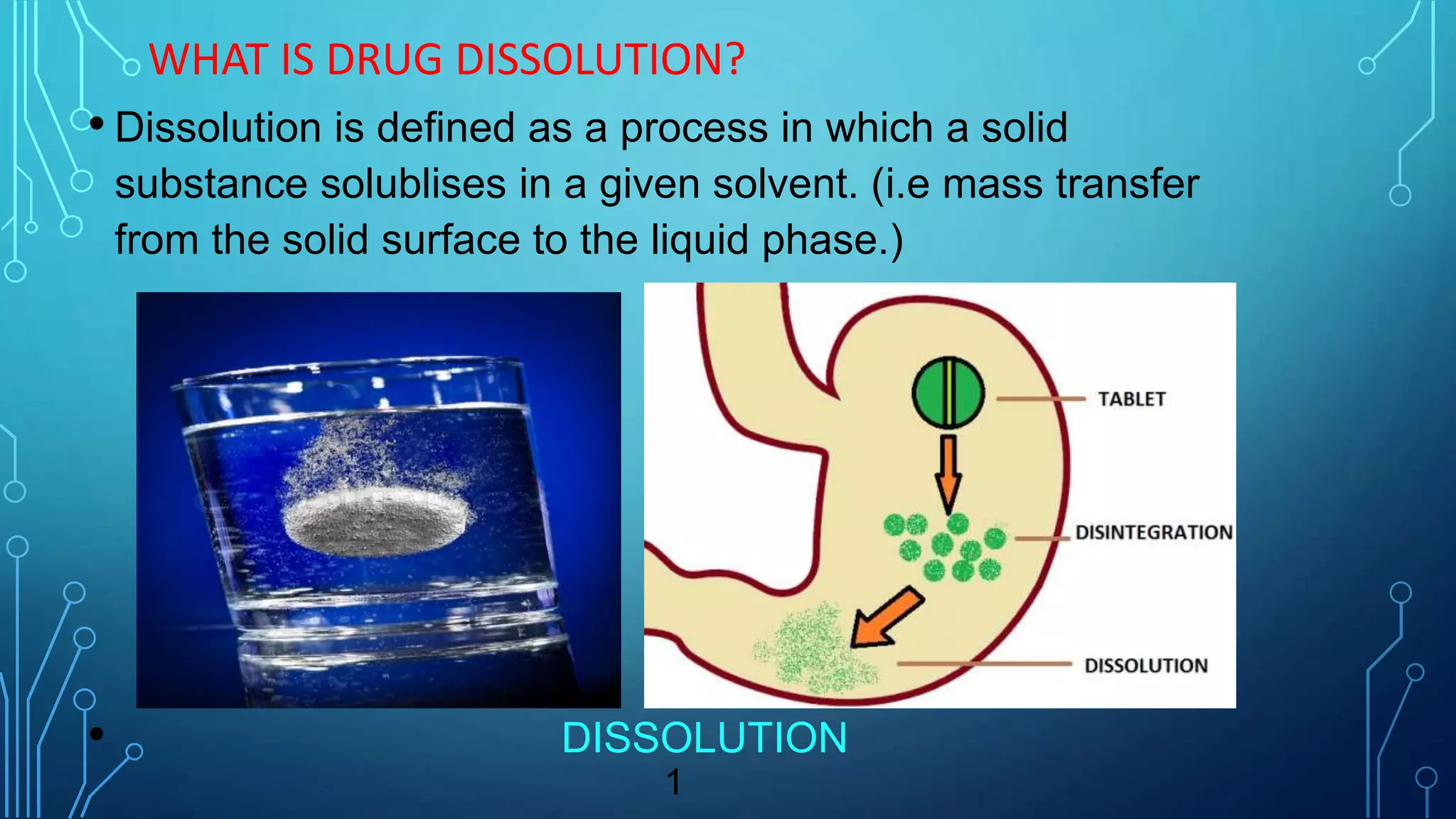
• Dissolution is defined as a process in which a solid
substance solublises in a given solvent. (i.e mass transfer
from the solid surface to the liquid phase.)
• DISSOLUTION
1
DIFFUSION LAYER MODEL:
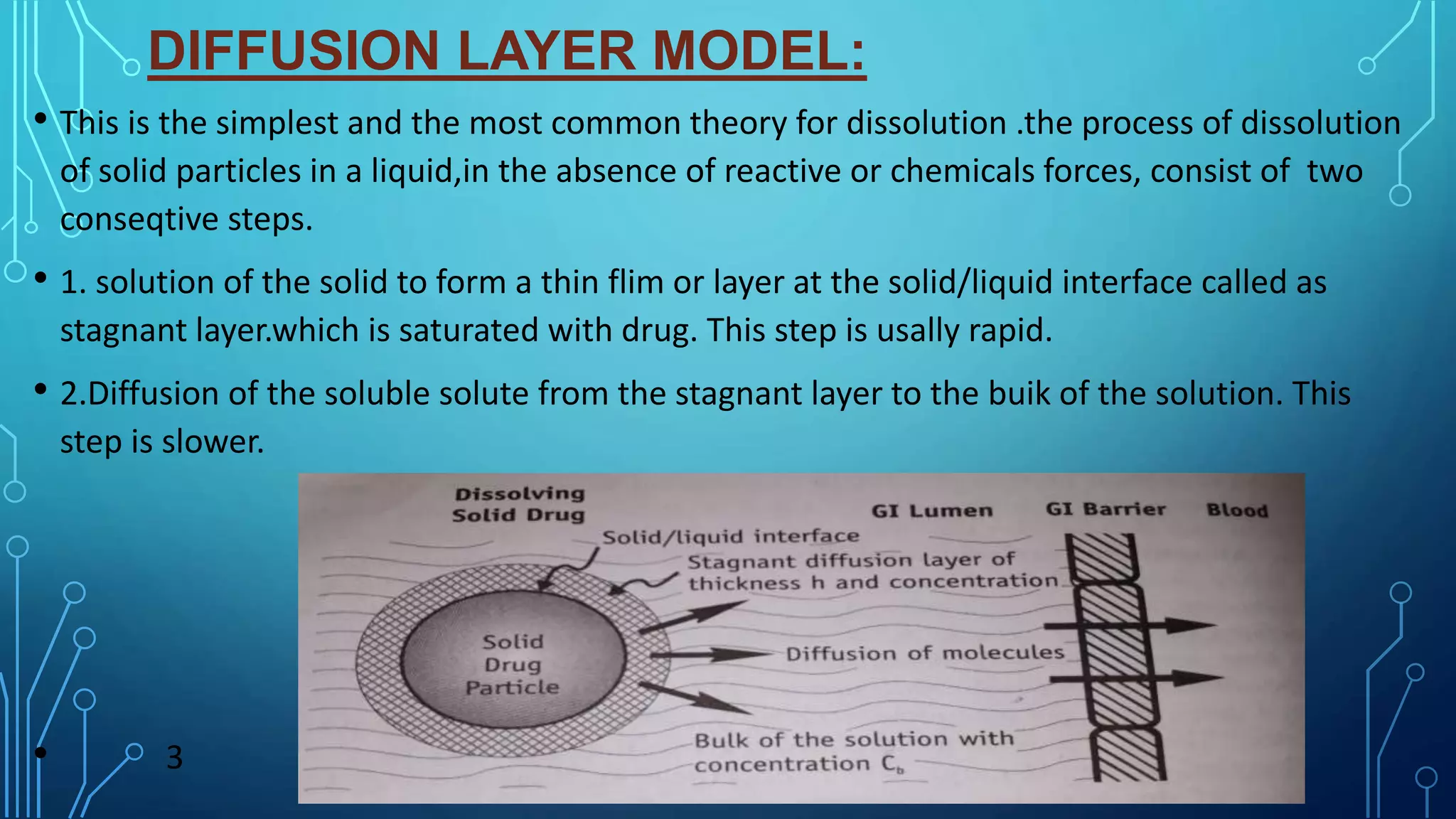
•This is the simplest and the most common theory for dissolution .the process of dissolution
of solid particles in a liquid,in the absence of reactive or chemicals forces, consist of two
conseqtive steps.
• 1. solution of the solid to form a thin flim or layer at the solid/liquid interface called as
stagnant layer.which is saturated with drug. This step is usally rapid.
• 2.Diffusion of the soluble solute from the stagnant layer to the buik of the solution. This
step is slower.
• 3
5.
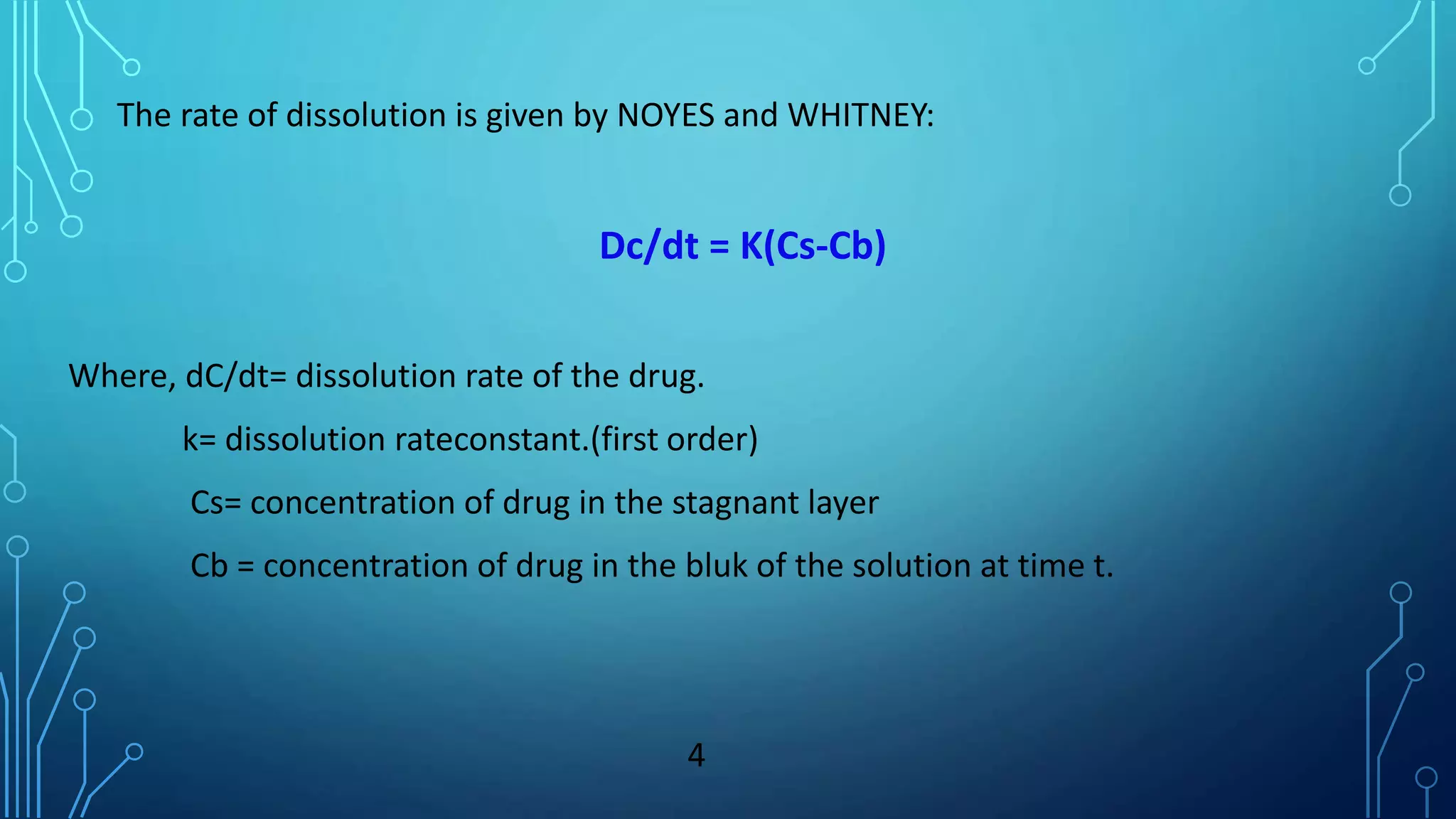
The rate ofdissolution is given by NOYES and WHITNEY:
Dc/dt = K(Cs-Cb)
Where, dC/dt= dissolution rate of the drug.
k= dissolution rateconstant.(first order)
Cs= concentration of drug in the stagnant layer
Cb = concentration of drug in the bluk of the solution at time t.
4
6.
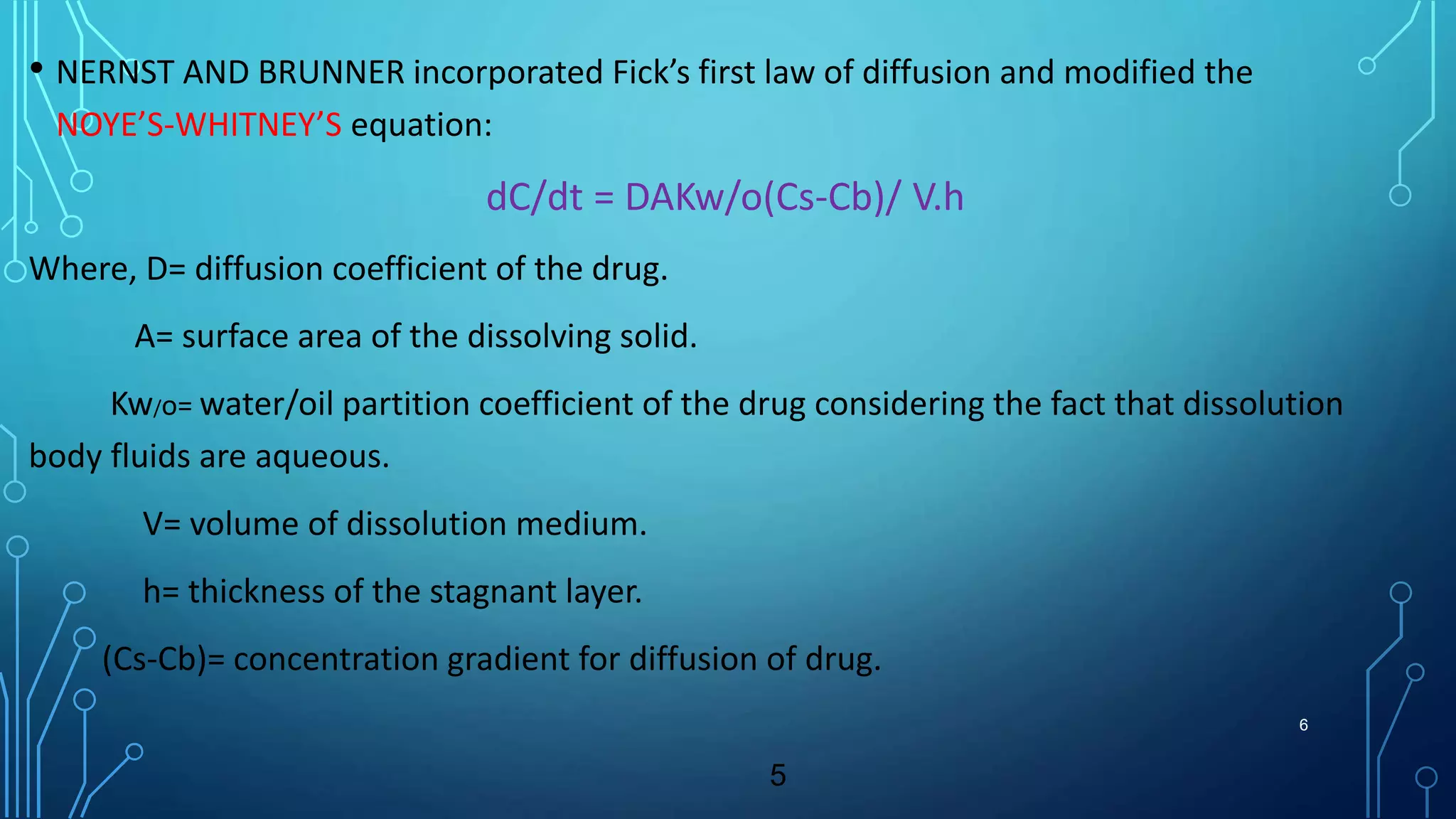
• NERNST ANDBRUNNER incorporated Fick’s first law of diffusion and modified the
NOYE’S-WHITNEY’S equation:
dC/dt = DAKw/o(Cs-Cb)/ V.h
Where, D= diffusion coefficient of the drug.
A= surface area of the dissolving solid.
Kw/o= water/oil partition coefficient of the drug considering the fact that dissolution
body fluids are aqueous.
V= volume of dissolution medium.
h= thickness of the stagnant layer.
(Cs-Cb)= concentration gradient for diffusion of drug.
5
6
7.
The Noyes-Whitney’sequation assumes that the surface area of the dissoving
solid remains constant during dissolution,which is practically not possible for
dissolving particles.
• Hence,dissolution methods that involve use of constant surface area discs are
employed to determine the rate of dissolution.
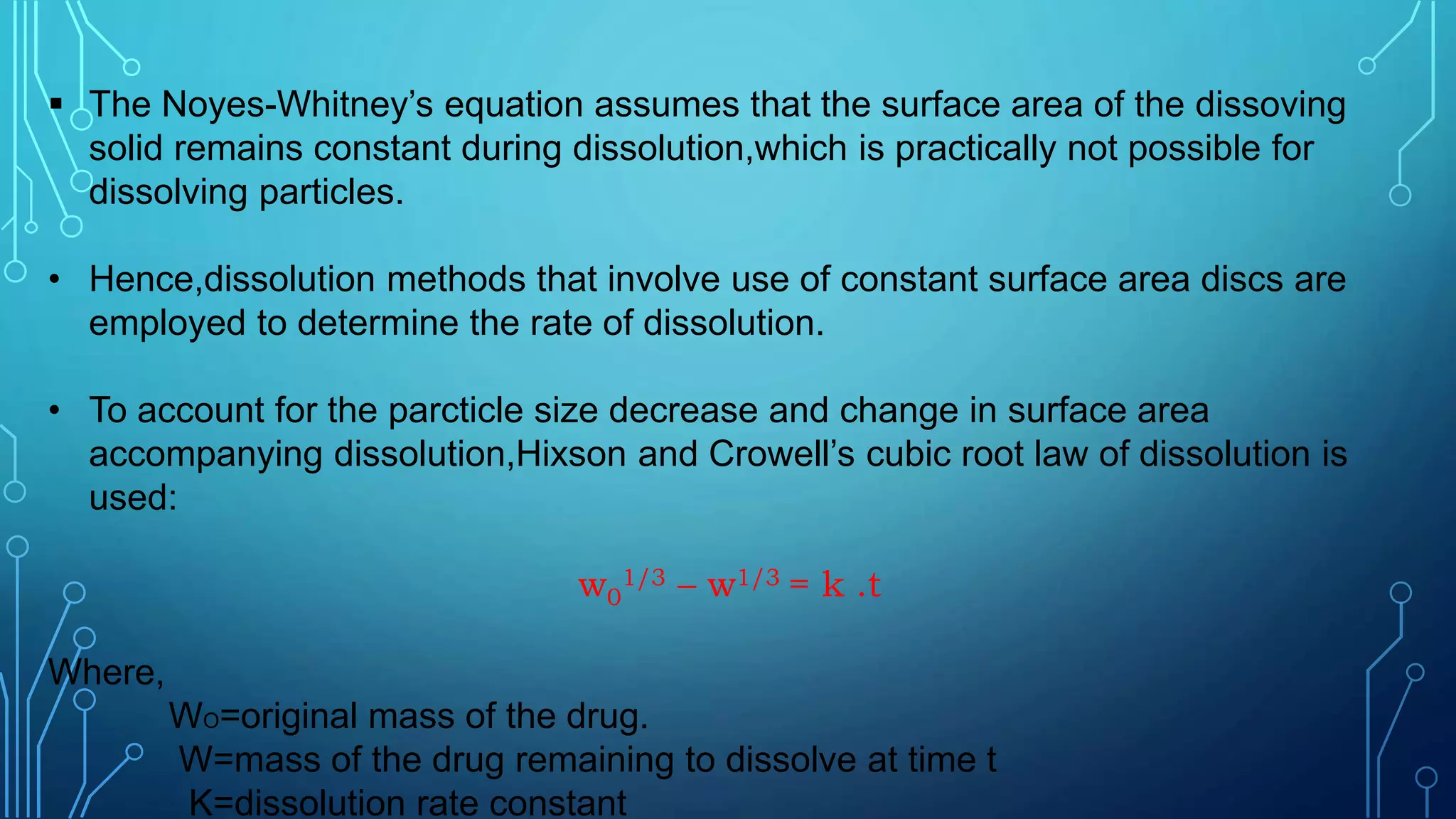
• To account for the parcticle size decrease and change in surface area
accompanying dissolution,Hixson and Crowell’s cubic root law of dissolution is
used:
w0
1/3 – w1/3 = k .t
Where,
WO=original mass of the drug.
W=mass of the drug remaining to dissolve at time t
K=dissolution rate constant
8.
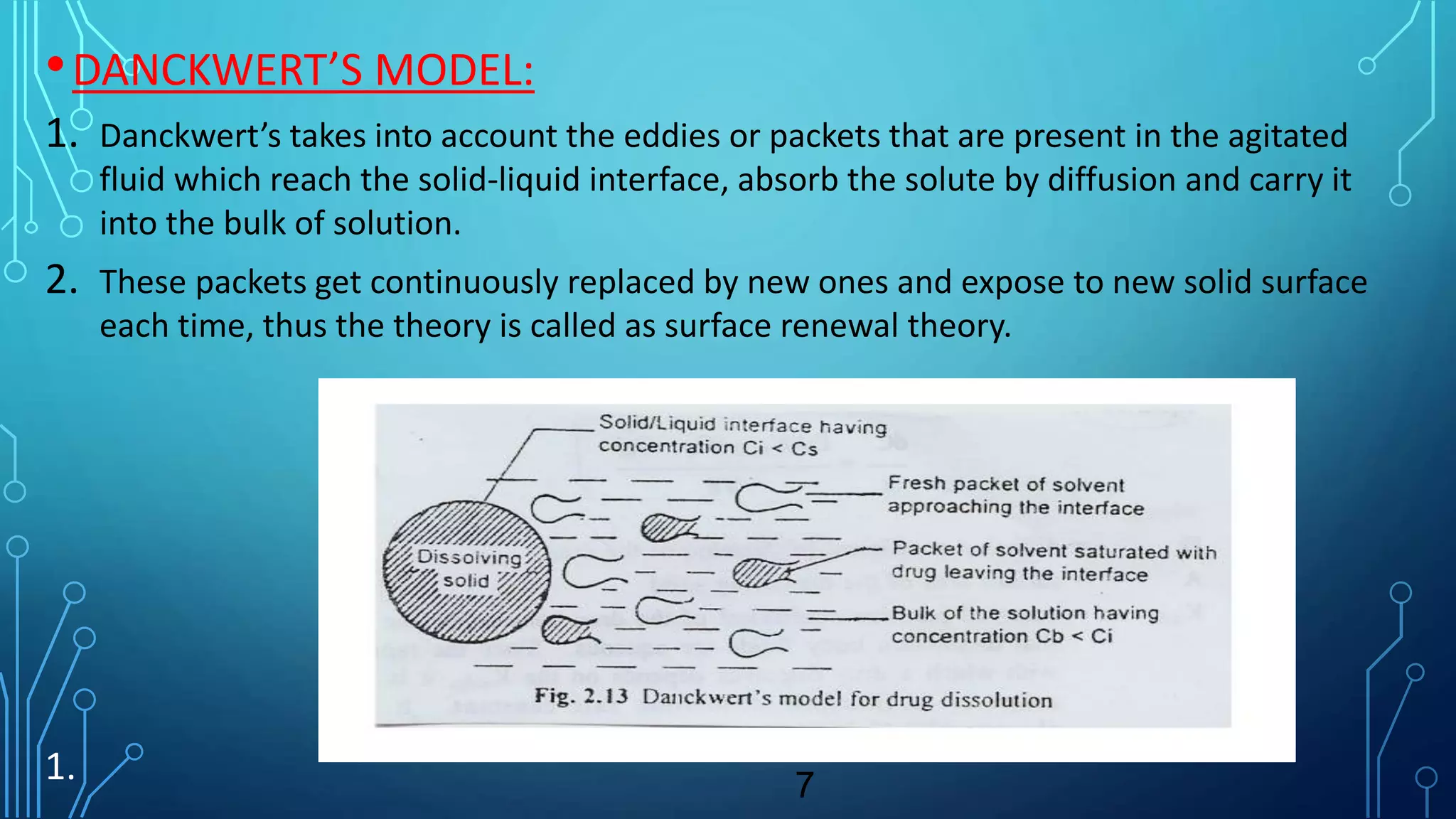
•DANCKWERT’S MODEL:
1. Danckwert’stakes into account the eddies or packets that are present in the agitated
fluid which reach the solid-liquid interface, absorb the solute by diffusion and carry it
into the bulk of solution.
2. These packets get continuously replaced by new ones and expose to new solid surface
each time, thus the theory is called as surface renewal theory.
1. 7
9.
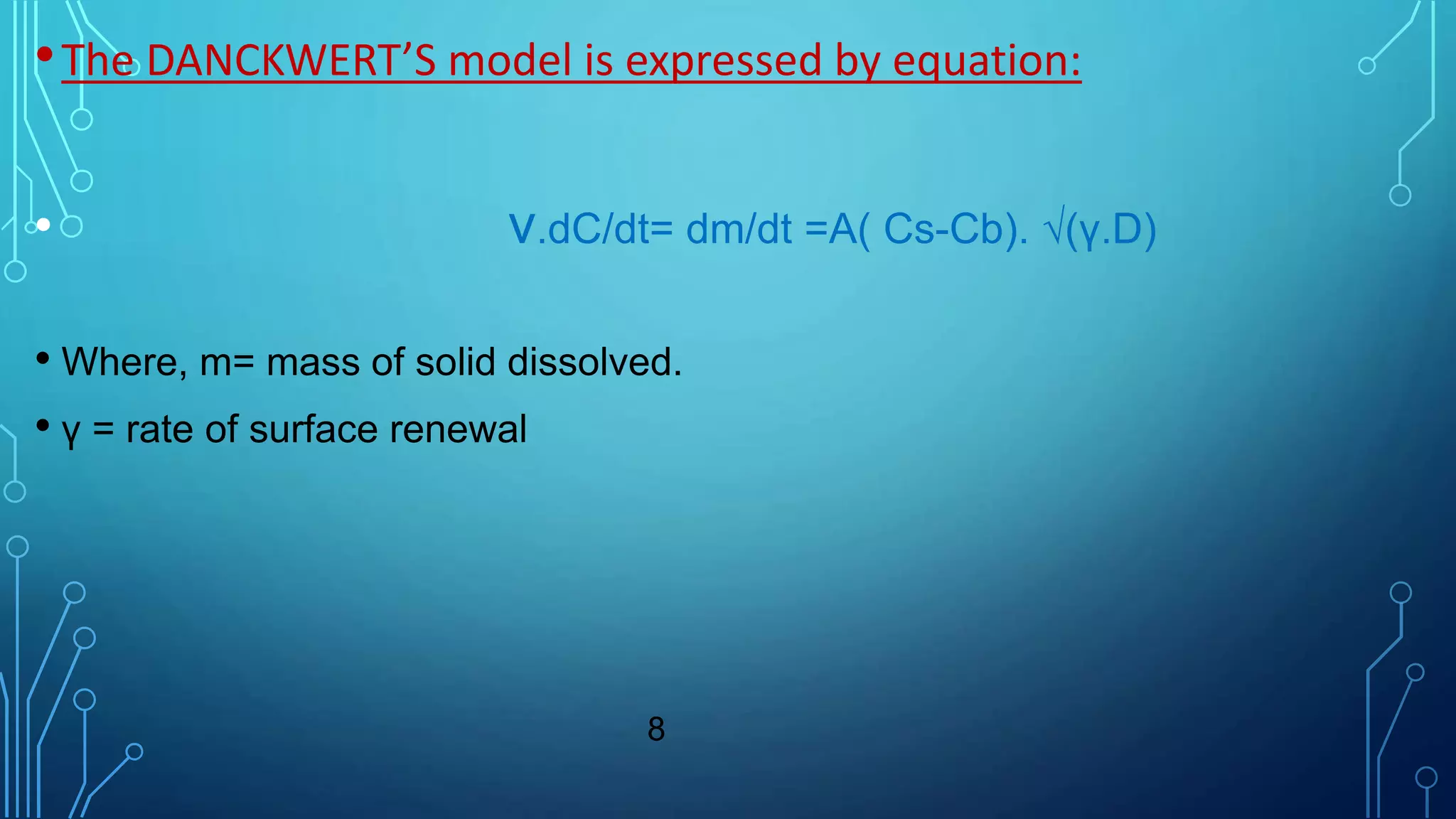
•The DANCKWERT’S modelis expressed by equation:
• v.dC/dt= dm/dt =A( Cs-Cb). √(γ.D)
• Where, m= mass of solid dissolved.
• γ = rate of surface renewal
8
10.
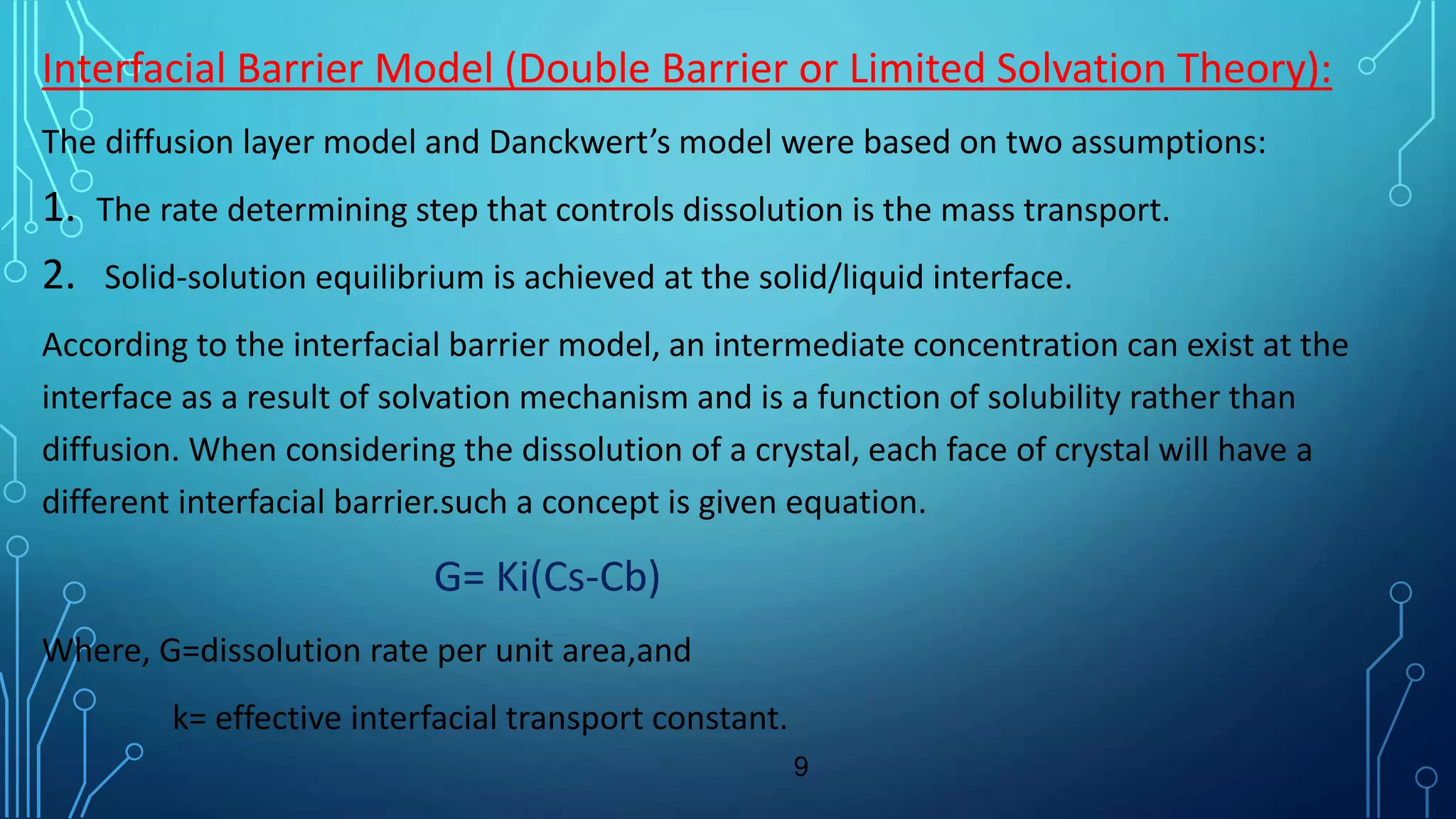
Interfacial Barrier Model(Double Barrier or Limited Solvation Theory):
The diffusion layer model and Danckwert’s model were based on two assumptions:
1. The rate determining step that controls dissolution is the mass transport.
2. Solid-solution equilibrium is achieved at the solid/liquid interface.
According to the interfacial barrier model, an intermediate concentration can exist at the
interface as a result of solvation mechanism and is a function of solubility rather than
diffusion. When considering the dissolution of a crystal, each face of crystal will have a
different interfacial barrier.such a concept is given equation.
G= Ki(Cs-Cb)
Where, G=dissolution rate per unit area,and
k= effective interfacial transport constant.
9
11.
•REFERENCES:
• 1. BrahmankarD.M., Jaiswal S.B. (2009), “Biopharmaceutics and
Pharmacokinetics-A Treatise” Vallabh Prakashan, 2nd Edition, Page No. 15-48
• 2. Government of Indian ministry of health and family welfare (2014), “Indian
Pharmacopoeia” Indian Pharmacopoeia commission, Ghaziabad,Volume-1,
Page No. 174
• 3. Subrahmanyam C.V.S. (2000), “Text book of Physical Pharmaceutics” Vallabh
Prakashan, 2nd Edition, Page No. 85-105
• 4. Banakar U.V. (1992), “Pharmaceutical Dissolution Testing” Informa helthcare,
1st Edition, Page No. 1-30
10