Media Studies ASTV DramaKey Vocabulary
Camera Shots, Angle, Movement and Composition
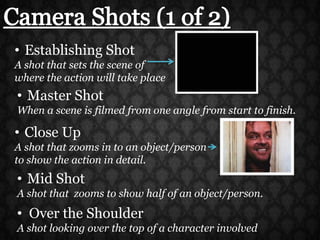
Camera Shots (1 of 2)Establishing ShotA shot that sets the scene of where the action will take placeMaster ShotWhen a scene is filmed from one angle from start to finish.Close UpA shot that zooms in to an object/person to show the action in detail.Mid ShotA shot that  zooms to show half of an object/person.Over the ShoulderA shot looking over the top of a character involved
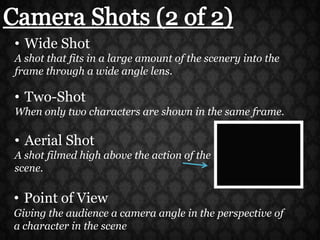
Camera Shots (2 of 2)Wide ShotA shot that fits in a large amount of the scenery into the frame through a wide angle lens.Two-ShotWhen only two characters are shown in the same frame.Aerial ShotA shot filmed high above the action of the scene.Point of View Giving the audience a camera angle in the perspective of a character in the scene
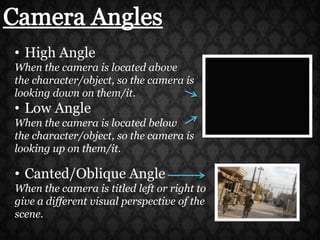
Camera AnglesHigh AngleWhen the camera is located above the character/object, so the camera is looking down on them/it.Low AngleWhen the camera is located below the character/object, so the camera is looking up on them/it.Canted/Oblique AngleWhen the camera is titled left or right to give a different visual perspective of the scene.
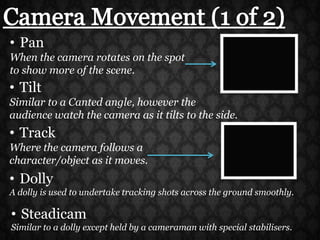
Camera Movement (1 of 2)PanWhen the camera rotates on the spot to show more of the scene.TiltSimilar to a Canted angle, however the audience watch the camera as it tilts to the side.TrackWhere the camera follows a character/object as it moves.DollyA dolly is used to undertake tracking shots across the ground smoothly.SteadicamSimilar to a dolly except held by a cameraman with special stabilisers.
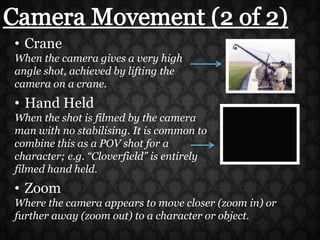
Camera Movement (2 of 2)CraneWhen the camera gives a very high angle shot, achieved by lifting the camera on a crane.Hand HeldWhen the shot is filmed by the camera man with no stabilising. It is common to combine this as a POV shot for a character; e.g. “Cloverfield” is entirely filmed hand held.ZoomWhere the camera appears to move closer (zoom in) or further away (zoom out) to a character or object.
CompositionRule of ThirdsThis is when the screen is separated into imaginary thirds.

Tv Drama Key Vocab

  • 1.
    Media Studies ASTVDramaKey Vocabulary
  • 2.
    Camera Shots, Angle,Movement and Composition
  • 3.
    Camera Shots (1of 2)Establishing ShotA shot that sets the scene of where the action will take placeMaster ShotWhen a scene is filmed from one angle from start to finish.Close UpA shot that zooms in to an object/person to show the action in detail.Mid ShotA shot that zooms to show half of an object/person.Over the ShoulderA shot looking over the top of a character involved
  • 4.
    Camera Shots (2of 2)Wide ShotA shot that fits in a large amount of the scenery into the frame through a wide angle lens.Two-ShotWhen only two characters are shown in the same frame.Aerial ShotA shot filmed high above the action of the scene.Point of View Giving the audience a camera angle in the perspective of a character in the scene
  • 5.
    Camera AnglesHigh AngleWhenthe camera is located above the character/object, so the camera is looking down on them/it.Low AngleWhen the camera is located below the character/object, so the camera is looking up on them/it.Canted/Oblique AngleWhen the camera is titled left or right to give a different visual perspective of the scene.
  • 6.
    Camera Movement (1of 2)PanWhen the camera rotates on the spot to show more of the scene.TiltSimilar to a Canted angle, however the audience watch the camera as it tilts to the side.TrackWhere the camera follows a character/object as it moves.DollyA dolly is used to undertake tracking shots across the ground smoothly.SteadicamSimilar to a dolly except held by a cameraman with special stabilisers.
  • 7.
    Camera Movement (2of 2)CraneWhen the camera gives a very high angle shot, achieved by lifting the camera on a crane.Hand HeldWhen the shot is filmed by the camera man with no stabilising. It is common to combine this as a POV shot for a character; e.g. “Cloverfield” is entirely filmed hand held.ZoomWhere the camera appears to move closer (zoom in) or further away (zoom out) to a character or object.
  • 8.
    CompositionRule of ThirdsThisis when the screen is separated into imaginary thirds.