Ozarks Technical Community College
HIS 125


What is your favorite COLOR?
 This

is an easy question for most people to
answer



Now, what is your favorite SOUND?
 Most

people have to think about this one 

 These

are two wonderful questions to ask your
patients to help them have a greater
appreciation for their hearing
 Because we live in such a visual world, we often
take our other senses for granted


Hearing healthcare professionals often
overlook the PREVENTION of noise-induced
hearing loss



Consider the following:
 Dentists

– encourage you to brush/floss, give out
toothbrushes after each cleaning
 We should be:




encouraging our patient’s to utilize hearing
protection in noisy situations
teaching them how and when to use it


Occupational Safety & Health Administration
 Branch

of the US Department of Labor, which
regulates employee health and safety
 OSHA regulates the use of hearing protection
devices (HPDs) for employees who work around
noise


OSHA determines if hearing protection is
required based on the employees timeweighted average (TWA), which is the
average dB exposure over an 8 hour shift
 This

is done by having employees wear a
dosimeter (a special sound level meter with a
microphone clipped onto the shoulder) to record
the noise exposure during their shift



According to OSHA, employers are required
to provide hearing conservation programs for
employees with a TWA ≥ 85 dBA


Earplugs
Foam
 Premolded
 Formable
 Custom
 Semi-insert





Berger, Chapter 10

Earmuffs
Helmets
Berger, Chapter 10





Foam earplugs provide the greatest
attenuation of all the hearing protection
devices (even more than a custom plug), BUT
most users do not achieve maximum
protection due to improper insertion
technique
When all else fails, put your fingertips in
your ears!
Dual protection (earplugs AND earmuffs) only
provides an extra 5 dB of attenuation
 Dual

protection is recommended when the 8 hr
TWA exceeds 105 dBA


Three steps:
 Roll
 Pinna Pull
 Insert and

Hold



Image from: tinnitus.org/au


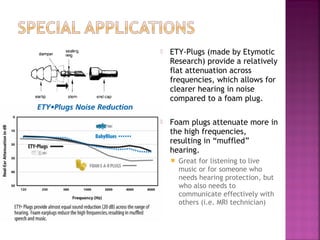
ETY-Plugs (made by Etymotic
Research) provide a relatively
flat attenuation across
frequencies, which allows for
clearer hearing in noise
compared to a foam plug.



Foam plugs attenuate more in
the high frequencies,
resulting in “muffled”
hearing.


Great for listening to live
music or for someone who
needs hearing protection, but
who also needs to
communicate effectively with
others (i.e. MRI technician)



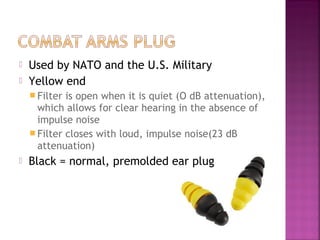
Used by NATO and the U.S. Military
Yellow end
 Filter

is open when it is quiet (O dB attenuation),
which allows for clear hearing in the absence of
impulse noise
 Filter closes with loud, impulse noise(23 dB
attenuation)


Black = normal, premolded ear plug


The risks of NIHL increase depending on:
 The

duration of the noise exposure
 The average dB level
 Peak dB levels


In order to reduce risk of hearing loss:
 Limiting

exposure
 Use of HPDs when exposed


General rule of thumb: if it is loud enough
that you have to shout to speak to someone
within arms reach of you, the level probably
exceeds 85 dBA and could cause hearing loss
if exposure time is long enough






Noise exposure can result in or exacerbate
tinnitus
Individuals with hearing loss are at an
increased risk for additional hearing loss due
to noise exposure
Individuals who are taking ototoxic
medications should be especially careful to
avoid loud noise exposure




In most situations, 10-15 dB of attenuation is
adequate
Always consider the 3 C’s to determine which
type of HPD is appropriate for the individual
 Comfort
 Convenience
 Communication


Earplugs are cheaper than hearing aids!

Hearing Conservation

  • 1.
  • 2.
     What is yourfavorite COLOR?  This is an easy question for most people to answer  Now, what is your favorite SOUND?  Most people have to think about this one   These are two wonderful questions to ask your patients to help them have a greater appreciation for their hearing  Because we live in such a visual world, we often take our other senses for granted
  • 3.
     Hearing healthcare professionalsoften overlook the PREVENTION of noise-induced hearing loss  Consider the following:  Dentists – encourage you to brush/floss, give out toothbrushes after each cleaning  We should be:   encouraging our patient’s to utilize hearing protection in noisy situations teaching them how and when to use it
  • 4.
     Occupational Safety &Health Administration  Branch of the US Department of Labor, which regulates employee health and safety  OSHA regulates the use of hearing protection devices (HPDs) for employees who work around noise
  • 5.
     OSHA determines ifhearing protection is required based on the employees timeweighted average (TWA), which is the average dB exposure over an 8 hour shift  This is done by having employees wear a dosimeter (a special sound level meter with a microphone clipped onto the shoulder) to record the noise exposure during their shift  According to OSHA, employers are required to provide hearing conservation programs for employees with a TWA ≥ 85 dBA
  • 6.
     Earplugs Foam  Premolded  Formable Custom  Semi-insert    Berger, Chapter 10 Earmuffs Helmets
  • 7.
  • 8.
       Foam earplugs providethe greatest attenuation of all the hearing protection devices (even more than a custom plug), BUT most users do not achieve maximum protection due to improper insertion technique When all else fails, put your fingertips in your ears! Dual protection (earplugs AND earmuffs) only provides an extra 5 dB of attenuation  Dual protection is recommended when the 8 hr TWA exceeds 105 dBA
  • 9.
     Three steps:  Roll Pinna Pull  Insert and Hold  Image from: tinnitus.org/au
  • 10.
     ETY-Plugs (made byEtymotic Research) provide a relatively flat attenuation across frequencies, which allows for clearer hearing in noise compared to a foam plug.  Foam plugs attenuate more in the high frequencies, resulting in “muffled” hearing.  Great for listening to live music or for someone who needs hearing protection, but who also needs to communicate effectively with others (i.e. MRI technician)
  • 11.
      Used by NATOand the U.S. Military Yellow end  Filter is open when it is quiet (O dB attenuation), which allows for clear hearing in the absence of impulse noise  Filter closes with loud, impulse noise(23 dB attenuation)  Black = normal, premolded ear plug
  • 12.
     The risks ofNIHL increase depending on:  The duration of the noise exposure  The average dB level  Peak dB levels  In order to reduce risk of hearing loss:  Limiting exposure  Use of HPDs when exposed  General rule of thumb: if it is loud enough that you have to shout to speak to someone within arms reach of you, the level probably exceeds 85 dBA and could cause hearing loss if exposure time is long enough
  • 13.
       Noise exposure canresult in or exacerbate tinnitus Individuals with hearing loss are at an increased risk for additional hearing loss due to noise exposure Individuals who are taking ototoxic medications should be especially careful to avoid loud noise exposure
  • 14.
      In most situations,10-15 dB of attenuation is adequate Always consider the 3 C’s to determine which type of HPD is appropriate for the individual  Comfort  Convenience  Communication
  • 15.
     Earplugs are cheaperthan hearing aids!