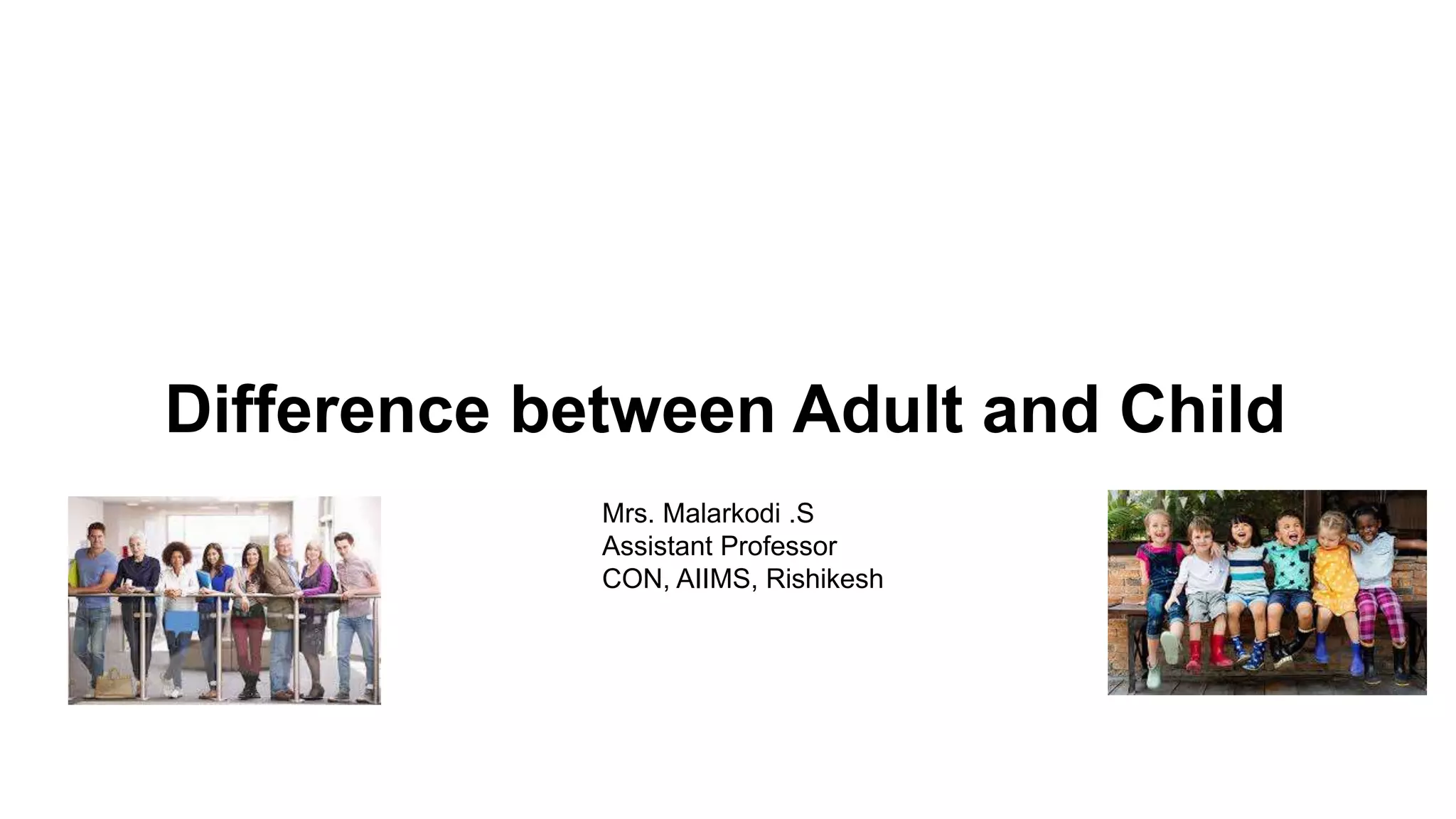
Difference between Adult and Child
Mrs. Malarkodi .S
Assistant Professor
CON, AIIMS, Rishikesh
Major Aspects of differences
• Physiological
• Psychological
• Social
• Immunological
Physiological Differences
• Size – size of the child differs according to the age
Significance need of various sized cots/ beds in the pediatric unit
• Head is comparatively large than the body for the newborn baby
Preventing heat loss, weight loss, thermo-neutral environment while caring is
significant
• Immaturity and inadequate ossification
Prone for injuries
• Sutures and skull is not united
Contd .,
• Fontanels are not closed
• Shape of the head and chest can be altered by constant
pressure from lying in one position
• Muscles are 25% of weight in infants and it is 40% adult
Mouth
• Infants tongue is large
• Nasal and oral airway passages are relatively small making the
baby more prone to airway obstruction
• Nose breathers till 6 months of age. (results in breathing
difficulty in respiratory infectious)
EYES
• No tears in early infancy – due to poor functional development of
lacrimal gland
• Eustachian Tube :
• It is short and straight in children (10 o in children and 40 o in adults)
• Air sinuses are not fully developed
• Sore throat extends to otitis media because of the closeness of it to
throat
Contd .,
• Excretion
• By utilizing energy substrate for the process of growth, the load
presented to the excretory pathway is decreased
Physiological Differences
Absolute measurements
• Rapid loss of ml of blood by a newborn baby represents 10% of
blood volume
• This much loss can lead to circulatory failure
Contd.,
Basal Metabolic Rate (BMR)
• BMR is high in newborn
• In neonate – 6-8 ml of oxygen/kg/min is normal whereas 2-4 ml
of oxygen/kg/min is normal in adults
• Increased CO2 due to more metabolic rate
Contd.,
Temperature Regulation
• Poor thermos regulation is attributed to immaturity of the
hypothalamus
• Shivering and sweating mechanisms are absent in newborn
Contd.,
Brown adipose tissue in newborn:
• Reserve of brown fat from which heat can be liberated by non
shivering thermogenesis
• Once used brown fat cannot be replaced
Contd.,
Voluntary Control
• No voluntary control over the environment or activity e.g., On
cold day adult used to wear socks, woollen clothes etc, but the
child depends on the care takers.
Contd.,
Proportion of water
• ICF – Less
• ECF – More double than the adults
• Easily Fluctuates during the GI infections
Contd.,
Blood Volume
• Neonate – 85ml/kg of Body Weight
• Adult 60-70ml.kg of Body Weight
Contd.,
Glomerular Filtration Rate
• Concentration of urine in new born is 800 mOsmol/L whereas in adults it
is 1400 mOsmol/L
• GFR and tubular functions are lower in neonates than adult because
low blood supply to kidney, smaller pore size and less filtration power
across nephron
• GFR – 38 ml/ min (Neonate)
• GFR – 125 ml/min (Adult)
Contd.,
Alimentary Tract
• Water absorption is poor – faeces of the child is watery
• Dehydration leads to circulatory failure within 24 hrs if treatment
is inadequate
Contd.,
Cardio Vascular System
• Change from fetal to normal circulation
• Heart rate is more in children
• Newborn – 110-160 beats/min
• Normal Circulation (Adult) – Fetal Circulation (Fetus)
Contd.,
Respiration
Respiratory Rate is 35-40 breaths/ Min
Hepatic function
Immature – Physiological Jaundice
Production of albumin, clotting factors and vitamin K are less
Iron Reserves is less
Contd.,
Hepatic Function
• Immature – Physiological Jaundice
• Production of albumin, clotting factors and vitamin K are less
• Iron reserve is less
Contd.,
• Central Nervous System
• 90% of brain growth takes place by 2 years of age
• Nerve endings in the retina (rods and cones) are not fully
developed. Thus the images are blurred and colorless for few
weeks
PHYSIOLOGICAL DIFFERENCES
• Fear, escape and avoid strangers till 5 years of age. Explore the
environment.
• Infancy – more bonding with parents, separation anxiety is very common
• Toddlers – Negativistic behaviors
• Pre schooler – Short attention span, easily distractible
• Adolescents – Identity of peer, confusion
Contd.,
• Children have a proportionately larger BSA Body Surface Area than
adults. The smaller the patient, the greater the ratio of surface area
to size.
• Thinner Skin than Adults
• Epidermis is thinner and under keratinized
• Risk for increased absorption of agents that can be absorbed
through skin
Contd.,
• Higher Respiratory rate  Higher minute volumes
• More susceptible to agents absorbed through the pulmonary
route
• Shorter than adults – breathing zone is lower to the ground –
agents which can be aerosolized are heavier than air
Contd.,
• Immature BBB Blood Brain Barrier and enhanced CNS
receptivity
• May exhibit a prevalence of neurological symptoms
• More Prone for dehydration - exposure to chemical agents and
biological agents leads to vomiting and diarrhea
• More symptomatic and earlier presentation of signs
Contd.,
• Higher proportion of rapidly growing tissues  more prone to
ionizing radiation and other agents that affect rapidly growing
tissue
• Relatively small airways  smaller the caliber of the airway, the
greater the reduction in airflow as a result of increased
Pulmonary secretions that occur following exposure to
chemicals or edema from inhalation of hot gases
Contd.,
•  children will suffer more pulmonary pathology than adult at
the same level of exposure
• Vascular access in the children can be difficult
• Errors in treatment administration  dosing, route etc
Drug Dosage
• Excessive IV fluids and medications easily causes pedal edema
• Hence flow rate should be titrated cautiously
• Dosage calculation of drug is also necessary
Contd.,
Trachea
• Short and narrow trachea under 5 years – susceptible for
foreign body aspiration
• GI Tract
• In children cardiac sphincter of the stomach is relaxed
• Vomiting is so frequent, hence proper positioning of the child
during feed is so important
• Poor protection of the liver and spleen – prone for trauma
References
• Assuma Beevi (2009). Concise Textbook of Pediatric Nursing. 2nd Edition.
Elsevier Publication
• OP Ghai (2013) Essentials of Pediatrics. 8th Edition. CBS Publishers and
distributors.
• Datta Parul (2010). Paediatric Nursing. 3rd Edition. JAYPEE publication

Difference between Adult and Child.pptx

  • 1.
    Difference between Adultand Child Mrs. Malarkodi .S Assistant Professor CON, AIIMS, Rishikesh
  • 2.
    Major Aspects ofdifferences • Physiological • Psychological • Social • Immunological
  • 3.
    Physiological Differences • Size– size of the child differs according to the age Significance need of various sized cots/ beds in the pediatric unit • Head is comparatively large than the body for the newborn baby Preventing heat loss, weight loss, thermo-neutral environment while caring is significant • Immaturity and inadequate ossification Prone for injuries • Sutures and skull is not united
  • 4.
    Contd ., • Fontanelsare not closed • Shape of the head and chest can be altered by constant pressure from lying in one position • Muscles are 25% of weight in infants and it is 40% adult
  • 5.
    Mouth • Infants tongueis large • Nasal and oral airway passages are relatively small making the baby more prone to airway obstruction • Nose breathers till 6 months of age. (results in breathing difficulty in respiratory infectious)
  • 6.
    EYES • No tearsin early infancy – due to poor functional development of lacrimal gland • Eustachian Tube : • It is short and straight in children (10 o in children and 40 o in adults) • Air sinuses are not fully developed • Sore throat extends to otitis media because of the closeness of it to throat
  • 7.
    Contd ., • Excretion •By utilizing energy substrate for the process of growth, the load presented to the excretory pathway is decreased
  • 8.
    Physiological Differences Absolute measurements •Rapid loss of ml of blood by a newborn baby represents 10% of blood volume • This much loss can lead to circulatory failure
  • 9.
    Contd., Basal Metabolic Rate(BMR) • BMR is high in newborn • In neonate – 6-8 ml of oxygen/kg/min is normal whereas 2-4 ml of oxygen/kg/min is normal in adults • Increased CO2 due to more metabolic rate
  • 10.
    Contd., Temperature Regulation • Poorthermos regulation is attributed to immaturity of the hypothalamus • Shivering and sweating mechanisms are absent in newborn
  • 11.
    Contd., Brown adipose tissuein newborn: • Reserve of brown fat from which heat can be liberated by non shivering thermogenesis • Once used brown fat cannot be replaced
  • 12.
    Contd., Voluntary Control • Novoluntary control over the environment or activity e.g., On cold day adult used to wear socks, woollen clothes etc, but the child depends on the care takers.
  • 13.
    Contd., Proportion of water •ICF – Less • ECF – More double than the adults • Easily Fluctuates during the GI infections
  • 14.
    Contd., Blood Volume • Neonate– 85ml/kg of Body Weight • Adult 60-70ml.kg of Body Weight
  • 15.
    Contd., Glomerular Filtration Rate •Concentration of urine in new born is 800 mOsmol/L whereas in adults it is 1400 mOsmol/L • GFR and tubular functions are lower in neonates than adult because low blood supply to kidney, smaller pore size and less filtration power across nephron • GFR – 38 ml/ min (Neonate) • GFR – 125 ml/min (Adult)
  • 16.
    Contd., Alimentary Tract • Waterabsorption is poor – faeces of the child is watery • Dehydration leads to circulatory failure within 24 hrs if treatment is inadequate
  • 17.
    Contd., Cardio Vascular System •Change from fetal to normal circulation • Heart rate is more in children • Newborn – 110-160 beats/min • Normal Circulation (Adult) – Fetal Circulation (Fetus)
  • 18.
    Contd., Respiration Respiratory Rate is35-40 breaths/ Min Hepatic function Immature – Physiological Jaundice Production of albumin, clotting factors and vitamin K are less Iron Reserves is less
  • 19.
    Contd., Hepatic Function • Immature– Physiological Jaundice • Production of albumin, clotting factors and vitamin K are less • Iron reserve is less
  • 20.
    Contd., • Central NervousSystem • 90% of brain growth takes place by 2 years of age • Nerve endings in the retina (rods and cones) are not fully developed. Thus the images are blurred and colorless for few weeks
  • 21.
    PHYSIOLOGICAL DIFFERENCES • Fear,escape and avoid strangers till 5 years of age. Explore the environment. • Infancy – more bonding with parents, separation anxiety is very common • Toddlers – Negativistic behaviors • Pre schooler – Short attention span, easily distractible • Adolescents – Identity of peer, confusion
  • 22.
    Contd., • Children havea proportionately larger BSA Body Surface Area than adults. The smaller the patient, the greater the ratio of surface area to size. • Thinner Skin than Adults • Epidermis is thinner and under keratinized • Risk for increased absorption of agents that can be absorbed through skin
  • 23.
    Contd., • Higher Respiratoryrate  Higher minute volumes • More susceptible to agents absorbed through the pulmonary route • Shorter than adults – breathing zone is lower to the ground – agents which can be aerosolized are heavier than air
  • 24.
    Contd., • Immature BBBBlood Brain Barrier and enhanced CNS receptivity • May exhibit a prevalence of neurological symptoms • More Prone for dehydration - exposure to chemical agents and biological agents leads to vomiting and diarrhea • More symptomatic and earlier presentation of signs
  • 25.
    Contd., • Higher proportionof rapidly growing tissues  more prone to ionizing radiation and other agents that affect rapidly growing tissue • Relatively small airways  smaller the caliber of the airway, the greater the reduction in airflow as a result of increased Pulmonary secretions that occur following exposure to chemicals or edema from inhalation of hot gases
  • 26.
    Contd., •  childrenwill suffer more pulmonary pathology than adult at the same level of exposure • Vascular access in the children can be difficult • Errors in treatment administration  dosing, route etc
  • 27.
    Drug Dosage • ExcessiveIV fluids and medications easily causes pedal edema • Hence flow rate should be titrated cautiously • Dosage calculation of drug is also necessary
  • 28.
    Contd., Trachea • Short andnarrow trachea under 5 years – susceptible for foreign body aspiration • GI Tract • In children cardiac sphincter of the stomach is relaxed • Vomiting is so frequent, hence proper positioning of the child during feed is so important • Poor protection of the liver and spleen – prone for trauma
  • 29.
    References • Assuma Beevi(2009). Concise Textbook of Pediatric Nursing. 2nd Edition. Elsevier Publication • OP Ghai (2013) Essentials of Pediatrics. 8th Edition. CBS Publishers and distributors. • Datta Parul (2010). Paediatric Nursing. 3rd Edition. JAYPEE publication