Presented By:-
Rashi
Bsc(Hons.) Nursing 3rd
year
Batch-2017
In Guidance Of:-
Mrs. Malar Kodi
Assistant professor,
AIIMS, Rishikesh
CONTENT
 Introduction
 Epidemiology
 Protein Energy Malnutrition
• Kwashiorkor
• Marasmus
 Vitamin C deficiency
• Scurvy
 Management
 Prevention
Enter title
Introduction
 An inadequate supply of essential
nutrients (as vitamins and minerals)
in the diet resulting in malnutrition or
disease.
 In India many children are suffering
with nutritional disorders. 2 million
children affected by nutritional
deficiency in every year.
FACTORS AFFECTING NUTRITIONAL
STATUS OF CHILD
 Nutritional intake of the child
 Health status
 Child feeding practice
 Food demand
 Family income/ Occupation
 Education of Mother etc.
Enter title
Epidemiology
 Global burden- more prevalent in
developing countries. "Often starts
in the womb and ends in the
tomb."
 1.9 billion adults are overweight or obese,
while 462 million are underweight.
 47 million children under 5 years of age are
wasted, 14.3 million are severely wasted and
144 million are stunted, while 38.3 million are
overweight or obese.
 Around 45% of deaths among children under 5
years of age are linked to undernutrition
WORLD SCENARIO
INDIAN SCENARIO
 Malnutrition caused 69 per cent of deaths of
children below the age of five in India,
according to a UNICEF
 The State of the World's Children 2019,
UNICEF said that every second child in that
age group is affected by some form of
malnutrition.
Enter title
Protein Energy Malnutrition
 Range of pathological conditions
arising from lack, in varying
proportions , of protein and calories.
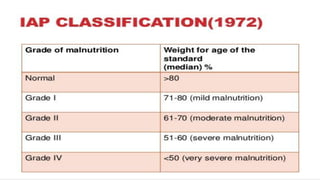
• Marasmus: weight for age < 60%
expected
• Kwashiorkor: weight for age < 80% +
edema
• Marasmic kwashiorkor: wt/age <60%
+ edema
Enter title
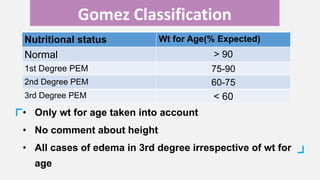
• Only wt for age taken into account
• No comment about height
• All cases of edema in 3rd degree irrespective of wt for
age
Gomez Classification
Nutritional status Wt for Age(% Expected)
Normal > 90
1st Degree PEM 75-90
2nd Degree PEM 60-75
3rd Degree PEM < 60
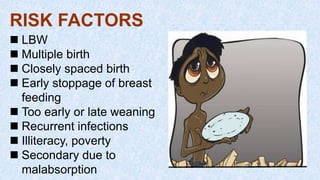
RISK FACTORS
 LBW
 Multiple birth
 Closely spaced birth
 Early stoppage of breast
feeding
 Too early or late weaning
 Recurrent infections
 Illiteracy, poverty
 Secondary due to
malabsorption
Enter title
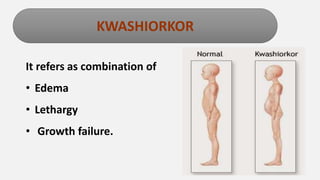
It refers as combination of
• Edema
• Lethargy
• Growth failure.
KWASHIORKOR
ETIOLOGY
 Non availability of suitable protein -rich
foods.
 Faulty feeding habits.
 Prolonged breast feeding.
 Infection and infestation
 Sudden loss of protein
 Seasonal incidence-July - august.
 Size of the family.
Enter title
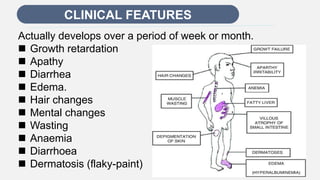
CLINICAL FEATURES
Actually develops over a period of week or month.
 Growth retardation
 Apathy
 Diarrhea
 Edema.
 Hair changes
 Mental changes
 Wasting
 Anaemia
 Diarrhoea
 Dermatosis (flaky-paint)
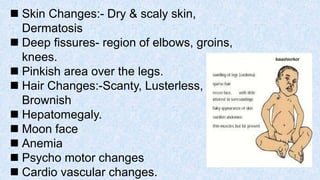
 Skin Changes:- Dry & scaly skin,
Dermatosis
 Deep fissures- region of elbows, groins,
knees.
 Pinkish area over the legs.
 Hair Changes:-Scanty, Lusterless,
Brownish
 Hepatomegaly.
 Moon face
 Anemia
 Psycho motor changes
 Cardio vascular changes.
 Bio chemical changes:
• Reduced serum protein (less than 1.5g)
• Blood cholesterol reduced, low serum iron
and copper.
• Decreased water and electrolytes
Enter title
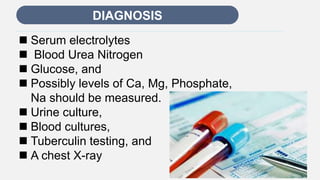
 Serum electrolytes
 Blood Urea Nitrogen
 Glucose, and
 Possibly levels of Ca, Mg, Phosphate,
Na should be measured.
 Urine culture,
 Blood cultures,
 Tuberculin testing, and
 A chest X-ray
DIAGNOSIS
Enter title
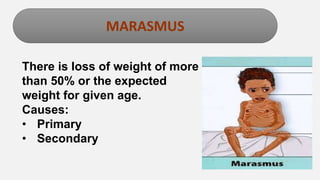
MARASMUS
There is loss of weight of more
than 50% or the expected
weight for given age.
Causes:
• Primary
• Secondary
 Primary:
• Artificial fed babies with over diluted
formula.
• Infection
• Poor socio economic background.
 Secondary:
• Chronic vomiting
• Chronic diarrhea
• Congenital disease Serious organic
disorders of heart, brain, kidney.
• Metabolic disorders.
Enter title
CLASSIFICATION
Grade 1: Wasting starts in axilla & groin
Grade 2: Wasting extended to thigh and buttocks
Grade 3: Chest and abdomen
Grade 4 : Wasting of buccal pad of fat also
Enter title
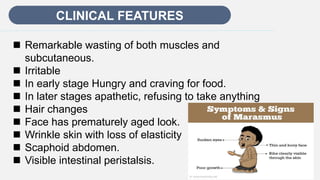
CLINICAL FEATURES
 Remarkable wasting of both muscles and
subcutaneous.
 Irritable
 In early stage Hungry and craving for food.
 In later stages apathetic, refusing to take anything
 Hair changes
 Face has prematurely aged look.
 Wrinkle skin with loss of elasticity
 Scaphoid abdomen.
 Visible intestinal peristalsis.
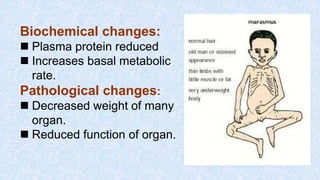
Biochemical changes:
 Plasma protein reduced
 Increases basal metabolic
rate.
Pathological changes:
 Decreased weight of many
organ.
 Reduced function of organ.
Enter titleDIAGNOSIS
 Care dietetic history of
the infant.
 Physical examination
 Lab investigation
 X-ray
Enter title
TREATMENT
Principles:
 Liberal protein must be offered.
 Carbohydrates and fat must also be supplied.
 Take care of their total calorie needs
 Treat underlying causes.
Enter title
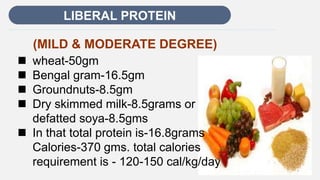
LIBERAL PROTEIN
(MILD & MODERATE DEGREE)
 wheat-50gm
 Bengal gram-16.5gm
 Groundnuts-8.5gm
 Dry skimmed milk-8.5grams or
defatted soya-8.5gms
 In that total protein is-16.8grams
Calories-370 gms. total calories
requirement is - 120-150 cal/kg/day
Enter title
CONTINUED
(FOR SEVERE DEGREE)
 Hospitalization
 Parenteral therapy
 N.G tube feeding (2-3gms/kg)
 Control the infection
 Correction of metabolic derangement and
deficiencies
Enter title
MANAGEMENT
Mild and moderate malnutrition
 Mainstay of treatment is to give
adequate amounts of protein and
energy.
 At Least 150 kcal/kg/day, protein
intake of 3g/kg/day.
 Best measure of efficacy of the
treatment is weight gain.
Enter title
Enter title
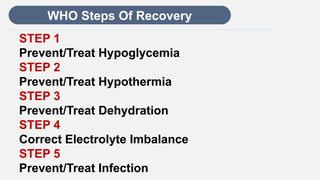
WHO Steps Of Recovery
STEP 1
Prevent/Treat Hypoglycemia
STEP 2
Prevent/Treat Hypothermia
STEP 3
Prevent/Treat Dehydration
STEP 4
Correct Electrolyte Imbalance
STEP 5
Prevent/Treat Infection
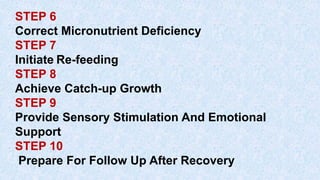
STEP 6
Correct Micronutrient Deficiency
STEP 7
Initiate Re-feeding
STEP 8
Achieve Catch-up Growth
STEP 9
Provide Sensory Stimulation And Emotional
Support
STEP 10
Prepare For Follow Up After Recovery
Enter title
VITAMIN C DEFICIENCY
Disease result from severe vitamin
C deficiency:
 Scurvy
 Cardiovascular Disease
 Stroke
 Cataract
 Lead toxicity
Enter title
SCURVY
ETIOLOGY:-
 Diet lacking in vitamin C-rich foods
 Destruction of vitamin C in foods by
overexposure to air or by overcooking
 PEM
 Malabsorption
 Artificial feeding
 Illness and infection
 Daily requirement 40 mg/ kg/day
Enter title
CLINICAL FEATURES
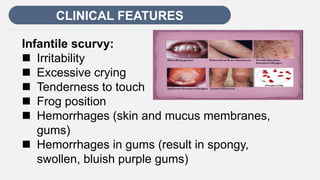
Infantile scurvy:
 Irritability
 Excessive crying
 Tenderness to touch
 Frog position
 Hemorrhages (skin and mucus membranes,
gums)
 Hemorrhages in gums (result in spongy,
swollen, bluish purple gums)
Enter title
CONTINUED
Childhood scurvy:
 Minute hemorrhages at the root of the hair
 Follicles.
 Bleeding to skin leads to petechiae or large
purpuric swelling, gums
Enter titleDIAGNOSIS
 History Collection
 Physical Examination
 Ascorbic Acid level in the serum usually less
than 0.1 mg/100 ml
 Excretion Ascorbic acid
 X ray
Enter title
TREATMENT
 Administer 500mg of single dose of
vit c Followed by daily dose of 100
to 300 mg for several week.
 Vitamin c rich diet
Enter title
SPECIAL CONSIDERATION
HOSPITAL
 Administer ascorbic acid orally or by slow I.V. infusion, as
ordered.
 Avoid moving the child unnecessarily, to avoid irritating
painful joints and muscles.
 Encourage child to drink orange juice.
 Explain the importance of supplemental ascorbic acid.
 Counsel the child and family about good dietary sources of
vitamin C.
 Advise against taking too much vitamin C.
 Explain that excessive doses of ascorbic acid may cause
nausea, diarrhea, and renal calculi formation and may also
interfere with anticoagulant therapy.
PREVENTION
At national level
1. Nutrition supplementation - Fortification,
iodination
2. Nutritional surveillance- define the character
and magnitude of nutritional problems and
strategies to tackle.
3. Nutritional planning- formulation of nutrition
policy, improve food production and supplies,
ensure distribution.
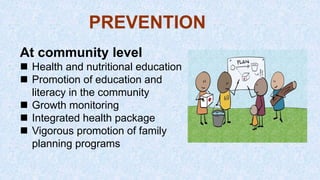
At community level
 Health and nutritional education
 Promotion of education and
literacy in the community
 Growth monitoring
 Integrated health package
 Vigorous promotion of family
planning programs
PREVENTION
Enter title
PREVENTION
At family level
 Exclusive breast feeding
 Complementary feeds at 6
months
 Vaccination
 Spacing between
pregnancies
GOVT INITIATIVE TO PREVENT
MALNUTRITION
 National Rural Health Mission Of India
 Mid-day meal Scheme
 Integrated Child Development Scheme
 National Children's Fund
 United Nations Children's Fund
REFERENCE
S
 1. Paul Vinod, Bagaa Arvind. Ghai Essential
Pediatrics: Nutrition.8th Edition.New Delhi:CBS
publishers,2013
 2. Datta Parul. Pediatric Nursing: Nutritionl
Deficiency Disorder. 3rd Edition. New
Delhi:Jaypee,2014
 3. Healthline. Nutritional Deficiencies: Symptoms
and Treatment[online].2018(cited 2020 May 28).
Available from:
www.healthline.com/health/malnutrition
THANK YOU

Nutritional_Deficiency_Disorder rashi.pptx

  • 1.
    Presented By:- Rashi Bsc(Hons.) Nursing3rd year Batch-2017 In Guidance Of:- Mrs. Malar Kodi Assistant professor, AIIMS, Rishikesh
  • 2.
    CONTENT  Introduction  Epidemiology Protein Energy Malnutrition • Kwashiorkor • Marasmus  Vitamin C deficiency • Scurvy  Management  Prevention
  • 3.
    Enter title Introduction  Aninadequate supply of essential nutrients (as vitamins and minerals) in the diet resulting in malnutrition or disease.  In India many children are suffering with nutritional disorders. 2 million children affected by nutritional deficiency in every year.
  • 4.
    FACTORS AFFECTING NUTRITIONAL STATUSOF CHILD  Nutritional intake of the child  Health status  Child feeding practice  Food demand  Family income/ Occupation  Education of Mother etc.
  • 5.
    Enter title Epidemiology  Globalburden- more prevalent in developing countries. "Often starts in the womb and ends in the tomb."
  • 6.
     1.9 billionadults are overweight or obese, while 462 million are underweight.  47 million children under 5 years of age are wasted, 14.3 million are severely wasted and 144 million are stunted, while 38.3 million are overweight or obese.  Around 45% of deaths among children under 5 years of age are linked to undernutrition WORLD SCENARIO
  • 7.
    INDIAN SCENARIO  Malnutritioncaused 69 per cent of deaths of children below the age of five in India, according to a UNICEF  The State of the World's Children 2019, UNICEF said that every second child in that age group is affected by some form of malnutrition.
  • 8.
    Enter title Protein EnergyMalnutrition  Range of pathological conditions arising from lack, in varying proportions , of protein and calories. • Marasmus: weight for age < 60% expected • Kwashiorkor: weight for age < 80% + edema • Marasmic kwashiorkor: wt/age <60% + edema
  • 9.
    Enter title • Onlywt for age taken into account • No comment about height • All cases of edema in 3rd degree irrespective of wt for age Gomez Classification Nutritional status Wt for Age(% Expected) Normal > 90 1st Degree PEM 75-90 2nd Degree PEM 60-75 3rd Degree PEM < 60
  • 11.
    RISK FACTORS  LBW Multiple birth  Closely spaced birth  Early stoppage of breast feeding  Too early or late weaning  Recurrent infections  Illiteracy, poverty  Secondary due to malabsorption
  • 12.
    Enter title It refersas combination of • Edema • Lethargy • Growth failure. KWASHIORKOR
  • 13.
    ETIOLOGY  Non availabilityof suitable protein -rich foods.  Faulty feeding habits.  Prolonged breast feeding.  Infection and infestation  Sudden loss of protein  Seasonal incidence-July - august.  Size of the family.
  • 14.
    Enter title CLINICAL FEATURES Actuallydevelops over a period of week or month.  Growth retardation  Apathy  Diarrhea  Edema.  Hair changes  Mental changes  Wasting  Anaemia  Diarrhoea  Dermatosis (flaky-paint)
  • 15.
     Skin Changes:-Dry & scaly skin, Dermatosis  Deep fissures- region of elbows, groins, knees.  Pinkish area over the legs.  Hair Changes:-Scanty, Lusterless, Brownish  Hepatomegaly.  Moon face  Anemia  Psycho motor changes  Cardio vascular changes.
  • 16.
     Bio chemicalchanges: • Reduced serum protein (less than 1.5g) • Blood cholesterol reduced, low serum iron and copper. • Decreased water and electrolytes
  • 17.
    Enter title  Serumelectrolytes  Blood Urea Nitrogen  Glucose, and  Possibly levels of Ca, Mg, Phosphate, Na should be measured.  Urine culture,  Blood cultures,  Tuberculin testing, and  A chest X-ray DIAGNOSIS
  • 18.
    Enter title MARASMUS There isloss of weight of more than 50% or the expected weight for given age. Causes: • Primary • Secondary
  • 19.
     Primary: • Artificialfed babies with over diluted formula. • Infection • Poor socio economic background.  Secondary: • Chronic vomiting • Chronic diarrhea • Congenital disease Serious organic disorders of heart, brain, kidney. • Metabolic disorders.
  • 20.
    Enter title CLASSIFICATION Grade 1:Wasting starts in axilla & groin Grade 2: Wasting extended to thigh and buttocks Grade 3: Chest and abdomen Grade 4 : Wasting of buccal pad of fat also
  • 21.
    Enter title CLINICAL FEATURES Remarkable wasting of both muscles and subcutaneous.  Irritable  In early stage Hungry and craving for food.  In later stages apathetic, refusing to take anything  Hair changes  Face has prematurely aged look.  Wrinkle skin with loss of elasticity  Scaphoid abdomen.  Visible intestinal peristalsis.
  • 22.
    Biochemical changes:  Plasmaprotein reduced  Increases basal metabolic rate. Pathological changes:  Decreased weight of many organ.  Reduced function of organ.
  • 23.
    Enter titleDIAGNOSIS  Caredietetic history of the infant.  Physical examination  Lab investigation  X-ray
  • 24.
    Enter title TREATMENT Principles:  Liberalprotein must be offered.  Carbohydrates and fat must also be supplied.  Take care of their total calorie needs  Treat underlying causes.
  • 25.
    Enter title LIBERAL PROTEIN (MILD& MODERATE DEGREE)  wheat-50gm  Bengal gram-16.5gm  Groundnuts-8.5gm  Dry skimmed milk-8.5grams or defatted soya-8.5gms  In that total protein is-16.8grams Calories-370 gms. total calories requirement is - 120-150 cal/kg/day
  • 26.
    Enter title CONTINUED (FOR SEVEREDEGREE)  Hospitalization  Parenteral therapy  N.G tube feeding (2-3gms/kg)  Control the infection  Correction of metabolic derangement and deficiencies
  • 27.
    Enter title MANAGEMENT Mild andmoderate malnutrition  Mainstay of treatment is to give adequate amounts of protein and energy.  At Least 150 kcal/kg/day, protein intake of 3g/kg/day.  Best measure of efficacy of the treatment is weight gain.
  • 28.
  • 29.
    Enter title WHO StepsOf Recovery STEP 1 Prevent/Treat Hypoglycemia STEP 2 Prevent/Treat Hypothermia STEP 3 Prevent/Treat Dehydration STEP 4 Correct Electrolyte Imbalance STEP 5 Prevent/Treat Infection
  • 30.
    STEP 6 Correct MicronutrientDeficiency STEP 7 Initiate Re-feeding STEP 8 Achieve Catch-up Growth STEP 9 Provide Sensory Stimulation And Emotional Support STEP 10 Prepare For Follow Up After Recovery
  • 31.
    Enter title VITAMIN CDEFICIENCY Disease result from severe vitamin C deficiency:  Scurvy  Cardiovascular Disease  Stroke  Cataract  Lead toxicity
  • 32.
    Enter title SCURVY ETIOLOGY:-  Dietlacking in vitamin C-rich foods  Destruction of vitamin C in foods by overexposure to air or by overcooking  PEM  Malabsorption  Artificial feeding  Illness and infection  Daily requirement 40 mg/ kg/day
  • 33.
    Enter title CLINICAL FEATURES Infantilescurvy:  Irritability  Excessive crying  Tenderness to touch  Frog position  Hemorrhages (skin and mucus membranes, gums)  Hemorrhages in gums (result in spongy, swollen, bluish purple gums)
  • 34.
    Enter title CONTINUED Childhood scurvy: Minute hemorrhages at the root of the hair  Follicles.  Bleeding to skin leads to petechiae or large purpuric swelling, gums
  • 35.
    Enter titleDIAGNOSIS  HistoryCollection  Physical Examination  Ascorbic Acid level in the serum usually less than 0.1 mg/100 ml  Excretion Ascorbic acid  X ray
  • 36.
    Enter title TREATMENT  Administer500mg of single dose of vit c Followed by daily dose of 100 to 300 mg for several week.  Vitamin c rich diet
  • 37.
    Enter title SPECIAL CONSIDERATION HOSPITAL Administer ascorbic acid orally or by slow I.V. infusion, as ordered.  Avoid moving the child unnecessarily, to avoid irritating painful joints and muscles.  Encourage child to drink orange juice.  Explain the importance of supplemental ascorbic acid.  Counsel the child and family about good dietary sources of vitamin C.  Advise against taking too much vitamin C.  Explain that excessive doses of ascorbic acid may cause nausea, diarrhea, and renal calculi formation and may also interfere with anticoagulant therapy.
  • 38.
    PREVENTION At national level 1.Nutrition supplementation - Fortification, iodination 2. Nutritional surveillance- define the character and magnitude of nutritional problems and strategies to tackle. 3. Nutritional planning- formulation of nutrition policy, improve food production and supplies, ensure distribution.
  • 39.
    At community level Health and nutritional education  Promotion of education and literacy in the community  Growth monitoring  Integrated health package  Vigorous promotion of family planning programs PREVENTION
  • 40.
    Enter title PREVENTION At familylevel  Exclusive breast feeding  Complementary feeds at 6 months  Vaccination  Spacing between pregnancies
  • 41.
    GOVT INITIATIVE TOPREVENT MALNUTRITION  National Rural Health Mission Of India  Mid-day meal Scheme  Integrated Child Development Scheme  National Children's Fund  United Nations Children's Fund
  • 42.
    REFERENCE S  1. PaulVinod, Bagaa Arvind. Ghai Essential Pediatrics: Nutrition.8th Edition.New Delhi:CBS publishers,2013  2. Datta Parul. Pediatric Nursing: Nutritionl Deficiency Disorder. 3rd Edition. New Delhi:Jaypee,2014  3. Healthline. Nutritional Deficiencies: Symptoms and Treatment[online].2018(cited 2020 May 28). Available from: www.healthline.com/health/malnutrition
  • 43.