The Need to
Supplement Your Diet
A Guide for Vitamins, Herbs, Minerals, and other Dietary Supplements
By David Terrill
• This information is not intended for medical
purposes. Please consult a physician or
registered dietitian for more information.
Key Points
• What dietary supplements are
• Why you might need to supplement your diet
• When you wouldn't need to supplement your diet
• Where to get supplements
• Where to learn more about supplements
• Resources
What are Dietary
Supplements?
Dietary supplements are products that are
intended to supplement the diet, contain
one or more dietary ingredients (including
vitamins, minerals, herbs or other
botanicals, amino acids, and other
substances), are intended to be taken by
mouth (a pill, capsule, tablet, or liquid),
and are labeled on the front as being
dietary supplements (NIH, 2011).
When You Would Need to Supplement
Your Diet
When You Don't Need to Supplement
Your Diet
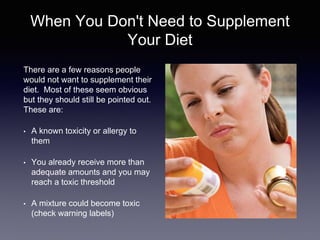
There are a few reasons people
would not want to supplement their
diet. Most of these seem obvious
but they should still be pointed out.
These are:
• A known toxicity or allergy to
them
• You already receive more than
adequate amounts and you may
reach a toxic threshold
• A mixture could become toxic
(check warning labels)
Where to Get Your Supplements
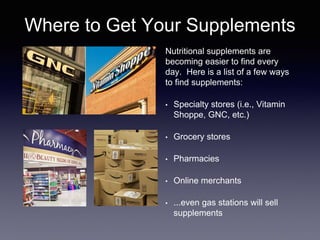
Nutritional supplements are
becoming easier to find every
day. Here is a list of a few ways
to find supplements:
• Specialty stores (i.e., Vitamin
Shoppe, GNC, etc.)
• Grocery stores
• Pharmacies
• Online merchants
• ...even gas stations will sell
supplements
Where to Learn More About Supplements
Dietary supplements are more popular than ever. This also means that there is
also a lot of information out there which, at times, can be confusing or even
contradicting. Before taking anything you are unsure about, it is important that you
find credible information. If you are unable to consult a physician or nutritionalist,
you can find information on credible websites such as:
• The National Center for Complimentary and Integrative Health (formerly
National Center for Complimentary and Alternative Medicine) is s the
Federal Government's lead agency for scientific research on the diverse
medical and health care systems, practices, and products that are not
generally considered part of conventional medicine (NCCIH, 2015)
https://nccih.nih.gov/#
• The Office of Dietary Supplements is another department of the NIH that
offers specific information about specific dietary supplements, maintaining
up to date health and warning information. https://ods.od.nih.gov
Summary
• Remember that dietary supplements and designed to
supplement your diet with what you are deficient of.
• Dietary supplements can be toxic or become toxic if taken in
excess
• Dietary supplements are readily available from many places.
• There are many places to find information about dietary
supplements but be sure it comes from reputable sources.
• This information is not intended for medical purposes. Please
consult a physician or registered dietitian for more information.
Photo Credits
• Slide 1: top.me. 2015. Retrieved from http://www.top.me/strength/best-strength-boosting-and-
muscle-building-supplements-195.html
• Slide 4: Passionate About Food. May 28, 2014. Retrieved from
http://www.passionateaboutfood.net/7-dangerous-dietary-supplements-that-could-jeopardize-your-
health/
• Slide 5: Agency for Healthcare Research and Quality. April 10, 2013. Retrieved from
http://effectivehealthcare.ahrq.gov/index.cfm/search-for-guides-reviews-and-
reports/?productid=1455&pageaction=displayproduct
• Slide 6: CNBC. September 2, 2014. Retrieved from http://www.cnbc.com/2014/09/02/cramer-
should-gnc-acquire-vitamin-shoppe.html
HNGN. August 11, 2014. Retrieved from http://www.hngn.com/articles/38732/20140811/amazon-
blocks-disney-movie-dvd-preorders.htm
Staffers of Kissel Hill. Retrieved from http://www.skh.com/supermarket/pharmacy/

Hw499 unit4assignment davidterrill

  • 1.
    The Need to SupplementYour Diet A Guide for Vitamins, Herbs, Minerals, and other Dietary Supplements By David Terrill • This information is not intended for medical purposes. Please consult a physician or registered dietitian for more information.
  • 2.
    Key Points • Whatdietary supplements are • Why you might need to supplement your diet • When you wouldn't need to supplement your diet • Where to get supplements • Where to learn more about supplements • Resources
  • 3.
    What are Dietary Supplements? Dietarysupplements are products that are intended to supplement the diet, contain one or more dietary ingredients (including vitamins, minerals, herbs or other botanicals, amino acids, and other substances), are intended to be taken by mouth (a pill, capsule, tablet, or liquid), and are labeled on the front as being dietary supplements (NIH, 2011).
  • 4.
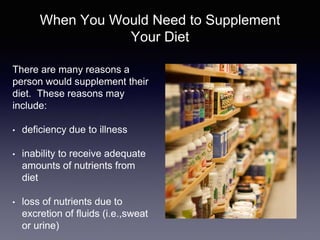
    When You WouldNeed to Supplement Your Diet
  • 5.
    When You Don'tNeed to Supplement Your Diet There are a few reasons people would not want to supplement their diet. Most of these seem obvious but they should still be pointed out. These are: • A known toxicity or allergy to them • You already receive more than adequate amounts and you may reach a toxic threshold • A mixture could become toxic (check warning labels)
  • 6.
    Where to GetYour Supplements Nutritional supplements are becoming easier to find every day. Here is a list of a few ways to find supplements: • Specialty stores (i.e., Vitamin Shoppe, GNC, etc.) • Grocery stores • Pharmacies • Online merchants • ...even gas stations will sell supplements
  • 7.
    Where to LearnMore About Supplements Dietary supplements are more popular than ever. This also means that there is also a lot of information out there which, at times, can be confusing or even contradicting. Before taking anything you are unsure about, it is important that you find credible information. If you are unable to consult a physician or nutritionalist, you can find information on credible websites such as: • The National Center for Complimentary and Integrative Health (formerly National Center for Complimentary and Alternative Medicine) is s the Federal Government's lead agency for scientific research on the diverse medical and health care systems, practices, and products that are not generally considered part of conventional medicine (NCCIH, 2015) https://nccih.nih.gov/# • The Office of Dietary Supplements is another department of the NIH that offers specific information about specific dietary supplements, maintaining up to date health and warning information. https://ods.od.nih.gov
  • 8.
    Summary • Remember thatdietary supplements and designed to supplement your diet with what you are deficient of. • Dietary supplements can be toxic or become toxic if taken in excess • Dietary supplements are readily available from many places. • There are many places to find information about dietary supplements but be sure it comes from reputable sources. • This information is not intended for medical purposes. Please consult a physician or registered dietitian for more information.
  • 9.
    Photo Credits • Slide1: top.me. 2015. Retrieved from http://www.top.me/strength/best-strength-boosting-and- muscle-building-supplements-195.html • Slide 4: Passionate About Food. May 28, 2014. Retrieved from http://www.passionateaboutfood.net/7-dangerous-dietary-supplements-that-could-jeopardize-your- health/ • Slide 5: Agency for Healthcare Research and Quality. April 10, 2013. Retrieved from http://effectivehealthcare.ahrq.gov/index.cfm/search-for-guides-reviews-and- reports/?productid=1455&pageaction=displayproduct • Slide 6: CNBC. September 2, 2014. Retrieved from http://www.cnbc.com/2014/09/02/cramer- should-gnc-acquire-vitamin-shoppe.html HNGN. August 11, 2014. Retrieved from http://www.hngn.com/articles/38732/20140811/amazon- blocks-disney-movie-dvd-preorders.htm Staffers of Kissel Hill. Retrieved from http://www.skh.com/supermarket/pharmacy/