Vitamins, Herbs, and Nutritional
Supplements

By:
Marvin Hall EMT-P, CPT, SPS
Kaplan University
19Jan2014
Objectives
• Define Vitamins, Herbs, and Nutritional
Supplements
• Define Recommended Dietary Allowances (RDA)
• Define Dietary Reference Intakes (DRI)
• Differentiate between vitamins and herbs
• Differentiate between macronutrients and
micronutrients
• Describe Vitamins A, B, C, D, E, K
• Determine if protein supplementation is right for
them
• Understand the importance of hydration
• Bringing it all together!
Vitamins, Herbs, and Nutritional
Supplements
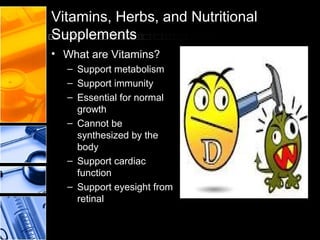
• What are Vitamins?
– Support metabolism
– Support immunity
– Essential for normal
growth
– Cannot be
synthesized by the
body
– Support cardiac
function
– Support eyesight from
retinal
Vitamins, Herbs and Nutritional
Supplements
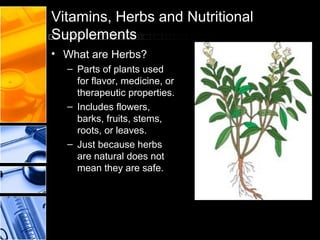
• What are Herbs?
– Parts of plants used
for flavor, medicine, or
therapeutic properties.
– Includes flowers,
barks, fruits, stems,
roots, or leaves.
– Just because herbs
are natural does not
mean they are safe.
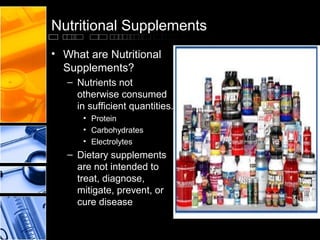
Nutritional Supplements
• What are Nutritional
Supplements?
– Nutrients not
otherwise consumed
in sufficient quantities.
• Protein
• Carbohydrates
• Electrolytes

– Dietary supplements
are not intended to
treat, diagnose,
mitigate, prevent, or
cure disease
Recommended Dietary Allowances
(RDA) and Dietary Reference Intakes
(DRI)
• What are RDA’s?
– RDA’s are quantities of nutrients in the diet that are
required to maintain good health (Nutrition.gov, 2014)
– How do you determine your RDA’s?

• What are DRI’s?
– A set of values for the dietary intakes of healthy people
used for planning and assessing diets (Nutrition.gov,
2014).

The Department of Agriculture has built a tool to
calculate these:
RDA/DRI Calculator for Health Professionals
What’s the difference between Vitamins
and Herbs then?
• Vitamins
– Body cannot create
– Body must have to survive
– Can be taken by mouth as a tablet, capsule, powder, or
liquid
– Comes from foods

• Herbs
–
–
–
–

Body cannot create
Used as dietary supplementation
Can mimic actions of drugs and/or medicines
Can be taken by mouth as a tablet, capsule, powder, or
liquid
– Comes from plants, trees, roots, stems, leaves
Micronutrients and Macronutrients
• Micronutrients are those nutrients required by
organisms for physiological function
– Only requires small amounts
– Are not considered vitamins
– Are the minerals needed to support function
•
•
•
•
•
•

Calcium
Chloride
Magnesium
Phosphorus
Potassium
Sodium

• Macronutrients are those nutrients required by
organisms for daily function
– Required in larger amounts
– Are not vitamins or minerals
Vitamin A
• What Is Vitamin A?
– It’s fat-soluble
– Important for normal vision, the immune system, and
reproduction

• Where is it found?
–
–
–
–
–
–

Salmon
Green leafy vegetables
Dairy products
Fortified breakfast cereals
Fruits
Carrots
Vitamin B
• Vitamin B comes in many forms B1, B2, B3, B5, B6,
B7, B9, B12
–
–
–
–
–
–
–
–

B1 – Thiamine – supports metabolism
B2 – Riboflavin – supports metabolism
B3 – Niacin – supports metabolism
B5 – Pantothenic Acid – Oxidation of fatty acids and
carbohydrates
B6 – Pyridoxine – metabolism of amino acids and lipids.
Important role in gluconeogenesis
B7 – Biotin – metabolism of proteins and lipids
B9 – Folic Acid – metabolism of nucleic acids and
amino acids
B12 – Cobalamin – cellular metabolism of
carbohydrates, proteins, and lipids
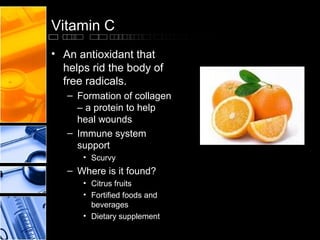
Vitamin C
• An antioxidant that
helps rid the body of
free radicals.
– Formation of collagen
– a protein to help
heal wounds
– Immune system
support
• Scurvy

– Where is it found?
• Citrus fruits
• Fortified foods and
beverages
• Dietary supplement
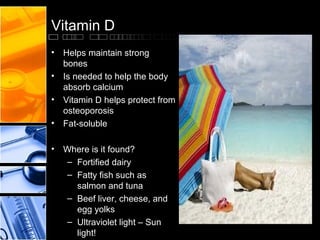
Vitamin D
• Helps maintain strong
bones
• Is needed to help the body
absorb calcium
• Vitamin D helps protect from
osteoporosis
• Fat-soluble
• Where is it found?
– Fortified dairy
– Fatty fish such as
salmon and tuna
– Beef liver, cheese, and
egg yolks
– Ultraviolet light – Sun
light!
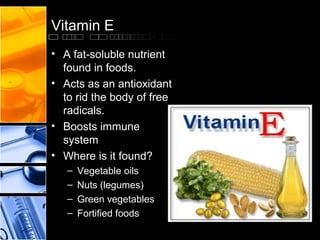
Vitamin E
• A fat-soluble nutrient
found in foods.
• Acts as an antioxidant
to rid the body of free
radicals.
• Boosts immune
system
• Where is it found?
–
–
–
–

Vegetable oils
Nuts (legumes)
Green vegetables
Fortified foods
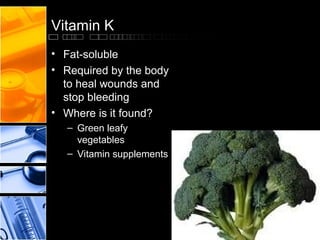
Vitamin K
• Fat-soluble
• Required by the body
to heal wounds and
stop bleeding
• Where is it found?
– Green leafy
vegetables
– Vitamin supplements
Is Protein Supplementation Right For
You?
•
•

•

•

To protein or not to protein…
What are the benefits to using protein powders?
– Muscle retention
– Muscle gain
What types are available?
– Soy
– Whey
– Isolate
– Casein
– Beef
– Egg
– Plant
How much do you need?
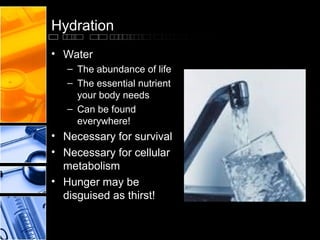
Hydration
• Water
– The abundance of life
– The essential nutrient
your body needs
– Can be found
everywhere!

• Necessary for survival
• Necessary for cellular
metabolism
• Hunger may be
disguised as thirst!
Summary
• Vitamins are an essential part of life and needed to
sustain body function
• Herbs may look beneficial but consult a Health
Professional before use
• Nutritional Supplementation is on an as needed
basis consult a Health Professional before use
• If you’re unsure of what you should be doing
consult a Health Professional
• Health Professional
–
–
–
–
–

Nutritionist
Health and Wellness Coach
Personal Trainers
Physician – Osteopathic Medicine
Nurses with a nutritional background
References
• CDC. (2012, October). Protein. Retrieved from
Centers for Disease Control and Prevention:
http://www.cdc.gov/nutrition/everyone/basics/pr
otein.html
• NCCAM. (2014, January). Dietary and Herbal
Supplements. Retrieved from National Center
for Complementary and Alternative Medicine :
http://nccam.nih.gov/health/supplements?nav=
gsa
• ODS. (2013, July 13). Dietary Supplementation.
Retrieved from Office of Dietary Supplements:
http://ods.od.nih.gov/Health_Information/ODS_
Frequently_Asked_Questions.aspx#Need
References
• Schlenker, E. D., & Roth, S. L. (2011). Williams'
Essentials of Nutrition and Diet Therapy. St. Louis:
Elsevier Mosby.
• Skidmore-Roth, L. (2010). Mosby's Handbook of
Herbs & Natural Supplements. St. Louis:
Elsevier.
• Thompson, J., & Manore, M. (2009). Nutrition an
Applied Approach. San Francisco: Benjamin
Cummings.
• USDA. (2014, January). Interactive DRI for Health
Professionals. Retrieved from Unit

Vitamins, herbs, and nutritional supplements presentation

  • 1.
    Vitamins, Herbs, andNutritional Supplements By: Marvin Hall EMT-P, CPT, SPS Kaplan University 19Jan2014
  • 2.
    Objectives • Define Vitamins,Herbs, and Nutritional Supplements • Define Recommended Dietary Allowances (RDA) • Define Dietary Reference Intakes (DRI) • Differentiate between vitamins and herbs • Differentiate between macronutrients and micronutrients • Describe Vitamins A, B, C, D, E, K • Determine if protein supplementation is right for them • Understand the importance of hydration • Bringing it all together!
  • 3.
    Vitamins, Herbs, andNutritional Supplements • What are Vitamins? – Support metabolism – Support immunity – Essential for normal growth – Cannot be synthesized by the body – Support cardiac function – Support eyesight from retinal
  • 4.
    Vitamins, Herbs andNutritional Supplements • What are Herbs? – Parts of plants used for flavor, medicine, or therapeutic properties. – Includes flowers, barks, fruits, stems, roots, or leaves. – Just because herbs are natural does not mean they are safe.
  • 5.
    Nutritional Supplements • Whatare Nutritional Supplements? – Nutrients not otherwise consumed in sufficient quantities. • Protein • Carbohydrates • Electrolytes – Dietary supplements are not intended to treat, diagnose, mitigate, prevent, or cure disease
  • 6.
    Recommended Dietary Allowances (RDA)and Dietary Reference Intakes (DRI) • What are RDA’s? – RDA’s are quantities of nutrients in the diet that are required to maintain good health (Nutrition.gov, 2014) – How do you determine your RDA’s? • What are DRI’s? – A set of values for the dietary intakes of healthy people used for planning and assessing diets (Nutrition.gov, 2014). The Department of Agriculture has built a tool to calculate these: RDA/DRI Calculator for Health Professionals
  • 7.
    What’s the differencebetween Vitamins and Herbs then? • Vitamins – Body cannot create – Body must have to survive – Can be taken by mouth as a tablet, capsule, powder, or liquid – Comes from foods • Herbs – – – – Body cannot create Used as dietary supplementation Can mimic actions of drugs and/or medicines Can be taken by mouth as a tablet, capsule, powder, or liquid – Comes from plants, trees, roots, stems, leaves
  • 8.
    Micronutrients and Macronutrients •Micronutrients are those nutrients required by organisms for physiological function – Only requires small amounts – Are not considered vitamins – Are the minerals needed to support function • • • • • • Calcium Chloride Magnesium Phosphorus Potassium Sodium • Macronutrients are those nutrients required by organisms for daily function – Required in larger amounts – Are not vitamins or minerals
  • 9.
    Vitamin A • WhatIs Vitamin A? – It’s fat-soluble – Important for normal vision, the immune system, and reproduction • Where is it found? – – – – – – Salmon Green leafy vegetables Dairy products Fortified breakfast cereals Fruits Carrots
  • 10.
    Vitamin B • VitaminB comes in many forms B1, B2, B3, B5, B6, B7, B9, B12 – – – – – – – – B1 – Thiamine – supports metabolism B2 – Riboflavin – supports metabolism B3 – Niacin – supports metabolism B5 – Pantothenic Acid – Oxidation of fatty acids and carbohydrates B6 – Pyridoxine – metabolism of amino acids and lipids. Important role in gluconeogenesis B7 – Biotin – metabolism of proteins and lipids B9 – Folic Acid – metabolism of nucleic acids and amino acids B12 – Cobalamin – cellular metabolism of carbohydrates, proteins, and lipids
  • 11.
    Vitamin C • Anantioxidant that helps rid the body of free radicals. – Formation of collagen – a protein to help heal wounds – Immune system support • Scurvy – Where is it found? • Citrus fruits • Fortified foods and beverages • Dietary supplement
  • 12.
    Vitamin D • Helpsmaintain strong bones • Is needed to help the body absorb calcium • Vitamin D helps protect from osteoporosis • Fat-soluble • Where is it found? – Fortified dairy – Fatty fish such as salmon and tuna – Beef liver, cheese, and egg yolks – Ultraviolet light – Sun light!
  • 13.
    Vitamin E • Afat-soluble nutrient found in foods. • Acts as an antioxidant to rid the body of free radicals. • Boosts immune system • Where is it found? – – – – Vegetable oils Nuts (legumes) Green vegetables Fortified foods
  • 14.
    Vitamin K • Fat-soluble •Required by the body to heal wounds and stop bleeding • Where is it found? – Green leafy vegetables – Vitamin supplements
  • 15.
    Is Protein SupplementationRight For You? • • • • To protein or not to protein… What are the benefits to using protein powders? – Muscle retention – Muscle gain What types are available? – Soy – Whey – Isolate – Casein – Beef – Egg – Plant How much do you need?
  • 16.
    Hydration • Water – Theabundance of life – The essential nutrient your body needs – Can be found everywhere! • Necessary for survival • Necessary for cellular metabolism • Hunger may be disguised as thirst!
  • 17.
    Summary • Vitamins arean essential part of life and needed to sustain body function • Herbs may look beneficial but consult a Health Professional before use • Nutritional Supplementation is on an as needed basis consult a Health Professional before use • If you’re unsure of what you should be doing consult a Health Professional • Health Professional – – – – – Nutritionist Health and Wellness Coach Personal Trainers Physician – Osteopathic Medicine Nurses with a nutritional background
  • 18.
    References • CDC. (2012,October). Protein. Retrieved from Centers for Disease Control and Prevention: http://www.cdc.gov/nutrition/everyone/basics/pr otein.html • NCCAM. (2014, January). Dietary and Herbal Supplements. Retrieved from National Center for Complementary and Alternative Medicine : http://nccam.nih.gov/health/supplements?nav= gsa • ODS. (2013, July 13). Dietary Supplementation. Retrieved from Office of Dietary Supplements: http://ods.od.nih.gov/Health_Information/ODS_ Frequently_Asked_Questions.aspx#Need
  • 19.
    References • Schlenker, E.D., & Roth, S. L. (2011). Williams' Essentials of Nutrition and Diet Therapy. St. Louis: Elsevier Mosby. • Skidmore-Roth, L. (2010). Mosby's Handbook of Herbs & Natural Supplements. St. Louis: Elsevier. • Thompson, J., & Manore, M. (2009). Nutrition an Applied Approach. San Francisco: Benjamin Cummings. • USDA. (2014, January). Interactive DRI for Health Professionals. Retrieved from Unit

Editor's Notes

  • #3 Here the student will be able to describe or define certain aspects of this presentation. What is it that we are doing here? How important is learning about Vitamins, Herbs, and Nutritional Supplements before adding them to your lifestyle?
  • #4 Vitamins are an important part of human growth and our bodies require the assistance of 13 different vitamins. Each Vitamin supports a function of the body, cellular function, and tissues (Schlenker & Roth, 2011). We will learn about the different vitamins later on in this presentation.
  • #5 Before using a herbal regiment it is best to consult a professional or your Physician. Herbal medicines can have the same effects as drugs or laboratory created medicines (NCCAM, 2014).
  • #6 Boost is a great supplement when proper nutrition is not being consumed in adequate amounts. Protein supplementation is what body builders intake to retain muscle mass. (ODS, 2013)
  • #7 When using this chart, which is accessible by everyone, it is important to consult a Health and Wellness Professional to help determine your values based on needs. This chart represents the most current scientific knowledge on nutritional needs and requirements may be higher or lower than the DRI’s listed (USDA, 2014).
  • #8 The differences between the two are minimal but the effects are greatly different. Vitamins support body functions, immunity, and overall health while herbs are a supplementation that can be used to enhance or mimic the effects of drugs or other medications. Example: St. John’s Wort (herb) – a plant that grows in the wild and is used to treat depression which mimics treatments by modern medications. Yohimbe (herb) – the bark of the yohimbe tree is used to concoct the drug yohimbine which is used for erectile dysfunction.
  • #9 Even though potassium is considered a vitamin it is still considered a mineral and is necessary for body function. Macronutrients are needed in larger amounts and are those that are eaten daily: Fats Carbohydrates Protein
  • #10 Vitamin A is important in healthy function of the body especially the eyes. Although vitamin A deficiency is rare in the United States it can be seen in pregnant women and young children. Research suggests eating foods with beta-carotene might lower the risk of certain cancers (ODS, 2014). How much is enough? Getting too much preformed vitamin A (usually from supplements or certain medicines) can cause dizziness, nausea, headaches, coma, and even death (ODS, 2014).
  • #11 The B vitamins support metabolism of all body functions and occurs at cellular level. Lack of vitamin B can result in a variety of diseases such as beriberi, Wernicke’s encephalopathy, ariboflavinosis, acne, depression, hypertenstion (high blood pressure), and peripheral neuropathy (ODS, 2014).
  • #12 Did you know that those who smoke or are exposed to secondhand smoke require more vitamin C to repair the damage caused by free radicals (ODS, 2014)?
  • #13 Believe it or not your body needs sun light for a number of different reasons. Vitamin D deficiency can cause rickets, osteoporosis, osteomalacia, and seasonal affective disorder. Vitamin D is also fat-soluble which means it requires fat to be absorbed.
  • #14 Vitamin E is an important part of a daily intake as it helps rid the body of free radicals that damage the body and the body’s cells.
  • #15 Vitamin K intake is important in blood clotting factors. Potassium also plays an important role in cardiac function and is used in conjunction with sodium.
  • #16 What determines whether or not you need protein in your diet? Are you vegetarian or derivative of vegetarian? Do you eat out of the major food groups daily? Do you find making meals tedious? For most men and women the amount of protein is between 46 (women) and 56 (men) (CDC, 2012).
  • #17 Water is what keeps you alive, literally. Water is necessary for cellular function and metabolism. Water is everywhere! Hunger may be disguised as thirst!
  • #18 Being able to decipher all the information about vitamins, herbs, and supplements takes quite a bit of knowledge and the guidance you seek will be that of a Health and Wellness Professional. These Professionals will be able to assist you in reaching your goals. What looks like an easy calculation may be easily deceptive.