DIETARY SUPPLEMENTS
EILEEN NAVARRO
HW499 BACHELORS CAPSTONE IN HEALTH AND WELLNESS
WHAT ARE DIETARY SUPPLEMENTS
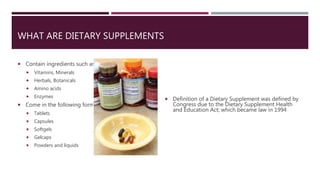
 Contain ingredients such as
 Vitamins, Minerals
 Herbals, Botanicals
 Amino acids
 Enzymes
 Come in the following forms
 Tablets
 Capsules
 Softgels
 Gelcaps
 Powders and liquids
 Definition of a Dietary Supplement was defined by
Congress due to the Dietary Supplement Health
and Education Act; which became law in 1994
BENEFITS & RISKS OF SUPPLEMENTS
 Benefits
 Get enough vital substances for the body to function
 Helps reduce the risk of disease
 Not to replace complete meals
 Risks
 Supplements can be harmful to the body or even life threatening when
 Combined with other supplements
 Using supplements with medications
 Substituting supplements for prescription medications
 Taking too many supplements of one kin
DIETARY SUPPLEMENT CLAIMS
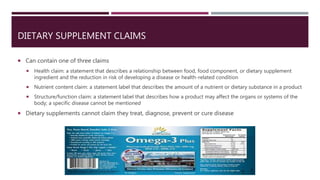
 Can contain one of three claims
 Health claim: a statement that describes a relationship between food, food component, or dietary supplement
ingredient and the reduction in risk of developing a disease or health-related condition
 Nutrient content claim: a statement label that describes the amount of a nutrient or dietary substance in a product
 Structure/function claim: a statement label that describes how a product may affect the organs or systems of the
body; a specific disease cannot be mentioned
 Dietary supplements cannot claim they treat, diagnose, prevent or cure disease
LABELING & REGULATION
Labeling
 FDA requires the following on a label
 Name of product
 Net quantity of contents
 Name and place of business, manufacturer, packer
or distributor
 Directions for use
 Serving size
 Proprietary blend
 Other ingredients
 Label must contain a cautionary statement
 Label does not determine the quality of the
product
Regulation
 FDA regulates dietary supplements as well as
the labels and claims
 There are no provisions in law for the FDA to
approve the safety and effectiveness of dietary
supplements
 Are not required to be standardized in the
United States
 Standardization is a process done by the
manufacturers and provides a measure of
quality control
REFERENCES
 National Institutes of Health, Office of Dietary Supplements, US Department of Health and Human
Services, (2017). Retrieved online at
https://ods.od.nih.gov/Health_Information/ODS_Frequently_Asked_Questions.aspx
 US Food and Drug Administration. Food. Dietary Supplements. US Department of Health and Human
Services, (2017). Retrieved online at https://www.fda.gov/Food/DietarySupplements/ucm2006892.htm

Unit 4 assignment

  • 1.
    DIETARY SUPPLEMENTS EILEEN NAVARRO HW499BACHELORS CAPSTONE IN HEALTH AND WELLNESS
  • 2.
    WHAT ARE DIETARYSUPPLEMENTS  Contain ingredients such as  Vitamins, Minerals  Herbals, Botanicals  Amino acids  Enzymes  Come in the following forms  Tablets  Capsules  Softgels  Gelcaps  Powders and liquids  Definition of a Dietary Supplement was defined by Congress due to the Dietary Supplement Health and Education Act; which became law in 1994
  • 3.
    BENEFITS & RISKSOF SUPPLEMENTS  Benefits  Get enough vital substances for the body to function  Helps reduce the risk of disease  Not to replace complete meals  Risks  Supplements can be harmful to the body or even life threatening when  Combined with other supplements  Using supplements with medications  Substituting supplements for prescription medications  Taking too many supplements of one kin
  • 4.
    DIETARY SUPPLEMENT CLAIMS Can contain one of three claims  Health claim: a statement that describes a relationship between food, food component, or dietary supplement ingredient and the reduction in risk of developing a disease or health-related condition  Nutrient content claim: a statement label that describes the amount of a nutrient or dietary substance in a product  Structure/function claim: a statement label that describes how a product may affect the organs or systems of the body; a specific disease cannot be mentioned  Dietary supplements cannot claim they treat, diagnose, prevent or cure disease
  • 5.
    LABELING & REGULATION Labeling FDA requires the following on a label  Name of product  Net quantity of contents  Name and place of business, manufacturer, packer or distributor  Directions for use  Serving size  Proprietary blend  Other ingredients  Label must contain a cautionary statement  Label does not determine the quality of the product Regulation  FDA regulates dietary supplements as well as the labels and claims  There are no provisions in law for the FDA to approve the safety and effectiveness of dietary supplements  Are not required to be standardized in the United States  Standardization is a process done by the manufacturers and provides a measure of quality control
  • 6.
    REFERENCES  National Institutesof Health, Office of Dietary Supplements, US Department of Health and Human Services, (2017). Retrieved online at https://ods.od.nih.gov/Health_Information/ODS_Frequently_Asked_Questions.aspx  US Food and Drug Administration. Food. Dietary Supplements. US Department of Health and Human Services, (2017). Retrieved online at https://www.fda.gov/Food/DietarySupplements/ucm2006892.htm