PRESENTATION TOPIC:
MALWARE AND IT’S TYPES
PRESENTED BY:
AAKASH AHMED
MALWARE:
 Malware is short for “Malicious Software”. It is
Computer programs designed to infiltrate and
damage computers without the user consent.
 Simply malware is any of software that was
written with the intent of doing harm to data
devices or to people it is malware which
causing damage to a computer or network.
Malware is the general term covering all the
different types of threats to our computer
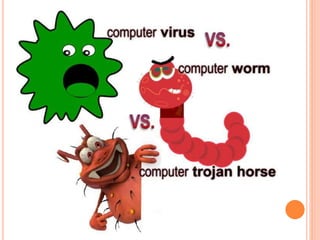
safety such as Virus, Trojan, Worms and so
on. There are differences among these
programs and knowing those differences can
help we better protect our computer from
damaging effects.
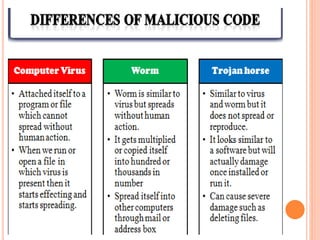
 A computer virus attaches itself to a program or
file enabling it to spread from one computer to
another leaving infections as it travels. Some
viruses cause only mildly annoying effects while
other can damage our hardware, software or
files. Almost all viruses are attached to an
executable file, which means the virus may
exist on our computer but it actually cannot
infect our computer unless we run or open the
malicious program. It is mostly known to spread
when software is shared between computers.
 Fast Facts: Attaches to an executable file,
require human action to spread.
VIRUS:
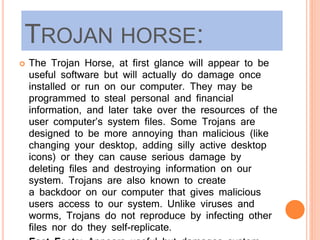
 The Trojan Horse, at first glance will appear to be
useful software but will actually do damage once
installed or run on our computer. They may be
programmed to steal personal and financial
information, and later take over the resources of the
user computer’s system files. Some Trojans are
designed to be more annoying than malicious (like
changing your desktop, adding silly active desktop
icons) or they can cause serious damage by
deleting files and destroying information on our
system. Trojans are also known to create
a backdoor on our computer that gives malicious
users access to our system. Unlike viruses and
worms, Trojans do not reproduce by infecting other
files nor do they self-replicate.
TROJAN HORSE:
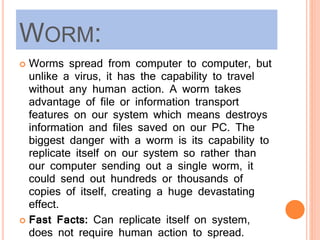
 Worms spread from computer to computer, but
unlike a virus, it has the capability to travel
without any human action. A worm takes
advantage of file or information transport
features on our system which means destroys
information and files saved on our PC. The
biggest danger with a worm is its capability to
replicate itself on our system so rather than
our computer sending out a single worm, it
could send out hundreds or thousands of
copies of itself, creating a huge devastating
effect.
 Fast Facts: Can replicate itself on system,
does not require human action to spread.
WORM:
Malware and it's types

Malware and it's types

  • 2.
    PRESENTATION TOPIC: MALWARE ANDIT’S TYPES PRESENTED BY: AAKASH AHMED
  • 3.
    MALWARE:  Malware isshort for “Malicious Software”. It is Computer programs designed to infiltrate and damage computers without the user consent.  Simply malware is any of software that was written with the intent of doing harm to data devices or to people it is malware which causing damage to a computer or network. Malware is the general term covering all the different types of threats to our computer safety such as Virus, Trojan, Worms and so on. There are differences among these programs and knowing those differences can help we better protect our computer from damaging effects.
  • 5.
     A computervirus attaches itself to a program or file enabling it to spread from one computer to another leaving infections as it travels. Some viruses cause only mildly annoying effects while other can damage our hardware, software or files. Almost all viruses are attached to an executable file, which means the virus may exist on our computer but it actually cannot infect our computer unless we run or open the malicious program. It is mostly known to spread when software is shared between computers.  Fast Facts: Attaches to an executable file, require human action to spread. VIRUS:
  • 6.
     The TrojanHorse, at first glance will appear to be useful software but will actually do damage once installed or run on our computer. They may be programmed to steal personal and financial information, and later take over the resources of the user computer’s system files. Some Trojans are designed to be more annoying than malicious (like changing your desktop, adding silly active desktop icons) or they can cause serious damage by deleting files and destroying information on our system. Trojans are also known to create a backdoor on our computer that gives malicious users access to our system. Unlike viruses and worms, Trojans do not reproduce by infecting other files nor do they self-replicate. TROJAN HORSE:
  • 7.
     Worms spreadfrom computer to computer, but unlike a virus, it has the capability to travel without any human action. A worm takes advantage of file or information transport features on our system which means destroys information and files saved on our PC. The biggest danger with a worm is its capability to replicate itself on our system so rather than our computer sending out a single worm, it could send out hundreds or thousands of copies of itself, creating a huge devastating effect.  Fast Facts: Can replicate itself on system, does not require human action to spread. WORM: