Originally Presented by Dr. Marissa Capette
Dr Jeku Jacob and CNC Lisa-Jayne Ferguson
Drug & Alcohol Service
St Vincent’s Hospital
Benzodiazepines
Effects,
Withdrawal &
Treatment Options
BZD’s - Introduction
 The most widely used of all psychotropic drugs
 Treatment of
 Anxiety states
 Muscle spasm/ tension
 Seizures
 Insomnia
 Safer than barbiturates (less chance of OD)
 However dependence can develop (3 weeks)
– tolerance and withdrawal
BZD’S ARE USED BY 2 MAIN GROUPS
 Elderly & women (low dose)
 Young, polysubstance users (high dose)
WHY PEOPLE USE BZD?
Enhance & prolong the 'high‘ of other drugs
Alleviate withdrawal effects
Users of stimulants take benzodiazepines as
'downers'
The mixture of alcohol and benzodiazepines
produces a hedonic effect
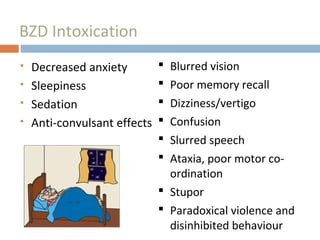
BZD Intoxication
 Decreased anxiety
 Sleepiness
 Sedation
 Anti-convulsant effects
 Blurred vision
 Poor memory recall
 Dizziness/vertigo
 Confusion
 Slurred speech
 Ataxia, poor motor co-
ordination
 Stupor
 Paradoxical violence and
disinhibited behaviour
BZD INTOXICATION
 Dose dependant
 Sedation Stupor
Respiratory depression
 Death can result if taken with
other drugs
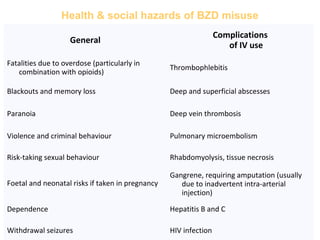
Health & social hazards of BZD misuse
General
Complications
of IV use
Fatalities due to overdose (particularly in
combination with opioids)
Thrombophlebitis
Blackouts and memory loss Deep and superficial abscesses
Paranoia Deep vein thrombosis
Violence and criminal behaviour Pulmonary microembolism
Risk-taking sexual behaviour Rhabdomyolysis, tissue necrosis
Foetal and neonatal risks if taken in pregnancy
Gangrene, requiring amputation (usually
due to inadvertent intra-arterial
injection)
Dependence Hepatitis B and C
Withdrawal seizures HIV infection
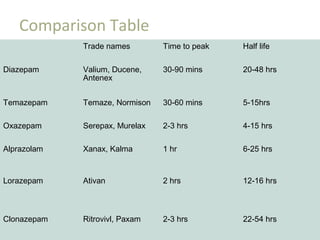
Comparison Table
Trade names Time to peak Half life
Diazepam Valium, Ducene,
Antenex
30-90 mins 20-48 hrs
Temazepam Temaze, Normison 30-60 mins 5-15hrs
Oxazepam Serepax, Murelax 2-3 hrs 4-15 hrs
Alprazolam Xanax, Kalma 1 hr 6-25 hrs
Lorazepam Ativan 2 hrs 12-16 hrs
Clonazepam Ritrovivl, Paxam 2-3 hrs 22-54 hrs
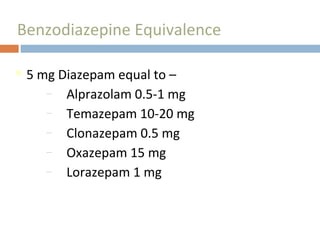
Benzodiazepine Equivalence
5 mg Diazepam equal to –
– Alprazolam 0.5-1 mg
– Temazepam 10-20 mg
– Clonazepam 0.5 mg
– Oxazepam 15 mg
– Lorazepam 1 mg
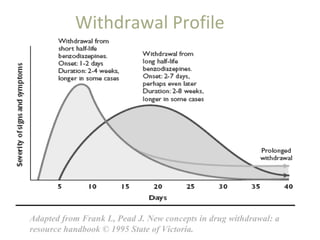
Adapted from Frank L, Pead J. New concepts in drug withdrawal: a
resource handbook © 1995 State of Victoria.
Withdrawal Profile
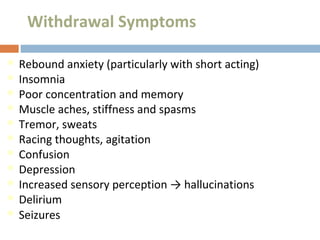
Withdrawal Symptoms
 Rebound anxiety (particularly with short acting)
 Insomnia
 Poor concentration and memory
 Muscle aches, stiffness and spasms
 Tremor, sweats
 Racing thoughts, agitation
 Confusion
 Depression
 Increased sensory perception → hallucinations
 Delirium
 Seizures
Signs of Withdrawal
 Withdrawals featuring a delirium can mimic
amphetamine intoxication or psychotic episode 2nd
to underlying Mental Health issues
 Pupils dilated and fine tremor may indicate
Benzodiazepine withdrawal
Assessment
Duration
Amount
Street or GP (phone)
Regularity of use, binge etc...
Does the pt wish to change intake?
In-Pt Withdrawal Treatment
 Convert short acting regular BZD dose to long acting
BZD (Diazepam)
 Patient stabilised at a dose of 40% of their regular
intake (or 80 mg/day whichever is lower) in 3 - 4
divided doses
 Day 5 onwards – Reduce by 10% every 2-4/7’s,
depending on pt’s response
Community Withdrawal Treatment
 Reduce by 10 mg / week until 40 mg
 Then by 5mg / week
 This will take about 12 weeks
 Supportive GP
 Pick up from pharmacy
 Pt can sign Dr Shopping form
Withdrawal Symptoms
Withdrawal symptoms do not decrease steadily
from a peak, but follow a fluctuating course with
good & bad periods
Eventually the good periods will last longer &
become more frequent
Abrupt or over-rapid withdrawal, especially from
high dosage, can give rise to severe symptoms
(convulsions, psychotic reactions, acute anxiety
states)
New South Wales Drug and Alcohol Withdrawal
Clinical Practice Guidelines (2007)
Treatment Options
 Detox / Rehabilitation (Limited facilities)
 Self Management & Recovery Training (SMART)
 Narcotics Anonymous/ 12 Step programme
 Individual Counselling
 Alcohol & Drug Information Service - 93618000 or local
area A&D service
Benzodiazepine Overdose: Treatment
 Monitor vitals & O2 sats
 Charcoal/Osmotic Purgative if recent ingestion
 Flumazenil – Benzodiazepine antagonist (0.2 mg/min IV
initially, repeat up to 3 mg maximum)
 Caution in patients where Benzodiazepine dependence is
suspected: risk of Benzodiazepine withdrawal seizure
Case Study
 58 year old female admitted to hospital after chest
pain
 On day 4, patient suffered two grand mal seizures.
 Pt known to be alcohol dependant
 Pt suspected of abusing benzodiazepenes
 Refused to admit to more than 10 mg/ night.

Bzd 2012[1]

  • 1.
    Originally Presented byDr. Marissa Capette Dr Jeku Jacob and CNC Lisa-Jayne Ferguson Drug & Alcohol Service St Vincent’s Hospital Benzodiazepines Effects, Withdrawal & Treatment Options
  • 2.
    BZD’s - Introduction The most widely used of all psychotropic drugs  Treatment of  Anxiety states  Muscle spasm/ tension  Seizures  Insomnia  Safer than barbiturates (less chance of OD)  However dependence can develop (3 weeks) – tolerance and withdrawal
  • 3.
    BZD’S ARE USEDBY 2 MAIN GROUPS  Elderly & women (low dose)  Young, polysubstance users (high dose)
  • 4.
    WHY PEOPLE USEBZD? Enhance & prolong the 'high‘ of other drugs Alleviate withdrawal effects Users of stimulants take benzodiazepines as 'downers' The mixture of alcohol and benzodiazepines produces a hedonic effect
  • 5.
    BZD Intoxication  Decreasedanxiety  Sleepiness  Sedation  Anti-convulsant effects  Blurred vision  Poor memory recall  Dizziness/vertigo  Confusion  Slurred speech  Ataxia, poor motor co- ordination  Stupor  Paradoxical violence and disinhibited behaviour
  • 6.
    BZD INTOXICATION  Dosedependant  Sedation Stupor Respiratory depression  Death can result if taken with other drugs
  • 7.
    Health & socialhazards of BZD misuse General Complications of IV use Fatalities due to overdose (particularly in combination with opioids) Thrombophlebitis Blackouts and memory loss Deep and superficial abscesses Paranoia Deep vein thrombosis Violence and criminal behaviour Pulmonary microembolism Risk-taking sexual behaviour Rhabdomyolysis, tissue necrosis Foetal and neonatal risks if taken in pregnancy Gangrene, requiring amputation (usually due to inadvertent intra-arterial injection) Dependence Hepatitis B and C Withdrawal seizures HIV infection
  • 8.
    Comparison Table Trade namesTime to peak Half life Diazepam Valium, Ducene, Antenex 30-90 mins 20-48 hrs Temazepam Temaze, Normison 30-60 mins 5-15hrs Oxazepam Serepax, Murelax 2-3 hrs 4-15 hrs Alprazolam Xanax, Kalma 1 hr 6-25 hrs Lorazepam Ativan 2 hrs 12-16 hrs Clonazepam Ritrovivl, Paxam 2-3 hrs 22-54 hrs
  • 9.
    Benzodiazepine Equivalence 5 mgDiazepam equal to – – Alprazolam 0.5-1 mg – Temazepam 10-20 mg – Clonazepam 0.5 mg – Oxazepam 15 mg – Lorazepam 1 mg
  • 10.
    Adapted from FrankL, Pead J. New concepts in drug withdrawal: a resource handbook © 1995 State of Victoria. Withdrawal Profile
  • 11.
    Withdrawal Symptoms  Reboundanxiety (particularly with short acting)  Insomnia  Poor concentration and memory  Muscle aches, stiffness and spasms  Tremor, sweats  Racing thoughts, agitation  Confusion  Depression  Increased sensory perception → hallucinations  Delirium  Seizures
  • 12.
    Signs of Withdrawal Withdrawals featuring a delirium can mimic amphetamine intoxication or psychotic episode 2nd to underlying Mental Health issues  Pupils dilated and fine tremor may indicate Benzodiazepine withdrawal
  • 13.
    Assessment Duration Amount Street or GP(phone) Regularity of use, binge etc... Does the pt wish to change intake?
  • 14.
    In-Pt Withdrawal Treatment Convert short acting regular BZD dose to long acting BZD (Diazepam)  Patient stabilised at a dose of 40% of their regular intake (or 80 mg/day whichever is lower) in 3 - 4 divided doses  Day 5 onwards – Reduce by 10% every 2-4/7’s, depending on pt’s response
  • 15.
    Community Withdrawal Treatment Reduce by 10 mg / week until 40 mg  Then by 5mg / week  This will take about 12 weeks  Supportive GP  Pick up from pharmacy  Pt can sign Dr Shopping form
  • 16.
    Withdrawal Symptoms Withdrawal symptomsdo not decrease steadily from a peak, but follow a fluctuating course with good & bad periods Eventually the good periods will last longer & become more frequent Abrupt or over-rapid withdrawal, especially from high dosage, can give rise to severe symptoms (convulsions, psychotic reactions, acute anxiety states) New South Wales Drug and Alcohol Withdrawal Clinical Practice Guidelines (2007)
  • 17.
    Treatment Options  Detox/ Rehabilitation (Limited facilities)  Self Management & Recovery Training (SMART)  Narcotics Anonymous/ 12 Step programme  Individual Counselling  Alcohol & Drug Information Service - 93618000 or local area A&D service
  • 18.
    Benzodiazepine Overdose: Treatment Monitor vitals & O2 sats  Charcoal/Osmotic Purgative if recent ingestion  Flumazenil – Benzodiazepine antagonist (0.2 mg/min IV initially, repeat up to 3 mg maximum)  Caution in patients where Benzodiazepine dependence is suspected: risk of Benzodiazepine withdrawal seizure
  • 19.
    Case Study  58year old female admitted to hospital after chest pain  On day 4, patient suffered two grand mal seizures.  Pt known to be alcohol dependant  Pt suspected of abusing benzodiazepenes  Refused to admit to more than 10 mg/ night.