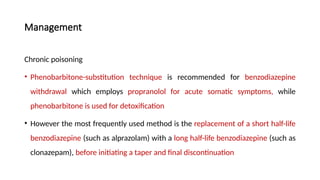
Benzodiazepines
DR JEEVA GEORGE
OBJECTIVES
At the end of this lecture, student will be able to:
Explain the mechanism of toxicity, toxicokinetics, clinical signs and symptoms,
investigations and management of benzodiazepine overdose
Introduction
• A benzodiazepine (sometimes colloquially "benzo"; often abbreviated "BZD") is
a psychoactive drug.
• The first such drug, chlordiazepoxide (Librium), was discovered accidentally by Leo
Sternbach in 1955, and made available in 1960 by Hoffmann–La Roche, which has
also marketed the benzodiazepine diazepam (Valium) since 1963
Introduction
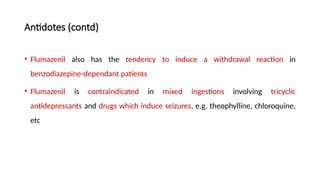
• Benzodiazepines enhance the effect of the neurotransmitter gamma-aminobutyric
acid (GABA) at the GABAA receptor, resulting in sedative, hypnotic (sleep
inducing), anxiolytic (anti-anxiety), euphoric, anticonvulsant, and muscle
relaxant properties
• Wider therapeutic window and lower drug tolerance for abuse with the
benzodiazepines
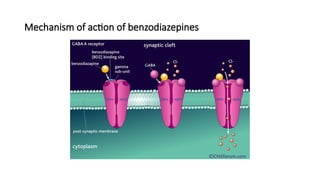
Mechanism of action of benzodiazepines
 These compounds act by stimulating the GABAA receptors , thereby
opening up the chloride ion channel in the receptor complex,
resulting in the increased conduction of chloride ion across the nerve
cell membrane.
 This lowers the potential difference between the interior and
exterior of the cell, blocking the ability of the cell to conduct nerve
impulses.
Mechanism of action of benzodiazepines
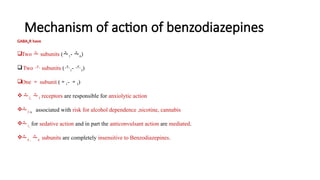
GABAAR have
Two  subunits (1- 6)
Two  subunits (1- 3)
One  subunit (1- 3)
2, 3 receptors are responsible for anxiolytic action
2 is associated with risk for alcohol dependence ,nicotine, cannabis
1, for sedative action and in part the anticonvulsant action are mediated.
4 , 6 subunits are completely insensitive to Benzodiazepines.
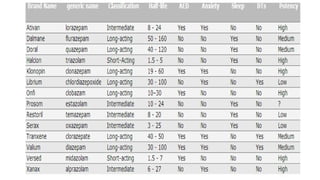
Classification based on duration of action
Uses
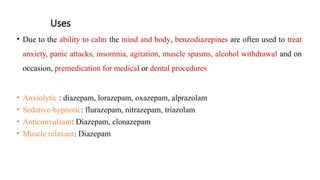
• Due to the ability to calm the mind and body, benzodiazepines are often used to treat
anxiety, panic attacks, insomnia, agitation, muscle spasms, alcohol withdrawal and on
occasion, premedication for medical or dental procedures
• Anxiolytic : diazepam, lorazepam, oxazepam, alprazolam
• Sedative-hypnotic: flurazepam, nitrazepam, triazolam
• Anticonvulsant: Diazepam, clonazepam
• Muscle relaxant: Diazepam
Risk assessment
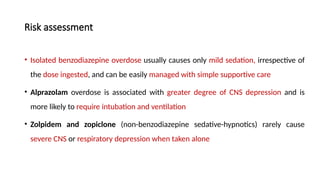
• Isolated benzodiazepine overdose usually causes only mild sedation, irrespective of
the dose ingested, and can be easily managed with simple supportive care
• Alprazolam overdose is associated with greater degree of CNS depression and is
more likely to require intubation and ventilation
• Zolpidem and zopiclone (non-benzodiazepine sedative-hypnotics) rarely cause
severe CNS or respiratory depression when taken alone
Risk assessment (contd)
• Co-ingestion of other CNS depressants (e.g. alcohol, opioids) increases the risk of
complications, prolonged length of stay and death
• The elderly and patients with cardiorespiratory co-morbidities may suffer greater
complications
• Children: Ingestion of one or two benzodiazepines usually manifests as mild sedation
and ataxia within 2 hours
Benzodiazepine Side effects
• Relaxation
• Euphoria
• Sense of wellbeing
• Sedation
• Dizziness
• Impaired vision
• Decreased motor skills/ unsteadiness
• Dizziness
• The side effects of benzodiazepines are increased when paired with other drugs such as
barbiturates, alcohol, narcotics or tranquilizers
Toxic Mechanism
• Benzodiazepines act by enhancing gamma-amino butyric acid (GABA) mediated
neurotransmission. They bind to the GABAA receptor complex and increase the
frequency of chloride channel opening
• Zolpidem and zopiclone are non-benzodiazepine sedative-hypnotics that also act at
the GABAA receptor complex
Toxicokinetics
• Benzodiazepines are rapidly absorbed orally. Most are highly protein bound and have
volumes of distribution that vary from 0.5 to 4 L/kg
• Benzodiazepines undergo hepatic metabolism
• Many have active metabolites. For example, diazepam is metabolized to N-
desmethyldiazepam, oxazepam and temazepam, and alprazolam is metabolized to 1-
and 4-hydroxyalprazolam
Toxicokinetics
• Duration of effect following overdose depends on CNS tolerance and redistribution,
rather than rate of elimination
• Clinical features of intoxication are poorly correlated to serum benzodiazepine levels
Clinical features
Acute poisoning
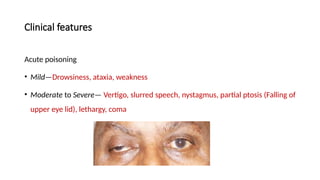
• Mild—Drowsiness, ataxia, weakness
• Moderate to Severe— Vertigo, slurred speech, nystagmus, partial ptosis (Falling of
upper eye lid), lethargy, coma
Clinical features
• Onset of symptoms occurs within 1–2 hours. Ataxia, lethargy, slurred speech and
drowsiness are followed by decreased responsiveness
• Apnoea is a complication of airway obstruction
• In very large ingestions hypothermia, bradycardia and hypotension may occur.
Resolution of CNS depression usually occurs within 12 hours
• More prolonged coma is common in the elderly
Clinical features
• Short acting benzodiazepines (midazolam and triazolam) and intermediate acting
(flunitrazepam) have a higher acute toxicity, as compared to diazepam,
lorazepam and nitrazepam
• Administration of benzodiazepines to a pregnant woman prior to delivery may
produce signs of poisoning in the neonate. A condition called “floppy infant
syndrome”, characterised by hypotonia (muscle weakness) that may last several
days, may occur following maternal diazepam use
Clinical features
Chronic Poisoning
• Long-term use of benzodiazepines is associated with the development of
tolerance
• Abrupt cessation provokes a mild withdrawal reaction characterised by anxiety,
insomnia, head- ache, tremor, and paraesthesia, restlessness
Management
Acute Poisoning
• Decontamination—Ipecac-induced emesis is not recommended because of the potential for
CNS depression
• Stomach wash may be helpful if the patient is seen within 6 to 12 hours after the ingestion
• Endotracheal intubation is a prerequisite in comatose patients
• Activated charcoal adsorbs benzodiazepines and can be administered in the usual manner
Management
• Establish clear airway
• Oxygen and assisted ventilation are often necessary
• IV fluids (Ringer’s lactate at a rate of 150 ml/hr for adults)
• If hypotension persists, administer dopamine or noradrenaline
• Forced diuresis and haemodialysis are ineffective
Antidotes
• Flumazenil is a competitive benzodiazepine antagonist with a limited role in
benzodiazepine overdose. Its indications include:
• Management of airway and breathing when resources are not available to safely
intubate and ventilate the patient
• Diagnostic tool to avoid further investigation
• Reversal of conscious sedation
Antidotes (contd)
• Flumazenil is a recently discovered pharmacologic antagonist of the CNS effects of
benzodiazepines
• It acts by binding CNS benzodiazepine receptors and competitively blocking
benzodiazepine activation of inhibitory GABA ergic synapses
• Most patients achieve complete reversal of benzodiazepine effect with a total slow IV
dose of just 1 mg
Antidotes (contd)
• Flumazenil also has the tendency to induce a withdrawal reaction in
benzodiazepine-dependant patients
• Flumazenil is contraindicated in mixed ingestions involving tricyclic
antidepressants and drugs which induce seizures, e.g. theophylline, chloroquine,
etc
Management
Chronic poisoning
• Phenobarbitone-substitution technique is recommended for benzodiazepine
withdrawal which employs propranolol for acute somatic symptoms, while
phenobarbitone is used for detoxification
• However the most frequently used method is the replacement of a short half-life
benzodiazepine (such as alprazolam) with a long half-life benzodiazepine (such as
clonazepam), before initiating a taper and final discontinuation

BDZ -benzodiazepines toxicology presentation

  • 1.
  • 2.
    OBJECTIVES At the endof this lecture, student will be able to: Explain the mechanism of toxicity, toxicokinetics, clinical signs and symptoms, investigations and management of benzodiazepine overdose
  • 3.
    Introduction • A benzodiazepine(sometimes colloquially "benzo"; often abbreviated "BZD") is a psychoactive drug. • The first such drug, chlordiazepoxide (Librium), was discovered accidentally by Leo Sternbach in 1955, and made available in 1960 by Hoffmann–La Roche, which has also marketed the benzodiazepine diazepam (Valium) since 1963
  • 4.
    Introduction • Benzodiazepines enhancethe effect of the neurotransmitter gamma-aminobutyric acid (GABA) at the GABAA receptor, resulting in sedative, hypnotic (sleep inducing), anxiolytic (anti-anxiety), euphoric, anticonvulsant, and muscle relaxant properties • Wider therapeutic window and lower drug tolerance for abuse with the benzodiazepines
  • 5.
    Mechanism of actionof benzodiazepines  These compounds act by stimulating the GABAA receptors , thereby opening up the chloride ion channel in the receptor complex, resulting in the increased conduction of chloride ion across the nerve cell membrane.  This lowers the potential difference between the interior and exterior of the cell, blocking the ability of the cell to conduct nerve impulses.
  • 6.
    Mechanism of actionof benzodiazepines
  • 7.
    Mechanism of actionof benzodiazepines GABAAR have Two  subunits (1- 6) Two  subunits (1- 3) One  subunit (1- 3) 2, 3 receptors are responsible for anxiolytic action 2 is associated with risk for alcohol dependence ,nicotine, cannabis 1, for sedative action and in part the anticonvulsant action are mediated. 4 , 6 subunits are completely insensitive to Benzodiazepines.
  • 8.
    Classification based onduration of action
  • 10.
    Uses • Due tothe ability to calm the mind and body, benzodiazepines are often used to treat anxiety, panic attacks, insomnia, agitation, muscle spasms, alcohol withdrawal and on occasion, premedication for medical or dental procedures • Anxiolytic : diazepam, lorazepam, oxazepam, alprazolam • Sedative-hypnotic: flurazepam, nitrazepam, triazolam • Anticonvulsant: Diazepam, clonazepam • Muscle relaxant: Diazepam
  • 11.
    Risk assessment • Isolatedbenzodiazepine overdose usually causes only mild sedation, irrespective of the dose ingested, and can be easily managed with simple supportive care • Alprazolam overdose is associated with greater degree of CNS depression and is more likely to require intubation and ventilation • Zolpidem and zopiclone (non-benzodiazepine sedative-hypnotics) rarely cause severe CNS or respiratory depression when taken alone
  • 12.
    Risk assessment (contd) •Co-ingestion of other CNS depressants (e.g. alcohol, opioids) increases the risk of complications, prolonged length of stay and death • The elderly and patients with cardiorespiratory co-morbidities may suffer greater complications • Children: Ingestion of one or two benzodiazepines usually manifests as mild sedation and ataxia within 2 hours
  • 13.
    Benzodiazepine Side effects •Relaxation • Euphoria • Sense of wellbeing • Sedation • Dizziness • Impaired vision • Decreased motor skills/ unsteadiness • Dizziness • The side effects of benzodiazepines are increased when paired with other drugs such as barbiturates, alcohol, narcotics or tranquilizers
  • 14.
    Toxic Mechanism • Benzodiazepinesact by enhancing gamma-amino butyric acid (GABA) mediated neurotransmission. They bind to the GABAA receptor complex and increase the frequency of chloride channel opening • Zolpidem and zopiclone are non-benzodiazepine sedative-hypnotics that also act at the GABAA receptor complex
  • 15.
    Toxicokinetics • Benzodiazepines arerapidly absorbed orally. Most are highly protein bound and have volumes of distribution that vary from 0.5 to 4 L/kg • Benzodiazepines undergo hepatic metabolism • Many have active metabolites. For example, diazepam is metabolized to N- desmethyldiazepam, oxazepam and temazepam, and alprazolam is metabolized to 1- and 4-hydroxyalprazolam
  • 16.
    Toxicokinetics • Duration ofeffect following overdose depends on CNS tolerance and redistribution, rather than rate of elimination • Clinical features of intoxication are poorly correlated to serum benzodiazepine levels
  • 17.
    Clinical features Acute poisoning •Mild—Drowsiness, ataxia, weakness • Moderate to Severe— Vertigo, slurred speech, nystagmus, partial ptosis (Falling of upper eye lid), lethargy, coma
  • 18.
    Clinical features • Onsetof symptoms occurs within 1–2 hours. Ataxia, lethargy, slurred speech and drowsiness are followed by decreased responsiveness • Apnoea is a complication of airway obstruction • In very large ingestions hypothermia, bradycardia and hypotension may occur. Resolution of CNS depression usually occurs within 12 hours • More prolonged coma is common in the elderly
  • 19.
    Clinical features • Shortacting benzodiazepines (midazolam and triazolam) and intermediate acting (flunitrazepam) have a higher acute toxicity, as compared to diazepam, lorazepam and nitrazepam • Administration of benzodiazepines to a pregnant woman prior to delivery may produce signs of poisoning in the neonate. A condition called “floppy infant syndrome”, characterised by hypotonia (muscle weakness) that may last several days, may occur following maternal diazepam use
  • 20.
    Clinical features Chronic Poisoning •Long-term use of benzodiazepines is associated with the development of tolerance • Abrupt cessation provokes a mild withdrawal reaction characterised by anxiety, insomnia, head- ache, tremor, and paraesthesia, restlessness
  • 21.
    Management Acute Poisoning • Decontamination—Ipecac-inducedemesis is not recommended because of the potential for CNS depression • Stomach wash may be helpful if the patient is seen within 6 to 12 hours after the ingestion • Endotracheal intubation is a prerequisite in comatose patients • Activated charcoal adsorbs benzodiazepines and can be administered in the usual manner
  • 22.
    Management • Establish clearairway • Oxygen and assisted ventilation are often necessary • IV fluids (Ringer’s lactate at a rate of 150 ml/hr for adults) • If hypotension persists, administer dopamine or noradrenaline • Forced diuresis and haemodialysis are ineffective
  • 23.
    Antidotes • Flumazenil isa competitive benzodiazepine antagonist with a limited role in benzodiazepine overdose. Its indications include: • Management of airway and breathing when resources are not available to safely intubate and ventilate the patient • Diagnostic tool to avoid further investigation • Reversal of conscious sedation
  • 24.
    Antidotes (contd) • Flumazenilis a recently discovered pharmacologic antagonist of the CNS effects of benzodiazepines • It acts by binding CNS benzodiazepine receptors and competitively blocking benzodiazepine activation of inhibitory GABA ergic synapses • Most patients achieve complete reversal of benzodiazepine effect with a total slow IV dose of just 1 mg
  • 25.
    Antidotes (contd) • Flumazenilalso has the tendency to induce a withdrawal reaction in benzodiazepine-dependant patients • Flumazenil is contraindicated in mixed ingestions involving tricyclic antidepressants and drugs which induce seizures, e.g. theophylline, chloroquine, etc
  • 26.
    Management Chronic poisoning • Phenobarbitone-substitutiontechnique is recommended for benzodiazepine withdrawal which employs propranolol for acute somatic symptoms, while phenobarbitone is used for detoxification • However the most frequently used method is the replacement of a short half-life benzodiazepine (such as alprazolam) with a long half-life benzodiazepine (such as clonazepam), before initiating a taper and final discontinuation