DIARRHEA AND FOOD
POISONING
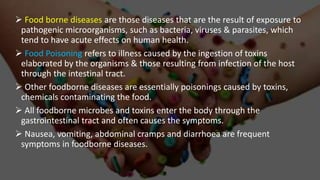
 Food borne diseases are those diseases that are the result of exposure to
pathogenic microorganisms, such as bacteria, viruses & parasites, which
tend to have acute effects on human health.
 Food Poisoning refers to illness caused by the ingestion of toxins
elaborated by the organisms & those resulting from infection of the host
through the intestinal tract.
 Other foodborne diseases are essentially poisonings caused by toxins,
chemicals contaminating the food.
 All foodborne microbes and toxins enter the body through the
gastrointestinal tract and often causes the symptoms.
 Nausea, vomiting, abdominal cramps and diarrhoea are frequent
symptoms in foodborne diseases.
 ACUTE DIARRHEA with or without
vomiting is the predominant symptom of
infective gastroenteritis.
DIARRHEA is an increase in fluid
frequency or volume of bowel movement
relative to the usual habit of the individual.
DYSENTRY is the presence of blood and
mucus in stool, often with tetanus.
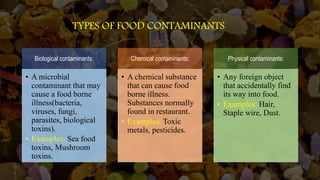
TYPES OF FOOD CONTAMINANTS
Biological contaminants:
• A microbial
contaminant that may
cause a food borne
illness(bacteria,
viruses, fungi,
parasites, biological
toxins).
• Examples: Sea food
toxins, Mushroom
toxins.
Chemical contaminants:
• A chemical substance
that can cause food
borne illness.
Substances normally
found in restaurant.
• Examples: Toxic
metals, pesticides.
Physical contaminants:
• Any foreign object
that accidentally find
its way into food.
• Examples: Hair,
Staple wire, Dust.
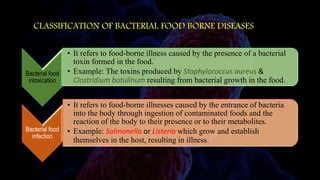
CLASSIFICATION OF BACTERIAL FOOD BORNE DISEASES
Bacterial food
intoxication
• It refers to food-borne illness caused by the presence of a bacterial
toxin formed in the food.
• Example: The toxins produced by Staphylococcus aureus &
Clostridium botulinum resulting from bacterial growth in the food.
Bacterial food
infection
• It refers to food-borne illnesses caused by the entrance of bacteria
into the body through ingestion of contaminated foods and the
reaction of the body to their presence or to their metabolites.
• Example: Salmonella or Listeria which grow and establish
themselves in the host, resulting in illness.
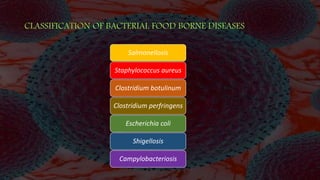
CLASSIFICATION OF BACTERIAL FOOD BORNE DISEASES
Salmonellosis
Staphylococcus aureus
Clostridium botulinum
Clostridium perfringens
Escherichia coli
Shigellosis
Campylobacteriosis
CLINICAL
PRESENTATION
 SMALL INTESTINE PATHOLOGY – manifests as large
voluminous watery stools (enteritis), without pus or blood
(unaided eye & microscopy).
LARGE INTESTINAL PATHOLOGY – usually manifests
as frequent, small-volume stools with pus and or blood
(unaided eye & microscopy)
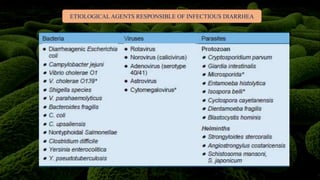
ETIOLOGICAL AGENTS RESPONSIBLE OF INFECTIOUS DIARRHEA
LABORATORY
DIAGNOSIS
 COLLECTION:
A sterile screw – capped wide – mouthed container is used to collect faeces for culture.
If collection of faeces is not possible, a rectal swab can be submitted.
The food implicated and the vomitus of the patient is collected along with the faeces
sample.
TRANSPORT:
Fresh faeces are ideal, but a transport medium such as Cary – Blair or Venkatraman –
Ramakrishnan is used if a delay in transport to the laboratory is anticipated.
For Vibrio cholerae, alkaline peptone water, which also serves as an enrichment medium,
can be used for transport.
MICROSCOPY
WET PREPARATION:
Microscopy of faeces is done to detect pus cells & RBCs, motility of the
organism and ova or cyst of parasites.
SALINE & IODINE PREPARATION:
Microscopy of a wet preparation of faeces is also done to detect helminth ova,
protozoan cyst & protozoan trophozoites.
HANGING DROP PREPARATION:
This is used to detect darting motility, which can suggest the presence of Vibrio
cholerae in a given sample.
If specific 01 antiserum is available, inhibition of motility by adding this can
lead to specific diagnosis.
GRAM – STAINED SMEAR:
Faeces contain many bacteria in a healthy person. Such
situations include:
1. Presence of curved bacilli suggestive of Vibrio
2. Presence of yeasts in an immunocompromised host
or an infant.
ZN STAIN:
Modified acid fast stain can be used for identification
of Cryptosporodium, Isospora & Cyclospora
ELECTRON MICROSCOPY FOR VIRUSES.
CULTURE OF FAECES
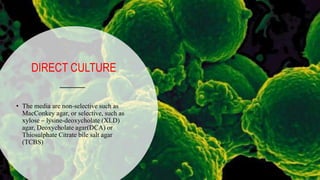
DIRECT CULTURE
• The media are non-selective such as
MacConkey agar, or selective, such as
xylose – lysine-deoxycholate (XLD)
agar, Deoxycholate agar(DCA) or
Thiosulphate Citrate bile salt agar
(TCBS)
Enrichment culture
Fresh faeces are introduced into a liquid culture medium.
EXAMPLE:
Selenite F broth, Tetrathionate broth (incubated 12 -18hours) or Alkaline
peptine water (6 – 8 hours).
A subculture is made om the solid culture medium used for direct plating,
By this method, if the sample contains only a small number of pathogens , the
enrichment medium allows selective growth of the pathogen, which then becomes
easier to isolate.
The organism is identified by biochemical test & serotyping.
Antibiotic sensitivity test is carried out.
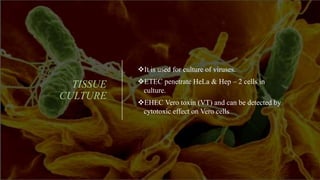
TISSUE
CULTURE
It is used for culture of viruses.
ETEC penetrate HeLa & Hep – 2 cells in
culture.
EHEC Vero toxin (VT) and can be detected by
cytotoxic effect on Vero cells
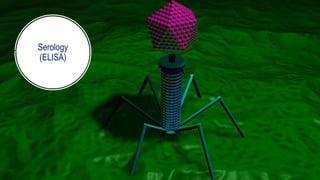
Serology
(ELISA)
ELISA is used for the detection of
E.coli 0157:H7 (EHEC), Shiga toxin &
C. difficile toxins.
It can be used to detect rotaviruses
antigens.
And PCR to detect the Norwalk virus.
DETECTION OF
ENTEROTOXIN
Immunodiffusion, ELISA,
neutralisation and latex
agglutination tests can be
used for detection of toxins.
References
• William C. Frazier, Dennis C. Westhoff, Textbook
of Food Microbiology, Fourth Edition.
• WM Foster, Textbook of Food Microbiology, First
Edition.
• Ananthanarayan and
panikar’s, Textbook of Microbiology.Pg.no.684-686.
10th Edition.
Diarrhea & Food poisoning

Diarrhea & Food poisoning

  • 1.
  • 2.
     Food bornediseases are those diseases that are the result of exposure to pathogenic microorganisms, such as bacteria, viruses & parasites, which tend to have acute effects on human health.  Food Poisoning refers to illness caused by the ingestion of toxins elaborated by the organisms & those resulting from infection of the host through the intestinal tract.  Other foodborne diseases are essentially poisonings caused by toxins, chemicals contaminating the food.  All foodborne microbes and toxins enter the body through the gastrointestinal tract and often causes the symptoms.  Nausea, vomiting, abdominal cramps and diarrhoea are frequent symptoms in foodborne diseases.
  • 3.
     ACUTE DIARRHEAwith or without vomiting is the predominant symptom of infective gastroenteritis. DIARRHEA is an increase in fluid frequency or volume of bowel movement relative to the usual habit of the individual. DYSENTRY is the presence of blood and mucus in stool, often with tetanus.
  • 4.
    TYPES OF FOODCONTAMINANTS Biological contaminants: • A microbial contaminant that may cause a food borne illness(bacteria, viruses, fungi, parasites, biological toxins). • Examples: Sea food toxins, Mushroom toxins. Chemical contaminants: • A chemical substance that can cause food borne illness. Substances normally found in restaurant. • Examples: Toxic metals, pesticides. Physical contaminants: • Any foreign object that accidentally find its way into food. • Examples: Hair, Staple wire, Dust.
  • 5.
    CLASSIFICATION OF BACTERIALFOOD BORNE DISEASES Bacterial food intoxication • It refers to food-borne illness caused by the presence of a bacterial toxin formed in the food. • Example: The toxins produced by Staphylococcus aureus & Clostridium botulinum resulting from bacterial growth in the food. Bacterial food infection • It refers to food-borne illnesses caused by the entrance of bacteria into the body through ingestion of contaminated foods and the reaction of the body to their presence or to their metabolites. • Example: Salmonella or Listeria which grow and establish themselves in the host, resulting in illness.
  • 6.
    CLASSIFICATION OF BACTERIALFOOD BORNE DISEASES Salmonellosis Staphylococcus aureus Clostridium botulinum Clostridium perfringens Escherichia coli Shigellosis Campylobacteriosis
  • 7.
  • 8.
     SMALL INTESTINEPATHOLOGY – manifests as large voluminous watery stools (enteritis), without pus or blood (unaided eye & microscopy). LARGE INTESTINAL PATHOLOGY – usually manifests as frequent, small-volume stools with pus and or blood (unaided eye & microscopy)
  • 10.
    ETIOLOGICAL AGENTS RESPONSIBLEOF INFECTIOUS DIARRHEA
  • 11.
  • 12.
     COLLECTION: A sterilescrew – capped wide – mouthed container is used to collect faeces for culture. If collection of faeces is not possible, a rectal swab can be submitted. The food implicated and the vomitus of the patient is collected along with the faeces sample. TRANSPORT: Fresh faeces are ideal, but a transport medium such as Cary – Blair or Venkatraman – Ramakrishnan is used if a delay in transport to the laboratory is anticipated. For Vibrio cholerae, alkaline peptone water, which also serves as an enrichment medium, can be used for transport.
  • 13.
  • 14.
    WET PREPARATION: Microscopy offaeces is done to detect pus cells & RBCs, motility of the organism and ova or cyst of parasites. SALINE & IODINE PREPARATION: Microscopy of a wet preparation of faeces is also done to detect helminth ova, protozoan cyst & protozoan trophozoites. HANGING DROP PREPARATION: This is used to detect darting motility, which can suggest the presence of Vibrio cholerae in a given sample. If specific 01 antiserum is available, inhibition of motility by adding this can lead to specific diagnosis.
  • 15.
    GRAM – STAINEDSMEAR: Faeces contain many bacteria in a healthy person. Such situations include: 1. Presence of curved bacilli suggestive of Vibrio 2. Presence of yeasts in an immunocompromised host or an infant. ZN STAIN: Modified acid fast stain can be used for identification of Cryptosporodium, Isospora & Cyclospora ELECTRON MICROSCOPY FOR VIRUSES.
  • 16.
  • 17.
    DIRECT CULTURE • Themedia are non-selective such as MacConkey agar, or selective, such as xylose – lysine-deoxycholate (XLD) agar, Deoxycholate agar(DCA) or Thiosulphate Citrate bile salt agar (TCBS)
  • 18.
    Enrichment culture Fresh faecesare introduced into a liquid culture medium. EXAMPLE: Selenite F broth, Tetrathionate broth (incubated 12 -18hours) or Alkaline peptine water (6 – 8 hours). A subculture is made om the solid culture medium used for direct plating, By this method, if the sample contains only a small number of pathogens , the enrichment medium allows selective growth of the pathogen, which then becomes easier to isolate. The organism is identified by biochemical test & serotyping. Antibiotic sensitivity test is carried out.
  • 19.
    TISSUE CULTURE It is usedfor culture of viruses. ETEC penetrate HeLa & Hep – 2 cells in culture. EHEC Vero toxin (VT) and can be detected by cytotoxic effect on Vero cells
  • 20.
  • 21.
    ELISA is usedfor the detection of E.coli 0157:H7 (EHEC), Shiga toxin & C. difficile toxins. It can be used to detect rotaviruses antigens. And PCR to detect the Norwalk virus.
  • 22.
    DETECTION OF ENTEROTOXIN Immunodiffusion, ELISA, neutralisationand latex agglutination tests can be used for detection of toxins.
  • 23.
    References • William C.Frazier, Dennis C. Westhoff, Textbook of Food Microbiology, Fourth Edition. • WM Foster, Textbook of Food Microbiology, First Edition. • Ananthanarayan and panikar’s, Textbook of Microbiology.Pg.no.684-686. 10th Edition.