DR.V.PADMA
M.D,FRCP(Glasgow).
PROFESSOR OF MEDICINE
SREE BALAJI MEDICAL COLLEGE
Epidemiology of Diarrhoea
Leading cause of illness and death among children in
developing countries.
estimated 1.3 thousand million episodes and 4 million
deaths occur each year in under-fives.
Main cause of death from acute diarrhoea is
dehydration. Other important causes of death are
dysentery and undernutrition.
Definitions
Acute Diarrhoea
 sudden onset and lasts less than two weeks
 90% are infectious in etiology
 10% are caused by medications, toxin ingestions, and
ischemia
Chronic Diarrhoea
 Diarrhoea which lasts for more than 4 weeks
 Most of the causes are non-infectious
Persistent Diarrhoea
-Diarrhoea lasting between 2 to 4 weeks
Classifications of Diarrhoea
Duration-
( Acute, Chronic)
Causes-
( infectious, post-infectious, drugs, endocrine,
factitious)
Chronic Dirrhoea-
Pathophysiologic mechanism
(osmotic, secretory, inflammatory, abnormal
motility)
Mechanism of Diarrhoea
Osmotic Diarrhoea
Secretory Diarrhoea
Inflammatory Diarrhoea
Abnormal Motility Diarrhoea
Osmotic Diarrhoea
Mechanism :
-retention of water in the bowel as a result of an
accumulation of non-absorbable water-soluble
compounds
-cease with fasting, discontinue oral agents
Causes :
-Purgatives like magnesium sulfate or magnesium
containing antacids
-especially associated with excessive intake of sorbitol
and mannitol.
-Disaccharide intolerance
-Generalized malabsorption
Secretory Diarrhoea
Mechanism :
Active intestinal secretion of fluid and electrolytes as
well as decreased absorption.
Large volume, painless, persist with fasting
Causes :
Cholera enterotoxin, heat labile E.coli enterotoxin
Vasoactive Intestinal Peptide hormone in Verner-
Morrison syndrome
Bile salts in colon following ileal resection
Laxatives like docusate sodium
Carcinoid tumours
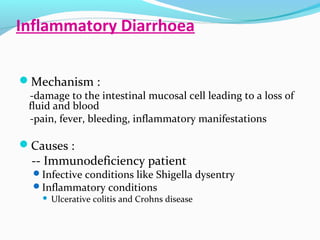
Inflammatory Diarrhoea
Mechanism :
-damage to the intestinal mucosal cell leading to a loss of
fluid and blood
-pain, fever, bleeding, inflammatory manifestations
Causes :
-- Immunodeficiency patient
Infective conditions like Shigella dysentry
Inflammatory conditions
 Ulcerative colitis and Crohns disease
Abnormal Motility Diarrhoea
Mechanism :
-Increased frequency of defecation due to underlying
diseases
-large volume, signs of malabsorption (steatorrhoea)
Causes :
Diabetes mellitus- autonomic neuropathy
Post vagotomy
Hyperthyroid diarrhoea
Irritable Bowel Syndrome
Etiology
Non- inflammatory :
enterotoxin production
Villus destruction
Adherence to surface
Inflammatory:
Direct invasion
cytotoxins
Mucosal adherence
- Bacteria adhere to specific receptors
on the mucosa, e.g. adhesions at the
tip of the pili or fimbriae
- Mode of action: effacement of
intestinal mucosa causing lesions,
produce secretory diarrhoea as a
result of adherence
- Causing moderate watery diarrhoea
- e.g. enteropathogenic E.coli
Mucosa Invasion
- The bacteria penetrate into the intestinal mucosa,
destroying the epithelial cells and causing dysentery
- e.g. Shigella spp.
Enteroinvasive E.coli
Campylobacter spp
Toxin Production
i) Enterotoxins
- toxin produced by bacteria adhere to the intestinal epithelium,
induce excessive fluid secretion into the bowel lumen, results in
watery diarrhoea without physically damaging the mucosa.
- Some enterotoxin preformed in the food can cause vomiting
- e.g Staph.aureus (enterotoxin B)
Bacillus cereus
Vibrio cholerae
ii) Cytotoxins
- damage the intestinal mucosa and sometimes vascular
endothelium, leads to bloody diarrhoea with inflammatory cells,
decreased absorptive ability.
- e.g. Salmonella spp.
Campylobacter spp.
Enterohaemorrhagic E.coli 0157
Bacterial
Campylobacter jejuni
Salmonella sp.
Shigella
Escherichia coli
Staphylococcal enterocolitis
Bacillus cereus
Clostridium perfringens
Clostridium botulinum
Gastrointestinal tuberculosis
Viral
Rotavirus
Norovirus
Adenovirus
Protozoa
• Entamoeba histolytica
• Cryptosporidium
• Giardia intestinalis
• Schistosomiasis
1. Travelers
Tourists to Latin America, Africa, and
Asia develop “traveler's diarrhea”
commonly due to enterotoxigenic
Escherichia coli, Campylobacter, Shigella,
and Salmonella.
Visitors to Russia may have increase risk
of Giardia-associated diarrhea.
Visitors to Nepal may acquire Cyclospora.
Campers, backpackers, and swimmers in
wilderness areas may become infected
with Giardia.
Consumers of Certain Food
Diarrhea closely following food
consumption may suggest infection with
Salmonella or Campylobacter from chicken;
Enterohemorrhagic Escherichia coli (O157:H7)
from undercooked hamburger
Bacillus aureus from fried rice
S. aureus from mayonnaise or creams
Salmonella from eggs
Vibro species, acute hepatitis A or B from (raw)
seafood
Clinical Features
Diarrhoea
Watery
Bloody
Cramping abdominal pain
Nausea, +/- Vomiting
Fever
Loss of appetite
Lethargy
Shock
Extraintestinal manifestation
Reactive arthritis :Salmonella ,shigella , Yersinia,
campylobacter C.difficile
Guillain-Barre Syndrome: campylobacter
Glomerulonephritis:Shigella , campylobacter
,Yersinia
IgA nephropathy :campylobacter
Erythema nodosum: Yersinia ,campylobacter,
salmonella
Hemolytic anemia : Yersinia ,campylobacter
HUS: shigella , E. coli
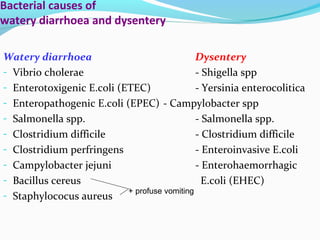
Bacterial causes of
watery diarrhoea and dysentery
Watery diarrhoea Dysentery
- Vibrio cholerae - Shigella spp
- Enterotoxigenic E.coli (ETEC) - Yersinia enterocolitica
- Enteropathogenic E.coli (EPEC) - Campylobacter spp
- Salmonella spp. - Salmonella spp.
- Clostridium difficile - Clostridium difficile
- Clostridium perfringens - Enteroinvasive E.coli
- Campylobacter jejuni - Enterohaemorrhagic
- Bacillus cereus E.coli (EHEC)
- Staphylococus aureus
+ profuse vomiting
Diurnal variation
 No relationship to time of day: Infectious Diarrhea
 Morning Diarrhea and after meals
 Gastric cause
 Functional bowel disorder (e.g. irritable bowel)
 Inflammatory Bowel Disease
 Nocturnal Diarrhea (always organic)
 Diabetic Neuropathy
 Inflammatory Bowel Disease
Weight Loss
 Despite normal appetite
 Hyperthyroidism
 Malabsorption
 Associated with fever
 Inflammatory Bowel Disease
 Weight loss prior to Diarrhea onset
 Pancreatic Cancer
 Tuberculosis
 Diabetes Mellitus
 Hyperthyroidism
 Malabsorption
Acute Diarrhoea
Viral,Bacterial,
Protozoa (90%)
Medications
Laxatives or diuretic
abuse
Ingestion of
environmental
preformed toxin such as
seafood
Ischemic Colitis
Graft versus Host
Chronic Diarrhoea
Irritable Bowel
Syndrome
Diverticular disease
Colorectal Cancer
Bowel Resection
Malabsorption
Inflammatory Bowel
Disease
Celiac Disease
Carcinoid tumour
DIFFERENTIAL DIAGNOSIS
Food intolerance e.g. Lactose intolerance,
Inorganic agents like Sodium nitrite,
Organic substances like Mushrooms and shellfish,
Drugs e.g. Laxatives and Antibiotics,
Emotional stress.
Diagnostic Methods
Stool samples :
 fresh collected
Mucous,bld,white cells
Ova & parasites:
Recent travel to endemic area,-ve stool cultures,diarrhea > 1wk
Part of an outbreak
Immunocompromised
Stool cultures:
As early as possible
Suspected HUS
Bloody diarrhea
outbreaks
Diagnostic Methods
Stool cultures :
Routine : Salmonella, shigella,yersinia,campylobacter.
Toxin assays: C. difficle,E.coli
Special stains:Aeromonas, cryptosporidium & vibrio sp.
Duodenal aspirate & Biopsy: Giardia,
Isospora,cryptosporidium.
ELISA
E.M.
Colonoscopy & sigmoidoscopy.
DRUG INDUCED DIARRHOEA
Antibiotics
Laxatives
Antihypertensives
Lactulose
Antineoplastics
Antiretroviral drugs
Magnesium containing
compounds
Anti arrhythmics
NSAIDs
Colchicine
Antacids
Acid reducing agents
Prostaglandin analogs
Antibiotic-induced diarrhea
unexplained onset of diarrhea that occurs with the
administration of any antibiotic
due to disruption of normal intestinal flora, which
leads to
either proliferation of pathogenic microorganisms or
impairment of the metabolic functions of the
microflora
Endocrine causes
Diabetic autonomic neuropathy
Thyrotoxicosis
Neuroendocrine tumours
~ Zollinger Ellison syndrome
~ VIPoma
~ Somatostatinoma
~ Carcinoid syndrome
~ Medullary carcinoma of thyroid
 Hypokalaemia
 Depletional hyponatraemia
 Hypernatraemia
 Hypophosphataemia
 Hypomagnesemia
 Dehydration
 Hypovolaemic shock
Acute Diarrhoea : Management
Access Hydration Status
Encourage fluids intake
Consider antibiotics if ill or frail
Consider referring if very ill, diabetic on insulin or
metformin
Children and Elderly are especially prone to
dehydration.
A child should be encouraged by their preferred diet.
Breastfeeding should be continued and alternate with
ORS
Oral Rehydration Therapy
Sodium chloride 3.5 g
Trisodium citrate dehydrate 2.9 g
(or sodium bicarbonate 2.5g)
Potassium chloride 1.5g
Glucose 20 g
To be dissolved in one litre of clean drinking water
encourage fluid intake e.g. salt + glucose drink to assist
in co-transport of sodium into the epithelial cells via
the SGLT1 protein, which enhances water and sodium
re-absorption in small intestines.
Ims diarrhoea-1
Ims diarrhoea-1
Ims diarrhoea-1
Ims diarrhoea-1
Ims diarrhoea-1
Ims diarrhoea-1
Ims diarrhoea-1
Ims diarrhoea-1
Ims diarrhoea-1

Ims diarrhoea-1

  • 1.
  • 2.
    Epidemiology of Diarrhoea Leadingcause of illness and death among children in developing countries. estimated 1.3 thousand million episodes and 4 million deaths occur each year in under-fives. Main cause of death from acute diarrhoea is dehydration. Other important causes of death are dysentery and undernutrition.
  • 3.
    Definitions Acute Diarrhoea  suddenonset and lasts less than two weeks  90% are infectious in etiology  10% are caused by medications, toxin ingestions, and ischemia Chronic Diarrhoea  Diarrhoea which lasts for more than 4 weeks  Most of the causes are non-infectious Persistent Diarrhoea -Diarrhoea lasting between 2 to 4 weeks
  • 4.
    Classifications of Diarrhoea Duration- (Acute, Chronic) Causes- ( infectious, post-infectious, drugs, endocrine, factitious) Chronic Dirrhoea- Pathophysiologic mechanism (osmotic, secretory, inflammatory, abnormal motility)
  • 5.
    Mechanism of Diarrhoea OsmoticDiarrhoea Secretory Diarrhoea Inflammatory Diarrhoea Abnormal Motility Diarrhoea
  • 6.
    Osmotic Diarrhoea Mechanism : -retentionof water in the bowel as a result of an accumulation of non-absorbable water-soluble compounds -cease with fasting, discontinue oral agents Causes : -Purgatives like magnesium sulfate or magnesium containing antacids -especially associated with excessive intake of sorbitol and mannitol. -Disaccharide intolerance -Generalized malabsorption
  • 7.
    Secretory Diarrhoea Mechanism : Activeintestinal secretion of fluid and electrolytes as well as decreased absorption. Large volume, painless, persist with fasting Causes : Cholera enterotoxin, heat labile E.coli enterotoxin Vasoactive Intestinal Peptide hormone in Verner- Morrison syndrome Bile salts in colon following ileal resection Laxatives like docusate sodium Carcinoid tumours
  • 8.
    Inflammatory Diarrhoea Mechanism : -damageto the intestinal mucosal cell leading to a loss of fluid and blood -pain, fever, bleeding, inflammatory manifestations Causes : -- Immunodeficiency patient Infective conditions like Shigella dysentry Inflammatory conditions  Ulcerative colitis and Crohns disease
  • 9.
    Abnormal Motility Diarrhoea Mechanism: -Increased frequency of defecation due to underlying diseases -large volume, signs of malabsorption (steatorrhoea) Causes : Diabetes mellitus- autonomic neuropathy Post vagotomy Hyperthyroid diarrhoea Irritable Bowel Syndrome
  • 10.
    Etiology Non- inflammatory : enterotoxinproduction Villus destruction Adherence to surface Inflammatory: Direct invasion cytotoxins
  • 13.
    Mucosal adherence - Bacteriaadhere to specific receptors on the mucosa, e.g. adhesions at the tip of the pili or fimbriae - Mode of action: effacement of intestinal mucosa causing lesions, produce secretory diarrhoea as a result of adherence - Causing moderate watery diarrhoea - e.g. enteropathogenic E.coli
  • 14.
    Mucosa Invasion - Thebacteria penetrate into the intestinal mucosa, destroying the epithelial cells and causing dysentery - e.g. Shigella spp. Enteroinvasive E.coli Campylobacter spp
  • 15.
    Toxin Production i) Enterotoxins -toxin produced by bacteria adhere to the intestinal epithelium, induce excessive fluid secretion into the bowel lumen, results in watery diarrhoea without physically damaging the mucosa. - Some enterotoxin preformed in the food can cause vomiting - e.g Staph.aureus (enterotoxin B) Bacillus cereus Vibrio cholerae ii) Cytotoxins - damage the intestinal mucosa and sometimes vascular endothelium, leads to bloody diarrhoea with inflammatory cells, decreased absorptive ability. - e.g. Salmonella spp. Campylobacter spp. Enterohaemorrhagic E.coli 0157
  • 16.
    Bacterial Campylobacter jejuni Salmonella sp. Shigella Escherichiacoli Staphylococcal enterocolitis Bacillus cereus Clostridium perfringens Clostridium botulinum Gastrointestinal tuberculosis
  • 17.
    Viral Rotavirus Norovirus Adenovirus Protozoa • Entamoeba histolytica •Cryptosporidium • Giardia intestinalis • Schistosomiasis
  • 19.
    1. Travelers Tourists toLatin America, Africa, and Asia develop “traveler's diarrhea” commonly due to enterotoxigenic Escherichia coli, Campylobacter, Shigella, and Salmonella. Visitors to Russia may have increase risk of Giardia-associated diarrhea. Visitors to Nepal may acquire Cyclospora. Campers, backpackers, and swimmers in wilderness areas may become infected with Giardia.
  • 24.
    Consumers of CertainFood Diarrhea closely following food consumption may suggest infection with Salmonella or Campylobacter from chicken; Enterohemorrhagic Escherichia coli (O157:H7) from undercooked hamburger Bacillus aureus from fried rice S. aureus from mayonnaise or creams Salmonella from eggs Vibro species, acute hepatitis A or B from (raw) seafood
  • 25.
    Clinical Features Diarrhoea Watery Bloody Cramping abdominalpain Nausea, +/- Vomiting Fever Loss of appetite Lethargy Shock
  • 26.
    Extraintestinal manifestation Reactive arthritis:Salmonella ,shigella , Yersinia, campylobacter C.difficile Guillain-Barre Syndrome: campylobacter Glomerulonephritis:Shigella , campylobacter ,Yersinia IgA nephropathy :campylobacter Erythema nodosum: Yersinia ,campylobacter, salmonella Hemolytic anemia : Yersinia ,campylobacter HUS: shigella , E. coli
  • 28.
    Bacterial causes of waterydiarrhoea and dysentery Watery diarrhoea Dysentery - Vibrio cholerae - Shigella spp - Enterotoxigenic E.coli (ETEC) - Yersinia enterocolitica - Enteropathogenic E.coli (EPEC) - Campylobacter spp - Salmonella spp. - Salmonella spp. - Clostridium difficile - Clostridium difficile - Clostridium perfringens - Enteroinvasive E.coli - Campylobacter jejuni - Enterohaemorrhagic - Bacillus cereus E.coli (EHEC) - Staphylococus aureus + profuse vomiting
  • 29.
    Diurnal variation  Norelationship to time of day: Infectious Diarrhea  Morning Diarrhea and after meals  Gastric cause  Functional bowel disorder (e.g. irritable bowel)  Inflammatory Bowel Disease  Nocturnal Diarrhea (always organic)  Diabetic Neuropathy  Inflammatory Bowel Disease
  • 30.
    Weight Loss  Despitenormal appetite  Hyperthyroidism  Malabsorption  Associated with fever  Inflammatory Bowel Disease  Weight loss prior to Diarrhea onset  Pancreatic Cancer  Tuberculosis  Diabetes Mellitus  Hyperthyroidism  Malabsorption
  • 31.
    Acute Diarrhoea Viral,Bacterial, Protozoa (90%) Medications Laxativesor diuretic abuse Ingestion of environmental preformed toxin such as seafood Ischemic Colitis Graft versus Host Chronic Diarrhoea Irritable Bowel Syndrome Diverticular disease Colorectal Cancer Bowel Resection Malabsorption Inflammatory Bowel Disease Celiac Disease Carcinoid tumour
  • 33.
    DIFFERENTIAL DIAGNOSIS Food intolerancee.g. Lactose intolerance, Inorganic agents like Sodium nitrite, Organic substances like Mushrooms and shellfish, Drugs e.g. Laxatives and Antibiotics, Emotional stress.
  • 36.
    Diagnostic Methods Stool samples:  fresh collected Mucous,bld,white cells Ova & parasites: Recent travel to endemic area,-ve stool cultures,diarrhea > 1wk Part of an outbreak Immunocompromised Stool cultures: As early as possible Suspected HUS Bloody diarrhea outbreaks
  • 37.
    Diagnostic Methods Stool cultures: Routine : Salmonella, shigella,yersinia,campylobacter. Toxin assays: C. difficle,E.coli Special stains:Aeromonas, cryptosporidium & vibrio sp. Duodenal aspirate & Biopsy: Giardia, Isospora,cryptosporidium. ELISA E.M. Colonoscopy & sigmoidoscopy.
  • 47.
    DRUG INDUCED DIARRHOEA Antibiotics Laxatives Antihypertensives Lactulose Antineoplastics Antiretroviraldrugs Magnesium containing compounds Anti arrhythmics NSAIDs Colchicine Antacids Acid reducing agents Prostaglandin analogs
  • 48.
    Antibiotic-induced diarrhea unexplained onsetof diarrhea that occurs with the administration of any antibiotic due to disruption of normal intestinal flora, which leads to either proliferation of pathogenic microorganisms or impairment of the metabolic functions of the microflora
  • 49.
    Endocrine causes Diabetic autonomicneuropathy Thyrotoxicosis Neuroendocrine tumours ~ Zollinger Ellison syndrome ~ VIPoma ~ Somatostatinoma ~ Carcinoid syndrome ~ Medullary carcinoma of thyroid
  • 51.
     Hypokalaemia  Depletionalhyponatraemia  Hypernatraemia  Hypophosphataemia  Hypomagnesemia  Dehydration  Hypovolaemic shock
  • 53.
    Acute Diarrhoea :Management Access Hydration Status Encourage fluids intake Consider antibiotics if ill or frail Consider referring if very ill, diabetic on insulin or metformin Children and Elderly are especially prone to dehydration. A child should be encouraged by their preferred diet. Breastfeeding should be continued and alternate with ORS
  • 54.
    Oral Rehydration Therapy Sodiumchloride 3.5 g Trisodium citrate dehydrate 2.9 g (or sodium bicarbonate 2.5g) Potassium chloride 1.5g Glucose 20 g To be dissolved in one litre of clean drinking water encourage fluid intake e.g. salt + glucose drink to assist in co-transport of sodium into the epithelial cells via the SGLT1 protein, which enhances water and sodium re-absorption in small intestines.