


Dr. Osama El-Shahat
Consultant Nephrologist
Head of Nephrology Department
New Mansoura General Hospital (international)
ISN Educational Ambassador
Objectives
When
What
HOW
to start ?
Modality ?
can we do it ?
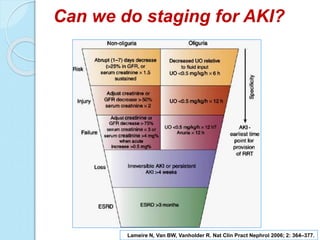
Lameire N, Van BW, Vanholder R. Nat Clin Pract Nephrol 2006; 2: 364–377.
Can we do staging for AKI?
AKIN Classification
What is the advantages of
RIFLE Criteria?
 Applying the RIFLE criteria revealed new insights.
 Firstly, the RIFLE classification is feasible and
fairly straightforward.
 Secondly, the patients categorized as RIFLE-F had
a far higher mortality than RIFLE-I and -R patients.
Max Bell et al; Nephrol Dial Transplant 2005 20:354 –360
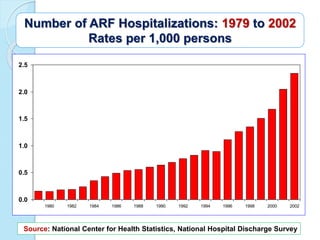
Number of ARF Hospitalizations: 1979 to 2002
Rates per 1,000 persons
0.0
0.5
1.0
1.5
2.0
2.5
1980 1982 1984 1986 1988 1990 1992 1994 1996 1998 2000 2002
Source: National Center for Health Statistics, National Hospital Discharge Survey
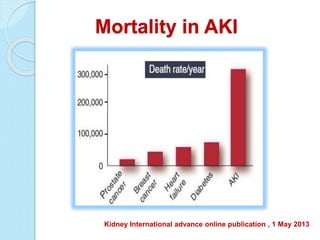
Kidney International advance online publication , 1 May 2013
Mortality in AKI
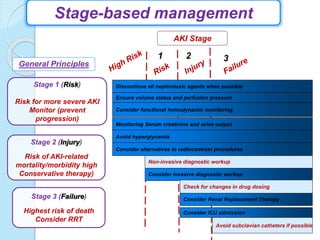
Stage-based management
General Principles
Stage 1 (Risk)
Risk for more severe AKI
Monitor (prevent
progression)
Stage 2 (Injury)
Risk of AKI-related
mortality/morbidity high
Conservative therapy)
Stage 3 (Failure)
Highest risk of death
Consider RRT
Avoid subclavian catheters if possible
Discontinue all nephrotoxic agents when possible
Consider invasive diagnostic workup
Consider Renal Replacement Therapy
1 2 3
Non-invasive diagnostic workup
Ensure volume status and perfusion pressure
Check for changes in drug dosing
AKI Stage
Consider functional hemodynamic monitoring
Monitoring Serum creatinine and urine output
Consider ICU admission
Avoid hyperglycemia
Consider alternatives to radiocontrast procedures
Whento start ?
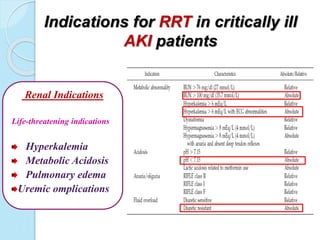
Indications for RRT in critically ill
AKI patients
Renal Indications
Life-threatening indications
Hyperkalemia
Metabolic Acidosis
Pulmonary edema
Uremic omplications
Dialysis Interventions for Treatment of
AKI
 5.1.1: Initiate RRT emergently when life-threatening
changes in fluid, electrolyte, and acid-base balance
exist.(Not Graded)
 5.1.2: Consider the broader clinical context, the
presence of conditions that can be modified with
RRT, and trends of laboratory tests—rather than
single BUN and creatinine thresholds alone—when
making the decision to start RRT. (Not Graded)
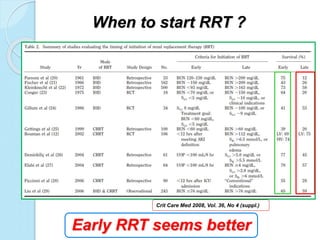
When to start RRT ?
Crit Care Med 2008, Vol. 36, No 4 (suppl.)
Early RRT seems better
What Modality?
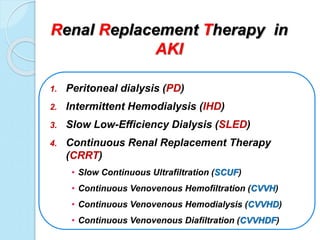
Renal Replacement Therapy in
AKI
1. Peritoneal dialysis (PD)
2. Intermittent Hemodialysis (IHD)
3. Slow Low-Efficiency Dialysis (SLED)
4. Continuous Renal Replacement Therapy
(CRRT)
• Slow Continuous Ultrafiltration (SCUF)
• Continuous Venovenous Hemofiltration (CVVH)
• Continuous Venovenous Hemodialysis (CVVHD)
• Continuous Venovenous Diafiltration (CVVHDF)
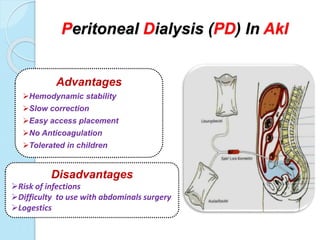
Peritoneal Dialysis (PD) In AkI
Advantages
Hemodynamic stability
Slow correction
Easy access placement
No Anticoagulation
Tolerated in children
Disadvantages
Risk of infections
Difficulty to use with abdominals surgery
Logestics
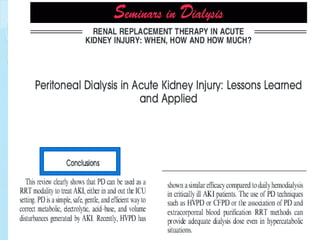
PD … the modality first used for the treatment of KI
Blood Purif 2013;36:226–230 DOI: 10.1159/000356627
What are the modalities of CRRT ?
Mode of
therapy
Principle method of
solute clearance
CVVH Convection
CVVHD Diffusion
CVVHDF Convection & Diffusion
SCUF Ultrafiltration (fluids)
Potential Advantages of CRRT
Homodynamic stability
Recovery of renal function
Brain edema
Biocompatibility
Removal of cytokines
Nutritional support
Correction of metabolic acidosis
CVVH Avoids Hypertensive Episodes
Ronco C et al Kidney Int 56 ( suppl 72 ) s-8-s-14 , 1999
Dialysis Interventions for Treatment
of AKI
5.6.2: We suggest using CRRT, rather than
standard intermittent RRT, for hemodynamically
unstable patients. (2B)
5.6.1: Use continuous and intermittent RRT as
complementary therapies in AKI patients. (Not Graded
Recovery from ARF in IHD vs CRRT
Study Modality
% recovering renal
function
SUPPORT IHD* 67%**
Morgera et al. CRRT 90%
Ronco et al. CRRT 90%
Mehta et al.
IHD
CRRT
59%
92%
BEST Kidney†
IHD
CRRT
65%
89%
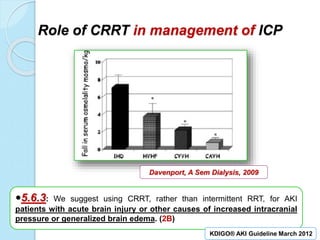
Role of CRRT in management of ICP
Davenport, A Sem Dialysis, 2009
5.6.3: We suggest using CRRT, rather than intermittent RRT, for AKI
patients with acute brain injury or other causes of increased intracranial
pressure or generalized brain edema. (2B)
KDIGO® AKI Guideline March 2012
Removal of Cytokine
 The elimination of
inflamatory mediator
occurs only during the 1st
hour after application of
new filter.
 Cytokines removal
capacity of curently
available membranes
hardly matches the
productin observed in
severly affected septic
patients.
De Vriese As-JAM Soc Nephrol 10-846-853 1999
Is their an alternative to CRRT ?
 Typically performed over 6-12 hours
 Can be performed with a conventional dialysis
machine
– A little less labor intensive
– Requires less training/startup
Fliser D and KielsteiJT Nat Clin Pract Nephrol, 2006
Slow Low-Efficiency Daily Dialysis (SLED)
Slow Low-Efficiency Daily Dialysis
(SLED)
 Major advantages: flexibility, reduced
costs, low or absent anticoagulation
 Similar adequacy and hemodynamics
One small study (16 pts) showed slightly higher
acidosis and lower BP (Baldwin 2007)
VA trial (Palevsky NEJM 2008) suggests similar
outcomes as CRRT and IRRT.
Vanholder et al. Critical Care 2011, 15:204
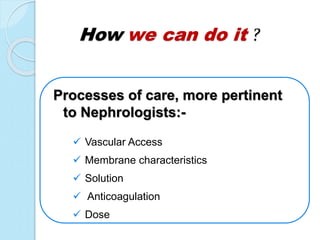
How we can do it ?
Processes of care, more pertinent
to Nephrologists:-
 Vascular Access
 Membrane characteristics
 Solution
 Anticoagulation
 Dose
 5.4.1: We suggest initiating RRT in patients with AKI via an
uncuffed nontunneled dialysis catheter, rather than a
tunneled catheter. (2D)
 5.4.2: When choosing a vein for insertion of a dialysis
catheter in patients with AKI, consider these preferences
(Not Graded):
 First choice: right jugular vein;
 Second choice: femoral vein;
 Third choice: left jugular vein;
 Last choice: subclavian vein with preference for the dominant side.
Vascular access
KDIGO® AKI Guideline March 2012
Vascular access
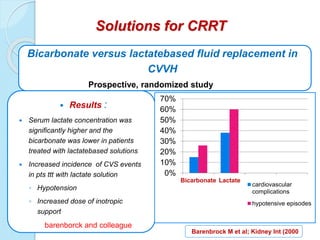
Bicarbonate versus lactatebased fluid replacement in
CVVH
Prospective, randomized study
 Results :
 Serum lactate concentration was
significantly higher and the
bicarbonate was lower in patients
treated with lactatebased solutions
 Increased incidence of CVS events
in pts ttt with lactate solution
◦ Hypotension
◦ Increased dose of inotropic
support
barenborck and colleague
Barenbrock M et al; Kidney Int (2000
0%
10%
20%
30%
40%
50%
60%
70%
Bicarbonate Lactate
cardiovascular
complications
hypotensive episodes
Solutions for CRRT
Dialysis Interventions for
Treatment of AKI
5.7.3: We suggest using bicarbonate, rather
than lactate, as a buffer in dialysate and
replacement fluid for RRT in patients with
AKI and liver failure and/or lactic acidemia. (2B)
KDIGO® AKI Guideline March 2012
The Membrane
 5.5.1: We suggest to use dialyzers with a biocompatible
membrane for IHD and CRRT in patients with AKI. (2C)
 High Flux membrane , synthetic , biocompatable , acting
by providing both methods of detoxications:
a) Diffusion : for low molecular weight toxins.
b) Convection : for large molecules.
KDIGO® AKI Guideline March 2012
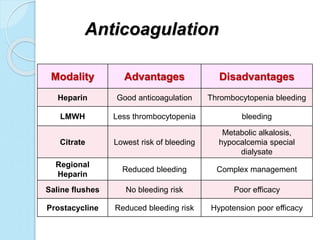
Anticoagulation
Modality Advantages Disadvantages
Heparin Good anticoagulation Thrombocytopenia bleeding
LMWH Less thrombocytopenia bleeding
Citrate Lowest risk of bleeding
Metabolic alkalosis,
hypocalcemia special
dialysate
Regional
Heparin
Reduced bleeding Complex management
Saline flushes No bleeding risk Poor efficacy
Prostacycline Reduced bleeding risk Hypotension poor efficacy
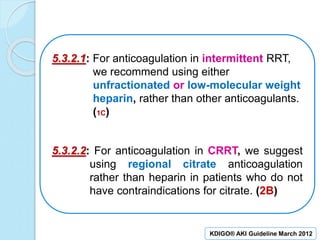
5.3.2.1: For anticoagulation in intermittent RRT,
we recommend using either
unfractionated or low-molecular weight
heparin, rather than other anticoagulants.
(1C)
5.3.2.2: For anticoagulation in CRRT, we suggest
using regional citrate anticoagulation
rather than heparin in patients who do not
have contraindications for citrate. (2B)
KDIGO® AKI Guideline March 2012
Dose
 RCT of 1124 critically ill pts with AKI and sepsis or at least
one organ failure to intensive or less intensive renal-
replacement therapy
 Hemodynamically unstable pts received CRRT or SLEDD,
 Stable pts IRRT
 Intensive RRT= IRRT or SLEDD 6x/wk or CRRT at 35
ml/kg/hr
 Less intensive RRT= IRRT or SLED 3x/wk or CRRT at 20
ml/kg/hr
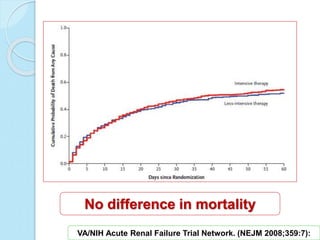
VA/NIH Acute Renal Failure Trial Network. (NEJM 2008;359:7):
Optimal intensity of RRT is controversial
VA/NIH Acute Renal Failure Trial Network. (NEJM 2008;359:7):
No difference in mortality
 1508 Critically ill patients with ARF on CVVHF were
randomized to:-
low (25 mL/kg/hr – 747 patients)
 high intensity (40 mL/kg/hr – 761 patients) effluent
rates.
N Engl J Med. 2009 Oct 22;361(17):1627-38
The RENAL Replacement Therapy Study
There was no
difference in 90 day
mortality rate
(44.7%) or the
need for RRT at 90
day between the
two treatment
groups.
5.8.1: The dose of RRT to be delivered should be
prescribed before starting each session of
RRT. (Not Graded)
We recommend frequent assessment of the
actual delivered dose in order to adjust the
prescription. (1B)
5.8.2: Provide RRT to achieve the goals of
electrolyte, acid-base, solute, and fluid
balance that will meet the patient’s needs.
(Not Graded)
KDIGO® AKI Guideline March 2012
Conclusions
 Data from high quality RCTs are lacking
 The current trend is to provide RRT earlier
 There may be a recovery advantage to using
CRRT vs. HD for initial management of AKI but
no difference on mortality
 Dose: No benefit to “intensive” therapy
Dialytic Support of AKI = Individualization
Dialytic support-of-aki-dep-2017

Dialytic support-of-aki-dep-2017

  • 1.
    Dr. Osama El-Shahat ConsultantNephrologist Head of Nephrology Department New Mansoura General Hospital (international) ISN Educational Ambassador
  • 2.
  • 3.
    Lameire N, VanBW, Vanholder R. Nat Clin Pract Nephrol 2006; 2: 364–377. Can we do staging for AKI?
  • 4.
  • 5.
    What is theadvantages of RIFLE Criteria?  Applying the RIFLE criteria revealed new insights.  Firstly, the RIFLE classification is feasible and fairly straightforward.  Secondly, the patients categorized as RIFLE-F had a far higher mortality than RIFLE-I and -R patients. Max Bell et al; Nephrol Dial Transplant 2005 20:354 –360
  • 6.
    Number of ARFHospitalizations: 1979 to 2002 Rates per 1,000 persons 0.0 0.5 1.0 1.5 2.0 2.5 1980 1982 1984 1986 1988 1990 1992 1994 1996 1998 2000 2002 Source: National Center for Health Statistics, National Hospital Discharge Survey
  • 7.
    Kidney International advanceonline publication , 1 May 2013 Mortality in AKI
  • 8.
    Stage-based management General Principles Stage1 (Risk) Risk for more severe AKI Monitor (prevent progression) Stage 2 (Injury) Risk of AKI-related mortality/morbidity high Conservative therapy) Stage 3 (Failure) Highest risk of death Consider RRT Avoid subclavian catheters if possible Discontinue all nephrotoxic agents when possible Consider invasive diagnostic workup Consider Renal Replacement Therapy 1 2 3 Non-invasive diagnostic workup Ensure volume status and perfusion pressure Check for changes in drug dosing AKI Stage Consider functional hemodynamic monitoring Monitoring Serum creatinine and urine output Consider ICU admission Avoid hyperglycemia Consider alternatives to radiocontrast procedures
  • 9.
  • 10.
    Indications for RRTin critically ill AKI patients Renal Indications Life-threatening indications Hyperkalemia Metabolic Acidosis Pulmonary edema Uremic omplications
  • 11.
    Dialysis Interventions forTreatment of AKI  5.1.1: Initiate RRT emergently when life-threatening changes in fluid, electrolyte, and acid-base balance exist.(Not Graded)  5.1.2: Consider the broader clinical context, the presence of conditions that can be modified with RRT, and trends of laboratory tests—rather than single BUN and creatinine thresholds alone—when making the decision to start RRT. (Not Graded)
  • 12.
    When to startRRT ? Crit Care Med 2008, Vol. 36, No 4 (suppl.) Early RRT seems better
  • 13.
  • 14.
    Renal Replacement Therapyin AKI 1. Peritoneal dialysis (PD) 2. Intermittent Hemodialysis (IHD) 3. Slow Low-Efficiency Dialysis (SLED) 4. Continuous Renal Replacement Therapy (CRRT) • Slow Continuous Ultrafiltration (SCUF) • Continuous Venovenous Hemofiltration (CVVH) • Continuous Venovenous Hemodialysis (CVVHD) • Continuous Venovenous Diafiltration (CVVHDF)
  • 15.
    Peritoneal Dialysis (PD)In AkI Advantages Hemodynamic stability Slow correction Easy access placement No Anticoagulation Tolerated in children Disadvantages Risk of infections Difficulty to use with abdominals surgery Logestics
  • 16.
    PD … themodality first used for the treatment of KI
  • 17.
    Blood Purif 2013;36:226–230DOI: 10.1159/000356627
  • 19.
    What are themodalities of CRRT ? Mode of therapy Principle method of solute clearance CVVH Convection CVVHD Diffusion CVVHDF Convection & Diffusion SCUF Ultrafiltration (fluids)
  • 20.
    Potential Advantages ofCRRT Homodynamic stability Recovery of renal function Brain edema Biocompatibility Removal of cytokines Nutritional support Correction of metabolic acidosis
  • 21.
    CVVH Avoids HypertensiveEpisodes Ronco C et al Kidney Int 56 ( suppl 72 ) s-8-s-14 , 1999
  • 22.
    Dialysis Interventions forTreatment of AKI 5.6.2: We suggest using CRRT, rather than standard intermittent RRT, for hemodynamically unstable patients. (2B) 5.6.1: Use continuous and intermittent RRT as complementary therapies in AKI patients. (Not Graded
  • 23.
    Recovery from ARFin IHD vs CRRT Study Modality % recovering renal function SUPPORT IHD* 67%** Morgera et al. CRRT 90% Ronco et al. CRRT 90% Mehta et al. IHD CRRT 59% 92% BEST Kidney† IHD CRRT 65% 89%
  • 24.
    Role of CRRTin management of ICP Davenport, A Sem Dialysis, 2009 5.6.3: We suggest using CRRT, rather than intermittent RRT, for AKI patients with acute brain injury or other causes of increased intracranial pressure or generalized brain edema. (2B) KDIGO® AKI Guideline March 2012
  • 25.
    Removal of Cytokine The elimination of inflamatory mediator occurs only during the 1st hour after application of new filter.  Cytokines removal capacity of curently available membranes hardly matches the productin observed in severly affected septic patients. De Vriese As-JAM Soc Nephrol 10-846-853 1999
  • 26.
    Is their analternative to CRRT ?  Typically performed over 6-12 hours  Can be performed with a conventional dialysis machine – A little less labor intensive – Requires less training/startup Fliser D and KielsteiJT Nat Clin Pract Nephrol, 2006 Slow Low-Efficiency Daily Dialysis (SLED)
  • 27.
    Slow Low-Efficiency DailyDialysis (SLED)  Major advantages: flexibility, reduced costs, low or absent anticoagulation  Similar adequacy and hemodynamics One small study (16 pts) showed slightly higher acidosis and lower BP (Baldwin 2007) VA trial (Palevsky NEJM 2008) suggests similar outcomes as CRRT and IRRT. Vanholder et al. Critical Care 2011, 15:204
  • 28.
    How we cando it ? Processes of care, more pertinent to Nephrologists:-  Vascular Access  Membrane characteristics  Solution  Anticoagulation  Dose
  • 29.
     5.4.1: Wesuggest initiating RRT in patients with AKI via an uncuffed nontunneled dialysis catheter, rather than a tunneled catheter. (2D)  5.4.2: When choosing a vein for insertion of a dialysis catheter in patients with AKI, consider these preferences (Not Graded):  First choice: right jugular vein;  Second choice: femoral vein;  Third choice: left jugular vein;  Last choice: subclavian vein with preference for the dominant side. Vascular access KDIGO® AKI Guideline March 2012
  • 30.
  • 31.
    Bicarbonate versus lactatebasedfluid replacement in CVVH Prospective, randomized study  Results :  Serum lactate concentration was significantly higher and the bicarbonate was lower in patients treated with lactatebased solutions  Increased incidence of CVS events in pts ttt with lactate solution ◦ Hypotension ◦ Increased dose of inotropic support barenborck and colleague Barenbrock M et al; Kidney Int (2000 0% 10% 20% 30% 40% 50% 60% 70% Bicarbonate Lactate cardiovascular complications hypotensive episodes Solutions for CRRT
  • 32.
    Dialysis Interventions for Treatmentof AKI 5.7.3: We suggest using bicarbonate, rather than lactate, as a buffer in dialysate and replacement fluid for RRT in patients with AKI and liver failure and/or lactic acidemia. (2B) KDIGO® AKI Guideline March 2012
  • 33.
    The Membrane  5.5.1:We suggest to use dialyzers with a biocompatible membrane for IHD and CRRT in patients with AKI. (2C)  High Flux membrane , synthetic , biocompatable , acting by providing both methods of detoxications: a) Diffusion : for low molecular weight toxins. b) Convection : for large molecules. KDIGO® AKI Guideline March 2012
  • 34.
    Anticoagulation Modality Advantages Disadvantages HeparinGood anticoagulation Thrombocytopenia bleeding LMWH Less thrombocytopenia bleeding Citrate Lowest risk of bleeding Metabolic alkalosis, hypocalcemia special dialysate Regional Heparin Reduced bleeding Complex management Saline flushes No bleeding risk Poor efficacy Prostacycline Reduced bleeding risk Hypotension poor efficacy
  • 35.
    5.3.2.1: For anticoagulationin intermittent RRT, we recommend using either unfractionated or low-molecular weight heparin, rather than other anticoagulants. (1C) 5.3.2.2: For anticoagulation in CRRT, we suggest using regional citrate anticoagulation rather than heparin in patients who do not have contraindications for citrate. (2B) KDIGO® AKI Guideline March 2012
  • 36.
    Dose  RCT of1124 critically ill pts with AKI and sepsis or at least one organ failure to intensive or less intensive renal- replacement therapy  Hemodynamically unstable pts received CRRT or SLEDD,  Stable pts IRRT  Intensive RRT= IRRT or SLEDD 6x/wk or CRRT at 35 ml/kg/hr  Less intensive RRT= IRRT or SLED 3x/wk or CRRT at 20 ml/kg/hr VA/NIH Acute Renal Failure Trial Network. (NEJM 2008;359:7): Optimal intensity of RRT is controversial
  • 37.
    VA/NIH Acute RenalFailure Trial Network. (NEJM 2008;359:7): No difference in mortality
  • 38.
     1508 Criticallyill patients with ARF on CVVHF were randomized to:- low (25 mL/kg/hr – 747 patients)  high intensity (40 mL/kg/hr – 761 patients) effluent rates. N Engl J Med. 2009 Oct 22;361(17):1627-38 The RENAL Replacement Therapy Study There was no difference in 90 day mortality rate (44.7%) or the need for RRT at 90 day between the two treatment groups.
  • 39.
    5.8.1: The doseof RRT to be delivered should be prescribed before starting each session of RRT. (Not Graded) We recommend frequent assessment of the actual delivered dose in order to adjust the prescription. (1B) 5.8.2: Provide RRT to achieve the goals of electrolyte, acid-base, solute, and fluid balance that will meet the patient’s needs. (Not Graded) KDIGO® AKI Guideline March 2012
  • 40.
    Conclusions  Data fromhigh quality RCTs are lacking  The current trend is to provide RRT earlier  There may be a recovery advantage to using CRRT vs. HD for initial management of AKI but no difference on mortality  Dose: No benefit to “intensive” therapy Dialytic Support of AKI = Individualization