preencoded.png
Language Variation
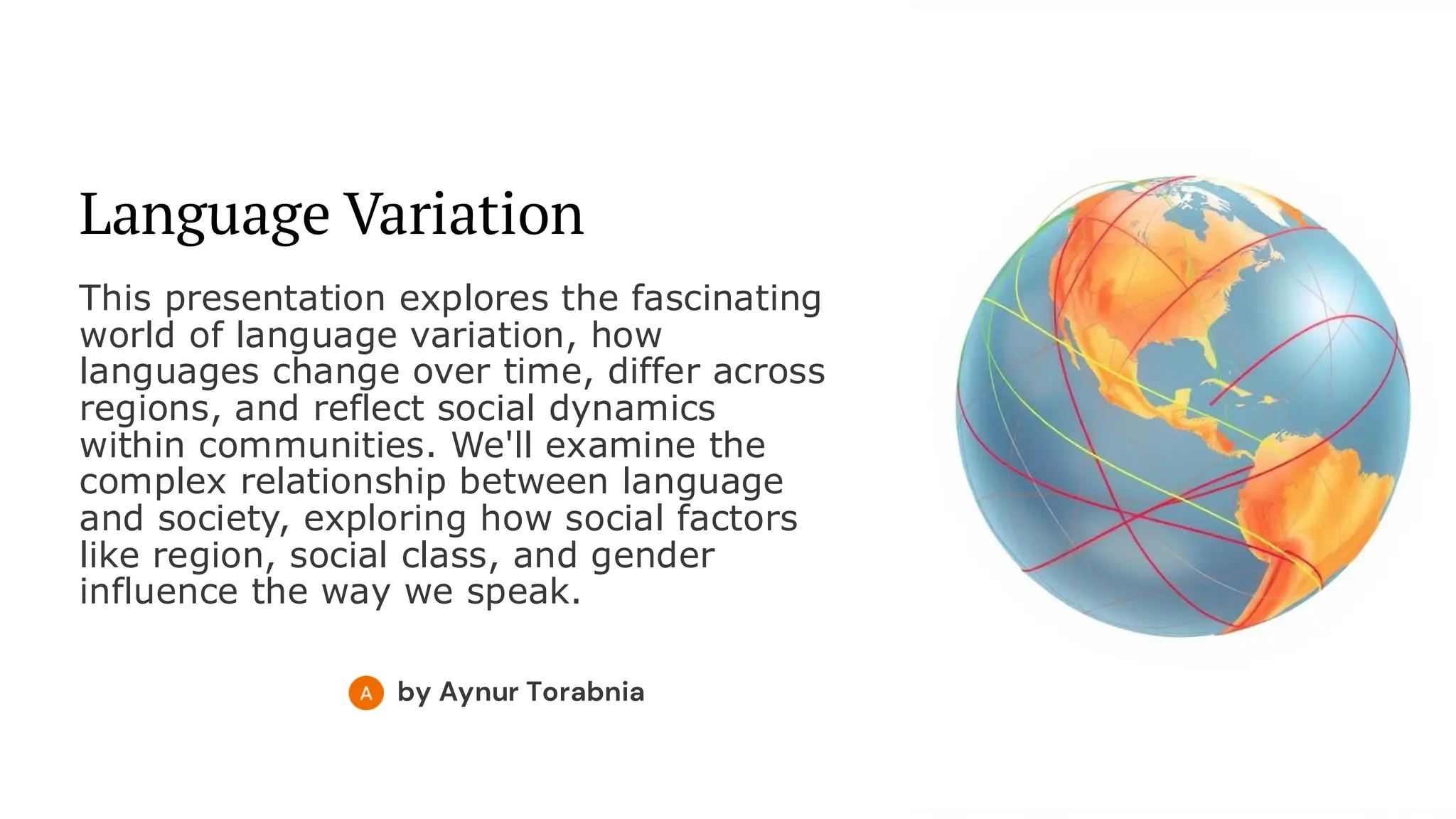
This presentationexplores the fascinating
world of language variation, how
languages change over time, differ across
regions, and reflect social dynamics
within communities. We'll examine the
complex relationship between language
and society, exploring how social factors
like region, social class, and gender
influence the way we speak.
by Aynur Torabnia
2.
preencoded.png
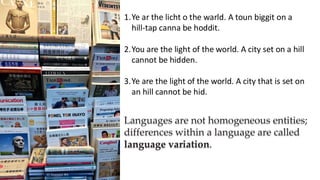
1.Ye ar thelicht o the warld. A toun biggit on a
hill-tap canna be hoddit.
2.You are the light of the world. A city set on a hill
cannot be hidden.
3.Ye are the light of the world. A city that is set on
an hill cannot be hid.
Languages are not homogeneous entities;
differences within a language are called
language variation.
3.
preencoded.png
Sociolinguistics
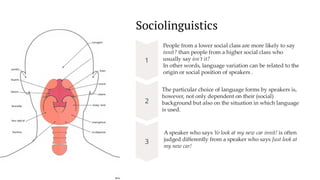
People from alower social class are more likely to say
innit? than people from a higher social class who
usually say isn’t it?
In other words, language variation can be related to the
origin or social position of speakers .
The particular choice of language forms by speakers is,
however, not only dependent on their (social)
background but also on the situation in which language
is used.
A speaker who says Yo look at my new car innit! is often
judged differently from a speaker who says Just look at
my new car!
4.
preencoded.png
Defining Language vs.Dialect
Language
Often considered a standardized,
codified system with a shared written
form, often associated with a nation
or cultural group. May include
multiple dialects.
Dialect
Dialects are, in general terms, the forms of
language use that occur in a certain area or
community.
Dialects themselves are not homogeneous
either.
Dialects are a regional variety.
5.
preencoded.png
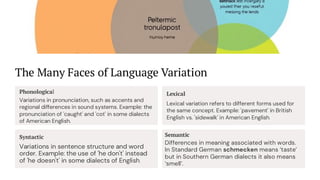
The Many Facesof Language Variation
Phonological
Variations in pronunciation, such as accents and
regional differences in sound systems. Example: the
pronunciation of 'caught' and 'cot' in some dialects
of American English.
Lexical
Lexical variation refers to different forms used for
the same concept. Example: 'pavement' in British
English vs. 'sidewalk' in American English.
Syntactic
Variations in sentence structure and word
order. Example: the use of 'he don't' instead
of 'he doesn't' in some dialects of English.
Semantic
Differences in meaning associated with words.
In Standard German schmecken means ‘taste’
but in Southern German dialects it also means
‘smell’.
6.
preencoded.png
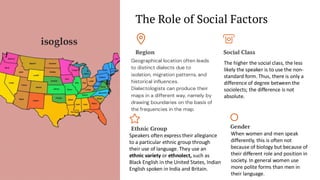
The Role ofSocial Factors
Region
Geographical location often leads
to distinct dialects due to
isolation, migration patterns, and
historical influences.
Dialectologists can produce their
maps in a different way, namely by
drawing boundaries on the basis of
the frequencies in the map.
Social Class
Ethnic Group Gender
isogloss
The higher the social class, the less
likely the speaker is to use the non-
standard form. Thus, there is only a
difference of degree between the
sociolects; the difference is not
absolute.
Speakers often express their allegiance
to a particular ethnic group through
their use of language. They use an
ethnic variety or ethnolect, such as
Black English in the United States, Indian
English spoken in India and Britain.
When women and men speak
differently, this is often not
because of biology but because of
their different role and position in
society. In general women use
more polite forms than men in
their language.
7.
Older people oftenspeak in a way that is different from the younger
generation.
Age differences may reflect an ongoing process of language change.
Lexical differences are very common here.
Young people regularly introduce new ,fashionable words.
Age:
8.
preencoded.png
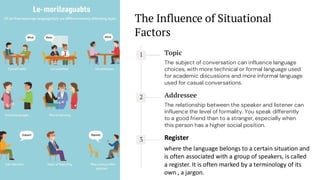
The Influence ofSituational
Factors
1 Topic
The subject of conversation can influence language
choices, with more technical or formal language used
for academic discussions and more informal language
used for casual conversations.
2 Addressee
The relationship between the speaker and listener can
influence the level of formality. You speak differently
to a good friend than to a stranger, especially when
this person has a higher social position.
3 Register
where the language belongs to a certain situation and
is often associated with a group of speakers, is called
a register. It is often marked by a terminology of its
own , a jargon.
9.
preencoded.png
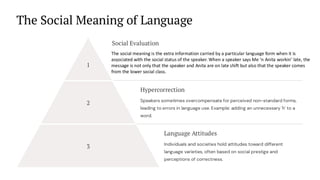
The Social Meaningof Language
1
Social Evaluation
.
2
Hypercorrection
Speakers sometimes overcompensate for perceived non-standard forms,
leading to errors in language use. Example: adding an unnecessary 'h' to a
word.
3
Language Attitudes
Individuals and societies hold attitudes toward different
language varieties, often based on social prestige and
perceptions of correctness.
The social meaning is the extra information carried by a particular language form when it is
associated with the social status of the speaker. When a speaker says Me ‘n Anita workin’ late, the
message is not only that the speaker and Anita are on late shift but also that the speaker comes
from the lower social class.
10.
preencoded.png
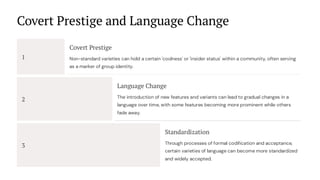
Covert Prestige andLanguage Change
1
Covert Prestige
Non-standard varieties can hold a certain 'coolness' or 'insider status' within a community, often serving
as a marker of group identity.
2
Language Change
The introduction of new features and variants can lead to gradual changes in a
language over time, with some features becoming more prominent while others
fade away.
3
Standardization
Through processes of formal codification and acceptance,
certain varieties of language can become more standardized
and widely accepted.
11.
preencoded.png
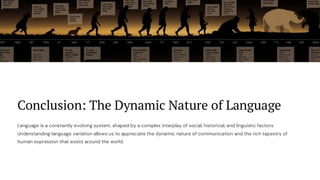
Conclusion: The DynamicNature of Language
Language is a constantly evolving system, shaped by a complex interplay of social, historical, and linguistic factors.
Understanding language variation allows us to appreciate the dynamic nature of communication and the rich tapestry of
human expression that exists around the world.