

DIABETIC NEPHROPATHY
PAA KWESI HACKMAN
RD, LD, MSC DIETETICS, BSC NUTRITION AND FOOD
SCIENCE
1
Outline
DEFINITION
EPIDEMIOLOGY
RISK FACTORS
PATHOPHYSIOLOGY
SIGNS & SYMPTOMS
COMPLICATIONS
MEDICAL Dx
MANAGEMENT
MNT
CONCLUSION
2
Definition
It is a clinical syndrome characterized
by:
• Persistent albuminuria (>300 mg/d or >200
μg/min) confirmed on at least 2 occasions
3-6 months apart.
• Progressive decline in GFR.
• Elevated BP.
3
Epidemiology
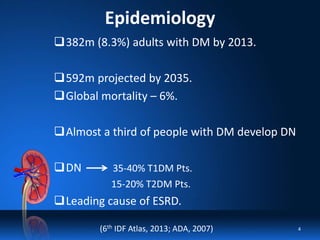
382m (8.3%) adults with DM by 2013.
592m projected by 2035.
Global mortality – 6%.
Almost a third of people with DM develop DN
DN 35-40% T1DM Pts.
15-20% T2DM Pts.
Leading cause of ESRD.
(6th IDF Atlas, 2013; ADA, 2007) 4
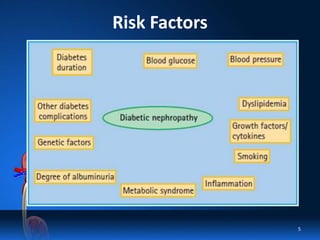
Risk Factors
5
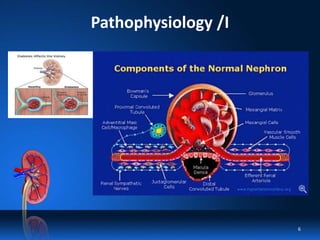
Pathophysiology /I
6
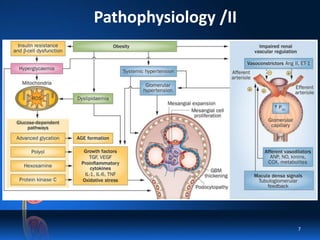
Pathophysiology /II
7
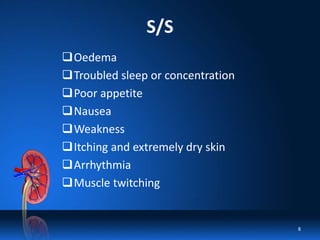
S/S
Oedema
Troubled sleep or concentration
Poor appetite
Nausea
Weakness
Itching and extremely dry skin
Arrhythmia
Muscle twitching
8
Complications
HTN
Anaemia
Bone abnormalities
CVD
Malnutrition
Metabolic acidosis
Uremia
Hyperlipidaemia
9
Medical Dx
 Blood tests
 Urine tests
• Dipstick
• Alb:Cr ratio > 2.5 in males and > 3.5 in females is
abnormal.
• Confirmed with AER of 20-200ug/min or 30-
300mg/24hrs & eGFR.
 Imaging tests
 Kidney biopsy
(ADA, 2004) 10
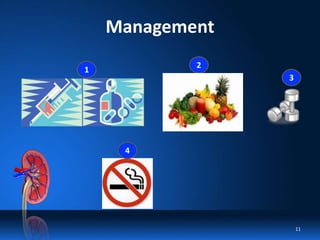
Management
11
1
2
3
4
MNT
12
MNT Goals
 Achieve and maintain:
• BGL in the normal or safe.
• Lipid profile that reduces CVD risk.
• BP normal or safe.
 To maintain good nutritional status, slow
progression, and to treat complications.
 To achieve weight loss in overweight or obese states.
 To Enhance health through food choices and physical
activity.
(ADA, 2008)
13
MNT: Nutrition Assessment
 Anthro’s
 Biochemical
 Client Hx
 Diet Hx
 Nutrition-focused Physical findings
14
MNT: Nutrition Dx /I
 Inadequate energy intake
 Inappropriate intake of types of CHO
 Inadequate fibre intake
 Excessive mineral intake (Na+ or K+)
 Altered GI function (gastroparesis)
 Altered nutrition-related Lab values
 Food-medication interaction
15
MNT: Nutrition Dx /II
Food-medication Interaction
Underweight
Food- and Nutrition-related Knowledge Deficit
Not Ready For Diet/Lifestyle Change
Self-monitoring Deficit
Undesirable Food Choices
Physical Inactivity
Inability or Lack of Desire to Manage Self-care
16
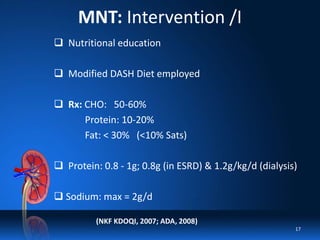
MNT: Intervention /I
 Nutritional education
 Modified DASH Diet employed
 Rx: CHO: 50-60%
Protein: 10-20%
Fat: < 30% (<10% Sats)
 Protein: 0.8 - 1g; 0.8g (in ESRD) & 1.2g/kg/d (dialysis)
 Sodium: max = 2g/d
(NKF KDOQI, 2007; ADA, 2008)
17
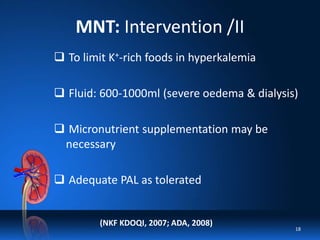
MNT: Intervention /II
 To limit K+-rich foods in hyperkalemia
 Fluid: 600-1000ml (severe oedema & dialysis)
 Micronutrient supplementation may be
necessary
 Adequate PAL as tolerated
(NKF KDOQI, 2007; ADA, 2008)
18
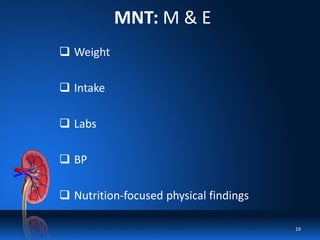
MNT: M & E
 Weight
 Intake
 Labs
 BP
 Nutrition-focused physical findings
19
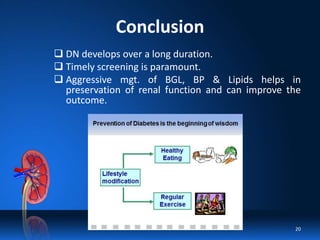
Conclusion
 DN develops over a long duration.
 Timely screening is paramount.
 Aggressive mgt. of BGL, BP & Lipids helps in
preservation of renal function and can improve the
outcome.
20
References
 KDOQI Clinical Practice Guidelines and Clinical Practice
Recommendations for Diabetes and Chronic Kidney Disease. Am
J Kidney Dis. 2007;49(2 suppl 2):S12-S154.)
 American Diabetes Association: Nephropathy in Diabetes
(Position Statement). Diabetes Care 27 (Suppl.1): S79-S83, 2004
 American Diabetes Association Standards of medical care in
diabetes. Diabetes Care 30:S4-S36, 2007
 American Diabetes Association Nutrition recommendations and
interventions for diabetes. Diabetes Care 31:S61-S78, 2008
 Hansen HP, Tauber-Lassen E, Jensen BR, et al. Effect of dietary
protein restriction on prognosis in patients with diabetic
nephropathy. Kidney Int.2002;62(1):220-228.
 IDF Atlas (2013).
 Pedrini MT, Levey AS, Lau J, et al. The effect of dietary protein
restriction on the progression of diabetic and nondiabetic renal
diseases: meta-analysis. Ann Intern Med. 1996;124:627-632.
21
•THANK YOU
22

DIABETIC NEPHROPATHY

  • 1.
    DIABETIC NEPHROPATHY PAA KWESIHACKMAN RD, LD, MSC DIETETICS, BSC NUTRITION AND FOOD SCIENCE 1
  • 2.
    Outline DEFINITION EPIDEMIOLOGY RISK FACTORS PATHOPHYSIOLOGY SIGNS &SYMPTOMS COMPLICATIONS MEDICAL Dx MANAGEMENT MNT CONCLUSION 2
  • 3.
    Definition It is aclinical syndrome characterized by: • Persistent albuminuria (>300 mg/d or >200 μg/min) confirmed on at least 2 occasions 3-6 months apart. • Progressive decline in GFR. • Elevated BP. 3
  • 4.
    Epidemiology 382m (8.3%) adultswith DM by 2013. 592m projected by 2035. Global mortality – 6%. Almost a third of people with DM develop DN DN 35-40% T1DM Pts. 15-20% T2DM Pts. Leading cause of ESRD. (6th IDF Atlas, 2013; ADA, 2007) 4
  • 5.
  • 6.
  • 7.
  • 8.
    S/S Oedema Troubled sleep orconcentration Poor appetite Nausea Weakness Itching and extremely dry skin Arrhythmia Muscle twitching 8
  • 9.
  • 10.
    Medical Dx  Bloodtests  Urine tests • Dipstick • Alb:Cr ratio > 2.5 in males and > 3.5 in females is abnormal. • Confirmed with AER of 20-200ug/min or 30- 300mg/24hrs & eGFR.  Imaging tests  Kidney biopsy (ADA, 2004) 10
  • 11.
  • 12.
  • 13.
    MNT Goals  Achieveand maintain: • BGL in the normal or safe. • Lipid profile that reduces CVD risk. • BP normal or safe.  To maintain good nutritional status, slow progression, and to treat complications.  To achieve weight loss in overweight or obese states.  To Enhance health through food choices and physical activity. (ADA, 2008) 13
  • 14.
    MNT: Nutrition Assessment Anthro’s  Biochemical  Client Hx  Diet Hx  Nutrition-focused Physical findings 14
  • 15.
    MNT: Nutrition Dx/I  Inadequate energy intake  Inappropriate intake of types of CHO  Inadequate fibre intake  Excessive mineral intake (Na+ or K+)  Altered GI function (gastroparesis)  Altered nutrition-related Lab values  Food-medication interaction 15
  • 16.
    MNT: Nutrition Dx/II Food-medication Interaction Underweight Food- and Nutrition-related Knowledge Deficit Not Ready For Diet/Lifestyle Change Self-monitoring Deficit Undesirable Food Choices Physical Inactivity Inability or Lack of Desire to Manage Self-care 16
  • 17.
    MNT: Intervention /I Nutritional education  Modified DASH Diet employed  Rx: CHO: 50-60% Protein: 10-20% Fat: < 30% (<10% Sats)  Protein: 0.8 - 1g; 0.8g (in ESRD) & 1.2g/kg/d (dialysis)  Sodium: max = 2g/d (NKF KDOQI, 2007; ADA, 2008) 17
  • 18.
    MNT: Intervention /II To limit K+-rich foods in hyperkalemia  Fluid: 600-1000ml (severe oedema & dialysis)  Micronutrient supplementation may be necessary  Adequate PAL as tolerated (NKF KDOQI, 2007; ADA, 2008) 18
  • 19.
    MNT: M &E  Weight  Intake  Labs  BP  Nutrition-focused physical findings 19
  • 20.
    Conclusion  DN developsover a long duration.  Timely screening is paramount.  Aggressive mgt. of BGL, BP & Lipids helps in preservation of renal function and can improve the outcome. 20
  • 21.
    References  KDOQI ClinicalPractice Guidelines and Clinical Practice Recommendations for Diabetes and Chronic Kidney Disease. Am J Kidney Dis. 2007;49(2 suppl 2):S12-S154.)  American Diabetes Association: Nephropathy in Diabetes (Position Statement). Diabetes Care 27 (Suppl.1): S79-S83, 2004  American Diabetes Association Standards of medical care in diabetes. Diabetes Care 30:S4-S36, 2007  American Diabetes Association Nutrition recommendations and interventions for diabetes. Diabetes Care 31:S61-S78, 2008  Hansen HP, Tauber-Lassen E, Jensen BR, et al. Effect of dietary protein restriction on prognosis in patients with diabetic nephropathy. Kidney Int.2002;62(1):220-228.  IDF Atlas (2013).  Pedrini MT, Levey AS, Lau J, et al. The effect of dietary protein restriction on the progression of diabetic and nondiabetic renal diseases: meta-analysis. Ann Intern Med. 1996;124:627-632. 21
  • 22.

Editor's Notes

  • #4  One of the main long-term specific microvascular complications of DM People with diabetes and kidney disease do worse overall than people with kidney disease alone. This is because people with diabetes tend to have other long-standing medical conditions, like high blood pressure, high cholesterol, and blood vessel disease (atherosclerosis). People with diabetes also are more likely to have other kidney-related problems, such as bladder infections and nerve damage to the bladder.
  • #12 Major therapeutic interventions include-
  • #14 Glycemic control has been shown to delay the progression of diabetic nephropathy. ADA recommendations state that adults with diabetes should strive to maintain an A1C of <7.0%, preprandial plasma glucose of 90-130 mg/dl (5.0-7.2 mmol/L), and peak postprandial plasma glucose of <180 mg/dl (<10.0 mmol/L). Components of a successful glycemic control plan include: self-monitoring of blood glucose (SMBG), performing an A1C test at least two times each year for patients who meet treatment goals and quarterly in patients who do not, and individualized medical nutrition therapy (MNT). The UKPDS, DCCT, and Minnesota Medical school Trial have shown that intensive management of blood glucose can be helpful to patients in preventing the progression to kidney disease.
  • #18 NKF Kidney Disease Outcomes Quality Initiative (NKF KDOQI)
  • #21 If early intervention done, progression can be delayed.