DIABETIC KIDNEY
DISEASE
SCIENTHIA SANJEEVANI
Intro
★ DKD leading cause ESRD in US
★ 30% in T1 DM and 40 % T2 DM
★ All cause and cardiovascular mortalitility is majorly attributable to DKD
RISK FACTORS
SUSCEPTIBILTY
FACTORS
-Age (elderly)
-sex (male)
-race/ethnicity (black,
american indian, hispanic,
asian pacific islanders)
-family history
❖ INITIATION FACTORS
-Hyperglycemia
-AKI
- genetic kidney disease
-smoking
PROGRESSION FACTOR
-HTN
-Dietery factors (high protein diet)
-Obesity
HYPERGLYCEMI
A
DCCT TRIAL
In patients with DM1, an intensive glucose control intervention Targeting a hemoglobin A1C (HbA1C)
level <7% reduced the 9-year risks of developing microalbuminuria and macroalbuminuria by 34% and
56%, respectively, compared with standard care .After a median follow-up of 22 years, the intensive
therapy group had approximately 50% lower risk of a low eGFR (,60 ml/min per 1.73 m2), and the
average rate of eGFR loss was significantly reduced from 1.56 ml/min per 1.73 m2 per year with
standard therapy to 1.27 ml/min per 1.73 m2 per year with intensive therapy
Similarly, in patients with newly diagnosed DM2, 10 years of an intensive glycemic control intervention
targeting an HbA1C of 7% produced a 24% reduction in development of microvascular complications,
including DKD, compared with conventional therapy . After 12 years, intensive glycemic control resulted
in a 33% reduction in the risk of development of microproteinuria or “clinical grade” proteinuria
and a significant reduction in the proportion of patients with a doubling of the blood creatinine level
(0.9% versus 3.5%) relative to the conventional therapy group
UKPDS TRIAL
● Nephropathy, retinopathy and possibly neuropathy benefited by lowering blood glucose in
type 2 DM with intensive therapy( hba1c <7%) compared with conventional therapy (Hba1c
<7.9%)
● Overaall microvascular complications decreased by 25 %
● In patients with newly diagnosed DM2, treating to a target BP 150/85 mmHg over a median of 15
years resulted in a significant 37% risk reduction of microvascular complications compared with that
in patients treated to a target of ,180/105 mmHg.
● Each 10-mmHg increase in mean systolic BP was associated with a 15% increase in the hazard ratio
for development of both micro- and macroalbuminuria and impaired kidney function
● Baseline systolic BP .140 mmHg in patients with DM2 has been associated with higher risk of ESRD
and death
HYPERTENSION
PATHOPHYSIOLOGY
HOW IT ALL STARTS
● UKPDS -Of enrolled patients, approximately 2% per year progressed from normo- to
microalbuminuria and from micro- to macroalbuminuria.
● At a median of 15 years after diagnosis, 40% of participants developed albuminuria, and 30%
developed eGFR,60 ml/min per 1.73 m2 or doubling of the blood creatinine level .
● 60% of those developing kidney functional impairment did not have preceding albuminuria, and 40%
never developed albuminuria during the study .
Albuminuria is a dynamic, fluctuating condition rather than a linearly
progressive process
CHANGING SCENARIOS
1988-1994 2009-2014
ALBUMINURIA 21% 16%
LOW eGFR
(<60)
9% 14%
SEVERELY LOW
eGFR (<30)
1% 3%
A recent autopsy study
● Higher prevalence of DKD diagnosed histologically compared with that
indicated by clinical laboratory testing.
● Of 168 patients with DM1 or DM2, 106 exhibited histopathologic
changes characteristic of DKD.
● Albuminuria or low eGFR was absent in 20% (20 of 106) of patients
throughout life
● Renal structure changes in patients with DM2 are similar to those seen in DM1,
● Early renal pathology studies described a high prevalence of nondiabetic
glomerular disease in the patients with DM2 population, probably because of
selection bias: patients who were diabetic and underwent biopsies tended to
have atypical presentations of DKD.
● Conclusions from more recent biopsy studies are more conservative, estimating
,10% prevalence of non-DKD in patients with diabetes and albuminuria
FACTORS AFFECTING VARIED PRESENTATION OF DKD IN T2DM
● Unreliable timing of onset
● Longer exposure of hyperglycemia
● Older population
● Atherosclerosis
● t/t with RAAS inhibitors
HYALINE ARTERIOSCLEROSIS
DIAGNOSIS OF DKD
● DKD is identified clinically by persistently high urinary albumin-to-creatinine ratio
>30 mg/g and/or sustained reduction in eGFR below 60 ml/min per 1.73 m2.
● Screening performed annually for patients with DM1 beginning 5 years after
diagnosis and annually for all patients with DM2 beginning at the time of diagnosis.
● In patients with albuminuria, the presence of diabetic retinopathy is strongly
suggestive of DKD.
● The preferred test- urinary albumin-to-creatinine ratio performed on a spot sample,
preferably in the morning .
● The eGFR is calculated from the serum creatinine concentration.
● Chronic Kidney Disease-Epidemiologic Prognosis Initiative equation is more accurate,
particularly at eGFR levels in the normal or near-normal range, the Modification of
Diet in Renal Disease equation is typically reported by clinical laboratories
● Confirmation of albuminuria or low eGFR requires two abnormal measurements at least
3 months apart. If features atypical of DKD
DKD unlikely if -
● sudden onset of low eGFR or rapidly decreasing eGFR
● Abrupt increase in albuminuria
● Development of nephrotic or nephritic syndrome
● Refractory hypertension
● Signs or symptoms of another systemic disease
● 30% eGFR decline within 2–3 months of initiation of a renin-
angiotensin system inhibitor
● Anemia and bone and mineral metabolism disorders develop earlier in DKD
than in other types of CKD.
● Nearly twice as likely to have anemia compared with patients with
nondiabetic CKD and comparable eGFR (predom. Tubulointerstitial ds---decr
EPO).
● Insulin is a cofactor for parathyroid hormone release--insulin deficiency
and/or resistance associated with lower PTH --- predispose patients with
DKD to adynamic bone disease
DKD vs CKD of other causes
GLUCOSE CONTROL
● Intensive glucose control after onset of complications or in
longstanding diabetes does not reduce risk of DKD progression or
improve overall clinical outcomes.
● Targeting low HbA1C (6%–6.9%) compared with standard therapy
increased the risk of severe hypoglycemia
● An analysis of patients with DM2 and early-stage CKD showed 30%
and 40% higher risks for all cause mortality and CV mortality,
respectively, with intensive glycemic control compared with standard
therapy.
TREATMENT
Conclusion-
● ADA - targets for glycemia tailored to age, comorbidities, and life
expectancy ( More stringent goals, such as HbA1C,6.5%, may be reasonable
for patients with shorter duration of diabetes, younger age, absence of
complications, and a longer life expectancy. To the contrary, less stringent
goals of HbA1C,8% recommended for longstanding diabetes, older age,
micro- and macrovascular complications, and limited life expectancy
● National Kidney Foundation–Kidney Disease Outcomes Quality Initiative
and KDIGO- target HbA1c of about 7.0% except in patients at risk for
hypoglycemia, such as those with diabetes and CKD.
HYPERTENSION
● JNC-8 initiation of pharmacologic treatment at a systolic BP >140 mmHg or
diastolic BP >90 mmHg, with treatment goals less than these levels.
● Initial antihypertensive treatment - thiazide-type diuretic, a calcium channel
blocker, an angiotensin-converting enzyme (ACE) inhibitor, or an angiotensin
receptor blocker (ARB).
● In black patients with diabetes, the JNC-8 recommends initial treatment with
a thiazide diuretic or calcium channel blocker.
● In patients who are diabetic with high levels of albuminuria, the medication
regimen should include an ACE inhibitor or an ARB alone or in combination with
medication from another drug class.
● KDIGO guidelines recommend use of an ACE or an ARB and a BP goal ,130/80
mmHg in all patients with CKD and albuminuria irrespective of diabetes status
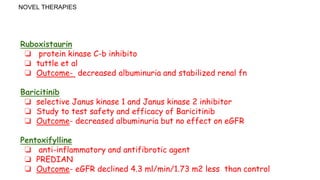
NOVEL THERAPIES
Ruboxistaurin
❏ protein kinase C-b inhibito
❏ tuttle et al
❏ Outcome- decreased albuminuria and stabilized renal fn
Baricitinib
❏ selective Janus kinase 1 and Janus kinase 2 inhibitor
❏ Study to test safety and efficacy of Baricitinib
❏ Outcome- decreased albuminuria but no effect on eGFR
Pentoxifylline
❏ anti-inflammatory and antifibrotic agent
❏ PREDIAN
❏ Outcome- eGFR declined 4.3 ml/min/1.73 m2 less than control
Atrasentan
❏ selective endothelin A receptor antagonist
❏ RADAR ,outcome- 35 % reduction in albuminuria
❏ SONAR, outcome-still ongoing
Finerenone
❏ Steroid mineralocorticoid receptor antagonist
❏ ARTS-DN
❏ Outcome- no diff. in eGFR but 17-40 % red in albuminuria
Allopurinol
❏ Xanthine oxidase inhibitor
❏ PERL
❏ ongoing
AVOR-TIMI
❏ Saxagliptin (DPP-4 inhibitor)
❏ Improvement in and/or less deterioration in ACR categories; no changes in eGFR
CARMELINA
❏ Linagliptin (DPP-4 inhibitor)
❏ Better glycemic control in DKD pt and no increased CV risk
LEADER
❏ Liraglutide (GLP-1 receptor agonist)
❏ Lower incidence of nephropathy (newonset albuminuria, doubling of SCr and CrCl,45 ml/min per 1.73
m2; need for RRT, death to renal causes
AWARD-7
❏ Dulaglutide (GLP-1 receptor agonist)
❏ estimated completion in July of 2018
EMPA-REG OUTCOME
❏ Empaglifozin (SGLT-2 inhibitor)
❏ Relative risk reduction of doubling of SCr (1.5% versus 2.6%); 38% relative risk reduction of progression
to macroalbuminuria (11.2% versus 16.2%); 55% relative risk reduction of initiation of RRT (0.3% versus
0.6%); slowing GFR decline (annual decrease 0.1960.11 versus 1.6760.13 ml/min per 1.73 m2
CREDENCE
❏ Canaglifozin (SGLT-2 inhibitor)
❏ In progress, estimated completion in June of 2019
❏ Despite current therapies, there is large residual risk of diabetic
kidney disease onset and progression.
❏ Widespread innovation is urgently needed to improve health
outcomes for patients with diabetic kidney disease.
❏ Achieving this goal will require characterization of new biomarkers,
designing clinical trials that evaluate clinically pertinent end points,
and development of therapeutic agents targeting kidney-specific
disease mechanisms (e.g., glomerular hyperfiltration, inflammation,
and fibrosis).
Conclusion
Effects of Diabetes Medications Targeting the Incretin
System on Kidney
xx%
Use this slide to show a major stat. It can help enforce the presentation’s main
message or argument.
Final point
A one-line description of it
“This is a super-important quote”
- From an expert
This is the most
important takeaway
that everyone has
to remember.
Thanks!
Contact us:
Your Company
123 Your Street
Your City, ST 12345
no_reply@example.com
www.example.com

Dkd

  • 1.
  • 2.
    Intro ★ DKD leadingcause ESRD in US ★ 30% in T1 DM and 40 % T2 DM ★ All cause and cardiovascular mortalitility is majorly attributable to DKD
  • 3.
    RISK FACTORS SUSCEPTIBILTY FACTORS -Age (elderly) -sex(male) -race/ethnicity (black, american indian, hispanic, asian pacific islanders) -family history ❖ INITIATION FACTORS -Hyperglycemia -AKI - genetic kidney disease -smoking PROGRESSION FACTOR -HTN -Dietery factors (high protein diet) -Obesity
  • 4.
    HYPERGLYCEMI A DCCT TRIAL In patientswith DM1, an intensive glucose control intervention Targeting a hemoglobin A1C (HbA1C) level <7% reduced the 9-year risks of developing microalbuminuria and macroalbuminuria by 34% and 56%, respectively, compared with standard care .After a median follow-up of 22 years, the intensive therapy group had approximately 50% lower risk of a low eGFR (,60 ml/min per 1.73 m2), and the average rate of eGFR loss was significantly reduced from 1.56 ml/min per 1.73 m2 per year with standard therapy to 1.27 ml/min per 1.73 m2 per year with intensive therapy Similarly, in patients with newly diagnosed DM2, 10 years of an intensive glycemic control intervention targeting an HbA1C of 7% produced a 24% reduction in development of microvascular complications, including DKD, compared with conventional therapy . After 12 years, intensive glycemic control resulted in a 33% reduction in the risk of development of microproteinuria or “clinical grade” proteinuria and a significant reduction in the proportion of patients with a doubling of the blood creatinine level (0.9% versus 3.5%) relative to the conventional therapy group
  • 6.
    UKPDS TRIAL ● Nephropathy,retinopathy and possibly neuropathy benefited by lowering blood glucose in type 2 DM with intensive therapy( hba1c <7%) compared with conventional therapy (Hba1c <7.9%) ● Overaall microvascular complications decreased by 25 %
  • 7.
    ● In patientswith newly diagnosed DM2, treating to a target BP 150/85 mmHg over a median of 15 years resulted in a significant 37% risk reduction of microvascular complications compared with that in patients treated to a target of ,180/105 mmHg. ● Each 10-mmHg increase in mean systolic BP was associated with a 15% increase in the hazard ratio for development of both micro- and macroalbuminuria and impaired kidney function ● Baseline systolic BP .140 mmHg in patients with DM2 has been associated with higher risk of ESRD and death HYPERTENSION
  • 8.
  • 10.
    HOW IT ALLSTARTS
  • 11.
    ● UKPDS -Ofenrolled patients, approximately 2% per year progressed from normo- to microalbuminuria and from micro- to macroalbuminuria. ● At a median of 15 years after diagnosis, 40% of participants developed albuminuria, and 30% developed eGFR,60 ml/min per 1.73 m2 or doubling of the blood creatinine level . ● 60% of those developing kidney functional impairment did not have preceding albuminuria, and 40% never developed albuminuria during the study . Albuminuria is a dynamic, fluctuating condition rather than a linearly progressive process
  • 12.
    CHANGING SCENARIOS 1988-1994 2009-2014 ALBUMINURIA21% 16% LOW eGFR (<60) 9% 14% SEVERELY LOW eGFR (<30) 1% 3%
  • 13.
    A recent autopsystudy ● Higher prevalence of DKD diagnosed histologically compared with that indicated by clinical laboratory testing. ● Of 168 patients with DM1 or DM2, 106 exhibited histopathologic changes characteristic of DKD. ● Albuminuria or low eGFR was absent in 20% (20 of 106) of patients throughout life
  • 14.
    ● Renal structurechanges in patients with DM2 are similar to those seen in DM1, ● Early renal pathology studies described a high prevalence of nondiabetic glomerular disease in the patients with DM2 population, probably because of selection bias: patients who were diabetic and underwent biopsies tended to have atypical presentations of DKD. ● Conclusions from more recent biopsy studies are more conservative, estimating ,10% prevalence of non-DKD in patients with diabetes and albuminuria
  • 15.
    FACTORS AFFECTING VARIEDPRESENTATION OF DKD IN T2DM ● Unreliable timing of onset ● Longer exposure of hyperglycemia ● Older population ● Atherosclerosis ● t/t with RAAS inhibitors
  • 19.
  • 24.
    DIAGNOSIS OF DKD ●DKD is identified clinically by persistently high urinary albumin-to-creatinine ratio >30 mg/g and/or sustained reduction in eGFR below 60 ml/min per 1.73 m2. ● Screening performed annually for patients with DM1 beginning 5 years after diagnosis and annually for all patients with DM2 beginning at the time of diagnosis. ● In patients with albuminuria, the presence of diabetic retinopathy is strongly suggestive of DKD. ● The preferred test- urinary albumin-to-creatinine ratio performed on a spot sample, preferably in the morning . ● The eGFR is calculated from the serum creatinine concentration. ● Chronic Kidney Disease-Epidemiologic Prognosis Initiative equation is more accurate, particularly at eGFR levels in the normal or near-normal range, the Modification of Diet in Renal Disease equation is typically reported by clinical laboratories ● Confirmation of albuminuria or low eGFR requires two abnormal measurements at least 3 months apart. If features atypical of DKD
  • 25.
    DKD unlikely if- ● sudden onset of low eGFR or rapidly decreasing eGFR ● Abrupt increase in albuminuria ● Development of nephrotic or nephritic syndrome ● Refractory hypertension ● Signs or symptoms of another systemic disease ● 30% eGFR decline within 2–3 months of initiation of a renin- angiotensin system inhibitor
  • 26.
    ● Anemia andbone and mineral metabolism disorders develop earlier in DKD than in other types of CKD. ● Nearly twice as likely to have anemia compared with patients with nondiabetic CKD and comparable eGFR (predom. Tubulointerstitial ds---decr EPO). ● Insulin is a cofactor for parathyroid hormone release--insulin deficiency and/or resistance associated with lower PTH --- predispose patients with DKD to adynamic bone disease DKD vs CKD of other causes
  • 27.
    GLUCOSE CONTROL ● Intensiveglucose control after onset of complications or in longstanding diabetes does not reduce risk of DKD progression or improve overall clinical outcomes. ● Targeting low HbA1C (6%–6.9%) compared with standard therapy increased the risk of severe hypoglycemia ● An analysis of patients with DM2 and early-stage CKD showed 30% and 40% higher risks for all cause mortality and CV mortality, respectively, with intensive glycemic control compared with standard therapy. TREATMENT
  • 28.
    Conclusion- ● ADA -targets for glycemia tailored to age, comorbidities, and life expectancy ( More stringent goals, such as HbA1C,6.5%, may be reasonable for patients with shorter duration of diabetes, younger age, absence of complications, and a longer life expectancy. To the contrary, less stringent goals of HbA1C,8% recommended for longstanding diabetes, older age, micro- and macrovascular complications, and limited life expectancy ● National Kidney Foundation–Kidney Disease Outcomes Quality Initiative and KDIGO- target HbA1c of about 7.0% except in patients at risk for hypoglycemia, such as those with diabetes and CKD.
  • 29.
    HYPERTENSION ● JNC-8 initiationof pharmacologic treatment at a systolic BP >140 mmHg or diastolic BP >90 mmHg, with treatment goals less than these levels. ● Initial antihypertensive treatment - thiazide-type diuretic, a calcium channel blocker, an angiotensin-converting enzyme (ACE) inhibitor, or an angiotensin receptor blocker (ARB). ● In black patients with diabetes, the JNC-8 recommends initial treatment with a thiazide diuretic or calcium channel blocker. ● In patients who are diabetic with high levels of albuminuria, the medication regimen should include an ACE inhibitor or an ARB alone or in combination with medication from another drug class. ● KDIGO guidelines recommend use of an ACE or an ARB and a BP goal ,130/80 mmHg in all patients with CKD and albuminuria irrespective of diabetes status
  • 30.
    NOVEL THERAPIES Ruboxistaurin ❏ proteinkinase C-b inhibito ❏ tuttle et al ❏ Outcome- decreased albuminuria and stabilized renal fn Baricitinib ❏ selective Janus kinase 1 and Janus kinase 2 inhibitor ❏ Study to test safety and efficacy of Baricitinib ❏ Outcome- decreased albuminuria but no effect on eGFR Pentoxifylline ❏ anti-inflammatory and antifibrotic agent ❏ PREDIAN ❏ Outcome- eGFR declined 4.3 ml/min/1.73 m2 less than control
  • 31.
    Atrasentan ❏ selective endothelinA receptor antagonist ❏ RADAR ,outcome- 35 % reduction in albuminuria ❏ SONAR, outcome-still ongoing Finerenone ❏ Steroid mineralocorticoid receptor antagonist ❏ ARTS-DN ❏ Outcome- no diff. in eGFR but 17-40 % red in albuminuria Allopurinol ❏ Xanthine oxidase inhibitor ❏ PERL ❏ ongoing
  • 32.
    AVOR-TIMI ❏ Saxagliptin (DPP-4inhibitor) ❏ Improvement in and/or less deterioration in ACR categories; no changes in eGFR CARMELINA ❏ Linagliptin (DPP-4 inhibitor) ❏ Better glycemic control in DKD pt and no increased CV risk LEADER ❏ Liraglutide (GLP-1 receptor agonist) ❏ Lower incidence of nephropathy (newonset albuminuria, doubling of SCr and CrCl,45 ml/min per 1.73 m2; need for RRT, death to renal causes AWARD-7 ❏ Dulaglutide (GLP-1 receptor agonist) ❏ estimated completion in July of 2018 EMPA-REG OUTCOME ❏ Empaglifozin (SGLT-2 inhibitor) ❏ Relative risk reduction of doubling of SCr (1.5% versus 2.6%); 38% relative risk reduction of progression to macroalbuminuria (11.2% versus 16.2%); 55% relative risk reduction of initiation of RRT (0.3% versus 0.6%); slowing GFR decline (annual decrease 0.1960.11 versus 1.6760.13 ml/min per 1.73 m2 CREDENCE ❏ Canaglifozin (SGLT-2 inhibitor) ❏ In progress, estimated completion in June of 2019
  • 33.
    ❏ Despite currenttherapies, there is large residual risk of diabetic kidney disease onset and progression. ❏ Widespread innovation is urgently needed to improve health outcomes for patients with diabetic kidney disease. ❏ Achieving this goal will require characterization of new biomarkers, designing clinical trials that evaluate clinically pertinent end points, and development of therapeutic agents targeting kidney-specific disease mechanisms (e.g., glomerular hyperfiltration, inflammation, and fibrosis). Conclusion
  • 34.
    Effects of DiabetesMedications Targeting the Incretin System on Kidney
  • 36.
    xx% Use this slideto show a major stat. It can help enforce the presentation’s main message or argument.
  • 37.
    Final point A one-linedescription of it
  • 38.
    “This is asuper-important quote” - From an expert
  • 39.
    This is themost important takeaway that everyone has to remember.
  • 40.
    Thanks! Contact us: Your Company 123Your Street Your City, ST 12345 no_reply@example.com www.example.com